



Abstract
The present research explored whether atheists managing death awareness would be effectively buffered by affirmations of supernatural and/or natural literal immortality. Prior data were reanalyzed, revealing ambiguous results, so further experiments were conducted. In Study 1 (n = 382), atheists were randomly assigned to a supernatural afterlife-confirmed (vs. afterlife-disconfirmed) prime, an MS (vs. control topic) prime, and then given an opportunity to engage in secular worldview defense. In Study 2 (n = 360), atheists were randomly assigned to supernatural (afterlife) versus natural (medical indefinite life extension; MILE) immortality prime, an MS (vs. control topic) prime, and then given an opportunity to engage in secular worldview defense. Atheists managing death awareness increased worldview defense in the supernatural/afterlife conditions but that effect was eliminated in the MILE condition. These findings are consistent with the terror management theory perspective on worldview defense. Implications for theory and research are discussed.
Filmmaker Woody Allen, a self-described “militant Freudian atheist” (Allen, 2008), is often quoted as having said, “I don’t want to achieve immortality through my work. I want to achieve immortality by not dying.” While clearly poking fun at the idea that symbolic immortality (his film legacy) could logically address mortality, it is perhaps notable that he said he wanted literal immortality by “not dying” rather than by supernatural afterlife. The difference highlights the split between natural and supernatural quests for immortality, which have each long been pursued in earnest.
In the earliest literature, Epic of Gilgamesh, Gilgamesh witnesses death and embarks on a long journey to discover the secret of living forever. Later, in the protoscientific days, the alchemists likewise sought to escape death through the panaceas to cure disease, and the elixir of life (philosopher’s stone) for rejuvenation, purity, and immortality. And, in the modern age of science and technology, people are still pursuing similar goals (Norman & Reedy, 2017). Considerable health and medical research is oriented toward extending life and preventing the main causes of death (aging, disease, and physical trauma). Advances in life extension procedures and technologies (de Grey & Rae, 2007; Kurzweil & Grossman, 2005), including advances in nutrition, emergency room procedures, nanotechnologies, genetic modification, regenerative medicine, biological engineering and replacement, and a number of other methods all reportedly herald the impending application of science and medical technology to achieve biological immortality (Kong, 2013).
But the secrets to biological immortality remain (for the moment) beyond the grasp of contemporary science and technology, as they were beyond the alchemists’ grasp and of our modern human ancestors such as Gilgamesh. Instead, for tens of thousands of years, complex supernatural concepts about spirits and afterlives have pulsed through the veins of the human experience (Mithen, 1996). In a world filled with routine reminders of unavoidable death and decay, it is difficult to imagine a more expedient solution to the problem of mortality than to believe it is simply not the end—and, indeed, a growing body of research reveals that religious beliefs can serve as a powerful and direct means of coping with the awareness of mortality (e.g., Vail, Soenke, & Waggoner, 2018). Similarly, polls show some form of supernatural/religious belief professed by a vast majority of people both globally and in the United States (Pew Research Center, 2012, 2015).
However, not all people claim to accept both natural (biological) and supernatural immortality concepts; in recent times, the numbers of people claiming to be nonreligious have been noticeably growing (Pew Research Center, 2015, 2017). This trend highlights the need for research to more closely examine how people claiming to be nonreligious, such as atheists, might cope with mortality awareness. Terror management theory and research (TMT; Greenberg, Vail, & Pyszczynski, 2015) can help to explore whether atheists managing the awareness of death would be effectively buffered by affirmations of natural (biological) and supernatural (afterlife) paths to literal immortality. In that light, the present research explores the TMT perspective, revisits the prior data on the topic, and then presents two well-powered studies investigating whether atheists managing the awareness of death would be effectively buffered by affirmations of supernatural and/or natural (biological) literal immortality.
TMT
TMT (Greenberg et al., 2015) posits that people can manage the awareness of mortality by (a) subscribing to cultural worldviews and (b) striving to become a valuable part of those cultures. The first component, cultural worldviews, are socially constructed and validated belief systems and standards of value that offer their followers some form of permanence through symbolic and/or literal immortality. Symbolic immortality is offered through the impression that one’s activity will leave a lasting, symbolic mark on the world, perhaps by contributing to the future of one’s society through family, business, service, education, health care, government, art, science, or any number of the other available domains that would affect the future lives of members of one’s culture. Literal immortality is offered through the impression that one might literally continue to exist, either by simply not dying (biological immortality) or via afterlife in an eternal spiritual realm (heaven, reincarnation, and so on; supernatural immortality). The second component involves self-esteem, conceptualized as a reflection of one’s positive or negative self-evaluation of whether one is meeting the standards and values of one’s permanence-promising cultural standards and values. Thus, TMT posits that people can manage death awareness by living up to the standards and values prescribed by their cultural beliefs.
One hypothesis stemming from TMT is the worldview defense hypothesis, which holds that if one’s cultural worldviews function to buffer against death awareness, then mortality salience (MS) will motivate people to defend the validity and primacy of their relevant death-denying cultural identities, beliefs, and values, and strive to live up to those relevant cultural standards. In contrast, TMT does not theorize that death awareness will motivate people to more strongly defend cultural worldviews that are not theirs, nor strive for self-esteem in worldview-irrelevant domains. And, indeed, more than 30 years of research has found support for the TMT idea that death awareness motivates worldview defense (Routledge & Vess, 2018). For example, MS increases: Germans’ preference for German currency over the Euro (Jonas, Fritsche, & Greenberg, 2005); Italians’ dislike of Germans (Castano, Yzerbyt, Paladino, & Sacchi, 2002); American liberals’ aggression toward conservatives, and conservatives’ aggression toward liberals (McGregor et al., 1998); Americans’ support for military action against enemy nations, and Iranian students’ support for martyrdom missions against America (Pyszczynski et al., 2006); and Israelis’ support for preemptive military attack on Iran and incursions into Gaza (Hirschberger, Pyszczynski, & Ein-Dor, 2010). Similarly, among a sample of non-Muslim Canadians who were told that Islam was becoming dominant in Nazareth (Jesus’ birthplace), MS increased death-thought accessibility unless participants were first informed that a plane full of Muslims on the way to Nazareth had crashed and all the Muslims aboard had been killed (Hayes, Schimel, & Williams, 2008). And MS increased American Christians’ faith in God/Jesus and rejection of Allah and Buddha, but increased Iranian Muslims’ faith in Allah and rejection of God/Jesus and Buddha (Vail, Arndt, & Abdollahi, 2012). These findings, and many more like them, are consistent with the TMT idea that death awareness motivates worldview defense—more strongly affirming and defending one’s death-denying worldviews and/or rejecting alternative or “competing” worldviews.
Similarly, TMT theorizes that death awareness motivates self-esteem striving in one’s worldview-relevant domains. Indeed, as just a few examples, MS has been found to increase the amount of strength output on a handheld force dynamometer among people who value physical fitness, but not among people who did not value fitness (Peters, Greenberg, Williams, & Schneider, 2005); increase speed and risky driving in a driving simulator among people who based their self-esteem on their driving ability, but not among those who did not (Ben-Ari, Florian, & Mikulincer, 1999); increase tanning intentions when the cultural desirability of tan skin was highlighted, but not when the cultural desirability of pale skin was highlighted (Cox et al., 2009); increase environmental concern among those who based their self-esteem on environmental action, but not among those who did not base their self-esteem on that value (Vess & Arndt, 2008); and forgiveness of aggressive outgroup members among those who valued empathy, but not among those who did not value empathy (Schimel, Wohl, & Williams, 2006). There may of course be many factors that influence attitude changes and broader shifts in one’s cultural values and belief systems, but these findings are consistent with the TMT idea that death awareness motivates self-esteem striving in one’s current worldview-relevant, but not worldview-irrelevant, domains.
In addition, the buffer substitution hypothesis posits that if one’s beliefs and/or self-esteem functions to buffer one against death awareness, then affirmation of the belief and/or high self-esteem will buffer against death awareness and eliminate the need for further defenses in other worldview-relevant domains. 1 Indeed, research found that MS elicited increased death-thought accessibility, but not when participants first engaged in self-affirmation of their cultural values and self-worth (Schmeichel & Martens, 2005; Vail, Morgan, & Kahle, 2018) or had high global self-esteem (Harmon-Jones et al., 1997). Similarly, MS led to subsequent defense of one’s nation against a critic, but not when participants first affirmed their religious beliefs (Jonas & Fischer, 2006) or had high self-esteem (Harmon-Jones et al., 1997).
Together, hundreds of studies (Burke, Martens, & Faucher, 2010; Hayes, Schimel, Arndt, & Faucher, 2010; Routledge & Vess, 2018) have indeed found (a) that compared with other negative or threatening inductions (e.g., pain, paralysis, failure, uncertainty, insecurity, exclusion), MS inductions (e.g., essay prompts mentioning death, death-related images or word primes, proximity to funeral homes or cemeteries) motivate efforts to bolster and defend one’s worldview; (b) MS motivates self-esteem striving in one’s worldview-relevant, but not worldview-irrelevant, domains; and (c) that affirming one’s beliefs can help reduce death-thought accessibility and eliminate the need for further worldview defense. In that light, we next consider whether atheists managing the awareness of death would be effectively buffered by affirmations of natural (biological) and supernatural (afterlife) paths to literal immortality.
Atheism and Immortality Beliefs
Although the vast majority of people around the world are religious, the numbers of the nonreligious are notable and growing (Pew Research Center, 2012, 2017). And atheism, specifically, has a history of skepticism stretching back through Renaissance thought to ancient Indic and Greek doubt. Articulations of atheism often echo Epicurian philosophy (e.g., Lucretius, C. 50 B.C.E./2007), draw upon advances in naturalism (e.g., Darwin, 1859) and other rational and scientific progress, and/or recoil from the logical contradictions and social and moral failures of religions and their supposed supernatural agents (e.g., Hitchens, 2007; Hume, 1779/1947; Kant, 1781/2008). Some thinkers argue that atheism may be either weak or strong (Flew, 1984; Martin, 1992). Weak atheism may be implicit or explicit; implicit weak atheism is when people simply lack belief in god, and do not explicitly recognize that they abstain from such supernatural beliefs; explicit weak atheism is when people explicitly recognize and report that they abstain from it. Strong atheism is necessarily explicit and is when people do not merely abstain from supernatural belief but assertively reject it; as Dawkins (2006) put it, . . . somebody who believes there is nothing beyond the natural, physical world, no supernatural creative intelligence lurking behind the observable universe, no soul that outlasts the body and no miracles—except in the sense of natural phenomena that we don’t yet understand. (p. 35, italics original)
Thus, atheism does not describe a comprehensive set of cultural beliefs, standards, and moral values through which one might pursue symbolic or literal immortality; instead, it entails at least the lack of belief in religious ideas about the supernatural (weak atheism) and at most the explicit rejection of them (strong atheism).
In that light, TMT would predict that because they do not accept supernatural concepts, atheists managing death awareness would not become more accepting of supernatural immortality concepts, such as souls, spirits, and afterlife. Indeed, Norenzayan and Hansen (2006) found that MS increased religiosity and belief in various supernatural agents among religious participants, but not among nonreligious participants. In addition, Vail et al. (2012) found that MS led to stronger religiosity and faith in supernatural agents among samples of Christians and Muslims, but not among atheists.
Instead, atheists managing death awareness would likely be more effectively buffered by affirmations of secular/non-supernatural paths to immortality. In terms of paths to symbolic immortality, atheists might strive for a legacy in any number of the many domains of one’s culture (family, business, sports, art, science, etc.). But, in terms of paths to literal immortality, atheists might pursue increasingly plausible paths toward non-supernatural, biological literal immortality. Scientists have identified organisms with apparent biological immortality, such as the freshwater hydra, bristlecone pine trees, bacteria, the turritopsis dohrnii (a jellyfish), and even tumor cells taken from Henrietta Lacks (HeLa cells). And futurists (e.g., de Grey & Rae, 2007; Kurzweil & Grossman, 2005) forecast that advances in life extension procedures and technologies will ultimately enable natural (biological) human immortality.
While atheism of course denotes only the lack of or rejection of supernatural forces, the possibility of medical indefinite life extension (MILE) is based on understanding and manipulating natural—rather than supernatural—forces, so atheists might explicitly accept MILE as a reasonable path to literal immortality. Recent research is consistent with that idea. In one study (Lifshin, Greenberg, Soenke, Darrell, & Pyszczynski, 2018), participants indicated their religiosity and then were exposed to either an MS or control prime condition, and to a news article either suggesting MILE was plausible or implausible, and then rated how much they supported MILE (i.e., found it to be plausible and worthwhile 2 ). Results indicated that, among those with low religiosity, MS and the pro-MILE article each led to increased support for MILE.
Thus, TMT would predict that atheists managing death awareness would not be effectively buffered by information about supernatural literal immortality (which they do not explicitly accept), but instead would likely be effectively buffered by affirmations of natural (vs. supernatural) paths to literal immortality.
Ambiguity in the Literature
Some findings in the literature could be taken to suggest that supernatural immortality is such a powerful way to manage death awareness that even atheists would be buffered by affirmations of it. For example, some correlational studies find that religious belief and commitment is associated with lower death anxiety (Jong, Ross, Philip, Chang, Simons, & Halberstadt, 2018). Experimental evidence suggests that people who believe in an afterlife increase their faith in it after death reminders (Osarchuk & Tatz, 1973; Schoenrade, 1989), that MS increased belief in afterlife and god (Willer, 2009), and that a report affirming spiritual afterlife (written by the experimenters) reduces participants’ secular worldview defense and self-esteem striving following MS (Dechesne et al., 2003). But none of these prior studies included samples of atheists, per se, and thus do not directly address the issue.
One study (Heflick & Goldenberg, 2012), though, did recruit a sample of atheists. In that study, self-identified atheists were randomly assigned to an afterlife-confirmed (vs. afterlife-disconfirmed) prime, followed by an MS (vs. control topic) prime, and then given an opportunity to engage in secular worldview defense. Results found an MS effect in the afterlife-disconfirmed condition, but not the afterlife-affirmed condition, which might suggest that the supernatural afterlife-confirmed (vs. afterlife-disconfirmed) prime served a buffering function for atheists. However, there remains some ambiguity about those findings; the sample size was small, the complete set of statistics and pairwise comparison analyses were not reported, and a visual inspection of the means suggests that the worldview defense scores in the MS/afterlife-disconfirmed and MS/afterlife-confirmed conditions were very similar—meaning that the afterlife-confirmed condition perhaps did not buffer atheists and reduce subsequent worldview defense. Thus, the literature is ambiguous about whether or not affirmations of supernatural immortality effectively buffered atheists against death awareness.
The Present Research
The present research tested whether atheists managing death awareness would be effectively buffered by affirmations of supernatural and/or natural literal immortality. We first revisit the Heflick and Goldenberg (2012) data and reevaluate the hypotheses to try to clarify the prior ambiguities. Then, in Study 1, atheists were randomly assigned to an afterlife-confirmed (vs. afterlife-disconfirmed) prime, followed by an MS (vs. pain) prime, and given an opportunity for worldview defense. In Study 2, atheists were randomly assigned to a supernatural (afterlife) versus natural (MILE) immortality prime, followed by an MS (vs. pain) prime, and given an opportunity for worldview defense. If atheists do not explicitly accept the premise of a supernatural afterlife, then the supposed validity or invalidity of it would neither affirm nor contradict their secular/non-supernatural worldview-relevant pursuits of symbolic (legacy via family, work, sports, art, science, etc.) and/or literal (e.g., MILE) immortality. Therefore, TMT would predict that MS (vs. control) would increase atheists’ worldview defense in both afterlife-confirmed and afterlife-disconfirmed conditions, but not in a MILE-affirmation condition because they are likely to accept MILE as a worldview-compatible path to literal immortality.
Revisiting the Heflick and Goldenberg (2012) Study
The present work began by revisiting the Heflick and Goldenberg (2012) data. Heflick and Goldenberg recruited atheists in a 2 (afterlife-confirmed vs. afterlife-disconfirmed) x 2 (MS vs. pain) design measuring secular worldview defense outcomes. However, the study used a small sample size (associated with unstable/unreliable effects, Button et al., 2013) and omitted some critical analyses, raising some ambiguity about whether or not the afterlife-confirmed prime did indeed buffer atheists against death reminders. Therefore, the present authors contacted Heflick (personal communication, fall 2014) who shared the data so that we could take a closer look.
Method
Participants
Heflick and Goldenberg (2012) recruited 139 college student participants based on responses to the following prescreen item: I would describe myself as _____. (a) Religious, (b) Spiritual but not religious, (c) Agnostic, or (d) Atheistic. Of those 139 participants, 45 indicated they were “theists” (religious, spiritual but not religious), 46 indicated they were agnostic, and 48 indicated they were atheist. We focus here on reexamining the data pertaining to the 48 atheists.
Materials and procedure
The 48 atheists were randomly assigned to conditions in a 2 (afterlife-confirmed vs. afterlife-disconfirmed) × 2 (MS vs. pain) between-subjects design, measuring worldview defense as dependent variable.
Afterlife confirmation manipulation
Following prior research (Dechesne et al., 2003), participants were randomly assigned to read one of two newspaper articles (created by experimenters) under the guise that it was part of a memory recall task to be completed later in the study. Half the participants read an article claiming that Harvard medical researchers examined more than 600 cases of out-of-body near-death experiences—in which more than 98% reported floating above their bodies, moving through a tunnel of light, feeling comfort, and interacting with deceased friends—and concluded that such similar experiences confirmed the existence of an afterlife (afterlife-confirmed condition). The other half read an article describing those same out-of-body near-death experiences but debunked them as a by-product of biological processes, such as oxygen deprivation in the brain (afterlife-disconfirmed condition).
MS manipulation
Following previous research (Greenberg et al., 1990), participants were then randomly assigned to respond to either MS or a control topic prompt. In the MS condition, two prompts asked participants to, “Please briefly describe the emotions that the thought of your own death arouses in you,” and “Jot down, as specifically as you can, what you think happens to you as you physically die.” The control topic prompts asked the same questions, but about pain, which was chosen to determine whether MS causes any effects beyond simply thinking of a negative event.
Delay and distraction
Next, participants completed a crossword puzzle and the 60-item positive and negative affect schedule (PANAS-X, Watson & Clark, 1992) to provide a task-switching distraction. This procedure is based on research (Kosloff, 2018, for review) finding that conscious awareness of death first motivates efforts to remove death thoughts from consciousness by suppressing them or directly reducing the threat of death (e.g., health and safety checks); but, when moved outside of focal awareness (e.g., subliminal primes, or an explicit MS prime followed by delay/distracter tasks), death awareness motivates cultural worldview defense.
Worldview defense
Secular worldview defense was measured following the methods of many prior studies (e.g., Greenberg et al., 1990; McGregor et al., 1998). Participants were American, and thus presented with an essay criticizing the United States and given a questionnaire asking them to indicate whether they agreed/disagreed with the essay (1 = completely, 9 = not at all), scored such that higher scores indicated greater worldview defense.
Results
Heflick and Goldenberg (2012) reported a 2 (afterlife-confirmed vs. afterlife-disconfirmed) × 2 (MS vs. pain) analysis of variance (ANOVA), but did not report the full sets of statistics (often only the p value, omitting test values and effect size confidence intervals [CIs]) or all the relevant pairwise comparisons. Thus, we elaborate and reexamine those analyses; descriptive statistics are presented in Table 1.
Atheists’ Worldview Defense After Literal Immortality Manipulation and MS Manipulation Primes.
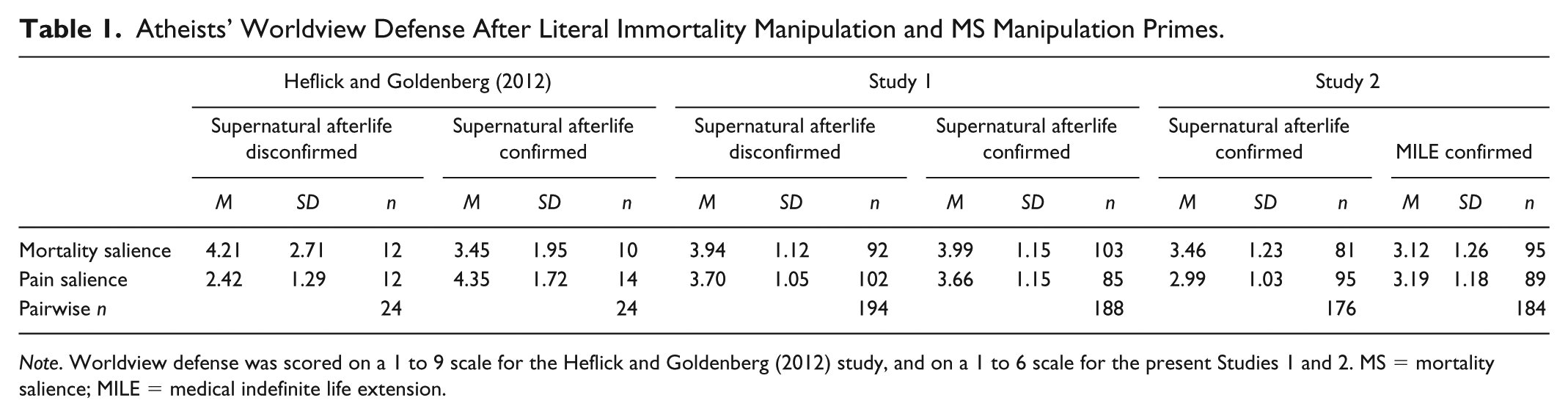
Note. Worldview defense was scored on a 1 to 9 scale for the Heflick and Goldenberg (2012) study, and on a 1 to 6 scale for the present Studies 1 and 2. MS = mortality salience; MILE = medical indefinite life extension.
Elaborating upon the previously-reported analyses
A 2 (MS vs. pain) × 2 (afterlife-confirmed vs. afterlife-disconfirmed) ANOVA revealed no main effect of afterlife manipulation, F(1, 44) = 1.06,
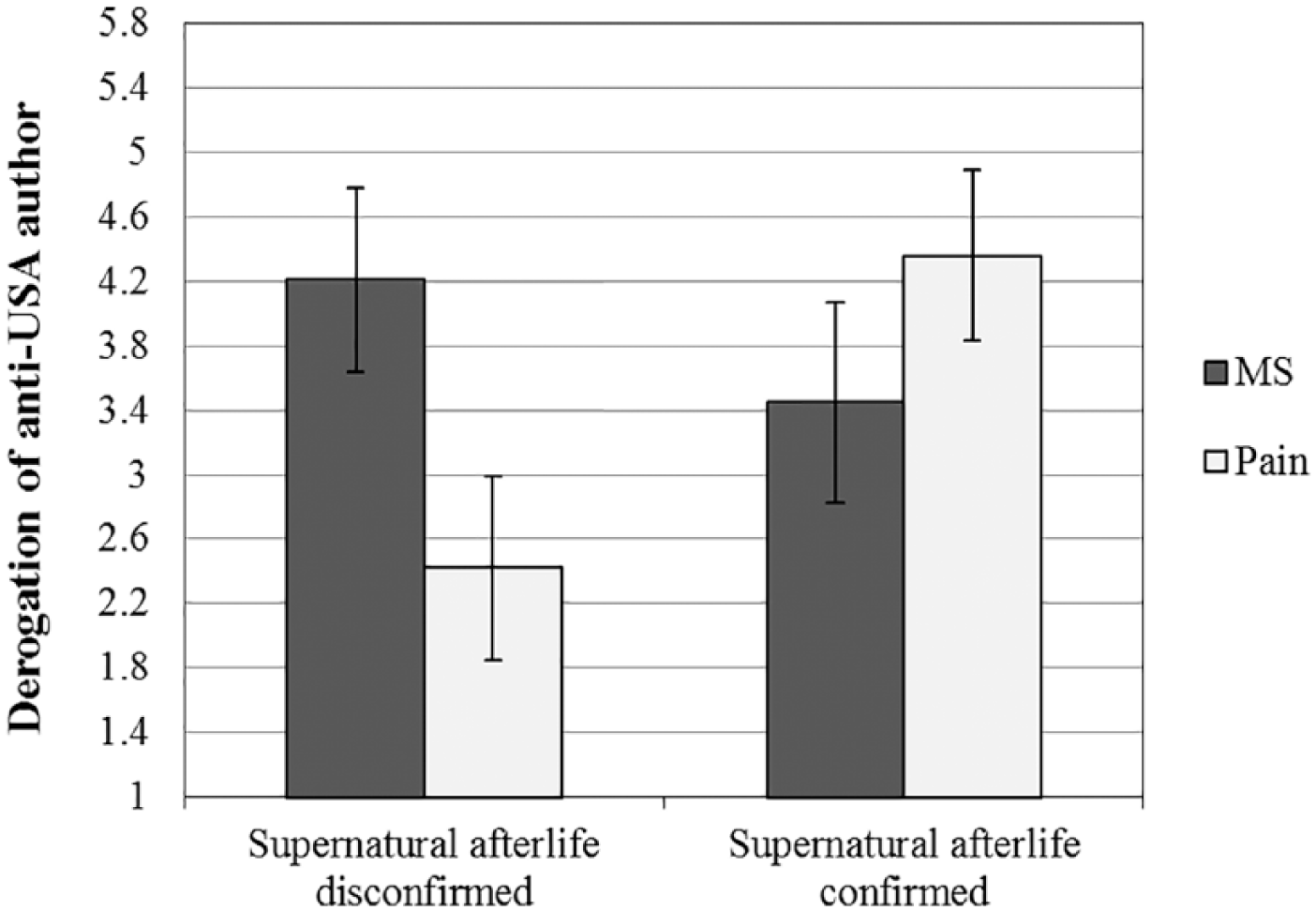
A reproduction of the Heflick and Goldenberg (2012) data.
In the afterlife-disconfirmed condition, worldview defense was significantly higher in the MS condition than the pain condition, t(22) = 2.22, p = .03, d = 0.84, 95% CI = [−.02, 1.65]. However, in the afterlife-confirmed condition, worldview defense was not statistically different in the MS and pain conditions, t(22) = −1.11, p = .27, d = −0.50, 95% CI = [−1.31, .34].
Relevant but previously-unreported analyses
Previously unreported were the pairwise comparisons of the article manipulation conditions within the MS and pain conditions. In the MS condition, worldview defense was not statistically different between the afterlife-confirmed and afterlife-disconfirmed conditions, t(20) = −0.90, p = .38, d = −0.32, 95% CI = [−1.15, .54]. However, in the pain condition, worldview defense was significantly higher in the afterlife-confirmed than afterlife-disconfirmed condition, t(24) = 2.50, p = .02, d = 1.26, 95% CI = [.38, 2.06].
Discussion
In revisiting these data, there was a significant effect of MS (vs. control) on worldview defense in the afterlife-disconfirmed but not in the afterlife-confirmed condition. Whereas the original report included only p values, we elaborated by generating test values, effect sizes, and CIs, and we note that the small sample size created statistical unreliability in the strength and even the direction of the observed effects. For example, although the MS effect in the afterlife-disconfirmed condition was significant, the 95% CI for the effect size (Cohen’s d) ranged between −0.02 to 1.65; that is, despite the significant p value, it remains ambiguous whether in the afterlife-disconfirmed condition the MS effect either had basically no effect (near d = −0.02) or up to an exceptionally large effect (near d = 1.65) on worldview defense. Similarly, in the afterlife-confirmed condition, despite the null p value, the wide 95% CIs [−1.31, .34] make it unclear whether the MS effect truly had basically no effect (near d = 0.0), an exceptionally large decrease in worldview defense (near d = −1.31), or instead—like the afterlife-disconfirmed condition—an increase in worldview defense (near d = 0.34).
Furthermore, although previously unreported, the other relevant pairwise analyses suggested that when atheists were reminded of death, worldview defense scores were similar in the afterlife-disconfirmed and the afterlife-confirmed conditions—suggesting that the supernatural afterlife affirmation condition did not buffer atheists against death awareness. The afterlife primes only affected atheists’ worldview defense in the pain salience condition. In fact, the mean worldview defense score in the pain/afterlife-confirmed condition (which, presumably, should have been the lowest) was higher than in the MS/afterlife-disconfirmed condition (which, presumably, should have been the highest score).
One possible explanation for the effect in the pain condition is that that for some rare few atheists, atheism might be part of their symbolic legacy, and thus an affirmation of it might buffer whereas affirmation of supernatural immortality might be taken as a worldview threat which would increase death-thought accessibility and subsequent worldview defense. Previous research has shown that threatening an important aspect of one’s worldview can produce effects similar to thinking about death (see Hayes et al., 2010 for review), which might have then led to increased worldview defense. However, as described earlier, “atheism” entails at least an absence (weak atheism) or at most a rejection (strong atheism) of faith in supernatural concepts—not a comprehensive belief system capable of offering a symbolic legacy (e.g., family, work, art, sports) or literal immortality (e.g., MILE). 4 In either event, the 95% CIs were quite wide for the effects of the afterlife manipulation in both the pain and MS conditions, making it difficult to be confident of neither the strength nor direction of effect of the afterlife prime.
Study 1
Study 1 therefore sought to further investigate the issue by repeating Heflick and Goldenberg’s (2012) method, but with a large online sample size to increase the statistical power, stability, and confidence about the direction of any possible effects. Materials, supplemental analyses, anonymized data, and code for both Studies 1 and 2 are available at https://osf.io/8q37y/?view_only=22e979061f9c49e5b9e8d13ec3ec2d9a.
Method
Estimation of target sample size
Burke et al. (2010) found an overall MS effect size of r = .35 (d = 0.75,
Participant recruitment and eligibility
Due to the difficulty of locating and recruiting sufficient numbers of local atheists to attend lab sessions, a research panel recruitment service (TurkPrime.com) was used to reach participants throughout the United States. Prior research has found that this recruitment service obtains high quality data (Litman, Robinson, & Rosenzweig, 2015) that are more representative of the general population than local convenience samples (Berinsky, Huber, & Lenz, 2012).
In spring 2016, TurkPrime began administering a religious belief item to its panel members around the world as part of its panel-building questionnaire. The item is as follows: What religion or philosophy are you affiliated with, if any? (a) Christian, (b) Muslim, (c) Jewish, (d) Buddhist, (e) Hindu, (f) Spiritual (I believe supernatural beings do exist, but I do not follow a specific religion), (g) Agnostic (I’m not sure whether, or it is impossible to know whether, supernatural beings do or do not exist), (h) Atheist (I do not believe supernatural beings exist), and (i) Other _____. Panel members who selected “atheist (I do not believe supernatural beings exist),” and were using IP addresses from verified U.S. locations, were eligible to participate. In fall 2016 and spring 2017, eligible participants were recruited in exchange for US$1.50.
In addition, once participants completed the primary materials, this eligibility item was administered again in the demographics questionnaire at the end of the study, to verify that the person who completed the materials was atheist.
Participants
A total 566 respondents accepted the invitation to participate. Of those, 117 provided only partial data, discontinuing before completing the manipulations or dependent variable. The remaining 449 completed the materials.
The second eligibility item indicated that 382 participants were indeed atheist; among the rest, 14 participants reported being Christian, three Jewish, five Buddhist, six “spiritual . . . ,” 35 “agnostic . . . ,” and four “other.” It is unknown whether the non-atheists were the same individuals who indicated “atheist” on the original pre-screener and subsequently changed their beliefs, or perhaps different individuals using those earlier atheist users’ accounts. Regardless, a three-way chi-square test of independence indicated that these responses were unrelated to the manipulations, so the non-atheist data were excluded (see Supplemental Materials).
The final sample consisted of 382 atheists who tended to be middle-aged adults (age M = 35.08, SD = 10.76); 5 college-educated (years education M = 15.64, SD = 2.36); included 216 males and 165 females (one did not report); mostly White (334 Caucasian, 14 Black/African American, four American Indian/Native Alaskan, 19 Asian, zero Native Hawaiian/Pacific Islander, and 11 “other”); and generally not Hispanic/Latino (353 Non-Hispanic/Latino, 28 Hispanic/Latino, one did not report).
Materials and procedure
Study 1 and 2 were both conducted with institutional review board (IRB) approval. The materials were formatted into a web-based research software (qualtrics.com, Provo, UT), and the online study link was distributed with a neutral description (e.g., “News reporting and social attitudes survey”) to conceal its true purpose and associated hypotheses. Upon obtaining informed consent, participants completed six filler items to orient them to the survey format before administering the primary materials; then, participants completed the primary materials (see methods supplement) in the following order:
Afterlife confirmation manipulation
The afterlife confirmation manipulation was the same as in Heflick and Goldenberg (2012; also Dechesne et al., 2003); participants were randomly assigned to either an afterlife-confirmed or afterlife-disconfirmed condition.
MS
The MS manipulation was the same as in Heflick and Goldenberg (2012; also Greenberg et al., 1990); participants were randomly assigned to either an MS or pain salience condition.
Delay and distraction
Similar to Heflick and Goldenberg (2012), the 60-item PANAS-X (Watson & Clark, 1992) 6 and a reading task provided the task-switching delay needed to observe distal terror management effects (Kosloff, 2018).
Worldview defense
Worldview defense followed Heflick and Goldenberg’s (2012; also Greenberg et al., 1990) method, such that these American participants read an anti-U.S. essay and then responded to a five-item questionnaire asking them to rate how much they agreed with the essay (see methods supplement). Items used a 6-point Likert-type scale (1 = Very much, 6 = Not at all) and formed a reliable composite (α = .90), such that higher scores indicated greater worldview defense.
Demographics
At the end of the survey, participants completed a demographic questionnaire recording age, sex, race, ethnicity, education level, and religious status.
Results
Descriptive statistics are presented in Table 1. A 2 (afterlife-confirmed vs. afterlife-disconfirmed) × 2 (MS vs. pain) ANOVA revealed no main effect of afterlife manipulation, F(1, 378) = 0.01,
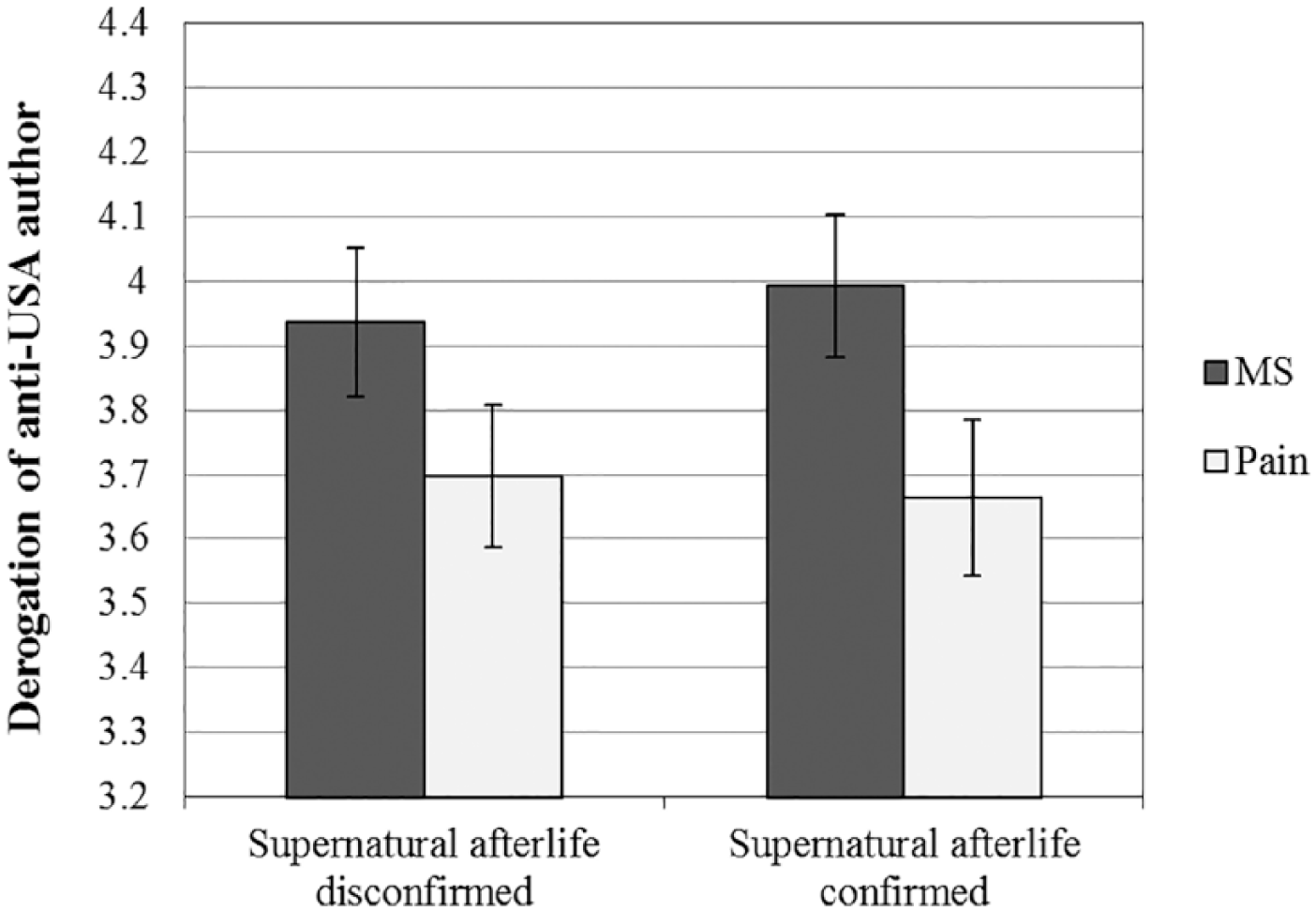
In Study 1, only a main effect was observed, such that MS increased worldview defense among atheists regardless of whether supernatural afterlife was disconfirmed or confirmed.
Noting that the interaction was not significant, we nevertheless examined the pairwise comparisons. In the afterlife-disconfirmed condition, worldview defense was higher (but not significantly so) in the MS condition than the pain condition, t(192) = 1.49, p = .14, d = 0.22, 95% CI = [−.06, .50]. In the afterlife-confirmed condition, worldview defense was significantly higher in the MS condition than the pain condition, t(186) = 2.01, p = .05, d = 0.29, 95% CI = [.00, .57]. From the other angle, the afterlife conditions did not statistically differ in the MS condition, t(193) = 0.35, p = .73, d = 0.05, 95% CI = [−.23, .33], nor in the dental pain condition, t(185) = −0.20, p = .84, d = −0.03, 95% CI = [−.32, .26].
Discussion
Study 1 found a main effect such that MS increased atheists’ secular worldview defense (derogating an anti-U.S. essay) across both the afterlife-disconfirmed and afterlife-confirmed conditions. In addition, the afterlife-confirmed (vs. afterlife-disconfirmed) prime did not influence worldview defense in either the MS or the pain condition. These findings are consistent with the TMT perspective that MS (vs. control) would lead atheists to engage in secular worldview defense in both the afterlife-confirmed and afterlife-disconfirmed conditions. Furthermore, if atheists’ worldview beliefs are based upon secular paths to symbolic immortality (legacies) and/or natural (biological) literal immortality through MILE, rather than supernatural literal immortality (afterlife), then TMT would predict that atheists managing death awareness should be effectively buffered by information affirming natural but not supernatural immortality. Study 2 was designed to test this idea.
Study 2
Study 2 explored whether atheists managing death awareness would be effectively buffered by information affirming natural, compared with supernatural, immortality. Atheists were recruited and randomly assigned to either an afterlife-confirming condition or a condition affirming natural/biological immortality through MILE techniques (following Lifshin, Greenberg, Soenke, Darrell, & Pyszczynski, 2018). Then, participants were randomly assigned to either a MS or pain condition, and given an opportunity for worldview defense. Thus, Study 2 involved a 2 (afterlife-confirmed vs. MILE-confirmed) × 2 (MS vs. pain) design measuring worldview defense outcomes. TMT would predict that atheists managing death awareness would be effectively buffered by information affirming natural but not supernatural immortality; that is, that MS (vs. pain) should increase atheists’ worldview defense in the afterlife-confirmed but not the MILE-confirmed condition.
Method
Estimation of target sample size
Study 2 used similar design, method, and procedure as Study 1, and again sought an overall sample of at least 351 participants.
Participant recruitment and eligibility
Again, TurkPrime was used to locate and recruit sufficient numbers of atheists throughout the United States, using the same eligibility criteria and procedure described in Study 1. In fall 2016 and spring 2017, eligible panel members were recruited for US$1.50.
Participants
A total 581 respondents accepted the invitation to participate. Of those, 141 provided only partial data, discontinuing before completing the manipulations or dependent variable. The remaining 440 completed the materials.
The second religious eligibility item, included at the end of the primary materials, indicated that 360 participants were indeed atheist; among the rest, 20 participants reported being Christian, five Jewish, three Buddhist, four “spiritual . . . ,” and 46 “agnostic . . . ,” and two “other.” Again, a three-way chi-square test of independence indicated that these responses were unrelated to the manipulations, so the non-atheist data were excluded (see Supplemental Materials).
The final sample consisted of 360 atheists, who tended to be young-adults (age M = 33.84, SD = 10.44); college-educated (years education M = 15.47, SD = 2.39); included 185 males and 175 females; mostly White (318 Caucasian, 10 Black/African American, two American Indian/Native Alaskan, 20 Asian, zero Native Hawaiian/Pacific Islander, nine “other,” one declined); and generally not Hispanic/Latino (331 Non-Hispanic/Latino, 28 Hispanic/Latino, one declined).
Materials and procedure
Study 2 used the same materials (e.g., MS manipulation, worldview defense measure) and procedure as Study 1, but with changes to the immortality manipulation as follows.
Literal immortality salience manipulation
Participants were randomly assigned to either a natural or supernatural immortality salience condition (see methods supplement). The afterlife-confirmed condition was the same as in Study 1 (based on Heflick & Goldenberg, 2012; also Dechesne et al., 2003). The natural literal immortality confirmation condition was based on materials validated by Lifshin et al. (2018), who found that participants low in religiosity increased their faith in biological immortality when presented with an article (written by experimenters) supporting the plausibility of MILE. The MILE-confirmed and afterlife-confirmed articles were similar length and format, but the MILE article discussed various means of extending one’s natural life indefinitely, such as Aubrey de Grey’s SENS (Strategies for Engineered Negligible Senescence) project, research finding that MILE works in rats, and suggestions that MILE may soon enable biological immortality in humans.
Results
Descriptive statistics are presented in Table 1. A 2 (afterlife-confirmed vs. MILE-confirmation) × 2 (MS vs. pain) ANOVA revealed no main effect of the immortality manipulation, F(1, 356) = 0.34,
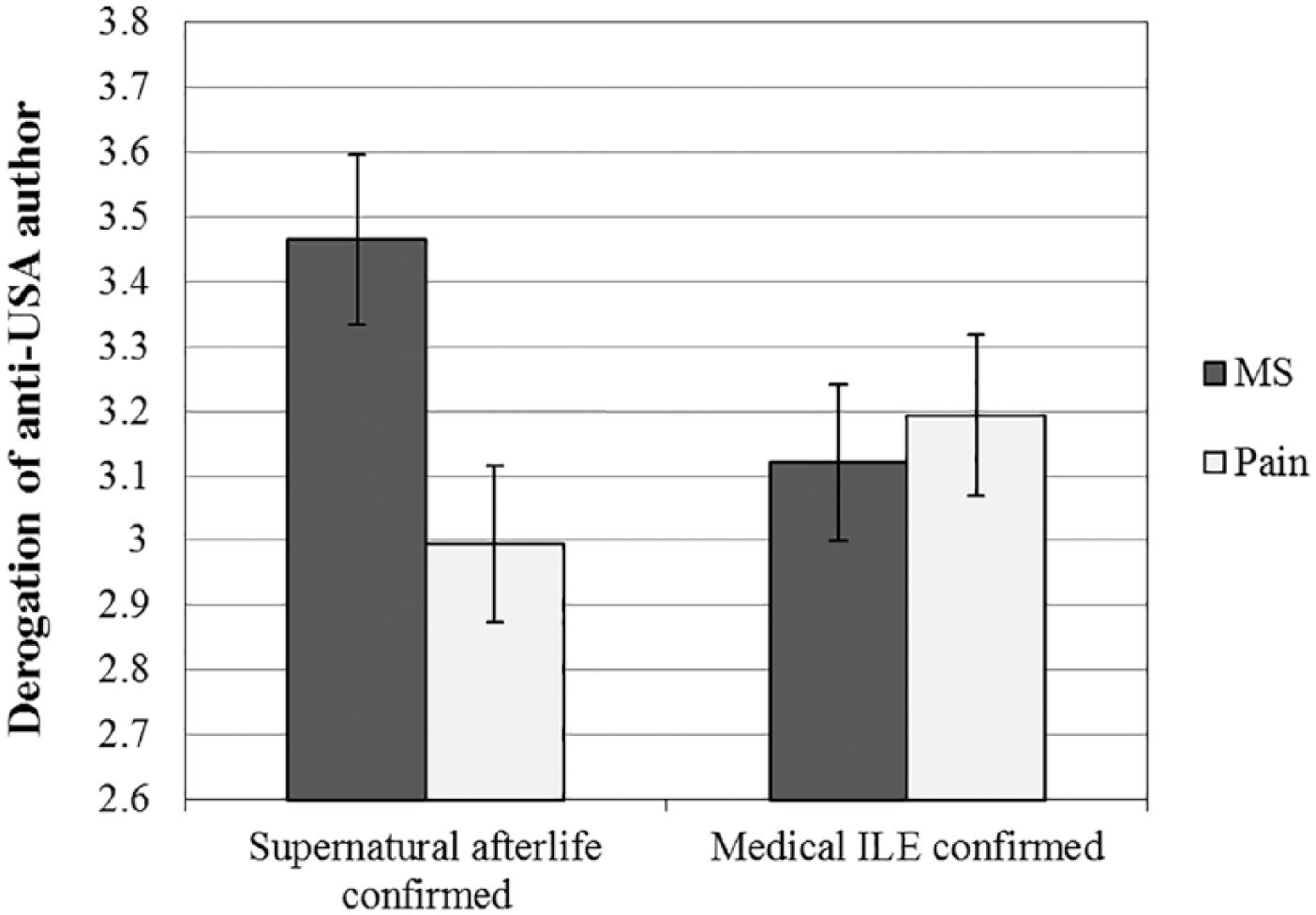
In Study 2, MS increased worldview defense among atheists when supernatural afterlife was confirmed, but not when MILE (a natural/non-supernatural immortality mode) was confirmed.
In the afterlife-confirmed condition, worldview defense was higher in the MS condition than the pain condition, t(174) = 2.65, p = .008, d = 0.42, 95% CI = [.12, .72]). In the MILE-confirmation condition, worldview defense did not statistically differ between the MS and pain conditions, t(182) = −0.42, p = .67, d = −0.06, 95% CI = [−.35, .23]. From the other angle, in the MS condition worldview defense was significantly higher in the afterlife-confirmed condition than the MILE-confirmed condition, t(174) = 1.93, p = .05, d = 0.28, 95% CI = [−.02, .57], whereas in the dental pain condition the article conditions did not statistically differ, t(182) = −1.16, p = .25, d = −0.18, 95% CI = [−.47, .11].
Discussion
Study 2 found that MS (vs. control topic) increased atheists’ worldview defense in the afterlife-confirmed but not the MILE-confirmed condition. In addition, the MILE-confirmed (vs. afterlife-confirmed) prime influenced worldview defense in the MS but not the pain condition. Thus the MILE-confirming article, but not the afterlife-confirming article, appeared to serve as a buffer for atheists, which is consistent with the TMT worldview defense perspective.
General Discussion
The present research explored whether atheists managing death awareness would be effectively buffered by affirmations of natural and/or supernatural literal immortality.
First, we revisited the possibility that atheists managing death awareness might be buffered by affirmations of supernatural literal immortality (afterlife). A prior study found an MS effect on atheists’ secular worldview defense (derogating an anti-U.S. essay) following an afterlife-disconfirmed prime but not following an afterlife-confirmed prime (Heflick & Goldenberg, 2012). Our reexamination of those shared data further revealed that the afterlife-confirmed (vs. afterlife-disconfirmed) prime did not reduce worldview defense when atheists were reminded of death, but instead appeared to increase worldview defense in the pain condition. In addition, the small sample size (n = 48) and variability involved created statistical unreliability about the strength and even the direction of the observed effects.
To further investigate the issue, the present Study 1 (n = 382) used a similar design, and found a main effect such that MS increased atheists’ worldview defense across both the afterlife-disconfirmed and the afterlife-confirmed condition. Study 1 also found that the afterlife-confirmed (vs. afterlife-disconfirmed) prime did not reduce atheists’ worldview defense in either the MS condition or the pain condition. Building on Study 1, Study 2 (n = 360) found that MS increased atheists’ worldview defense in an afterlife-confirmed but not a MILE-confirmed condition. Study 2 also found that the MILE-confirmed (vs. afterlife-confirmed) prime reduced atheists’ worldview defense in the MS condition, but that it had no effect in the pain condition.
Whereas prior data on the topic appeared ambiguous, the present research recruited a large number of atheists in Studies 1 and 2 and found in both studies that supernatural afterlife confirmation did not attenuate atheists’ MS-induced worldview defense. In addition, we conducted a meta-analysis (Borenstein, Hedges, Higgins, & Rothstein, 2009) on the MS effects in the afterlife-confirmed conditions from the present Study 1 (n = 188) and Study 2 (n = 176) and Heflick and Goldenberg’s (2012) study (n = 24), to summarize the overall (n = 388) effect of MS on atheists’ worldview defense in the afterlife-confirmed condition. With the conditions being the same across these studies, a fixed effects model did not reject homogeneity, Q(2) = 4.22, p = .12. As can be seen in Figure 4, the summary effect indicates that—across all three studies—when given an article affirming supernatural afterlife, atheists’ secular worldview defense was higher in the MS condition than the pain condition, Z = 2.90, p = .004, d = 0.30, 95% CI = [.10, .50]. Thus, taken together, these data contradict the idea that atheists managing death awareness would be effectively buffered by affirmations of supernatural literal immortality.
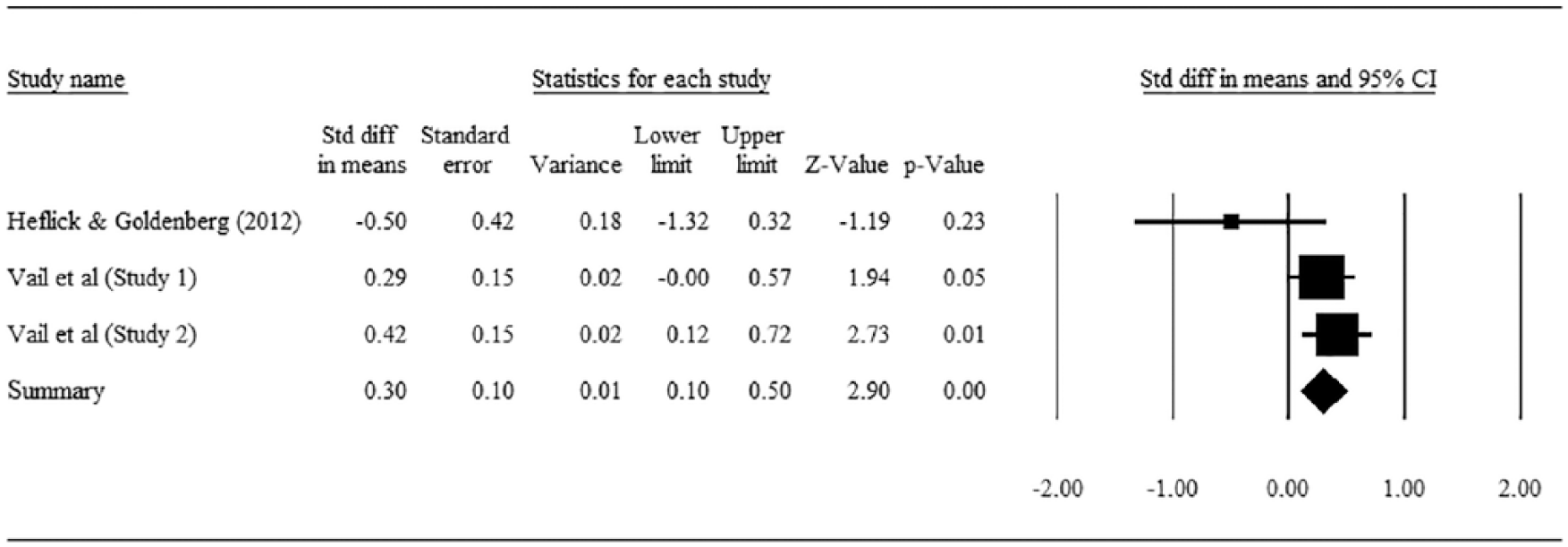
Forest plot of MS effects in the afterlife-confirmed condition, across studies.
On a related note, the possible special buffering efficacy of supernatural belief is theoretically and empirically distinct from the possible special attractiveness of supernatural belief as a buffer. The present research found that among atheists a supernatural afterlife affirmation did not have buffering efficacy, yet the present work does not inform whether or not atheists reminded of death found supernatural belief more attractive. Other prior research has found that MS did not lead atheists/nonreligious participants to express increase faith in religiosity, belief in a higher power, or other supernatural beliefs (Norenzayan & Hansen, 2006; Vail et al., 2012), though it remains an open question about whether atheists managing death awareness might find such concepts more “attractive” even though they may not increase belief in them.
Implications for the TMT Perspective
The present work also bears implications for the TMT perspective, more broadly, which theorizes that people manage the awareness of death by living up to the standards and values prescribed by their relevant cultural belief system. Consistent with this idea, much prior research has found that (a) MS motivates efforts to bolster and defend one’s own worldviews; (b) MS motivates self-esteem striving in one’s worldview-relevant, but not worldview-irrelevant domains; and (c) that affirming one’s own beliefs can help reduce death-thought accessibility and eliminate the need for further worldview defense. Thus, if atheists limit themselves to secular/non-supernatural worldviews, and do not explicitly accept supernatural ideas, then TMT would predict that atheists should be buffered against death awareness by affirmations of natural, but not supernatural, paths to immortality.
Indeed, Study 1 found that MS led atheists to increase worldview defense in both the afterlife-confirmed and afterlife-disconfirmed conditions. Instead, TMT suggested that atheists should be buffered by affirmations of death-denying ideas that they would explicitly find acceptable and compatible with their secular/non-supernatural worldviews. In terms of symbolic immortality, that might mean affecting future generations by raising a family, teaching students, being patriotic, or perhaps contributing to business, government, art, science, sports, or any number of other domains. In terms of literal immortality, that might mean entertaining, supporting, or pursuing the possibility of MILE. Study 2 was consistent with this idea, as MS led atheists to increase secular worldview defense when exposed to an article affirming afterlife but not when exposed to an article affirming the possibility of MILE.
The present findings also converge with prior TMT research in a number of other ways. First, prior work also shows that MS can motivate people to engage in patriotic worldview defense (Greenberg et al., 2015). Second, prior work also suggests that affirming one’s worldview beliefs can buffer against death awareness and mitigate defensive reactions (e.g., Jonas & Fischer, 2006; Schmeichel & Martens, 2005), yet clarifies that MS motivates defensive striving in worldview-relevant but not worldview-irrelevant domains (e.g, Peters et al., 2005) and motivates defensive responses to worldview-relevant but not worldview-irrelevant threats (e.g., Arndt & Greenberg, 1999). And third, prior work on atheists/nonreligious samples similarly shows that MS does not lead atheists/nonreligious participants to increase explicit religiosity, belief in a higher power, or faith in other supernatural beliefs (Jong, Halberstadt, & Bluemke, 2012; Norenzayan & Hansen, 2006; Vail et al., 2012).
Implications for Future Research on Existential Motivation
The present data suggest that atheists managing death awareness were buffered by secular and not supernatural immortality ideas. If these findings are accurate, then future research could further explore the various motivational conditions and implicit and explicit cognitive mechanisms leading to religious unbelief (vs. belief). For example, interfacing existential motivation with cognitive science of religion research (e.g., Baumard & Boyer, 2013), it is possible that atheists managing death awareness implicitly activate religious concepts but then explicitly regulate (abstain from or reject) them. If so, then one could make the prediction that MS should lead both religious believers and atheists to implicitly “prepare” faith in supernatural/spiritual concepts (e.g., perhaps seen in implicit-association test [IAT] measures, under time pressure, or when explicit self-report items are worded in terms of desires rather than beliefs), but only lead believers to explicitly express faith because atheists reflectively over-ride those intuitions (e.g., Jong et al., 2012; Vail et al., 2012).
Additional research might also investigate whether atheists are at a disadvantage in terms of maintaining well-being under death awareness (Vail & Soenke, 2018), and whether atheists’ meaning in life might be buoyed by affirmations of concepts offering secular immortality (e.g., MILE). Furthermore, future research could identify and explore the death-denying capacities of other facets of atheists’ secular worldviews, such as the advancement of science in general (vs. advancement of science toward MILE, specifically), as well as advances in government, education, art, sports, and so on, and whether atheists might need to take extra steps to cognitively “search” to activate such secular death-denying concepts (whereas supernatural/spiritual concepts might be intuitively/implicitly activated). Such research would not only advance understanding about the unique implicit and explicit patterns of atheists’ existential motivation, but learning about such “deviations” among atheists could help reveal the motivational and cognitive mechanisms underlying the “standard” patterns of existential motivation among believers—that is, using the exceptions to study the rules.
Future research could also explore variations of these effects among different types of atheists. The present findings suggest that atheists were not buffered by affirmations of supernatural immortality. But that finding does not rule out the possibility that some subtypes of atheists might be exceptions to this general rule, and perhaps find supernatural belief a more appealing and/or effective buffer when reminded of death. One possible direction for future research, in that regard, would be to explore variations of so-called weak and strong atheism (e.g., Flew, 1984; Martin, 1992). In the present investigation, participants explicitly self-identified as “atheistic” (Heflick and Goldenberg’s study) or “atheist (I do not believe supernatural beings exist)” (Studies 1 and 2), which means that participants in these studies were necessarily either weak explicit or strong atheists. It remains possible that weak implicit atheists may find supernatural belief a more appealing and/or effective buffer when reminded of death. It also remains possible that weak explicit and strong atheists differ in meaningful ways, and that there might be variation in how firm such individuals might be in their stance. For example, some weak explicit atheists (simply abstaining) might be firm about abstaining from supernatural belief whereas others might be less firm about abstaining and thus might be more willing to entertain supernatural belief. Similar variation might exist among strong atheists. Future research could explore these possibilities.
Conclusion
Although humans have long-held faith in the possibilities of supernatural (e.g., souls, afterlife, heaven) and natural (biological) immortality, atheists are unique in that they seem to abstain from or reject supernatural concepts and instead subscribe to secular/nonsupernatural beliefs. The present research therefore explored how atheists might accept natural and/or supernatural immortality concepts to cope with mortality awareness. Results were consistent with the TMT worldview defense perspective: atheists managing death awareness were not buffered by ideas about supernatural immortality but were instead buffered by the possibility of scientific advances to extend their natural lives indefinitely.
Supplemental Material
Supplemental_materials_-_Appendix_S1 – Supplemental material for Natural, But Not Supernatural, Literal Immortality Affirmation Attenuates Mortality Salience Effects on Worldview Defense in Atheists
Supplemental material, Supplemental_materials_-_Appendix_S1 for Natural, But Not Supernatural, Literal Immortality Affirmation Attenuates Mortality Salience Effects on Worldview Defense in Atheists by Kenneth E. Vail, Melissa Soenke, Brett Waggoner and Ilianna Mavropoulou in Personality and Social Psychology Bulletin
Supplemental Material
Vail_OnlineAppendix – Supplemental material for Natural, But Not Supernatural, Literal Immortality Affirmation Attenuates Mortality Salience Effects on Worldview Defense in Atheists
Supplemental material, Vail_OnlineAppendix for Natural, But Not Supernatural, Literal Immortality Affirmation Attenuates Mortality Salience Effects on Worldview Defense in Atheists by Kenneth E. Vail, Melissa Soenke, Brett Waggoner and Ilianna Mavropoulou in Personality and Social Psychology Bulletin
Footnotes
Acknowledgements
We thank Nate Heflick and Jamie Goldenberg for providing their prior data, giving extensive feedback on earlier drafts of this article, suggesting exploratory statistical analyses, and for ongoing and enjoyable discussion of the topic.
Declaration of Conflicting Interests
The author(s) declared no potential conflicts of interest with respect to the research, authorship, and/or publication of this article.
Funding
The author(s) received no financial support for the research, authorship, and/or publication of this article.
Notes
Supplemental Material
Supplemental material is available online with this article.
References
Supplementary Material
Please find the following supplemental material available below.
For Open Access articles published under a Creative Commons License, all supplemental material carries the same license as the article it is associated with.
For non-Open Access articles published, all supplemental material carries a non-exclusive license, and permission requests for re-use of supplemental material or any part of supplemental material shall be sent directly to the copyright owner as specified in the copyright notice associated with the article.
