



Abstract
Recent work demonstrated that whereas high-status and low-status group members seek to address cross-group commonalities during intergroup contact, members of low-status groups show a greater desire to discuss status differences between the groups. Drawing on social identity theory, the current research investigated the combined influence of status legitimacy and status stability on these contact preferences. In Study 1, perceived stability and perceived legitimacy were measured among members of a high-status ethnic group in Israel. In Study 2, group status, status stability, and status legitimacy were experimentally manipulated in a U.S. sample. Although they generally preferred to discuss commonalities over status differences, across studies high-status group members’ willingness to discuss status differences increased when they perceived the hierarchy as illegitimate but stable. By contrast, low-status group members were particularly inclined to address status differences and least interested in discussing commonalties, when the hierarchy was illegitimate and unstable.
Positive intergroup interactions robustly elicit more favorable intergroup attitudes (Pettigrew & Tropp, 2006, 2011). Although these encounters are typically marked by status asymmetries, involving interaction between members of high-status and low-status groups, processes pertaining to group status and related interests have rarely been considered in research on intergroup contact (cf. Tropp & Pettigrew, 2005). Such differences have been traditionally regarded as obstacles to intergroup harmony, leading to attempts to overcome them by creating equal status in the contact situation and de-emphasizing the status differences that characterize the relations outside the encounter (Allport, 1954; Amir, 1969; see Maoz, 2011). Nevertheless, because group status plays a powerful role in people’s motivations and goals (Tajfel & Turner, 1979), it can also shape the way they approach, experience, and are affected by intergroup contact. Consistent with the emerging notion that intergroup contact is best understood as a practice occurring within a social context shaped by power and status differences (Dixon, Levine, Reicher, & Durrheim, 2012; Saguy, Tausch, Dovidio, & Pratto, 2009; Wright & Lubensky, 2009), the present research focused on the influence of insecure status relations on preferences for the content of contact. Understanding how people approach intergroup interactions can provide conceptual and practical insights into processes that shape such encounters and advance understanding of the potential effectiveness of different types of encounters for serving group members’ needs.
According to social identity theory (Tajfel & Turner, 1979), individuals derive an important part of their self-definition, their social identity, from memberships in social groups. Because people strive for positive self-worth, they are motivated to achieve a valued social identity. The need for a positive social identity can be satisfied by comparing one’s group to other relevant groups. Such social comparisons typically yield favorable outcomes for members of high-status groups, promoting a positive social identity, whereas members of low-status groups are more likely to experience a devalued or threatened social identity (Ellemers, Wilke, & van Knippenberg, 1993; Scheepers & Ellemers, 2005).
Extensive research within the social identity framework has focused on strategies that low-status groups adopt to manage their threatened identity (e.g., Ellemers, Spears, & Doosje, 2002; Ellemers, van Knippenberg, & Wilke, 1990; Scheepers, Spears, Doosje, & Manstead, 2006; Wright, Taylor, & Moghaddam, 1990). This work has demonstrated that when group boundaries are well defined, with limited opportunities to move individually to another group, members of low-status groups will likely seek to advance the position of their group as a whole (e.g., engage in collective efforts to advance social change). This motivation, however, has been found to be critically shaped by the extent to which the hierarchical relations between the groups are perceived to be secure, namely, stable and legitimate (Bettencourt, Charlton, Dorr, & Hume, 2001; Doosje, Ellemers, & Spears, 1999; Ellemers et al., 1993). When status relations are perceived as potentially changeable (unstable) and as morally wrong (illegitimate), attempts to advance one’s group status are likely to be particularly pronounced (Tajfel & Turner, 1979; see also Ellemers et al., 1993; Halabi, Nadler, & Dovidio, in press; Turner & Brown, 1978). Under these insecure status conditions, alternatives to the status quo seem most plausible and justified, promoting low-status group members’ efforts to advance their group’s status.
Far less research, particularly with respect to the combined influence of stability and legitimacy, has been devoted to strategies that high-status groups adopt to maintain their positive social identity (cf. Turner & Brown, 1978). With respect to stability, when status relations are perceived as changeable, members of high-status groups are more threatened (Scheepers & Ellemers, 2005), which can motivate them to defend their advantage. In terms of legitimacy, perceptions of illegitimate advantage can seriously threaten the moral image of members of high-status groups, which may weaken their motivation to defend the hierarchy (Tajfel & Turner, 1979). Indeed, recognition of illegitimate advantage can instigate a variety of moral emotions (e.g., shame or guilt about the ingroup’s actions) and lead members of high-status groups to increase their support for social equality (Iyer, Leach, & Crosby, 2003; Miron, Branscombe, & Schmitt, 2006). However, unlike research on low-status groups, research examining reactions of members of high-status groups to illegitimate advantage has rarely considered the role of status stability as a moderator. Under clearly unstable status relations, there is a possibility that the threat of losing status might overcome other orientations, including the commitment to equality, even when status relations seem illegitimate.
In the current work, we drew on these insights from social identity theory to investigate the combined effect of status stability and legitimacy on the way high-status and low-status group members approach intergroup contact. In our previous work, we found that group position, whether based on differences in ethnic status or in experimentally manipulated control over resources, systematically shaped preferences for topics of discussion in intergroup interactions (Saguy, Dovidio, & Pratto, 2008; see also Bikmen & Sunar, 2012). Members of high-status groups preferred to talk about topics emphasizing cross-group commonalities rather than about status differences between the groups. Members of low-status groups preferred to talk about status differences more than did members of high-status groups, but they expressed an equivalently high level of interest in talking about commonalities. Although we reasoned that interests derived from group status can account for these group-based patterns, evidence supporting this idea is still limited. Our goal in the current work was to provide empirical support for the notion that group-based interests shape the way people approach intergroup encounters. If the desire to address commonalities and/or status differences during contact reflects attempts to serve group interests, these preferences would likely be shaped by beliefs about the stability and legitimacy of status relations in systematic ways. Thus, the current research extends previous work by investigating factors that moderate the different preferences of members of high-status and low-status groups for the content of intergroup interactions.
Group Status and Preferences for the Content of Contact
Talking about status differences and about commonalities can have fundamentally different consequences for intergroup relations. Research on collective action has established that acknowledging status differences and associated inequities represents a critical element for stimulating social change (van Zomeren, Postmes, & Spears, 2008; Wright & Lubensky, 2009). Thus, members of low-status groups, who are generally more motivated to advance change than are members of high-status groups, are likely to also have a greater desire to address status differences in intergroup encounters (Saguy et al., 2008) because discussing such issues can be potentially “functional” for altering the status quo.
By contrast, to maintain their advantaged position, high-status group members may be motivated to avoid discussion of status differences and instead promote emphasis on issues that would not pose a threat to the existing power structure. Focusing on common and positive connections between the groups can be functional in that respect (Dixon et al., 2012; Saguy, Tropp, & Hawi, 2012). Because such emphasis can promote a strong sense of shared identity (Gaertner & Dovidio, 2000, 2012), it can shift group members’ attention away from intergroup comparisons (Tajfel, 1978; Turner, Oakes, Haslam, & McGarty, 1994) and group differences, including those pertaining to differences in status. Indeed, the blurring of status differences between groups was found to lead low-status group members to view the status hierarchy as more legitimate and less discriminatory (Saguy & Chernyak-Hai, 2012), and to be less inclined to advance efforts aimed at promoting their group status (Dixon et al., 2012; Saguy et al., 2009). Thus, by emphasizing commonalities and de-emphasizing status differences, high-status groups may reduce tension and avoid contentious issues, which may reinforce the status quo favoring their own group.
Members of low-status groups may also desire to address commonalities, but mainly in conjunction with attention to status differences to create awareness to social inequality under conditions that could lead high-status group members to be more receptive of those issues. Indeed, because people are more sensitive and responsive to injustices within their group than across group lines, emphasizing commonalities and status differences, a pattern we obtained in previous research (Saguy et al., 2008), could sensitize high-status group members to issues related to group-based injustice (Tyler & Blader, 2003; see also Opotow, 2008).
Insecure Status Relations and Preferences for the Content of Contact
In the current work, consisting of two studies, we propose that insecure status relations may further shape high-status and low-status group members’ contact preferences. As we noted earlier, recognizing the illegitimacy of their group’s advantage can motivate members of high-status groups to increase their support for social equality (e.g., Iyer et al., 2003; Miron et al., 2006). Applying this perspective to the realm of intergroup contact, in our previous research, we found that framing disparities between ethnic groups as illegitimate led members of a high-status ethnic group to be more interested in talking about status differences, to a level comparable with their desire to address commonalities (Saguy et al., 2008). This prior work, however, did not take into account the potentially moderating role of status stability.
Consistent with social identity theory (Doosje et al., 1999; Tajfel & Turner, 1979), research that considered the influence of status instability on high-status group members’ responses clearly demonstrates a strong motivation to defend or restore one’s group position. For example, Scheepers and Ellemers (2005) showed that after the possibility of change in the hierarchy was introduced, individuals assigned to a dominant group exhibited a defensive physiological threat response, reflecting their distress at the risk of losing their advantage. Georgesen and Harris (2006) demonstrated that participants assigned to a high power role were more discriminatory toward subordinates when their advantaged position was more tentative. In addition, high-status group members, and particularly those in favor of group-based hierarchy, are more likely to engage in actions that reinforce the dependency of low-status groups when they perceive their group’s status as less secure (Halabi, Dovidio, & Nadler, 2008).
Taken together, these studies indicate that the stability of status relations plays a pivotal role in determining how members of high-status groups react in general, and particularly toward members of low-status groups. As such, views regarding the stability of their status may also relate to high-status group members’ preferences for the content of intergroup encounters. As described earlier, when they view the hierarchy as illegitimate (compared with legitimate), high-status group members were more willing to discuss status differences in a future encounter with members from the low-status group (Saguy et al., 2008). Status stability, however, may further shape this willingness. When status relations are illegitimate but stable, acknowledging status differences may not undermine the high-status group’s position because the hierarchy is secure. In fact, under conditions of stable and illegitimate hierarchy, discussing issues pertaining to status and power may alleviate high-status group members’ moral concerns without risking their privileges. However, the threat of status loss elicited by unstable status hierarchy may loom large for members of high-status groups (Georgesen & Harris, 2006; Scheepers & Ellemers, 2005), leading them to avoid discussion of status differences, even when the hierarchy is considered illegitimate. Drawing on these ideas, we tested whether stability moderates high-status group members’ willingness to address status differences when the hierarchy is illegitimate. In particular, we hypothesized that recognition of the illegitimacy of the status hierarchy would increase high-status group members’ willingness to discuss status difference, but mainly when status relations are stable and not when they are unstable.
Following a similar reasoning, linking group interests to contact preferences, we predicted that members of low-status groups would be particularly inclined to direct attention to status differences when they perceive their disadvantaged status as most insecure. Indeed, whereas stability and legitimacy can independently influence strategies for social change, their combination (i.e., unstable and illegitimate status hierarchies) has been shown to produce an especially potent impetus for social change among members of low-status groups (Commins & Lockwood, 1979; Ellemers et al., 1993; Tajfel, 1981; Turner & Brown, 1978; Vaughan, 1978). When status relations are unstable and illegitimate, change in the status relations seems most likely and justifiable, which would particularly stimulate low-status group members’ attempts to advance their group position. The hypothesized interactive effect of stability and legitimacy on strategies for social change is consistent with the notion that it is not enough for low-status group members to feel unjustly treated to act for change; they also need to believe in the feasibility of their efforts (Klandermans, 1984; Mummendey, Kessler, Klink, & Mielke, 1999; van Zomeren, Leach, & Spears, 2012). We therefore predicted that when the status hierarchy is considered unstable and illegitimate, low-status group members’ desire to address status differences would be especially strong (relative to when the status hierarchy is considered either stable, legitimate, or both).
With respect to addressing commonalities, although our previous work has revealed that low-status group members generally want to address commonalities to the same extent that they want to address status differences (Saguy et al., 2008), in the present research, we further examined whether their preference to discuss commonalities may decrease when status relations are unstable and morally questionable (i.e., illegitimate). Under these conditions, maintaining positive connections with those high in status can become less relevant for serving the interests of the low-status group. In fact, harmonious relations with the high-status group might even interfere with attempts to advance change by limiting intergroup competition (see Dixon et al., 2012; Saguy et al., 2009; Wright & Lubensky, 2009). We therefore predicted that when their status is most insecure (perceived to be unstable and illegitimate), low-status group members’ desire to address commonalities would be particularly low, resulting in their clear preference to emphasize status differences over commonalities under these conditions.
Taken together, we hypothesized that beliefs about the status hierarchy as stable and legitimate would shape the preferences that group members bring to situations of contact. We predicted that high-status group members would show a general preference to address commonalities over status differences. However, we expected their willingness to address status differences to increase when the hierarchy is illegitimate (Saguy et al., 2008)—but only when status relations are also perceived as stable, not unstable. For members of low-status groups, we predicted a generally equivalent desire to address status differences and commonalities. However, when the status hierarchy is considered unstable and illegitimate, we expected them to have a particularly strong desire to address status differences and a particularly weak desire to discuss commonalities. These predictions were tested in two studies. In Study 1, we focused on high-status group members in a naturalistic setting in Israel by measuring perceived stability and perceived legitimacy among members of an advantaged ethnic group of Ashkenazi-Jews. In Study 2, we experimentally manipulated group status, status stability, and status legitimacy among a U.S. sample to provide an experimental test of our full set of predictions.
Study 1
Participants in Study 1 were Ashkenazi-Jews, who constitute a high-status group in Israeli society, particularly in relation to Mizrahi-Jews. Ashkenazim are Jews born in North America or Europe, or whose parents were born in those continents; Mizrahim are Jews born in Asia or Africa, or whose parents were born in those continents. Although socioeconomic differences between the groups, favoring the Ashkenazim, are well documented in levels of education, average income, and poverty rates (Smooha, 2003), the origins of these disparities are often debated. The controversy about the bases of the disparities in resources between Ashkenazim and Mizrahim—whether due to different values of the groups or due to discrimination (see Saguy et al., 2008)—provides an appropriate range of perceptions among Ashkenazi-Jews about the legitimacy and stability of status relations for testing our hypotheses. 1
Participants answered a brief online survey in which they were asked to rate their perceptions of the status hierarchy between the groups on stability and legitimacy dimensions and the desirability of different discussion topics for a future intergroup encounter. Some of the topics addressed status differences between the groups and some addressed aspects that both groups share in common. This correlational design enabled us to conduct an initial examination of our predictions in a naturalistic context among members of a high-status group.
Method
Participants
Participants were 93 Ashkenazi-Jews (48% women, M age = 28.69, SD = 4.76). They were recruited for the study through an online survey company and received a small monetary compensation (approximately US$3) for taking part in the short online survey.
Procedure and Measures
The study was described as dealing with future discussion encounters between Mizrahim and Ashkenazim in Israel. It was explained that to design the encounters, the investigators would first like to learn how the participants view the relations between the groups and then to examine their preferences for a future intergroup encounter. To stress the status inequality, all participants were initially presented with a short synopsis of data describing actual disparities between Mizrahim and Ashkenazim (in levels of income, academic achievement, and societal influence; www.cbs.gov.il, see Saguy et al., 2008, Study 2 for a parallel procedure).
After reading the summary of disparities, participants rated the extent to which they perceived the inequality described to be legitimate and stable. To assess perceived legitimacy (see Jost & Burgess, 2000), participants indicated on three bipolar 7-point scales the extent to which they felt the inequalities were unfair versus fair, unjustifiable versus justifiable, and illegitimate versus legitimate (α = .89). Stability was measured with two items assessing the extent to which the current hierarchical structure between the groups was perceived to be narrowing. One item assessed expectations about potential changes in the inequalities described in the data “10 years from now.” Responses ranged from 1 (the inequality would greatly diminish) to 7 (the inequality would remain as described), such that higher scores reflected more stability of the current status hierarchy. The second item read, “To what extent do you think it is likely that in the coming years the groups would become more equal?” Responses ranged from 1 (not at all likely) to 7 (very likely). After reverse-scoring this second item, we averaged the questions to create a perceived stability score, r(91) = .53, p < .001.
To assess preferences for the content of contact, participants then rated their desire to discuss eight topics, on a scale from 1 (not at all) to 7 (very much), if they were to participate in a future intergroup encounter between Mizrahim and Ashkenazim. Modeled after the work of Saguy et al. (2008), the four topics emphasizing commonalities were (a) “discussing cultural similarities between the two groups,” (b) “discussing common aspect to both ethnicities,” (c) “discussing the joint contribution of both ethnicities to the common Israeli identity,” and (d) “discussing dimension that bring members of both ethnicities together” (α = .91). The four topics emphasizing status differences were (a) “discussing ways for promoting more equal distribution of resources between the groups,” (b) “discussing ways of promoting Mizrahim to powerful positions in Israeli society,” (c) “discussing ways to advance affirmative action aimed at promoting Mizrahim in the universities and workplaces,” and (d) “discussing the lowering of taxes to cities in the south of Israel (where many Mizrahim reside)” (α = .87). Participants then answered demographic questions and were debriefed.
Results
We obtained an appropriate range of perceptions on the legitimacy score (M = 3.20, SD = 1.55) and on the stability measure (M = 3.26, SD = 1.40). To test our predictions, we performed multilevel modeling using the HLM software (version 7), which permits examination of the effects of continuous independent variables in a repeated measures design. Because each individual had two scores on the Topics measure (Commonalities vs. Status Differences), this factor was nested within individuals; Stability, Legitimacy, and their interaction were treated as predictors at the person level (Level 2 predictors). The analysis revealed a main effect for Topics, B = 1.22, SE = .17, t = 7.16, p < .001: As anticipated, overall, Ashkenazim preferred to discuss commonalities (M = 4.74, SD = 1.63) more than status differences (M = 3.51, SD = 1.56).
The analysis further revealed the predicted Stability × Legitimacy × Topics interaction, B = 0.15, SE = .07, t = 2.01, p = .048. To interpret this interaction, we next conducted Legitimacy × Stability analyses separately for Commonalities and Status Differences topics, using the PROCESS macro (Hayes, 2012). For interest in discussing commonalities, the analysis did not reveal any significant effects. As in prior work (Bikmen & Sunar, 2012; Saguy et al., 2008), high-status group members had a consistently strong desire to focus on commonalities when interacting with low-status groups (see Figure 1a). For the desire to discuss status differences, a Legitimacy × Stability interaction was obtained, B = −0.16, SE = .07, t = −2.37, p = .02 (see Figure 1b). Among those who perceived the status relations as stable, the effect of legitimacy on the desire to address status differences was significant: The more participants perceived the hierarchy as illegitimate, the more willing they were to discuss status differences, B = −0.45, SE = .14, t = −3.29, p = .001. However, for participants who saw the status relations as unstable, there was no effect of legitimacy on the desire to address status differences, t = −0.07, p = .95. These results are supportive of our hypothesis that perceptions of the illegitimacy of status relations alone are not enough to predict high-status group members’ willingness to address status difference. Such willingness is moderated by perceptions of stability, such that only among those who see their advantaged position as secure, stronger perceptions of illegitimacy predict willingness to discuss status differences.
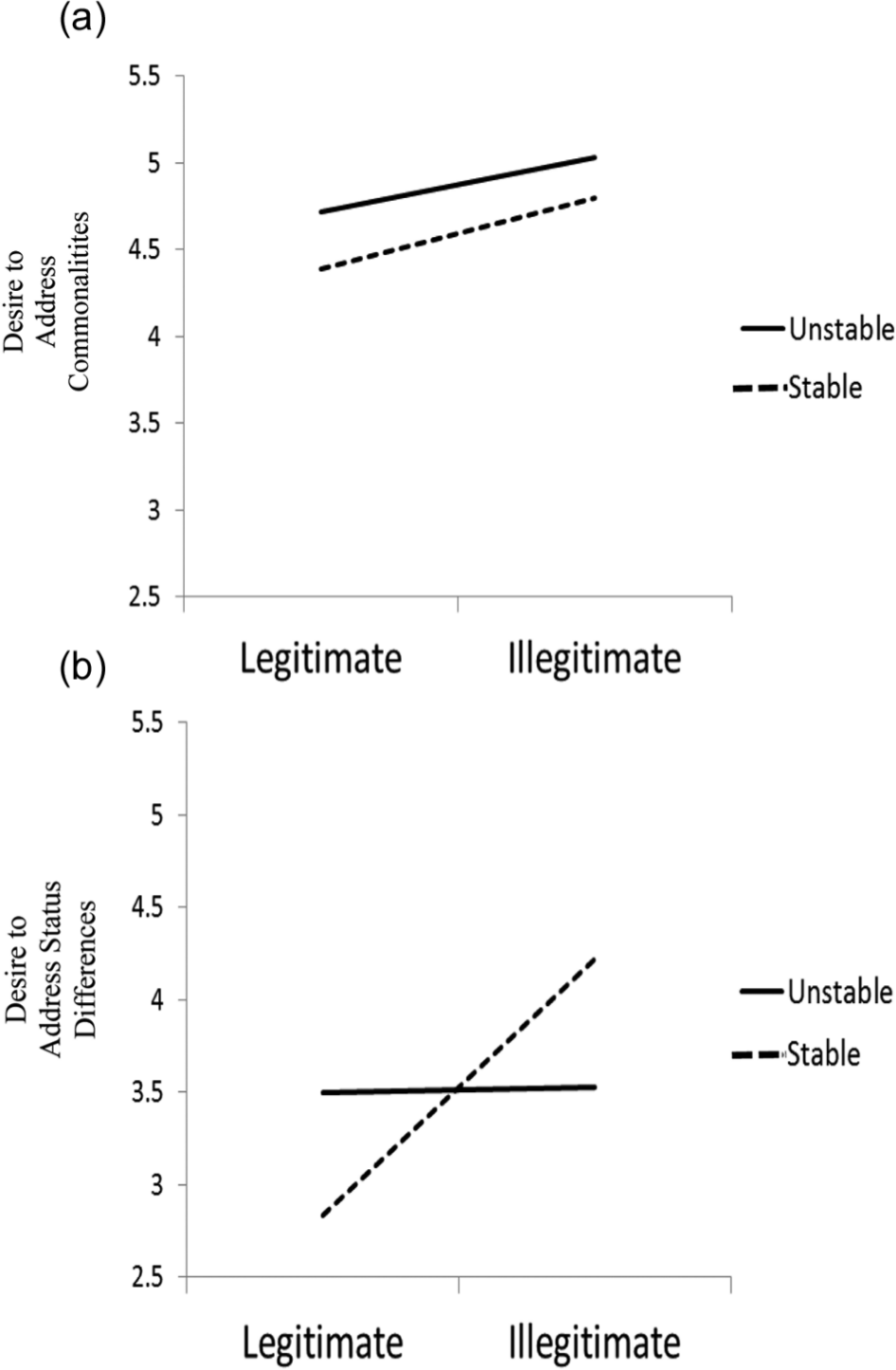
Desire to address (a) commonalities and (b) status differences as a function of stability and legitimacy perceptions among high-status group members in Study 1.
To further corroborate this interpretation, we next examined whether participants who perceived the status relations as illegitimate (1 SD below the mean of legitimacy) and stable (1 SD above the mean of stability) distinctively showed an equivalent desire to discuss status differences and commonalities. To that end, we used Preacher, Curran, and Bauer’s (2006) computational tool for probing three-way interactions (Stability × Legitimacy × Topics) in multilevel modeling and tested whether the simple effect of Topics is significant among each of the four possible combinations of stability and legitimacy. The analysis revealed that for those who perceived the status relations to be illegitimate but stable, the willingness to address status difference was not significantly different from their desire to discuss commonalities (Ms = 4.8 vs. 4.22; B = 0.71, SE = .42, t = 1.68, p = .10). However, among participants who considered the status relations as illegitimate and unstable, there was a significant preference to address commonalities over status differences (Ms = 5.03 vs. 3.53; B = 1.377, SE = .31, t = 4.44, p < .001). The preference to address commonalities over status differences was also significant among participants who perceived the status relations to be legitimate and unstable (Ms = 4.72 vs. 3.50; B = 1.09, SE = .32, t = 3.43, p = .001), and among those who perceived status relations to be legitimate and stable (Ms = 4.39 vs. 2.83; B = 1.26, SE = .37, t = 5.65, p < .001).
Discussion
Study 1 provided initial support for our predictions regarding high-status group members’ preferences for the content of intergroup contact. Ashkenazim, members of a high-status ethnic group in Israel, generally preferred to discuss commonalities more than status differences in a future encounter with Mizrahim (the low-status group). Their willingness to discuss status differences was, nevertheless, moderated by their perceptions of the legitimacy and the stability of the status hierarchy. Ashkenazi-Jews who felt secure in their advantaged position were more willing to discuss status differences—in fact, as willing as they were to discuss commonalities—when they viewed the hierarchy as illegitimate. However, when status relations were perceived as unstable, perceived illegitimacy did not predict Ashkenazi-Jews’ desire to discuss status differences, suggesting that the threat of status loss (Scheepers & Ellemers, 2005) may overcome high-status group members’ concerns with the legitimacy of their position.
Despite this initial support for our hypotheses, the correlational nature of Study 1 prevents us from drawing casual conclusions about the role that legitimacy and stability play in affecting high-status group members’ preferences for the content of contact. Another limitation of Study 1 is that it focused solely on high-status group members. Our goal in Study 2 was to examine more fully, and experimentally, the processes by which status legitimacy and status stability operate to shape preferences for contact among members of high-status and low-status groups. We also investigated our hypotheses with a different national sample, in the United States rather than in Israel.
Study 2
In this experiment, we presented undergraduate students with information emphasizing their university’s higher status compared with a neighboring institution, or with the same information but altered to illustrate their university’s lower status relative to another local university (Schmader, Major, Eccleston, & McCoy, 2001). Participants further received information regarding the stability of these status differences and about their legitimacy, and then rated their desire to talk about different topics in a future encounter with students at the other institution. Some topics focused on the status differences between the schools and others on commonalities.
We hypothesized that high-status group members would show a general preference to address commonalities over status differences, unless the hierarchy was illegitimate and stable—the only condition in which we expected them to have an equivalent desire to discuss commonalities and status differences. For low-status group members, we predicted that when the status hierarchy was unstable and illegitimate, their desire to address status differences would increase and their desire to address commonalities would decrease. As noted earlier, when status relations are unstable and illegitimate, social change appears justifiable and feasible—joint conditions that are particularly likely to stimulate members of minority groups to take action for changing their position (van Zomeren et al., 2012).
Method
Participants
Participants, who earned research credit for their psychology course, were 179 undergraduate students at the University of Connecticut (UConn; M age = 19, SD = 1.64; 55% women). The majority of participants were White (77%), 5% were African American, 8% Latino, 4% Asian, and the remainder reported “Other” ethnic identity.
Procedure and Manipulations
Participants arrived in groups of 10 to 15 to a study titled “Universities in Connecticut,” described as dealing with future discussion encounters between students from different academic institutions in Connecticut. As in Study 1, it was explained that to design the encounters according to the students’ needs, the investigators would like to learn about the students’ preferences for different topics to be potentially discussed in such encounter. To manipulate group status, participants, who were all students at the UConn, believed the future encounter would either involve students from a more prestigious university (Yale) or a less prestigious school (Eastern Connecticut State University, referred to as “Eastern” hereafter), rendering their institution’s relative status as low or high, respectively (see Schmader et al., 2001). All manipulations and measures in the study were worded such that in the low-status conditions, Yale was always the high-status institution and UConn the low-status institution, and in the high-status conditions, UConn was the high-status institution and Eastern the low-status institution.
Subsequently, participants were presented with a newspaper article, described as providing relevant background about the two institutions, through which the status relations were emphasized and their legitimacy and stability were manipulated. The opening paragraph of the article described differences in socioeconomic achievements (financial income, career advancement, postgraduate education completed), along with a table with a relevant numerical summary (see Jost, 2001), between graduates from UConn and, depending on the status condition, either Eastern or Yale. In the high-status condition, these differences were described as favoring UConn over Eastern graduates. In the low-status condition, the exact same differences were described as favoring Yale over UConn graduates.
To manipulate the legitimacy of the status relations, the reasons for the differences in socioeconomic success were described as reflecting either actual differences in students’ abilities or unearned privileges on part of the high-status group (Saguy et al., 2008; Schmader et al., 2001). Specifically, the reasons in the legitimate condition were [The high-status college] admits students with more academic ability and greater record of experience; [low-status college] students, compared to [high-status college] students, are less focused on academics during their years in college . . . intelligence and experience are good predictors of ambition and ability . . . potential employers are probably sensitive to legitimate differences in the qualifications of students at the two schools . . . Hence, it is not surprising that [high-status college] alumni are more successful than [low-status college] alumni.
In the illegitimate condition, the reasons were [The high-status college] admits more students with privileged backgrounds, who have more advantages to begin with and more connections later in life. There is a misperception that [low-status college] students, compared to [high-status college] students, are less focused on academics during their years in college . . . “wealth begets wealth” and it is far easier for people of higher social classes to succeed economically, whether they deserve that success or not . . . potential employers are probably relaying on false perceptions, without paying attention to the merits of qualified individuals at [the low-status college] . . . Hence, [low-status college] students are at an unfair disadvantage.
To manipulate the stability of the status relations, a paragraph titled “Future Estimates” followed the legitimacy manipulation. Because the essence of the inequality between the schools is reflected in the graduates’ socioeconomic outcomes, the paragraph described the differences in socioeconomic success among the two schools’ alumni as either likely or unlikely to change over the coming years. This paragraph (with the italicized wording, and the corresponding changes in parenthesis, serving as a stability manipulation) read According to recent estimates, the differences between the schools’ alumni are likely to remain the same [/change] for people who graduated, or will graduate, between 2000-2010. In other words, this pattern of differences in economic success and professional outcomes is very unlikely to change in the coming years. Although both schools are advancing as academics institutes, the disparities between the schools’ alumni is projected to remain the same [/likely to decrease mainly because the low-status college is advancing as an academic institution]. These predictions are accurate within 3 percentage points.
Participants then filled out the outcome measures in the following order: perceived status, perceived legitimacy, perceived stability, talking scales, and demographic questions.
Measures
To examine perceived status, participants were asked, “Do you think that Yale [UConn] students’ social and economic success is greater or less than that of UConn [Eastern] students?” Responses on this perceived status measure ranged from 1 = definitely lower to 7 = definitely higher, with 4 indicating equal status. The perceived legitimacy measure was identical to the one used in Study 1 (α = .77; Jost & Burgess, 2000). Perceived stability was measured with two items. One item was “How stable or unstable are the differences in socioeconomic success between Yale [in the high-status condition: Eastern] and UConn alumni?” Responses ranged from 1 = extremely unstable to 7 = extremely stable. The other item was “Are the differences in socioeconomic success between the schools’ alumni likely to change in the coming years?” Responses for this reverse-coded item ranged from 1 = not at all to 7 = very much. These items were significantly correlated, r(174) = .40, p < .001, and were averaged to form a composite stability score.
To measure the desire to talk about commonalities and/or status differences, participants rated their interest in discussing eight topics (1 = not at all to 7 = very much) if they were to participate in a future discussion between the groups. The four commonalities topics were (a) “discussing living in Connecticut,” (b) “discussing hobbies and things students at the two universities do when not studying,” (c) “discussing things that students in Connecticut share in common,” and (d) “discussing the transition from high school to college” (α = .59). The four status differences topics were (a) “discussing ways to improve the reputation that [low-status college] has compared with the [high-status college] so that students from both schools will have an equal chance to succeed after graduation,” (b) “discussing how the legacy-acceptance procedure provides unfair opportunities to students at [the high-status college],” (c) “discussing the advantages available to students at [the high-status college] compared with at [the low-status college] due to University facilitates,” and (d) “discussing the problem with employers’ stereotypes about [the high-status college] versus [the low-status college], which give students at [the high-status college] an unearned advantaged compared with students at [the low-status college]” (α = .83). Following the completion of demographic questions, participants were debriefed and excused.
Results
Manipulation Checks
To examine whether in the low-status condition participants perceived the status of Yale University to be higher than that of their own university (UConn), we compared the perceived status scores of participants in the low-status condition to the scale value of 4, indicating equal status between Yale and UConn. As expected, participants perceived Yale University to have a higher status (M = 5.24, SD = 0.88), relative to the equal status value of 4, t(81) = 12.76, p < .001, d = 1.41. Similarly, in the high-status condition, participants perceived their own institution to be higher in status than Eastern (M = 5.46, SD = 0.94) compared with the scale value of 4, t(90) = 14.43, p < .001, d = 1.55. These findings indicate that our status manipulation generated the intended sense of high status and low status in the predicted directions.
To evaluate the effectiveness of the legitimacy manipulation, a 2 (Status: Advantaged vs. Disadvantaged) × 2 (Legitimacy: Legitimate vs. Illegitimate) × 2 (Stability: Stable vs. Unstable) ANOVA was conducted on the legitimacy score. As intended, participants in the legitimate condition reported the status differences as more legitimate, M = 4.53, SD = 1.04, than those in the illegitimate condition, M = 4.06, SD = 0.99, F(1, 166) = 9.27, p = .003, η p 2 = .05. In addition, consistent with work showing that higher status groups are motivated to perceive the inequality in ways that reflect positively on their own group (Leach, Snider, & Iyer, 2002), the analysis further revealed a main effect for Status, F(1, 166) = 17.90, p < .001, η p 2 = .10. Participants assigned to the high-status condition saw the status differences as more legitimate (M = 4.60, SD = 0.99) than did participants assigned to the low-status condition (M = 3.98, SD = 1.00). No other effects were significant. The same ANOVA on the stability score revealed that participants in the stable condition reported the status differences to be more stable, M = 4.93, SD = 1.14, than did participants in the unstable condition, M = 3.41, SD = 0.90, F(1, 166) = 92.67, p < .001, ηp2 = .36. No other effects for the stability score reached significance.
Desire to Address Commonalities and Status Differences
To test the effects of the manipulations on contact preferences, we conducted a 2 (Status: High-Status vs. Low-Status) × 2 (Legitimacy: Legitimate vs. Illegitimate) × 2 (Stability: Stable vs. Unstable) × 2 (Topics: Commonalities vs. Status Differences) mixed-model ANOVA with the last factor varying within participants. The analysis revealed a Status × Topics interaction, F(1, 169) = 15.43, p < .001, η p 2 = .08. Consistent with previous findings (Saguy et al., 2008) and with Study 1, high-status group members had a stronger desire to address commonalities (M = 5.27, SD = 1.02) over status differences (M = 4.51, SD = 1.29), F(1, 89) = 16.68, p < .001, ηp2 = .16. Low-status group members had an equivalently strong desire to address commonalities (M = 5.00, SD = 1.01) and status differences (M = 5.29, SD = 1.30), p = .17. This interaction was further qualified by a four-way interaction, F(1, 169) = 8.33, p = .004, η p 2 = .05. To interpret this interaction, the effects of Stability and Legitimacy on the desire to address commonalities and status differences were examined separately for high-status and low-status group members.
Among participants assigned to the high-status condition, the 2 (Legitimacy: Legitimate vs. Illegitimate) × 2 (Stability: Stable vs. Unstable) × 2 (Topics: Commonalities vs. Status Differences) mixed-model ANOVA revealed a marginally significant three-way interaction, F(1, 86) = 3.18, p = .08, η p 2 = .04 (Figure 2b). To interpret this interaction, we next conducted Legitimacy × Stability ANOVA separately for desire to address commonalities and for the desire to address status differences.
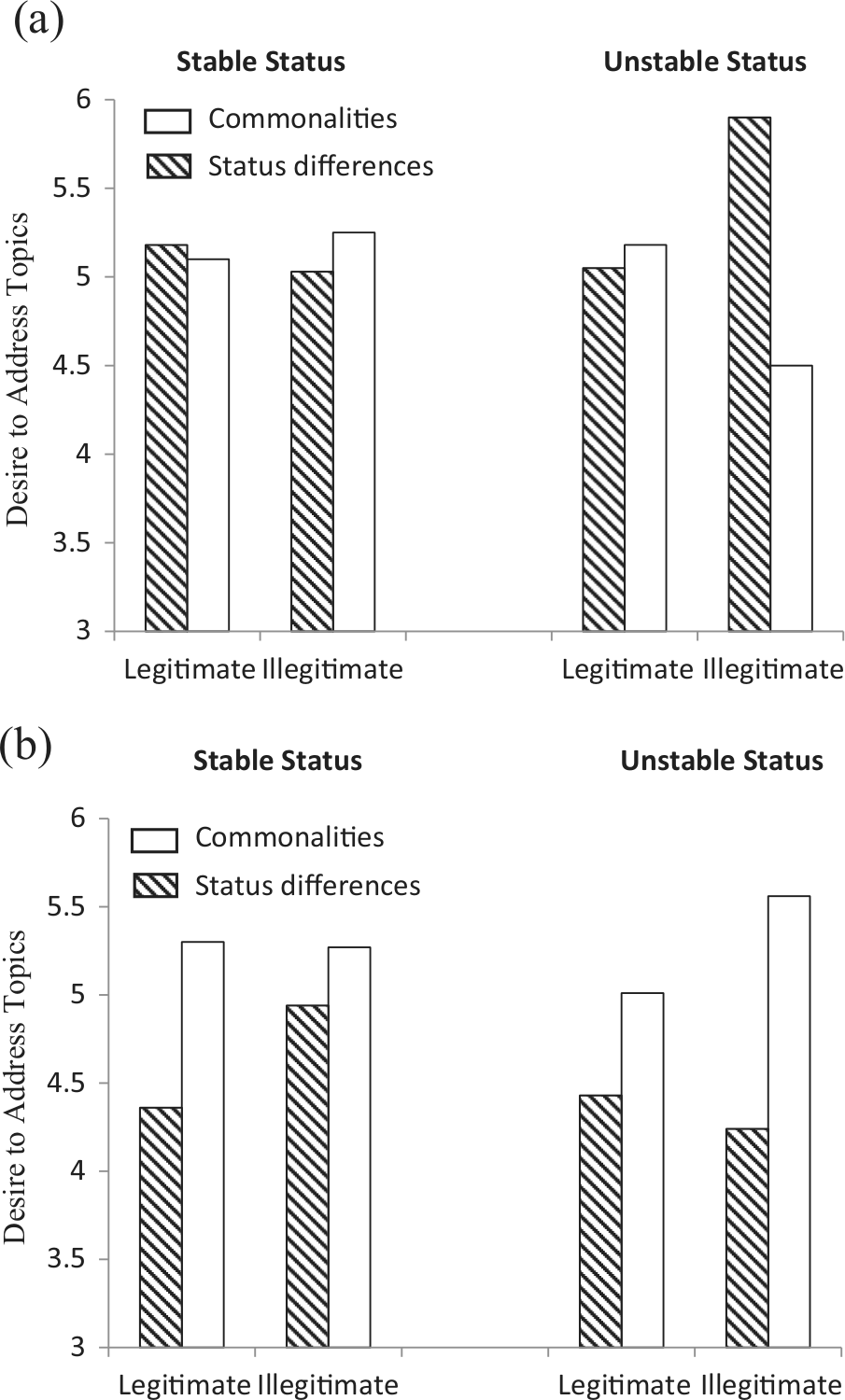
Desire to address commonalities and status differences as a function of the stability and legitimacy of status relations.
As in Study 1, the analysis for the commonality topics did not reveal significant effects and indicated a generally strong desire to address commonalities during intergroup contact. Although the Stability × Legitimacy interaction for the desire to address status differences did not reach significance (p = .17), planned comparisons between the desire to address status differences and commonalities in each of the four different conditions were fully in line with our predictions and with the findings from Study 1. Specifically, the smallest difference in preference to talk about commonalities (M = 5.27, SD = 1.10) relative to status differences (M = 4.94, SD = 1.00), which was not significant, was in the illegitimate but stable condition, F(1, 23) = 0.94, p = .342, ηp2 = .04. However, in the illegitimate and unstable condition, high-status group members preferred to talk about commonalities (M = 5.56, SD = 0.71) significantly more than status differences (M = 4.24, SD = 1.39), F(1, 17) = 9.87, p = .01, η p 2 = .37. Thus, as in Study 1, the willingness to address commonalities and issues related to status differences was, again, apparent only when status relations were illegitimate and stable. Under unstable status hierarchy, information about illegitimacy of one’s status produced a clear desire to emphasize commonalities over status differences.
In the conditions in which the hierarchy was legitimate, high-status participants in the legitimate-stable condition preferred to address commonalities over status differences (M = 5.30, SD = 1.14 vs. M = 4.36, SD = 1.62), F(1, 24) = 4.95, p = .04, η p 2 = .10. Participants in the legitimate-unstable condition also tended to display a preference for addressing commonalities more than status differences (M = 5.01, SD = 1.01 vs. M = 4.43, SD = 1.03), F(1, 22) = 4.08, p = .06, ηp2 = .16.
Among participants assigned to the low-status condition, the 2 (Legitimacy: Legitimate vs. Illegitimate) × 2 (Stability: Stable vs. Unstable) × 2 (Topics: Commonalities vs. Status Differences) mixed-model ANOVA revealed only the expected three-way interaction, F(1, 83) = 5.21, p = .03, ηp2 = .06 (Figure 2a). The Legitimacy × Stability follow-up ANOVA on the desire to address status differences revealed a marginally significant interaction, F(1, 83) = 3.28, p = .07, ηp2 = .04. As expected, least significant difference (LSD) tests demonstrated that low-status group members showed the greatest preference to discuss status difference in the unstable-illegitimate condition (M = 5.90, SD = 0.96), significantly greater than in the unstable-legitimate condition (M = 5.05, SD = 1.24, p = .03) and the stable-illegitimate condition (M = 5.03, SD = 1.54, p = .03), and marginally greater than the stable-legitimate condition (M = 5.18, SD = 1.51, p = .07).
For the desire to discuss commonalities, a Legitimacy × Stability interaction was obtained, F(1, 83) = 3.88, p = .05, ηp2 = .05. As expected, low-status group members were least interested in discussing commonalities in the unstable-illegitimate condition (M = 4.50, SD = 0.98), significantly less than in the unstable-legitimate condition (M = 5.18, SD = 1.11, p = .02), the stable-illegitimate condition (M = 5.25, SD = 0.88, p = .02), and the stable-legitimate condition (M = 5.10, SD = 0.92, p = .05).
As we did for the high-status group, we further examined whether low-status participants’ had an equivalent desire to address status differences and commonalities within each of the four conditions defined by the combinations of stability and legitimacy. The only condition in which members of the low-status group showed a significant preference to address status differences (M = 5.90, SD = 0.96) over commonalities (M = 4.50, SD = 0.98) was the unstable-illegitimate condition, F(1, 21) = 28.58, p < .001, η p 2 = .58. Within the other three conditions, the desire to address commonalities and status differences did not significantly differ.
Discussion
Study 2 provided experimental support for our predictions regarding the contact preferences of high-status and low-status group members. When participants were randomly assigned to a high-status group, they had a clear preference to discuss commonalities over status difference, unless they saw the hierarchy as illegitimate and stable—a finding that is highly consistent with Study 1 involving a different sample and method. Moreover, the fact that members of both groups in Study 2 were students at the same university, who were randomly assigned to believe they would be interacting with students from either a lower status institution or a higher status institution, makes these results particularly compelling.
When students were randomly assigned to be low in status, and believed the status relations were unstable and illegitimate, they showed a distinct preference to prioritize the discussion of status differences over commonalities. In all other conditions, low-status group members displayed the pattern we found in our previous work (Saguy et al., 2008) of wanting to discuss commonalities and status differences to similar extents. Demonstrating that when their status was most insecure, low-status group members wanted to address status differences the most, corroborates the strategic value of discussing status difference in intergroup encounters to advance change. Moreover, their particularly weakened desire to address commonalities in this condition suggests that low-status group members realize that harmonious atmosphere with the high-status group might sometimes undermine, rather than promote, their group’s interests. Under conditions that can facilitate social change, members of low-status groups might want to actively compromise intergroup harmony in favor of advancing elements of intergroup competition by raising attention to status differences. Addressing commonalities might be indeed effective for securing cooperation with the high-status group—but this cooperation becomes significantly less relevant when the low-status group can advance on its own.
General Discussion
Contact theory is of the most widely studied and applied contributions of social psychology to ameliorating problems associated with intergroup tension (Pettigrew, 1998; Pettigrew & Tropp, 2006). Traditionally, however, contact research has devoted only limited attention to the ways in which differences in group status influence the dynamics of intergroup encounters (Tropp & Pettigrew, 2005). The current work complements recent efforts (Dixon, Tropp, Durrheim, & Tredoux, 2010; Saguy et al., 2009; Wright & Lubensky, 2009) to investigate the role that group status plays in intergroup contact. Consistent with our previous research (Saguy et al., 2008), we found that people have different preferences for the content of contact as a function of their group’s status. Whereas members of high-status groups want to primarily emphasize commonalities between the groups while de-emphasizing issues related to status differences, low-status group members wish to address commonalities and status differences. Extending this previous work, the current experiment provided the first empirical support for the notion that group interests, derived from social identity, largely account for these group-based patterns.
Our findings revealed distinct patterns of preferences for the content of contact among members of high-status and low-status groups, as a function of stability and legitimacy, perceived (Study 1) and manipulated (Study 2). Replicating previous work (Bikmen & Sunar, 2012; Saguy et al., 2008), we found that across different methodologies, national samples, and intergroup contexts, high-status group members preferred to emphasize commonalities over status differences in intergroup encounters. However, across studies, there was one segment of the high-status group who had an equivalent desire to address commonalities and status differences: those who saw their advantaged status as morally wrong (illegitimate), but the hierarchy in general, as rather stable. Perceptions of illegitimate advantaged did not produce a willingness to address status differences among those who thought the inequality is narrowing. For them, the insecurity of their position seemed to have dominated their contact preferences over legitimacy-related concerns. These findings further our understandings of reactions to illegitimate advantage. When status differences are considered stable, members of high-status groups may be willing to address status differences because their advantage is not threatened. Discussing inequalities in this condition may not jeopardize their group’s higher status and could, in fact, further serve them by meeting their basic psychological need for moral acceptance (Shnabel & Nadler, 2008). This pattern of findings suggests that when members of high-status groups recognize injustice, the kinds of actions they would be willing to take to amend it may be limited in ways that do not threaten the advantaged status of their group overall. If such efforts are token efforts, they will relieve feeling of guilt among members of high-status groups and enhance perceptions of fairness among members of low-status groups-processes which may solidify existing status relations (Wright, 2001).
Given our findings for the high-status group, future research might investigate how members of high-status groups actually discuss issues related to status differences in intergroup interactions when status relations are illegitimate and either stable or unstable. It could be the case that, under conditions of unstable status relations, status differences are discussed in ways that could relegitimize, rather than challenge, the status relations. Future research might thus include topics about status differences that would either lead to greater sensitivity to unfairness (e.g., to discuss how historical or economic forces contribute subtly to disadvantage) or are likely to produce system-justifying dialogue (e.g., how differences in effort or motivation may underlie current status differences).
We further replicated our previous work when examining the findings for the low-status group in Study 2, showing an equivalent desire to address commonalities and status differences. Importantly, however, Study 2 revealed that this dual-preference does not hold for one particular case, when the status hierarchy was unstable and illegitimate. In that condition, low status group members had a particularly heightened desire to emphasize status differences,and to deemphasize commonalities. Interestingly, for the high-status group, their preference to emphasize commonalities over status differences seemed to have been most pronounced in that very same condition of unstable and illegitimate heirarchy. The fact that in this condition, high-status group members’ preference for the content of contact contrasted sharply with that of members of low-status groups further corroborates the strategic value of discussing status difference and commonalities for serving status-based interests. As work by Scheepers and colleagues (2006) suggests, the motivation of high-status groups to maintain their advantage may be expressed in subtle ways that do not arouse the reactance of members of low-status groups. Presumably, in this condition of increased insecurity to one’s status, members of high-status groups would strive to show positive attitudes and feelings toward members of the low-status group, but these positive orientations might not necessarily translate into actual efforts to promote equality between the groups (Saguy et al., 2009).
Together, our findings point to the value of investigating the impact of insecure status relations not only on how people approach intergroup contact but also on how they actually behave and are affected by different types of encounters. It could be the case that under insecure status relations, encounters that focus on commonalities would be particularly ineffective for promoting positive intergroup relations because low-status group members may wish to actively change the topic of the encounters. Future research, combining also observational methods, can be highly informative in detecting the actual content that comes to dominate intergroup encounters and the subsequent outcomes of such encounters. This type of work can also shed light on unresolved issues in the contact literature concerning the reasons for why contact is less satisfying for members of low-status than high-status groups (Gaertner, Rust, Dovidio, Bachman, & Anastasio, 1996) and why it is less effective for improving the attitudes of members of low-status than high-status groups (Tropp & Pettigrew, 2005).
In conclusion, the present research reveals how group status and the structural elements associated with status can critically shape the ways by which people approach intergroup encounters. Our finding suggests that the different contents we identified indeed have a strategic value that is utilized to different extents by group members, depending on what the social contexts afford. When change is possible and justifiable, a commonalities focus, which has been traditionally considered to be the hallmark of optimal contact, is less utilized by members of low-status groups. Under these conditions, harmony might not be effective or may even compromise attempts to advance change. Thus, a focus on cooperative elements can be successful in inducing a pleasant atmosphere, yet, under certain conditions, it might better serve the interests and goals of members of high-status groups than of low-status groups (see also Dixon et al., 2010, Dixon et al., 2012; Dovidio, Gaertner, & Saguy, 2009). Recognizing the different ways by which high-status and low-status group members may approach and be affected by contact is of crucial importance when considering the wide implementation of contact interventions (Brown & Hewstone, 2005; Paluck & Green, 2009). If such interventions inadvertently work to serve the needs of one group over the other, they may ultimately do little to advance more positive intergroup relations. Understanding the complexity and range of consequences of what is typically considered “optimal” contact is thus essential for creating a society that is inclusive and just in structure and practice, not only in principle.
Footnotes
Declaration of Conflicting Interests
The author(s) declared no potential conflicts of interest with respect to the research, authorship, and/or publication of this article.
Funding
The author(s) disclosed receipt of the following financial support for the research, authorship, and/or publication of this article: This research was partially supported by Marie Curie FP7 Reintegration Grant awarded by the European Union to the first author.