




Abstract
The threat of terrorist attacks motivates emotional reactions that elicit functional behavioral responses to characteristics of a threatening group. We argue that the more the group is seen as unjust, the more anger arises, whereas the more it is seen as powerful, the more fear arises. In Experiment 1, British participants read about terrorist groups with varied levels of injustice and power. As expected, the manipulation of injustice increased anger, and power increased fear. Anger and fear predicted offensive and defensive reactions. Experiment 2 used a representative sample of U.S. residents and again found distinct effects of an injustice manipulation on anger, and a power manipulation on fear. Anger was a primary motivator of support for offensive and defensive measures in both experiments. Willingness to negotiate was reduced with more injustice and anger, but increased with more outgroup power and fear. These findings have implications on public reactions to terrorist organizations.
International terrorism has become a realistic and symbolic threat (see Crowson, 2009) that lingers daily over people’s lives. Research has shown that making a specific, imminent, terror threat salient increases concern for homeland security (Willer & Adams, 2008), while changes to terror threat levels increase support for leadership (Willer, 2004). Thus, even without an actual enacted attack, threats of terrorism can play an important role in intra- and intergroup processes. And emotional responses to this kind of threat can give important insights into how people handle threatening outgroups in general.
Our research investigates how specific aspects of threatening terrorist groups elicit the emotional reactions of anger and fear, and corresponding behavioral intentions. Overall, we see two aspects of the larger construct of “threat” as being particularly important in distinguishing anger from fear. First, the extent to which a threatening group is seen as unjust—that is, acting intentionally and without provocation—is one aspect of threat that principally influences feelings of anger. Second, the amount of power the group is seen as having is another aspect of threat that principally influences fear. Whereas previous research has investigated the role that emotional reactions to terrorist attacks play in eliciting retaliatory behavior, we investigate how threatening foreign groups, as read in the news or implied through terror threat warnings, elicit preemptive behavioral intentions to engage, confront, or avoid the threat.
Threat Appraisals and Emotion
It is now well established that people can feel emotions in response to groups that threaten the well-being of their own group (Mackie & Smith, 2002). Some approaches to the study of group-based emotion have investigated reactions to specific intergroup interactions, exploring how social categorization and identification (see Dumont, Yzerbyt, Wigboldus, & Gordijn, 2003), or appraisals of specific intergroup events impact emotional experiences (see Mackie, Devos, & Smith, 2000). Other approaches have investigated how more stable perceptions of intergroup relationships influence the emotions people feel toward outgroups (see Cottrell & Neuberg, 2005; Cuddy, Fiske, & Glick, 2007). Cuddy et al. (2007), for example, investigated how another group’s general intentions (helping or harming; competing or cooperating) and ability to enact those intentions (status or power) elicit stable stereotypes, emotional reactions, and behavioral intentions.
Most research that has investigated group-based emotional reactions to terrorism has investigated how anger and fear in response to specific terrorist attacks elicit specific behavioral consequences. Less research has investigated what elicits those emotional reactions and intended responses in the absence of an enacted threat. Like Cuddy et al. (2007), we contend that when a threat is impending rather than enacted—when there is no specific event to appraise—individuals are likely to appraise stable characteristics of a group whose existence has negative consequences for the ingroup’s interests. These appraisals should impact both emotional reactions and behavioral intentions.
Anger and Injustice
Theorists as far back as Aristotle have recognized the role of perceived injustice in the elicitation of anger. Aristotle (322 B.C.E./1926) claimed that anger was “a longing, accompanied by pain, for a real or apparent revenge for a real or apparent slight, affecting a man himself or one of his friends, when such a slight is undeserved” (p. 173). Anger has been shown to respond to perceptions of unfairness (Ellsworth & Smith, 1988; Roseman, Spindel, & Jose, 1990), and indeed, people most commonly respond to injustice with feelings of anger (Clayton, 1992; Mikula, Scherer, & Athenstaedt, 1998). A recent meta-analysis, too, shows that anger plays a key role in reactions to injustice, motivating support for collective action (van Zomeren, Postmes, & Spears, 2008). Likewise, research in the intergroup domain has shown a connection between anger and the perception of a group’s actions as intentional and unfair, in contexts such as international aggression and academic politics (e.g., Gordijn, Wigboldus, & Yzerbyt, 2001; Gordijn, Yzerbyt, Wigboldus, & Dumont, 2006).
In general, perceptions of injustice are an important component of threat because they add information to that provided by assessments of the group’s raw power to achieve its goals. A group that acts unjustly against one’s own group shows itself to be without moral restraint, either internal or external. Regardless of its power, it is likely to prove a persistent threat. Justice, however, is a multifaceted construct, perceptions of which can be influenced by a variety of factors.
One factor that increases perceptions of injustice is intent. Miller (2001), for example, links the malicious intent underlying an offense to the extent to which it is perceived as unjust, and therefore the extent to which it elicits anger. Likewise, moral judgments often involve blame and culpability, which in turn rest on intentionality (Quigley & Tedeschi, 1996; Weiner, 1995). Several neuroscience and developmental studies have linked intentionality judgments to fairness concerns (e.g., Castelli, Massaro, Sanfey, & Marchetti, 2010; Güroğlu, van den Bos, Van Dijk, Rombouts, & Crone, 2011). Other recent research has shown anger, unlike disgust, to respond to an agent’s intentionality in a moral judgment (Russell & Giner-Sorolla, 2011). This suggests that if a group is appraised as posing an intentional threat, it will be appraised as unjust and anger may arise as a functional motivator to ward off attack through any means necessary.
Provocation has also been linked to justice perceptions, with harmful actions that are seen as a response to provocation being perceived as more justified (e.g., Tedeschi, Smith, & Brown, 1974). If a group’s hostility has been provoked, it may be seen as more justified in its threat, and anger may be reduced accordingly.
Fear and Power
Smith, Cronin, and Kessler (2008), in a correlational study, found that injustice and intentionality-related appraisals best predicted anger in a collective pay dispute, while assessments of ingroup coping potential best predicted fear. In fact, a number of empirical studies (e.g., Roseman, Antoniou, & Jose, 1996; Scherer, 1997) have shown that fear corresponds to a perception that one has low coping potential for dealing with a negative situation. When an assessment of coping potential is focused on a threatening group, it is most important to find out how much power the group has to enact its threat. Thus, we argue that the more ability a group has to enact its threat—the more power, resources, and support it has—the more it will instill fear in relevant outgroups. A threatening group is, after all, one which can cause harm to my group. One which also has power and resources is significantly more likely to be able to do so.
Emotions and Behavioral Reactions to Threats
Research investigating reactions to terrorism has shown that anger and fear result from terrorist attacks, and that the two emotions are somewhat correlated (see Skitka, Bauman, & Mullen, 2004). Cheung-Blunden and Blunden (2008) showed that anger mediates the effect of many terrorism-related attitudes on support for war, post September 11. Likewise, Sadler, Lineberger, Correll, and Park (2005) showed that people who responded to terrorist attacks with anger endorsed an aggressive military response, blaming the September 11 attacks on fanaticism and poor security. In contrast, people who experienced more fear were uncomfortable with the idea of strong military responses (see Sadler et al., 2005). This fits with the findings of Skitka, Bauman, Aramovich, and Morgan (2006), whose U.S. participants post September 11 supported aggressive action against terrorists, the more anger they felt, and defensive actions against them (e.g., expulsion from the country), the more fear they felt.
Thus, it seems that in response to terrorist attacks, anger elicits aggressive responses, whereas fear elicits a desire to avoid the terrorist group. However, Skitka et al. (2004) found that both anger and fear elicited political intolerance, although they did so through different pathways. In addition, other evidence from studies of intergroup emotions shows that anger can also be associated with avoidant responses (Plant, Butz & Tartakovsky, 2008; Yzerbyt et al., 2003), and fear with aggressive ones (Spanovic, Lickel, Denson, & Petrovic, 2010). Therefore, the fear–avoidance and anger–aggression links are not universally supported at the intergroup level.
Maitner, Mackie, and Smith (2006) argued that enacting an emotionally motivated behavioral intention (e.g., aggressing against a terrorist group when feeling anger) regulated emotional reactions (e.g., reducing anger) by effectively eliminating the underlying threat. Thus, we argue that characteristics of a lingering threat may largely determine how individuals will want to behave. Because our work investigates how emotions elicit behaviors aimed at preventing—rather than reacting to—attacks, we anticipated that characteristics of the threat would influence which behaviors could functionally reduce threat. We explored how perceptions of the injustice and power of terrorist groups, and resulting anger and fear, influenced desires to engage, avoid, or confront threatening groups. In the context of a threat that has not been enacted, as opposed to one that has, any characteristics of a group that increase the likelihood that it would attack (power and injustice) might increase defensive (i.e., avoidant) and offensive (i.e., confrontational) responses via the mediators of anger for injustice, and fear for power. However, negotiation is likely to be affected differently. If a group is seen as unjust, it is unlikely to play fair in negotiation, so these perceptions should work against support for negotiation, via the mediator of anger. Power and fear, if anything, may work to increase support for negotiation, increasing the perceived importance of the threat.
Present Research
This article reports two experiments in which threatening group types were presented as having characteristics related to injustice and power. We predicted that when another social group is perceived as presenting a threat to the ingroup, fear will be predicted by the threatening group’s perceived power, and anger will be predicted by perceived injustice in the threatening group’s intent. We further predicted that while perceptions of power and injustice would independently increase perceptions of overall threat, specific aspects of the threat would be related to specific emotional reactions. We then explored how these characteristics influenced preventative intergroup behaviors.
Experiment 1 establishes the causal impact of these appraisals on emotions. In this experiment, British participants read descriptions of terrorist groups, ostensibly compiled by the intelligence agency MI5. We manipulated perceived injustice by varying the group’s intent to cause harm, as well as manipulating the power ascribed to these groups. We then measured emotional reactions as well as approach and avoidance intentions. In Experiment 2, a nationally representative sample of American citizens again read descriptions of threatening groups that varied in levels of injustice and power, and rated their support for negotiation with the group in addition to the variables measured in Experiment 1.
Experiment 1
Method
Participants and design
Participants were 60 students of British nationality at the University of Kent who participated in exchange for course credit. Participants were randomly assigned to the cells of a 2 (injustice: low versus high) × 2 (power: low versus high) between-subjects design.
Procedure
Participants came into the laboratory to participate in a study investigating perceptions of terrorism. They read a short article ostensibly taken from the BBC News website about the terrorist threat facing the United Kingdom. Care was taken to ensure the psychological impact of the manipulations by modeling the presentation style of bbc.co.uk, including a “page last updated” date and time, an annotated image, and an actual quote by (at the time) Home Secretary Jacqui Smith, “We now face a threat level that is severe. It’s not getting any less, it’s actually growing. The number of organizations and plots being monitored globally has increased dramatically over the past 2 years” (BBC News Online, 2006).
Participants next learned that “although most terror groups have a goal of reducing Western influence in their homelands, organizations vary widely in their size, access to resources, and behavioral goals.” Participants were told that analysts within MI5 had categorized hundreds of organizations into a few general types, and that they would be asked to evaluate some groups that “pose an imminent threat to British interests.”
Injustice manipulation
In this study, we manipulated the injustice of the threat by modifying the intent underlying the group type’s ideology. Participants read either the high injustice condition phrases—“these groups have a strong interest in causing harm to any Western interests either at home or abroad. These groups actively seek to harm individuals or organizations with ties to Western governments or organizations”—or the low injustice condition phrases—“this type of group tends to have little interest in causing direct harm to Western individuals or interests. Although their focus is not on harming Westerners, this group type’s actions ultimately have devastating consequences for Western individuals and businesses.”
Power manipulation
Next, participants read either the high power condition phrases—“[t]his group type is comprised of groups with large numbers of wealthy members, and good access to finances and weapons” or the low power condition phrases—“[t]hese types tend to be small groups of poorer guerrilla fighters, with fewer resources to serve their harmful goals.”
Emotions
Participants were next asked to indicate, as a British citizen, the extent to which they felt a variety of emotional responses toward their group type using 7-point Likert-type scales (1 = not at all, 7 = very much). Out of these 18 responses, which included measures of disgust, hatred, and confusion, we focused on the theoretically relevant constructs of anger and fear. We analyzed participants’ response of anger toward (angry at, rage at, frustrated by, furious at, irritated by, and outrage toward, α = .93) and fear of (frightened of, fearful of, scared of, afraid of, 1 α = .94) the presented group type. These scales were correlated at r = .44, p < .001.
Behavioral intentions
Participants then reported on similar scales the extent to which they wanted to aggress against (be verbally aggressive toward, retaliate against, punish, and be physically aggressive toward, α = .82) and avoid (stay away from, reject, distance myself from, and avoid, α = .86) the group type. These two intentions were correlated, r = .34, p = .008.
Appraisals and threat evaluation
Four items using similar 7-point scales assessed perceptions of general threat: “This group type is a danger to my group,” “This group type is of no great concern to my group” (reversed), “I think this group type is damaging as a whole,” and “This group type is harmful to my group,” (α = .87). Four items measured appraisals of intent: “This group type operates with clear goals in mind,” “This group type’s actions are unplanned” (reversed), “This group type carries out actions unknowingly” (reversed), and “This group type’s actions are deliberate” (α = .70). Four more such items assessed power: “This group type will have a significant impact on my group,” “My group will be unaffected by this group type” (reversed), “This group type will have little effect on my group” (reversed), and “This group type is influential on my group” (α = .76). Finally, four more items assessed the injustice of the group’s actions (“This group type is acting outside their rights in society,” “This group type has good reason for doing what they do” [reversed], “This group type is justified in what they do” [reversed], and “This group type’s behavior is inexcusable,” α = .80). Participants then reported demographic information before being thanked and debriefed.
Results
Appraisals
Threat
A 2 × 2 general linear model (GLM) analysis of participants’ threat appraisals revealed main effects of injustice, F(1, 56) = 14.03, p < .001,
Power
To check the power manipulation, power appraisal scores were subjected to a 2 (injustice) × 2 (power) ANOVA. Analysis revealed only the predicted main effect of the power manipulation, F(1, 56) = 18.54, p < .001,
Injustice
A similar analysis of injustice appraisals revealed only a main effect of injustice manipulation, F(1, 56) = 10.34, p = .002,
Emotions
To investigate the experimental effects of injustice and power on participants’ anger and fear, emotions were subjected to 2 (injustice) × 2 (power) GLM analyses. Each analysis controlled for the other emotion as a covariate because of the correlation between anger and fear, as already noted.
Anger
Analysis of anger controlling for fear revealed an effect of the covariate, F(1, 55) = 8.62, p = .005,
Fear
Analysis of fear controlling for anger revealed an effect of the covariate, F(1, 55) = 8.62, p = .005,
Behavioral intentions
Next, we subjected behavioral intentions to 2 (injustice) × 2 (power) ANOVA.
Aggression
Aggressive intentions showed a main effect of injustice, F(1, 56) = 6.48, p = .01,
Avoidance
Analysis of avoidance intent also revealed a main effect of injustice, F(1, 56) = 6.19, p = .02,
Relations among appraisals, emotions, and behaviors
To clarify how emotions responded to perceptions of power, intent, and injustice, we ran regression analyses collapsing across conditions and predicting the emotion variables from appraisals of power, intent, and injustice, controlling for the other emotion as before; both emotions were significant predictors of the other. Anger was predicted only by perceived injustice of the group’s actions (β = .43, p < .001) and not by any other appraisal (both p > .30). Fear was predicted only by perceived power of the group (β = .47, p <.001) and not by any other appraisal (both p > .30).
We also ran regression analyses collapsing across conditions and predicting the behavioral intention variables simultaneously from anger, fear, and appraisals of power, intent, and justice. Aggressive intention was predicted by feelings of anger (β = .50, p < .001) and by injustice (β = .29, p = .02). No other predictors were significant (all p > .28). Likewise, avoidance intention was predicted by feelings of anger (β = .52, p < .001) and marginally by injustice (β = .23, p = .07). No other predictors were significant (all p > .55).
Finally, we ran mediation analyses using the PROCESS bootstrapping macro for SPSS (Hayes, 2013), with 5,000 resamples, testing anger and fear as mediators between each of our manipulations (coded 0 for low and 1 for high) and each of our outcomes (aggressive and avoidant intention). As with our other analyses, we included as a covariate the emotion not being used as a mediator, and also covaried out the manipulation not being studied in the analysis.
These analyses are presented in Figure 1, with the total zero-order effect of manipulation of outcome broken down into direct effect and indirect effect via the mediating path, and all three of these coefficients for each of the eight analyses presented in a grid below the illustration. The only significant mediating path between a manipulation and behavioral intention outcome was between the injustice manipulation and aggressive action tendencies, via anger. To test an alternative mediation model, we also ran similar analyses with the same variables, but with mediator and outcome switched, so that action tendencies were tested as mediators and emotions as outcomes, and controlling for the other actions and the other contrast. However, none of these yielded a significant indirect path, all confidence intervals including zero.
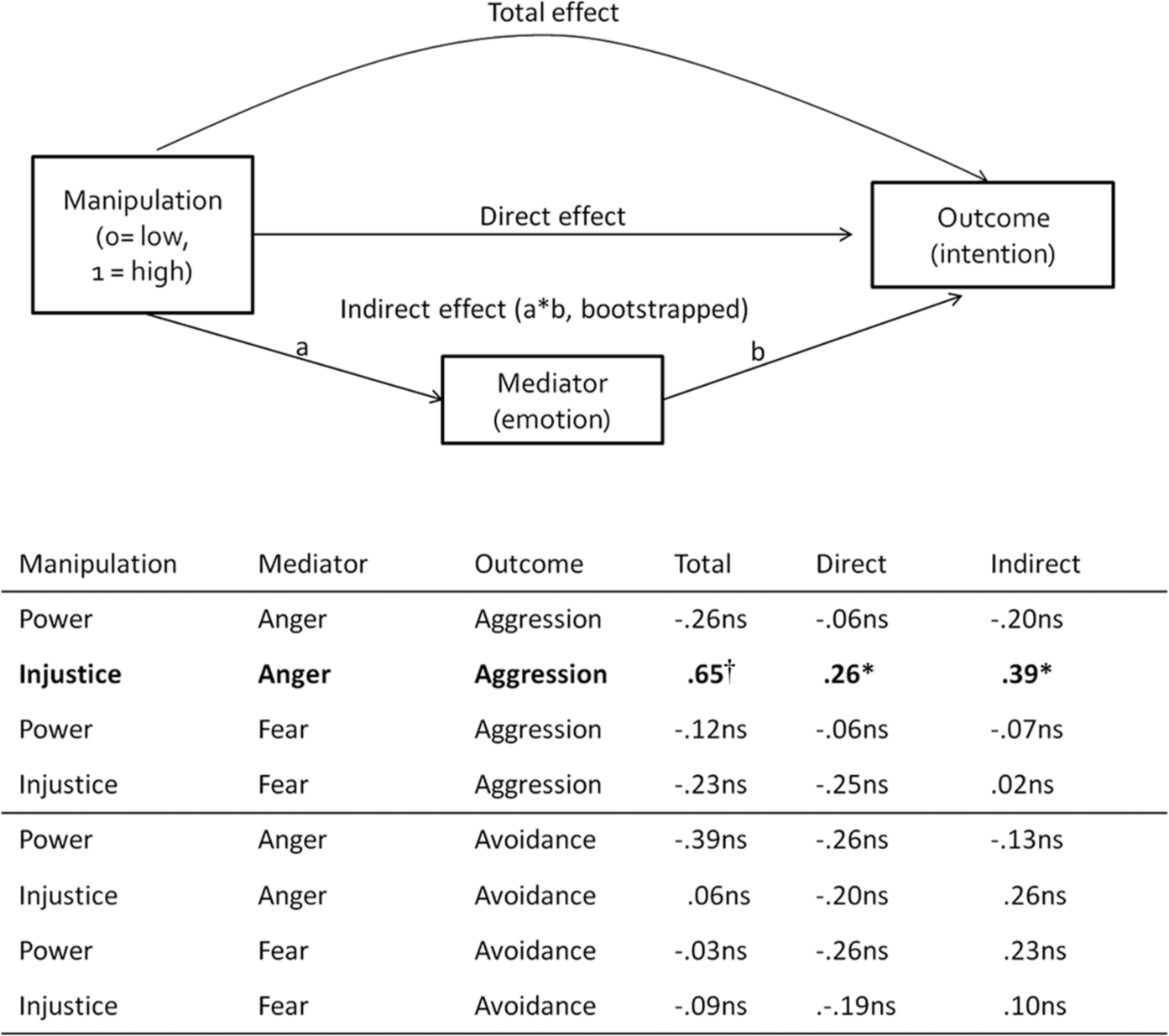
Mediation analysis: emotions as mediators between injustice manipulation and behavioral intention outcomes, Experiment 1.
Discussion
These results provide initial support for the idea that, in response to looming threat, anger emerges from perceptions of injustice, whereas fear emerges from the power a group has to cause us harm. But, in contrast to findings from some previous research, we found that anger was related to intentions to confront and avoid a threatening group, although it only mediated between the injustice manipulation and confrontational intentions. In contrast, fear was unrelated to both intentions. We will give a fuller reflection on these findings in our “Discussion” of Experiment 2.
Experiment 2
Our second experiment was conducted on a nationwide online sample in the United States as part of the Timesharing Experiments in the Social Sciences (TESS) program, using a research panel sample representative of the U.S. population maintained by Knowledge Networks, Inc. By using a general-population sample, we hoped to overcome the well-known limitations inherent in using a student sample, including lack of representativeness, greater awareness of psychological theory, and more liberal attitudes than the general population (Sears, 1986).
In Experiment 2, we also added a more sophisticated manipulation of perceived injustice. Modifying the intention-based manipulation of injustice in Experiment 1, we added an intermediate level in which harm was intentional but was a response to provocation. Participants in a “high injustice” condition learned that the target group wished to harm the United States intentionally, without provocation; in a “moderate injustice” condition, the target group wished to harm the United States intentionally, but in revenge for what it saw as the past exploitation by the United States; finally, in a “low injustice” condition, the target group harmed the United States, but unintentionally.
Our Experiment 1 found that only injustice and anger predicted aggressive and avoidant intentions toward impending threat, unlike previous studies of enacted terrorist violence (i.e., Skitka et al., 2006). In Experiment 2, we represented behavioral intentions with items more similar to those in other research, asking for specific national-level policy recommendations rather than general action intentions. We also used this opportunity to assess a new behavioral intention: negotiation with the threatening group. Negotiation is a policy option not previously assessed in the literature on emotion and terrorism, to our knowledge.
The international relations literature suggests two considerations concerning negotiation with terrorist groups (e.g., Bapat, 2006; Pruitt, 2006). First, if negotiation is seen as dealing with people who unjustly wish destruction on one’s own nation, it may be categorically excluded as an immoral and foolish option. For this reason, we supposed that negotiation would be a less favored option the more unjust the terrorist group’s cause, and the more anger felt toward it. Second, negotiation is a pragmatic measure often resorted to when a group is doing harm but is otherwise hard to influence. Because of this, it was possible that greater power ascribed to a terrorist group, and greater fear about it, might underlie greater support for negotiation.
Method
Participants and design
Participants were 1,072 U.S. citizens who were members of a Knowledge Networks research panel, forming a weighted stratified sample representative of the U.S. population (for further details see Knowledge Networks, Inc., 2011). The questionnaire was administered online, and the completion rate was 63.6% (i.e., 1,685 participants started the questionnaire), a rate comparable with the typical TESS completion rate of 65% (Freese, 2010). Among completed surveys, 52.1% of respondents were male, and 72.9% identified as White non-Hispanic, 8.7% as Black non-Hispanic, 10.7% as Hispanic, and 7.8% as Other or multiple race, non-Hispanic. The mean age was 48.78 (SD = 17.08).
Procedure
Participants were randomly assigned to one of 6 conditions of our 3 (injustice: low, medium, or high) × 2 (power: low or high) design. As in Experiment 1, participants were asked to read a vignette describing a type of group, then report their opinions and judgments.
Injustice manipulation
In the low injustice condition, the group was described as harming U.S. interests unintentionally: These groups have little interest in directly harming American interests either at home or abroad. They are driven by their own interests, and don’t seem to worry about America. Even though their focus is not on harming Americans, these groups’ violent actions have very negative consequences for American people and businesses.
In the moderate injustice condition, the group was described as acting intentionally against the United States, but with provocation, in revenge for perceived U.S. injustice against its country: These groups have a strong interest in harming American interests either at home or abroad. They are driven by revenge, and believe that their country has been exploited by American companies and governments. These groups actively try to harm people or organizations with ties to America.
In the high injustice condition, the animosity against the United States was described as intentional and without provocation: These groups have a strong interest in harming American interests either at home or abroad. They are driven by hatred, and believe that America is evil and should be eliminated from the face of the earth. These groups actively try to harm people or organizations with ties to America.
Power manipulation
In the rest of the paragraph, participants in the low power condition learned that “[t]hese groups have few friends even within their own country, and tend to be small in size. They have almost no access to money or weapons.” Participants in the high power condition learned that “[b]acked by rich and well connected friends, these groups tend to be large in size. They have nearly limitless access to money and weapons.”
Dependent variables
Participants reported appraisals, emotions, and behavioral intentions in a blocked random order. They reported, as an American, how angry (angry, furious, outraged; α = .95) and afraid (afraid, fearful, worried; α = .93) they felt about the group using 7-point Likert-type scales anchored at 1 = not at all and 7 = very much. As in Experiment 1, these two factors were correlated, r = .67, p < .001.
Participants also reported appraisals of intent (“This type of group has clear goals to harm the USA,” “This type of group’s actions against the USA are not planned” [reversed], and “This type of group’s actions against the USA are deliberate”; α = .82), provocation (“This type of group was provoked into harming the USA,” “This type of group has no reason for acting against the USA” [reversed], “This type of group is responding to the actions of the USA”; α = .51), injustice (“This type of group is acting outside their rights,” “This type of group is acting fairly” [reversed], and “This type of group is committing injustice”; α = .74), and power (“This type of group is strong,” “This type of group is influential,” “This type of group is not very powerful” [reversed]; α = .79). Each appraisal was measured with 3-item Likert-type scales anchored at 1 = strongly disagree and 7 = strongly agree.
Behavioral intentions were measured with 2-item Likert-type scales in the same format. Participants reported support for aggression (“The USA should send troops to attack this type of group” and “The USA should spend money to fight this type of group’s influence”; r = .59, p < .001), defensive measures representing avoidant responses (cf. Skitka et al., 2006; “The USA should deport anyone who supports this type of group from America” and “The USA should spend money to increase security against this type of group”; r = .47, p < .001), or negotiation (e.g., “The USA should make a deal with this type of group” and “The USA should try to talk this group type out of harming America”; r = .31, p < .001).
Results
Appraisals
As manipulation checks, participants’ appraisals were subjected to 2 (power) × 3 (injustice) ANOVAs. Data for all cell means can be seen in Table 1.
Appraisals of Power, Injustice, Intent, and Provocation by Condition, Experiment 2.

Power
As expected, perceptions of power were strongly affected by the manipulation of power, F(1, 1056) = 359.38, p < .001,
Injustice
Also as expected, participants’ perceptions of injustice were significantly affected by the manipulation of injustice, F(2, 1053) = 85.18, p < .001,
Because the injustice manipulation varied intentionality of action and the unreasoning (i.e., unprovoked) nature of the action, we also investigated our more specific measures of intentionality and provocation.
Intent
Analysis again revealed a strong effect of the injustice manipulation, F(2, 1056) = 270.61, p < .001,
Provocation
Finally, we investigated appraisals of lack of provocation (i.e., high numbers indicated lack of perceived reason for the group’s hostility). First, it is important to note that the three-item measure was not highly reliable (α = .51). With that in mind, analysis revealed a significant effect of the injustice manipulation, F(2, 1051) = 4.35, p = .013,
Thus, it appears that we successfully manipulated perceptions of power and injustice. Although the manipulation checks were not fully independent, this is likely due, in part, to the very large sample size, which can make even very small effects statistically significant (Cohen, 1994). Importantly, all predicted effects were stronger than unpredicted ones by at least a factor of 10, indicating that perceptions were largely affected as intended.
We did not, however, find large differences in injustice between the moderate and high conditions, which varied the degree of provocation described. While participants accurately judged the moderate condition’s group as having more reasons for their violence than the high condition, both groups were seen as equally unjust.
Emotions
We next investigated how participants’ emotional reactions were affected by the power and injustice manipulations. To control for shared variance in the two emotions, which were correlated, we conducted ANCOVAs predicting each emotion from the manipulations while entering the other emotion as a covariate. Descriptive statistics can be seen in Table 2.
Anger and Fear by Condition, Experiment 2 (Means Adjusted With Other Emotion as Covariate).

Anger
Analysis of anger revealed a significant effect of the covariate, fear, F(1, 1052) = 688.55, p < .001,
To look internally at which components of injustice had independent influences on anger, we conducted a regression analysis (collapsing across condition) predicting anger, controlling for fear, from their appraisals of intent, provocation, injustice, and power. Power was not a significant predictor (β = .01, p = .75), but intent (β = .23), injustice (β = .19), and (lack of) provocation (β = .19) each made independent contributions to anger at p < .001.
Fear
Analysis of fear also revealed a significant effect of the covariate, anger, F(1, 1052) = 688.55, p < .001,
Behavioral intentions
To investigate the impact of the manipulations on group-level behavioral intentions, we submitted each measure to 2 (power) × 3 (injustice) ANOVAs. Cell means are shown in Table 3.
Behavioral Intentions by Condition, Experiment 2.

Attack
Desire to attack the threatening group was most strongly affected by perceptions of injustice, F(2, 1057) = 53.03, p < .001,
Avoidance
Desire to avoid the threatening group was also most strongly affected by perceptions of injustice, F(2, 1057) = 61.27, p < .001,
Negotiation
Participants’ desire to negotiate with the threatening group was also affected by injustice, F(2, 1056) = 11.20, p < .001,
Overall, our manipulation of power increased the desires to negotiate, avoid, and attack, while our manipulation of injustice reduced the desire to negotiate, but increased desires to avoid and attack a threatening group.
Relations among appraisals, emotions, and behaviors
Regression analyses simultaneously entering all appraisals and emotions as predictors of each of these action tendencies across the whole study further clarified the most immediate influences on behavioral intentions.
Anger (β = .26, p < .001) and fear (β = .11, p = .002) related to increased desire to attack, as did intent (β =.21, p < .001) and power (β =.18, p < .001). Anger again most strongly predicted avoidance (β = .35, p < .001), although fear (β = .11, p = .001), intent (β = .18, p < .001), injustice (β = .11, p < .001), and power (β = .14, p < .001) also played a role. Finally, fear was positively related to negotiation (β = .26, p < .001) while intent (β = −.19), lack of provocation (β = −.23), and injustice (β = −.19), each had independent negative relations to negotiation, p < .001. Anger, however, was unrelated to the desire to negotiate in this analysis (β = −.01, ns).
Finally, we carried out mediation analyses as in Experiment 1 to further understand how the emotions mediated between the manipulations and outcomes (Figure 2). The injustice manipulation was coded dichotomously, collapsing the high and moderate injustice conditions (which did not differ on the manipulation check) into one condition (coded 1) and coding the low injustice condition as 0. The power manipulation was coded, as before, 0 for low power and 1 for high power. These analyses show that although anger was a stronger mediator of the effects on aggressive and avoidant intentions than fear was, the emotions did mediate uniquely between their respective manipulations and both outcomes; that is, the effect of power was significantly mediated by fear alone, and the effect of injustice by anger, regardless of whether aggression or avoidance was the outcome. For negotiation, the analyses showed that anger and fear had opposing mediating effects. While fear responded to the manipulated power of the group and in turn was related to increased support for negotiation, anger responded to the manipulated injustice of the group and in turn was related to reduced support for negotiation. 3

Mediation analysis: emotions as mediators between injustice manipulation and behavioral intention outcomes, Experiment 2.
Discussion
In Experiment 2 we again found that while anger and fear were strongly correlated as two negative responses to threat, they also had independent relationships with other variables that corresponded to our predictions. Once the two emotions were statistically controlled for each other’s influence, then the threatening group’s power uniquely influenced fear, and the intentionality of its actions uniquely influenced anger.
We found only partial support for our prediction that participants would take into account whether a potential terrorist organization was motivated by a grievance against the United States, or by unprovoked hatred. In fact, the two conditions that varied this factor (moderate and high injustice) showed no difference in levels of anger or support for harm to the group. Importantly, however, there was more support for negotiation with a group if it had stated a grievance. This may be related to a greater influence of the group’s reasonableness in the specific context of negotiation.
Our regression and mediational analyses further supported the equivalence of aggressive and avoidant intentions, and their greater predictability from anger than fear, as was found in Experiment 1. A clearer mediational picture emerged in Experiment 2, possibly due to the higher number of participants, to sample differences (U.K. undergraduates vs. U.S. general population), or to differences in the measurement of aggression and avoidance in this study. The strongest indirect effects on aggressive and avoidant intentions involved anger in response to the injustice manipulations, whereas in Experiment 1, only aggressive intentions showed this mediation pattern. Also, smaller but significant mediation effects showed that fear, in response to power manipulations, also increased aggressive and avoidant intention.
Beyond this, we found evidence linking appraisals and emotions to support for negotiation under threat. Negotiation is not simply the opposite of attack, as shown by the effect of outgroup power, which increased the impulse to attack and to compromise with the outgroup. It seems that when people feel afraid of a threatening group, they want to negotiate and to a lesser extent, avoid and cause harm. By contrast, perceptions of injustice increased the impulse to attack but decreased the desire to make a deal. Interestingly, while the emotion of fear was related to increased desire to negotiate, our regression analyses showed that rejection of negotiation was mainly predicted by injustice and related appraisals; anger did not separately predict negotiation intentions, although it did mediate between the manipulation of injustice and (reduced) intention to negotiate.
We also investigated multiple kinds of information that could elicit perceptions of injustice from a threatening group. Intentionality clearly had a greater influence on perceptions of justice than did provocation. Because the manipulation check of provocation, while significant, was fairly low in reliability and weak in effect size, it may be that participants did not accept past exploitation by the United States as a legitimate reason. However, it may also be that, in the specific context where a group is seen as a future threat, pure intent is a much stronger cue to injustice than any rationale for the threat.
General Discussion
Across two experiments investigating reactions to terrorist threats, we found that the injustice underlying a perceived threat uniquely predicted the extent to which people felt anger toward an outgroup, whereas the threatening group’s perceived power predicted the extent to which people felt fear. In spite of correlations between anger and fear representing a common component of general negativity felt toward each group, when the separate influences upon each emotion were investigated, we found the predicted relationships between injustice and anger, and power and fear.
One finding that was consistently supported across both studies is that our manipulations of injustice had a clearer effect on broader judgments of injustice than on direct judgments of intentionality, even though the manipulations were based on descriptions that varied intentionality. In Experiment 1, the measure of intentionality was only marginally affected by the injustice manipulation, and was much more strongly influenced by the power manipulation (see Note 2). In Experiment 2, we attempted to additionally manipulate aspects of injustice other than intentionality but found that the greatest effects of perceived injustice were due to the contrast involving different levels of intent, and not the contrast involving different levels of justification. However, it is clear from the manipulation checks in both studies that varying intentionality successfully manipulated injustice perceptions. This is consistent with the well-established finding in the justice and morality literatures that perceptions of malicious intent are important in determining injustice perceptions (Miller, 2001) and moral blame (Cushman, 2008; Shaver, 1985). Indeed, Experiment 1’s questions asking about the intentionality of the group may have been interpreted too narrowly—of course the terrorists are literally aware of what they do in general—so the measures of injustice may have done a better job of capturing the specific perception that the terrorists intended to single out the ingroup for harm, which we believe to underlie the particular aspect of threat that provokes anger.
It might also be noted that the varied descriptions in the injustice manipulation happened to intensify the description of the target group’s intentions (i.e., “They . . . believe that America is evil and should be eliminated from the face of the earth.”) and so might be seen as raising the level of threat as well as the level of injustice. In fact, as stated in the “Introduction,” we view acting unjustly as a form of threat in itself, because people who are unrestrained by justice concerns are more dangerous, so any “confound” between injustice and threat caused by more hostile description of the outgroup’s intentions is actually part of our theoretical structure. Indeed, in Experiment 1, a much more restrained description of hostile intentions succeeded in raising the level of perceived threat as well as injustice. Finally, because the manipulation successfully affected perceptions of injustice, which in turn affected anger even controlling for level of power perceived, we are confident that we are interpreting this manipulation correctly.
We also found that, in the context of impending menace from terrorist groups as opposed to a completed attack, it was principally anger that motivated offensive and defensive responses aimed at preventing future attack, while fear played a smaller and less consistent part in both responses. This contrasts with previous research on past terrorist attacks, which has found unique associations between anger and confrontation and fear and avoidance (see Skitka et al., 2006). Such contrasts should not be unexpected, as the behaviors that are likely to functionally prevent attack are not identical to the behaviors that are functional in response to attack. Importantly, characteristics of the looming threat, in particular, whether a group wanted to or could enact it, increased the extent to which individuals wanted to confront or avoid the threat. Negotiation intentions, in contrast, were heightened toward groups that might be perceived as more difficult to influence (i.e., groups high in power) or groups who may respond to a reasonable approach (i.e., groups low in injustice), consistent with work from the international relations domain (see Bapat, 2006; Pruitt, 2006).
Although our current data only allow us to speculate on why the emotion–action links might be different for impending versus enacted threats, one factor may be the uncertain nature of an impending threat. The terrorist groups that have successfully attacked the United States are relatively few compared with the number that would like to. Given this picture of numerous enemies who may or may not ever be worth noticing, it makes sense that the decision to take any action against them—offensive or defensive—should be motivated by a proactive, approach-oriented emotion such as anger. However, fear has been analyzed on an individual level as an emotion that responds reactively to a definite, visible danger (Rosen & Schulkin, 1998); if generalized to potential threat, it becomes a more pathological form of anxiety. Therefore, it makes sense that fear’s role in promoting defensive action should be more pronounced when the terrorist group is associated with definite and visible evidence of threat. This assertion, of course, could be tested more directly in the future.
It is possible that our behavioral effects may be moderated by appraisals of the ingroup’s strength and power. Although a strong threatening group may elicit fear in any target, a strong target may be better able to respond confrontationally, whereas a weak one may prefer an avoidance response. This possibility may also help explain apparent inconsistencies between the appraisal and emotion results reported here and in past research. Mackie et al. (2000), for instance, reported that the more power one’s own group was seen to have in comparison with a rival, the more the anger; the less relative power one’s own group was seen to have, the more the fear. Investigating the interaction between perceived ingroup and outgroup power—establishing a dominant or equal intergroup relationship—may help clarify the apparent discrepancy.
Although outside of our theoretical considerations for this research, another factor that may separate terrorism from other intergroup contexts is the nature of the threat posed by terrorist groups. Such threat can be seen as realistic (e.g., attacking the safety and resources of the ingroup) and symbolic (e.g., undermining ingroup cohesion and values). Stephan and Mealy (2011) speculate that realistic threats may arouse anger and fear more so than symbolic threats, which would arouse more morally relevant emotions such as contempt and disgust; Cottrell and Neuberg (2005) found that threats to values aroused disgust and anger, while threats to safety aroused anger and fear. While our research seems to have focused on emotions linked to realistic threat, a reasonable extension of these questions might seek to identify factors rooted in symbolic threat that would activate other negative emotions such as disgust.
Our findings have important implications for communication about various forms of threat. First, ubiquitous reminders of terror threat levels in the news, or through announcements at bus stations, airports, or other public venues are likely to serve as constant reminders of looming threat. When individuals focus on threats coming from specific groups known to harbor harmful intentions and have sufficient power to enact those intentions, individuals may feel anger and fear, and may marginalize or harm other individuals who are even only tangentially related to a threatening group (e.g., by subjecting Muslims to additional security screening or other forms of discriminatory treatment).
Results reported here also show that communications focusing on the power of threatening groups and their ability to cause harm are likely to elicit feelings of fear. Through the emotion of fear, they can lead to greater support for negotiation, but at the same time fear may also support hostile and discriminatory action against threatening groups. However, communications focusing on the unjust nature of threatening groups are likely to elicit feelings of anger, and desires to marginalize or confront them, without room for negotiation. Put together, these emotional results show that if the goal of terrorism is to cause concessions and capitulation through fear, increasing this fear does increase the desire to negotiate concessions. But, if terrorist groups are seen as acting intentionally and unfairly, this produces anger, together with unintended side effects of increased hostile measures and reduced support for negotiation. These side effects are only compounded by the strong correlations we found between the negative, high-arousal emotions of anger and fear, suggesting that to a large extent, the two emotions tend to be coactivated.
In conclusion, these studies provide a clear model of emotional reactions to terrorist threat: Even when anger and fear co-occur, anger aligns itself with justice concerns, while fear aligns itself with concerns about the power of the group. Our perspective on action readiness also suggests that the clearest division may not be between aggressive anger and defensive fear, but between confrontational approaches supported by anger, and conciliatory approaches that are positively related to fear but negatively related to anger. This model, we believe, can help shed light on collective reactions not just to threats from terrorist groups, but from international crises, and from factions within society that also pose threats to the ingroup.
Footnotes
Declaration of Conflicting Interests
The author(s) declared no potential conflicts of interest with respect to the research, authorship, and/or publication of this article.
Funding
The author(s) disclosed receipt of the following financial support for the research, authorship, and/or publication of this article: This research was partly funded by a partnership between Timesharing Experiments for the Social Sciences (TESS) and the Human Factors/Behavioral Sciences Division (HFD) of the U.S. Department of Homeland Security’s Science and Technology Directorate (Project TESS2-DHS04).