



Abstract
The present research examined when happy individuals’ processing of a counterattitudinal message is guided by mood-congruent expectancies versus hedonic considerations. Recipients in positive, neutral, or negative mood read a strong or weak counterattitudinal message which either contained a threat to attitudinal freedom or did not contain such a threat. As expected, a freedom-threatening counterattitudinal message was more mood threatening than a counterattitudinal message not threatening freedom. Furthermore, as predicted by the mood-congruent expectancies approach, people in positive mood processed a nonthreatening counterattitudinal message more thoroughly than people in negative mood. Message processing in neutral mood lay in between. In contrast, as predicted by the hedonic-contingency view, a threatening counterattitudinal message was processed less thoroughly in positive mood than in neutral mood. In negative mood, processing of a threatening counterattitudinal message was as low as in positive mood. These findings suggest that message processing is determined by mood congruency unless hedonic considerations override expectancy-based processing inclinations.
How does positive as compared with neutral or negative mood affect counterattitudinal message processing? Separate lines of research indicate that mood effects are contingent on whether counterattitudinal message processing is mood threatening or not. For example, whereas a counterattitudinal message on a tuition plan placing new burdens on students (Wegener, Petty, & Smith, 1995) may be highly mood threatening, a counterattitudinal message on constructing a shopping mall (Ziegler, 2013) may be hardly mood threatening. As results of one line of research suggest, happy mood (vs. neutral or sad mood) leads to little processing when a counterattitudinal message is mood threatening (Wegener et al., 1995; see also Bless, Bohner, Schwarz, & Strack, 1990; Worth & Mackie, 1987). Such findings are consistent with a hedonic-contingency view (HCV; Wegener & Petty, 1994), which holds that processing effort in positive mood may be guided by the motivational mechanism of mood maintenance (Clark & Isen, 1982). In comparison, results of a second line of research suggest that happy individuals evince more effortful processing than sad individuals when a counterattitudinal message is not mood threatening (Ziegler, 2013; see also Ziegler, 2010; Ziegler & Burger, 2011; Ziegler & Diehl, 2011). Such findings are consistent with a mood-congruent expectancies approach (MCA; Ziegler, 2010), which holds that processing effort in positive as well as negative mood may be guided by the cognitive mechanism of mood-based expectancies.
However, as yet no research has directly compared when counterattitudinal message scrutiny is affected by mood congruency (Ziegler, 2010) versus hedonic considerations (Wegener et al., 1995). To fill this gap, the current study investigates processing of a counterattitudinal message that either clearly threatens mood or hardly threatens mood. Whereas mood-congruent expectancies should guide happy and sad individuals’ processing of a nonthreatening counterattitudinal message as well as sad individuals’ processing of a threatening counterattitudinal message, hedonic considerations should determine happy individuals’ processing of a threatening counterattitudinal message. To test this proposition, we build on reactance research by presenting individuals a counterattitudinal message that either contains a threat to their freedom or does not contain such a threat (for overviews on reactance research, see Brehm, 1966; Brehm & Brehm, 1981; Miron & Brehm, 2006). In line with Brehm’s (1966) suggestion that “if the magnitude of reactance is relatively great, the individual may be aware of hostile and aggressive feelings as well” (p. 9), we assume that a freedom-threatening counterattitudinal message is experienced as more mood threatening than a counterattitudinal message not threatening freedom.
Notably, albeit reactance research has examined the role of various factors in regard to threat effects, the role of an individual’s current affective state when confronted with a threat to freedom (i.e., incidental affect) has not been considered to date. Rather, extant research has been conducted exclusively with participants in a nonmanipulated and thus presumably neutral affective state. Hence, after more than 40 years of reactance research, the current study appears to represent the first investigation to compare reactance effects in positive, neutral, and negative mood. In addition, existing research regarding threats to attitudinal freedom has not considered the role of the strength of arguments brought forward in a persuasive communication to justify an attitudinal stance (for an exception, see Smith, 1977). As numerous persuasion studies have shown, manipulating argument strength may help document the level of processing of a persuasive message (Eagly & Chaiken, 1993; Petty & Cacioppo, 1986), which has important ramifications regarding the lasting impact of resulting attitudes (e.g., Petty, Haugtvedt, & Smith, 1995). Thus, by manipulating the strength of arguments contained in a freedom-threatening message, the present research may also contribute to a better understanding of the processes involved in dealing with threats to freedom.
Mood and Processing Effort
Mood Maintenance and Message Processing
Early research on mood and message processing revealed that positive mood may lead to less effortful processing than neutral mood (Worth & Mackie, 1987) or negative mood (Bless et al., 1990). To account for such findings, early explanations focused on reduced cognitive resources in positive versus neutral mood (Mackie & Worth, 1991) and different signalling functions of positive and negative mood (Schwarz, 1990). However, research based on the HCV (Wegener & Petty, 1994) has shown that positive (vs. neutral or negative) mood does not always lead to reduced processing. Rather, happy individuals more likely choose their activities on the basis of the hedonic consequences of actions. In particular, to maintain their affective state, happy individuals eschew mood-threatening activities more than individuals in neutral or negative mood. Wegener et al. (1995) argued that previous research revealed little message processing in positive mood because these studies used counterattitudinal or depressing messages (e.g., fee increases, acid rain) which were presumably mood threatening. Hence, when message processing allows individuals to maintain their pleasant state or feel better, positive mood need not involve less message scrutiny than neutral or negative mood. Processing in neutral and negative mood, in comparison, is held to be less affected by hedonic considerations. Supportive evidence was found in two studies comparing positive mood with either neutral mood or negative mood (Wegener et al., 1995). For example, one study showed that happy individuals’ attitudes were affected by argument strength given an uplifting proattitudinal message, but not given a depressing counterattitudinal message. Processing by sad individuals, in comparison, was not contingent on the hedonic tone of the message (but see Handley & Lassiter, 2002).
Mood-Based Expectancies and Message Processing
Recently, Ziegler (2010) advanced a mood-congruent expectancies approach, suggesting a basic cognitive mechanism that affects the extent of processing by happy and sad individuals. The MCA is based on research revealing (a) wide-ranging and generalized mood-congruent expectancies (Mayer, Gaschke, Braverman, & Evans, 1992), (b) that mood-incongruent (vs. congruent) story outcomes are less expected (Egidi & Nusbaum, 2012; see also Egidi & Gerrig, 2009), and (c) heightened message processing given disconfirmed (vs. confirmed) expectancies unrelated to mood (Ziegler, Diehl, & Ruther, 2002). Integrating these findings, the MCA holds that happy as well as sad individuals may evince more effortful message processing when mood-based expectancies are disconfirmed (vs. confirmed; for details see Ziegler, 2013).
Initial support was provided by two studies showing that happy and sad individuals processed a message more thoroughly when source valence was mood incongruent (vs. mood congruent; Ziegler, 2010; see also Ziegler & Diehl, 2011). More important with respect to counterattitudinal message processing, Ziegler (2013) argued for distinguishing message valence (i.e., a message advocating a proattitudinal vs. a counterattitudinal position) from mood consequences of message processing (i.e., a mood-elevating vs. a mood-threatening message). Specifically, neither are all counterattitudinal messages profoundly mood threatening nor are all proattitudinal messages profoundly mood elevating. Rather, while some counterattitudinal messages may be clearly mood threatening, other counterattitudinal messages may be hardly mood threatening. Similarly, some proattitudinal messages may be clearly mood elevating; other proattitudinal messages may be hardly mood elevating. However, when a persuasive message is less mood relevant or mood irrelevant (i.e., hardly/not mood threatening or mood elevating), mood-management motives (Wegener et al., 1995) may be less important in regard to processing in positive mood than when a message is highly mood relevant (i.e., clearly mood threatening or mood elevating). Rather, mood-irrelevant message processing may be guided by mood-congruent expectancies.
Indeed, two studies provided evidence consistent with the assumption that a mood-irrelevant message endorsing a counterattitudinal (proattitudinal) position is less congruent with positive (negative) expectations in positive (negative) mood, and hence elicits greater message scrutiny, than a mood-irrelevant message endorsing a proattitudinal (counterattitudinal) position (Ziegler, 2013). For instance, in one study, participants’ premessage attitudes toward a mobile phone were manipulated, followed by mood induction. Afterwards, they were presented a persuasive message advocating the mobile phone. Thus, depending on premessage attitudes (positive vs. negative), message position was either proattitudinal or counterattitudinal. Results of both studies showed that attitudes and thoughts of happy individuals were affected by argument strength when a message advocated a counterattitudinal stance. When a message advocated a proattitudinal stance, however, happy individuals’ reactions were unaffected by argument strength. Conversely, attitudes and thoughts of sad individuals were affected by argument strength when a proattitudinal stance was advocated in the message, but not when a counterattitudinal stance was advocated.
Mood Congruency and Hedonic Contingency
Viewed together, existing findings suggest that the MCA and the HCV may complement each other (see Ziegler, 2013, for a discussion of the implications of the MCA for the cognitive-tuning extension of the mood-as-information approach, Schwarz, 1990, 2001, and the mood-as-a-resource approach, Trope, Ferguson, & Raghunathan, 2001). In particular, whether counterattitudinal processing is determined by mood congruency or by hedonic considerations may depend on the extent to which a counterattitudinal message is mood threatening. Mood congruency should determine processing effort in positive and negative mood given a counterattitudinal message that does not threaten (or hardly threatens) mood. In contrast, hedonic considerations should determine processing effort in positive mood given a counterattitudinal message that clearly threatens mood. Research on threats to attitudinal freedom may afford an opportunity to delineate when message scrutiny is affected by mood-congruent expectancies versus hedonic considerations.
Mood and Threats to Attitudinal Freedom
Numerous studies have shown that a threat to attitudinal freedom may lead to source derogation and reduced attitudinal agreement (e.g., Silvia, 2006; Wicklund & Brehm, 1968; Worchel & Brehm, 1970; Wright, 1986). These studies typically compare conditions with freedom-threatening statements (“high threat”) to conditions without freedom-threatening statements (“low threat” or “no threat”; e.g., Wicklund & Brehm, 1968; Wright, 1986). The advocated position may be proattitudinal, counterattitudinal, or attitudinally “neutral” for recipients.
In regard to mood and message processing, this suggests that a message advocating a counterattitudinal position with versus without freedom-threatening statements may allow delineating when either mood-congruency (Ziegler, 2010) or hedonic-contingency processes (Wegener et al., 1995) affect processing effort. Obviously, a counterattitudinal message should be incongruent with positive expectations in positive mood, and congruent with negative expectations in negative mood, irrespective of whether it threatens attitudinal freedom or not. However, counterattitudinal messages with versus without a threat to freedom may differ in the extent to which they are mood threatening. Specifically, it has been argued that threats to attitudinal freedom may elicit anger (Brehm, 1966; Dillard & Shen, 2005). Hence, a counterattitudinal message containing a threat to freedom may pose a greater threat to happy individuals’ mood than a counterattitudinal message that does not contain a threat to their attitudinal freedom. Thus, although a counterattitudinal message should be incongruent with positive mood irrespective of freedom threat, a freedom-threatening message may be more mood threatening than a message not threatening freedom. Hence, whereas a nonthreatening message should not evoke hedonic considerations, a threatening message should evoke hedonic considerations.
Processing of a Counterattitudinal Message Without a Threat to Freedom
When a counterattitudinal message that does not threaten freedom is hardly mood threatening, the MCA (Ziegler, 2010) predicts more effortful processing in positive mood than in negative mood. In regard to processing of a nonthreatening counterattitudinal message in neutral mood, the MCA does not make any predictions because the MCA is concerned exclusively with expectancies given positive or negative mood. Research conducted with participants in nonmanipulated mood, however, has often found that a counterattitudinal message is processed more thoroughly than a proattitudinal message (e.g., Cacioppo & Petty, 1979; Edwards & Smith, 1996). Such findings suggest substantial processing of a nonthreatening counterattitudinal message given neutral mood. In comparison with processing in positive or negative mood, a number of different outcomes are possible. Notably, two outcomes would be clearly inconsistent with the MCA: first, higher processing effort in neutral mood than in positive mood, as predicted by the cognitive capacity approach (Mackie & Worth, 1991); second, higher processing effort in negative mood than in neutral mood, as predicted by the mood-as-information approach (Schwarz, 1990). The most likely finding, however, is that processing effort in neutral mood lies in between negative and positive mood.
Processing of a Counterattitudinal Message With a Threat to Freedom
When a counterattitudinal message that threatens freedom is clearly mood threatening, predictions regarding positive mood effects on processing may be derived by the HCV. Specifically, while the MCA suggests that positive mood leads to effortful processing of a nonthreatening counterattitudinal message, the HCV suggests that positive mood will lead to decreased processing when this affective state is threatened. Hence, hedonic considerations may override happy individuals’ processing inclinations based on mood congruency when mood is threatened by additional freedom-threatening statements contained in a counterattitudinal message. In contrast, as hedonic sensitivity is assumed to be lower in neutral and negative mood, processing of a counterattitudinal message that threatens freedom and mood should be less affected by hedonic consequences in these affective states. Consequently, in neutral and negative mood, processing of a threatening counterattitudinal message should be similar to processing of a nonthreatening counterattitudinal message. Specifically, in negative mood, processing of a freedom-threatening and thus mood-threatening counterattitudinal message should be as reduced as predicted by the MCA in regard to a nonthreatening counterattitudinal message. Thus, low message scrutiny should be found in both positive and negative mood (cf. Handley & Lassiter, 2002), albeit resulting from different processes. In neutral mood, in comparison, the level of scrutiny given to a freedom-threatening message should remain relatively high (Cacioppo & Petty, 1979; Edwards & Smith, 1996).
Overall, this suggests that two specific comparisons are particularly informative. The first comparison concerns message scrutiny in positive versus negative mood given a counterattitudinal message without a threat to freedom. As predicted by the MCA, positive mood should trigger more effortful processing than negative mood. The second comparison concerns message scrutiny in positive versus neutral mood given a counterattitudinal message that threatens attitudinal freedom and mood. In line with the HCV, positive mood should lead to less effortful processing than neutral mood. Together, such findings would provide important direct empirical evidence that the MCA and the HCV complement each other, with hedonic considerations overriding processing inclinations in positive mood based on mood-congruent expectancies.
The Present Research
To test our predictions, positive, neutral, or negative mood was induced via a film clip. Participants then received a counterattitudinal message that consisted of strong arguments or weak arguments, and either contained freedom-threatening statements or did not contain such statements. In addition to attitudes, source perceptions and thoughts served to establish amount of processing. Persuasion research has found that source perceptions may be affected by argument strength (Reimer, Mata, & Stoecklin, 2004; see also Ziegler et al., 2002). Hence, similar to attitudes, source perceptions should be affected by argument strength in conditions predicted to elicit more than negligible amounts of message scrutiny.
With respect to thoughts, reactance research suggests that high threat to freedom provokes more negative thoughts than low threat to freedom irrespective of other factors involved in the experimental design (Dillard & Shen, 2005; see also Silvia, 2006). Noteworthy in this respect, Dillard and Shen (2005) analyzed only thoughts coded as negative; results on positive thoughts were not reported. Yet, existing research on threats to attitudinal freedom has used arguments of moderate strength (Silvia, 2006) or unknown strength (e.g., Dillard & Shen, 2005; Worchel & Brehm, 1970; Wright, 1986). Favorable thoughts, however, may be elicited in particular given substantial processing of strong arguments (Eagly & Chaiken, 1993; Petty & Cacioppo, 1986). Therefore, favorable message-related thoughts should show a similar pattern as attitudes and source perceptions.
Statistically, these predictions amount to an overall three-way interaction of mood, threat, and argument strength which should encompass specific two-way interactions of argument strength with positive versus negative mood given low threat, and of argument strength with positive versus neutral mood given high threat. Complementing these predictions, analyses within mood states should reveal an interaction of threat and argument strength solely in positive mood. In neutral mood, an argument strength effect should indicate heightened message scrutiny across (high vs. low) threat. In negative mood, finally, reduced processing across threat is expected.
Method
Participants and design
One hundred and seventy-one male students (age: M = 24.24; SD = 3.59) from the University of Tuebingen participated in the study in return for a small reward worth about 1.50 Euro. They were randomly assigned to one of the experimental conditions in the Mood (positive vs. neutral vs. negative) × Threat to Freedom (high vs. low) × Argument Strength (strong vs. weak) between-subjects factorial design.
Procedure and independent variables
Students were approached in the university cafeteria building and asked for participation in two independent studies. In a quiet area, up to four participants could take part in parallel. The ostensible first study concerned “processing of visual information.” Depending on condition, participants saw a movie clip eliciting neutral mood (from the movie “Hannah and her Sisters”), positive mood (“An Officer and a Gentleman”), or negative mood (also from “An Officer and a Gentleman”), respectively (Hewig et al., 2005). Embedded within several questions about the film clip were two items tapping whether participants felt happy and sad right now (1 = not at all happy/sad to 7 = very happy/sad). Responses on participants’ current mood were correlated (r = −.47, p < .001) and averaged (sadness-scores reversed).
The second study concerned decision making. Participants read a short introduction into the topic “Building of a new tunnel in Rotterdam” and asked to put themselves in the place of a Rotterdam citizen visiting the public information meeting and listening to the input that the source voiced there.
Forty students (age: M = 24.25; SD = 3.13) of a control group received similar instructions but indicated their attitude toward building the tunnel without being presented the source’s statement (1 = positive; 7 = negative; see attitude measure below). The sample mean was significantly lower than the scale midpoint of 4 (M = 3.33; SD = 1.33, t(39) = 3.22, p < .01), thus indicating that participants were favorably disposed to building the tunnel.
After an introductory remark of the source, participants in high-threat conditions read, “I want to say in advance that I already know I will convince you of my opinion.” This sentence was omitted in low-threat conditions. Depending on condition, the source then presented either two strong arguments or two weak arguments against the tunnel construction, selected on the basis of a pretest. Strong arguments referred to a 70% increase in traffic noise level for residents both during and after constructing the tunnel, and 50% higher maintenance costs when constructing a tunnel instead of an alternatively proposed viaduct. Weak arguments referred to slightly longer riding times during tunnel construction causing higher strain in car drivers, and a 5% higher risk of accidents in tunnels with greater difficulties to access by, and higher risk for, firemen and rescue personnel. In high-threat conditions, the source ended by saying “I am convinced that you share my opinion. After all, as responsible citizens of the city of Rotterdam, you have no choice but to agree with me.” These sentences were omitted in low-threat conditions.
Further booklets were made up of the dependent measures and an open-ended suspicion probe. Participants were assured of the anonymity of their responses immediately prior to the first page of the dependent measures, and asked to indicate their age and field of studies “for descriptive purposes” only (cf. Wright & Brehm, 1982).
Dependent measures
All ratings were made on 1 to 7 scales. Three items served to measure attitude: “What is your standpoint in regard to the tunnel construction in Rotterdam?” (clearly in favor to clearly against), “I think it is an urgent necessity to build the tunnel” (do not agree at all to fully agree), and “How much do you agree with the opinion of the person?” (do not agree at all to fully agree). Responses were averaged so that higher scores indicate more agreement with the source’s position against building the tunnel (α = .81). Three items measured perceived threat to freedom: “The person wants to impose his opinion upon me,” “The person has tried to prevent me from forming my own opinion about the tunnel construction,” “The person is obtrusive” (does not apply at all to fully applies; α = .88). Threat to mood was measured by asking individuals how much the manner of the recommendation annoyed them and angered them, respectively (not at all to very; r = .70). Source perceptions were measured on three scales (very incompetent/biased to very competent/unbiased, and not at all trustworthy to very trustworthy; α = .73). The item “It is very important to me to make a correct decision in regard to the tunnel construction” (do not agree at all to fully agree) measured participants’ processing motivation.
While Brehm (1966) noted that a person whose freedom is threatened will feel an increased amount of self-direction, research has not attempted to assess participants’ motivation directly (Eagly & Chaiken, 1993). The item “I want to decide for myself whether I am in favor or against something” (do not agree at all to fully agree) probed for participants’ desire to self-determine their attitudes. Finally, participants were again asked how they felt right now (rather sad to rather happy).
Participants were also asked to spend 3 min on writing down the thoughts they had. Two independent raters blind to conditions and hypotheses coded thoughts as to whether they were related to the message, to the manner in which the source made the recommendation, or to something else. Message-related thoughts were further coded as favorable, unfavorable, or neutral with respect to message arguments. Manner-related thoughts were coded as positive, negative, or neutral. Interrater agreement was satisfactory (71%); disagreements were resolved by discussion.
Results
Unless noted otherwise, the data were analyzed by three-factorial ANOVAs with Mood, Threat, and Argument Strength as independent variables.
Mood prior to the message
A mood main effect, F(2, 159) = 13.32, p < .001, η2 = .14 (all other ps > .15), revealed that participants’ current affective state immediately after viewing the video clip was more elated in positive mood conditions (M = 5.19; SD = 1.04) than in negative mood conditions (M = 4.14; SD = 1.30), t(159) = 4.94, p < .001. Current mood in neutral mood conditions lay in between (M = 4.96; SD = 1.00), differing significantly from negative mood conditions, t(159) = 3.79, p < .001, but not differing significantly from positive mood conditions, t(159) = −1.11, p = .27. 1
Processing motivation
No effects were found in regard to ratings of decision importance (all ps > .24). The sample mean (M = 4.81; SD = 1.81) indicated moderate (to high) processing motivation.
Perceived threat to freedom
Perceptions of threat to freedom were affected by manipulated threat to freedom, F(1, 158) = 67.76, p < .001, η2 = .29 (all other Fs < 1). Freedom was perceived as more threatened in high-threat conditions (M = 5.20; SD = 1.42) than in low-threat conditions (M = 3.26; SD = 1.62).
Desire for attitudinal freedom
Desire to self-determine attitudes was affected by threat to freedom, F(1, 158) = 4.89, p < .03, η2 = .03 (all other ps > .17). Though already quite high in low-threat conditions (M = 6.43; SD = 0.89), it was still higher in high-threat conditions (M = 6.69; SD = 0.54).
Threat to mood
A main effect of threat to freedom, F(1, 159) = 30.63, p < .001, η2 = .16, revealed that participants perceived high-threat conditions as more annoying/angering (M = 4.32; SD = 1.77) than low-threat conditions (M = 2.87; SD = 1.62; other ps > .1). This finding is consistent with the assumption that a counterattitudinal message with a threat to freedom is more mood threatening than a counterattitudinal message not containing a threat to freedom.
Attitudes
An ANOVA revealed main effects of threat, F(1, 159) = 4.87, p < .03, η2 = .02, and argument strength, F(1, 159) = 23.88, p < .001, η2 = .12. Agreement was higher given low threat (M = 3.95; SD = 1.30) than high threat (M = 3.54; SD = 1.34), and higher given strong arguments (M = 4.20; SD = 1.31) than weak arguments (M = 3.30; SD = 1.20). Moreover, the omnibus three-way interaction was significant, F(2, 159) = 4.41, p < .02, η2 = .04 (see Table 1 for means). To follow up this interaction, further analyses tested for the specific processing predictions in low-threat (see Figure 1, top panel) and high-threat conditions (see Figure 1, bottom panel) by comparing positive with negative mood, positive with neutral mood, and neutral with negative mood within each threat condition. Supplementary analyses within mood states were conducted to test whether the effect of argument strength was contingent on threat in positive, neutral, or negative mood.2,3
Attitudes, Source Perceptions, and Favorable Message-Related Thoughts As a Function of Recipient Mood, Threat to Freedom, and Argument Strength.
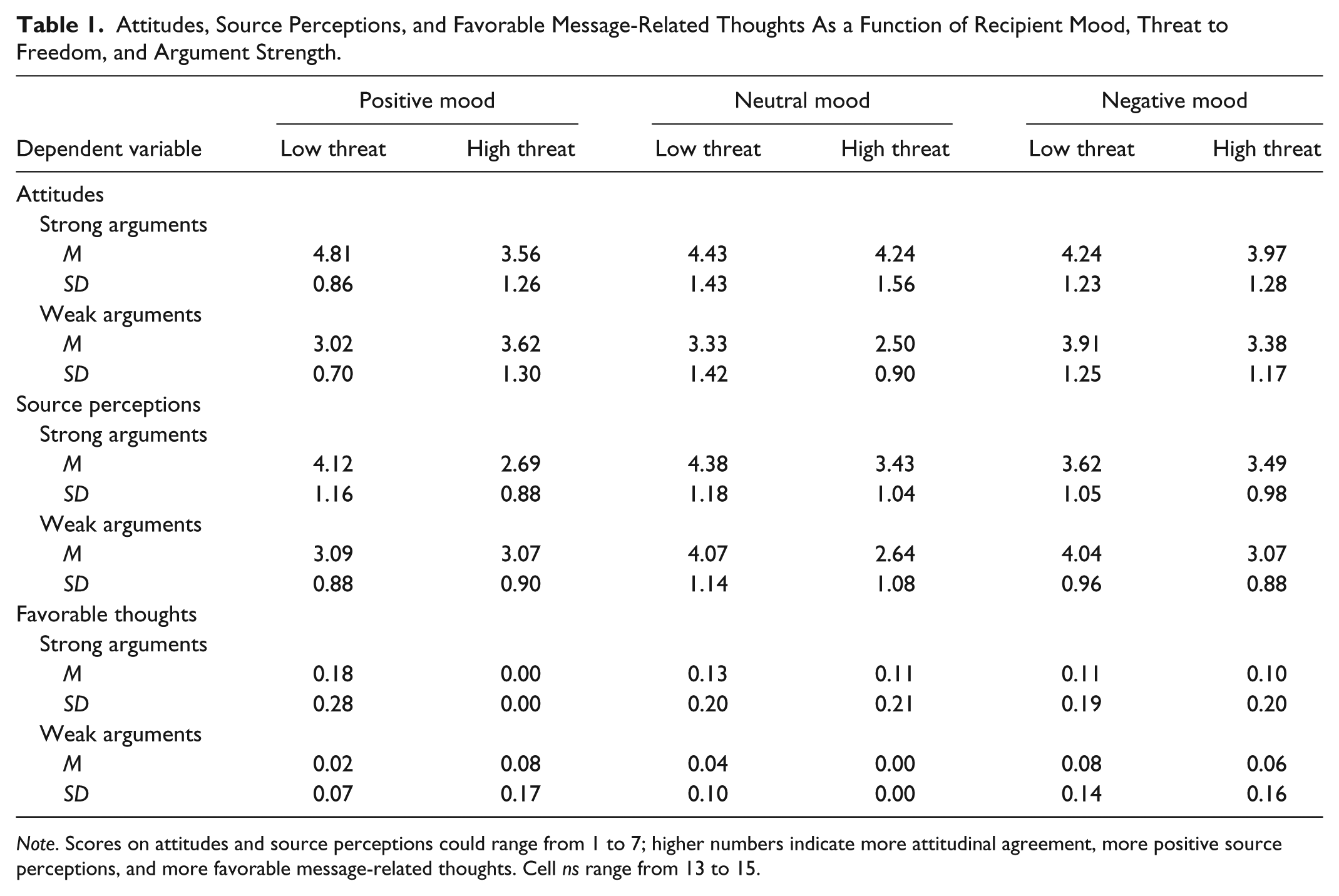
Note. Scores on attitudes and source perceptions could range from 1 to 7; higher numbers indicate more attitudinal agreement, more positive source perceptions, and more favorable message-related thoughts. Cell ns range from 13 to 15.
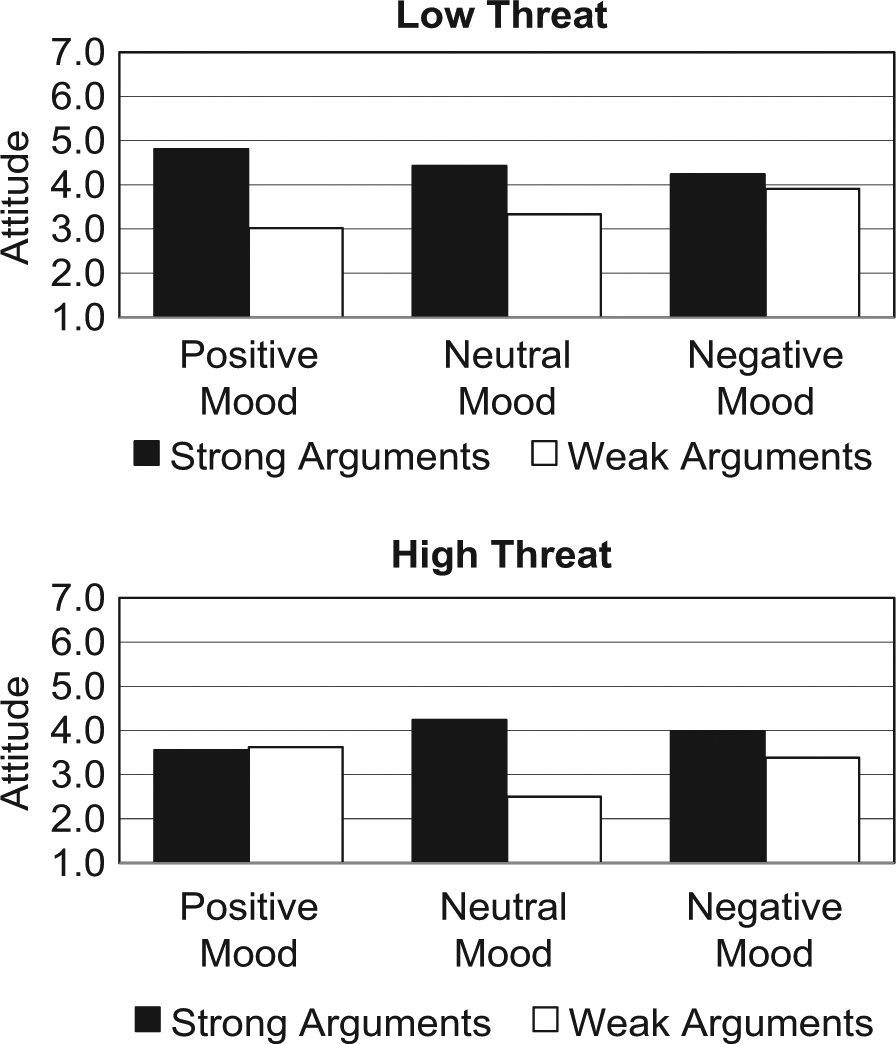
Attitude as a function of recipient mood and message strength.
In low-threat conditions, the predicted interaction of positive versus negative mood with argument strength was found, F(1, 159) = 5.19, p < .03, f2 = 0.03. In positive mood, strong arguments led to more attitudinal agreement than weak arguments, F(1, 159) = 15.55, p < .001, f2 = 0.10. In negative mood, in contrast, attitudes did not differ as a function of argument strength, F < 1. Further analyses revealed that neither the interaction of neutral versus negative mood with argument strength nor the interaction of neutral versus positive mood with argument strength were significant (ps > .23). In neutral mood, an argument strength effect, F(1, 159) = 5.65, p < .02, f2 = 0.04, showed that strong arguments led to more agreement than weak arguments. Overall, these results in conditions with a nonthreatening counterattitudinal message indicated, as predicted by the MCA, high processing effort in positive mood, and low processing effort in negative mood. Message scrutiny in neutral mood lay in between the extent of message scrutiny in positive and negative mood.
In high-threat conditions, the predicted interaction of positive versus neutral mood with argument strength was found, F(1, 159) = 7.92, p < .01, f2 = 0.05. It showed that strong arguments led to more attitudinal agreement than weak arguments given neutral mood, F(1, 159) = 14.21, p < .001, f2 = 0.09, but not given positive mood, F < 1. Further analyses revealed that the effect of argument strength on attitudes also tended to be stronger in neutral mood than in negative mood, F(1, 159) = 3.02, p = .08, f2 = 0.02. Unlike in neutral mood, argument strength did not affect attitudes in negative mood (p > .20). The interaction of negative versus positive mood with argument strength was not significant (p > .30). Taken together, these results in conditions with a freedom-threatening counterattitudinal message showed, as predicted by the HCV, more effortful processing in neutral mood than in positive mood. Processing effort in negative mood was as low as in positive mood (in line with assumptions of the MCA and the HCV, respectively).
Supplementary analyses within mood states revealed an interaction of threat with argument strength in positive mood, F(1, 159) = 8.51, p < .01, f2 = 0.05, but not in neutral or negative mood, Fs < 1. Thus, while high threat led to less processing than low threat in positive mood, threat did not affect processing in neutral or negative mood. In neutral mood, the argument strength effect, F(1, 159) = 18.89, p < .001, f2 = 0.12, indicated more agreement given strong versus weak arguments across threat conditions. In negative mood, the argument strength effect was not significant (p > .16). Thus, across threat conditions, processing effort was high in neutral mood, but low in negative mood (see also Note 3).
Source perceptions
Source ratings proved to be very similar to attitude ratings (see Table 1). ANOVA revealed main effects of threat to freedom, F(1, 159) = 28.13, p < .001, η2 = .13, and argument strength, F(1, 159) = 3.49, p = .064, η2 = .02. The source was rated more positive given low threat (M = 3.88; SD = 1.12) and strong arguments (M = 3.61; SD = 1.16) as compared with high threat (M = 3.05; SD = 0.99) and weak arguments (M = 3.33; SD = 1.09). Moreover, the omnibus three-way interaction was significant, F(2, 159) = 5.13, p < .01, η2 = .05. Similar to the attitude analyses, further analyses of source perceptions tested for effects in low-threat and high-threat conditions. 4
In low-threat conditions, the predicted interaction of positive versus negative mood with argument strength was found, F(1, 159) = 7.47, p < .01, f2 = 0.05. In positive mood, strong arguments led to more positive source perceptions than weak arguments, F(1, 159) = 7.48, p < .01, f2 = 0.05. In negative mood, in contrast, source perceptions did not differ as a function of argument strength (p > .25). In neutral mood, source perceptions also were unaffected by argument strength (F < 1). Further analyses revealed that neither the interaction of neutral versus negative mood with argument strength nor the interaction of neutral versus positive mood with argument strength were significant (ps > .16). Overall, similar to attitudes, source perceptions were affected by argument strength in conditions with a nonthreatening counterattitudinal message given positive mood, but not given negative mood. Different from attitudes, source perceptions in neutral mood were not affected by argument strength. Nonetheless, as with attitudes, the influence of argument strength on source perceptions in neutral mood lay in between its influence on source perceptions in positive and negative mood (see Table 1).
Analyses in high-threat conditions revealed the predicted interaction of positive versus neutral mood with argument strength, F(1, 159) = 4.77, p < .04, f2 = 0.09. Strong arguments led to more positive source perceptions than weak arguments given neutral mood, F(1, 159) = 4.20, p < .05, f2 = 0.03, but not given positive mood (p > .30). Further analyses revealed that the effect of argument strength on source perceptions did not differ in neutral versus negative mood (F < 1) or in negative versus positive mood (p > .13). In negative mood, the effect of argument strength was not significant (p > .28). In sum, as with attitudes, argument strength affected source perceptions in conditions with a freedom-threatening counterattitudinal message in neutral mood, but not in positive or negative mood.
Supplementary analyses within mood states revealed an interaction of threat with argument strength in positive mood, F(1, 159) = 7.11, p < .01, f2 = 0.04, but not in neutral or negative mood (F < 1 and p > .12, respectively). Thus, as with attitudes, the impact of argument strength on source perceptions was moderated by threat solely in positive mood (higher impact given low threat). In neutral mood, the argument strength effect, F(1, 159) = 4.08, p < .05, f2 = 0.03, indicated more positive source perceptions given strong versus weak arguments across threat conditions. In negative mood, the argument strength effect was not significant (F < 1). Thus, similar to attitudes, source perceptions were affected by argument strength across threat conditions in neutral mood, but unaffected by argument strength across threat conditions in negative mood.
Cognitive responses
Separate analyses were conducted in regard to manner-related thoughts and message-related thoughts. Consistent with previous reactance research on negative thinking (Dillard & Shen, 2005; Silvia, 2006), high threat elicited more negative manner-related thoughts (M = 0.58; SD = 0.75) than low threat (M = 0.14; SD = 0.46), F(1, 159) = 20.60, p < .001, η2 = .11 (all other ps > .22). 5 Similar results were found in regard to unfavorable message-related thoughts (i.e., the number of unfavorable message-related thoughts divided by the sum total of message-related thoughts). 6 A threat main effect, F(1, 144) = 7.51, p < .01, η2 = .05 (all other ps > .19), showed that high threat led to more unfavorable message-related thoughts (M = 0.51; SD = 0.38) than low threat (M = 0.35; SD = 0.34).
However, further analyses regarding favorable message-related thoughts (i.e., the number of favorable thoughts divided by the sum total of message-related thoughts) revealed a pattern of means consistent with results on attitudes and source perceptions (see Table 1). ANOVA revealed a main effect of argument strength, F(1, 144) = 4.67, p < .04, η2 = .03. Strong arguments elicited more favorable thoughts (M = 0.11; SD = 0.20) than weak arguments (M = 0.05; SD = 0.12). Moreover, the three-way interaction approached significance, F(2, 144) = 2.54, p = .083, η2 = .03. 7
In low-threat conditions, the predicted interaction of positive versus negative mood with argument strength was not significant, F(1, 144) = 2.09, p = .15. Nonetheless, in positive mood, strong arguments elicited more favorable thoughts than weak arguments, F(1, 144) = 6.03, p < .02, f2 = 0.04. In negative mood, in comparison, favorable thoughts did not differ between argument strength conditions, F < 1. In neutral mood, the effect of argument strength on favorable thoughts was in the predicted direction (more favorable thoughts given strong vs. weak arguments) but failed to reach significance, F(1, 144) = 2.08, p = .15. Further analyses revealed that neither the interaction of neutral versus negative mood with argument strength nor the interaction of neutral versus positive mood with argument strength was significant (both Fs < 1). Overall, these results on favorable thoughts in conditions with a nonthreatening counterattitudinal message are consistent with heightened processing in positive mood as compared with negative mood. Processing effort in neutral mood was intermediate to processing effort in positive and negative mood.
In high-threat conditions, the predicted interaction of positive versus neutral mood with argument strength was found, F(1, 144) = 4.26, p < .05, f2 = 0.03. In neutral mood, strong arguments led to slightly more favorable thoughts than weak arguments, F(1, 144) = 2.82, p = .095, f2 = 0.02. In positive mood, in contrast, argument strength did not affect favorable thoughts (p > .21). Similarly, argument strength did not affect favorable thoughts in negative mood, F < 1. Further analyses revealed that the effect of argument strength on favorable thoughts did not differ in neutral versus negative mood (F < 1) or in negative versus positive mood (p > .20). Thus, these results in conditions with a freedom-threatening counterattitudinal message are consistent with the HCV, indicating increased processing in neutral as compared with positive mood. Message scrutiny in negative mood was as low as in positive mood (as predicted by the MCA and the HCV, respectively).
Supplementary analyses within mood states revealed an interaction of threat with argument strength in positive mood, F(1, 144) = 6.74, p < .01, f2 = 0.04, but not in neutral or negative mood (Fs < 1). In neutral mood, the predicted argument strength effect, F(1, 144) = 4.88, p < .03, f2 = 0.03, indicated more favorable thoughts given strong versus weak arguments across threat conditions. In negative mood, the argument strength effect was not significant (p > .16). Thus, similar to attitudes, high (vs. low) threat led to reduced processing in positive mood, but threat did not affect processing in neutral or negative mood. Rather, regardless of threat, processing effort was high in neutral mood, but low in negative mood.
Correlation analyses
If the attitudes of happy individuals given low threat were more based on effortful message processing than those of sad individuals given low threat, then favorable message-related thoughts should be related to attitudes in positive mood, but not in negative mood (Wegener et al., 1995). Similarly, if the attitudes of individuals in neutral mood given high threat were more based on effortful processing than those of individuals in positive mood given high threat, then favorable thoughts should be related to attitudes in neutral mood, but not in positive mood. To test these predictions, moderated regression analyses were conducted in which mood (dummy-coded with positive mood as comparison group), the proportion of favorable message-related thoughts (centered), and the two-way products of mood with favorable thoughts served as predictors of attitudes (cf. Aiken & West, 1991).
In low-threat conditions, the interaction of positive versus negative mood with favorable thoughts failed to reach significance, t(74) = −1.43, p = .16. Nonetheless, further analyses showed that favorable thoughts were positively related to attitudes in positive mood, t(74) = 1.93, p = .058, but unrelated to attitudes in negative mood, |t| < −1.
In high-threat conditions, the interaction of positive versus neutral mood with favorable thoughts also failed to reach significance, t(70) = 1.51, p = .14. Nonetheless, further analyses showed that favorable thoughts were positively related to attitudes in neutral mood, t(70) = 3.79, p < .001, but unrelated to attitudes in positive mood, t(70) = 1.24, p > .2.
Overall, these findings are consistent with the assumption that attitudes in low-threat conditions would be based on message-related thoughts in positive mood, but not in negative mood, and that attitudes in high-threat conditions would be based on thoughts in neutral mood, but not in positive mood.
Mood after the message and mood change
No effects were found with respect to participants’ mood after they had read the message (all Fs < 1.1; Moverall = 4.70; SD = 1.11). We also calculated mood change scores by subtracting premessage mood scores from postmessage mood scores. Mood change was only affected by manipulated mood, F(2, 159) = 8.27, p < .001, η2 = .09 (all other ps > .24). Tests of significance of mood change showed that mood became more positive in negative mood conditions (M = 0.52; SD = 1.63), t(159) = 3.89, p < .001, remained stable in neutral mood conditions (M = −0.21; SD = 1.14), t < 1, and became less positive in positive mood conditions (M = −0.49; SD = 1.23), t(159) = −2.96, p < .01. These findings suggest that the effects of our mood induction were, as intended, short-lived and thus of a temporary nature (cf. Isen, Clark, & Schwartz, 1976).
Discussion
The major objective of the current research was to delineate when counterattitudinal message processing in different affective states is guided by mood-congruent expectancies versus hedonic considerations. Existing research either found evidence consistent with a mood-congruent expectancies approach (Ziegler, 2010) or it found evidence consistent with a hedonic-contingency view (Wegener & Petty, 1994; Wegener et al., 1995). While studies revealing MCA-consistent findings used hardly mood-threatening counterattitudinal messages (e.g., Ziegler, 2013), studies revealing HCV-consistent findings used clearly mood-threatening counterattitudinal messages (e.g., Wegener et al., 1995). Against this background, the present study directly compared when processing effort is guided by mood congruency versus hedonic contingency. To this end, one factor assumed to affect threat to mood given a counterattitudinal message was examined. Specifically, threat to mood was varied by a counterattitudinal message that either contained a threat to attitudinal freedom or did not contain a freedom threat. As expected, results showed that a counterattitudinal message not threatening freedom was perceived as less annoying and hence provided less of a threat to happy individuals’ affective state than the same counterattitudinal message containing additional freedom-threatening statements (cf. Brehm, 1966). Furthermore, findings within threat conditions as well as findings within mood conditions lend strong support to predictions.
Specifically, when the counterattitudinal message did not threaten attitudinal freedom, and hence was hardly mood threatening (low-threat conditions), findings for happy and sad individuals were consistent with predictions of the MCA (Ziegler, 2010). While attitudes, source perceptions, and favorable message-related thoughts of happy individuals were affected by argument strength, these measures were unaffected by argument strength for sad individuals (see also Ziegler, 2013). In addition, message-related thoughts were related to happy individuals’ attitudes, but unrelated to sad individuals’ attitudes.
Different from existing research on mood and message processing guided by the MCA (e.g., Ziegler, 2013), the present study also examined neutral mood. As expected (Cacioppo & Petty, 1979; Edwards & Smith, 1996), results on attitudes and favorable thoughts indicated that processing effort in regard to a nonthreatening counterattitudinal message given neutral mood lay in between processing effort in positive and negative mood. Thus, findings in low-threat conditions suggest a progression of processing effort from negative mood (low effort) over neutral mood to positive mood (high effort). More generally, in comparison with processing effort in neutral mood, these findings suggest symmetric and opposed effects of positive mood (heightened processing) and negative mood (reduced processing).
When the counterattitudinal message threatened attitudinal freedom, and hence was clearly mood threatening (high-threat conditions), findings for individuals in positive and neutral mood were in line with the HCV (Wegener & Petty, 1994). Specifically, consistent with the assumed difference in hedonic sensitivity between neutral and positive mood, attitudes, source perceptions, and favorable thoughts were affected by argument strength in neutral mood, but not in positive mood. In addition, message-related thoughts were related to attitudes in neutral mood, but unrelated to attitudes in positive mood. Thus, results indicate that individuals in positive mood refrained from effortful processing of a counterattitudinal message which threatened their elated affective state.
Notably, processing of a threatening message was low in both positive and negative mood. Similar findings were reported by Handley and Lassiter (2002) in an extended replication of the research by Wegener et al. (1995). Specifically, Handley and Lassiter (2002) argued that sad people might process a mood-threatening counterattitudinal message less thoroughly than a mood-elevating proattitudinal message when no prior information about the depressing or uplifting nature of the message is provided. In fact, their results in conditions without prior information about the affective quality of the message revealed that both sad and happy people refrained from effortful processing of a mood-threatening counterattitudinal message. The current results suggest that happy individuals may have refrained from message scrutiny because it threatened their mood; sad individuals, in comparison, may have refrained from message scrutiny because the counterattitudinal message was mood congruent.
Findings of supplementary analyses within mood conditions were also clearly consistent with predictions and thus further elucidate processing differences as a function of threat. In particular, threat was found to only moderate the effect of argument strength on attitudes, source perceptions, and favorable thoughts in positive mood conditions. As predicted by the MCA, happy individuals evinced effortful processing of a counterattitudinal message not threatening mood. As predicted by the HCV, in contrast, happy individuals refrained from effortful processing of a counterattitudinal message when their mood was threatened. In neutral mood, in comparison, threat did not moderate processing effort. Rather, substantial message processing was found regardless of threat. These findings support the assumption of the HCV (Wegener & Petty, 1994; Wegener et al., 1995) regarding low hedonic sensitivity of individuals in neutral mood who did not evince reduced processing in the face of a mood-threatening message. 8 Similar processing effort across threat conditions was also found in negative mood. Different from neutral mood, however, processing effort in negative mood was comparatively low across threat conditions (see also Footnote 3). According to the MCA, this was the case because sad individuals’ motivation to process was low as a result of the mood-congruent counterattitudinal stance taken in the persuasive communication. 9
Arguably, the present research addressed mood effects on processing with threats to positive mood that were less direct and blatant than the conditions used in the primary hedonic-contingency research (Wegener et al., 1995). Moreover, none of the Wegener et al. (1995) research included positive mood and both neutral and sad mood in the same study. Hence, the current findings appear to provide the clearest evidence as yet of the differences in hedonic contingencies across happy, neutral, and sad mood.
An issue worth addressing refers to the finding that positive and neutral mood conditions did not differ significantly with respect to participants’ affective state prior to the persuasive message. In this regard, however, the results on postmessage mood and mood change suggest that the positive versus negative mood inductions led to a temporary but significant increase versus decrease in participants’ affective state prior to the message. Specifically, it was found that mood conditions did not differ with respect to postmessage mood. Furthermore, results showed that mood in neutral mood conditions did not change from pre- to post-message. In positive mood conditions, in contrast, postmessage ratings were significantly lower than premessage ratings. However, in negative mood, on the contrary, postmessage mood was significantly higher than premessage mood. Note first that mood enhancement in negative mood conditions speaks against an interpretation of mood impairment in positive mood conditions as having resulted from the persuasive message. That is, given the counterattitudinal message stance such an interpretation would implicate that individuals’ affective state in negative mood conditions should at least have remained comparatively negative. Hence, mood enhancement in negative mood conditions suggests that postmessage mood ratings rather indicate a return to a baseline affective state in all three mood conditions. In comparison to this baseline, the positive mood induction, but not the neutral mood induction, temporarily increased participants’ current affective state.
Another issue concerns the manipulation of threat to mood, which may raise the question whether the present findings are specific to a mood threat in terms of anger. That is, persuasion research guided by the HCV (Wegener et al., 1995) particularly emphasizes that happy individuals may eschew effortful processing when anticipating depressing consequences rather than when the persuasive communication involves anger. In this regard, note, however, that Wegener et al.’s (1995) research also contained elements alluding to anger (i.e., the message title and first paragraph explicitly referred to students being upset and vehemently opposing the tuition plan). Nonetheless, research has shown that anger may have profoundly different effects than other negative affective states, in particular sadness (Bodenhausen, Sheppard, & Kramer, 1994; DeSteno, Petty, Rucker, Wegener, & Braverman, 2004; Moons & Mackie, 2007). Thus, one could ask whether the findings in high-threat conditions can be explained in terms of effects elicited by the emotion of anger. We hold this to be unlikely, first of all, because postmessage mood and mood change were unaffected by threat (see above), thus speaking against threat having induced anger. However, postmessage mood measures were not in particular targeted at measuring anger. Moreover, results regarding threat-to-mood showed that high (vs. low) threat led to higher anger ratings. However, we believe that these measures do not indicate that individuals in high-threat conditions were in a full-blown emotional state of anger, but rather indicate their affective reaction toward the manner of the recommendation. In other words, we hold that to be angry (an emotional state) is different from being angered by something (an emotional reaction; cf. Weiss, 2002).
In any case, note also that recent persuasion research has shown that the emotional state of anger may lead to effortful message processing, and higher processing than a neutral emotion (Moons & Mackie, 2007). With respect to the present study this would implicate (a) effortful processing given high threat across mood conditions and (b) more effortful processing given high (vs. low) threat in neutral mood. The results indicated, however, (a) effortful processing given high threat only in neutral mood and (b) similar levels of processing given high and low threat in neutral mood. All in all, therefore, we prefer to interpret the current results without reference to research on effects of the anger emotion. Nonetheless, further research on the HCV may profitably investigate message processing effects of qualitatively different hedonic threats (e.g., fear, disgust).
A final issue concerns that mood threat was established by the source’s manner of recommendation, and thus independent from the message proper. Hence, it could be asked whether similar effects arise out of a threat by some property inherent to the persuasive message. As research on the MCA has shown, source factors and message factors may be more or less congruent with expectations in positive or negative mood, and hence lead to analogous message processing effects (Ziegler, 2010, 2013). In a similar vein, further research on the HCV may test whether threats to mood elicited by either source factors or message factors affect message processing alike.
More generally, further studies may be devoted to identifying other factors than threat to freedom that affect threat to mood given a counterattitudinal message, and thus affect the role of mood congruency and hedonic considerations for processing effort in positive mood. For example, attitudes based on more or stronger arguments may be held with higher certainty (Tormala & Rucker, 2007) or may be more extreme (Tesser, Martin, & Mendolia, 1995) than attitudes based on fewer or weaker arguments. Counterattitudinal messages may threaten happy individuals’ affective state more strongly in the case of more extreme prior attitudes, or prior attitudes held with higher certainty, than in the case of less extreme prior attitudes, or prior attitudes held with less certainty.
Mood Congruency and Hedonic Contingency
The current findings make an important step toward delineating when counterattitudinal message processing is informed by mood congruency (Ziegler, 2010, 2013) versus hedonic contingency (Wegener & Petty, 1994; Wegener et al., 1995). Mood-based expectancies led happy individuals to invest high effort in processing a counterattitudinal message unless hedonic considerations elicited by freedom-threatening statements reduced their willingness to invest effort in message scrutiny. In both neutral and negative mood, in comparison, processing effort did not differ as a function of threat. However, whereas processing effort was high in neutral mood (Cacioppo & Petty, 1979; Edwards & Smith, 1996), processing effort in negative mood was low, as predicted by the MCA.
Viewed together with other recent studies (Ziegler, 2010, 2013; Ziegler & Diehl, 2011), these findings suggest that mood-based expectancies represent a fundamental cognitive mechanism affecting processing inclinations of individuals in both positive and negative mood. In comparison, hedonic considerations represent a motivational process mainly affecting processing inclinations of individuals in positive mood (Wegener et al., 1995). Specifically, when mood threatening factors come into operation, processing inclinations of happy individuals based on mood congruency may be overridden by hedonic considerations.
Mood and Reactance
A further objective of the present research was to test the effects of threats to attitudinal freedom across different mood states. The current results indicate that high threat leads to higher perceptions of threats to freedom and more negative manner-related thoughts than low threat across positive, neutral, and negative mood (cf. Dillard & Shen, 2005). Thus, different affective states do not appear to lead to different thresholds regarding perceptions of a threat to attitudinal freedom (cf. Brehm & Brehm, 1981; Brockner & Elkind, 1985). Furthermore, high threat elicited more anger and unfavorable message-related thoughts than low threat (cf. Dillard & Shen, 2005) regardless of recipients’ incidental affect. This suggests that different affective states also lead to the same magnitude of reactance. Finally, regardless of mood, high (vs. low) threat increases individuals’ desire to self-determine their attitudes (cf. Brehm, 1966).
Previous threat research also has not considered the role of argument strength. Therefore, a last goal of the current study was to investigate the effects of argument strength in reactions to threats to attitudinal freedom. In this regard, Dillard and Shen (2005) discussed “reason” as being “present in any given message when justifications are offered in support of the claim that audience members should adopt the position advocated by the source” (p. 163). They suggested that reason giving may soften perceptions of intrusiveness and might therefore provoke less reactance. The present results, however, showed that threat perceptions and magnitude of reactance were unaffected by argument strength. Nonetheless, consistent with their suggestion, argument strength affected attitudes at least for individuals in neutral mood. Happy individuals, however, strongly rejected an advocacy and derogated a source threatening their attitudinal freedom irrespective of argument strength. Similarly, sad individuals’ reactions did not differ as a function of argument strength. Given these differences in positive and negative mood as compared with neutral mood, further research may investigate the lasting impact of attitudes (Petty et al., 1995) that result under conditions of threat in different affective states.
In sum, the present study showed that different affective states lead to distinct processes and effects of threats to attitudinal freedom. While the present focus was on (diffuse) moods, future reactance research may also investigate the influence of distinct emotions like, for instance, incidental anger (Moons & Mackie, 2007). More generally, further studies may be concerned with the role of moods and emotions for the effects of threats to attitudinal as well as nonattitudinal freedom.
Conclusion
The present research investigated processing effort in positive, neutral, or negative mood in regard to a counterattitudinal message that either contained a threat to freedom, and thus was clearly mood threatening, or did not contain a threat to freedom, and thus was hardly mood threatening. The results support the assumption that processing effort is guided by mood congruency in the case of a nonthreatening message. Mood congruency led to heightened processing in positive as compared with negative mood. In the case of a freedom-threatening message, however, processing inclinations of happy individuals based on mood congruency were overridden by hedonic considerations. As a result, happy individuals evinced little message scrutiny. Together with other recent research (Ziegler, 2010, 2013; Ziegler & Burger, 2011; Ziegler & Diehl, 2011) these findings suggest that the MCA provides a basic cognitive account of mood-based processing inclinations. Motivational mechanisms such as mood maintenance may overwhelm processing tendencies based on mood congruency. More generally, mood research may profit from further studies delineating the role of different mechanisms proposed to guide processing.
Footnotes
Acknowledgements
We would like to thank Petra Bugl, Henning Daus, Amanda del Rosario Martinez, Plamen Petrow, and Janusch Sieber for their help in conducting this research, and Michael Diehl for helpful comments.
Declaration of Conflicting Interests
The author(s) declared no potential conflicts of interest with respect to the research, authorship, and/or publication of this article.
Funding
The author(s) received no financial support for the research, authorship, and/or publication of this article.