




Abstract
Sixty-one couples engaged in two video-recorded discussions in which one partner (the support recipient) discussed a personal goal with the other partner (the support provider). The support provider’s visible and invisible support behaviors were coded by independent raters. Measures of perceived support, discussion success, and support recipients’ distress during the discussion were gathered. Recipients also reported their goal achievement at 3-month intervals over the following year. Greater visible emotional support was associated with greater perceived support and discussion success for highly distressed recipients, but it was costly for nondistressed recipients who reported lower discussion success. In contrast, greater invisible emotional support was not associated with perceived support or discussion success, but it predicted greater goal achievement across time. These results advance our current understanding of support processes by indicating that the costs and benefits of visible support hinge on recipients’ needs, whereas invisible support shapes recipients’ long-term goal achievement.
Prior research has produced an inconsistent set of findings about the relative benefits versus costs of support. On one hand, greater observed support delivered by intimate partners during couples’ support-relevant exchanges has been shown to build feelings of closeness and support, boost positive mood and self-esteem, and foster greater goal achievement and relationship quality across time (e.g., Collins & Feeney, 2000; Feeney, 2004; Feeney & Collins, 2003; Overall, Fletcher, & Simpson, 2010; Sullivan, Pasch, Johnson, & Bradbury, 2010). On the other hand, direct or visible support behaviors that are perceived by support recipients during daily life have been associated with increased anxiety and depressed mood (e.g., Bolger, Zuckerman, & Kessler, 2000; Gable, Gosnell, Maisel, & Strachman, 2012). Indeed, this latter body of work has provided good evidence that partner support is most effective in improving mood when it is invisible or goes unnoticed by recipients (e.g., Bolger et al., 2000; Howland & Simpson, 2010; Shrout, Herman, & Bolger, 2006). However, no prior research has examined whether invisible support produces benefits for recipients over time.
In the present research, we assessed visible and invisible support observed during couples’ video-recorded discussions of each other’s personal goals. Our aim was to reconcile and extend prior research in two novel ways. First, we examined whether the immediate benefits and costs of visible support depend on the contextual needs of support recipients. We hypothesized that visible support would be beneficial when recipients were more distressed and needed their partner’s comfort, but would be relatively costly when recipients were low in distress and thus did not need direct forms of emotional reassurance. Second, we tracked recipients’ goal accomplishment across a 1-year period to provide the first test of whether invisible support has long-term personal benefits by facilitating actual goal achievement.
Short-Term Contextual Costs and Benefits of Visible and Invisible Support
Research documenting the costs of visible support and the benefits of invisible support has primarily focused on personal outcomes, such as recipients’ mood or perceived efficacy (Bolger & Amarel, 2007; Bolger et al., 2000; Gleason, Iida, Shrout, & Bolger, 2008; Shrout et al., 2006). The first set of studies, for example, found that perceiving greater partner support in the week leading to an important exam or receiving overt support before delivering a speech is associated with relative increases in anxiety and depressed mood (Bolger & Amarel, 2007; Bolger et al., 2000). Such costs likely arise because visible support increases the salience of impending stressors, conveys low confidence in recipients’ capability to cope or achieve their goals (Bolger et al., 2000), and may disrupt recipients’ focus on the task at hand. In contrast, support that is provided but not perceived by recipients—support that is invisible—appears to aid recipients without undermining their perceived efficacy or ability to deal with current challenges. Accordingly, invisible support has been linked with reductions in anxiety and depressed mood (Bolger & Amarel, 2007; Bolger et al., 2000; Gleason et al., 2008; Shrout et al., 2006).
More recently, Howland and Simpson (2010) have also shown that invisible support within couples’ observed discussions about personal goals bolsters mood and self-efficacy. They defined invisible support as adopting a subtle, conversational approach that blurs the distinction between support recipient and provider roles, and using third-party examples to draw the focus away from recipients and their distressing issue. As above, these behaviors should minimize the salience of the recipients’ difficulties and reduce self-relevant threat that might accompany more visible support behaviors (as typically assessed during observed support discussions). Indeed, Howland and Simpson (2010) found that recipients felt less anxious and more efficacious when their partners enacted invisible behaviors that were not perceived as support than when delivering more direct and perceived visible support.
In contrast to the focus on personal outcomes, research demonstrating the benefits of visible support has typically focused on interpersonal outcomes. By validating recipients’ feelings and conveying positive regard, for example, visible support should help recipients feel cared for, understood, and supported, which in turn should alleviate distress and facilitate coping. Accordingly, observed direct support during couples’ discussions of ongoing stressors and goals has been repeatedly linked to greater felt-support, closeness, and relationship satisfaction (Collins & Feeney, 2000; Cutrona & Suhr, 1992; Feeney & Collins, 2003; Gleason et al., 2008; Overall et al., 2010; Pasch, Bradbury, & Sullivan, 1997; Sullivan et al., 2010; Verhofstadt, Buysse, Ickes, Davis, & Devoldre, 2008). Moreover, more visible support and, in particular, the resulting feelings of support, have been linked with increases in positive mood, coping, and self-esteem (Collins & Feeney, 2000; Conger, Rueter, & Elder, 1999; Feeney, 2004), more successful goal achievement (Feeney, 2004; Overall et al., 2010), and increases in relationship quality and conflict resolution over time (Feeney & Collins, 2003; Overall et al., 2010; Sullivan et al., 2010).
Prior research attempting to reconcile the costs and benefits of visible support has also distinguished between personal versus interpersonal outcomes. Examining both outcomes, Gleason and colleagues (2008) found that on days when participants received visible partner support, they reported increases in relationship closeness (interpersonal benefits), but also greater negative mood when they did not reciprocate support to their partner (personal costs). This latter effect illustrates that the potential costs of visible support depend on the contextual needs of participants; visible support had costs only when recipients did not reciprocate support, which made their dependent position more salient. Moreover, perceiving the partner as responsive and supportive may be paramount in many support interactions and trump or override costs to personal mood or efficacy. Accordingly, Maisel and Gable (2009) found that greater visible support accompanied by perceptions of the partner’s greater understanding and validation did not generate more negative mood in support recipients; instead, it produced greater relationship connectedness and security. In addition, intimates felt more sadness and less connectedness on days when their partners provided more invisible support, but were perceived to be less understanding and responsive.
These findings illustrate that the relative costs and benefits of visible support depend on the needs of the recipient in the particular context in which the support transaction is occurring (also see Cutrona, Shaffer, Wesner, & Gardner, 2007; Simpson, Winterheld, Rholes, & Oriña, 2007). Within support-relevant discussions, when individuals are disclosing their thoughts and feelings about ongoing personal goals and stressors, more direct and visible support may be needed and expected. Even in this context, however, recipients are likely to vary in their need for visible support and reassurance. Recipients who are experiencing high levels of distress probably need more direct care and comfort from their partner, and therefore benefit from visible support. Indeed, the absence of visible reassurance might be particularly costly when people are distressed and need comfort. In contrast, visible support may be intrusive and costly for recipients who are not distressed and do not need or want reassurance. To sum up, we predicted that the benefits and costs of visible support provided during couples’ support discussions would depend on recipients’ level of distress, and thus their need for direct comfort, during the discussion.
We tested this contextual prediction by measuring the degree to which partners exhibited visible (direct displays of care and reassurance) and invisible (subtle and indirect forms of care) support behaviors while couples were discussing important personal goals. We focused on emotional support because it is most beneficial for relationships (Feeney & Collins, 2003; Gleason et al., 2008; Overall et al., 2010; Sullivan et al., 2010) and the most relevant response to recipients’ emotional distress (Cutrona et al., 2007; Feeney, 2004). At the end of each couple’s discussions, we asked recipients how much distress they experienced during the discussion and gathered ratings of how supportive the partner had been during the discussion and how successful the discussion was in facilitating the recipient’s goal progress.
Consistent with prior research, we predicted that visible emotional support would provide interpersonal benefits, such that recipients would feel more supported by their partners. Considering the contextual needs of the recipient, however, we expected that these benefits would be particularly relevant to recipients who were distressed and needed care, reassurance, and affection from their partner. Moreover, by acknowledging and being responsive to recipient distress, we also predicted that greater visible emotional support would benefit the personal outcomes of distressed recipients, who should report that the discussion was more successful in facilitating their goal achievement. However, we also thought that visible emotional support would result in personal costs for individuals who were less distressed and did not need direct care and comfort, which should result in nondistressed recipients viewing their discussions as less successful in helping them achieve their goals.
In contrast to direct and visible displays, invisible emotional support is more subtle and indirect. It is conveyed by adopting an equal and more conversational tone, disguising affectionate contact, and indirectly reassuring recipients that they can cope by considering how others’ have overcome similar challenges (Howland & Simpson, 2010). If these behaviors constitute “invisible” support as originally conceptualized, the presence of these behaviors should go unnoticed and should be unrelated to recipients’ perceptions of support, regardless of their level of distress. Invisible support might also have little impact on perceptions of goal progress following discussions because, unlike the boosts in mood and efficacy linked to responsive invisible support, perceptions of discussion success depend on recipients evaluating the discussion and their partner’s invisible behavior as being effective with regard to their goal. However, as we discuss next, even though it may not be perceived as supportive or helpful when it is delivered, invisible support may work “under the radar” to facilitate long-term goal achievement.
Long-Term Costs and Benefits of Visible and Invisible Support
Prior theoretical arguments indicate that, compared with visible support, invisible support should be more effective at enhancing recipients’ efficacy and ability to achieve personal goals by bypassing threats to their competence or capability (e.g., Bolger & Amarel, 2007; Bolger et al., 2000; Shrout et al., 2006). Indeed, (visible) support that threatens recipients’ self-esteem is associated with more negative self-evaluations in regard to the stressor (Fisher, Nadler, & Whitcher-Alagna, 1982), and low self-esteem individuals tend to be more defensive when receiving (visible) support, probably because they lack confidence in their abilities or feel indebted (Newsom & Schulz, 1998). In contrast, support communications designed to avoid conveying the recipient is unable to complete challenging tasks are most beneficial in reducing negative mood (Bolger & Amarel, 2007). In addition, Bolger and Amarel (2007) found that invisible support buffered negative mood because it was associated with more positive perceptions of the degree to which others evaluated the self as competent and efficacious. Howland and Simpson (2010) also found that invisible practical (but not emotional) support was associated with greater self-efficacy.
Although not providing solid evidence that emotional invisible support bolsters self-efficacy, these prior findings and the theorized function of invisible support suggest that invisible support should be less likely to interfere with recipients’ feelings of goal-related competence. More positive beliefs in one’s ability motivate persistence when inevitable setbacks and challenges occur, and the sustained goal strivings that result contributes to greater goal success (Bandura, 1994; Bandura & Locke, 2003). Instead of building self-efficacy, visible emotional support may reinforce the belief that help is required from the partner. Knowing that others are there to help can also reduce goal-related efforts, perhaps because recipients perceive less is needed to achieve their goals (Fitzsimons & Finkel, 2011). Invisible support, in contrast, might increase the degree to which individuals take responsibility for their own goal achievement and for managing any goal-related distress or challenges they encounter. We tested these possibilities by examining whether invisible support delivered during couples’ goal-related discussions was more successful than visible support in facilitating recipients’ achievement of that goal during the following year.
Current Research
The current research examined the short- versus long-term effects of visible and invisible support provided by partners during laboratory-based interactions in which support recipients discussed with their partners an important personal self-improvement goal. We assessed the type of emotional support provided by partners (support providers) when individuals discussed their own personal goal (support recipients). Independent coders rated visible (e.g., overt reassurance) and invisible (e.g., subtle, conversational forms of comfort) forms of emotional support. Following each discussion, support recipients rated their levels of distress during the discussion, their perceptions of support received from their partners, and how successful the discussion was in helping them achieve their goals. Recipients also reported their actual goal achievement at 3-month intervals over the following year.
Our first objective was to examine whether the immediate or short-term costs and benefits of visible support depended on the contextual needs of the support recipient. For highly distressed individuals who need more visible reassurance and comforting, we predicted that greater visible emotional support would be beneficial, leading to more positive postdiscussion perceptions of support and success in propelling positive change in the targeted goal. For support recipients low in distress and not in need of direct emotional comfort, however, we expected that greater visible support would be costly, leading to lower discussion success. Given the subtle and indirect nature of invisible support, along with the fact that these behaviors should go unnoticed by recipients (i.e., be invisible), we also expected that invisible support would have little or no impact on recipients’ immediate perceptions of either support or discussion success.
Our second objective was to provide the first test of whether invisible support, despite being unnoticed in the short-term, has long-term benefits. We reasoned that if invisible support avoids threatening goal-related confidence and efficacy and fosters greater responsibility for recipients’ own goal attainment, invisible support might predict greater goal achievement over time. Thus, we examined whether invisible and visible support delivered during couples’ goal-related discussions predicted the degree to which recipients were successful at achieving their goal over the following year.
Method
Participants
Sixty-one heterosexual couples responded to campus advertisements at a New Zealand University and were paid NZ$40 for participating. Couples were relatively young (M = 23.38, SD = 5.37), but were involved in long-term (M = 33.67 months, SD = 33.89) and fairly serious relationships (30% serious, 49% cohabiting, 15% married). This sample was used by Overall et al. (2010, Study 2), but the hypotheses, coding, and outcomes associated with visible and invisible support tested here are completely novel and have never been reported before.
Materials and Procedure
Partners first completed the Perceived Relationship Quality Components inventory (PRQC; Fletcher, Simpson, & Thomas, 2000). Items tapping satisfaction, commitment, intimacy, trust, passion, love, and romance (e.g., “How satisfied are you with your relationship?” 1 = not at all, 7 = extremely) were averaged to provide an overall index of perceived relationship quality (α = .84).
Participants then identified and ranked in order of importance three aspects of themselves they wanted to change or improve, which they were told they might discuss with their partner. After a short warm-up discussion, each couple engaged in two 5-min video-recorded discussions regarding the most important self-improvement goal of each partner. The order of discussion (whether the female partner’s or the male partner’s goal was discussed first vs. second) was counterbalanced across couples. We refer to the person whose goal was discussed as the “support recipient,” and their partner who could be supportive as the “support provider.” Following each discussion, support recipients and support providers reported their perceptions of the discussion.
Distress
Following each discussion, support recipients reported on how stressful (1 = not at all stressful, 7 = extremely stressful) and upset they were during the discussion (1 = not at all upset, 7 = extremely upset). These items were averaged (r = .60, p < .001) to index how much recipients were distressed when discussing their goal with their partner.
Perceived support
To index how much each recipient perceived that his or her partner was supportive, support recipients also reported how much they felt supported (1 = not at all supported, 7 = extremely supported) and helped (1 = did not help me at all, 7 = helped me very much) by their partner, as well as how much they valued (1 = did not value at all, 7 = valued partner very much) and appreciated (1 = did not appreciate at all, 7 = appreciated partner very much) their partner’s input during the discussion (α = .91).
Reported support
Analogous items were used to assess support providers’ perceptions of how supportive they were to recipients (e.g., “To what extent did you feel you supported your partner during their discussion?” 1 = did not support at all, 7 = extremely supported). Items were averaged (α = .83) to index providers’ reported support provision.
Discussion success
Finally, support recipients and providers reported how successful (a) the discussion was, (b) he or she was, and (c) his or her partner was in bringing about change (or intention to change) in the goal that was discussed (1 = not at all successful, 7 = extremely successful). Items were averaged to create separate indexes of discussion success perceived by support recipients (α = .85) and providers (α = .85).
Coding Procedure
Integrating themes in Howland and Simpson’s (2010) coding procedure to assess visible and invisible support, we identified three overarching principles that define the nature of invisible support: (a) strategically providing support in subtle or indirect ways, (b) de-emphasizing the roles of support provider and support recipient, and (c) reframing the locus of the problem away from the support recipient. Table 1 provides detailed descriptions of these principles and describes the role each plays in supporting recipients. As stated in Table 1, these principles specify that invisible support behaviors (a) avoid making the support recipient feel as if they are receiving support, (b) avoid creating feelings of indebtedness or incompetence in the recipient, and (c) shift the recipient’s focus away from their problem or difficulty to a broader view of similar shared experiences, which reduce the salience of the recipient’s difficulties and foster openness and insight by revealing how others have successfully coped with and solved similar challenges. Visible support was conceptualized as the opposite: (a) providing support in direct and overt ways, (b) providing support that emphasizes or makes salient the roles of the support provider and the support recipient based on how the discussion is guided and directed, and (c) focusing on the support recipient and his or her problem, issue, or goal, thereby narrowing the recipient’s view and increasing the salience of problems or distress they might be feeling.
Overarching Principles of Invisible Support.

These principles were then combined with prior definitions of emotional support and associated behaviors (see Overall et al., 2010) to specify behaviors reflecting visible and invisible emotional support. Visible Emotional Support was defined as support that was motivated to make the recipient feel better by overtly expressing care and affection and providing reassurance and positive feedback, such as obvious displays of love and affection, using humor to reduce tension, active listening, and providing reassurance, feedback or reinterpretations of the issue while making references to the recipient’s problem/issue/goal. Invisible Emotional Support was defined by more subtle behaviors that deemphasized recipient versus provider roles and reduced the salience of the recipient’s difficulties, such as providing affection by creating subtle physical contact (e.g., maintaining open body posture, fixing the recipient’s hair or clothes), using “off-topic” humor, using one’s own or another’s similar troubles and difficulties to provide reassurance, feedback, or reinterpretations of the problem, and insights about alternative ways of coping with the issue. (A detailed coding schedule, associated procedural information, and exemplar videos demonstrating support behaviors are available from the corresponding author.)
Three coders were trained to understand the underlying principles and then given examples of visible and invisible support behaviors using video exemplars from Howland and Simpson (2010). Once coders were able to reliably identify visible versus invisible support behaviors, they independently rated the videotaped interactions for visible and invisible emotional support, taking into account the frequency, quality, and duration of support behaviors displayed (1-2 = low, 3-5 = moderate, 6-7 = high). Coder ratings for visible (ICC [intraclass correlation coefficient] = .89) and invisible (ICC = .88) support were highly consistent and averaged across coders to construct scores for each support type. Because this sample had already been coded by Overall et al. (2010), we were able to validate that our visible support rating was strongly associated with prior ratings of emotional (r = .35, p < .01) and esteem (r = .71, p < .01) support provision. In contrast, invisible support was only weakly associated with prior support codes (rs = .10 with emotional support, and .18 with esteem support), and the new ratings of visible and invisible emotional support were also only weakly associated (see Table 3). These relations indicate that (a) prior support taxonomies predominantly assess visible, direct forms of support and (b) the invisible support behaviors identified assess a unique set of behaviors that are not strongly related to more direct forms of support.
Goal Achievement Over the Following Year
Participants completed a telephone interview at 3-month intervals during the following year. Participants were reminded of the specific personal goal they discussed with their partner during the laboratory session. They were then asked to verbally rate the degree to which they had discussed the topic with their partner in the past 3 months (1 = not discussed at all, 7 = discussed a great deal), the extent to which they demonstrated change (1 = not changed at all, 7 = changed a lot), and how effective/successful they had been in bringing about desired change (1 = not at all, 7 = extremely) in the aspect of themselves they wanted to improve during the past 3 months. The latter two items were averaged (average r = .83, p < .01) to index overall goal achievement.
Results
Short-Term Benefits and Costs of Visible and Invisible Support
We first examined the cross-sectional relations between visible and invisible emotional support provision and immediate perceived support and discussion success. Table 2 displays descriptive statistics for all measures collected at the initial laboratory session. Recipients’ reported low to moderate levels of distress. Consistently, support providers provided moderate levels of visible emotional support, and lower levels of invisible emotional support. Nonetheless, recipients perceived high levels of support, discussion success, and relationship quality, and the support variables had good range and variability.
Means and Standard Deviations of Cross-Sectional Measures.
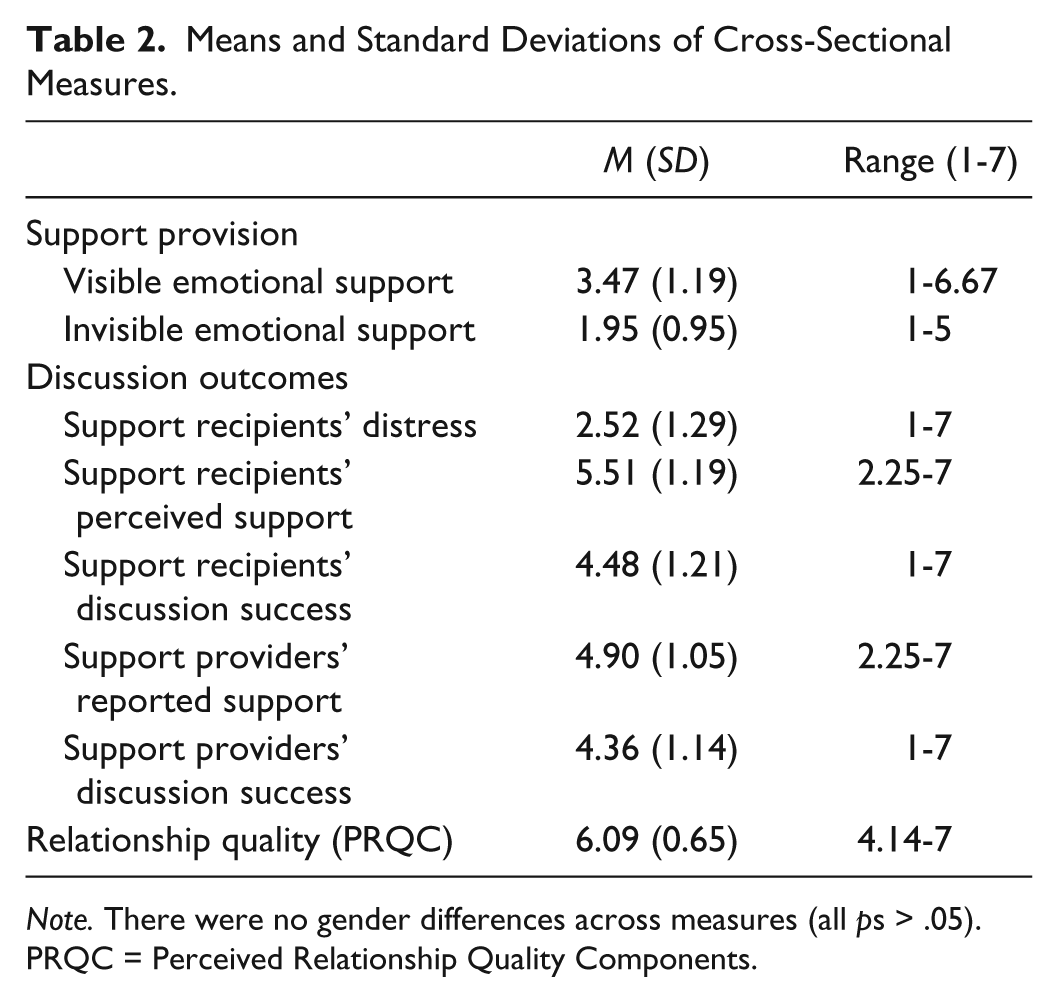
Note. There were no gender differences across measures (all ps > .05). PRQC = Perceived Relationship Quality Components.
Table 3 displays the correlations across measures at the initial session. Consistent with prior research showing the benefits of observed support in the laboratory, support providers’ visible emotional support was associated with higher perceived support, whereas invisible emotional support was not associated with any discussion outcomes. However, we predicted that the benefits and costs of visible support should depend on how distressed—and therefore how in need of direct reassurance—recipients were during the discussion. In addition, the provision and perceptions of support were correlated across partners (see Table 3), indicating that support behavior and perceptions may, in part, reflect general positivity within the relationship.
Correlations for all Measures.
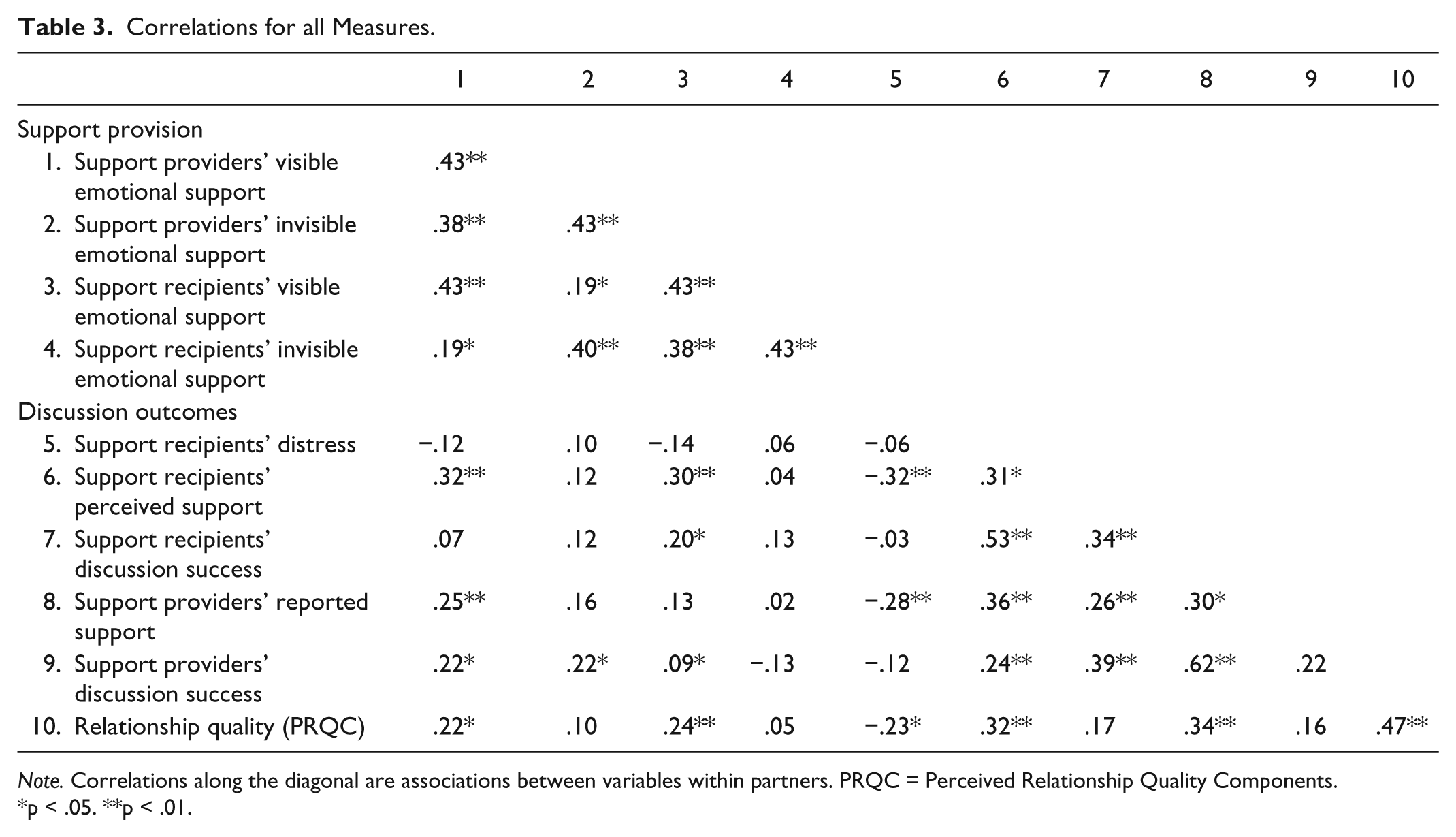
Note. Correlations along the diagonal are associations between variables within partners. PRQC = Perceived Relationship Quality Components.
p < .05. **p < .01.
To test our predictions, and to account for the statistical dependence inherent in dyadic data, we ran a series of Actor–Partner Interdependence Model (APIM) analyses using the MIXED procedure in SPSS 19 (Kenny, Kashy, & Cook, 2006). In particular, we regressed recipients’ perceived support on their partners’ provision of visible emotional support, recipients’ distress, and the interaction between partners’ visible emotional support and recipients’ distress. We also controlled for the general positivity or supportiveness across the dyad by simultaneously modeling the recipients’ provision of visible emotional support to their partner. 1 All predictor variables were grand-mean centered prior to the analyses. We pooled the effects across men and women, but included the main and interaction effects of gender to test for differences across men and women. No gender differences were found.
Visible Emotional Support
The results of the analyses testing the impact of visible emotional support on recipients’ perceptions of support are presented in the top left section of Table 4. As predicted, the more partners provided visible support, the more recipients perceived their partners were supportive during the discussion, but this effect was moderated by how much distress recipients were experiencing. This interaction is shown in Figure 1. Individuals low in distress (−1 SD) perceived their partners to be relatively supportive, regardless of whether partners provided high (+1 SD) or low (−1 SD) levels of visible support (slope = .10, SE = .12, t = −0.82, p = .41). However, individuals reporting high levels of distress (+1 SD) felt more supported when their partners provided greater visible support (slope = .45, SE = .17, t = 3.87, p < .001). Examining perceived support at low versus high levels of support indicated that more distressed recipients felt much less supported when their partners provided less visible support (slope = −.37, SE = .10, t = −3.64, p < .001), but felt just as supported as low distress recipients when their partners provided high levels of visible support (slope = −.05, SE = .12, t = −.38, p = .71). Thus, the benefits of visible support—and the costs of the absence of support—primarily occurred for recipients who were distressed and, therefore, required more direct forms of emotional reassurance.
Partners’ Provision of Visible and Invisible Emotional Support on Recipients’ Perceptions of Support and Discussion Success.
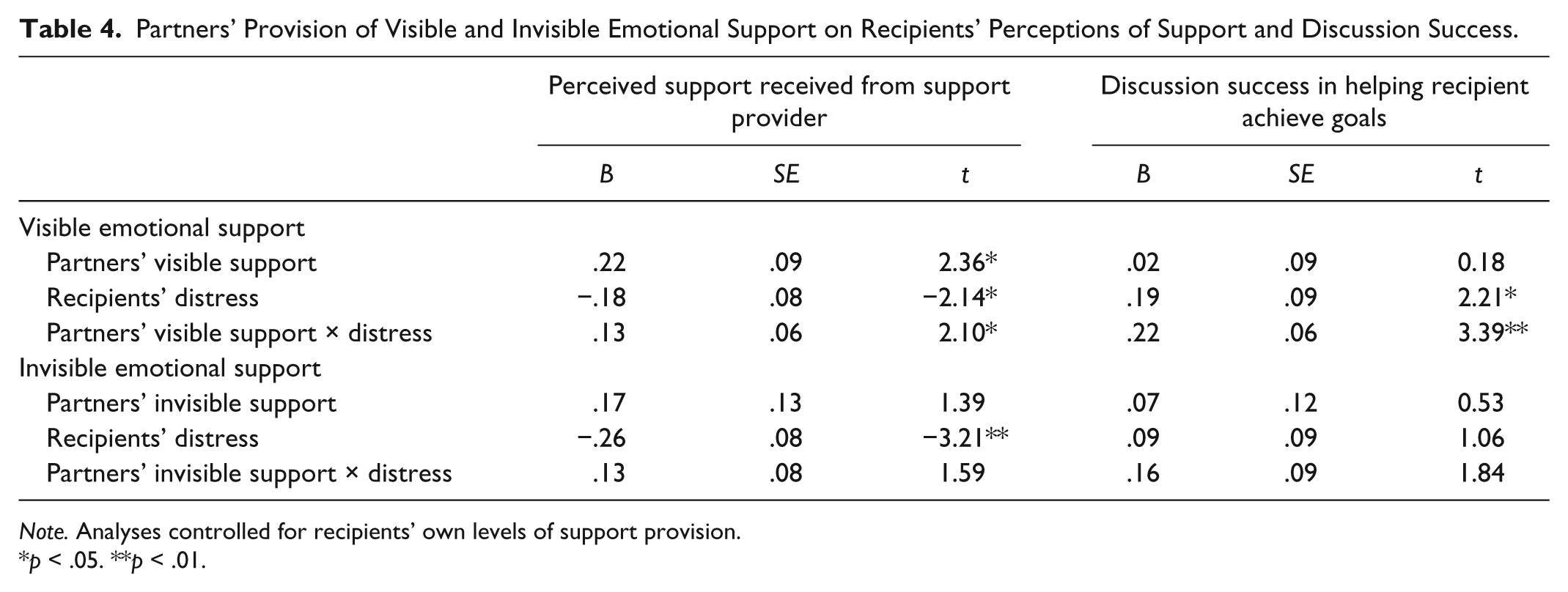
Note. Analyses controlled for recipients’ own levels of support provision.
p < .05. **p < .01.

Interaction between support recipients’ level of distress and visible emotional support provided by their partners on support recipients’ perceptions of support received.
Analogous models were run predicting recipients’ perceptions of discussion success in helping them achieve their goals (see top right of Table 4). Although the main effect of visible emotional support was not significant, a significant interaction emerged as predicted. Shown in Figure 2, greater visible support was associated with significant increases in perceived success for individuals who were higher in distress (slope = .32, SE = .13, t = 2.44, p = .02), but it was associated with significantly lower perceived success for individuals who were lower in distress (slope = −.28, SE = .12, t = −2.26, p = .03). This pattern indicates that the costs of visible support occur for people who are less distressed and, thus, do not need direct, visible reassurance. In contrast, visible support had benefits in helping recipients feel they could achieve their goals when they were more distressed and required direct reassurance and comfort.

Interaction between support recipients’ level of distress and visible emotional support provided by the partner on support recipients’ perceptions of discussion success.
Although we statistically controlled for overall levels of support across each dyad, we also wanted to ensure that the benefits of visible support for more distressed individuals were not attributable to more global perceptions of positivity. When rerunning the analyses controlling for relationship quality (assessed by the PRQC), the main and interaction effects shown in Table 4 and described hereinbefore remained significant.
Invisible Emotional Support
We next ran identical analyses to test whether invisible emotional support has immediate benefits or costs for recipients. The results are presented in the bottom of Table 4. In contrast to visible support, invisible support was not associated with recipients’ perceived support or discussion success, regardless of recipients’ level of distress. These effects were unaltered when controlling for relationship quality.
Support Providers’ Reported Support and Discussion Success
Our primary objectives centered on testing the impact of visible versus invisible support provision on support recipients’ outcomes. However, we also assessed support providers’ reports of the degree to which they delivered support during each discussion and how successful they felt the discussion was in helping recipients achieve their goals. This allowed us to test a key tenet that invisible support represents intentional enacted support behaviors by support providers that go unnoticed by support recipients (and thus are “invisible”).
APIM analyses revealed that support providers who were rated by coders as providing greater visible support reported they provided more support to recipients (B = .19, se = .08, t = 2.28, p < .05) and perceived that the discussion was more helpful in achieving recipients’ personal goals (B = .19, se = .09, t = 2.05, p < .05). More importantly, despite null associations between observer-ratings of invisible support and perceived support and discussion success for support recipients (Table 4), partners rated as providing greater invisible support also reported providing more support to recipients (B = .23, se = .11, t = 2.12, p < .05) and that the discussion was more successful in helping the recipient achieve his or her goal (B = .21, se = .12, t = 1.74, p = .08). These effects occurred regardless of how much distress the recipient was experiencing (tests of moderation ps > .05). This pattern of results indicates that the invisible support behaviors we coded do capture intentional supportive acts by the support-providing partner that are not perceived or rated as supportive by recipients. This provides direct evidence for the conceptualization of invisible support as support provided by one partner, but not perceived by the recipient.
To sum up, these findings reveal that the benefits of visible support depend on the degree to which recipients are distressed. Visible support increased perceived support and success in achieving future goals when recipients were more distressed and, hence, needed direct comfort. In contrast, visible forms of support reduced perceived success in achieving goals when recipients were less distressed and, thus, did not require direct reassurance. In contrast to visible support, invisible support was not related to recipients’ immediate perceptions of support and success, even though their partners reported being more supportive when delivering invisible forms of support. Thus, any benefits of invisible support are “working under the radar” of support recipients. We next tested whether invisible support helped recipients achieve their goal over time.
Long-Term Benefits and Potential Costs of Visible and Invisible Support
Our longitudinal analyses tested the degree to which partners’ visible and invisible emotional support predicted recipients’ goal achievement during the following year. Table 5 shows descriptive statistics for goal achievement at each 3-month follow-up phase as well as the number of couples assessed at each phase. Six couples ended their relationship before the first follow-up phase, and eight more couples broke up during the next 9 months. The multilevel analyses described in the following take into account sample attrition by weighting the estimates according to the reliability of each couple (i.e., how many measurements were available for each couple), meaning that we could include all couples on whom data were collected during at least one follow-up (N = 55). There were no differences between the couples who dissolved versus those who stayed together in levels of visible or invisible support (ts = < 1.1, ps > .05).
Means (and Standard Deviations) of Longitudinal Measures at Each 3-Month Follow-up Phase.

Our data have a nested structure, with the repeated measures of goal achievement at each 3-month measurement phase nested within each dyad. Thus, we tested our prediction following Kenny et al.’s (2006) recommendations for analyzing repeated measures data. Specifically, we regressed the multiple reports of goal achievement across the following year (Level 1) on the partner’s visible emotional support, the recipient’s distress, and the interaction between these two measures (Level 2). 2 The results, displayed in the top half of Table 6, revealed that visible emotional support, the recipient’s distress during the discussion, and the interaction between partner’s visible emotional support and recipient’s distress did not significantly predict goal achievement across the following year. However, analogue analyses testing the long-term effects of invisible support (see the bottom section of Table 6) revealed that greater invisible support predicted higher average levels of goal achievement by the recipient over the subsequent year, regardless of the levels of distress that recipients reported when initially receiving support.
Partners’ Provision of Visible and Invisible Emotional Support on Support Recipients’ Goal Achievement across Time.

Note. Coefficients control for recipients’ own levels of support provision.
p < .01.
We next ran analyses to rule out three alternative explanations. First, rerunning the analyses statistically controlling for initial relationship quality did not reduce the long-term benefits of invisible support (B = .35, se = .13, t = 2.73, p < .01), highlighting that the long-term benefits of invisible support were not attributable to more global positivity. Although the provision of invisible support was not associated with perceptions of support (see Table 4), we also wanted to determine whether the longitudinal effect of invisible support occurred above and beyond the documented boost in goal achievement associated with postdiscussion perceptions of support (see Overall et al., 2010). Rerunning the analyses with support recipients’ perceived support as an additional predictor revealed that perceptions of greater support independently predicted more goal achievement over the subsequent year (B = .19, se = .09, t = 2.08, p = .04). However, greater invisible support continued to predict greater goal achievement across the year, independent of recipients’ perceived support (B = .34, se = .12, t = 2.78, p < .01). These analyses suggest that invisible emotional support and perceptions of support are unrelated support process, each of which operates independently to facilitate recipients’ goal success. Finally, most recipients reported that they had ongoing discussions with their partners about their personal goals over time (see Table 5). Recipients were more successful at achieving their goal when couples continued to discuss their goal more over time (B = .21, se = .04, p < .001). However, visible and invisible emotional support were not associated with the degree to which couples discussed the targeted goals across time (B = −.00, se = .10, p > .05; B = −.04, se = .12, p > .05, respectively), and rerunning the longitudinal models controlling for the amount recipients discussed the topic over time with their partner did not diminish the degree to which invisible support predicted goal achievement over the year (B = .39, se = .11, p = .001).
Discussion
This study investigated the short- and long-term costs and benefits of receiving visible and invisible support during romantic couples’ discussions of each partner’s personal goal. We hypothesized that the short-term costs and benefits of receiving visible support on recipients’ perceived support and goal progress would depend on support recipients’ level of distress. As predicted, visible emotional support was associated with perceptions of greater support and discussion success for recipients who felt greater distress during the discussion and, thus, needed more direct reassurance. However, for recipients who experienced less distress and, therefore, did not require direct emotional comfort, greater visible emotional support had more personal costs, as indicated by perceptions that the discussions had been less successful in helping recipients achieve their long-term goals.
In contrast, invisible emotional support was not associated with recipients’ postdiscussion perceptions of support or discussion success, despite the fact that partners who provided more invisible support (as rated by coders) reported they were more supportive and that the discussion facilitated goal progress. This pattern of results provides direct evidence that the invisible support behaviors we assessed constitute invisible support as conceptualized in the prior literature: intentional supportive acts by the support-providing partner that are not perceived as supportive by recipients. More importantly, despite being invisible to recipients, invisible (but not visible) emotional support predicted greater goal achievement across the following year. This is the first demonstration that the provision of invisible support has long-term benefits in relationships, which is a critical and novel test of the proposed benefits of invisible support.
Viewed together, these results suggest that visible and invisible support serve different functions. Visible support appears to be immediately beneficial by reassuring recipients that they are in fact cared for, supported, and will have help to achieve their goals, but these benefits accrue only for recipients who need this type of support (i.e., those who feel distressed during support exchanges). In contrast, invisible support tends to go unnoticed by support recipients, but it plays an important role in facilitating long-term success in achieving recipients’ goals. We discuss potential underlying mechanisms for these effects in the following discussion.
Visible Support: Benefits and Costs Depend on the Needs of the Recipient
Consistent with prior research and theorizing, our results illustrate that the personal and interpersonal benefits associated with receiving visible support hinge on the contextual needs of the support recipient (e.g., Cutrona et al., 2007; Maisel & Gable, 2009; Simpson et al., 2007). Visible support is important in communicating care and helping regulate recipients’ distress when they feel upset and need their partners’ direct support. Accordingly, recipients who report high levels of distress when discussing their goal with their partner felt more supported and perceived greater success in moving toward their goal when their partners provided direct forms of reassurance. Moreover, the failure to deliver visible support when recipients are distressed has interpersonal costs for recipients. Recipients who were more distressed and received less visible support felt the least supported. The absence of visible support may signal that the partner cannot be counted on to be responsive to one’s needs, which should take a toll on relationships. For example, perceived lack of support and responsiveness erodes relationship satisfaction over time (Overall et al., 2010; Reis, Clark, & Holmes, 2004; Sullivan et al., 2010), undermines security and goal strivings in those who need support (Feeney, 2004; Overall et al., 2010), and can produce strong reactivity to problematic relationship interactions (Murray, Holmes, & Collins, 2006; Sullivan et al., 2010).
The current findings suggest that the benefits of support may outweigh the potential costs of visible support when recipients are distressed and need their partners. Visible support should communicate care and regard, even when support recipients are not overly distressed. Indeed, in our study, visible support was associated with greater perceived support, even among less-distressed recipients. However, consistent with the previously documented costs of visible support, these interpersonal benefits were accompanied by personal costs when recipients were less distressed and did not necessarily need overt reassurance. In particular, greater visible support given to nondistressed recipients predicted lower perceived discussion success in facilitating recipients’ ability to achieve their goals in the future. As suggested by prior research (e.g., Bolger & Amarel, 2007; Howland & Simpson, 2010), this probably occurred because the provision of visible support, in the absence of distress, conveys a lack of confidence that recipients can achieve their goals on their own. Extending that research, the current findings highlight that personal costs occur mainly for recipients who do not need immediate reassurance or support from their partners.
Invisible Support: Unnoticed in the Short-Term, but Promoting Goal Achievement in the Long-Term
The undermining effect of visible support on recipients’ perceived ability to cope and achieve their goals (which we found for less-distressed recipients) was the impetus for the theoretical development of invisible support. The degree to which support providers delivered invisible support was not associated with support recipients’ perceptions of support or their immediate felt-success in achieving their personal goals, yet it was associated with perceptions of greater support and discussion success reported by support providers. This pattern validates the premise that invisible support behaviors are likely to be provided strategically, but go “under the radar” and unnoticed by most support recipients. However, contrary to prior research showing that invisible support boosts self-efficacy and buffers negative mood (e.g., Bolger & Amarel, 2007; Bolger et al., 2000; Howland & Simpson, 2010; Shrout et al., 2006), we found that invisible support provision was not associated with immediate perceptions of success in facilitating goal progress. The reason for this, we believe, is that perceptions of discussion success involve evaluating how the self and partner contribute to goal success. Previously studied outcomes, such as mood and self-efficacy, have not required recipients to evaluate how support interactions lead to these states. Given that invisible support went unnoticed by most of our support recipients, it is not surprising that an evaluation of how the discussion facilitated goal achievement remained unaffected by these support behaviors.
However, consistent with the proposed functions of invisible support, the invisible support behaviors that did go unnoticed by most recipients were precisely those that helped them achieve their goals over time. The more support providers delivered invisible forms of support—such as discussing how others have coped with similar issues, engaging in off-topic or preemptive humor, and expressing subtle displays of affection—the more support recipients reported actual goal achievement across the following 12 months. This outcome is consistent with the premise that invisible support bypasses threats to recipients’ confidence and self-esteem (e.g., Bolger & Amarel, 2007; Bolger et al., 2000) and often bolsters feelings of self-efficacy (Howland & Simpson, 2010), which is critical to sustaining goal strivings and overcoming goal-relevant challenges (Bandura, 1994). Furthermore, the provision of invisible support predicted greater goal achievement, over and above how supportive recipients perceived their partners to be. This provides a powerful illustration that the invisible support behaviors we coded during couples’ discussions work outside and independently of the support recipients’ awareness.
To summarize, this study is the first one to demonstrate that invisible support facilitates actual goal achievement across time. This novel finding provides a critical test of the benefits of invisible support, and bolsters the argument that invisible support is integral to building (or retaining) personal efficacy and competence. In contrast, the provision of visible support was not directly associated with goal achievement across time. Based on prior theory and research, we now discuss the potential psychological mechanisms through which invisible (vs. visible) support may operate to facilitate goal achievement.
Boosting ownership over personal goals
By providing subtle forms of support that go unnoticed by support recipients, invisible support may “plant the seed” for recipients to attribute goal-related progress and coping to themselves rather than their partners. The extent to which individuals perceive that they can cope with goal-related stressors, barriers, and challenges and effectively pursue their goals is essential for managing goal-related anxiety and increasing the likelihood that they will eventually achieve their goals (Bandura, 1994). In the long run, therefore, the provision of invisible emotional support may boost recipients’ ownership of their goals and goal-related successes, as well as their mastery over challenges, barriers, and goal-related relapses. In contrast, despite alleviating distress and bolstering felt-support in the short-term, the overt nature of visible emotional support may lead recipients to attribute goal-related coping and achievement at least partly to the support provider, promoting reliance on the support provider and undermining their intrinsic goal-related motivation.
Aiding emotion regulation
Similarly, whereas visible emotional support (as we measured it) helps down-regulate recipients’ negative affect, invisible emotional support may scaffold recipients’ own emotion regulation. Goal achievement should be augmented by more effective coping or emotion regulation strategies on the part of recipients (e.g., Boekaerts, 2002), such as reappraising challenging situations (Gross & John, 2003). Instead of directly soothing distress, the provision of invisible support might model effective emotion regulation strategies by providing reappraisals of goal-related problems or strategies (e.g., acknowledging others’ shared experiences), which recipients can then chose to adopt as their own. This, in turn, should leave recipients better prepared to cope with negative emotions that may arise when they face new goal-related challenges or other stressors, permitting them to make further progress toward their long-term goals.
Strengths, Caveats, and Future Research Directions
A large body of research has examined invisible support by assessing discrepancies in support recipients’ and support providers’ reports of support (e.g., Bolger et al., 2000; Maisel & Gable, 2009; Shrout et al., 2006). In contrast, we examined specific invisible support behaviors (rated by coders) during support-relevant discussions between romantic partners. This observational approach captures how actual support behaviors influence recipients’ goal-related outcomes rather than relying only on partner-reported support provision, and it extends the one other observational study of invisible support (Howland & Simpson, 2010) by revealing what invisible support looks like during actual support interactions. Moreover, the pattern arising from these observational data offers good support for the conceptualization of invisible support as support provided by one partner but not perceived by the recipient in that partners who were rated as exhibiting more invisible support perceived themselves as providing more support, but recipients did not perceive greater support from these partners. Thus, the behaviors we identified were indeed “invisible” to recipients.
We focused on emotional forms of support because emotional support tends to be the most beneficial for relationships, and it is the most relevant response to a partner’s distress in the context of personal goal discussions. However, practical forms of support can also be important and may at times be particularly relevant to other needs that support recipients have. For example, practical support might be important for recipients who do not have the skills or lack the knowledge to accomplish their personal goals. Like our arguments regarding invisible emotional support, invisible practical support may impart goal-related knowledge and strategies in a way that recipients adopt as their own, boosting their intrinsic motivation and goal mastery. Future research should test the mechanisms through which invisible support facilitates recipients’ goal achievement over time, and whether differences exist in how emotional and practical invisible support operate.
Our findings demonstrate that the costs and benefits of support depend on the needs of the recipient in the specific context in which the support is occurring. Visible emotional support had benefits if recipients experienced distress while discussing their personal goals—a context of disclosure, reflection, and deliberation in which direct emotional support is needed, expected, and appropriate. However, in other contexts, even when recipients are experiencing high levels of distress, visible emotional support may not be needed or appropriate, and the interpersonal benefits of support could be superseded by personal costs. For example, Bolger and colleagues found that visible emotional support was damaging in the week preceding a stressful exam (Bolger et al., 2000) and detrimental immediately prior to giving an unrehearsed speech (Bolger & Amarel, 2007). In these contexts, the need to minimize distress and quell self-doubts to complete the task at hand involves a different set of acute needs that visible support could undermine; the need to feel understood and comforted may be irrelevant until the critical task has been completed. Thus, the balance of personal versus interpersonal need fulfillment, and the relative benefits and costs of visible support, ought to vary across different contexts. Indeed, understanding when visible and invisible support have costs and benefits is critical to enacting effective support provision, and examining the contextual needs of recipients should be a primary component of future investigations.
Considering the wider context is also important. Our sample was drawn from a university community in a Western and relatively egalitarian country, so whether and how these results generalize to other types of samples and social contexts remains unknown. Indeed, the extent to which individuals express distress and respond to direct versus more subtle forms of support is likely to differ across social and cultural contexts. For example, individuals of Asian descent are less likely to seek support from close others when experiencing stress or difficulties (Taylor et al., 2004), and they benefit more from indirect forms of support that do not make references to personal stressors (Kim, Sherman, & Taylor, 2008). Asian participants, compared with their European counterparts, also experience decreases in cortisol when asked to write a letter conveying indirect support strategies (e.g., write about a group that is close to you) compared with seeking support explicitly (e.g., asking for help from a close group; Taylor, Welch, Kim, & Sherman, 2007). These effects most likely arise because drawing attention to personal goals and stressors threatens cultural expectations about forgoing personal interests for the sake of the collective (Taylor et al., 2004). Thus, visible forms of support that directly focuses on the recipient and his or her stressors may be detrimental for recipients who have collectivist cultural backgrounds, and this may be particularly true when they are distressed. The benefits of invisible support might also be enhanced in these contexts. This example highlights that the potential costs and benefits of visible versus invisible support may vary across different cultural and social contexts, and understanding these contexts should be a major consideration in future research.
Finally, our sample also consisted of relatively young couples involved in relationships for an average of 3 years. Although 61% were cohabiting or married, roughly 20% broke up during the following year. These age and relationship demographics may limit the degree to which our findings generalize to a wider range of ages and relationship length. For example, given the difficulty of providing invisible support strategically (especially in a laboratory context), invisible support may be most effectively used by individuals in longer relationships who know more about how to best guide and aid their partner’s long-term goal-related needs. The potential costs of visible support might also be dampened in more long-term and established relationships because recipients’ knowledge of their partner’s availability may render direct displays of emotional reassurance and affection less necessary. Additional analyses of our data, however, revealed that the effects of invisible support were not modified by individuals’ age, relationship length, or relationship status. Nonetheless, given the costs and benefits of different types of support, identifying who needs more visible support, who provides more effective invisible support, and in what contexts, is an important direction for future research.
Conclusion
Prior research presents contradictory evidence regarding the costs and benefits of visible forms of support (e.g., overt displays of care and reassurance), and recent models suggest that invisible forms of support (e.g., subtle, conversational forms of comfort) might produce more benefits for support recipients. The present research advances our current understanding of support processes by illustrating that (a) the costs of visible forms of emotional support depend on the contextual needs of the recipient and (b) invisible support has long-term benefits. In our behavioral observation study of romantic couples, we found that greater visible support provision was associated with greater perceived support and discussion success when support recipients were highly distressed during the discussion, but it was costly for less-distressed support recipients, who reported lower discussion success. In contrast, greater invisible emotional support was not associated with perceived support or discussion success, but predicted greater goal achievement over time. Together, these results suggest that visible support is the most beneficial as an immediate strategy for distressed individuals to feel supported and positive about their goals, whereas invisible support plays an important role in shaping recipients’ goal pursuit and accomplishment over time.
Footnotes
Acknowledgements
We thank Kirstyn Turnbull, Antoinette Murray, and Joshua Bayliss for their contribution to the development of the coding schedule and coding.
Declaration of Conflicting Interests
The author(s) declared no potential conflicts of interest with respect to the research, authorship, and/or publication of this article.
Funding
The author(s) received no financial support for the research, authorship, and/or publication of this article.