




Abstract
Interfacing the terror management health model with the meaning transfer model, we offer novel hypotheses concerning the effectiveness of celebrity and medical endorsements for consumer products and health behavior decisions. Studies 1 and 2 revealed that, compared with control topic primes, death thoughts in focal attention increased the effectiveness of health-oriented (doctor) endorsers but not culture-oriented (celebrity) endorsers, whereas death thoughts outside of focal attention increased the effectiveness of culture-oriented endorsers but not health-oriented endorsers. Studies 3 and 4 then focus more specifically on the valence and specificity of culture-oriented endorsements, revealing that death thoughts outside focal attention increase the effectiveness of culture-oriented endorsers only on the behaviors specifically endorsed and only when the endorser is characterized as possessing cultural value. Discussion focuses on everyday management of existential concerns and implications for persuasive communications in the health domain.
“I’m not a doctor, but I play one on TV” is one of the most famous television commercial lines of all time, delivered by Chris Robinson (General Hospital) and later by Peter Bergman (All My Children) to sell Vicks cough syrup in the 1980s. Research suggests that endorsements are influential on account of the transfer of meaning from the endorser to the product or behavior (McCracken, 1986) and, thus, a “doctor” should be especially effective to sell cough syrup. Of course, the actor in this commercial is a celebrity, and celebrities lend meanings to the products and behaviors they endorse as well. The present research takes a novel approach to the question of how endorsements of products and behaviors can influence people’s decisions to “buy” the message being sold. To do so, we build on terror management theory (TMT; Greenberg, Pyszczynski, & Solomon, 1986), and specifically the terror management health model (TMHM; Goldenberg & Arndt, 2008), in conjunction with the meaning transfer model (McCracken, 1986) to investigate the effects of mortality awareness on the effectiveness of health- and culture-oriented endorsements. Four studies investigated the efficacy of health- and culture-oriented endorsements as a function of the consciousness of death-related thoughts.
TMT and the Dual Process Model of Defense
Building from the works of cultural anthropologist Ernest Becker (1973), TMT (Greenberg, Solomon, & Arndt, 2008) posits that awareness of inevitable death plays a key role in human social behavior. The theory holds that, to manage the threat of mortality, people maintain faith in cultural worldviews, which enable the individuals to cultivate a sense of value (self-esteem) by upholding the standards of their culture. Substantial evidence supporting TMT follows from the mortality salience hypothesis (Rosenblatt, Greenberg, Solomon, Pyszczynski, & Lyon, 1989): If self-esteem and cultural beliefs buffer death-related concerns, then reminders of mortality (i.e., mortality salience; MS) should motivate strivings to adhere to and protect one’s worldviews and enhance one’s feelings of worth. Consistent with this hypothesis, research shows that MS fosters behavior oriented toward upholding and defending worldview beliefs and bolstering self-esteem (see Burke, Martens, & Faucher, 2010; Greenberg et al., 2008; Pyszczynski, Greenberg, Solomon, Arndt, & Schimel, 2004).
Critically, research demonstrates that explicit awareness of mortality engenders a dual process system of defense (Pyszczynski, Greenberg, & Solomon, 1999), which has recently been expanded into the TMHM (Goldenberg & Arndt, 2008) to specify how conscious and nonconscious death thoughts affect attitudes and behaviors in health domains. The model posits that the proximal motivations engendered by conscious mortality concerns lead people to engage in health-oriented responses that reduce the perceived threat by facilitating good health or, when salient options are not available or perceived as efficacious, by denying vulnerability to life threatening diseases and distraction from the threatening information. In contrast, when mortality concerns are cognitively accessible, yet not the subject of conscious attention, distal motivations lead people to make self- or culture-oriented responses, directing their attitudes and behaviors toward accruing self-esteem and upholding cultural standards of worth—popularly held criteria for judging the value of members of one’s culture (Crocker & Wolfe, 2001).
Research finds, for example, that immediately following explicit reminders of death (when death thoughts are presumably in focal awareness) participants increase intentions to use more protective sunscreen (Routledge, Arndt, & Goldenberg, 2004), express greater fitness intentions (Arndt, Schimel, & Goldenberg, 2003), and reduce their in vivo smoking intensity when not craving cigarettes (Arndt et al., 2013). But when explicit reminders of mortality are followed by a delay or distracter task (shown to remove death thoughts from focal attention; Greenberg, Pyszczynski, Solomon, Simon, & Breus, 1994), those who smoked to maintain a favorable social image increased smoking cessation intentions when smoking was portrayed as socially “uncool” (Arndt et al., 2009), and the desire to suntan varied as a function of the attractiveness and cultural appeal of tanned skin (Cox et al., 2009; Routledge et al., 2004). Taken together, this and other research converge to suggest distinct consequences of death-related thoughts that are in or outside of focal attention (e.g., Hayes, Schimel, Arndt, & Faucher, 2010; Pyszczynski et al., 1999). Indeed, this prior work suggests that whereas conscious death-related thoughts motivate an increased appeal of health-oriented cues, thoughts of death outside of conscious attention should increase the appeal of cues associated with esteem and cultural value. Consistent with this possibility, studies have found that when reminded and distracted from thoughts of mortality, people become especially interested in fame and cultural celebrities (Greenberg, Kosloff, Solomon, Cohen, & Landau, 2010).
The Effectiveness of Health- Versus Culture-Oriented Communication: The TMHM Perspective
Commercial and public service communications commonly feature endorsements by spokespersons adding persuasive appeal to the product, brand, or message. Classic perspectives on the effectiveness of such strategies have included considerations of source credibility (Hovland, Janis, & Kelley, 1953), source attractiveness (Chaiken, 1979), endorser–product match (Forkan, 1980), and dual routes of message elaboration (Petty & Cacioppo, 1986). The foregoing analysis of TMHM suggests another factor that has not been considered in prior work: the extent to which the endorsing spokesperson is relevant to the consumer’s operative existential motivation.
Endorsing spokespeople are typically chosen because they have acquired and evoke important and valued attributes (i.e., meanings; Erdogan, 1999; see Byrne, Whitehead, & Breen, 2003). For example, endorsements by basketball superstar Lebron James are presumably sought because of the enormous successes attributed to his skills on and off the court, whereas endorsements by a medical doctor might be sought for the skill attributed to maintaining good health. The present work explores whether the various meanings/ attributes conveyed by the endorser may make a given product, brand, or service more or less relevant to the psychological motivations engaged by awareness of mortality. One useful platform for considering this process is the meaning transfer model (McCracken, 1986, 1989), which outlines three basic steps by which endorsement affects product consumption. First, an initial set of meanings become attributed to the endorser based on his or her known background (e.g., professional expertise, prior acting roles). Second, the spokesperson’s endorsement helps imbue the product, brand, or message with those attributes. Finally, once those meanings are associated with the product, the consumer can then symbolically glean those meanings by purchasing or consuming the product or otherwise adhering to the message (see also Levy, 1959; Rozin, Millman, & Nemeroff, 1986; Seno & Lukas, 2007, for a related analysis). Accordingly, studies have shown increased purchase intentions and value placed on items previously owned by likeable and moral, but not unlikable and immoral, celebrities (Newman, Diesendruck, & Bloom, 2011).
The Present Research
The present research focuses on what motivates consumers to prefer certain endorser attributes over others. Specifically, the studies reported here integrate the meaning transfer model with the TMHM to offer unique predictions about which types of endorsements will be the most effective in guiding consumer attitudes and behaviors, with a focus on why and when. Following TMHM, it was hypothesized that actively thinking about death would trigger efforts to reduce actual vulnerability to mortality, enhancing effectiveness of commercial and public service campaigns featuring endorsers conveying health-oriented meaning sets (e.g., a medical doctor). In contrast, thoughts of death outside of focal attention should trigger efforts to symbolically manage mortality by following cultural standards of worth and popular social appeal, enhancing effectiveness of advertisements featuring endorsers conveying culturally oriented value (e.g., a successful celebrity).
In testing such novel predictions, four studies were conducted. Studies 1 and 2 investigated the immediate and delayed effects of mortality reminders on the effectiveness of advertisements featuring endorsements by either a medical doctor (health-oriented) or a celebrity (culture-oriented). In Study 1, the endorsements promoted a (fictitious) commercial water product, with the effectiveness of the endorsements measured by the consumer demand (i.e., the price participants were willing to pay) for the product. Study 2 extended this investigation to behavior, measuring the amount of the water product participants drank.
Studies 3 and 4 focused more specifically on the valence and specificity of the culture-oriented endorsements. Study 3 tested whether a culturally oriented celebrity is only effective to the extent that he or she embodies a positive set of cultural meanings. The celebrity endorser was portrayed either as enjoying a popular and successful career or as enduring an unpopular and faltering career, and the endorsement content and the outcome were expanded into the health domain, responsible alcohol use. Study 4 examined whether the endorsement of one health behavior will also influence support for another, or remain specific to the behavior endorsed. Thus, in Study 4, endorsement content was manipulated, with the celebrity endorsing either an antismoking campaign or an influenza vaccination campaign; all participants were then specifically asked to report their antismoking attitudes. These latter studies thus positioned the present research to inform the breadth and specificity of how culturally oriented celebrities influence peoples’ efforts to manage underlying concerns about mortality.
Pilot Study
Each study sought to examine the influence of terror management processes on the effectiveness of communications featuring endorsements by either a medical doctor or a celebrity. The celebrity endorser was selected via a pilot study that asked 67 undergraduates to evaluate the top 25 celebrities named by People magazine 2010. Evaluations were based on five questions concerning cultural representation, with items such as “how much do you feel this person represents American culture?” (1 = not at all, 10 = very much; α = .85). Jennifer Aniston and Sandra Bullock, respectively, were two celebrities rated as the best representing American culture.
Study 1
The TMHM suggests that focal awareness of death fosters health-oriented responses, but once distracted from death-related cognition, individuals instead initiate responses associated with acquiring cultural value. Integrating these ideas with the meaning transfer model of endorsements, the present analysis predicted that participants would more strongly desire a product endorsed by a medical doctor (i.e., a product associated with health-oriented attributes) when death thought was in focal awareness, but would more strongly desire a product endorsed by a celebrity (i.e., a product associated with cultural-value-oriented attributes) when death thought was accessible but out of focal awareness. Thus, in Study 1, participants were reminded of mortality (or not) and then, either immediately or after a delay, encountered an ostensibly new brand of bottled water, endorsed by a medical doctor or by a celebrity, and were asked to indicate the price they would be willing to pay for the water.
Method
Participants
In all, 125 students (age: M = 18.5 years, SD = 0.97; male = 48, female = 72, sex not reported = 5) participated. In this and all subsequent studies, students participated in exchange for course credit.
Materials and Procedure
A cover story informed participants that they were to take part in a study on personality and consumer attitudes.
MS
Following prior research (Rosenblatt et al., 1989), a questionnaire was used to manipulate awareness of death (vs. control). In the mortality condition, two open-ended questions were asked: “What do you think will happen to you when you die?” and “What do you think happens to you as you physically die?” The control condition asked about failing an exam.
Delay/distraction
To manipulate proximal and distal terror management processing, participants were next either given or not given a set of distracter tasks. The distraction task serves to move thoughts of mortality out of direct conscious attention. Prior research, for example, has shown that immediately after explicit mortality reminders, people suppress death-related thought or deny (or increase intentions to reduce) vulnerability to a short life expectancy (e.g., Arndt et al., 2003; Greenberg et al., 1994; Greenberg, Arndt, Simon, Pyszczynski, & Solomon, 2000). Such actions are hypothesized to reflect efforts to remove death-related thoughts from consciousness/focal awareness (reflecting proximal terror management processes). However, once distracted from such reminders, death-related cognitions remain nonconsciously accessible (triggering distal or symbolic terror management processes). Such distraction manipulations have been used effectively to remove death thoughts from conscious attention in a large number of terror management studies (see Burke et al., 2010; Martens, Burke, Schimel, & Faucher, 2011, for meta-analytic reviews). Following that prior work, those in the delay condition completed the Expanded Positive and Negative Affect Schedule (PANAS-X; Watson & Clark, 1992) and read a short story, taking approximately 5 to 8 min. The no-delay condition did not include these tasks.
Endorsement manipulation and purchase ratings
Participants evaluated a color print advertisement for a purported new bottled water product called “H2O.” The page resembled popular commercial advertisements, with a logo and background image of a blue water splash. The celebrity condition advertisement included a stock photo of Jennifer Aniston, seated and in a white blouse. The medical doctor condition advertisement included a stock photo of a medical doctor (matching Aniston’s gender and approximate physical appearance), presented as “Dr. Jane Watson,” seated in a white medical coat with a stethoscope over her neck. Both conditions included identical text describing the product endorsement, along with purported signatures (Jennifer Aniston/Jane Watson) to emphasize the endorsement.
Consumer demand
Participants then indicated on a 13-point Likert-type scale how much they would be willing pay for the product (ranging from US$0.50 to US$3.50, in increments of US$0.25).
In this and all studies, a demographics questionnaire assessed items such as age and sex, and all participants were fully debriefed. Sex did not qualify any primary effects in any study and is thus not discussed further (all ps > .31).
Results and Discussion
A 2 (MS vs. control) × 2 (delay vs. no delay) × 2 (celebrity vs. medical endorser) ANOVA revealed a main effect for MS, F(1, 117) = 10.49, p = .002,

Three-way interaction between MS, delay, and endorser on price participants were willing to pay for the water (Study 1).
In the no-delay condition, MS (vs. control) increased the amount of money participants were willing to pay for the bottle of water when endorsed by a medical doctor, t(31) = 3.40, p = .001, d = 1.22, but not when endorsed by the celebrity t(28) = 0.03, p = .98, d = 0.01. However, after a delay, MS (vs. control) increased the amount of money participants were willing to pay for the bottle of water when endorsed by a celebrity t(29) = 2.68, p = .008, d = 1.00, but not when endorsed by a medical doctor t(29) = 0.47, p = .64, d = 0.17. In line with previous TMT research, no effects of MS on either positive or negative affect were found in this or the following studies and are not discussed further (all ps > .25).
Results of Study 1 suggested that when death thought is in focal awareness, it fosters health-oriented responses, increasing the amount people are willing to pay for a product endorsed by a medical doctor (and not a celebrity); but when death thought is activated yet outside focal awareness, it instead initiates responses oriented toward cultural value, increasing the amount people are willing to pay for a product endorsed by a celebrity (and not a medical doctor). This provides the first evidence of differential responses to medical and cultural endorsements contingent on the level of conscious awareness of mortality.
Study 2
The initial findings of Study 1 were informative but were limited to the price participants were willing to pay for the product. Thus, it is unclear whether these processes would similarly influence actual consumption behavior. Study 2, therefore, investigated this process in a behavioral scenario, which has been increasingly advocated in psychological research (e.g., Baumeister, Vohs, & Funder, 2007).
Method
Participants
Eighty-eight students (age: M = 19.49 years, SD = 1.62; male = 47, female = 34, sex not reported = 7) were recruited and run in groups of three per session with each participant in separate cubicles.
Materials and Procedure
Study 2 resembled Study 1, with one major exception. Rather than manipulating a print advertisement, Study 2 manipulated the packaging and labeling of an actual water bottle. Participants were given a manila envelope containing a 330ml bottle of chilled water. The envelope ensured that the experimenter was blind to condition. The original plastic wrapping of the bottle was removed and replaced with a wrapping featuring the “H2O” brand graphics and endorsements from Study 1. In the celebrity endorsement condition, the wrappers featured the same image, endorsement text, and purported signature of Jennifer Aniston used in Study 1. In the medical doctor endorsement condition, the same was true for the image, text, and signature of the ostensible Dr. Jane Watson. All wrappers included a fabricated FDA nutrition information label and bar code to bolster realism. Participants were told that they could drink as much of the water as they desired while they completed the rest of the study (actually filler items). On completion of the study, the remaining water in each bottle was measured using a graduated cylinder. The amount (in ml) of water consumed was calculated by subtracting the remaining ml water from the initial 330 ml.
Results and Discussion
A square root transformation (based on a Box-Cox test) corrected the non-normal distribution of error revealed by a Levene’s test and q-q plot. A 2 (MS vs. control) × 2 (delay vs. no delay) × 2 (celebrity endorser vs. medical endorser) ANOVA revealed no main effects but a two-way interaction between endorser and delay, F(1, 80) = 6.28, p = .01,

Three-way interaction between MS, delay, and endorser on water consumption (Study 2).
In the no-delay condition, MS (vs. control) increased consumption when the water was endorsed by a medical doctor t(20) = 2.28, p = .03, d = 1.02, but not when endorsed by a celebrity, t(20) = −1.56, p = .10, d = −0.700. In contrast, in the delay condition, MS (vs. control) increased consumption when the water was endorsed by a celebrity, t(20) = 4.19, p < .001, d = 1.87, but not when endorsed by a medical doctor, t(20) = −1.33, p = .19, d = −0.59.
Thus, Study 2 conceptually replicated Study 1 in a behavioral setting. When death thoughts were in focal awareness, participants drank more water when endorsed by a medical doctor. In contrast, when distracted from thoughts of death, participants drank more water when endorsed by a celebrity. 1 These findings provide unique insights into how responses to endorsers with medical or cultural appeal can differentially be shaped by individuals’ motivation to seek better health (in the no-delay condition) or to seek cultural value (in the delay condition).
Study 3
Building on Studies 1 and 2, Study 3 more specifically addressed the role of celebrity endorser attributes. Although some endorsers carry stable and positive appeal, others can experience a few bumps along the road or even a dramatic fall from public favor (e.g., Tiger Woods was a popular golfer and successful spokesperson until dramatic revelations of his marital infidelities in 2009 seemingly played a key role in him being dropped by a number of companies; Piazza, 2009). In gauging why some celebrity endorsements are not—or suddenly cease to be—effective, a recent meta-analysis suggests that negative celebrity information is the strongest predictor of endorser ineffectiveness (Amos, Holmes, & Strutton, 2008). That finding fits well with the meaning transfer model perspective in that celebrity endorsement can transfer the celebrity’s desirable and undesirable attributes alike to the product or message being endorsed (Stages 1 and 2 of the meaning transfer model of endorsements). Thus, it could be that some celebrities maintain their favorable celebrity attributes and transfer those culturally desirable meanings via their endorsements, whereas other more troubled celebrities do not because their image becomes tarnished by negative information. Thus, from the TMT perspective, the salience of favorable versus unfavorable celebrity attributes would influence the effect of MS on celebrity endorsement efficacy.
To explore this possibility, Study 3 focused on the distal terror management process (when death thought is outside focal awareness) and manipulated the salience of favorable versus unfavorable celebrity endorser attributes. Specifically, the endorser was portrayed either as (a) a celebrity with a popular and successful career, (b) that same celebrity with an unpopular and faltering career, or (c) a noncelebrity endorser (comparison condition). The endorsement content and outcome measure dealt with responsible alcohol consumption, a behavior relevant to commercial and health domains. Based on the TMHM and the meaning transfer model, it was expected that death reminders would increase intention to drink responsibly (as opposed to engaging in a potentially dangerous level of excess drinking) when a “drink responsibly” public service campaign was endorsed by a popular and successful celebrity but not when endorsed by an unpopular celebrity or a noncelebrity (e.g., medical doctor).
Method
Participants
A total of 126 (age: M = 18.56 years, SD = 1.24; male = 48, female = 78) participated via an Internet-based data collection service (Qualtrics, Provo, Utah).
Materials and Procedure
Participants in Study 3 were randomly assigned to conditions in a 2 (MS vs. uncertainty) × 3 (endorser: popular celebrity vs. unpopular celebrity vs. medical endorser) design and then presented with a risky alcohol scenario and asked about their willingness to make responsible drinking decisions.
MS and delay/distraction
Study 3 used the same MS prompt as Studies 1 and 2, but the control condition prompt instead asked participants to contemplate personal uncertainty. The personal uncertainty condition was identical to the MS condition, except that it asked “What do you think will happen to you when you experience personal uncertainty?” and “What do you think happens to you as you physically experience personal uncertainty?” This control topic enabled us to examine theoretical suggestions that MS effects emerge not because they trigger terror management processes per se, but instead because thoughts of mortality elicit feelings of personal uncertainty that lead to efforts to reaffirm certainty via worldview defenses 2 (e.g., van den Bos, 2009; but see also Martens et al., 2011 for a meta-analysis addressing this possibility). Following the MS manipulation, all participants completed the delay/distraction tasks.
Endorser
The endorser manipulation was similar to those in Studies 1 and 2 but with several exceptions. First, participants were randomly assigned to one of three endorser conditions: popular celebrity, unpopular celebrity, and medical doctor. Second, the celebrity condition used Sandra Bullock (who also ranked high in the pilot test and allowed us to generalize beyond Jennifer Aniston). The medical condition used the same doctor (presented in Study 3 as “Dr. Laura Kaufield” 3 ).
Participants read a short news article about responsible alcohol consumption, ostensibly taken from a “Life & Times” section of a newspaper. The article featured the image of the endorser and closed by quoting the endorser saying, “Students like to party. I did when I was a student, but I was always responsible. So I’m happy to work with universities to encourage students to drink responsibly.” The cultural value of the celebrity (Bullock) was manipulated by including a brief description of an alleged rise versus fall in Bullock’s position in People magazine’s “definitive list of the Top 100 celebrities” as well as either a positive versus negative assessment of her upcoming films. The doctor condition did not mention popularity and served as a noncelebrity control condition.
Responsible drinking intentions
Finally, participants completed the dependent variable that assessed anticipated alcohol consumption in risk conductive situations. A five-item measure assessed willingness for responsible alcohol consumption in two risky drinking scenarios (Ouellette, Gerrard, Gibbons, & Reis-Bergan, 1999; Zimmermann & Sieverding, 2010). The first risky alcohol scenario stated, “Suppose that you were with some friends at a party and one of them offered you some kind of alcoholic drink.” Participants then indicated their intention to engage in the following three behavior items: “Take and try it,” “Tell them no thanks,” and “Leave the situation.” The second scenario stated, “Suppose that you are at a party with some friends. After several drinks you are beginning to feel that you may have had enough, and are getting ready to leave. Then, a very attractive guy/girl you had been wanting to meet asks you to stay and offers to get you another drink.” Participants indicated their intention to engage in the following two behavior items: “Stay and continue to drink” and “Say you need to leave, but ask to call him/her sometime.” Each of the five drinking intention items was assessed using 10-point Likert-type scales (1 = not at all likely, 10 = very likely) and, after reverse-scoring the appropriate items, they formed a reliable composite (α = .82) such that lower scores indicated intention to engage in potentially risky drinking and higher scores indicated more responsible and healthy drinking intentions.
Results and Discussion
A 2 (MS vs. control) × 3 (popular celebrity vs. unpopular celebrity vs. medical doctor) ANOVA revealed a main effect for MS, F(1, 120) = 8.76, p = .004,
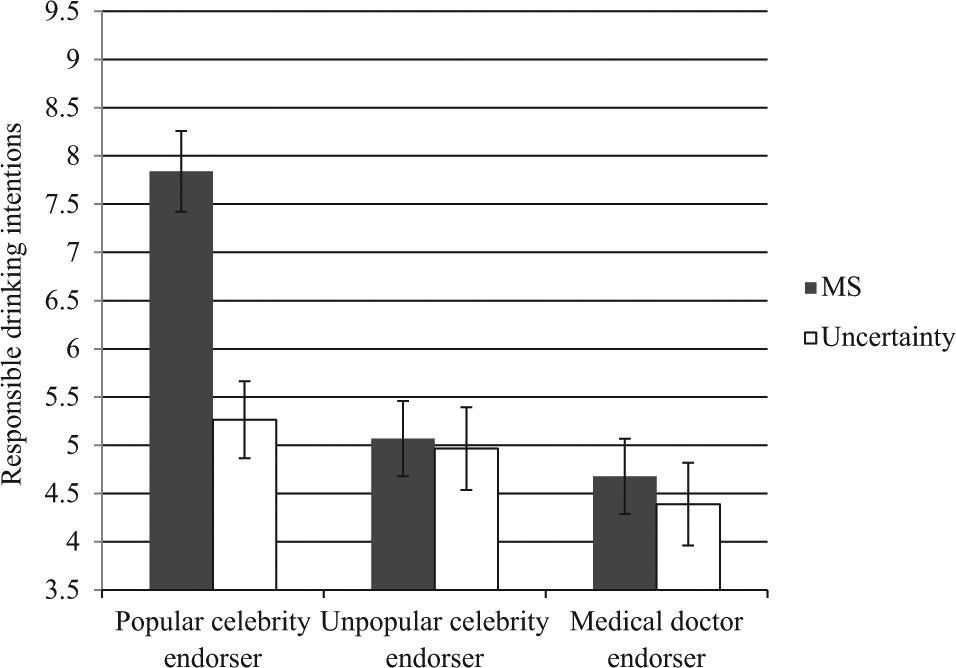
Two-way interaction between MS and endorser on willingness to drink alcohol (Study 3).
Study 3 supported the hypothesis that MS would increase intention to drink responsibly when a responsible drinking campaign was endorsed by a popular celebrity but not when endorsed by an unpopular celebrity or a noncelebrity. These findings support the meaning transfer model, suggesting that the endorsement portrayals transferred specific meanings and attributes from the endorser to the message (or product), and support the TMHM by showing that distal terror management processes increase the effectiveness of endorsements associating the message (or product) with cultural success.
Study 4
Study 3 illustrated the impact of desirable versus undesirable endorser attributes but does not inform the specificity of the endorser impact after reminders of mortality. That is, it remains unclear whether the endorsement transfers those meanings to the specific message (or product) being endorsed or whether effective endorsement of a specific health campaign increases healthy behavior more indiscriminately. According to the meaning transfer model, endorsements transfer the meaning sets of the endorser to the specific campaigns/products endorsed, and therefore, MS should increase efforts to attain cultural value by aligning the self with the specific public health message that is endorsed.
To examine this specificity hypothesis, Study 4 again focused on the distal terror management process (when death thought is outside focal awareness) and manipulated the content of the celebrity endorsements. The celebrity endorser was described as endorsing either (a) an antismoking campaign or (b) an influenza vaccination campaign. If cultural endorsements specifically transfer value to the campaigns they endorse, then MS should increase the value of participants’ nonsmoker self-concepts and negative view of smokers. Moreover, this is only expected in the condition where the celebrity endorsed the antismoking campaign, not in the condition where the endorsement targeted the influenza vaccination campaign.
Method
Participants
A total of 226 students in an introductory psychology class (age: M = 19.5 years, SD = 1.26; male = 44, female = 182) participated via an Internet-based data collection interface (Qualtrics, Provo, Utah). However, four participants did not complete the materials and thus were not included in the below analyses. An initial question asked students if they were smokers, and if so, they were taken to materials for a different study. Thus, all participants in this study reported being nonsmokers.
Materials and Procedure
Study 4 randomly assigned participants to conditions in a 2 (MS vs. failure) × 2 (celebrity endorsement: antismoking vs. influenza vaccination) design and then assessed (a) the value of their nonsmoking self-concept and (b) changes in the extent to which they associated the prototypical smoker with various negative and positive traits.
Smoker prototypes pre-measure
Embedded among a number of filler items, a 12-item measure assessed participants’ initial perceptions of the prototypical smoker (Gibbons & Gerrard, 1995). The instructions first defined a prototype: “We would like to get your opinion of other smokers your age; in other words, the ‘typical’ smoker in your age group. We are not looking for anyone in particular; we just want to know what you think the average person (or most people) your age who smokes is like.” Items used a 6-point Likert-type scale (1 = strongly disagree, 6 = strongly agree) and assessed the degree to which participants viewed the prototypical smoker as possessing negative (e.g., “The typical smoker is self-centered,” “The typical smoker is weak”) and positive (e.g., “The typical smoker is friendly,” “The typical smoker is smart”) attributes. Positive attribute items were reverse scored, such that higher scores on each item indicated a more negative smoker prototype (α = .70).
MS and delay/distraction
Study 4 used the same MS versus control topic (failure) manipulation as Studies 1 and 2, and all participants completed the delay/distraction tasks.
Nonsmoker self-concept
A three-item measure assessed how much participants valued their nonsmoker self-concept. Items used a 10-point Likert-type scale and were “How important to you is being a nonsmoker?” “How good does being a nonsmoker make you feel?” and “How much self-esteem do you get from being a nonsmoker?” A composite was formed (α = .69) such that higher scores indicated greater nonsmoker self-concept value.
Smoker prototypes post-measure
The 12-item measure of participants’ perceptions of the prototypical smoker (Gibbons & Gerrard, 1995) was again assessed. Positive attribute items were reverse scored such that higher scores on each item indicated a more negative smoker prototype (α = .83). To assess change in smoker prototypes, each pre-measure item score was subtracted from each post-measure item score, such that below-zero scores indicated a shift toward favorable smoker prototypes and above-zero scores indicated an increase in unfavorable smoker prototypes.
Results and Discussion
Nonsmoker self-concept
A 2 (MS vs. control) × 2 (endorsement: antismoking vs. influenza vaccination) ANOVA revealed a main effect for MS, F(1, 218) = 12.25, p = .001,
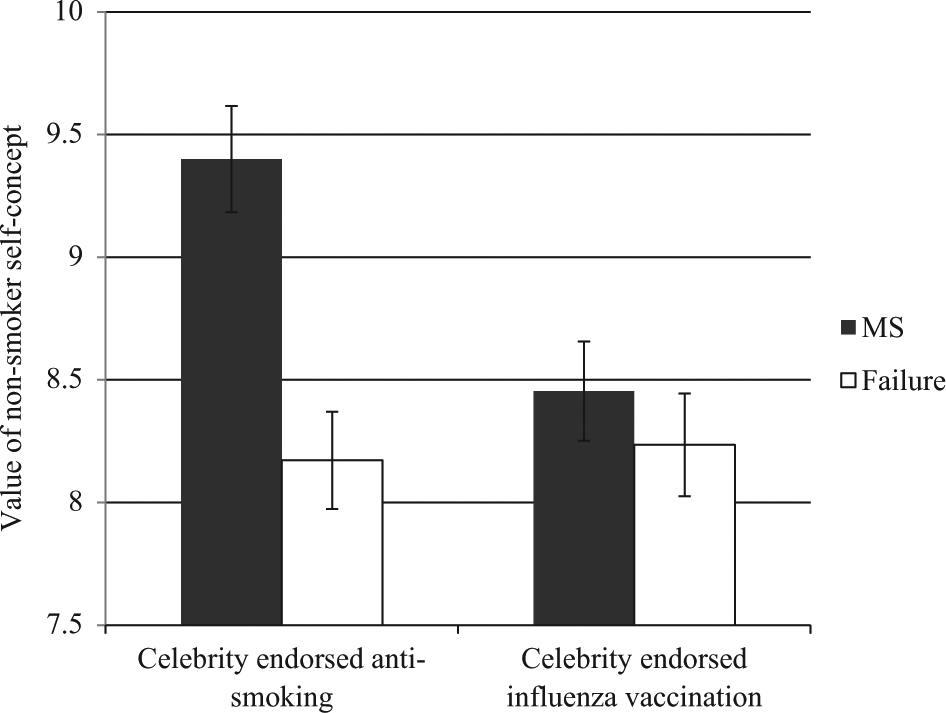
Two-way interaction between MS and endorsement (Study 4).
Smoker prototypes
Examining change in smoker prototype scores, there emerged a main effect for MS, F(1, 218) = 7.13,
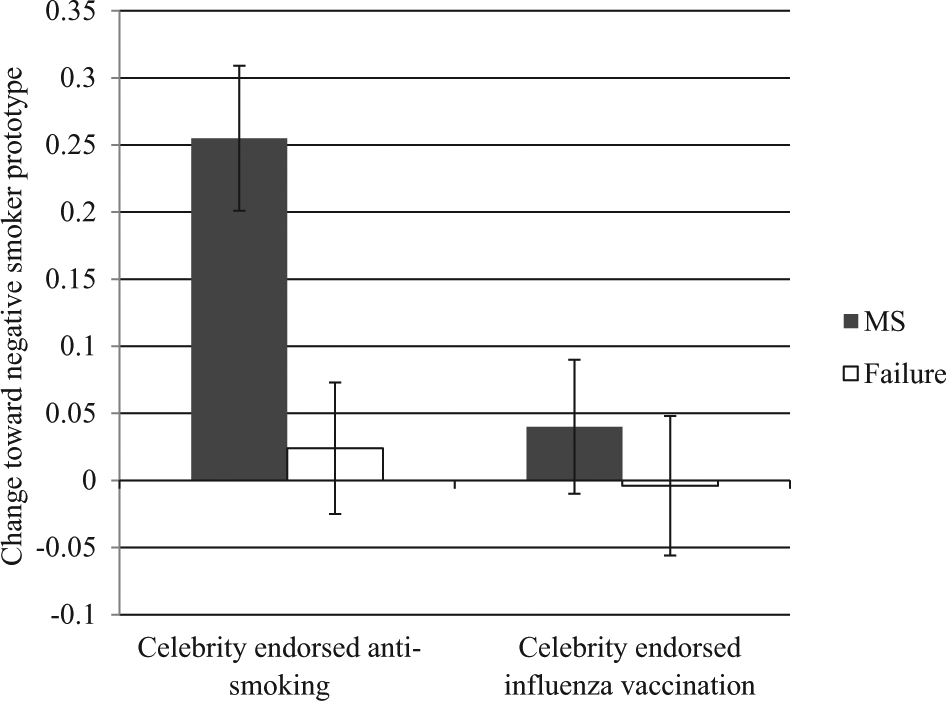
Two-way interaction between MS and endorsement (Study 4).
Study 4 supported the hypothesis that death reminders would increase the value of participants’ nonsmoker self-concepts and negative view of smokers and that this is only the case if the celebrity endorsement supported an antismoking campaign specifically, and not an unrelated health campaign.
General Discussion
The present research offers a novel conceptual perspective on endorser effectiveness and insights into the everyday consequences of mortality awareness. Studies 1 and 2 demonstrated the immediate and delayed effects of mortality reminders on the effectiveness of advertisements featuring either a medical doctor (health-oriented) or a celebrity (culture-oriented) endorser. In Study 1, when death thoughts were in focal attention, participants indicated that they would pay more money for a commercial water product when endorsed by a medical doctor but not when endorsed by a celebrity. When death thoughts were accessible but not in focal attention, participants indicated greater willingness to pay more for the water product when endorsed by a celebrity but not a medical doctor. Study 2 demonstrated that these processes similarly affect consumption behavior (the amount of the water participants drank).
Studies 3 and 4 focused on particular aspects of the distal terror management process (when death thoughts were accessible but not in focal attention) in the context of public service announcements. Study 3 demonstrated the role of cultural success and desirability in the appeal of celebrity endorsements. Specifically, thoughts of mortality that had presumably faded from focal attention increased intentions to drink responsibly when a responsible drinking campaign was endorsed by a popular and successful celebrity, but not when that same endorsing celebrity was instead portrayed as unpopular and faltering or when the campaign was endorsed by a noncelebrity. Study 4 further examined implications and specificity of the celebrity endorsement effects. When the celebrity endorser supported an antismoking campaign, death reminders increased the value of participants’ nonsmoker self-concepts and negative view of smokers; that did not happen when the celebrity endorsement targeted an unrelated health campaign. Together, these findings illustrate how the distal terror management process orients individuals toward accruing cultural value, increasing the effectiveness of celebrity endorsements conferring cultural value to specific targets (e.g., public service messages or commercial products).
These results emphasize the importance of existential motivational states to common, seemingly unconnected, everyday behaviors and suggest a number of theoretical and practical implications, as well as generative contributions for future research.
TMHM and Health- Versus Culture-Oriented Endorsements
In the absence of the TMHM, it may have been assumed that reminders of death would orient participants toward medical endorsements, as doctors represent protection from death. Yet, the picture is clearly more nuanced. On one hand, the present findings showed that actively thinking about death enhanced the effectiveness of communications featuring a medical doctor endorser, converging with prior research showing that conscious death awareness motivates people to change their attitudes and/or take steps to deny death by enhancing healthy attitudes and behavior (Arndt et al., 2003). These findings suggest, for example, that for certain commercial products (e.g., medical alert systems), brands (e.g., insurance firms), or public health messages (e.g., urging precautions against carcinogenesis) that likely evoke conscious death-related thoughts, marketing efforts may be most effective when health-oriented endorsements (or other health-oriented information) dominate the communication.
However, findings also revealed that thoughts of death outside focal attention enhanced the effectiveness of communications featuring a celebrity endorser, converging with research showing that nonconscious death thought motivates efforts to uphold cultural standards of worth (Greenberg et al., 2008). Such nonconscious death awareness can motivate a variety of pursuits, from materialism and desire for fame (e.g., Dar-Nimrod, 2012; Greenberg et al., 2010; Sheldon & Kasser, 2008) to prosocial and healthy action (Arndt et al., 2009; Gailliot, Sillman, Schmeichel, Maner, & Plant, 2008; Routledge et al., 2004), assuming that such pursuits are perceived to be valued by one’s culture. Importantly, the distal terror management process dominated responses even when a simple “rational” appraisal of the endorsements might have predicted that medical doctor endorsements would have been more appealing. Specifically, Study 3 demonstrated that nonconscious death awareness increased the effectiveness of the celebrity endorser even when the target behavior—safe/responsible drinking—could have been more easily linked to the expertise of the medical endorser in the comparison condition. These findings suggest that when there are more subtle connections to death-related thoughts (as opposed to those that evoke conscious death-related thoughts), marketing efforts may be the most effective when celebrated cultural people, messages, or icons dominate the endorsement communication.
In addition, this work also raises some interesting possibilities regarding the occasional overlap between culture- and health-oriented endorsers. There of course do exist medical doctor celebrities (e.g., such as CNN’s Dr. Sanjay Gupta, a neurosurgeon and television show host), and indeed, there is widespread respect for the medical profession. However, although celebrities and doctors are both valued, it seems clear that they are valued for very different reasons: Celebrities are valued due to their broader social appeal and cultural contributions (e.g., influence on fashion, style, and image), and doctors are valued due to their contributions to their patients’ health. Perhaps especially for the young adults comprising the samples of this research, cultural relevance is more compelling. However, on occasions, some medical doctors are also celebrities (e.g., Dr. Gupta, Dr. Drew), and may thus straddle that divide and convey both types of value. Thus, future research might fruitfully investigate whether reminders of death increase the effectiveness of celebrity doctor endorsements immediately and after a delay.
TMHM and Persuasion Processes
This research also points toward the possible impact of terror management processes on central and peripheral routes of processing (e.g., as described by the elaboration likelihood model; Petty & Cacioppo, 1986). Prior work (e.g., Tiedens & Linton, 2001) suggests that threat can lead to more attentive, central processing. In the terror management context, if death awareness is more threatening when in conscious attention, it could trigger central route processing, and if it is less threatening when outside conscious attention, it could instead fuel peripheral route processing. If that were the case, the dual terror management processes may differentially influence the effectiveness of different types of endorsements and other persuasive appeals.
Although the present work was not designed to address that issue, it can help inform future investigations. In the present work, the endorsement message in Studies 1 and 2 were exactly the same for the doctor and celebrity, so there was no apparent difference in the “central” route argument of either endorser. Furthermore, there was not much information in the advertisements that would be expected to inspire elaboration and thus bring about central route persuasion. In contrast, it seems more likely that the medical and celebrity endorsers diverged on their peripheral route dimensions: One conveyed medical expertise, whereas the other instead conveyed attractiveness and popularity.
Interestingly, some research suggests that peripheral cues can be used as part of central route arguments when individuals are engaged in high levels of elaboration (Chaiken, Liberman, & Eagly, 1989; Petty & Wegener, 1998). Thus, it could be possible that participants reminded of death more deeply considered these peripheral cues as part of the central route “argument” when there was no delay, which might explain why the doctor endorsement was more persuasive in the MS/no-delay condition (Studies 1 and 2). It is also not clear whether the doctor and celebrity offered equally compelling peripheral cues, albeit for different reasons. If they did, then when peripheral route processing took over—as might have been the case after the distraction/delay task—MS should have increased the persuasiveness of both endorsers (that was not the case). However, if the celebrity endorser presented more persuasive peripheral cues, then we might expect—as was the case—that MS would increase the effectiveness of the celebrity endorsements after a delay. Thus, future research on the dual process model of TMT could help provide insights into when and why certain peripheral route endorsements are more persuasive (i.e., when accessible death-related thought heightens sensitivity to social appeal). Similarly, understanding the role of central and peripheral route processing in the dual terror management processes could advance understanding of information processing following existential threat.
TMHM and the Appeal and Specificity of Culture-Oriented Endorsements
Study 3 illustrated the role of celebrity endorser attributes in determining whether a celebrity endorsement appeals to a distal terror management motivation, showing that nonconscious death awareness increased intention to drink responsibly when a responsible drinking campaign was endorsed by a popular and successful celebrity but not when that same celebrity endorser was instead portrayed as unpopular and faltering. Study 4 examined the specificity of celebrity endorsement to a specific message. The meaning transfer model suggests that endorsements transfer cultural value to the specific message or product being endorsed, helping explain why it is important to design endorsement campaigns to target specific health risks or promote specific products. Indeed, Study 4 showed that when the celebrity endorser supported an antismoking campaign, but not an unrelated health campaign, MS increased the value of participants’ nonsmoker self-concepts and negative view of smokers.
The outcomes in Study 4 also potentially inform some of the processes by which a celebrity might influence judgments and behavior. In this study, after being reminded of mortality, the celebrity endorser affected participants’ views of themselves with regard to the targeted domain (i.e., the nonsmoker self-concept) as well as their perceptions of others who engage in the targeted behavior (i.e., the smoker prototype). Although further research is needed, to the extent that MS increases desires for positive self-perceptions (Pyszczynski et al., 2004) and to avoid association with negatively perceived groups (Dechesne, Janssen, & van Knippenberg, 2000), it may be that this change in self- and other perceptions helps to explain why participants are more likely to follow the advocated advice.
Existential Motivation and Health Outcomes
The effects concerning water consumption (Studies 1 and 2), safe alcohol consumption (Study 3), and antismoking appeals (Study 4) have public health implications. These studies provide preliminary support for the utility of potential interventions, featuring death reminders and endorsers, to increase consumption of healthy food and drink, curb problematic consumption of alcohol, and improve healthy antismoking attitudes and behaviors. For example, Study 3 bolsters existing work suggesting that terror management processes can influence attitudes and behaviors pertaining to alcohol use (Jessop & Wade, 2008; McCabe & Arndt, 2013). More broadly, this research suggests how thoughts of death, inside or outside focal awareness, can be combined with the appropriate endorsements (either cultural or medical) to steer individuals toward healthier attitudes and behaviors.
However, in light of the observed dual terror management effects, we hasten to note that the basic motivation to manage death awareness can be directed in either beneficial or destructive direction, depending on contextual factors (see Vail et al., 2012). In the present case, the doctor and celebrities presented in each study endorsed a relatively innocuous water product and different public health campaigns (safe and responsible alcohol consumption and staying smoke-free). However, there are situations in which such endorsers, knowingly or unknowingly, might promote harmful behaviors. In the early 1900s, for example, celebrities and doctors alike endorsed various cigarette brands, raising the provocative possibility of having inadvertently motivated individuals to quell mortality awareness via smoking. The impact of celebrity association with smoking has of course been documented in a variety of ways, for example, when viewing movies and films depicting smoking predict adolescent smoking initiation (Heatherton & Sargent, 2009; Wills, Sargent, Stoolmiller, Gibbons, & Gerrard, 2007) and fits with recent research showing, for example, that graphic cigarette warning labels that increase death awareness can decrease cessation intentions among people who derive self-esteem from smoking (Hansen, Winzeler, & Topolinski, 2010).
While the present findings, particularly Study 4, point to some specificity in how terror management processes interact with celebrity appeals to influence health behavior, this also raises interesting questions for future research. For example, none of the endorsements in the present studies targeted a general healthy lifestyle. Future research might thus investigate whether death thoughts coupled with a more global celebrity endorsement of healthy attitudes and behaviors generalizes to general and specific, and different, health domains.
Conclusion
The present research added a new layer to a basic understanding of persuasion processes, marketing effectiveness, and the management of existential insecurity. It builds on the insights offered by the meaning transfer model (McCracken, 1986, 1989) and the TMHM (Goldenberg & Arndt, 2008) to make novel predictions about the role of mortality awareness in endorsement efficacy, and specific understanding of when a doctor’s endorsement may be especially effective, and when an endorsement from somebody who plays a doctor, or something else, on TV, may be even more influential. That this was the case even in domains pertinent to health (when death thought was activated but not conscious) suggests that tailoring a message endorsement to the pressing existential motivational orientation is an important, previously unrecognized, vehicle for effectively promoting good health.
Footnotes
Acknowledgements
We thank Hayley Nolan, Ashley Langston, and Kaitlin McDaniel for their help in data collection.
Declaration of Conflicting Interests
The author(s) declared no potential conflicts of interest with respect to the research, authorship, and/or publication of this article.
Funding
The author(s) disclosed receipt of the following financial support for the research, authorship, and/or publication of this article: This research was partially supported by National Cancer Institute Grant R01CA09658 and a National Science Foundation Graduate Research Fellowship.