



Abstract
Multiracial individuals often do not easily fit into existing racial categories. Perceivers may adopt a novel racial category to categorize multiracial targets, but their willingness to do so may depend on their motivations. We investigated whether perceivers’ levels of internal motivation to control prejudice (IMS) and external motivation to control prejudice (EMS) predicted their likelihood of categorizing Black–White multiracial faces as Multiracial. Across four studies, IMS positively predicted perceivers’ categorizations of multiracial faces as Multiracial. The association between IMS and Multiracial categorizations was strongest when faces were most racially ambiguous. Explicit prejudice, implicit prejudice, and interracial contact were ruled out as explanations for the relationship between IMS and Multiracial categorizations. EMS may be negatively associated with the use of the Multiracial category. Therefore, perceivers’ motivations to control prejudice have important implications for racial categorization processes.
Forty-six years ago, the U.S. Supreme Court declared laws against interracial marriage to be unconstitutional (Loving v. Virginia, 1967). Since then, interracial marriage in the United States has been steadily growing—in 2010, 15% of new marriages were between persons of different races (Hayes, 2012). As such, it is not surprising that the number of multiracial individuals in the United States is increasing as well, with the most common multiracial background being Black–White multiracial (U.S. Census, 2010). In fact, multiracials are now one of the fastest growing racial groups in the country, yet social psychologists are only beginning to investigate how this population is perceived and ultimately treated.
As multiracial individuals gain visibility in American society, they challenge the utility of perceivers’ existing racial categorization system. The average perceiver relies heavily on monoracial categories (e.g., Black, White) in person perception, and use of these categories is highly automatic (Chen & Hamilton, 2012; Cunningham et al., 2004; Willadsen-Jensen & Ito, 2006). Furthermore, monoracial categories are typically thought to be mutually exclusive (Hirschfeld, 1996), such that racial categorization of a novel individual consists of asking the question, “Is he Black or White?” However, multiracial individuals often do not offer a straightforward answer to this question. Therefore, perceivers may find the racial categorization of multiracial individuals to be more difficult than the racial categorizations they are accustomed to making (Chen & Hamilton, 2012; Freeman, Pauker, Apfelbaum, & Ambady, 2010).
Perceivers may deal with the ambiguity surrounding the categorization of multiracial individuals in a number of ways, and several different motivations may play an important role in these categorization processes. For instance, perceivers often categorize a multiracial target on the basis of his or her lower status racial group, a categorization pattern called hypodescent that has historical and legal precedence in the United Sates (Halberstadt, Sherman, & Sherman, 2011; Ho, Sidanius, Levin, & Banaji, 2011; Krosch, Berntsen, Amodio, Jost, & Van Bavel, in press; Peery & Bodenhausen, 2008). Hypodescent occurs in part because perceivers are motivated to maintain the current racial hierarchy and protect the highest status racial group (i.e., Whites; Ho, Sidanius, Cuddy, & Banaji, 2013; Ho et al., 2011; Kahn, Ho, Sidanius, & Pratto, 2009).
In addition, perceivers may be guided by a desire to exclude multiracial targets from their own racial group, a tendency known as the in-group overexclusion effect (Castano, Yzerbyt, Bourguignon, & Seron, 2002). In-group overexclusion occurs among perceivers who are highly identified with their race group and consequently are motivated to protect their group’s boundaries (Castano et al., 2002; Knowles & Peng, 2005). Together, the hypodescent and in-group overexclusion mechanisms suggest that perceivers’ motives play an important role in determining how they categorize multiracial individuals.
To date, research has primarily explored the ways in which monoracial categories are applied to multiracial targets and the motivational underpinnings of those categorization patterns. Yet, a potential consequence of the growing multiracial population is the increased use of a new category, that is, a Multiracial category. Although the Multiracial category has not been institutionalized in the United States, American perceivers do categorize multiracial people as Multiracial when given the option to do so (Chen & Hamilton, 2012; Peery & Bodenhausen, 2008). The present research is the first to investigate the motivational underpinnings of categorizing multiracial persons as Multiracial, as opposed to Black or White.
Increased use of a Multiracial category could have profound implications for intergroup relations. For instance, encountering racially ambiguous individuals who are described as biracial decreases perceivers’ endorsement of psychological essentialism, the belief that racial differences are natural and immutable (D. M. Young, Sanchez, & Wilton, 2013), which is positively associated with racial stereotyping (Keller, 2005) and greater acceptance of racial inequalities (Williams & Eberhardt, 2008). Thus, whether or not individuals use the Multiracial category in person perception may be an important precursor to undermining stereotyping of and prejudice toward multiracial individuals.
Because use of the Multiracial category demands more time and cognitive resources relative to the application of monoracial categories (Chen & Hamilton, 2012), whether or not it is used in social perception may depend highly on the motives of the perceiver. Researchers have distinguished between two types of race-related motivations that people can have: internal and external motivation to control prejudice (IMS and EMS; Plant & Devine, 1998). People with strong IMS are intrinsically motivated to behave in an egalitarian way with respect to race. People high in EMS feel compelled to control their prejudice to avoid social sanctions from others. Individuals can be high in both IMS and EMS; however, IMS and EMS are independent, orthogonal motivations (Plant & Devine, 1998). More than a decade of research has shown that motivations to control prejudice influence the psychological processes engaged in race-related contexts, from preconscious control of prejudice (e.g., Amodio, Devine, & Harmon-Jones, 2008; Amodio, Harmon-Jones, & Devine, 2003) to affective responses toward anticipated interracial interactions (Butz & Plant, 2009; Plant, 2004). We reasoned that these motivational orientations would also predict perceivers’ reactions to individuals who obscure the traditional boundaries between race groups.
People high in IMS generally approach, rather than avoid, interracial contexts and strive to behave in egalitarian ways (Butz & Plant, 2009; Monteith, Ashburn-Nardo, Voils, & Czopp, 2002; Monteith, Lybarger, & Woodcock, 2009; Plant, 2004). By definition, people high in IMS are motivated to treat racial minorities with respect and to behave without racial bias. As such, people high in IMS may be motivated to validate multiracial individuals’ unique racial backgrounds and to consider the possibility that existing monoracial categories may not adequately capture multiracials’ identities. To achieve these egalitarian goals, people higher in IMS often devote greater attention to race-related information compared with people lower in IMS (Amodio et al., 2003; Devine, Plant, Amodio, Harmon-Jones, & Vance, 2002; Gonsalkorale, Sherman, Allen, Klauer, & Amodio, 2011; Maddux, Barden, Brewer, & Petty, 2005). Thus, when encountering multiracial individuals, people high in IMS may devote more attention and effort to processing their faces and be more likely to conclude that they are mixed race, as opposed to Black or White. Therefore, we hypothesized that IMS would be positively associated with categorizing multiracial individuals as Multiracial.
Our investigation of the relationship between EMS and Multiracial categorizations was exploratory. People high in EMS have higher levels of prejudice (Plant & Devine, 1998) and having higher prejudice is associated with lower tolerance for ambiguity (Sidanius, 1985). Therefore, people high in EMS may have more rigid racial categorization systems and be less likely to deviate from using traditional monoracial categories, resulting in less frequent use of a Multiracial category. However, individuals high in EMS may believe that Multiracial is the most socially acceptable categorization of multiracial targets, leading to increased use of the Multiracial category due to the desire to avoid disapproval from others. Therefore, we could reasonably predict that EMS would be associated with Multiracial categorizations in either a positive or negative direction.
Study 1
Study 1 was our initial investigation of the relationships among IMS, EMS, and Multiracial categorizations. Participants viewed pictures of Black, White, and Black–White biracial faces and were asked to categorize the faces by race (either Black, White, or Multiracial) as quickly as possible. We also measured participants’ levels of IMS and EMS. Given the pervasive and consensual nature of the existing monoracial categories, we did not expect IMS and EMS to influence categorizations of Black targets or White targets. Monoracial Black and White persons are usually categorized quickly and easily as Black and White, respectively (Chen & Hamilton, 2012; Willadsen-Jensen & Ito, 2006).
One way of thinking about our main hypothesis is that high IMS would predict increased accuracy in categorizing multiracials. However, “accuracy” is a complex issue when discussing racial categorization, especially in the case of multiracial targets. For example, Barack Obama has a White mother and a Black father, but he identifies as Black (Obama, 1995). What is the “correct” categorization of Barack Obama? We do not wish to define accuracy in race perception as racial heritage, racial identity, or any other criterion. For this reason, we henceforth refer to the categorization of multiracial targets as being Multiracial as concordant categorization (meaning that the perceivers’ categorizations are consistent with the categories we and other researchers have assigned to the targets). Specifically, concordant categorizations of multiracial targets mean categorizing them as Multiracial, whereas concordant categorizations of Black targets and White targets mean categorizing them as Black and White, respectively. Discordant categorizations occur when perceivers categorize multiracial targets as monoracial (either Black or White) and when they categorize monoracial Black or White targets as Multiracial (see Chen & Hamilton, 2012, for additional discussion of this terminology).
Thus, we predicted that IMS would lead to increased concordant categorizations for Multiracial targets but have no relationship to categorization concordance for Black or White targets. As stated previously, there were competing hypotheses as to whether EMS would lead to increased or decreased concordant categorizations for multiracial targets, and we believed that EMS would not predict categorization concordance for monoracial targets.
We also conducted exploratory analyses to determine whether IMS and EMS predicted the type of discordant categorizations of multiracial targets and the latencies of participants’ concordant categorizations. We were especially interested in whether perceiver motives to control prejudice would predict their tendencies to engage in hypodescent (i.e., Black + White = Black). Given that hypodescent is an anti-egalitarian categorization strategy (see Ho et al., 2013; Krosch et al., in press), we thought it was possible that EMS would positively predict hypodescent and that IMS would negatively predict hypodescent.
Method
Participants
Thirty-eight undergraduates (23 females) from the University of California, Santa Barbara (UCSB), participated for partial course credit (Mage = 19.6 years). The sample included 8 Asians, 1 Black, 6 Latinos, 1 Pacific Islander, and 22 Whites. 1
Materials
The stimuli consisted of a total of 32 faces (8 Black, 8 White, and 16 Multiracial faces) that were masked so that only the face, and no hair, was showing. Each category was half male and half female. Among the multiracial faces, there were 8 faces of real persons with 1 Black and 1 White parent and eight 50:50 morphs of 1 Black and 1 White face photo (originally used by Peery & Bodenhausen, 2008). The real Black–White faces were collected by Pauker, Johnson, and Ambady (2013). We measured participants’ internal and external motivations to control prejudice using Plant and Devine’s (1998) scale.
Procedure
Participants were told that they would be categorizing faces by race on the computer screen by pressing the appropriate response key. The response options were Black (“S” key), White (“L” key), or Multiracial (spacebar). 2 Prior to the categorization task, participants completed 24 practice trials in which they categorized the words “Black,” “White,” and “Multiracial.” The practice trials did not advance until the correct response was given. After the practice trials, participants categorized the experimental stimuli. They were instructed to categorize the faces as quickly as possible. In addition, participants were randomly assigned to view either the morphed or real multiracial faces. All participants viewed the same eight Black faces and eight White faces. The twenty-four faces were presented one at a time, in random order, on the computer. Participants’ categorizations and response times were recorded. After the categorization task, participants completed the IMS Scale (e.g., “Being non-prejudiced toward Black people is important to my self-concept”; α = .82), the EMS Scale (e.g., “I try to act non-prejudiced toward Black people because of pressure from others”; α = .83), and provided demographic information.
Results
For each participant, we computed the proportion of concordant categorizations for each type of target (Black, White, and Multiracial), the average response time for concordant categorizations, and his or her level of IMS and EMS. We present the zero-order correlations among all of the study variables in the Supplemental Materials (Table A) and a subset of these correlations in the results reported below.
Categorization concordance
The proportion of concordant categorizations of multiracial targets was positively correlated with IMS, r(36) = .35, p = .03, and negatively correlated with EMS, r(36) = −.34, p = .04. These correlations supported our hypothesis with respect to IMS and provided initial evidence that EMS was negatively associated with Multiracial categorization concordance.
We tested our hypotheses that IMS and EMS would be related to multiracial but not to monoracial categorization concordance by conducting a fixed effects multilevel model predicting categorization concordance with target race as a three-level factor nested within individual participants (i.e., Level 1 factor). Also included in the model were grand-mean-centered IMS and EMS as individual-level predictors (i.e., Level 2) and all interactions among target race, IMS, and EMS. The analysis revealed a main effect of target race, F(2,63) = 27.84, p < .001. Compared with Multiracial targets, participants had significantly higher concordance in their categorizations of Black targets (b = 0.21, SE = 0.04, p < .001) and White targets (b = 0.28, SE = 0.04, p < .001). Categorization concordance for Black targets was 21% higher than categorization concordance for Multiracial targets, and concordance for White targets was 28% higher than concordance for Multiracial ones. In addition, participants were marginally more concordant in their categorizations of White targets than Black targets, b = 0.07, SE = 0.03, p = .06. There were no main effects of IMS or EMS, ps > .33.
There was a significant target race by IMS interaction, F(2,63) = 4.30, p = .02 (see Figure 1). IMS was associated with increased Multiracial categorization concordance, b = 0.06, SE = 0.02, p = .02, but had no relationship with categorization concordance for Black targets, p = .50, or White targets, p = .22. For every one unit increase in IMS, there was a 6% increase in categorizing multiracial targets as Multiracial.
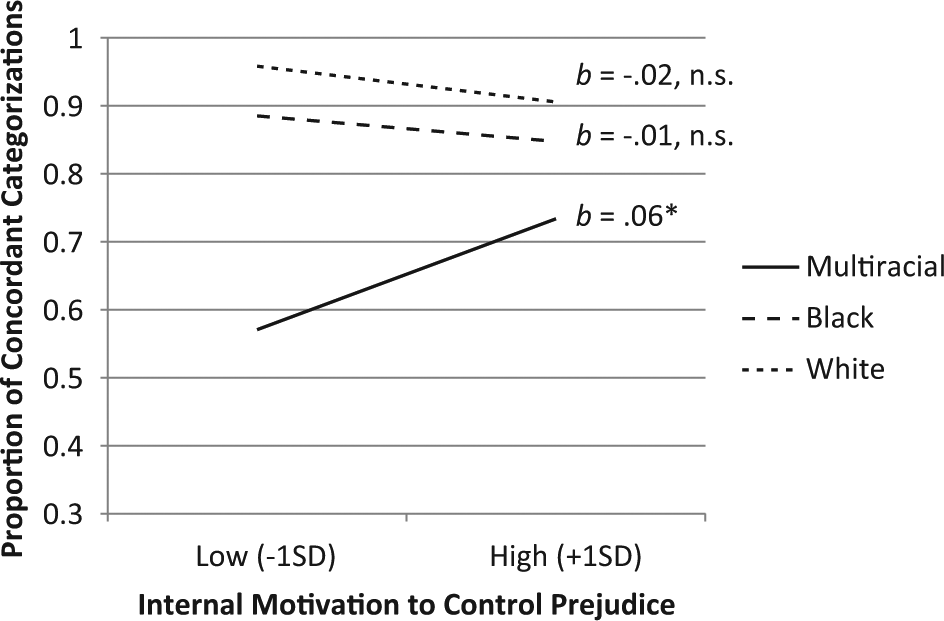
Relationship between internal motivation to control prejudice and categorization concordance for Black, White, and Multiracial targets in Study 1.
There was also a significant target race by EMS interaction, F(2,80) = 4.09, p = .02. EMS was negatively associated with categorization concordance for Multiracial targets, b = −0.05, SE = 0.02, p = .01, but not associated with concordance for White targets, p = .31, or Black targets, p = .64. For every one unit increase in EMS, there was a 5% decrease in concordant Multiracial categorizations. The interaction between IMS and EMS was not significant, nor was the three-way interaction between IMS, EMS, and target race, Fs < 1. 3
Type of discordant categorizations
We computed the number of times each participant categorized multiracial faces as Black and as White. Then we created an index of hypodescent by subtracting the number of White categorizations from the number of Black categorizations for each participant (M = −.37, SE = 0.39). Positive scores on the index would indicate more frequently categorizing the multiracial faces as Black than as White (i.e., hypodescent). A one sample t-test showed that the hypodescent index was not significantly different from zero, t(37) = −.95, p = .35. Therefore White and Black categorizations of multiracial faces were equally frequent.
To determine whether IMS and EMS predicted hypodescent, we regressed grand-mean-centered IMS, grand-mean-centered EMS, and their interaction terms onto the hypodescent index. The analysis revealed no significant predictors; hypodescent was not significantly predicted by IMS (p = .92), EMS (p = .27), or their interaction (p = .98).
Concordant response latencies
We conducted another fixed effects multilevel model on response latencies for concordant categorizations. In this and all subsequent studies, we log-transformed response latencies to achieve normality and report them in milliseconds for ease of interpretation. As in the categorization concordance analysis, target race was the three-level factor nested within individuals, and we included grand-mean-centered IMS and EMS, all two-way interactions, and the three-way interaction in the model. The analyses revealed only a significant effect of target race, F(2,62) = 18.81, p < .001, showing that participants were significantly slower to concordantly categorize Multiracial targets (M = 870, SE = 249) than Black targets (M = 1,341, SE = 506), b = −0.42, SE = 0.07, p < .001, or White targets (M = 876, SE = 296), b = −0.42, SE = 0.07, p < .001. There were no other significant effects in the model, ps > .24.
Discussion
Study 1 provided initial support for our hypotheses that IMS and EMS would be related to Multiracial categorization concordance. As expected, higher levels of IMS were associated with more concordant Multiracial categorizations. In addition, higher levels of EMS were associated with fewer concordant Multiracial categorizations. Whereas people high in IMS were likely to categorize a racially ambiguous face as Multiracial, people high in EMS were more likely to use traditional race categories (Black or White) to categorize those faces.
Participants’ discordant categorizations and response times were not predicted by their levels of IMS or EMS. We observed similar null findings for these dependent measures in subsequent studies (see Supplemental Materials for details). The discordant categorization analysis established that participants did not engage in hypodescent on average, consistent with Chen and Hamilton (2012) and other experiments in which categorization is not a dichotomous choice (see Chen, Pauker, Gaither, Hamilton, & Sherman, 2013). The fact that IMS was not negatively associated with hypodescent tendencies argues against the possibility that people high in IMS overrode the tendency toward hypodescent by making more concordant Multiracial categorizations. Rather, these results are more consistent with the idea that people high in IMS attempt to individuate racially ambiguous faces prior to reaching any judgment about category membership.
The response time analysis also did not reveal any significant results with respect to IMS and EMS. At first glance, these results may seem inconsistent with the idea that people high in IMS are motivated to deeply process racially ambiguous faces. However, response latencies are not diagnostic of the depth of face processing. Previous research continually shows that faces presented for the same amount of time are differentially remembered because perceivers’ motivation to process each individual face varies (e.g., Bernstein, Young, & Hugenberg, 2007). Therefore, our response latency results are neither consistent nor inconsistent with the idea that IMS and EMS predicted Multiracial categorizations due to differences in how deeply multiracial faces were processed. EMS also did not predict response times for racial categorizations in general. Thus, EMS was not associated with faster response times across all targets, which could indicate low task engagement. Rather, our findings indicate that EMS is associated with greater reliance on monoracial categories and more reluctance to use the Multiracial category.
The present study provided initial evidence that perceivers’ motivations to control prejudice influence how they categorize racially ambiguous persons. However, there are other variables that co-vary with IMS and EMS that could be responsible for the observed relationships in Study 1. In Studies 2 and 3, we examined three potential third variables that could be responsible for the relationships between IMS, EMS, and Multiracial categorization concordance: explicit prejudice, interracial contact, and implicit prejudice.
Study 2
Study 1 showed that IMS predicted higher Multiracial categorization concordance, whereas EMS predicted lower Multiracial categorization concordance. We have argued that IMS and EMS are differentially associated with how perceivers process racially ambiguous faces and their subsequent willingness to use a non-traditional racial category in the description of those faces. However, IMS and EMS are known to co-occur with several other individual differences that could provide alternative explanations for the Study 1 findings. Study 2 investigated whether two different third variables—explicit prejudice and interracial contact—were responsible for the relationships among IMS, EMS, and Multiracial categorization concordance. In addition to our primary objective of investigating alternative explanations for the findings from Study 1, Study 2 also examined whether explicit prejudice and interracial contact are directly associated with Multiracial categorization concordance.
Explicit prejudice is associated with intolerance of ambiguity (Sidanius, 1985). Because the Multiracial category is more novel and less developed compared with Black and White categories, we expected that people high in explicit prejudice would be less likely to use the Multiracial category. If true, then explicit prejudice could account for the associations between IMS, EMS, and Multiracial categorizations. In particular, people high in IMS and low in EMS have lower levels of explicit prejudice than people high in EMS (Plant & Devine, 1998). If explicit prejudice is negatively associated with concordant Multiracial categorizations, it could be responsible for the positive correlation between IMS and Multiracial categorization concordance observed in Study 1. Similarly, because people high in explicit prejudice tend to be high in EMS, it is possible that explicit prejudice explains the negative relationship between EMS and Multiracial categorization concordance. We tested these possibilities in Study 2.
We also investigated the role of interracial contact in the relationships among Multiracial categorizations and IMS and EMS. People high in IMS tend to have more interracial contact than people low in IMS. In addition, people high in EMS tend to avoid interracial contact because they are concerned with appearing prejudiced in front of others (Butz & Plant, 2009; Plant, 2004). People engaging in more interracial contact are more likely to have contact with Multiracial individuals compared with people who generally avoid interracial contact in favor of socializing primarily with members of their racial in-group. In addition, people who engage in more interracial contact may be more likely to think about multiracialism. In the strongest case, someone in an interracial relationship may be more likely to think about multiracialism and mixed race children than someone who is in a romantic relationship with a same-race individual. Thus, interracial contact is another potential variable that could account for the relationships observed among IMS, EMS, and Multiracial categorization concordance in Study 1.
We have argued that perceiver motivations to control prejudice have direct relationships with the use of the Multiracial category. As such, we predicted that the relationships of IMS and EMS with Multiracial categorization concordance would remain significant even after controlling for explicit prejudice and interracial contact.
Method
Participants
Fifty-six UCSB undergraduates (38 females; Mage = 19.2 years, SD = 1.07) participated in exchange for partial course credit or US$5. The sample included 20 Asians, 18 Whites, 14 Latinos, 2 Blacks, 1 Native American, and 1 Pacific Islander.
Procedure and materials
Prescreening
Participants completed departmental prescreening measures at least 2 weeks before participating in the study. The prescreening measures included versions of the IMS (α = .89) and EMS (α = .75), in which the questions asked about participants’ motivations to control prejudice toward “racial minorities” rather than toward “Black people,” as in the original Plant and Devine (1998) scale. Also included in prescreening was a measure of explicit prejudice: two feeling thermometer items (“How do you feel about Blacks?” and “How do you feel about Black−White biracials?”) from 0 (very cold) to 100 (very warm) in 10 unit increments, r(47) = .91, p < .001. 4
Experimental session
The study procedure was identical to that of Study 1, with a few exceptions. In this study, the type of multiracial face (real or morph) was a within-subjects factor; participants categorized a total of 32 faces (eight Black, eight White, eight 50:50 morphs, and eight real biracial). After the categorization task, participants completed the original IMS (α = .84), the original EMS (α = .86), and measures of interracial contact with Black people (α = .87) and Black–White biracial people (α = .91) in random order. 5 The contact measure was adapted from the intergroup contact literature (Turner, Hewstone, & Voci, 2007; Voci & Hewstone, 2003; Walker & Hewstone, 2006) and included five items such as “I spend a lot of free time doing things with people who are Black” and “I often talk to people in class/at work who are Black,” to which the participants indicated their level of agreement using a 7-point Likert-type scale. The same scale was also used to assess contact with Black–White biracial people by changing the target group to “Black–White biracial people.”
Results
Categorization concordance
As in Study 1, we computed the proportion of concordant categorizations for each type of target (Black, White, and Multiracial) for each participant. A fixed effects multilevel model with target race as the three-level factor nested within individuals was then conducted. Grand-mean-centered IMS, grand-mean-centered EMS, all two-way interactions, and the three-way interaction were also included in the model.
There was a main effect of target race, F(2,100) = 92.5, p < .001, revealing that participants categorized Multiracial targets less concordantly than Black targets (b = 0.35, SE = 0.03, p < .001) or White targets (b = 0.35, SE = 0.03, p < .001). Categorization concordance was 35% higher for monoracial targets than for multiracial targets. There was no difference in categorization concordance between Black targets and White targets, p = .97. There was a main effect of IMS, F(1,116) = 6.73, p = .01, due to the fact that IMS led to increased categorization concordance across all three target groups, b = 0.03, SE = 0.01.
The two significant main effects were qualified by a significant target by IMS interaction, F(2,100) = 5.08, p = .01 (see Figure 2). As predicted, IMS was significantly associated with Multiracial categorization concordance, b = 0.09, SE = 0.03, p < .001, but not with categorization concordance for White targets, p = .43, or Black targets, p = .19. There were no other significant effects in the model. In contrast to Study 1, EMS was not associated with Multiracial categorization concordance, F(1,116) = .80, p = .37, nor did it interact with target race to predict Multiracial categorization concordance, F(2,100) = .85, p = .43.
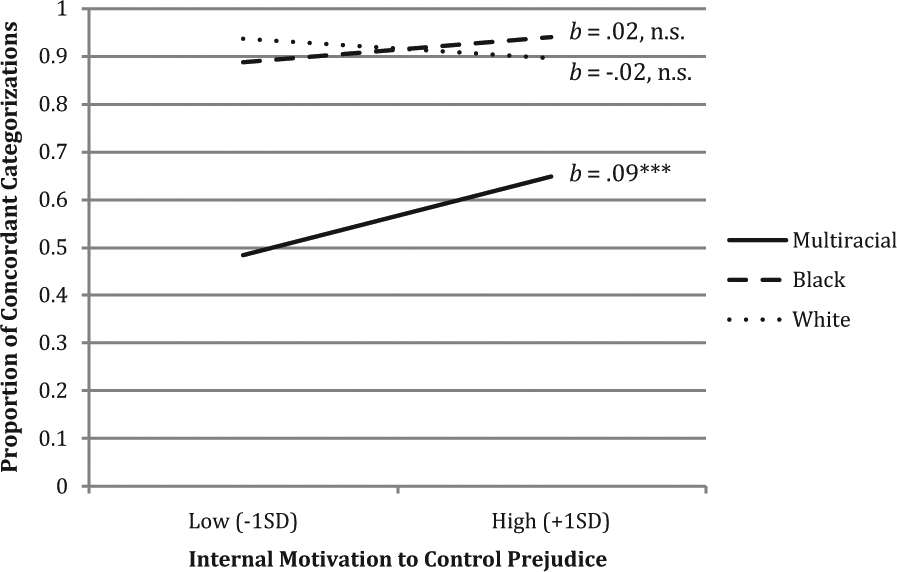
Relationship between internal motivation to control prejudice and categorization concordance by target race in Study 2.
Variables for evaluating alternative explanations
Table 1 displays the zero-order correlations among all variables in Study 2. Without any control variables, bivariate regression established that IMS positively predicted Multiracial categorization concordance, β = .41, p = .002, R2 = .15.
Study 2 Inter-Item Correlations.
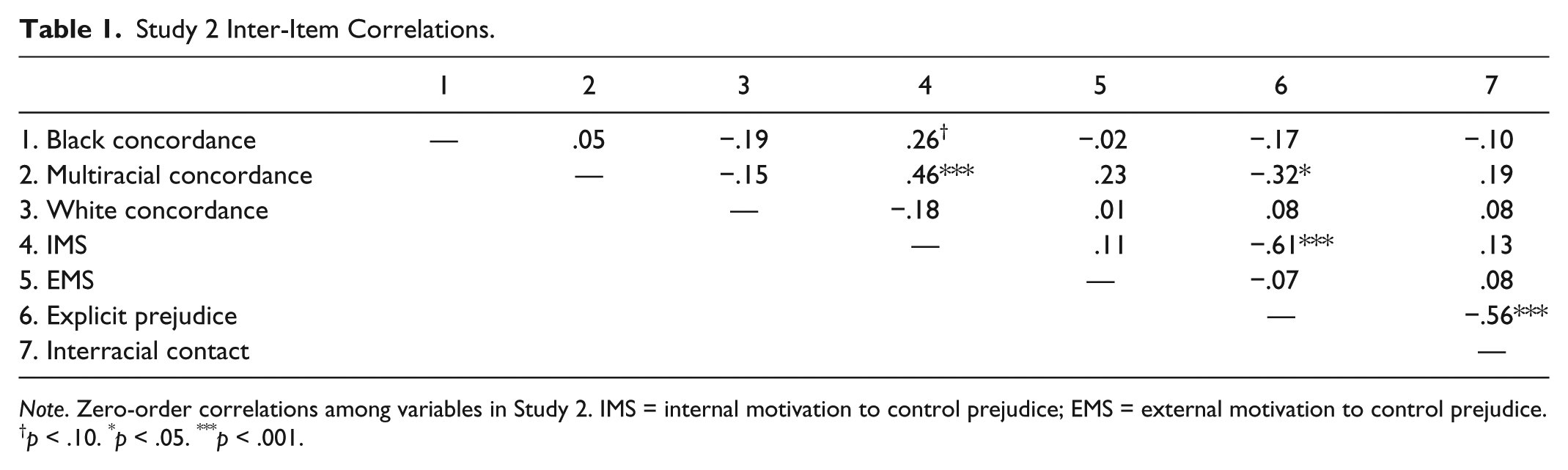
Note. Zero-order correlations among variables in Study 2. IMS = internal motivation to control prejudice; EMS = external motivation to control prejudice.
p < .10. *p < .05. ***p < .001.
Interracial contact
We measured participants’ amount of contact with Black and Black–White biracial people. Because these measures were highly correlated, r(55) = .72, p < .001, and because results did not differ depending on which measure we used, we created a composite “contact” variable by averaging the two variables together. We then used hierarchical regression to determine whether IMS predicted Multiracial categorization concordance above and beyond interracial contact. In Step 1, contact did not significantly predict Multiracial categorization concordance, β = .19, p = .17, R2 = .04. Step 2 confirmed that IMS significantly predicted Multiracial categorization, β = .39, p = .004, ΔR2 = .14, above and beyond interracial contact.
Explicit prejudice
As predicted, higher explicit prejudice predicted fewer Multiracial categorizations of the multiracial targets, r(47) = −.32, p = .03. Next, we used hierarchical regression to determine whether explicit prejudice was responsible for the positive relationship observed between IMS and Multiracial categorization concordance. In Step 1, we entered explicit prejudice to predict Multiracial categorization concordance, β = −.32, p = .03, R2 = .10. In Step 2, we entered IMS, β = .43, p = .01, ΔR2 = .12. IMS positively predicted Multiracial categorization concordance above and beyond explicit prejudice.
Thus, our analyses with interracial contact and explicit prejudice revealed that neither variable accounted for the positive relationship between IMS and Multiracial categorization concordance.
Discussion
Study 2 provided several important insights. We replicated and extended a portion of the concordance findings from Study 1. Specifically, the results do not support explicit prejudice and interracial contact as third variable explanations for the positive association between IMS and Multiracial categorization concordance. These findings provide additional support for our assertion that the IMS leads to a willingness to use a new racial category. People high in IMS may be more willing to consider complex or novel racial categories and identities than are participants who are low in IMS.
One potential criticism of our failure to identify explicit prejudice as an explanation for the relationship between IMS and Multiracial categorization concordance relates to how these constructs were measured. Specifically, explicit prejudice was measured with two items, whereas IMS was measured with five items, making IMS more reliable and therefore statistically more likely to predict an outcome than explicit prejudice. However, the validity of our measure of explicit prejudice was supported by its negative correlations with IMS and interracial contact. In addition, explicit prejudice was sufficiently reliable to negatively predict Multiracial categorization concordance. Participants high in explicit prejudice were less likely to use a Multiracial category and more likely to categorize multiracial persons using traditional racial categories, Black and White, relative to participants low in explicit prejudice. Though the present findings are sufficient to conclude that explicit prejudice is not exclusively responsible for the association between IMS and Multiracial categorization concordance, future research could investigate whether other facets of racial prejudice (e.g., modern racism) play a role in the IMS-Multiracial categorization concordance relationship.
We also found that interracial contact did not predict Multiracial categorization concordance, contrary to our predictions. It may be that other measures of contact may have produced more support for our hypothesis. Whereas we measured participants’ amount of interracial contact, the quality of their interracial contact could be a more important predictor of Multiracial categorization concordance. It may be that only high levels of positive contact are associated with increased use of the Multiracial category. Furthermore, it is possible that an interaction between amount of contact and quality of contact could account for the relationship between IMS and Multiracial categorization concordance. That is, people high in IMS may be more likely to have high levels of positive interactions with Black and multiracial individuals and, consequently, may be more likely to use a Multiracial category. Additional research is needed to investigate these possibilities.
Study 2 did not replicate Study 1 with respect to EMS, in that EMS did not predict Multiracial categorization concordance. Before speculating on possible explanations for this result, we wanted to retest the reliability of the relationship between EMS and Multiracial categorization concordance in a third study.
Study 3
Thus far we have documented that IMS is positively associated with Multiracial categorization concordance and that this relationship could not be explained by perceivers’ levels of explicit prejudice or interracial contact. Yet, implicit prejudice is negatively associated with a person’s level of IMS (Devine et al., 2002; Gonsalkorale et al., 2011). Study 3 investigated whether implicit prejudice could account for the relationship between IMS and Multiracial concordance and provided another opportunity for an empirical test of the relationship between EMS and concordant Multiracial categorizations.
We have argued that IMS is associated with Multiracial categorization concordance because people high in IMS are more sensitive to mixed race facial features and may be more willing to adopt a new race category. We therefore hypothesized that IMS would positively predict categorizing multiracials as Multiracial above and beyond implicit prejudice.
Method
Participants
Fifty-three Tufts University undergraduates (37 females; Mage = 18.9 years, SD = 1.20) participated in exchange for partial course credit. The sample included 35 Whites, 9 Asians, 1 Latino, 1 Black, 4 Multiracials, and 3 self-identified “Other” race individuals.
Procedure and materials
Participants completed the original measures of IMS (α = .85) and EMS (α = .73) as part of the departmental prescreening of the subject pool. Upon entering the lab, participants completed the same categorization task as in Study 2. Participants then completed the Black/White Implicit Association Test (IAT; Greenwald, McGhee, & Schwartz, 1998) to measure their implicit racial bias toward African Americans. 6 After completing the IAT, participants were thanked and debriefed.
Results
The predictor variables—IMS, EMS, and implicit prejudice—were uncorrelated with each other, ps > .31 (see Table 2).
Study 3 Inter-Item Correlations.
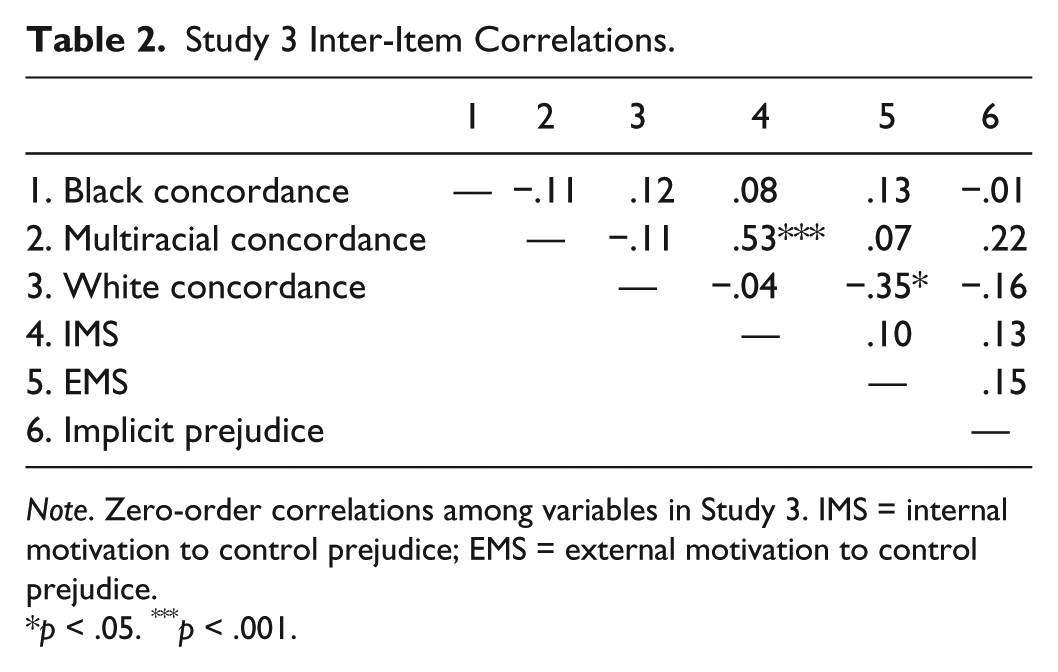
Note. Zero-order correlations among variables in Study 3. IMS = internal motivation to control prejudice; EMS = external motivation to control prejudice.
p < .05. ***p < .001.
Categorization concordance
As in the previous studies, we computed categorization concordance for each target type (Black, Multiracial, and White) for each participant. We then conducted a fixed effects multilevel model on categorization concordance with target race as the Level 1 factor. Also included in the model were grand-mean-centered IMS, grand-mean-centered EMS, the two-way interactions, and the three-way interaction.
There was a significant main effect of target, F(2,90) = 135.86, p < .001. As in the previous studies, participants made fewer concordant categorizations of Multiracial targets than Black targets (b = 0.35, SE = 0.03, p < .001) or White targets (b = 0.35, SE = 0.03, p < .001). Concordance for monoracial targets was approximately 35% greater than concordance for multiracial targets. There was also a difference in concordance for Black targets and White targets, b = 0.07, SE = 0.03, p = .004, indicating that concordance for Black targets was approximately 7% lower than concordance for White targets. There was also a main effect of IMS, F(1,96) = 7.37, p = .01. Overall, every one unit increase in IMS led to a 3% increase in concordance, b = 0.03, SE = 0.01.
These main effects were qualified by a significant target by IMS interaction, F(2,90) = 7.63, p = .001. For multiracial targets, IMS was positively associated with categorization concordance, b = 0.09, SE = 0.03, p < .001. Every one unit increase in IMS predicted a 9% increase in Multiracial categorizations of multiracial targets. IMS was not associated with categorization concordance for Black targets or White targets, ps > .66. There were no other significant effects in the model. EMS did not predict categorization concordance, F(1,96) = .003, p = .96, nor did it interact with target race to predict concordance, F(2,90) = 1.56, p = .22.
Alternative variable: Implicit prejudice
To calculate participants’ levels of implicit prejudice from the IAT, we used the “D_biep” measure (Greenwald, Nosek, & Banaji, 2003). 7 Higher scores indicated more prejudice against Black people. Implicit prejudice was not significantly correlated with Multiracial categorization concordance, r(49) = .21, p = .13.
Bivariate regression confirmed that IMS predicted Multiracial categorization concordance, β = .53, p < .001, R2 = .28. We then conducted a hierarchical regression to confirm that the relationship between IMS and Multiracial categorization concordance persisted after controlling for implicit prejudice. In Step 1, we entered implicit prejudice, β = .23, p = .12, R2 = .05. In Step 2, we found that IMS was positively associated with Multiracial categorization concordance above and beyond implicit prejudice, β = .50, p < .001, ΔR2 = .25. Thus, implicit prejudice did not account for the positive relationship between IMS and Multiracial categorization concordance. 8
Discussion
Study 3 provided additional evidence for a direct relationship between IMS and Multiracial categorizations of multiracial faces. Although IMS leads to lower levels of implicit prejudice and the successful regulation of racial biases (Amodio et al., 2008; Gonsalkorale et al., 2011; Monteith et al., 2009), Studies 2 and 3 have demonstrated that perceivers’ levels of IMS are associated with Multiracial categorization concordance independent of their levels of both explicit and implicit racial biases.
The EMS results of Study 3 were consistent with those of Study 2; we did not find evidence for a relationship between EMS and Multiracial categorization concordance. Additional research is therefore needed to determine whether there are moderators of the relationship between EMS and Multiracial categorization concordance. We return to this issue in the General Discussion.
Across three studies, we have continually shown that IMS positively predicts Multiracial categorizations of multiracial (50% White, 50% Black) targets. In Study 4, we tested the generality of this association by varying the multiracial composition of the targets being categorized.
Study 4
Our goal for Study 4 was to replicate and extend the previous findings by identifying the boundary conditions of the relationship between IMS and Multiracial categorizations. Participants were presented with a continuum of faces varying in composition from 100% Black to 100% White and were asked to categorize these faces as Black, White, or Multiracial. Variation along this continuum represents differences in racial ambiguity or multiracialism. Faces at the end points of the continuum were termed either 100% Black or 100% White because they were least ambiguous and least mixed race on the spectrum of stimuli. In contrast, faces at the middle of the continuum (50% Black, 50% White) were most racially ambiguous and most visually multiracial.
We hypothesized that Multiracial categorizations would increase as a function of racial ambiguity, resulting in the maximum number of Multiracial categorizations when faces were most racially ambiguous (i.e., 50:50 biracial). In addition, we hypothesized that the effect of racial ambiguity would depend on participants’ levels of IMS. We reasoned that, if IMS is related to increased motivation to process race-related ambiguities, resulting in more concordant categorizations of multiracial faces, then it would more strongly predict Multiracial categorizations as faces increased in racial ambiguity. Given the lack of consistency for EMS results in the previous studies, we did not have specific predictions as to whether EMS would predict Multiracial categorizations along the continuum of faces.
Method
Participants
Twenty-four participants (13 females) completed the study in exchange for US$5 at UCSB. The average age was 20.83 years old (SD = 4.17). The sample included eight Asians, eight Latinos, six Whites, one Multiracial/Mixed person, and one self-identified “Other” race person.
Materials
The stimuli represented a continuum of faces from 100% Black to 100% White, morphed in four percent increments for a total of 26 faces per continuum. We created four continua of faces generated from four White and four Black male faces using Morph Version 2.5 (Gryphon Software Corp., San Diego, CA). Each continuum contributed two faces to each level of racial ambiguity and, thus, there were 13 levels of racial ambiguity, from least ambiguous (100% White and 100% Black) to most ambiguous (48% Black, 52% White and 52% Black, 48% White; see Figure 3 for stimulus examples).
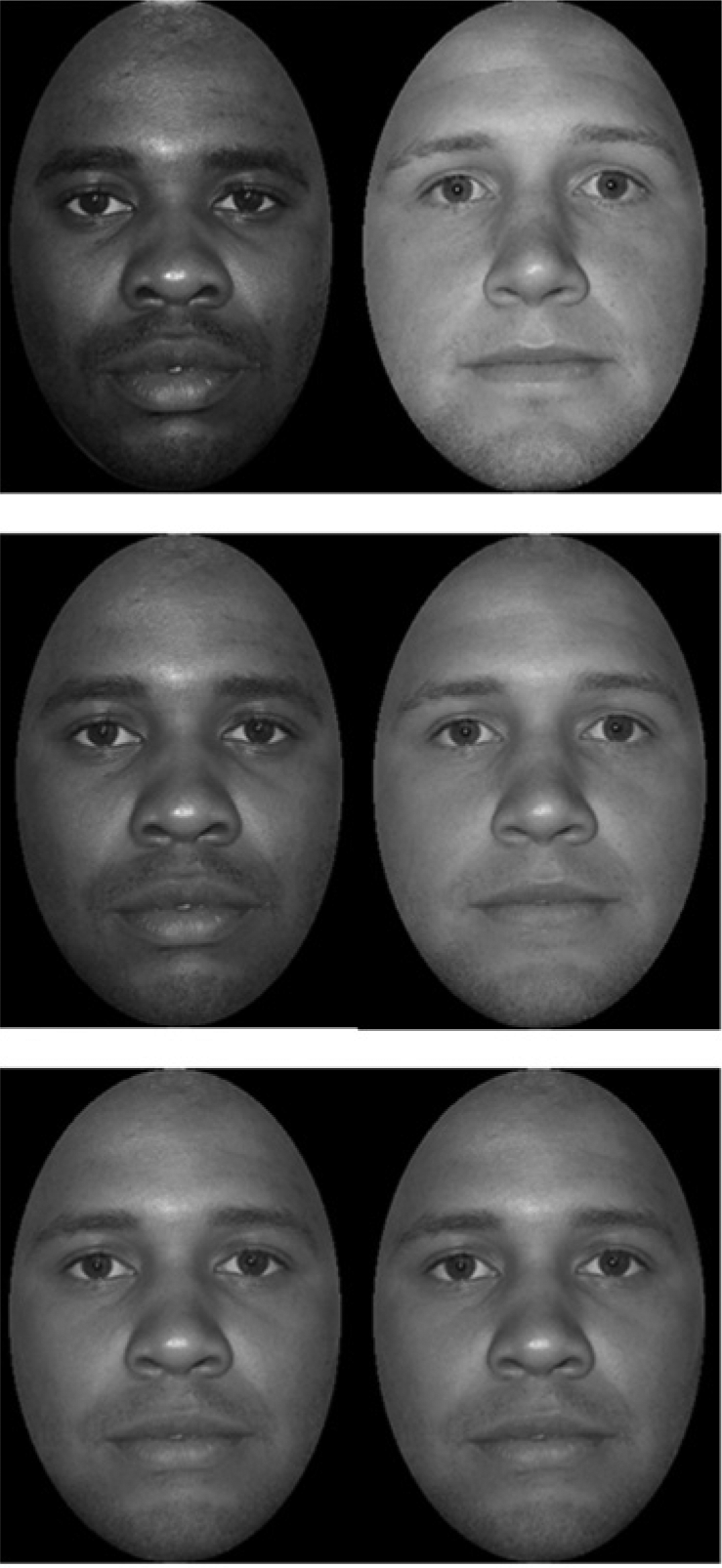
Stimuli examples for Study 4.
Procedure
The procedure was the same as in Study 1, with a few exceptions. The assignment of Black and White response options was counterbalanced to the “S” and “L” keys, and Multiracial was always the spacebar. During the categorization task, labels helped participants remember the race to key assignments. 9 Participants saw all faces in grayscale and saw each face five times. Because there was a total of 520 trials, participants were given a few evenly spaced breaks, during which they could stretch or relax for a period before continuing on with the task. The study resumed at the participant’s discretion, when he or she elected to press the spacebar to continue. After the categorization task, participants completed the measures of IMS (α = .82) and EMS (α =.87), and reported their demographic information.
Results
Monoracial categorizations
We totaled the number of concordant categorizations for the Black faces and White faces at the continuum end points. A paired samples t-test showed that categorization concordance was not different for White faces (M = .80, SE = 0.02) and Black faces (M = .79, SE = 0.03), p = .63. Zero-order correlations revealed that IMS was neither correlated with Black categorization concordance nor with White categorization concordance, ps > .38. EMS was also not correlated with categorization concordance for Black targets or White targets, ps > .53. These results are consistent with the findings from Study 1. Refer to Table B in Supplemental Materials for zero-order correlations among all of the variables in Study 4.
Multiracial categorizations along the continuum
The average proportion of Multiracial categorizations was calculated for each of the 13 levels of racial ambiguity (see Figure 4). Next we tested our hypotheses with a fixed effects multilevel model. The Level 1 factor was grand-mean-centered racial ambiguity. The Level 2 factors were grand-mean-centered IMS, grand-mean-centered EMS, and all interactive effects among racial ambiguity, IMS, and EMS.
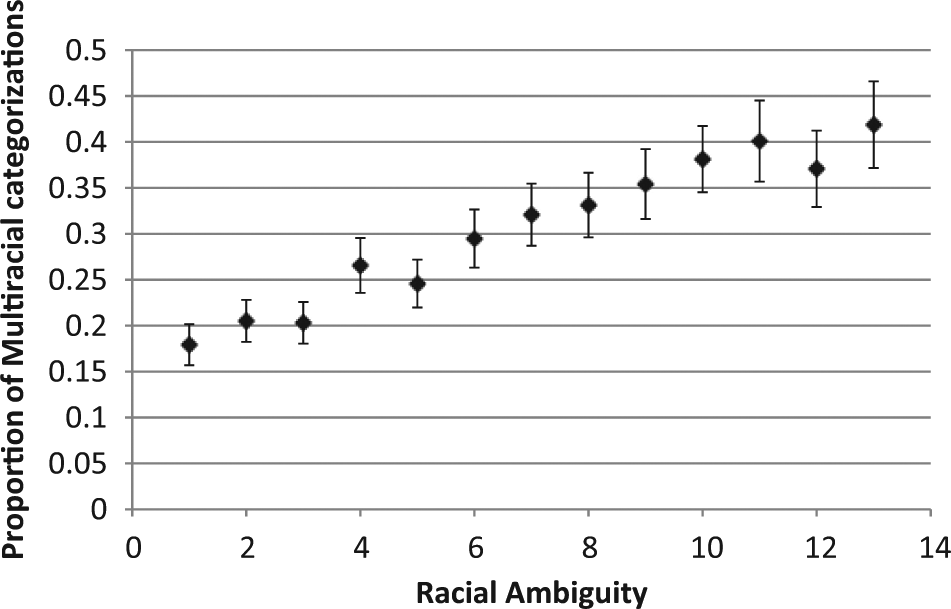
Proportion of Multiracial categorizations at each level of racial ambiguity in Study 4.
As predicted, the analysis revealed a significant effect of racial ambiguity, F(1,175) = 76.89, b = 0.02, SE = 0.002, p < .001, indicating that Multiracial categorizations increased as the faces became more racially ambiguous. There was a marginal main effect of EMS, F(1,265) = 3.25, b = −0.01, SE = 0.005, p = .07, indicating that every one unit increase in EMS predicted a 1% decrease in the use of the Multiracial category. There was also a main effect of IMS, F(1,265) = 13.18, b = 0.03, SE = 0.007, p < .001, which was qualified by a significant IMS by racial ambiguity interaction, F(1,175) = 4.20, p = .04. There was no EMS by racial ambiguity interaction, F(1,175 ) = 2.12, p = .15.
To understand the IMS by racial ambiguity interaction, the relationship between IMS and Multiracial categorizations was examined at each of the 13 levels of racial ambiguity (see Table 3). As predicted, IMS did not significantly predict Multiracial categorizations of the least ambiguous, monoracial faces, p = .74. The relationship between IMS and Multiracial categorizations was strongest at the two highest levels of racial ambiguity (i.e., 44:56, 48:52), bs = .05, p = .002. At these levels of racial ambiguity, every one unit increase in IMS was associated with a 5% increase in the use of the Multiracial category. The relationship between IMS and Multiracial categorizations remained significant for most mixed race faces (from 12:88 to 52:48), ps < .05. No other effects in the model were significant, ps > .15. 10
Relationship Between IMS and Multiracial Categorizations by Racial Ambiguity Level in Study 4.
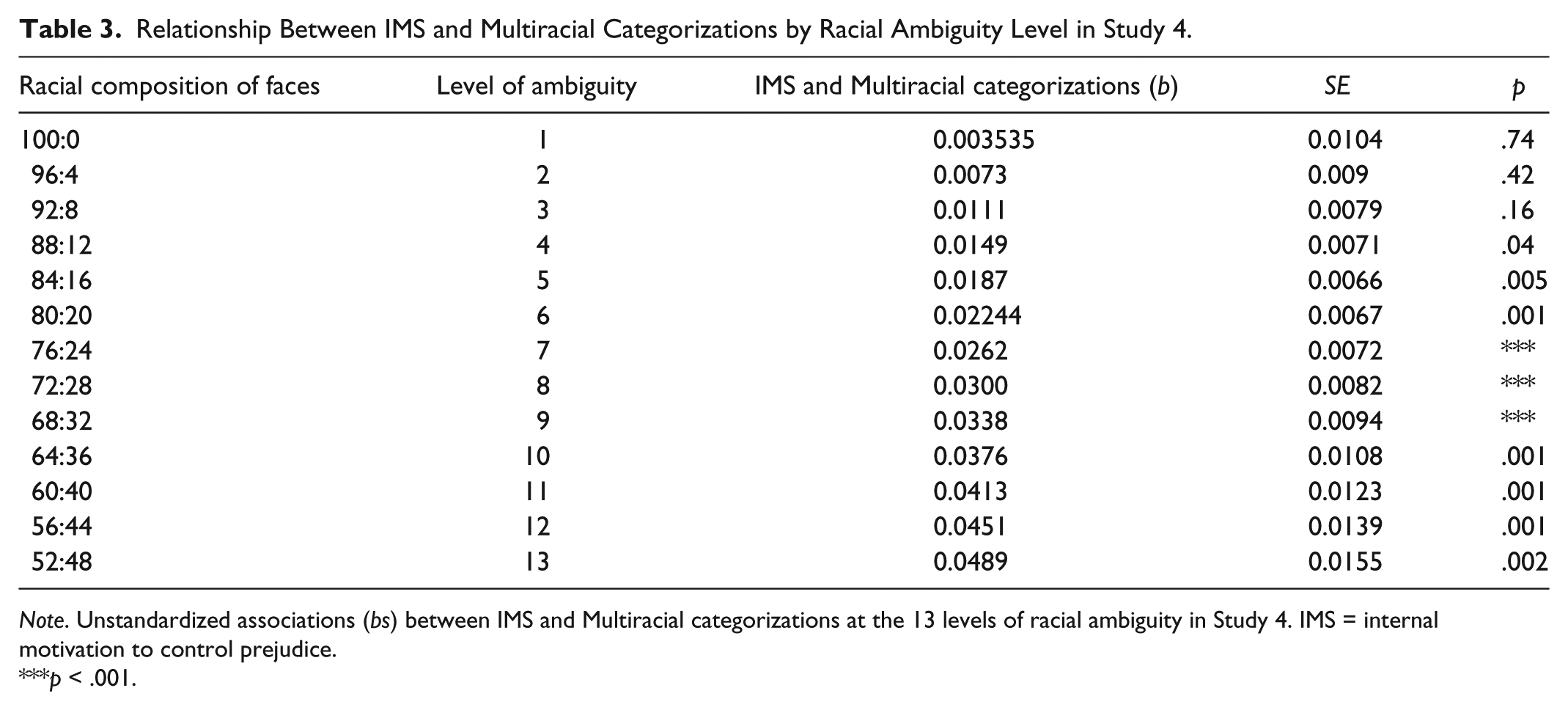
Note. Unstandardized associations (bs) between IMS and Multiracial categorizations at the 13 levels of racial ambiguity in Study 4. IMS = internal motivation to control prejudice.
p < .001.
Discussion
Using a different methodology, Study 4 replicated and extended the findings from Studies 1 to 3, again demonstrating that IMS was positively associated with categorizing mixed race faces as Multiracial. Furthermore, this positive association depended on the targets’ level of racial ambiguity/multiracialism. As the racial ambiguity/multiracialism of the faces increased, people high in IMS were increasingly likely to categorize them as Multiracial.
Study 4 also produced marginal support for a negative relationship between EMS and Multiracial categorization concordance. Interestingly, the relationship between EMS and Multiracial categorizations did not depend on targets’ racial ambiguity; people high in EMS were marginally less likely to categorize others as Multiracial regardless of their appearance. These results suggest that EMS is associated with a general reluctance to use the Multiracial category, perhaps because people high in EMS are uncertain as to whether it is socially accepted to use this category. However, these conclusions should be taken with caution because the relationship between EMS and Multiracial categorization concordance was not statistically reliable across our four studies.
To date, Study 4 is the first exploration of Multiracial categorizations along the race continuum. Ho et al. (2011) examined the threshold for making Black and White categorizations using a video in which a face morphed from Black to White, yet they did not investigate the threshold for perceiving faces as Multiracial. Chen and Hamilton (2012) reported experiments examining the Multiracial categorization process in which perceivers were always asked to categorize monoracial and biracial (Black–White or Asian–White) faces, but those stimuli did not include the full continuum of faces. Thus, the present study extended previous work by examining Multiracial categorizations for a range of multiracial faces and showed that perceivers make the most Multiracial categorizations when faces are nearly biracial.
Nonetheless, even at the maximum level of racial ambiguity (approximately 50:50), perceivers only made Multiracial categorizations of those multiracial faces approximately 40% of the time (see Figure 4). These results are consistent with those of Chen and Hamilton (2012), who showed that Multiracial categorizations of biracial faces were made significantly less reliably than monoracial categorizations of Black, White, and Asian faces (approximately 80%-90% of the time). Perhaps, through repeated use, individuals higher in IMS would exhibit more frequent Multiracial categorizations as they continue to use and develop a Multiracial category.
General Discussion
The racial dynamics of American society are shifting as interracial marriages rise and the number of multiracial people continues to grow. The extent to which perceivers adapt to this societal change may depend on their motivations. Across four studies, we have shown that perceivers’ levels of IMS were positively associated with categorizing multiracial persons as Multiracial rather than relying on traditional monoracial categories. Although racial categorization was once conceptualized as a straightforward step in impression formation (e.g., Brewer, 1988; Fiske & Neuberg, 1990), our research adds to the substantial body of work that has now established that categorization processes are highly contextual and strongly influenced by perceiver motivations (e.g., Castano et al., 2002; Johnson, Freeman, & Pauker, 2012; Knowles & Peng, 2005).
Our findings show that the influence of IMS is not limited to perceivers’ abilities to regulate biased attitudes and behaviors and has consequences for the first stages of person perception as well. Specifically, we demonstrated that perceivers higher in IMS are more likely to deviate from traditional monoracial categorizations by adopting the Multiracial category and using it concordantly (Study 1). Studies 2 and 3 showed the importance of IMS for Multiracial categorization concordance above and beyond implicit prejudice, explicit prejudice, and interracial contact. Study 4 showed that the influence of IMS on making Multiracial categorizations increased as faces became more racially ambiguous (i.e., more mixed race). The present research builds upon the work of Chen and Hamilton (2012), who suggested that the Multiracial category could eventually gain prominence in American society. Our findings suggest that it is perceivers high in IMS who will be at the forefront of this social change, if it occurs.
We have argued that IMS leads to increased concordant use of the Multiracial category because people high in IMS exhibit greater consideration of complex, non-traditional identities and increased processing of racially ambiguous faces. We have several ideas for how future studies could provide more direct evidence for these proposed mechanisms. First, a questionnaire study could determine whether IMS is positively related to believing that complex or novel racial identities should be validated by others and that multiracial people want to identify as multiracial more than as monoracial. A subsequent experiment could then manipulate participants’ beliefs about racial identity to determine whether they causally impact Multiracial categorization concordance. Second, previous research has linked deeper processing of faces with greater attention to the face’s eye region (Kawakami et al., 2013) and to better memory for those faces (see S. G. Young, Hugenberg, Bernstein, & Sacco, 2012, for a review). As such, follow-up experiments could determine whether people high in IMS are more attentive to the eyes of racially ambiguous faces and more likely to remember those faces than people low in IMS. If shown, these results would support the idea that IMS leads to increased processing of multiracial faces. These proposed experiments would provide important information about the mechanisms underlying the association between IMS and Multiracial categorization concordance. These and other possible mechanisms should be explored in future research.
The present studies had some limitations that should also be addressed in future work. First, our experimental stimuli were limited to Black–White multiracial faces. Future studies should extend this research by investigating whether IMS and EMS predict categorization concordance for other types of multiracial individuals. Because people who are high in IMS are likely to want to control prejudice toward many racial groups, we would predict that the positive relationship between IMS and concordant categorizations of Black–White multiracials would generalize to other types of multiracial people. Second, our findings with respect to EMS were inconclusive. Follow-up work should investigate whether there are moderators of the relationship between EMS and Multiracial categorization concordance, such as the perceived anonymity of the categorization responses. It is possible that EMS predicts decreased use of the Multiracial category when perceivers believe that their responses are public because they cling to traditional, widely accepted monoracial categories.
Our findings have important implications for intergroup relations, especially as the number of multiracial individuals in American society continues to grow exponentially. As a result of being more likely to categorize multiracial people as Multiracial, higher IMS may lead to less endorsement of psychological essentialism (see D. M. Young et al., 2013) and increased suppression of Black stereotypes when encountering a Black–White individual. As such, people higher in IMS may be less likely to believe that multiracial people will act in ways consistent with the stereotypes of their racial group memberships. In contrast, someone relatively low in IMS who encounters a Black–White person may be more likely to have beliefs and expectations about the person that are guided by stereotypes about Black people.
Moreover, multiracial people want to interact with individuals who accurately identify their multiracial heritage and view those individuals as more likely to meet their self-verification needs (Remedios & Chasteen, in press). Because IMS is positively associated with categorizing multiracial people as Multiracial, IMS may also predict smoother and more pleasant initial interactions between monoracial and multiracial individuals. Therefore, multiracial people may prefer interacting with people higher in IMS and like them better than people lower in IMS. As a result, people higher in IMS may be more likely to have meaningful social relationships with multiracial individuals.
Furthermore, ours is the first investigation of how perceivers’ motivations predict their willingness to use new, non-traditional categories such as the Multiracial category. An intriguing possibility is that perceivers’ IMS toward other groups, such as sexual minorities, would predict their willingness to deem other blended categories, such as transgender or gender queer, as legitimate. As a result, our findings may reflect a more general tendency for people with strong egalitarian goals to be more likely to validate non-traditional identities. This possibility would have important implications for understanding attitudes toward non-traditional social groups more generally and warrants further investigation.
As the American demographic landscape undergoes significant changes, it is imperative for social psychologists to understand how social perception processes change as well. The potential adoption of the Multiracial category provides an opportunity for researchers to better understand the development of novel cognitive categories and perhaps the development of stereotypes associated with them.
Footnotes
Acknowledgements
We would like to thank the members of the University of California, Davis, Social Cognition Lab for their comments on an earlier draft of this manuscript. We are grateful to Dr. Jamin Halberstadt and Helen Owen for creating the Study 4 stimuli for us.
Declaration of Conflicting Interests
The author(s) declared no potential conflicts of interest with respect to the research, authorship, and/or publication of this article.
Funding
The author(s) disclosed receipt of the following financial support for the research, authorship, and/or publication of this article: This research was partially supported by a University of California Chancellor’s Post-Doctoral Fellowship awarded to the first author and by a National Science Foundation (NSF) Graduate Research Fellowship awarded to the third author.