




Abstract
Mortality salience (MS) strengthens cultural values but individuals might differ in whether this process operates at a superficial, explicit level only or also at a profound, implicit level. Two studies investigated whether explicit and implicit attitudes toward Muslims after an MS induction vary as a function of threat-related action orientation (AOT), an efficient form of self-regulation of emotion and behavior that draws on the activation of the implicit, integrated self. In Study 1, there was a main effect of MS on explicit prejudice but only participants with high levels of AOT showed reduced implicit prejudice following MS. In Study 2, this interaction effect was replicated using an alternative implicit measure of prejudice. Defense in response to MS might thus not be a uniform phenomenon but might be composed of processes operating on different (i.e., profound vs. superficial) levels that vary with types of self-regulation such as high versus low AOT.
Reminders of death can engender the upholding and defense of cultural values such as patriotism, generosity, increased ingroup favoritism, and also increased tolerance toward outgroup members (cf. Greenberg, Simon, Pyszczynski, Solomon, & Chatel, 1992; Jonas et al., 2008; see Burke, Martens, & Faucher, 2010, for a review). A number of automatic processes have been proposed to underlie this so-called cultural worldview defense (CWD; e.g., Pyszczynski, Greenberg, & Solomon, 1999; see also Fritsche, Jonas, & Fankhänel, 2008; Holbrook, Sousa, & Hahn-Holbrook, 2011; Proulx & Inzlicht, 2012). The exact form responses to mortality threat take might be based on social desirability and a superficial adoption (introjection; see for example, Deci & Ryan, 1980) of normative values typically shaping self-reports of attitudes (e.g., King & Bruner, 2000). Alternatively, such reevaluations might also capitalize on the activation of values internalized and integrated in the implicit self (see, for example, Kuhl, 2000, 2001), and individuals might differ in the degree to which they have access to the implicit self, particularly in threatening contexts.
It has been proposed by personality systems interactions theory (PSI theory; Kuhl, 2000, 2001) and empirically supported that individuals with high levels of action orientation after threat (AOT), a type of self-regulation that allows for the autonomous pursuit of core values and goals, are able to access representations hosted by the implicit, integrated self to efficiently self-regulate their emotions and behavior in threatening circumstances. As such, we hypothesize that whereas at an explicit (self-report) level, mortality threats lead to a general change in prejudice toward outgroup members (Muslims), at an implicit level, this change can only be found for action-oriented individuals.
We begin by describing terror management theory (TMT; for example, Greenberg, Pyszczynski, & Solomon, 1986; Solomon, Greenberg, & Pyszczynski, 1991), a theory that explains defensive reactions in response to mortality threats, and reviewing empirical support for this theory. Next, we discuss findings on the specific form that these defensive reactions can take. We continue by outlining theory and evidence suggesting that AOT is associated with an efficient and integrative mechanism to cope with threats (i.e., by activating the implicit self), and by reporting studies in which AOT moderated responses to mortality threats. We then present two studies suggesting that AOT is associated not only with explicit but particularly with implicit (profound) shifts in outgroup prejudice in response to mortality threat, possibly due to its association with increased access to internalized values that are stored in the implicit self.
TMT
Humans are thought to be the only animals that are aware of their own inescapable mortality. According to Becker (1971, 1973, 1975), this awareness is the driving force behind a number of sometimes perplexing or seemingly irrational uniquely human social phenomena. As research on terror management (Greenberg et al., 1986; Solomon et al., 1991) demonstrates, these phenomena appear to be relatively stable in terms of their basic mechanism and only the specific shape they take seems to depend on personality content (Burke et al., 2010).
TMT (Greenberg et al., 1986; Solomon et al., 1991) proposes that the irresolvable conflict between a basic survival instinct and the awareness of the inescapable truth that one will eventually die is a source of potentially overwhelming anxiety or existential terror that needs to be managed through a number of elaborate defense mechanisms. When reminded of their own inevitable death, humans generally tend to remove death-related thoughts from core consciousness by suppressing these thoughts or by rationalizations such as assuring oneself that death is not imminent and therefore not relevant in the given moment (e.g., Jemmott, Ditto, & Croyle, 1986; Quattrone & Tversky, 1984; see also Martin & Tesser, 1989, for a similar suppression of ego-threatening but death-unrelated thoughts). While successfully reducing conscious death rumination, this initial suppression is followed by a well-documented increase of subconscious accessibility of death-related thoughts (Pyszczynski et al., 1999; see also Arndt, Greenberg, Solomon, Pyszczynski, & Simon, 1997; Greenberg, Pyszczynski, Solomon, Simon, & Breus, 1994). This increased mortality awareness is presumably dealt with by subscription to a specific, culturally validated worldview that promises either literal or symbolic immortality (e.g., a specific religious faith or the belief that one’s works will continue to exist beyond one’s personal death). First studies even began to trace these subtle psychological processes related to mortality salience (MS) at the level of brain functioning (e.g., Han, Qin, & Ma, 2010; Klackl, Jonas, & Kronbichler, 2013; Quirin et al., 2012; for an overview, see Jonas et al., 2014).
TMT is not unique in its proposal that individuals deal with existential threats symbolically or fluidly as Heine, Proulx, and Vohs (2006) call it. In particular, there are a number of theories that propose that individuals react to threats by compensating in a seemingly unrelated area (cf. Jonas et al., 2014). Perhaps most notably, the meaning maintenance model (MMM; Heine et al., 2006; see also Proulx & Inzlicht, 2012) proposes that human beings naturally seek and construct relational frameworks within themselves, in the outside world, and between themselves and the outside world. If these relational frameworks are disrupted at one place, they seek to compensate for this disruption in another place. Similarly, although somewhat less broadly, McGregor, Zanna, Holmes, and Spencer (2001) proposed in their reactive approach motivation (RAM) theory that humans react to impediments to goal pursuit with feelings of uncertainty and anxiety. The anxiety then drives them to reactive approach of alternative goals, for example, in form of pursuit of lifestyle extremes, which down-regulates the anxiety.
In contrast to TMT, both MMM and RAM theory do not see death as unique, but propose that other existential threats can have a similar effect. Furthermore, RAM theory also differs from TMT in its statement that a goal has to be activated for a threat to it to invoke reactive approach (cf. McGregor, Prentice, & Nash, 2013).
Supporting these theories in general and TMT in particular, a large number of studies from the last two decades have demonstrated that individuals tend to increase the defense of their specific worldview after a mortality reminder by devaluing persons (Greenberg et al., 1990, Study 1), opinions (Greenberg et al., 1990, Study 3), objects (e.g., Friese & Hofmann, 2008; Jonas, Fritsche, & Greenberg, 2005), or actions (Rosenblatt, Greenberg, Solomon, & Pyszczynski, 1989) contradicting or threatening their respective beliefs while revaluing and supporting persons, opinions, objects, or actions in line with them. Specifically, a recent meta-analysis (Burke et al., 2010) found a highly significant overall effect of a reminder of mortality on a number of dependent variables measuring worldview defense.
Defending Tolerance in Response to MS
Despite the overall robustness of the effect of MS on worldview defense, the specific form that worldview defense takes appears to depend on the content of an individual’s worldview as well as on which aspects of a given cultural worldview are salient (see Burke et al., 2010; Niesta, Fritsche, & Jonas, 2008). In particular, MS does not always lead to denigration of outgroup members but can also lead to increased tolerance if denigration of outgroup members is contradicting one’s worldview while tolerance is in line with it. For example, Greenberg et al. (1992, Study 1) found that while all participants tended to prefer targets that held a political view similar to their own, only politically conservative Americans evaluated a politically progressive target less favorably after MS than after a control manipulation. Politically progressive American participants, however, evaluated a politically conservative target more favorably after MS instead, possibly because they had a strong value of tolerance toward people with worldviews different from their own (cf. Stone, 1980). In a second study, Greenberg at al. also showed that American participants tended to react more favorably to an outgroup member with an anti-American attitude after MS induction as compared with after a control manipulation if they had been primed with the value of tolerance.
Influences of AOT on Self-Access Under Threat
It has been proposed (Kuhl, 2000, 2001) and empirically validated (e.g., Baumann & Kuhl, 2003; Kazén, Baumann, & Kuhl, 2003; Koole & Jostmann, 2004) that individuals with high but not low levels of AOT (Kuhl, 1994b) are able to self-regulate successfully under threatening circumstances (Baumann & Kuhl, 2003). According to PSI theory, this difference is based on the ability of individuals high in AOT to access the implicit self (or extension memory; see Kuhl, 2000, 2001), a psychological structure comprising fully integrated as well as intrinsic goals, values, and self-representations even and especially in self-threatening conditions. Access to the implicit self in self-threatening conditions in turn enables individuals with high levels of AOT to cope with the threat at hand by reaffirming their sense of self as reflected in their internalized goals and values, thereby integrating the threat (for a detailed conceptualization of the difference between extrinsic and intrinsic goals as well as of different degrees of integration of extrinsic goals, see Deci & Ryan, 1980, 2000). By contrast, individuals with low levels of AOT have difficulty accessing the implicit self and their internalized goals and values under stressful conditions (Baumann & Kuhl, 2003; Kazén et al., 2003) and have to rely on other copying mechanisms.
Empirical support for the assumption of self-access even under threat in individuals high in AOT but not in individuals low in AOT comes from studies investigating the degree to which individuals shield personal (self-chosen) goals against other individuals’ expectations, which in turn prohibits introjection of others’ expectations (i.e., the self-imposition and pursuit of self-alien goals that individuals do not fully identify with; Baumann & Kuhl, 2003; Baumann, Kuhl, & Kazén, 2005; Kazén et al., 2003; Kazén, Baumann, & Kuhl, 2005; see also Quirin, Baumann, Kazén, Kuhl, & Koole, 2009). In this research, diminished access to the implicit self was measured by the degree to which individuals misremembered tasks as self-chosen that had in reality been assigned to them by an authority figure. Supporting the notion that individuals low in AOT show increased introjection under threat, Baumann and Kuhl (2003, Study 2) found that participants low but not participants high in AOT showed higher rates of introjection after watching a movie clip from a documentary about the inhumane conditions in Romanian orphanages before the fall of the iron curtain. Likewise, Kazén et al. (2003) demonstrated that individuals high in AOT have a lower tendency for introjection as compared with individuals low in AOT in various other threatening contexts, such as when working on a meaningless task.
In a similar vein, Koole and Jostmann (2004, Study 3) found that individuals high in demand-related action orientation, which is related to AOT but refers to the ability to self-regulate in demanding rather than threatening contexts (cf. Kuhl, 2001; Kuhl & Beckmann, 1994), showed increased self-activation in demanding contexts as indicated by participants’ speed of categorizing attributes as to whether they describe them or not. This increased self-activation in turn mediated the influence of demand-related action orientation on an implicit measure of emotion regulation, namely, reduced reaction times when looking for a happy face in a crowd of angry faces.
As such, action orientation might moderate the exact nature of defense processes elicited by mortality threats. Specifically, whereas individuals high in AOT should more easily capitalize on values integrated in the implicit self, individuals low in AOT should adhere to socially desired, normative responses because they have low access to the implicit self under threat. A reminder of one’s mortality and the potential existential terror inherent in it presents a prime example of a context threatening the self. It therefore should be associated with access to the implicit self and to implicit, fully integrated goals and values for individuals with high levels of AOT but not in individuals with low levels of AOT. This should result in differences in using defense mechanisms under MS for individuals differing in AOT.
In fact, Koole and Van den Berg (2005) provided evidence for a moderating role of AOT in terror management processes by showing that individuals high in AOT rate wilderness (which has been shown to be associated with death, see Koole & Van den Berg, 2005, Study 1) as compared with cultivated nature more positively than individuals low in AOT after a mild mortality reminder, suggesting that individuals high in AOT have more efficient self-regulation after MS.
Furthermore, Kazén et al. (2005) demonstrated that German participants low in AOT were unable to increase their national pride and thereby use it as a worldview defense mechanism after MS while participants high in AOT had this ability. As reported by Kazén et al., national pride is generally evaluated as negative in contemporary Germany (see also European Commission, 2004). Using national pride as a defense mechanism should therefore require access to internalized goals and values while not using or even rejecting national pride can be explained as a consequence of introjecting the values of the surrounding majority culture.
The Present Research and Hypotheses
The main objective of the present research is to investigate differences in worldview defense mechanisms after MS dependent on levels of AOT. In particular, we are interested in clarifying whether individuals high as opposed to low in AOT draw on defenses that utilize the implicit self. For that purpose, we concentrate on implicit and explicit attitudes in terms of prejudice against Muslims as dependent variables.
We predict that the ability to access the implicit self under threat combined with the need for worldview defense after MS, as present in individuals high in AOT who have been exposed to a mortality reminder, will lead to adjustments of both explicit and implicit prejudice levels. In contrast, lacking ability to access the self after threat combined with the need for worldview defense after MS, as expected in individuals low in AOT who have been exposed to a mortality reminder, will lead to adjustments of only explicit prejudice levels because the lack of self-access does not permit an adjustment of implicit prejudice levels in this case.
Based on the majority of previous findings (Burke et al., 2010), one might expect outgroup derogation after MS induction. However, because of potential influences of contextual factors such as the specific cultural values prevalent in a population (Greenberg et al., 1992) or the specific appearance of the target (Schimel et al., 1999), an effect opposite to the expected direction is conceivable too. Please note, however, that the focus of the present article is on how AOT moderates deep (implicit) versus superficial (explicit) responding toward MS rather than on the direction of the main effect along with its potential causes.
Study 1
Following Das, Bushman, Bezemer, Kerkhof, and Vermeulen (2009), we used a reminder of terrorism as MS induction in Study 1 (for other examples of terrorism reminders used as MS manipulation, see Landau et al., 2004; Osborn, Johnson, & Fisher, 2006). We then measured implicit and explicit prejudiced attitudes toward Muslims as dependent variables. To investigate the effect of AOT on implicit prejudice after MS, we also asked participants to complete the AOT scale of the Action Control Scale (Kuhl, 1994a). We predict that increased death thought accessibility following an MS reminder will lead to changes in explicit prejudice regardless of participants’ AOT while only participants high in AOT will be able to change their implicit prejudice after MS.
Method
Participants
A total of 110 undergraduate psychology and cognitive science students at Osnabrueck University participated in the study in return for study credits. Due to technical difficulties that led to longer presentation primes than programmed, 4 participants consciously perceived the refresher primes (see below) and were subsequently excluded from data analysis; and 10 additional participants were excluded due to missing data. This left 96 (85 female and 11 male) undergraduate psychology (n = 86) and cognitive science students (n = 10), respectively, M age = 25.09 years, SD = 7.39, whose data were used for analysis.
Materials
Experimental manipulation: “Perception task”
The experimental manipulation consisted of four separate parts for all conditions: an imaging task, a short text participants were asked to read, several pictures participants were asked to look at, as well as several questions about the imaging task and the pictures that participants were asked to respond to in writing.
For the imaging task, participants were asked to either recall any memories of the terrorist attacks in New York, Madrid, and London between 2001 and 2005 (MS condition), to bring to mind their feelings and emotions when experiencing toothache (toothache condition) or to bring to mind their feelings and emotions when thinking of television (TV condition). After the imaging task, participants in the MS condition read a short text listing some facts about the terrorist attacks in New York, Madrid, and London, as well as about several additional planned but thwarted attacks in several German and other European cities. Participants in the toothache and TV conditions read some facts concerning the underlying causes, incidence rates, and consequences of toothache or concerning the TV-watching habits of Germans, respectively. Participants then viewed four pictures related to their condition. Examples of these pictures were: a picture of the smoking towers of the World Trade Center in New York right after the first plane had hit them during the terrorist attacks in the MS condition, a picture of a person undergoing dental treatment in the toothache condition, and a picture of a couple watching television in the TV condition. Finally, participants were asked to respond to three questions concerning their bodily sensations and emotions, as well as concerning their personal memories related to their respective condition such as “Please describe your emotions and feelings that arise when you think about the terrorist attacks in New York, Madrid, and London, as well as about the attempted attacks in England, Scotland, and Germany” in the MS condition.
Experimental manipulation: “Attention task”
Due to a delay between the original experimental manipulation and the dependent variables, we used an additional priming procedure to refresh the activation of terrorism/death (MS condition), toothache (toothache condition), or television (TV condition) thoughts, respectively (cf. Arndt, Greenberg, Pyszczynski, & Solomon, 1997). This refresher priming was introduced to participants as an attention task in which they would see two neutral pictures with contents unrelated to any of the topics of the three conditions. After a fixation cross (duration 1 s), the first of a pair of neutral pictures (forward mask) was presented for 350 ms followed by the second picture (backward mask), which was also presented for 350 ms. Participants indicated via mouse click whether the two pictures (forward mask and backward mask) belonged together or not. Unknown to participants, one of the four picture primes previously used in their respective condition was sandwiched between the forward mask and backward mask. This prime was presented for 10 ms and therefore was unlikely to be consciously perceived. In total, each of the four priming pictures was presented 3 times in this way during each round of refresher priming.
AOT scale
We used the threat-related AOT subscale of the Action Control Scale (Kuhl, 1994b) to measure individual differences in self-regulation. The AOT subscale of the Action Control Scale (which has been extensively validated; see Kuhl & Beckmann, 1994) consists of 12 statements in the form of conditional sentences that describe possible reactions after unpleasant experiences. More specifically, participants read if-clauses and then choose between an action and a state-oriented then-clause to complete the sentence so that the resulting statement describes them. One example for an item is “When I am told that my work has been completely unsatisfactory” with the response options “I don’t let it bother me for too long” (action-oriented response) and “I feel paralyzed” (state-oriented response). All action-oriented responses are later coded as 1, whereas all state-oriented responses are coded as 0. The codes for the response options are then summed so that participants can have a minimum score of 0 and a maximum score of 12. In the present sample, Cronbach’s alpha of the scale was .82.
Implicit Association Test (IAT)
We used a version of the IAT (Greenwald, McGhee, & Schwartz, 1998) to assess implicit prejudice. Recent research has demonstrated that the IAT is responsive to factors influencing the motivation to adjust prejudice levels (e.g., Zogmaister, Arcuri, Castelli, & Smith, 2008).
The IAT measures implicit attitudes toward a target category relative to a second target category. In this case, the first target category was Arabic-Muslim culture, while the second target category was European-Christian culture. More specifically, participants were asked to sort stimuli belonging to the two target categories (here: Muslim vs. Christian) and two attitude categories (positive words vs. negative words) using just two keys on a computer keyboard with a target category and an attitude category assigned to each of the two keys. For example, participants might have been asked to press the E key when a representation of Arabic–Muslim culture or a positive word appeared on screen and the I key when a representation of European–Christian culture or a negative word appeared on screen. According to Greenwald et al. (1998), sorting the concepts in this way becomes easier with increasing strength of association between the two concepts assigned to one key, and this increased ease is reflected in shorter reaction times. Consequently, participants who associate negative words more strongly with Christian culture and positive words more strongly with Muslim culture should have relatively short reaction times when asked to sort stimuli representing the concepts Christian culture and negative words and Muslim culture and positive words together. By contrast, they should have relatively long reaction times when asked to sort stimuli representing the concepts Christian culture and positive words and Muslim culture and negative words together.
There were seven stimuli in each of the target and attitude categories resulting in 28 stimuli in total. Target stimuli consisted of four pictures and three names for each of the categories (e.g., a woman in typical contemporary Western dress and the name Marco representing European–Christian culture and a picture of a woman wearing hijab and the name Karim representing Arabic–Muslim culture). The IAT consisted of seven blocks with stimuli of each block presented in random order and with participants sorting words according to different rules in each block.
The first two blocks consisted of practice trials. In one of these practice blocks, participants sorted only target stimuli, in the other, only attitude stimuli. After these two practice trial blocks, two identical blocks of critical trials followed in which participants had to sort both target and attitude stimuli with all four categories assigned to the same keys as in the two practice trial blocks. This was followed by an additional block of practice trials in which participants sorted only the target stimuli and in which key assignment of the categories was reversed. Finally, participants completed two identical blocks of critical trials, in which key assignment of the target stimuli was identical to the last practice trial block whereas key assignment of the attitude stimuli was identical to the original key assignment.
Order of key assignments to the different concept combinations was counterbalanced between participants whereas order of the combinations of target and attitude concepts was kept constant. Thus, all participants sorted the concept Christian together with positive words and the concept Muslim together with negative words in the first two critical blocks. In the last two critical blocks, participants then sorted the concept Muslim together with positive words and the concept Christian together with negative words. IAT scores were calculated by following the improved algorithm detailed by Greenwald, Nosek, and Banaji (2003) so that positive IAT scores indicate a relative preference for European Christians (and therefore a negative implicit attitude to Arabic Muslims).
Explicit prejudice measures
Explicit prejudice against Arabic Muslims was assessed with several items that had been translated and adapted where necessary from the explicit items used in conjunction with the online IATs on the Project Implicit website (“Project Implicit: Arab-Muslim IAT,” n.d.; see also Greenwald et al., 2003). The first of these items was a 7-point scale with each point corresponding to a different statement that indicated some level of preference for European Christians relative to Arabic Muslims. The endpoints of this scale were 1 (I strongly prefer European Christians to Arab Muslims) and 7 (I strongly prefer Arab Muslims to European Christians), respectively. The midpoint of the scale was 4 (I like European Christians and Arabic Muslims equally).
The remaining six items consisted of two items that asked participants to rate how much they associated positive versus negative feelings with European Christians and Arabic Muslims, respectively (scale from 0 = very positive feelings to 9 = very negative feelings), two items concerning participants’ agreement with several practices that can be viewed as discriminatory toward Arabic Muslims (e.g., “Law enforcement officers should pay particular attention to those social groups more heavily involved in crime, even if this means focusing on members of particular ethnic groups”), and two items concerning participants’ spontaneous experience of prejudiced thoughts toward Muslims (e.g., “No spontaneous prejudiced thoughts come into my mind when I encounter an unfamiliar Arab Muslim”). For the latter six items, participants indicated how much they agreed with each on a 10-point scale ranging from 0 (total disagreement) to 9 (total agreement).
For our analyses, we derived two different measures of explicit prejudice against Muslims. The first measure was simply the one item assessing relative prejudice against Muslims as compared with Christians on a 7-point scale. We reverse-coded this item so that higher scores indicated a more negative attitude toward Muslims to make it easier to compare scores on this item with IAT scores. The second measure of explicit prejudice was derived by first recoding the remaining six items so that higher scores indicated higher levels of prejudice on each of them and then calculating the mean of all these items. Cronbach’s alpha for the resulting measure was .73.
Procedure
Several weeks prior to the experimental session, participants received and completed a questionnaire package containing the AOT scale. Then, after arrival in the lab for the experimental session, participants were assigned to one of the three conditions (MS, toothache, and TV, with MS constituting the experimental condition and toothache and TV serving as control conditions). We had previously categorized participants into a group with AOT scores above and a group with AOT scores below the median score reported in the literature. While single participants in each group were assigned randomly to the conditions, we made sure that the number of participants with action orientation scores above the median and below the median was approximately equal in each condition.
During the study, participants sat in separate cubicles and were instructed that they would participate in several unrelated tasks that supposedly measured the relation of self- and other perception. Depending on their assigned condition, participants then underwent the experimental manipulation in form of the so-called perception task we have described as part of the “Materials” section. After the experimental manipulation, all participants first worked on a prisoner’s dilemma type coin distribution task (see Tazelaar, Van Lange, & Ouwerkerk, 2004; Van Lange, Ouwerkerk, & Tazelaar, 2002, for similar tasks), which was unrelated to the topic of this article. The task took approximately 10 to 12 min, a delay that was introduced to reduce conscious processing of the topics of the different priming procedures, a necessary precondition for distal regulation mechanisms such as worldview defense (Greenberg et al., 1994; see also Burke et al., 2010). However, the length of the interruption might also have been long enough to return subconscious accessibility of the primed concepts to baseline levels that would negate detection of any possible effects of the priming procedure. Therefore, after completing the first two practice rounds of the IAT, participants were again subliminally exposed to the picture primes they had previously seen during the perception task, this time by completing the second part of the experimental manipulation, which was introduced to them as an attention task (see “Materials” section). They then proceeded to complete the first and second critical rounds of IAT trials. This procedure was repeated between the third practice round and the third critical round of IAT trials as well as between the IAT and the explicit prejudice measures. This ensured increased subconscious accessibility of the concepts primed in the different conditions while possible conscious accessibility of the same concepts was unlikely as also reflected by participants’ reports that they had not perceived the pictures.
The procedure for the whole experimental session therefore followed the sequence: original priming period with imaging task, pictures, text, and questions related to the text dependent on condition, delay period, practice trials for the first two critical rounds of trials of the IAT, first refresher priming, first and second critical rounds of the IAT, practice trials for the later two critical rounds of the IAT, second refresher priming, third and fourth critical rounds of the IAT, third refresher priming, and, finally, the explicit prejudice measures. After completing the explicit prejudice measure, participants indicated whether they had perceived the primes during refresher priming and were thanked for their participation. After completion of data collection, they were debriefed via email.
Results
AOT
The mean AOT score was 5, SD = 3.35. The median was 4, one point below the norm for the German population reported in the literature (Kuhl & Beckmann, 1994). A one-way ANOVA with condition as predictor and AOT scores as outcome variable confirmed that within-conditions variance of AOT scores was bigger than the between-conditions variance, F(2, 93) = 0.20, p = .82.
Overall levels of explicit prejudice and implicit prejudice
The overall means were above the theoretical scale midpoints for both explicit prejudice measures, M = 5.00, SD = 0.83 on the one-item measure (scale midpoint was 4) and M = 5.00, SD = 1.19 on the aggregated measure (scale midpoint was 4.5), respectively. The mean IAT score was also above the respective scale midpoint of 0, M = 0.57, SD = 0.24. Three one-sample t tests comparing each of the means of the three prejudice measures with the respective scale midpoints confirmed that the difference to the scale midpoint was significant in each case, t(95) = 11.51, p < .001 for the one-item explicit prejudice measure, t(95) = 8.46, p < .001 for the aggregated explicit prejudice measure, and t(95) = 23.51, p < .001 for the IAT, respectively. On average, participants thus preferred European Christians over Arabic Muslims on both explicit and implicit measures. IAT scores were significantly correlated with the aggregated explicit prejudice measure, r = .32, p = .001, but not with the one-item explicit prejudice measure, r = .09, p = .38. Furthermore, the two explicit prejudice measures were significantly correlated, r = .60, p < .001.
Differences in explicit prejudice between conditions
Means of scores on the three prejudice measures for all three conditions can be found in Table 1. To test for the influence of an MS reminder compared with a toothache or a television reminder in conjunction with participants’ AOT on explicit attitudes and specifically explicit prejudice against Arabic Muslims, we calculated two series of regression models for each measure of explicit prejudice. For the first series of regression models, condition was coded as contrast comparing MS (coded −2) against the two control conditions (each coded 1) to test for differences between MS and controls in general. In the second series of regression models, we used a coding scheme which compared the two control conditions with each other (toothache coded −1, TV coded 1, and MS coded 0) and which was orthogonal to the first contrast. Each series consisted of three models, with the first model using only the respective contrast as predictor, the second model adding AOT as an additional predictor, and the third model also including the interaction of the two other predictors as a third predictor.
Means and Standard Deviations of Explicit and Implicit Prejudice Against Muslims for Studies 1 and 2.

Note. Items from EP 1 and EP 2 both taken from “Project Implicit: Arab-Muslim IAT” (n.d.). IAT self-developed based on Greenwald, McGhee, and Schwartz (1998). IP measure in Study 2 self-developed. EP = explicit prejudice; IP = implicit prejudice; IAT = Implicit Association Test.
A summary of the results is shown in Table 2. As can be seen, condition (coded as terror vs. both control conditions) explained more than 50% of the variance for both explicit measures while AOT and the interaction of the contrast with AOT explained only little additional variance. 1 In line with the changes in explained variance, the third model including all three predictors showed no significant main effect of AOT for either dependent measure, B = −0.002, p = .902, 95% confidence interval (CI) = [−0.038, 0.033], for the one-item measure and B = −0.018, p = .433, 95% CI = [−0.064, 0.028], for the aggregated measure, respectively. Also in line with the changes in variance, there was no significant interaction of AOT and condition for either measure, B = −0.018, p = .135, 95% CI = [−0.043, 0.006], for the one-item measure and B = −0.007, p = .657, 95% CI = [−0.038, 0.024], for the aggregated measure, respectively. For both dependent variables, there was only a significant main effect of the condition contrast for each dependent measure, B = 0.422, p < .001, 95% CI = [0.340, 0.505], for the one-item measure and B = 0.652, p < .001, 95% CI = [0.546, 0.759], for the aggregated measure, indicating that explicit prejudice levels were lower in the MS condition as compared with the two control conditions. For the second contrast comparing the two control conditions, none of the models became significant. 2
Regression Analysis for Explicit Prejudice in Study 1.
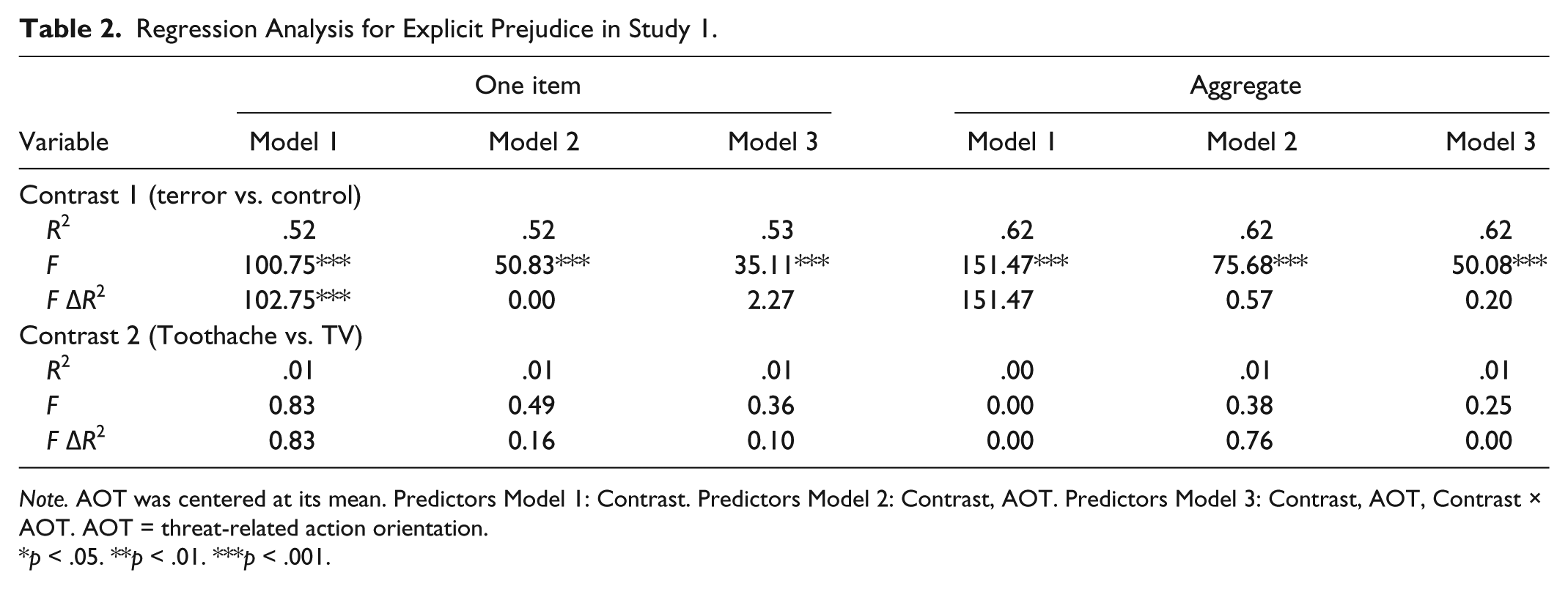
Note. AOT was centered at its mean. Predictors Model 1: Contrast. Predictors Model 2: Contrast, AOT. Predictors Model 3: Contrast, AOT, Contrast × AOT. AOT = threat-related action orientation.
p < .05. **p < .01. ***p < .001.
Differences in implicit prejudice between conditions
To test for the influence of an MS reminder compared with a toothache or a television reminder in conjunction with participants’ AOT on implicit prejudice against Arabic Muslims as assessed with the IAT described above, we computed regression analyses equivalent to the ones used to analyze the effects on explicit prejudice. The results, including a summary of the changes in variance explained as well as the regression coefficients for each model, are shown in Table 3. As can be seen, for the first contrast, the third model including the interaction explained significantly more variance than the second model with only the contrast and AOT as predictors. Furthermore, for the third model, the regression coefficients showed that there was no significant main effect of AOT. As for the explicit measure, none of the models for the second contrast reached significance.
Regression Analysis for Implicit Prejudice (IAT) in Study 1.

Note. Implicit prejudice was measured with the IAT. AOT was centered at its mean. IAT = Implicit Association Test; CI = confidence interval; AOT = action orientation after threat.
p < .05. **p < .01. ***p < .001.
To investigate the exact nature of the interaction effect for the contrast comparing MS with both control conditions, we computed simple slopes for high (+1 SD) and low (−1 SD) levels of AOT. For high levels of AOT, the effect of the condition contrast was positive and significant, B = 0.090, p < .001, 95% CI = [0.046, 0.133], indicating that participants high in AOT had lower implicit prejudice scores in the MS condition compared with the two control conditions. For low levels of AOT, the effect of the condition contrast was not significant, B = 0.012, p = .582, 95% CI = [−0.032, 0.057], indicating that participants low in AOT did not differ in prejudice scores depending on whether they were in the MS or in one of the control conditions. The regression slopes for the MS condition and the summarized control condition are shown in Figure 1.

Regression slopes for the effect of AOT, condition, and their interaction on relative implicit prejudice against Muslims as compared with Christians as measured with the IAT in Study 1.
Discussion
As expected, worldview defense on an implicit level in form of an adjustment of implicit prejudice depended on AOT. In particular, implicit prejudice levels toward Muslims as assessed with an IAT decreased with increasing levels of AOT after MS so that condition (MS vs. the two controls) had a significant effect on implicit prejudice for participants with high levels of AOT while there was no significant effect for participants with low levels of AOT.
In addition, we found that individuals are able to engage in worldview defense after MS on an explicit level in form of an adjustment of explicit prejudice irrespective of their self-regulation ability. Specifically, participants exposed to an MS manipulation in form of an MS reminder showed lower levels of explicit prejudice toward Muslims than participants in the two control groups. A reduction rather than an increase in derogation can plausibly be explained as a consequence of the political orientation of our participant population, namely, German university students, who tend to hold progressive political values of tolerance and cooperation (Simeaner, Dippelhofer, Bargel, Ramm, & Bargel, 2008; see also Hastie, 2007). We will consider this issue in more depth in the “General Discussion” section.
The most important finding of our first study, however, remains the decrease of implicit prejudice within the MS condition for participants with high levels of AOT but not for participants with low levels of AOT. This finding suggests that individuals with high levels of AOT are able to access the self even under stressful circumstances, which in turn enables them to effectively utilize implicit mechanisms of affect regulation. Presumably, action-oriented participants are thus not restricted in their worldview defense to an explicit level of processing. Instead they are able to engage in worldview defense also on the level of the implicit self.
The implicit measure with which we obtained these results, the IAT, has been criticized in terms of its validity to measure prejudice, however (cf. Arkes & Tetlock, 2004; Blanton et al., 2009; Oswald, Mitchell, Blanton, Jaccard, & Tetlock, 2013). We therefore aimed to replicate our findings with a different kind of implicit prejudice measure in Study 2.
Study 2
Study 1 provided initial empirical evidence for the notion that individuals with high levels of AOT show changed implicit prejudice as an expression of an in-depth coping with MS. Also, the effect of increased tolerance toward an outgroup as a main effect was not expected, albeit conceivable. Therefore, we set up another study to replicate our findings concerning the moderating effect of AOT on implicit prejudice after MS induction. Unlike Study 1, Study 2 capitalized on a different implicit prejudice measure that was based on the Implicit Positive and Negative Affect Test (Quirin, Kazén, & Kuhl, 2009), a test that assesses implicit affect through ratings of artificial words in terms of their affective content (see also Kuhl, 2005, for an earlier variant of the test).
Method
Participants
A total of 88 undergraduate students (43 female and 45 male, M age = 23.47, SD = 3.16) with various majors (education: n = 31; social sciences: n = 24; law: n = 18; other majors: n = 15) at Osnabrueck University participated in return for a monetary compensation of €5.
Measures
Implicit prejudice measure
We compared ratings of artificial words without a defined meaning that sounded either Muslim or Christian to assess implicit prejudice. The six artificial words used were chosen from a list of 39 words that had been rated on a 7-point scale ranging from 1 (sounds clearly Muslim) to 7 (sounds clearly Christian) according to how Muslim or Christian they sounded by a separate sample of 16 psychology students. The three words with the lowest mean ratings were chosen as Muslim-sounding words (Kushaf, M = 1.50, SD = 0.63; Rhadad, M = 1.56, SD = 0.51; and Muladad, M = 1.31, SD = 0.48) whereas the three words with the highest mean ratings were chosen as Christian-sounding words (Droten, M = 6.38, SD = 0.50; Urona, M = 6.00, SD = 0.63; and Wolund, M = 6.00, SD = 0.63).
To measure relative implicit prejudice against Muslims as compared with Christians, participants were asked to rate these six words according to how well they expressed four positive (joy, happiness, hope, and peace) and four negative (sad, terrible, evil, and cruel) concepts on a 6-point scale ranging from 1 (does not fit at all) to 6 (fits very well). The total number of Muslim- and Christian-sounding word–concept pairs was therefore 48.
After data collection, we calculated mean ratings across the three Muslim-sounding and the three Christian-sounding words, respectively, so that we ended up with 16 scores in total, with 4 scores each indicating the strength of participants’ associations of positive or negative concepts with Muslim- or Christian-sounding words, respectively. We then reversed the 4 scores of the Christian-sounding words paired with negative concepts and the 4 scores of the Muslim-sounding words paired with positive concepts so that a higher score always indicated a more negative judgment of Muslim-sounding words or a more positive judgment of Christian-sounding words. In a final step, we calculated a grand mean of the 8 reversed and the 8 remaining scores that resulted in a measure of the relative implicit prejudice against Muslims relative to Christians. Cronbach’s alpha for the 16 scores that were used to calculate this grand mean was .79.
Procedure
As in Study 1, participants received and completed the AOT subscale of the Action Control Scale several weeks prior to the experimental session; Cronbach’s alpha for the scale was .77 in this sample. Also as in Study 1, approximately equal numbers of individuals with AOT scores above and below the median were assigned to the three conditions (MS, toothache, and TV). Participants sat in separate cubicles and were told that they would participate in several unrelated studies about self- and other perception.
After being exposed to the experimental manipulation described in Study 1, participants worked on an implicit (Quirin, Kazén, et al., 2009) and an explicit affect questionnaire (Kuhl & Kazén, 2014), both of which served as fillers and were unrelated to the current topic for approximately 5 to 7 min. As the resulting delay was smaller than in Study 1, we assumed that subconscious accessibility of MS and death-related thoughts had not returned to baseline at this point. Participants therefore completed our measure of implicit prejudice against Arabic Muslims without intermittent refresher priming. At the end, participants were probed for suspicions concerning the aim of the study. The probing confirmed that none of the participants had correctly guessed the purpose of our research. Participants were then paid and thanked for participation. Debriefing took place via email once data collection had been completed.
Results and Discussion
Overall levels of implicit prejudice and AOT
The overall mean of our implicit prejudice measure was 3.62, SD = 0.48. While this value was very close to 3.5, the theoretical midpoint of the scale, a one-sample t test confirmed that the difference between measured implicit prejudice and the scale midpoint was significant, p < .05, indicating that our implicit prejudice measure successfully replicated the finding that participants from a German college student population appear to hold some implicit prejudice against Muslims on average.
The overall mean AOT score was 4.43, SD = 2.97. The median was 4, one point lower than the median recorded in the literature (Kuhl, 1994a; Kuhl & Beckmann, 1994). Our sample therefore appeared to be somewhat less action-oriented than the population at large. A one-way ANOVA with condition as predictor and AOT as outcome variable did not find any effect of condition, F(2, 85) = 0.68, p = .51, indicating that the experimental groups did not differ from each other with respect to pre-existing AOT.
Differences in implicit prejudice
As in Study 1, we tested for the influence of MS compared with the two control conditions in conjunction with AOT on implicit prejudice by computing two series of regression models with the first series using a contrast coding scheme for condition that compared MS (coded −2) against the two controls (each coded 1) whereas the second series used a coding scheme comparing the two controls with each other (toothache coded −1, TV coded 1, and MS coded 0). Again, the respective contrast was used as predictor in the first model of each series, whereas in the second model, AOT was added as additional predictor and the third model included the interaction as the third predictor.
The results of these regressions are shown in Table 4. As can be seen, there was a marginal increase in explained variance from the second to the third model in the first series. Regression coefficients for the third model including all three predictors indicated a marginal main effect of AOT, a significant main effect of condition, and an interaction of AOT and the condition contrast with p = .054. 3
Regression Analysis for Implicit Prejudice in Study 2.

Note. Implicit prejudice was measured with Muslim- versus Christian-sounding artificial word ratings. AOT was centered at its mean. CI = confidence interval; AOT = action orientation after threat.
Exact p was .054.
p < .10.*p < .05. **p < .01. ***p < .001.
To investigate the exact nature of the interaction effect for the contrast comparing MS with both control conditions, we again computed simple slopes for high (+1 SD) and low (−1 SD) levels of AOT for this contrast. For high levels of AOT, the effect of the condition contrast was positive and significant, B = 0.162, p < .001, 95% CI = [0.066, 0.258], indicating that participants high in AOT had lower implicit prejudice scores in the MS condition compared with the two control conditions. For low levels of AOT, the effect of the condition contrast was not significant, B = 0.032, p = .501, 95% CI = [0.062, 0.125], indicating that participants low in AOT did not differ in prejudice scores depending on whether they were in the MS or in one of the control conditions. The regression slopes for the MS condition and the summarized control condition are shown in Figure 2.

Regression slopes for the effect of AOT, the contrast terror/control, and their interaction on relative implicit prejudice against Muslims as compared with Christians in Study 2.
General Discussion
In two studies, we found evidence that AOT moderates implicit worldview defense after MS. More specifically, participants high in AOT showed decreased levels of implicit prejudice against Muslims after an MS manipulation as compared with the control conditions while implicit prejudice levels for participants low in AOT did not differ depending on condition. This is in line with our assumption that individuals high in AOT access integrated values stored as part of the implicit self under threatening conditions and that these individuals are therefore able to engage in worldview defense on the implicit level while individuals low in AOT lack this ability. Consequently, worldview defense appears to take different forms depending on differences in self-regulation and accessibility of implicitly operating systems under threat such as the implicit self.
Direction of the MS Effect
In addition to the MS effect on implicit prejudice that was moderated by AOT, we also found that explicit prejudice was reduced in response to MS as a main effect. This was unexpected because the majority of TMT studies have found an increase rather than a decrease in prejudice levels toward an outgroup (Niesta et al., 2008; see also Burke et al., 2010). However, as outlined, for example, by Niesta et al., an adjustment of the level of prejudice against an outgroup can also occur in the other direction and can thus even lead to prosocial tendencies toward this group (see also Burke et al., 2010). Specifically, this depends on how strongly the value of tolerance is supported by an individual’s worldview (Greenberg et al., 1992, Study 1), how salient the value of tolerance is in a given situation (Greenberg et al., 1992, Study 2), or how much the targeted outgroup members fit the stereotype of their group (Schimel et al., 1999).
In line with Niesta et al.’s (2008) reasoning as well as with a number of empirical studies that found increased pacifism (Jonas et al., 2008) and acceptance of an outgroup (Greenberg et al., 1992), the direction of the present main effect might be explained by the specific political view held by the population we drew our participants from. Specifically, German university students tend to hold progressive political opinions (Simeaner et al., 2008; see also Hastie, 2007). American participants with a similar political orientation have previously been found to show decreased rather than increased levels of prejudice against outgroup members after MS, presumably because they hold a strong value of tolerance (Greenberg et al., 1992, Study 1). It should be noted, however, that we did not directly measure the political views of our participants. This is a limitation of the research at hand and should be addressed in future research.
Furthermore, alternative explanations of the direction of the effect that have nothing to do with the specific sample are certainly possible. For one, our manipulation was not independent of our CWD measures because the priming with reminders of Islamic terrorist acts as well as the implicit and explicit prejudice measures should have activated stereotypes and prejudices toward Muslims. It is possible that the pre-activation of these prejudices and stereotypes during the manipulation activated goals not to discriminate. To investigate the direction of the affect, the studies presented in this article should be replicated with samples differing in nationality, age, educational background, and (predominant) gender from the samples used here. In addition, a CWD measure that is independent in content from the manipulation or a manipulation reminding participants more directly of death without using reminders of terrorism or reminding of non-Muslim terrorist acts should be used. It is important to note, however, that although the direction of the effect is interesting, it is not the main outcome of this article. Instead, the true novelty introduced is the demonstration of a personality variable such as AOT moderating the effect of the manipulation in a way that causes the manipulation to have different effects at the implicit as compared with the explicit level.
AOT-Based Differences in Worldview Defense
Implicit worldview defense mechanisms in individuals high in AOT are supposedly based on these individuals’ increased ability to access the implicit self under threatening circumstances. As the implicit self is thought to store an individual’s motives, goals, values, and preferences (Baumann, Kaschel, & Kuhl, 2005; Kuhl, 2000, 2001), which are all components of the respective individual’s worldview, implicit worldview defense should be more closely related to this kind of personal worldview than explicit worldview defense which should be more vulnerable to influences from a more general, cultural worldview held by the majority in the respective surrounding culture. In other words, implicit worldviews might constitute representations on an advanced level of cultural worldview internalization (e.g., Deci & Ryan, 1980, 2000) and thus constitute deep (rather than superficial) values lying at the core of the personal self.
In fact, the findings by Kazén et al. (2005) that we have discussed in the introduction support the existence of a personal rather than CWD that is based on the content of the implicit self in individuals with high but not low levels of AOT. As already described, these researchers found that German individuals scoring high (as opposed to low) on the AOT scale increased their national pride in response to an MS manipulation. In a culture like Germany where national pride tends to be regarded negatively compared with other European cultures (European Commission, 2004), especially in highly educated individuals (Identity Foundation, 2009) such as the student population that Kazén et al. drew their participants from, this defies the general cultural worldview and is therefore presumably dependent on an individual’s personal implicit values.
In addition, Baumann and Kuhl (2003) found that individuals low in AOT tend to show higher levels of rumination about a threatening event that they have just experienced. If the respective threat is MS related, these individuals should therefore have a higher inclination to ruminate about death-related themes and maintain higher levels of death thought accessibility, possibly due to their decreased ability to engage in coping mechanisms supported by the implicit self. In this context, a series of studies by Koole and Van den Berg (2005) provide support for the notion that individuals high in AOT apparently are able to self-regulate more efficiently in MS contexts, at least when exposed to a mild mortality reminder (e.g., exposure to wilderness as compared to exposure to cultivated nature, see Koole & Van den Berg, 2005, Study 1).
However, Kazén et al. (2005) as well as Koole and Van den Berg (2005) found evidence for differences in terror management processes between individuals high in AOT compared with individuals low in AOT on explicit dependent measures, whereas we found evidence for differences in worldview defense in the form of prejudice against Muslims dependent on participants’ levels of AOT on an implicit level only. A possible explanation for this apparent discrepancy might lie in the homogeneity of our participant population (German undergraduate students) in terms of the likely core beliefs of their cultural worldview: German university students tend to be politically progressive and to hold a strong value of tolerance (Simeaner et al., 2008; see also Hastie, 2007), so the personal values of our participants most likely supported the goal not to be prejudiced against Muslims. In addition, they tend to be surrounded by an academic culture that supports these same goals. We therefore assume that in Study 1, differences in explicit prejudice after MS were independent of AOT because the different mechanisms that should influence individuals with low or high levels of AOT should lead to the same result in this sample. Within the group of participants with lower AOT levels and therefore inferior self-access, however, explicit prejudice levels were presumably influenced more by the values of the surrounding culture (i.e., CWD), whereas explicit prejudice levels in participants with higher AOT levels and therefore superior self-access were influenced more by personal values stored in the implicit self (i.e., personal worldview defense). To the extent that personal and cultural (social) worldviews coincide, both should have similar effects even though they might cause these effects via different mechanisms.
Other research on the effect of AOT on worldview defense has found diminished worldview defense in individuals high in AOT (Koole & Van den Berg, 2005) whereas we found increased worldview defense for the same group of individuals, at least at the implicit level. A possible explanation might be that different defense mechanisms against death thoughts are replaceable and that individuals with superior self-regulation abilities, such as individuals high in AOT, can use more flexible defenses in line with their personal values whereas individuals with inferior self-regulation abilities remain restricted to more rigid defenses determined by the values of the surrounding culture. This should be addressed in future research by giving participants the opportunity to engage in different kinds of worldview defense.
Limitations of the Present Research
Implicit and explicit prejudice measures in Study 1 were not counterbalanced; instead, participants always completed the implicit measure first. We chose this fixed order because previous research has found that explicit measures can increase the effect found on subsequent implicit measures while the opposite does not seem to be the case (Bosson, Swann, & Pennebaker, 2000). In light of these findings, placing the implicit measure before the explicit measure seemed the best way to rule out artifacts of order. However, the lack of counterbalancing also allows for the possibility that the differences in findings concerning implicit and explicit measures were due to the order of these measures instead of due to the mechanisms proposed in this article. For example, it is possible that participants low in AOT needed longer to access both implicit and explicit values, possibly due to less ability to suppress conscious death thoughts (cf. Baumann & Kuhl, 2003). This could have led to the absence of an effect on the implicit measure, which was completed closer to the manipulation, in this group. 4 Therefore, future studies should try to replicate our findings with counterbalanced measures and with measure order included as a factor in the analysis in a sample big enough to find possible interactions of measure order with AOT and/or manipulation. Alternatively, a design in which half the participants complete only the explicit prejudice measure while the other half only completes the implicit measure could be used to avoid order effects.
Furthermore, it should be noted that the combined use of several modalities of terrorism reminders (pictures, recall of memories and emotions, as well as subliminal priming) constitutes a more involved MS manipulation than usually used in TMT research. It is unclear if this constitutes a limitation or an advantage of our research, though. In fact, our manipulation is probably more comparable with the naturally occurring terrorism reminders in the days, weeks, and months after 9/11. People in the United States as well as in Germany were exposed frequently to pictures of the smoking twin towers, and terrorism was a quite regularly discussed topic in the media (cf. Pyszczynski, Solomon, & Greenberg, 2003). The accessibility of terrorism- and death-related thoughts therefore should have been chronically high during this period.
Finally, the use of a terrorism reminder instead of a standard MS manipulation might have influenced our results. Although theoretical work has analyzed in detail how exposure to terrorism can lead to increased death thought accessibility and therefore to a number of societal phenomena observed in recent years (Pyszczynski et al., 2003) and although research by Landau et al. (2004) has demonstrated that exposure to primes related to the 9/11 terrorist attacks lead to increased death thoughts, it cannot be ruled out that the present effects might be caused by the activation of aspects of the concept of terror that are not directly mortality related. Therefore, future studies should aim to replicate the present findings with a mortality reminder unrelated to terrorism.
Alternative Theories Explaining the Findings
As discussed in the introduction, TMT is just one of a number of theories proposing symbolic compensation of existential threats (e.g., Heine et al., 2006; McGregor et al., 2001; Steele, 1988). In particular, MMM might provide an alternative explanation of our findings. In fact, MMM explicitly posits that the defensive reactions to death reminders found in TMT research are not due to participants’ unconscious pursuit of symbolic mortality but due to their motivation to maintain a certain level of meaning (cf. Heine et al., 2006). If this is the case, our results including the interaction of a terrorism versus control priming and AOT should be replicable not only with a mortality reminder unrelated to terrorism but also with a different type of existential meaning threat, such as a threat to a close relationship, or exposure to a surrealist piece of art (cf. Randles, Heine, & Santos, 2013). In fact, AOT is unspecific to MS in that individuals high in AOT are better at self-regulation under threatening conditions in general (Kuhl, 2000, 2001). Yet, if MS is different from other existential threats, it is possible that AOT has different effects when individuals are reminded of death than when they are threatened in another way.
In this context, it also becomes an intriguing possibility that terrorism is not just a mortality reminder but simultaneously threatens meaning in other ways. For example, watching or remembering people die through a terrorist act could also pose a threat to people’s belief in a just world (cf. Montada & Lerner, 1998). Finally, because participants high in AOT should actually have an easier time to construct meaning due to their superior ability to access their implicit self, a system perfectly suited to notice meaningful relationships (cf. Kuhl, 2001), there is also the question whether participants low in AOT compensate for their inability to use implicit coping mechanisms in other ways. Future studies should concentrate on these issues.
Conclusion
We found evidence that individuals differ in their ability to engage in implicit worldview defense after MS depending on their AOT level. These differences in implicit worldview defense may result from different abilities to access the implicit self and therefore implicit personal goals and values under mortality threat. The present findings provide important evidence that worldview defense is not a uniform phenomenon but can take different forms depending on differences in self-regulation and accessibility of implicitly operating systems under threat such as the implicit self.
Footnotes
Declaration of Conflicting Interests
The author(s) declared no potential conflicts of interest with respect to the research, authorship, and/or publication of this article.
Funding
The author(s) received no financial support for the research, authorship, and/or publication of this article.
Notes
References
Supplementary Material
Please find the following supplemental material available below.
For Open Access articles published under a Creative Commons License, all supplemental material carries the same license as the article it is associated with.
For non-Open Access articles published, all supplemental material carries a non-exclusive license, and permission requests for re-use of supplemental material or any part of supplemental material shall be sent directly to the copyright owner as specified in the copyright notice associated with the article.
