



Abstract
When a speaker presents an opinion, an important factor in audiences’ reactions is whether the speaker seems to be basing his or her decision on ethical (as opposed to more pragmatic) concerns. We argue that, despite a consequentialist philosophical tradition that views utilitarian consequences as the basis for moral reasoning, lay perceivers think that speakers using arguments based on consequences do not construe the issue as a moral one. Five experiments show that, for both political views (including real State of the Union quotations) and organizational policies, consequentialist views are seen to express less moralization than deontological views, and even sometimes than views presented with no explicit justification. We also demonstrate that perceived moralization in turn affects speakers’ perceived commitment to the issue and authenticity. These findings shed light on lay conceptions of morality and have practical implications for people considering how to express moral opinions publicly.
Imagine two strong supporters of marriage equality who give different reasons for their views. One explains, “It would not harm anyone, gay people would be happier, and society would benefit from their investment in families.” The other says, “Marriage is a basic right that same-sex couples deserve equally, and denying them this right is unfair.” Both support same-sex marriage, but they justify their positions using distinct ethical arguments, recognizable as consequentialist (focusing on increasing aggregate welfare; e.g., Mill, 1899) and deontological (focusing on rights and justice; e.g., Kant, 2002). In theory, both arguments are moral—based on conceptions of the ultimate good, each with long traditions in moral philosophy. Yet we propose that lay audiences asked which speaker treats same-sex marriage as a moral issue would predominantly point to the second one. We argue that consequentialist reasoning strips an argument of moral resonance, making it seem pragmatic and common sense. If you support a policy because it increases everyone’s happiness, your position seems merely practical, not ethically based.
Why Study Perceived Moralization?
An individual who bases his or her attitudes about an issue on moral convictions is said to moralize that issue (Rozin, 1999; Skitka, Bauman, & Sargis, 2005); perceived moralization refers to the perception that someone sees an issue as morally relevant.
Speakers perceived to moralize an issue are treated differently from those whose positions seem merely pragmatic (Kreps & Monin, 2011). Moralization implies commitment, integrity, and good faith; but moralizers can also appear inflexible or self-righteous. There is some truth to these perceptions: Moralized attitudes lead to deeper commitment and corresponding behaviors than other strong attitudes (Mullen & Skitka, 2006; Skitka et al., 2005; Skitka & Mullen, 2002). Thus, individuals delivering public messages—whether to the American public or to friends—would benefit from understanding when audiences will perceive them as committed moralizers or open-minded pragmatists. Testing whether consequentialist views appear less moralized also speaks to lay perceptions of ethical theories. To philosophers, deontological and consequentialist theories are both legitimate ethical foundations; demonstrating that lay perceivers depart from this view would contribute to a growing literature comparing lay intuitions with ethical theory (e.g., Sinnott-Armstrong, 2008).
Why Would Consequentialist Positions Appear Less Moralized?
Consequentialist opinions may sound amoral for three reasons: They may appear less abstract, less deontological, or more prudential. First, they sound concrete: People believe that morality is generally abstract and high level (e.g., Eyal & Liberman, 2012), and harm-and-benefit considerations sound less abstract than deontological global rules. Second, consequentialist speakers may seem not to appreciate the inviolability of certain deontological rules: Quantitative, aggregation-based tradeoffs may seem taboo in domains considered sacred (Tetlock, Kristel, Elson, Green, & Lerner, 2000) and can imply a lack moral of concern (Bartels & Pizarro, 2011; Koenigs et al., 2007). Third, though consequentialist arguments are not merely prudential or opportunistic (they concern consequences to the aggregate, not just the speaker), their superficial resemblance to self-interested arguments causes confusion (cf. Mill, 1899).
In summary, we propose that lay individuals, departing from a philosophical standpoint, do not perceive consequentialist, societal harm-and-benefit arguments as ethical; they infer that consequentialist speakers must not be guided by general abstract principles (less deontological), and they confuse a focus on societal costs and benefits with selfishness (more prudential). We predict that speakers expressing consequentialist arguments for a given position will be perceived to moralize less than speakers presenting deontological arguments for the same position.
Overview of Studies and Summary of Predictions
Four studies tested the effect of consequentialist justifications on perceptions of moralization. Studies 1a and 1b tested the effect of consequentialist justifications for political statements, compared with no justification. Study 2 used quotations from actual presidential speeches to show that consequentialist statements are viewed as less moralized than both no-justification and deontological ones. It also demonstrated that speakers perceived to moralize are seen as more committed to their cause. Study 3 ruled out the alternative explanation that the effect was due to consequentialist arguments presenting more descriptive facts. Study 4, in an organizational context, demonstrated that even consequentialist statements accompanied by a principled consequentialist premise are seen as less moral than deontological ones; it also tested whether inferences of a target’s privately held reasons explain the effect, and it demonstrated again that perceived moralization increases perceived commitment.
Our central hypothesis was that consequentialist positions would appear less moralized than deontological positions (Studies 2-4) and positions given no explicit justification (Studies 1, 2, and 4). We predicted that, though the contrast between consequentialist and deontological decisions would be the greatest, adding consequentialist arguments could sometimes even appear less moralized than providing no justification at all—by clarifying that one’s reasons are consequentialist, whereas giving no justification may imply deontological arguments.
Study 1
Studies 1a and 1b, using similar methods but different participant populations and vignette contexts, tested the effects of consequentialist arguments compared with no explicit justification. Participants read about two hypothetical individuals stating their opinions about novel political issues; one gave his or her opinion with no justification, and the other gave a consequentialist justification. We predicted that adding consequentialist justifications would make an argument seem less moralized.
Method
Participants and design
For Study 1a, 135 students (82 female, Mage = 20.26) participated in a paid mass questionnaire session. For Study 1b, 103 participants (63 female, Mage = 40.17) from a privately maintained U.S. online participant pool participated for a chance to win a gift certificate. Because the key manipulation was within-participants, we had 135 and 103 observations per cell, for total sample sizes of 270 and 206 observations, which seemed reasonable for our initial studies.
Participants each read about two speakers discussing different issues. Justification (consequentialist vs. none) was manipulated within participants; between participants, we varied which issue was given which justification.
Procedure and stimuli
In Study 1a, targets were state senators commenting on ballot measures to fund a mobile health care unit for the homeless or increase funding for school arts programs. In Study 1b, the targets were identified by their first names and stated their opinions as part of “a conversation”: The issues were cutting taxes for low-income individuals and Greece’s recognition of the Republic of Macedonia.
All participants saw the issues in the same order (Study 1a: health care, then arts; Study 1b: tax, then Macedonia), but we counterbalanced which issue was given a consequentialist justification. For example, half of Study 1a participants read the no-justification health care vignette, then the consequentialist arts vignette, and the other half read the consequentialist health care vignette followed by the no-justification arts vignette.
After a brief introduction, each quotation began and ended with a strong statement of the target’s view; in the consequentialist conditions, the target also provided consequentialist arguments. For example, one of the senators in 1a said (with the consequentialist addition in brackets): I support Measure G because it is a change we ought to make. [The students would benefit from having more arts education, and all of society can benefit from the talented artists who would be more likely to emerge from these schools. For these reasons,] it would simply be wrong not to pass this measure.
Measures
Following each vignette, participants answered questions on scales from 1 (strongly disagree) to 7 (strongly agree). Eight items, presented together in an individually randomized order, each measured either perceived consequentialism or perceived moralization. A principal axis factor analysis with Promax rotation (Russell, 2002) for each study revealed two factors confirming our intended constructs; we omitted one item that had the weakest loadings in both studies (see Table 1). The resulting three-item consequentialism measure (Study 1a: α = .89; Study 1b: α = .88) and four-item moralization measure (Study 1a: α = .90; Study 1b: α = .85) were moderately correlated (Study 1a: r = −.27, 95% confidence interval or CI [−0.37, −0.15]; Study 1b: r = −.15, [−0.28, −0.02]). 3
Pattern Matrix, Principal Axis Analysis With Promax Rotation of Moralization and Consequentialism Items, Studies 1a and 1b.
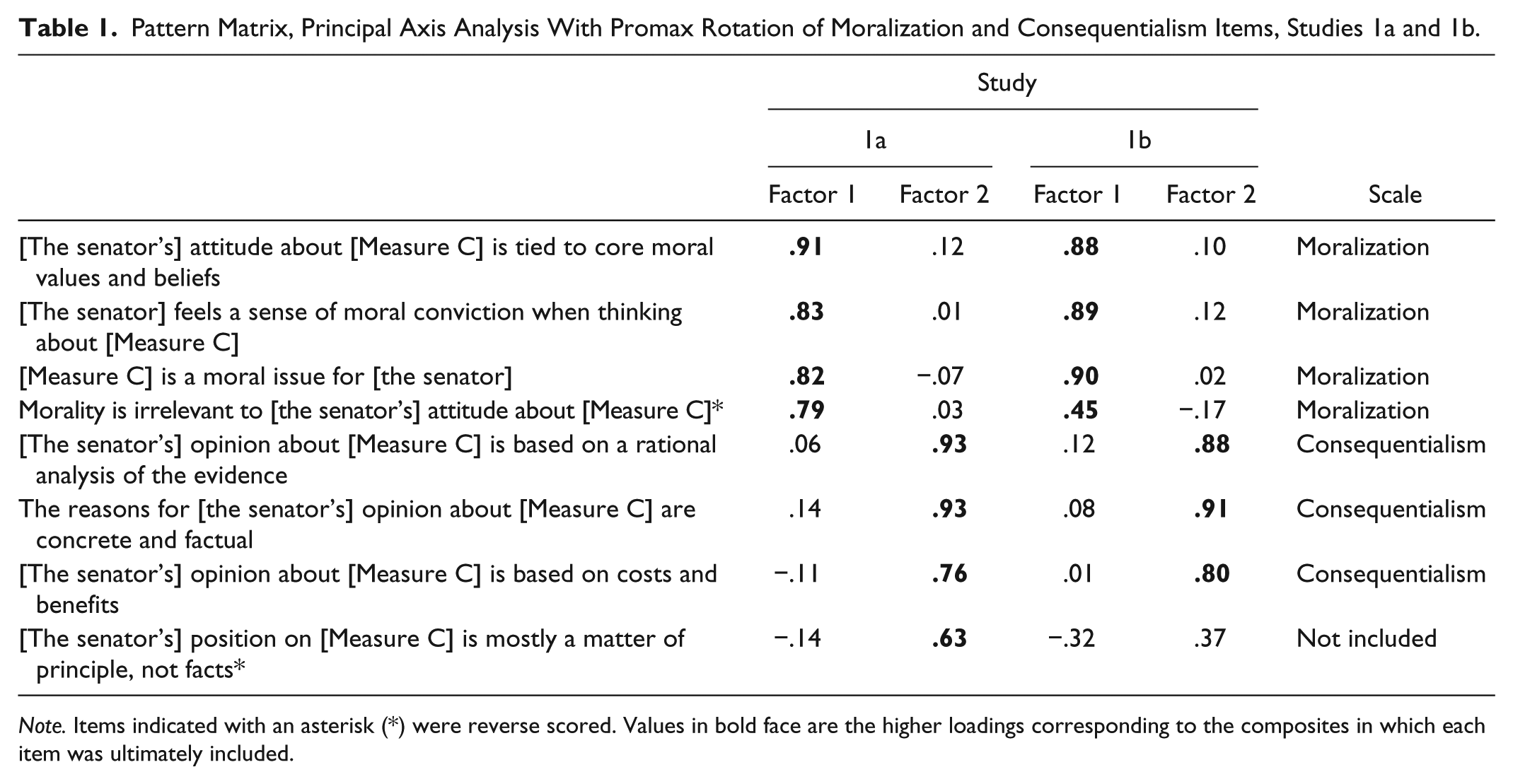
Note. Items indicated with an asterisk (*) were reverse scored. Values in bold face are the higher loadings corresponding to the composites in which each item was ultimately included.
Next, we measured perceived attitude strength 1 and participants’ agreement with targets, 2 from 1 (strongly disagree) to 7 (strongly agree). In Study 1a, the attitude strength measure comprised two items (“Measure G is an important issue to the senator,” “The senator has strong feelings about Measure G”; r = .74) and agreement three items (“I agree with the senator on this issue,” “The senator’s arguments would be convincing to me,” “The senator’s arguments would be convincing to other people”; α = .78). In Study 1b, attitude strength was one item (“This issue is an important issue to Alex [Brian]”) and agreement was two items (“I agree with Alex [Brian] on this issue”; “I find Alex [Brian] quite convincing on this issue”; r = .50 [0.40, 0.60]). In Study 1b, the attitude strength and agreement items were embedded among and presented in a random order with items intended to measure possible downstream effects of moralization (liking and closed-mindedness). Results for these items are reported in supplementary analyses.
Finally, participants indicated their political orientation from 1 (extremely conservative) to 7 (extremely liberal). We measured political orientation to test whether liberals and conservatives attribute different degrees of moralization to consequentialist targets (cf. Graham, Haidt, & Nosek, 2008); we expected no moderation by political orientation.
Statistical methods
Most statistical analyses in this article used linear mixed models (Baayen, 2008), as recently advocated for use with repeated measures or multiple stimuli (Judd, Westfall, & Kenny, 2012). In line with recent recommendations (Cumming, 2014), we report 95% confidence intervals in square brackets, without p values.
Study 1 had two crossed within-participant factors: justification (none vs. consequentialist) and issue (Study 1a: health care vs. arts; Study 1b: tax vs. Macedonia). Though we were not interested in those particular issues, we could not treat issue as random because it took only two values per study (Bates, 2010). Thus, our model was as follows:
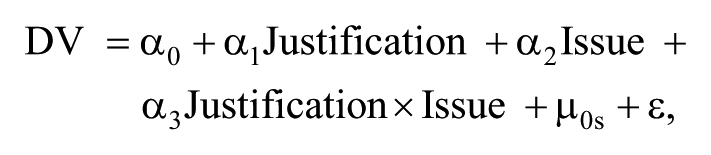
where the α weights are fixed effects, µ0s is the random per-participant intercept, and ϵ is a residual error term. Where noted, we added other fixed factors, such as political orientation.
Because issue did not interact with justification, except where noted, we present its effects in supplementary analyses.
Results
Moralization (main analysis)
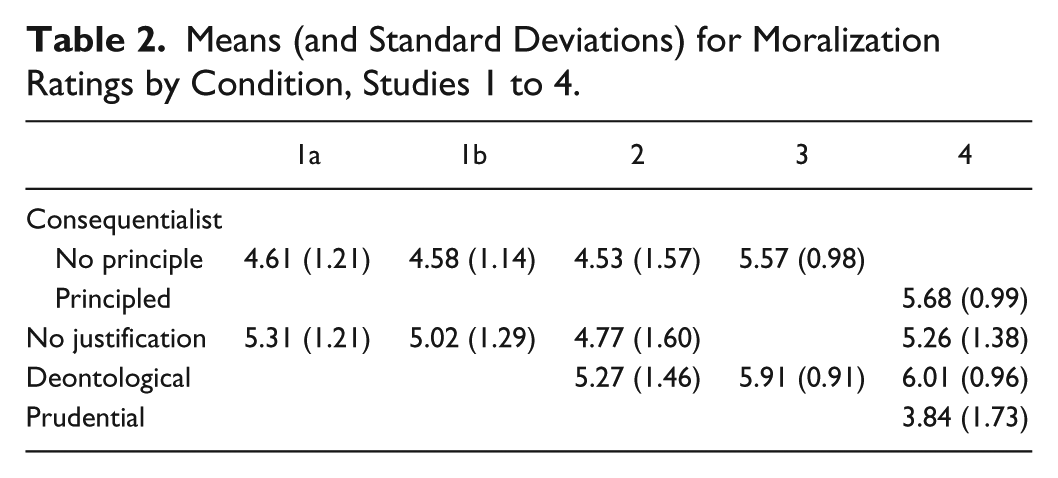
In both studies, as predicted, the consequentialist target was perceived to moralize less than the control: Study 1a, b = −.70 [−0.93, −0.46], d = .49; Study 1b, b = −1.65 [−2.02, −1.29], d = .29 (see Table 2).
Means (and Standard Deviations) for Moralization Ratings by Condition, Studies 1 to 4.
There were no main or interaction effects of political orientation in either study.
Perceived consequentialism
Perceived consequentialism and perceived moralization were negatively correlated in both studies (as mentioned above; Study 1a: r = −.27, 95% CI [−0.37, −0.15]; Study 1b: r = −.15 [−0.28, −0.02]). Justification also affected perceived consequentialism. The consequentialist target was rated as more consequentialist than the control target: Study 1a (Mcons = 4.84, SDcons = 1.08; Mcontrol = 2.95, SDcontrol = 1.22), b = 1.92 [1.66, 2.18], d = 1.06; Study 1b (Mcons = 4.59, SDcons = 1.28; Mcontrol = 2.94, SDcontrol = 1.47), b = 1.65 [1.29, 2.02], d = .79. In Study 1b, this effect, though present for both issues, was stronger for the Macedonia issue (Mcons = 4.95, SDcons = 1.20; Mnojust = 2.46, SDnojust = 1.16; b = 2.49 [1.98, 3.01]) than for the tax issue (Mcons = 4.13, SDcons = 1.26; Mnojust = 3.31, SDnojust = 1.57; b = .81 [0.30, 1.32]), interaction b = 1.68 [0.96, 2.40].
Discussion
In Studies 1a and 1b, as predicted, individuals who gave consequentialist justifications were perceived to moralize less than those who gave no explicit justification. Participants also thought consequentialist speakers had more “concrete and factual reasons,” and based their opinions on “costs and benefits” and “a rational analysis of the evidence”—that is, they were more consequentialist. It was less clear what inferences participants drew about no-justification speakers, and in particular whether the statement that “it’s simply the right thing to do” sounded deontological. To clarify this, we included explicitly deontological statements in Study 2.
Study 2
Study 2 tested our hypothesis in the context of real political statements. We aimed to establish that consequentialist justifications, as well as deontological, duty-based ones, are used in the real world, and that these real exemplars have the same effects as hypothetical ones. Thus, we used real quotations, pre-categorized as expressing consequentialist, deontological, or no justification. We predicted that consequentialist statements would appear less moralized than both no justification (replicating Study 1) and deontological justifications.
We also measured two interpersonal perceptions that could result from perceived moralization. Prior work on moralization (Kreps & Monin, 2011; Skitka et al., 2005) suggests that individuals judged to moralize an issue could appear less willing to compromise and more committed in their views. Thus, to the extent that consequentialism reduces perceived moralization, consequentialist targets could appear more flexible and willing to compromise. We thus hypothesized that consequentialist statements would make a speaker appear more flexible and willing to compromise by reducing perceived moralization.
Method
Participants
Thirty-eight participants (29 female, Mage = 35.53) recruited from a U.S. online participant pool maintained by a U.S. business school participated in exchange for a gift certificate. We recruited fewer participants because, in this within-subject design, each participant rating 60 quotes yielded 2,280 observations. Our sample size was consistent with Judd and colleagues’ (2012, Figure 1) simulation showing that, in a design like this one, power increases minimally with more than 30 participants.
Procedure
To generate study materials, the first author read through Bill Clinton and George W. Bush’s annual State of the Union addresses and collected 60 quotations from each president. Each quotation took a position on a policy; some also provided justifications. We removed the words “morality” and “ethics” and all references to Congress, specific years, or religious themes. When quotations gave multiple justification types, we replaced parts of these quotations with ellipses, thus featuring only one type.
To determine each quotation’s justification type, three moral philosophy doctoral students independently coded each quotation as consequentialist, deontological, or no justification. The first author met with the coders to discuss quotations that all coders did not code similarly; some disagreements were resolved, though agreement was never forced. For the study, we used only statements that were ultimately categorized the same by all three coders. The final, balanced set of stimuli (see online Appendix) comprised 60 quotations: 10 from each president in each of the three categories according to unanimous coder agreement.
Participants read that quotations came from different politicians’ speeches and were instructed to evaluate each independently. After reading each quotation in an individually randomized order, participants rated agreement (“I agree with the speaker on this issue”), 4 and perceived moralization (“This issue is a moral one for the speaker”), consequentialism (“The speaker’s position on this issue is based on costs and benefits”), and effectiveness at compromising (“The speaker would be effective at finding compromises with others who disagree on this issue”) from 1 (strongly disagree) to 7 (strongly agree). They then rated flexibility versus commitment: “Based on this quotation, what do you think the speaker is better at?”, from 1 (The speaker is better at recognizing when he/she is wrong, acknowledging mistakes, and changing course if needed) to 7 (The speaker is better at staying true to his/her message, being strong in his/her convictions, and never weakening his/her resolve) with the midpoint labeled, Equally good at both.
After reading and responding to all of the quotations, participants completed the 20-item Moral Foundations Questionnaire (MFQ; Graham et al., 2008), an exploratory measure designed to examine whether our effects depended on an individual’s conception of the foundation of morality. We had no specific prediction about the moderating effects of the MFQ.
Finally, among other demographic questions, we measured political orientation from 1 (extremely liberal) to 7 (extremely conservative).
Results
Statistical models included fixed effects for justification (α1), president (α2)—which was not of theoretical interest but, with two values, was better treated as fixed (Bates, 2010)—and their interaction (α3); a random by-participant intercept (µ0s); and a random by-quotation intercept (µ0q): 5
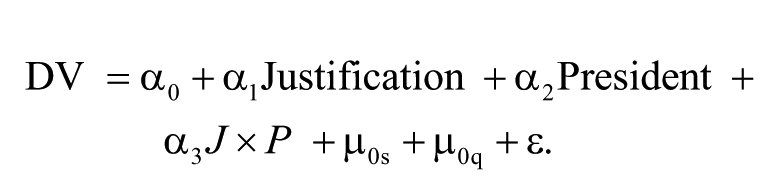
There was no president by justification interaction in any model; main effects of president are reported in supplementary analyses.
Moralization (main analysis)
As predicted, consequentialist quotations appeared less moralized than deontological ones, b = −.74 [−1.04, −0.44], d = .68. They also appeared less moralized than no-justification quotations, b = −.23 [−0.50, 0.03], 90% CI [−0.45, −0.01], d = .39 (see Table 2).
Perceived consequentialism
Consequentialist quotations (M = 4.67, SD = 1.70) appeared more consequentialist than deontological quotations (M = 4.21, SD = 1.75), b = .46 [0.14, 0.78], d = .38. In contrast to Study 1, they did not differ on perceived consequentialism from no-justification quotations (M = 4.47, SD = 1.77), b = .20 [−0.12, 0.52], d = .20. Also in contrast to Study 1, perceived consequentialism was positively related to perceived moralization, b = .20 [0.16, 0.23].
Political orientation
Political orientation moderated the difference in moralization between consequentialist and deontological quotations, interaction b = −.08 [−0.15, −0.01]. Although present at all levels of political orientation, the difference was stronger for conservative (at political orientation = 7, contrast b = −.98 [−0.64, −1.31]) than for liberal participants (at political orientation = 1, contrast b = −.51 [−0.18, −0.84]). Political conservatism also had a negative overall main effect, b = −.14 [−0.27, −0.01].
Moral foundations
We tested the moral foundation subscales (Harm, Fairness, Ingroup, Authority, and Purity) as moderators by adding each one’s main effect and interactions with justification and president to separate analyses. Endorsing the Harm (b = .35 [0.03, 0.67]), Fairness (b = .62 [0.36, 0.88]), and Ingroup (b = .31 [0.04, 0.58]) foundations positively predicted overall ratings of perceived moralization; Authority and Purity did not have main effects. In addition, the Harm (b = −.26 [−0.43, −0.10]), Fairness (b = −.16 [−0.32, 0.008]; 90% CI [−0.30, −0.02]), and Ingroup dimensions (b = .14 [0.0005, 0.29]) moderated the difference between consequentialist and deontological quotations. The difference in moralization was present for higher levels of Harm and Fairness: the confidence interval excluded zero at levels of Harm ≥ 3.13 and Fairness ≥ 2.94. The Ingroup interaction was in the opposite direction: While consequentialist quotations appeared less moralized at all levels of Ingroup (at the maximum score of 6, b = .42 [0.004, 0.83]), the effect was larger for lower levels of Ingroup (at the mean score of 3.77, b = .74 [0.48, 1.00]). Authority and Purity did not interact with justification. No moral foundations interacted with the consequentialist versus no justification comparison.
Interpersonal consequences
Justification did not affect perceived willingness to compromise. As predicted, however, speakers of consequentialist quotations (M = 4.35, SD = 1.40) appeared less committed than speakers of deontological quotations (M = 4.59, SD = 1.43), b = −.24 [−0.49, −0.003]. Consequentialist and no justification (M = 4.53, SD = 1.51) did not differ. Perceived moralization, when added to the model, was positively related to commitment, b = .18 [0.14, 0.22], and the consequentialist versus deontological comparison no longer differed from zero, b = −.12 [−0.35, 0.12], suggesting mediation by perceived moralization.
Discussion
Study 2 confirmed our predictions using actual presidential quotations: Consequentialist arguments were perceived as less moralized compared with no-justification statements, replicating Studies 1a and 1b, and deontological arguments.
One striking result of Study 2 is that consequentialist statements, identified as such by trained philosophers, did not appear to lay participants to be more consequentialist than no-justification statements; yet, as predicted, they were perceived as less moralized (observed effect size d = .39, vs. .49 and .29 in Studies 1a and 1b, respectively). This null effect on perceived consequentialism might result from the change from three items in Study 1 to a single-item measure in Study 2, from the within-subject contrast effect with deontological quotations (absent in Study 1), or perhaps from the fact that Study 2 participants could easily summon to mind consequentialist justifications for familiar political issues when no other reason was volunteered.
In addition, unlike Studies 1a and 1b, perceived consequentialism was positively, not negatively, related to perceived moralization. The reasons for this flip are unclear; perhaps, again, in the context of known political issues with familiar consequentialist arguments, awareness of costs and benefits indicated a strong and hence moralized attitude. What this effect does suggest, in any case, is that something other than perceived consequentialism might be underlying the effects of consequentialist statements on perceived moralization. Perceived deontology may be one such candidate, given the high moralization ratings for deontological statements: Consequentialism may reduce moralization because it suggests lower deontology. We return to this possibility in Study 4.
An intriguing unexpected finding in Study 2 is that the consequentialism versus deontology contrast was especially sharp for participants sensitive to harm and fairness violations and less sensitive to ingroup violations. Thus, participants sensitive to harm, who may themselves be more consequentialist, actually viewed deontological arguments, not consequentialist ones, as being especially moralized. This finding suggests that audiences judging a speaker’s moralization are not looking for a match between a speaker’s justification and their own moral views but rather are noticing justifications that seem inexplicable or striking: To someone who cares about harm violations, consequentialist arguments would sound even more like plain common sense.
Study 2 also demonstrated a downstream effect of perceived moralization on perceived commitment. Although it did not affect perceived willingness to compromise, the lower perceived moralization of consequentialist arguments did make speakers appear more flexible and less committed. This finding supports our contention that perceived moralization is a meaningful factor in interpersonal judgments, and that differences in justification type can lead to such judgments. We again tested this effect on commitment, as well as additional downstream consequences, in Study 4.
One potential concern about Studies 1 and 2 is that the differences in perceived moralization may be driven by differences in quotations’ factual content. Although descriptive facts can never add up to a normative argument about what ought to be (cf. Colton, 2010), perhaps the presence of descriptive information dilutes the sense of moral conviction. Consequentialist statements are based on calculations of utility and thus often naturally include more descriptive facts than deontological statements; could this be enough to drive the observed effects? To address this possibility, we presented the 60 quotations from Study 2 to an additional sample of 40 U.S.-based Amazon Mechanical Turk workers, and asked participants to rate “to what extent [each] statement include[d] facts,” from 1, absolutely does not include facts, to 5, absolutely includes facts. A mixed model analysis revealed that consequentialist quotations were rated as equally factual (M = 2.70, SD = 1.46) compared with no-justification (M = 2.54, SD = 1.46) and deontological quotations (M = 2.52, SD = 1.35), contrast ts < 1. Although differences in factual content thus cannot fully explain the observed differences in moralization, controlling for each quotation’s average factualness rating in the main analysis predicting did reduce the key effects: versus deontology, b = −.66 [−1.48, 0.16]; versus no justification, b = .15 [−0.67, 0.97]. Thus, though factualness was not strongly or reliably related to justification, it could have contributed somewhat to the effects on moralization. We designed Study 3 to further address the factualness alternative.
Study 3
To further rule out the possibility that differences in factual content drove the effects on moralization in Studies 1 to 2, we designed Study 3 to compare consequentialist and deontological statements that each clearly includes facts. In addition, Study 3 returned to the context of informal discussions among non-politicians, as in Study 1b, to establish the generality of our effect beyond political norms. We predicted that, even with the addition of clearly descriptive factual content, consequentialist statements would appear less moralized than deontological ones.
Method
Participants and design
Four hundred and seven Amazon Mechanical Turk workers participated for payment. Participants were all U.S. based, had a Mechanical Turk approval rate of 70% or higher, and had completed at most 100 HITs. We excluded data from 22 participants who did not respond correctly to an attention check (“Please skip this item—do not select an answer on this line”; see Oppenheimer, Meyvis, & Davidenko, 2009). 6 Thus, the final sample size for this study was 385 participants (205 female, 180 male; Mage = 31.23).
The design was a 2 (justification: consequentialist or deontological) × 2 (issue: after-school programs or accessible taxicabs) between-subjects design.
Procedure and stimuli
Participants read and answered questions about an individual, John, having a conversation about a political issue (each participant saw only one issue). John expressed strong support for the issue—either expanding after-school programs or requiring taxicabs to be wheelchair accessible. In support of his view, John provided one to two factual statements, which were identical across justification conditions—highlighted by the introduction, “Here’s a fact [or, Here are some facts] that not many people know”—followed by a consequentialist or deontological justification. For example, both statements for the after-school programs issue began, “We really should expand support for after-school programs. Here’s a fact not many people know: most juvenile crime is committed between the hours of 3 in the afternoon and 8 at night.” The consequentialist quotation continued: We can keep so many children out of trouble in the first place if we give them someplace to go other than the streets. We ought to do this, to improve their lives and the well-being of our society as a whole.
And the deontological statement continued: We are failing in our obligation to our children if we do not offer them someplace to go other than the streets—they have a right to a safe environment. We ought to do this, to provide the protection we owe to them.
Measures
Following John’s statement, participants reported perceived moralization using the same four items as in Study 1 (α = .78). Next on a separate page, they rated the extent to which “John’s argument present[ed] facts,” from 1 (not at all) to 5 (very much). Finally, they completed demographic measures.
Results
We used linear models and included a fixed effect for issue, which had only two values and thus could not be treated as statistically random. Issue did not interact with justification on either measure. Main effects of issue are presented in supplementary analyses.
Moralization
As predicted, the consequentialist target appeared to moralize the issue less than the deontological target, b = −.35 [−0.54, −0.16], d = .36 (see Table 2).
Factualness
As predicted, both justifications appeared equally factual, b = .01 [−0.25, 0.27].
Discussion
In Study 3, consequentialism reduced perceived moralization even for statements whose amount of factual content was held constant. Although this study’s consequentialist and deontological statements were rated as equally factual, they nonetheless differed in perceived moralization—providing further evidence that our effect is not due to differences in factualness. Furthermore, Study 3 replicated our effect in the context of two additional political issues and everyday conversations rather than political speeches.
However, another potential alternative explanation remains. Though representative of how consequentialist justifications are expressed in real life, earlier studies’ consequentialist statements, which focused on concrete consequences, contrast with the abstract principles often mentioned explicitly in deontological statements (e.g., “To whom much is given, much is required”). Thus, perhaps our earlier studies confounded consequentialism with a narrow presentation of cost/benefit analyses, and consequentialism, properly presented, would appear just as moralized as deontology. Consequentialist justifications are based on a broad principle—doing what maximizes the aggregate good—but perhaps this is implied too subtly in our realistic statements. We thus designed Study 4 as a more stringent test, by using consequentialist statements including an explicit statement of their broad underlying moral principle. If our effects so far resulted from a (natural) co-occurrence between deontology and explicit principle, we should no longer see a difference once this explicit statement of principle is added. If, on the other hand, something in consequentialist arguments sounds inherently less moralized, we should still observe a difference in moralization.
Study 4
We have shown thus far that consequentialist justifications are perceived to reflect less moralization than both deontological justifications and no justification. Study 4 included a prudential, self-interested justification; tested whether our earlier effects resulted from the omission of an explicit consequentialist principle; measured more precisely perceptions of different justifications; and extended our findings to an additional context (organizations).
In addition to consequentialist (Studies 1-3), no-justification (Studies 1-2), and deontological arguments (Studies 2-3), Study 4 included prudential justifications as a clearly non-moral comparison condition (according to most philosophical theories; Shaver, 2010). Furthermore, unlike in prior studies, we used consequentialist, deontological, and prudential arguments with explicit statements of a broad underlying principle (e.g., consequentialist: “I believe our company’s guiding principle should be to increase the well-being of as many people as possible while inconveniencing as few people as possible”). This change enabled us to rule out the possibility that earlier studies’ consequentialist statements seemed less moralized than deontological ones merely because observers did not realize that they were based on a broad abstract principle. Obtaining similar results as in earlier studies, in which, more realistically, the moral principle was implicit, would suggest that the abstractness and generality of different types of statements was not driving these effects.
Making the utilitarianism principle more explicit could rule out this “hidden principle” (naturally occurring) confound, but it would still not explain the psychological processes at work behind perceived moralization. One possible mechanism, perceived consequentialism, seems less promising after Study 2, in which participants (unlike trained philosophers) perceived consequentialist justifications as no less consequentialist than no-justification ones but still less moralized. Thus, Study 3 tested two other possible mechanisms: that utilitarian justifications highlight a speaker’s lack of deontological concerns, or that they evoke prudential self-interest. We tested these mechanisms using separate measures of perceived consequentialist, deontological, and prudential reasoning, adapted from previous research (Tanner, Medin, & Iliev, 2007).
These measures of perceived reasoning also addressed a potential flaw in Studies 1 and 2’s “consequentialism” measures, which did not specify whether the consequences were to the speaker or to society as a whole (e.g., “The speaker’s position on this issue is based on costs and benefits”), and thus could have conflated consequentialism with prudential reasoning. In Study 4, we clearly distinguished prudential from broadly consequentialist reasoning in both our stimuli and our measures.
Study 4 thus included four justification conditions: principled consequentialist, principled deontological, principled prudential, and no justification. We predicted that consequentialist justifications would appear less moralized than deontological justifications—even with the addition of a clear moral principle—but more moralized than clearly amoral prudential justifications. Although we also included a no-justification condition for consistency with previous studies, we had less clear predictions about how it would compare with the three “principled” justifications; we suspected that the inclusion of a broad principle could make the new consequentialist condition appear more moralized, perhaps even more than no justification. However, because the no-justification did not include a statement of principle, the key comparison was between the principled consequentialist and the principled deontological condition.
Finally, as in Study 2, we tested potential downstream consequences of believing a target moralizes an issue. Using a more straightforward measure of commitment to the issue, we aimed to replicate the Study 2 finding that targets perceived to moralize are also perceived as more committed to the issue. Relatedly, we tested whether targets perceived to moralize are also perceived as more likely to have views that generalize to related issues. Finally, we measured perceived authenticity or dishonesty as another potential consequence: Because statements perceived as moralized could be seen as revealing a person’s core values (e.g., Skitka & Mullen, 2002), particularly in business contexts in which moral statements are counternormative (Bird & Waters, 1989; Sonenshein, 2006), we predicted that targets perceived to moralize would be perceived as more authentic.
In summary, we predicted that, despite the addition of an explicit statement of the principle of utilitarianism, consequentialist statements would still appear less moralized than deontological statements. Furthermore, we hypothesized that this effect would result either from the association between utilitarian justifications and self-interest or from the inference that such arguments preclude the existence of deontological reasons, and thus that consequentialist speakers would appear to have more prudential justification and less deontological justification than deontological speakers.
Method
Participants and design
Four hundred and ninety-four Amazon Mechanical Turk workers participated for payment. Participants were all U.S.-based, had a Mechanical Turk approval rate of 70% or higher, and had completed at most 100 HITs. We excluded data from 22 participants who did not respond correctly to an attention check (“Please select answer choice ‘not at all’”; see Oppenheimer et al., 2009). Thus, the final sample size for this study was 472 participants (234 female, 234 male, 4 declined to state; Mage = 30.50).
The design was a 4 (justification: none, principled prudential, principled consequentialist, principled deontological) × 2 (dependent measure order: justification first or moralization first) × 6 (issue; random) between-subjects design.
Procedure and stimuli
Participants read and answered questions about a middle manager at a company considering one of six proposals. The manager, Andy, expressed strong support for the proposal and provided either no justification or a principled prudential, consequentialist, or deontological justification.
To confirm our justification manipulation, we turned again to our philosopher colleagues: We presented the 24 vignettes to one doctoral student and one postdoctoral scholar in moral philosophy, and asked them to rate how much each statement expressed a consequentialist, deontological, and/or prudential argument (separate items), “as you think most philosophers understand these categories.” They also rated how clear and how typical each statement was as an example of its predominant type. All ratings were from 1 (not at all) to 5 (very much). The raters’ responses across the five items were correlated at r = .97 and confirmed our intended manipulation (see Table 3).
Means (and Standard Deviations) for Philosopher Pre-Ratings, Study 4.

Measures
Participants answered several questions following each vignette. Moralization was measured using the same four items as in Study 1 (α = .88). We used three items each, adapted from Tanner and colleagues’ (2007) measure of deontological and consequentialist reasoning, to measure perceived deontological (“Andy would say, ‘I strongly support the proposal . . . ’” followed by “because it is consistent with principles one has to follow,” “because our company has a duty to behave that way,” “because doing otherwise would not be acceptable under any circumstances”; α = .75), consequentialist (“because it can be justified by its consequences to society as a whole,” “because its outcomes produce the best net value for society as a whole,” “because the positive outcomes outweigh the negative ones for society as a whole”; α = .83), and prudential justification (“because it can be justified by its consequences to our company’s bottom line,” “because its outcomes produce the best net value for our company’s bottom line,” “because the positive outcomes outweigh the negative ones for our company’s bottom line”; α = .82). The response scale ranged from 1 (not at all) to 5 (very much). The four moralization items and nine perceived reasoning items were presented in different randomized orders for each participant.
To address the possibility that presenting perceived reasoning before perceived moralization could artificially increase our effect size, we also manipulated whether the moralization measure or the perceived reasoning measures were presented first. We predicted that this order manipulation would not interact with justification.
Following the moralization and perceived reasoning measures, participants responded to nine items on potential downstream effects of perceived moralization. Three items each measured perceptions of Andy’s authenticity (“Andy’s explanation for his position seems dishonest,” reverse scored; “Andy’s explanation for his position seems authentic”; “Andy did not express the real reasoning behind his views,” reverse scored), commitment (“Andy would invest a lot of effort to make this proposal happen,” “Andy would continue supporting this proposal in the long term,” “Andy is committed to supporting this proposal”), and the generality of his views about the issue at hand in the vignette (“I would expect Andy to fall on the same side of the issue in any situation involving [e.g., child labor],” “Andy feels strongly about the broader issue of [child labor],” “Andy might feel differently the next time a situation involving [child labor] comes up,” reverse scored). A principal axis factor analysis with Promax rotation (Russell, 2002) of these nine items mostly confirmed our intended measures, with the exception of the item, “Andy might feel differently the next time a situation involving [child labor] comes up,” which was omitted from analyses (see Table 4). The resulting composites were adequately reliable (authenticity, α = .71; commitment, α = .78; generality, r = .50 [0.43, 0.57]) and moderately intercorrelated (see Table 5).
Pattern Matrix, Principal Axis Analysis With Promax Rotation of Downstream Items, Study 4.
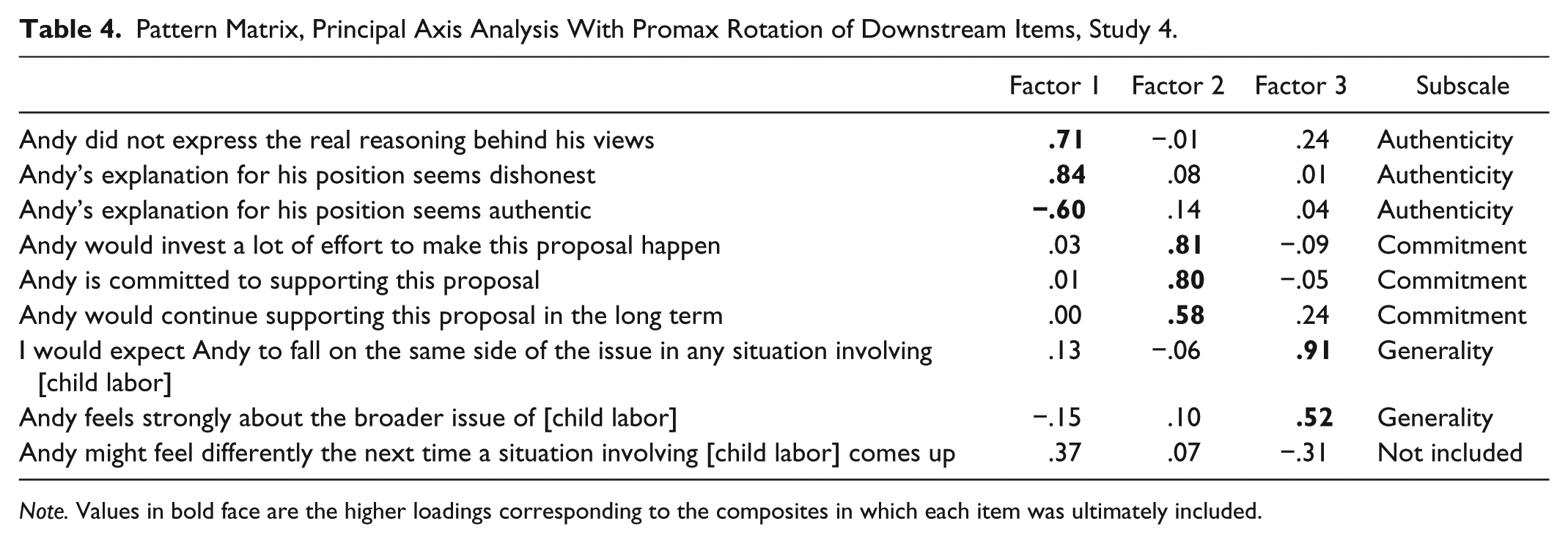
Note. Values in bold face are the higher loadings corresponding to the composites in which each item was ultimately included.
Pearson Correlations and 95% Confidence Intervals of Downstream Measures, Study 4.
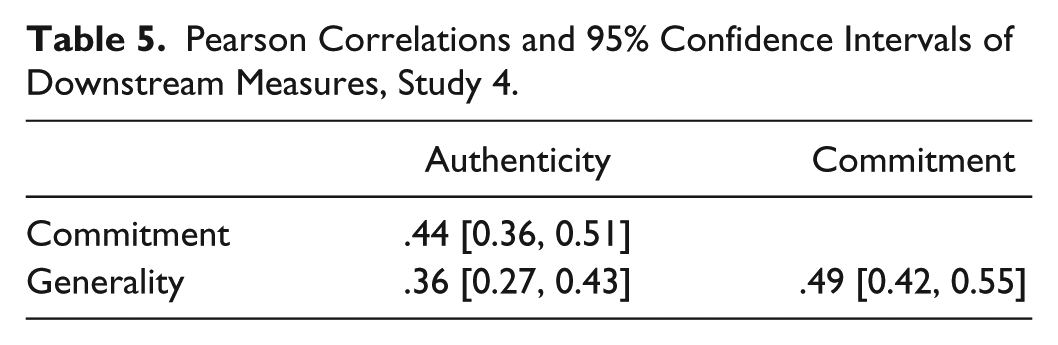
Results
We used mixed models to treat issue (six levels) as a random factor. Models included fixed effects for justification, order, and their interaction (αs), as well as random by-issue intercepts (µ0Issue):
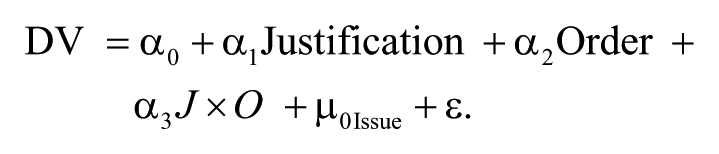
We omitted by-issue slopes because models including these failed to converge. 7
Order and justification did not interact in any of our models. Main effects of order are reported in the supplementary analyses.
Moralization
Supporting our main hypothesis, the principled consequentialist target was still perceived to moralize the issue less than the principled deontological target, b = −.33 [−0.65, −0.004], d = .34. Furthermore, he was seen to moralize more than both the principled prudential target, b = 1.85 [1.52, 2.17], d = 1.31, and the no-justification target, b = .42 [0.09, 0.74], d = .35 (see Table 2).
Perceived justification
Perceived consequentialist justification
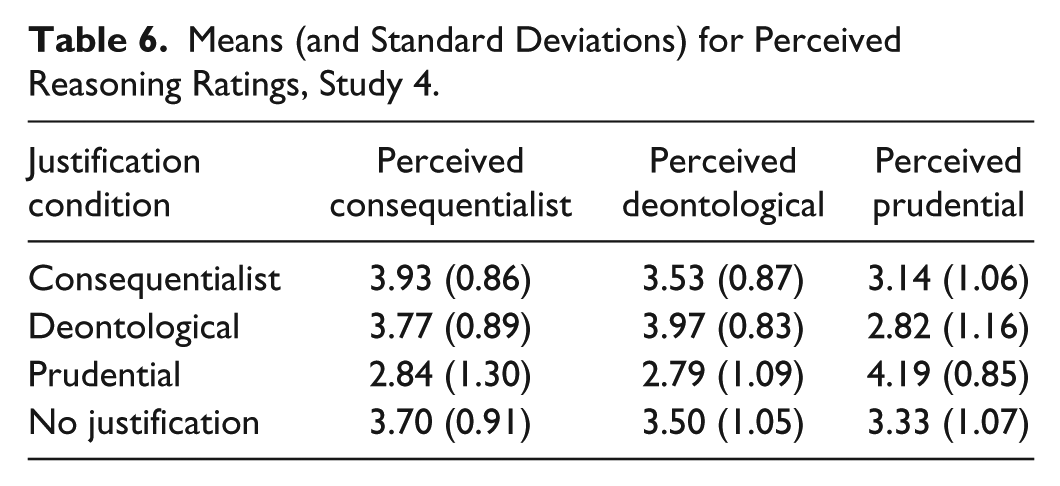
The principled consequentialist target (M = 3.93, SD = 0.86) appeared more consequentialist than the principled prudential target (M = 2.84, SD = 1.30), b = 1.10 [0.86, 1.34], d = .99, and somewhat more so than the no-justification target (M = 3.70, SD = .91), b = .23 [−0.01, 0.47], 90% CI [0.03, 0.43], d = .26. The principled consequentialist and principled deontological targets (M = 3.77, SD = .89) did not differ, b = .17 [−0.07, 0.40], d = .18 (see Table 6).
Means (and Standard Deviations) for Perceived Reasoning Ratings, Study 4.
Perceived deontological justification
The principled consequentialist target (M = 3.53, SD = 0.87) appeared less deontological than the principled deontological target (M = 3.97, SD = 0.83) b = −.43 [−0.66, −0.20], d = −.52, and more so than the principled prudential target (M = 2.79, SD = 1.09), b = .77 [0.54, 1.00], d = .76. The principled consequentialist target did not differ from the no-justification target (M = 3.50, SD = 1.05), b = .03 [−0.20, 0.26], d = .03.
Perceived prudential justification
The principled consequentialist target (M = 3.14, SD = 1.06) appeared more prudential than the principled deontological target (M = 2.82, SD = 1.16), b = .30 [0.03, 0.56], d = .29, and less so than the principled prudential target (M = 4.19, SD = 0.85), b = −1.06 [−1.32, −0.79], d = −1.09, but no different from the no-justification target (M = 3.33, SD = 1.07), b = −.20 [−0.46, 0.07], d = −.18.
Additional tests for mediators of the consequentialist versus deontological comparison
Finally, we wondered whether the effects of consequentialist versus deontological moralization on perceived moralization could be explained by perceived justification. Given that deontological justifications are seen as more moralized than consequentialist ones, is this because deontological targets are assumed to differ in how consequentialist, deontological, or prudential they are?
A potential mediator must be related to the independent variable (Baron & Kenny, 1986). Because consequentialist and deontological targets differed in perceived deontological and prudential reasoning, but not in perceived consequentialism, perceived deontological and prudential reasoning are possible mediators but perceived consequentialism is not. Also consistent with mediation, when either of these measures was added to the basic model predicting moralization, the effect of consequentialist versus deontological justification was reduced (prudential, b = −.23 [−0.55, 0.08]; deontological, b = −.04 [−0.34, 0.25]) whereas each perceived justification measure remained predictive (prudential, b = −.29 [−0.40, −0.19]; deontological, b = .65 [0.55, 0.76]). When both perceived deontological and perceived prudential justification were added to the model, both remained predictive (prudential, b = −.29 [−0.39, −0.20]; deontological, b = .65 [0.55, 0.76]). Thus, confirming our predictions in light of the Study 2 results, it appears that consequentialist statements appeared less moralized than deontological ones because they were judged to reflect a less deontological approach to the issue and/or a more prudential one—but not because they were perceived by lay perceivers as reflecting consequentialism. We return to these findings in the study discussion.
Downstream perceptions
Commitment
As predicted, replicating Study 2, consequentialist targets appeared less committed (M = 5.82, SD = 0.95) than deontological targets (M = 6.13, SD = 0.76), b = −.31 [−0.54, −0.09]. They did not differ from no-justification (M = 5.85, SD = 0.81), b = −.03 [−0.26, 0.19] or prudential targets (M = 5.76, SD = 0.98), b = .06 [−0.16, 0.29]. Perceived moralization, when added to the model, positively predicted perceived commitment, b = .21 [0.15, 0.26]; the consequentialist versus deontological comparison was reduced to b = −.26 [−0.47, −0.04]. In addition, unexpectedly, consequentialist targets at a given level of perceived moralization appeared less committed than no-justification targets at the same level of perceived moralization, b = −.33 [−0.57, −0.09]. Consequentialist targets still did not differ from prudential ones when controlling for moralization, b = −.13 [−0.34, 0.09].
Generality
As predicted, consequentialist targets appeared to have less generalized views (M = 5.57, SD = 1.01) than deontological targets (M = 5.91, SD = 0.91), b = −.34 [−0.64, −0.04], and more generalized views than prudential targets (M = 4.38, SD = 1.70), b = 1.19 [0.89, 1.50]; they did not differ from no-justification targets (M = 5.61, SD = 0.98), b = −.04 [−0.34, 0.27]. Perceived moralization, when added to the model, positively predicted perceived generality, b = .52 [0.45, 0.59], and the consequentialist versus deontological difference (b = −.17 [−0.42, 0.08]) and consequentialist versus prudential difference (b = .25 [−0.03, 0.53]; 90% CI [0.01, 0.48]) were both reduced. Also, consequentialist targets at a given level of moralization appeared to have somewhat less general views than no-justification targets at the same level of perceived moralization, b = −.25 [−0.50, 0.002], 90% CI [−0.46, −0.04]. Thus, as for the commitment measure, consequentialism had a negative direct effect but a positive indirect effect via increased moralization.
Perceived authenticity
As predicted, consequentialist targets appeared less authentic (M = 5.58, SD = 1.21) than deontological targets (M = 5.93, SD = 0.99), b = −.33 [−0.63, −0.04]; more authentic than no-justification targets (M = 4.45, SD = 1.11), b = 1.13 [0.83, 1.43]; and somewhat more authentic than prudential targets (M = 5.30, SD = 1.34), b = .27 [−0.03, 0.57], 90% CI [0.02, 0.52]. Perceived moralization, when added to the model, positively predicted perceived authenticity, b = .27 [0.19, 0.35]. In addition, all of the main effects were reduced, consistent with mediation by moralization: consequentialist versus deontological comparison, b = −.25 [−0.53, 0.03], 90% CI [−0.49, −0.02]; consequentialist versus no-justification comparison, b = 1.00 [0.72, 1.29]; and consequentialist versus prudential comparison, b = −.25 [−0.58, 0.06].
Discussion
In Study 4, despite being reminded of the general underlying principle of consequentialism, participants once again saw consequentialist arguments as expressing less moralization than deontological ones. Also, targets using a prudential and thus transparently non-moral justification appeared to moralize less than consequentialist targets.
To provide a conservative comparison with deontological justifications by equating the obviousness of a broad moral premise, we added a statement of principle to our consequentialist justifications in Study 4. As a result, principled consequentialist justifications appeared more moralized than no justification, whereas the sparser consequentialist arguments used in earlier studies appeared less moralized than no justification. Although this reversal, as well as the smaller difference between deontological and consequentialist statements (d = .34 rather than .68 in Study 2), suggests that differences in generality or abstraction may have partially driven the effects of previous studies, the fact that a difference remains supports our contention that consequentialism per se appears less moralized.
Although our predictions center on the effects of consequentialist arguments, observers clearly go beyond the actual argument presented in their inferences about speakers, and this study’s perceived reasoning results suggest that it is these further inferences that drive the effects of these arguments on moralization. Though our philosopher colleagues confirmed that our principled deontological targets did not express any consequentialist reasoning, participants inferred that these targets privately held consequentialist reasons for their views just as strongly as the consequentialist targets. Yet, the deontological managers still appeared to moralize the issue more. Thus, consequentialist arguments reduce perceived moralization because of what they signal about a speaker’s genuine reasoning about the issue: an absence of deontological, duty-based reasons, or a focus on self-interest, or both.
Finally, as in Study 2, deontological speakers appeared more committed to the issue than consequentialist speakers as a result of their greater perceived moralization. Consequentialist speakers also appeared to hold less generalized attitudes than deontological speakers, and more generalized attitudes than prudential speakers, as a result of differences in perceived moralization. Our predictions for another downstream measure, perceived authenticity, were also confirmed: Consequentialist speakers appeared less authentic than deontological speakers, and more so than prudential ones. Expressing a moralized view may be seen as a revelation of oneself and one’s personal values, particularly in a business context in which such arguments are counternormative (Bird & Waters, 1989; Sonenshein, 2006). Altogether, these findings support the notion that perceptions of moralization have important and multifaceted downstream consequences for interpersonal perception, and suggest that speakers can use an arsenal of utilitarian facts to appear more flexible, but when it comes to communicating conviction, commitment, and authenticity, less is more.
General Discussion
Basing a recommendation on its consequences (a favored style of moral reasoning in Western industrialized cultures: see Haidt, Koller, & Dias, 1993) implies to observers that one is basing it less on moral convictions. Across our studies, consequentialist reasoning, based on aggregate costs and benefits, was consistently associated with lower perceived moralization compared with duty-and rights-based reasoning; the average effect size in our studies that tested this comparison (Studies 2-4) was .41 [0.22, 0.62]. 8 In fact, unless they included an explicit moral principle (Study 4), consequentialist arguments were consistently judged to reflect moralization even less than giving no justification whatsoever (Studies 1a, 1b, and 2). This effect appears to result from judgments that consequentialist statements reveal less appreciation for the sacred, non-commensurable nature of the issue (i.e., less deontological reasoning; see Tanner et al., 2007) or more self-interest (more prudential reasoning).
These findings suggest that people can use consequentialist arguments to manage others’ perceptions of their moralization and these perceptions’ downstream consequences (see Kreps & Monin, 2011). We found that targets perceived to moralize are judged to be more committed to their views and less flexible, a finding that resonates with prior literature on first-person effects of moralization (Skitka et al., 2005). Managers in organizations, who value flexibility, therefore face substantial pressure not to moralize (Bird & Waters, 1989). Prior research also suggests that targets perceived to moralize could also appear to claim moral superiority (Monin, 2007; Sabini & Silver, 1982). Our findings in Study 4 suggest, however, that individuals who use moral arguments—perhaps especially in contexts where doing so is unusual—may appear more authentic (cf. Srivastva, 1989); speakers trying to appear authentic should therefore cite deontological principles, not welfare consequences. Our findings thus have relevance to anyone choosing how to express a strong opinion—especially to leaders who must publicly justify their views.
Issues for Future Research
Consequentialism and First-Person Moral Conviction
These results raise the question of whether people use the presence of consequentialist justification to infer, not only others’ moralization, but also their own: Perhaps, when asked whether they see an issue as moral, people conclude that their views are more based on moral values, the less they can think of consequences. Research focusing on first-person moralization could test this possibility. Self-reported moral conviction produces powerful downstream effects (e.g., Mullen & Skitka, 2006; Skitka et al., 2005); discovering that moral conviction is related to a consequentialist basis would shed light on the psychology behind these self-reports, and could suggest a situational manipulation of moral conviction, creating exciting methodological possibilities for a literature that has often relied on pre-existing differences.
The Pragmatics of Moral Justification
In Study 4, participants went beyond targets’ arguments in judging their privately held reasons, in interesting ways: Though our manipulation was clearly validated by experts, lay participants judged deontological and consequentialist targets as equally consequentialist. These findings suggest that the mechanism driving our effects likely involves perceived private deontological or prudential reasoning, not consequentialism; they also have an intriguing semantic implication: They suggest that deontological reasons may be perceived as semantically stronger than consequentialist ones, such that expressing only deontological reasons is consistent with privately having both types, but expressing only consequentialist reasons is not (e.g., Davis, 2013). Future research should explore this possibility.
The Moderating Effect of Leadership Role
Many of our studies explored perceptions of political or organizational leaders. Leaders are often in a position to publicly justify their views and attempt to persuade followers, but how might audience perceptions differ depending on a target’s role? One consideration relevant to role concerns accountability. Because leaders are often under pressure to be accountable for their statements, deontological justifications may seem especially counternormative because, being less concrete, they provide less accountability; both positive and negative inferences that follow from deontological reasoning may thus be even stronger for speakers who are leaders. In addition, what observers infer about speakers who give no justification may depend especially on role, because giving no justification is so counternormative under high accountability demands—which may partly explain why no justification was perceived as less moralized than consequentialism in Study 4 but more so in other studies. However, we also demonstrated our effect for everyday speakers with no leadership role, comparing consequentialism with both no justification (Study 1b) and deontological justification (Study 3). Furthermore, Study 3 demonstrates that deontological statements including concrete facts can still express moralization, so adding facts to a deontological argument may be one way for a leader to meet accountability demands while also expressing ethical conviction. Future research should explore how speaker role affects audience perceptions of speakers’ justifications.
Conclusion
Despite a tradition of consequentialism in moral philosophy, lay audiences see arguments based on harm and welfare consequences as reflecting less moralization, suggesting a lay perception of the moral domain that diverges from the traditional philosophical definition. On a practical level, these findings suggest that people can manage the degree of moralization they convey by choosing how they explain their views: Even when taking a stand on a contentious political issue, expressing a consequentialist view leads observers to infer less moralization. When you argue that an action is right because everyone benefits from it, it does not sound like ethics; it just sounds like common sense.
Footnotes
Acknowledgements
The authors are grateful to Samuel Asarnow, Mark Budolfson, Luis Cheng-Guajardo, Sara Mrsny, and John Thrasher for their help in validating study materials.
Declaration of Conflicting Interests
The author(s) declared no potential conflicts of interest with respect to the research, authorship, and/or publication of this article.
Funding
The author(s) received no financial support for the research, authorship, and/or publication of this article.

Notes
References
Supplementary Material
Please find the following supplemental material available below.
For Open Access articles published under a Creative Commons License, all supplemental material carries the same license as the article it is associated with.
For non-Open Access articles published, all supplemental material carries a non-exclusive license, and permission requests for re-use of supplemental material or any part of supplemental material shall be sent directly to the copyright owner as specified in the copyright notice associated with the article.
