




Abstract
We investigated U.S. citizens’ politicization (i.e., switching from not self-defining to self-defining as an active political party supporter) during the 2012 U.S. Presidential Elections. We used a novel identity content approach to explore qualitative changes in overlap between personal and politicized identity traits. We collected longitudinal data from a community sample of U.S. citizens (N = 760), tracking whether and how personal and politicized identity content developed: two months before (T1), immediately before (T2), and 2 months after (T3) the election. We explored a subsample of participants who met inclusion criteria (n = 115), comparing 87 participants who did not politicize with 28 participants who self-labeled as unpoliticized at T1, but politicized at T2/T3. Results confirmed hypotheses: Only politicizers showed greater integration between their personal and politicized identity content over time; moreover, identity content was a significant positive predictor of politicization and action engagement. We discuss the value of identity content for politicization research.
Accounts of activism and social change suggest that personal and societal transformation is inherently intertwined (Duncan, 2012). Individuals with a politicized identity (i.e., activists) have typically committed themselves to seeking societal change (Klandermans, 1997; Simon et al., 1998); conversely, individuals’ first involvement in a political project toward social change may lead to changes in their self-image. Such changes can transform a weakly political person into an “activist” (Drury & Reicher, 2005; Livingstone, 2014); in fact, without this personal change, many societal developments (e.g., in human rights or democratic quality) would not be possible. Yet, despite the importance of this intrapersonal change for an analysis of politicization, surprisingly little is known about it empirically. In this article, we suggest that understanding what personal and political identity means (i.e., identity content) is key to understanding how the political can become personal and vice versa. Specifically, we conceptualize politicization as a psychological process in which identity content changes. We thus examine the idea that politicization involves the transformation of personal and political identity content from relatively isolated to more integrated. To test this, we conducted a longitudinal study during the 2012 U.S. Presidential Elections. Such an election period is arguably ideal for studying (intrapersonal) political change, given the psychological and political processes it evokes (e.g., through political campaigns, debates, interpersonal and group discussions; Grant, Mockabee, & Monson, 2010).
This article contributes to the literature in at least three ways. First, we propose a novel identity content approach, which aims to gain a direct insight into qualitative changes in an individual’s self-concept (e.g., Ashmore, Deaux, & McLaughlin-Volpe, 2004), by looking at developments in the meaning of their subjectively internalized politicized and personal identities. Previous work on politicization often focused on differences in strength of identification with political organizations (Klandermans, 2014). Although this is certainly informative at some level (e.g., stronger commitment to activist issues or a social movement), identity content comes closer to what it means to be(come) politicized—which is an important aim of our approach. The second contribution of the article is the introduction of a new identity content measure, which allows the quantification of qualitative changes within the self-concept. The measure taps overlap between personal and politicized identity traits by asking participants to list their personal and politicized identity content (e.g., traits, attributes). Overlap between the two identities can then be modeled as a content-based index of politicization. The third contribution of this article is that we study identity content change longitudinally. This design allows us to account for temporal changes in idiosyncratic perceptions of identities and thus what it means to be politicized. For all these reasons, this research is in a unique position to study the processes of politicization and identity change that were previously proposed (e.g., Stürmer & Simon, 2004a).
Identity Content
Identity content refers to an identity’s meanings (including its characteristics, ideologies, and self-narratives; Ashmore et al., 2004). It assumes a central position in theories of identity (Mead, 1934; Stryker, 1968; Tajfel & Turner, 1979; Turner, 1985): What an identity means to the individual provides him or her with a place in the social world (Simon, Trötschel, & Dähne, 2008) and an understanding of that place in relation to the world. The importance of identity content is arguably most visible in self-categorization theory (Turner, 1985), which proposes that individuals internalize group norms, understandings, and meanings in a social identity. In this way, identity content that is socially shared among members of a social category (e.g., liberal political ideologies) becomes part of the self and influences individual thought, perception and behavior (e.g., broader personal opinions about the environment). For instance, in the U.S. election context, one can self-categorize as a Democrat, but this category contains different political agendas (e.g., liberal, social, left-wing, libertarian). Knowing the extent to which an individual identifies with (i.e., is committed to), the Democrats certainly point to certain content, but this is typically assumed rather than measured. We seek to address this gap by tapping into (subjectively internalized) identity content and meaning directly with a new measure.
This is important because identity content tends to be empirically neglected. Research has widely focused on identity strength, showing that group identification is generally a reliable predictor of group-serving behavior such as collective action (for a meta-analysis, see van Zomeren, Postmes, & Spears, 2008). Accordingly, a lot of attention has been devoted to questions of how to conceptualize and measure identity strength (Ellemers, van Knippenberg, De Vries, & Wilke, 1988; Leach et al., 2008; Luhtanen & Crocker, 1992; Postmes, Haslam, & Jans, 2013). Even though there is broad consensus in the literature that the effects of social identification strength are codetermined by social identity content (e.g., Ellemers, Spears, & Doosje, 1999; Livingstone & Haslam, 2008; Thomas, McGarty, & Mavor, 2009), only few studies have grappled with how this should be operationalized. Laboratory settings (and some observational studies; for example, Iyer, Jetten, Tsivrikos, Postmes, & Haslam, 2009; Livingstone & Haslam, 2008) suggest that if identity strength determines how much group members are influenced, identity content determines in what way they are influenced (e.g., Jetten, Postmes, & McAuliffe, 2002; Postmes, Spears, & Cihangir, 2001; Becker & Wagner, 2009). Accordingly, it would appear to be important not just to operationalize identity strength but also identity content. This is particularly so for processes such as politicization, which conceptually revolve around identity redefinition: The study of identity strength alone seems inadequate without first testing the assumption that politicization implies a certain (change in) content.
Unfortunately, the progress of identity content research has been slowed by the complexity of operationalizing something that is highly idiosyncratic: Different groups have different contents (i.e., externally shared identity content), as do members within these groups (i.e., subjectively internalized identity content). So far, individual studies have operationalized identity content focusing on specific issues or identities (e.g., the consequences of antagonistic identity content for intergroup conflict in Northern Ireland; Livingstone & Haslam, 2008; see also Iyer et al., 2009; Sellers, Smith, Shelton, Rowley, & Chavous, 1998). Thus, research has typically measured predefined content that the researcher preselects as relevant. This means that for every individual topic or group, a validated measure of identity content needs to be developed, while more subtle variations in identity content (e.g., between different members of one group) may be lost. Furthermore, as identity content may change over time, those instruments would need continual updating. To overcome these obstacles, in the present research, we develop a measure of social identity content that applies to the social identity content of any group in any context. Such an instrument is particularly suited to studying politicization in the U.S. elections, because theory suggests that the development of (politicized) identity content is central to the process of politicization (e.g., Simon & Klandermans, 2001).
Politicization as Change in Identity Content
Politicization has been conceptualized as an individual’s intentional involvement in a power struggle against another group, while being aware that this conflict is nested in a wider societal context (Simon & Klandermans, 2001). As such, politicized individuals are likely to be active in political struggles (e.g., activists, feminists, member of social movements, etc.). Also, because they are acting for their group, they are likely to have internalized group norms, understandings, and meanings in their identity (i.e., identity content). Nevertheless, politicization is typically operationalized as strength of identification with a social movement organization or activist group (e.g., Simon et al., 2008; Stürmer & Simon, 2004b; for a review, see; Klandermans, 2014; Stürmer & Simon, 2004a) which generally assumes but does not assess identity content. This means that research often explores samples of already politicized activist group members (Blackwood & Louis, 2012) or differences between members and nonmembers (Hornsey et al., 2006) or different activist categories (Brunsting & Postmes, 2002). Yet, the factors that promote politicization—especially those involved in the discontinuous transition from nonengagement to engagement—have not been studied (Livingstone, 2014). Furthermore, recent attempts to measure politicization operationalized it as a mixture of individuals’ attitudes, ideological stances, intentions, and behaviors, and treated it as an outcome rather than as a process variable (e.g., Simon & Grabow, 2010). As such, it remains unclear in this research what politicization is (i.e., a process or an outcome variable) and how it should be measured (via identity strength or a broad mixture of psychological measures).
We conceptualize politicization as a psychological process in which identity content changes, such that the political becomes personal or vice versa. In this process, political goals and ideologies which may have been separate from the self, are internalized as the individual takes on the personalized goal of achieving social change. Thus, “what it means to be me” becomes more similar to “what it means to be a political activist.” The outcome of this process can be an alignment of personal and politicized identity, as described in other research showing that social identities can become positively related to (and strengthen) personal identity (Baray, Postmes, & Jetten, 2009; Postmes, Baray, Haslam, Morton, & Swaab, 2006). However, the present research extends this work by focusing on the process by which the contents of personal and social identities are aligned in relation to one another. In this way, it also extends research by Thomas et al. (2009) who proposed that content needs to be aligned within political identities to create sustainable action identities. Moreover, given that this research tends to focus on the consequences of strong social identifications (e.g., for personal identity strength, distinctiveness, and dependence; Baray et al., 2009) or normative alignment (e.g., for sustainable action identities; Thomas et al., 2009), we add a new layer of analysis by focusing on the content-level process by with these identities became integrated (see Turner-Zwinkels, Postmes, & van Zomeren, 2015, for a detailed discussion of the role of identity content in self-defining groups). By exploring changes in identity content, we hope to get closer to phenomena implicated in the overlooked “transformation of form” involved in the emergence of action (Livingstone, 2014, p. 121).
Our conceptualization of politicization as a process of change in identity content fits with the idea that becoming politicized generally involves substantial transformation of the self-concept, which may also include increased identity strength (Duncan, 2012; Livingstone, 2014). For example, stage models of identity transformation (Cross, 1971; Downing & Roush, 1985) highlight the importance of the individual’s progression through phases of recognition of injustice in their social environment (Deutsch & Steil, 1988; Jost & Banaji, 1994; Sidanius & Pratto, 2001), but also in the norms and ideologies internalized within their identities (e.g., in the form of traditional gender roles; Gurin, Miller, & Gurin, 1980), and the ability to resolve inconsistencies between old and new (politicized) identities. This suggests that the process of politicization should be studied through identity content, and over time: The content of various aspects of identity (personal, social) should be measured, and changes in relations among identity aspects should be modeled. We therefore developed a new measure and opted for a longitudinal design in the current study of politicization in the context of the U.S. 2012 elections.
Measuring Identity Content
Our identity content measure taps intrapersonal changes by allowing individuals to freely list the content (i.e., characteristics, activities, ideologies, etc.) that they associate with their personal identity (i.e., their unique self, distinct from other individuals) and with the (contextually relevant, subjectively internalized) politicized identity. We can then quantify the (longitudinal change in) relation between the two, using an individual-level analysis to track personal development in how an individual conceives of these identities and their relation. Although this method may tap aspects of group identification (i.e., higher overlap between personal and social identity is likely to occur with greater identity strength; McConnell, 2010), it also uniquely taps qualitative changes in the specific meaning and prominence of politicized identity content within the self-concept. We therefore expect identity content to predict politicization over time, and outcomes of involvement in political action. Thus, our aim in conducting these analyses is to promote a new and more specific understanding of how politicization can be construed. Importantly, politicization is operationalized as a self-labeled shift from seeing the self as unpoliticized to politicized: This reflects the notion that politicization may involve a qualitative or discontinuous shift in the moment that one sees the self as being politically active (for a discussion of this topic, see Livingstone, 2014), and that theoretically important differences in the identities, ideologies and behaviors exist between individuals who do (not) self-label as politicized (Bay-Cheng & Zucker, 2007; Duncan, 2010).
More concretely, our line of thought is summarized in two hypotheses. The first hypothesis is the integration hypothesis, which states that individuals who change their self-definition from nonpoliticized to politicized during the election period would show greater integration between their personal and politicized identity content over time. By contrast, we expected no substantive change in these relations for nonpoliticizing individuals. The second hypothesis is the content-action hypothesis, which states that identity content overlap will positively predict politicization and political action.
Study Outline
We investigate the process of identity politicization by exploring the coevolution of personal and politicized identity content over a period of 4 months during the U.S. 2012 Presidential Elections. An election period is an ideal context in which to probe potential identity change, because citizens are actively encouraged to support and promote their preferred political party. This situation of increasing political salience provides a context for wider intrapersonal change within members of the population. Longitudinal data from a community sample were gathered at three time-points: Approximately (a) 2 months before, (b) 2 weeks before, and (c) 2 months after the elections. We compared self-labeled politicizers (i.e., individuals who self-labeled as nonpoliticized at the first time-point, but politicized at later time-points, and also voted) and nonpoliticizers (i.e., individuals who self-labeled as nonpoliticized throughout the elections but did vote): Thus, from a group of individuals who were all political in some way, we sought to investigate the identity processes which predict politicization and therein develop our understanding of the way that politicization is construed.
Method
Sample
Approximately 2 months before the 2012 U.S. Presidential Elections, 760 U.S. participants were recruited via Amazon’s crowd sourcing website Mechanical Turk to participate in a three-wave longitudinal survey “about you, the U.S. and the presidential elections.” Participants were paid U.S. dollars in exchange for their participation: 50¢ at T1, $1 at T2 (approximately 2 weeks before the elections), and $1.50 at T3 (approximately 2 months after the elections). Attrition rates were reasonable, with 59.34% of participants returning for T2 and/or T3: 309 participants participated in T1 only (40.66%), 280 participated in all waves (36.84%), 105 were present in T1 and T2 (12.82%), and 66 participated in T1 and T3 (8.68%).
We selected participants for inclusion based on their response pattern of self-labeling as an active party supporter (yes vs. no vs. unsure vs. no response) across multiple waves. Our subsample included 115 participants who self-labeled as not politically active at the first measurement point (approximately 2 months before the U.S. Presidential Elections on November 6, 2012), but all held some preference for a political party and ultimately voted in the elections. 1 Of this, 28 participants became more politically active during the course of the elections: At T1, they did not self-label as an “active party supporter” (answering “no” or “maybe”), but they did at T2 or T3 (by answering “yes”). A preliminary analysis suggested that comparable processes were present in individuals who were both no’s or maybe’s, and who politicized at T2 and T3. 2 To increase statistical power, participants were pooled into one group of politicizing self-labelers. 3 The remaining 87 participants self-labeled as not politically active throughout the survey and therefore constitute the group of unpoliticized self-labelers.
The final sample consisted of 36 males, 79 females (58 religious, 50 nonreligious, 7 unsure), aged between 18 and 83 (M = 36.29, SD = 14.29). Both the average household income (Mode = between $40,000 and $49,999) and the level of education (Mode = bachelor’s degree) were relatively high. At T1, 60% had a Democratic Party preference, 22.60% Republican, 8.7% Libertarian, 7% Green, and 1.7% had another preference (one was Independent and the other did not specify).
Procedure
In the first section of the questionnaire, participants completed the identity content task for their personal identity. In the second, politically oriented section participants reported their party preference (in T1 and T2, and party voted for in T3) before completing the identity content task for politicized identity and a questionnaire about politicized identity and action engaged in. All questions about politicized identity were about “active party supporters” who supported the participant’s party preference. Active party supporters were defined as the
group of people who aim to promote [party preference] . . . seek to influence the decisions of others and persuade them to vote for [this party]. The ultimate purpose of this is to benefit [this party] in the elections (i.e., to win votes for this party).
Finally, participants reported their demographics. At the end of the questionnaire, participants were thanked and paid.
Measures
In line with integrative models of collective action (e.g., Stürmer & Simon, 2004a; van Zomeren et al., 2008; van Zomeren, Postmes, & Spears, 2012), theoretically relevant items pertaining to identity and action were measured. All items were measured on a 7-point Likert-type scale (1 = strongly disagree, 7 = strongly agree); however, for the causal analyses applied in this article, only T1 and T2 alphas are reported.
Identity
Participants reported personal identity content and politicized identity content. They listed the “traits, values, principles, attributes, roles, personal goals, activities, lifestyle characteristics, and qualities that you consider to define [yourself/an active party supporter for the (political preference) party], or that distinguishes [you/them] from others.” This ensured that an encapsulating sense of identity was captured rather than only traits. Participants were presented with 20 blank spaces in which to write their answers.
From this raw identity content data, 4 we constructed our key quantitative measure of qualitative personal and politicized identity content: Overlap measured the integration between personal and politicized identities by counting the number of words repeated across the personal and politicized lists at each time-point (e.g., how many identity concepts listed for personal identity at T1 were also listed for politicized identity at T1). Content data were cleaned to facilitate accurate counts of personal/politicized content overlap. Thus, spelling was checked and corrected, and semantically identical concepts were merged (e.g., “nature lover” and “lover of nature”), blind to politicization group. This was a relatively minimal process that reduced the 2,757 unique concepts down to 2,092.
Politicization was measured via the question: “I consider myself to be an ‘active party supporter’” (yes, no, unsure). Politicized identification or identity strength was measured with four items adapted from Doosje, Ellemers, and Spears (1995; for example, “I see myself as an active party supporter”; αT1 = .89, αT2 =.90, rT1,T2 = .56).
Engagement in actions
Two items measured individuals’ engagement in party action which supported and promoted their party preference (e.g., Since the beginning of the election campaign, on average, how frequently have you actively promoted the party that you support, for example, by campaigning for them or convincing others? 1 = less than once per month, 7 = multiple times per day; rT1 = .19, rT2 =.52, rT1,T2 = .35).
Demographics
Politically influential demographics of age, gender, education, income and strength of faith were measured to use as controls. Education was measured using a 7-point scale (1 = less than high school, 7 = doctorate degree). Income was measured using a 12-item scale (1 = less than $10,000, 2 = $10,000-$19,999, . . ., 10 = $90,000-$99,999, 11 = $100,000-$149,999, 12 = above $150,000). Faith was measured with 1 item (How strong would you describe your faith? 1 = very weak, 7 = very strong).
Results
Identity Content Over Time
According to our integration hypothesis, personal and politicized identities should become more integrated (i.e., have more overlapping content) over time among politicizing individuals, especially at T2 and T3. We thus conducted a repeated-measures ANOVA with one within-subjects factor (Time: T1 vs. T2 vs. T3) and one between-subjects factor (Politicization: politicizing labelers vs. unpoliticized labelers). In addition to the key identity content overlap data, we analyzed two other content-based measures: Total recall summed the number of personal and politicized identity concepts listed (range = 1-20). Consistency measured the number of words repeated within identity lists, across waves (e.g., counting the personal identity concepts listed at T1 which were also listed at T2). Results, including means, standard deviations, and omnibus F values, are presented in Table 1. 5 Analyses focus on overall counts, but normalized proportion data (calculated by dividing total repetition by total number of words written on both lists) are also reported for reference. First, in a preliminary analysis, we explore patterns of change in personal and politicized identity over time; second, we directly test the integration hypothesis by analyzing the overlap of personal and politicized identity content for politicizing versus unpoliticized labelers across the three time-points.
Repeated-Measures ANOVA With One Within Factor (Time: 1 vs. 2 vs. 3) and One Between Factor (Politicization: Politicizing vs. Unpoliticized labelers), Exploring Personal and Politicized Identity Content, Including Means (Standard Deviations) and Omnibus F Values (Partial Eta Squared).

p ≤ .08. *p < .05. **p < .01. ***p < .001.
Preliminary analysis
We analyzed identity content to establish whether personal and politicized identity content developed differently in politicized and unpoliticized individuals during the course of the elections. This analysis aims to offer a preliminary indication of what changes in identity content occur during politicization, and where such change occurs, before focusing on the overlap variable in our main analyses. Looking first at personal identity content, our analyses showed that politicizing individuals undergo substantial change in comparison with nonpoliticizing individuals. Repeated-measures ANOVAs show a significant interaction between time and politicization for both the total recall and consistency of personal identity measures: Politicizing participants showed (a) an expansion of the self just before the election, evidenced in more lengthy listing in their total recall of personal identity content (T2); and (b) change in personal identity content consistency at T2 which was maintained at T3 (i.e., consistency drops between T1 and T3 and increases between T2 and T3). By contrast, unpoliticized participants (a) reported lower total recall over time, and (b) although they showed some change in content consistency at T2, they evinced greater long-term consistency, with T1 and T3 personal identity content being most similar. For politicized identity content, we observed only main effects of politicization, whereby politicizing individuals recalled more politicized identity content, which was more consistent across time than unpoliticized participants.
Main analysis
To directly test our integration hypothesis, we focused on the identity content overlap variable to test whether personal and politicized identities become more integrated in politicizing (vs. unpoliticized) participants. In line with our hypothesis, the overlap of personal and politicized identity developed in different ways for politicizing versus nonpoliticizing participants (see Figure 1). Significant main effects of time and politicization were qualified by the predicted significant interaction effect (see Table 1). In line with expectations, there was a steady increase in identity content overlap among politicizing individuals. In contrast, there was no discernible development in the overlap between the politicized- and personal-identity in unpoliticized individuals. More detailed planned contrasts of the differences in means between the politicization groups at each time-point confirmed this pattern; t tests were conducted with a Bonferroni correction (p < .02) and with equal variances assumed at T1 (p < .24) but not assumed at T2 or T3 (ps < .002; according to Levene’s test). Results indicated that identity content overlap in politicizing participants was significantly higher than unpoliticized participants 2 months after the election—T3; t(24.21) = 3.17, p < .005, d = .86, 95% confidence interval (CI) = [0.59, 2.81]—and 2 months before the election—T1; t(111) = 2.41, p < .02, d = .53, 95% CI = [0.12, 1.24]. The difference between these groups was however more marginal immediately before the election—T2; t(26.03) = 2.26, p < .04, d = .61, 95% CI = [0.12, 2.53]. Thus, while unpoliticized individuals showed substantially segregated politicized and personal identities and no substantial change in overlap, politicizing individuals evidenced substantive changes in the overlap between their personal and politicized identity, which also became more integrated as time progressed. This supports the conceptualization of politicization as a psychological process of change in identity content, in which an individual experiences qualitative change in how they see themselves, so that “what it means to be me” becomes more similar to “what it means to be a political activist.”

Total personal and politicized identity content overlap for politicizing and unpoliticized participants, over time. Standard errors are represented in the figure by the 95% confidence interval around the estimate.
Predicting Politicization From Identity Content Overlap
Next, we tested our content-action hypothesis, which stated that identity content overlap is a positive predictor of politicization and political action. We did so by using identity content overlap in a logistic regression to predict self-labeled politicization. To make a more thorough assessment of these constructs, we then tested the predictive and construct validity of identity content overlap by using it to predict engagement in political action.
The role of identity content overlap in predicting politicization was tested using a logistic regression to predict self-labeled categorization as an active party supporter (at T2 or T3); thus, politicizing labelers = 1 and unpoliticized labelers = 0. Control variables of age, gender (male = 0, female = 1), educational level, income level, and faith were entered at Step 1. Steps 2 and 3 entered T1 and T2 identity content overlap, respectively (see Table 2). In line with expectations, both T1 and T2 identity content overlap enter the model as significant positive predictors of politicization (although T1 effects were rendered nonsignificant by the addition of T2). The addition of each variable results in a significant increase in model fit (as indicated by chi-square difference test) and the final model presents a good fit to data. Every single item of overlapping content at T2 increases the likelihood of politicizing by 1.40 times (95% CIT2 = [1.08, 1.84], 95% CIT1 = [0.92, 1.93]). Thus, in line with our hypothesis, this model emphasizes the strong relation between identity content overlap and politicization. 6
Logistic Regression Model Predicting Shift in Self-Labeled Politicization From Identity Content Overlap at T1 and T2.
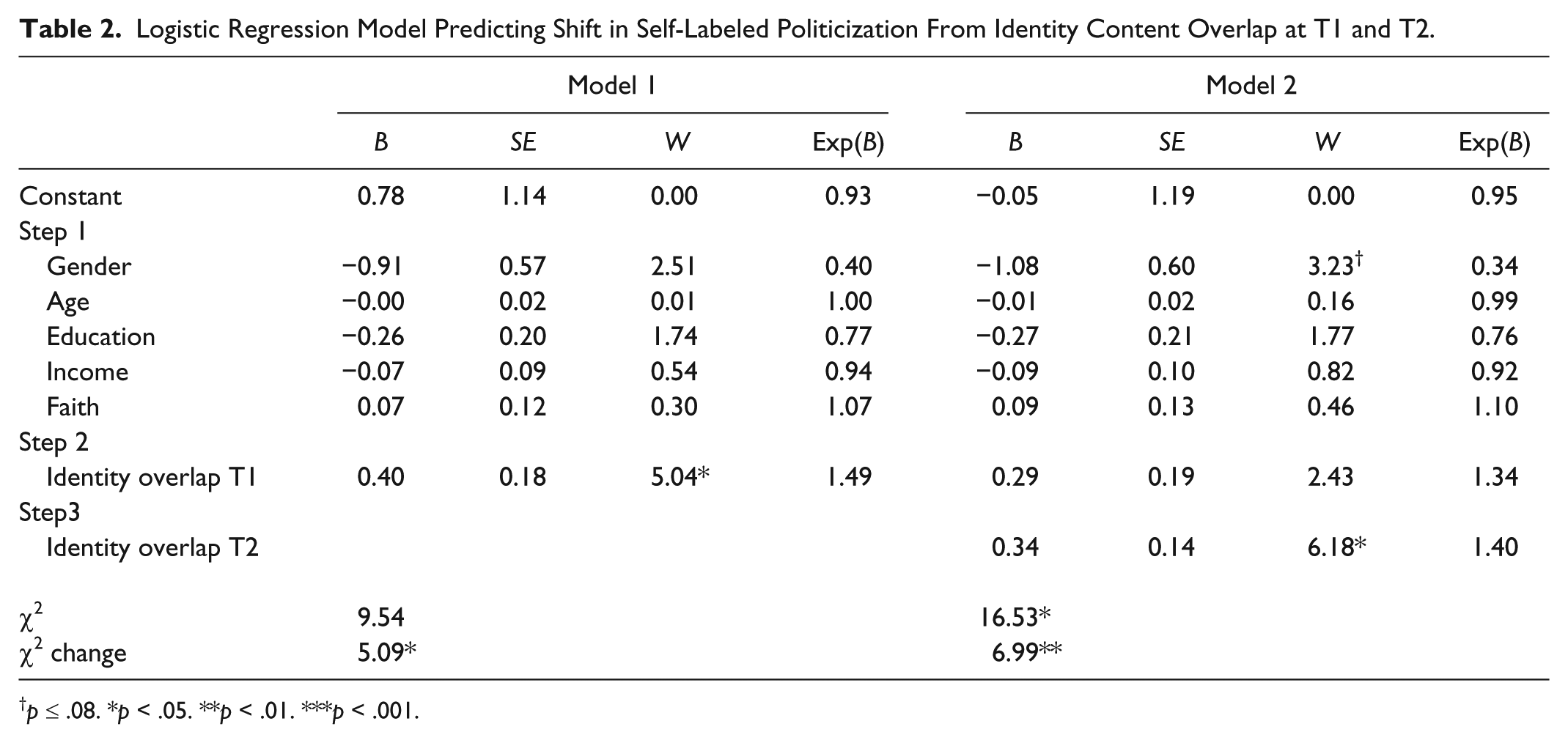
p ≤ .08. *p < .05. **p < .01. ***p < .001.
We subsequently tested the same model as above, now predicting party action at T2 (controlling for T1) to test the predictive and construct validity of identity content overlap. The model, shown in Table 3, largely replicated the effects displayed in Table 2. Identity content overlap enters significantly at T2 (although not at T1) and positively predicts party action (in terms of actively supporting and promoting one’s party) before the elections at T2. Thus, our findings suggest that identity content predicts politicization and party action. 7
Multiple Regression Model Predicting Engagement in Party Action From Identity Content Overlap at T1 and T2.
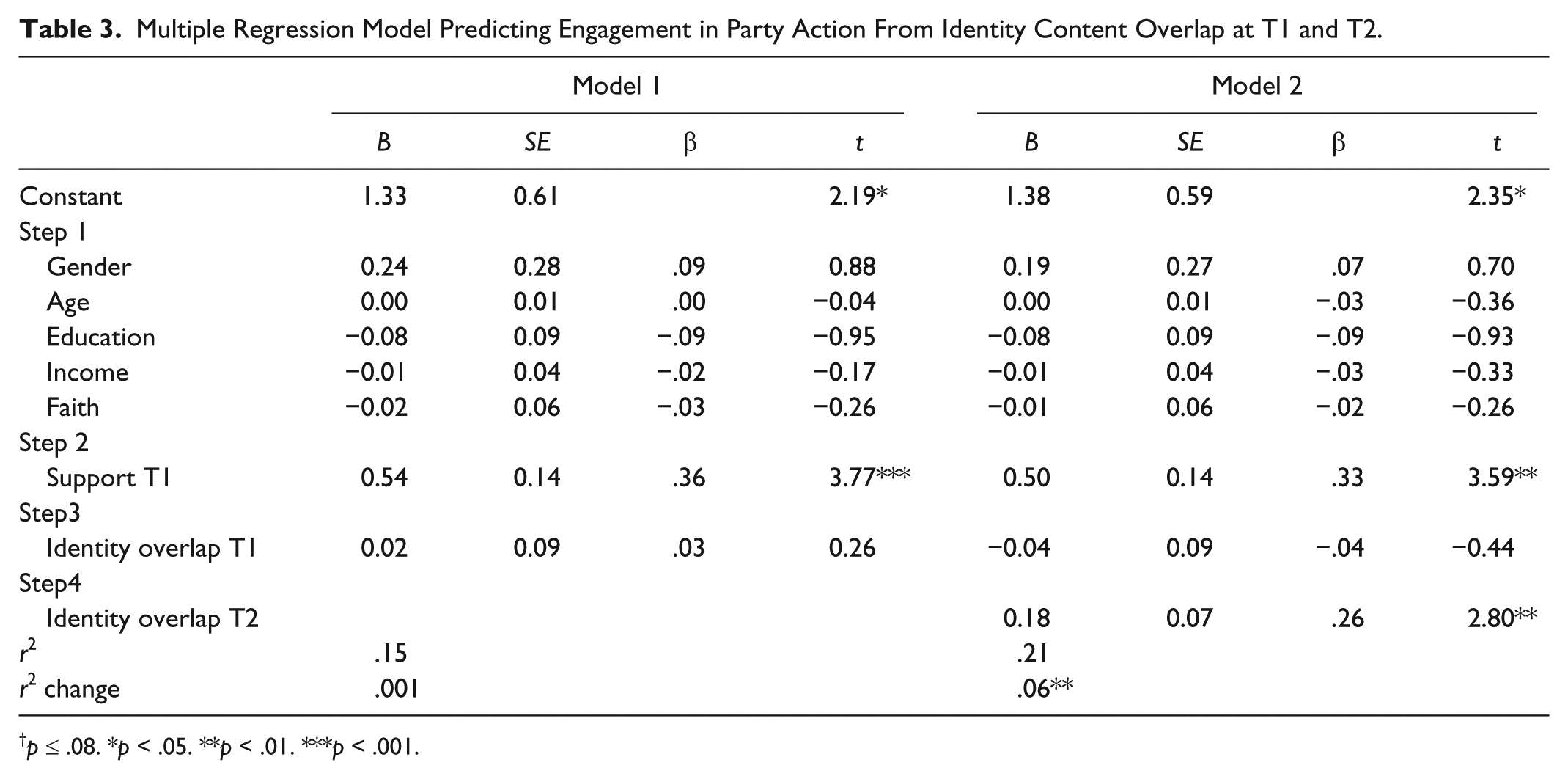
p ≤ .08. *p < .05. **p < .01. ***p < .001.
Discussion
Results supported both hypotheses. In line with the integration hypothesis, development of identity content overlap over time differed in systematic ways between politicizing and unpoliticized individuals: Identity content overlap between personal and politicized identities increased substantially in politicizing individuals both at the time of the elections and 2 months later, while unpoliticized individuals showed no substantive changes. Consistent with our content-action hypothesis, identity content overlap both preceded and causally predicted self-labeled politicization (shifting from nonpolitically active to politically active) and increases in political action. Thus, identity content overlap between personal- and politicized-self explained not only how people saw themselves in the current context but also whether they engaged in political action.
Implications of an Identity Content Approach
Theoretically, the present research adds to existing literature by specifying what politicization involves. That is, our findings demonstrate that politicization concerns a long-term process of qualitative change in the self-concept. More specifically, and consistent with our integration hypothesis, results show that the shift in self-categorization from unpoliticized to politicized was accompanied by qualitative changes in the meaning of politicized and personal identities, and the relation between the two. Indeed, there was triadic change of (a) internalization of a “new” action-focused politicized identity into the self (cf. Cross, 1971) and subsequent transformation of (b) (intrapersonal) interidentity relations and (c) associated identity contents. These three changes show that politicization is not simply a matter of increasing ones allegiance to a political agenda. We view politicization as a psychological process in which associative webs of knowledge about what it means to be politicized and what the self means become more closely integrated. We believe this points to a process in which both identities are gradually adjusted and tessellated together to make a coherent whole. Moreover, these observations were uncovered in a sample in which the self-categorization shift to seeing the self as politicized was actually observed—something which has rarely been captured in political and psychological research, and potentially captures the “tipping point” in the emergence of action identities (Livingstone, 2014). Importantly, this implies that the politicization process can best be studied over time, for instance, through a longitudinal design such as in the current study.
An important focus of this qualitative change in the self-concept captured by the identity content measure concerns the relation between the personal and politicized. Although there were some hints in the data that personal identity underwent more substantial changes than politicized identities, it remains unclear whether changes in identity can be attributed to internalization of social identity content (Turner, 1985) or self-projection onto the group (Cadinu & Rothbart, 1996; van Veelen, Otten, & Hansen, 2011). What is more clear, however, is that overlap between politicized and personal identities may be achieved through their mutual coevolution—whereby both identities develop in relation to each other to express one’s (lack of) connection with the group. In this way, results demonstrate that politicization is a psychological process through which the political becomes personal: What it means to be “me” and to be “politicized” becomes closely aligned, so political goals can be taken on as personally meaningful and agentically pursued.
This observation is consistent with a number of recent developments in the literature. For instance, some have suggested that personal and social identities are not antithetical (Postmes & Jetten, 2006) but can mutually enforce each other (Baray et al., 2009). Our findings concur with this suggestion and add some nuance to suggestions that collective action requires a shift from individualistic motives (e.g., egoistic deprivation) to collective ones (e.g., fraternal deprivation; Runciman, 1966; Smith, Pettigrew, Pippin, & Bialosiewicz, 2012). In fact, this shift from personal to collective may only be necessary for relatively low identifiers, because relatively high identifiers may not shift from personal to political, but integrate political into the personal. This means that personal aims become synonymous with political aims (i.e., an individual fully shares—and in a way personally owns—party ideologies and interests so that an election win would not only feel like a collective victory but also a personal victory).
The current findings also fit with suggestions that a politicized identity is a form of dual identity (cf. (Simon & Grabow, 2010; Simon & Ruhs, 2008), although not in the sense that it is a nested or cross-cutting identity, but rather in the sense that it is dualistic in terms of the integration between the personal and the political. Nevertheless, these processes of personal and political identity integration should not be confused with the notion of identity fusion (Swann et al., 2014; Swann, Jetten, Gómez, Whitehouse, & Bastian, 2012). Fusion research focuses on the (extreme) outcome of personal and social identity relations: Fusion occurs when personal and social identities are no longer differentiated, resulting in relational ties between group members, thereby explaining extreme personal sacrifices for one’s group (Swann et al., 2014; Swann, Gómez, Seyle, Morales, & Huici, 2009; Swann et al., 2012). In contrast, personal/politicized identity overlap described here reflects a long-term, self-definitional process through which the meanings of identities become shared to promote normative group commitment and action.
Methodologically, we offered a new way of measuring politicization as a psychological process of qualitative change, which is, coupled with a longitudinal research design, an important and novel addition to researchers’ toolkit. Indeed, it is noteworthy that although higher identity content overlap at Time 1 was causally predictive of politicization, the strongest predictor of politicization was change in these variables from Time 1 to Time 2. This suggests that politicization is a process of personal change that may be strongly self-referential (i.e., individuals feel they are politicizing if they feel that they have increased their action on behalf of their group relative to an earlier personal baseline) and may consequently be best assessed longitudinally.
Furthermore, with regard to measurement of politicization, these findings imply that tracking qualitative change in identity content may be important for a holistic politicization analysis. We believe that our identity content measure offers an important window into the intrapersonal changes experienced during politicization. The simple, nondirective nature of this measure is immensely valuable in measuring identity content across the whole spectrum of possible social groups and categories. The resulting data can be analyzed at different levels—the individual level (presented in the current article) and group level (see Turner-Zwinkels, Postmes, & van Zomeren, 2015, Study 3)—or easily adapted and extended in future research (e.g., assessing variable consequences of trait importance). This methodology is less vulnerable to selective inclusion or exclusion of core identity aspects, demand characteristics, and shared method variance with other questionnaire items.
Importantly, this lack of shared method variance gives our identity content measure important advantages over measures of politicized identification. Indeed, the common practice of predicting collective action from measures of identification with a politicized group can be criticized for being circular and almost descriptive: It is small wonder that items such as “I see myself as an activist” and “I am willing to take action” are highly correlated. Identity content overlap does not suffer from this disadvantage, but nevertheless predicted politicization and party action (thus evincing the validity of our content measure). Indeed, we believe that our identity content measure gets to the core of what a politicized identity means. In this sense, the identity content measure harnesses some of the strengths of qualitative methodology while retaining the benefits of quantification. In this way, our identity content measure offers a valuable and unique insight into the self-concept which complements and builds on previous research.
Limitations and Future Research
One limitation of our study is that it focused on a single context, namely, the 2012 U.S. Presidential Elections. It is unclear whether our findings generalize to other elections or political contexts (e.g., social protest contexts). Nevertheless, the current context is certainly one in which individuals can become involved in a power struggle, against an opposition, and seek to involve wider society (Simon & Klandermans, 2001). Although the aspect of shared grievance may be somewhat less prominent in election contexts than in social protest contexts, there is reason to believe that the two types of contexts are more alike than they are different when it comes to predicting whether individuals act (van Zomeren, Saguy, Mazzoni, & Cicognani, 2015). Thus, theoretically we may expect that changes in identity content, as demonstrated in the current study, would replicate in other political contexts, including social protest contexts (Klandermans, 2002, 2014; Klandermans, Sabucedo, Rodriguez, & De Weerd, 2002; Stürmer & Simon, 2004a, 2004b). This is one interesting avenue for future research.
A second limitation of the current study concerned the seemingly small sample of 28 politicizing individuals. Although the size of this sample unfortunately made it unviable to conduct more sophisticated analyses such as latent growth curve modeling, we do not believe this sample is too small or underpowered for the current analyses. Furthermore, we believe that although politicization may be a relatively modest phenomenon when conceptualized in terms of numbers of people, even these small numbers can have a big influence on politics and social change. An arguably more serious implication of the study’s sample size is that it required us to pool politicizing individuals from different political parties. Although we do not think that this poses a problem from a theoretical point of view—we expect similar identity-related politicization processes to be operating within the supporters of different parties—it did unfortunately mean that it was not possible to take a more detailed, descriptive look into the concepts which define the identities of politicizing individuals. However, in follow-up research, we are currently investigating the descriptive content that distinguishes politicized from unpoliticized identities using the identity content measure (e.g., Turner-Zwinkels, van Zomeren, & Postmes, 2015).
Conclusion
The present research confirms the central role that identity content plays linking personal and politicized identities, and motivating identity enactment (in this case, political actions on behalf of one’s party). This study is the first to statistically show that individuals undergo qualitative change in identity content through the psychological process of politicization. Moreover, exploring this change holds important additional information about the processes involved in politicization: Identity content is a precursor to, and expression of, one’s changing relation to this political group. It therefore presents a promising avenue for future research which both supports and extends prior politicization research, with the potential to reveal more about what a politicized identity actually is and how it positions itself in the wider self-concept. In this sense, we believe that an understanding of election politics and political participation would benefit from a better understanding of intrapersonal identity politics, where individuals negotiate the meaning and position of politicized identities within the self-concept.
Footnotes
Declaration of Conflicting Interests
The author(s) declared no potential conflicts of interest with respect to the research, authorship, and/or publication of this article.
Funding
The author(s) disclosed receipt of the following financial support for the research, authorship, and/or publication of this article: This work was supported by the Nederlandse Organisatie voor Wetenschappelijk Onderzoek (Grant 404-10-018).

Notes
References
Supplementary Material
Please find the following supplemental material available below.
For Open Access articles published under a Creative Commons License, all supplemental material carries the same license as the article it is associated with.
For non-Open Access articles published, all supplemental material carries a non-exclusive license, and permission requests for re-use of supplemental material or any part of supplemental material shall be sent directly to the copyright owner as specified in the copyright notice associated with the article.
