




Abstract
In a three-wave, year-long, large-sample dataset (N = 755), 10 candidate “personality strengths” (Grit, Gratitude, Curiosity, Savoring, Control Beliefs, Meaning in Life–Presence, Strengths Use, and Engagement, Pleasure, and Meaning-Based Orientations Toward Happiness) were compared as predictors of 6-month increases in goal attainment, and as moderators of goal attainment effects upon boosted subjective well-being (SWB). Seeking internal replication, we tested our models twice, both during T1-T2 and during T2-T3. We also examined whether any Personality × Attainment moderator effects upon change in SWB at T2 still persisted at T3. Grit was the only candidate strength that predicted increased goal attainment from T1 to T2 and from T2 to T3, and Curiosity was the only candidate strength that moderated attainment effects on well-being from T1 to T2 and from T2 to T3. T2 Goal attainment effects on SWB were best sustained at T3 when Meaning Orientation increased from T1 to T2. Implications for identifying keystone constructs in personality (and positive) psychology are discussed.
Several prominent models of human behavior emphasize the importance of goal attainment and the attendant processes that support the likelihood of goal attainment and its consequent positive outcomes (Bandura, 1977; Carver & Scheier, 1998; Deci & Ryan, 2000). According to Sheldon and colleagues (Sheldon, 2014); Sheldon & Elliot, 1999; Sheldon & Kasser, 1995, 1998), “self-concordant” individuals are those who have managed to select personal goals that are congruent with their implicit personalities and growth potentials. Unfortunately, people do not always have the insight or wherewithal to identify and pursue self-concordant goals. Non-concordant goal pursuit tends to lead to two pernicious effects. First, non-concordant individuals typically do not do as well in attaining their goals. Because their goals are not funded by stable sources of energy within the psychic economy, the level of effort of non-concordant strivers often drops off over time, reducing later attainment (Sheldon & Elliot, 1999). Second, even when non-concordant strivers do manage to attain their self-stated goals, they may not benefit as much. Although achieving personal goals typically elevates people’s well-being, these increases are smaller or may not occur at all if the goals were not self-concordant ones (Sheldon & Elliot, 1999; Sheldon & Kasser, 1998). Stated in the positive direction, self-concordant strivers reap two important benefits: They try harder and longer and thus do better, and they also obtain greater increases in well-being when they attain their goals.
In the current research we hoped to show that these two benefits of self-concordant goal-striving can also result from other “personality strengths,” conceptualized and measured in a variety of ways. In other words, there may be other adaptive personality characteristics besides goal self-concordance that can help people to better attain their goals in life, and derive more satisfaction and happiness as a result of the process (Sheldon, 2004
What are “personality strengths?” King and Trent (2013) considered this question in depth, defining strengths as personality characteristics that serve as assets promoting adjustment and adaptation. King and Trent discussed a wide variety of potential characteristics under this general rubric, including big five traits, narrower personality traits, self-regulatory capacities, capacities for resilience in the face of trauma and adversity, and various goal system characteristics. Although King and Trent considered more complex issues as well (such as whether the effect of strengths varies in different contexts, whether people have to be aware that they have strengths to use them, and whether strengths can be strengthened, like a muscle), key for our purposes is their proposal of an overarching category of personality strengths, which can be populated by examining and comparing the effects of various personality characteristics upon adjustment. Of course not all personality characteristics can be examined simultaneously. Thus, researchers must perforce identify particular subsets of personality characteristics, to evaluate as possible strengths.
Recent positive psychology research has provided an interesting subset of new constructs to consider in this regard. This research has shown that psychologically healthy and well-adapted individuals are higher in Grit, defined as manifesting goal-perseverance and resilience in the face of adversity (Duckworth, Peterson, Matthews, & Kelly, 2007); Gratitude, the disposition and ability to feel appreciative of benefits received (Emmons & McCullough, 2003); Curiosity, the desire to explore and understand the environment (Kashdan et al., 2009); Savoring, defined as the tendency to use strategies to amplify, sustain, and recall positive experiences (Bryant & Veroff, 2007); Control, defined as the belief that one can successfully generate behaviors that are necessary for the emergence of positive future outcomes (Haidt & Rodin, 1999); Meaning in Life, especially the presence of (rather than the search for) meaning (Steger, Kashdan, Sullivan, & Lorentz, 2008); Regular use of one’s strengths of character (Seligman, Steen, Park, & Peterson, 2005); and Orientations Toward Happiness (OTH), construed as gravitation toward the experiences of pleasure, engagement, or meaning (Peterson, Park, & Seligman, 2005). Although this list includes trait, motivation, and experiential constructs that differ in important ways, they can all be directly compared on their ability to promote adaptation and adjustment (King & Trent, 2013; Sheldon & Tan, 2007), allowing simultaneous evaluation of many of the new personality strengths that have been identified by positive psychology researchers (Sheldon, 2011).
Notably, this simultaneous evaluation approach was used by Sheldon, Elliot, Kim, and Kasser (2001) to winnow 10 candidate psychological needs down to 3, and by Sheldon and Tan (2007) to winnow 2 candidate measures of optimal functioning, located at multiple different levels of analysis, down to 1 measure at each level. By this metric, the psychological characteristics that most highly (or uniquely) correlated with concurrent well-being are the characteristics most worth promoting or developing. Unfortunately, the cross-sectional strategy used by the above-mentioned researchers is imperfect, because it risks conflating method variance with substantive variance, and provides questionable insights about causal relationships. Is a particular personality strength a cause, or outcome, of well-being—or are both outcomes of another factor or set of factors?
In the current research, we went beyond comparing concurrent associations between candidate personality strengths and well-being, by examining two dynamic processes known to boost or enhance well-being over time. Our two dynamic metrics were derived from the self-concordance research discussed above, which, again, showed that initial self-concordance predicts better goal attainment over time and also amplifies the positive impacts of goal attainments upon well-being. The self-concordance findings suggest that increasing one’s happiness levels may require both (a) an ability to maximize the effectiveness of one’s goal-striving and (b) an ability to maximize the quality of the experiences that result from striving. In other words, happiness increases may take both “a will and a proper way” (Lyubomirsky, Dickerhoof, Boehm, & Sheldon, 2011).
Why might both abilities be needed? Because effective striving may not suffice to raise well-being if the resulting behaviors or life-changes are maladaptive or do not provide the quality of experiences that people need to thrive (Lyubomirsky, Sheldon, & Schkade, 2005; Sheldon, 2011; Sheldon & Kasser, 1998). Successfully pursuing the “wrong things” may not bring new fulfillment, as discovered by main characters within many films and novels (Sheldon & Krieger, 2014). Conversely, having personality strengths without taking effective action may also be insufficient to raise a person’s well-being, because changing the status quo is difficult, requiring a dynamic force impelling the successful execution of behaviors to make goal progress (Sheldon & Elliot, 1999). In addition, the effects of personality strengths on well-being may already be represented and reflected within a person’s well-being during an initial assessment (in a study or intervention), and may not be able to produce further well-being effects on their own.
In sum, in this research, we asked the following questions: “Which candidate personality strengths, measured at time t, best predict goal attainment from time t to time t + 1?” (Research Question 1, or RQ1), and “which candidates moderate the effects of goal attainment upon changes in well-being from time t to time t + 1?” (Research Question 2, or RQ2). We were fortunate to have a large longitudinal dataset at our disposal, which contained measures of the 10 positive personality constructs listed above, each administered several times over the course of a year. All of the constructs (which are described in more detail in the “Method” section) have been linked to desirable outcomes such as improved functioning, greater happiness, maximized resilience, and/or boosted psychological development (e.g., maturity, wisdom, wholeness). Thus, all are appropriately characterized as potential personality strengths, that is, as internal assets that are available to aid in a person’s functioning.
As another way of evaluating the potential strength status of various positive personality characteristics, we also asked “which constructs are able to create changes in well-being that actually last?” (Research Question 3, or RQ3). In other words, if a particular construct is able to amplify the effects of goal attainment upon changes in well-being by the end of that time period (at T2), does that effect still persist at an even later time point (at T3)? This question invokes the “sustainable happiness” problem discussed by Sheldon, Lyubomirsky, and colleagues (Lyubomirsky et al., 2005; Sheldon & Lyubomirsky, 2007, 2012). The problem is this: Because of hedonic adaptation to positive life-changes, and/or homeostatic processes that maintain mood within genetically determined ranges, it is very difficult to boost people’s well-being in a way that lasts. Instead, regression back to the person’s mean or “happiness set point” typically occurs. However, research has shown that some types of life-change can boost well-being for longer compared with other types of life-change (Diener, Lucas, & Scollon, 2006; Sheldon & Lucas, 2014; Sheldon & Lyubomirsky, 2007). Again, constructs that have longer lasting effects become more justifiable targets for intervention research.
As already intimated, a fourth purpose of the current research was to comparatively examine many of the constructs currently on the scene in positive psychology (Research Question 4, or RQ4). One criticism of the field has been that too many new constructs have been introduced, without a corresponding attempt to compare and consolidate the various constructs (Sheldon, 2011). This situation has led to a sometimes-confusing proliferation of new constructs that in some ways overlap and in some ways diverge. For parsimony’s sake, we thought it might be useful to determine which constructs have the strongest or most unique associations with important outcomes, such as longitudinal goal attainment or longitudinal improvements in well-being. We reasoned that these would be the characteristics most worthy of the label strengths, with effects most worthy of interpretation and intervention design. In contrast, characteristics that did not survive the simultaneous test, or did not have consistent effects across both tests of the model, are less worthy of the label personality strength, and their inconsistent effects are less worthy of interpretation.
We ventured two specific hypotheses concerning these four research questions. First, it seemed logical that Grit (Duckworth et al., 2007) would (of the set) best predict increased goal attainment, because this construct was specifically designed to explain why some people strive more diligently and successfully toward their goals, despite whatever difficulties they may encounter. In other words, the participants who feel grittiest at Time 1 (when they are initiating participation in a year-long psychology study) should report the highest or most boosted levels of goal attainment 6 months later, if proponents of the Grit construct are right about the construct’s properties. Second, it seemed logical that Curiosity (Kashdan, 2009) would best moderate goal attainment effects upon changes in well-being, because Curiosity is most closely akin to Intrinsic motivation, which is an important component of the Self-concordance construct and research upon which the current research is based (Sheldon & Elliot, 1999). Intrinsically motivated striving allows people to achieve greater creativity and knowledge-integration, and also helps them to find continuing sources of enjoyment and satisfaction in the process (Sheldon, 2014); it seemed possible that Curiosity would serve the same function. In other words, the participants who feel most curious at Time 1, while beginning the year-long study, should report the greatest and most continuing enjoyment from their goal attainments.
Of course, if we find that a particular construct is not useful in regard to effective goal attainment or maximal benefit derived from attainment, this does not necessarily invalidate that construct: The construct may have many other positive effects within the psychic economy that are worth studying. However, if a particular construct is found to be useful for boosting both processes, then it may become justifiable to focus major research and intervention attention upon that construct, as a potential “keystone” for enhancing people’s well-being and psychological health.
The Present Study’s Modeling Approach
To test our four research questions, we conducted a series of focused regression analyses, which we describe here. RQ1 asked which personality strengths best predict enhanced goal functioning. To answer this question, T2 Goal attainment was regressed upon T1 Goal attainment (so that change in attainment becomes the focus of the analysis) and also upon the T1 version of each of the 10 personality strength variables (described later), taken one at a time. Then a 11th analysis was conducted with all 10 predictors, using both forward and simultaneous entry procedures to determine which predictors account for the most unique variance (addressing RQ4, concerning which predictors have the strongest unique effects). To address RQ1 at a second time point, we also conducted the same analyses focusing on the period between T2 and T3 instead of between T1 and T2. We reasoned that if the salubrious influence of a particular strength replicates across the two time periods, then we might draw firmer conclusions concerning the importance of that characteristic.
Again, RQ2 asked which personality strengths moderate the effects of goal attainment upon changes in well-being. To answer this question, T2 Subjective well-being (SWB) was regressed upon T1 SWB, the T1 version of each positive personality variable, T1 and T2 Goal attainment, and a T1 Orientation × T2 Goal attainment product term. An 11th analysis using all 10 predictors was also conducted (again addressing RQ4). To address RQ2 a second time, we conducted the same analysis focusing on T2-T3 instead of T1-T2. As mentioned above, we reasoned that if a particular characteristic consistently moderates attainment effects across the two time periods, then we can have more confidence about the importance of that characteristic and robustness of that effect.
Again, RQ3 asked which moderator effects might still persist at T3, demonstrating that a personality strength promotes a persistent and perhaps stable increase in SWB. To answer this question, we merely substituted T3 SWB for T2 SWB in the first of the two RQ2 models. Can the 6-month beneficial effects of personality strengths persist across a second 6-month gap? However we also addressed RQ4 in a second way, by examining the role of “improved” personality between T1 and T2.
Method
Participants and Procedure
Participants were 755 community participants who completed the International Wellbeing Study (IWBS; http://www.wellbeingstudy.com/), which was designed and conducted by a consortium of international scientists centered in New Zealand. Participants came from 40 different countries, with the greatest number coming from New Zealand (n = 263), the United States (n = 121), Hungary (n = 70), and Australia (n = 68). No other nationalities had more than 39 participants. Participants were 623 females and 122 males, of mean age 39 years (SD = 14.4, range 15-81). The majority of participants were married (n = 292) or in long-term relationships (n = 163), but there were also 177 single persons, 42 divorced persons, 20 separated persons, 17 widowed persons, and 44 “other.” Participants identified a wide range of ethnicities, but the large majority of the sample indicated White/Caucasian.
Upon landing at the IWBS website, participants were asked to complete multiple assessments over the course of the year. The core assessment battery consisted of 208 questions and took on average 29 min. Participants were informed that upon completion of the study, they would be entered into a drawing for 10 NZ$100 amazon.com vouchers and would also receive an email report describing the study and measures, and describing the participant’s scores in relation to other participants. Although five assessments were taken during the year, based on our research questions and a desire to focus on change over longer time intervals, we chose to focus only on the first, third, and fifth assessments, ignoring the second and fourth assessments. This decision was made both to enhance the efficiency of reporting and to provide the most conservative test of our dynamic hypotheses. It is more difficult for a candidate personality strength to predict positive change 6 months later, compared with 3 months later, because of the general difficulty and unlikelihood of maintaining positive changes above an original baseline, with the increasing passage of time and increasing regression to the mean (Sheldon & Lyubomirsky, 2007).
Measures
SWB
To assess SWB, we used the five-item Satisfaction With Life Scale (SWLS; Diener, Emmons, Larsen, & Griffin, 1985; αs = .90, .91, and .91), the four-item Subjective Happiness Scale (SHS; Lyubomirsky & Lepper, 1999; αs =.86, .87, and .88), and the 20-item Center for Epidemiological Studies–Depression Scale (CES-D; Radloff, 1977; αs =.92, .91, and .92). Because exploratory factor analyses at all three time points revealed a single factor underlying these three scales (with CES-D loading negatively), and because no noteworthy differences emerged when considering the three scales separately, we averaged them into a single SWB score at each of the three time points (after standardizing all three variables and reversing the CES-D score). We choose the label SWB because conventional SWB measures typically include measures of positive affect, negative affect, and life-satisfaction, and we reasoned that subjective happiness could stand in for positive affect and depression could stand in for negative affect. Happiness and positive affect are closely akin to one another, and depression has been used before as a stand-in for negative affect (Sheldon & Krieger, 2007). Also, the single-factor solution found at every time point bolsters our claim that SWB is adequately assessed within the IWBS.
Adult Hope Scale (AHS)
The AHS assesses two facets of Hope, defined as “a positive motivational state that is based on an interactively derived sense of successful agency (goal-directed energy) and pathways (planning to meet goals)” (Snyder et al., 1991, p. 287). In a review article, Snyder (2002) showed that high levels of Hope are related to better outcomes in a wide variety of domains including psychotherapy, athletics, academics, and more. The AHS assesses the two facets of hope, Hope-Agency and Hope-Pathways, via two four-item scales.
In this research, we employed the Hope-Agency scale as our measure of current goal attainment, because three of the four items directly concern goal attainment (“I meet the goals that I set for myself,” “I’ve been pretty successful in life,” and “I energetically pursue my goals”). The fourth agency item, “My past experiences have prepared me well for my future,” was excluded because it is clearly a less face valid measure of goal attainment. The three Hope-Agency items were summed at each time point (αs = .80, .81, and .81), and are henceforth referred to as “Goal attainment.”
Grit Scale (GS)
The 17-item GS addresses people’s perseverance in the face of difficulties, and their ambition and passion in pursuing long-term goals (Duckworth et al., 2007). The latter researchers showed that Grit predicted educational attainment and retention independently of both IQ and conscientiousness. Example items include, “I finish whatever I begin,” “Setbacks don’t discourage me,” and “I have achieved a goal that took years of work.” We computed a Grit score at each time point by adding the 15 positively worded items and subtracting the 2 negatively worded items (αs = .79, .80, and .82).
Gratitude Questionnaire (GQ)
This six-item questionnaire assesses the general tendency to feel grateful for benefits that one has received (Emmons, 2007). Trait Gratitude has been linked to greater positive affect, prosocial behavior, and spirituality, and less envy and materialism received (McCullough, Emmons, & Tsang, 2002). Furthermore, gratitude interventions have been linked to enhanced daily mood and affective tone (Emmons & McCullough, 2003). Example items in the GQ include, “I have so much in life to be thankful for” and “I am grateful to a wide variety of people.” We computed a Gratitude score at each time point by adding the five positively worded items and subtracting the negatively worded item (αs = .83, .85, and .84).
Curiosity and Exploration Inventory–II (CEI-II)
This 10-item scale (Kashdan et al., 2009) assesses people’s disposition to explore unsolved problems, unpredictable challenges, and unfamiliar experiences, all out of a sense of curiosity about the world. Example items include, “I actively seek as much information as I can in new situations” and “I prefer jobs that are excitingly unpredictable.” The CEI-II has been employed as both a personality trait measure and as a daily state measure, and the trait and state versions have been found to moderate each other’s effects on the experience of daily meaning in life (i.e., curious people experience the most meaning on curiosity-inducing days). The trait version was used in the IWBS survey; the 10 items were summed at each time point (αs = .88, .89, and .89).
Ways of Savoring Scale (WOSS)
The WOSS is an 11-item scale (Jose, Lim, & Bryant, 2012) addressing people’s tendencies to try to amplify positive experiences when they occur. Savoring is a positive personality characteristic because it enables people to maximize and sustain the amount of pleasure and satisfaction they derive from the good things that happen to them (Bryant & Veroff, 2007). Participants first bring to mind recent positive events, and then rate how they have responded to them; eight of the items from the WOSS were included in this data collection (e.g., “I thought about what a lucky person I am that so many good things have happened to me” and “I look for other people to share it with”). The eight items were summed at each time point (αs = .78, .69, and .74).
Control Beliefs Scale (CB)
The four-item CB (Bryant & Veroff, 2007) concerns peoples’ beliefs about their ability to control whether or not good things happen to them. Control Beliefs are related to optimism and self-efficacy. Example items are “In general, how much control do you feel that you personally have over whether or not good things happen to you” and “In general, how likely or unlikely do you think it is that good things will happen to you?” The four CB items were summed at each time point (α’s = .74, .77, and .79).
Meaning in Life Questionnaire (MLQ)
The MLQ is a 10-item scale assessing both the presence of meaning (“I understand my life’s meaning”) and the search for meaning (“I am always looking to find my life’s purpose”). Research has shown that MLQ-Presence is reliably associated with SWB, whereas MLQ-Search tends to be negatively associated with SWB (Steger, Frazier, Oishi, & Kaler, 2006). This pattern makes sense, as those searching for meaning may be people who currently lack a sense of meaning and are suffering because of it. Because MLQ-Search has questionable status as a personality strength we focused herein on the MLQ Presence scale, assessed by five items. For each time point, the negatively worded item of the MLQ-Presence scale was subtracted from the sum of the four positively worded items (αs = .91, .92, and .92).
Strengths Use and Knowledge Scale (SUK)
The 10-item SUK (Govindji & Linley, 2007) was designed in the wake of Seligman et al.’s (2005) findings that asking participants to use their “signature strengths” every day had the strongest and most stable positive effect upon their happiness levels over a 6-month period, compared with other interventions that were investigated. The SUK contains items such as “I know my strengths well,” “I achieve what I want by using my strengths,” and “I always try to use my strengths.” Forest et al. (2012) showed that an intervention designed to increase strengths use successfully boosted scores on the SUK, which in turn elevated participant’s harmonious passion (Vallerand et al., 2003) and thus their well-being. We computed a SUK score at each time point by adding the nine positively worded items and subtracting the negatively worded item (αs = .89, .87, and .92).
OTH
This 18-item scale was designed by Peterson et al. (2005), based on the theorizing of Seligman (2002). The scale consists of three subscales: obtaining happiness via pleasure (OTH-Pleasure; a hedonic route involving maximizing pleasure and minimizing pain), obtaining happiness via engagement (OTH-Engagement; an activity-based route involving flow and intrinsic motivation), and obtaining happiness via meaning (OTH-Meaning; a eudaimonic route involving identifying and cultivating virtues). Example items are “Life is too short to postpone the pleasures it can provide,” “I am always very absorbed in what I do,” and “My life serves a higher purpose,” respectively. The three subscales have good psychometric properties (Park, Peterson, & Ruch, 2009) and have been shown to each independently predict life-satisfaction (Peterson, Ruch, Beermann, Park, & Seligman, 2007). Giannopoulos and Vella-Brodrick (2011) demonstrated that appropriate positive interventions can increase all three orientations, and that such increases are associated with increased well-being. The three sets of six items were summed at each of three time points, and the nine α coefficients ranged from .69 to .86.
Results
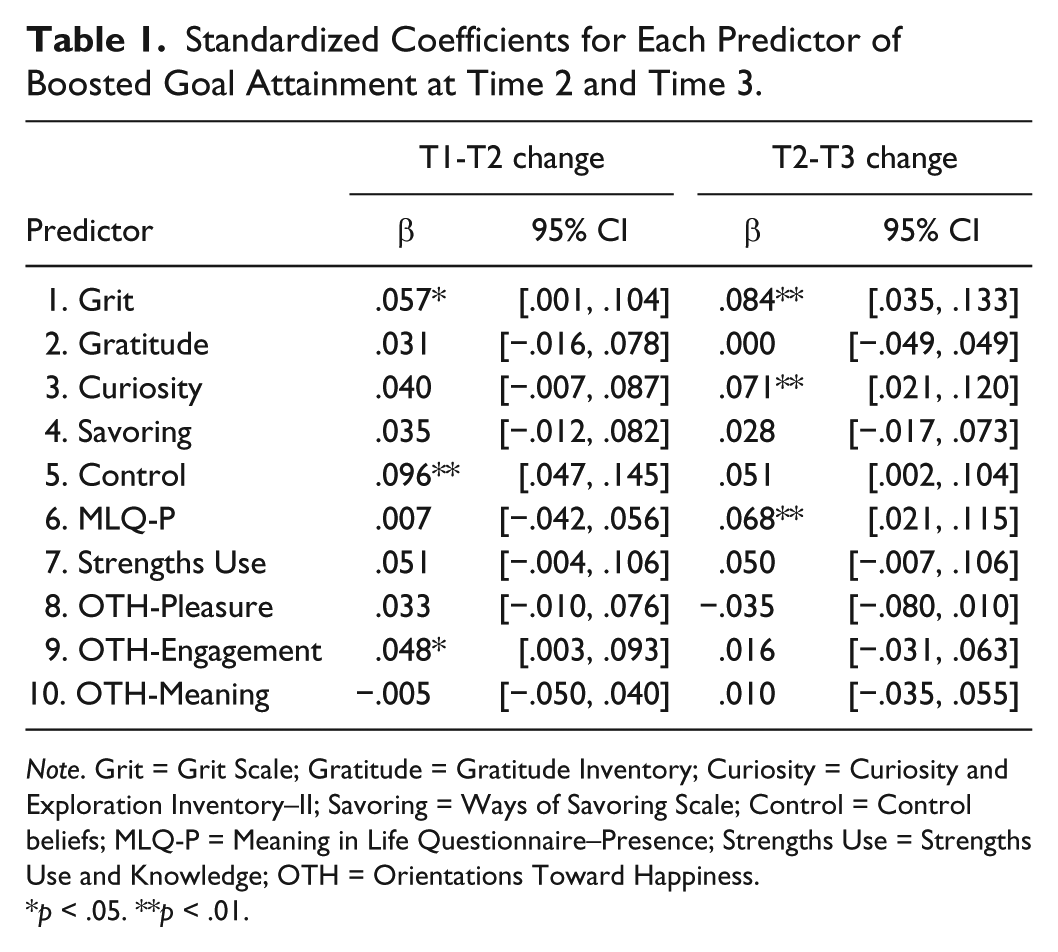
To address RQ1 (“what personality characteristics predict enhanced goal attainment?”), we first conducted 10 analyses in which T2 Goal attainment was regressed upon two predictors at a time: T1 Goal attainment (focusing the analysis on increases in attainment), and one of the T1 personality strengths. The coefficient for the T1 Goal attainment variable was high, ranging from .76 to .81 across the 10 analyses. Nevertheless, several of the personality strengths yielded significant effects (see Table 1). To identify the most influential predictors (RQ4), we conducted an 11th analysis with a forward entry procedure. Two predictors remained significant in this analysis: Control Beliefs (β =.094, p < .01) and Grit (β = .054, p < .05). When we conducted the same analysis with a forced entry of all 10 predictors, Control Beliefs (β =.084, p < .01) and Grit (β = .066, p < .05) again emerged as the only significant predictors. Notably, multi-collinearity was not a problem in these models, as no Variable Inflation Factors exceeded 2.5 and no Tolerance statistics were less than .500; this remains true for all of the models reported below. Simply put, the 10 candidate predictors are not that highly correlated, only rarely exceeding r = .50. Thus, we report no further collinearity diagnostics.
Standardized Coefficients for Each Predictor of Boosted Goal Attainment at Time 2 and Time 3.
Note. Grit = Grit Scale; Gratitude = Gratitude Inventory; Curiosity = Curiosity and Exploration Inventory–II; Savoring = Ways of Savoring Scale; Control = Control beliefs; MLQ-P = Meaning in Life Questionnaire–Presence; Strengths Use = Strengths Use and Knowledge; OTH = Orientations Toward Happiness.
p < .05. **p < .01.
We then addressed RQ1 a second time, by focusing on change between T2 and T3. The models were the same as above, except that T3 Goal attainment was predicted by T2 Goal attainment and by one of the T2 personality strengths. The pattern of coefficients was somewhat different (see Table 1). Comparing the two columns in Table 1, only Grit was significant at both T2 and T3. In the 11th T3 analysis testing RQ4, only Grit (β = .086, p < .01) and Curiosity (β = .073, p < .01) were significant with the forward entry procedure. When a forced entry procedure was used, Grit (β = .065, p < .01), Curiosity (β = .095, p < .01), and MLQ-Presence (β = .071, p < .05) were all significant. Because only Grit emerged in the top group in both RQ4 tests, by both the forward entry and simultaneous entry procedures, it seems safe to conclude that strong initial Grit is essential for effective goal-striving, just as researchers have shown in studies with specialized populations (Duckworth et al., 2007; Maddi, Matthews, Kelly, Villarreal, & White, 2012).
To address RQ2 (“what personality strengths moderate goal attainment effects on boosted SWB?”), we conducted 10 analyses in which T2 SWB was regressed upon five predictors: T1 SWB (focusing the analysis on increases in SWB), one of the T1 personality strengths (centered), T1 Goal attainment and T2 Goal attainment (both centered, focusing the analysis on the effects of changes in attainment), and a T1 personality strength × T2 Goal attainment product term (to test for the hypothesized moderation effects). Associations of T1 with T2 SWB were fairly high, ranging from .64 to .74 across the 10 analyses. Nevertheless, many variables influenced changes in SWB. As shown in Table 2, two T1 personality strengths manifested main effects upon change in SWB at T2: Control Beliefs and Gratitude. More importantly, four significant strength moderator relationships emerged, involving OTH-Engagement, Strengths Use, Savoring, and Curiosity. Figure 1 illustrates the form of this interaction for Curiosity. As can be seen, the slope depicting the relationship of goal attainment to changes in SWB was slightly steeper for participants high in Curiosity relative to those low in curiosity. The other four significant interactions yielded forms similar to the one illustrated in Figure 1.
Predicting T1-T2 SWB From T1-T2 Goal Attainment, T1 Personality Strengths, and the Personality Strength × Attainment Interaction.

Note. SWB = subjective well-being; Grit = Grit Scale; Gratitude = Gratitude Inventory; Curiosity = Curiosity and Exploration Inventory–II; Savoring = Ways of Savoring Scale; Control = Control beliefs; MLQ-P = Meaning in Life Questionnaire–Presence; Strengths Use = Strengths Use and Knowledge; OTH = Orientations Toward Happiness.
p < .10. *p < .05. **p < .01.

T1 Curiosity moderates the T1-T2 Goal attainment effect on T1-T2 changes in SWB.
To address RQ4, we conducted an 11th analysis in which all 10 personality strength predictors were entered simultaneously along with T1 and T2 Goal attainment, with a forward entry procedure for the 10 product interaction terms. Only the T1 Curiosity × T2 Goal attainment interaction emerged as significant in this analysis (β = .068, p < .01). When we did the same analysis using a simultaneous entry procedure, none of the 10 interaction terms reached significance, likely due to the small effect sizes and the sheer size of the model (27 predictors). However, the Curiosity × Goal attainment interaction was closest to significance in this analysis.
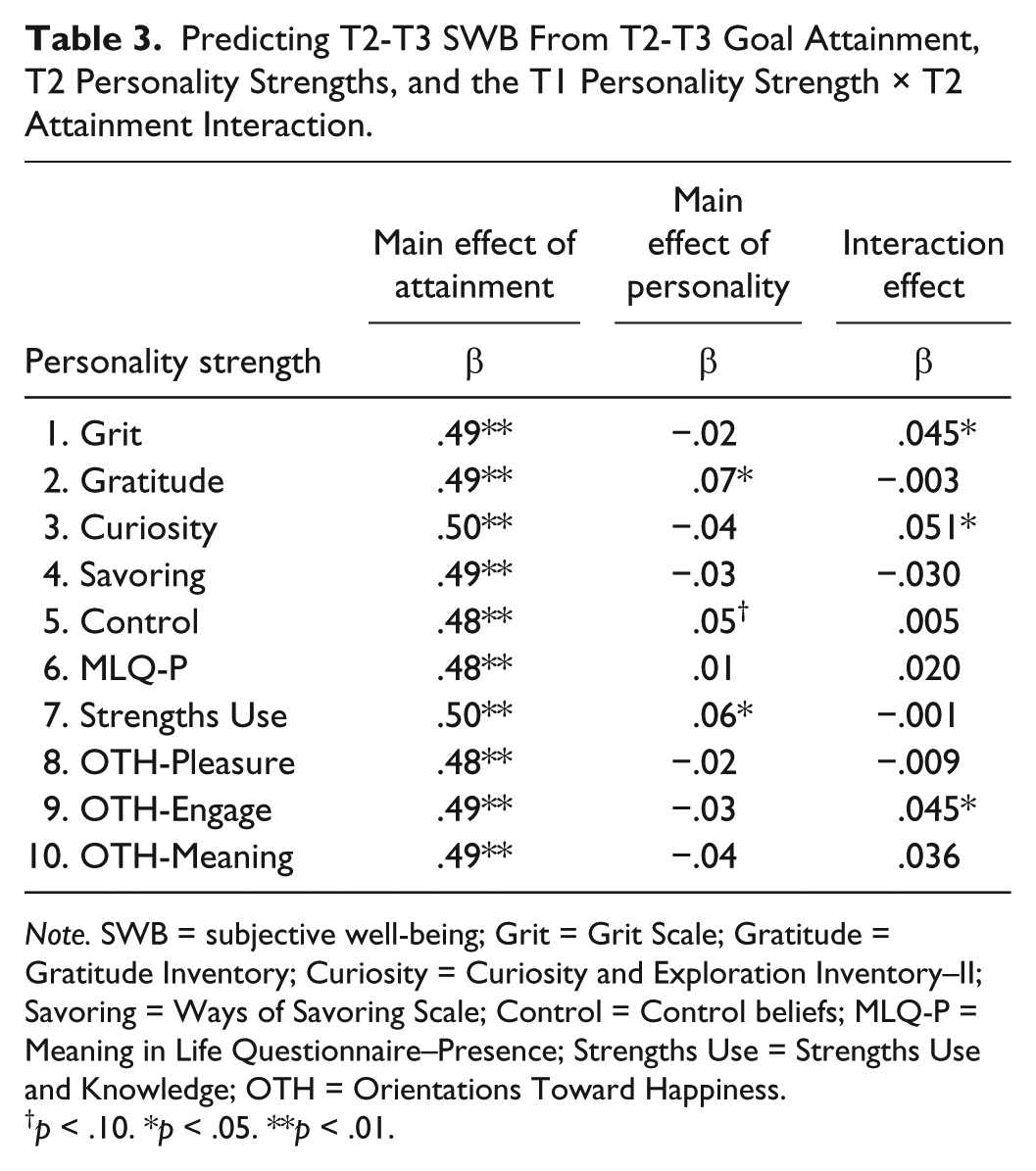
We then addressed RQ2 a second time, focusing on the interim between T2 and T3 instead of the interim between T1 and T2. We conducted 10 analyses in which T3 SWB was regressed upon five predictors: T2 SWB (focusing the analysis on increases in SWB), one of the T2 personality strengths (centered), T2 Goal attainment and T3 Goal attainment (both centered, focusing the analysis on the effects of changes in attainment), and a T2 personality strength × T3 Goal attainment product term (to test for the hypothesized moderation effects). Coefficients for T1 SWB were again moderately high, ranging from .62 to .66 across the 10 analyses. As shown in Table 3, two T2 personality strengths manifested significant main effects upon change in SWB at T3: Strengths Use and Gratitude. More importantly, three significant moderator relationships emerged: for OTH-Engagement, Curiosity, and Grit. The form of the interactions was similar to the one shown in Figure 1.
Predicting T2-T3 SWB From T2-T3 Goal Attainment, T2 Personality Strengths, and the T1 Personality Strength × T2 Attainment Interaction.
Note. SWB = subjective well-being; Grit = Grit Scale; Gratitude = Gratitude Inventory; Curiosity = Curiosity and Exploration Inventory–II; Savoring = Ways of Savoring Scale; Control = Control beliefs; MLQ-P = Meaning in Life Questionnaire–Presence; Strengths Use = Strengths Use and Knowledge; OTH = Orientations Toward Happiness.
p < .10. *p < .05. **p < .01.
To again address RQ4, we conducted an 11th analysis in which all 10 personality strengths were entered simultaneously along with T1 and T2 Goal attainment, with a forward entry procedure for the 10 product interaction terms. Only the T2 Curiosity × T3 Goal attainment interaction emerged as significant and positive in this analysis (β = .052, p < .05). When we employed a simultaneous entry procedure, Curiosity was again positive and significant (β = .111, p < .05), and no other interaction effects were significant. Given that only Curiosity emerged as a significant moderator in both the T1-T2 and the T2-T3 tests of RQ4, we concluded that Curiosity may be most essential personality strength studied here for boosting the effects of goal attainment upon well-being. When one strives out of curiosity, goal attainment feels best.
We then turned to RQ3, concerning the sustainability of T1-T2 SWB effects at a later time (T3). This question could only be tested once, because of the three-wave design. To examine this question, we re-ran the T1-T2 analyses, with one change: We substituted T3 SWB for T2 SWB as the dependent measure. These analyses asked, which T1 strength by T1-T2 attainment moderator effects observed for T2 SWB are still in evidence 6 months later, for T3 SWB? T2 Goal attainment had weaker but still significant effects upon SWB at T3, with coefficients ranging from .16 to .19. Thus, a period of improved goal-striving continued to have some measurable effects 6 months later. However, none of the 10 T1 personality strength × T1-T2 Goal attainment interactions were significant in these analyses, indicating that none of the T1-T2 moderator effects were consistent or “sustainable” across the additional 6-month gap to T3.
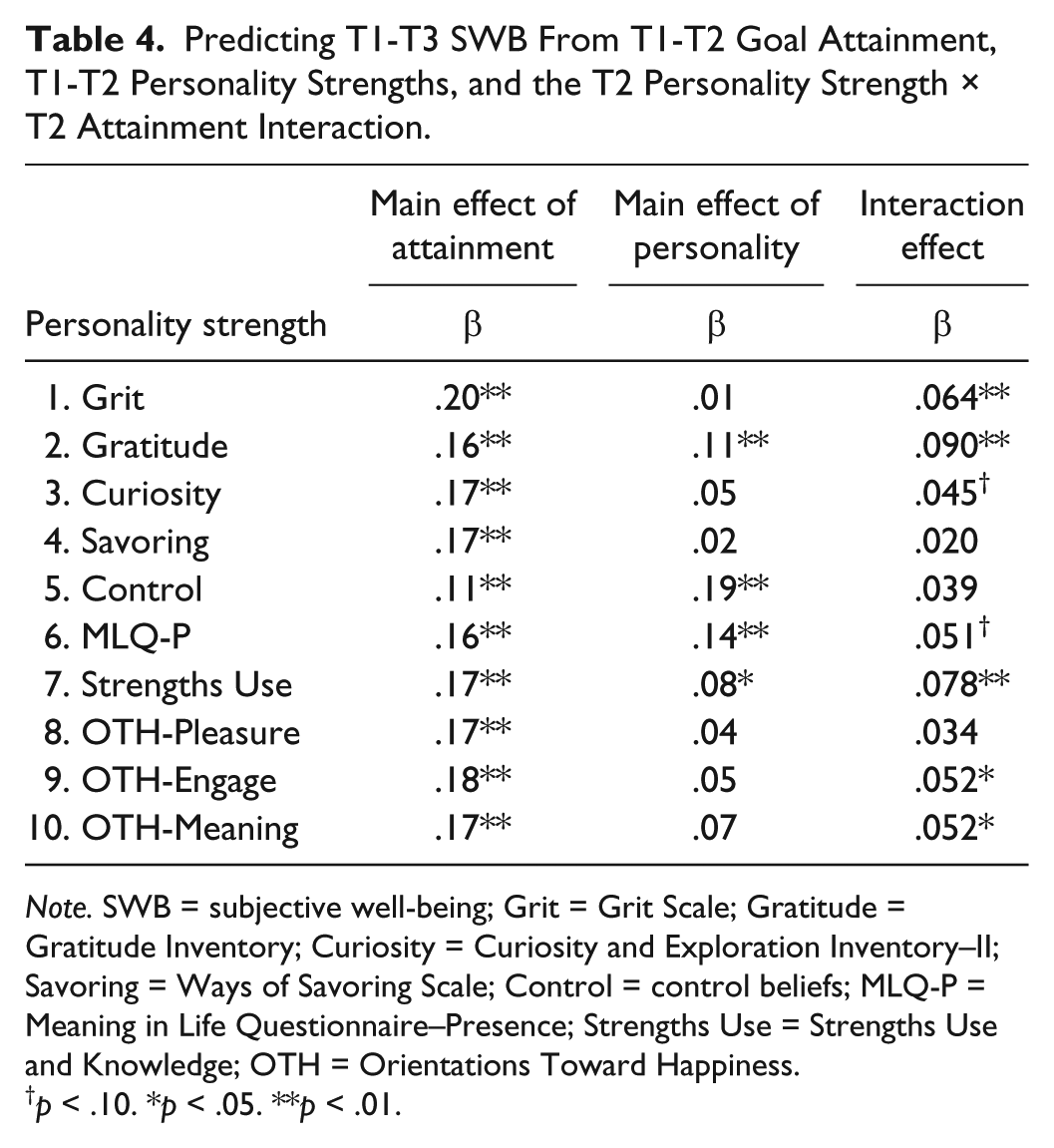
Finally, we addressed RQ3 a second way, by asking whether change in personality strengths between T1 and T2 might succeed in moderating T2 Goal attainment effects upon T3 SWB. In this view, it is the combination of having made excellent goal progress during a period of time, plus having positively altered one’s personality in the process, that produces effects that are still observable 6 months later. To examine this question we re-ran the 10 analyses above, while (a) also including the T2 as well as the T1 personality strengths in the equation (so that change in personality from T1 to T2 would become the predictor of interest), and (b) re-computing the interaction product terms, such that the T2 rather than the T1 version of the personality variable was represented in that product. As can be seen in Table 4, five significant interactions emerged from the analysis (involving OTH-Meaning, OTH-Engagement, Strengths Use, Grit, and Gratitude), and two additional marginal effects emerged (involving Curiosity and MLQ-Presence).
Predicting T1-T3 SWB From T1-T2 Goal Attainment, T1-T2 Personality Strengths, and the T2 Personality Strength × T2 Attainment Interaction.
Note. SWB = subjective well-being; Grit = Grit Scale; Gratitude = Gratitude Inventory; Curiosity = Curiosity and Exploration Inventory–II; Savoring = Ways of Savoring Scale; Control = control beliefs; MLQ-P = Meaning in Life Questionnaire–Presence; Strengths Use = Strengths Use and Knowledge; OTH = Orientations Toward Happiness.
p < .10. *p < .05. **p < .01.
To again address RQ4, we conducted an 11th analysis predicting T3 SWB in which all 20 T1 and T2 personality strength predictors were entered simultaneously along with T1 SWB and T1 and T2 Goal attainment at Step 1, with a forward entry procedure at Step 2 for the 10 T2 personality strength × T2 Goal attainment product interaction terms. Only one interaction coefficient was significant in this analysis: T2 OTH-Meaning (controlling for T1 OTH-Meaning) significantly interacted with T2 Goal attainment (controlling for T1 Goal attainment) to predict T3 SWB (controlling for T1 SWB). This finding suggests that when a participant’s meaning orientation increases at the same time that his or her goal attainment increases, a synergistic positive effect on SWB is still detectable 6 months later.
Discussion
Science progresses when different theories and measures are directly compared with each other, to evaluate which ones have the most merit. We were able to make such a comparison in the current large dataset, evaluating 10 different positive personality characteristics. This approach is valuable because the field of positive psychology has been criticized for supplying too many new measures and constructs, without also conducting enough studies that achieve integration and consolidation (Sheldon, 2011). The following metrics of comparison were used: Does a particular personality strength consistently predict enhanced goal-performance, and does the personality strength consistently amplify the effects of goal attainment upon SWB? Both of these metrics were derived from previously published research on goal self-concordance (Sheldon, 2014; Sheldon & Elliott, 1999). Our basic question was which positive psychology constructs are true “keystones” in goal functioning that are most worthy of future research attention and intervention development.
RQ1 (“which personality strengths predict subsequent goal attainment?”) was addressed twice, both in the T1-T2 period and in the T2-T3 period. Although a number of the 10 personality strengths showed some evidence of enhancing people’s goal attainment over the next 6 months, only two T1 constructs yielded unique effects at T2 (i.e., Grit and Control Beliefs), and only two T2 constructs yielded unique effects at T3 (i.e., Grit and Curiosity). Because only Grit appeared twice on the lists, it seems that Grit won this contest, just as hypothesized. Thus, people looking to enhance their level of goal functioning in an upcoming period of time might do well to try to increase their levels of Grit, defined as “perseverance and passion for long-term goals” (Duckworth et al., 2007, p. 1087). Importantly, the definition of Grit is conceptually similar to the operational definition of Self-concordance (Sheldon, 2014), which is said to exist when people strive for long-term goals because they enjoy and believe in what they are doing (i.e., they are passionate about the goals). It remains for future research to compare Self-concordance and Grit directly. For example, one hypothesis that might be considered in the future is that Grit is an outcome of self-concordant goal-motivation, which can help explain why self-concordant strivers do better. If people succeed in identifying goals that truly express their growth impulses (Sheldon, 2014), then they may find themselves with enhanced Grit as a natural consequence of that self-insight and courage.
Although achieving one’s goals is important, “not all progress is beneficial” (Sheldon & Kasser, 1998). People sometimes become passionate about the wrong goals, based on delusions, self-deception, or inadequate self-insight (Sheldon, 2014). RQ2 addressed this issue by asking “which personality strengths maximize the effects of goal attainment upon SWB?” In other words, are there certain personality strengths which allow people to get the most benefit from their own activities? RQ2, like RQ1, was also tested twice, both in the T1-T2 period and in the T2-T3 period.
Many of the 10 personality strengths evidenced significant moderator effects in the two tests, as can be seen in the third columns of Tables 2 and 3. Nonetheless, only Curiosity and OTH-Engagement were significant in Table 2 and Table 3. Furthermore, only Curiosity was significant in both RQ4 analyses, which compared the 10 interaction effects with each other. Because only Curiosity appeared twice on the list, it appears that Curiosity won this contest, just as hypothesized. Thus, people looking to boost the effects of goal attainment on their own SWB during an upcoming period of time might do well to try to increase their levels of curiosity and exploration at the beginning of that period. What is it about curiosity? Similar to the concept of Intrinsic motivation, Curiosity is defined as “a positive emotional-motivational system associated with the recognition, pursuit, and self-regulation of novelty and challenge” (Kashdan, Rose, & Fincham, 2004, p. 291). When people approach what makes them curious, they are likely to discover new information of interest, and likely to elaborate their own cognitive structures in the process (Kashdan, McKnight, Fincham, & Rose, 2011). They are also more likely to initiate an autocatalytic (internally initiated and directed) program of exploratory activity, an activity that continues to provide them with experiential benefits over time (Kaczmarek et al., 2013). In other words, goal attainments associated with an attitude of seeking novelty and discovery can have more enduring effects on SWB (Sheldon, Boehm, & Lyubomirsky, 2013), perhaps because of the further learning and growth that are afforded by this combination (Kashdan, 2009).
Finally, RQ3 asked “which moderator effects demonstrated at T2 still persisted at T3.” If the combination of having high levels of a personality strength at T1 plus reporting considerable Goal attainment between T1 and T2 predicts 6-month increases in SWB at T2, is this effect still there at T3, a year after the study began? In our first test of RQ3, in which T2 SWB was simply swapped out for T3 SWB in the models, no significant interaction effects remained involving the 10 T1 personality strengths. However, in a second test of RQ3, we examined the 10 T2 personality strengths as the moderators, rather than the 12 T1 strength variables. This change altered the question to “does change in personality strength between T1 and T2 boost the impact of T1-T2 goal attainment on SWB 6 months later, at T3?” In this second test, several moderator effects were in evidence, suggesting that changes in both personality and goal attainment may evoke the most sustainable changes in SWB. However, in the simultaneous (RQ4) test, only 1 of the 10 interaction effects emerged as significant: the one involving having a Meaning-Based OTH (β = .058, p < .01). This result suggests that if a person becomes more meaning oriented in their pursuit of happiness during a period of time, and also strives successfully during that period of time, he or she may gain new SWB that persists even 6 months later (and perhaps longer). Just as curiosity may boost the positivity of inflowing experience by increased creativity and ongoing engagement, a boosted meaning orientation may enable people to experience gains in SWB that last, because the world now provides them with a richer inflow of coherent positive experiences (Heintzelman & King, 2014).
Only 3 of 10 positive psychology constructs emerged as “winners” according to the tests we conducted (Grit, Curiosity, and Meaning-Based OTH). What about the 7 constructs that were “losers,” should they be discarded? Not at all—there are many routes and processes that can take people to boosted well-being or enhanced thriving or flourishing (Lyubomirsky et al., 2005), and the goal-striving process examined here is only one possible route. For example, the GQ (Emmons & McCullough, 2003) showed relatively few effects in the current study. This result does not mean that the GQ is invalid or unimportant; it just means that gratitude may not be as relevant for understanding goal-striving processes and goal-striving effects upon SWB. If we had instead examined other SWB-relevant processes in this research (such as processes related to boosting social capital, or processes related to improving personal relationships), then we may have found more salutary effects for Gratitude, or for many of the other constructs examined herein.
Several possible study limitations deserve mention. One concerns the particular set of personality strengths available for the study. There are many other “positive psychology” characteristics that might also have been chosen, but were not (such as flow, self-compassion, mindfulness, hardiness, optimism, psychological need-satisfaction, and even goal self-concordance). However, the ones we examined are well known and influential. Also, examining all 10 predictors together means that some results might be unstable or difficult to replicate, despite the non-problematic multi-collinearity statistics observed. However, the fact that we relied on internal replications across the two time periods helps to mitigate this concern. The RQ2 and RQ3 moderator effect sizes were very modest, and one might question how practically important such effects are. However, the fact that the effects were predicted by relevant theory indicates theoretical importance at least. Other limitations include the fact that the sample was 80% female, as is typical in many psychology research studies; the fact that the sample was self-selected and may not be population-representative; and the fact that goal attainment was assessed with the Hope-Agency sub-scale, a non-traditional measure of personal goal attainment.
Finally, it would be desirable to better sample the world population as a whole. Our sample was mainly drawn from Western nations, was mainly Caucasian, and was relatively affluent (with access to an online computer and with the wherewithal to take a rather lengthy web survey several times over a year). It is unknown how well our effects would generalize to members of more traditional cultures or to members of non-Western nations. However, our non-reliance on college students, and the representation of 40 different nations within the sample, may be construed as strengths of the current study.
In conclusion, we believe that the current study makes an excellent beginning to the task of consolidating the many personality strengths (and positive psychology constructs) by understanding their simultaneous relationships with important outcomes like goal attainment and enhanced SWB. The main conclusions of our study are that Grit gets you the most goal attainment, that Curiosity gets you the most SWB bang for your goal-striving buck, and that developing an enhanced Meaning orientation, while striving, may best serve to prolong one’s SWB gains.
Footnotes
Declaration of Conflicting Interests
The author(s) declared no potential conflicts of interest with respect to the research, authorship, and/or publication of this article.
Funding
The author(s) received no financial support for the research, authorship, and/or publication of this article.

References
Supplementary Material
Please find the following supplemental material available below.
For Open Access articles published under a Creative Commons License, all supplemental material carries the same license as the article it is associated with.
For non-Open Access articles published, all supplemental material carries a non-exclusive license, and permission requests for re-use of supplemental material or any part of supplemental material shall be sent directly to the copyright owner as specified in the copyright notice associated with the article.
