



Abstract
When and why do people advocate on behalf of their attitudes? Past research suggests that attitude certainty is one important determinant. The current research seeks to provide more nuanced insight into this relationship by (a) exploring the unique roles of attitude clarity and attitude correctness, and (b) mapping clarity and correctness onto different forms of advocacy (sharing intentions and persuasion intentions). Across four studies, we find that correctness but not clarity plays an important role in promoting persuasion intentions, whereas both correctness and clarity help shape sharing intentions. Thus, this research unpacks the certainty–advocacy relation and helps identify experimental manipulations that uniquely drive persuasion and sharing intentions.
Every day, people are exposed to advocacies generated by other individuals. The positions advocated vary along a number of dimensions—for example, complexity, controversy, and personal relevance. One person might advocate for stricter gun control after learning of a school shooting, whereas another might endorse a new product based on a recent personal experience. Despite its ubiquity, and despite a voluminous literature on attitude change and persuasion more generally, the social-psychological literature has little to say about the factors that prompt persuasive advocacy. That is, what drives people to advocate on behalf of their beliefs and opinions? When, and why, do people share ideas with others or try to persuade them?
Attitude Certainty
One thing we do know about advocacy is that attitude certainty is an important determinant. Attitude certainty refers to the subjective sense of conviction, or confidence, with which one holds one’s attitude (Rucker, Tormala, Petty, & Briñol, 2014). As a dimension of attitude strength, attitude certainty contributes to an attitude’s durability and impact (Krosnick & Petty, 1995)—generally speaking, attitudes held with certainty are more resistant to change and have greater influence on thoughts and behaviors than attitudes held with uncertainty (Tormala & Rucker, 2007). Most germane to the current research, there is a growing body of work suggesting that attitude certainty fosters advocacy-relevant behavior. For instance, Barden and Petty (2008) found that increasing attitude certainty increased people’s willingness to vote and sign petitions, and Krosnick, Boninger, Chuang, Berent, and Carnot (1993) found that attitude certainty predicted people’s likelihood of talking about a variety of attitude issues. In addition, Visser, Krosnick, and Simmons (2003) found that high (vs. low) attitude certainty encouraged people to seek to persuade others. More recently, Akhtar, Paunesku, and Tormala (2013) found that greater attitude certainty was associated with greater intentions to persuade others to adopt one’s attitudinal position.
Based on this initial research, however, we still know relatively little about when or why attitude certainty fosters advocacy. The current research seeks to provide new, more nuanced insight into this relationship. We first consider the notion that attitude certainty can be conceptually and empirically separated into two underlying constructs: (a) attitude clarity—the subjective sense of truly knowing one’s attitude on a topic, and (b) attitude correctness—the subjective sense that one’s attitude is correct, or valid, and reflects the right way to think about a topic (Petrocelli, Tormala, & Rucker, 2007). In a series of studies, Petrocelli et al. (2007) demonstrated that although clarity and correctness are correlated, they are distinct attitudinal constructs with unique antecedents. Specifically, attitude correctness was shown to derive from metacognitive activity aimed at gauging the overall validity of a target attitude or opinion (e.g., it increased when participants learned that most people shared their opinion). Attitude clarity was shown to derive from metacognitive activity aimed at better identifying one’s true opinion (e.g., it increased when participants repeatedly expressed their attitudes toward an issue). When a person is high in correctness, she feels certain that her attitude is the valid or correct one to hold, meaning others should hold it as well. When a person is high in clarity, she knows how she thinks or feels about an issue but does not necessarily see it as correct in any absolute sense, meaning reasonable others might agree or disagree.
Attitudinal Advocacy
The aim of the current work is to investigate how clarity and correctness differentially influence advocacy intentions. From classic and contemporary social-psychological research, we know that people often are persuaded by their own advocacy or argumentation (e.g., Anderson, Lepper, & Ross, 1980; Briñol, McCaslin, & Petty, 2012; Janis & King, 1954). However, as noted earlier, we know surprisingly little about the factors that prompt advocacy in the first place. To begin charting the antecedents, it is useful to consider the definition of advocacy.
Broadly speaking, attitudinal advocacy can be viewed as an expression of support for (or opposition to) something—for example, a person, cause, or policy. However, like attitude certainty, we submit that there are different ways to define, or conceptualize, types of advocacy. One way is that advocacy involves attempting or seeking to persuade others to adopt one’s attitude or position. We refer to this form of advocacy as persuasion intention. Importantly, though, advocacy can also be defined in terms of merely sharing or expressing one’s opinion. Indeed, whether one explicitly intends to solicit others’ support or not, sharing or expressing an opinion could be interpreted as a form of advocacy in that it involves communicating and disseminating one’s attitude to others. For example, an individual might share her opinion to ensure that it is noted or taken into account by others, even if she has no explicit desire to change others’ minds. We refer to this form of advocacy as sharing intention. An individual who shares without persuasion intention might think, “I’m not trying to change anyone’s opinion; I just want to make sure that my views are part of the conversation”; or “I would share my belief if asked, but I’m not going to get out there and try to change people’s minds.” In recent work, advocacy has been conceptually and operationally defined in terms of both persuasion and sharing intentions (Akhtar et al., 2013).
Although persuasion and sharing intentions have commonalities, there are important differences as well. First, as hinted above, they can be accompanied by distinct goals. Indeed, by definition persuasion intentions imply that one seeks to change the valence or extremity of another person’s attitude to bring it into closer alignment with one’s own. By contrast, although one could share one’s attitude to try to change someone’s mind, one could also share one’s attitude with others who already agree (e.g., to offer them assurance or social support), with others who are merely surveying the landscape of public opinion, or with others who are forming their own opinions and simply want to know where people stand. In short, whereas persuasion intentions imply that the target of one’s advocacy holds a different opinion from one’s own (in either valence or extremity), sharing intentions do not. Thus, sharing constitutes a broader category of advocacy that can but does not necessarily include persuasion intentions. In addition, it seems reasonable to assume that persuading others typically requires more effort than merely sharing one’s opinion (see also Briñol et al., 2012), and therefore, that persuasion intentions (relative to sharing intentions) imply greater willingness to expend the effort required to advocate for one’s views.
Based on this reasoning, we posit that correctness and clarity differentially predict persuasion and sharing intentions. First consider persuasion intentions. Our hypothesis is that seeking to persuade others depends more on the feeling of correctness than clarity. Indeed, feeling clear about one’s attitude does not necessarily imply that others should agree with it, let alone that one should direct one’s efforts toward attempting to convince others of it (“This is my opinion, but I’m not saying it’s right and I’m not going to try to convince anyone.”). In contrast, feeling that one’s attitude is somehow objectively correct—for instance, that it accurately captures the evidence on a topic—very well might suggest that others should hold it. To the extent that people feel that they have the correct opinion on a topic, and that others should agree with them, they should be more willing to direct effort toward persuading others toward their own attitude or opinion (“I know I’m right, and you should agree with me. Here’s why . . . ”). Thus, we posit that correctness, and the factors that drive it, will be more likely than clarity to foster persuasion intentions.
This initial hypothesis is bolstered by recent studies suggesting that increasing feelings of correctness, but not clarity, can promote a more competitive conflict style (Rios, DeMarree, & Statzer, 2014). Conflict style can be construed in terms of how competitive one is during argumentation or conflicts of opinion. Rios et al. explored how participants behaved when they believed that they were going to have a debate with someone who disagreed with them. They used a measure of conflict style that asked participants to select from a set of sentences to send to their debate partner. The options included three sentences expressing a desire to compete, three expressing a desire to cooperate, and three designed to be neutral. Competitive conflict style was measured by summing the number of competitive sentences sent. Rios et al. found that correctness significantly predicted competitiveness, but there was no such relationship with clarity. Although conflict style and advocacy are distinct constructs, the Rios et al. (2014) findings suggest that correctness can promote a desire to win an argument and convince people to adopt one’s viewpoint. In other words, those findings lend potential support to the notion that correctness will exert more impact than clarity on persuasion intentions.
However, there may be advocacy-relevant situations or behaviors in which winning and convincing others is not the immediate goal—for example, when others already hold the desired opinion, or when one is simply asked what one thinks and the asker’s opinion is unknown. In these contexts, or for these behaviors, perhaps clarity does play some role. We examine this possibility in the context of sharing intentions. We postulate that although clarity likely plays little role (relative to correctness) in fostering persuasion intentions, it could play an independent and important role in shaping sharing intentions—that is, in influencing people’s willingness to express, and interest in expressing, their opinions to others. Again, having high clarity suggests that a person feels that she genuinely knows her true opinion on a topic. To the extent that perceiving that one can identify one’s true attitude makes it more likely that one would express that attitude to others (e.g., if asked), we posit that clarity might contribute to sharing intentions. Viewed differently, the less clarity a person has about her own attitude, the less likely she is to want to share it. With greater clarity, her willingness to share should be relatively increased.
In short, we hypothesize that although correctness (and not clarity) is a key determinant of persuasion intentions, both correctness and clarity influence intentions to share one’s opinion with others. If true, this pattern of results would suggest that clarity is not an impotent component of attitude certainty, as the Rios et al. (2014) findings might be interpreted, but rather that it plays an independent and meaningful role in advocacy as long as the appropriate type of advocacy is examined.
Overview
The aim of the current research is to explore the relation between the two underlying constructs of attitude certainty—clarity and correctness—and advocacy intentions. As noted, past research has shown that there are different antecedents for clarity and correctness: repeated attitude expression and perceived attitude consensus, respectively. The current research seeks to provide evidence for their different consequences with respect to advocacy. In exploring these issues, we also provide a new look at some classic variables in attitudes and persuasion research, looking beyond their effects on attitudes and even attitude certainty to better understand their potential effects on advocacy. Thus, the current research expands current understandings of the diverse effects of classic variables in attitudes research.
We present four studies. Across studies, we used different approaches to assess our hypothesis that correctness is a key driver of persuasion intentions. These same approaches also allowed us to examine whether, in contrast to being unimpactful, clarity might play a role in driving people’s intentions to share their opinions with others. In Study 1, we used a correlational approach to assess the links between correctness, clarity, and advocacy intentions across five different policy issues. In Study 2, we used a social consensus paradigm to experimentally manipulate correctness and examine its effect on advocacy. In Study 3, we used a repeated expression paradigm to experimentally manipulate clarity. Finally, in Study 4, we developed a new attitude expression paradigm to manipulate both clarity and correctness to show that even when these two constructs vary together, they differentially predict advocacy intentions. Across studies, we offer new insight into the relationship between attitude certainty and advocacy, showing that factors that increase correctness boost both sharing and persuasion intentions, whereas factors that increase clarity boost sharing but not persuasion intentions.
Study 1
Study 1 used a correlational design to provide initial evidence that clarity and correctness could be statistically differentiated in how they predict persuasion and sharing intentions. Across five different issues, participants were asked about their attitudes, attitude certainty, clarity, correctness, and their intentions to advocate, operationalized in terms of two separate three-item scales for persuasion and sharing intentions. We expected that attitude certainty would predict advocacy intentions, as in past research. More importantly, we also predicted that this general relationship between certainty and advocacy would mask a more specific mapping of persuasion intentions onto correctness, and sharing intentions onto both correctness and clarity. That is, we hypothesized that correctness would be a better predictor of persuasion intentions, whereas both correctness and clarity would predict sharing intentions.
Method
Two hundred eleven participants (Mage = 32.24, SDage = 11.72, 46% female) from Amazon’s Mechanical Turk were recruited online to participate in exchange for a small monetary compensation. Participants were asked about their attitudes toward five policy issues (randomly ordered). The questions read as follows: (a) Should the United States require the labeling of genetically modified foods (GMOs)? (b) Should school prayer be mandated in all public schools? (c) Should burning the American flag as an act of protest be protected by the Constitution? (d) Should the government issue school vouchers? (e) Should the current gun control laws in the United States be made stronger? After each separate policy question, participants were asked to report their attitudes on a 9-point scale anchored at 1 = against and 9 = in favor. Following the attitude measure for each issue, participants completed a measure of global attitude certainty adapted from past research (e.g., Fazio & Zanna, 1978; Tormala & Petty, 2002), asking how certain they were of their attitudes toward the issue. Responses were provided on a scale ranging from 1 = not at all to 9 = very much.
After reporting global attitude certainty, participants completed a series of clarity and correctness items for each issue. Specifically, they completed the seven clarity and correctness items established by Petrocelli et al. (2007). These items were randomly ordered for each issue, and responses were provided on scales anchored at 1 = not at all and 9 = very much. The four clarity items were (a) How certain are you that you know what your true attitude on this issue really is? (b) How certain are you that the attitude you expressed toward this issue really reflects your true thoughts and feelings? (c) To what extent is your true attitude toward this issue clear in your mind? (d) How certain are you that the attitude you just expressed toward this issue is really the attitude you have? The three correctness items were (a) How certain are you that your attitude toward this issue is the correct attitude to have? (b) To what extent do you think other people should have the same attitude as you on this issue? (c) How certain are you that of all the possible attitudes one might have toward this issue, your attitude reflects the right way to think and feel about the issue? For each issue, we averaged responses to form composite indices of clarity (αs > .96) and correctness (αs > .87).
Following the clarity and correctness items for each issue, participants completed a series of scales intended to capture advocacy intentions. The first included three questions assessing sharing intentions: (a) How likely would you be to share your views on this topic with your friends or family? (b) How likely would you be to share your views on this topic with someone you do not know well but see often (a classmate, colleague, or neighbor)? (c) How likely would you be to share your views on this topic with a stranger? Next, participants responded to three questions assessing persuasion intentions: (a) How likely would you be to try to persuade your friends or family to your position on this topic? (b) How likely would you be to try to persuade someone you do not know well but see often (a classmate, colleague, or neighbor) to your position on this topic? (c) How likely would you be to try to persuade a stranger to your position on this topic? Each of the sharing and persuasion intention questions was followed by a scale ranging from 1 = not at all to 9 = very much. We averaged responses for each issue to form composite indexes of sharing (αs > .86) and persuasion (αs > .91) intentions. Finally, all participants completed a set of demographic questions.
Results
To examine the relationship between attitude certainty, correctness, and clarity with sharing and persuasion intentions, we submitted the data to a series of correlation analyses. Because clarity and correctness were significantly correlated with each other for every issue (all rs > .70), we controlled for each when analyzing the other to separate their independent roles in predicting advocacy. That is, for each of the five policy issues, we considered the partial correlations of correctness controlling for clarity and the partial correlations of clarity controlling for correctness.
We first assessed the basic relationship between attitude certainty and advocacy. Not surprisingly, and as past research would suggest, on all five issues we found a significant correlation between attitude certainty and both sharing intentions (GMOs: r = .54, p < .001, 95% confidence interval [CI] = [0.47, 0.74]; school prayer: r = .21, p = .002, 95% CI = [0.08, 0.35]; flag burning: r = .50, p < .001, 95% CI = [0.41, 0.69]; school vouchers: r = .45, p < .001, 95% CI = [0.35, 0.62]; gun control: r = .39, p < .001, 95% CI = [0.28, 0.55]) and persuasion intentions (GMOs: r = .48, p < .001, 95% CI = [0.39, 0.66]; school prayer: r = .19, p = .007, 95% CI = [0.06, 0.33]; flag burning: r = .40, p < .001, 95% CI = [0.29, 0.56]; school vouchers: r = .48, p < .001, 95% CI = [0.39, 0.66]; gun control: r = .35, p < .001, 95% CI = [0.23, 0.50]). Across issues, then, there was a robust positive correlation between attitude certainty and advocacy intentions: The more certain participants felt about their attitudes, the more likely they were to share their attitudes with others and seek to persuade them. However, as stated earlier, our primary interest was in more specifically understanding how the underlying components of attitude certainty—correctness and clarity—differentially predicted persuasion and sharing intentions.
We consider persuasion intentions first. As shown in Table 1, controlling for clarity, correctness was a significant predictor of persuasion intentions for all five policy issues. By contrast, controlling for correctness, clarity failed to predict persuasion intentions on any of the five issues. We then examined sharing intentions. As shown in Table 2, controlling for clarity, correctness was a significant predictor of sharing intentions for four of the five policy issues. Similarly, as hypothesized, controlling for correctness, clarity significantly predicted sharing intentions on four of the five policy issues. Moreover, clarity marginally predicted sharing intentions on the remaining issue (p = .08). 1
Raw and Partial Correlations for Persuasion Intentions in Study 1.
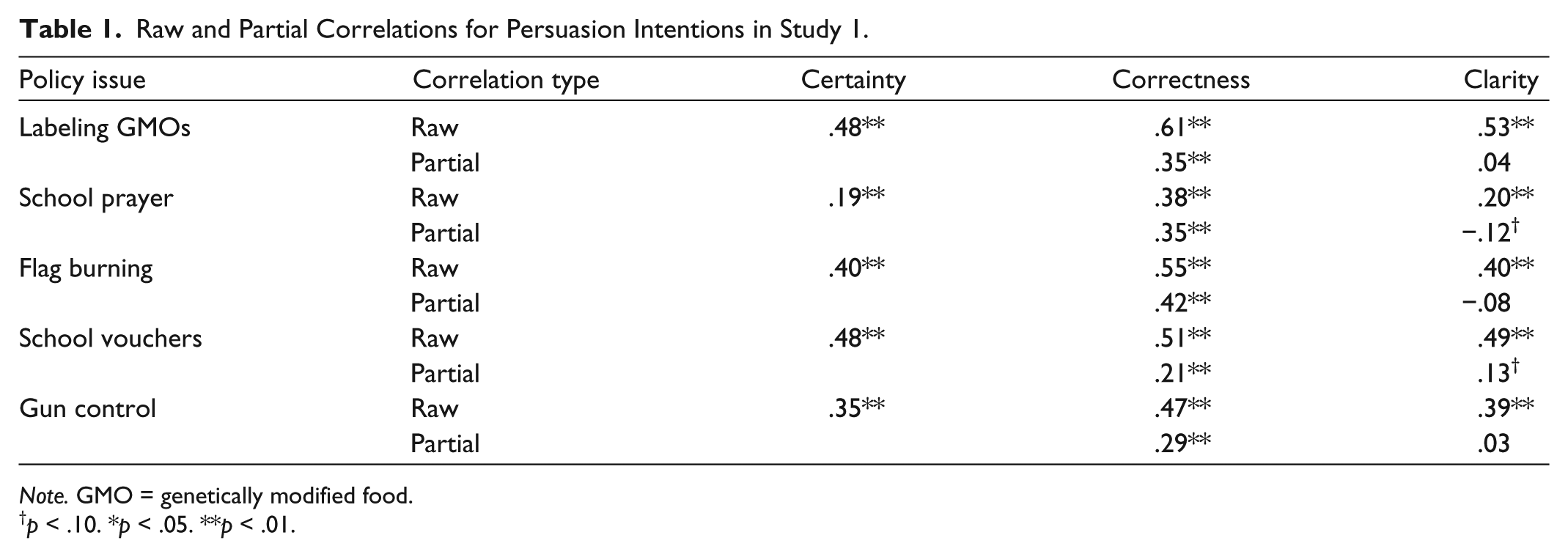
Note. GMO = genetically modified food.
p < .10. *p < .05. **p < .01.
Raw and Partial Correlations for Sharing Intentions in Study 1.
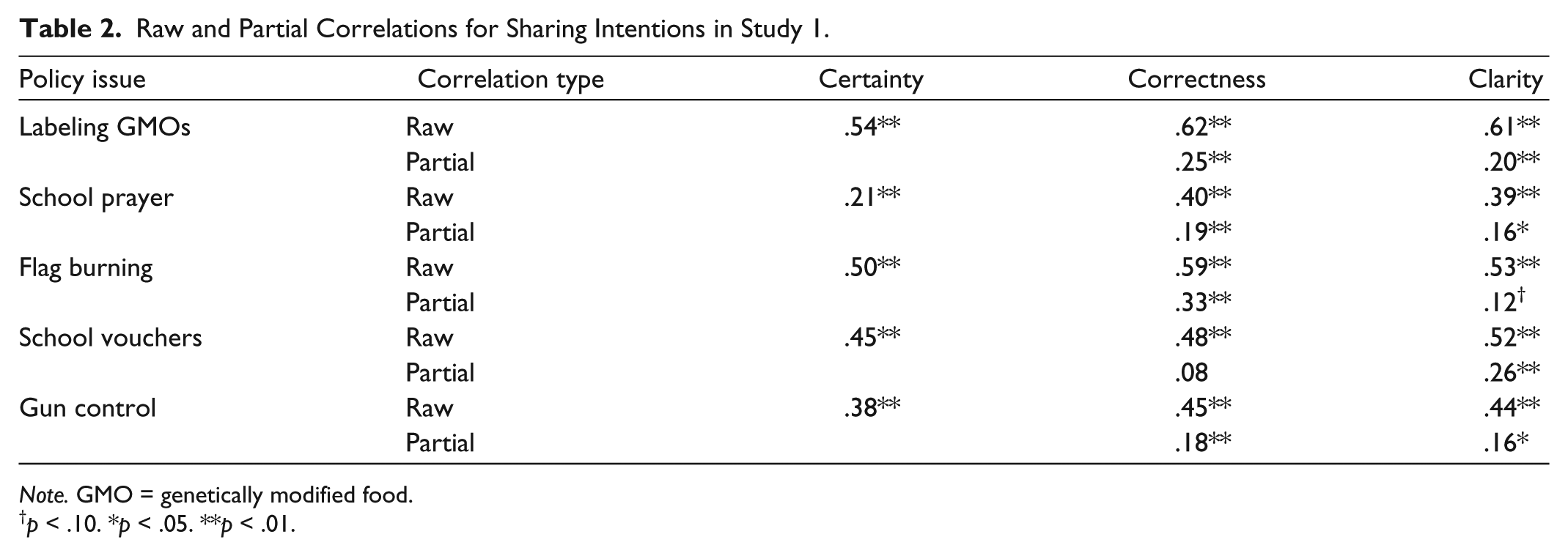
Note. GMO = genetically modified food.
p < .10. *p < .05. **p < .01.
To view these relations differently, we averaged across the five issues. Consistent with the individual analyses, we found that the correlation between correctness and persuasion intentions, controlling for clarity, was significant (r = .29, p < .001, 95% CI = [0.16, 0.43]), whereas the correlation between clarity and persuasion intentions, controlling for correctness, was not (r = .02, p = .82, 95% CI = [−0.12, 0.16]). In addition, we found that the correlation between correctness and sharing intentions, controlling for clarity, was marginally significant (r = .13, p = .07, 95% CI = [−0.01, 0.27]), whereas the correlation between clarity and sharing intentions, controlling for correctness, reached significance (r = .25, p < .001, 95% CI = [0.12, 0.39]). Using the predictor-discrimination technique recommended by Olkin and Finn (1995), we found that correctness was a stronger predictor of persuasion intentions than was clarity (z = 5.86, p < .001). However, there was a significant difference in the other direction for sharing intentions, such that clarity was actually a stronger predictor than correctness (z = −2.61, p = .005). Thus, we found that both correctness and clarity mattered for sharing intentions, and that clarity actually had a stronger relationship on average. 2
Discussion
The results of Study 1 were consistent with our hypotheses. Correctness had a robust relationship with persuasion intentions, whereas clarity did not. Furthermore, both correctness and clarity proved predictive of sharing intentions. It is important to note that, before controlling for correctness, clarity did consistently predict persuasion intentions (Table 1). However, consistent with the notion that the correctness was the primary contributor, controlling for correctness attenuated or even eliminated the correlation between clarity and persuasion intentions, whereas controlling for clarity left the correlation between correctness and persuasion intentions intact. Also important, correctness and clarity appeared to independently predict sharing intentions. In fact, averaging across issues, we found that the clarity-sharing relation was slightly stronger than the correctness-sharing relation.
In short, Study 1 provided initial evidence for the unique mapping of correctness onto persuasion intentions, and the more mutual role of correctness and clarity in shaping sharing intentions. Of course, although the results were suggestive, there are obvious limitations with respect to causal inference due to our reliance on a purely correlational design. In addition, one of the correctness items—“To what extent do you think other people should have the same attitude as you on this issue?”—could be viewed as too closely aligned with the persuasion intention measures. The concern would be that the stronger relationship between correctness and persuasion intentions (compared with the relationship between clarity and persuasion intentions) could be a methodological artifact reflecting the fact that the items or questions themselves were more similar to each other. Believing that people should agree with you is not the same thing as expressing a willingness or intention to persuade them, and we submit that it is the feeling of correctness that fosters persuasion intentions (rather than simply the manner in which we assess it), but to bolster confidence in the proposed causal relation between these constructs, we manipulated attitude correctness in Study 2.
Study 2
Study 2 aimed to provide stronger evidence for the link between correctness and persuasion intentions by manipulating correctness. The essential logic was that if correctness drives persuasion intentions, manipulating correctness should also produce variation in those intentions. In the original research distinguishing correctness from clarity, perceived attitude consensus (i.e., the extent to which others were thought to share one’s attitude) was shown to affect correctness more than clarity (Petrocelli et al., 2007). Thus, in Study 2 we manipulated perceived attitude consensus to experimentally vary correctness but not clarity and assess its impact on advocacy. Specifically, after reporting their attitudes toward one of the issues from Study 1, all participants were informed that their attitude was either similar or dissimilar to the attitudes reported by the majority of other survey respondents. In line with Petrocelli et al. (2007), we predicted that participants in the high (vs. low) consensus condition would report greater correctness but not necessarily greater clarity. Furthermore, if true, we expected participants in the high rather than low consensus condition to be more likely to exhibit persuasion intentions. Findings of this nature would suggest that by identifying correctness as a determinant of persuasion intentions, we can also predict the kinds of situational factors, or interventions, that induce those intentions.
Method
Four hundred four participants (Mage = 31.51, SDage = 10.96, 43.8% female) from Amazon’s Mechanical Turk were recruited online to participate in exchange for monetary compensation. At the outset of the study, participants were asked to report their attitudes toward a statement on the issue of gun control: “The current gun control laws in the United States are too lenient and need to be made stronger.” Attitudes were reported on a scale anchored at 1 = against and 9 = in favor. Following the attitude measure, participants were exposed to either a high or low consensus manipulation (adapted from Petrocelli et al., 2007). In the high consensus condition, participants were first reminded of where they scored themselves on the attitude scale and then were informed that, “Of the 2,106 people who have participated in this survey, 89.37% reported an attitude score in the same range as your score.” In the low consensus condition, participants were reminded of their score and then informed that, “Of the 2,106 people who have participated in this survey, 10.63% reported an attitude score in the same range as your score.” Participants then completed the exact same measures as in Study 1, this time focusing exclusively on the target issue of gun control. 3
Results
Global attitude certainty
We assessed the effect of the consensus manipulation on each of our dependent measures, starting with global attitude certainty. Surprisingly, we found no effect of consensus on global certainty, t(402) = −1.22, p = .22, 95% CI for the mean difference = [−0.73, 0.17], d = −.12. Participants in the high consensus condition (M = 7.20, SD = 2.19) tended to report more certainty than those in the low consensus condition (M = 6.92, SD = 2.40), but this effect was not significant.
Attitude correctness
We then examined correctness (α = .85). In this case, there was a significant effect, t(402) = −3.20, p = .001, 95% CI = [−0.90, −0.22], d = .32, such that participants in the high consensus condition (M = 7.02, SD = 1.65) reported significantly greater correctness than did those in the low consensus condition (M = 6.46, SD = 1.85).
Attitude clarity
On the clarity index (α = .94), we found a marginally significant effect of consensus, t(402) = −1.80, p = .072, 95% CI = [−0.60, 0.03], d = .18, such that participants in the high consensus condition (M = 7.81, SD = 1.46) reported feeling slightly more clarity than did those in the low consensus condition (M = 7.52, SD = 1.73).
Sharing intentions
Surprisingly, there was no effect of consensus on sharing intentions (α = .81), t(402) = −0.12, p = .90, 95% CI = [−0.43, 0.38], d = −.01. Participants in the high (M = 5.71, SD = 2.02) and low (M = 5.68, SD = 2.09) consensus conditions reported similar intentions to share their attitudes with others.
Persuasion intentions
Finally, we assessed the effect of our manipulation for persuasion intentions (α = .88). Here, there was a significant effect of consensus, t(402) = −2.79, p = .006, 95% CI = [−1.07, −0.19], d = .28, such that participants in the high consensus condition (M = 4.66, SD = 2.28) expressed greater persuasion intentions than did those in the low consensus condition (M = 4.03, SD = 2.23).
Mediation
Our approach for testing mediation in all studies was to conduct a formal mediation analysis if both the independent variable’s effect on the mediator and the mediator’s effect on the dependent variable were at least marginally significant (p < .10, or p < .05 one-tailed). That is, each potential mediator variable went through two tests: The first was to see whether there was an effect of the manipulation on the mediator and the second was to see whether the mediator predicted the dependent variable in a simultaneous multiple regression. If both these tests were at least marginally significant, the mediator was included in a formal mediation analysis. We adopted this criterion to be more inclusive of the potential variables that could play a mediating role even if their initial total effect was not statistically significant (see Hayes, 2009; MacKinnon, Lockwood, Hoffman, West, & Sheets, 2002; Preacher, Rucker, & Hayes, 2007; Shrout & Bolger, 2002). Indeed, even in the absence of a total effect of one variable on another, indirect effects can sometimes be observed and be theoretically meaningful (Rucker, Preacher, Tormala, & Petty, 2011).
To this point, the data in Study 2 were consistent with the notion that correctness might mediate the effect of consensus on persuasion intentions. Indeed, the only effects to emerge from our initial analyses were the effects of the consensus manipulation on correctness and persuasion intentions. Nevertheless, the consensus manipulation had a marginal effect on clarity. Thus, we conducted a simultaneous regression analysis in which persuasion intentions were predicted by correctness, clarity, and consensus condition (dummy coded: 0 = low consensus, 1 = high consensus). We found that correctness was a significant predictor of persuasion intentions (b = .618, SE = .08, p < .001), but neither clarity (b = .006, SE = .08, p = .94) nor condition (b = .278, SE = .20, p = .16) were reliable predictors. Because correctness was the only significant predictor in this analysis, we examined whether correctness mediated the relationship between consensus and persuasion intentions, using bootstrapping procedures recommended by Preacher and Hayes (2008). Specifically, we used the 95% CI approach based on 10,000 bootstrapped samples. This approach involves computing CIs around indirect effects (e.g., the effect of consensus on persuasion intentions through correctness); mediation is indicated by CIs that do not contain zero. Results indicated a CI = [.138, .574], suggesting that correctness did play a mediating role in the persuasion intention effect (Figure 1).

Mediation model for persuasion intentions in Study 2.
Next, although there was no effect of the consensus manipulation on sharing intentions, the manipulation did affect correctness and had a marginal impact on clarity. Thus, we conducted an exploratory follow-up analysis to determine if there was any evidence of indirect effects on sharing intentions through clarity and correctness. Specifically, we performed a simultaneous regression analysis in which sharing intentions were predicted by correctness, clarity, and consensus condition. In this case, we found that both correctness (b = .349, SE = .30, p < .001) and clarity (b = .216, SE = .17, p = .005) were significant predictors, whereas condition continued to have no effect (b = −.231, SE = −.06, p = .22). Because the consensus manipulation tended to affect both correctness and clarity and both correctness and clarity predicted sharing intentions, we formally examined the possibility that the consensus manipulation had an indirect effect on sharing intentions through both clarity and correctness. To test this parallel mediation, we again employed the bootstrapping technique recommended by Preacher and Hayes (2008). This analysis revealed significant indirect effects for both correctness (CI = [0.077, 0.365]) and clarity (CI = [0.003, 0.18]). The full mediation model is present in Figure 2. 4
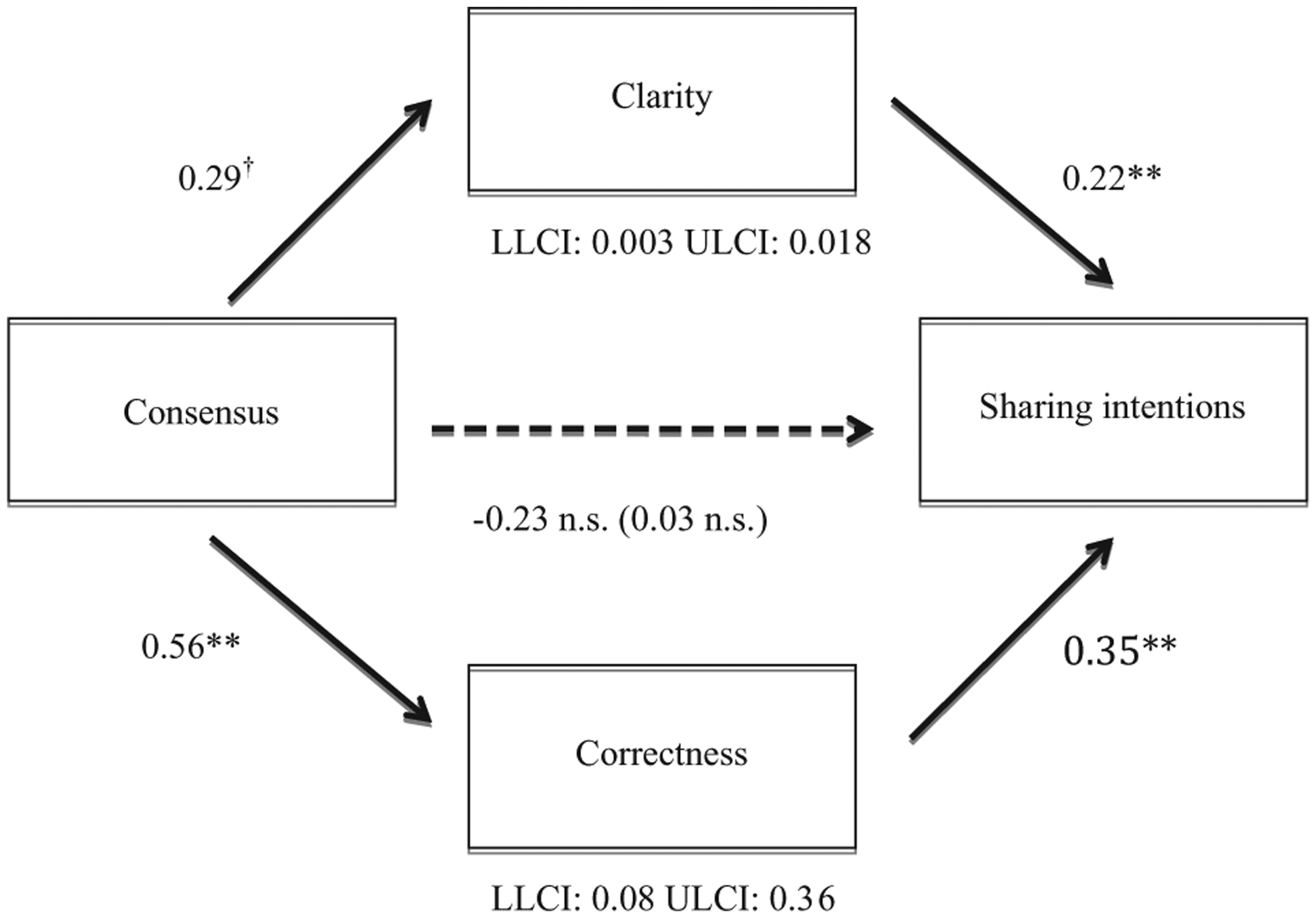
Mediation model for sharing intentions in Study 2.
Discussion
The results of Study 2 were consistent with predictions. We found that correctness mediated the effect of consensus on persuasion intentions, whereas clarity did not. We also found that correctness and clarity each independently predicted sharing intentions. Most important, by experimentally manipulating correctness (and less so clarity), we were able to manipulate persuasion intentions but not sharing intentions, suggesting that our results are not an artifact of the correctness and persuasion intention items being more similarly worded, which was a concern following Study 1. As intended, then, Study 2 provided additional support for the notion that correctness is more closely linked than clarity to persuasion intentions, and in doing so it uncovered an experimental manipulation (previously used to vary correctness) than can be used to influence persuasion intentions. Also noteworthy, Study 2 provided additional evidence for the hypothesis that although clarity does little to contribute to persuasion intentions, it appears to play a role in shaping sharing intentions. Study 3 was designed to follow up on this finding by experimentally manipulating clarity.
Study 3
Study 3 aimed to provide further evidence for the link between clarity and sharing intentions by experimentally manipulating clarity. Petrocelli et al. (2007) found that repeated attitude expressions tended to influence clarity more than correctness—specifically, repeatedly expressing one’s attitude toward an issue was shown to boost clarity (but not correctness) compared with expressing it just once. Thus, we adapted the repeated expression paradigm to experimentally manipulate clarity (but not correctness) and show that this manipulation would have an effect on sharing intentions but not persuasion intentions. Because we predicted a null effect of the repeated expression manipulation on both correctness and persuasion intentions, and null effects are notoriously hard to interpret with any confidence, we took a conservative approach and manipulated attitude expression in two different ways to create an internal conceptual replication of the predicted finding.
Method
Three hundred ninety-five participants (Mage = 31.90, SDage = 10.46, 39.2% female) from Amazon’s Mechanical Turk took part in exchange for monetary compensation. 5 At the outset of the study, participants were asked to report their attitudes toward requiring the labeling of GMOs in the United States. Based on their randomly assigned attitude expression condition, participants reported their attitudes either once or multiple times. This manipulation was carried out in two ways. In version 1, participants in the repeated expression condition were asked, “How do you feel about the labeling of genetically modified foods?” and responded to five 9-point semantic differential scales with the following anchors: bad-good, unfavorable-favorable, negative-positive, harmful-beneficial, against-in favor. In the single expression condition, participants were asked the same question but responded on just a single semantic differential scale, the final one from the repeated expression condition: against-in favor.
In version 2, participants in the repeated expression condition were presented with 14 randomly ordered items assessing their attitudes toward various policy issues. Within that set, the issue of labeling GMOs came up four different times (see supplementary materials for full list of items in each treatment condition), accompanied by a scale anchored at 1 = strongly disagree and 9 = strongly agree. The 15th item was always the same and was the fifth opportunity to express an attitude toward the target issue of labeling GMOs—“The United States should require the labeling of genetically engineered foods (GMOs).” Other attitudes were queried multiple times as well to avoid making our focal issue too salient during the manipulation. In the version 2 single expression condition, participants were again presented with 14 randomly ordered items but only the 15th and final item focused on the target issue of GMOs—“The United States should require the labeling of genetically engineered foods (GMOs).”. The other 14 items were fillers.
Following the attitude expression manipulation, participants completed measures of global attitude certainty, clarity and correctness (randomly ordered), and sharing and persuasion intentions. These items were identical to those used in Studies 1 and 2, but they were framed in terms of GMOs.
Results
This study employed a 2 (manipulation type: version 1 or version 2) × 2 (attitude expression: single or repeated) between-participants factorial design. Thus, we began by submitting each dependent measure to a 2 × 2 ANOVA.
Global attitude certainty
We first considered global attitude certainty. A 2 × 2 ANOVA with manipulation type and attitude expression as the independent variables revealed no main effect of manipulation type, F(1, 389) = 1.74, p = .188,
Attitude clarity
Next, we submitted the clarity index (α = .93) to the same analysis. There was no main effect of manipulation type, F(1, 391) = 0.37, p = .545,
Attitude correctness
We next examined the correctness index (α = .90). This analysis revealed no main effect of manipulation type, F(1, 391) = 2.17, p = .142,
Sharing intentions
Having established that the attitude expression manipulation affected clarity but not correctness, we next examined whether it also affected sharing but not persuasion intentions. To do so, we first submitted the sharing intentions index (α = .87) to the same 2 × 2 ANOVA. In this case, there was an unexpected main effect of manipulation type, F(1, 391) = 5.17, p = .024,
Persuasion intentions
Finally, the persuasion intentions index (α = .91) showed no effects even approaching significance, all Fs < 1.
Mediation
Although we did not observe the expected effect of attitude expression on sharing intentions, as in Study 2 we conducted follow-up analyses to determine whether there may have been an indirect effect through clarity (see Rucker et al., 2011). Because there was no moderation by manipulation type, we collapsed across that variable to conduct the mediation analyses. First, we conducted a simultaneous regression analysis in which sharing intentions were predicted by correctness, clarity, and expression condition (dummy coded: 0 = low expression, 1 = high expression). We found that correctness was a significant predictor (b = .462, SE = .07, p < .001) and clarity was a marginally significant predictor (b = .16, SE = .09, p = .07), whereas condition did not predict sharing intentions (b = −.129, SE = −.20, p = .517). Although correctness predicted sharing intentions, the expression manipulation did not influence correctness, F(1, 391) = 2.05, p = .153,
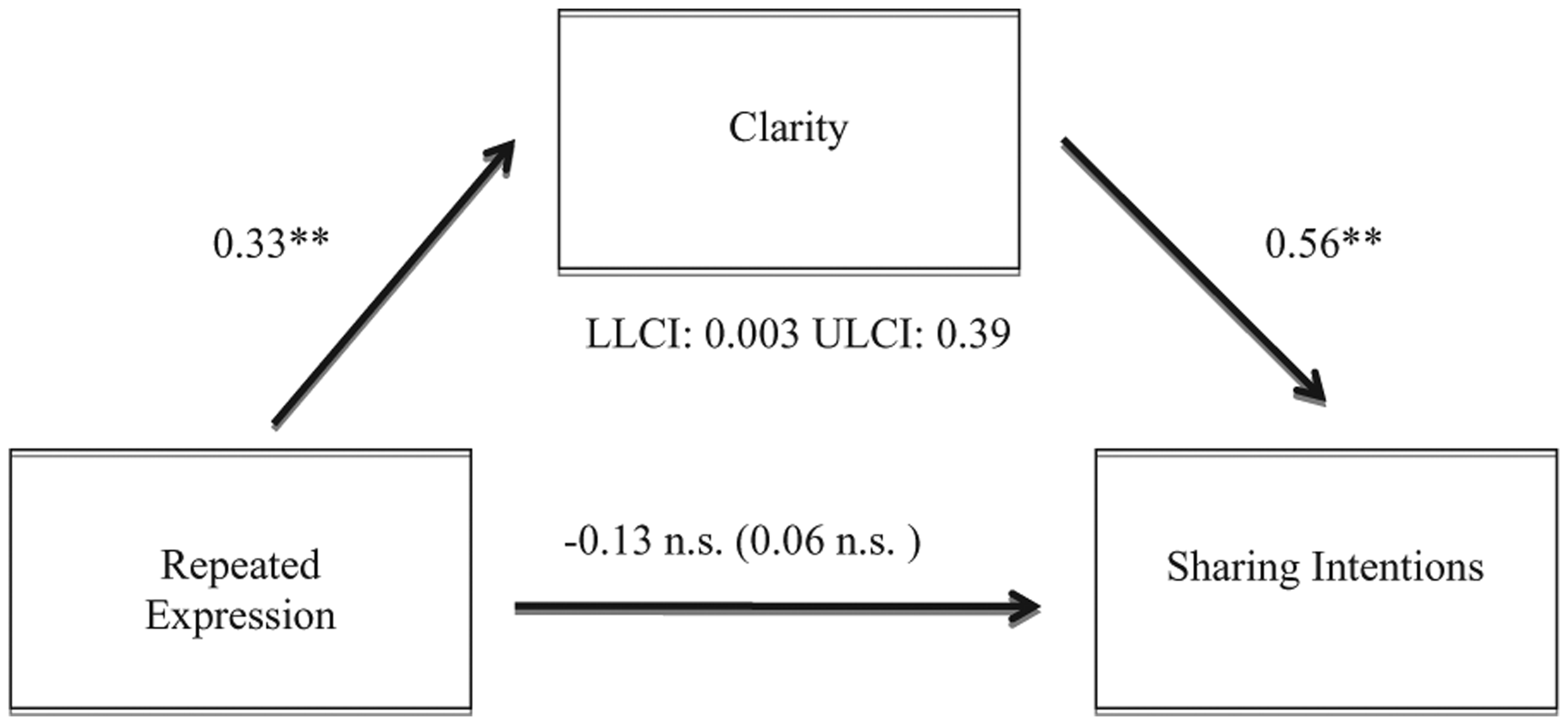
Mediation model for sharing intentions in Study 3.
Next, we conducted a simultaneous regression analysis in which persuasion intentions were predicted by correctness, clarity, and condition. In this case, we found that correctness was a significant predictor (b = .69, SE = .07, p < .001), but neither clarity (b = 0, SE = .09, p = .99) nor condition (b = −.134, SE = .20, p = .497) predicted persuasion intentions. These results suggest that correctness continued to have a strong relationship with persuasion intentions, whereas clarity did not. Given that repeated expressions did not affect correctness in the first step, however, we did not proceed further with mediation analysis.
Discussion
Overall, the results of Study 3 were consistent with our predictions. We successfully manipulated clarity without influencing correctness. Moreover, although the total effect of attitude expressions on sharing intentions was not significant, we did find evidence for the predicted indirect effect from repeated expression to sharing intentions through clarity. There was no such evidence for an indirect effect of repeated expression on persuasion intentions. Taken together, these results are consistent with our conceptualization of persuasion intentions as stemming more from correctness and sharing intentions as being at least partly attributable to clarity.
Of course, stronger evidence for the predicted conceptualization would have been provided by a total effect of repeated expressions on sharing intentions. In an attempt to understand this limitation in the evidence from Study 3, we noted what could be a ceiling effect for clarity. Indeed, the clarity means across conditions were quite high and very close to the top of the scale (9). Although we did still observe a significant effect of repeated expression on clarity, it could be that the potential ceiling effect and restricted range it imposed on clarity was responsible for the lack of direct effect of attitude expressions on sharing intentions. Perhaps with greater variance in clarity, or a larger effect of condition on clarity, we would have obtained a significant overall effect of condition on sharing intentions. To address this potential issue, and also test if we could simultaneously manipulate clarity and correctness while still showing that they differentially predict advocacy, we conducted a fourth experiment to follow up on Study 3.
Study 4
In Study 4, we developed a modified version of an attitude expression paradigm in which participants either did not express their attitude at all or expressed it 5 times. This manipulation was designed with two goals in mind: First, we sought to examine whether we could simultaneously influence clarity and correctness with the same manipulation and still provide evidence that they differentially predict advocacy intentions. We hypothesized that having (compared with lacking) an opportunity to think about, consolidate, and express one’s opinion should boost both the feeling that one’s attitude is clear in one’s mind and the feeling that one’s attitude is correct, or valid. This manipulation was based on the notion that increased opportunity for thought about one’s attitude can boost certainty by offering greater opportunity to both identify one’s attitude and evaluate the likely validity of it, or the evidence for it (see also Barden & Tormala, 2014; Clarkson, Tormala, & Leone, 2011). In contrast, when people lack the opportunity to consider and reflect upon their attitude, they might also lack a feeling of clarity and correctness about that attitude (“I’m not sure what I think yet, much less if I’m right.”). Particularly when an attitude issue is novel or unfamiliar, the opportunity to think about or analyze it should promote the mutual perceptions that one knows what one’s opinion is and that that opinion reflects a more reasoned or thoughtful position (Tormala, Clarkson, & Henderson, 2011). Thus, we introduced a novel topic to participants and asked them or did not ask them to report their attitudes toward it. To strengthen this manipulation and hopefully achieve even more separation in certainty across conditions, we conducted a zero versus five (rather than zero vs. one) expression manipulation.
Our second aim was to address the potential ceiling effect issue from Study 3. In particular, if the relatively restricted range of means near the top of the clarity scales hindered our ability to detect the direct effect of attitude expressions on sharing intentions, we thought using a novel issue (which might lower certainty overall) and changing the low expression condition to a no expression condition would address the problem and increase the chances of detecting a significant effect. We predicted that the modified expression manipulation would influence both clarity and correctness and, thus, drive both sharing and persuasion intentions. Critically, however, we expected that whereas correctness would mediate both sharing and persuasion intentions, clarity would map uniquely onto sharing.
Method
Four hundred two participants (Mage = 28.02, SDage = 7.41, 35.8% female) from Amazon’s Mechanical Turk took part in exchange for monetary compensation.
8
At the outset, participants received information about a novel attitude issue: the instituting of a mandatory year of service at many universities (adapted from Baker & Petty, 1994; Tormala, DeSensi, & Petty, 2007). Participants read,
Many universities in the United States are considering instituting a mandatory year of service before students can graduate with their Bachelors degree. This year of service would entail doing some sort of work that will benefit society, allowing students to either create their own service project or be a part of a University arranged project.
Following this general description, participants were randomly assigned to an attitude expression condition. This manipulation was similar to version 1 of the manipulation from Study 3, with the exception that participants in the low expression condition reported their attitude 0 times. (Participants in this condition moved directly from the issue description to the attitude certainty measures. We worded the opening issue description carefully so that this transition would seem reasonable to participants.) Following the attitude expression manipulation, participants completed measures of global attitude certainty, clarity and correctness (randomly ordered), and sharing and persuasion intentions using the same items as in the earlier studies, but framed in terms of the new university service program.
Results
Global attitude certainty
First, we found a significant effect of attitude expression on global certainty, t(397) = −8.32, p < .001, 95% CI = [−2.19, −1.35], d = .84. Participants in the repeated expression condition (M = 6.95, SD = 1.92) felt significantly more certain of their attitudes than did those in the no expression condition (M = 5.18, SD = 2.30). 9
Attitude clarity
We then considered the implications of our manipulation for clarity (α = .92). We found a significant effect of attitude expression on clarity, t(400) = −4.64, p < .001, 95% CI = [−1.11, −0.45], d = .47, such that participants in the repeated expression condition (M = 7.36, SD = 1.58) felt significantly greater clarity than did those in the no expression condition (M = 6.58, SD = 1.78). Also, as intended, the means were slightly lower on this index than in the previous study.
Attitude correctness
On correctness as well (α = .85), we found a significant effect of expression condition, t(400) = −3.83, p < .001, 95% CI = [−1.06, −0.34], d = .38, such that participants in the repeated expression condition (M = 6.12, SD = 1.75) reported feeling significantly more correct than did those in the no expression condition (M = 5.42, SD = 1.90).
Sharing intentions
We next tested the implications of our manipulation for sharing intentions (α = .84). Here, we found a marginally significant effect of attitude expression, t(400) = −1.76, p = .08, 95% CI = [−0.77, 0.04], d = .18. Participants in the repeated expression condition (M = 5.64, SD = 2.11) tended to express stronger sharing intentions than did those in the no expression condition (M = 5.28, SD = 2.03).
Persuasion intentions
Finally, we tested the attitude expression effect on persuasion intentions (α = .91) and found a significant effect, t(400) = −1.98, p = .05, 95% CI = [−0.87, −0.002], d = .20. Participants in the repeated expression condition (M = 4.57, SD = 2.31) expressed more persuasion intentions than did those in the no expression condition (M = 4.14, SD = 2.13).
Mediation
To assess mediation, we followed the same procedure as in the previous studies. First, we conducted a simultaneous regression analysis in which sharing intentions were predicted by correctness, clarity, and attitude expression condition (dummy coded: 0 = no expression, 1 = repeated expression). We found that correctness (b = .265, SE = .07, p < .001) and clarity (b = .290, SE = .07, p < .001) were significant predictors, whereas condition was not (b = −.048, SE = −.19, p = .81). Because condition influenced both clarity and correctness, and both clarity and correctness predicted sharing intentions, we tested their parallel mediating roles in guiding the sharing outcome. As illustrated in Figure 4, this analysis revealed significant indirect effects for both correctness (CI = [0.080, 0.338]) and clarity (CI = [0.099, 0.409]).
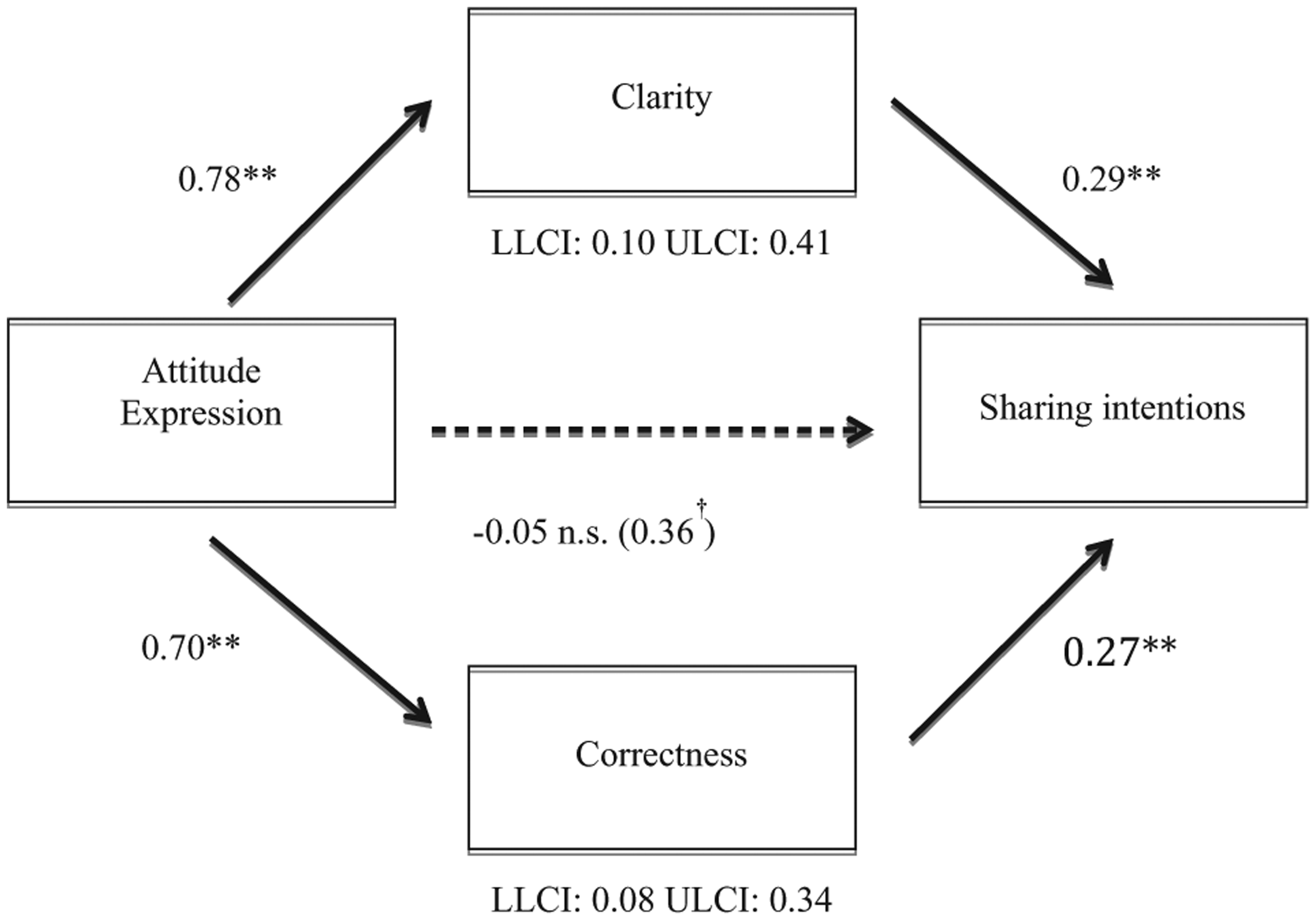
Mediation model for sharing intentions in Study 4.
Next, we conducted a simultaneous regression analysis in which persuasion intentions were predicted by correctness, clarity, and condition. In this case we found that correctness was a significant predictor (b = .588, SE = .07, p < .001), but neither clarity (b = .05, SE = .07, p = .49) nor condition (b = −.011, SE = .20, p = .95) predicted persuasion intentions. As observed in our earlier studies, then, correctness continued to have a strong relationship with persuasion intentions whereas clarity did not. To provide direct evidence that correctness mediated the relationship between attitude expression and persuasion intentions, we again followed the recommendations of Preacher and Hayes (2008), although this time we did not test parallel mediation as the regression analysis uncovered no relationship between clarity and persuasion intentions. As shown in Figure 5, correctness mediated the manipulation effect on persuasion intentions (CI = [0.217, 0.672]). 10

Mediation model for persuasion intentions in Study 4.
Discussion
The results of Study 4 were consistent with our predictions. The adapted attitude expression manipulation affected both clarity and correctness, and thus enabled us to show that even when the same independent variable influences those constructs—that is, even when they derive from the same situational source and vary in the same direction—they differentially foster sharing and persuasion intentions. Replicating our earlier findings, correctness reliably influenced both sharing and persuasion intentions, whereas clarity influenced only sharing intentions.
General Discussion
Previous research reveals that attitude certainty can play an important role in advocacy. Across four studies, the current research provides evidence for a more specific mapping of this effect onto correctness and clarity. Correctness appears to be a driver of persuasion intentions, whereas both correctness and clarity play roles in directing sharing intentions. In other words, the drive to persuade others appears to emanate from correctness rather than clarity. The drive to share one’s opinion with others, however, is mutually influenced by both constructs.
Study 1 provided correlational evidence for this mapping. Studies 2 to 4 provided experimental evidence. Study 2 manipulated correctness through a consensus manipulation and found that it fostered persuasion and sharing intentions. Study 3 manipulated clarity through a repeated expression manipulation and found that it promoted sharing but not persuasion intentions. Finally, in Study 4, we developed a new attitude expression manipulation to experimentally vary both correctness and clarity, which allowed us to demonstrate that even when these constructs move simultaneously (and in the same direction), their roles in guiding persuasion and sharing intentions are separable. Across studies, we observed this overall pattern using a number of different attitude issues, including gun control, labeling of GMOs, and a novel university service policy, among others. Furthermore, on balance, our evidence suggests that these effects are largely independent of attitude extremity. Although the mediating pathway from repeated expression to sharing intentions through attitude clarity was no longer significant after controlling for extremity in Study 3, clarity did remain a significant predictor of sharing intentions after controlling for extremity. In each of the other studies in which we measured attitudes, controlling for attitude extremity had no discernable impact on our findings.
The current results contribute to the extant literature not only by expanding our understanding of the drivers of advocacy—a vitally important yet understudied topic in attitudes and persuasion research—but also by deepening our insight into attitude certainty. Petrocelli et al. (2007) provided the first evidence that certainty could be construed in terms of clarity and correctness, and shed light on the unique origins of these constructs. The current research makes a critical contribution in this area by demonstrating that clarity and correctness have unique consequences as well. The original Petrocelli et al. studies demonstrated that clarity and correctness independently contributed to resistance to persuasion. Rios et al. (2014) found that clarity and correctness could be separated in terms of their implications for conflict style—correctness increased competitiveness whereas clarity had no effect. The current research is the first to show that clarity and correctness both matter but are uniquely tied to different forms of advocacy.
Interestingly, unlike the current research and related recent work showing that attitude certainty helps promote advocacy, research on self-certainty has sometimes shown the opposite: that uncertainty is what prompts advocacy-type behavior (e.g., Rios, Wheeler, & Miller, 2012; see also Gal & Rucker, 2010). That work suggests that people sometimes share their views about an issue to compensate for self-uncertainty and perhaps to strengthen their commitment to their own beliefs (see Higgins & Rholes, 1978). Why do attitude certainty and self-certainty seem to affect advocacy in different ways? We can only speculate, but perhaps when people feel uncertain about themselves, it activates a different set of motives and needs compared with when they feel uncertain about an attitude. Direct investigation of this issue would be an important next step in further strengthening our understanding of the relationship between certainty and advocacy.
Future Directions
Looking forward, we see a number of interesting and potentially important directions for future research. For example, although attitude certainty appears to play an important role in engendering advocacy, it is likely just one of many determinants. We see the current studies, along with recent research by Akhtar et al. (2013), as sounding a call for research that more systematically charts out the causal origins of advocacy. When and why do people advocate on behalf of their beliefs and opinions? This is an important yet oft overlooked question for attitudes and persuasion researchers. We hope the current research encourages others to examine additional determinants.
One possibility could be to examine the role that power might play in fostering advocacy intentions. According to the power literature, an increased sense of power activates an action orientation and other approach-related tendencies (Galinsky, Gruenfeld, & Magee, 2003; Keltner, Gruenfeld, & Anderson, 2003; Rucker, Galinsky, & Dubois, 2012). This increased action orientation likely could translate into advocacy. Consistent with this line of reasoning, Moreland and Levine (1989) found that high-power group members have a tendency to be more actively engaged in group discussions, and are more likely to advocate their beliefs to other group members. Low-power group members, by contrast, are more withdrawn and less likely to advocate. The current research suggests that it might be worth considering the role of certainty—and correctness in particular—in this phenomenon. According to Briñol, Petty, Valle, Rucker, and Becerra (2007), when people are made to feel powerful before exposure to a persuasive message, their existing views can be validated, suggesting that power likely makes people feel more correct about their beliefs. Thus, perhaps power produces persuasion intentions as well. Alternatively, maybe attitude correctness, like power, produces action orientation, whereas clarity does not. Future studies exploring these issues would be worthwhile.
It also would be useful to explore other dimensions of attitude strength, such as attitude importance, to assess their roles in stimulating advocacy. Past research by Visser et al. (2003) indicates that attitude importance predicts voting behavior, but it remains to be seen if it also contributes to advocacy in the way that we define it in the current research. We suspect that attitude importance does facilitate advocacy, but understanding how it maps onto the distinct aspects of persuasion and sharing intentions awaits empirical scrutiny. Another interesting possibility is that attitude importance moderates the effect of attitude certainty on advocacy. Feeling certain of particularly important attitudes, for instance, might boost persuasion intentions regardless of whether the operative factor is clarity or correctness. Or perhaps importance amplifies the effects of clarity and correctness examined in this research. That is, it could be that clarity and correctness predict sharing and persuasion intentions when the attitude or issue is important but not when it is unimportant. Given the policy issues we used in the current studies, we assume that most participants thought the issues were at least moderately important. Perhaps with less important issues, the relationships we observed would be attenuated. Relatedly, attitudes tied to moral values might sometimes feel more important, or perhaps more objective by default (Goodwin & Darley, 2012). When they do, perhaps clarity and correctness are equally likely to foster persuasion intentions. Further investigation in this area would better illuminate our understanding of advocacy and its origins.
We also believe that future research ought to consider behavioral measures, including content analysis of actual advocacy messages that people generate, to further understand the constructs of sharing and persuading and how they manifest in actual advocacy behavior. Recent advocacy studies have used word count as an objective advocacy metric (Akhtar et al., 2013; Gal & Rucker, 2010), but a deeper consideration of the actual content of people’s advocacy messages could help expand our understanding of attitudinal advocacy.
Finally, the current research highlights situational manipulations that can be used to foster different forms of advocacy. Thus, in addition to advancing our theoretical insight into advocacy and its origins, our studies have potential practical implications for designing strategic interventions to promote different forms of advocacy in others. Although exploring these applications is beyond the purview of the current research, we see it as a useful and potentially important direction for subsequent work.
Footnotes
Declaration of Conflicting Interests
The author(s) declared no potential conflicts of interest with respect to the research, authorship, and/or publication of this article.
Funding
The author(s) received no financial support for the research, authorship, and/or publication of this article.

Notes
References
Supplementary Material
Please find the following supplemental material available below.
For Open Access articles published under a Creative Commons License, all supplemental material carries the same license as the article it is associated with.
For non-Open Access articles published, all supplemental material carries a non-exclusive license, and permission requests for re-use of supplemental material or any part of supplemental material shall be sent directly to the copyright owner as specified in the copyright notice associated with the article.
