



Abstract
Autonomy-supportive parenting yields manifold benefits. To gain more insight into the family-level dynamics involved in autonomy-supportive parenting, the present study addressed three issues. First, on the basis of self-determination theory, we examined whether mothers’ satisfaction of the psychological needs for autonomy, competence, and relatedness related to autonomy-supportive parenting. Second, we investigated maternal autonomy support as an intervening variable in the mother–child similarity in psychological need satisfaction. Third, we examined associations between autonomy-supportive parenting and autonomy-supportive sibling interactions. Participants were 154 mothers (M age = 39.45, SD = 3.96) and their two elementary school-age children (M age = 8.54, SD = 0.89 and M age = 10.38, SD = 0.87). Although mothers’ psychological need satisfaction related only to maternal autonomy support in the younger siblings, autonomy-supportive parenting related to psychological need satisfaction in both siblings and to an autonomy-supportive interaction style between siblings. We discuss the importance of maternal autonomy support for family-level dynamics.
Key to children’s development is parents’ support of autonomy, such that children engage in daily activities with a sense of willingness and volition rather than out of obligation and pressure (Ryan, Deci, Grolnick, & La Guardia, 2006). Various scholars have highlighted the importance of autonomy for children’s development (e.g., Nucci, 2013; Smetana & Asquith, 1994). One theory in which the concept of autonomy support takes a prominent place is self-determination theory (SDT), a broad theory on human motivation and socialization (Deci & Ryan, 2000; Vansteenkiste, Niemiec, & Soenens, 2010). SDT states that autonomy support plays a key role in children’s development because it provides the crucial nutrients for growth in the form of satisfaction of the psychological needs for autonomy, competence, and relatedness.
Multiple studies within the SDT-tradition and beyond have indicated that parental autonomy support is crucial for children’s well-being, emotion regulation skills, and adaptive social and cognitive development (Bernier, Carlson, & Whipple, 2010; Grolnick, Ryan, & Deci, 1991; Joussemet, Landry, & Koestner, 2008). Yet, few studies have shed light on the origins of autonomy-supportive parenting (e.g., Grolnick & Apostoleris, 2002). In the present research, we examined whether mothers’ experiences of psychological need satisfaction would relate to an autonomy-supportive child-rearing style and whether autonomy support would, in turn, relate to children’s psychological need satisfaction. Also, research on autonomy support in families has tended to focus on one specific dyad (most often the parent–child dyad) without examining the interplay between different dyads in the family. As such, to the best of our knowledge, research has not yet examined whether maternal autonomy support is related to the way siblings interact with each other. This is unfortunate because in middle childhood sibling relationships take a prominent role and substantially affect children’s psychosocial adjustment (Gass, Jenkins, & Dunn, 2007). This study addresses the question whether maternal autonomy support is related positively to mutual autonomy support among siblings and whether siblings’ psychological need satisfaction plays an intervening role in this relation.
Parental Autonomy Support and Children’s Psychological Need Satisfaction
In SDT, autonomy-supportive parenting is defined as parents’ promotion of volitional functioning in children (e.g., Grolnick et al., 1991; Ryan et al., 2006). A key characteristic of parental autonomy support is parents’ capacity to adopt and accept the frame of reference of their children. When doing so, parents are capable of providing the desired amount of choice to their children, to stimulate their children to take initiative thereby following children’s pace of development, and to provide rationales for requests that are personally meaningful to their children (Grolnick et al., 1991; Joussemet, Landry, & Koestner, 2008; Soenens & Vansteenkiste, 2010). In contrast, autonomy-suppressing parenting involves being controlling. Controlling parents minimize, ignore, or deny the child’s perspective, thereby imposing their own viewpoint by making use of a variety of pressuring strategies (Grolnick & Pomerantz, 2009), such as guilt induction, love withdrawal, verbal hostility, and physical punishment (Soenens & Vansteenkiste, 2010).
Within SDT, it is stated that parental autonomy support contributes to optimal psychosocial development through the satisfaction of children’s psychological needs (Grolnick et al., 1991; Joussemet, Landry, & Koestner, 2008). SDT postulates three needs, that is, the needs for autonomy, competence, and relatedness (Deci & Ryan, 2000; Vansteenkiste et al., 2010). The need for autonomy concerns experiencing a sense of volition and self-endorsement when carrying out an activity. Satisfaction of this need is apparent, for example, when children do chores in the house willingly or when they are offered the opportunity to express irritation or sadness vis-à-vis the parents. The need for competence entails the experience of mastery in executing daily activities and effective coping with challenges. This need is satisfied, for example, when children feel proficient when doing homework or when they feel capable of developing their music skills. Finally, the need for relatedness signifies having warm and trusting relationships. The need for relatedness is satisfied when children feel connected with their parents and experience a sense of authentic care.
The satisfaction of these psychological needs relates positively to a variety of beneficial outcomes (for an overview, see Deci & Ryan, 2000). Although previous research found such relations systematically in adult samples (e.g., Van den Broeck, Vansteenkiste, Lens, De Witte, & Soenens, 2010), the number of studies involving elementary school children, the population targeted in the present research, is more limited. Véronneau, Koestner, and Abela (2005) showed that third to seventh graders’ overall need satisfaction yielded a concurrent positive relation to a composite score of well-being. Sebire, Jago, Fox, Edwards, and Thompson (2013) found in a cross-sectional study that need satisfaction in 7- to 11-year-old children related positively to greater enjoyment of physical activity.
Furthermore, consistent with theorizing, parental autonomy support was found to relate to need satisfaction in children and adolescents between 9 and 20 years old (Sheldon, Abad, & Omoile, 2009). Moreover, studies among elementary school-age children showed that parental autonomy support is related to beneficial outcomes such as school performance (Grolnick et al., 1991), interest in mathematics (Aunola, Viljaranta, Lehtinen, & Nurmi, 2013), and autonomous motivation for engaging in physical activity (Vierling, Standage, & Treasure, 2007). Need satisfaction was found to account for many of these associations (e.g., Grolnick et al., 1991). In contrast, autonomy-suppressing (i.e., controlling) parenting was found to relate to adolescent ill-being and problem behaviors via reduced need satisfaction (Ahmad, Vansteenkiste, & Soenens, 2013; Mabbe, Soenens, Vansteenkiste, & Van Leeuwen 2015).
Parents’ Own Psychological Need Satisfaction and Parental Autonomy Support
Given the benefits associated with autonomy-supportive, relative to more controlling, parenting, the present study aimed to examine whether parental psychological need satisfaction represents a critical resource for parents (mothers) to be autonomy-supportive. That is, processes of need satisfaction would help not only to explain why autonomy-supportive parenting is related to outcomes in children but also to predict why some parents are more autonomy-supportive than others. We reasoned that when parents experience in general a sense of psychological freedom and volition (i.e., autonomy satisfaction), feel able to effectively engage in daily activities (i.e., competence satisfaction), and feel related to other persons (i.e., relatedness satisfaction), they are likely to have more energy available. Energy is defined herein as the feeling of vitality and being alive (Ryan & Frederick, 1997). Such elevated energy would then manifest more specifically via enhanced receptivity toward the child (Hodgins, Koestner, & Duncan, 1996) and psychological availability to be attuned to the child’s viewpoint (Danner-Vlaardingerbroek, Kluwer, Van Steenbergen, & Van der Lippe, 2013). These resources are probably key to provide meaningful choices, to encourage initiative, and to constructively handle child resistance through dialogue. Instead, the frustration of these needs would generally reduce parents’ level of energy. This, in turn, would prompt a more self-centered and defensive attitude (Hodgins et al., 1996), such that parents would more easily impose their own expectations on their children in a pressuring way.
Several strands of work have provided indirect evidence for this reasoning. First, the energy-boosting effects of need satisfaction and the energy-depleting effects of need frustration have been documented extensively (for an overview, see Ryan & Deci, 2008). For example, daily fluctuations in the satisfaction of the need for autonomy and competence related positively to daily fluctuations in vitality (Reis, Sheldon, Gable, Roscoe, & Ryan, 2000), whereas need frustration related to emotional exhaustion (Vander Elst, Van den Broeck, De Witte, & De Cuyper, 2012). In addition, energy was found to be crucial for parenting as it was associated positively with parental self-efficacy and with feelings of satisfaction with one’s parenting (Janisse, Barnett, & Nies, 2009).
Furthermore, a number of studies found that context-specific need satisfaction is related positively to an autonomy-supportive socialization style within that context. For instance, coaches’ need satisfaction in the context of sport is related positively to coaches’ autonomy support toward athletes (e.g., Stebbings, Taylor, Spray, & Ntoumanis, 2012) and teachers’ need satisfaction in the context of school is related positively to the provision of autonomy toward students (e.g., Van den Berghe et al., 2014). Similar evidence for an association between parental need satisfaction and autonomy-supportive parenting is indirect at best. In one relevant study, de Haan, Soenens, Dekovic, and Prinzie (2013) showed that indirect measures of parental need satisfaction, as reported by the parents, related negatively to autonomy-suppressing (i.e., overreactive or controlling) parenting, as reported by early and middle adolescents.
We must note, however, that in each of these previous studies, need satisfaction and autonomy-supportive socialization were assessed within the same context. In contrast, this study investigated whether need satisfaction as experienced by mothers in general (i.e., across contexts) would spill over to their provision of autonomy support in one specific relation, that is, the mother–child relationship. According to the ecological perspective on child development (Bronfenbrenner, 1986), the parent–child relationship is influenced by parents’ experiences in other contexts (e.g., work). Consistent with this argument, Danner-Vlaardingerbroek et al. (2013) found that parents who had a bad day at work had more negative interactions with their child after that workday, whereas a good day at work fostered a more positive parent–child interaction.
Autonomy-Supportive Interactions Among Siblings
Research has demonstrated convincingly the relational benefits of maternal autonomy support outside the family, with children of autonomy-supportive parents, for instance, reporting higher social competence (e.g., Soenens & Vansteenkiste, 2005) and less physical aggression toward peers (e.g., Joussemet, Vitaro, et al., 2008). In the present study, we examined whether similar benefits of maternal autonomy support would emerge within the family, that is, in sibling relationships. This is an important issue because sibling relationships are a critical predictor of children’s adjustment, in particular during middle childhood and adolescence (Furman & Buhrmester, 1992). Research in middle childhood and adolescence has shown that the way siblings interact with each other relates to their psychological functioning. For example, autonomy-suppressive sibling interactions are related to adjustment problems, reduced self-confidence (Conger, Conger, & Scaramella, 1997), as well as to anxiety and depressive symptoms (Campione-Barr, Lindell, Greer, & Rose, 2014).
Herein, we aimed to investigate whether an autonomy-supportive parenting style would relate to an autonomy-supportive interaction style between siblings. To the best of our knowledge, this question has not been investigated previously. Yet, previous studies have shown that the quality of the parent–child relationship and the quality of the sibling relationship are related (e.g., Brody, Stoneman, & McCoy, 1994; McHale, Whiteman, Kim, & Crouter, 2007). For example, in a sample of parents and their 8- to 12-year-old children, Hakvoort, Bos, Van Balen, and Hermanns (2010) found that parent–child relationships characterized by warmth and low levels of conflict were associated with more affectionate and less conflictual sibling relationships. A study among adolescents showed that an autonomy-suppressive (i.e., psychologically controlling) parenting style was associated with a similar autonomy-suppressive interaction style between siblings (Conger et al., 1997).
In addition to investigating the relation between an autonomy-supportive parenting style and autonomy-supportive sibling interactions, we also investigated the possible mechanism behind this association. We propose that need satisfaction plays an important intervening role. Similar to the reasoning with regard to parental need satisfaction, we hypothesize that children who experience more need satisfaction (due to experiencing more maternal autonomy support) have more energy available to engage in an autonomy-supportive interaction style vis-à-vis their sibling.
The present study focused on middle childhood (i.e., the life period beginning around age 7 or 8 until about the age of 12) because sibling interactions in this period are numerous and of a high intensity. Indeed, in this developmental period, children spend most of their free time with their siblings (Bank & Kahn, 1982; McHale & Crouter, 1996). Furthermore, Buhrmester and Furman (1990) showed that sibling relationships in this period are highly intense as indicated by both more experienced closeness and more conflict between siblings compared with sibling relationships during adolescence. Therefore, it seems particularly important to examine a possible spillover from maternal to sibling autonomy support during this developmental period.
The Present Study
This study had three important aims, which we investigated in a sample of mothers and their two elementary school-age children. A first aim was to examine whether mothers’ psychological need satisfaction would relate to their use of an autonomy-supportive interaction style. On the basis of the argument that need satisfaction provides mothers with energy and important resources, we expected that maternal psychological need satisfaction would relate positively to child-perceived autonomy support (Hypothesis 1). To examine whether mothers’ overall adjustment would serve as a confounding variable accounting for the contribution of mothers’ need satisfaction to autonomy support, we controlled for maternal differences in self-esteem. To illustrate, a mother who feels valuable may experience both more need satisfaction and be perceived as providing more autonomy support, such that maternal self-esteem accounts for the association between maternal need satisfaction and autonomy support.
Second, given that we expected that maternal autonomy support would relate to psychological need satisfaction in the child, we also examined whether maternal autonomy support would represent an intervening variable in the intergenerational similarity in mothers’ and children’s psychological need satisfaction. We anticipated that maternal need satisfaction would be related to children’s need satisfaction through mothers’ adoption of an autonomy-supportive style (Hypothesis 2).
A third aim was to investigate whether maternal autonomy support would relate to autonomy support in sibling relationships through children’s psychological need satisfaction. Indeed, children’s experiences of psychological need satisfaction (as fostered by maternal autonomy support) may allow the children to engage in more autonomy-supportive interactions with their siblings. Thus, we hypothesized that perceived maternal autonomy support would spill over to sibling autonomy support via siblings’ experiences of need satisfaction (Hypothesis 3). The full hypothesized model is displayed graphically in Figure 1.
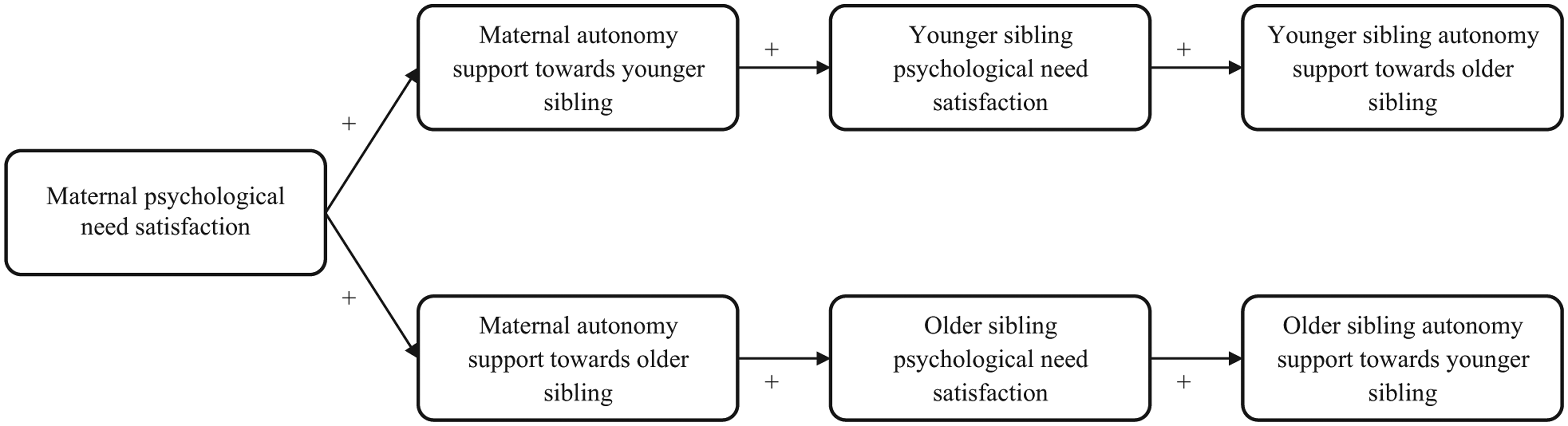
The hypothesized model based on self-determination theory.
Method
Participants and Procedure
Participants were mothers (N = 154, M age = 39.45, SD = 3.96) and two of their children (N = 308). Of these two children, the younger siblings were on average 8.54 years old (SD = 0.89), and the older siblings were on average 10.38 years old (SD = 0.87). All children attended elementary school. Of the children, 55% were female. The distribution of gender did not differ between the younger and older participants: 53% girls in the younger group and 56% girls in the older group, χ2(1) = .21, p = .65. In most families, there were two (49%) or three (33%) children. The majority of mothers followed higher education (78%) and were married (85%).
Families were recruited as part of an undergraduate course in developmental psychology in which students were asked to invite two families (who were not relatives or close friends of the student) with at least two elementary school children between 8 and 12 years old. If a family had more than two children between 8 and 12 years old, we informed students to select those two children who were closest to each other with respect to their age. Furthermore, we trained students to approach potentially interested families and to assist the children in filling out the questionnaires. Students also asked mothers to remind their children to fill out the diary questionnaires (see below) each day. Participation was voluntary, and confidentiality was guaranteed. Mothers gave their written consent on behalf of themselves and their children.
Students administered questionnaires via a home visit and a diary. During the home visit, children filled out a questionnaire assessing perceived maternal autonomy support and both mothers and children filled out a questionnaire concerning psychological need satisfaction. We had two reasons to include a measure of child-perceived autonomy support. First, the association between mothers’ need satisfaction and maternal reports of provided autonomy support could be driven by shared method variance, a problem that can be overcome by relying on different reporters (i.e., maternal report of need satisfaction and child reports of autonomy support). Second, previous research showed that the association between parental and child reports of parenting is rather modest (e.g., Schwarz, Barton-Henry, & Pruzinsky, 1985), with especially child perceptions of parenting relating to child outcomes.
Children were also provided with a diary booklet, tapping into daily sibling autonomy support, which they filled out once a day during five consecutive schooldays. Specifically, we asked each sibling to report daily on the degree to which she or he received autonomy support from the other sibling (of which an average score across all days was created), which yielded an important methodological advantage. When examining the association between the degree to which each sibling experienced need satisfaction and provided autonomy support, we used the younger sibling’s report of need satisfaction and the older sibling’s report of the degree to which she or he received autonomy support from the younger sibling (and vice versa). In doing so, we avoided the problem of shared method variance. In addition, an important advantage of the used diary methodology is that it reduces recall bias (Laurenceau & Bolger, 2005) and, as such, may provide a more veridical picture of the degree to which siblings support each other’s autonomy.
Measures
Psychological need satisfaction
Both mothers and children filled out the Basic Psychological Need Satisfaction and Need Frustration Scale (BPNSNF; Chen et al., 2015). This 24-item questionnaire measures the satisfaction (4 items per need) as well as the frustration (4 items per need) of the three psychological needs. We slightly simplified the items of this questionnaire in the child version as to fit the age of the participants. Example items from the child version are “I feel a sense of freedom in the things I do” (i.e., autonomy satisfaction), “I feel forced to do many things I actually don’t want to do” (i.e., autonomy frustration), “I feel confident that I can do things well” (i.e., competence satisfaction), “I have serious doubts about whether I can do things well” (i.e., competence frustration), “I feel close to other people I care about” (i.e., relatedness satisfaction), and “I feel that people who are important to me are unfriendly to me” (i.e., relatedness frustration). We reverse scored the 12 items assessing need frustration and averaged these with the 12 items assessing need satisfaction to obtain an aggregate score of need satisfaction versus frustration, as has been done in previous research (e.g., Baard, Deci, & Ryan, 2004). For ease of presentation, we will refer to this score as a score for need satisfaction. The scale was reliable both for mothers (α = .89) and children (α = .76 for the younger children and α = .84 for the older children).
Maternal autonomy support
Children were administered a seven-item Dutch version (Vansteenkiste, Zhou, Lens, & Soenens, 2005) of the Autonomy Support Scale of the Perceptions of Parents Scale (POPS; Grolnick et al., 1991; for example, “My mother, whenever possible, allows me to choose what to do”). This scale contains only two items tapping into autonomy-suppressing (controlling) parenting. To better capture the autonomy-suppressing pole of this parenting dimension, participants also filled out a Dutch version (Soenens, Vansteenkiste, Luyckx, & Goossens, 2006) of the eight-item Psychological Control Scale–Youth Self-Report (PCS-YSR; Barber, 1996). An example item is “My mother is less friendly with me if I do not see things her way.” Items from both scales were slightly simplified to make them appropriate and readable for elementary school children. As in previous studies (e.g., Kins, Beyers, Soenens, & Vansteenkiste, 2009; Soenens & Vansteenkiste, 2005), we reverse scored items for psychological control and averaged these with items for autonomy support to obtain an aggregate score of perceived maternal autonomy support versus control. For ease of presentation, we will refer to this score simply as a score for perceived maternal autonomy support. This scale was reliable (α = .77 for the younger children and α = .74 for the older children).
Sibling autonomy support
Autonomy support from the sibling, as experienced by the children, was assessed daily during 5 days by means of a shortened and slightly adjusted version of the maternal autonomy support scale discussed in the previous paragraph. For this purpose, we replaced references to “my mother” with “my brother or sister” and adapted the items to assess daily autonomy support. In addition, we selected those items of the maternal autonomy support scale that were most suitable for daily assessments of autonomy support as well as for the sibling relationship. In this way, we ended up with four items for autonomy support (e.g., “Today, whenever possible, my brother or sister allowed me to choose what to do”) and four items for psychological control (e.g., “Today my brother or sister was less friendly with me if I did not see things his or her way”). All eight items were averaged across the 5 days. As with the scale for maternal autonomy support, we reverse scored items tapping into psychological control and averaged these with the autonomy support items. This scale was reliable (α = .81 for the younger children and α = .88 for the older children). The response rate across these 5 days was high as only one child did not fill out the diary questionnaires each day.
Mothers’ level of self-esteem
We included the Dutch version (Franck, De Raedt, Barbez, & Rosseel, 2008) of the Rosenberg Self-Esteem Scale (RSES; Rosenberg, 1979) to assess self-esteem in mothers. This scale consists of 10 items (e.g., “On the whole, I am satisfied with myself”) that were rated on a scale ranging from 0 (strongly disagree) to 3 (strongly agree). This scale was reliable (α = .86).
Plan of Analyses
To address our research aims, path models (with manifest variables) were tested using the lavaan package (Rosseel, 2012) of the R system for statistical analyses (Version 2.15.2; R Development Core Team, 2012), with estimation based on robust maximum likelihood. We employed several indices to evaluate the model fit of these models, namely, the comparative fit index (CFI), the χ2 test, the standardized root mean square residual (SRMR), and the root mean square error of approximation (RMSEA). An acceptable fit was indicated by CFI values of .90 or above, χ2/df ratio of 2 or below, and SRMR and RMSEA values of around .08 or below (Hu & Bentler, 1999; Kline, 2005).
In total, we tested four different path models. In all models, we controlled for age and gender of the children. In a first model, we tested whether mothers’ need satisfaction would relate to maternal autonomy support as perceived by the children. In a second model, we investigated the relation between mothers’ and children’s need satisfaction. In a third model we examined the mediating role of maternal autonomy support in the relation between mothers’ and children’s need satisfaction. In a fourth and final model, sibling autonomy support was added to the model, with mothers’ and children’s need satisfaction and maternal autonomy support as its predictors. In this final model, we also controlled for perceiver effects (Kenny, 1994). Specifically, there might be a tendency for children to perceive their mother and their sibling as similarly autonomy-supportive. To control for this perceiver tendency, we allowed a path between perceived maternal autonomy support and perceived sibling autonomy support. In all models, we allowed measures of both siblings to be correlated (e.g., need satisfaction of the younger siblings was allowed to be correlated with need satisfaction of the older siblings), as to account for the interdependence in the data (i.e., children from one family are expected to be more similar to one another than children from two different families). Unstandardized paths coefficients and their standard errors are reported in the text and figures. In total, there were 0.65% cases with missing values in the data. By default, the R statistical system treated these cases as structurally missing (i.e., complete case analysis).
To examine whether the associations in these four models would be similar for the two siblings, we performed a multigroup comparison, thereby comparing unconstrained, partially constrained, and fully constrained models. In this way, we could determine whether the relations between the constructs in our model were equally strong for both siblings (e.g., “Is mothers’ need satisfaction associated with children’s need satisfaction to the same degree in younger and older siblings?”). In the unconstrained model, all path coefficients were allowed to be freely estimated between the siblings. In other words, relations in the models were allowed to be different for younger and older siblings. In contrast, in the constrained model, all path coefficients were constrained to be equal for both siblings, thus testing the assumption that the relations were equally strong for both siblings. In the partially constrained models, we gradually constrained path coefficients so that some were constrained to be equal for both siblings and other path coefficients were estimated freely. To decide which of these models fitted the data best, chi-square difference tests were performed. If the fit of the more complex model was significantly better, we reported that model. If models fitted equally well, we reported the more parsimonious model, that is, with (partially) constrained paths.
Results
Descriptive Statistics and Preliminary Analyses
Bivariate correlations between the study variables can be found in Table 1. Mothers’ need satisfaction related to maternal autonomy support experienced by the younger but not the older children. Furthermore, mothers’ need satisfaction related positively to children’s need satisfaction although the association with need satisfaction in the older children was only marginally significant. Perceived maternal autonomy support was related to need satisfaction in both children. Finally, perceived sibling autonomy support, as reported by both the youngest and the oldest child, related positively to mothers’ need satisfaction, to children’s and siblings’ need satisfaction, and to maternal autonomy support according to both children.
Descriptives and Correlations Between the Study Variables.

Note. M = mother report; Y = younger child report; O = older child report.
p < .10. *p < .05. **p < .01. ***p < .001.
We also performed paired-samples t tests to compare the means of need satisfaction, maternal autonomy support, and sibling autonomy support between the younger and older children. As can be seen in Table 1, older children reported receiving more autonomy support from their mothers, t(153) = −4.66, p < .01, and siblings, t(152) = 8.44, p < .01, and there was a marginally significant trend for them to report more need satisfaction than their younger siblings, t(153) = −1.79, p < .10.
Correlational analyses indicated that maternal age and age of the younger siblings were not associated with the study variables. Age of the older siblings did correlate positively with mothers’ need satisfaction (r = .16, p < .05) and with maternal autonomy support as perceived by the older siblings (r = .29, p < .01). Furthermore, we conducted independent-samples t tests to examine effects of family structure (intact or not intact) and gender. No significant effects were found, except for a significant gender difference in older siblings’ need satisfaction, with boys reporting more need satisfaction (M = 4.11, SD = 0.41) than girls (M = 3.86, SD = 0.50), t(152) = −3.40, p < .01. Finally, a one-way analysis of variance indicated that maternal educational level was unrelated to the study variables.
Primary Analyses
Hypothesis 1: Relation between mothers’ psychological need satisfaction and maternal autonomy support.
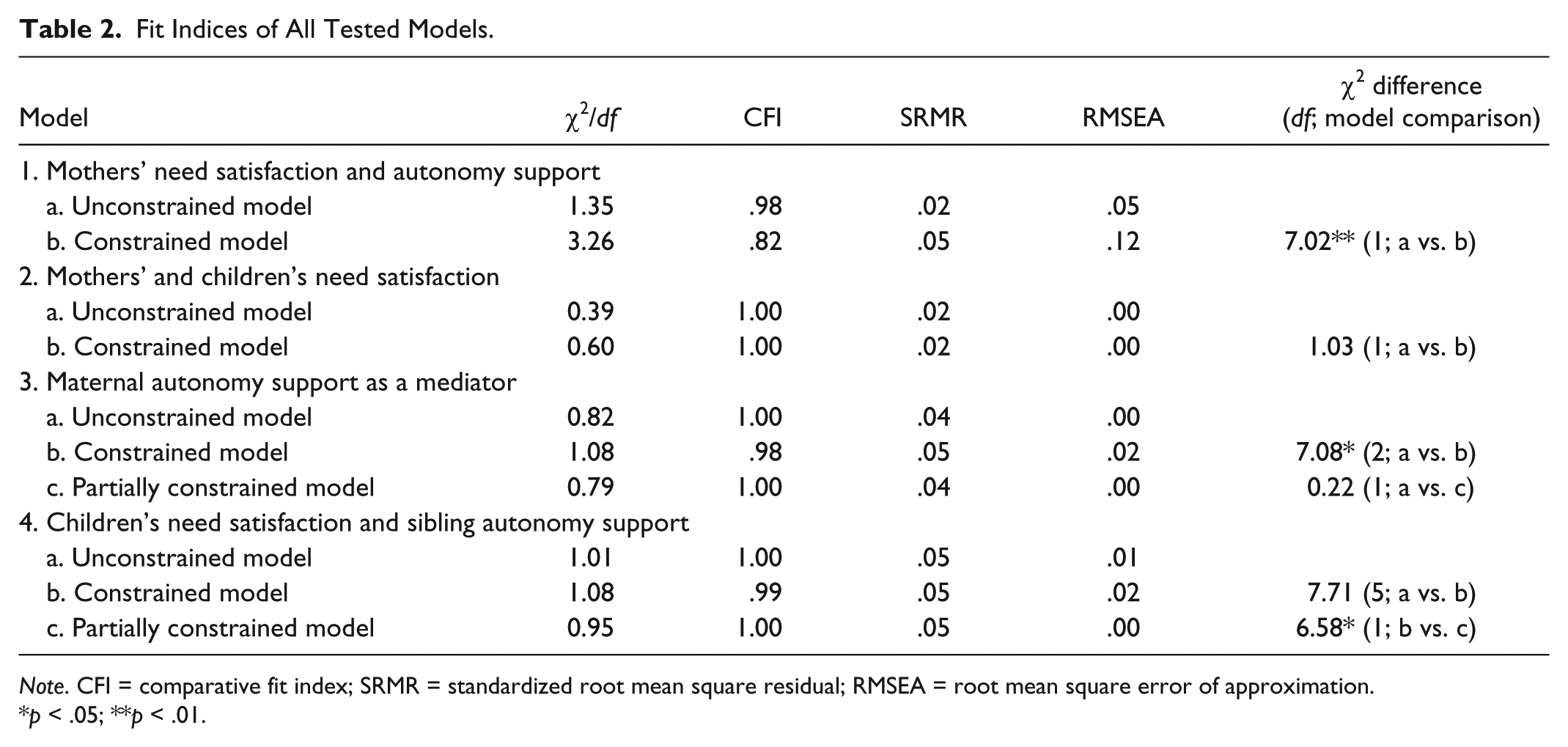
Fit indices of all structural models can be found in Table 2. In the first structural model, we examined whether mothers’ need satisfaction would relate to perceived maternal autonomy support. The fit of the unconstrained model was significantly better than the fit of the constrained model (see Table 2). Mothers’ need satisfaction related positively to maternal autonomy support as reported by the younger sibling, B = .17 (SE = .06), p < .01; 95% confidence interval [CI] = [0.06, 0.28], but not to maternal autonomy support as reported by the older sibling, B = .03 (SE = .04), p > .05; 95% CI [−0.04, 0.11]. In addition, reports of maternal autonomy support provided by both siblings were positively correlated after accounting for mothers’ need satisfaction (r = .27, p < .01).
Fit Indices of All Tested Models.
Note. CFI = comparative fit index; SRMR = standardized root mean square residual; RMSEA = root mean square error of approximation.
p < .05; **p < .01.
Hypothesis 2: Maternal autonomy support as an intervening variable in the mother–child similarity in psychological need satisfaction.
In the second model, we examined whether mothers’ need satisfaction would relate to children’s need satisfaction. The fit of the unconstrained model was similar to the fit of the constrained model (see Table 2), showing that this association did not differ between younger and older siblings. Specifically, mothers’ need satisfaction related positively to both children’s need satisfaction, B = .09 (SE = .03), p < .01; 95% CI [0.04, 0.15]. Furthermore, there was a marginally significant residual association between both siblings’ reports of need satisfaction (r = .18, p < .10).
The third model was a mediation model with perceived maternal autonomy support playing an intervening role in the relation between mothers’ need satisfaction and children’s need satisfaction. We also added a direct path from mothers’ need satisfaction to children’s need satisfaction to the model, but this path was dropped again due to being nonsignificant. The fit of the unconstrained model was not significantly better than the fit of the constrained model (see Table 2), indicating that the associations in this model were similar for both siblings. However, given the results obtained with Model 1, we also tested a partially constrained model in which the first part of the model (i.e., the path from mothers’ need satisfaction to maternal autonomy support) was unconstrained while the second part of the model (i.e., the path from maternal autonomy support to children’s need satisfaction) was constrained. This partially constrained model yielded a better fit to the data than the fully constrained model. This model is displayed graphically in Figure 2. Among the younger children, mothers’ need satisfaction related positively to perceived maternal autonomy support, which, in turn, related to children’s need satisfaction. This indirect effect was significant, B = .05 (SE = .02), p < .01; 95% CI [0.01, 0.09]. In contrast, among the older children, mothers’ need satisfaction did not relate to maternal autonomy support. Maternal autonomy support did relate positively to children’s need satisfaction. Thus, although mothers’ need satisfaction only related to perceived maternal autonomy support in the younger children, experiencing maternal autonomy support was related to need satisfaction in both younger and older children.
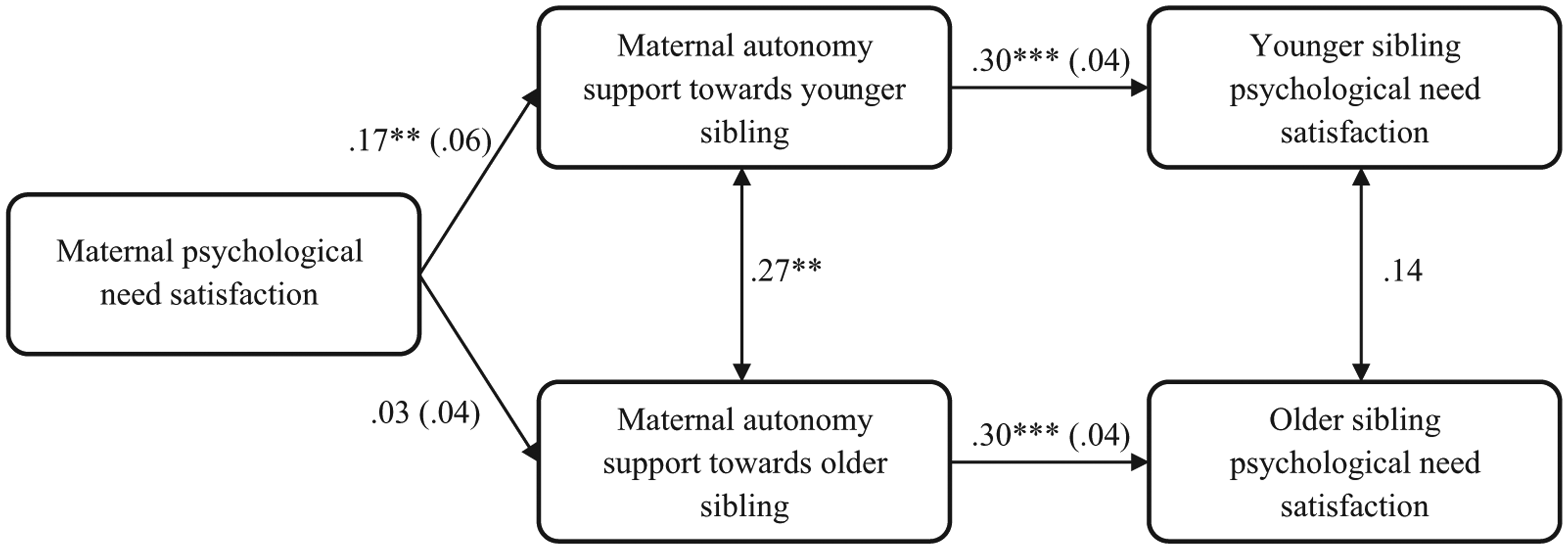
Structural model depicting the relation between mothers’ psychological need satisfaction, perceived maternal autonomy support, and children’s psychological need satisfaction.
Hypothesis 3: Associations between maternal autonomy support and sibling autonomy support.
In Model 4, we added sibling autonomy support as an outcome to Model 3. The overall constrained model fitted the data equally well as the unconstrained model (see Table 2). We also tested several partially constrained models in which different parts of the model were held equal between the siblings. Only one partially constrained model yielded a better fit than the fully constrained model. This model is displayed graphically in Figure 3. In this model, all paths were constrained, except for the path from mothers’ need satisfaction to maternal autonomy support, which was allowed to be estimated freely between the two siblings.

Structural model depicting the relation between mothers’ psychological need satisfaction, perceived maternal autonomy support, children’s psychological need satisfaction, and sibling autonomy support.
In line with the previous models, mothers’ need satisfaction positively predicted maternal autonomy support in the younger children (but not in the older children) and maternal autonomy support related positively to children’s need satisfaction. Furthermore, there was a significant indirect association between maternal autonomy support and sibling autonomy support via children’s need satisfaction, B = .07 (SE = .03), p < .01; 95% CI [0.02, 0.12]. The direct path between maternal and sibling autonomy support was not significant. Notably, there also was a direct positive association between mothers’ need satisfaction and sibling autonomy support. Both effects were obtained after taking into account a strong perceiver effect: Children tended to perceive their mother and their sibling as similarly autonomy-supportive. Finally, maternal autonomy support, need satisfaction, and sibling autonomy support experienced by the younger children related positively to the corresponding measures in the older children (although only marginally significant with respect to need satisfaction).
Supplementary Analyses
In a series of supplementary analyses, we examined the robustness of our proposed model. First, to investigate the generalizability of our model across child age and gender, we included both background variables as moderators in the following relations: (a) mothers’ need satisfaction to maternal autonomy support, (b) maternal autonomy support to children’s need satisfaction, and (c) children’s need satisfaction to sibling autonomy support. None of the interaction terms involving child age and gender were significant, indicating that age and gender of the child did not moderate the main paths in our final model. 1 To investigate whether the gender composition of the sibling pairs affected the paths in our final model, we performed a multigroup comparison. Specifically, we created three groups of sibling pairs: (a) sibling pairs of two sisters, (b) siblings pairs of two brothers, and (c) sibling pairs of one sister and one brother. We compared an unconstrained version of the final model (Model 4; that is, a version of the model in which the parameters were allowed to vary across the three sibling groups) with a model wherein we constrained all paths in the model to be similar for three groups of sibling pairs. In this way, we could determine whether the relations between the constructs in our model were equally strong for these three types of sibling pairs. A chi-square difference test indicated that both models fitted the data equally well, indicating that the paths in the model did not differ between the three types of sibling pairs, χ2 difference (36) = 46.59, p < .05.
Second, to examine whether mothers’ self-esteem would serve as a confounding variable in the relation between mothers’ need satisfaction and autonomy support (for the younger siblings), we tested a series of models wherein we controlled for maternal differences in self-esteem. Results showed that the initial associations observed in Model 1 remained significant, with maternal need satisfaction yielding a significant positive association with maternal autonomy support as reported by the younger sibling, B = .31 (SE = .08), p < .01, but not as reported by the older sibling, B = −.01 (SE = .06), p > .05. As for Model 2, maternal need satisfaction also remained associated significantly with children’s need satisfaction, B = .09 (SE = .04), p < .05, for both siblings, after controlling for maternal self-esteem. These findings suggest that the observed associations of maternal need satisfaction with perceived autonomy support and sibling need satisfaction are not spurious.
Third, we tested a model wherein all the paths in our final model (Model 4) were reversed. It is indeed possible that the degree to which a mother is autonomy-supportive (according to her children) predicts her level of psychological need satisfaction. In general, all paths in this reversed model were positive and significant, with the exception of the path from maternal autonomy support as reported by the older sibling to mothers’ need satisfaction. The Akaike Information Criterion (AIC) was used to decide whether this reversed model or the final model (Model 4) as previously presented was the best with respect to fit to the data and simplicity, with a smaller AIC indicating the better model (Burnham & Anderson, 2004). The AICs of the models indicated that the proposed model (AIC = 3,045.40) had a slightly better fit than the alternative model (AIC = 3,056.93). Although these supplementary analyses seem to corroborate the robustness of our model, future longitudinal research is needed to really examine the direction of effects.
Discussion
Grounded in SDT (Deci & Ryan, 2000), abundant research has shown that parental autonomy support is essential for children’s psychosocial functioning (e.g., Grolnick et al., 1991; Joussemet, Landry, & Koestner, 2008; Soenens & Vansteenkiste, 2010). Yet, there is comparatively less research on the origins of an autonomy-supportive parenting style (e.g., Grolnick & Apostoleris, 2002). In addition, because research on autonomy support in families has typically focused on the parent–child dyad only, possible associations between an autonomy-supportive parenting style and the way siblings interact with one another have not been directly examined up till now. This study intended to address these lacunae.
Psychological Need Satisfaction as a Resource for Autonomy-Supportive Parenting
An autonomy-supportive parenting style requires attentiveness, patience, and energy from the side of parents (Joussemet, Landry, & Koestner, 2008). That is, to fully take the frame of reference of the child, to offer choices consistent with the child’s preferences, and to provide truly meaningful rationales, parents need to be psychologically available, that is, receptive for what is going on for the child. We reasoned that the satisfaction of parents’ own psychological needs for autonomy, competence, and relatedness would generate this level of energy and open-mindedness required to be autonomy-supportive (Ryan & Frederick, 1997).
Consistent with this hypothesis, we found that mothers who experienced more need satisfaction were perceived as being more autonomy-supportive by their children. Yet, rather unexpectedly, this effect was only observed in younger and not in older siblings. Future research is needed to see whether this null finding can be replicated. For the time being, we can only speculate about possible reasons for this unexpected finding. Possibly, mothers with multiple children pay relatively more attention to the youngest child and display comparatively more active involvement in his or her activities because he or she is less independent and more in need of care than the older child. As such, mothers’ level of need satisfaction may manifest more strongly in the interaction with the younger child. In other words, the benefits of need satisfaction may emerge particularly strongly in relation to the child requiring the most care and posing the most challenges to mothers’ parenting skills, as experiences of need satisfaction precisely allow one to stay psychologically available and patient and to keep taking the child’s viewpoint. If this speculative reasoning holds true, future research could also address the possibility that parents’ need satisfaction is particularly important for parents’ communication style in interaction with temperamentally difficult children.
It is important for future research to gain more insight in the association between parental need satisfaction and autonomy support. This can be done by examining whether certain factors mediate or moderate the relation between parental need satisfaction and parental autonomy support. As regards mediation, we hypothesized that parental feelings of vitality and energy could be general explanatory mechanisms. In addition, future studies could investigate whether these general feelings of energy translate into more specific resources, including enhanced receptivity and openness (Hodgins et al., 1996) and psychological availability (Danner-Vlaardingerbroek et al., 2013). An explicit examination of these mediating mechanisms could also help to test an implicit assumption behind the link between mothers’ psychological need satisfaction and provided autonomy support: Providing autonomy support would require more effort and energy (which are provided by higher levels of psychological need satisfaction) than being controlling. It seems likely that, in the moment, autonomy-supportive parenting requires energy because listening carefully to the child’s wishes and complaints requires effort, patience, and concentration. In the longer run, however, autonomy-supportive parenting might be less effortful than controlling parenting because it lays a foundation for a child’s deep internalization of parental values (Grolnick et al., 1991) and for a smooth parent–child dialogue (Mauras, Grolnick, & Friendly, 2013). As such, parents would not continuously need to reiterate requests and may even derive energy from the pleasant and open conversations they have with their children. In contrast, controlling parenting relates to various problems including halfhearted enactment of parental requests (Assor, Roth, & Deci, 2004), blunt defiance against the parents’ requests (Van Petegem, Soenens, Vansteenkiste, & Beyers, 2015), and secrecy (Tilton-Weaver et al., 2010). Dealing with such problems is likely to consume parental energy in the longer run.
With regard to possible moderators, it could be the case that for need satisfaction to translate into the provision of autonomy support, parents need to value autonomy. Although a previous study did not yield evidence for such a moderating effect of autonomy valuation on the relation between need satisfaction and personal well-being (Chen et al., 2015), the moderating role of need valuation also needs to be determined in family dynamics. Moreover, although an innovative aspect of this study was the focus on general, as opposed to context-specific, psychological need satisfaction, future studies could include measures of both general as well as relationship-specific need satisfaction to investigate the unique relations with provided autonomy support.
Future studies could also investigate the relation between more distal sources of parental autonomy support and parental need satisfaction. Theoretically, a distinction has been made between three types of more distal antecedents of parenting (Belsky, 1984; Grolnick & Apostoleris, 2002), that is, (a) child characteristics (e.g., low school performance), (b) social-contextual characteristics (e.g., neighborhood safety), and (c) parent characteristics (e.g., personality characteristics). Undoubtedly, these three factors feed into mothers’ overall psychological need satisfaction (Milyavskaya, Philippe, & Koestner, 2013). Accordingly, future research may investigate whether parents’ need satisfaction explains why some contextual, personal, and child-related factors strengthen parents’ capacity to engage in autonomy-supportive parenting while other factors undermine this capacity and even render parents vulnerable to engagement in ineffective parenting strategies.
Maternal Autonomy Support and Children’s Psychological Need Satisfaction
Although mothers’ need satisfaction did not relate to perceived maternal autonomy support in the older siblings, younger as well as older siblings who perceived more maternal autonomy support reported more experiences of need satisfaction. This finding is in line with previous studies demonstrating the beneficial effects of parental autonomy support on children’s need satisfaction (e.g., Vierling et al., 2007). Finally, in younger siblings, mothers’ need satisfaction related to children’s need satisfaction via maternal autonomy support. Mothers who experience more autonomy, competence, and relatedness are more likely to be perceived as autonomy-supportive by their (younger) children who, in turn, themselves report feeling more autonomous, competent, and related. The observation of such intergenerational similarity is encouraging because it suggests the possibility of a positive spiral across generations. While many studies have demonstrated intergenerational similarity and even transmission of maladaptive traits and parenting behaviors, relatively fewer studies have addressed and documented intergenerational similarity of adaptive experiences such as need satisfaction (Belsky, Jaffee, Sligo, Woodward, & Silva, 2005).
In a set of supplementary analyses, we examined the unique predictive value of mothers’ need satisfaction. Maternal need satisfaction was related to maternal autonomy support (only for younger siblings) and to both children’s need satisfaction even after controlling for mothers’ more general level of adjustment, as indicated by their self-esteem. Future research could include additional indicators of mothers’ general adjustment to examine the associations in our model in even more conservative ways.
The finding that mothers’ need satisfaction was related to more autonomy-supportive parenting (at least among younger siblings) and to higher child need satisfaction highlights the necessity for parents to monitor and manage their own need satisfaction. To the extent that future (preferably longitudinal and experimental) studies confirm this finding, it may have practical implications because it suggests promising ways to strengthen parents’ capacity to be autonomy-supportive through prevention or intervention programs. Parents may be taught to engage in self-care, that is, to become aware of their own psychological needs and to seek opportunities for need satisfaction, as to increase their likelihood of engaging in an autonomy-supportive style toward their children.
Maternal Autonomy Support, Need Satisfaction, and Sibling Autonomy Support
Past research has shown convincingly that perceived maternal autonomy support contributes not only to the child’s personal well-being and development (e.g., Bernier et al., 2010; Grolnick et al., 1991) but also to children’s social and interpersonal functioning (e.g., Joussemet, Vitaro, et al., 2008; Soenens & Vansteenkiste, 2005). While past work has focused primarily on the relational benefits of maternal autonomy support outside the family, herein, we examined whether similar benefits would emerge within the family, that is, in terms of sibling dynamics. Interestingly, this appeared to be the case, as child-perceived maternal autonomy support related to mutual sibling autonomy support via children’s need satisfaction, a pathway that was found among both younger and older siblings.
The evidence for this pathway is remarkable, as we tested it in a fairly conservative way. First, these associations emerged after controlling for perceiver effects, that is, the tendency for children perceiving their mother as more autonomy-supportive to also perceive their sibling as being more autonomy-supportive. This perceiver effect was quite strong and is consistent with past work on other features of the family climate (e.g., Manders et al., 2009). Second, sibling autonomy support was not assessed at exactly the same time point and using the same methodology as children’s need satisfaction. Instead, we used a diary assessment of sibling autonomy support, a type of methodology that helps to overcome problems with retrospective reporter bias. Third, a multi-informant design was used, as need satisfaction reported by the youngest (oldest) sibling was related to sibling autonomy support as reported by the oldest (youngest) sibling.
Two other findings deserve being mentioned. First, there was a direct positive association between mothers’ need satisfaction and sibling autonomy support. Apparently, mothers’ need satisfaction contributes to an autonomy-supportive interaction style between siblings not only through an indirect pathway (i.e., via an autonomy-supportive parenting style and children’s need satisfaction) but also via a more direct pathway. Possibly, through a process of motivational contagion (Radel, Sarrazin, Legrain, & Wild, 2010), mothers’ experiences of need satisfaction and corresponding levels of vitality translate quite directly and vicariously into more need-supportive interactions among family members. Second, older siblings were perceived to be less autonomy-supportive toward their younger siblings than vice versa. This finding is in line with Buhrmester and Furman (1990), who found that sibling relationships become less intense and nurturing when children move toward adolescence.
Although this study confirmed the mediating role of children’s need satisfaction in the relation between maternal and sibling autonomy support, future studies could examine other possible mechanisms. For example, from a spillover perspective, observational learning is one potential mechanism through which behaviors and emotions are transferred from one subsystem of a family (e.g., parent–child) to another subsystem (e.g., sibling–sibling; Erel & Burman, 1995). Children may observe the interaction between their mother and themselves and copy this interaction style toward their sibling. Note, however, that we did not find a direct relation between maternal and sibling autonomy support when children’s need satisfaction was taken into account.
According to family systems theory, the family is a complex and multilayered system in which personal features of family members, processes within specific dyads, and processes at the level of the family as a whole are in continuous and reciprocal interaction with each other (e.g., Minuchin, 1985). One type of methodology used to chart such family processes more comprehensively is a round-robin design (in which all family members report on each other) and corresponding social relations model (SRM) analyses (Cook, 2005; Eichelsheim, Dekovic, Buist, & Cook, 2009). A logical next step after this study is a full SRM analysis to examine autonomy support in every dyad of the family. In addition, future studies could further investigate the relation between each of the three psychological needs and provided autonomy support. Complementary correlational analyses 2 indicated that the most substantial associations between experienced need satisfaction and autonomy support are obtained with the need for autonomy.
Limitations
This study had several limitations. First, we only included mothers and two of their children, thereby excluding fathers and possible other children. Several studies have shown that paternal and maternal autonomy support both foster positive psychological functioning in children and adolescents (e.g., Grolnick et al., 1991). However, other studies have shown that fathers and mothers may affect developmental outcomes in children differently (e.g., Guay, Ratelle, Larose, Vallerand, & Vitaro, 2013; Soenens & Vansteenkiste, 2005). It is important, therefore, for future research to include fathers. Furthermore, previous studies have shown that there is a moderate similarity between the quality of the sibling relationship across different sibling-dyads within one family (e.g., Jenkins, Dunn, O’Connor, Rasbash, & Behnke, 2005). Nevertheless, it is important for future studies to include multiple sibling-dyads per family to investigate whether the beneficial effects of autonomy-supportive parenting apply to all sibling-dyads within one family. In addition, as we did not undertake specific actions to ensure the independence of the sibling report, future studies need to consider this issue further.
A second limitation is the correlational design, which hindered us to investigate family dynamics over time. Although the current study aimed at investigating the effects of parenting on sibling interactions, other studies have shown that sibling relations can also influence the parent–child and the mother–partner relationship (e.g., Dunn, Deater-Deckard, Pickering, Golding, & ALSPAC Study Team, 1999). Future studies could therefore investigate reciprocal relations between sibling autonomy support and parental autonomy support. Furthermore, a longitudinal design (e.g., from middle childhood to early adolescence) would also permit to investigate changes over time in mean levels of and structural relations between maternal autonomy support, need satisfaction, and provided sibling autonomy support.
Furthermore, although we employed multiple informants and controlled for perceiver effects, we had only questionnaire data, which have well-known disadvantages (e.g., lack of detail; Kelley, Clark, Brown, & Sitzia, 2003). Future studies could, therefore, employ other techniques to assess family dynamics of autonomy support and psychological need satisfaction, such as observations of family interactions. Finally, we also need to be careful about generalizing the obtained pattern of findings to the broader population as the data were collected by undergraduate students, a procedure that may have resulted in a relatively homogeneous sample of families (Bornstein, Jager, & Putnick, 2013).
Conclusion
This study provided evidence for an important sequence of events regarding the provision of autonomy support in families and the role of psychological need satisfaction therein. Mothers’ experiences of volition (autonomy), effectiveness (competence), and connection (relatedness) were related to a more autonomy-supportive parenting style (albeit only among younger siblings), which, in turn, was related to children’s experiences of psychological need satisfaction. Children’s experiences of need satisfaction were related to a higher provision of autonomy support in sibling relations, suggesting a dynamic interplay between maternal autonomy support and mutual autonomy support among siblings via experiences of need satisfaction. Overall, these findings point to the relevance of a dynamic perspective on autonomy support and psychological need satisfaction within the family.
Footnotes
Declaration of Conflicting Interests
The author(s) declared no potential conflicts of interest with respect to the research, authorship, and/or publication of this article.
Funding
The author(s) received no financial support for the research, authorship, and/or publication of this article.

Notes
References
Supplementary Material
Please find the following supplemental material available below.
For Open Access articles published under a Creative Commons License, all supplemental material carries the same license as the article it is associated with.
For non-Open Access articles published, all supplemental material carries a non-exclusive license, and permission requests for re-use of supplemental material or any part of supplemental material shall be sent directly to the copyright owner as specified in the copyright notice associated with the article.
