



Abstract
Across six studies, this research found consistent evidence for motivated implicit theories about personality malleability: People perceive their weaknesses as more malleable than their strengths. Moreover, motivation also influences how people see themselves in the future, such that they expect their present strengths to remain constant, but they expect their present weaknesses to improve in the future. Several additional findings suggest the motivational nature of these effects: The difference in perceived malleability for strengths versus weaknesses was only observed for the self, not for other people. When the desirability of possessing a certain trait was manipulated, that trait was perceived to be more malleable when it was depicted as undesirable. And these different beliefs that people have about how malleable their traits are, and how they will develop in the future, were associated with their desire for change, which is higher for weaknesses versus strengths.
Research on implicit theories has identified beliefs about the malleability of human attributes as one important factor influencing how people interpret, explain, and predict human behavior (for reviews, see Dweck, 1999, 2012; Molden & Dweck, 2006). In their framework, Dweck and colleagues distinguish between two different ideas about malleability that represent opposite ends of the spectrum of implicit theories: People holding an entity theory consider human attributes (e.g., intelligence, personality) as inborn, fixed, and stable, whereas people with an incremental theory believe that human attributes are malleable and can be developed through effort and learning (Dweck & Leggett, 1988). Whether people believe human qualities to be fixed or rather see them as malleable has been shown to have consequences for several crucial aspects of human functioning such as motivation and achievement (e.g., Dweck & Leggett, 1988; Hong, Chiu, Dweck, Lin, & Wan, 1999), social perception (e.g., Chiu, Hong, & Dweck, 1997; Dweck, Hong, & Chiu, 1993; Molden, Plaks, & Dweck, 2006), stereotyping (e.g., Levy, Stroessner, & Dweck, 1998), self-control (Job, Dweck, & Walton, 2010), and aggression (e.g., Yeager, Trzesniewski, & Dweck, 2013). For example, research has demonstrated that an incremental (vs. entity) theory enhances people’s motivation for learning and leads them to seek out rather than avoid challenges, improving persistence and performance in the face of difficulties across important areas of life such as education (e.g., a difficult school transition; Blackwell, Trzesniewski, & Dweck, 2007), business (e.g., negotiation; Kray & Haselhuhn, 2007), health (e.g., dieting; Burnette, 2010), relationships (e.g., interpersonal conflict; Kammrath & Dweck, 2006), and sports (e.g., physical training; Ommundsen, 2003).
However, despite the large number of studies demonstrating meaningful consequences of implicit theories of malleability, very little research has examined which factors might in turn influence these theories. What factors determine whether people perceive a certain characteristic as either malleable or stable? The goal of the present research was to investigate how motivational factors influence people’s implicit theories of malleability. In particular, we sought to test whether people strategically shape their beliefs about the malleability of personality traits in the service of self-enhancement.
Antecedents of Implicit Theories
Although implicit theories are found to be relatively stable across time (e.g., rtt = .80-.82 over 2 weeks, Dweck, Chiu, & Hong, 1995; rtt = .57 over 2 years, Robins & Pals, 2002), and are often assumed to be chronic dispositions (see Dweck, 2008), previous work has demonstrated that they are, just like other beliefs, malleable: Specific implicit theories have been temporarily induced via experimental manipulations (e.g., Chiu et al., 1997; Hong et al., 1999; Levy et al., 1998), and real-life interventions such as mind-set training programs have been shown to engender long-lasting changes in implicit theories (e.g., Blackwell et al., 2007; Yeager et al., 2013). Besides direct interventions, socialization practices can also have an impact on the development of people’s implicit theories. The kind of praise or criticism that children receive affects their implicit theories, such that children are more likely to see their intelligence or personality as fixed rather than changeable when they are given person-focused instead of process-focused praise or criticism (i.e., focus on intelligence or talent vs. effort or strategy; Kamins & Dweck, 1999; Mueller & Dweck, 1998). Finally, people’s implicit theories were also shown to be influenced by self-compassion, such that participants saw their personal weaknesses as more malleable after being instructed to approach them from a self-compassionate perspective (Breines & Chen, 2012).
The present research is concerned with the question of how motivation influences people’s implicit theories of personality. Specifically, we investigate whether people’s motivation to see themselves in a positive light shapes their implicit theories about the malleability of personality.
Motivated Reasoning
Research on motivated reasoning has identified a wide array of strategies that people use to enhance their self-esteem and deal with ego threat (for reviews, see Dunning, 1999; Kunda, 1990; Molden & Higgins, 2005). For instance, people make self-serving attributions, relating success to internal and stable causes, and failure to external and unstable causes (e.g., Bradley, 1978; Campbell & Sedikides, 1999; Frieze & Weiner, 1971). They alter their self-concept to include desirable characteristics (Kunda & Sanitioso, 1989; Sanitioso, Kunda, & Fong, 1990), they define desirable traits according to their own skills (Dunning, Perie, & Story, 1991), and consider those traits as desirable that they possess themselves (Dunning, Leuenberger, & Sherman, 1995).
In the present research, we were interested in extending the investigation of such self-serving strategies to the domain of implicit theories. Specifically, we sought to test whether people adjust their implicit theories of personality trait malleability in a self-serving way. Thus, besides investigating motivation as one potential factor influencing people’s implicit theories, the present research also aims to contribute to the literature on motivated reasoning by establishing motivated implicit theories as another strategy that people use to enhance or protect a positive self-image.
Specifically, we expected that, for self-relevant characteristics that people do not think they possess to a desirable extent, they should be motivated to perceive such traits as malleable, with the chance of future improvement to a more desirable trait level. In contrast, for traits that people believe to possess to a desirable extent, they should be motivated to perceive them as stable, and expect them to remain at a desirable level in the future.
Overview
In Studies 1 and 2, we manipulated motivation (i.e., trait desirability) by asking participants to name one strength and one weakness in their personality, and we then examined how malleable participants perceived each of these traits to be. We expected participants to perceive their strengths as stable and their weaknesses as malleable.
In line with a self-enhancement account, we expected our manipulation to induce such differences in participants’ implicit theories only when their self-esteem was at stake, but not when self-esteem was not involved. To test this, in Study 2, participants named their strengths and weaknesses, but we manipulated whether participants estimated the malleability of these strengths and weaknesses in themselves, or in other people. If the expected differences in people’s implicit theories are due to the motivation to enhance the self, removing the self-relevance of the traits (i.e., by asking for people’s malleability beliefs about other people’s rather than their own strengths and weaknesses) should make such differences disappear.
Furthermore, in Study 2, participants’ desire to change their strengths and weaknesses was assessed as a potential mediator of the hypothesized effect of motivation on implicit theories. We expected participants’ stronger beliefs in the malleability of their weaknesses versus strengths to be accounted for by their greater desire to change their weaknesses versus strengths.
In addition, in Studies 3 and 4, we directly manipulated whether a certain predetermined trait (Study 3: kindness, Study 4: intuition) was perceived to be either desirable (a strength) or undesirable (a weakness), and we then tested whether this influenced participants’ theories about the malleability of that trait. We expected to find evidence for motivated shaping of implicit theories, such that participants should believe more in the malleability of their traits after they were induced to perceive them as undesirable (a weakness) rather than desirable (a strength).
Finally, in Studies 5A and 5B, we investigated consequences of these motivated implicit theories for the end-of-history illusion (Quoidbach, Gilbert, & Wilson, 2013): people’s tendency to expect their personality to remain stable in the future. According to our hypothesis, we expected this tendency to be moderated by motivation (i.e., trait desirability), such that participants should only expect future stability for those traits for which their current state was desirable; for those traits for which their current level of possession was undesirable, however, they should expect future change and, in particular, improvement. Also, in Study 5B, we further explored the motivational mechanism behind people’s expectations of change: We investigated whether discrepancies between participants’ current personality and their ideal personality (a proxy for desire for change) would predict expectations of future personality change. Based on our motivational account, we predicted that participants would expect more future change in their personality the more they desire change in their current personality, that is, the more they experience a discrepancy between their current and ideal selves.
Study 1: Implicit Theories About Strengths Versus Weaknesses
In Study 1, we examined people’s malleability beliefs for self-generated strengths versus weaknesses. We predicted that people would perceive their weaknesses as more malleable than their strengths.
Method
Participants
Eighty-one people (36 female; age M = 32.23, SD = 11.10) were recruited through Amazon’s Mechanical Turk and were paid US$0.25. They were required to be located in the United States and to have an approval rate in previous assignments of at least 99%. With regard to our sample sizes, we aimed for at least 40 participants in each cell of our design across all studies. Based on the size of the effect in Study 1, sample sizes for the present studies were determined to be large enough to test our predicted effects with a power of at least .80.
Design
Study 1 followed a 2 (trait desirability: strength vs. weakness) × 2 (order: strength first vs. weakness first) mixed design, with trait desirability manipulated within-subjects and order between-subjects.
Procedure
In what was advertised as a study on people’s perception of their personality, participants first completed the desirability manipulation by naming a personal strength or weakness. Next, they responded to the implicit theory measure with respect to that trait. In a second block, participants were asked to name a trait with the opposite valence of the one they generated in the first block (e.g., if in the first block they named a strength, in the second block they were asked to name a weakness), and then completed the implicit theory measure tailored to the second trait.
Desirability manipulation
Participants were asked to think of a personality trait that they liked versus disliked about themselves and then generate an adjective corresponding to this trait so as to complete the following sentence:
A central strength (weakness) in my personality: I (dis)like how _____________ I am.
The self-generated trait word of each participant was then automatically inserted in all implicit theory items to create customized versions of the implicit theory measure.
Implicit theory assessment
Participants provided their ideas about the malleability of their self-generated strength or weakness on a three-item implicit theory scale (adapted from Dweck, 1999; Spinath, Spinath, Riemann, & Angleitner, 2003) from 1 (strongly disagree) to 6 (strongly agree). The order of the items below was randomized.
How (trait adjective) I am is something very basic about me and it cannot be changed very much.
How (trait adjective) I am cannot be influenced by me.
How (trait adjective) I am is a part of me that I cannot change very much.
Results
Ratings on the implicit theory measure were reverse-scored, so that higher ratings indicate a belief in greater malleability. The implicit theory score was then calculated as the mean rating across the three items for the strength and weakness (respectively, αs = .88 and .93).
In Studies 1 and 2, for the between-subjects analyses, only the first block was considered, referring to the trait that participants generated first (a strength for half of the participants and a weakness for the other half). Participants perceived those traits that they disliked about themselves to be more malleable than traits that they liked about themselves, both between-subjects (weaknesses: M = 3.94, SD = 1.24; strengths: M = 3.07, SD = 1.43), t(79) = 2.94, p = .004, d = 0.66, 95% confidence interval (CI) = [0.28, 1.47], and within-subjects (weaknesses: M = 3.88, SD = 1.30; strengths: M = 3.29, SD = 1.42), paired t(80) = 3.61, p < .001, d 1 = 0.40, 95% CI = [0.27, 0.92].
Discussion
Study 1 provides initial evidence for motivational influences on implicit theories, demonstrating differences in people’s malleability beliefs as a function of trait desirability. However, the difference in perceived malleability between strengths and weaknesses could have also resulted from systematic differences in perceived malleability between the self-generated strengths and weaknesses regardless of motivation. This alternative explanation was addressed in Study 2.
Study 2: Self Versus Others and Desire for Change as a Mediator
Study 2 sought to replicate and extend Study 1. First, we used a different definition of strengths and weaknesses to generalize the effects of Study 1 to a different wording of instructions.
Second, participants were not only asked about the malleability of their strengths and weaknesses, but also about the expected direction of future change, that is, improvement or decline. We were interested in whether participants not only perceived their weaknesses as more malleable than their strengths, but specifically expected them to improve in the future.
Third, and most important, to lend further support to the motivational nature of the effect, we included an other-people target, a control condition that is frequently used to demonstrate the presence of self-enhancing tendencies (e.g., Epley & Dunning, 2000; see also Alicke & Sedikides, 2009). Participants had to express their implicit theories either about their own strengths and weaknesses, or about those same strengths and weaknesses but with regard to other people. A motivational explanation for differences in malleability beliefs is bolstered if the desirability manipulation affects evaluations of trait malleability for the self (high self-relevance), but not for other people (low self-relevance).
Furthermore, if differences in perceived malleability for strengths versus weaknesses only emerge for the self, but not for other people, this suggests that the motivational effect on implicit theories was not an artifact of the different trait words that participants provided for strengths versus weaknesses.
Finally, to investigate the underlying mechanism of the motivational effect on implicit theories, desire for change was tested as a potential mediator. We expected participants’ stronger belief in malleability for their weaknesses versus strengths to be explained by a stronger desire for change for weaknesses versus strengths.
Method
Participants
One hundred sixty participants (48 female; age M = 30.91, SD = 9.24) were recruited using the same criteria as in Study 1 and were paid US$0.25.
Design
Study 2 followed a 2 (trait desirability: strength vs. weakness) × 2 (order: strength first vs. weakness first) × 2 (target: self vs. other) mixed design, with trait desirability as a within-subjects factor, and both target and order as between-subjects factors.
Procedure
Participants were asked to name a trait that they were satisfied (i.e., strength) versus dissatisfied with (i.e., weakness). Subsequently, participants indicated their beliefs about the malleability of their self-generated strengths and weaknesses, either for self or other people, on the same implicit theory scale used in Study 1. Then, participants completed two more dependent measures: First, to measure direction of expected future change, participants indicated whether they expected their own (other people’s) strength and weakness to either “get much worse” or “get much better” in the future on a 7-point scale (“stay the same” was the midpoint). Subsequently, participants rated desire for change by indicating how important it was for them (other people) to change (from 1 = not at all important to 7 = extremely important), and how much they (other people) would like to change (from 1 = not at all to 7 = very much) with regard to both their strength and weakness.
In both the self and the other-people conditions, participants were first asked to name a strength or a weakness that they themselves believed to have, thereby making the target traits equivalent in both conditions. However, in the other-people condition, when it came to indicating their implicit theories, participants were explicitly instructed that they were not to provide their beliefs about the malleability of those strengths or weaknesses in themselves, but rather in other people who considered the same traits to be their strength or weakness (for instructions, see online supplemental appendix).
Results
Implicit theories
As in Study 1, implicit theory ratings were first reverse-scored and then aggregated into an implicit theory score (αs = .91 and .88, for strengths and weaknesses, respectively).
To test for between-subjects effects, a 2 (order: strength first vs. weakness first) × 2 (target: self vs. other people) ANOVA was performed on participants’ implicit theory score in the first block. Neither main effect was significant (Fs < 1.22, ps > .272,
This effect also showed up in the within-subjects analysis. In a 2 (trait desirability: strength vs. weakness) × 2 (target: self vs. other people) mixed-model ANOVA performed on participants’ implicit theory scores, there was no significant main effect of target, F < 1, and only a marginally significant main effect of trait desirability, F(1, 158) = 3.36, p = .069,
Direction of expected future change
Ratings were recoded such that 0 indicated expected future stability, positive numbers (+1 to +3) indicated expected future improvement, and negative numbers (−1 to −3) indicated expected future decline.
A 2 (order: strength first vs. weakness first) × 2 (target: self vs. other people) between-subjects ANOVA yielded a significant main effect of target, F(1, 156) = 22.98, p < .001,
These results were replicated in the within-subjects analysis. A 2 (trait desirability: strength vs. weakness) × 2 (target: self vs. other people) mixed-model ANOVA performed on participants’ expected future change resulted in significant main effects of target, F(1, 158) = 33.87, p < .001,
Desire for change
Desire-for-change scores were aggregated across items (α = .72 for both weaknesses and strengths). A 2 (order: strength first vs. weakness first) × 2 (target: self vs. other people) between-subjects ANOVA yielded significant main effects of both target, F(1, 156) = 8.79, p = .004,
This interaction raises the question of whether the hypothesized mediation (i.e., the effect of trait desirability on implicit theories is mediated by desire for change) differs for self versus others. However, before probing this moderated mediation (see below), we first tested the simpler mediation for the self that we hypothesized originally.
Mediation
To examine whether, in the self-condition, participants’ stronger desire to change their weaknesses versus strengths mediated the motivational effect (i.e., the effect of trait desirability) on implicit theories, we used the Process procedure for SPSS (10,000 resamples), Version 2.13, Model 4, provided by Hayes (2013), and considered the between-subjects data from the first block. The bias-corrected 95% CI for the indirect effect was [0.089, 1.206], suggesting that the motivational effect on implicit theories is mediated by desire for change (Figure 1). Participants’ desire for change was stronger for traits that they considered to be their weaknesses versus strengths, and the stronger this desire for change was, the more they believed the trait to be malleable.
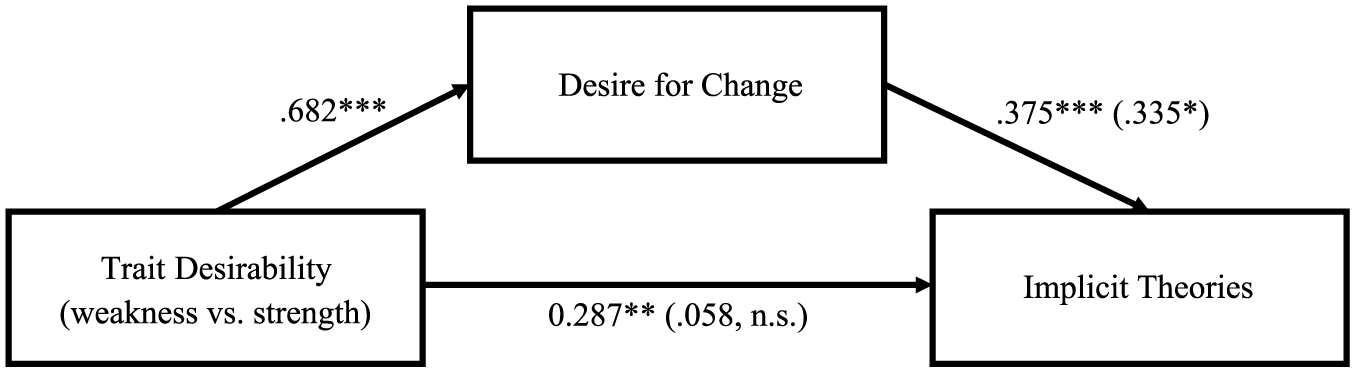
Mediation model showing the effect of trait desirability on implicit theories, as mediated by desire for change for the self (Study 2).
Moderated mediation
Given the previous findings that (a) desire for change mediated the motivational effect on implicit theories for the self, and (b) target moderated the effect of trait desirability on desire for change (i.e., a stronger desire to change weaknesses vs. strengths for self compared with others), we examined whether target moderated the strength of the mediated relationship between trait desirability and implicit theories, that is, a moderated mediation (Hayes, 2013, 2015; Muller, Judd, & Yzerbyt, 2005) of the motivational effect on implicit theories via desire for change by target. According to a motivational account for differences in implicit theories, the motivated mediation should be stronger when self-relevance is high (i.e., for the self) rather than low (i.e., for other people).
We tested a first-stage moderated mediation model (Hayes, 2015, Model 8, 10,000 resamples) for the full sample, using the same procedure used in the mediation analysis above. As can be seen in Table 1, the first-stage moderation was significant (a3 = −1.746, 95% CI = [−2.484, −1.008]), that is, the Trait Desirability × Target interaction predicted desire for change. Also, desire for change was a significant predictor of implicit theories (b1 = 0.265, 95% CI = [0.106, 0.423]). Most importantly, target significantly moderated the indirect effect of trait desirability on implicit theories via desire for change (95 % CI of the index of moderated mediation = [0.156, 0.931]), indicating a stronger motivated mediation for the self (indirect effect = 0.635, 95% CI = [0.240, 1.137]) versus others (indirect effect = 0.173, 95% CI = [0.053, 0.374]).
Unstandardized OLS Regression Coefficients With Confidence Intervals (Standard Errors in Parentheses) Estimating Desire for Change (Mediator) and Implicit Theories (Dependent Variable) for Study 2.
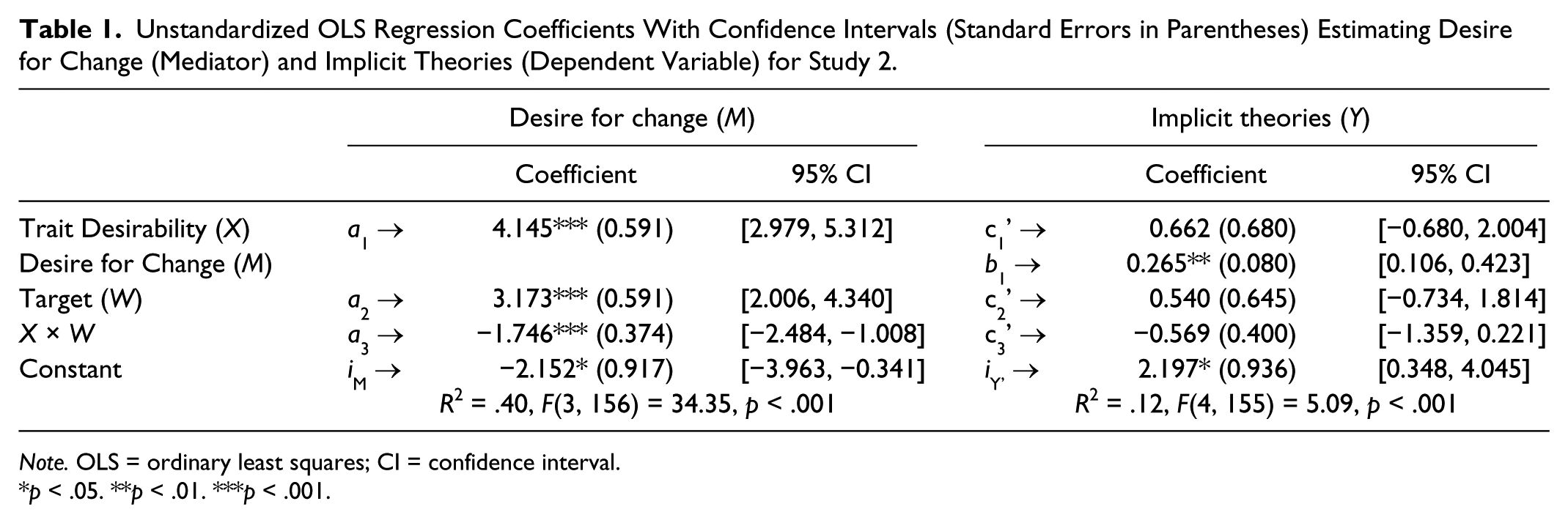
Note. OLS = ordinary least squares; CI = confidence interval.
p < .05. **p < .01. ***p < .001.
Discussion
The results of the first two studies provide consistent evidence for motivational influences on implicit theories, in that participants held different self-serving implicit theories about the malleability of their strengths versus weaknesses (Studies 1 and 2), but they held similar implicit theories for the strengths and weaknesses of other people (Study 2). These effects could be demonstrated both between- and within-subjects, and using different wordings in the instructions. Desire for change was shown to mediate the motivational effect on implicit theories: Participants’ stronger desire to change their weaknesses versus strengths predicted perceptions of their weaknesses as more malleable than their strengths (Study 2). Likewise, consistent with a motivational explanation for the results, the effect of trait desirability on implicit theories via desire for change was moderated by target, such that there was a stronger motivated mediation when self-esteem was affected (i.e., for the self) than when it was not (i.e., for other people).
Studies 3 and 4: Manipulating Desirability of a Predetermined Trait
Studies 3 and 4 were conducted to (a) gather direct evidence for the causal impact of motivation (i.e., trait desirability) on implicit theories and (b) demonstrate people’s flexibility in strategically shaping their malleability beliefs. Instead of having participants rate the malleability of self-generated idiosyncratic strengths and weaknesses, we directly manipulated the desirability of perceived current possession of a specific trait that was held constant across participants (kindness, in Study 3, and intuition, in Study 4), and we assessed how this desirability manipulation affected beliefs about the malleability of that trait. We predicted that participants would perceive their trait as either more or less malleable depending on whether it was depicted as undesirable or desirable.
Study 3: Priming Undesirable Versus Desirable Trait Possession
People’s current perception of their personality, the working self-concept (e.g., Markus & Nurius, 1986), is not static but rather can be altered by rendering certain aspects of the self more accessible (e.g., through priming). For example, people perceive themselves as more extraverted (introverted) after being asked to describe extraverted (introverted) life events (Fazio, Effrein, & Falender, 1981). Using a similar manipulation, participants in Study 3 were either primed with a desirable (kind) or undesirable (unkind) working self-concept of their own kindness. We expected participants to perceive their kindness as more malleable after they were prompted to see themselves as unkind (undesirable current trait) rather than kind (desirable current trait).
Method
Participants
One hundred fifteen participants (49 female; age M = 31.93, SD = 9.88) were recruited using the same criteria as in the previous studies and were paid US$0.40.
Procedure
Participants first completed a writing task (i.e., the desirability manipulation), where they were asked to describe a situation in their recent past in which they behaved either kindly or unkindly toward someone else (manipulated between-subjects; see online supplemental appendix). Afterward, all participants indicated their beliefs about the malleability of their kindness on a three-item Implicit-Theory Scale (the scale was identical in both conditions, as shown in the online supplemental appendix; ratings reverse-scored and averaged, α = .72).
Results
Participants who were primed with an undesirable, unkind self-concept perceived their kindness as more malleable (M = 3.46, SD = 1.06) than participants primed with a desirable, kind self-concept (M = 2.95, SD = 1.04), t(113) = 2.61, p = .010, d = 0.49, 95% CI = [0.12, 0.90].
Study 4: Linking Trait Possession to Success Versus Failure
Study 4 provided a conceptual replication of Study 3: After inducing participants to believe that they had an intuitive thinking style, we prompted them to believe that this thinking style was either desirable or undesirable, such that it was said to be associated with either personal success or failure (e.g., Kunda & Sanitioso, 1989; Sanitioso et al., 1990). We expected participants to see their intuitive thinking style as more malleable when it was believed to be undesirable rather than desirable.
Method
Participants
One hundred students (67 female; age M = 22.83, SD = 4.08) were recruited among a student population at the University of Mannheim in return for either course credit or €1.
Procedure
Participants were first asked to describe a situation in their recent past in which they made a decision based on their intuition. Subsequently, to manipulate the desirability of their intuitive working self-concept, participants read an ostensible scientific report linking an intuitive thinking style to either future academic and professional success or failure (between-subjects), and were asked to explain—based on their own experience and knowledge—why these findings might be true (adapted from Augustinova, Collange, Sanitioso, & Musca, 2011; see online supplemental appendix). Finally, participants provided their implicit theories about their intuitive thinking style on a three-item scale similar to the one that was in the previous studies (ratings reverse-scored and averaged, α = .71; see online supplemental appendix).
Results
Participants in the intuition–failure condition perceived their intuitive thinking style as more malleable (M = 3.69, SD = 0.93) than participants in the intuition–success condition (M = 2.94, SD = 0.90), t(98) = 4.05, p < .001, d = 0.81, 95% CI = [0.38, 1.11]. 2
Discussion
Studies 3 and 4 provide direct causal evidence for people’s flexibility in shaping their malleability beliefs about a certain trait as a function of motivation (i.e., the desirability of their perceived trait possession): Participants perceived a certain personal characteristic as more malleable after it was manipulated to be seen as unfavorable versus favorable. This effect emerged with two different manipulations of self-concept desirability (i.e., priming a desirable vs. undesirable self-concept, Study 3; or linking self-concept to positive vs. negative outcomes, Study 4) and for two different traits (kindness, Study 3; intuition, Study 4).
Study 5A: The End-of-History Illusion Revisited—A Motivational Account
Study 5A tested further implications of our results for the perception of personality change. Specifically, we investigated consequences of these motivated implicit theories for a recently documented effect, the end-of-history illusion (Quoidbach et al., 2013): people’s tendency to expect their personality to remain stable in the future. Based on the results of Studies 1 to 4, we expected this tendency to be moderated by motivation (i.e., desirability of current trait possession). Specifically, we predicted that participants would only succumb to the end-of-history illusion for their personal strengths, those traits for which participants’ current state was desirable (i.e., possessing positive traits or lacking negative traits). However, for their weaknesses, those traits for which the current level was undesirable (i.e., possessing negative traits or lacking positive traits), participants were predicted to believe in future improvement. Examining the role of motivation for the end-of-history illusion also enables us to follow up on the hypothesis put forward in Study 2: that people not only expect their weaknesses to be generally more malleable than their strengths, but that they specifically expect their weaknesses to improve in the future.
Method
Participants
Eighty people (36 female; age M = 28.91, SD = 7.38) were recruited using the same criteria as in Studies 1 to 3 and were paid US$0.25.
Procedure
The procedure of Study 5A was a partial replication of the first study in the original end-of-history-illusion paper (Quoidbach et al., 2013). In a within-subjects design, participants first rated their personality on the Ten Item Personality Inventory (TIPI; Gosling, Rentfrow, & Swann, 2003), a standard measure of the five basic dimensions of human personality (the “Big Five”). Next, participants were asked to complete the TIPI again, but this time, instead of rating their current personality, they were to indicate how they expected their personality to be in 10 years from now (see online supplemental appendix).
TIPI
Participants had to indicate whether they saw themselves as possessing a certain trait on a scale from 1 (disagree strongly) to 7 (agree strongly), either in the present or 10 years from now. Each of the Big Five personality dimensions (e.g., conscientiousness) was represented by two items, one item consisting of a pair of positive trait words (e.g., dependable, self-disciplined), and the other item consisting of one pair of negative trait words (e.g., disorganized, careless). Thus, participants rated both their current and expected future trait possession across 10 items (see Table 2). The order of items was randomized in both versions (current and future) of the TIPI.
Descriptive Statistics and Comparisons Between Expected Future and Current Trait Possession for Specific Traits (Study 5A).
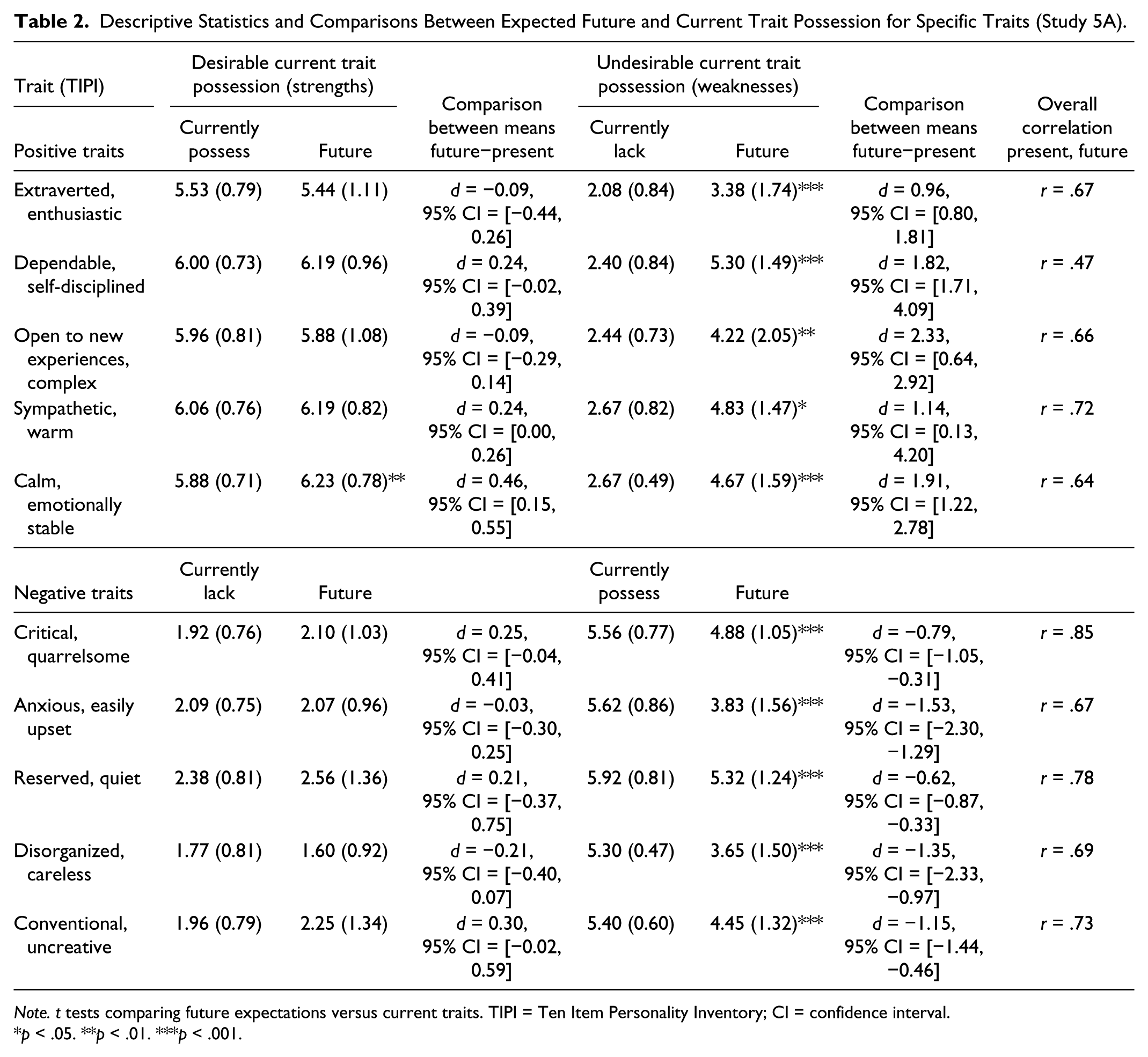
Note. t tests comparing future expectations versus current traits. TIPI = Ten Item Personality Inventory; CI = confidence interval.
p < .05. **p < .01. ***p < .001.
Results
To calculate expected future change, present ratings were subtracted from future ratings for all 10 items. Positive values indicate an expected future increase in trait possession; negative values indicate an expected decrease.
End-of-history illusion
As in the original study, we computed participants’ overall expected change between current and future personality as the average expected change across all items. We replicated the end-of-history illusion: The expected change in personality did not differ from 0 (M = 0.05, SD = 0.40), t(79) = 1.10, p = .274, d = 0.12, 95% CI = [−0.04, 0.14].
Motivation as a moderator
To test whether trait desirability moderated the end-of-history illusion, we first distinguished desirable current trait possession (i.e., personal strengths) from undesirable current trait possession (i.e., personal weaknesses). Specifically, possessing positive traits (ratings above midpoint) and lacking negative traits (ratings below midpoint) were considered desirable, whereas possessing negative traits and lacking positive traits were considered undesirable (Study 5B will provide further evidence supporting this categorization).
To calculate participants’ overall expected future change separately for currently desirable and undesirable traits (averaged across all items, respectively), data for those traits that participants currently lacked were reverse-scored before aggregating, such that positive values indicate an expected future increase in trait possession, that is, improvement in the case of strengths (i.e., having more strengths in the future), and worsening in the case of weaknesses (i.e., having more weaknesses in the future), whereas negative values indicate an expected future decrease (i.e., having less strengths in the future, having less weaknesses in the future). This meaning of positive (negative) change values indicating expected future increase (decrease) in trait possession holds for all reported results regarding expected future change.
One-sample t tests comparing the expected future change scores against 0 revealed that participants showed an end-of-history illusion for their strengths, such that they expected traits that they currently possessed to a desirable extent (i.e., positive traits that they possessed or negative traits that they lacked) to remain stable in the future (aggregating across traits, M = 0.01, SD = 0.58, t < 1). However, they expected their weaknesses to improve, that is, to have less of them in the future (M = −1.05, SD = 1.03), t(72) = −8.61, p < .001, d = −1.02, 95% CI = [−1.25, −0.81]). Therefore, they expected more change for weaknesses versus strengths, paired t(70) = −7.22, p < .001, d = −0.88, 95% CI = [−1.34, −0.76]). 3 These results (expecting change for weaknesses, not strengths) showed up not only at the aggregate level, but also for specific traits: For nine out of 10 traits, when participants’ current trait level was desirable, they perceived that trait to remain stable in the future (see left columns of Table 2). However, when participants’ current trait level was undesirable, they always (for all 10 traits) expected that trait to improve in the future (i.e., expecting a future increase in possession of positive traits that were currently absent, and expecting a future decrease in possession of negative traits that were currently present; see right columns of Table 2).4,5
Discussion
The end-of-history illusion was moderated by trait desirability: Participants expected future stability only for their strengths; for their weaknesses, they expected future improvement. These results add to Study 2’s results in showing that people not only see their weaknesses as more malleable than their strengths, but they specifically expect them to develop in a desirable way.
Study 5B: Discrepancy Between Current and Ideal Selves as the Mediator
Study 5B followed the same procedure as Study 5A, but in addition to describing their current and expected future selves, participants also described their ideal self. Including a measure of ideal self served two purposes: First, comparing participants’ current self with their ideal self enabled us to validate our categorization of positive and negative traits in Study 5A, and therefore the coding of strengths and weaknesses used in that study. Specifically, we expect participants to want to have more of what we considered positive traits (i.e., ideal ratings higher than present ratings), and less of what we considered negative traits (i.e., ideal ratings lower than present ratings). Likewise, supporting our coding of strengths and weaknesses, for current trait possessions coded as strengths, participants should indicate a lower discrepancy between current and ideal selves compared with current trait posessions coded as weaknesses.
More importantly, assessing participants’ ideal self enables us to extend our findings from Study 2 and gather further evidence for a motivational mechanism (i.e., desire for change) underlying people’s expectations of change and their representations of their future selves.
According to several theories about the self (e.g., self-discrepancy theory, Higgins, 1987; regulatory focus theory, Higgins, 1997), facing discrepancies between one’s current self and one’s ideal self feels uncomfortable and induces a desire to reduce such discrepancies. Indeed, current-to-ideal-self discrepancies evoke negative emotions (e.g., Higgins, Bond, Klein, & Strauman, 1986; Higgins, Shah, & Friedman, 1997), have detrimental effects on self-esteem (e.g., Moretti & Higgins, 1990; Renaud & McConnell, 2007), and induce approach motivation toward one’s ideal (Higgins, Roney, Crowe, & Hymes, 1994).
In Study 5B, we tested whether expectations of future personality change were driven by desire for change (i.e., the magnitude of current-to-ideal-self discrepancy), such that participants should expect more future change for traits for which the gap between their current self and their ideal self is larger (i.e., a positive correlation between current-to-ideal-self discrepancies and expected future change).
Method
Participants
Eighty-one people (37 female; age M = 33.64, SD = 9.00) were recruited using the same criteria as in Studies 1 to 3 and 5, and were paid US$0.40.
Procedure
Study 5B followed the same procedure of Study 5A, except that, in between rating their current personality and their expected future personality on the TIPI, participants also completed the TIPI with regard to their ideal personality. (Asking participants to rate their ideal personality before their expected future personality did not influence the latter, as future ratings in Study 5B were comparable with those of Study 5A, t < 1.)
Results
As in Study 5A, expected future change was calculated as the difference between future and present ratings for all 10 items, with positive values indicating expecting to have more of the trait in the future. In addition, the potential mediator, current-to-ideal-self discrepancy, was calculated as the difference between participants’ ideal versus present ratings, with positive values indicating wishing to have more of the trait. Coding of current trait possession as strengths and weaknesses was done as in Study 5A.
Validation of trait-valence categorization and coding of strengths and weaknesses
First, comparing ratings for current versus ideal self confirmed our categorization of trait valence: Across all traits, participants wished to have more of what we considered to be positive traits (e.g., warm; ts > 4.90, ps < .001), and less of what we considered to be negative traits (e.g., reserved; negative ts > 5.27, ps < .001). Second, with regard to our coding of strengths and weakness, current-to-ideal-self discrepancies were also as expected: Aggregated across all 10 traits, participants indicated smaller self-discrepancies (ideal – present) for strengths (M = 0.56, SD = 0.57) compared with weaknesses (M = −2.63, SD = 1.47), t(71) = 16.00, p < .001, d = 1.99, 95% CI = [2.79, 3.59].
Replication of end-of-history illusion and motivational moderation
We again replicated the end-of-history illusion, as overall expected future change (i.e., the difference between future and present), averaged across all 10 traits, did not differ from 0 in a one-sample t test (M = 0.06, SD = 0.39), t(80) = 1.42, p = .160, d = 0.16, 95% CI = [−0.02, 0.15].
However, when expected future change was analyzed separately for current strengths and weaknesses, we found the same motivational moderation as in Study 5A: In one-sample t tests comparing aggregated expected future change scores for all traits against 0, there was only an end-of-history illusion for strengths, such that participants did not expect change (M = 0.02, SD = 0.77, t < 1). However, they did expect their weaknesses to improve (i.e., to be reduced) in the future (M = −1.16, SD = 1.39), t(72) = −7.09, p < .001, d = −0.83, 95% CI = [−1.48, −0.83]. Therefore, participants expected more future change (i.e., improvement) for their weaknesses versus strengths, paired t(71) = −5.74, p < .001, d = −0.69, 95% CI = [−1.57, −0.76]. 6 And again, results were confirmed at the level of specific traits, such that participants expected future improvement of their weaknesses (|ts| > 3.92, ps < .003, 0.53 < |ds| < 2.85) and future stability of their strengths (|ts| < 1.79, ps > .078, 0.05 < |ds| < 0.30) for the majority of traits. 7
Motivated expectations of change
As a first hint of motivational influences, we found that participants’ expectations of their future personality were determined by their ideal personality (i.e., a significant positive correlation between participants’ ideal self and future self: aggregating across items, r = .42, p < .001). That is, the higher participants rated their ideal self, the higher they rated their expected future self. Moreover, the three crucial variables—positivity of participants’ current self-view, the potential mediator desire for change (i.e., current-to-ideal-self discrepancy), and the dependent variable expected future change (all three calculated as average ratings across all traits, with ratings of negative traits reverse-scored before averaging)—were all significantly correlated. In particular, positivity of participants’ current self-view predicted both participants’ absolute current-to-ideal-self discrepancy, r = −.77, p < .001, and their absolute expected future change, r = −.32, p = .003, such that the more positive participants presently saw themselves, the closer they felt to their ideal (and, thus, the lower was their desire for change), and the less they expected their personality to change in the future. Most important, in line with a motivational account, participants’ expectations of future change in their personality were informed by their desire for change, such that the stronger was participants’ desire for change (i.e., current-to-ideal-self discrepancies), the more they expected their personality to change in the future, both on an aggregated level (r = .41, p < .001) and for specific traits (rs > .19, ps < .076, for nine out of 10 traits). Absolute current-to-ideal-self discrepancy predicted absolute expectations of future change, even when controlling for participants’ current self-view (aggregated across traits: partial r = .27, p = .016). That is, independent of their specific current self-view, the more participants desired change, the more they expected their personality to change from present to future.
To ensure that expected change was predominantly in the direction of improvement rather than decline, we did an additional analysis in which we scored participants’ expectations of change according to their ideal. That is, we gave a positive sign to expected changes whereby participants expected to get closer to their ideal, and a negative sign if they expected to get more distant from their ideal in the future. As expected, participants believed themselves to improve toward their ideal in the future, both aggregating across traits (M = 0.59, SD = 0.66), t(80) = 8.03, p < .001, d = 0.89, 95% CI = [0.45, 0.74], and for all individual traits (ts > 2.40, ps < .019).
Motivated mediation of expected changes
We used Process 2.13 (Hayes, 2013; Model 4; 10,000 resamples) to test whether the effect of positivity of current self-view on expectations of change was mediated by desire for change. The bias-corrected 95% CI for the indirect effect was [−0.421, −0.048], supporting the hypothesized mediation: The worse participants perceived their current personality to be, the stronger was their desire for change, and the stronger their desire for change, the more they expected their personality to actually change (i.e., to improve toward their ideal) in the future.
Discussion
Study 5B added to Study 5A in three important ways: First, the results of Study 5A were replicated by demonstrating that the end-of-history illusion is moderated by trait desirability: Participants only assumed future stability for their strengths, not their weaknesses, which they believed would change to a more desirable level in the future. Second, assessing participants’ ideal self, we validated our categorization of trait valence (i.e., the distinction between positive and negative traits), and our coding of strengths versus weaknesses: Participants indicated an ideal self that was higher (lower) than their current self for what we considered positive (negative) traits, and indicated stronger current-to-ideal-self discrepancies for trait possessions that we coded as weaknesses versus strengths. Third, and most important, following up on Study 2, Study 5B contributes further evidence for a motivational mechanism (i.e., desire for change) behind people’s expectations of change: Desire for change, as inferred from current-to-ideal-self discrepancies, was consistently found to predict expectations of change across traits and mediated the effect of positivity of current self-view on expectations of change. Thus, people seem to expect change in their personality (in particular, future improvement) especially when they desire change, that is, when they experience that their current self falls short of their ideal.
With respect to the results of Studies 5 A and B concerning expectations of change, one might argue that they could, at least in part, be explained by a ceiling (bottom) effect caused by restrictions inherent in our expected-change measure and our coding of strengths and weaknesses. Specifically, the stronger participants rated a certain trait to be their strength (i.e., high possession of a desirable trait, and low possession of undesirable trait), the less room there was left for them to indicate beliefs in future improvement (i.e., to possess even more of desirable and even less of undesirable traits in the future). Consequently, to the extent that people have an optimistic outlook on the future and do not expect to get worse over time, this ceiling (bottom) effect for desirable (undesirable) traits might have limited the amount of change expressed for strengths, potentially rendering the interpretation of what appear to be strong beliefs in the stability of strengths somewhat ambiguous.
However, we have several reasons to believe that such measurement restrictions cannot account for our results. First, we found very similar effects in all our other studies (Studies 1 to 4), and the implicit theory measures used in those studies did not have the same constraints. Participants in those studies rated their strengths as stable, but they could have rated them as changeable. Second, the same measurement restrictions that are present for strengths apply to weaknesses as well (although in the opposite direction; that is, if people rate themselves low on a desirable trait, or high on an undesirable trait, then there is not much room to go lower in the first case, or higher in the second), but for weaknesses, people do not expect stability, but rather believe that they will change for the better. Therefore, high current trait possessions only lead to a ceiling effect of expected future change if possessing a lot of a trait is desirable (i.e., for positive traits/strengths). Third, in Study 5B, participants’ perceived current-to-ideal-self discrepancy significantly predicts their expectations of future change, even when we control for participants’ current self-view. That is, independent of how participants saw their personality at present, the stronger their desire for personality change was, the more they expected their personality to actually change in the future. These results support a motivational account for participants’ expectations of future change and suggest that our effects are not due to any measurement constraints or to our coding of strengths and weaknesses.
General Discussion
Across six studies, we found consistent evidence for motivated implicit theories of personality: Participants perceived weaknesses in their personality as more malleable than their strengths. This motivational effect on implicit theories was shown to be mediated by a stronger desire to change weaknesses versus strengths (Studies 2 and 5B). However, in the absence of motivation to self-enhance, such as when participants were asked how malleable the same traits were in other people, this difference in perceived malleability vanished (Study 2), in line with a motivational account. In a more direct test of this motivational account, Studies 3 and 4 manipulated the desirability of specific traits. Participants perceived a trait as more or less malleable when they were led to believe that it was undesirable versus desirable. Such motivated shaping of implicit theories could be demonstrated for different manipulations of trait desirability and different traits.
These studies complement recent work by Leith and colleagues (2014), who found evidence for motivated implicit theories in response to acute threat to self-esteem. The present research also found evidence for motivated implicit theories under acute threat (Studies 3 and 4), but in addition, it found motivated implicit theories even when acute threat was not induced, such as when people’s chronic representations of their ideal selves differed from the representations of their present selves (Study 5B), or when people are asked to think of their weaknesses or their strengths (Studies 1-2). More importantly, Studies 5A and 5B investigated a novel implication of motivated implicit theories with regard to people’s expectations about their future personality development and their representations of their future self. Specifically, these studies show that the end-of-history illusion is moderated by motivation (i.e., desirability of current trait possession), such that people assume future stability only for their current strengths, but believe their current weaknesses not only to be malleable but also to develop in a desirable direction, that is, to improve in the future. We believe that this is an important implication that had not yet been explored, as it shows that motivation not only affects people’s beliefs about how changeable their traits are (e.g., whether people think that they can change in how anxious they are), but also how they see themselves in the future (e.g., whether they see themselves as more or less anxious 10 years from now). Furthermore, Study 5B provides novel evidence for the motivational nature of these effects. In that study, participants were asked to rate how they see their personality presently and in 10 years time, but also how they would like to be, that is, their ideal self. In line with a motivational account, the different beliefs about future change were mediated by desire for change (i.e., present-to-ideal-self discrepancy), which was stronger for weaknesses versus strengths.
In sum, our research shows that, when people’s current self falls short of their ideal, they not only expect it to be changeable, but, more specifically, they expect it to be changeable in a predictable way: They assume their current self will change for the better. Although people believe that their current strengths will remain constant, they expect that their weaknesses will be mitigated in the future, which enables them to imagine their future self as a more ideal version of their current self.
These results might also have implications for people’s willingness to work on certain aspects of their personality, depending on whether they perceive them as undesirable (i.e., weaknesses) or desirable (i.e., strengths). According to extant research, people who believe that personal attributes are malleable are more willing to invest effort into improving them (e.g., Hong et al., 1999). If so, and given that people believe a certain personal attribute to be more malleable when they perceive it as undesirable (e.g., Studies 3 and 4), an interesting question arises: Are people less willing to work on traits that they consider to be their strengths rather than their weaknesses? This would mean that people’s self-serving regulation of implicit theories might come with a downside: Believing that strengths are stable might make people too sure of their assets and, therefore, make them forego practicing opportunities, which bears the risk of stagnation or even decline. This hypothesis is but one example of how there is still much to be explored about the self-regulation of implicit theories and its consequences.
Conclusion
This research adds to extant research on implicit theories in suggesting that motivation shapes implicit theories of personality: It appears that people’s implicit theories of personality’s malleability are themselves quite malleable. In addition, the present research contributes to the motivated reasoning literature by presenting a new strategy that people use to see themselves in a favorable light: motivated implicit theories of malleability. Consequently, the perceived controllability of a trait does not only affect how much people self-enhance (i.e., more self-enhancement in ratings of trait possession to the extent that traits are controllable), as demonstrated by Alicke’s (1985) seminal work, but perceptions of trait controllability (i.e., malleability) are themselves subject to self-enhancement, in that people believe traits to be more or less malleable depending on the desirability of their current trait possession. As a consequence, people have a double standard whereby they believe that their weaknesses will go away, but their strengths are here to stay.
Footnotes
Authors’ Note
All measures and conditions that were included in the studies are reported.
Declaration of Conflicting Interests
The author(s) declared no potential conflicts of interest with respect to the research, authorship, and/or publication of this article.
Funding
The author(s) disclosed receipt of the following financial support for the research, authorship, and/or publication of this article: The authors gratefully acknowledge the financial support provided by the Baden-Württemberg Landesgraduiertenförderung program, the Portuguese Science Foundation (UID/PSI/04810/2013; IF/01612/2014), and the German Research Foundation (Koselleck Grant Fi 294/23-1).

Notes
References
Supplementary Material
Please find the following supplemental material available below.
For Open Access articles published under a Creative Commons License, all supplemental material carries the same license as the article it is associated with.
For non-Open Access articles published, all supplemental material carries a non-exclusive license, and permission requests for re-use of supplemental material or any part of supplemental material shall be sent directly to the copyright owner as specified in the copyright notice associated with the article.
