



Abstract
Two studies tested the affect-as-cognitive-feedback model, in which positive and negative affective states are not uniquely associated with particular processing styles, but rather serve as feedback about currently accessible processing styles. The studies extend existing work by investigating (a) both incidental and integral affect, (b) out-group judgments, and (c) downstream consequences. We manipulated processing styles and either incidental (Study 1) or integral (Study 2) affect and measured perceptions of out-group homogeneity. Positive (relative to negative) affect increased out-group homogeneity judgments when global processing was primed, but under local priming, the effect reversed (Studies 1 and 2). A similar interactive effect emerged on attributions, which had downstream consequences for behavioral intentions (Study 2). These results demonstrate that both incidental and integral affect do not directly produce specific processing styles, but rather influence thinking by providing feedback about currently accessible processing styles.
Keywords
Over three decades of research demonstrates that positive affect promotes global, abstract, heuristic, top-down information processing, whereas negative affect promotes local, detailed, systematic, bottom-up processing (for a review, see Isbell & Lair, 2013). For example, compared with individuals in sad moods, those in happy moods are more likely to rely on stereotypes and traits during impression formation (e.g., Bodenhausen, Kramer, & Süsser, 1994; Isbell, 2004; Isbell, Burns, & Haar, 2005), rely on scripts when processing information about routine events (Bless et al., 1996), use heuristic cues in response to persuasive communications (Mackie & Worth, 1989; Schwarz, Bless, & Bohner, 1991), use categories more broadly and flexibly (Isen & Daubman, 1984; Murray, Sujan, Hirt, & Sujan, 1990), and describe themselves using more abstract language (Isbell, McCabe, Burns, & Lair, 2013). Individuals in happy moods are also more likely to perceptually “zoom out” and perceive object configurations more holistically compared with individuals in sad moods (e.g., Gasper & Clore, 2002). Many such findings have been explained as resulting from a tendency for positive affect to promote global processing and broadened conceptual and perceptual scope, and a tendency for negative affect to promote local processing and a narrower scope (for reviews, see Isbell & Lair, 2013; Schwarz & Clore, 2007).
One prominent explanation for many of these results lies in the affect-as-information model. According to this account, positive affect signals the presence of a safe situation, which allows individuals to rely on heuristics and categorical information to simplify information processing. Negative affect, in contrast, signals a threatening situation, which requires individuals to think in a more systematic, detail-oriented manner to resolve the problem (Schwarz, 1990; Schwarz & Clore, 2007; Wyer, Clore, & Isbell, 1999). Despite strong empirical support for this model, one problem with the conclusion that positive affect tends to promote global processing whereas negative affect tends to promote local processing is that sometimes opposite findings emerge (for reviews, see Huntsinger, Isbell, & Clore, 2014; Isbell, Lair, & Rovenpor, 2013).
Rooted in the affect-as-information tradition, our affect-as-cognitive-feedback account (Huntsinger et al., 2014) is a comprehensive and overarching theoretical model that can account for the most common influences of affect on processing as well as instances in which such effects reverse. According to this account, affective experiences serve as “go” or “stop” signals that promote or inhibit any cognitive inclination with which they are associated. Thus, affective experiences are not inherently responsible for triggering any specific processing style, but rather confer value on whatever processing style is currently dominant. As a result, either positive or negative affect can result in either global or local processing. This perspective emphasizes the critical importance of the mental context in which affect is experienced in determining affect’s cognitive impact.
One widespread limitation of prior research investigating the influence of affect on cognition (rooted in any perspective) is that it has almost exclusively investigated affect that is elicited in one situation and carries over to influence processing in an unrelated situation (i.e., incidental affect). To date, it is unknown whether affect that is relevant to the situation in which processing occurs (i.e., integral affect) will have similar effects. Thus, the extent to which the affect–cognition literature can generalize to real-world conditions—in which affect is frequently elicited by the very situations that require processing—is limited (Perrott & Bodenhausen, 2002).
The current research tests and extends the generalizability of the affect-as-cognitive-feedback model to important new conditions that are of both theoretical and practical importance. Specifically, we investigate this model in the context of both incidental and integral affect, and in a new domain (out-group judgments). After discussing our theoretical perspective, we review evidence on affect and out-group judgments, and discuss the importance of studying integral affect.
The Affect-as-Cognitive-Feedback Model
Consistent with the affect-as-information approach, the affect-as-cognitive-feedback account maintains that affective cues provide perceivers with conscious feedback about largely nonconscious, continuously operating appraisal processes (Schwarz, 1990; Schwarz & Clore, 2007). Such feedback is highly functional in that it serves as valuable information that guides individuals’ thoughts, judgments, and behaviors (e.g., Frijda, 1988; Simon, 1967). Early writings provided important foundational ideas for the affect-as-cognitive-feedback model (e.g., Clore et al., 2001; Martin, Ward, Achee, & Wyer, 1993; Wyer et al., 1999). These ideas sprung from research demonstrating that affect serves as feedback about whether to continue or stop processing information. In an impression formation task, for example, happy individuals instructed to stop reading target information once they acquired enough information stopped sooner than sad individuals, but sad individuals stopped sooner when instructed to stop when they no longer enjoyed reading the information (Martin et al., 1993). This work demonstrated that the impact of affect on amount of processing depends on other factors, an idea that has recently been significantly expanded upon.
The affect-as-cognitive-feedback model formalized these earlier ideas into a comprehensive framework that can explain both past findings and seemingly inconsistent new results, and make new predictions about the role of affect in promoting the use of global versus local processing and other accessible mental content (Huntsinger et al., 2014). According to this model, affect acts as a “go” or “stop” signal that serves to reinforce (positive affect) or inhibit (negative affect) whatever cognitive inclinations or tendencies are associated with it (Clore & Huntsinger, 2009; Huntsinger et al., 2014; Isbell & Lair, 2013; Isbell, Lair, & Rovenpor, 2013; Wyer et al., 1999; see Briñol, Petty, & Barden, 2007, for a related conceptualization). Thus, in the information-processing domain, the functional value of affect comes not from directing individuals to use any particular processing style, but by providing feedback on the processing styles that individuals are currently using.
The model accounts for prior research assuming dedicated links between affect and processing by suggesting that earlier research, which failed to manipulate processing style, missed this key moderator and, as a result, drew unwarranted conclusions about the mechanism underlying the influence of affect on processing. Given that a significant body of research demonstrates that global, heuristic information processing is frequently dominant in both perceptual (e.g., Bruner, 1957; Kimchi, 1992; Navon, 1977) and conceptual tasks (e.g., Brewer, 1988; Fiske & Neuberg, 1990), our model predicts the commonly found effects when processing is not manipulated. In fact, many tasks investigated by affect researchers seem to pull for global processing (Clore & Huntsinger, 2009). Given this, the affect-as-cognitive-feedback model posits that the conclusion that positive affect typically promotes global processing and negative affect often promotes local processing is only part of the story, and that such effects might instead emerge from a more flexible feedback mechanism.
Findings from several recent studies uniquely support the affect-as-cognitive-feedback account (for a review, see Huntsinger et al., 2014). Following global processing primes, the customary effects of positive and negative affect have been found on perceptual processing of letter and shape displays (Huntsinger, Clore, & Bar-Anan, 2010) and the flanker task (Huntsinger, 2012). That is, positive affect broadened attention and negative affect narrowed it. Under local priming, these effects reversed, with positive affect narrowing attention and negative affect broadening it. Importantly, when global and local processing were equally primed (and therefore affect could not serve as a stop or go signal for either processing style), no effects of mood emerged (Huntsinger, 2012).
Research examining more conceptual, higher order judgment tasks shows similar effects. Under conditions in which global processing was assumed to be active by default, positive affect promoted reliance on stereotypes during impression formation, and negative affect promoted reliance on detailed behaviors; however, these effects reversed when a local attentional focus was dominant (Hunsinger, Isbell, & Clore, 2012). Similarly, under global and no priming (default) conditions, Huntsinger (2014) found that positive affect led individuals to assimilate their judgments of “Donald” in the classic impression formation paradigm to primed trait concepts, whereas negative affect led participants to contrast their judgments from these concepts. In local priming conditions, the opposite pattern of assimilation and contrast emerged. Huntsinger (2014) found similar effects in a stereotype-priming task.
The affect-as-cognitive feedback model’s claim that the affect–cognition relationship is flexible is consistent with a growing literature demonstrating other moderators of this relationship. Importantly, however, none make the same claims about affect’s role in providing feedback about momentarily accessible processing styles (see Huntsinger et al., 2014). Instead, other models claim that a host of affect-relevant variables and processes (e.g., mood management concerns [Wegener & Petty, 1994; Wegener, Petty, & Smith, 1995], expectancy violations, [Ziegler, 2014], motivational intensity [Harmon-Jones, Gable, & Price, 2013]) directly drive the relationship between affect and cognitive processing styles. The stop/go feedback mechanism that we propose may also underlie the effects of these other variables. We return to this issue in the “Discussion” section.
Affect, Processing Styles, and Out-Group Homogeneity
In the current research, we extend work on the affect-as-cognitive-feedback account to an important new domain: perceptions of out-groups and the overwhelming tendency for individuals to perceive members of out-groups to be similar to one another (e.g., Linville, Fischer, & Salovey, 1989; Messick & Mackie, 1989; Park & Judd, 1990). Perceiving out-group members as homogeneous is a defining attribute of stereotypes (e.g., Allport, 1954), and reducing such perceptions has been shown to reduce prejudice and discrimination in both experimental and real-world contexts (Er-rafiy & Brauer, 2012).
How does affect impact these perceptions? Research demonstrates that individuals in experimentally induced happy moods judge out-group members to be more homogeneous than individuals in experimentally induced neutral moods (Queller, Mackie, & Stroessner, 1996; Stroessner, Mackie, & Michaelsen, 2005). Furthermore, research demonstrates that individuals who tend to construe actions abstractly (vs. concretely) perceive greater out-group homogeneity (Levy, Freitas, & Salovey, 2002), and that people who process globally focus on similarities instead of differences (see Burgoon, Henderson, & Markman, 2013). Because global processing is active in many intergroup processing tasks and individuals tend to experience positive resting mood states (e.g., Diener & Diener, 1996), it is not surprising that the general out-group homogeneity effect thrives in the absence of any manipulation. In fact, results obtained in experimentally manipulated happy moods often replicate standard textbook phenomena reflecting global processing (Clore & Huntsinger, 2007).
Given that both positive affect and global processing have been shown to increase out-group homogeneity perceptions, it remains an open question whether positive affect directly promotes such perceptions or whether it does so by conferring positive value on dominant global processing. According to the affect-as-cognitive-feedback model, happy moods should promote the out-group homogeneity effect by conferring positive value on dominant global processing. We sought to test this possibility by manipulating both processing (global vs. local) and affect (positive vs. negative), as this provides the clearest and strongest test of our theoretical ideas.
Incidental Versus Integral Affect
Almost all of what we know about the impact of affect on cognitive processing comes from a voluminous body of research on incidental affective experiences, that is, affective experiences that are irrelevant to the information-processing context. However, research that only examines effects of incidental affect arguably ignores some of the most important affective reactions that humans experience—that is, affective experiences that are elicited by the target or situation that individuals are processing information about (i.e., integral affect; Bodenhausen, 1993; Bodenhausen, Mussweiler, Gabriel, & Moreno, 2001; Perrott & Bodenhausen, 2002). Bodenhausen et al. (2001) has referred to such experiences as episodic integral affect to emphasize that it is elicited in particular situations, and to differentiate it from chronic integral affect, which refers to enduring affective reactions to social targets or groups.
Although studying the extent to which affect–cognition models generalize from research on incidental affect to integral affect is of significant importance, it is not without methodological challenges (Perrott & Bodenhausen, 2002), which we believe have limited research in this area. Episodic integral affect is difficult to manipulate without varying the content of the information that individuals process, which can create ambiguity about the cause of any observed effects. We answer a more than decade old call to investigate the impact of integral affect (Perrott & Bodenhausen, 2002) by conducting two studies (one involving incidental affect and one involving episodic integral affect) to assess whether similar effects emerge. In doing so, we extend our knowledge of both the general affect–cognition relationship and the affect-as-cognitive-feedback model.
The Present Research
We conducted two experiments to examine the joint influence of affect and information-processing primes on intergroup perceptions. In Experiment 1, we experimentally manipulated incidental affect and exposed participants to global, local, or both types of information-processing primes before having them form impressions of out-group members (i.e., students at a nearby liberal arts college). Under global priming conditions, we expected that happy participants would perceive greater homogeneity than sad participants would; however, under local priming conditions, we predicted the opposite, that is, sad participants would perceive greater homogeneity than happy participants would. Our mixed processing conditions, in which participants were exposed to an equal number of global and local primes, provide a strong test of the affect-as-cognitive-feedback hypothesis. That is, if currently accessible processing styles are responsible for the relationship between affect and homogeneity judgments, no relationship between affect and judgments should emerge in these conditions because there is no dominant processing style for affect to promote or inhibit.
In Experiment 2, we experimentally manipulated information processing and episodic integral affect to examine their impact on homogeneity perceptions of stigmatized out-group members (homeless individuals). If episodic integral affect functions like incidental affect, we expected to find the same pattern of results as in Experiment 1. In Experiment 2, we also examined the possibility that any interactive impact of affect and processing primes will extend to participants’ attributional judgments for homelessness, and have downstream effects on behavior.
Experiment 1
Method
Participants and design
Two hundred thirty-one students (180 female) were randomly assigned to one of six conditions in a 2 (sad vs. happy mood) × 3 (local vs. global vs. mixed priming) experimental design. Students participated in exchange for extra credit in their psychology courses.
Procedure
Participants first wrote about either a happy or sad recent life experience to manipulate mood (Schwarz & Clore, 1983), and then completed one of three map tasks designed to prime local, global, or both types of processing (similar to Förster, Liberman, & Kuschel, 2008). All participants were exposed to eight maps of U.S. states with six cities labeled (see Figure 1 for an example), and were told either to study the shape of the state (global condition), the labeled cities (local condition), or both (mixed condition). After viewing each map for 10 s, participants were asked to identify which of three shapes best represents the map they just viewed (global condition; see Figure 1), whether a particular city was on the map (local condition), or were asked about the shape for half of the trials and about the cities for the other half (mixed condition).
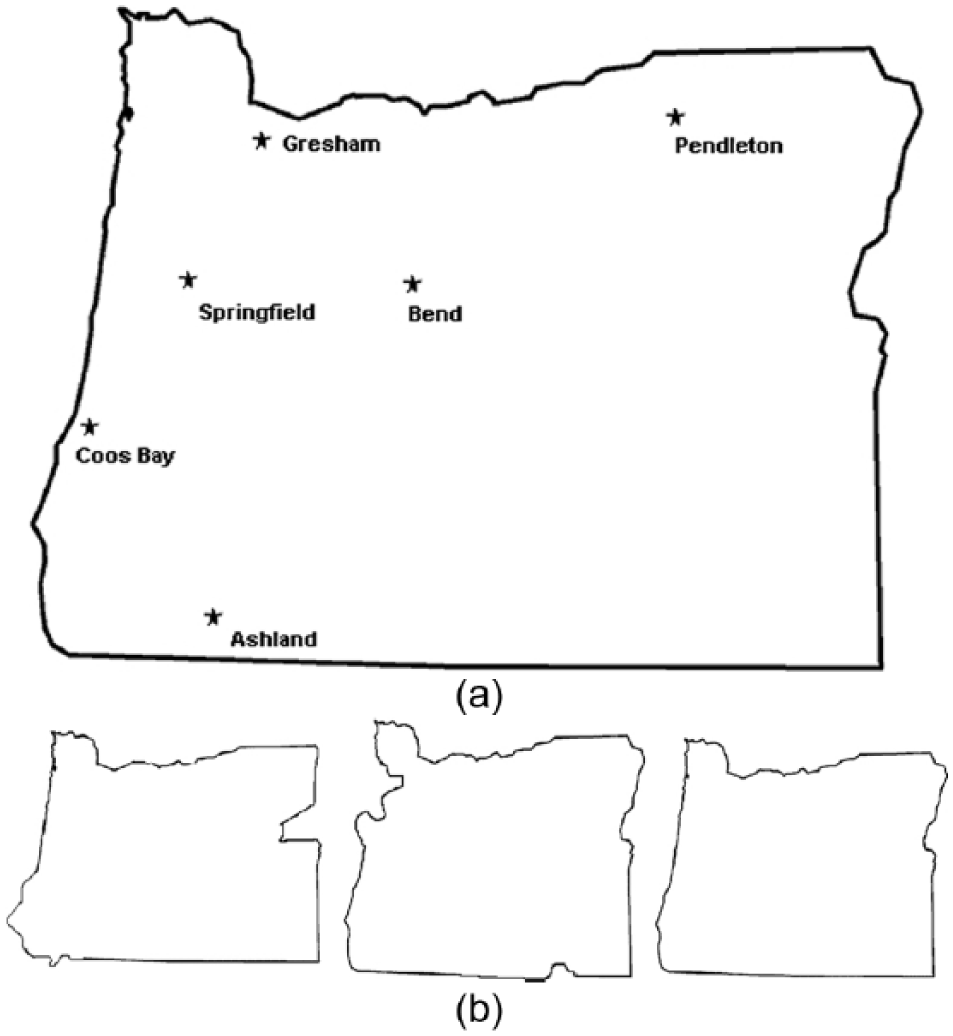
Sample map presented to all participants (a) and maps provided in the global priming task (b) following initial map exposure.
Participants then viewed clips from four videotaped interviews with students who were purportedly from nearby Amherst College. We created these videos using student volunteers, whom we interviewed about various student life topics. Using a scale form 0 (not at all) to 10 (extremely), participants then rated the extent to which Amherst College students are similar to one another with regard to morality, motivation, social opinions, intellect, values, honesty, worries, wealth, arrogance, confidence, entitlement, and ambition (see Levy et al., 2002). These items were averaged to create a measure of perceived homogeneity (α = .855).
Participants then reported how happy and sad they felt while writing their stories using a scale from 1 (not at all) to 7 (extremely) and provided demographic information.
Results and Discussion
Mood manipulation check
Participants’ reports of how happy and sad they felt were analyzed as repeated measures as a function of mood and processing prime conditions. As expected, an interaction between the repeated measure and mood emerged, F(1, 225) = 878.555, p < .001,
Out-group homogeneity judgments
Participants’ perceived homogeneity scores were analyzed as a function of mood and map priming conditions. Consistent with the affect-as-cognitive-feedback perspective, only the predicted interaction between these two variables emerged, F(2, 225) = 3.181, p = .043;
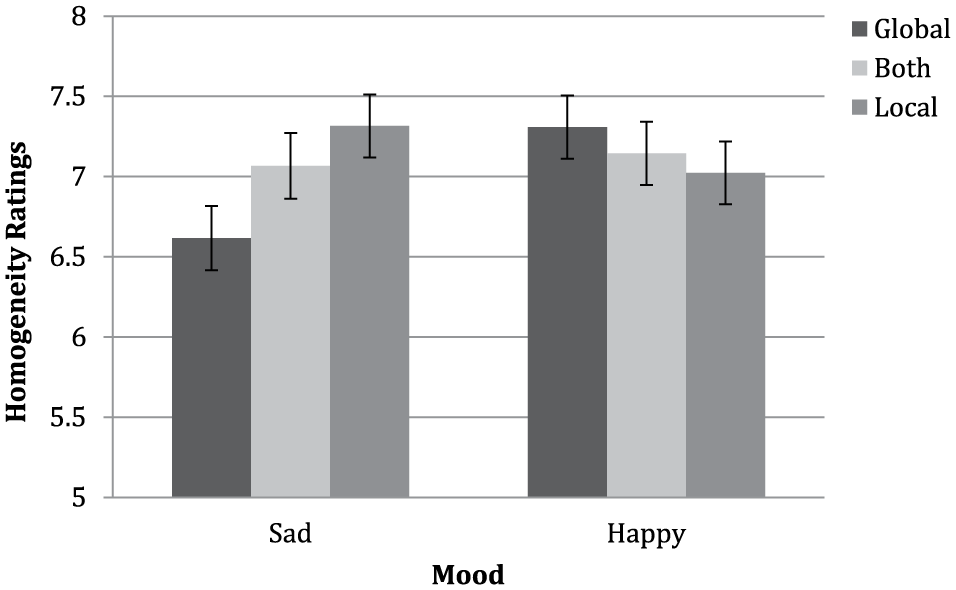
Mean out-group homogeneity ratings for Amherst college students (Experiment 1).
Experiment 2
Experiment 2 aimed to build upon the results of Experiment 1 in three primary ways. First, as described earlier, we sought to examine the impact of integral affect elicited by the stimulus materials themselves (Bodenhausen et al., 2001; Perrott & Bodenhausen, 2002).
Second, we sought to subject our hypotheses about the role of affect in social perception to a strong test by examining the generalizability of the findings in Experiment 1 to a disadvantaged and stigmatized out-group for which impressions may be less malleable. Specifically, we examined perceptions of homeless individuals, a highly stigmatized out-group falling among “the lowest of the low” (Harris & Fiske, 2006) in both perceived warmth and competence in comparison with a large number of social groups in the United States (Cuddy, Fiske, & Glick, 2007).
Third, we examined possible influences of affect and information-processing styles on attributional judgments about the causes of homelessness and downstream behaviors that have important real-world consequences: intentions to donate money to homeless people. Individuals may perceive homelessness as being due to individualistic causes (i.e., addiction), societal causes (i.e., lack of affordable housing), or both (e.g., Bullock, 2008). Individualistic causes of homelessness are perceived to be more controllable than societal ones, and therefore tend to be associated with attributions of personal responsibility, which results in decreased helping behavior (see Weiner, Osborne, & Rudolph, 2011). Research demonstrates that compared with local processing primes, global primes broaden attention to contextual factors (Huntsinger, 2012) and increase focus on contextual information in social interactions (Woltin, Corneille, & Yzerbyt, 2012). Furthermore, people who are attuned to contextual factors (e.g., East Asians) make greater situational attributions (Choi, Nisbett, & Norenzayan, 1999). For this reason, we expected that globally primed participants may be more likely to consider “big picture” contextual factors when judging why individuals are homeless. Thus, consistent with the affect-as-cognitive-feedback model, we expected that conditions that promote global processing (i.e., positive affect coupled with a global prime, negative affect coupled with a local prime) would lead to increased attributions to broad contextual (i.e., societal) causes of homelessness relative to individualistic causes and therefore would result in increased intentions to donate money to homeless individuals. We expected that conditions that promote local processing would lead to fewer attributions to societal causes of homelessness relative to individualistic causes and thereby lower intentions to donate money.
Method
Pilot Study
Given the methodological concerns raised in the introduction about manipulating episodic integral affect, we conducted a pilot test to ensure that our stimulus materials effectively manipulate affect while holding the actual content of the materials constant.
We constructed two news articles titled “Meeting the People on the Streets,” which participants were told came from the monthly newsletter, “Spotlight on the Community.” The articles began as follows: In the hustle and bustle of our daily lives, we often ignore billboards, street signs, businesses, and people. This month’s “Spotlight” focused on the homeless. After speaking to a representative of a homeless shelter, we met six homeless people who candidly answered questions about their lives.
The articles contained information about the homeless individuals (three men and three women with one of each gender selected from different age groups as follows: young [27, 32], middle age [51, 42], and older age [68, 72]), and a “6-month update” about each individual that was purportedly obtained after the original interviews.
The content of the newsletter was the same for all participants, with one exception. That is, we varied the order in which we presented the homeless individuals. Specifically, in the positive newsletter condition, we presented homeless individuals who had relatively more positive “6-month updates” first (e.g., “Sue has reconnected with her sister, and has a new job bagging groceries”), whereas in the negative newsletter condition, we presented individuals who had relatively more negative updates first (e.g., “Dave is still looking for work”). Importantly, the manipulation involved differences in the affect associated with the homeless individuals’ prospects (e.g., desperate vs. hopeful), rather than with the character of the individuals themselves. Thus, we did not confound affect with judgments. That is, although the affect is integral to the context, it is not inherently tied to the extent to which the homeless individuals are perceived to be homogeneous or responsible for their problems.
We randomly assigned 259 student volunteers (200 females) to read either the relatively positive or the relatively negative newsletter. Participants then reported the extent to which they felt a variety of positive (happy, optimistic; α = .755) and negative (sad, depressed, upset; α = .722) emotions using a scale from 0 (not at all) to 6 (extremely). To examine participants’ affective experiences in response to the newsletters, we computed a measure of affective tone by subtracting participants’ mean negative affect score from their mean positive affect score. As expected, the positive newsletter elicited relatively more positive affect, whereas the negative newsletter elicited relatively more negative affect (Mpositive = .3068, SD = 1.898; 95% CI [−.020, .634]; Mnegative = −.4764, SD = 1.601; 95% CI [−.758, −.195]), F(1, 257) = 12.836, p < .001, d = .446. The mean in the positive condition is greater than zero, t(131) = 1.857, p = .066, whereas the mean in the negative condition is significantly less than zero, t(127) = 3.354, p = .001. These differences reveal that the positive article had a relatively positive affective tone, whereas the negative article had a relatively negative one. Based on these findings, we are confident that our newsletters elicited the intended affect.
Main Study
Participants and design
One hundred forty-nine students (117 females) were randomly assigned to one of six conditions in a 2 (negative vs. positive newsletter) × 3 (local vs. global vs. mixed task) experimental design. Students received extra course credit for their participation.
Procedure
After completing the map task described in Study 1, participants read either the positive or negative newsletter described earlier. Participants then indicated on a scale from 0 (not at all) to 10 (extremely) the extent to which these homeless individuals are similar to one another in intelligence, values, honesty, morality, worries, motivation, social opinions, work ethic, and social skills (see Levy et al., 2002). These items were averaged to create a measure of perceived homogeneity (α = .801).
Next, participants responded to questions assessing their attributions for homelessness. Specifically, using a scale from 0 (not at all likely) to 10 (very likely), they rated the extent to which they believed that the individuals they read about were homeless as a result of individualistic, person-level causes (mental illness, addiction, family problems; α = .795) and societal, system-level causes (loss of employment, lack of funding for governmental social services, lack of affordable housing; α = .827). Both a priori rationale (see Weiner et al., 2011) and a factor analysis supported the creation of these composite scores, as the items loaded cleanly onto these two factors. A maximum likelihood factor analysis revealed two factors explaining 69.05% of the variance, with high loadings on the predicted factors (all rotated factor loadings above .65) and low secondary loadings (all below .166).
Following several other questionnaires that are not relevant to our primary hypotheses, intentions to donate money to homeless individuals were measured. To approximate actual behavior from hypothetical behavior, we used a corrective entreaty shown to minimize differences between hypothetical and actual monetary behaviors (Ajzen, Brown, & Carvajal, 2004). We told participants that they would be asked to predict what they would do in various scenarios involving homeless individuals and money. Before responding to the scenarios, participants were told that prior research has shown that some people are unwilling to donate, others are willing to donate, and that people generally provide very different responses to the scenarios. Therefore, we asked participants to respond truthfully rather than with a socially desirable answer.
Participants were then asked to imagine (a) being approached by a person raising money for a national homeless foundation, (b) being approached by a homeless person on the street, and (c) walking down the street and seeing a homeless person displaying a sign asking for money. For each scenario, participants imagined that they had US$10.00 in their pocket and were asked how much money they believe they would actually give. Responses to these scenarios were combined (α = .780).
Participants then reported how sad, depressed, and upset they felt while reading the newsletter (α = .749), as well as how happy and optimistic they felt (α = .640) using a scale from 1 (not at all) to 7 (extremely), and then reported demographic information.
Results and Discussion
Affect manipulation check
We computed affective tone (as in the pilot study) and analyzed this variable as a function of newsletter and processing prime conditions. Replicating the pilot study, we found that the positive newsletter elicited relatively more positive affect and the negative newsletter elicited relatively more negative affect (Mpositive = .549, SD = 1.619; 95% CI [.141, .957]; Mnegative = −.372, SD = 1.877; 95% CI [−.777, .033]), F(1, 143) = 10.021, p = .002,
Out-group homogeneity judgments
An analysis of participants’ perceived homogeneity scores as a function of newsletter (positive vs. negative) and processing prime conditions revealed the predicted interaction, F(2, 143) = 3.245, p = .042,
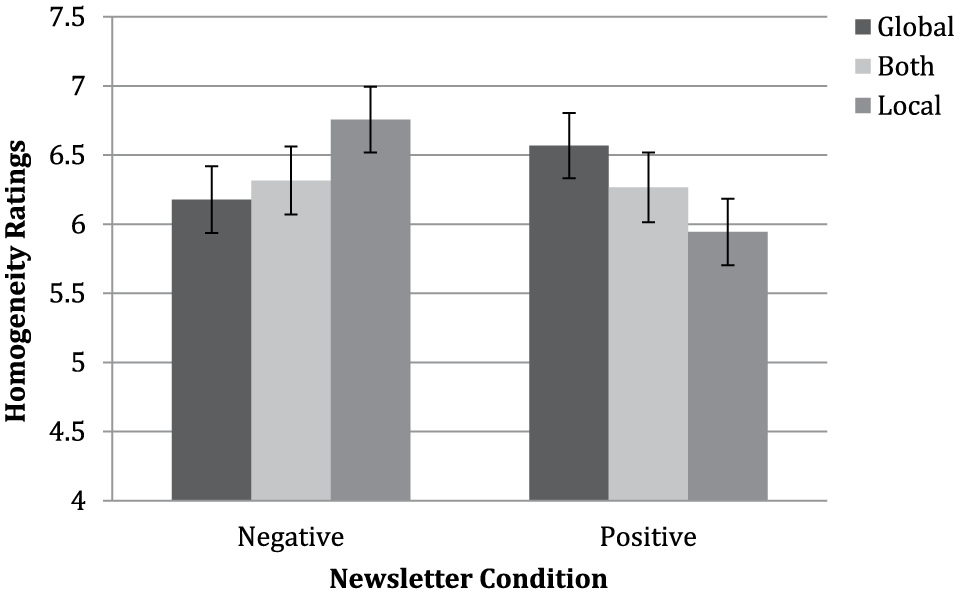
Mean out-group homogeneity ratings for homeless individuals (Experiment 2).
Perceptions of the causes of homelessness
An analysis of participants’ judgments of the person-level and system-level causes of homelessness as repeated measures as a function of affect and information-processing conditions revealed a three-way interaction between these variables, F(2, 143) = 4.405, p = .014;
Mean System-Level and Person-Level Attributions for Homelessness.
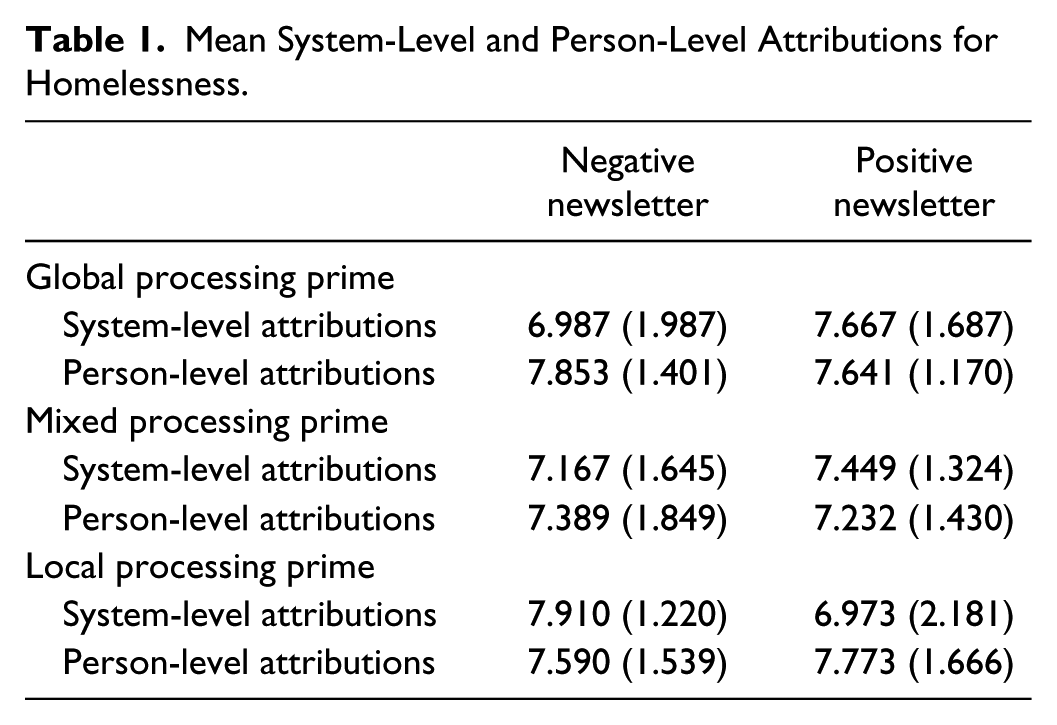
Examination of the system-level attributions reveals the predicted effects. In the local processing condition, individuals who read the negative newsletter endorsed system-level causes for homeless more than did participants who read the positive newsletter (7.910, SD = 1.220; 95% CI [7.247, 8.573] vs. 6.973, SD = 2.181; 95% CI [6.297, 7.649]), F(1, 143) = 6.971, p = .009, d = .530. In the global condition, the opposite pattern emerged. That is, participants who read the positive newsletter endorsed system-level causes for homelessness more than did participants who read the negative newsletter (7.667, SD = 1.687; 95% CI [7.004, 8.330] vs. 6.987, SD = 1.987; 95% CI [6.311, 7.663]), F(1, 143) = 3.672, p = .057, d = .369. Finally, consistent with the notion that our mixed priming conditions rendered neither global nor local processing dominant, no effects of affect emerged on attribution judgments in this condition (7.167 [negative], SD = 1.645; 95% CI [6.477, 7.857] vs. 7.449 [positive], SD = 1.324; 95% CI [6.744, 8.154]), F(1, 143) < 1, d = .189. These results suggest that affect regulates the impact of processing styles on the tendency to take the larger societal context into consideration when making attributional judgments about the causes of homelessness.
Behavioral intentions to donate
We next examined our hypothesis that affect and primed information-processing styles would have downstream consequences on real-world behavioral intentions given their interactive effects on homogeneity and attributional judgments. Research demonstrates that perceiving greater out-group homogeneity has negative intergroup consequences and thus could be related to decreased donation amounts (e.g., Er-rafiy & Brauer, 2012), whereas attributing the causes of homelessness to systemic and societal causes has positive intergroup consequences and should be related to increased donations (e.g., see Skitka, 1999). Thus, the affect and processing style conditions that result in global processing, which led to greater perceptions of homogeneity and greater attributions to systemic causes, may simultaneously decrease (via greater perceptions of homogeneity) and increase (via greater systemic attributions) the propensity to donate to homeless individuals. Due to these conflicting possibilities, we did not expect to find a direct influence of affect and information-processing conditions on donations.
1
Indeed, the interaction between affect and processing styles did not influence donation intentions directly: F(2, 143) = 1.375, p = .256,
We computed a difference score reflecting the relative tendency to make more system-level attributions than person-level attributions for the causes of homelessness. 2 Making relatively greater system-level causal judgments was significantly correlated with higher donation intentions when controlling for affect, b = .15, p = .048. However, homogeneity judgments were not significantly related to donation intentions (p > .05), and it is likely, as a result of this, that homogeneity ratings did not mediate the experimental effects on donation intentions. We thus focused on causal attributions as potential mediators. We considered whether affect influenced donation intentions due to its effect on system- versus person-level causal judgments, and whether this indirect effect is moderated by processing style (global vs. local 3 ; see Figure 4). We expected that in the global conditions, positive affect would increase system-level causal judgments and thereby increase intentions to donate, and that in local conditions, positive affect would decrease system-level causal judgments and thereby decrease intentions to donate.
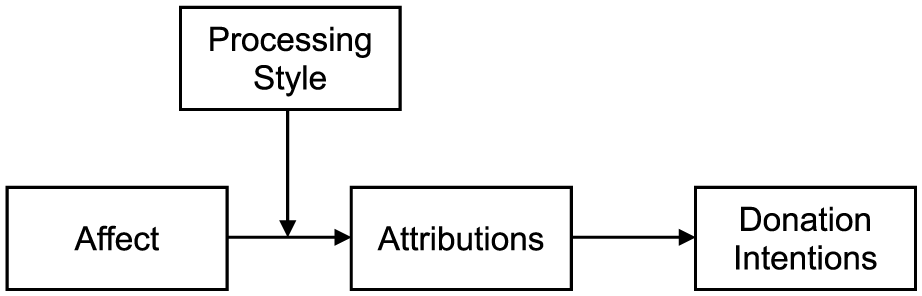
Proposed conditional process model.
We tested the significance of indirect effects using bias corrected bootstrapping with 20,000 resamples. We found a significant indirect influence of affect on donation intentions via causal attributions under local processing conditions, b = −.1340, 95% CI [.0051, .3908]. That is, under local processing, positive (relative to negative) affect reduced system-level attributions, which reduced intentions to donate. In the global condition, the indirect effect was marginally significant and in the opposite direction, b = .1303, 95% CI [−.3810, .0031], suggesting that positive affect promoted relatively greater system-level attributions, and thereby tended to increase intentions to donate. The two indirect effects not only operate in opposite directions, but are of nearly the same magnitude. In the critical test comparing these indirect effects (Hayes, 2015), we found that the effects in the global and local conditions were significantly different from one another, 95% CI [.0338, .6231], demonstrating that processing style moderates the indirect effects of affect on donation intentions. 4 This suggests that due to their impact on causal attribution judgments, affect and processing styles have interactive downstream consequences on real-world behavioral intentions.
Meta-Analysis of Studies 1 and 2
Although the predicted interaction between affect and information-processing primes is significant in both studies when examining out-group homogeneity judgments, not all simple effects achieved statistical significance. For this reason, we conducted a meta-analysis (following DeCoster, 2009) of the simple effects across both studies. The results demonstrate that differences between positive and negative affect within each processing condition are robust when meta-analytically averaged: global processing conditions, gweighted = .466, 95% CI [.818, .115], Z = 2.601, p = .0046; and local processing conditions, gweighted = .358, 95% CI [.705, .011], Z = 2.021, p = .0216. As expected, there was no effect in the mixed processing conditions, gweighted = .057, 95% CI [.412, −.298], Z = 0.31, p = .3371.
Statistical Power
Post hoc power analyses revealed that the statistical power to detect the effects on out-group homogeneity is .61 in Study 1 and .62 in Study 2, and power for Study 2’s attributional effects is .77, which is greater than the average power in the field of psychology (0.35; Bakker, van Dijk, & Wicherts, 2012), and within the range of the average power of 0.65 in studies published in Journal of Personality and Social Psychology (JPSP), Personality and Social Psychology Bulletin (PSPB), and Journal of Experimental Social Psychology (JESP; Fraley & Vazire, 2014).
General Discussion
Consistent with prior work, the current results suggest that the relationship between affective experiences and global versus local information-processing styles is highly malleable in response to basic differences in currently activated processing styles. These studies provide important new evidence supporting the affect-as-cognitive-feedback account, which maintains that affective states function as “stop” and “go” signals that confer value on dominant processing inclinations (Huntsinger et al., 2014). Together, these studies extend existing research by demonstrating (a) the effects in a new domain (i.e., out-group judgments), (b) that the effects generalize to a manipulation of integral affect, and (c) that such effects have important downstream consequences for real-world behavioral intentions.
Across two studies using different target out-groups (college students and homeless people), we found that among individuals primed with global processing, positive affect led to greater perceptions of homogeneity compared with negative affect, whereas these effects reversed in the local priming condition and disappeared in the mixed priming condition. The fact that this pattern of results emerged for both incidental and integral affect is noteworthy and confirms what many have theorized but few have tested. That is, episodic integral affect may well function in a manner similar to incidental affect. To our knowledge, this is the first research to demonstrate flexible and analogous effects on processing for these different types of affective experiences. Studying integral affect experimentally represents an important foray into understanding how affect influences cognition in the real world.
Study 2 further demonstrated the implications of affect’s value-signaling feedback function for attributions and downstream behavioral intentions. Specifically, under global processing conditions, integral positive affect (relative to negative) promoted relatively greater system-level attributions for homelessness, which increased intentions to donate; however, under local processing, integral positive affect (relative to negative) reduced system-level attributions, which decreased intentions to donate. These findings are consistent with research demonstrating that global processing leads to broadened attention and sensitivity to contextual information (e.g., Huntsinger, 2012; Woltin et al., 2012).
Taken together, our findings have important implications for the literature investigating the impact of affect on intergroup judgments. Whereas the existing literature suggests that positive affect promotes perceptions of out-group homogeneity, our data suggest that this is only part of the story. That is, positive affect can also reduce homogeneity perceptions when local processing is dominant. We believe this work can have important applied implications by informing efforts to reduce out-group homogeneity and intergroup bias (e.g., Er-rafiy & Brauer, 2012). Specifically, our data suggest that inducing positive affect in conjunction with even the most basic local processing primes can make individuals more sensitive to differences among out-group members. Furthermore, negative affect might produce similar effects, but only in the absence of local processing primes.
Our model and findings are consistent with broader evidence that affect serves as stop/go signals on other types of accessible information (e.g., goals, thoughts; for example, Fishbach & Labroo, 2007; Pastötter, Gleixner, Neuhauser, & Bäuml, 2013; see Huntsinger et al., 2014, for a review), as well as recent work emphasizing the socially situated nature of cognition (e.g., Mesquita, Barrett, & Smith, 2010).
Processing Versus Judgment Effects
It is important to point out that we predicted and found processing effects on our measures in both studies; however, one may wonder why we did not find judgment effects on our measures, which would be predicted by research demonstrating that affect can shape judgments in a valence-consistent manner (e.g., Schwarz & Clore, 1983). That is, why did we not find main effects of affect on judgments, in addition to interactions? Our paradigm was designed to test processing effects, not judgment effects. First, we used affect manipulations that avoided confounding affect with judgments (by using incidental affect in Study 1 and affect associated with homeless individuals’ prospects, not their characteristics, in Study 2). Second, our dependent measures have been shown to be sensitive to processing effects, not judgment effects. That is, prior work demonstrates that positive affect promotes greater perceptions of homogeneity (a decidedly negative outcome) by inducing global processing—no judgment mechanism is postulated (Queller et al., 1996; Stroessner et al., 2005). Third, a core tenet of the affect-as-cognitive-feedback model is that affective cues confer value on whatever one happens to be focusing on at the time. By priming information-processing styles, we specifically set up conditions that were likely to produce processing effects and lead individuals to perceive their affect as feedback about these experimentally induced processing styles.
Theoretically, if the object of one’s affect is one’s thoughts, then processing effects are likely to emerge; however, if the object of one’s affect is an object in the world external to the person, then judgment effects are likely to emerge (e.g., Clore & Huntsinger, 2009; Clore & Schiller, in press). In practice, however, it is not always clear what the object is (Clore & Schiller, in press). Even in situations that appear to be ripe for judgment effects, processing effects can emerge if affect serves as feedback about the validity of one’s attitude as a basis for judgment. To test this possibility, Schiller and Clore (2014) investigated the impact of mood on judgments of disliked targets (i.e., disgraced athletes Lance Armstrong and Alex Rodriguez). In these studies, individuals in positive moods rendered more negative judgments of the targets than did individuals in negative moods. Such findings are consistent with the notion that positive affect conferred value on preexisting attitudes and increased the validity of these attitudes as a basis for judgment.
The results of many judgment studies that have been interpreted as evidence that affect has a direct effect on judgment may, however, be open to alternative interpretation given that the targets of judgment in such studies are generally favorable. For example, in the classic Schwarz and Clore (1983) study that established the direct informational influence of affect on judgments, individuals in happy moods (due to warm weather) evaluated their lives more favorably than those in unhappy moods (due to rainy weather), effects that disappeared when mood was no longer perceived to be a valid source of information about their lives. However, given that people in the United States generally report on average that they are satisfied with their lives (Diener & Diener, 1996), such results may also be the result of affect serving as feedback on currently accessible attitudes. That is, positive mood may have conferred positive value on individuals’ preexisting positive attitudes about their lives, whereas negative moods may have conferred negative value, reducing reliance on their preexisting attitudes. To date, these different possibilities have not been empirically differentiated. Future research should be aimed at predicting the precise conditions in which affect serves as feedback about currently accessible information and when it serves as direct information about a target.
Our findings are of practical importance because global processing is not always active by default. In fact, one’s default processing style may vary based on a potentially large number of variables, including cultural and individual difference variables. For example, in a study investigating analytic versus holistic reasoning across cultures, Koo, Clore, Kim, and Choi (2012) demonstrated that positive affect promoted (and negative affect inhibited) whatever style of reasoning was culturally dominant (analytic in Western cultures and holistic in East Asian cultures). A host of other factors make one more likely to process information locally rather than globally by default (e.g., autism, obsessive-compulsive disorder, anxiety disorders; Mikulincer, Kedem, & Paz, 1990; Wang, Mottron, Peng, Berthiaume, & Dawson, 2007; Yovel, Revelle, & Mineka, 2005). In these conditions, positive affect should promote this dominant processing tendency and negative affect should inhibit it. This prediction should be tested in future research.
Comparison to Other Theories
The claims made by the affect-as-cognitive-feedback model are consistent with a growing body of literature that demonstrates that the influence of affect on cognition is flexible (for a review, see Huntsinger et al., 2014). Importantly, however, the conditions under which such flexibility is theorized to exist differ, as do the proposed mechanisms for such effects. We consider four such models.
The hedonic contingency model takes into account mood management concerns and predicts that positive affect can promote a systematic analysis of information when individuals believe that such processing will help them maintain or enhance their current affective state (e.g., Wegener & Petty, 1994; Wegener et al., 1995). The mood-congruent expectancies approach predicts that greater processing effort emerges when individuals encounter mood-incongruent information and hence their expectations for mood-congruent information are violated (e.g., Ziegler, 2014). The motivational intensity model maintains that the relationship between affective valence and processing style is malleable, and predicts that affective experiences that are high in motivational intensity narrow attention (to aid goal pursuit), whereas those low in motivational intensity broaden attention (to allow for new opportunities; Harmon-Jones et al., 2013). Thus, unlike our model, this model fixes cognitive outcomes to affective states that differ in motivational intensity.
The affect-as-cognitive-feedback approach offers a fundamentally different perspective on the mechanism underlying prior research, arguing that affect serves a signaling function and does not directly induce particular cognitive processing styles. Although the hedonic contingency, mood-congruent expectancies, and motivational intensity approaches provide evidence for important moderators of the relationship between affect and cognition, these approaches all assume that some dimension or component of affect is directly linked to a particular processing style. The affect-as-cognitive feedback account posits that it is possible that no dimension or component of affect directly prescribes processing (be it valence, appraisals, motivational intensity, hedonic value, or expectancy violations) but rather that all of these variables might serve as arbiters of momentarily accessible processing styles. That is, many variables may operate as “go” or “stop” signals and confer value on currently accessible information. Although an empirical question, we hypothesize that high motivational intensity and hedonic motives may act as go signals that promote accessible processing, and expectancy violations may operate as stop signals that inhibit such processing. Thus, these perspectives may be missing half of the equation by overlooking what happens when local processing is dominant, and may be subject to the feedback mechanisms we demonstrate here. It is also possible that variables such as hedonic contingency override or serve as barrier conditions to affect’s signaling functions. Future research should investigate the intersections between these models to ascertain whether these other variables also influence information processing by serving as stop or go signals, and to identify the boundary conditions of affective feedback effects.
Self-validation theory and our affect-as-cognitive-feedback approach share a common theoretical background and have similar histories (e.g., Clore & Gasper, 2000; Clore et al., 2001; Petty, Briñol, & Tormola, 2002; Wyer et al., 1999). Both views maintain that affective and other subjective experiences serve to validate currently accessible thoughts; however, the self-validation approach maintains that a meta-cognitive process drives these effects. Although the self-validation approach has not investigated global and local processing styles to date, evidence suggests that self-validation processes are most likely to operate under conditions of high-elaboration (i.e., when motivation and ability to think are high). In contrast, our view does not propose elaboration as a moderator. In fact, the effects that we predict oftentimes emerge in situations in which cognitive elaboration is low (see Huntsinger et al., 2014). Despite this difference, self-validation theory is highly complementary to the affect-as-cognitive-feedback account.
In sum, the affect-as-cognitive-feedback model is broadly consistent with other work that maintains that the relationship between affect and cognition is malleable but proposes a unique mechanism (i.e., nonconscious feedback) for a wide variety of effects reported in the literature.
Conclusion and Future Directions
Overall, the current studies provide new evidence for a dynamic relationship between affect and cognition. We demonstrated that both incidental and episodic integral affective states do not lead to specific processing styles, but instead provide feedback on currently active processing styles. Furthermore, these interactive effects have important downstream consequences for behavior. In summary, the present research sheds light on the processes through which affect influences important social psychological phenomena while simultaneously illustrating the important real-world implications of the affect–cognition relationship.
The affect-as-cognitive-feedback perspective is postulated to be a broad theoretical conceptualization with widespread applicability; however, future research is needed to establish this more fully. Specifically, researchers should explore the extent to which existing findings extend to discrete emotions (see Isbell, Rovenpor, et al., 2016) and to implicit affective cues (Friedman & Förster, 2010), as theorized by the model. Finally, we hope that the present work will spur additional research examining the effects of integral affect to enhance our understanding of how affect functions in more real-world contexts.
Footnotes
Declaration of Conflicting Interests
The author(s) declared no potential conflicts of interest with respect to the research, authorship, and/or publication of this article.
Funding
The author(s) disclosed receipt of the following financial support for the research, authorship, and/or publication of this article: This work was supported by National Science Foundation Research Grant BCS-0956309 to Linda M. Isbell.

Notes
References
Supplementary Material
Please find the following supplemental material available below.
For Open Access articles published under a Creative Commons License, all supplemental material carries the same license as the article it is associated with.
For non-Open Access articles published, all supplemental material carries a non-exclusive license, and permission requests for re-use of supplemental material or any part of supplemental material shall be sent directly to the copyright owner as specified in the copyright notice associated with the article.
