




Abstract
In the present research, we examined academic self-enhancement in students (N = 264) followed longitudinally through 4 years of college. We used social comparison (i.e., better-than-average ratings) and self-insight (i.e., criterion-based) approaches to assess the degree to which students self-enhanced in their self-perceptions of academic ability, with SAT scores, high school grade point average (GPA), and college GPA used as criterion measures. We also examined ethnic variability in academic self-enhancement. We found that academic self-enhancement (a) increased or decreased over the 4 years of college, depending on its operationalization, (b) tended to be adaptive according to social comparison indices, and (c) demonstrated a trajectory that differed by ethnicity, but ethnicity did not moderate the effect of academic self-enhancement on outcomes. We discuss the implications of the findings for debates about the adaptive value of self-enhancement, the magnitude of cultural differences, and how best to conceptualize and operationalize the construct.
Self-enhancement refers to the tendency to see oneself in an overly positive way. One view within the literature is that most people (Dunning, 1999; Taylor & Armor, 1996; Taylor & Brown, 1994), in most cultures (Brown, 2003; Sedikides, Gaertner, & Vevea, 2005) self-enhance, because it satisfies a fundamental need to feel positively about oneself. Another view is that self-enhancement, rather than being pervasive, shows substantial individual (Colvin & Block, 1994; John & Robins, 1994) and cultural (Heine, Kitayama, & Hamamura, 2007; Heine, Lehman, Markus, & Kitayama, 1999) variability due to differences in values and norms.
Like its pervasiveness, the adaptiveness of self-enhancement has also been debated. Self-enhancement has been linked to well-being and physical health (Dunning, 1999; Taylor & Armor, 1996; Taylor & Brown, 1994), suggesting that having overly rosy self-views is adaptive. Yet, individual differences in self-enhancement have been linked to negative outcomes such as depression and narcissism, perhaps because inaccurate self-views lead to the miscalibration of behavior (Colvin & Block, 1994; Gosling et al., 1998; Shedler et al., 1993). To make sense of the heterogeneity in findings, researchers have taken into account differences in the operationalization of self-enhancement (Church et al., 2014; Kwan, John, Kenny, Bond, & Robins, 2004), the type and longevity of its effects (Paulhus, 1998; Robins & Beer, 2001), and the specific domains of functioning in which self-enhancement occurs (Brown & Kobayashi, 2002; Gaertner, Sedikides, & Chang, 2008; Kurman & Sriram, 1997; Sedikides, Gaertner, & Toguchi, 2003).
We combined these strategies in the present research by using two different operationalizations of self-enhancement to examine its occurrence, course, and correlates across college, specifically within the academic domain. Academic self-enhancement, or having overly positive views of one’s academic ability, has been of interest due to the importance of academic achievement for self-concept (Marsh, 1990), the availability of objective indicators (Südkamp, Kaiser, & Möller, 2012), and the implications of academic achievement for important outcomes (Dufner et al., 2012; Gramzow & Willard, 2006). One open question is how this type of self-enhancement, if observed, changes over time, especially during important life transitions when one’s self-views and performance in the real world might be especially likely to shape each other.
In the present study, we examined academic self-enhancement as indicated by college students’ self-ratings versus objective indicators of their academic ability, investigating whether students self-enhanced, how this tendency changed over 4 years of college, and with what consequences for academic performance and well-being. We extend previous research in the following ways. First, by examining the trajectory of self-enhancement during college, we shed light not only on whether self-enhancement occurs but whether it changes, immediately after the transition into young adulthood. Second, by investigating self-enhancement in the academic context, we add to the literature that examines self-enhancement in domain-specific ways. Third, by including different operationalizations of self-enhancement, we investigate academic self-enhancement from two different perspectives (i.e., using both social comparison and self-insight approaches) and thus derive a more fine-grained understanding of (a) the kinds of academic self-enhancement that occur during the college years and (b) their different associations with outcomes. Last, by examining academic self-enhancement in an ethnically diverse sample of college students, we provide data on how academic self-enhancement tendencies might differ by ethnicity, including for Latinos, on whom there is little research. Below, we review research relevant to these topics.
Academic Self-Enhancement
Academic self-enhancement, or the exaggeration of one’s academic abilities, has been a topic of interest due to its real-world significance (Dufner et al., 2012; Gramzow, Johnson, & Willard, 2014; Kurman & Eshel, 1998; Robins & Beer, 2001), including its association with academic achievement (Marsh, Byrne, & Yeung, 1999). Although there may be cultural differences in self-enhancement, as we discuss below, most students, including college students, tend to have inflated views of their academic abilities (Beyer, 1999; Garavalia & Gredler, 2002; Nowell & Alston, 2007; Svanum & Aigner, 2011; Wendorf, 2002). Researchers have suggested that this indicates ego involvement in the academic domain (Elliot & McGregor, 2001; Marsh & Shavelson, 1985). In line with this reasoning, higher levels of academic self-enhancement among college students have been associated with having a stronger motivational orientation toward academics (Gramzow & Willard, 2006; Willard & Gramzow, 2009). Thus, in the present study, we expected academic self-enhancement to occur because most students are academically motivated. However, because students are academically motivated to different extents, we also expected there to be individual differences in this tendency that are associated with psychological and educational outcomes.
Changes in Academic Self-Enhancement
Although a body of research has examined the different consequences of self-enhancement across time (Paulhus, 1998; Robins & Beer, 2001), we know of only a few studies that have tracked longitudinal changes in self-enhancement itself. In two different studies, college students’ expectations for grades were found to decrease over the course of a semester, although expectations remained high by the end of the course (Buckelew, Byrd, Key, Thornton, & Merwin, 2013; Wendorf, 2002). In a longer term study of Dutch adolescents followed from seventh to ninth grade, students’ levels of self-enhancement decreased for ratings of ability (e.g., aptitude in French and Mathematics) but increased for desirable attributes and global traits (e.g., physical attractiveness and likeability; Kuyper & Dijkstra, 2009). These sets of findings suggest that self-enhancement may decrease for attributes for which objective feedback is regularly provided but may increase for somewhat subjective and general attributes. Consistent with this, researchers have shown that self-esteem, one’s subjective global evaluation of oneself, increases in young adulthood (Orth & Robins, 2014), suggesting that self-enhancement, a process related to self-esteem, might increase.
In sum, the findings from existing research suggest different possibilities for what to expect for the trajectory of self-enhancement. It could be that receiving regular feedback on academic performance might lead to a decrease in academic self-enhancement over time. However, academic self-enhancement may increase as part of the overall process related to increases in self-esteem in young adulthood (Orth & Robins, 2014). Knowing of no research that has specifically examined change in academic self-enhancement throughout the college years, we pursued this question by investigating changes in academic self-enhancement at multiple time points over 4 years of college in a sample of ethnically diverse college students.
Adaptive and Maladaptive Correlates of Academic Self-Enhancement
To what extent is academic self-enhancement adaptive? Some research indicates that viewing one’s academic abilities favorably is beneficial, with findings showing that academic self-enhancement is associated with achieving better grades (Dufner et al., 2012; Gramzow et al., 2014), better psychological adjustment (Dufner et al., 2012; Dufner, Reitz, & Zander, 2014; Kurman & Eshel, 1998; Noble, Heath, & Toste, 2011), and greater motivation to academically succeed (Gramzow et al., 2014; Gramzow & Willard, 2006). Other research suggests that academic self-enhancement is costly, finding that academic self-enhancement is associated with lower grades (Gramzow, Elliot, Asher, & McGregor, 2003) and disengagement from academics (Robins & Beer, 2001).
These mixed findings for academic self-enhancement align with the broader literature on self-enhancement, wherein the adaptiveness of self-enhancement may depend on its operationalization and measurement. For example, if self-enhancement is defined as the tendency to view oneself more favorably than one views others, referred to as the social comparison approach, the outcomes are often positive, but, if defined as the tendency to view oneself more favorably than one is viewed by others (or by some other external criteria for what the person is like), referred to as the self-insight approach, the outcomes are often unfavorable (Kwan et al., 2004; Kwan, John, Robins, & Kuang, 2008; Schriber & Robins, 2012). A major distinction with regard to operationalization is whether an external criterion is used to evaluate the veracity of self-ratings (Colvin & Block, 1994; Shedler et al., 1993). For example, the social comparison approach (Alicke, 1985; Guenther & Alicke, 2010) compares self-ratings with ratings made about an average other on a trait or behavior, whereby higher “better-than-average” ratings are evidence of self-enhancement. However, whether or not one is actually better-than-average is not considered. In contrast, the self-insight approach (John & Robins, 1994; Paulhus, 1998; Robins & John, 1997) uses an external criterion (e.g., informant ratings, actual performance on relevant measures) to determine the accuracy of self-ratings such that positive discrepancies between a self-rating and criterion with regard to a desirable attribute are considered evidence of self-enhancement.
With both approaches in mind, we examined trajectories of academic self-enhancement using a social comparison approach based on better-than-average ratings, and a self-insight approach based on (a) better-than-average ratings controlling for prior academic achievement and (b) discrepancies between expected versus actual grades. We expected the social comparison measure to show that academic self-enhancement is adaptive, and the self-insight measures, to show that it is maladaptive. To gauge the adaptiveness of academic self-enhancement, we examined self-esteem and narcissism as sources of individual differences in the occurrence and course of academic self-enhancement. Self-esteem and narcissism are both reflections of chronically positive self-regard (Bosson, Brown, Zeigler-Hill, & Swann, 2003; John & Robins, 1994; Schriber & Robins, 2012), but it is only in the case of self-esteem that self-worth is genuine, whereas narcissism is associated with having inflated but insecure self-views. We also investigated how self-enhancement was prospectively associated with the outcomes of psychological adjustment and academic success (attrition, graduation, and final college grades). Thus, we examined the antecedents, correlates, and consequences of self-enhancement using multiple indicators of academic self-enhancement.
Finally, we examined ethnicity as a source of variability in self-enhancement. Some research indicates that self-enhancement varies with culture, with self-enhancement being less prevalent in Eastern versus Western cultures (Heine & Hamamura, 2007; Heine & Lehman, 1997; Heine, Lehman, Markus, & Kitayama, 1999; Heine & Renshaw, 2002), whereas other research indicates that self-enhancement is simply more domain-specific in Eastern cultures (Brown & Kobayashi, 2002; Gaertner et al., 2008; Sedikides et al., 2003; Sedikides, Gaertner, & Vevea, 2005; Tam, Leung, Kim, Chiu, Lau, & Au, 2012). Likewise, findings have been mixed regarding whether self-enhancement is more or less adaptive depending on culture (Kang, Shaver, Sue, Min, & Jing, 2003; Kobayashi & Brown, 2003; Kurman, 2003; O’Mara, Gaertner, Sedikides, Zhou, & Liu, 2012; Tsai et al., 2014). Thus, our investigation into the effects of ethnicity was exploratory.
Present Study
The present study examined academic self-enhancement using longitudinal data on an ethnically diverse sample of college students followed through their college years. We addressed three questions: First, what do the trajectories of academic self-enhancement look like across the 4 years of college when using different operationalizations of self-enhancement? Second, to what extent are the correlates of academic self-enhancement adaptive? Third, as an exploratory question, are there ethnic differences in the trajectories and correlates of academic self-enhancement? Participants provided self-perceptions of their academic ability through better-than-average ratings and ratings of their expected grade point average (GPA) 6 times over the course of college. High school GPA, cumulative GPA, and Scholastic Aptitude Test (SAT) scores, which served as criterion measures, were obtained from the university registrar. Given this set of measures, our data provided a unique opportunity to examine self-enhancement in several ways. We were able to examine our questions using two different operationalizations of academic self-enhancement that respectively followed a (a) social comparison approach (Alicke, 1985) by examining better-than-average ratings concerning academic ability and (b) self-insight approach (John & Robins, 1994) by comparing self-ratings with a criterion measure in two ways—by taking better-than-average ratings and controlling for prior academic achievement, and by examining discrepancies between expected and actual grades. Finally, the multiwave nature of our assessments allowed us to test for the differential course of self-enhancement according to these metrics.
Method
Sample and Procedure
The present study used data from the Berkeley Longitudinal Study, a study designed to examine the development of self-esteem and personality during college (for further details about the study and sample, see Noftle & Robins, 2007; Robins & Beer, 2001; Robins, Fraley, Roberts, & Trzesniewski, 2001; Robins, Noftle, Trzesniewski, & Roberts, 2005). Participants were recruited during the first week of college and were then assessed annually throughout college. Participants were contacted by mail and asked to complete an extensive questionnaire in exchange for money (ranging from 6 to 20 USD). Six assessments were conducted over a 4-year period: first week of college (n = 508), end of the first semester (n = 455), and end of the first (n = 306), second (n = 260), third (n = 200), and fourth (n = 303) years of college. In the present study, data were analyzed for 280 individuals who completed the relevant measures at the first and last assessments (first week and end of fourth year). Forty-four percent of this sample was of Asian descent, 38% was of European descent, 13% was of Hispanic descent, 5% was of African American descent, and 1% had missing data for ethnicity. The sample size for individuals of African American descent was very small (n = 13); because we were interested in examining ethnicity in relation to academic self-enhancement, analyses were carried out only for individuals of Asian, European, or Hispanic descent (n = 264). This sample was diverse in terms of sex (59% female), socioeconomic status (20% came from families with 1992 household incomes less than 25,000 USD; and 13% from families with household incomes more than 100,000 USD), and academic ability (combined SAT scores ranging from 650 to 1,530; M = 1,200; SD = 165).
To test for attrition effects, we compared participants whose data were analyzed versus not analyzed on all demographic variables and variables of interest. Compared with individuals who were not included in the present analyses, those who were included received higher SAT scores, high school grades, and college grades, and were more likely to graduate from college. Thus, the sample examined in the present study is biased toward individuals who are higher in academic ability and achievement and the results may not generalize to individuals who are lower in ability and achievement.
Measures
Better-than-average ratings
At every assessment, participants provided self-reports of academic ability, that is, “Compared to the average UC (University of California) Berkeley student, how would you rate your academic ability?” Items were rated on a 5-point scale ranging from 1 (much worse than average) to 5 (much better than average), with 3 (average) as the midpoint.
Expected academic achievement
At six different points (3 times during the first year, then annually for the next 3 years), participants provided ratings of their expected performance in college, that is, “Realistically, what overall GPA do you think you will attain?” Responses were made on a GPA scale ranging from 0.00 (all Fs) to 4.00 (all As). Surveys were sent to participants before they were notified about their semester grades. Because actual GPA records were available starting only from the end of the first semester (i.e., after the Week 1 assessment), only the last five waves of ratings for expected grades were considered, starting with the first semester of college.
Academic achievement
Two indices served as objective indicators of academic achievement. The first index captured academic achievement as assessed in high school and was a standardized composite of combined SAT scores (SAT-Verbal plus SAT-Math) and high school GPA (Robins & Beer, 2001; r = .59). The second index, obtained at the end of every college semester, was cumulative GPA (on a 0.00 to 4.00 scale). For this index, we used the five assessments that corresponded with the expected grades variable. SAT scores, high school GPA, and cumulative college GPA were obtained from university records.
Academic self-enhancement
Academic self-enhancement was defined as the degree to which self-perceived academic ability was higher than actual academic ability as demonstrated by academic achievement. Typically, self-reports of actual ability, standing, personality, and so on are regressed onto criterion measures of these same constructs to create an index of self-enhancement that is independent of “reality” (Gramzow & Willard, 2006; John & Robins, 1994; Vazire & Carlson, 2010). For the present study, we created two measures of academic self-enhancement. The first measure of self-enhancement was created by using the standardized composite of combined SAT scores and high school GPA as a covariate of the trajectory for better-than-average ratings and is based on the operationalization of self-enhancement in Robins and Beer (2001); we refer to this as an index of unrealistic evaluations. The second measure of self-enhancement bias was created by taking the difference between actual college grades from expected grades at each assessment and drew from the operationalization of academic exaggeration in Gramzow and Willard (2006); however, it is important to note that Gramzow and Willard looked at discrepancies between reported versus actual grades, whereas we looked at expected versus actual grades; thus, we refer to this as an index of unrealistic expectations. 1
Genuine self-esteem and narcissistic self-aggrandizement
During the first week of college, participants completed the 10-item Rosenberg Self-Esteem (RSE; Rosenberg, 1965) Scale. Items were rated on a 5-point scale ranging from 1 (not very true of me) to 5 (very true of me). A scale score was computed by taking the average of the 10 items (omega reliability = .92). Also during the first week of college, participants completed a 33-item abbreviated version of the Narcissistic Personality Inventory (NPI; Raskin & Hall, 1979). Items were in a forced-choice format, such that participants chose the more accurate of two statements. A scale score was computed by taking the average of the 33 items (omega reliability = .82). Because we were interested in the effect of self-esteem separately from narcissism, and of narcissism separately from self-esteem, we followed Paulhus, Robins, Trzesniewski, and Tracy (2004) by regressing the self-esteem score on the narcissism score, and vice versa, thus creating narcissism-free self-esteem scores (genuine self-esteem) and self-esteem-free narcissism scores (narcissistic self-aggrandizement) for the first week of college.
Adjustment to college
At the end of the fourth year of college, participants were asked three items (adapted from Aspinwall & Taylor, 1992) about self-perceptions of adjustment specific to the university environment: “How well do you think you’ve adjusted to the academic environment at UC Berkeley?” “How well do you think you’ve adjusted to the social environment at UC Berkeley?” And, “Overall, how well do you think you’ve adjusted to college?” Responses were made on a scale of 1 (poorly) to 5 (very well). A total scale score was computed by taking the average of the items (omega reliability = .77).
Attrition, graduation, and final cumulative GPA
Attrition rates were proportion scores that were calculated by dividing the number of semesters not enrolled in school by eight (the total semesters in 4 years), with higher values indicating more time spent not enrolled in college. Graduation was a dichotomous item that indicated whether or not the individual had graduated from the university, coded 0 (did not graduate) or 1 (did graduate). Final cumulative GPA was the GPA that the individual earned on leaving the university. These indices were obtained from university records.
Results
Descriptive statistics and correlations among study variables are presented in Table 1 of this article. We produced plots and estimates of coefficient omega in the psych package Version 1.5.8 (Revelle, 2015) in R (R Core Team, 2014), and we conducted longitudinal analyses within a structural equation modeling framework using Mplus Version 7 (Muthén & Muthén, 1998-2012). Models are listed in Table 1 of the online appendix. Model fit statistics are presented in Tables 2a and 2b of the online appendix. A summary of the results of our research questions is presented in Table 2 of this article.
Descriptive Statistics and Correlations Among Study Variables.
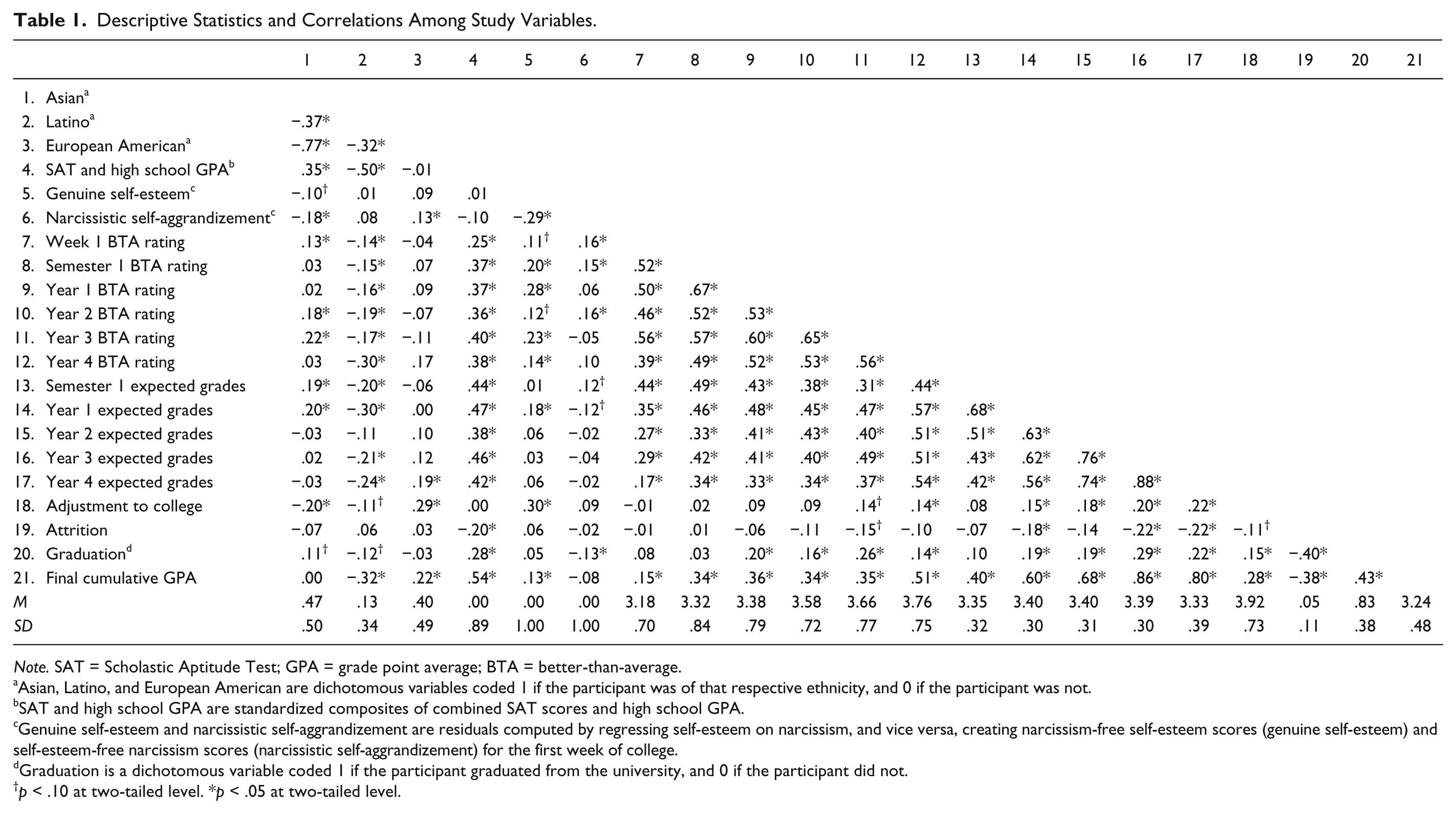
Note. SAT = Scholastic Aptitude Test; GPA = grade point average; BTA = better-than-average.
Asian, Latino, and European American are dichotomous variables coded 1 if the participant was of that respective ethnicity, and 0 if the participant was not.
SAT and high school GPA are standardized composites of combined SAT scores and high school GPA.
Genuine self-esteem and narcissistic self-aggrandizement are residuals computed by regressing self-esteem on narcissism, and vice versa, creating narcissism-free self-esteem scores (genuine self-esteem) and self-esteem-free narcissism scores (narcissistic self-aggrandizement) for the first week of college.
Graduation is a dichotomous variable coded 1 if the participant graduated from the university, and 0 if the participant did not.
p < .10 at two-tailed level. *p < .05 at two-tailed level.
Summary of Findings Regarding the Relations Between the Self-Enhancement Trajectories and Psychological and Educational Correlates.
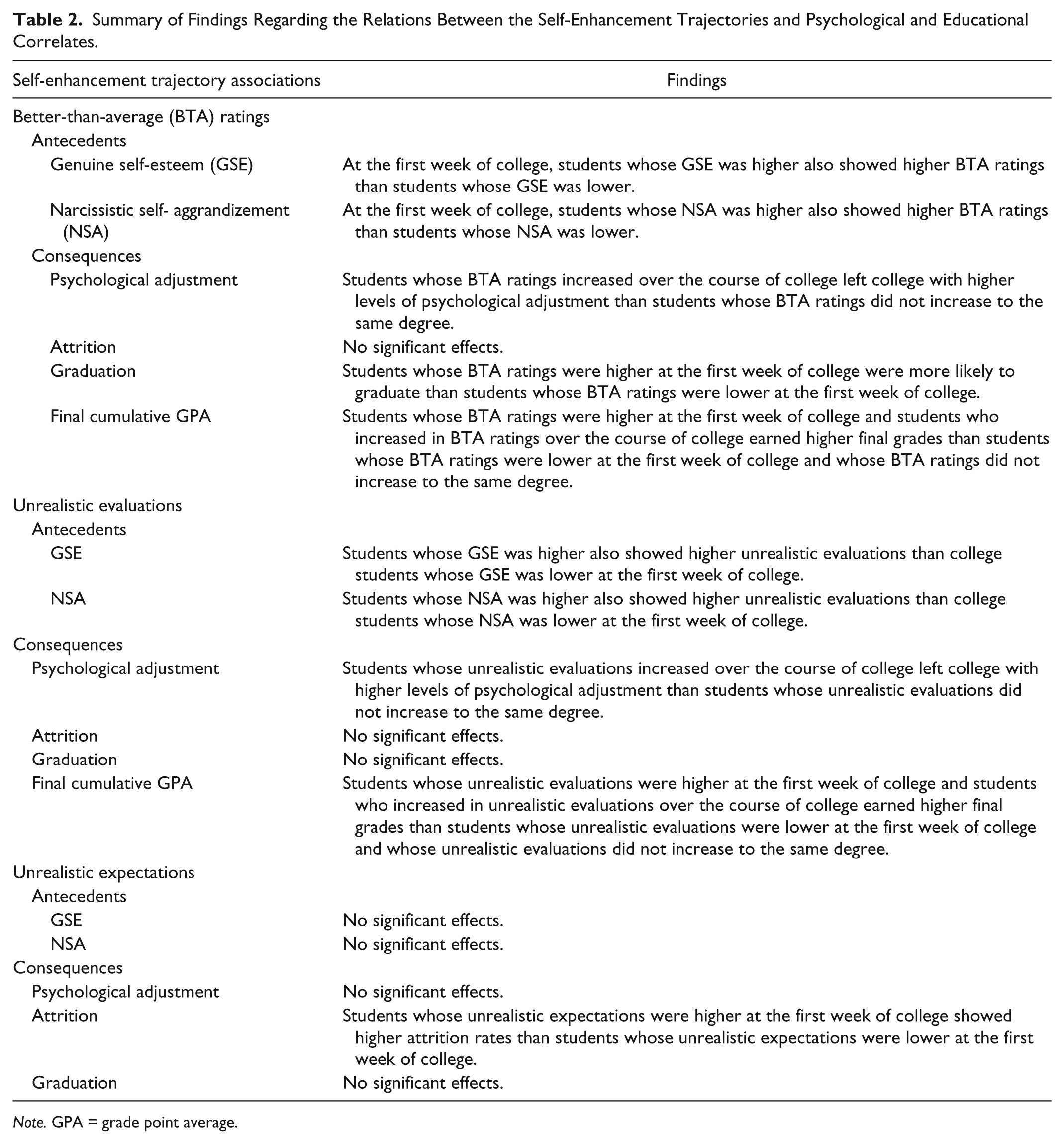
Note. GPA = grade point average.
What Is the Trajectory of Academic Self-Enhancement Across 4 Years of College?
Better-than-average ratings
After visually inspecting the better-than-average ratings across the 4 years of college (see Figure 1 for a density distribution), we fit a latent basis model to the data (Model 1; see Table 3 of this article for model coefficients, and online appendix, p. 6 for a detailed description of model specification). The results indicated that on average, students started college rating themselves as slightly better than the average UC Berkeley student (e.g., above the midpoint of the scale), and subsequently increased in their better-than-average ratings across the 4 years of college.

Density distribution of better-than-average ratings over 4 years of college.
Model 1. Latent Basis Model of Better-Than-Average Trajectory.
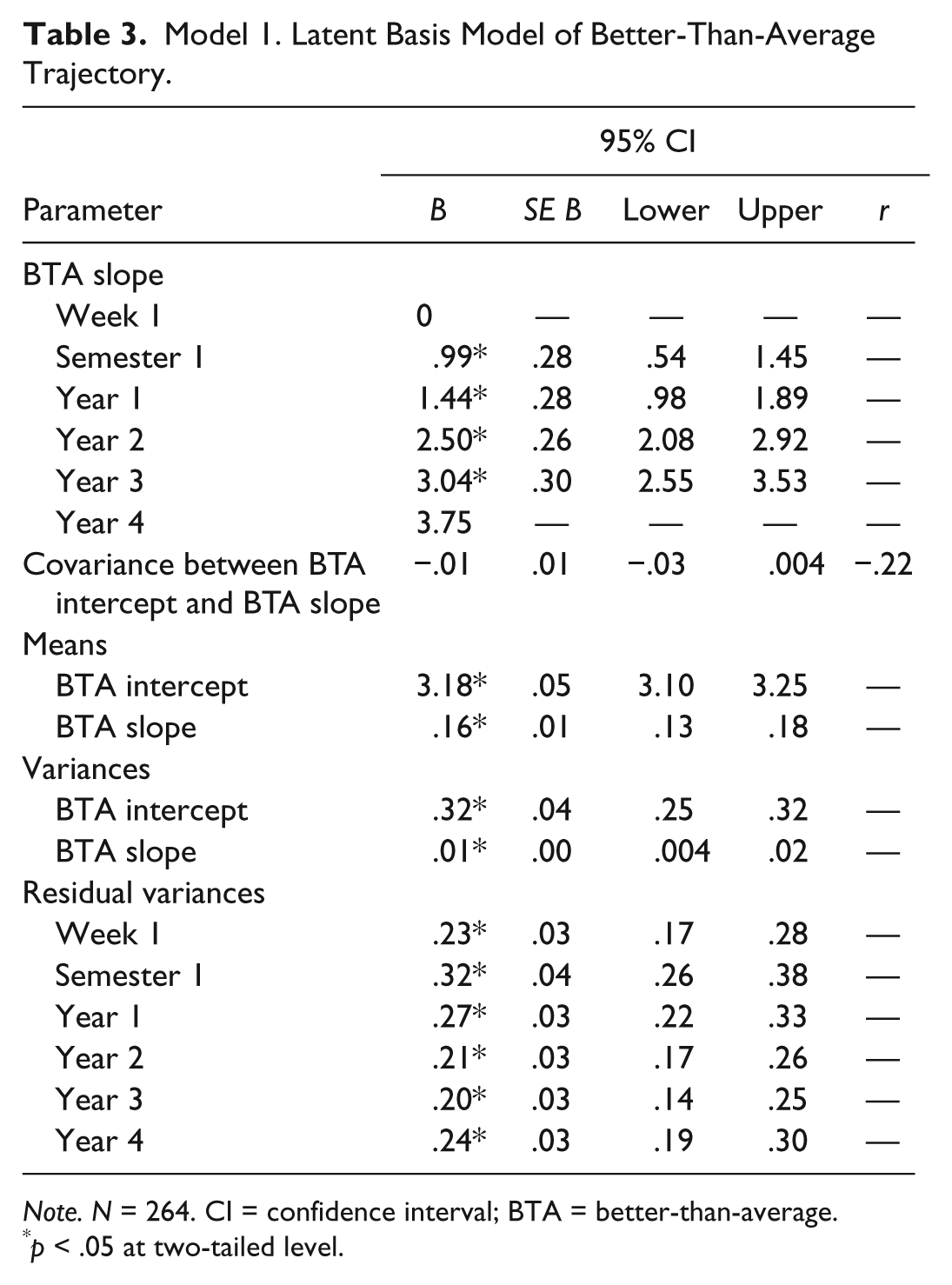
Note. N = 264. CI = confidence interval; BTA = better-than-average.
p < .05 at two-tailed level.
Unrealistic evaluations
To examine the unrealistic evaluations trajectory, we specified a model that included the standardized composite variable for combined SAT scores and high school GPA as a predictor of the better-than-average trajectory. Thus, we created an index of unrealistic evaluations that was unconfounded with prior achievement (Model 2; see Table 4 of this article for model coefficients and online appendix, p. 6 for a detailed description of model specification). Similar to our results for better-than-average ratings, results indicated that, on average, students started college with above-average levels of self-enhancement, and subsequently increased in their self-enhancement across the 4 years of college.
Model 2. Latent Basis Model of Unrealistic Evaluations.
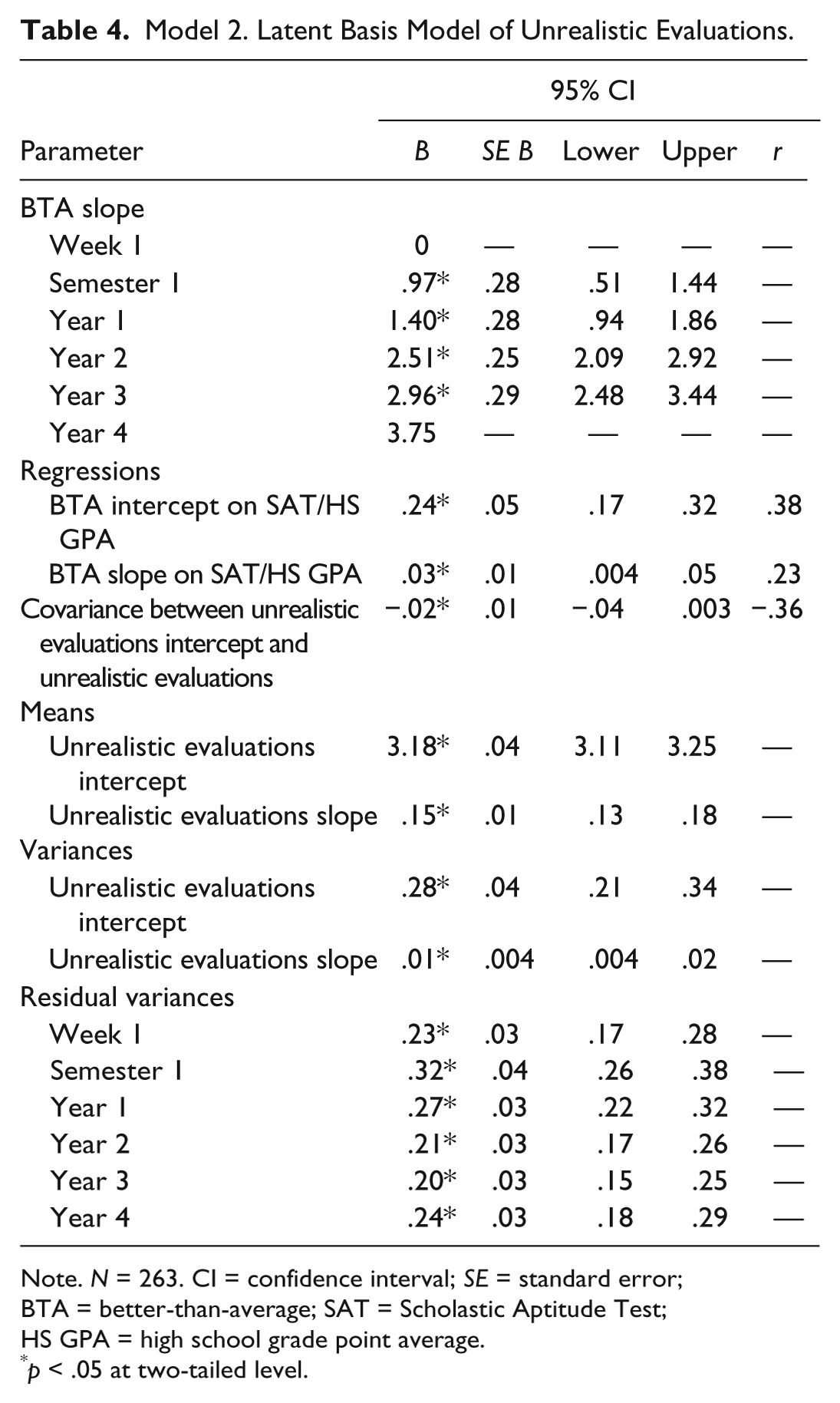
Note. N = 263. CI = confidence interval; SE = standard error; BTA = better-than-average; SAT = Scholastic Aptitude Test; HS GPA = high school grade point average.
p < .05 at two-tailed level.
Unrealistic expectations
To examine the trajectory of unrealistic expectations across 4 years of college, we first subtracted actual grades 2 from expected grades for each assessment (see Figure 2 for a density distribution), then fit a latent growth curve model to these values (Model 3; see Table 5 of this article for model coefficients). The results indicated that at the end of the first semester of college, students expected higher grades than they actually received, but the magnitude of the discrepancy decreased across the 4 years of college.
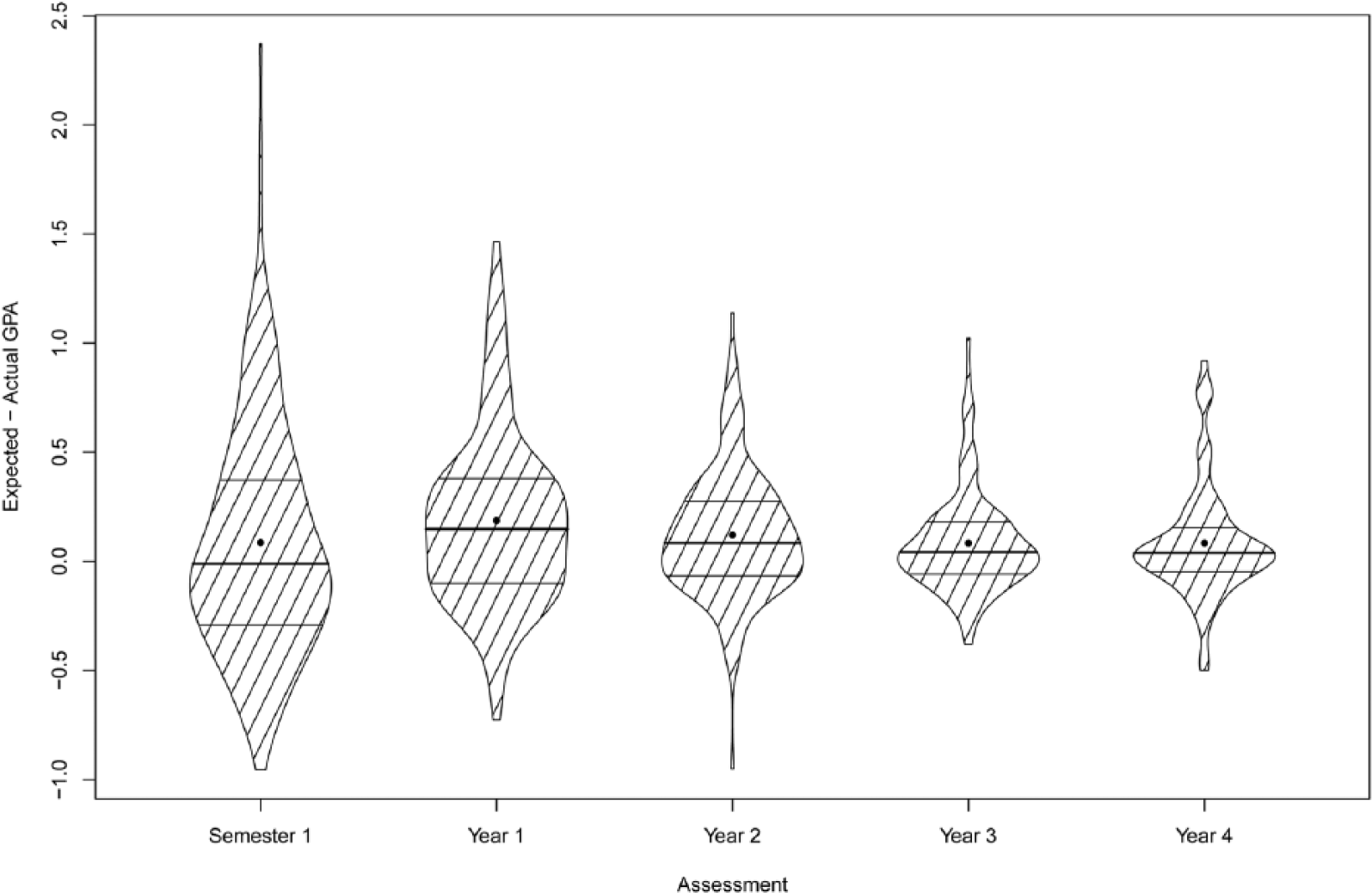
Density distribution of unrealistic expectations over 4 years of college.
Model 3a. Latent Growth Curve Model of Unrealistic Expectations.
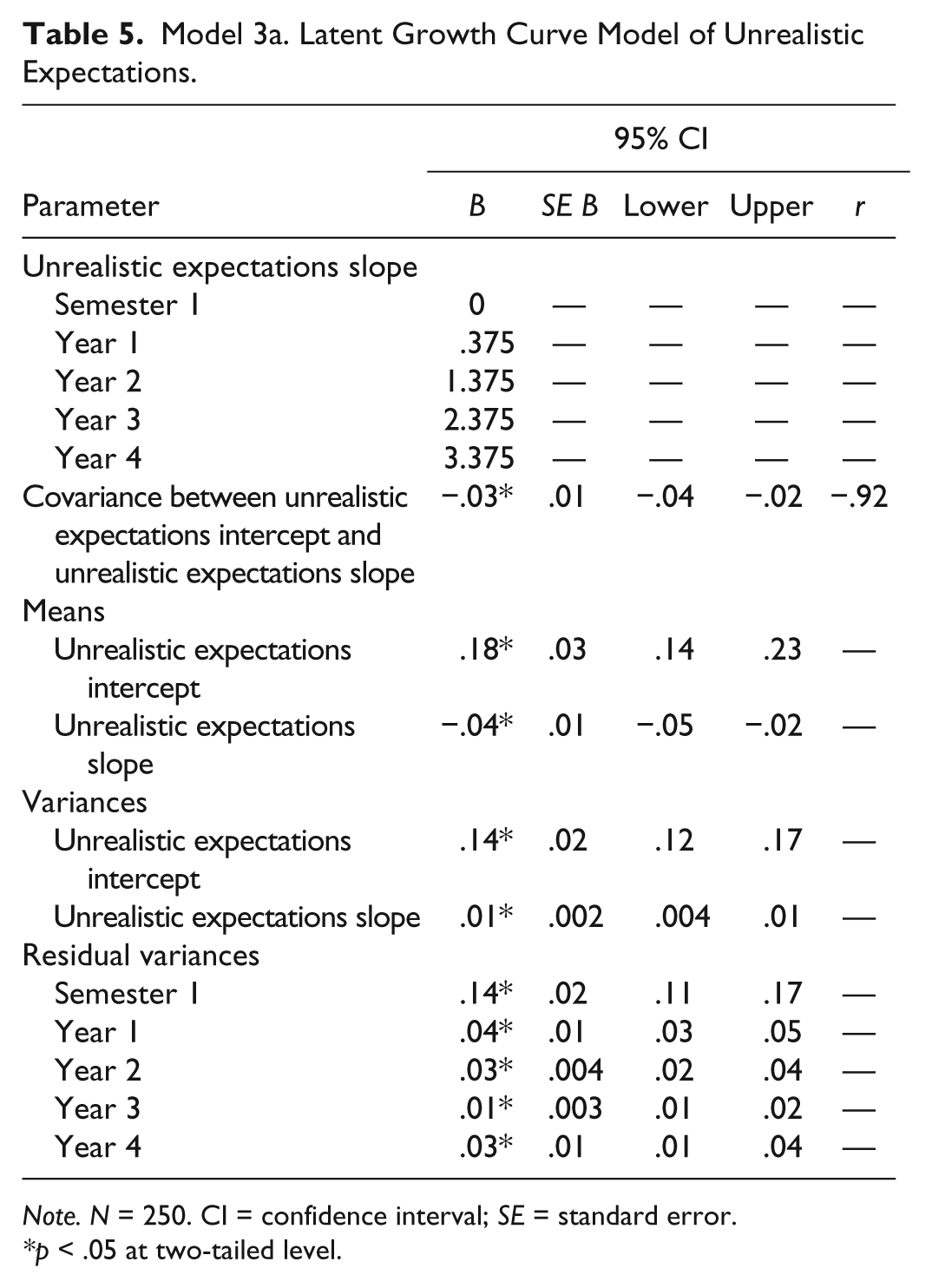
Note. N = 250. CI = confidence interval; SE = standard error.
p < .05 at two-tailed level.
In sum, these results indicated that academic self-enhancement tended to increase or decrease depending on its operationalization. When self-enhancement was examined using better-than-average ratings, even after accounting for prior academic achievement, students’ perceptions of their own versus the average student’s academic ability increased over time, indicating that students increased in self-enhancement about their academic ability over the course of college. However, when self-enhancement was examined as discrepancies between expected and actual grades, it decreased, suggesting that students became better at calibrating their expectations as they proceeded through college. This decrease could be due, at least in part, to the fact that as time spent in college increases, cumulative GPA becomes more stable, because it is calculated across all prior semester grades. Therefore, GPA can change drastically during the early semesters, when there are fewer grade points contributing to overall grades, but as students get closer to graduation, GPA is less likely to change. For all three self-enhancement trajectories, the variances of the intercept and slope were significant, indicating that there were substantial individual differences around each trajectory.
What Are the Antecedents and Consequences of Academic Self-Enhancement?
Although academic self-enhancement generally increased or decreased across college depending on its operationalization, to what extent were individual differences in these trajectories related to psychological functioning and academic outcomes? To examine the correlates and consequences of academic self-enhancement, we entered genuine self-esteem and narcissistic self-aggrandizement as observed predictors into the respective models for the trajectories of better-than-average ratings (Model 1), unrealistic evaluations (Model 2), and unrealistic expectations (Model 3); psychological adjustment, attrition, graduation, and final cumulative GPA were entered as observed outcomes.
Antecedents of the self-enhacement trajectories
Results examining the effects of genuine self-esteem and narcissistic self-aggrandizement on the trajectories of self-enhancement are presented in Table 6 of this article.
Models 4a, 4b, 4c, 5a, 5b, and 5c. Genuine Self-Esteem and Narcissistic Self-Aggrandizement as Antecedents of Self-Enhancement Trajectories.
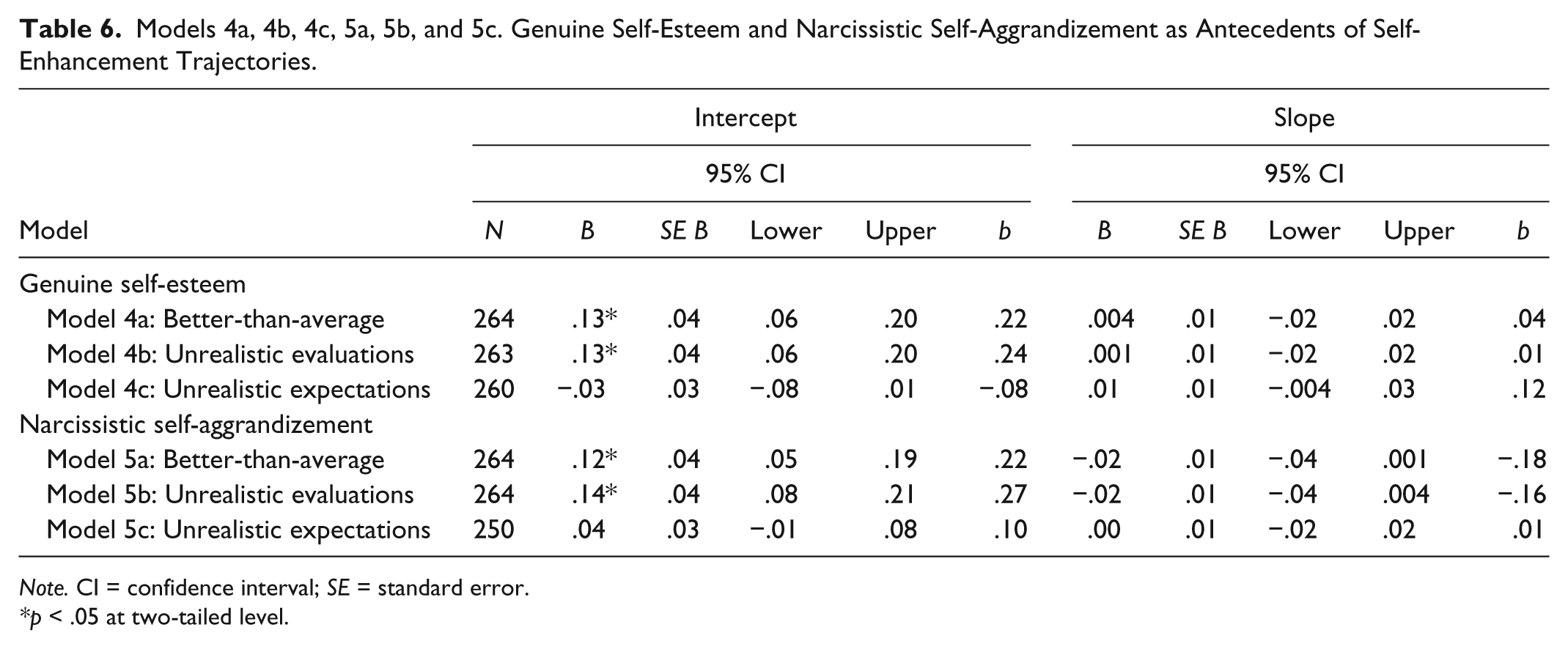
Note. CI = confidence interval; SE = standard error.
p < .05 at two-tailed level.
Genuine self-esteem
Genuine self-esteem was positively associated with the intercept of the better-than-average trajectory but was unrelated to its slope (Model 4a). Its relation to the unrealistic evaluations trajectory was similar (Model 4b). With regard to the unrealistic expectations trajectory (Model 4c), the effects of genuine self-esteem were not significant.
Narcissistic self-aggrandizement
Similarly, narcissistic self-aggrandizement was positively associated with the intercept of the better-than-average trajectory but was unrelated to its slope (Model 5a). Its relation to the unrealistic evaluations trajectory was similar (Model 5b). With regard to the unrealistic expectations trajectory (Model 5c), the effects of narcissistic self-aggrandizement were not significant.
In sum, these results suggest that at the first week of college, higher levels of genuine self-esteem and narcissistic self-aggrandizement were associated with higher concurrent self-enhancement using both a social comparison approach (i.e., better-than-average ratings) and a self-insight approach that accounted for academic achievement prior to college (i.e., unrealistic evaluations). However, neither genuine self-esteem nor narcissistic self-aggrandizement was associated with changes in self-enhancement across college. In addition, neither antecedent was associated with self-enhancement from the self-insight approach that accounted for grades received during college (i.e., unrealistic expectations).
Consequences of the self-enhancement trajectories
Results examining the effects of the self-enhancement trajectories on psychological adjustment, attrition, graduation, and final cumulative GPA are presented in Table 7 of this article. To account for potential relations between prior academic achievement and attrition, and prior academic achievement and graduation, the standardized composite of combined SAT scores and high school GPA was included in the models examining the effects of the self-enhancement trajectories on attrition and graduation.
Models 6a, 6b, 6c, 7a, 7b, 7c, 8a, 8b, 8c, 9a, 9b, and 9c. Psychological Adjustment, Attrition, Graduation, and Final Cumulative GPA as Consequences of Self-Enhancement Trajectories.

Note. To account for potential relations between prior academic achievement and attrition, and prior academic achievement and graduation, the standardized composite of combined SAT scores and high school GPA was included in the models examining the effects of the self-enhancement trajectories on attrition and graduation. Because the graduation variable was a binary variable (0 = did not graduate, 1 = graduated), it was specified as a categorical outcome and maximum likelihood estimation was used. GPA = grade point average; CI = confidence interval; SE = standard error; SAT = Scholastic Aptitude Test; HS GPA = high school grade point average.
p = .08 at two-tailed level. *p < .05 at two-tailed level.
Psychological adjustment
Regarding the better-than-average trajectory, the effect of the intercept on adjustment was not significant, but the effect of the slope on adjustment was positive (Model 6a). The effect of the unrealistic evaluations trajectory on psychological adjustment was similar (Model 6b). With regard to the unrealistic expectations trajectory, neither the effect of the intercept nor that of the slope on adjustment was significant (Model 6c).
Attrition
For the better-than-average trajectory, neither the effects of the intercept nor those of the slope were significant (Model 7a). The effect of the unrealistic evaluations trajectory on attrition was similar (Model 7b). With regard to the unrealistic expectations trajectory, the effect of the intercept on attrition was positive, but the effect of the slope was not significant (Model 7c).
Graduation
With regard to the better-than-average trajectory, the effect of the intercept on graduation was marginal and positive, but the effect of the slope was not significant (Model 8a). In terms of the unrealistic evaluations trajectory, neither the effect of the intercept nor that of the slope on graduation was significant (Model 8b). Similarly, for the unrealistic expectations trajectory, neither the effects of the intercept nor those of the slope on graduation were significant (Model 8c).
Final cumulative GPA. 3
With regard to the better-than-average trajectory, the effects of the intercept and slope on final cumulative GPA were positive (Model 9a). The effects of the trajectory of unrealistic evaluations on final cumulative GPA were similar (Model 9b).
In sum, these results indicate that the better-than-average and unrealistic evaluations trajectories showed more relations with the consequences we examined than did the unrealistic expectations trajectory, and that self-enhancement from the social comparison approach is more adaptive than self-enhancement from the self-insight approach. We also found differing effects for level and slope of the academic self-enhancement indices. Levels of self-enhancement at the beginning of college were associated with graduation and attrition, depending on the metric. Specifically, when we used the social comparison approach, higher better-than-average ratings were associated with greater likelihood of graduating, yet according to the self-insight approach that focused on unrealistic expectations, having more unrealistic expectations about grades for the first semester of college was associated with spending more time on leave from school. Changes in self-enhancement over the course of college were associated with psychological adjustment. Specifically, when using a social comparison approach and a self-insight approach that focused on unrealistic evaluations taking prior achievement into account, increases in self-enhancement over the course of college were associated with higher psychological adjustment at the end of college. Finally, both initial level and change in self-enhancement were associated with final cumulative GPA. According to both social comparison and self-insight approaches that used the better-than-average ratings, greater self-enhancement at the beginning of college as well as growth in self-enhancement was associated with having a higher cumulative GPA.
Are There Ethnic Differences in Academic Self-Enhancement?
Finally, after examining the correlates of these self-enhancement trajectories and finding that self-enhancement was more adaptive according to the social comparison as compared with the self-insight approach, we were interested in testing whether there were ethnic differences in the trajectories of academic self-enhancement. To do so, we entered two dummy-coded ethnicity variables for European American participants and Latino participants as observed predictors of the trajectories, designating the largest group in our sample, the Asian Americans, as our reference group. Coefficients for all models are presented in Table 8 of this article.
Models 10, 11, and 12. Effect of Ethnicity on Self-Enhancement Trajectories.
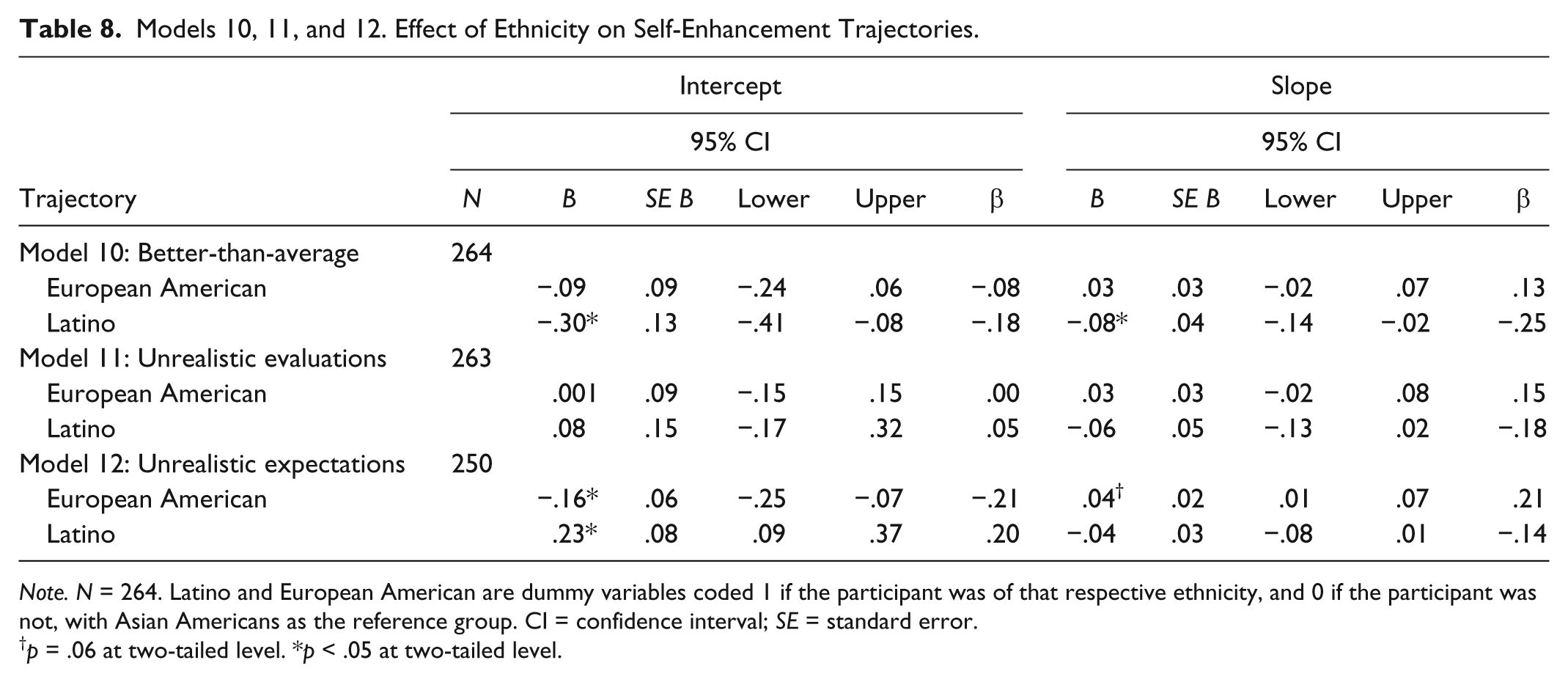
Note. N = 264. Latino and European American are dummy variables coded 1 if the participant was of that respective ethnicity, and 0 if the participant was not, with Asian Americans as the reference group. CI = confidence interval; SE = standard error.
p = .06 at two-tailed level. *p < .05 at two-tailed level.
With regard to the better-than-average trajectory, the effect of the European American variable on the intercept was not significant, but the effect of the Latino variable was negative (Model 10). In addition, the effect of the European American variable on the slope was not significant, but the effect of the Latino variable on the slope was negative. In contrast, there were no significant effects of either ethnicity variable on the unrealistic evaluations trajectory (Model 11). With regard to the unrealistic expectations trajectory, the effect of the European American variable on the unrealistic expectations intercept was negative, while the effect of the Latino variable was positive (Model 12). Regarding the unrealistic expectations slope, the effect of the European American variable was marginal and positive, but the effect of the Latino variable was not significant.
In sum, ethnic variation in the self-enhancement trajectories depended on the operationalization of self-enhancement. When operationalized from a social comparison approach (i.e., better-than-average ratings), European American and Asian students self-enhanced to a similar extent, and both more than Latino students, but these ethnic differences disappeared after controlling for prior academic achievement (i.e., unrealistic evaluations). In contrast, when operationalized as unrealistic expectations regarding academic performance (i.e., unrealistic expectations), Latino students were more self-enhancing than Asian American students, who, in turn, were more self-enhancing than European American students. 4
Is There Ethnic Variation in the Correlates and Consequences of Academic Self-Enhancement?
After finding ethnic differences in the self-enhancement trajectories, we wished to examine whether the relations between the trajectories of self-enhancement and their correlates differed by ethnicity. To examine possible moderation of ethnicity on the relations between the covariates and the academic self-enhancement trajectories, we tested for interactions. A description of how these models were specified is presented in the online appendix (p. 7). These analyses showed that six of 44 interaction effects tested were marginal (see online appendix, Tables 4-9 for model coefficients). These marginal effects did not yield a pattern of results that could be clearly interpreted, such that the effects were not specific to ethnicity, operationalization of self-enhancement, nor type of outcome (see online appendix, pp. 19-20 for description of marginal effects). Given the small proportion of marginal effects to total effects tested, we concluded that, in general, ethnicity did not influence the relations between the trajectories of self-enhancement examined and their educational and psychological correlates.
In sum, we found that how ethnicity was related to the trajectory of self-enhancement over college depended on the operationalization of self-enhancement, but that ethnicity was unrelated to the correlates of these trajectories. Results tentatively suggested that Latino students showed less of the adaptive type of self-enhancement via the social comparison approach (i.e., better-than-average ratings) but more of the maladaptive type of self-enhancement via the self-insight approach (i.e., unrealistic expectations) relative to Asian American and European American students; however, it is important to note that the Latino sample was small.
Discussion
In the present study, we addressed three questions about academic self-enhancement in a longitudinal sample of ethnically diverse students who rated their academic ability as we followed them over 4 years of college. We asked, (a) What is the trajectory of academic self-enhancement across college? (b) What are the correlates and consequences of engaging in academic self-enhancement across college? (c) Are there ethnic differences in the above? Below, we review the implications of the current findings with regard to each of our research questions.
Trajectory of Academic Self-Enhancement
We first sought to examine how academic self-enhancement changed across the 4 years of college. Our results suggest that academic self-enhancement increases during this time when operationalized as better-than-average ratings of academic ability, including when these ratings are considered alongside prior academic achievement, yielding a measure of unrealistic evaluations. In contrast, when operationalized as unrealistic expectations, or the discrepancy between actual and expected grades, academic self-enhancement appears to decrease. These findings are noteworthy because they indicate that the direction of normative change in academic self-enhancement depends on how self-enhancement is operationalized. Our findings support previous research that suggests that self-enhancement increases for attributes that are somewhat subjective, such as how one compares with the average student (Kuyper & Dijkstra, 2009), but decreases for attributes in which objective feedback is regularly provided (Buckelew et al., 2013; Radhakrishnan, Arrow, & Sniezek, 1996; Wendorf, 2002), such as receiving grades at school. Yet, the decrease that we found for the unrealistic expectations trajectory should be interpreted with the caveat that we used cumulative GPA as the criterion, and thus may have constrained how unrealistic our participants could be over the course of college.
Correlates and Consequences of Academic Self-Enhancement
Individual differences in these self-enhancement trajectories were meaningfully related to preexisting tendencies and later outcomes. Regarding better-than-average ratings of academic ability, we found that individuals who entered college with higher levels of genuine self-esteem (i.e., narcissism-free self-esteem) and narcissistic self-aggrandizement (i.e., self-esteem-free narcissism) exhibited higher better-than-average ratings. In turn, those who increased more in this form of academic self-enhancement over college were more likely to report feeling psychologically adjusted to the university environment. In terms of academic correlates, we found that students who entered college with higher better-than-average ratings were more likely to graduate from college and to have attained better grades across college. Increases in better-than-average ratings were also associated with getting better grades. These results indicate that, when operationalized as better-than-average ratings, academic self-enhancement is largely adaptive. They are thus consistent with the positive illusions perspective (Taylor & Brown, 1988) and, specifically, with research indicating that thinking about one’s academic abilities in an overly favorable way is academically advantageous (Dufner et al., 2012; Kurman & Eshel, 2010; Willard & Gramzow, 2009).
Indeed, although we also found relations between narcissistic self-aggrandizement and self-enhancement, suggesting that rating oneself as better than the average college student might have drawbacks, it is important to consider that the Narcissistic Personality Inventory appears to largely assess the dominance/leadership and grandiosity facet of narcissism rather than the more toxic exploitativeness/entitlement facet (Ackerman, Donnellan, & Robins, 2012; Ackerman et al., 2011). An interesting future direction would be to investigate self-enhancement with alternative measures of narcissism that were developed to distinguish the adaptive and maladaptive aspects of narcissism, such as the Narcissistic Admiration and Rivalry Questionnaire (Back et al., 2013). Importantly, the correlates of self-enhancement were similar when self-enhancement was operationalized as unrealistic evaluations, with the exception that this metric was not associated with the likelihood of graduating, suggesting that the effect had been driven by previous academic performance.
We found that unrealistic evaluations, the criterion-based version of better-than-average ratings, were associated with better adjustment and higher grades at the end of college. These results are in line with a recent longitudinal study (Dufner et al., 2014) in which academic self-enhancement, operationalized as self-rated academic competence after accounting for grades, was reciprocally related to subjective well-being over the course of an academic year in a sample of children and adolescents. Taken together, these findings suggest that academic self-enhancement may fuel psychological adjustment in academic contexts across the life span, including in adolescence and young adulthood. Yet, it is also possible that by controlling for academic performance that occurred prior to college in the present study, our index of unrealistic evaluations became less sensitive to ratings after the first year, due to the fact that each successive rating became more temporally distant from our criteria for actual academic ability (high school grades and SAT scores). If so, by not adequately partialing out current reality, our unrealistic evaluations measure would show the adjustment benefits that are typically associated with social comparison indices.
Regarding unrealistic expectations for academic performance, we found that having more unrealistic expectations at the first week of college was associated with a greater likelihood of dropping out of college sometime during the 4 years of college. This finding supports previous research showing that when a criterion-based self-insight approach is used, self-enhancement is maladaptive. However, why this trajectory was unrelated to the other variables examined is unclear.
In sum, by examining how three different operationalizations of academic self-enhancement might be associated with a range of correlates, we found that people’s perceptions of their academic ability were relevant for how well they felt they had adjusted to the academic and social aspects of college as well as for their academic behavior. The implications of academic self-enhancement were especially clear, and mostly favorable, for metrics related to seeing oneself as more academically able than the average college student.
Ethnicity and Academic Self-Enhancement
We also examined whether the trajectory of academic self-enhancement varied by ethnicity. When taking a social comparison approach, we found that European American and Asian American students self-enhanced to a similar extent. However, compared with Latinos, albeit with marginal effects, both groups tended to self-enhance more and show greater increases in their self-enhancement. Notably, these ethnic differences disappeared when examining unrealistic evaluations by controlling for prior academic achievement. Furthermore, when examining self-enhancement as unrealistic expectations regarding academic performance, we found that at the beginning of college, European American students self-enhanced the least and Latino students self-enhanced the most. Moreover, European American students attenuated these unrealistic expectations the most over the course of college, significantly more so than did Asian Americans, whose rates were similar to those of Latinos. Thus, we found that ethnic differences in self-enhancement depended on which type of self-enhancement we examined.
In contrast, we found no significant effects of ethnicity on the psychological and academic correlates of academic self-enhancement; rather, the effects were all marginal, and the ratio of marginal effects to total number of interaction effects tested was small (i.e., six effects out of 44 effects were marginal). These findings are consistent with previous research that has found that self-enhancement is similarly associated with psychological adjustment across different cultural groups (Kobayashi & Brown, 2003; Kurman, 2003; O’Mara et al., 2012). Thus, although self-enhancement may manifest in different ways and to different degrees based on ethnicity and other culturally relevant characteristics, its consequences may be similar. However, we encourage future researchers to further explore the possibility that the correlates and consequences of academic self-enhancement might differ by ethnicity, as suggested by another strand of previous research (Kang et al., 2003; Tsai et al., 2014).
Strengths and Limitations
Several strengths characterize the present research. First, by including various measures of academic self-views and of criteria for gauging their veracity across multiple waves, we enabled an examination of different operationalizations of academic self-enhancement. In doing so, we were able to compare and contrast each type of academic self-enhancement within the same study, specifically with regard to their psychological and academic correlates.
Second, by examining self-enhancement within a longitudinal framework, we were able to characterize how students changed in their academic self-enhancement from the very beginning to the end of the college. We found that students generally grew more confident in their academic ability as they advanced in their college careers, but at the same time, learned to temper their academic expectations. Relatedly, we were able to uncover interesting effects regarding the correlates of these trajectories. That we found different effects when examining our correlates concurrently as well as across time also shows the importance of examining self-enhancement tendencies longitudinally.
Third, by examining self-enhancement in an ethnically diverse sample, we contribute to the literature regarding the interplay between culture and self-enhancement. On one hand, we showed that the Asian students in our sample were just as self-enhancing as the European Americans when examined from a social comparison approach via better-than-average ratings. On the other hand, we found that this effect was largely driven by prior academic achievement. Thus, the Asian American students’ ratings of their academic ability tended to reflect their actual academic performance prior to college. This finding is consistent with previous literature finding that individuals of Asian heritage are less self-enhancing than individuals of European heritage. Yet, that Asian American students were more self-enhancing than European American students according to the self-insight approach via expected versus actual academic performance provides a more nuanced picture. In addition, the inclusion of the Latino group in the present research showed that Asian American students were less self-enhancing than the Latino students, extending research on culture and self-enhancement past the East–West dichotomy. Relatedly, by including Latino students in the present study, we contribute much-needed data on a large and prevalent ethnic group that has been underrepresented in the literature. The rapidly changing ethnic composition of the United States makes it imperative to better understand how ethnicity relates to various aspects of psychological and academic functioning. The dramatic increase of Latinos in particular promises to broadly affect the education system, especially as academic disparities in this group, which are well-documented, persist, with school dropout at worrisome rates (Gándara, Larson, Mehan, & Rumberger, 1998; Pulido, 1995; Steinberg, Blinde, & Chan, 1984; Steinberg, Dornbusch, & Brown, 1992; Velez, 1989). As such, it is important to study Latinos’ academic behavior. Nevertheless, our sample was quite small, limiting our power to detect effects and making it necessary to replicate our findings before extensively interpreting them.
The present research was not without other limitations. The criterion measures we used to derive our self-insight indices were imperfect. We used prior academic performance as one criterion, reasoning that one’s prior academic performance would indicate academic aptitude in college and thus be a valid index of academic ability against which to compare better-than-average ratings. It could be that the time of measurement of our criterion really matters for the effects we wished to examine, as prior academic performance might become less consequential for assessments of self-enhancement and its correlates after the first year of college. It also bears repeating that our use of cumulative GPA as the criterion for our second self-insight index, unrealistic expectations for academic performance, was limited because students may become better calibrated simply because cumulative GPA becomes more stable over the course of college. We encourage future research to examine semester by semester grades to address this possibility.
Moreover, it is important to acknowledge that the findings regarding the trajectories of academic self-enhancement may be due to nuances in the way the questions were framed. Previous research has shown that as the framing becomes more specific (Alicke, 1985; Kuyper & Dijkstra, 2009), self-enhancement becomes less pronounced. We encourage future research to examine the nuances of these frames by inquiring about more specific comparison targets (e.g., comparing one’s academic ability to the average student vs. average freshman; asking for expected overall grades vs. semester grades).
Finally, it is important to comment on the generalizability of our results, especially for the adaptiveness of self-enhancement. The present study examined academic self-enhancement within a sample of students at an elite university, students who exceled in academics prior to entering college. Thus, it may be that academic self-enhancement above a certain threshold might be generally adaptive for college students because there is some truth to their self-perceptions (i.e., they were admitted into a top university). Considering the characteristics of the school context, such as its sociodemographic diversity and academic reputation, would also be important for interpreting the effects of ethnicity. For example, although we found evidence that the self-enhancement tendencies of Asian Americans were equal to or greater than that of European Americans, it is important to remember that these ethnic differences were found among groups of students attending the same prestigious American university and that they thus may not be reflective of dynamics at other universities or in other everyday settings in the United States. We encourage future research to examine academic self-enhancement within different populations to examine the boundary conditions of these effects.
Conclusion
The present study examined self-enhancement longitudinally through the college years and within the academic domain, a context in which performance can greatly affect future opportunities, including later educational and job prospects. We found that the degree to which college students became progressively insightful depended on the operationalization of academic self-enhancement, and that normative changes in academic self-enhancement revealed that on average, college students exhibited more confidence in their academic ability, yet became more realistic in their expectations for academic performance. Moreover, we found that engaging in academic self-enhancement from the social comparison approach was more advantageous than doing so from the self-insight approach. Finally, we found preliminary evidence of ethnic differences in the academic self-enhancement trajectories, findings that will need to be replicated and extended in future research.
Footnotes
Authors’ Note
We would like to thank Jonathan L. Helm, Simine Vazire, and Keith F. Widaman for their helpful comments on earlier versions of this manuscript.
Declaration of Conflicting Interests
The author(s) declared no potential conflicts of interest with respect to the research, authorship, and/or publication of this article.
Funding
This research was supported by National Institute of Mental Health Predoctoral Fellowship Award T32-MH2006 to Joanne M. Chung, National Institute of Child Health and Human Development Grant HD064687 and William T. Grant Foundation Postdoctoral Fellowship Award 3-GUYWTGM to Roberta A. Schriber, and National Institute on Drug Abuse Grant R01-DA017902 to Richard W. Robins.
Notes
References
Supplementary Material
Please find the following supplemental material available below.
For Open Access articles published under a Creative Commons License, all supplemental material carries the same license as the article it is associated with.
For non-Open Access articles published, all supplemental material carries a non-exclusive license, and permission requests for re-use of supplemental material or any part of supplemental material shall be sent directly to the copyright owner as specified in the copyright notice associated with the article.
