



Abstract
Every close relationship has a history, but how people manage their relational past varies and can have important implications in the present. The current research investigated the role of subjective representation of time: How feeling subjectively close (vs. distant) to a past relational transgression (vs. kind act) predicted “kitchen thinking”—the tendency to bring to mind relational past memories in new, unrelated contexts. We explored the role of attachment anxiety as a predictor of subjective time perception and kitchen thinking. We found support for our hypothesis that when negative memories felt subjectively closer relative to positive memories, people were more likely to kitchen think (Studies 1-3). Kitchen thinking, in turn, predicted negative relationship outcomes (Study 4). Furthermore, people high (vs. low) in attachment anxiety were less likely to perceive the timing of their relational memories adaptively, accounting for more kitchen thinking and in turn, maladaptive relational outcomes.
No close relationship exists in a temporal vacuum. All have a history of both good and bad events. However, how people regulate their memory of these events may vary considerably. For instance, on a romantic getaway one partner might reminisce about the special moments of their early dating years, enhancing the positive tone of the new experience. Conversely, during a heated argument another person might bring up a litany of past misdeeds committed by their partner, contributing to the distress of the current conflict.
How people manage their remembered relational history can have important relationship implications; relationship memories are not always recalled just as they occurred but rather reconstructed in light of present beliefs, motives, and knowledge (e.g., Lemay & Neal, 2013; Luchies et al., 2013; Murray & Holmes, 1993). For example, people revise their former attitudes about a dating partner to fall in line with present attitudes (McFarland & Ross, 1987). Indeed, how people recall their relational memories can contribute to relationship well-being outcomes (Finkel, Rusbult, Kumashiro, & Hannon, 2002; Karney & Coombs, 2000). Moreover, ruminating on past negative events predicts negative relational outcomes (McCullough et al., 1998; Worthington & Wade, 1999), such as reduced forgiveness and increased physiological stress.
This research suggests that the way memories are construed and resurfaced matters for the current climate of the relationship. In this article, we explore when people might revisit past memories in unrelated relationship situations. Specifically, we examine the role of attachment anxiety—a variable related to maladaptive cognitive processing—in relationship partners’ management of their interpersonal memories.
Kitchen Thinking
During interpersonal conflicts, past slights may get introduced. For example, a partner expressing frustration about a new transgression, such as failing to do the promised chores, might also bring up other past slights (“the time you lied” and “the time you were an hour late”), even if those incidents are unrelated to the problem at hand. This conflict tendency is termed “kitchen sinking”—reflecting the idea that people throw “everything but the kitchen sink” at the partner. Kitchen sinking has been identified as a maladaptive conflict style related to partner criticism (Gottman & Silver, 1995) and has been part of the focus of couple intervention studies (Floyd & Markman, 1984). Although there has been little empirical research on kitchen sinking, one line of work found that socially anxious people were more likely to kitchen sink (Wenzel, Graff-Dolezal, Macho, & Brendle, 2005), demonstrating that some people are more susceptible to this maladaptive behavior.
In the current research, we take a step back from kitchen sinking (the pattern of conflict behavior in which past harms are verbalized) and focus on the patterns of cognition that might underlie these maladaptive conflict behaviors. We were interested, therefore, not in the likelihood of verbally expressing past slights (kitchen sinking) but rather the extent to which people think about unrelated past transgressions when facing a current conflict (for which we coin the corresponding term kitchen thinking). Kitchen thinking is important to study in its own right given that not all thoughts are expressed to partners, and it is possible that many people kitchen think without kitchen sinking (i.e., verbally expressing their thoughts). We contend that if a negative memory is brought to mind, negative consequences for the relationship could unfold, regardless of whether the memory is verbally expressed.
Although kitchen thinking is related to rumination (i.e., repeated, negative, self-reflective thinking; Lyubomirsky, Caldwell, & Nolen-Hoeksema, 1998), we view it as a distinct, more specific tendency to revisit unrelated past partner transgressions during a current conflict. Some past research has examined how repetitive, intrusive thoughts about a particular harm can impair forgiveness (e.g., McCullough et al., 1998), but has not examined how the context of a new conflict may elicit memories of past harms. Similar to general rumination, we expect that kitchen thinking should also be costly for relationships.
What might lead people to think about past transgressions when facing a current conflict? To answer this question, we consider the types of people who might be more susceptible to negative patterns of cognitive processing in relationships—people high in attachment anxiety. Because attachment anxiety is associated with vigilance for interpersonal threat, low trust, and tendencies to ruminate about the self and events (Collins & Read, 1990; Fraley & Waller, 1998), we expected that anxiously attached people would be especially susceptible to kitchen thinking.
Attachment Anxiety in Relationships
Anxiously attached people chronically desire close relationships, yet they fear abandonment and lack interpersonal trust (Brennan, Clark, & Shaver, 1998; Collins & Read, 1990). People high in attachment anxiety also engage in maladaptive cognitive behaviors, such as being more likely to ruminate about past events (Burnette, Davis, Green, Worthington, & Bradfield, 2009; Lanciano, Curci, Kafetsios, Elia, & Zammuner, 2012), heightening the accessibility of negative emotional memories (e.g., personal experiences of anger, sadness; Mikulincer & Orbach, 1995) and perceiving more conflict in their relationships than their partners report exists (Campbell, Simpson, Boldry, & Kashy, 2005). They also tend to show lower accessibility of trust-related partner memories (Mikulincer, 1998). These maladaptive cognitive patterns may be driven by anxiously attached people’s hypervigilance about relationship responsiveness (Shaver & Hazan, 1993) and likely contribute to the well-established finding that anxiously attached people tend to have lower quality relationships (e.g., J. A. Feeney, 1999).
Subjective Time
Although all relational events are located in actual, chronological time, where people subjectively locate events in time may play a more powerful role. Some long-past events feel like yesterday, whereas other recent experiences might be relegated to the subjectively distant past. The way partners manage the subjective temporal distance of a memory (how close or faraway a past event feels in time, regardless of calendar time) can have important implications for their views of the present (Ross & Wilson, 2000; Wilson & Ross, 2001). According to temporal self-appraisal theory, people tend to subjectively distance past personal failures and to perceive past successes as subjectively close in time (Ross & Wilson, 2002; Wilson & Ross, 2003). Because more recent memories are deemed more self-relevant (Broemer, Grabowski, Gebauer, Ermel, & Diehl, 2008), this subjective time bias can protect people from the negative implications of past failures while still allowing them to capitalize on past successes.
Recent research suggests that managing the subjective time of relational memories serves constructive functions for relationships as it does for the self. For example, Wohl and McGrath (2007) found that partners who subjectively distanced a past partner transgression were more likely to forgive their partner for a new hypothetical transgression. Given that subjectively close memories feel more relevant to the present relationship (Broemer et al., 2008), it is not surprising that subjectively distancing past slights and holding onto positive relational memories predict relationship satisfaction (Cortes, Leith, & Wilson, 2016; Wakimoto, 2011), and thus appear adaptive for the well-being of relationships.
The Present Research
The current research extends this previous work by examining how the management of past relational memories predicts tendencies to kitchen think and how kitchen thinking predicts relationship outcomes in real reported conflicts faced by couples. We hypothesized that memories that felt subjectively closer in time (controlling for reported calendar time) would feel more relevant to the present. Thus, if past negative (vs. positive) memories felt subjectively closer, we hypothesized that kitchen thinking would be more likely to occur. We also hypothesized that people high (vs. low) in attachment anxiety would fail to manage the subjective time of their relational memories adaptively (i.e., would be less likely to push transgressions to the distant past and keep kindnesses subjectively close in time). We predicted that these subjective distancing tendencies would be linked to more kitchen thinking for anxiously attached people, which would in turn predict negative relationship consequences.
In all studies, we measure attachment anxiety at the outset. In Studies 1 to 3, we manipulate the type of “target” relationship memory recalled (transgression or kind act), measure subjective distance from those memories, and then examine the extent to which people “kitchen think.” We employed various measures to capture kitchen thinking—we asked participants how likely they would be to think about the original negative target memory in a new, unrelated conflict scenario (Study 1), we prompted participants to retrieve other negative memories and asked how important those new memories felt in the present (Study 2), and we examined the types of spontaneous memories people recalled following a target memory (Study 3). In Study 4, we had participants report the amount of kitchen thinking they did during a real, recent conflict with their partner. We then examined relational downstream consequences such as healthy conflict responding, perceptions of conflict severity, and perceived relationship quality.
Study 1
Study 1 examined whether subjective temporal distance of past relational events predicted the likelihood of rehearsing those past events in an unrelated current scenario. We hypothesized that events that felt subjectively closer in time would be more likely to be thought about in an unrelated scenario. This study also tested the prediction that people low in attachment anxiety would relegate transgression memories to the subjectively distant past and keep close positive memories compared with people high in attachment anxiety. We expected people high (vs. low) in attachment anxiety would be more likely to recruit a past negative memory in a new hypothetical conflict (i.e., kitchen think) but not a past positive memory in a new positive hypothetical scenario. We predicted that kitchen thinking would be more likely to occur for anxiously attached people due to their memory time management.
In this study, we manipulated whether participants recalled a past negative (transgression condition) or positive (kind act condition) relationship event. We then asked participants to rate how faraway the event felt, regardless of when it actually occurred. Finally, participants were asked to imagine that their close other committed another unrelated act in the present. We matched the valence of the new hypothetical scenario to the original memory, as we reasoned that people would be more likely to activate other memories of similar valence (Mayer, McCormick, & Strong, 1995). Critically, participants were asked how likely they would be to think about the original memory in the event of this new hypothetical incident. The reported likelihood of rehearsing the memory in the negative event condition served as a proxy for kitchen thinking.
Method
Participants and procedure
A total of 209 (171 females, 32 males, six unspecified) undergraduate students participated in exchange for course credit. A target sample size of approximately 100 per condition was determined in advance for all studies, knowing that attachment anxiety would be tested as a moderator.
Participants were first asked to think of someone in their lives to whom they felt very close. People chose romantic partners (49%), close friends (40%), or family members (11%). 1 To measure attachment anxiety, participants completed the Experiences in Close Relationships–Revised Scale (ECR-R; Fraley, Waller, & Brennan, 2000), responding to 36 items on a scale from 1 (strongly disagree) to 7 (strongly agree). Sample items include “I worry a lot about my relationships” and “My desire to be very close sometimes scare people away” (M = 3.71, SD = 0.89; α = .90). Participants also reported their relational feelings toward their nominated close other by completing the Satisfaction and Commitment scales of the Fletcher, Simpson, and Thomas (2000) Perceived Relationship Quality Scale. Sample items include “How satisfied are you with your relationship?” and “How committed are you to your relationship?” which were rated on a 1- (not at all) to 7 (extremely)-point scale (M = 6.02, SD = 1.28; α = .95). 2
Participants were then randomly assigned to the valence memory condition. In the transgression condition, they were asked to recall an event in which their nominated close other did something that hurt or wronged them, which was very upsetting to them. In the kind act condition, participants recalled an event in which their nominated close other did something very kind for them that they very much appreciated. In both conditions, participants were instructed to visualize the specific event and to write about it in detail. This was what we refer to as the “target memory.” As a manipulation check, participants indicated how positive or negative the event was on a 7-point scale (1 = very negative and 7 = very positive). Participants indicated their best estimate of the date when the event occurred (actual distance).
Next, participants reported the subjective distance of the event, that is, how close or faraway the event felt, regardless of when it actually occurred. Given that the subjective experience of time is influenced by factors other than duration (Ross & Wilson, 2002), we treat subjective temporal distance as a psychological variable distinct from calendar time. We assessed subjective temporal distance of the memory on two 10-point scales: “Feels very close” to “Feels very distant,” and “Feels like yesterday” to “Feels like a long time ago” (r = .43, p < .001). Items were aggregated; higher numbers indicate greater subjective distance from the present.
Finally, participants were asked to imagine that their close other committed another act. In the transgression condition, participants were instructed to imagine that their partners did something else, unrelated to what they just wrote about, to hurt or wrong them. In the kind act condition, participants were asked to imagine that their close other did something else kind for them. Finally, participants were asked to consider the originally reported target memory: “How likely would you be to think about this past hurtful (kind) act, regardless of whether you brought it up?” which they responded to on a 1 (not at all) to 6 (extremely) scale. We define the tendency to revisit past harms as “kitchen thinking”; therefore, this item captures kitchen thinking in the transgression condition, and a parallel, but positive, memory process in the kind act condition.
Results
Preliminary analyses
A manipulation check analysis confirmed that participants in the transgression condition (M = 1.96, SD = 1.04) recalled significantly more negative memories than participants in the kind act condition (M = 6.30, SD = 1.00), t(207) = −30.80, p < .001.
Next, we examined participants’ reports of the calendar date of the event (objective time) to rule out the possibility that individuals high in attachment anxiety simply recalled events that actually differed systematically in calendar time. Event date estimates were converted into a measure of months from the time of study completion (M months ago = 14.67, SD = 32.09). We regressed attachment anxiety, memory condition (−1 = kind act, 1 = transgression), and their interaction term on objective time. Attachment anxiety, β = .08, t(200) = 1.16, p = .246, condition, β = .11, t(200) = 1.53, p = .127, and the interaction term, β = .06, t(200) = 0.92, p = .361, were all nonsignificant, indicating that calendar time did not vary systematically by participants’ attachment anxiety or event valence. We acknowledge that participants’ reports of calendar time may not be factually accurate; however, whether accurate or not, the nonsignificant effects suggest that date estimates were not systematically biased. Furthermore, calendar time and subjective time were uncorrelated (r < .01, p = .971). Nevertheless, because events spanned a long period of time, we controlled for calendar time in all subsequent analyses (results did not change when the covariate was omitted).
Primary analyses
Subjective distancing predicts reported memory recruitment
First, we tested our prediction that people would be more likely to report thinking about past events that felt subjectively closer compared with events that felt further. We also included our manipulation of event valence in the analyses. We expected that on average people might report more inclination to revisit positive than negative memories (consistent with Ross & Wilson, 2002). We had no reason to expect that valence would moderate the predicted link between subjective distance and memory recruitment, though we were more interested in the implications for negative events (which would signify kitchen thinking). We ran a multiple regression analysis, including valence condition, subjective time, and their interaction in the model simultaneously, and chronological time as a covariate. As predicted, a main effect of subjective distance revealed that when participants’ events felt subjectively closer in time, they were more likely to report that they would think about the event in an unrelated, similarly valenced future scenario, β = −.40, t(199) = −6.48, 95% confidence interval (CI; all subsequent analyses refer to 95% interval) = [−0.99, −0.53], p < .001. A main effect of condition revealed that people were more likely to think about past kind acts in a new positive relationship context than recalling past slights in a new relationship conflict, β = −.28, t(199) = −4.63, CI = [−0.77, −0.31], p < .001. There was also a significant interaction, β = −.14, t(199) = −2.19, CI = [−0.50, −0.03], p = .030 (see Figure 1), indicating that although people reported more likelihood of thinking about the target memory when the target event felt subjectively close (vs. far) in a new hypothetical scenario, this tendency was considerably stronger for negative target memories. 3 This suggests that the subjective closeness of a past event appears more relevant for kitchen thinking contexts than other types of contexts (i.e., thinking of old memories in new positive scenarios).
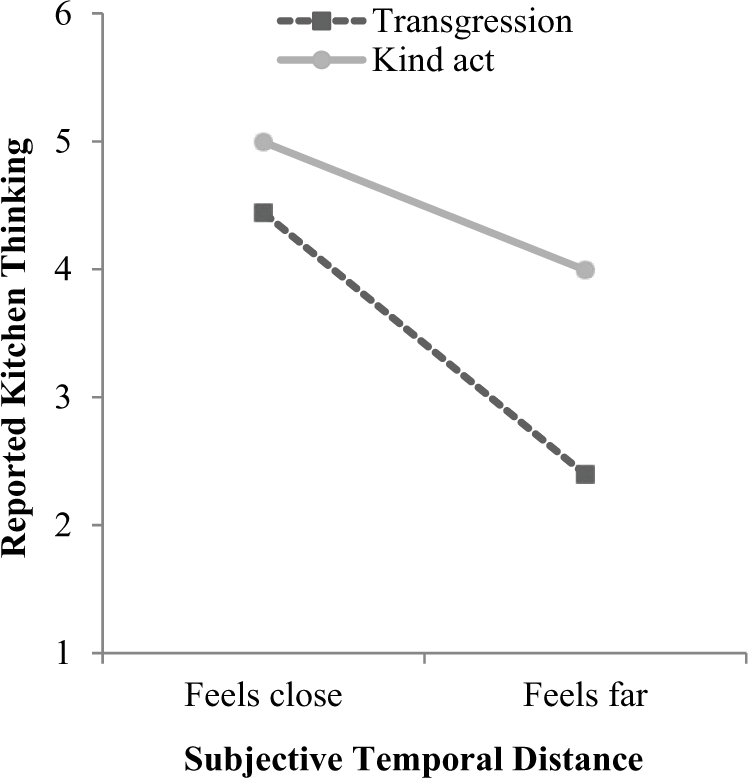
Predicted values calculated for individuals rating memories high and low (±1 SD) in subjective temporal distance (Study 1).
Attachment anxiety predicts subjective distancing
We next examined our central hypothesis that anxiously attached individuals would be less likely to manage their relational memories adaptively. We included attachment anxiety, valence condition, and their interaction in a multiple regression analysis, with subjective time as the dependent variable. As predicted, there was no main effect of attachment anxiety, β = .06, t(199) = 0.80, CI = [−0.20, 0.50], p = .409, a condition main effect revealing that transgressions seemed more distant than kindnesses, β = −.26, t(199) = 3.96, CI = [0.35, 1.05], p < .001, and a significant interaction, β = −.22, t(199) = −3.23, CI = [−0.93, −0.23], p = .001 (see Figure 2). As hypothesized, while individuals low in attachment anxiety perceived transgressions to be subjectively farther away in time than kind acts, β = .48, t(205) = 5.13, CI = [1.57, 3.53], p < .001, individuals high in attachment anxiety failed to make this distinction, β = .03, t(205) = 0.28, CI = [−0.84, 1.12], p = .778.
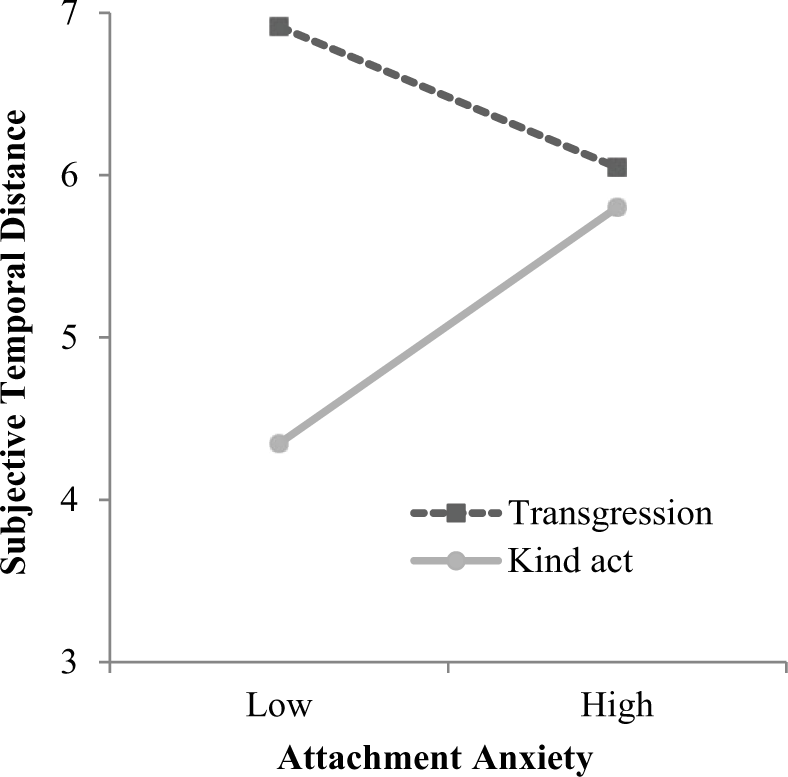
Predicted values calculated for individuals high and low (±1 SD) in attachment anxiety (Study 1).
Attachment anxiety predicts reported kitchen thinking
Our next critical prediction was that individuals high (vs. low) in attachment anxiety would be more likely to report thinking about the negative target event when faced with a new transgression (kitchen think) but no more likely to recruit positive memories in new positive scenarios. We regressed attachment anxiety, valence condition, and their interaction on reports of kitchen thinking. A marginal main effect of attachment anxiety indicated that high (vs. low) anxiously attached individuals reported they would think somewhat more about past events in future unrelated scenarios, β = .12, t(199) = −1.89, CI = [−0.01, 0.48], p = .062. A condition main effect revealed that people expected to think less about past negative than positive events in a new similarly valenced situation, β = −.29, t(199) = −4.40, CI = [−0.80, −0.30], p < .001. As predicted, the significant interaction, β = .17, t(199) = −1.84, CI = [0.08, 0.57], p = .011 (see Figure 3), indicated that although people low in anxious attachment were more likely to report that they would retrieve positive events than negative events, β = −.45, t(204) = −4.88, CI = [−2.40, −1.02], p < .001—an arguably adaptive tendency to revisit happy memories but not dredge up past slights—people high in attachment anxiety failed to show this positive memory preference, β = −.08, t(204) = −0.81, CI = [−0.98, 0.41], p = .418. Furthermore, highly anxiously attached people were more likely to report that they would revisit the target memory when it was negative (transgression condition: β = .33), t(204) = 3.43, CI = [0.22, 0.80], p = .001, but no more likely to do so when the target memory was positive, β = −.05, t(204) = −0.51, CI = [−0.33, 0.20], p = .613.
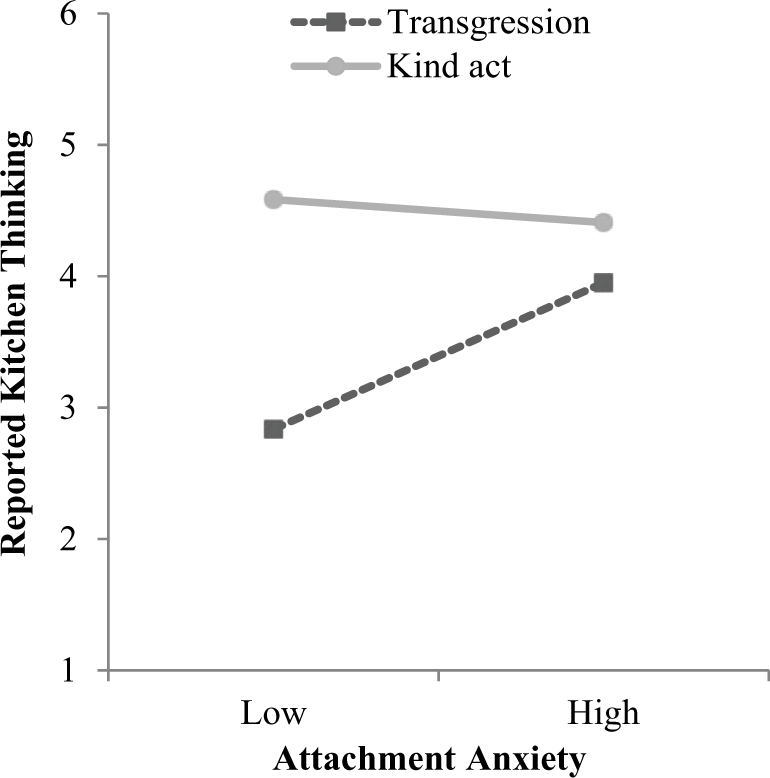
Predicted values calculated for individuals high and low (±1 SD) in attachment anxiety (Study 1).
Mediation analysis
Finally, we conducted a mediation analysis to determine whether individuals high in attachment anxiety tended to kitchen think negative memories in new conflict scenarios at least in part because of their subjective distancing of the target memories. Using Hayes’s (2013) bootstrapping macro, we entered the interaction term of valence condition and attachment anxiety as the predictor, controlling for both main effects and chronological time. We entered subjective temporal distance as the mediator and kitchen thinking as the dependent variable. The interaction term significantly predicted subjective temporal distance (the mediator), t(185) = −2.71, b = −.19, p = .007, which in turn predicted kitchen thinking, t(186) = −5.55, b = −.71, p < .001. The total effect of the interaction term on kitchen thinking was significant, t(186) = 2.57, b = .33, p = .010, but became nonsignificant once the mediator (subjective distance) was accounted for, t(185) = 1.64, b = .20, p = .103. Bootstrapping analysis with 5,000 samples estimated the true indirect effect to lie between .04 and .26, with 95% confidence. Because the CI does not include 0, one can conclude that the real indirect effect was significant at p < .05.
Discussion
Study 1 revealed that subjective time matters: When past memories felt closer in time, people reported that they would be more likely to mentally re-access those memories in new unrelated scenarios. This was especially true for negative events, which, although not necessary to our model, is consistent with our theoretical interest in the implications of kitchen thinking negative relational events. Furthermore, these data show important individual differences in people’s adaptive memory management: While people low in attachment anxiety showed a strong adaptive bias, seeing kindnesses as recent and transgressions as remote despite no difference in calendar time, people high in attachment anxiety felt just as close to the past transgressions as to past kind acts. This pattern accounted for anxiously attached partners’ increased expectation that they would revisit this target transgression in the event of a new, unrelated conflict.
Although Study 1 offered preliminary support for our hypotheses, the measure of kitchen thinking relied on what people thought they might do in a new hypothetical situation. Kitchen thinking was only relevant in the transgression condition (in the positive condition, people were reporting on whether they would revisit the positive memory in a new hypothetical positive scenario). This was useful to compare kitchen thinking with thinking about past memories in other contexts (i.e., positive ones); however, in the remaining studies we assessed kitchen thinking as our dependent variable across all conditions.
Furthermore, we captured people’s expectations to kitchen think about the target transgression in the future. Kitchen thinking could also be elicited by priming a target event, then measuring the tendency to revisit other unrelated events. Accordingly, Studies 2 and 3 were designed to capture kitchen thinking in conceptually parallel ways by assessing people’s in-the-moment reactions to a recent target transgression memory, then assessing their tendency to access and judge pertinent other past transgressions. We contend that if a target relationship transgression feels subjectively recent, it will seem more reflective of the current state of the relationship. In turn, other similarly valenced memories that reflect the same state should also seem pertinent to the present relationship. In Study 2, participants retrieved a recent target memory, then engaged in a memory elicitation task where they were prompted to nominate two additional negative, positive, and neutral memories and to rate how important those events felt to them at the time, and currently. We considered ratings of the current importance of past negative memories as an indicator of kitchen thinking: When prompted with a recent target transgression, do people think of other past negative events as also still currently important? We reasoned that current importance was a reasonable indicator of the kitchen thinking process of interest: that people will retrieve unrelated past slights because they deem them to be still pertinent.
Study 2
The purpose of Study 2 was to extend the previous study by focusing on romantic relationships in particular and by using a new outcome variable to capture kitchen thinking: the degree to which other past negative memories are perceived as important in the present. Participants were randomly assigned to recall a past partner-committed transgression or kind act. Unlike Study 1, participants in both conditions reported the importance of other past negative memories, which served as our dependent measure of kitchen thinking. We predicted that when individuals perceived a target transgression as subjectively closer in time compared with a target kind act, they would perceive other negative memories as more important in the present. We expected that people high in attachment anxiety would be especially susceptible to this pattern.
Method
Participants and procedure
A total of 160 (112 females, 48 males) undergraduate students (n = 62) and Mechanical Turk workers (n = 98) participated in the study. 4 The undergraduate students (M = 1.80 years, SD = 1.83) and MTurk workers (M = 8.15 years, SD = 9.18) were required to be in romantic relationships and were given course credit (undergraduate sample) or financial payment (MTurk workers) for their time.
Participants completed the same Attachment (M = 2.78, SD = 1.23; α = .87) and Relationship Quality (α = .96; M = 6.10, SD = 0.79; M = 5.92, SD = 0.98, respectively) scale as in Study 1 but with a focus on relationship-specific attachment (i.e., How they are in their current romantic relationship). Participants were then randomly assigned to the same memory valence conditions as in Study 1. To ensure that we elicited relatively recent target transgressions, we tightened the window of calendar time, asking participants to select a recent event, from within the past year, that fit the description. The same valence manipulation check was used as in Study 1. Participants also answered the same valence items, estimated actual calendar date, and reported subjective time of the memory using the same two items as in Study 1 (r = .90, p < .001).
Next, participants received six sequential prompts to record the first additional memory that came to mind fitting the requested valence: two other negative, two neutral, and two positive memories with their partner (prompts appeared in a rotating order; neutral, negative, positive, repeated twice). After each memory prompt, participants responded to importance items: “How important was this event when it occurred?” and “How important is this event now?” on a 1 (not important at all) to 7 (extremely important) scale. The “importance then” item allows us to examine (and rule out) the possibility of systematic differences in severity of the original event. If, as we expect, attachment anxiety predicts importance now but not importance then, this suggests that it is not the severity (at the time) of the transgression itself that differs but how much continued importance it is accorded.
Results
Preliminary analyses
Participants in the transgression condition (M = 1.94, SD = 1.17) recalled memories that were significantly more negative than participants in the kind act condition (M = 6.30, SD = 1.51), t(158) = −20.46, p < .001. Although we more tightly controlled for chronological time by instructing participants to recall a recent event (M months ago = 4.96, SD = 4.96), we nevertheless examined chronological time of the event to rule out systematic dating effects. We regressed attachment anxiety, memory condition, and their interaction on calendar time in months. Attachment anxiety, β = −.04, t(149) = −0.47, p = .637, condition, β = .11, t(149) = 1.35, p = .179, and the interaction term, β = −.02, t(149) = −0.26, p = .793, were all nonsignificant. Calendar time did not vary systematically by participants’ attachment anxiety or event valence.
Primary analyses
Attachment anxiety predicts subjective distancing
We regressed attachment anxiety, valence condition, and their interaction on subjective time. There was no main effect of attachment anxiety, β = −.01, t(156) = −0.06, CI = [−0.44, 0.41], p = .956. A main effect of condition, β = .39, t(156) = 5.42, CI = [0.74, 1.60], p < .001, indicated that transgressions seemed subjectively further in time than kind acts. As predicted, the Attachment Anxiety × Valence Condition interaction, β = −.15, t(156) = −2.12, CI = [−0.88, −0.03], p = .036, replicated Study 1; individuals low (vs. high) in attachment anxiety placed past transgressions subjectively farther away in time compared with past kind acts.
Subjective distancing predicts importance of other negative memories
We next tested the prediction that when past target transgression memories felt subjectively recent, other unrelated negative memories would be rated as more important at the present time. However, we did not expect that subjective distance of a target transgression would predict how important those other past harms were at the time. We created a composite measure of importance of negative memories by averaging the importance-now ratings of both negative memories (r = .37, p < .001). We regressed valence condition, subjective time, and their interaction on the current importance of new negative memories. The subjective time main effect was marginal, β = −.17, t(141) = −1.95, CI = [−0.57, 0.01], p = .053, and the valence condition main effect, β = −.10, t(141) = −1.16, CI = [−0.45, 0.12], p = .246, was nonsignificant. Confirming our prediction, there was a significant Valence Condition × Subjective Time interaction, β = −.31, t(141) = −3.91, CI = [−0.85, −0.28], p < .001 (see Figure 4). When the target transgression felt subjectively closer, additional negative memories were rated as more important than when the initial target transgression felt further away, β = −.50, t(141) = −4.60, CI = [−0.41, −0.16], p < .001. In contrast, as expected, in the positive target memory condition, the subjective distance of the target positive memory did not predict importance ratings of subsequent negative memories, β = .17, CI = [−0.05, 0.24], t(141) = 1.27, p = .205.
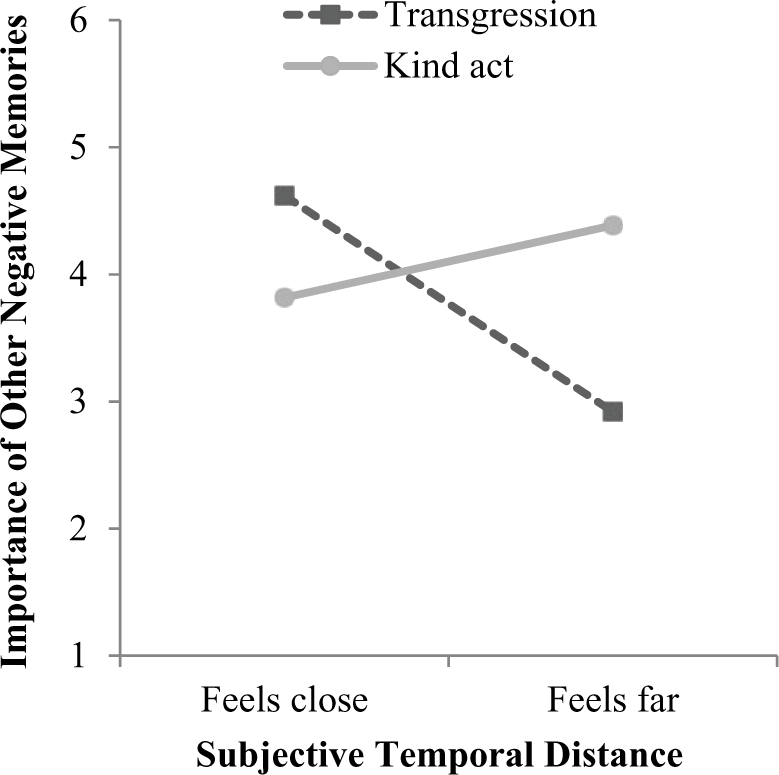
Predicted values calculated for individuals rating memories high and low (±1 SD) in subjective temporal distance (Study 2).
To assess our contention that this pattern should be specific to the negative memories elicited, we conducted the same Subjective Time × Valence Condition regression analysis on the positive and neutral memories. The interaction was nonsignificant for the current importance of positive memories, β = .01, t(140) = 0.06, p = .952, and marginally significant for neutral memories, β = .15, t(143) = 1.79, CI = [−0.02, 0.46], p = .075, suggesting that the adaptive subjective distancing of past negative memories uniquely predicts the current felt importance of other negative memories. 5 We conducted identical Subjective Time × Valence Condition regressions examining recalled importance of negative, positive, and neutral memories at the time of occurrence. As expected, no interactions emerged for negative memories, β = −.07, t(141) = −0.88, p = .383, positive (β = .06, p = .486) or neutral (β = .07, p = .379) memories.
Attachment anxiety predicts rated importance of negative memories
Unlike Study 1, we did not predict a Valence Condition × Attachment Anxiety interaction, due to the nature of the dependent variable. Specifically, in Study 1 we measured tendencies to think about events of the same valence as the target event. In the transgression condition, thinking about the event signified kitchen thinking (which we argue is maladaptive); in the kindness condition, thinking about the event was adaptive. Anxiously attached people showed more (negative) kitchen thinking but not more positive memory recruitment in positive contexts relative to those low in anxious attachment. In the current study, however, high scores on the dependent variable (rated current importance of additional negative memories) are maladaptive, regardless of condition. Therefore, we predicted only a main effect of attachment anxiety. That is, anxiously attached people would be more likely to place higher importance on past negative memories, regardless of condition, as they tend to engage in less adaptive distancing for both positive and negative memories.
We regressed attachment anxiety, valence condition, and their interaction on perceived importance of past negative memories. There was an unanticipated main effect of valence, β = −.17, t(141) = −2.05, CI = [−0.56, −0.01], p = .042, demonstrating that people rated negative memories slightly more important in the kind act than transgression condition. However, crucial to our hypothesis, the predicted main effect of attachment anxiety, β = .19, t(141) = 2.27, CI = [0.04, 0.56], p = .025, indicated that people high in attachment anxiety placed higher current importance on past negative memories than those low in attachment anxiety. Also consistent with our predictions, the Valence × Attachment Anxiety interaction was nonsignificant, β = −.02, t(141) = −0.18, p = .856.
The design in Study 2 also requires testing a different type of mediation model. Rather than using subjective distance to mediate the interaction effect as we did in Study 1 (a mediated moderation), we will examine the main effect of attachment anxiety on importance of negative memories mediated by the interaction between subjective distance and memory valence condition (a moderated mediation).
Mediation analysis
We examined whether the attachment anxiety main effect predicting importance of negative memories would be at least partially mediated by the subjective time management of positive versus negative memories. We ran a moderated mediation analysis using the bootstrapping macro outlined in Hayes (2013). The interaction term of Subjective Distance × Valence Condition (mediator) significantly predicted the importance of negative memories, t(141) = −3.56, p < .001, and was also significantly predicted by attachment anxiety (predictor variable), t(141) = −2.18, p = .030. The direct effect of attachment anxiety on current importance dropped to marginal significance once the mediator was accounted for, t(141) = 1.77, p = .080. Bootstrapping analysis with 5,000 samples estimated the true indirect effect to lie between .01 and .21, with 95% confidence.
Discussion
The findings from Study 2 suggest that the process of keeping past positive memories subjectively close and relegating slights to the distant past is adaptive, as doing so predicted placing less importance on other past negative memories. We found once again that people high in attachment anxiety manage their relational memories in less adaptive ways, which in turn predicts greater likelihood of kitchen thinking—in this case, placing more importance on other past negative memories.
Although Study 2 offered additional evidence that attachment anxiety and subjective time of relational memories may play a role in kitchen thinking, our measure of kitchen thinking was indirect. In Study 3, we implemented a new measure of kitchen thinking to better capture people’s tendencies to bring to mind past negative memories when faced with a current target transgression. Specifically, we examined the types of spontaneous memories that come to mind after having just thought about a past slight or positive act committed by a partner. We reason that if a target relationship transgression feels subjectively closer, it will feel more reflective of the current state of the relationship. In turn, other memories that reflect the same state should be more accessible and come to mind spontaneously. For instance, when a target transgression feels subjectively more recent (vs. far), it should be more likely to elicit other negative memories.
Study 3
The purpose of Study 3 was to extend the previous findings by adopting a more in-the-moment measure of kitchen thinking. Specifically, we examined the types of memories that spontaneously came to mind subsequent to a positive or negative memory recall task. We again expected that people low in anxious attachment would show an adaptive distancing bias more than those high in anxious attachment, and that this would account for highly anxiously attached people being more likely to spontaneously generate more negative memories.
Method
Participants and procedure
A total of 199 (161 females, 35 males, three unspecified) undergraduate students in romantic relationships (M months = 22.18, SD = 16.92) participated in exchange for course credit.
Participants completed the same Relationship-Specific Attachment Style scale (M = 3.23, SD = 1.22; α = .93) as in Study 2 and Relationship Quality Scale (M = 7.87, SD = 1.22; α = .94) as in Studies 1 and 2. Participants were then randomly assigned to memory valence conditions. As in Study 2, participants were asked to think of a recent event (within the past year). Participants reported valence, indicated the objective event date (M months ago = 4.18, SD = 6.24), and the subjective time of the memory using the same two measures (r = .75, p < .001) as in Studies 1 and 2.
Next, kitchen thinking was measured by asking participants to freely recall the first three memories that came to mind which involved their romantic partner. After participants described each memory, they indicated its valence (“How positive or negative was this event?” from 1 [very negative] to 7 [very positive]) and the degree to which it had positive relationship implications (“Did this event involve, or lead to, bonding with your partner?” from 1 [not at all] to 7 [definitely]). We included the relationship implication item to capture a more qualitative meaning of the memory. Some memories may have been negative at the time but could actually hold positive significance for the current relationship (e.g., a fight that ended up being a relationship breakthrough and positively changed the relationship). By including both items, higher negativity scores would indicate that the event itself was relatively negative in both valence and implications (in line with our conceptual notion of negative memory recall). These two items were significantly correlated (r = .38, p < .001) and were aggregated into a composite score to indicate the overall memory type recalled. We reverse coded each item before aggregating, so that higher numbers indicate a more negative overall meaning of the memories recalled. This measure served as our dependent variable of the valence of spontaneous memories recalled. Finally, participants completed a relationship optimism measure (see Supplements for detailed information).
Results
Preliminary analyses
Participants recalling transgressions (M = 2.28, SD = 1.48) reported that their target memory was more negative than those recalling kindnesses (M = 6.63, SD = 0.70), t(195) = −26.73, p < .001. Once again, a multiple regression examining chronological time revealed that attachment anxiety, condition, and the interaction term were all nonsignificant (βs < .07, ps > .370). Calendar time did not vary systematically by participants’ attachment anxiety or event valence.
Primary analyses
Attachment anxiety predicts subjective distancing
We regressed attachment anxiety, valence condition, and their interaction on subjective time. There was no main effect of attachment anxiety, β = −.05, t(178) = −0.78, CI = [−4.87, 2.12], p = .438, a significant main effect of condition, β = .41, t(178) = 6.24, CI = [7.50, 14.43], p < .001, such that transgressions seemed on average more subjectively remote than kind acts, and a significant interaction, β = −.22, t(178) = −3.26, CI = [−9.26, −2.27], p = .001. Replicating Studies 1 and 2, while individuals low in attachment anxiety adaptively relegated transgressions to the distant past but kept kindnesses subjectively recent, individuals high in attachment anxiety showed considerably less tendency toward adaptive distancing.
Subjective distancing predicts spontaneous recall of negative memories
We next tested the prediction that when the past target transgression felt subjectively closer (and when kind acts felt further away), more negatively valenced relationship memories would spontaneously come to mind. A multiple regression analysis with valence condition, subjective time, and their interaction, predicting spontaneous negative relationship memories recalled, supported our hypothesis. A significant interaction, β = −.25, t(189) = −3.40, CI = [−0.41, −0.11], p = .001, revealed that when target transgressions felt subjectively more recent, additional negative memories were more likely to spontaneously come to mind than when kind acts felt close, β = .29, t(189) = −2.70, CI = [0.15, 0.93], p = .008. Similarly, when transgressions felt subjectively further away in time, negative memories were less likely to spontaneously come to mind than when kind acts felt far, β = −.27, t(189) = −2.25, CI = [−0.95, −0.06], p = .026.
Mediation analysis
As in Study 2, we next tested our critical prediction that highly anxiously attached people would be more likely than people low in anxious attachment to kitchen think due to their differential patterns of subjectively distancing memories. We conducted a moderated mediation analysis using Hayes’s (2013) bootstrapping macro. The interaction term of Subjective Distance × Valence Condition (mediator) significantly predicted tendencies to spontaneously recall more negative memories, t(176) = −2.15, p = .033, and was also significantly predicted by attachment anxiety, t(177) = −3.09, p = .002. This main effect of attachment anxiety was partially mediated by the Valence Condition × Subjective Distance interaction. Bootstrapping analysis with 5,000 samples estimated the true indirect effect to lie between .004 and .09, with 95% confidence (p < .05). These results suggest that anxiously attached people were more likely to spontaneously recruit more negatively valenced memories, in part as a result of their subjective time management of target memories.
Discussion
This study showed that partners who keep past positive memories subjectively close and who relegate slights to the distant past are also less likely to bring additional negative relational memories spontaneously to mind (our in-the-moment measure of kitchen thinking). In addition, anxiously attached people’s dampened tendency to adaptively manage relational memories partly mediated their tendency to spontaneously recruit more negative memories.
Study 4
The purpose of Study 4 was to examine (a) kitchen thinking as it naturally occurs in real relational conflicts and (b) the downstream consequences of kitchen thinking for relationships, particularly for anxiously attached people. Although we have suggested that kitchen thinking should be maladaptive in relationships, similar to kitchen sinking (bringing up unrelated past harms during a conflict; Gottman, 1995), we have not directly examined how kitchen thinking is linked to conflict responses or relational outcomes. We have also not yet explored the link between kitchen thinking and kitchen sinking in conflict. Although it is likely that kitchen thinking is a precursor to kitchen sinking (individuals would need to bring past harms to mind before bringing them up), we suspect that negative outcomes can be linked to kitchen thinking whether or not it resulted in verbalizing those thoughts during conflict. Indeed, it is conceivable that privately recalling a partner’s past slights without conveying these thoughts could be as, if not more, harmful as the intensity of the recaller’s reactions during the target conflict may be exacerbated for reasons beyond their partner’s understanding.
In this study, we had participants recall a recent conflict with their partner, and asked them to report their thoughts (including kitchen thinking) at the time. We also asked participants about their kitchen sinking tendencies (whether they verbally brought up past slights), to examine its relationship with kitchen thinking and how both predict conflict outcomes and relational consequences. Finally, participants reported on how severe they perceived the conflict, how constructively and destructively they responded to conflict, and how satisfied and committed they felt after the conflict as post-interaction outcome variables. Participants also indicated how frequent and intense they perceived conflict to be in their relationship. We hypothesized that kitchen thinking would predict negative consequences in general. We also hypothesized that anxiously attached people would report having engaged in more kitchen thinking during conflict, which would account for their maladaptive relationship responses.
Method
Participants and procedure
A total of 201 (108 females, 93 males) Mechanical Turk workers in romantic relationships (M years = 7.21, SD = 7.61) participated in the study in exchange for financial payment.
After completing Attachment Anxiety and Relationship Satisfaction scales, participants were asked to vividly recall a past event with their partner. They read,
In the course of all romantic relationships, it is inevitable that couples will experience conflict. Please take a couple minutes to think of the
Participants were then asked to write about the conflict and indicate the date the conflict occurred (they were encouraged to use calendars/text messages to assist them with accuracy). 6 We then assessed kitchen thinking and kitchen sinking using three measures each. First, participants indicated their agreement with six items on a 1 (no, not at all) to 9 (yes, a great deal) scale which all began with “During the conflict . . .” Two items assessed kitchen thinking: “Other past fights with my partner came to mind” and “I remembered other hurtful things my partner has done in the past.” To broaden the focus of the questions and render our interest in kitchen thinking less obvious, we also assessed the extent to which positive events came to mind (e.g., “Positive relationship memories with my partner came to mind”) and the extent to which people focused on the current conflict (e.g., “I focused on what was happening in the moment only”). Next, with a “yes” or “no” option response, participants indicated whether during the conflict they thought about any other past negative events with their partner, and if so, how many. They answered the same questions regarding positive events. Using an identical set of questions as listed above, participants were also asked about their kitchen sinking tendencies (e.g., “During the conflict, I verbally brought up past fights with my partner”).
To assess potential outcomes linked to kitchen thinking (and kitchen sinking), participants then completed post-interaction measures: They reported the perceived severity of the conflict, how constructively or destructively they responded to the conflict, and how satisfied and committed they felt when facing the conflict. Participants also indicated how frequent and intense their conflicts tend to be.
Measures
Anxious attachment
Participants completed the same Attachment scale as in Studies 2 and 3 (Fraley et al., 2000; M = 2.85, SD = 1.37; α = .95).
Relationship satisfaction
Six items (α = .95) adapted from the Marital Quality Index (Norton, 1983) assessed participants’ relationship satisfaction (e.g., “We have a good relationship”). Participants responded to these items on a 9-point scale (1 = strongly disagree, 9 = strongly agree; M = 7.48, SD = 1.52).
Perceptions of conflict severity
This three-item scale (α = .81) assessed participants’ perception of the severity of the conflict (e.g., “How serious was this conflict”). Participants responded to these items on a 7-point scale (1 = not at all, 7 = extremely).
Conflict response
We administered Rusbult, Verette, Whitney, Slovik, and Lipkus’s (1991) 16-item Accommodation scale to assess how constructive and destructive people were in their response to the conflict. Four items each from the Accommodation scale assessed exit tendencies (e.g., “I threatened to leave him/her”), voice tendencies (e.g., “I calmly discussed things with him/her”), loyalty tendencies (e.g., “I forgave my partner and forgot about it”), and neglect tendencies (e.g., “I sulked and avoided confronting the issue”). Scale scores range from 0 (I did not do this) to 8 (I definitely did this). An overall accommodation score was computed by subtracting destructive (exit, neglect) responses from constructive responses (voice, loyalty).
Perceived relationship quality
Participants indicated how satisfied and committed they felt to their partner at the time of the conflict using an adapted version of the same perceived relationship quality measure as used in Studies 1 to 3 (e.g., “I felt satisfied with my relationship”; Fletcher et al., 2000; α = .96).
Perceptions of conflict frequency and intensity
Participants indicated their agreement with three items assessing perceptions of conflict frequency (e.g., “My partner and I argue frequently”; α = .88) and perceptions of conflict intensity (e.g., “When my partner and I get into fights, they feel very intense for me”; α = .91). Items were answered on a 1 (strongly disagree) to 9 (strongly agree) scale.
Results
Kitchen thinking measures
We assessed people’s kitchen thinking tendencies with three measures: a continuous measure asking people to what extent they engaged in kitchen thinking, a dichotomous yes/no question about whether they were kitchen thinking or not, and finally a fill-in-the blanks item asking participants how many past transgressions came to mind. As seen in Table 1, all three measures were significantly correlated. We standardized and averaged the three measures to create an overall composite of kitchen thinking. We used this composite to represent kitchen thinking in the subsequent analyses.
Correlations Between Attachment Anxiety, Reported Kitchen Thinking, Focusing on the Current Conflict, and Reported Thinking About Positive Memories (Study 4).
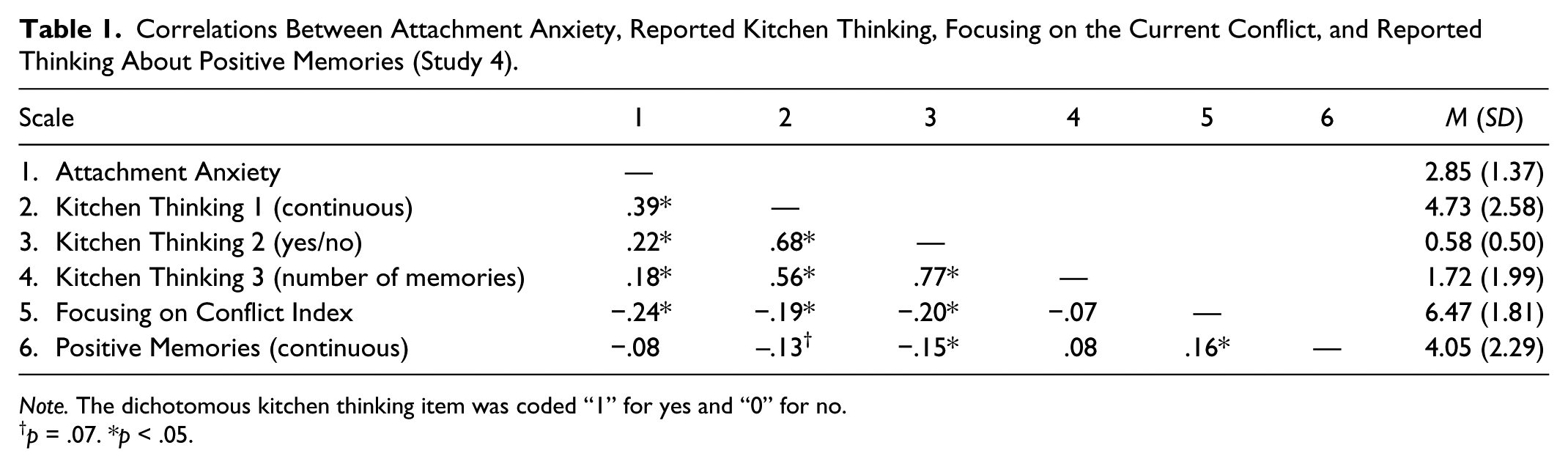
Note. The dichotomous kitchen thinking item was coded “1” for yes and “0” for no.
p = .07. *p < .05.
Attachment anxiety predicts kitchen thinking
We first sought to replicate and extend our past findings, showing that anxiously attached people were more likely to report kitchen thinking, this time in an actual recalled conflict with their partner. People high in attachment anxiety were more likely to report kitchen thinking on all three measures (continuous scale items, yes/no item, number of memories item) and less likely to focus on the current conflict but equally likely to report recruiting positive memories relative to people low in attachment anxiety. 7 People high (vs. low) in attachment anxiety were also more likely to report kitchen sinking, r(201) = .37, p < .001, and people who were thinking about past transgressions were also more likely to verbally bring them up, r(201) = .53, p < .001. See Part 2 of Supplements for additional information about kitchen sinking findings, including how it predicts outcome variables in this study and the findings when both kitchen thinking and sinking are included as predictors in the same models.
Kitchen thinking predicts negative relationship outcomes
Our next hypothesis was that kitchen thinking would predict negative relational outcomes. As seen in Table 2, the more people reported kitchen thinking during their conflict, the more severe they perceived the conflict and the less constructively they responded. They also reported feeling less satisfied and committed, and perceived more frequent and intense conflict in their relationship. 8
Correlations Between Attachment Anxiety, Reported Kitchen Thinking, and Relationship Outcome Variables (Study 4).
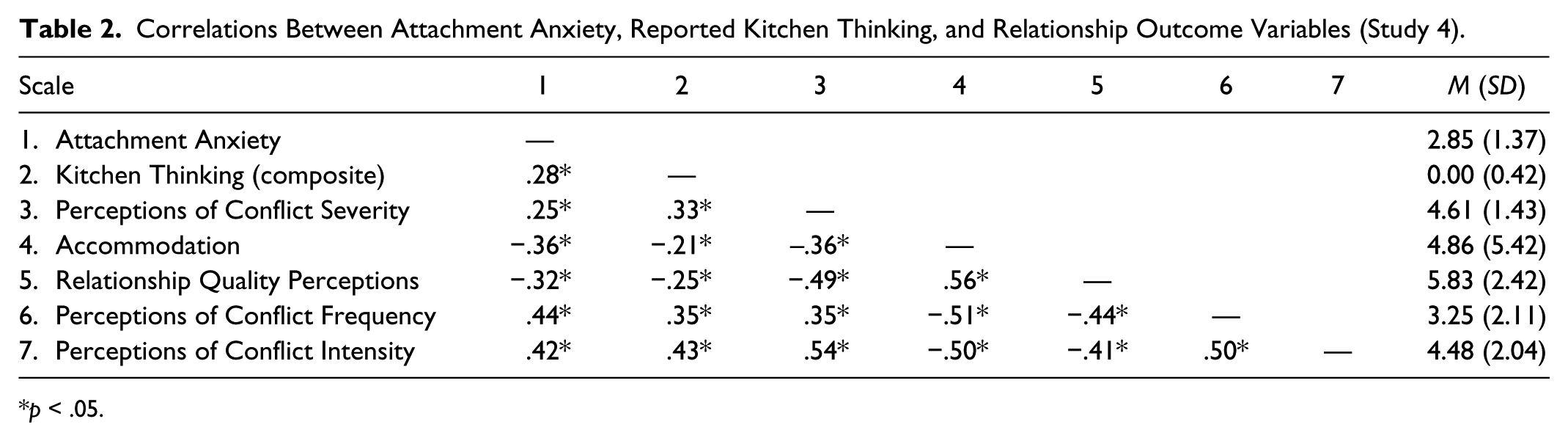
p < .05.
Mediation analyses
As seen in Table 2, attachment anxiety correlated significantly with all relationship well-being outcomes. People high (vs. low) in attachment anxiety reported perceiving more conflict severity, reported responding less constructively and more destructively to the conflict, and felt poorly about the state of their relationship. They also reported experiencing conflict more frequently and with greater intensity.
The next step involved examining whether reported kitchen thinking tendencies would mediate the link between attachment anxiety and poor post-conflict and relationship well-being outcomes. We conducted five mediation analyses using Hayes’s (2013) bootstrapping macro, with attachment anxiety as the predictor variable and the continuous measure of kitchen thinking as the mediator variable. We examined the three post-interaction variables as separate outcome variables (perceptions of conflict severity, accommodation, perceptions of relationship well-being) along with perceptions of conflict frequency and intensity. Kitchen thinking (mediator) significantly predicted each dependent variable, ts(199) > ±2.35, ps < .02, and was significantly predicted by attachment anxiety in all models, ts(199) = 4.14, ps < .001, with the exception of the accommodation measure (including both constructive and destructive responding), which was marginally predicted by kitchen thinking when attachment anxiety was included in the model, t(199) = −1.70, p = .091. Furthermore, when we broke down accommodation to examine destructive (exit, neglect) responding separately from constructive responding (voice, loyalty), kitchen thinking significantly predicted destructive responding when attachment anxiety was included in the model, t(199) = 3.37, p < .001, and not constructive responding. Importantly, the main effect of attachment anxiety was significantly mediated by reports of kitchen thinking with perceptions of conflict severity, destructive responding, perceptions of relationship well-being, perceptions of conflict frequency and intensity as the dependent variables. Bootstrapping analysis with 5,000 samples estimated the true indirect effect to lie between .03 (−.27 for negatively valenced items) at the lowest end and .20 (−.02) at the highest end, with 95% confidence (p < .05) across all five analyses.
Discussion
Data from real-world, recent conflicts of relationship partners suggest the negative downstream consequences of kitchen thinking in relationships. People who reported thinking about other unrelated past slights during their conflict also reported reacting to the conflict at hand more destructively—they reported having more conflict as a result of kitchen thinking, having less healthy conflict, and feeling worse about their relationships. Anxiously attached people reported being more likely to kitchen think during their conflicts but not more likely to think about positive events (showing that anxiously attached people do not simply engage in more relational thoughts during conflict, but that they recruit past transgression thoughts in particular). Importantly, anxiously attached people reacted more poorly to the conflict because of their kitchen thinking tendencies—they perceived the conflict to be more severe, responded in more relationship-destructive ways, and felt less satisfied. In addition, kitchen thinking during a conflict appeared to underlie a conviction that they fight more often and with greater intensity.
Taken together, these data offer preliminary evidence to suggest that tendency of anxiously attached people to kitchen think during conflict (and indirectly, to perceive negative memories as subjectively closer) is maladaptive for their relationships. They tended to respond more destructively, perceived more frequent and intense conflict, and felt worse about their relationships because of it.
General Discussion
Virtually every relationship has a past made up of both positive and negative events. Which earlier events are left behind in the past and which are held psychologically nearer to the present can have implications for the current relationship. Of particular interest in the current research was the role of subjective time—how recent or distant in time past events felt, regardless of when they actually occurred. Across three studies, we found that people low in attachment anxiety showed a consistent tendency to adaptively distance relational events (push slights to the distant past and hold positive memories close), whereas those high in attachment anxiety were less likely to distance their memories in this adaptive way. Importantly, the actual date of the conflict (recalled by participants) was not affected by event valence or attachment anxiety, helping to rule out the possibility that these effects are rooted in reality rather than in the subjective temporal perception of memories.
The second central focus of this research was to consider the process of kitchen thinking—how focusing on one relational event begets memories of other loosely related events. We discovered that subjective time played an important role in kitchen thinking: When a target transgression felt recent in time, people reported that they would be more likely to revisit it during future unrelated conflicts (Study 1), placed higher importance on other unrelated negative memories (Study 2), and spontaneously recalled other more negative memories (Study 3). We propose that when events seem subjectively recent, they are viewed as more reflective of the state of the current relationship, prompting a currently activated slight to beget other past slights. Along these same lines, the data showed the importance of holding onto past positive memories subjectively close in time, as doing so has the potential to buffer against the likelihood of kitchen thinking. Keeping memories subjectively close in time also likely serves as an “emotional capital” strategy (using built-up positive shared relationship experiences to endure relationship threats; B. C. Feeney & Lemay, 2012). Kitchen thinking tendencies of anxiously attached people were mediated by their less adaptive, subjective memory management.
Is this pattern of kitchen thinking actually problematic for relationships? We found (Study 4) that anxiously attached individuals showed a stronger propensity to kitchen think during conflicts, and that their kitchen thinking tendencies were related to problematic relationship outcomes—less healthy conflict, more frequent and intense conflict, and poorer perceptions of the relationship. These findings suggest that when enduring a conflict with their partner, anxiously attached people might encounter an additional challenge: They must face the current harm, further compounded by remembered past slights. Consequently, anxiously attached people likely have difficulty navigating through conflicts with their partners successfully. Rather than investing resources into problem solving and constructively responding, they may be thinking about past slights and potentially exacerbating their hurt feelings. Indeed, this memory process may help explain the finding that highly anxiously attached people tend to perceive more conflict than their partners report exists (Campbell et al., 2005) and react more extremely to relationship threats (e.g., Overall, Fletcher, Simpson, & Filo, 2015). It is easy to see how a negative pattern of relationship dynamics could unfold. An anxiously attached person’s partner may find it difficult to understand how his or her partner has become “this upset” over something so minor, which could cause frustration and lowered responsiveness. In turn, the anxiously attached individual might view his or her partner as less responsive and may feel less understood (Reis, Clark, & Holmes, 2004), potentially feeding back into their insecurities.
Speculation About the Attachment Anxiety Process
The precise mechanisms accounting for the intriguing patterns between attachment anxiety and management of relational history are still a matter of speculation. Why do anxiously attached individuals perceive transgressions as more recent than those who are low in anxious attachment? One possibility is that they developed cognitive tendencies such as these early on as a defense mechanism in response to unavailable caregivers. If these tendencies were practiced early on and persisted throughout the life span, it may be difficult to “turn them off” when entering new relationships that do not carry the same threats. It is also possible that anxiously attached people find past negative events more emotionally arousing (Campbell et al., 2005), which in turn causes them to feel closer to the present (Van Boven, Kane, Peter, & Dale, 2010). Another possibility anxiously attached people get more upset during conflict, leaving them in a “hot” state. According to research on the cold-to-hot empathy gap, it is difficult for people to bridge the gap between mental states—when in a “cold” state for instance, people cannot empathize with or predict how they will behave in a future “hot” state (Loewenstein, 1996; Sayette et al., 2008). In line with this reasoning, we speculate that anxiously attached people in a “hot” state may feel more empathy for and connection to their own past “hot” states, producing the illusion that these past events are closer in time and more frequent (Campbell et al., 2005).
A Caveat
In this article, we stress the importance of subjectively managing relational memories successfully, and argue that kitchen thinking is maladaptive for relationships. However, there are exceptions. In line with McNulty and Fincham’s (2012) contextual model, to the extent that people are involved in detrimental (e.g., abusive) relationships that offer more costs than benefits, the documented subjective time bias or kitchen thinking tendencies would not be adaptive. For mistreated partners, it may be more adaptive to keep partner’s past harms close in time and to actively retrieve these past instances when new ones occur. Doing so may intensify rather than minimize reactions to truly harmful behavior, prompting partners to end rather than manage abusive relationships.
Limitations and Future Research
The current research is the first to demonstrate the role of attachment anxiety in subjective distancing of relational memories and to show downstream effects on kitchen thinking. However, several limitations should be addressed in future research. First, although we used different measures that conceptually converged on kitchen thinking and had participants report their kitchen thinking tendencies in a conflict situation, we did not capture the process of kitchen thinking purely in the moment during a current relationship conflict. Future research could examine these processes perhaps during a lab-instigated conflict, or using diary methodologies that encourage participants to record their thoughts as soon as possible following new conflicts.
Second, because we do not have access to an objective record of the relational events retrieved by participants, we cannot unequivocally distinguish the actual facts of remembered incidents (i.e., their valence and date) from the retrospective account (remembered valence, recalled date). We established that reported calendar time of recalled events did not differ by valence or attachment anxiety levels, which helps rule out a “reality” account of the subjective time findings. Nonetheless, at core, the effects we describe do not really depend on the reality of relationship histories but rather on the systematic, and sometimes maladaptive, ways that people reconstruct and remember them. In future research, it would be useful to track enough events over time to be able to identify the factual details of kitchen thinking memories—but given that partners can sometimes hold onto and kitchen think about decade-old resentments, it would be virtually impossible to have a factual record of all revisited memories.
It is worth noting that the subjective time mediation results presented in Studies 1 to 3, although significant, were also somewhat weak. It is plausible that attachment anxiety predicts kitchen thinking directly or due to a number of mechanisms (not solely due to subjective time), making the mediation results weaker. However, we contend that the relatively robust effect of attachment anxiety on subjective memory management is at least partially accounting for anxiously attached people’s kitchen thinking tendencies.
Last, given the correlational nature of Study 4, we cannot infer causality with certainty—recalling conflicts in which one responded poorly could have led participants to incorrectly recall more kitchen thinking. Although we think this is less plausible, future research could replicate these findings in an experimental context by inducing kitchen thinking during conflict and examining its consequences.
The data from Study 4 offered preliminary evidence to suggest that verbalizing the kitchen thinking process to partners may in fact be less detrimental to the well-being of relationships than simply thinking about previous slights during conflicts (see Supplements). We suspect that it is possible that thinking of, but not verbalizing, past slights would be even more problematic because of the large reality gap this cognitive process could create.
Conclusion
Although people are less likely to kitchen think (i.e., rehearse past transgressions in new conflict situations) when they distance past transgressions and keep past kindnesses close, anxiously attached partners fail to show this adaptive misperception of time. Future research should further explore the complex temporal dynamics of partners’ perceptions and misperceptions of their relational memories, and how management of the relational past affects other relationship dynamics.
Footnotes
Declaration of Conflicting Interests
The author(s) declared no potential conflicts of interest with respect to the research, authorship, and/or publication of this article.
Funding
The author(s) disclosed receipt of the following financial support for the research, authorship, and/or publication of this article: This research was supported by a Social Sciences and Humanities Research Council granted to both authors.

Notes
References
Supplementary Material
Please find the following supplemental material available below.
For Open Access articles published under a Creative Commons License, all supplemental material carries the same license as the article it is associated with.
For non-Open Access articles published, all supplemental material carries a non-exclusive license, and permission requests for re-use of supplemental material or any part of supplemental material shall be sent directly to the copyright owner as specified in the copyright notice associated with the article.
