




Abstract
Research suggests that certain facets of people’s political ideals can be motivated by different goals. Although it is widely accepted that emotions motivate goal-directed behavior, less is known about how emotion-specific goals may influence different facets of ideology. In this research, we examine how anger affects political ideology and through what mechanisms such effects occur. Drawing on the dual-process motivational model of ideology and the functionalist perspective of emotion, we propose that anger leads people to support conservative economic ideals, which promote economic independence and discourage societal resource sharing. Four studies support our hypothesis that anger can enhance support for an election candidate espousing conservative economic ideals. We find that anger shifts people toward economic conservatism by orienting them toward competition for resources. Implications and future research on the relationship between emotions and political ideology are discussed.
In 2016, two thirds of Americans reported seeing news that made them angry at least once a day, and roughly half reported being angrier today than they were a year prior (“American Rage,” 2016). The anger that Americans felt was believed to have played an influential role during the election season, with the New York Times designating 2016 as the “Year of the Angry Voter” (Boylan, 2016). Given the pervasiveness of anger, how might its experience affect people’s political ideals? In this article, we investigate how anger affects different aspects of political ideology and the motivations by which such ideological shifts occur.
Perspectives of Political Ideology
Political ideology refers to a person’s set of beliefs regarding how society should function. Ideologies can be classified as liberal (i.e., “left-wing”) or conservative (i.e., “right-wing”; Adorno, Frenkel-Brunswick, Levinson, & Sanford, 1950; Wilson, 1973). The issues that encompass a person’s political ideology are multifaceted and include two key domains (Crowson, 2009; Feldman & Johnston, 2014). In the sociocultural domain, liberals endorse progressive social policies, whereas conservatives promote enforcement of traditional social norms (Jost, 2009; Malka & Soto, 2015). In the economic domain, liberals advocate greater egalitarianism and sharing of society’s wealth, whereas conservatives advocate free market capitalism and opportunity for individuals with minimal redistribution of wealth in a society (Duckitt & Sibley, 2009; Jost & Thompson, 2000).
The academic literature offers different approaches to studying the psychological structure and causality of political ideology. These perspectives vary in their assumptions about the dimensionality of ideology, and whether people are driven by the same motivational underpinnings across all facets of ideology. Traditional perspectives have taken a one-dimensional approach to ideology, assuming that people’s sociocultural and economic views are structured along a single liberal–conservative dimension and motivated by the same set of psychological determinants (Adorno et al., 1950; Jost et al., 2007; Wilson, 1973). An influential theory derived from this approach is the rigidity of the right model (Jost, Glaser, Kruglanski, & Sulloway, 2003), central to which is the hypothesis that conservative (vs. liberal) sociocultural and economic beliefs are both driven by the same underlying needs to mitigate threat and uncertainty (Jost, 2009; Nail, McGregor, Drinkwater, Steele, & Thompson, 2009). According to this model, adopting a broad-based conservative ideology allows people to protect the status quo and thus satisfy their needs to manage threat and uncertainty (Jost et al., 2007).
The rigidity of the right model has been widely studied, with some aspects of the framework better supported than others. Although the needs to manage threat and uncertainty have been shown to reliably predict conservative sociocultural ideals (Duckitt & Sibley, 2009; Jost et al., 2007), there is less support for the claim that conservative economic ideals are predicted by the needs to manage threat and uncertainty (Feldman & Huddy, 2014; Malka, Lelkes, & Holzer, 2018). Some research has associated these needs with economic conservatism (Jost et al., 2003; Onraet, Dhont, & Van Hiel, 2014), other research has associated the needs to manage threat and uncertainty with support for liberal economic ideals (Johnston, 2013; Malka & Soto, 2015), while several studies have found no relationship between these needs and economic ideology (Carney, Jost, Gosling, & Potter, 2008; Crowson, 2009). Taken together, this suggests that sociocultural and economic ideals are structurally independent.
Recent perspectives have adopted a two-dimensional approach to ideology, assuming that people’s sociocultural and economic views are held along two separate liberal–conservative dimensions with different motivational bases (Duckitt & Sibley, 2009; Feldman & Johnston, 2014; Hetherington & Weiler, 2009; Malka & Soto, 2015). One of the most prominent theories from this approach is the dual-process motivational model of ideology (Duckitt & Sibley, 2009, 2010), which posits that sociocultural conservatism stems from the goal of maintaining societal stability and security, and is driven by the perception that the world is dangerous and threatening. By contrast, economic conservatism is posited to stem from the goal of establishing or maintaining one’s own self-interest and superiority, and is driven by the perception that the world is a ruthless jungle where the survival of the fittest and struggle for resources is natural. A key assumption of the dual-process motivational model is that situational factors can influence the extent to which each of these goals is active. We suggest that emotions are an important situational factor for altering people’s goals and, subsequently, their political ideals.
Anger, Competitiveness, and Economic Conservatism
The functionalist perspective of emotion posits that all emotions, regardless of valence, are evolutionary adaptations that exist to facilitate fitness-enhancing solutions to problems in one’s environment (Keltner & Gross, 1999; Keltner, Haidt, & Shiota, 2006; Tooby & Cosmides, 1990). From this perspective, emotions are functional in the sense that they activate unique motivational orientations that are specifically suited for accomplishing emotion-specific goals (Lazarus, 1991; Tamir, Mitchell, & Gross, 2008). Thus, functionalism aligns with the dual-process motivational model of ideology, in that the effect of a specific emotion may not exert the same influence across all facets of ideology, and different emotions may exert different influences on people’s ideology.
The goal of the current research is to examine how anger influences people’s political ideology. We hypothesized that anger would promote economic conservatism, reflected in a decreased willingness to distribute resources across one’s society in favor of determining one’s own economic welfare. We derived our hypothesis from the dual-process motivational model of ideology, which states that economic conservatism is driven by self-enhancement, whereas sociocultural conservatism is motivated by stability and security (Duckitt & Sibley, 2009, 2010).
Anger emerges when a person believes that he or she fails to reach a desired end state due to the actions of people or other external sources (Smith & Ellsworth, 1985; Tamir et al., 2008). Because anger originates from the unfair blockage of goals, its experience motivates behavior that maximizes the welfare of the angry individual (Lazarus, 1991). This self-enhancement motive of anger has been shown to activate an approach orientation focused on having resources (Sell, Tooby, & Cosmides, 2009). Consistent with this proposition, Ford et al. (2010) found that experiencing anger, compared with fear or no emotion, increased people’s attention toward rewarding information but not threatening information. Similarly, Tamir et al. (2016) found that people wanted to feel more anger when pursuing the goal of resource attainment, but not when pursuing the goal of security. Given that economic ideology deals with the distribution of resources in a society, these results suggest that the self-enhancement motive of anger may serve as an important input for promoting conservative economic ideals. If so, it is important to understand the process by which this effect occurs.
We propose that anger promotes economic conservatism by heightening people’s proclivity to engage in interpersonal competition. According to the functionalist perspective of emotion, the self-enhancement motive of anger that orients people toward resources should encourage adaptive responses to help facilitate this goal (Tamir et al., 2016). Past research has shown that a focus on resources can lead people to become more competitive (Tooby & Cosmides, 1990). This heightened state of competitiveness is adaptive in that it empowers people to do what is required to attain a better outcome for themselves over others (Sell et al., 2009). Thus, anger may serve the function of heightening people’s competitiveness as a means of securing desired resources. Within the context of political ideology, people who are in a heightened state of competitiveness may be more likely to support economic conservatism.
Overview of the Current Studies
We conducted four studies to test our proposed relationship between anger and economic conservatism. Study 1 measured people’s general proneness toward anger in addition to competitiveness and economic conservatism. Study 2 manipulated anger and tested the proposed causal effect of anger on economic conservatism, while examining whether anger also encourages sociocultural conservatism. Study 3 tested whether economic conservatism is similarly influenced by other negative emotions by comparing the effects of anger with fear, while exploring the potential mediating role of perceived threat and other-blame, in addition to competitiveness. Finally, Study 4 examined the moderating role of perceived resource availability as further evidence for the effect being driven by increased competitiveness.
General Methodological and Empirical Considerations
The online materials provide a full list of our manipulations and dependent measures used in each of our studies. In each study, we indicate when we employed shortened forms of longer scales: When this was done, our objective was to minimize participant fatigue and therefore enhance response quality (Galesic & Bosnjak, 2009). At the end of each study, we extensively debriefed participants for suspicion. We did not exclude any participants from our analyses.
In Studies 2 to 4, we measured people’s self-reported political ideology on a 7-point Likert-type scale (i.e., from 1 = very liberal to 7 = very conservative). Our goal was to test whether the effect of anger could account for any observed differences in economic conservatism above and beyond people’s stated political ideology, which is consistent with prior research examining determinants of economic conservatism (Brown-Iannuzzi, Lundberg, Kay, & Payne, 2015; Eidelman, Crandall, Goodman, & Blanchar, 2012; Luguri & Napier, 2013). We note that our results remain largely unchanged when this variable is not controlled for in the analyses (see online materials).
Finally, prior research has recommended recruiting at least 20 participants per cell (Simmons, Nelson, & Simonsohn, 2011). However, other research has recommended larger samples when conducting mediational analyses (Fritz & MacKinnon, 2007) and when analyses include covariates (Tosteson, Buzas, Demidenko, & Karagas, 2003). Thus, in our experiments (Studies 2-4), we predetermined that the number of observations per condition (ncondition) should be greater than or equal to 50.
Study 1
Study 1 investigated the relationship among trait anger proneness, competitiveness, and support for economic conservatism. We expected that individuals with greater anger proneness would be more competitive and also more conservative in their economic ideals.
Method
Participants and procedure
Participants were 538 students (47.8% female; Mage = 20.83) from an undergraduate subject pool who participated in exchange for partial course credit. We conducted this study over the course of a week as part of a larger effort to capture a variety of individual difference measures for members of the subject pool: Each participant completed 18 individual difference scales in a single 60-min session. We dispersed the three scales central to this research throughout the larger set of scales.
Participants first completed the five-item (α = .83) Trait Anger Proneness Scale (Spielberger, 1988), which served as our measure for anger proneness (e.g., “I am quick-tempered,” from 1 = almost never to 4 = almost always). Toward the middle of the session, participants completed five-items (α = .78) from the Hypercompetitive Attitude Scale (Ryckman, Hammer, Kaczor, & Gold, 1990) relating to competitiveness (e.g., “Competition inspires me to excel,” from 1 = never true of me to 5 = always true of me). Near the end of the session, participants completed the 17-item (α = .72) Economic System Justification Scale (Jost & Thompson, 2000), which served as our measure of economic conservatism (e.g., “Laws of nature are responsible for differences in wealth in society,” “If people work hard, they almost always get what they want,” from 1 = strongly disagree to 9 = strongly agree).
Results and Discussion
To test our hypothesis about the relationship among trait anger proneness, competitiveness, and economic conservatism, we conducted a mediation analysis with Model 4 from the PROCESS macro by Hayes (2013). 1 We averaged responses on each scale used to measure anger proneness, competitiveness, and economic conservatism (see Supplemental Table 1 in the online supplement for the correlations among our dependent measures).
As hypothesized, there was a positive relationship between anger proneness and economic conservatism, b = .28, SE = .06, t = 3.96, p < .01, 95% confidence interval (CI) = [.14, .41]. Anger proneness predicted competitiveness, b = .34, SE = .06, t = 5.26, p < .001, 95% CI = [.21, .47], and competitiveness predicted economic conservatism, b = .37, SE = .04, t = 8.35, p < .001, 95% CI = [.28, .45]. Critically, the 95% confidence interval for the indirect effect from anger proneness to economic conservatism through competitiveness excluded zero, b = .12, SE = .03, 95% CI = [.07, .19], which indicates that competitiveness mediated the effect of anger proneness on economic conservatism. Thus, Study 1 provides preliminary evidence that anger enhances support for economic conservatism by making people more competitive.
Study 2
In Study 2, we manipulated anger and examined its effect on broad-based conservatism. We used a general measure of political ideology to investigate whether the effect of anger is specific to economic conservatism, or whether anger also promotes sociocultural conservatism, as reflected in people’s beliefs about civil rights, religion, science, and education. If economic and sociocultural conservatism are driven by the same goals, anger should promote broad-based conservative ideals. If, however, economic and sociocultural conservatism have different motivational determinants, anger could promote a specific facet of conservatism. Drawing from the dual-process motivational model of ideology, we expected that the self-enhancement motive of anger would be specific to promoting conservative economic views (Duckitt & Sibley, 2009). Given that our competitiveness-based mechanism is hypothesized to facilitate the self-enhancement motive of anger by orienting people toward resources, we did not anticipate that anger would promote broad-based conservatism.
We also tested the role of competitiveness in driving the effect of anger on economic conservatism. To do this, we compared competitiveness with an independent self-construal, which has been shown to result from anger (Cross, Hardin, & Gercek-Swing, 2011). As economic conservatism involves the independent pursuit of financial self-interest (Malka & Soto, 2015), a general independent self-construal may be sufficient to encourage economic conservatism. However, because an independent self-construal does not specifically orient people toward having resources, as is the case with competitiveness, we did not expect this aspect of anger to influence economic conservatism.
Method
Participants and design
We recruited 203 participants (42.9% female; Mage = 35.11) from Amazon Mechanical Turk over a 2-day period. Participants completed the study online in exchange for payment. We used a single factor (emotion: control vs. anger) between-subject design.
Procedure
We told participants that the study would consist of a writing task and some personality and demographic items. The writing task served as our emotion manipulation, which is a common method to manipulate emotions (Isbell, Ottati, & Burns, 2006; Polman & Kim, 2013; Small & Lerner, 2008). In the no-emotion (control) condition, participants were asked to write about a typical day. In the anger condition, participants were asked to write about an experience that illustrates what it feels like to be angry. In both conditions, we asked participants to spend a few minutes writing a response that was vivid enough so that a person not present during the events could read their description and know exactly how they felt. 2
After completing the writing task, participants completed two scales that measured their current levels of competitiveness and independence, with the scales presented in random order. Participants completed the same five-item (α = .78) competitiveness scale from Study 1 and five items (α = .70) from the Independent Self-Construal Scale (Singelis, 1994) relating to independence (e.g., “Being able to take care of myself is a primary concern for me,” from 1 = strongly disagree to 7 = strongly agree). Participants then completed the 26-item Social Attitudes Statement Scale (Kerlinger, 1984), which measures sociocultural and economic facets of ideology, while treating liberalism and conservatism as distinct constructs. Thirteen items (α = .89) are used to measure general liberalism (e.g., “Society should be quicker to throw out old ideas and traditions and adopt new thinking and customs”), and 13 items (α = .86) are used to measure general conservatism (e.g., “Science and society would be better off if scientists took no part in politics”). Importantly, the scale also uses six (α = .76) of the 13 conservative items to form an economic conservatism subscale (e.g., “Individuals with the ability and foresight to earn and accumulate wealth should have the right to enjoy that wealth without government interference and regulations”). All items were completed on a 6-point Likert-type scale (1 = disagree very strongly to 6 = agree very strongly). At the end of the session, participants were also asked to identify their self-reported political ideology (M = 3.40, SD = 1.70). 3
Results
We averaged responses on the items for each scale in subsequent analyses (see Supplemental Table 3 in the online supplement for the correlations among each of our dependent measures).
General liberalism and conservatism
An analysis of covariance (ANCOVA) revealed that while the effect of the self-reported political ideology covariate on general liberalism was significant, F(1, 200) = 147.43, p < .001,
Economic conservatism
An ANCOVA revealed an effect of emotion on economic conservatism, F(1, 200) = 3.10, p = .080,
Competitiveness
An analysis of variance (ANOVA) revealed an effect of emotion on competitiveness, F(1, 201) = 5.25,p = .023,
Independent self-construal
An ANOVA revealed an effect of emotion on self-construal, F(1, 201) = 5.76, p = .017,
Mediational analysis
To examine whether anger promotes economic conservatism through heightened competitiveness or an independent self-construal, we conducted a mediational analysis, using Model 4 in PROCESS (Hayes, 2013). Emotion was our predictor variable (0 = control, 1 = anger), economic conservatism was our outcome variable, competitiveness and independent self-construal were both entered as potential mediators, and self-reported political ideology was included as a covariate. The results of this analysis revealed a significant mediating pathway through competitiveness, b = .08, SE = .04, 95% CI = [.02, .17], but not through an independent self-construal, b = .01, SE = .02, 95% CI = [−.04, .08] (see Figure 1 for the beta coefficients of each path). These results indicate that competitiveness mediated the effect of anger on economic conservatism.
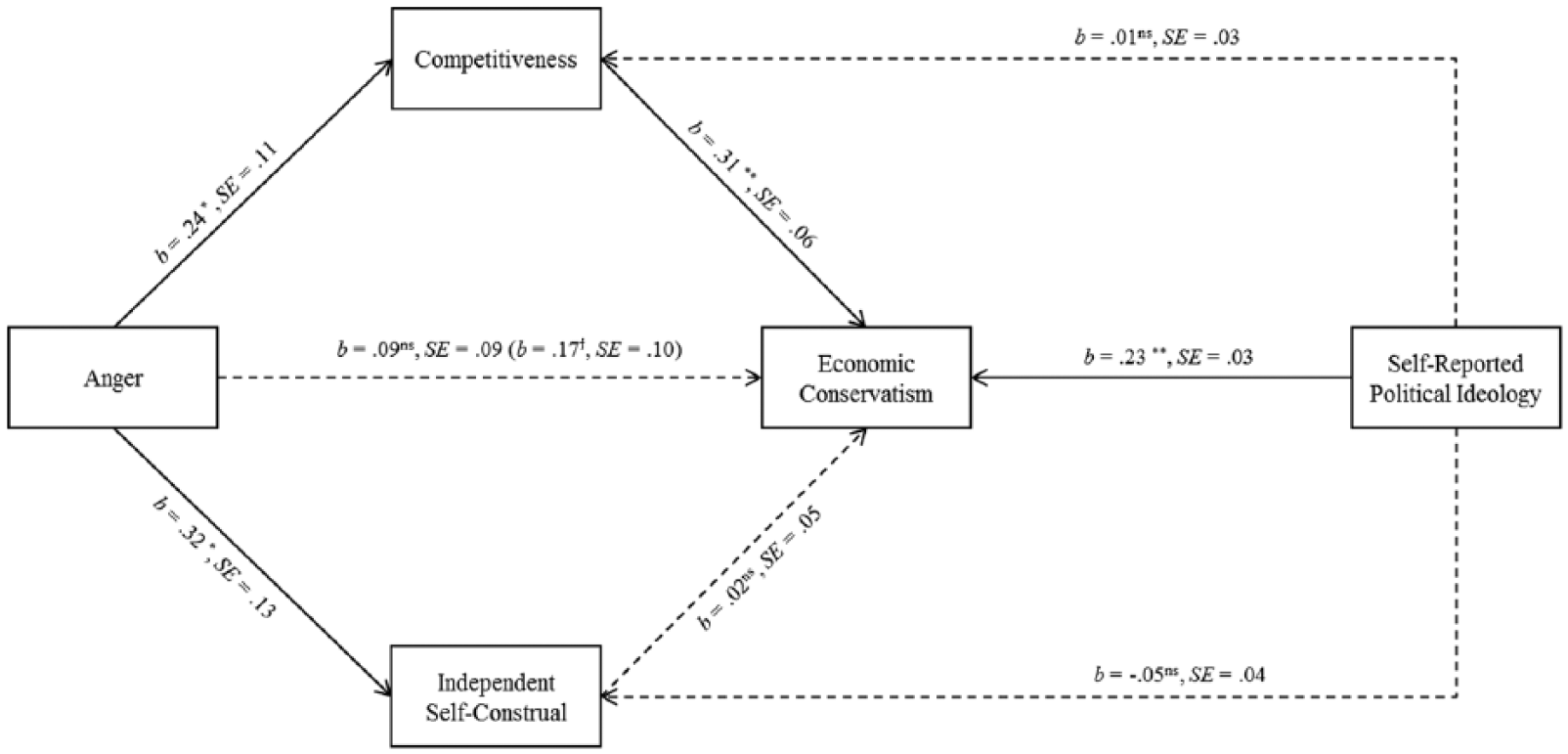
Path analysis in Study 2.
Discussion
The results of Study 2 support the two-dimensional approach to ideology, which states that the sociocultural and economic facets of ideology have different motivational bases (Duckitt & Sibley, 2009, 2010; Malka & Soto, 2015). In support of our hypotheses, we found that anger led people to express greater support for conservative economic ideals, but anger did not affect conservative sociocultural ideals. Study 2 also shed light on the process underlying this effect. While we found that experiencing anger led people to become both more independent and competitive, only competitiveness drove the effect of anger on economic conservatism. Our results provide support for a functionalist account of anger, whereby its influence on economic conservatism is motivated by self-enhancement and a heightened focus on competition for resources (Sell et al., 2009).
Study 3
In Study 3, we sought to further test the central hypothesis of two-dimensional frameworks—that economic and sociocultural conservatism have different motivational bases—by comparing the effect of anger with fear. Fear is a negative emotion that is uniquely suited to testing the divergent assumptions of one-dimension versus two-dimension perspectives of ideology because its experience has been shown to heighten perceptions of threat susceptibility (Lazarus, 1991; Lerner & Keltner, 2001). According to the rigidity of the right model, susceptibility to threat is instrumental in motivating a broad-based endorsement of conservatism (Jost, 2009). If this is so then fear, like anger, should lead people to endorse conservative economic ideals. In contrast, the dual-process motivational model of ideology posits that threat susceptibility motivates the goal of security—a goal that is known to primarily influence sociocultural conservatism (Duckitt & Sibley, 2009, 2010)—and fear may not lead people to endorse economic conservatism. To explore these competing predictions, Study 3 included a measure of perceived threat susceptibility.
Study 3 also examined the potential role of threat susceptibility in accounting for the effect of anger on economic conservatism. Although anger and fear can occur in response to threats, each emotion processes threatening information differently (Lazarus, 1991). For instance, fearful individuals perceive more threat and risk in situations, whereas angry individuals perceive less danger (Lerner & Keltner, 2001). Fear also orients people’s attention toward threats in the environment, whereas anger focuses attention toward rewards (Ford et al., 2010) and has been shown to empower people to address threats in their environments (Tamir et al., 2008). Therefore, we did not expect anger to heighten people’s susceptibility to threat.
Finally, in Study 3, we compare our hypothesized mechanism (competitiveness) with an alternative mechanism: that anger involves blaming others for causing the emotion-eliciting event (Smith & Ellsworth, 1985). Prior research has demonstrated that the other-blame tendency of anger can carry over into people’s decision-making in unrelated social dilemmas. For instance, Small and Lerner (2008) found that making people angry led them to attribute a welfare recipient’s circumstance to that individual’s own missteps (as opposed to other external factors). Similarly, Polman and Kim (2013) found that participants made to feel anger behaved antagonistically by contributing less to other participants in a public goods dilemma task. In both cases, the other-blame tendency of anger led participants to misattribute their feelings toward another person, and subsequently punish them. Study 3 included a measure of other-blame tendencies to determine whether it could account for the effect of anger on economic conservatism. Although we expected anger to increase other-blame tendencies, the other-blame tendency of anger is typically attributed to an individual or group and, unlike competitiveness, pertains to many other domains besides resources. Thus, we did not expect the other-blame tendency to encourage economic conservatism.
Method
Participants and design
We recruited 194 undergraduate participants (41.8% female; Mage = 20.42) over a 1-week period. Students participated in exchange for course credit. We used a single factor (emotion: control vs. anger vs. fear) between-subject design.
Procedure
We told participants that they would be completing two unrelated studies. In the first study, participants completed a writing task that served as the emotion manipulation. The control and anger manipulations were identical to those used in Study 2. In the fear condition, the instructions paralleled those in the anger condition, such that participants were asked to write about an experience that illustrates what it feels like to be fearful.
After completing the writing task, participants indicated how they currently felt by responding to the Anger (α = .96), Fear (α = .96), and Anxiety (α = .92) subscales of the Discrete Emotions Questionnaire (Harmon-Jones, Bastian, & Harmon-Jones, 2016). Each subscale was comprised of four emotion adjectives that were reflective of the specific discrete emotion being assessed. The Anger subscale contained the items “anger,” “mad,” “pissed off,” and “rage”; the Fear subscale contained the items “fear,” “terror,” “scared,” and “panic”; and the Anxiety subscale contained the items “worry,” “anxiety,” “dread,” and “nervous.” Participants were told to indicate the extent to which they currently felt each emotion adjective (from 1 = not at all to 7 = an extreme amount), with the presentation order of each item randomized.
Next, participants completed the same competitiveness scale (α = .81) from Study 1, five items (α = .88) from Bennett, Lowe, and Honey (2003) to measure other-blame tendencies (e.g., “Someone else is to blame when I am in a bad situation,” from 1 = never applies to me to 5 = always applies to me), and five items (α = .88) from Rahinel and Nelson (2016) to measure perceived threat susceptibility (e.g., “I feel susceptible to threats in the world around me,” from 1 = not at all to 5 = very much so).
Participants then moved to a second, ostensibly unrelated study about political candidates. We presented participants with a pair of political candidates, including a short description of their economic ideals. Candidate A was said to favor financial responsibility and sought to allocate resources toward reducing the government deficit. Candidate B was said to favor financial maneuverability and wanted to allocate resources toward supporting social services. Thus, Candidate A espoused more conservative economic ideals than Candidate B. A pretest confirmed that participants rated each candidate equally favorably at baseline but found Candidate A to be more conservative (see online materials). The presentation order of the candidates was counterbalanced. We asked participants which candidate they were more likely to vote for. At the end of the session, participants completed the same self-reported political ideology item from Study 2 (M = 4.18, SD = 1.51).
Results
We averaged responses on each scale for subsequent analyses (see Supplemental Table 4 in the online supplement for the correlations among each of our dependent measures).
Emotional experience
There was an effect of emotion on anger felt, F(2, 191) = 46.72, p < .001,
Economic conservatism
There was an effect of emotion on candidate choice, χ2(3, N = 194) = 8.22, p = .016. Participants in the anger condition were more likely to choose the economically conservative candidate (75.4%) than participants in the control (53.0%), χ2(1, N = 194) = 7.11, p = .006, Cohen’s d = 0.48, and fear condition, 55.6%, χ2(1, N = 194) = 5.58,p = .015, Cohen’s d = 0.43.
Competitiveness
An ANOVA on the competitiveness measure revealed an effect of emotion, F(2, 191) = 6.75, p = .001,
Other-blame tendency
An ANOVA on the other-blame measure revealed an effect of emotion, F(2, 191) = 10.06, p < .001,
Threat susceptibility
An ANOVA on the threat measure revealed an effect of emotion, F(2, 191) = 7.74, p = .001,
Mediational analyses
We hypothesized that while anger would increase other-blame tendencies and competitiveness, only competitiveness would mediate the effect of anger on economic conservatism. In contrast, we hypothesized that fear would increase perceptions of threat susceptibility, but threat would not subsequently predict higher levels of economic conservatism. Because our predictor variable had three levels (control, anger, and fear), we followed the steps outlined by Hayes and Preacher (2014) for multicategorical variable analysis. Specifically, we conducted a mediational analysis, using Model 4 from the PROCESS macro (Hayes, 2013), with competiveness, other-blame, and threat as potential mediators. We created two dummy code variables (anger and fear), whereby the focal emotion was coded as 1 and remaining variables as 0 (making our control condition the reference category in the analysis), which enabled us to decipher the effects of each separate emotion. We included self-reported political ideology as a covariate. We coded the outcome variable (candidate choice) such that the conservative candidate was 1 and the liberal candidate was 0.
We present the results in Figure 2. The analysis comparing the fear and control condition did not reveal a significant mediating pathway through competitiveness, b = −.01, SE = .09, 95% CI = [−.20, .16]; other-blame, b = .01, SE = .04, 95% CI = [−.03, .17]; or threat, b = −.11, SE = .13, 95% CI = [−.40, .12]. Thus, fear heightened threat susceptibility but threat did not predict economic conservatism. The analysis comparing the anger and control condition revealed a significant mediating pathway through competitiveness, b = .25, SE = .14, 95% CI = [.04, .61], but not through other-blame, b = −.11, SE = .12, 95% CI = [−.41, .10], or threat, b = −.03, SE = .05, 95% CI = [−.21, .03]. While anger heightened competitiveness and other-blame tendencies, only competitiveness accounted for the effect of anger on economic conservatism.
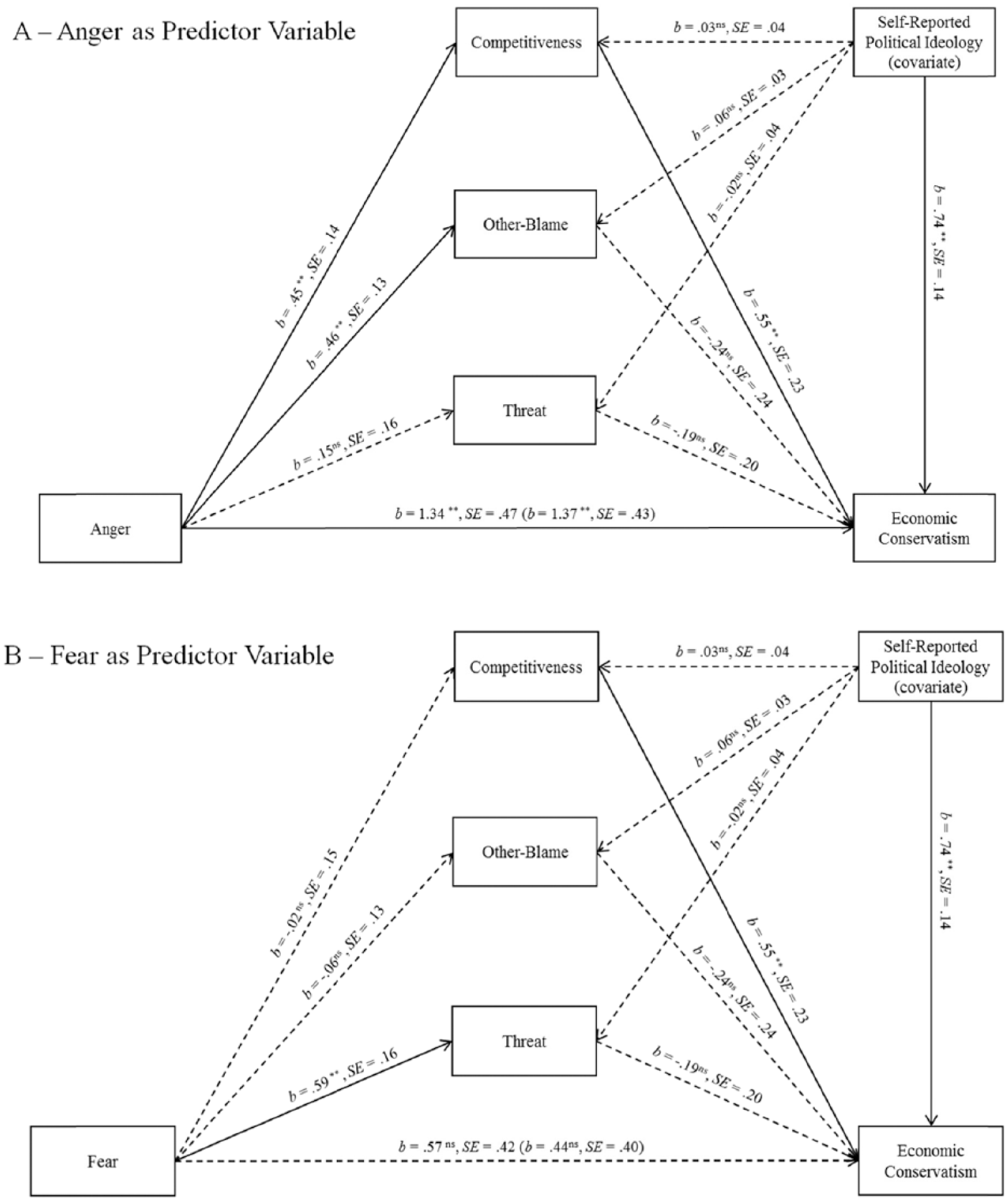
Path analyses in Study 3.
To test whether these effects are driven by the emotional experience of anger, we conducted a multiple-step mediation analysis using Model 6 from the PROCESS macro (Hayes, 2013). The anger dummy variable was our predictor variable, felt anger was Mediator 1 (M1), competitiveness was Mediator 2 (M2), and economic conservatism was our outcome variable. We conducted this analysis while controlling for participant’s reported levels of fear and anxiety to assess whether felt anger uniquely accounts for the effect of the anger manipulation on competitiveness and subsequently economic conservatism (cf. Lambert et al., 2010). The analysis revealed a significant mediating pathway of the anger manipulation on economic conservatism via felt anger and competitiveness, b = .13, SE = .10, 95% CI = [.01, .40].
Discussion
Study 3 provides several insights regarding how emotions influence economic conservatism. First, we found that fear, and perceptions of threat susceptibility more broadly, did not enhance support for conservative economic ideals. At first glance, these results seem at odds with prior research associating perceptions of threat and a broad-based endorsement of conservative ideology (Jost, 2009; Nail et al., 2009). However, our findings are consistent with two-dimensional models of political ideology that posit that sociocultural conservatism is motivated by threat perceptions (Duckitt & Sibley, 2009; Malka & Soto, 2015), and with recent research suggesting that the effect of threat on conservative ideology depends on the type of threat being experienced (Onraet et al., 2014; Onraet, Van Hiel, & Dhont, 2013). Together, these findings suggest that the role of threat in shaping political ideology might be more nuanced than previously thought—a possibility we highlight in the general discussion.
The results of Study 3 demonstrate that while anger increased competitiveness and other-blame tendencies, only competiveness mediated the effect of anger on economic conservatism. This lends further support to our proposition that competiveness encourages economic conservatism because of a focus on resources, a possibility we examine more directly in Study 4. Finally, Study 3 extended the results of Studies 1 and 2 by using a measure of economic conservatism that is representative of voting behavior (Isbell et al., 2006), which supports the notion that emotion can play an important role in determining election outcomes.
Study 4
To this point, we have demonstrated that anger promotes economic conservatism by heightening competitiveness. We designed Study 4 to test our hypothesized account: that anger increases competitiveness by orienting people toward having resources.
According to the functionalist perspective of emotion, the pursuit of emotion-specific goals can be modified depending on the presence of other goal-relevant environmental cues (Tamir et al., 2008; Tooby & Cosmides, 1990). If an orientation toward resources underlies the competitive function of anger, then altering perceptions of resource availability should moderate the path from anger to competitiveness. In support of this possibility, Roux, Goldsmith, and Bonezzi (2015) found that participants primed with resource scarcity (relative to a control condition) showed greater accessibility of competition-related words on a lexical decision task, indicating that competition was more salient for those participants. Thus, in Study 4 we investigate whether priming resource scarcity (vs. resource abundance) moderates the effect of anger on competitiveness and, consequently, economic conservatism. We predicted that the effect of anger on competitiveness and economic conservatism would intensify when people were primed with resource scarcity, and would attenuate when people were primed with resource abundance.
Method
Participants and design
We recruited 323 participants (47.1% female; Mage = 33.48) from Amazon Mechanical Turk over a 2-day period. Participants completed the study online in exchange for payment. We used a 2 (emotion: control vs. anger) × 3 (prime: neutral vs. resource scarcity vs. resource abundance) between-subject design.
Procedure
We told participants they would complete two unrelated studies. The first study consisted of the same emotion manipulations for the control and anger conditions of Study 2, and the second study contained our resource priming manipulation. For the resource prime, participants completed a scrambled sentence task adapted from Chartrand and Bargh (1996). We presented participants with 10 sets of five words each, and asked them to form sentences by unscrambling those words. In the resource scarcity condition, each sentence contained one word consistent with scarce resources (e.g., scarce, insufficient, broke). In the resource abundance condition, each sentence contained one word consistent with abundant resources (e.g., abundant, plenty, sufficient). In the neutral prime condition, each sentence contained a neutral word (e.g., interesting, considers, surprised) so as not to instantiate a resource prime (see online materials for the pretest results verifying our priming manipulation).
After participants finished the scrambled sentence task, we told them that the second study was complete, and that they would answer some additional questions. Participants then completed the same competitiveness scale as in Study 2 (α = .78). Next, participants completed the same economic conservatism scale (α = .89) as in Study 1. At the end of the session, participants also completed the same self-reported political ideology item from Study 2 (M = 3.36, SD = 1.58).
Results
We averaged responses on the items for each scale in subsequent analyses.
Economic conservatism
An ANCOVA on the economic conservatism measure revealed a main effect of resource prime, F(2, 316) = 11.71, p < .001,
To investigate this interaction, we first compared the effect of the anger manipulation with the control condition within each prime condition. Anger led to greater economic conservatism in the neutral prime condition (Mcontrol = 4.32, SD = 1.37 vs. Manger = 4.80, SD = 1.24), F(1, 316) = 4.93, p = .027,
Competitiveness
An ANOVA on the competitiveness measure revealed a main effect of resource prime, F(2, 317) = 13.12, p < .001,
The anger manipulation enhanced competitiveness in the neutral prime condition (Mcontrol = 2.62, SD = 0.67 vs. Manger = 2.97, SD = 0.81), F(1, 317) = 5.34, p = .021,
Moderated mediation analysis
We hypothesized that competitiveness would mediate the effect of anger on economic conservatism and that the path from the predictor (anger) to the mediator (competitiveness) would be strengthened by resource scarcity and weakened by resource abundance. This implies a moderated mediation analysis. As our moderator had three levels (neutral, resource scarcity, and resource abundance), we used PROCESS Model 10 (Hayes, 2013), applying the recommendations of Hayes and Preacher (2014) for a multicategorical variable analysis. We created dummy codes representing comparisons between resource prime conditions: neutral versus resource scarcity (D1) and neutral versus resource abundance (D2). The model included emotion as the predictor variable, two moderators representing resource prime (D1 and D2), their interactions with the predictor variable, competitiveness as the mediator, economic conservatism as the outcome variable, and self-reported political ideology as a covariate (for a figure that displays the conditional process model used, see the online supplement).
An analysis of the variance in our mediator (competitiveness) accounted for by the joint influence of our interaction terms yielded a significant interaction, ΔR2 = .02, F(2, 316) = 3.49, p = .031, which qualified us to examine the conditional indirect effects at different values of the resource prime moderator (see Supplemental Table 5 in the online supplement for each of the conditional process model coefficients). In support of our theoretical model, the analysis revealed a significant mediating pathway through competitiveness in the neutral prime condition, b = .13, SE = .07, 95% CI = [.03, .29], and in the resource scarcity condition, b = .14, SE = .08, 95% CI = [.02, .32], but not in the resource abundance condition, b = −.05, SE = .06, 95% CI = [−.19, .05] (see Figure 3 for the beta coefficients of each path at each level of the moderator).
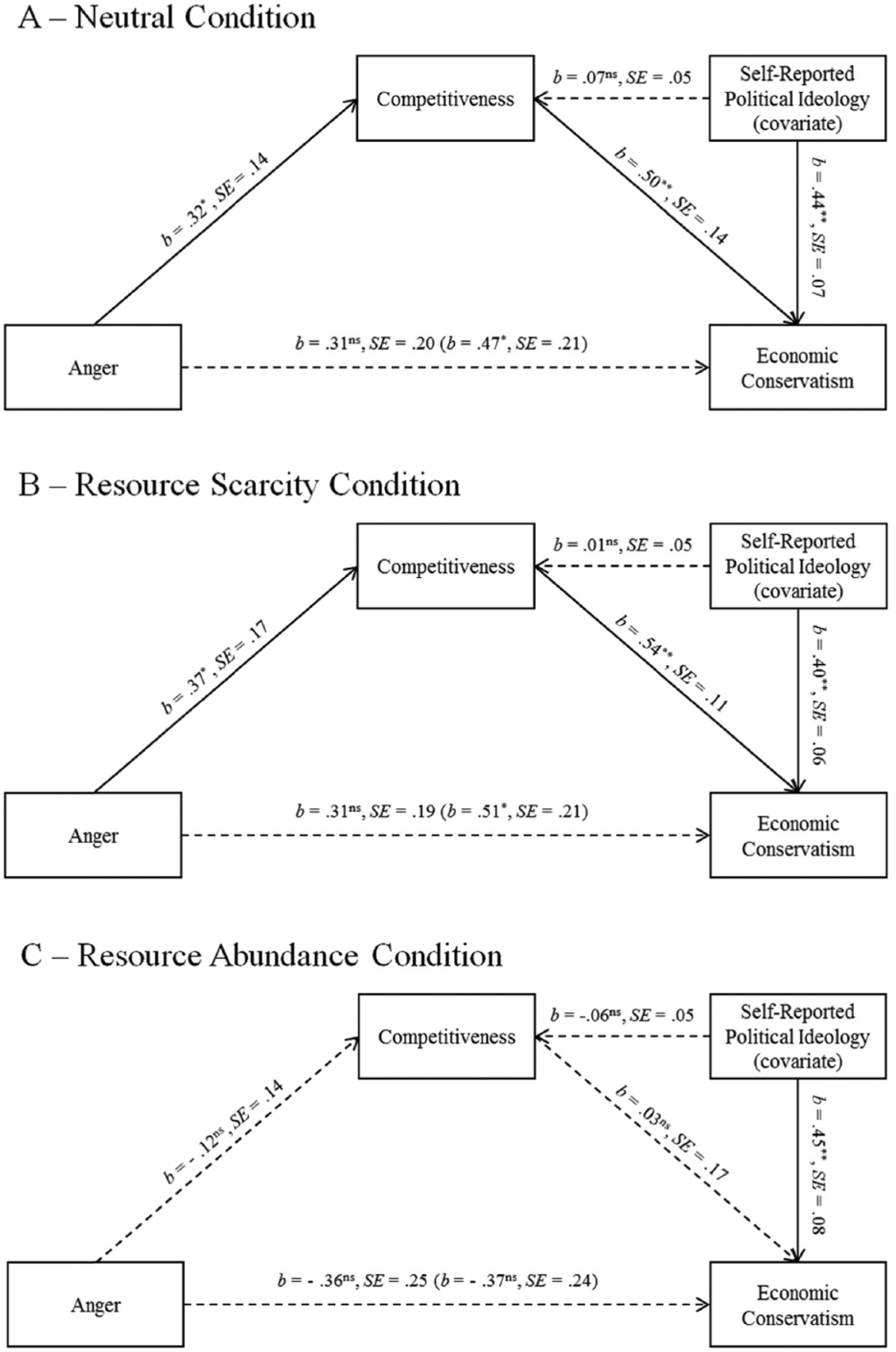
Path analyses in Study 4 at each level of the moderator (resource prime).
Discussion
The results of Study 4 provide further support for our account that competitiveness is the mechanism underlying the effect of anger on support for conservative economic ideals. We found that, as compared with a control condition, the effect of anger on competitiveness (and, subsequently, economic conservatism) was stronger when people perceived resource scarcity, and weaker when they perceived resource abundance. These results are consistent with a functionalist account of emotions, which posits that the pursuit of emotion-specific goals can be modified as a function of the current environment (Keltner et al., 2006; Tamir et al., 2008; Tooby & Cosmides, 1990). Thus, the competitive function of anger can either be amplified or mitigated depending on people’s perceptions of resource availability. These results demonstrate conditions under which anger will or will not promote economic conservatism.
General Discussion
It is widely accepted that emotions play a role in people’s political ideals. However, from a theoretical perspective, the question of how specific emotions shape certain facets of political ideology has received scant empirical investigation. Our objective has been to examine how anger influences people’s support for political ideals. Across four studies, we find that people with greater proneness to anger are more supportive of economic conservatism (Study 1), and that experiencing anger increases people’s support for conservative economic ideals, and for a political candidate espousing those ideals (Studies 2-4). Our results indicate that anger promotes economic conservatism through a heightened sense of competitiveness, but anger does not encourage broad-based conservatism (Study 2). We demonstrate that anger and fear activate distinct sets of emotion-specific goals that have different implications for political ideology (Study 3). Finally, we identify perceptions of resource availability as an important moderator of this effect, such that anger promotes economic conservatism most strongly when people perceive resources to be scarce (Study 4).
Theoretical Implications
The present research offers important contributions to the literature on political ideology. A longstanding view in the ideology literature has been that people’s sociocultural and economic ideals can be classified along a single liberal–conservative dimension because each ideological facet is guided by the same motivational determinants (Adorno et al., 1950; Jost et al., 2007; Wilson, 1973). Recent evidence, however, suggests that people’s sociocultural and economic ideals have unique motivational bases, and may not be adequately classified along a single liberal–conservative dimension (Feldman & Johnston, 2014; Hetherington & Weiler, 2009; Malka, Lelkes, & Soto, 2017). More work must be done to understand what social-psychological factors might activate the goals that distinctly motivate sociocultural versus economic ideals (Duckitt & Sibley, 2009). By demonstrating that the self-enhancement motive of anger leads people to support economic conservatism but not sociocultural conservatism, our work suggests that future political ideology research needs to consider how emotion-specific goals differentially affect distinct facets of political ideology.
By integrating the dual-process motivational model of ideology and the functionalist perspective of emotion, the present research provides a promising approach to understanding the relationship between emotions and political ideology. A key assumption of two-dimensional ideological frameworks is that the goals that motivate different facets of ideology may be modified based on the presence of other goal-relevant environmental cues (Duckitt & Sibley, 2009; Malka & Soto, 2015). Similarly, the functionalist perspective states that the goals made active by an emotion are dynamic and can change depending on the context in which the emotion is experienced (Keltner et al., 2006; Tamir et al., 2008). Our research synthesizes these perspectives, as we show that while a default response to the self-enhancement motive of anger is to seek resources, this goal-directed behavior may be modified based on perceptions of resource availability (Study 4). Thus, emotions guide people’s goal-directed behavior based on the current context, a finding that complements two-dimensional models of ideology.
Our findings also compare different mechanisms of anger to contribute to our understanding of the scope within which anger affects resource-related decisions. Prior research has shown that anger can decrease people’s willingness to give resources to another individual because of a misattribution of their angry feelings toward the individual (Polman & Kim, 2013; Small & Lerner, 2008). This finding is consistent with the displaced aggression hypothesis, which states that anger elicited by one individual can heighten aggressive behavior toward another individual (Isbell et al., 2006). Our findings extend this work by demonstrating that anger can affect support for resource distribution more broadly, as we find that anger makes people more supportive of a free economic system that promotes economic independence and discourages societal resource sharing. This result is important as it shows that the carryover effects of anger can influence resource distribution on a societal scale.
Limitations and Future Directions
Although our findings outline conditions that diminish the effect of anger on support for economic conservatism, we do not outline the conditions in which anger might enhance support for liberal economic ideals or when anger might influence sociocultural ideals. We suspect that there are circumstances in which these effects could occur, but it would likely require a deeper investigation into how different types of anger affect political ideology. We manipulated incidental anger, in that our participants’ emotional experiences were normatively irrelevant to the current political ideal under consideration. However, an integral manipulation of anger could have different consequences for people’s economic ideals. For instance, when people are angry toward their government for rising rates of income inequality, anger could promote economic liberalism. An investigation into group-based emotions could also shed light on when anger influences people’s sociocultural ideals. For instance, when an in-group experiences collective anger toward an out-group (e.g., immigrants), that anger may promote sociocultural conservatism (Mackie, Devos, & Smith, 2000).
We hope that our work sparks future research investigating how other emotions influence aspects of people’s political ideology. For instance, gratitude results from the belief that another person has caused a positive outcome in one’s own life and has been shown to increase generosity and cooperation with others (DeSteno, Li, Dickens, & Lerner, 2014). This sense of indebtedness toward others could motivate people to espouse egalitarian economic ideals. In addition, awe is a positive emotion experienced in response to a novel event that challenges a person’s current understanding of the world (Keltner et al., 2006). By enhancing tolerance for uncertainty, awe could motive people to become more open-minded and progressive in their sociocultural ideals.
Finally, the results of Study 3 highlight the need to further investigate the role of threat in political ideology. We outline two emerging research streams to facilitate this investigation.
Two-dimensional models of ideology
The dual-process motivational model of ideology proposes that the goal of mitigating threat is central to sociocultural conservatism (Duckitt & Sibley, 2009). Similarly, Malka and Soto (2015) present the menu-independent and -dependent influence model, and propose that the need to reduce threat motivates people toward sociocultural conservatism. However, their model goes one step further and suggests reasons that the goal of mitigating threat can actually encourage liberal economic ideals. Their rationale stems from the idea that many liberal economic policies are designed to provide economic security and stability, which help mitigate certain threats (Malka, Lelkes, & Soto, 2017). They further posit that the extent to which threat encourages economic liberalism versus conservatism depends on other moderating factors, such as people’s political engagement (Malka, Lelkes, & Holzer, 2018). Importantly, the idea that threat can either promote economic conservatism or liberalism lends support to the notion that political ideology is complex and influenced by a host of other moderating factors.
Internal versus external threat
A growing body of evidence suggests that conservative ideology is only motivated by certain types of threat. One acknowledged barrier to understanding the role of threat in political conservatism is that the literature has often adopted different conceptual definitions and empirical operationalizations of threat (Thórisdóttir & Jost, 2011). In an effort to present a more parsimonious conceptualization of threat, Onraet and colleagues propose two main categories of threat. Internal threats are experienced at the individual level (i.e., solely by the individual), whereas external threats occur when threat is experienced at a societal level (i.e., by the individual and society as a whole). Their research suggests that only external threat strongly predicts conservative ideology (Onraet et al., 2014; Onraet et al., 2013).
In our studies, we used an open-ended manipulation of fear which encouraged participants to be highly focused on themselves. This inward focus may have led participants to experience internal threat. We suspect that had participants been instructed to write about a time in which they felt fearful alongside others (e.g., collective fear of a terrorist attack), external threat would have been more prevalent (Mackie et al., 2000). Thus, these findings highlight the need for greater conceptual clarity in future threat research, as its effect on political ideology may vary considerably depending on the type of threat under examination.
Conclusion
Historically, conservatives have been commonly referred to as “hawks” by the press (e.g., The Economist), in popular literature (e.g., DC Comics’s characters Hawk and Dove; Costello & Worcester, 2014), and in academic research (Lambert et al., 2010). Although the “hawk” moniker originated with conservatives’ support for military action, journalists often use it to describe individuals who support competition and oppose wealth redistribution. In examining the relationship between anger, competitiveness, and economic conservatism, the present research found some evidence that economic conservatives are indeed competitive. We believe these results add to our understanding of the determinants of political ideology and hope they prompt future investigations to provide us with a more systematic framework for understanding how emotions guide people’s ideals and behavior.
Footnotes
Acknowledgements
The authors thank Dr. Duane T. Wegener and the review team for their guidance, and they also thank Josh Clarkson and Derick Davis for their helpful comments on previous drafts of this manuscript.
Authors’ Note
Both authors contributed equally to this work.
Declaration of Conflicting Interests
The author(s) declared no potential conflicts of interest with respect to the research, authorship, and/or publication of this article.
Funding
The author(s) disclosed receipt of the following financial support for the research, authorship, and/or publication of this article: The authors gratefully acknowledge the financial support provided by the Provost Research Fund at the University of Miami.
Supplemental Material
Supplementary material is available online with this article.
Notes
References
Supplementary Material
Please find the following supplemental material available below.
For Open Access articles published under a Creative Commons License, all supplemental material carries the same license as the article it is associated with.
For non-Open Access articles published, all supplemental material carries a non-exclusive license, and permission requests for re-use of supplemental material or any part of supplemental material shall be sent directly to the copyright owner as specified in the copyright notice associated with the article.
