



Abstract
The current research examined two fundamental motives that could lie at the root of separatist groups’ desire to be independent from the nonseparatist majority: the need to maintain the own subgroup identity and the need to preserve power vis-à-vis the majority. These motives were examined in two studies through surveys among samples of indigenous people in West Papua (N = 201 and N = 248), where separatist movements are actively striving for secession from the Republic of Indonesia. As expected, identity threat increased perceptions of injustice in both studies, whereas power threat increased the need for subgroup empowerment. Perceived injustice and need for subgroup empowerment, in turn, decreased support for reconciliation with the majority. The current research is the first to examine how identity and power motives combine in predicting separatist intentions. The studies reveal important insights that can contribute to the reconciliation of separatist conflict.
Where globalization pressures promote alliances between nations, these forces are counteracted by separatist movements striving for secession and political independence. As a common type of conflict that spares no continent, separatism is rooted in various psychological, economic, and political motives (Kingsbury & Laoutides, 2015). Separatist conflict is among the most violent and pervasive types of intergroup conflict in the world, and is often characterized by a combination of direct and structural violence (Beary, 2011). However, a systematic empirical investigation of the motives that drive separatist groups, and how these might hinder the reconciliation of separatist conflict, is still missing. A better understanding of separatist motives may ultimately help contribute to the de-escalation of separatist conflict and the promotion of peace and reconciliation. In the current article, we examined the notion that the desire to separate from a majority reflects two fundamental motives: the need to be free in expressing the own (ethnic) identity (an identity motive; Sani & Todman, 2002) and the need to preserve and strengthen a sense of control and influence over economic and political resources vis-à-vis the majority (a power motive; Shnabel, Nadler, Ullrich, Dovidio, & Carmi, 2009). We reasoned that the extent to which the separatist group believes that the majority is willing to meet these needs kindles the willingness to reconcile with the majority, and thus contributes to the de-escalation of separatist conflict.
By taking identity and power motives simultaneously into account, the approach of the current research is novel in the sense that it is the first to integrate the two motives into a single model. This integrative approach is important because it allows for a critical investigation of the unique effects of both motives. For example, it could be argued that identity motives are a mere façade for power motives. Separatist groups could claim that the majority has subverted their ethnic identity, when these claims in reality may reflect their desire for more power and independence from the majority. We sought to verify the uniqueness of the identity motive and the power motive, demonstrating that each affects reconciliatory attitudes and behaviors through distinct paths.
Separatist Conflict in West Papua
Labeled as one of the most intractable and violent type of conflicts (Bakke, O’Loughlin, & Ward, 2009), separatist conflict involves at least two disputing parties: the nonseparatist majority group (from here on referred to as “the majority”) and the separatist group. The current research was conducted in West Papua, Indonesia, where motives to separate West Papua (the separatist group) from the rest of Indonesia (the majority) are strong. West Papua was integrated into Indonesia through the Act of Free Choice in 1969, which is perceived by many West Papuans as an illegitimate act (Tebay, 2005). Separatist motives are often rooted in the feeling that a past inclusion within a larger nation was in fact an invasion or annexation, which fuels a sense of injustice (Kingsbury & Laoutides, 2015). Since joining the Republic of Indonesia, the Free Papua Movement (Organisasi Papua Merdeka, or OPM) has been actively striving for secession (Tebay, 2005). The OPM had repeatedly expressed its intention to attack the Indonesian military and non-Papuan civilians at the time of our studies in 2015 (Ambarita, 2015). The majority group, as represented by the Indonesian military forces, often responds to OPM’s actions with violence. According to Aspinall and Berger (2001), the high level of violence used by the Indonesian military to suppress separatist voices in West Papua only strengthened the Papuan’s ethnic identity. Economic inequality and exploitation of natural resources also play key roles in strengthening the Papuans’ desire for separation.
Because separatist conflict is triggered by multiple interconnected causes, reconciliation is a complex process (Bakke et al., 2009). This is certainly the case in West Papua. Although West Papua was granted special autonomy in 2001, many Papuans reject this gesture, as evidenced by a march in June 2010 to demand a referendum on self-determination (Friedman, 2010). West Papuans acknowledge that the special autonomy program has triggered a surge of financial investments in their region, but they reject the program because it does little to empower the West Papuans themselves (Harvey, 2010). The aim of the two studies presented in this article was to acquire a better understanding of the motives underlying separatist movements, as well as to examine factors that can contribute to conciliatory attitudes toward the majority group.
The Identity Motive: Identity Subversion and Injustice
The term “separatism” is adopted from political discourse, where it is defined as “the intention to leave a larger political entity in order to constitute a new and politically independent country” (Gebel, 2007, p. 5). Sani and colleagues (Sani, 2008; Sani & Todman, 2002) suggested that separatism is ingrained in so-called identity subversion. Identity subversion refers to a sense that the norms and values of the superordinate group are dominated by the majority subgroup such that they undermine the essence of the separatist subgroup. Framed in this way, identity subversion is closely linked to the concept of symbolic threat, which arises as a result of perceived harm to the ingroup’s identity as represented by its norms and values, religion, belief system, ideology, philosophy, morality, or worldview (Stephan, Ybarra, & Morrison, 2016).
At the root of identity subversion is perceived incompatibility, which refers to the extent to which the norms and values of the separatist subgroup are different from and contradict those of the majority (Sani, 2005; Sani & Todman, 2002). The greater the perceived incompatibility, the more subgroup members feel alienated and disconnected from the majority. As a result, identity subversion increases subgroup members’ concern over the continuity of their subgroup identity. In other words, identity subversion reflects resistance to a common identity because it threatens to replace the valued subgroup identity (Dovidio, Gaertner, & Saguy, 2008).
Identity subversion may be affected by two factors: subgroup identification and perceived subordination. Empirical evidence suggests that people who strongly identify with their subgroup are the most committed to resist a common identity (Crisp, Stone, & Hall, 2006). For example, Sindic and Reicher (2009) found that, among Scottish participants, identification as Scots positively corresponded to the perception that the British majority group had threatened the continuity of the Scottish identity by suppressing its expression within the larger British identity. We, therefore, predicted the following:
Perceived identity subversion may also be fed by the perception that the separatist group is dominated by the majority. This sense of subordination activates the concern that the norms and values of the majority group undermine those of their separatist subgroup (Sani, 2005). This implies that, the more members of the separatist group feel subordinated or dominated by the majority, the more they conceive the latter as subverting their identity (Sani, 2008). We, thus, predicted the following:
Within the context of separatist conflict, perceived injustice emanates from the perceived violation of expectations about fair materialistic distributions (e.g., infrastructure equality between provinces) and fair procedures (e.g., equal political treatments; Hesli, Reisinger, & Miller, 1997). This operationalization of injustice is parallel to that by van Zomeren, Postmes, and Spears (2008), but its focus is more on cognitive appraisals rather than affective appraisals. The injustice that is subjectively experienced by members of the separatist group results from the perception that the majority has treated them illegitimately—that is, that they received less from the majority group than what they believe they deserved (Abrams & Grant, 2012).
Identity subversion contributes to a sense of injustice because the norms and values that are used to judge the subgroup typically represent the majority group identity, and are, therefore, advantageous to the majority group but not the subgroup (Sani & Todman, 2002). In this situation, protesting the majority group or leaving it to create a breakaway nation can be a medium through which the subgroup can reassert justice (Sani, 2008). In an examination of their model of group schisms in an organizational context, Sani and Todman (2002) found that greater identity subversion increased the extent to which subgroup members experienced feelings of injustice over being unable to voice their opposition or disagreement toward the majority. Although organizational schisms may differ from national separatism in various ways, they also share some basic underpinnings such as the desire to be free in expressing the own subgroup identity. Moreover, separatist groups express a strong concern over justice issues (Abrams & Grant, 2012), which corroborates Sani and Todman’s (2002) findings in the context of schisms. We, therefore, predicted the following:
The Power Motive: Power Threat and Need for Subgroup Empowerment
Separatism is a type of conflict that revolves around power (Aspinall & Berger, 2001). The needs-based model of reconciliation (NBMR; Nadler & Shnabel, 2011) proposes that subordinated groups, similar to the victim groups in intergroup conflicts, are likely to suffer a threat to their sense as a powerful agent. Subordination has to do with lower power and status one group has in comparison with another group on the basis of objective hierarchical criteria in the domains of, for example, politics, economy, or professions (Fiske, 2012). According to NBMR (Shnabel et al., 2009), power threat refers to a group’s perception that its ability to have influence, control, and make decisions over its own resources is dominated, hindered, or decreased by another group.
Realistic conflict theory (Levine & Campbell, 1971) posits that threat perceptions and intergroup conflict automatically originate from power asymmetry. To illustrate, Stephan et al. (2002) observed, among members of a dominated group (i.e., Black students in the United States), that subordination positively predicted the perception that the dominant group (i.e., Whites) posed a threat to the power of the dominated group. Similarly, a study among a sample of Catholics and Protestants in Northern Ireland revealed that status subordination was positively linked to the perception that one group (Catholics or Protestants) believed that their own group had been politically dominated by the other group (Tausch, Hewstone, Kenworthy, Cairns, & Christ, 2007). Within the context of our research, indigenous Papuans often feel dominated and marginalized, both politically or economically, by the majority. This negative sentiment in turn gives rise to indigenous Papuans’ belief that the presence of the majority in West Papua is harmful instead of beneficial (Tebay, 2005). We, thus, predicted the following:
Research has shown that separatist groups often experience a sense of power loss in their relation with the majority (Cederman, Wimmer, & Min, 2010). Power is one of the resource elements group members value highly due to its functionality to maintain group status (Correll & Park, 2005). Because high identifying group members, more than low identifying members, are attuned to anything that can harm the status of their own group (Ellemers, Spears, & Doosje, 2002), they should be more likely to be concerned about the power loss of their group.
We, thus, predicted the following:
Power threat, we argue, heightens the separatist group’s need for empowerment. The NBMR states that power threat is experienced as aversive because it downgrades the victim group’s status and esteem. To protect and boost their group’s status, victim group members increasingly experience a need for empowerment (Shnabel et al., 2009). The need for empowerment can be satisfied through the victim group’s sense of autonomy, influence, and esteem as a social actor when the perpetrating group is willing to acknowledge and take responsibility for its wrongdoings (Shnabel, Nadler, Canetti-Nisim, & Ullrich, 2008). Although the NBMR does not deal specifically with separatist conflict, it is nonetheless applicable to this type of conflict because separatist groups typically feel victimized by the majority group (Harff & Gurr, 1989). Accordingly, we predicted the following:
Reconciliatory Attitudes
Reconciliation requires constructive cognitive orientations including mutual trust and positive attitudes toward the other party (Bar-Tal & Bennink, 2004). However, as discussed earlier, reconciliation in separatist conflict is a complex process because relations between parties in this type of conflict are marked by distrust and retaliation (Bakke et al., 2009). Under such conditions, even positive gestures by the other party can be interpreted with suspicion, as illustrated by the fact that separatist groups sometimes reject reconciliatory programs because they view them as a means of being controlled (e.g., Brancati, 2006). There are, therefore, several obstacles to reconciliation that need to be addressed.
The first obstacle to reconciliation is injustice (see Rouhana, 2004, for a review). The group engagement model (Tyler & Blader, 2003) theorized that procedural justice and economic or distributive justice both enhance group identification, as well as feelings of trust. Previous research found that outgroup trust and identification with a superordinate parent nation are strong predictors of the willingness of parties in conflict to forgive their adversaries (Noor, Brown, Gonzalez, Manzi, & Lewis, 2008), which makes them good indicators of reconciliatory attitudes. Applying these insights to our separatism context, we reasoned that, if Papuans feel that they have been unjustly treated by the majority, they may be less likely to feel trust in and identify with the parent nation, which is dominated by the majority. We accordingly argue that perceived injustice would be negatively linked to Papuan’s reconciliatory attitudes. Moreover, Sani and Todman’s (2002) model of group schism suggests how the impact of identity subversion on reconciliatory attitudes is mediated by a sense of injustice in terms of a subgroup’s inability to voice disagreement with the parent group. We, thus, predicted the following:
Another variable that can inhibit reconciliatory attitudes is the need for subgroup empowerment. The NBMR suggests that subordination contributes to power threat, and power threat heightens the need for subgroup empowerment (Siem, Oettingen, Mummendey, & Nadler, 2013). A heightened need for subgroup empowerment propels the victim group toward power-seeking behaviors, with the aim to get even with, or to enhance its power vis-à-vis the perpetrating group (Shnabel et al., 2008). It, thus, makes theoretical sense to argue that the separatist group’s need for subgroup empowerment attenuates their reconciliatory attitudes toward the majority. We, therefore, expected the following:
The Current Research
We tested these hypotheses among indigenous Papuans living in Java (Study 1) and in West Papua (Study 2). In Study 1, we examined a model focusing on the effect of identity motives and power motives on reconciliatory attitudes. In Study 2, we extended this model by including reconciliatory intentions and behaviors.
Study 1
Method
Participants
Participants were 201 indigenous Papuan students enrolled in various universities in Yogyakarta in the province of Java, Indonesia (122 female, 79 male, Mage = 21.70 years, SDage = 4.49 years). Participants took part in the study in return of a small fee. 1
Procedure and measures
Study 1 was conducted either on the university campus or in student dormitories where participants were handed a questionnaire. After obtaining informed consent, the questionnaire commenced with a measure of ethnic identification that contained four items adapted from Sindic and Reicher (2009; e.g., “Being Papuan is very important for me”; α = .84). Status subordination was assessed with three items adapted from Fiske, Cuddy, Glick, and Xu (2002; e.g., “The Papuans are not as well educated as other Indonesians”; α = .80). Power subordination was assessed with three items adapted from Mashuri, van Leeuwen, and Hanurawan (2016; e.g., “The Papuans are less powerful than other Indonesians”; α = .81). We combined status subordination and power subordination into a latent construct of subordination. Identity subversion was assessed with four items adapted from Sani (2005; e.g., “Indonesia has subverted the true nature of the Papua”; α = .83).
Distributive injustice was assessed with five items that we developed to suit the Papuan context (e.g., “Similar products cost much more in Papua than in other parts of Indonesia”; α = .77). Procedural injustice was assessed with seven items adapted from Blader and Tyler (2009; e.g., “Decisions about Papua made by the Indonesian government are not based on information that is as accurate and complete as possible”; α = .58). To achieve acceptable levels of internal reliability, two items of procedural injustice were omitted from the final scale (α = .80). Distributive injustice and procedural injustice were then combined into a latent construct of injustice. Power threat was assessed with five items that were based on Rouhana and Fiske (1995; e.g., “The integration of West-Papua into the Indonesian Republic has decreased Papuans’ opportunity to control their own human and natural resources”; α = .73).
The need for subgroup empowerment was a latent construct that consisted of four subscales: community engagement, community control, community building, and restoration of power. Community engagement was based on Hur (2006) and assessed with five items (e.g., “It is important for me that Papuan people are motivated to improve their own problems”; α = .64). Community control (e.g., “It is important for me that Papuan people become leaders instead of followers”; α = .69) and community building (e.g., “It is important for me that Papuan people cooperate with each other to solve their problems”; α = .81) were each assessed with four items adapted from Zimmerman and Zahniser (1991). Restoration of power was assessed with five items that were developed by the authors (e.g., “It is important for me that violators of Papuans’ human rights are penalized”; α = .76).
Reconciliatory attitudes was also a latent construct that consists of four subscales. The first subscale was national identification, which was assessed with the same four items as ethnic identification (e.g., “Being Indonesian is very important for me”; α = .90). The second subscale was trust in the national government, assessed with seven items adapted from Mutz and Reeves (2005; e.g., “The Indonesian central government generally has good intentions”; α = .95). The third was positive attitudes assessed with six items adapted from Mashuri et al. (2016) and Duckitt (2006; e.g., “I feel positive about other Indonesians”; α = .58). The fourth subscale, positive stereotypes, was assessed by asking participants to what extent they think that seven traits such as generous and faithful are typical of other Indonesians (α = .58; adapted from Stephan et al., 2002). Two items assessing positive attitudes (α = .90) and three items assessing positive stereotypes (α = .87) were omitted to obtain acceptable internal reliability. Participants finally were asked to provide demographic information including gender and age, and were subsequently paid, debriefed, and thanked. 2
Results
Preliminary analyses
The data were analyzed by means of structural equation modeling (SEM) using Mplus version 7.4 (Muthén & Muthén, 1998-2015). As the data contained no missing values, we used the MLM estimator to examine the structural model. As a robust estimator, MLM is warranted for complete data that violate the assumption of multivariate normality (Muthén & Muthén, 1998-2015).
Following Little, Cunningham, Shahar, and Widaman (2002), we created item parcels as indicators of factors in our structural model, given our focal interest in examining structural relations among latent constructs instead of relations among individual items within the constructs. Item parcels were created by means of two techniques: (a) an item-to-construct balance (Little et al., 2002) and (b) a domain-representative technique (Kishton & Widaman, 1994). The first technique was used for unidimensional variables and the second for multidimensional variables. Inspection of the dimensionality of each construct was done by means of exploratory factor analysis (EFA) with oblique rotation (Little et al., 2002). With the item-to-construct balance, the item within a unidimensional construct with the highest factor loading was paired with the item with the lowest factor loading to construct the first parcel. The subsequent parcels were constructed by pairing items with the next highest and lowest factor loadings. Parcels with the domain-representative technique were formed by joining items from different factors or dimensions such that they are representative of all factors or dimensions. In doing so, we adopted a procedure from Kishton and Widaman (1994; see also Little et al., 2002), where the first item from the first factor was combined with the first item from another factor, the second item from the first factor was combined with the second item from another factor, and so forth. 3
The hypothesized structural model resulted in good fits to the data: root mean square error of approximation (RMSEA) = .044, 90% confidence interval (CI) = [0.028, 0.057], comparative fit index (CFI) = .97, Tucker–Lewis index (TLI) = .97 (see Hu & Bentler, 1999, for criteria of goodness of fit). However, modification indices suggested adding a path from subordination to injustice (see Figure 1). This additional path did not affect the relationships among other variables within the original model. The chi-square of this revised model, χ2(158) = 189.661, was significantly lower than that of the hypothesized model, χ2(159) = 219.569, ∆χ2(1) = 29.908, p < .001. 4 The goodness of fit of this revised model also increased, RMSEA = .03, 90% CI = [0.006, 0.047], CFI = .99, TLI = .98. These findings indicate that the revised model fitted the data significantly better than the hypothesized model. We, therefore, used the revised model for testing our hypotheses.
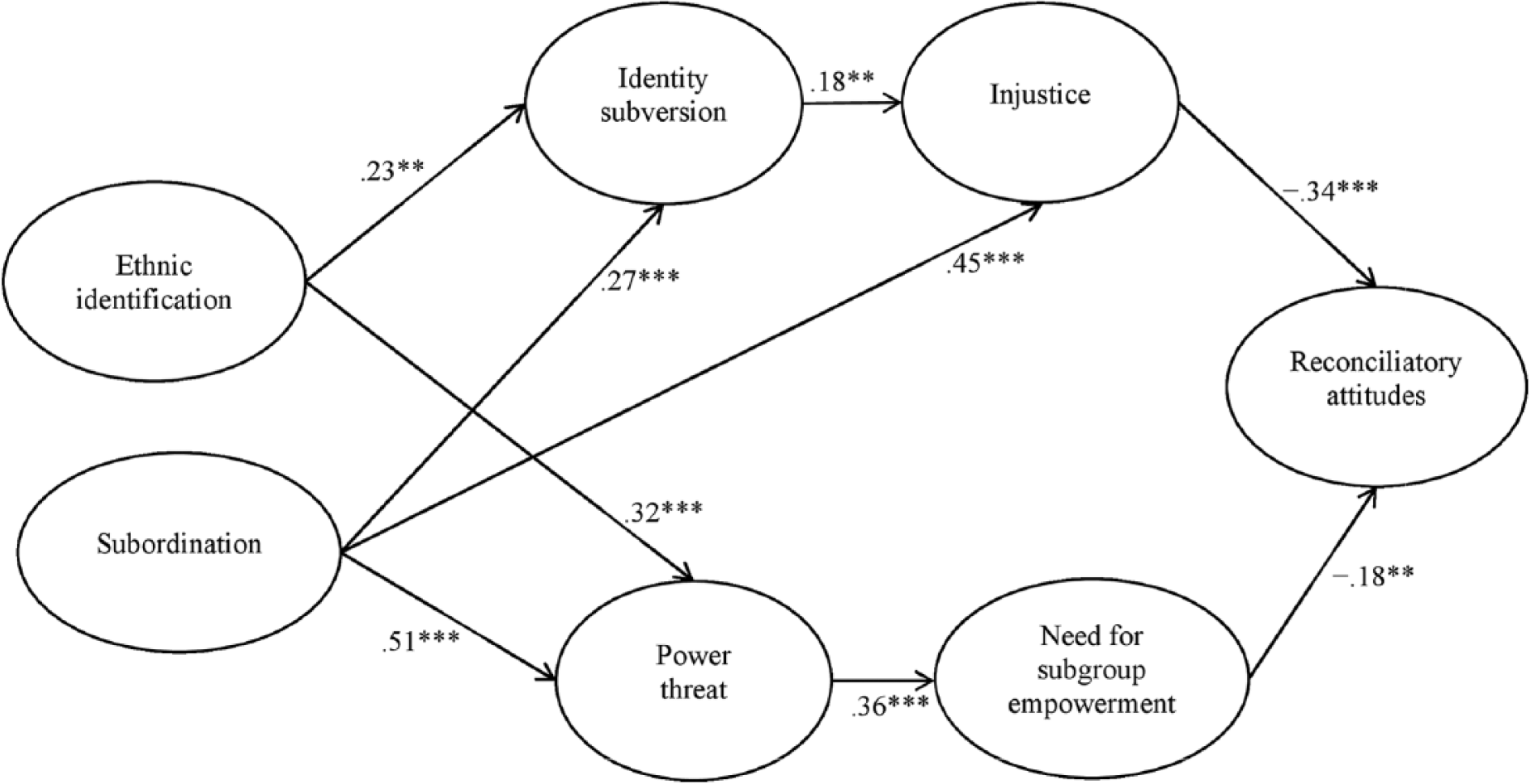
The results of the revised model for Study 1 with the addition of a direct path from subordination to perceived injustice.
Hypotheses testing
As shown in Figure 1, ethnic identification positively predicted identity subversion, β = .23, SE = 0.09, p = .006, 95% CI = [0.066, 0.399], sr2 = .06, power = .90, supporting Hypothesis 1a. 5 Likewise, subordination was positively related to identity subversion, β = .27, SE = 0.08, p = .001, 95% CI = [0.110, 0.428], sr2 = .08, power = .91, which is in line with Hypothesis 1b. In support of Hypothesis 2, identity subversion positively predicted injustice, β = .18, SE = 0.07, p = .007, 95% CI = [0.048, 0.302], sr2 = .05, power = .92. The additional path from subordination on injustice was also significant, β = .45, SE = 0.07, p < .001, 95% CI = [0.309, 0.592], sr2 = .21, power = .93. Moreover, in line with Hypothesis 3a, subordination positively corresponded to power threat (β = .51, SE = 0.07, p < .001, 95% CI = [0.386, 0.641], sr2 = .30, power = .93) as did ethnic identification (β = .32, SE = 0.07, p < .001, 95% CI = [0.174, 0.456], sr2 = .11, power = .92). These findings supported Hypothesis 3b.
In line with Hypothesis 4, power threat was positively linked to need for subgroup empowerment, β = .36, SE = 0.08, p < .001, 95% CI = [0.200, 0.512], sr2 = .16, power = .94. Confirming Hypothesis 5a, the role of identity subversion in decreasing reconciliatory attitudes was significantly mediated by perceived injustice, indirect effect: β = −.06, SE = 0.03, p = .016, 95% CI = [−0.108, −0.011], power = .90. Finally, as was predicted in Hypotheses 5b, need for subgroup empowerment significantly mediated the role of power threat in attenuating reconciliatory attitudes, indirect effect: β = −.07, SE = 0.03, p = .034, 95% CI = [−0.126, −0.005], power = .93. In sum, all hypotheses in Study 1 were supported.
Alternative models
To assess its plausibility, we compared the revised model with three alternative models. Following recommendations (Burnham & Anderson, 2004), the comparison is based on chi-square difference test for nested models. When two models of interest are nonnested, the comparison is based on Akaike information criteria (AIC). Two models significantly differ from each other if the value of ∆AIC is 4 or greater, with a smaller AIC indicating better fits to the data (Burnham & Anderson, 2004). 6
Alternative model 1: Unique effects of the identity motive and the power motive
The first alternative model is nested within the revised model. We specified this model by adding the path from identity subversion to need for subgroup empowerment, and from power threat to perceived injustice (see Figure 3 in the supplementary materials). The aim of this alternative model is to validate our arguments that the identity motive and the power motive affect reconciliation via two distinct paths. The chi-square of this model, χ2(156) = 185.594, was not significantly different from that of the revised model, χ2(158) = 189.661, ∆χ2(2) = 3.99, p > .05. This observation implies that the additional paths within the alternative model 1 were empirically redundant, thereby confirming that identity subversion and power threat uniquely influenced reconciliatory attitudes.
Alternative model 2: Group identity reaction
The second alternative model is nonnested within the revised model, which builds upon group identity reaction theory (Verkuyten, 2009). This theory postulates that intergroup threat increases group identification, and identification predicts people’s cognitive, attitudinal, intentional, and behavioral reactions to the threatening group (see Figure 4 in the supplementary materials). However, the AIC of this alternative model was 8,419.296, which was not significantly different from that of the revised model (8,415.924), ∆AIC = 3.372. The revised model and alternative model 1 were, thus, equally well fitted to the data.
Alternative model 3: Group identity moderator
Group identity moderator theory (Verkuyten, 2009) posits that group identification interacts with threat perceptions in shaping people’s attitudinal, intentional, and behavioral reactions to a threatening group. We accordingly generated the alternative model 3, in which identity subversion and power threat interact with ethnic identification to predict reconciliatory attitudes (see Figure 5 in the supplementary materials). The AIC of this nonnested model was 8,420.077, which is significantly higher than that of the revised model (8,415.924), ∆AIC = 4.153. These findings indicate that the revised model was better fitted to the data than alternative model 3.
Discussion
Based on various modification indices, we revised our model by adding a direct path from subordination to perceived injustice. This additional path makes theoretical sense. The relational model of justice (Tyler & Lind, 1992) posits that the extent to which people perceive that another group has treated them justly is partially contingent on the concerns they have over their group’s status vis-à-vis the other group. Members of lower status groups experience more injustice in their relations with the higher status outgroups than vice versa (Tyler & Lind, 1992).
All hypotheses in Study 1 were supported. However, two potential limitations need to be addressed. First, the goodness of fit of the first alternative model was comparable with that of the revised model. However, when testing this alternative model, the specified paths from ethnic identification to injustice, need for subgroup empowerment, and reconciliatory attitudes were not significant. Even though the alternative model fitted the data equally well as the revised model, it should, therefore, still be considered as empirically inferior. To examine the consistency of these findings, a follow-up study is nonetheless necessary.
A second limitation concerns the fact that reconciliation in Study 1 was examined in terms of reconciliatory attitudes. However, reconciliation is a multidimensional construct that bears within it cognitive and behavioral components (Bar-Tal & Bennink, 2004). It is, therefore, crucial to examine how reconciliatory attitudes can translate into reconciliatory behaviors, which was an aim of Study 2.
Study 2
The objective of Study 2 was twofold. First, we sought to replicate our model and to obtain another critical test of the three rival alternative models. Second, we expanded our measure of reconciliation by adding measures of reconciliatory intentions and behaviors.
We conducted Study 2 among indigenous Papuans in West Papua. Indigenous Papuans living in Papua might encounter different social and political situations compared with those living outside of Papua. Moreover, Papuans living outside of Papua may reflect a specific subset of Papuans—a subset that is more open to contact with members of the majority, which may have driven their decision to move out of Papua in the first place. It is, therefore, important to examine the validity of the model among indigenous Papuans currently living in West Papua.
Reconciliatory Intentions and Behaviors
Reconciliation in separatist conflict ensues when the majority and the separatist group converge at peaceful agreements, and put them into action (Bertsch, Craft, Jone, & Beck, 2000). According to the theory of planned behavior (TPB; Ajzen, 1991), attitudes are predictors of behavioral intentions, and intentions predict actions. Reconciliatory intentions in the current research specifically relate to impersonal or indirect actions (MacLachlan & Speight, 2013). These actions may reflect individuals’ support for ingroup initiatives to cooperate with the adversaries or for the ingroup’s acceptance to forgive the adversaries’ wrongdoings (Noor et al., 2008). Reconciliatory behaviors are operationalized as personal or direct actions, which describe the extent to which individuals are personally willing to help the adversaries by, for example, making donations or volunteering (Fisher, Nadler, Little, & Saguy, 2008), or engage in collective actions to promote peace (Hartley, McGarty, & Donaghue, 2013).
Drawing from the rationales of the TPB (Ajzen, 1991), reconciliatory intentions are conceived as a construct, which mediates the relationship between reconciliatory attitudes and reconciliatory behaviors. We, accordingly, predicted the following:
Method
Participants
Participants were 248 undergraduate Papuan students from a university in Papua, Indonesia (80 females, 141 males, 27 participants did not mention their gender, Mage = 21.73 years, SDage = 3.72 years). Participants took part in this study in exchange for a small fee.
Procedure and measures
The questionnaire was administered in a classroom and the materials were the same as in Study 1, with the exception of the added measures of reconciliatory intentions and reconciliatory behaviors. After procedural injustice, we assessed reconciliatory intentions, which consisted of three scales. The first was support for cooperation, which was assessed with four items adapted from Scott, Bishop, and Chen (2003; e.g., “Cooperation with other Indonesians is the key to the United Nation of Indonesia’s success”; α = .85). The second was willingness to forgive, assessed with four items (e.g., “It is important that Papuans forgive the wrongdoings committed by the Indonesian central government during the conflicts in Papua”; α = .76) adapted from Cehajic, Brown, and Castano (2008) and Noor et al. (2008). The third was support for special autonomy, assessed with four items created by the authors (e.g., “I support the Indonesian central government’s initiative to grant Papua greater special autonomy”; α = .81). Finally, we assessed reconciliatory behaviors with four items created by the authors that assessed the extent to which participants were likely to engage in peace-promoting actions within the next 6 months (e.g., “Donating blood to other Indonesians inside or outside Papua who are in need”; α = .72). 7
The questionnaire further included measures of ethnic identification (α = .89), status subordination (α = .79), power subordination (α = .76), identity subversion (α = .83), distributive injustice (α = .76), procedural injustice (α = .80), power threat (α = .80), community engagement (α = .87), community control (α = .82), community building (α = .83), restoration of power (α = .71), national identification (α = .86), trust in national government (α = .86), positive attitudes (α = .82), and positive stereotypes (α = .83), that were identical to those used in Study 1. Upon completing demographic questions including age, gender, and study major, participants were paid, debriefed, and thanked.
Results
Preliminary analyses
Because the data set contained some missing values, we used MLR estimator to assess the structural model, which is suitable for data with missing values that violate the assumption of multivariate normality (Muthén & Muthén, 1998-2015).
Hypotheses testing
The hypothesized model (see Figure 2) fitted the data well, RMSEA = .040, 90% CI = [0.029, 0.050], CFI = .97, TLI = .96. Both ethnic identification and subordination were positively related to identity subversion (ethnic identification: β = .20, SE = 0.07, p = .004, 95% CI = [0.065, 0.337], sr2 = .05, power = .94; subordination: β = .45, SE = 0.08, p < .001, 95% CI = [0.305, 0.600], sr2 = .26, power = .94). Identity subversion was positively related to injustice (β = .28, SE = 0.08, p < .001, 95% CI = [0.123, 0.440], sr2 = .07, power = .95) as was subordination (β = .36, SE = 0.08, p < .001, 95% CI = [0.200, 0.515], sr2 = .11, power = .94). Subordination also had a positive relationship with power threat (β = .33, SE = 0.08, p < .001, 95% CI = [0.168, 0.482], sr2 = .14, power = .94) as did ethnic identification (β = .26, SE = 0.08, p < .000, 95% CI = [0.117, 0.409], sr2 = .09, power = .94). Identity subversion, via perceived injustice, suppressed reconciliatory attitudes, indirect effect: β = −.09, SE = 0.03, p = .003, 95% CI = [−0.153, −0.033], power = .93. In a similar vein, power threat obstructed reconciliatory attitudes via the need for subgroup empowerment, indirect effect: β = −.06, SE = 0.02, p = .011, 95% CI = [−0.102, −0.013], power = .93. These findings overall verified Hypotheses 1a to 5b.
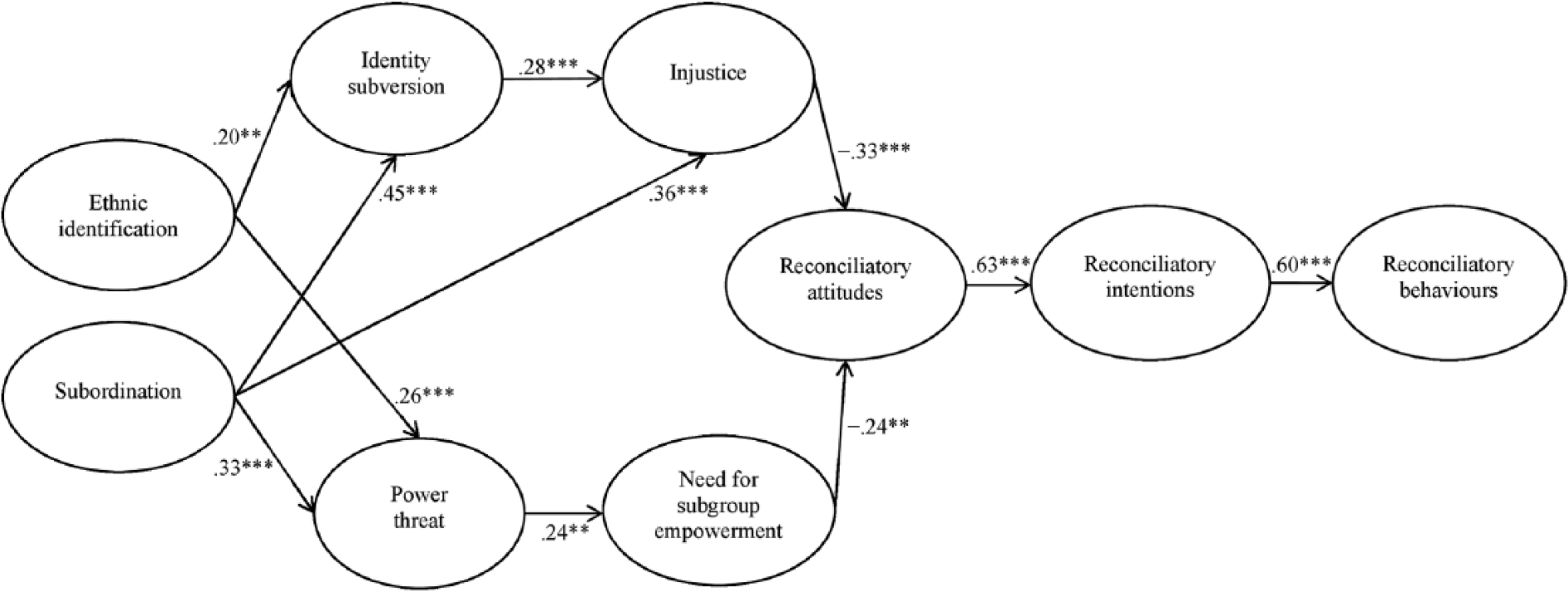
The results of the hypothesized model for Study 2.
Finally, reconciliatory intentions significantly mediated between reconciliatory attitudes and reconciliatory behaviors, indirect effect: β = .38, SE = 0.05, p < .000, 95% CI = [0.280, 0.471], power = .94. This finding confirmed Hypothesis 6.
Alternative models
Alternative model 1: Unique effects of identity motive and power motive
The chi-square of this nested alternative model, χ2(236), = 329.729 (see Figure 6 in the supplementary materials) was not significantly different from the hypothesized model, χ2(238), = 331.164, ∆χ2(2) = 1.60, p > .05.
Alternative model 2: Group identity reaction
The AIC (=14,369.185) of the second alternative model (see Figure 7 in the supplementary materials) was significantly higher than the hypothesized model (=14,364.814, ∆AIC = 4.371).
Alternative model 3: Group identity moderator
The third alternative model (see Figure 8 in the supplementary materials) resulted in a significantly higher AIC (=14,373.009) than the hypothesized model (=14,364.814, ∆AIC = 8.195).
Discussion
The data from this second study not only replicated those from the first (our first aim) but also demonstrated that the relationship between reconciliatory attitudes and reconciliatory behaviors was significantly mediated by reconciliatory intentions (the second aim). Moreover, the second study has lent an empirical support to the superiority of the hypothesized model over the theory-driven alternative models.
General Discussion
We set out to investigate two motives that could hinder separatist groups’ willingness to reconcile with the majority in separatist conflict: an identity motive and a power motive. By combining these two motives into a single model, we provide novel evidence on the distinct role of psychological and structural factors in separatist conflict and reconciliation. In doing so, we meet the repeated call made by both scientists and practitioners for a more integrative approach to this type of conflict (e.g., Kingsbury & Laoutides, 2015). Such an integrative approach is not only important to further our understanding of separatist conflict but also essential for policy makers and practitioners to devise and implement reconciliation programs.
We found consistent evidence across two studies that both the identity motive and the power motive can hamper reconciliation. Support for the identity motive was found by the finding that the more the majority was viewed as subverting the separatist group’s ethnic identity, the more the latter group felt a sense of injustice. The power motive was supported by the observation that power threat was a positive predictor of Papuans’ need for empowerment. Altogether, injustice and need for subgroup empowerment ultimately attenuated Papuans’ support for reconciliation with the majority.
When referring to the majority group in the current research, we sometimes used the terms “other Indonesians,” and sometimes the term “the Indonesian central government.” Theoretically, this latter term could be construed as a superordinate body, which includes both the majority and the separatist group. In reality, however, as a result of prolonged conflict, the separatist group does not view the Central government as its representative, but instead as the representative of the majority only (Widjojo, Elizabeth, Al Rahab, Pamungkas, & Dewi, 2010). We used the term “Central government” for those items that involved economic or political policies such as infrastructure development and a special autonomy program—issues that are typically instigated or under control by the Central government.
Theoretical Implications
The need for subgroup empowerment decreased Papuans’ reconciliatory attitudes across both studies. This observation is consistent with the NBMR (Shnabel et al., 2009), suggesting that continued deprivation of power motivates victim groups to enhance subgroup power, which is incongruent with conflict reconciliation. Reconciliation in separatist conflict requires the separatist group to relinquish its secessionist struggle (Bakke et al., 2009). Yet, power deprivation motivates separatist groups to strengthen their position relative to the majority—in other words, it stimulates a power struggle, which is arguably at odds with conflict reconciliation. It, thus, makes perfect sense that the need for subgroup empowerment hinders conflict reconciliation.
The findings of both studies also demonstrated how the separatist group’s identity subversion was significantly associated not only with procedural injustice but also with distributive injustice (see Tables 1 and 3 in the supplementary materials). These observations are noteworthy as they may extend Sani and Todman’s (2002) model of schisms. This model states that identity subversion results in heightening perceived procedural injustice as subgroup members feel unable to voice disagreement with their current inclusion. However, Sani and Todman (2002) suggested that identity subversion may also echo distributive injustice as it elevates subgroup members’ sense of marginalization, and the current data are in line with this suggestion. Marginalization can be a potent trigger of separatist demands, as illustrated by separatist conflicts involving peripheral ethnic groups such as those in South East Asia, Russia, Canada, Western Europe, and China (Beary, 2011).
Limitations and Suggestions for Future Research
In the current research, we investigated the effect of identity motives and power motives of a separatist group on reconciliatory attitudes. Whereas it is of course important, not just for theoretical reasons but also for practical reasons, to understand what factors promote conflict reconciliation, observant readers may still have noted that a measure of conflict escalation, or more specifically of separatist motives and intentions, was absent in our research. The reason for this was primarily a practical one—in the current context, separatist intentions are politically sensitive and, therefore, difficult to assess. Participants were unlikely to express such desires honestly, which would affect the validity of such measures. We reasoned that, to some extent, our measures of reconciliation could simultaneously indicate separatist intentions, because separatism denotes a decreased commitment to reconciliation (Cederman, Hug, Schädel, & Wucherpfennig, 2015). Indeed, the ultimate aim of most separatist movements, including those in West Papua, is to achieve full independence (Beary, 2011), whereas reconciliation implies a willingness to relinquish that goal (Bakke et al., 2009). This suggests that the assessment of support for reconciliation is a good, and simultaneously politically more acceptable, inverse indicator of separatist intentions. It should be stressed, however, that this assumption remains to be tested, as there are some indications that reconciliation and separatist intentions are not always opposite sides of the same coin. For example, some ethnic groups have been found to radicalize their separatist demands the more they have been granted with autonomy (Hale, 2000; Jenne, Saideman, & Lowe, 2007).
Feelings of injustice were an important suppressor of reconciliatory attitudes in our research, reflecting the central role of this concept in existing theories of collective action (e.g., van Zomeren, Postmes, & Spears, 2008). Indeed, reconciliation is challenging, in part, because separatist groups perceive their inclusion within the parent nation as something that was unjustly imposed, rendering their separatist claims legitimate (Tan, 2000). However, people sometimes do accept injustice, for example, when they consider that collectively challenging injustice is socially and politically risky (Spears, Jetten, & Doosje, 2001). When people believe that they have no choice but to accept their situation, they are more likely to view the status quo as legitimate (Spears et al., 2001). Status quo legitimacy and externalized legitimacy were not assessed in the current research, which could be done in future research to examine their moderating role in the relationship between perceived injustice and reconciliation.
Within a specific context of separatism in Indonesia, West Papua is the most underdeveloped region in the Republic of Indonesia, and its lack of structural power within the national government has left it economically deprived despite the fact that it is rich in natural resources (Collins, 2003). Economic deprivation resulting from a lack of power has been identified as a major reason for separatist movements across the globe (Ross, 2004), and in this respect, our results should easily generalize to similar settings. However, separatism is also pursued in more developed regions such as Catalonia (Spain), Wallonia (Belgium), Quebec (Canada), and Scotland (United Kingdom), and these movements cannot always be explained by the power motive. The other motives, however, also emerge in existing literature such as the perception that the parent nation has restricted and even suppressed the expression of the separatist group’s identity within the superordinate entity (Sindic & Reicher, 2009). This factor also plays a pivotal role in Papua. Overall, it appears that identity and power motives are at the core of separatist conflict around the globe, although their relative strength may vary across settings. Future research, however, should examine the generalizability of our model to different settings.
Practical Implications
To facilitate the reconciliation, and even prevention, of separatism conflict, given the importance of perceived injustice and the need for subgroup empowerment, we suggest that policy makers pay special attention to the political representation of the minority or separatist group at a national level. Political representation is a policy that is carried out by increasing the number of representatives of the separatist minority within the national parliament. Political representation is promising, because it demonstrably decreases minority groups’ sense of injustice, because representation allows for the articulation of the aspirations of the separatist minority group (Iyer, Mani, Mishra, & Topalova, 2011). As a consequence, political representation can increase feelings of empowerment, which encourages positive attitudes toward the majority (Banducci, Donovan, & Karp, 2004).
The challenge of political representation is that members of the majority may resist this policy because they perceive it as unjustly giving power to unqualified members of the minority (Murrell, Dietz-Uhler, Dovidio, Gaertner, & Drout, 1994). The resistance could also reflect an attempt by the majority to preserve its group’s dominance over the minority (Sidanius & Pratto, 1999). Members of the minority, however, could reject the policy because they interpret it as a façade—an attempt by the majority to exert power and dominance (Nadler, Harpaz-Gorodeisky, & Ben-David, 2009). It is, therefore, crucial that special attention is given to ensure that political representation is not interpreted as a mere token gesture, but as a real means of granting more power and voice to the minority group. It is equally important that representatives of the minority group are seen as qualified by the majority. These are not small challenges.
Conclusion
Separatist conflict is a complex phenomenon because it involves multiple motives. In our own research, we focused on two of these: an identity motive and a power motive. Each motive operated independently in affecting the separatist group’s willingness to reconcile with the majority. Although no two separatist conflicts are identical, we argue these motives are at the core of the vast majority of separatist conflicts around the world. We, therefore, believe it is essential that researchers and practitioners adopt an integrative approach of separatist conflict with which multiple motives are not only combined but also specified as having a unique impact on reconciliation. This integrative approach helps academicians and policy makers alike advance their understanding of practical strategies that are effective and efficacious to de-escalate the motives and ultimately promote reconciliation.
Footnotes
Declaration of Conflicting Interests
The author(s) declared no potential conflicts of interest with respect to the research, authorship, and/or publication of this article.
Funding
The author(s) disclosed receipt of the following financial support for the research, authorship, and/or publication of this article: This research was funded by The Netherlands Fellowship Programmes (NFP; Grand CF8784/2013), which was awarded to the first author.
Notes
Supplemental Material
Supplementary material is available online with this article.
References
Supplementary Material
Please find the following supplemental material available below.
For Open Access articles published under a Creative Commons License, all supplemental material carries the same license as the article it is associated with.
For non-Open Access articles published, all supplemental material carries a non-exclusive license, and permission requests for re-use of supplemental material or any part of supplemental material shall be sent directly to the copyright owner as specified in the copyright notice associated with the article.
