



Abstract
Insufficient sleep is linked to increased stress and suboptimal self-control; however, no studies have examined stress as a reason for why sleep affects self-control. Moreover, it is unknown if there are individual differences that make people vulnerable to this dynamic. Daily diary entries from 212 university students across 30 days were used in a multilevel path model examining if stress explained how prior night sleep affected next-day self-control difficulties and exploring if individual differences in sleep duration, stress, or self-control qualified this effect. Increased stress partially mediated of the effect of reduced sleep duration on increased next-day self-control difficulty. Moreover, short sleep increased next-day stress more for individuals with higher typical stress. Daytime stress especially amplified self-control difficulty for individuals with shorter typical sleep duration. Findings implicate stress as a substantial factor in how sleep loss undermines self-control and identify individuals particularly susceptible to this effect.
After staying up late to study, a tired student fails her organic chemistry exam. At home, a tired man arguing with his wife strikes her out of frustration. Late at night, an elderly woman squanders her monthly paycheck playing blackjack in a casino. On the surface, these events seem very different; however, they are all tied together through self-control. Self-control is the process by which people alter their mental states and behaviors to achieve desired goals in the face of goal-opposing temptations or distractions. Being able to successfully enact self-control predicts a host of consequential outcomes, including less propensity to drink alcohol in excess, eat unhealthy foods, fight with romantic partners, and neglect responsibilities (Crane, Testa, Derrick, & Leonard, 2014; Hofmann, Rauch, & Gawronski, 2007; Muraven, Collins, Shiffman, & Paty, 2005; Simons, Wills, Emery, & Spelman, 2016). Because self-control is so critical to many important psychological processes, it is vital to identify factors that shape self-control, including physiological factors such as sleep (Krizan & Hisler, 2016).
Growing evidence indicates that inadequate sleep leads to self-control and these detrimental effects become especially disconcerting when considering that large portions of children and adults in the United States routinely fail to obtain adequate sleep (Barnes & Drake, 2015; Barnes, Schaubroeck, Huth, & Ghumman, 2011; Lanaj, Johnson, & Barnes, 2014). Thus, understanding the influence of sleep on self-control is also important for promoting optimal functioning and well-being. To advance this understanding the current study used data from a month-long daily diary to (a) replicate past findings where less sleep the prior night leads to next-day self-control difficulties, (b) examine a novel reason (i.e., perceived stress) for why short sleep leads to self-control difficulties, and (c) explore who may be more or less vulnerable to this dynamic.
How Does Sleep Affect Self-Control?
One reason why insufficient sleep leads to self-control failures involves amplified difficulties in exerting control over visceral and cognitive impulses. After a night of short or poor sleep, people are less able to restrain undesirable urges, such as stealing office supplies, cheating on tests, or insulting others (Barnes, Lucianetti, Bhave, & Christian, 2015; Barnes et al., 2011; Christian & Ellis, 2011). People also have greater difficulty starting and continuing effortful behaviors, such as staying engaged in their job over the day or continuing exercise (Baron, Reid, & Zee, 2013; Kühnel, Sonnentag, Bledow, & Melchers, 2018; Lanaj et al., 2014). In addition to behavioral control, sleep loss also appears to disrupt the stability and control of emotions (Baum et al., 2014; Mauss, Troy, & LeBourgeois, 2013; Zohar, Tzischinsky, Epstein, & Lavie, 2005). However, how sleep loss leads to these difficulties is not well understood.
One possibility is that shortened sleep directly impairs cognitive and motivational mechanisms that underlie self-control (e.g., attention, effort; see Krizan & Hisler, 2016). Even moderate loss of sleep can undermine cognitive-control processes critical to inhibition of behavior or maintenance of goal-relevant information in memory (Van Dongen, Maislin, Mullington, & Dinges, 2003). Furthermore, people report greater self-control difficulties in the morning after a night of short sleep, suggesting that sleep-related impairments in self-control are already present upon awakening (Lanaj et al., 2014). However, not only may short sleep directly make self-control more difficult by corroding underling self-control mechanisms, but it may also increase stress, which in turn may further undermine self-control, a possibility not yet examined.
Sleep, Stress, and Self-Control
Curtailed sleep amplifies stress by increasing the frequency in which stressors are encountered, as well as by intensifying appraisals of stressful events. For instance, when sleep duration was cut in half for a week, participants reported increasingly more complaints, as well as greater stress each successive day (Dinges et al., 1997). In addition, as sleep duration decreases, next-day tasks seem more difficult and effortful, while events that impede goal progress elicit stronger negative emotional reactions (Engle-Friedman et al., 2003; Zohar et al., 2005). Heightened physiological responses (e.g., cortisol levels, blood pressure) corroborate with self-reports of increased stress to demonstrate that sleep loss elevates both psychological perceptions and physiological markers of stress (Minkel et al., 2014; Spiegel, Leproult, & Van Cauter, 1999; Williams, Cribbet, Rau, Gunn, & Czajkowski, 2013). These elevated stress levels arise, in part, because sleep loss hyper-activates the Hypothalamic−Pituitary−Adrenal (HPA) axis as well as lowers the psychological threshold needed to perceive threat (Hirotsu, Tufik, & Andersen, 2015; Minkel et al., 2012). For instance, in comparison to their rested counterparts, sleep-deprived individuals reported twice the amount of stress even when facing only mildly stressful tasks (Minkel et al., 2012).
Intensifying stress as a consequence of sleep loss has important implications for self-control. Basic cognitive functions integral to self-control such as response inhibition and working memory decline following stress, as do effortful activities such as exercise or household chores (Inzlicht, McKay, & Aronson, 2006; Oaten & Cheng, 2005; Schoofs, Preuß, & Wolf, 2008). Such effects partly arise because stress alters neural connectivity within the brain (Arnsten, 2009). Not only does stress decrease connectivity between prefrontal areas crucial for exerting self-control, but it simultaneously amplifies neural connectivity of prefrontal cortex areas involved in perceiving reward with the amygdala and the striatum (Maier, Makwana, & Hare, 2015). Thus, stress poses a double threat to self-control by impairing the capacity to refrain from temptations or ignore unwanted distractions, while also enhancing the perceived reward of tempting stimuli. In line with this premise, greater daytime stress predicted reduced self-control later that same day (Park, Wright, Pais, & Ray, 2016). Interestingly, the effect of stress did not carryover to next-day self-control, suggesting that sleeping may “reset” the detrimental effects of stress on self-control.
Altogether, sleep, stress, and self-control are interdependent and research is just beginning to piece apart the connections among these processes. However, current understanding of the sleep-self-control relation tends to focus on how sleep affects self-control directly and no study has examined how sleep indirectly affects self-control through stress. To address this gap, the current study examined how insufficient sleep amplified stress and whether this ultimately contributed to impaired self-control.
Individual Differences in Sleep, Stress, and Self-Control
Although sleep may affect self-control in part through stress, it is important to note that this may not be true for some, yet especially severe for others; a possibility often ignored in past research. To address this gap, individual differences in sleep, stress, and self-control were explored in the current research as moderators of the sleep-stress-self-control pathway.
First, given substantial differences in habitual sleep across people, typical sleep patterns may be one factor that determines the extent that any one night of poor sleep affects psychological outcomes (Van Dongen, Vitellaro, & Dinges, 2005). This may occur because multiple nights of insufficient sleep add up a sleep debt that increasingly impairs psychological functioning (Van Dongen et al., 2003). For instance, an individual who typically sleeps for 6 hr (approximately two less than recommended by the National Sleep Foundation; Hirshkowitz et al., 2015) would accrue sleep debt over time, making a single night of particularly short sleep potentially more detrimental than the for someone else who typically sleeps 8 hr a night. In line with this premise, worse recent sleep has been found to exacerbate the effect of stressors, such as working under time pressure or having to show fake emotions during work, on self-control (Dietsel, Rivkin, & Schmidt, 2015; Sheng, Wang, Hong, Zhu, & Zhang, 2017). Thus, individuals with less sleep overall should have greater sleep debt and be more affected by a night of short sleep than individuals with more sleep overall.
Second, chronic stress levels may also moderate this pathway. Exposure to chronic stress can shrink neurons in the prefrontal cortex (undermining control) while neurons in the amygdala can simultaneously expand (intensifying emotional urges; Brown, Henning, & Wellman, 2005; Vyas, Mitra, Rao, & Chattarji, 2002). In support of these anatomical alterations, lab studies show that individuals with higher chronic stress demonstrate harsher psychological and physiological reactions to stress as well as impaired performance on cognitive tasks which rely on the prefrontal cortex (Arnsten, Mazure, & Sinha, 2012; Yuen et al., 2012). However, investigating these dynamics in everyday life suggests that for people with high chronic stress, any particular stressful event does not influence self-control beyond the effect of already being chronically exposed to stress (Park et al., 2016). More research is needed to tease apart the interplay between chronic stress and acute stress on psychological functioning and the current study explores this dynamic.
Third, people higher in trait self-control tend to form habits or seek out environments that minimize the need for self-control (De Ridder, Lensvelt-Mulders, Finkenauer, Stok, & Baumeister, 2012). Because individuals high in trait self-control avoid situations or behaviors that tax self-control, they may also avoid stressors that impair self-control. In turn, avoiding stressors may reduce the impact of sleep on stress and stress on self-control. Thus, trait self-control may also be a factor that qualifies the impact of sleep loss on self-control via stress.
Current Study
To further develop the understanding of how sleep affects self-control, the current study used data from a month-long daily diary study to examine a multilevel moderated-mediation path model in which prior night sleep duration predicted current self-control difficulties through daytime stress. It was hypothesized that shorter prior night sleep duration will predict greater current self-control difficulty, and that this will be at least partly due to increased daily stress that arises from a night of short sleep. Moderation of this indirect pathway by individual differences in typical sleep duration, stress, and self-control difficulty was also explored. These person-level variables were all derived from month-long aggregates of repeated daily reports and were thus very reliable estimates of individual differences. On an exploratory basis, it was hypothesized that individuals who typically sleep less, who have higher typical stress, or who typically have greater self-control difficulties may be more vulnerable to the sleep-stress-self-control pathway.
Method
Participants
Totally, 212 students from Loyola University Chicago were recruited through the psychology participant pool to participate in a 30-day Diary Study of College Student Daily Life that focused on experiences of college drinking, mistreatment, and self-control (DeHart, Longua Peterson, Richeson, & Hamilton, 2014). The study was approved by the university’s Ethics Review Board. One student reported receiving an average of 30 min of sleep a night and was excluded from analyses due to lack of responding. Thus, the final sample size was 211 (42% male) and had a mean age of 18.80 (SD = 1.05 years). The majority (82%) of the sample identified as European American, 9% as Hispanic American, 5% as Asian American, and 4% as African American. Although the study involved assessment of numerous personality and daily variables, only variables and analyses relevant to the current investigation are described in this report. The data are available upon request from the first author.
Procedure
Prior to the 30 days of diary measures, participants completed an online survey assessing demographic characteristics and individual differences. After completing this initial survey, participants were given access to a website where they completed daily measures of last night’s sleep duration, the day’s stressfulness, and their current self-control difficulty (as well as additional daily measures not relevant to the current study). Participants could only access the website between 3:00 p.m. and 9:00 p.m. These access times were selected to allow students to complete the daily measures after the day’s classes but before beginning evening social activities that may lead them to not respond (e.g., drinking).
Participants received partial course credit for completing the initial online survey and monetary compensation for completing the daily measures. Participants were paid US$1 for each daily measure completed. In addition, participants received a US$5 bonus for each complete week of diary measures and were entered in a US$25 lottery drawing for that week. All participants began the study in mid-October and concluded in mid-November. On average, participants made diary entries on 25.54 out of the possible 30 diary days (SD = 4.66). Thus, of 6,360 opportunities possible to complete the daily diary, the diary was completed on 5,415 days (85% response rate). Primary analyses focused on daily sleep, stress, and self-control recorded over these 5,415 daily observations. Although the original investigation was not designed to estimate the effect of sleep on self-control, this large number of observations (over 5,000) afforded very high precision to capture even small within-person effects and, therefore, had exceptional statistical power for detecting the indirect effect of interest as well as their moderation (Scherbaum & Ferreter, 2009).
Measures
Daily prior night sleep duration
Each day participants reported how many hours they slept last night rounded to the nearest whole number. No other sleep measures were administered.
Daily prior night stress
During each survey participants rated how stressful last night had been from “not at all stressful” (1) to “very stressful” (7).
Daily daytime stress
Daily stress was measured by participant ratings of the day’s stressfulness from “not at all stressful” (1) to “very stressful” (7). No other stress measures were administered.
Daily self-control difficulty
To measure self-control difficulty, participants responded to three items from the State Self-Control Capacity Scale (Ciarocco, Twenge, Muraven, & Tice, 2009). This scale is often used in diary studies to measure difficulties in self-control and predicts behaviors relevant to self-control such as unethical behavior, physical activity, alcohol consumption, and social deviance (Barnes et al., 2015; Christian & Ellis, 2011; DeHart, Longua Peterson, Richeson, & Hamilton, 2014; Schondube, Bertrams, Sudeck, & Fuchs, 2017). Further validity information is available in Bertrams, Unger, and Dickhäuser (2011). Participants indicated how true the following statements were the following: “Right now my mind feels unfocused,” “Right now my mental energy is running low,” “Right now I am having a hard time controlling my urges” from “disagree very much” (1) to “agree very much” (7). Responses were averaged to create an index of self-control difficulties in that moment (α = .80). No other measures of daily self-control were administered.
Daily negative affect
Negative affect was measured by the average of participant responses to six items asking how well “angry,” “sad,” “dejected,” “nervous,” “ashamed,” and “guilty” describes their current mood (α = .85). These six items were selected from Larsen and Diener’s (1992) and Watson, Clark, and Tellegen’s (1988) markers of negative affect.
Daily alcohol use
Alcohol consumption during the day (i.e., before completing the that day’s survey) was monitored through participant responses to “How many alcoholic drinks have you had today?” Participants typed in the number of alcohol drinks.
Daily prior night alcohol use
Alcohol consumption that occurred during the previous evening after completion of the prior night’s survey was monitored through participant responses to “How many alcoholic drinks did you have last night?” Participants typed in the number of alcohol drinks.
Weekday vs weekend
Whether the diary was completed was on a weekday (Monday-Friday) or weekend (Saturday and Sunday) was dummy coded into weekend variable (0 = week, 1 = weekend).
Person-Level Measures
Typical sleep duration
Individual differences in typical sleep duration were measured by averaging individual’s daily sleep duration across the study period (30 days).
Typical stress
Individual differences in typical stress were measured by averaging individual’s daily stress across the study period.
Typical self-control difficulty
Individual differences in typical self-control difficulty were measured by averaging person’s daily self-control difficulty across the study period (α = .92).
Trait neuroticism
Trait neuroticism (an individual’s propensity to feel negative emotions) was measured with 10 items from the International Personality Item Pool based on the Goldberg’s (1992) neuroticism scale. These items are available at https://ipip.ori.org/newBigFive5broadKey.htm and highly correlate with Goldberg’s original items (r = .72). Participants indicated from “very inaccurate” (1) to “very accurate” (7) how well these items described them (e.g., “Am relaxed most of the time,” “Worry about things,” “Often feel blue”). Responses to these 10 items were then averaged (α = .89).
Trait self-control
Trait self-control was assessed using the 36-item Self-Control Scale; this scale converges with other measures of self-control and relevant outcomes (Tangney, Baumeister, & Boone, 2004). Participants indicated from “not at all like me” (1) to “very much like me” (5) how well each statement described their self (e.g., “I am good at resisting temptation,” “I have trouble concentrating,” “I sometimes drink or use drugs to excess.” Responses to these 36 items were then averaged (α = .90).
Analytic Strategy
Because daily diary data were clustered within people and daily data within a person were not independent of one another, multilevel path modeling was used to examine whether stress partially mediated the influence of sleep duration on self-control difficulty and whether individual differences in typical sleep, stress, or self-control moderated this pathway (Raudenbush & Bryk, 2002). Importantly, although sleep, stress, and self-control were reported simultaneously each day during the late afternoon or evening, the question wording retained temporal precedence of constructs. Participants reported on prior night sleep duration, stress during the day, and self-control difficulty right now, allowing for analysis of how prior night sleep loss affected daytime stress, and how stress in turn predicted current self-control difficulty.
Prior to all analyses, day-level predictors were centered at the individual’s mean (i.e., daily sleep duration, stress, and self-control difficulty) and all person-level factors were standardized (i.e., typical sleep duration, typical stress, typical self-control difficulty, trait self-control, and trait neuroticism). Centering day-level variables at the individual’s mean removes all between-person variance, ruling out between-person differences in these variables, or others (e.g., chronotype, neuroticism) as confounding factors for the results. Importantly, interpretation of the effects of person-centered daily variables changes; increases or decreases in person-centered variables indicate higher or lower standing on that variable than what is typical for that individual (Raudenbush & Bryk, 2002).
To test the final moderated-mediation model of interest, a four-step model building approach was used in MPLUS v7 (Muthén & Muthén, 2012). First, whether there was sufficient variance in daily sleep duration, stress, and self-control difficulty was examined by testing a null intercept model. Such a model only specifies randomly varying intercepts (i.e., individual differences) and is used to decompose variation in variables to within (i.e., daily) and between (i.e., person) level sources. Note that due to person-centering the estimate of between-level variance is zero because each participant’s average level of a variable is zero. However, an estimate of day-level variability is still calculated and provides evidence that there is variation in these variables across days. Second, to explain this variation, fixed slopes of daily sleep duration predicting daily stress and daily self-control difficulty, and daily stress predicting daily self-control difficulty, were added to the model. Adding these fixed slopes allowed for an initial test of whether daily stress mediated the effect of daily sleep duration on daily self-control. Third, individuals’ sleep-to-stress and stress-to-self-control slopes were then modeled as randomly varying across individuals. The fit of the random-slope model (which allows for individual differences in within-person effects) was then compared to the fit of the fixed-slope model (which does not allow for such individual differences) via a chi-square test of differences in model loglikelihood (Raudenbush & Bryk, 2002). Significantly smaller loglikelihood of the random (vs. fixed) slope model would indicate that the magnitude of these pathways varies across individuals and opens the possibility that individual differences in sleep, stress, or self-control may predict the strength of this pathway.
Fourth and final, individual differences in typical sleep duration, stress, and self-control difficulty were added as cross-level predictors of the effect of daily sleep on daily stress and of the effect of daily stress on daily self-control difficulty, allowing for examination of whether these individual differences influenced the indirect effect of sleep on self-control difficulty through stress. All detected interactions were plotted and tests of simple slopes were conducted using Preacher, Curran, and Bauer’s (2006) freely available online resource at http://www.quantpsy.org/interact/hlm2.htm (Case 3). Using Raudenbush and Bryk’s (2002) nomenclature, the equations for this final moderated-mediation multilevel path model are the following:





Alternative models
After testing this final model, four alternative models were tested to rule out competing interpretations and examine the robustness of the results. First, an alternative model examining the effects of current negative affect, prior night and current day alcohol use, and prior day stress as confounds was examined. It is possible that negative emotions during the day (e.g., feeling sad) or alcohol consumption from the previous evening (e.g., being hungover) and during the current day (e.g., being intoxicated) curtail sleep, increase stress, and undermine current self-control, thereby accounting for the relations among sleep, stress, and self-control. In addition, the indirect effect of sleep on self-control through stress could be explained by prior night stress. A stressful prior night could lead to poor sleep that night and stress could carry over into the next day, explaining both short sleep that night and increased stress the next day, negating any sleep-stress-self-control indirect effects. Because of these possibilities, an alternative model in which negative affect, prior night and current day alcohol use, and prior day stress were included as covariates in all model effects was examined.
Second, the extent to which findings may be unique to weekdays versus weekends was examined. Perhaps the dynamics between sleep, stress, and self-control difficulties disappear on weekends when individuals have less obligations such as school or work and have more control over their environments. Thus, an alternative model incorporating the effects of weekday versus weekend and its interaction with predictors was examined.
Third, although the sleep, stress, and self-control difficulty items asked about different time frames (i.e., last night, during the day, and right now, respectively), participants nevertheless answered all these questions during the same daily survey. Because greater self-control difficulty predicts greater stress, it is plausible that the data are better explained by a model specifying that insufficient prior night sleep predicts more next-day self-control difficulty and then this difficulty increases stress (Park et al., 2016). To examine this possibility, model fit was compared between this sleep-self-control-stress model and the original sleep-stress-self-control model; both models allowed for randomly varying slopes.
Fourth, individual differences in typical stress and typical self-control difficulty aggregated from daily reports should be highly overlapping with the broader personality traits of neuroticism and self-control, respectively. Because of this overlap, it is unclear if any moderation effects would be due to individual differences in stress and self-control difficulties more specifically, or if these effects just reflect the broader traits of neuroticism and self-control. This possibility is particularly interesting given that Tangney et al.’s (2004) Self-Control Scale seems to tap into habitual or automatic processes in self-control and this measure of trait self-control tends to dominate the self-control literature (De Ridder et al., 2012; Hofmann, Baumeister, Förster, & Vohs, 2012). Using individual differences in self-control difficulties as a measure of trait self-control provided the opportunity to examine the effect of individual differences in self-control when it is derived from an alternative measurement technique. To examine these possibilities, the model fit of the final model was compared to a model in which trait neuroticism and self-control replaced typical stress and self-control difficulty, respectively.
Missing Data
Experiencing self-control difficulties at the time of diary completion may have induced failures in completing that day’s entry. Therefore, a preliminary multilevel analysis was conducted to assess the influence of missing data on daily self-control difficulty. Number of diary entrees completed by a participant was used as a predictor of the intercept of self-control difficulty (i.e., average self-control difficulty across the study; self-control was not person-centered in this analysis) as well as a person-level moderator of the effect of daily sleep duration and daily stress on daily self-control difficulty. People who completed more daily diary entrees reported less self-control difficulty (B = −.04, p = .01), suggesting that analyses predicting daily self-control difficulty may be conservative because higher values of daily self-control difficulty are underrepresented in the data. The number of diary entrees completed did not influence the effect of daily sleep duration and daily stress on self-control difficulty (both ps > .45); estimates of the effects of sleep duration and stress on self-control difficulty should thus not be biased by missing data.
Results
Descriptive statistics and bivariate correlations among all study variables after centering procedures are presented in Table 1. The null intercept model revealed significant within-person variability in participants’ daily sleep duration, stress, and self-control difficulty across days (all zs > 20.49). To explain this daily variability, the fixed effects of daily sleep duration on daily stress and self-control difficulty, and daily stress on daily self-control difficulty, were added to this model. Results revealed that individuals reported more daytime stress than typical after a night of shorter sleep than usual, β = −.14, t = −10.56, 95% confidence interval (CI) = −.16 to −.11, p < .001. Moreover, self-control difficulty that evening was greater than usual after a more stressful day (β = .17, t = 12.31, 95% CI = .14 to .20, p < .001) and after a night of shorter sleep than typical (β = −.03, t = −3.18, 95% CI = −.05 to −.01, p = .001). In support of the central hypothesis, shorter sleep duration predicted greater self-control difficulty partially because of increased stress (indirect β = −.02, t = −7.80, 95% CI = −.03 to −.02, p < .001). Note that the total effect of prior night’s sleep on self-control difficulty was −.05 (t = −5.39, 95% CI = −.07 to −.03, p < .001, R2 = .01); thus, the indirect effect through stress accounted for almost half (40%) of the total effect of sleep on self-control.
Descriptive Statistics of and Correlations Among Study Variables.
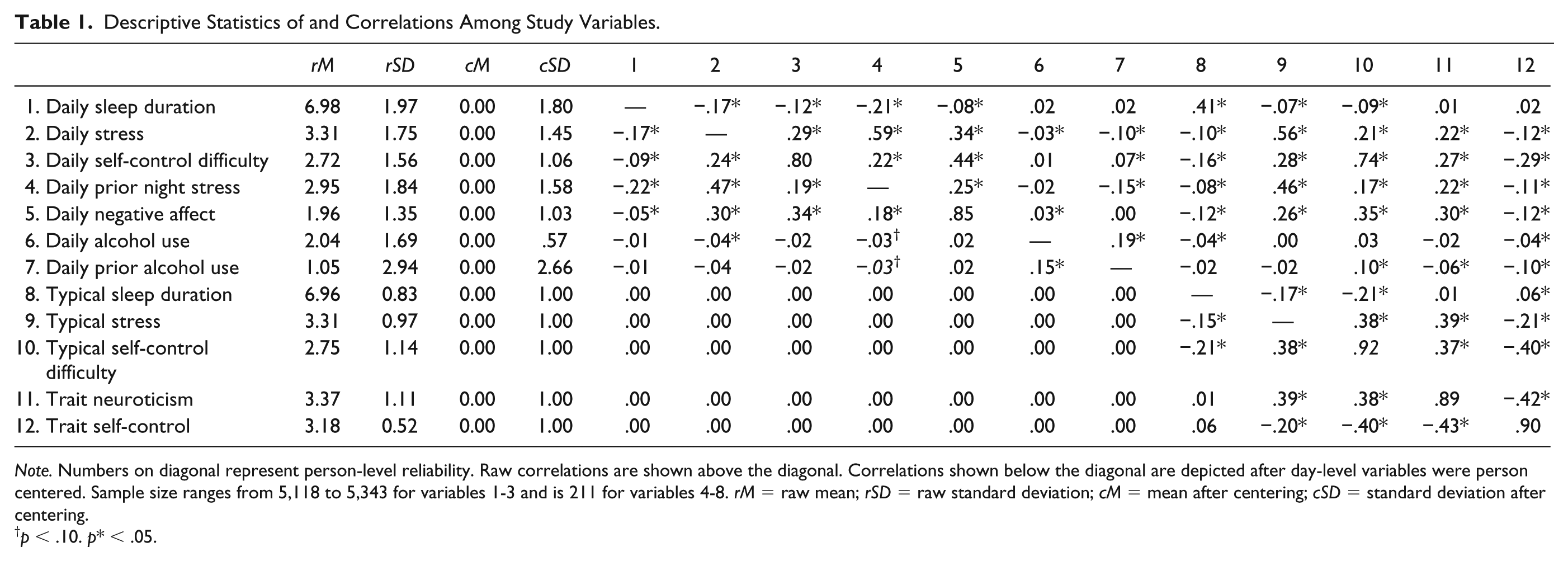
Note. Numbers on diagonal represent person-level reliability. Raw correlations are shown above the diagonal. Correlations shown below the diagonal are depicted after day-level variables were person centered. Sample size ranges from 5,118 to 5,343 for variables 1-3 and is 211 for variables 4-8. rM = raw mean; rSD = raw standard deviation; cM = mean after centering; cSD = standard deviation after centering.
p < .10. p* < .05.
Next, these fixed effects were modeled as random to determine whether individual differences in typical sleep duration, stress, or self-control difficulty explain variation in the magnitude of these effects across people. Modeling the effects as random improved model fit (Δ-2 Loglikelihood = −39.98, p < .001) and all the effects varied across people (all zs > 3.44). Magnitude of all effects remained unchanged when modeling effects as random. 1 Given this variability in within-person effects, typical (between-person) sleep duration, stress, and self-control difficulty were added as cross-level predictors of these (within-person) effects.
The results revealed two moderated pathways, both consistent with prior theorizing (see Figure 1). First, greater typical stress tended to intensify the effect of short sleep on next-day stress (γ = −.03, t = −1.83, 95% CI = −.06 to .00, p = .07). Shorter sleep predicted more daytime stress for both highly stressed individuals (one standard deviation above the sample mean of typical stress), γ = −.17, t = −11.80, p < .001, and for low-stressed individuals (one standard deviation below the sample mean), γ = −.11, t = −7.99, p < .001. However, this effect was stronger for individuals with higher typical stress than for individuals with lower typical stress (γdiff = −.06, t = −3.03, p = .002, see Figure 2), implying that chronically stressed individuals are more susceptible to stress following less sleep.

Moderation of the sleep-stress-self-control pathway by individual differences in typical sleep, stress, and self-control.
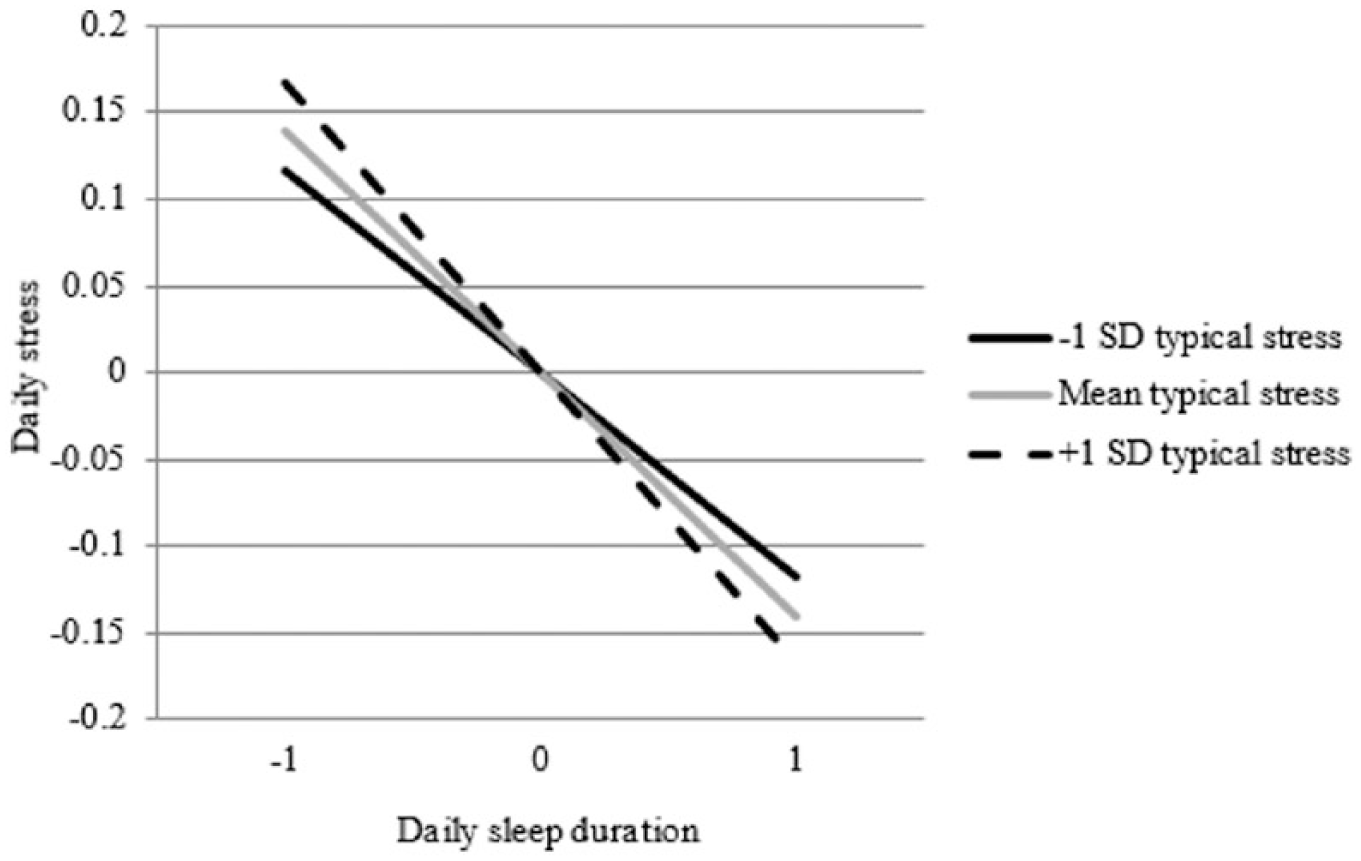
Higher typical stress increases the effect of daily sleep duration on lowering daily stress.
Second, higher typical sleep duration buffered the effect of stress on self-control difficulty (γ = −.03, t = −1.93, 95% CI = −.05 to .00, p = .05). Again, stress increased self-control difficulty for both individuals who typically slept for 6 hr a night (2 hr below the recommended sleep duration) and individuals who typically slept for the recommended 8 hr a night (γ = .20, t = 14.14, p < .001, and γ = .14, t = 9.90, p < .001, respectively). However, individuals who typically slept for 8 hr a night had less self-control difficulty after more daytime stress than individuals who typically slept for 6 hr a night (γdiff = .06, t = 3.03, p =.002; see Figure 3), implying that shorter sleepers are particularly vulnerable to the corrosive effect of stress on self-control.

Shorter typical sleep duration increases the effect of daily stress on increasing daily self-control difficulty.
Alternative Models
The first alternative explanation examined was whether negative affect, current day alcohol use, prior night alcohol use, and prior night stress explained the effect of sleep on self-control and the sleep-stress-self-control indirect effect. After including these covariates in the study model, prior night sleep still predicted both next-day stress (β = −.05, t = −4.74, 95% CI = −.07 to −.03, p < .001) and self-control difficulty (β = −.02, t = −2.46, 95% CI = −.04 to −.005, p = .01). Stress still predicted self-control difficulties (β = .08, t = 6.05, 95% CI = .06 to .11, p < .001) and still partially mediated the effect of sleep on self-control (indirect β = −.004, t = −3.82, 95% CI = −.007 to −.002, p < .001). Thus, while these covariates accounted for some of the effect of sleep on next-day stress and self-control, sleep duration still had a unique effect on next-day stress and self-control.
The extent to which results were unique to weekdays versus weekend was examined next. Individuals reported both less stress (β = −.53, t = −11.43, 95% CI = −.62 to −.44, p < .001) and less self-control difficulties (β = −.07, t = −2.51, 95% CI = −.13 to −.02, p = .01) on the weekend. Interestingly, weekend versus weekday did not moderate the total effect of sleep on self-control difficulties (t = 1.12, p = .26); it did, however, moderate the effect of sleep duration on stress (β = .07, t = 2.95, 95% CI = .03 to .12, p = .003). Shorter than usual sleep increased stress during weekdays and during the weekend (β = −.13, Z = 8.22, p < .001, β = −.06, Z = 2.82, p = .005), but this effect was weaker on the weekend than during the week (Δβ = .07, t = 2.71, p = .004). The effect of stress on self-control difficulties was also moderated by the weekend (β = −.07, t = −2.61, 95% CI = −.12 to −.02, p = .01). Higher than usual stress predicted greater self-control difficulties on both weekdays (β = .18, Z = 12.73, p = .003) and during the weekend (β = .11, Z = 4.49, p < .001), but again, the weekend mitigated the observed effect (βdiff = −.07, t = 2.52, p = .01). Because the weekend moderated the effect of sleep duration on stress and stress on self-control difficulties, Sobel tests were conducted to examine the size of the indirect effect on sleep on self-control difficulties through stress on weekdays and weekends. This indirect effect was significant on both weekdays (indirect β = −.02, Sobel Z = −7.19, p < .001) and weekends (indirect β = −.006, Sobel Z = −2.43, p = .02) and was significantly larger during weekdays than the weekend (βdiff = .014, t = 3.88, p < .001). Recall that the total effect of sleep duration on self-control difficulties was .05 for both weekday and weekends. Thus, stress accounted for 40% of the effect on sleep duration on self-control difficulties during on a weekday, but this dropped to 12% during the weekend.
Next, to examine whether sleep predicting stress through self-control more accurately described the data, model fit between the sleep-stress-self-control and sleep-self-control-stress models were compared. This comparison revealed that the original model in which shorter sleep predicted greater evening self-control difficulty through increased daytime stress described the data better than shorter sleep predicting next-day stress through self-control difficulty (Δ-2 Loglikelihood = 37.24).
Finally, the original model that used typical stress and typical self-control difficulty as moderators of the sleep-stress-self-control pathway was compared to an alternate model that replaced typical stress and typical self-control difficulty with trait neuroticism and self-control, respectively. Although both models fit the data relatively equally well (Δ-2 Loglikelihood = 3.90), different patterns of moderation emerged between the two models depending on whether typical daytime stress or trait neuroticism was used (neither trait self-control nor typical self-control difficulty exhibited moderation patterns or different effects across the two models). While typical stress increased the effect of prior night sleep on daily stress in the original model, trait neuroticism had no bearing on this effect in the alternate model. In contrast, while typical daytime stress did not influence the effect of daily stress on self-control difficulty in the original model, higher trait neuroticism intensified this effect in the alternate model. These different patterns of moderation between the two models suggest that the effects of higher chronic reports of daily stress were not reducible to underlying neuroticism.
Discussion
An ever-growing number of findings show that suboptimal sleep contributes to deteriorations in self-control, yet it is unknown what role stress may play in this relation. Given the theoretical interconnections among sleep, stress, and self-control, examining the role of stress in this dynamic can offer finer-grain insights into how sleep loss undermines self-control. By using an extensive collection of participant’s daily reports of sleep, stress, and self-control difficulty, this is the first study to examine stress as a reason for why insufficient sleep undermines self-control. Indeed, sleep duration accounted for 1% of the variability in daily self-control difficulties and, on average, stress accounted for 40% of this effect, implicating stress as substantial factor in the detrimental effect of sleep on self-control in daily life.
From Sleep to Self-Control
Linking sleep to self-control difficulties through stress has implications for understanding how sleep influences self-control more broadly. Although not a behavioral assessment of self-control, self-control difficulty is an important predictor of whether self-control will be successful. When self-control becomes more difficult, it reflects the need for more motivation and more mental resources to successfully reign in temptations (Kotabe & Hofmann, 2015). While stress undermines the neural circuity and cognitive functions central to successful self-control, it may also undermine the motivation to engage in self-control (Arnsten, 2009; Schoofs et al., 2008). For example, dealing with stress may lead to self-licensing, wherein a person justifies indulging in desires because he or she has been dealing with stress (e.g., a student indulging in abnormally large amounts of ice cream during a stressful final exam week, De Witt Huberts, Evers, & De Ridder, 2014). In addition, coping with stress is mentally fatiguing which should reduce the motivation to engage in subsequent acts of self-control (R. Hockey, 2014). Altogether, reduced motivation and cognitive resources should be driving a large proportion of the effect of sleep and stress on self-control difficulty, although future work will be needed to test this possibility directly.
The role of stress in the effect of sleep on self-control difficulty may also reflect how sleep affects more basic cognitive processes because self-control partly depends on executive functions and attention. Past studies have often focused on how sleep loss directly affects cognitive functioning and have given little interest to stress as a factor that may mediate this relation in real-world environments (Boonstra, Stins, Daffertshofer, & Beek, 2007; Killgore, 2010). Often, total sleep deprivation procedures (not sleeping for more than 24 hr) are used, despite the fact they do not reflect levels of sleep loss actually experienced in daily life. Similarly, assessments of self-control typically occur in controlled laboratory conditions that strive not to induce stress. This latter point is especially important because increased stress reactions in response to sleep loss may be limited to stressors that involve significant emotional and cognitive appraisals (Meerlo, Sgoifo, & Suchecki, 2008). Thus, past studies may only capture how sleep loss affects cognitive operations within the confines of a controlled laboratory environment and not how sleep loss affects such processes when a sleep-deprived person is attempting to navigate the setbacks and pitfalls of everyday life. This is an important reason to use daily diary methodology to investigate the effects of sleep loss, as such studies capture naturally occurring levels of sleep loss, stress, and their consequences within ecologically valid settings.Moreover, daily diary methodology allows for examining weekday vs. weekend effects. In the current study, the weekend diminished the influence of sleep duration on stress and stress and self-control difficulties. Because the effect of sleep duration on self-control difficulties was the same regardless of day of the week, this resulted in stress being much less important for the effect of sleep on self-control difficulties during the weekends. In a broad stroke, this pattern of relations may emerge because the weekend likely affords greater control over stressors and the environment. Specifically, most individuals have less obligations such as work or school on the weekends and this may free them to exert more control and successfully cope with sleep loss and stress. Having control over the environment is critical in how the effects of sleep loss unfold because individuals will maintain overall performance during sleep loss by choosing easier tasks or letting less important goals slip to focus on important ones (Engle-Friedman et al., 2003; G. R. J. Hockey, Wastell, & Sauer, 1998). Thus, environments constituting the weekend which afford flexibility to engage in compensatory responses or avoid stressors are likely to reduce or mask the effects of sleep loss. Alternatively, weekday versus weekend differences might have emerged because individuals may face more stressors during weekdays and are more overwhelmed, or because people have to tackle different types of demands on self-control or face different types of stressors (e.g., stressful job during the week vs. dealing with tensions at a family gathering on the weekend; Brantley, Cocke, Jones, & Goreczny, 1988; Smyth et al., 2009).
While the current study emphasized how sleep affects self-control through stress, it is important to “zoom out” and acknowledge that sleep, stress, and self-control are interconnected. For instance, getting proper sleep often depends on self-control, such as resisting the urge to consult social media instead of going to bed (Kroese, Evers, Adriaanse, & De Ridder, 2016). Moreover, more self-control predicts reduced stress, because controlling temptations and urges can reduce interpersonal altercations, procrastination, and other sources of stress (Park et al., 2016). In addition, stress can often undermine sleep, yet the effect of stress on sleep is likely dependent on self-control. For example, people who tend to control and regulate their anger tend to have better sleep quality, likely because these people downregulate angry emotions that inhibit sleep (Hisler & Krizan, 2017). Thus, while the current study advances the understanding of how sleep affects self-control, more work is needed to examine the various ways sleep, stress, and self-control can all affect each other.
Who Is the Most Vulnerable to Self-Control Problems Following Lost Sleep?
In addition to testing a novel factor explaining how sleep undermines self-control in naturalistic settings, this study also systematically explored individual differences that should theoretically predict who is more or less susceptible to this dynamic. People with chronically shorter sleep experienced more self-control difficulty after a stressful day (following less sleep than those who tended to sleep longer. This mirrors earlier findings that poor recent sleep amplifies the corrosive effect of time pressure and emotional dissonance on self-control [Dietsel, Rivkin, & Schmidt, 2015; Sheng et al., 2017). Because those with chronic short sleep are likely to be carrying psychological deficits caused by sleep loss that limit their ability to cope with stress, there are at least two possibilities to explain this effect. First, insufficiently coping with stressors may sustain the magnitude of stress perceptions and reactions at higher levels. Because stress disrupts the neural circuitry that self-control employs, these greater experiences of stress should increase the difficulty of self-control (Arnsten, 2009; Maier et al., 2015). Second, although the capacity to cope with stress may be reduced, individuals may still sufficiently cope by compensating for this diminished capacity by applying more effort. The greater investment of effort into coping is likely to be fatiguing and lead to greater perceptions of difficulty (Hockey, 2013; Inzlicht, Schmeichel, & Macrae, 2014).
Whereas people with chronically short sleep had even more self-control difficulty after stress, people with typically high stress had a more stressful day (and ultimately less self-control) after a night of short sleep than those with typically low stress. Importantly, this effect did not emerge when neuroticism was used in the model instead of typical stress, providing evidence against the possibility that people with high typical stress were engaging in “neurotic” responding (e.g., were biased toward negative experiences) or were simply experiencing more stress due to elevated neuroticism. Rather, a chronically stressed person may experience compounded stress when navigating the demands of a stressful environment in the wake of sleepiness, cognitive haze, and emotional instability that result from insufficient sleep. People in a low stress environment, by comparison, may experience more stress as a result of sleep loss, but this increase in stress may be smaller because their environment generated less stress to deal with in general.
Limitations and Future Directions
The current study has important methodological limitations. First, this study only measured sleep duration and not sleep quality or continuity. Although related to sleep duration, sleep quality represents a distinct aspect of sleep that has been tied more closely to well-being than sleep duration (Akerstedt, Axelsson, Lekander, Orsini, & Kecklund, 2014; Pilcher, Ginter, & Sadowsky, 1997). Similarly, these other aspects of sleep may exhibit stronger or even unique relations with stress and self-control relative to sleep duration.
Second, stress and self-control were measured via self-report. Relying purely on self-report measures can lead to bias in findings. For instance, traits such as neuroticism can artificially inflate relations among constructs with a negative affinity (e.g., poor sleep and high stress; Watson & Pennebaker, 1989). Fortunately, person-centering day-level variables in multilevel models eliminates the influence of these between-person differences because it removes associations between person-level variables (i.e., that neurotic people are more likely to over-report sleep loss and stress) and instead predicts daily deviations from each person’s average. However, person-centering does not rule out artificial inflation of the effect of one variable on another, such as increased reporting of stress as a result of sleep loss for people high versus low in neuroticism (although whether such effects are “artificially” inflated is debatable). Other types of bias, such as common method bias, may also affect results when relying on one method of data collection (Podsakoff, MacKenzie, Lee, & Podsakoff, 2003). Because of these limitations, future work should attempt to replicate these findings using more objective measures such as actigraphy to track sleep and mobile performance assessment to track self-control.
Third, daily sleep explained only slightly more than 1% of the variance in daily self-control difficulties (and stress explained 40% of this effect). While this effect appears small and perhaps unimportant at first glance, it is critical to consider four things when interpreting its practical significance. First, centering daily variables at that individual’s mean removed the influence of individual differences from analyses. This would inherently reduce the effect size by removing effects at the individual difference level from influencing the estimation of the day-level effects. In this vein, individual differences in sleep explained 4% of the variance in typical self-control difficulties, and some individuals (namely those more stressed and with less chronic sleep) evidenced even stronger affects of daily sleep on next-day self-control. Second, sleep loss adds up to a sleep debt that carries over days and this study only examined the (average) effect of one night of sleep on self-control. It is likely that multiple nights of insufficient sleep would produce a larger effect on self-control, similar to other studies evaluating the effects of continued sleep restriction (Dinges et al., 1997). Third, self-control is critical for many important health and well-being behaviors such as diet and exercise. Understanding and accounting for even a small amount of variance in factors that influence behaviors essential to health and well-being is critical for promoting health. Fourth, this study only examined how sleep related to self-control difficulty, but sleep likely also affects other self-control aspects such as cognitive resources, valuation of goals, and intensity of desires, all of which influence whether self-control is ultimately successful (Kotabe & Hofmann, 2015). Thus, the observed study effect size may only illuminate the tip of the iceberg for the practical effect of sleep on self-control.
Conclusion
This research extends the current understanding of how sleep undermines self-control by demonstrating that stress plays a substantial role in this effect. Moreover, the analyses of individual differences revealed that how long people tended to sleep and how stressful were their days predicted who was more resistant or vulnerable to this effect, although nobody emerged as completely immune to it. These findings underscore that, regardless of who you are, less sleep will mean less self-control the next day, partly because of heightened stress experienced in between.
Supplemental Material
Hisler_OnlineAppendix – Supplemental material for Does Stress Explain the Effect of Sleep on Self-Control Difficulties? A Month-Long Daily Diary Study
Supplemental material, Hisler_OnlineAppendix for Does Stress Explain the Effect of Sleep on Self-Control Difficulties? A Month-Long Daily Diary Study by Garrett C. Hisler, Zlatan Krizan and Tracy DeHart in Personality and Social Psychology Bulletin
Footnotes
Declaration of Conflicting Interests
The author(s) declared no potential conflicts of interest with respect to the research, authorship, and/or publication of this article.
Funding
The author(s) disclosed receipt of the following financial support for the research, authorship, and/or publication of this article: “The third author was awarded a Loyola University Chicago Research Support Grant to help conduct this research.”
Notes
Supplemental Material
Supplemental material is available online with this article.
References
Supplementary Material
Please find the following supplemental material available below.
For Open Access articles published under a Creative Commons License, all supplemental material carries the same license as the article it is associated with.
For non-Open Access articles published, all supplemental material carries a non-exclusive license, and permission requests for re-use of supplemental material or any part of supplemental material shall be sent directly to the copyright owner as specified in the copyright notice associated with the article.
