




Abstract
Agents must sometimes decide whether to exploit a known resource or search for potentially more profitable options. Here, we investigate the role of psychological distancing in promoting exploratory behavior. We argue that exploration dilemmas pit the value of a reward (“desirability”) against the difficulty or uncertainty of obtaining it (“feasibility”). Based on construal level theory, which suggests that psychological distance increases the importance of rewards’ desirability (vs. feasibility), we expect that psychological distance will increase exploration. Four experiments support this prediction. In Experiment 1, participants who were prompted to consider an exploration game from a physically distanced perspective were more likely to leave a local maximum in search of a global maximum. Experiments 2 and 3 show that social distance has similar results. Experiment 4 finds evidence of a direct association between construal mind-set and exploration. Overall, this research highlights how psychological distancing strategies can promote exploration.
Imagine a group of nomads in an oasis surrounded by a vast desert. The oasis barely supplies their basic needs of food and water. People tell stories about a better and larger oasis in a faraway place, but nobody knows for certain where exactly this oasis is supposed to be. When, and under what conditions, will the nomads choose to leave the oasis and cross the desert in search of the better place?
This problem, known as an “exploration/exploitation” or “search” dilemma, is well known in the literature on experience-based learning (for a review, see Cohen, McClure, & Yu, 2007; Hills et al., 2014). It shares an underlying structure with a range of dilemmas facing decision makers in an uncertain world. For example, should a company invest more in its sales team (to sell existing products) or in research and development (to find new, even more profitable ones)? Should a young woman in a stable but unexciting relationship go off in search of a more fulfilling romantic connection? The problem in each case is that if one leaves the fold, it is highly uncertain whether one will succeed in encountering a better situation.
A considerable amount of research has been devoted to modeling the behavioral, economic, and neural factors affecting exploration in humans, animals, and organizations (Charnov, 1976; Daw, O’Doherty, Dayan, Seymour, & Dolan, 2006; Laureiro-Martínez, Brusoni, Canessa, & Zollo, 2015; Pyke, Pulliam, & Charnov, 1977). For example, research in cognitive science has attempted to model the features of situations that determine and influence exploration behavior (e.g., Navarro & Newell, 2014; Navarro, Newell, & Schulze, 2016; Tversky & Edwards, 1966). Other groups have utilized the exploration/search paradigm to explain phenomena as diverse as memory (Hills, Jones, & Todd, 2012), problem solving (Wilke, Hutchinson, Todd, & Czienskowski, 2009), and learning (Metcalfe & Jacobs, 2010). Still others have examined the problem in the context of organizational learning, showing that organizations must make explicit and implicit choices between exploring novel markets and exploiting known resources (Fang, Lee, & Schilling, 2010; Lavie, Stettner, & Tushman, 2010; March, 1991; Miller, Zhao, & Calantone, 2006). And recent work has begun to investigate the neural mechanisms underlying search decisions, implicating such regions as the striatum and ventromedial prefrontal cortex (Cohen et al., 2007; Daw et al., 2006).
A notable feature of this past work is that it has focused predominantly on understanding the factors influencing exploration that agents encounter in the exploration space itself. For example, a vast quantity of work has been devoted to modeling how agents react when placed within exploration situations with varying degrees of uncertainty, or different relative payoffs of exploitation versus exploration behavior (e.g., Beachly, Stephens, & Toyer, 1995; Charnov, 1976; Goldstone, Ashpole, & Roberts, 2005; Inglis, Langton, Forkman, & Lazarus, 2001). What this focus overlooks is the fact that behavior may just as easily be influenced by processes of interpretation, or construal, that agents bring to bear on a situation. Such construal processes constitute a core area of study in the field of social psychology; as such, a social psychological perspective is well suited to investigate them.
In this work, we provide one such investigation. Our work focuses on one factor that influences construal processes: namely, perceivers’ sense of psychological distance from the space that they are exploring. Building on construal level theory (CLT; Liberman & Trope, 2008, 2014; Trope & Liberman, 2010), we propose that the more psychological distance from an exploration dilemma people possess, the more likely they will be to explore.
Feasibility and Desirability in the Local–Global Maxima Dilemma
Our hypothesis is based on the finding that psychological distance affects the level at which a given object or situation is construed. High-level construals are abstract, general, and decontextualized, whereas low-level construals are more concrete, detailed, and contextualized. In the domain of goal attainment, high- and low-level features are reflected in that goal’s desirability and the feasibility, respectively. Desirability reflects the value of an action’s end state, whereas feasibility reflects the ease or difficulty of achieving that end state. Because a goal’s end state is its most central feature, desirability reflects the superordinate, high-level features of that goal. Feasibility, by contrast, reflects the subordinate low-level features of a goal (Fujita et al., 2008; Liberman & Trope, 1998; Wakslak, Trope, Liberman, & Alony, 2006).
CLT contends that the farther away an object is in psychological distance (including temporal distance, spatial distance, and social distance), the more weight people place on its desirability as opposed to its feasibility. For example, people judge an inconvenient (but interesting-sounding) lecture as more attractive when it is taking place in the distant versus the near future (Liberman & Trope, 1998; see also Freitas, Salovey, & Liberman, 2004). In addition, people are more persuaded by arguments that highlight desirability versus feasibility concerns when that argument refers to objects to be encountered in the distant versus near future (Fujita et al., 2008). Other work has found evidence of trade-offs in feasibility and desirability according to social distance (Pick-Alony, Liberman, & Trope, 2014; Halamish & Liberman, 2017; Liviatan, Trope, & Liberman, 2008), physical distance (Yudkin, Liberman, Wakslak, & Trope, 2018), and hypotheticality (Wakslak et al., 2006).
The findings of CLT are important for exploration behavior because some exploration situations adhere to the type of feasibility/desirability trade-off delineated by this theory. Consider again the nomads in the desert oasis. The minimally sufficient oasis they currently occupy, termed the “local maximum,” is inherently less desirable than the distant oasis portended by legend, termed the “global maximum.” By contrast, the global maximum is far less feasible than the local maximum because it can be reached only with great difficulty, and even then, the prospect of locating it is uncertain. This framework suggests that people who are placing more value on the feasibility of certain goals would be more inclined to remain in the local maximum. Those who value desirability, by contrast, should seek out the global maximum. As we have seen, CLT suggests that psychological distance increases people’s emphasis on the desirable aspects of a goal. As a result, people considering the situation from a distance should be more likely to leave the local maximum in search of the global maximum. By contrast, people who consider the space as more psychologically proximal will tend to emphasize the feasibility dimensions of the space and thus remain in the local maximum.
Note that these predictions pertain only to one class of exploratory situations. Other conditions may lead to different predictions. For instance, if no global maximum is believed to exist, then psychological distancing would not necessarily lead to more exploration. In addition, there may be situations in which exploration is not intrinsically aversive. For example, while searching for a new romantic partner, one may encounter pleasurable and exciting new scenarios and feel no loneliness in the meantime (see Cohen & Todd, 2018). Because there is no local and global maximum in this situation, and no “valley” between them, this situation does not fit the structure of local/global maximum. We, therefore, restrict our predictions to those classes of exploration in which a person has acquired some knowledge—whether through communication, induction, or personal observation—that a more valuable outcome may exist, and considers the intervening period of exploration to be aversive.
Procedural Overview
Across our experiments, we made use of a procedure which, because it presented participants with a trade-off between a local and a global maximum, captured the type of exploration dilemma under consideration. The procedure, called the “Two Hills task,” is a computer game implemented in JavaScript in which participants are instructed to explore a 20 × 20 grid of buttons, each with its own hidden point value (Figure 1). This procedure was originally developed by Yechiam, Erev, and Gopher (2001) as part of an effort to better understand the limitations and potential of exploration-enhancing training methods. In the task, participants are instructed to earn the most points possible in a limited number of turns. Unbeknownst to participants, each button is assigned a predetermined number of points (with a noise factor of –/+10% applied on each click) and the distribution is such that, while the point gradient of the grid leads one to a region of reasonable payoff in the upper left-hand corner of the grid (the local maximum), the highest point value is at the bottom right-hand corner of the grid (global maximum). The area between the local and the global maxima (experimentally termed the “valley” although participants were not told so explicitly and had to find out on their own) contains points that are relatively lower than those of the two maxima.

Graphical representation of the Two Hills task (known to participants as the grid game). (A) What participants see, (B) contour map of actual grid point values, and (C) surface plot of point values.
After filling out some basic demographic information, participants were introduced to a task termed the Two Hills Task (it was called the grid game for participants so as to not betray the underlying structure of the task). They were introduced to the basic rules of the game. They were told that they would have a limited number of turns to explore the space, and would be told how many turns they had remaining in their game. They were also informed that somewhere on the grid was a high point value (78) and a low point value (8). They were further told that each button would earn them between 8 and 78 points. The accumulated sum of points, as well as the number of turns remaining, would be displayed on the bottom of the screen during the course of the game, and the object was to obtain as many points as possible by clicking adjacent squares.
At the beginning of the game, the starting point of the game at the left side of the matrix was highlighted in red. The point gradient at the starting point tended to lead participants in the direction of the local maximum. On each turn, the previously chosen button, as well as the buttons adjacent to it (including diagonal) were highlighted to indicate possible buttons that could be chosen on the next turn, and the clicked button displayed its score. Participants could either remain at the same button as the previous turn or explore an adjacent button. Once they clicked an adjacent button, the original button returned to its “unclicked” appearance with no score value displayed. After passing some basic comprehension check to ensure they understood the basic game procedure, participants were given a “practice round” in which they had about 10 turns to familiarize themselves with the game play. After playing, they were asked a few follow-up questions, then debriefed, dismissed, and paid for their participation. Participants were not told about the optimal strategy of the game; they were left to decide this for themselves. They were also not informed of the actual layout of the game; only the range of possible point values. The previously clicked button was indicated but not buttons before that. They were informed the precise number of turns they would have in the game. (All instructions are available at Supplementary Materials.)
Overall, then, our hypothesis leads to the prediction that people who construe the game as psychologically distant will be more likely to leave the local maximum in search of the global maximum. By contrast, those who construe the game as psychologically proximal will more likely remain in the relative security of the local maximum.
Experiment Overview
We conducted four experiments to test the hypothesis that psychological distance increases people’s exploratory tendencies in the game. In these experiments, we used several primary dependent variables to assess the extent to which people were engaging in exploration. First, we measured the number of turns people remained in the local maximum after reaching it. If the grid was defined as a coordinate plane with the lower left-hand corner corresponding to the point (0, 0), then the local maximum was defined as a square with the following corners, inclusive: (0, 16), (0, 20), (4, 20), (4, 16). Lower values on this measure indicated that people were more interested in venturing beyond the local maximum and thus more willing to explore. Next, we measured whether people successfully located the global maximum. Those who did were considered as having a higher propensity to explore. Next, we measured the total number of turns people took to reach the global maximum (as measured from the starting point) among those who actually did reach it. The global maximum was defined as a region with the following corners, inclusive: (17, 3), (17, 7), (19, 7), (19, 3); the actual global maximum was located at point (18, 5). Those who did not reach the global maximum were not included in this analysis. Lower numbers were associated with greater willingness to explore. Finally, we measured the total number of points people scored in the game. Because the global maximum was worth so many more points than any other button on the board, we predicted that people who were more willing to explore, and who, therefore, potentially reached the global maximum sooner, would score higher points. We note that these three measures were not completely independent from each other; indeed, speed of exiting the local maximum and of finding the global maximum were positively associated across studies, which were, in turn, negatively correlated with total points scored. We tested all of these measures across all studies to obtain a reliable indicator of people’s propensity to explore, predicting that participants in the distant condition would leave the local maximum sooner, find the global maximum sooner, be more likely to find the global maximum, and earn more total points than those in the near condition. We report all primary measures and all data exclusions across all studies, and all data are available online at the Open Science Framework (osf.io/wkjad).
Experiment 1
In the first experiment, we set out to test the primary hypothesis that psychological distance would affect exploration. To first test the effects of psychological distance on exploration, we directly manipulated participants’ sense of physical distance from the Two Hills task prior to playing by asking them to imagine the game as either close up or far away. We predicted that participants who were imagining the grid as nearby would prove less willing to explore than those thinking of it as far away.
Method
Participants
Based on pilot testing (data at osf.io/wkjad), we anticipated a small-to-medium effect size and aimed to recruit approximately 150 participants to complete our study through Amazon’s Mechanical Turk (two independent samples, Cohen’s d = .45, power = 80%); 161 participants (68 male, 93 female), mean age = 32 years, SD = 10.7 ended up agreeing to participate in exchange for US$0.30.
Procedure
The psychological distance manipulation was enacted via a set of instructions that participants saw before playing the grid game. In the near condition, participants read, “The grid game rewards people who think of the grid as up close and personal. Imagine you are exploring someone’s backyard, or a small patch of earth. Zoom in, and focus on the details.” In the distant condition, participants read, “The grid game rewards people who think of the grid as very far away. Imagine you are exploring the terrain of a distant country, or the surface of the moon. Zoom out, and think big picture.” Following this set of instructions, participants played the grid game as described above for 400 turns with no mention of the “Hills” in the game (with the exception of being informed the peak value was 78), completed some follow-up questions, then were debriefed and dismissed (full instructions available in the Supplementary Materials).
Results and Discussion
In this and later experiments, participants tended to initially move “uphill” toward higher points and the local maximum, finding it 96% of the time, then staying at the local maximum for a number of turns (reported below), then leaving that area and searching further, often exploring “downhill” toward fewer points and then discovering the global maximum 62% of the time, and finally staying there for the rest of their turns. The amount of time spent in the local maximum was positively associated with both the number of turns in which people found the global maximum (r = .39, p < .001) and negatively associated with the total score (r = –.32, p < .001).
A video of the typical movement of a participant can be found in the Supplementary Materials and at osf.io/wkjad.
Consistent with our predictions, results showed that participants in the distant condition spent fewer turns in the local maximum (M = 102.6, SD = 98.2) than those in the near condition (M = 136.3, SD = 103.9), t(160) = 2.12, p = .036, d = .33, 95% CI = [2.28, 65.15]. They were also more likely to find the global maximum overall, (52% vs. 72%), χ2(1, n = 161) = 6.45, p = .011, V = .19. Among those who did find the global maximum, those in the distant condition (M = 140.1, SD = 84.4) found it with fewer turns than those in the near condition (M = 182.0, SD = 94.7), t(98) = 2.31, p = .023, d = .4, 95% CI = [5.94, 77.16]. Moreover, participants in the distant condition (M = 13,830, SD = 5,600) scored marginally higher than those in the near condition, (M = 12,436, SD = 4,783), t(160) = −1.70, p = .092, d = .26, 95% CI = [–3,005.9, 219.2]; see (Figure 2).
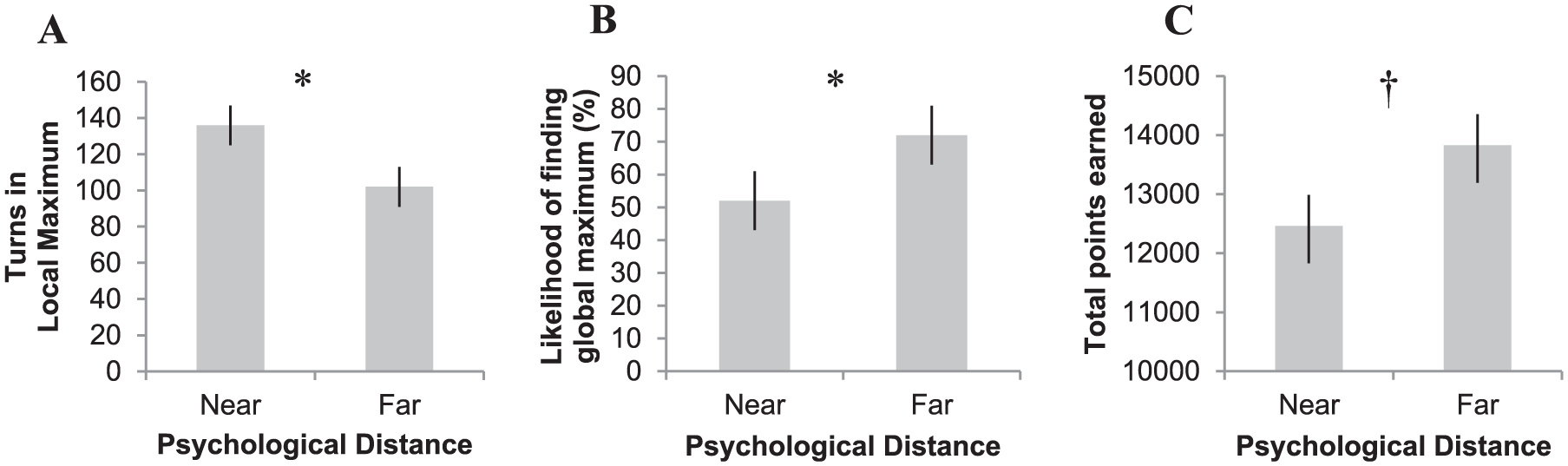
(A) Number of turns participants stayed in the local maximum, (B) likelihood of finding the global maximum, and (C) total number of points earned, by psychological distance from exploration space.
This experiment serves as preliminary evidence that psychological distance promotes exploration. Participants who had been prompted to think of the grid as physically far away left the local maximum sooner, found the global maximum sooner, were more likely to find the global maximum overall, and scored more points in the game than those who had been prompted to think of the game as physically close.
However, it is possible that the wording of the manipulation in Experiment 1 encouraged global versus local search through means other than a manipulation of construal level. Specifically, it is possible that the distance prime simply encouraged participants to traverse regions of the grid that were farther away from their starting point. The following experiments attempt to account for this possibility and corroborate these results in other domains of psychological distance.
Experiment 2
In this experiment, we moved away from manipulations of physical distance into the realm of social distance. This was to allay the potential alternative explanation that priming physical distance simply led participants to want to explore farther reaches of the grid. As we have mentioned, social distance is one of the several interchangeable forms of psychological distance. Research has shown that social distance engenders the same sorts of shifts in construal level that physical distance does. For instance, people construe the actions of dissimilar others at a more abstract level than those of similar others (Stephan, Liberman, & Trope, 2011), and seek more abstract information about them (Yudkin, Liberman, Wakslak, & Trope, 2018). Given these findings, we predicted that manipulating participants’ social distance to the Two Hills task would result in greater propensity to seek the global maximum.
Our manipulations of social distance were enacted through social power. Past research suggests that high interpersonal power associated with occupying a high position in a social hierarchy creates greater psychological distance from others (e.g., Fromkin & Snyder, 1980; Hogg, 2001; Hogg & Reid, 2001; Lee & Tiedens, 2001; Magee & Smith, 2013). Moreover, Smith and Trope (2006) showed that a state of high social power prompts people to think more about the desirability of end states and less about their feasibility (Magee & Smith, 2013). In the present study, participants were assigned either a role of a team leader (high power) or that of a subordinate team member (low power) and then completed the Two Hills task. We predicted that participants who assumed the role of a team leader (socially distant condition) would gain more points, reach the global maximum faster, and leave the local maximum faster than participants who assumed the role of a team member (socially proximate condition).
Method
Participants
This experiment was conducted in the lab, so we anticipated less variance (and thus higher power) than those conducted online, and recruited as many participants as possible in the academic semester. We successfully recruited 62 undergraduate students (17 men) from the Open University in Israel (age = 21-53 years, M = 27.79, SD = 5.70) to participate in the study in exchange for course credit. Participants were randomly assigned to conditions.
Procedure
Interpersonal power was manipulated by instructing half of the participants to assume the role of a team leader (high-power, socially distant condition) and the other half to assume the role of a team member (low-power, socially proximate condition). In the “low power” condition, participants were instructed to imagine that they were a member of a team, and that their decisions were subordinate to that of a team leader. In the “high power” condition, they were asked to imagine that they were the leader of a team, with the authority to make independent decisions. Thus, this manipulation consisted of a simple imagination exercise, which has been shown to be effective in other studies (Smith & Trope, 2006). In addition, to observe whether the effects of the previous experiment were dependent on the number of turns played in the game, we increased the number of turns available in the game to 600. After completing the game, participants were debriefed, thanked for participating, and assigned course credit.
Results and Discussion
One participant was dropped from further analysis because she demonstrated a lack of understanding of the experiment procedure. 100% of participants found the global maximum; 70% found the global maximum. Time in the local maximum negatively predicted how soon people reached the global maximum (r = –.73, p < .001), likelihood of finding the global maximum (r = –.71, p < .001), and total points scored (r = –.72, p < .001); and likelihood of finding the global maximum positively predicted total points scored (r = .69, p < .001).
Turning to the primary findings, as predicted, participants in the role of a team leader (distant condition) fewer turns at the local maximum (M = 128, SD = 142) than participants in the proximate condition (M = 213, SD = 161), t(58) = 161, p = .034, d = 0.53, 95% CI = [6.79, 163.81], were more likely to find the global maximum overall, (M = 58% vs. 83%), χ2(1, n = 61) = 4.68, p = .031, and earned more points (M = 28.955, SD = 7.100) than participants in the role of a team member (socially proximate condition; M = 24.013, SD = 8.834), t(59) = 2.40, p = .019, d = 0.53, 95% CI = [–9,057.3, 828.1]; see (Figure 3). There was no difference between conditions in how soon people reached the global maximum among those who did find it (p < .25), possibly because this analysis eliminated all those who did not find the global maximum and thus included only 70% of the sample.
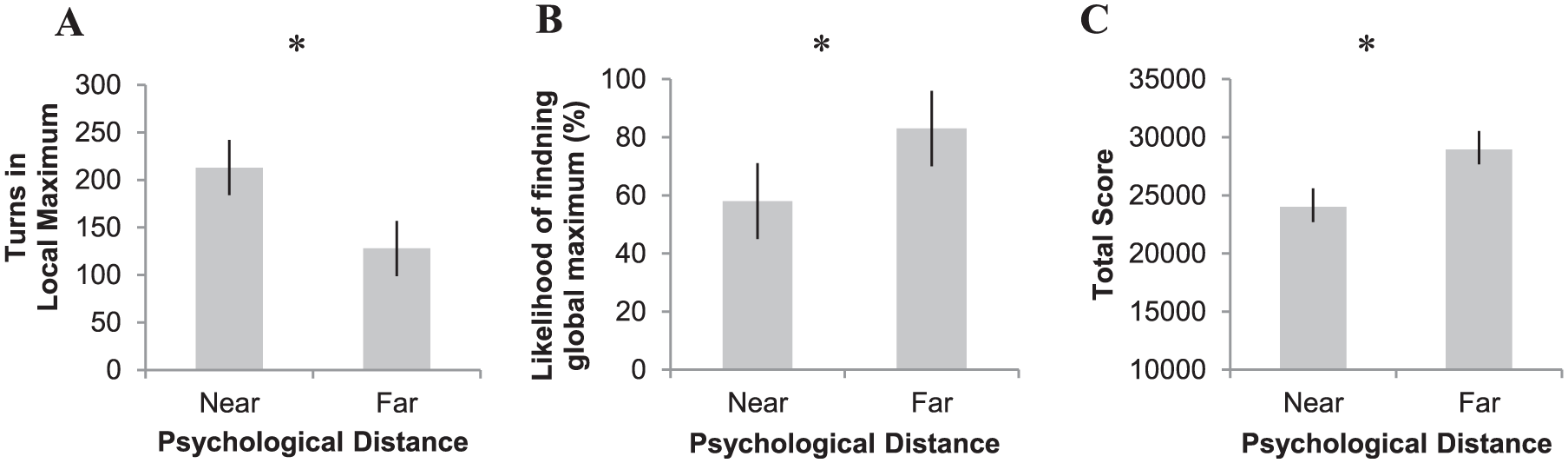
(A) Number of turns taken to leave the local maximum, (B) likelihood of finding the global maximum, and (C) total number of points earned, by level of interpersonal power.
In sum, as expected, participants in the distant, high-power condition, left the local maximum sooner, reached the global maximum sooner, and earned more points than participants in the proximate, low-power condition. This serves as further evidence that social distance promotes exploration. At the same time, the results of this experiment should be taken with certain qualifications. First, it is possible that participants who imagined themselves as a team member felt they shared the responsibility with other team members and were hence less obligated to earn the highest amount of points. In addition, there remains the possibility that social power affected participants’ attentiveness or mood, which in turn changed their tendency to explore, or that it was power itself, rather than the indirect effect of construal level, that influenced exploration. Finally, we note that participants did not play for actual money and hence might have been less committed to earning as many points as possible. Experiment 3 set out to address these concerns.
Experiment 3
In this experiment, social distance was manipulated by telling participants that they would be playing the Two Hills task either on behalf of themselves or another participant. The self-versus-other difference is an effective and basic manipulation of social distance (Pronin, Olivola, & Kennedy, 2008). We also included the Positive and Negative Affect Scale (PANAS; Watson, Clark, & Tellegen, 1988) to assess whether any observed differences in condition could be explained by manipulations of attentiveness or mood. In addition, participants played more turns to reduce the potential risk in seeking the global maximum. Finally, participants in this study played for real money. We predicted that participants who earned money for another participant (socially distant condition) would gain more points, reach the global maximum faster, and leave the local maximum faster than participants who earned money for themselves (socially proximate condition).
Method
Participants
Based on the results of the previous experiment, we sought approximately 60 participants; 57 undergraduate students (14 men) from Tel-Aviv University enrolled in an introductory psychology course (age = 18-30 years, M = 23.00, SD = 2.23) participated in the study for course credit and monetary payment. Participants were randomly assigned to conditions.
Materials and procedure
The procedure was similar to Experiments 1 and 2, except that participants were told that each 5,000 points would be converted to 1 NIS (approximately US$0.25). In addition, we increased the number of turns to 1000 to increase the possibility that everyone would reach the global maximum. To manipulate social distance, half of the participants were (truthfully) told that the money they earn would go to another participant, who would come after the next participant, whereas the money they would receive was earned by the participant who came before the last one (socially distant condition). The other half of the participants were (truthfully) told that they would earn money for themselves (socially proximate condition; see Pronin et al., 2008, for a similar manipulation of social distance).
After the game, participants completed the PANAS Scale (Watson et al., 1988), in which they indicated the extent to which they felt, at that moment, interested, excited, strong, enthusiastic, proud, alert, inspired, determined, attentive and active (positive affect items) and jittery, distressed, guilty, scared, hostile, ashamed, nervous, irritable, afraid and upset (negative affect items) on scales that ranged from 1 (not at all) to 5 (very much). Participants then indicated the extent to which they were motivated to earn as many points as possible on a scale that ranged from 1 (not motivated at all) to 7 (very motivated). At the end of the experiment participants were debriefed, thanked, and received the appropriate course credit and payment.
Results and Discussion
Because of the more enclosed and campus-like nature of Tel Aviv University in contrast to that of Hebrew University (Experiment 2) and the online sample (Experiment 1), there was reason to suspect the participants may have shared information with each other about the true layout of the grid. Indeed, three participants behaved as though they had prior information—heading straight for the global maximum with no deviation and remaining there for the rest of the game. These three participants were, therefore, dropped from all further analysis.
As expected given the greater number of turns in this compared with the previous experiment, 100% of participants reached the local maximum and 94% located the global maximum. Time in the local maximum negative predicted how soon people found the global maximum (r = –.86, p < .001) and their total score (r = –.71, p < .001).
Turning to the primary results, the number of turns spent at the local maximum in the distant condition (M = 48, SD = 44) was smaller than that in the proximate condition (M = 158, SD = 197), t(52) = 2.82, p = .007, d = 0.77, 95% CI = [30.2, 189.2]. Furthermore, as expected, participants in the socially distant condition reached the global maximum in fewer turns (M = 178, SD = 110) than participants in the socially proximate condition (M = 298, SD = 257), t(49) = 2.21, p = .032, d = 0.60, 95% CI = [4.67, 236.0]. In this experiment, the number of turns to reach the global maximum was more important than whether the global maximum was found at all, as such a high proportion of participants across experiments did indeed find it. Indeed, there was no difference between conditions in likelihood of finding the global maximum, p > .25. Finally, participants in the socially distant condition earned more points (M = 62.87, SD = 9.04) and subsequently more money than those in the socially proximate condition; M = 55.53, SD = 15.30), t(52) = 2.15, p < .037, d = 0.60, 95% CI = [–14.24, –440]; see (Figure 4).
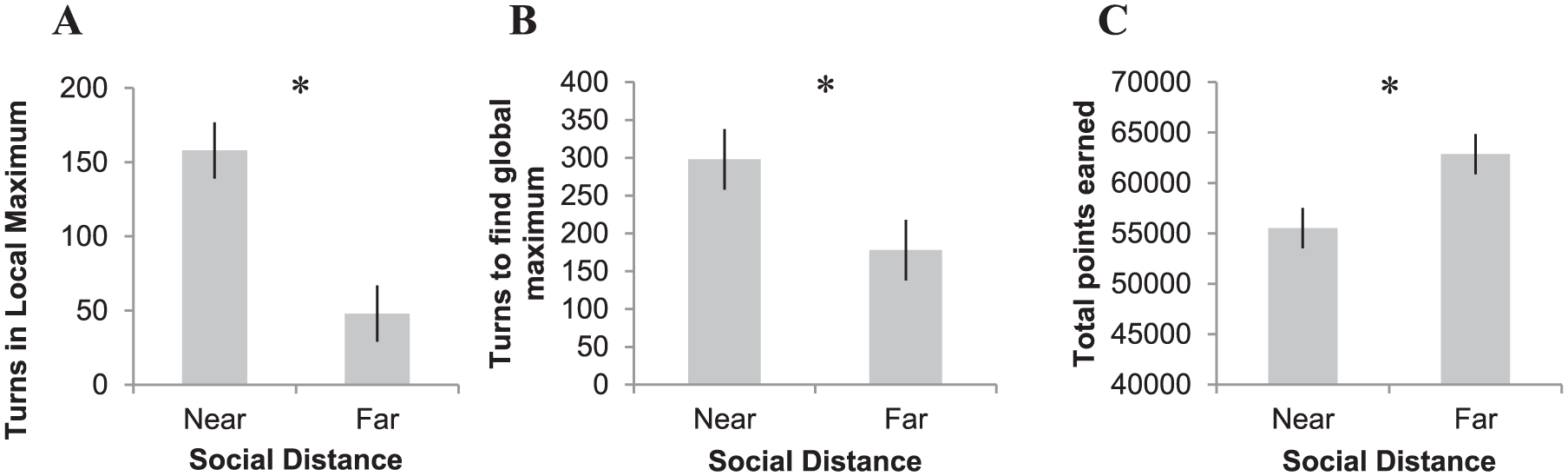
(A) Number of turns spent in the local maximum, (B) number of turns taken to reach the global maximum, and (C) total number of points earned, by social distance.
To check whether the social distance manipulation had any effect on participant’s mood, we conducted a series of t tests on each of the items in the PANAS examining between-group differences for each item. Results showed no significant difference in any of the 20 items, all ps > .05, suggesting that the manipulation of social distance had no effect on these factors and, therefore, the effects could not be explained by manipulations of mood alone. Moreover, combined indices of positive effect, distant: M = 2.31, SD = 0.61; proximate: M = 2.29, SD = 0.65, t(52) = 0.09, ns; and negative effect, distant: M = 1.34, SD = 0.37; proximate: M = 1.31, SD = 0.28, t(52) = 0.26, ns on the PANAS also showed no significant difference between conditions, further demonstrating that these factors were not causally responsible for the observed effects.
In addition, an index of attentiveness (the average of the items attentive, alert and determined from the PANAS, Watson et al., 1988) showed no difference between conditions (distant: M = 2.78, SD = 0.87; proximate: M = 2.65, SD = 0.83), t(52) = 0.56, ns. Finally, there was no difference in the level of motivation between conditions (distant: M = 5.67, SD = 1.24; proximate: M = 5.96, SD = 0.94), t(52) = 0.99, ns. As in Experiment 2, the results of this study show that psychological distance, in the form of social distance, promotes exploration. Moreover, this effect was not due to differences in affect or levels of motivation.
Experiment 4
In the first three experiments of this article, we presented evidence that psychological distance promotes more exploration in the Two Hills task. However, we have not yet presented evidence as to the direct relationship between exploration and construal level. The present experiment attempts to address this issue. Ample past research has shown that psychological distance influences level of construal (e.g., Liberman & Trope, 2008, 2014; Trope & Liberman, 2010). In addition, it has been shown that people’s “construal mind-set” can vary such that some individuals may have the propensity to consider things more abstractly than others (Freitas et al., 2004; Hansen & Melzner, 2014). In this experiment, we hypothesized people in a higher level construal mind-set would have a greater propensity to explore.
To test our hypothesis, we first measured people’s construal mind-set, then allowed them to play the Two Hills task. A significant association between mind-set and exploration in the Two Hills task would qualify as support for our hypothesis. We hasten to note that, because this experiment relies on measurement rather than manipulation, it is impossible to prove a causal relationship between the variables in question. At the same time, it can provide circumstantial evidence of the relationship in question.
To assess participants’ level of construal, we used the “category inclusiveness” task. Past work suggests that exemplars vary in the extent to which they may be grouped in superordinate categories. For instance, a “chair” is a better example of the category “furniture” than is an “oven.” Furthermore, research shows that people’s willingness to say that an exemplar fits in a category varies as a function of their perceived distance from that exemplar and can be used as a measure of their level of construal. In one study, for instance, researchers showed that participants thinking of a camping trip as taking place further in the future were more likely to group a number of camping items into fewer categories of more items, suggesting they were being more inclusive in their categorization (Liberman, Sagristano, & Trope, 2002). Another experiment showed that people who had been primed to process at a high, global level of construal were more likely to include atypical exemplars into a larger category (Rim, Trope, Liberman, & Shapira, 2013). Accordingly, we used category inclusiveness as a measure of level of mental construal. We predicted that the higher people’s level of category inclusiveness, the greater would be their tendency to depart the local maximum in the Two Hills task.
Method
Participants
142 participants (76 male, 66 female, Mage = 33.3 years) were recruited through Amazon’s Mechanical Turk to play the “Grid Game” in exchange for US$0.30. For this experiment, we returned to the original number of turns (400) as used in Experiment 1.
Materials and procedure
After collecting participants’ demographic information, participants were given instructions to the game. They then completed the categorization task, and finally completed the Two Hills task. We always presented the tasks in this order to avoid the possibility that completing the categorization task after the game might influence people’s level of abstraction: insofar as a positive mood has been tied to more expansive mind-sets (e.g., “broaden and build” theories of positive affect; see Fredrickson, 2001), then success on the game might have caused people to have a more abstract mind-set. This would have given the impression that abstract mind-sets caused exploration, when in fact it was the other way around. For this reason, we presented the categorization task first, because there was no reason to believe that categorization responses would influence exploration behavior.
Categorization task
The categorization task consisted of a series of category headings, under each of which was a list of potential category exemplars. For each category, participants were instructed to indicate “How well does each item fit in the category?” on a scale ranging from 1 to 10. The category headings were “vehicle” (car, elevator, bicycle, feet, truck, skateboard, bus, camel, boat), “clothing” (sandals, shirt, cane, vest, dress, purse, stockings, ring, pants), “carpentry” (chisel, knife, slide rule, crane), “vegetable” (greens, parsley, pickles, rice), “bird” (parrot, peacock, penguin, bat), “weapon” (brass knuckles, axe, bricks, glass), “toy” (hula hoop, sled, dishes, books), fruit (lemon, kumquat, coconut, nut), sport (bowling, hiking, jump rope, cards), and “furniture” (ottoman, stool, shelf, refrigerator). Construal level was assessed via participants’ overall willingness to indicate that the exemplar fit in each category, with higher scores indicating higher levels of construal.
Results and Discussion
In total, 75% of participants found the local maximum, and 68% found the global maximum. As with the previous experiments, amount of time in the local maximum negatively predicted how soon people found the global maximum (r = –.27, p = .014) and total score (r = –.30, p = .002). Regarding our specific predictions, the higher people’s category inclusiveness, the less time they stayed in the local maximum (r = –.23, p = .019), the sooner they found the global maximum (r = –.21, p = .039), and the more points they scored in the game (r = .28, p = .001). Contrary to predictions, the relationship between category inclusiveness and likelihood of reaching the global maximum did not reach significance, p = .141.
In this experiment, we find correlational evidence of an association between individual differences in general levels of construal and exploration behavior. People who were construing categories at broader levels were faster to leave the local maximum, and earned more points in the game. This provides some evidence as to our proposed relationship between construal level and exploration behavior. At the same time, it does not prove that construal levels cause exploration behavior. A myriad of other “third variables,” including such things as optimism, depletion (or lack thereof), mood, impulsivity, and so on, may all be responsible for the observed effects insofar as they influence both construal level and exploration behavior. In addition, construal did not predict likelihood of finding the global maximum, which we did not expect. However, when taken together with the observations of the previous experiments (and only in this context), this experiment adds to the claim of a relationship between construal level and exploration.
One question that arises regarding this experiment is, given the correlational nature of the design, if it would not have been better to manipulate mind-set directly, as previous experiments have (e.g., Freitas et al., 2004; Fujita, Trope, Liberman, & Levin-Sagi, 2006). In fact, we did indeed attempt to manipulate mind-set using both a “why/how task” (see Freitas et al., 2004) and a “categories/exemplars task” (see Fujita et al., 2006). Neither attempt produced significant differences in exploration tendencies. We speculate that this is the result of the difficulty of priming construal mind-set for a time period long enough to affect behavior in the game together with salient, attention-grabbing nature of the task itself. The results of Experiment 4, by contrast, are successful because individual differences in high or low mind-sets should persist throughout the course of the game. Future research teams may devise a more potent and/or longer-lived manipulation of construal level and examine its effect on exploration.
General Discussion
Four experiments provide evidence of a relationship between psychological distancing and people’s willingness to search beyond local maxima. In Experiment 1, participants who construed the game as far away left the local maximum sooner, found the global maximum sooner, and earned more points than those who considered it as nearby. In Experiments 2 and 3, we corroborated this effect with different manipulations of psychological distance: first with social power, then with interpersonal distance. Finally, in Experiment 4, we found evidence of a significant correlation between exploration and construal level: People who tended to categorize items in more abstract terms also had a greater tendency to engage in exploration in the Two Hills task. Overall, these point to the effect of psychological distance on transcending local maxima.
These experiments are among the first to examine how construal processes can influence exploration behavior. Although previous experiments have put forward models describing the neural and behavioral patterns underlying exploration in humans and animals (Charnov, 1976; Daw et al., 2006; Hills et al., 2014; Laureiro-Martínez et al., 2015), no work to our knowledge has shown how such behavior is influenced by construal processes. Here we provide evidence that, because psychological distance creates an emphasis on high- versus low-level features of an action space, it leads to greater prioritization of the value of the global maximum, and thence to more exploration.
These findings add to a growing body of evidence pointing to the adaptive function of high-level construals in transcending the here-and-now. Research in CLT has shown that people use high-level construals when considering distant social targets (Kalkstein, Kleiman, Wakslak, Liberman, & Trope, 2016; Yudkin et al., 2017), considering unlikely scenarios (Wakslak et al., 2006), predicting their own future behavior (Nussbaum, Liberman, & Trope, 2006), and communicating to diverse audiences (Joshi & Wakslak, 2014). Overall, this research suggests that the ability to “zoom out” from the present situation to consider more distant possibilities and far-flung objects is a vital feature of human life. Indeed, the act of mental abstraction, which is linked to such other processes as symbolization (Barsalou, 2003) and language (Bransford & Franks, 1971), has been posited as a unique capacity, which may have contributed to humans’ evolutionary success. This work shows how yet another critical behavior, exploration, may similarly benefit from people’s ability to mentally abstract beyond the exigencies of the current moment.
What accounts for the connection between adopting a distal perspective and seeking the global maximum in the Two Hills Game? One possibility has to do with the idea that a distal perspective is the result of having greater resources, whereas a more proximal perspective the result of having fewer resources. Typically, when organisms have more resources, they can better afford to expand their perspective to consider more distant—and potentially more uncertain—options. By contrast, when organisms are faced with limited resources, they are often restricted to considering the options that are immediately available to them, because they cannot afford to withstand the negative consequences that might arise in a more uncertain environment (see Gervey, Igou, & Trope, 2006; Raghunathan & Trope, 2002; Trope & Neter, 1994). Thus, high-level construals may promote a greater emphasis on opportunities that are more desirable but more difficult to obtain. In this way, such construals may serve as an adaptive strategy by which organisms can regulate their scope of consideration in an uncertain environment.
Theoretical Implications
Search behavior has a number of theoretical analogs in the domain of judgment and decision making. For example, research on maximizing/satisficing has found reliable differences in people’s tendency to seek an optimal outcome versus “settle” for a satisfactory one (Schwartz et al., 2002). In addition, psychological distance has been shown to lead people to seek out larger samples of experiences before making a decision (Halamish & Liberman, 2017), and to examine larger “assortments” of alternatives: behaviors that are functionally similar to maximizing but not identical to it (Chernev, 2006; Goodman & Malkoc, 2012). The choices inherent in this situation are very similar to those presented in the Two Hills task, insofar as they both test people’s willingness to seek the best possible (and less feasible) outcome. Indeed, this theoretical parallel has been formally presented in prior work (e.g., Carmel & Ben-Haim, 2005; Ölander, 1975). At the same time, no work to our knowledge has directly investigated whether psychological distancing strategies influence maximizing behavior per se. Given the psychological parallels between maximization and exploration, we would predict a similar relationship between the high-level construal and propensity to maximize, particularly in cases when a superior alternative is known to exist.
Another theoretical link between past work and the current research is that concerning the status quo bias—that is, people’s tendency to prefer the current state of affairs over potentially more favorable alternatives (Kahneman, Knetsch, & Thaler, 1991). If the status quo bias does indeed reflect people’s aversion to pursue more (temporally, spatially or socially) distant, potentially more desirable alternatives, then it is possible that the same manipulations presented in the current research would influence the status quo bias. More specifically, psychological distancing might help mitigate the status quo bias—encouraging a greater willingness to consider and accept other possible worlds.
An additional concept relevant to the current work is that of risk preferences, as it is possible to conceive of exploration as an act of seeking a higher value, lower probability reward. Risks are typically subordinate to rewards, because while the reward is the reason why you do something, the risks make that reward more or less feasible to obtain. From the perspective of CLT, it follows that the risky, high-reward option (in this case, the global maximum) should be more attractive when considered from a distance. Indeed, past research has shown that psychological distance reduces risk aversion in decision making (e.g., Sagristano, Trope, & Liberman, 2002; see also Chandran & Menon, 2004, for effects of psychological distance on perception of risk). Thus, the dilemma presented to participants in the Two Hills Game can be interpreted as a special case of a trade-off between risk and reward, which may then be understood through the CLT approach we have taken here.
Another important question concerns how our results relate to cost–benefit analysis (Quah & Haldane, 2007). Clearly, cost–benefit analysis must come into play when people are considering the pros and cons of leaving the local maximum in search of the global maximum. And previous findings have demonstrated that psychological distance can moderate the relative weightings of pros and cons in the cost–benefit analysis. For instance, Eyal, Liberman, Trope, and Walther (2004) have shown that people pay more attention to pros relative to cons as psychological distance increases. However, it is important to note that this happens only when pros are higher level than cons (for example when con considerations are subordinate to pro considerations). Although this tends to be the case in many situations, it is not always the case: when cons are not subordinated to pros, distance does not increase the relative weight of pros to cons (Eyal et al., 2004). For this reason, considering exploration through the lens of costs and benefits does not lead to any predictions about the effect of psychological distance on exploration. By contrast, it is only when treating the exploration dilemma as a special case of costs and benefits—one involving a trade-off between feasibility and desirability—that one can derive our predictions and make sense of our observations.
On a different note, this research raises the question of an interesting linkage between mental abstraction and the emergence of exploratory behavior in children. Research has shown that across the course of development, children become increasingly proficient at the process of mental abstraction (Kato, Kamii, Ozaki, & Nagahiro, 2002; Piaget, 1959). Simultaneously, children tend to engage in greater levels of exploration, venturing farther from the immediate security of the parent (Power, 1999). There is no question that a number of developmental factors are at play in facilitating children’s burgeoning propensity to explore. However, the concurrent emergence of these mental capacities and behaviors raises the possibility that high-level thought facilitates childrens’ willingness to consider and investigate more distant opportunities. More research is needed to verify the mechanisms underlying this association.
Self-Control
Are exploration dilemmas just a form of self-control problems? Self-control dilemmas and exploration both involve a trade-off between a more local, smaller reward and a more distant, larger one (e.g., Fujita et al., 2006). Indeed, there is evidence that the same processes implicated in self-control are at work in exploration. For instance, research has shown that brain regions associated with self-control, such as the frontopolar cortex, are preferentially activated during exploratory behavior (Daw et al., 2006). Correspondingly, work in CLT has shown that high-level construals are associated with such self-regulatory behavior (Fujita & Carnevale, 2012; Fujita et al., 2006). Taken together, these two lines or research provide convergent evidence of the self-regulatory challenges inherent in the act of exploration.
On the contrary, the relationship is less clear when considered in the context of other definitions of self-control. For example, defining self-control dilemmas as a conflict between visceral and nonvisceral motivations (e.g., Loewenstein, 1996) or as a conflict between automatic and controlled behaviors (Muraven & Baumeister, 2000) hardly applies to the experimental paradigm we use here. The lay view of self-control dilemmas as a conflict between vice and virtue, between temptations and moral principles does not apply either. This is because one could think of leaving the local maximum both as a temptation (a temptation for adventure; greed) and as a moral behavior (courageous exploration). Staying at the local maximum likewise could be construed both as a temptation (to stay secure) and as a morally virtuous persistence and modesty. Thus, while there may be some commonalities between exploration and self-control, there are also some ways in which they are distinct.
Practical Applications
The current work gives practical hints as to how people may deal with exploration dilemmas. For example, research has demonstrated the efficacy of “self-distancing,” in which taking a metaphorical step back from one’s situation allows one to see things from a more distant and all-encompassing perspective, and may result in higher levels of construal (Kross & Ayduk, 2008; Kross, Ayduk, & Mischel, 2005). If one is attempting to encourage exploration in oneself, encouraging a self-distanced perspective may lead one to place less emphasis on the temporary aversive state engendered by departing the local maximum, and may, therefore, encourage exploratory behavior.
Although we have limited our conclusions only to those situations in which a global maximum is known to exist, our work may very well extend to other search scenarios, including those in which the existence of a global maximum is uncertain or one in which people are exploring a series of “patchy” resources in search of an optimal patch (e.g., Mata, Wilke, & Czienskowski, 2013; Wilke et al., 2009). Such instances may arise across a variety of situations far beyond the exploration of a physical space, including engaging in search for information (e.g., on the Internet), finding a long-term romantic partner, or settling on a fulfilling career. Given that such situations, in a manner similar to the Two Hills task, often involve a trade-off between a potentially valuable reward and the difficulty of attaining it, it is possible that psychological distancing strategies—and the attendant high-level construal—would foster more search tendencies in such situations as well.
At the same time, there may be other psychological factors at play in such scenarios that are not at play here. For instance, if a global maximum is not known to exist, then characteristics such as optimism or curiosity might additionally influence people’s exploratory behavior. Furthermore, construal-level effects might not hold in scale-free environments that appear similar at whatever scale they are considered (e.g., something akin to a fractal)—although it is not clear whether such environments are ever encountered in daily life (see Maglio & Trope, 2011). In addition, in a patchy setting, more complex issues surrounding inferred values of patches and the spaces between them may complicate the relationship between construal level and exploration. In addition, in situations in which people find exploration intrinsically rewarding (e.g., when one enjoys dating multiple romantic partners), psychological distancing may not add any further motivation to explore. By contrast, there are many real-life situations (e.g., long-term and fulfilling marriages) in which remaining in the local maximum is preferable to chasing after potentially unattainable dreams of perfection.
Limitations and Future Directions
Although the current observations present convergent evidence as to the relationship between exploration and construal processes, there are several promising avenues for future investigations. One important step for future work is to extend the findings to other domains of exploration beyond the Two Hills task, including in behavioral situations or those with more ecological validity than a computer game. Our research focused on this game because it isolates the psychological components of exploration decisions and allowed us to focus our analysis on these properties. However, we believe that future research would do well to extend these results to more realistic scenarios.
Conclusion
The choice of whether to stay or leave is a perennial one facing organisms in an uncertain world, including such dilemmas as whether a company should invest in sales or research and development, whether someone should try a new shampoo, and whether someone should continue or end a romantic relationship. Here, we show that exploration is facilitated by the act of psychological distancing, which serves to increase the weight given to high- versus low-level considerations. Taking a mental step back, in other words, may help people find out what lies beyond.
Supplemental Material
Yudkin_OnlineAppendix – Supplemental material for Psychological Distance Promotes Exploration in Search of a Global Maximum
Supplemental material, Yudkin_OnlineAppendix for Psychological Distance Promotes Exploration in Search of a Global Maximum by Daniel A. Yudkin, Rotem Pick, Elina Yewon Hur, Nira Liberman and Yaacov Trope in Personality and Social Psychology Bulletin
Footnotes
Authors’ Note
Rotem Pick is now at Department of Psychology and Education, The Open University, Ra’anana.
Declaration of Conflicting Interests
The author(s) declared no potential conflicts of interest with respect to the research, authorship, and/or publication of this article.
Funding
The author(s) disclosed receipt of the following financial support for the research, authorship, and/or publication of this article: This research was supported by a US-Israel Binational Science Foundation to Nira Liberman and Yaacov Trope, BSF 2007/247.
Supplemental Material
Supplemental material is available online with this article.
References
Supplementary Material
Please find the following supplemental material available below.
For Open Access articles published under a Creative Commons License, all supplemental material carries the same license as the article it is associated with.
For non-Open Access articles published, all supplemental material carries a non-exclusive license, and permission requests for re-use of supplemental material or any part of supplemental material shall be sent directly to the copyright owner as specified in the copyright notice associated with the article.
