




Abstract
The human psyche is profoundly shaped by its cultural milieu; however, few studies have examined the dynamics of cultural influence in everyday life, especially when it comes to shaping people’s automatic, implicit attitudes. In this quasi-experimental field study, we investigated the effect of transient, but salient, cultural messages—the pop-cultural phenomenon of celebrity “fat-shaming”—on implicit anti-fat attitudes in the population. Adopting the “copycat suicide” methodology, we identified 20 fat-shaming events in the media; next, we obtained data from Project Implicit of participants who had completed the Weight Implicit Association Test from 2004 to 2015. As predicted, fat-shaming led to a spike in women’s (N=93,239) implicit anti-fat attitudes, with events of greater notoriety producing greater spikes. We also observed a general increase in implicit anti-fat attitudes over time. Although these passing comments may appear harmless, we show that feedback at the cultural level can be registered by the “body politic.”
The human psyche is profoundly shaped by its cultural milieu. More than 100 years of research on social influence leaves no doubt that humans are highly attuned to the attitudes of others (Latané, 1981) and critically rely on cultural norms—which convey information about what is good, right, proper, valued, and beautiful—to guide thought and behavior (Heine, 2010). Despite decades of research, with a few notable exceptions (Fiske, Kitayama, Markus, & Nisbett, 1998; Kitayama & Karasawa, 1997; Oyserman & Lee, 2008), we know relatively little about the dynamics of cultural influence on people’s implicit attitudes, and even less about how this phenomenon plays out in everyday life, no doubt because it is challenging to experimentally manipulate and measure these subtle processes outside of the laboratory. These “gut-level” evaluative associations are important to study because they are difficult to control and can influence behavior in ways that people may not even be aware of (Fazio & Olson, 2003; Gawronski & Payne, 2010; Greenwald & Banaji, 1995; Greenwald, Poehlman, Uhlmann, & Banaji, 2009).
Although implicit attitudes were initially conceptualized as relatively stable habits of thought arising from overlearned evaluative associations communicated and experienced in our social world (Banaji, 2001; Devine, 1989), more recent research indicates that, in the lab, implicit attitudes are sensitive to momentary situational cues (Lane, Banaji, Nosek, & Greenwald, 2007; Lowery, Hardin, & Sinclair, 2001), priming manipulations (Steele & Ambady, 2006), and short-term experimental training (Lai et al., 2016; Olson & Fazio, 2001). Preliminary evidence suggests that implicit attitudes are sensitive to broad changes across the social–cultural context (e.g., changes in legal rights regarding gay men and lesbians; Westgate, Riskind, & Nosek, 2015; also see Inbar, Westgate, Pizarro, & Nosek, 2016), and Sawyer and Gampa (2018) recently showed changes in implicit attitudes produced by discrete societal events. Specifically, they identified events associated with the Black Lives Matter movement—for example, protests and civil unrest following the shooting of Michael Brown by a White police officer and the shooting of Trayvon Martin by a community watch member—and documented a decrease in pro-White bias during and after the events as compared with the month preceding the events. This work provides compelling initial evidence for the role of specific societal events in shaping people’s implicit attitudes. However, the phenomenon examined was arguably limited in scope: The events focused on in the Black Lives Matter study received a great deal of mainstream media coverage, for example, and were, at least in part, intentionally directed at effecting social attitude change. What about more casual, spontaneous, below-the-radar public events? Do they also leave a private trace?
To address this question, we identified instances where the cultural standard fat is bad was communicated publicly—that is, conveyed by the phenomenon of celebrity “fat-shaming”—and assessed whether these events influenced people’s implicit attitudes to align with the expressed norm. We then used the “copycat suicide” methodology, which revealed that suicide rates spike after a suicide has been publicized in the media (Phillips, 1986), to investigate whether these fat-shaming events were associated with an increase in implicit anti-fat attitudes. Phillips and colleagues identified highly publicized suicides and then compared suicide rates in the general population before and after the event. Similarly, we identified publicized fat-shaming events (see Table 1) and then obtained data from the public website Project Implicit (Xu, Lofaro, Nosek, & Greenwald, 2017b) of participants who had completed the Weight Implicit Association Test (IAT; Greenwald, McGhee, & Schwartz, 1998), an index of implicit anti-fat bias. Following Phillips (1986), we created two groups: the “pre-event group,” operationalized as anyone who completed the Weight IAT during the 2-weeks before a fat-shaming event, and the “post-event group,” operationalized as anyone who completed the Weight IAT during the 2-weeks after a fat-shaming event (with the start date being the date of the event itself). By comparing the mean Weight IAT D-score (i.e., indexing the strength of the evaluative association) for the pre- and post-event groups, we could assess whether the fat-shaming event spurred an increase in anti-fat bias.
Celebrity Fat-Shaming Events, Including a Description of the Incident, the Individual Effect the Event Had on Implicit Attitudes, the Sample Size, and the Notoriety of the Event. Events are Ranked According to the Magnitude of the Weight IAT Difference Effect.
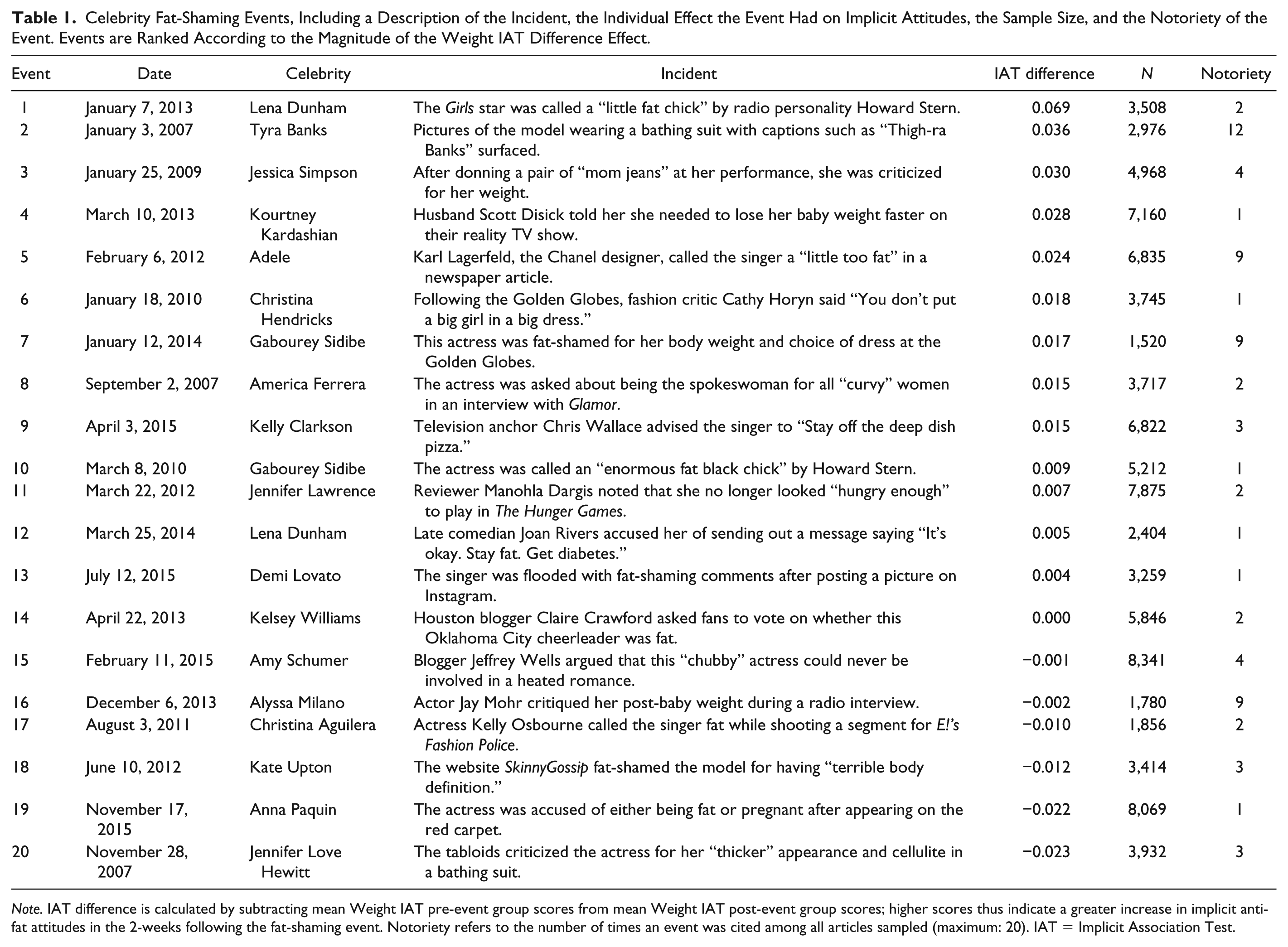
Note. IAT difference is calculated by subtracting mean Weight IAT pre-event group scores from mean Weight IAT post-event group scores; higher scores thus indicate a greater increase in implicit anti-fat attitudes in the 2-weeks following the fat-shaming event. Notoriety refers to the number of times an event was cited among all articles sampled (maximum: 20). IAT = Implicit Association Test.
We focused our analyses on events involving female celebrities and female IAT respondents. It is well-known that body weight, and the “thin ideal,” is central to culture’s and women’s definition of female beauty (Fredrickson, Roberts, Noll, Quinn, & Twenge, 1998; Jhally & Kilbourne, 2010; Miller & Halberstadt, 2005; Swami et al., 2010), and that women are held to a narrower range of socially acceptable weight (Roehling, 2012). Female celebrities experience a disproportionate degree of weight scrutiny (Fikkan & Rothblum, 2012). Because the stigma associated with body weight is thought to be especially impactful for women (Pearl & Puhl, 2016), and because our celebrity targets were female, we theorized that women would be particularly likely to identify with the fat-shaming targets and internalize these messages.
In addition to testing our primary hypothesis, we conducted the following additional analyses 1 :
We conducted parallel analyses with the Skin-tone IAT (assessing implicit racial attitudes) as our dependent variable to address the specificity of the association between fat-shaming and anti-fat attitudes.
We conducted a meta-analysis, treating each event as an independent quasi-experiment, to address the reproducibility of the effect.
Because Project Implicit also collected data on explicit weight attitudes, and given past work showing that implicit and explicit attitudes are often correlated, we assessed the association between implicit and explicit weight attitudes (e.g., Greenwald et al., 2009). We also explored the effects of fat-shaming on explicit anti-fat attitudes; however, we did not have specific predictions. Although explicit attitudes may similarly increase following a fat-shaming event, the effect might be countered by defensive processes (Banaji, 2001; Fazio, Jackson, Dunton, & Williams, 1995) or other factors that influence the expression of prejudicial attitudes (Crandall & Eshleman, 2003).
We assessed the effect of time on implicit weight bias. As Crandall (1994) noted in the mid-90s, weight bias is one of the last socially acceptable forms of prejudice. Research indicates an increase in weight bias discrimination from 1995 to 2006 (Andreyeva, Puhl, & Brownell, 2008) and the problem of weight bias continues to be discussed today in mainstream culture, see https://www.thisamericanlife.org/radio-archives/episode/589/tell-me-im-fat (Glass, 2016). We wondered if there has been a corresponding increase in implicit anti-fat attitudes. Moreover, if implicit weight bias has increased over time, then one could see an increase in such attitudes over any 2-week period, and we wanted to rule this possible confound out.
Finally, we assessed the effect of event notoriety. As Latané (1981) argued, social impact is a function of the strength, immediacy, and number of sources that impress on a target; as such, more popularized fat-shaming events should produce larger effects, as was the case with copycat suicides (Phillips, 1986).
Method
Participants
Participants were individuals who accessed the Weight IAT (https://osf.io/iay3x/; Xu et al., 2017b) from April 2004 to December 2015 through the public website, Project Implicit (https://implicit.harvard.edu; see Supplemental Materials). This is the time period for which Weight IAT data were collected through Project Implicit and made available to the public through the OSF. The Weight IAT dataset contains IAT scores, as well as some optional demographic measures and explicit weight-related measures participants agreed to complete.
In total, there were 1,675,496 session ID codes created for participants who accessed the Weight IAT through Project Implicit. Of these participants, 64.9% (n = 1,086,828) actually completed the Weight IAT portion of the study. Participants from this dataset were included in our primary analyses if they met the following criteria: (a) the participant was female, (b) the participant was 18 years of age or older, and (c) the participant had completed the Weight IAT during a 2-week period either preceding or following one of the 20 fat-shaming events we identified.
Our final sample consisted of 93,239 female participants (Mage = 27.13, SD = 10.52). Among these participants, 77.8% were employed (e.g., management, business, sales, engineering, health care, education), 12.1% were students, 9.1% were unemployed, 0.8% were homemakers, and 0.2% were retired. Of those with education level data available (n = 91,468), 4.6% had less than a high school education, 8.6% completed high school, 37.8% finished some college, 8.5% had an associate’s degree, 25.2% had at least an undergraduate degree, and 13.4% had a graduate or some other advanced degree (1.9% declined to answer). Of those with nationality data available (i.e., country of citizenship; N = 49,842), 81.0% were from the United States and the remainder were from Canada (4.2%), the United Kingdom (2.8%), Australia (1.9%), and 234 other countries (10.1%).
Identification and Selection of Fat-Shaming Events
To identify fat-shaming events for inclusion in this study, we followed the procedure outlined in our preregistration with the OSF (https://osf.io/wgsed/ Ravary, Bartz, & Baldwin, 2017; also see “Preregistration” section in the Supplemental Materials). We first conducted a Google search with the following keywords: “fat shaming” AND “celebrities” to identify articles about celebrity fat-shaming (note that the articles provided lists of fat-shaming events rather than single events). We selected the first 20 articles providing a list of celebrity fat-shaming events that met our inclusion criteria (see Supplemental Materials), and we inspected these articles to identify fat-shaming events occurring between 2004 and 2015 (the period for which we had Weight IAT data) for inclusion in this study. Because our goal was to compare Weight IAT scores between the 2-week period following and preceding a celebrity fat-shaming event, we selected only fat-shaming events that were associated with a clearly identifiable date (in the case that two events overlapped within 30-days of each other, the event that happened first in time was selected to prevent contamination/bias from the other event). For further details on our criteria for selecting articles and for selecting events see the Supplemental Materials available online.
This procedure resulted in a total of 24 fat-shaming events that met our inclusion/exclusion criteria. However, because the Project Implicit website periodically varies the types of IAT tests that are available for website visitors, there were no Weight IAT data available for four of the events, which left us with 20 fat-shaming events to study. Our final list and brief descriptions of 20 fat-shaming events are displayed in Table 1 (also see Supplemental Table S2).
The Weight IAT
Participants’ automatic anti-fat attitudes were assessed using the Weight IAT (see Supplemental Materials for a more comprehensive explanation of the IAT), which presents participants with stimuli related to the concept of “fat” (e.g., silhouette of an overweight body or picture of an overweight individual) and “thin” (silhouettes or faces) as well as words related to “good” (e.g., “wonderful”) and “bad” (e.g., “terrible”). On congruent trial blocks, participants use one key to categorize “fat” images and “bad” words and a different key to categorize “thin” images and “good” words. On incongruent trial blocks, participants use one key to categorize “fat” images and “good” words and another key to categorize “thin” images and “bad” words. The rationale behind the IAT is that participants will find it easier, and thus respond more quickly, when categorizing congruent concepts and attributes with the same key, whereas the task becomes more difficult, resulting in slower reaction times, when the concept and attribute being categorized with the same key are incongruent. One can calculate a Weight IAT D-score by taking the relative mean difference in response times between the congruent and incongruent trial types, with positive D-scores indicating a greater implicit anti-fat bias. Other research using the Weight IAT indicates that, on average, participants tend to be quicker on trials where they categorize “fat” with “bad” and “thin” with “good” (Schwartz, Vartanian, Nosek, & Brownell, 2006).
The Skin-Tone IAT
To investigate the specificity of our findings, we obtained another dataset from Project Implicit, covering the same time period, in which participants completed a skin-tone version of the IAT assessing implicit racial attitudes (Xu, Lofaro, Nosek, & Greenwald, 2017a).
Self-Report Measures of Explicit Anti-Fat Attitudes
Explicit weight preference measure
Participants completed a single-item measure assessing the extent to which they preferred thin people versus fat people; higher scores indicate stronger explicit anti-fat attitudes. In total, 90,260 of our participants had completed this measure of weight preference (M = 4.86, SD = 1.04).
Weight thermometer measure
Participants also completed two thermometer ratings assessing the degree to which they felt warm or cold toward fat and thin people, respectively. Higher scores on the fat thermometer indicated colder attitudes toward fat people. Overall, 91, 351 participants completed the fat thermometer (M = 4.99, SD = 2.19). We reverse scored the thin thermometer, such that higher scores on this measure indicated warmer attitudes toward thin people (consistent with weight bias predictions). Overall, 91,378 participants completed the thin thermometer (M = −4.40, SD = 1.92).
Composite explicit anti-fat measure
Although the three explicit measures described above measure slightly different facets of weight bias (indeed, their average intercorrelation was low, raverage = .07), we elected to combine these measures to increase the reliability of the explicit anti-fat attitudes measure (see Supplemental Materials for details).
Results
Effect of Fat-Shaming on Implicit Anti-Fat Attitudes
To test our primary hypothesis, we conducted an independent samples t test comparing pre-event Weight IAT D-scores with post-event weight IAT D-scores. Results showed a significant effect of event group on Weight IAT D-score, t(93237) = 2.70, p = .007, with higher implicit anti-fat attitudes in the 2-week period following a fat-shaming event (M = .456, SD = .42) compared with the 2-week period leading up to this event (M = .449, SD = .42) (Figure. 1). The estimated effect size of the change in implicit anti-fat attitudes is d = .0177, 95% confidence interval (CI) = [.004, .03]. This effect was not moderated by age, β = .00, t(93235) = –.82, p = .412, rsp = –.003, CI = [–.001, .000], nor education variables, β = .00, t(91464) = .25, p = .800, rsp = .001, CI = [–.002, .003]; we also ruled out two possible forms of selection bias (i.e., that women with stronger weight attitudes and/or heavier/thinner women were more likely to take the IAT after a fat-shaming event; see Supplemental Materials for details).
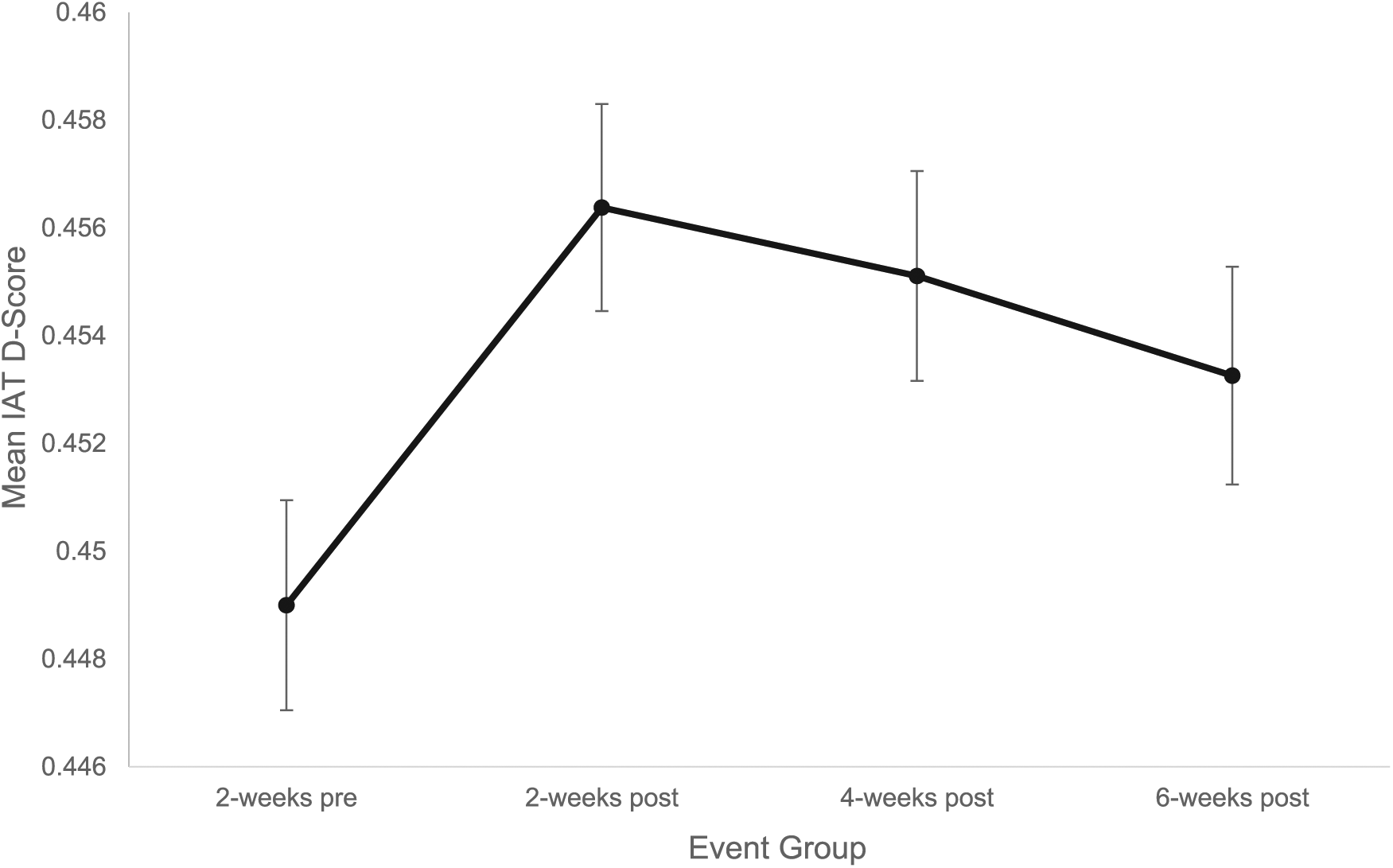
Changes in implicit anti-fat attitudes following a fat-shaming event in the media.
Control Analyses on Implicit Racial Attitudes
To ascertain the specificity of the fat-shaming effect, we analyzed across this same period of time with the Skin-tone IAT (assessing implicit racial attitudes; https://osf.io/rf5t4/; Xu et al., 2017a) also obtained from Project Implicit (N = 67,243; Mage = 28.18, SD = 10.71) as our dependent variable. We selected this particular IAT variant as a control test because it captures not only negative attitudes in general, but negative attitudes related to appearance specifically. The Skin-tone IAT has also been shown to be malleable, making it an appropriate control variable, and it provided a sample comparable with that of the Weight IAT. An independent samples t test showed no change in implicit racial attitudes following fat-shaming events, t(67241) = 1.11, p = .268, d = .009 (pre-event M = .308, SD = .43; post-event M = .312, SD = .43), indicating that celebrity fat-shaming uniquely increased anti-fat attitudes, but not other types of negative attitudes.
Meta-Analysis of Individual Fat-Shaming Events
To examine the reproducibility of the effect of fat-shaming on implicit anti-fat attitudes, we used the SPSS macros for meta-analysis provided by David Wilson (2010). Results from this meta-analysis revealed that although not all events were associated with an increase in weight bias scores, there was a statistically reliable effect of celebrity fat-shaming on anti-fat attitudes, p < .001; d = .022; CI = [.0188, .0241]; see Figure. 2).

Effects of event on weight IAT difference scores (post—pre) for each of the 20 fat-shaming events.
Explicit Anti-Fat Attitudes: Association With Implicit Attitudes and Effect of Fat-Shaming
Analyses investigating the association between implicit and composite of explicit weight attitudes revealed that they were positively correlated, r(91711) = .22, p < .001 (see Supplemental Materials for details), consistent with other research (e.g., Schwartz et al., 2006). We reran our primary analyses, including explicit weight bias as a control variable, to ascertain the specificity of the fat-shaming effect on implicit attitudes. Controlling for explicit anti-fat attitudes, which provides an arguably more pure index of implicit attitudes, did not alter our main finding, F(1, 91708) = 8.56, p = .003, d = .013.
Turning to the question of whether fat-shaming similarly affects explicit attitudes, we conducted an independent samples t test, with pre- or post-event group as the independent variable and our composite measure of explicit weight-related attitudes as the dependent variable. We did not find an increase in explicit anti-fat attitudes; rather, the independent samples t test revealed that celebrity fat-shaming had no effect on explicit anti-fat attitudes, t(91709) = .32, p = .572, d = .004. That the fat-shaming events did not alter explicit attitudes may reflect the susceptibility of explicit attitudes to self-presentation and other sources of influence (Banaji, 2001; Fazio et al., 1995); that said, caution is warranted in interpreting these null effects given that the explicit measure is based on only three self-report items.
Effect of Time on Implicit Anti-Fat Attitudes
Consistent with the aforementioned cultural increase in weight bias discrimination, our correlational analyses between implicit attitudes and time revealed an overall increase in implicit anti-fat bias over the 12-year period studied, r(93237) = .05, p < .001; also see Supplemental Materials. This represents a .011 increase in Weight IAT D-scores for any given year, which, notably, is comparable with the average increase in Weight IAT D-scores after a single fat-shaming event (.007). It is unlikely that this reflects a more general increase in overall negative or, specifically, negative appearance-related attitudes as we found no evidence for an increase in race bias; actually, our parallel analysis on race bias showed a decrease over this time period, r(67241) = –.03, p < .001, Figure. 3; see Supplemental Material for discussion.
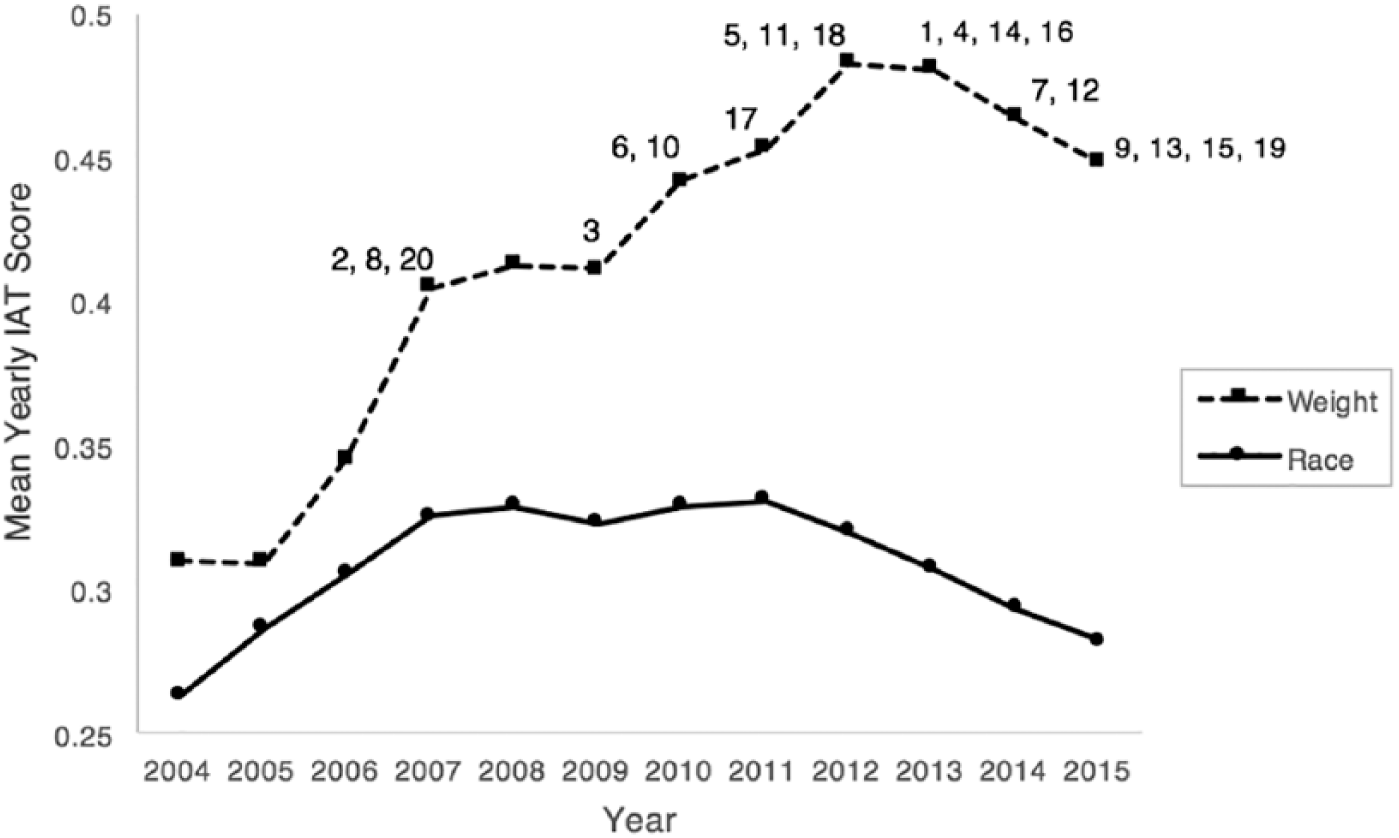
Mean implicit weight and race attitude scores from 2004 to 2015.
Given the increase in implicit weight bias over time, there could very well be an increase in such attitudes over any 2-week period. To ensure that the celebrity fat-shaming effect was not due to the general increase in implicit weight bias over time, we again followed the copycat suicide literature (Phillips, 1986) and looked at mean Weight IAT scores up to 6 weeks after the fat-shaming event. If the effect we observed was due to a general increase in anti-fat bias over time, then one would expect anti-fat attitudes to continue to increase during the 3-to-6 week period after the event. To analyze trends in the weeks following a fat-shaming event, we expanded our sample to include groups of female participants who had completed the Weight IAT either 3 to 4 weeks post-event or 5 to 6 weeks post-event (N = 175,771; Mage = 27.28, SD = 10.69). As can be seen in Figure. 1, the spike in anti-fat attitudes we observed in the 2-week period after a fat-shaming event begins to decrease in the subsequent weeks. By the week 5 to 6, implicit anti-fat attitudes were not significantly different from baseline levels (i.e., the 2-week pre-event group), t(89702)=1.52, p>.05, d = .010, suggesting that the effect we observed reflects an acute spike in negative attitudes that subsequently plateaued. Moreover, statistically correcting for the linear trend over time by adjusting for the increment that would be expected to occur over any given biweekly period (Phillips, 1982) also does not alter the effect (see Supplemental Materials).
Effect of Event Notoriety on Implicit Anti-Fat Attitudes
Our central thesis is that celebrity fat-shaming events, being highly publicized, are potent means by which norms about weight are communicated; as such, event notoriety should influence the strength of the effect, with more popularized events producing the largest effects. To test this hypothesis, we calculated the notoriety of each fat-shaming event, operationalized as the number of times the event was cited across all 20 articles (M = 3.20; SD = 2.85; Table 1). Because the notoriety data were positively skewed, we used a square root transformation to normalize the data (see Supplemental Materials). In our regression model, we entered (a) the main effect of group (coded 0 = pre-event and 1 = post-event), (b) the transformed main effect of notoriety (centered), and (c) the two-way Group X Notoriety interaction. To decompose this two-way interaction, we used the procedure outlined by Aiken and West (1991) and examined the effect of group at + and − 1 standard deviation (SD) from the notoriety mean. In Figure 4, we plot the simple slopes for group at high (+1 SD) and low (–1 SD) levels of notoriety. We found that the association between group and Weight IAT was significant for relatively high notoriety events, t(93235) = 2.99, p = .003, rsp = .010, CI = [.004, .019], but not for low notoriety events, t(93235) = .73, p = .466, rsp = .002, CI = [–.005, .010] (Figure. 4), suggesting that, as predicted, only the high notoriety events resulted in a significant increase in implicit anti-fat attitudes. Although the two-way Group X Notoriety interaction did not reach conventional levels of statistical significance, β = .01, t(93235) = 1.60, p = .109, rsp = .005, CI = [–.001, .014], the Group X Notoriety interaction was significant, β = .01, t(91706) = 2.14, p = .032, rsp = .007, CI = [.001, .016], when we used our more pure index of implicit attitudes, which covaried the explicit anti-fat attitudes composite. In addition to highlighting the role of mass media publicity in social influence, this impact of notoriety speaks to the causal role that fat-shaming plays in weight bias, since this event-specific factor specifically predicted degree of change in anti-fat attitudes.

Effects of notoriety (number of times event was cited) on weight IAT scores pre- and post-event.
Discussion
More than a century of research on social influence has shown that humans are highly attuned to the attitudes of others (Latané, 1981). However, little work has probed the dynamics of implicit attitude change as it occurs in everyday life, en masse. We harnessed the availability of existing public datasets to assess the impact of real-world events on implicit attitudes. We found that the phenomenon of celebrity fat-shaming in the media increases women’s gut-level association that fat is bad. This work extends prior research by demonstrating that implicit attitudes are susceptible to change based on shifts in our broader social–cultural context and, importantly, links these changes with specific events, supporting the notion that public events do leave a private trace. Whereas other work indicates that high profile, mass media communications and social movements can alter implicit attitudes (Sawyer & Gampa, 2018), we show that even casual cultural messages—more precisely, purportedly “harmless” comments about another’s appearance primarily occurring in tabloids and/or blogs—can shape implicit attitudes to reflect the cultural milieu. It is also worth noting that in contrast to the Black Lives Matter events, these messages were not aimed at changing people’s attitudes.
Although our meta-analysis revealed a statistically reliable effect of fat-shaming on anti-fat attitudes, the effect was small. It is worth noting that, presumably, not all of our Project Implicit respondents were exposed to the media coverage, since these events were not covered by the mainstream media. The notoriety analyses support this hypothesis since notoriety—which indexes the event’s potential exposure—was associated with the event effect size. It is also likely that idiosyncratic characteristics of specific events may have made some events more impactful than others and diluted the aggregated effect size (see Supplemental Materials for further discussion). Notwithstanding the small effect, and as Greenwald, Banaji, and Nosek (2015) argue, even small changes in implicit attitudes can have important cumulative effects due to repeated influence across many individuals. We cannot directly link an increase in implicit anti-fat attitudes to specific negative outcomes with our available data; however, culture’s emphasis on the thin ideal can contribute to eating disorders (Polivy & Herman, 2002), which are particularly prevalent among young women (Nagl et al., 2016). It is well established that media exposure is an important vehicle through which these norms are communicated and internalized, not only for Western cultures but also non-Western cultures: As Becker, Burwell, Gilman, Herzog, and Hamburg (2002) showed, the introduction of Western television in Fiji (a previously media-naive population) increased disordered eating attitudes and behavior among Fijian adolescent girls.
Aside from the acute effects of celebrity fat-shaming on implicit anti-fat attitudes, we observed an overall increase in anti-fat attitudes over time, an effect that was not observed for other kinds of negative attitudes (i.e., race). This general increase in anti-fat attitudes could reflect the fact that unlike other forms of stigma, the expression of anti-fat attitudes is still seen as relatively socially acceptable (Crandall, 1994; Puhl & Heuer, 2009). Indeed, as anyone who has stood in a grocery store checkout line, walked past an airport newsstand, or scrolled through a social media news feed can attest, it is difficult to escape such communications. In light of our findings, it is interesting to consider that repeated fat-shaming (and other public expressions of weight bias) over time may contribute to the increase in baseline anti-fat attitudes; this is a question to be tested in future work.
In contrast to implicit attitudes, we did not find that celebrity fat-shaming increased people’s explicit anti-fat attitudes. Implicit attitudes are thought to be more difficult to consciously control, whereas explicit attitudes are thought to be controllable and, consequently, vulnerable to censorship from defensive processes (Banaji, 2001) and/or such influences as social norms, personal standards, beliefs, and values (Crandall & Eshleman, 2003). Although there has been an increase in weight bias discrimination (Andreyeva et al., 2008), there has been a recent burgeoning of body acceptance movements (Afful & Ricciardelli, 2015). The effect of celebrity fat-shaming on implicit but not explicit attitudes may reflect the tension between these two opposing factors and reinforces the notion that implicit and explicit attitudes operate differently (Greenwald et al., 1998). That said, our measure of explicit attitudes is composed of only three items, whereas our measure of implicit attitudes is composed of many trials on the IAT. Thus, the lack of findings with the explicit anti-fat attitudes may simply reflect a measurement issue.
In conclusion, the phenomenon of celebrity fat-shaming can increase women’s implicit anti-fat attitudes. Although comments of this nature may seem trivial, we show their effects extend beyond the celebrity target. We believe this work is timely: The rapid developments in communication technology and exponential growth of social media have increased the speed at which cultural messages can be communicated. These advances have also created more opportunities for exponential dissemination of cultural messages throughout society at large, augmenting the likelihood that cultural attitudes existing in the air will insidiously find their way into the mind.
Supplemental Material
Bartz_OnlineAppendix – Supplemental material for Shaping the Body Politic: Mass Media Fat-Shaming Affects Implicit Anti-Fat Attitudes
Supplemental material, Bartz_OnlineAppendix for Shaping the Body Politic: Mass Media Fat-Shaming Affects Implicit Anti-Fat Attitudes by Amanda Ravary, Mark W. Baldwin and Jennifer A. Bartz in Personality and Social Psychology Bulletin
Supplemental Material
Supplemental_Materials_Jan_2019 – Supplemental material for Shaping the Body Politic: Mass Media Fat-Shaming Affects Implicit Anti-Fat Attitudes
Supplemental material, Supplemental_Materials_Jan_2019 for Shaping the Body Politic: Mass Media Fat-Shaming Affects Implicit Anti-Fat Attitudes by Amanda Ravary, Mark W. Baldwin and Jennifer A. Bartz in Personality and Social Psychology Bulletin
Footnotes
Acknowledgements
All materials for this research were developed and administered by the researchers associated with Project Implicit. As we do not hold copyright to the materials, and the materials are publicly available at the website Open Science Framework (OSF), we include here a link to the original authors’ Experiment Materials page: https://osf.io/gisvk/. The data reported in this paper are available in the Supplemental Materials and archived at the public database Open Science Framework ( ).
).
Declaration of Conflicting Interests
The author(s) declared no potential conflicts of interest with respect to the research, authorship, and/or publication of this article.
Funding
The author(s) disclosed receipt of the following financial support for the research, authorship, and/or publication of this article: This research was supported by a Fonds de recherche du Québec—Société et culture (FRQSC) Team Grant (FRQ-SC SE-#210323).
Supplemental Material
Supplemental material is available online with this article.
Notes
References
Supplementary Material
Please find the following supplemental material available below.
For Open Access articles published under a Creative Commons License, all supplemental material carries the same license as the article it is associated with.
For non-Open Access articles published, all supplemental material carries a non-exclusive license, and permission requests for re-use of supplemental material or any part of supplemental material shall be sent directly to the copyright owner as specified in the copyright notice associated with the article.
