



Abstract
Does income rank matter more for well-being in more unequal countries? Using more than 160,000 observations from 24 countries worldwide, we replicate previous studies and show that the ranked position of an individual’s income strongly predicts life evaluation and positive daily emotional experiences, whereas absolute and reference income generally have weak or no effects. Furthermore, we find the association between income rank and an individual’s well-being to be significantly larger in countries where income inequality, represented by the share of taxable income held by the top 1% of income earners, is high. These results are robust to using an alternative measure of income inequality and different reference group specifications. Our findings suggest that people in more unequal societies place greater weight on the pursuit of higher income ranks, which may contribute to enduring income inequality in places where greater well-being can be bought from moving up the income ladder.
Perhaps the single most-researched question on the relationship between money and well-being in recent years is not whether but rather how money buys happiness. While studies have shown that greater happiness can be bought by spending more money on experiential goods (Nicolao, Irwin, & Goodman, 2009; Van Boven & Gilovich, 2003), on others (Dunn, Aknin, & Norton, 2008, 2014), and on time (Whillans, Wispinski, & Dunn, 2016), one of the most consistent findings in the literature has been that a large portion of the well-being gains from an increase in income can be attributed to its operational effectiveness in making individuals “richer” than other people in their reference group (see, for example, Ball & Chernova, 2008; Clark & Oswald, 1996; Ferrer-i-Carbonell, 2005; Luttmer, 2005). That is, they tend to care more about an increase in relative rather than absolute income.
These empirical findings are in line with the relative income hypothesis (Duesenberry, 1949), which postulates that people evaluate their satisfaction based on how much their income is above or below that of the average income of other people in a comparison group. However, while many studies have found evidence of average comparison income entering well-being regressions in a negative and statistically significant manner (e.g., Clark & Oswald, 1996; Ferrer-i-Carbonell, 2005), recent research has shown that people care primarily about how their income is ranked within an income distribution, and very little about their absolute income and the difference between their income and the average income of a reference group (e.g., Brown, Gardner, Oswald, & Qian, 2008; Clark, Westergârd-Nielsen, & Kristensen, 2009; Powdthavee, 2009; Wood, Boyce, Moore, & Brown, 2012). To illustrate this case in point, Boyce, Brown, and Moore (2010) employed a sample of more than 80,000 observations to show that, when both measures are included in the same regression, it is an individual’s income rank, rather than the absolute or average income of the reference group, that predicts overall life satisfaction.
Several explanations have been put forward to explain the importance of ordinal income position for individual satisfaction. One proposed explanation is based on range–frequency theory (Parducci, 1965; Parducci & Perrett, 1971), which states that ratings assigned to a stimulus are determined both by its distance from the lowest to the highest value within the range and by its ordinal position in the distribution of the stimuli. This concept of rank-dependent judgment of stimuli has been confirmed by empirical observations across different domains (e.g., Birnbaum, 1992; Hagerty, 2000; Mellers, Ordóñez, & Birnbaum, 1992) and should also apply to assessments of life satisfaction based on relevant stimuli, such as income.
Evidence that humans care deeply about their ordinal ranking within a reference group—for example, whether they are the fifth or the 40th highest paid person in their workplace—has been used to explain why in societies where income rank is of great importance, individual choices are not only socially wasteful but also potentially detrimental to the individual. According to Frank (1985), the pursuit of a limited number of upper ranks in a society not only results in a zero-sum game for all involved—in that for every winner, there is a loser—but also reduces individuals’ consumption of nonpositional goods (i.e., goods whose value does not depend, or only weakly depends, on how they compare to goods owned by other people; such as vacation time) that tend to bring long-run benefits for well-being. Income rank has also been used to explain the Easterlin Paradox, that is, the observation that although there is a positive association between income and subjective well-being at one point in time, this relationship is nil over time in many countries (Easterlin, 1974, 1995). Yet, despite the importance of the rank model in social sciences, previous studies often focused on the average effect of rank on well-being in a society. To date, very little is known about the extent to which individuals, groups, or societies differ in their pursuit of rank and the well-being they derive from achieving certain income ranks.
In the present study, we propose that the relationship between income rank and an individual’s well-being is likely to be moderated by the level of income inequality in a society. There are two possible reasons for why this might be the case; the first of which is based on social identity theory (see, for example, Tajfel & Turner, 1979). This theory postulates that people have a strong incentive to adopt and internalize the same values and behaviors as others in their group or society to preserve their own identity, self-esteem, and reputation—all of which are important to one’s sense of well-being. Essentially, it implies that people gain utility from following societal codes and norms and receive social sanctions whenever they fail to do so.
Here, we propose that income inequality is a good proxy for how much value a society places on the pursuit of rank and status as a desirable life goal (Schor, 1999). In line with this argument, a study by Walasek and Brown (2016) found a positive correlation between national levels of income inequality and the frequency of Google searches related to status-oriented goods, thus suggesting that the pursuit of rank is likely to be much more prevalent in more unequal societies. Accordingly, the effects on well-being of being ranked higher on the income ladder are hypothesized to be larger in unequal societies as more weight is being placed on positional pursuits.
The second reason for a potential moderating role of income inequality on the association between income rank and well-being is based on the fairness–legitimacy hypothesis (see, for example, Rawls, 1999). According to this hypothesis, differences in income are perceived as acceptable if they result from responsible choices, not from factors that are arbitrary and outside people’s control. Hence, in countries like China and the United States where income inequality is perceived by many to be the result of merit rather than luck (for evidence, see Alesina, Di Tella, & MacCulloch, 2004; Jiang, Lu, & Sato, 2012), an increase in income rank should similarly be considered by most members of society to be an achievement to be proud of and thus positively contribute to the well-being of the individual moving up the income hierarchy. As the assumption of merit and effort is more prevalent in unequal societies, the fairness–legitimacy hypothesis provides a good explanation of why the effect of income rank on well-being might be larger in more unequal societies. Consequently, the relationship between income rank and well-being should be weaker in countries where most residents perceive income inequality to be the result of luck and/or societal structures as is the case in a number of Western European nations (Alesina et al., 2004).
However, to date, empirical evidence in this area is scarce. To the best of our knowledge, there has only been one study to date that investigated the moderating effect of income inequality in a well-being regression. Using the Gini coefficient as a measure of income inequality, Cheung and Lucas (2016) showed in an analysis of six waves of U.S. Behavioral Risk Factor Surveillance System (BRFSS) data that Americans’ subjective well-being was more strongly influenced by an increase in the average income of other people in their neighborhood when income inequality in a county was high. However, as county fixed effects had not been partialed out from their regression model, it is possible that this finding is confounded by unobserved county-specific effects that correlate with relative income, income inequality, and life satisfaction. For example, such unobserved effects could include differences in the underlying geopolitical environment or cultural factors that hardly change over time and that may be correlated with both the population’s well-being and income inequality.
Here, we plan to contribute to the currently sparse literature on well-being, relative income, and income inequality in several ways. First, given its importance for individuals’ well-being evaluations, income rank, rather than the average income of a reference group, will be our primary focus. Second, instead of using the Gini coefficient with its well-known limitations—for example, it is less sensitive to changes at the tails of the income distribution, which happens to be where most of the changes in inequality originate (Atkinson, Piketty, & Saez, 2011)—we use the share of income held by the top 1% of income earners in a country as the preferred measure of income inequality. Third, instead of looking at cross-regional comparisons taken from the same country, we use more than 160,000 observations from 24 countries across the world. This enables us to conduct a subsample analysis by continent to test the fairness–legitimacy hypothesis through exploring whether the interaction between income rank and income inequality varies significantly across groups of countries that share different attitudes toward inequality. Fourth, our analyses account for both country and year fixed effects, thus allowing for unobserved, country-specific and time-specific confounders to be partialed out from the regressions. Fifth, multiple well-being outcomes, namely, evaluations of life satisfaction and daily emotional experiences, are used in the analyses.
There is, however, little indication from existing theories which dimensions of well-being will be more affected by both income rank and its interaction with income inequality. According to Kahneman and Deaton (2010), life satisfaction—an evaluative dimension of well-being that relates closely to one’s life goals—has been found to be sensitive to an individual’s socioeconomic circumstances such as income and employment. On the contrary, measures of daily emotional experiences, which represent the affective dimension of well-being that relates more to one’s immediate conditions and experiences, have been found to be sensitive to circumstances that evoke emotional responses, such as time spent commuting and caring for others. Hence, our article is the first of its kind to explore how income rank and its interaction with income inequality are correlated with affective well-being vis-à-vis evaluative well-being.
Method
We extended a simple income rank model and investigated whether the association between well-being and the ordinal ranking of a person’s income within a reference group (defined by, for example, country, year, region, gender, and age) is moderated by the level of income inequality in their country of residence. More specifically, we estimated the interaction effect between individuals’ income rank and income inequality at the country-year level in a multiple regression analysis where individual well-being is the outcome variable. The idea was to see not only whether well-being is positively associated with income rank, but also to what extent the association between income rank and well-being differs across countries with different levels of economic inequality.
Using self-reported household income data from the Gallup World Poll (GWP), which were collected in 24 countries between 2009 and 2015, we followed Boyce et al. (2010) and defined income rank as the ratio between the number of people with a lower per capita income than that of the respondent
To assess income inequality, we used the share of taxable income (excluding capital gains) held by the top 1% of income earners at the country-year level provided by the World Inequality Database (WID; www.wid.world). There are pros and cons to using top income shares data as a measure of income inequality in a well-being regression equation (Powdthavee, Burkhauser, & De Neve, 2017). First, tax record data are often imperfect as they do not capture tax evasion and tax avoidance, which may occur to varying degrees across countries. Moreover, the share of taxable income held by a given income percentile varies according to who is being taxed. Furthermore, as we use an indicator of national income inequality in a given year, this measure may also proxy trends in other country-level factors that vary over time, such as changes in medical technology.
These shortcomings are, however, more than counterbalanced by four attractive features of tax record data, such as the data employed by the WID to compute its indicators. First, such administrative databases include all taxes paid and all tax-paying units, thus avoiding problems with sample bias due to attrition over time which often plague longitudinal surveys. Second, the data cover information about the top part of the income distribution, which is difficult to capture fully in survey data. Third, the measure correlates well with a country’s Gini coefficient (Leigh, 2007), confirming its validity. And fourth, the top income shares data are observed much more frequently than the Gini coefficient. 1
Measures of individual well-being as well as individual-level control variables and the household income data that underpin the income rank variable were obtained from the GWP, a nationally representative survey that covers 150 countries with about 1,000 respondents per country and year (of these, 24 countries were included in our sample based on the availability of relevant measures). Life evaluation, a measure of a person’s cognitive well-being, is elicited using Cantril’s (1965) life ladder question: Please imagine a ladder with steps numbered from zero at the bottom to ten at the top. Suppose we say that the top of the ladder represents the best possible life for you, and the bottom of the ladder represents the worst possible life for you. On which step of the ladder would you say you personally feel you stand at this time, assuming that the higher the step the better you feel about your life, and the lower the step the worse you feel about it? Which step comes closest to the way you feel?
Reponses range from 0 (worst possible life) to 10 (best possible life).
The GWP further includes a battery of questions concerning the respondent’s affective well-being. Questions on real-time positive experiences include the following: “Did you experience the following feelings during a lot of the day yesterday?”—“How about enjoyment?” “Did you smile or laugh a lot yesterday?” “How about happiness?” and “Did you feel well-rested yesterday?” Questions on respondents’ real-time negative experiences include, among others, the following: “Did you experience the following feelings during a lot of the day yesterday?”—“How about worry?” “How about stress?” “How about anger?” and “How about sadness?” Each item was recoded so that positive answers are coded as a “1” and “0” otherwise. Following advice by Stone and MacKie (National Research Council, 2013), we treated each measure of positive and negative emotional experience separately instead of combining them to form one unified construct. Our well-being measures assess distinct concepts: While life evaluation reflects people’s satisfaction with life as a whole, measures of daily emotional experiences capture respondents’ mood, usually at a specific point in time.
The income inequality indicator from the WID was matched to the corresponding countries and years in the GWP to produce a sample of 161,839 respondents. This final sample employed the last seven waves of the GWP (2009-2015) and included the 24 countries that are also featured in the WID, namely, Australia, Brazil, Canada, China, Colombia, Denmark, France, Germany, Ireland, Italy, Japan, Malaysia, the Netherlands, New Zealand, Poland, Singapore, South Africa, South Korea, Spain, Sweden, Switzerland, the United Kingdom, the United States, and Uruguay.
We accounted in all of our empirical analysis for the average household income per capita (in US$) at the country-year level as an additional measure of relative income, as well as a number of sociodemographic factors that have previously been found to be associated with well-being, namely, age, gender, household income per capita (at the individual level, in US$), level of education, marital status, the number of children below the age of 15 years in the household, and the personal health index 2 (see, for example, Dolan, Peasgood, & White, 2008). In addition, we included three macroeconomic variables that are typically significantly associated with subjective well-being (e.g., Di Tella, MacCulloch, & Oswald, 2003), namely, the inflation rate, the unemployment rate, and the log of gross domestic product (GDP) per capita—all of which were obtained from the World Bank Database (www.data.worldbank.org).
Standard errors were clustered at the country-year level (Moulton, 1990). The share of taxable income held by the top 1% is standardized to have a mean of zero and a standard deviation of 1. This way, we can readily interpret the income rank coefficient as the well-being effect of a one-unit increase in income rank on individuals with an average level of top income shares—that is, whose standardized top income shares are equal to zero. The coefficient of the interaction between income rank and income inequality presents the well-being effect of a one-unit increase in income rank on individuals whose standardized top income shares are one standard deviation above the mean. This variable and other macroeconomic measures were lagged by 1 year to reduce the possibility of reverse causality.
Descriptive statistics of all the variables used in the analysis can be found in Table S.12 in the supplemental material.
Results
Does one’s ranking in the income hierarchy matter more for well-being in countries where income inequality is high? To make a first pass at this question, the average life evaluation scores of the top and the bottom 1% in the income rank were calculated by country and year. The difference between these two scores was then plotted against the share of taxable income held by the top 1% of income earners by country and year. The plot, which is presented in Figure 1, reveals a noticeable positive correlation between this life evaluation gap and top income shares—that is, in countries with high income inequality, life evaluation differs more markedly between those at the top and at the bottom of the income rank. In an ordinary least squares (OLS) regression, the estimated coefficient of the top income shares is 0.045 (p < .001, 95% CI [0.044, 0.046], η2 = 0.038). These aggregate numbers provide first suggestive evidence that being ranked higher in the income distribution may produce greater life evaluation for individuals in countries where income inequality is high.

The life evaluation gap between those at the top and bottom 1% in the income rank and top 1% income shares.
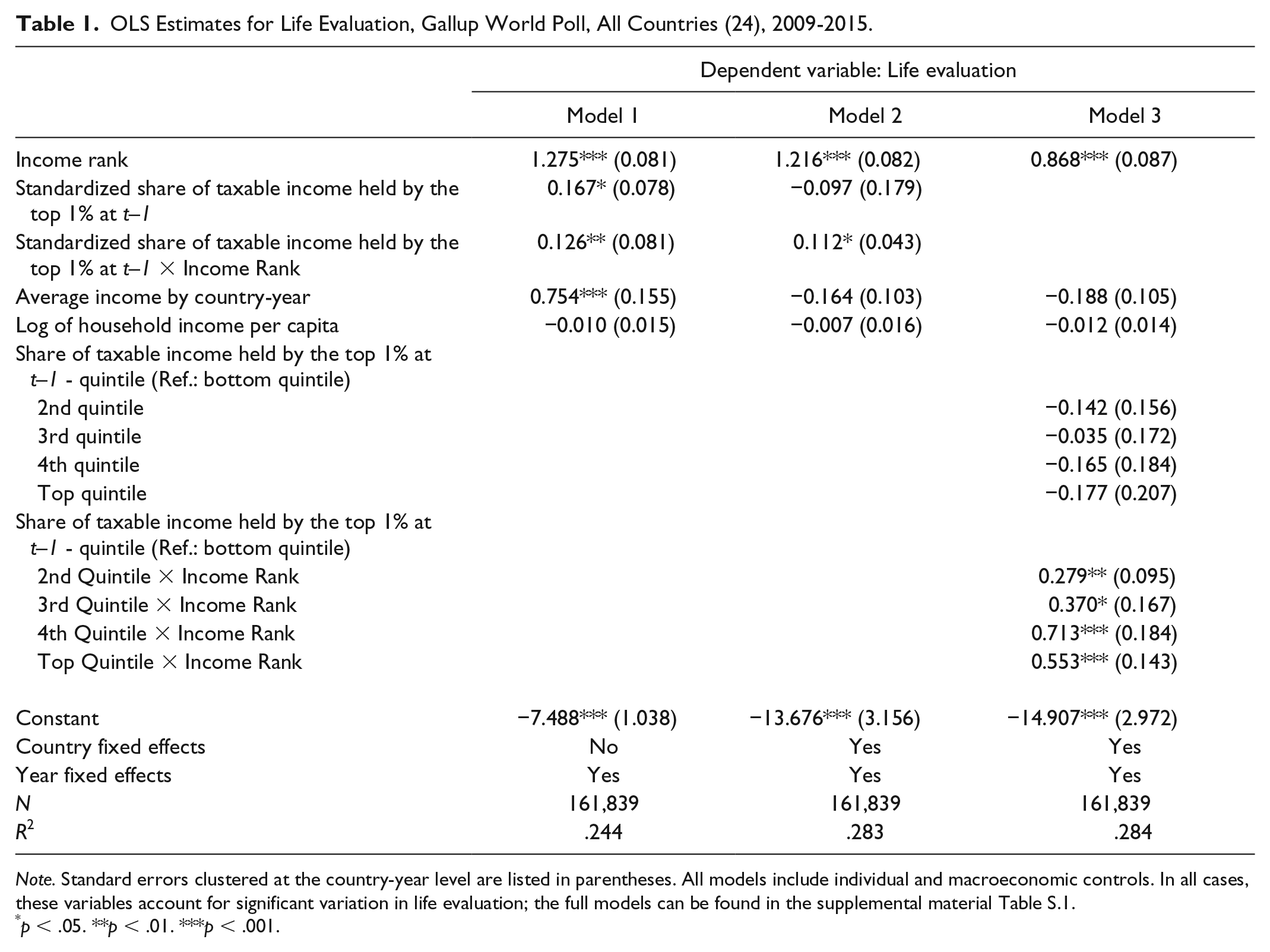
However, to be confident that the raw data pattern observed in Figure 1 is evidence that income rank matters more in more unequal countries, we need to account for relevant covariates such as absolute income, average income by country-year, 3 and other sociodemographic and macroeconomic variables. We do this in the regressions shown in Table 1, where in Model 1 we found life evaluation to be positively and statistically significantly correlated with normalized income rank (b = 1.275, p < .001, 95% CI [1.114, 1.436], η2 = .014); that is, being ranked higher in the income distribution was, on average, associated with higher life evaluation. Consistent with Boyce et al. (2010), the inclusion of income rank removed the effect of absolute income, while the average income at the country-year level was positive and statistically significantly different from zero in a model without country and year fixed effects. Also, consistent with cross-sectional evidence from the United States (Cheung & Lucas, 2016), we were able to show that a one-unit increase in an individual’s income rank was statistically significantly associated with a greater increase in life evaluation in more unequal countries; the interaction coefficient was positive and statistically significant at the 5% level (b = 0.126, p = .004, 95% CI [0.040, 0.212], η2 = .001). This implies that while the marginal effect of income rank on life evaluation was approximately 1.3 points (on a 0-10 scale) for an average person residing in an average top income shares country, this effect was roughly 10% higher (1.275 + 0.126 = 1.401) for an average person living in a country with a one standard deviation higher top income share than the average. 4
OLS Estimates for Life Evaluation, Gallup World Poll, All Countries (24), 2009-2015.
Note. Standard errors clustered at the country-year level are listed in parentheses. All models include individual and macroeconomic controls. In all cases, these variables account for significant variation in life evaluation; the full models can be found in the supplemental material Table S.1.
p < .05. **p < .01. ***p < .001.
A statistically significant and positive coefficient for this interaction was also observed in Model 2 (Table 1), in which country-specific effects were differenced out by including country dummies in the regression. Moreover, after replacing the continuous top income measure with top income quintile dummies (Table 1, Model 3), we continued to see a near-monotonic increase in the estimated marginal effects of income rank on life evaluation by top income quintiles. 5 For example, holding absolute income, among other things, constant, a one standard deviation increase in income rank for individuals residing in the top income shares quintile countries produced a life evaluation score that was, on average, 0.55 (p < .001, 95% CI [0.269, 0.835], η2 = .001) higher than that obtained for individuals residing in countries that are placed at the bottom of the income shares quintiles.
It is worth noting here that the marginal effect of income rank on life evaluation peaked for people reporting to be in the second top income quintile and not those in the top; the coefficient of the interaction between the 4th quintile and income rank is 0.713 (p < .001, 95% CI [0.608, 0.818], η2 = .001). It is possible that in an extremely unequal society the positive effect of moving up in income rank is partially offset by an increase in negative externalities associated with being richer than others. For example, relatively richer individuals are more likely to be the target of criminal activities, which are more prevalent in highly unequal societies (e.g., Kennedy, Kawachi, Prothrow-Stith, Lochner, & Gupta, 1998), which could in turn cancel out the effect of income rank on their subjective well-being. Nevertheless, despite observable differences in coefficient size, we were unable to reject the null hypothesis that the two coefficients—the coefficients of the “4th Quintile × Income Rank” and the “Top Income Quintile × Income Rank” interaction terms—are statistically the same (p = .449). This suggests that the marginal effect of income rank on life evaluation is similar across the two top income shares quintiles.
We then explored whether income rank and income inequality were also associated with measures of affective well-being (all results are presented in Table 2). We found that respondents whose income ranked higher than that of other people in their reference group (i.e., country and survey year) were overall more likely to have felt enjoyment (b = 0.245, p < .001, 95% CI [1.157, 1.411], odds ratio [OR] = 1.278), happiness (b = 0.304, p < .001, 95% CI [1.217, 1.511], OR = 1.356), and to have smiled the day before (b = 0.193, p < .001, 95% CI [1.102, 1.335], OR = 1.213), although they were less likely to have felt well-rested (b = –0.519, p < .001, 95% CI [0.527, 0.671], OR = 0.595). More importantly, we further found that, in more unequal countries, income rank was likely to buy additional enjoyment (b = 0.215, p < .001, 95% CI [1.182, 1.299], OR = 1.239), happiness (b = 0.220, p < .001, 95% CI [1.149, 1.351], OR = 1.246), an increased likelihood to have smiled the day before (b = 0.073, p < .001, 95% CI [1.029, 1.124], OR = 1.076), and less sadness the day before (b = –0.101, p = .005, 95% CI [0.843, 0.969], OR = 0.904). We do not have a strong theory to explain why income rank predicts positive affect better than negative affect. However, we know from previous evidence that higher income is associated with less daily sadness and anxiety but not with more daily happiness (Kushlev, Dunn, & Lucas, 2015). Hence, it is plausible to assume that people with low incomes are more likely to be sad and anxious no matter where they are positioned on the income ladder relative to others, whereas a higher income only contributes to increased daily happiness if it allows people to obtain a higher income rank within their reference group. This explanation would be consistent with the results shown in Table 2, in which an increase in the log of household income per capita is found to be negatively and statistically significantly correlated with feelings of stress and sadness only.
Binomial Logistic Regressions for Positive and Negative Emotional Experiences, Gallup World Poll, All Countries (24), 2009-2015.

Note. Standard errors clustered at the country-year level are listed in parentheses. All models include country-year fixed effects as well as individual and macroeconomic controls. In all cases, these variables account for significant variation in life evaluation; the full models can be found in supplemental material Table S.9.
p < .05. **p < .01. ***p < .001.
Our final analysis investigated whether the moderating effect of income inequality varied significantly across different continents. For this subsample analysis, we reported the estimated effects of income rank on life evaluation for (a) a person residing in a country with an average top income share—that is, where the mean of the standardized top income shares equals zero—and (b) a person residing in a country where the top income share is one standard deviation higher than the average (Figure 2). Consistent with fairness–legitimacy theory and previous evidence on the effect of income inequality on individual happiness in urban China (Jiang et al., 2012), our results showed that the marginal effects of income rank on life evaluation were largest in Asia, which includes China—one of the countries with the highest level of income inequality in the world (and based on previous evidence, probably one of the most tolerable of income inequality as well). This is followed by Europe, North America, and the rest of the world. The finding that income rank matters more to the life evaluations of Europeans than of North Americans is surprising as it is not consistent with fairness–legitimacy theory. U.S. Americans tend to perceive inequality to result from effort and merit, whereas Europeans tend to perceive inequality to be the result of luck and social structures. However, this result might have been driven by the inclusion of Canadians in the North American sample, whose views on inequality are probably more in line with European attitudes. There was also evidence of a statistically significant moderating effect of income inequality on the association between well-being and income rank in Asia, Europe, and North America, but not for the remaining countries in our sample.
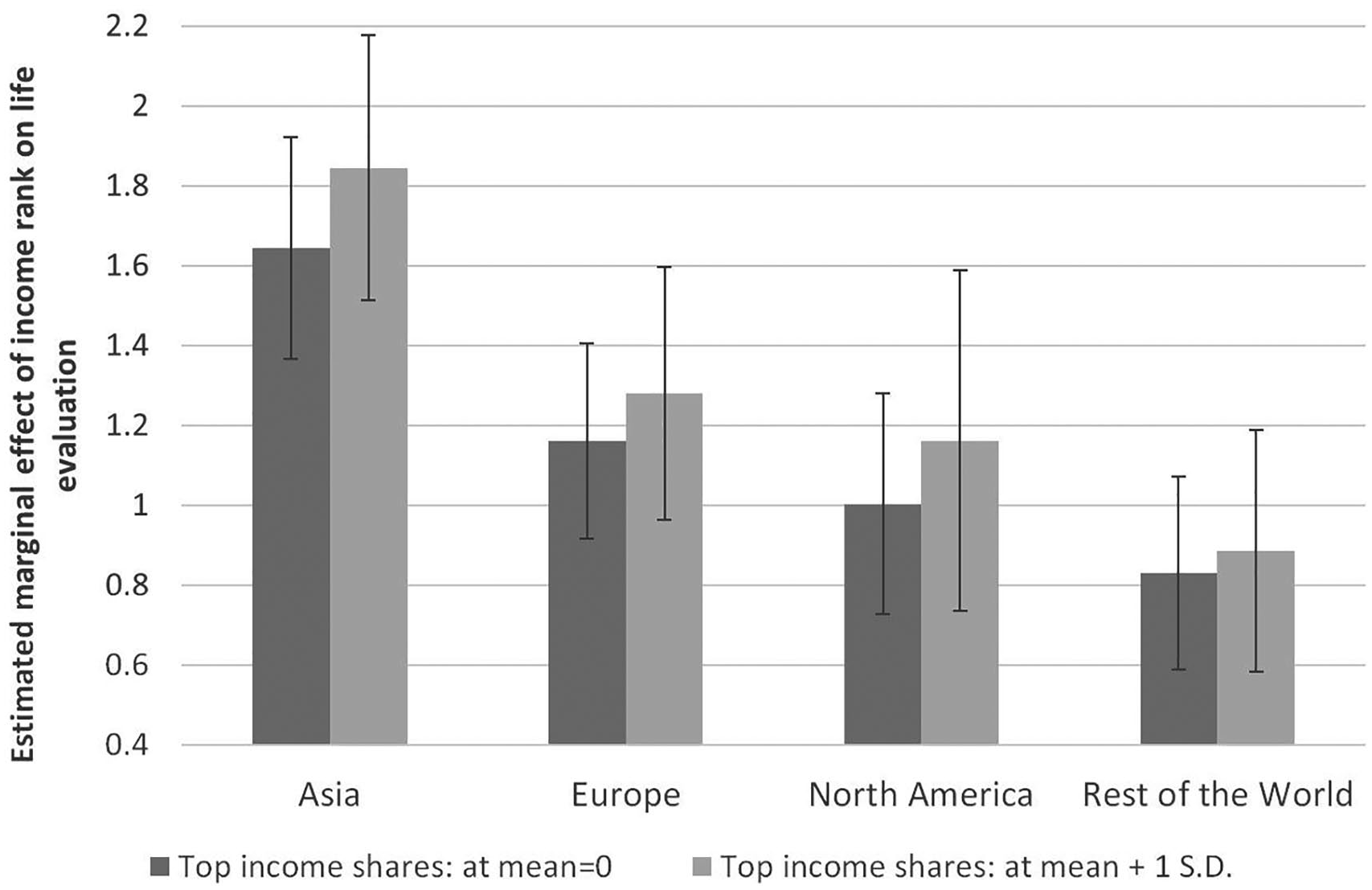
The estimated marginal effects of income rank on life evaluation at different levels of income inequality by continents, regression-corrected.
Finally, similar substantive results were obtained when we re-estimated the regression equations using ordered logit estimators or multi-level models with random intercepts (by country); the results can be found in Tables S.2 and S.3 respectively in the supplemental material. In addition, we conducted several robustness checks to confirm our overall findings. This included running regressions with different specifications for the reference groups on which the income rank variable is based (e.g., by region, gender, and age). We also tested employing a simple relative income variable, that is, the respondent’s income relative to the mean income of the reference group, as well as replacing the top income shares by the Gini Index 6 as the measure of income inequality. The results obtained from these additional tests still lead us to the same conclusion: The marginal effect of income rank on an individual’s well-being is higher in more unequal countries. Full regression models can be found in Tables S.4 to S.8 in the supplemental material.
Discussion
Our analysis of more than 160,000 observations from 24 different countries showed that income rank, and not absolute income, strongly predicted life evaluation and some dimensions of positive—though not negative—affect. More importantly, we demonstrated that the marginal effect of income rank on well-being was higher in countries where income inequality at the top-end of the income distribution was high. The estimated moderating effect of income inequality on the association between income rank and well-being was large; a one standard deviation difference in top income shares produced a 10% gap in the effect of income rank on an average person’s life evaluation. This finding is consistent with social identity theory (e.g., Tajfel & Turner, 1979), which states that people internalize the values and preferences of other people in a society and, consequently, gain utility (or satisfaction) from achieving what their society values as important. In this study, it was the value that society placed on rank and status, which tend to be higher in places where income inequality is more pronounced (e.g., Paskov, Gërxhani, & van de Werfhorst, 2013). We also found evidence that the moderating effect of income inequality varied significantly within, as well as between, continents. Evidence in the Asian subsample analysis was consistent with the fairness–legitimacy hypothesis (e.g., Rawls, 1999). All results were robust to controlling for the average income at the country-year level and macroeconomic variables, as well as country and year fixed effects.
Although the literature on subjective well-being, relative income, and income inequality is still sparse, these findings are consistent with past work on income inequality and other social outcomes, such as social cohesion or health, which have been found to be negatively associated with income inequality possibly due to increased personal mistrust and increased competition and anxiety about social status (for an overview, see Buttrick & Oishi, 2017). The “status anxiety hypothesis,” which describes the emotional stress response stemming from income inequality and related status competition (Layte & Whelan, 2014), has been put forward for previous findings suggesting that high levels of income inequality in a society are damaging for health and other social outcomes (e.g., Pickett & Wilkinson, 2015; Wilkinson & Pickett, 2017). Evidence from European samples suggests that status anxiety is higher in countries with high levels of income inequality regardless of individuals’ income rank (Layte & Whelan, 2014; Paskov et al., 2013), supporting our conjecture that income rank is more important for subjective well-being in these societies. Relatedly, income inequality has been found to moderate the relationship between subjective social status and subjective well-being (Schneider, 2019). However, contrary to our analysis, most of these previous studies focused on European or American data, highlighting the need to extend such investigations to other regions.
Constraints on Generality
We now take the opportunity to express what we believe to be the constraints on generality of our findings (Simons, Shoda, & Lindsay, 2017). We found the main results to hold when various measures of income rank based on different specifications of the reference group (e.g., based on country, year, region, gender, and/or age) were used in the analysis. Furthermore, we obtained similar results when we replaced the top income shares with another measure of income inequality: the Gini index. Based on these robustness checks, we expect our main results to hold irrespective of the use of (a) different reference groups to construct the income rank variable and (b) different income inequality metrics such as the Hoover index or the Theil index.
However, we only included 24 countries in our analysis due to the lack of top income shares data for other countries. We can therefore not claim with certainty that the overall results would be found in other countries as well. As Figure 2 seems to suggest, including more countries from the Rest of the World, for example, countries from Sub-Saharan Africa and Latin America where the moderating effect of income inequality is noticeably smaller, may drive the overall estimates down toward zero. Hence, we will need significantly more data on top income shares across countries to be able to make our findings more generalizable. Finally, apart from the limitations stated above, we have no reason to believe that the results depend on other characteristics of the subjects, materials, or context.
Strength, Limitations, and Future Directions
Our results were based on nationally representative data obtained from 24 countries included in the GWP, comprising countries from many parts of the world, which allowed a comparison of income rank, well-being, and income inequality across a number of societies. However, as we explain above, it might not be possible to extrapolate our findings to other societies, and future studies should therefore aim to incorporate a larger set of countries. The limitations of our study were offset by the robustness of our findings across multiple model specifications, lending credence to our main findings.
A particular strength of this study can be found in its inclusion of affective measures of well-being in the form of daily positive and negative emotions. Most studies on relative income and subjective well-being focus on life evaluation—which we also include in our study—but do not consider other outcomes which are important elements of subjective well-being, such as affect or eudaimonia. To our knowledge, our study is the first to investigate the moderating effect of income inequality on the association between income rank and affective measures of well-being. Future studies should aim to incorporate all three elements of subjective well-being as described by the Organisation for Economic Co-Operation and Development (2013), namely evaluative well-being, affect, and eudaimonia. However, to the best of our knowledge, currently available data sets do not contain adequate measures of eudaimonic well-being, which describes a sense of meaning and purpose in life, to allow such an analysis across a large number of countries.
Implications
Our findings imply not only that individuals living in countries where income inequality is high may be able to gain more in terms of well-being from moving up income ranks, but also that the same individuals are likely to suffer more psychologically from moving down the income distribution. As well-being has been found to be generally more sensitive to losses than gains (Boyce, Wood, Banks, Clark, & Brown, 2013), our results could be viewed as a partial explanation for the negative association between income inequality and well-being often found in the literature (e.g., Delhey & Dragolov, 2014; Oishi, Kesebir, & Diener, 2011; Powdthavee et al., 2017).
Our results could be of interest to policymakers who consider addressing increasing income inequalities through tax and welfare policies to improve societal well-being. Although our analysis did not assess whether changes in income inequality over time would cause changes in life satisfaction, there is evidence that redistributive policies which lower income inequality are beneficial for the life satisfaction of both tax payers and welfare recipients (Cheung, 2018). Decreased levels of social status anxiety and a corresponding lower emphasis on income rank could be a plausible explanation for this observation.
Concluding Remarks
In sum, our study suggests that income rank is of greater importance for subjective well-being in societies with higher levels of income inequality. We described several psychological theories and mechanisms that could explain this observation, including the relative income hypothesis, range–frequency theory, social identity theory, the fairness–legitimacy hypothesis, and the status anxiety hypothesis. These findings may have implications for the consideration of redistributive tax and welfare policies.
More generally, we believe that our results, which pointed toward individuals having a greater incentive to pursue higher income ranks in more unequal countries, have shed a new light on the long-standing issue of why income inequality is much more persistent in some societies than others.
Supplemental Material
PSPB877413_suppl_mat – Supplemental material for Buying Happiness in an Unequal World: Rank of Income More Strongly Predicts Well-Being in More Unequal Countries
Supplemental material, PSPB877413_suppl_mat for Buying Happiness in an Unequal World: Rank of Income More Strongly Predicts Well-Being in More Unequal Countries by Lucía Macchia, Anke C. Plagnol and Nattavudh Powdthavee in Personality and Social Psychology Bulletin
Footnotes
Acknowledgements
The authors are grateful to Gordon Brown and Redzo Mujcic for helpful discussions.
Author’s Note
N.P. developed the idea and designed the research, L.M. analyzed the data, and all authors contributed to the writing of the paper. The GWP (Gallup World Poll) data belong to the Gallup Organization. The data are made available by the Gallup Organization for a fee. For more information, see: http://www.gallup.com/services/170945/world-poll.aspx. The data are made available for free to researchers who obtain “Research Advisor” status with the Gallup Organization. The World Income Database can be obtained from the WID website:  .
.
Declaration of Conflicting Interests
The author(s) declared no potential conflicts of interest with respect to the research, authorship, and/or publication of this article.
Funding
The author(s) received no financial support for the research, authorship, and/or publication of this article.
Supplemental Material
Supplemental material is available online with this article.
Notes
References
Supplementary Material
Please find the following supplemental material available below.
For Open Access articles published under a Creative Commons License, all supplemental material carries the same license as the article it is associated with.
For non-Open Access articles published, all supplemental material carries a non-exclusive license, and permission requests for re-use of supplemental material or any part of supplemental material shall be sent directly to the copyright owner as specified in the copyright notice associated with the article.
