




Abstract
Self-control is often thought to be reactive and focused solely on the inhibition of responses elicited by temptations. In two studies, we assessed whether self-control can instead (a) be planned and (b) target the antecedents of the response to temptation. We assessed self-control planning, four antecedent-focused self-control strategies (i.e., situation-selection, situation-modification, distraction, and reappraisal) and one response-focused strategy (i.e., response-inhibition). In both studies, we found that self-control planning predicted the initiation of self-control independently of temptation. Each antecedent-focused self-control strategy uniquely predicted goal-progress. Response-inhibition did not produce consistent effects on goal-progress. These studies provide evidence that people proactively initiate self-control by targeting the antecedents of temptation and that doing so supports goal-progress.
During the pursuit of most long-term goals, we are occasionally tempted to engage in actions that run against that goal. Dieters are sometimes tempted gorge on dessert, and students are sometimes tempted to skip class. Self-control is needed to overcome such temptations. Indeed, previous research demonstrates that individuals high in trait self-control are better at maintaining a healthy weight and a high-grade point average (de Ridder, Lensvelt-Mulders, Finkenauer, Stok, & Baumeister, 2012), presumably because they are better at overcoming temptations (Tangney, Baumeister, & Boone, 2004).
Yet, how can people effectively control themselves and achieve their goals? Classically, research has focused on response-inhibition—inhibiting a behavioral response elicited by temptation (Duckworth, Gendler, & Gross, 2016a; Fujita, 2011). For example, the dieter can inhibit the urge to eat the cake, and the student force herself to attend class. Three related assumptions are made when self-control is defined exclusively in terms of effortful inhibition. A first assumption is that self-control consists solely of inhibiting behavioral responses (Duckworth et al., 2016a). We refer to this as the “inhibition assumption.” The second is that self-control requires a great deal of effort (Duckworth et al., 2016a). We refer to this as the “assumption of effort.” A final assumption is that self-control is carried out in response to temptation (Fujita, 2011). We refer to this as the “assumption of reactivity.”
Several developments challenge these three assumptions. In contrast to the inhibition assumption, theorists now suggest that self-control can consist of different strategies and that antecedent-focused self-control strategies may be more effective than effortful inhibition (Duckworth, White, Matteucci, Shearer, & Gross, 2016b). To briefly illustrate, the dieter may engage in the antecedent-focused strategy of situation-selection and avoid restaurants that serve his favorite desserts, or the student may engage in reappraisal and reinterpret the leisurely activities luring her away from class in a way that makes them unappealing.
In contrast to the assumption of effort, there are now indications that increased effort does not necessarily improve self-control or lead to goal-attainment (Gillebaart & de Ridder, 2015; Milyavskaya & Inzlicht, 2017). Finally, in contrast to the assumption of reactivity, a few studies suggest that self-control can be planned in advance (i.e., before a temptation is experienced directly: Fishbach & Hofmann, 2015) and that proactive planning ultimately makes subsequent acts of self-control more efficient (Webb & Sheeran, 2003).
Building off this, we conducted two studies examining the theorized precursors to (i.e., self-control planning and temptation) and consequences of (i.e., goal-progress) several self-control strategies in daily life. In the first study, we conducted a series of exploratory analyses and then sought to replicate our results in a second confirmatory study. We were primarily interested in addressing the following two questions:
What leads to the initiation of different self-control strategies? Can proactive planning contribute to the initiation of self-control, or is self-control always initiated in reaction to temptation?
Which self-control strategies predict progress toward long-term goals? In this regard, we considered the classically researched strategy of response-inhibition, as well as four recently proposed antecedent-focused self-control strategies.
Self-Control as Response-Inhibition
Self-control consists of any process that allows one to forgo immediate rewards in support of conflicting long-term goals (Duckworth et al., 2016a; Fujita, 2011). Although this conceptualization of self-control is becoming more widely accepted, it should be emphasized that self-control has not always been construed this broadly.
In the past, self-control was often equated with the effortful inhibition of unwanted impulses (Fujita, 2011). Drawing off a dual process framework, self-control is often framed as a conflict between reflective—controlled processes and impulsive—automatic processes (Hofmann, Friese, & Strack, 2009). In this research, response-inhibition is often treated as the defining feature of self-control because it is assumed that controlled processes are needed to prevent behaviors generated by impulsive processes (Fujita, 2011).
Perhaps the best example of this comes from experimental research on ego-depletion (Baumeister & Heatherton, 1996). In ego-depletion studies utilizing a sequential task paradigm, participants first engage in an effortful task (e.g., do not laugh at the comedian) and then carry out a subsequent self-control task where they are forced to inhibit an unwanted impulse (e.g., do not eat the chocolate). Although controversial, the results from these studies generally suggest that engaging in a prior effortful task reduces one’s ability to inhibit impulses on subsequent self-control tasks (Friese, Loschelder, Gieseler, Frankenbach, & Inzlicht, 2019). Although many debate how to explain this effect (Inzlicht & Berkman, 2015), most theorists agree that self-control, when carried out in this manner is quite effortful, and that the effort underlying self-control produces subsequent self-control lapses.
The emphasis on response-inhibition is also apparent in studies of self-control in daily life (e.g., Wilkowski, Ferguson, Williamson, & Lappi, 2018), which are largely based on Hofmann, Baumeister, Förster, and Vohs’s (2012) framework for understanding self-control in daily life. In this framework, a desire can emerge of varying strength when a person encounters a relevant stimulus (e.g., looking at a dessert menu). As most desires do not conflict with long-term goals (e.g., sleeping at night), people can enact them without need for self-control. However, when desires do conflict with goals (e.g., wanting to sleep during class), people need to initiate self-control to resist the desire. In these studies, self-control attempts are normally assessed by asking participants if they tried to resist a goal-conflicting desire (i.e., a temptation). Self-control success is assessed by asking participants if they successfully stopped themselves from enacting a temptation.
Interestingly, multiple studies of this type point to the limitations of response-inhibition. For example, early research assumed that the benefits of high trait self-control were due to effective response-inhibition (Tangney et al., 2004). Surprisingly, though, Hofmann et al. (2012) found that trait self-control does not predict the successful resistance of temptations. Instead, participants high in trait self-control seem to experience less temptation, possibly because they avoid tempting situations (Ent, Baumeister, & Tice, 2015). In addition, individuals high in trait self-control develop habits that effortlessly support self-control (Adriaanse, Kroese, Gillebaart, & de Ridder, 2014; Galla & Duckworth, 2015).
Directly relevant to the current investigation, Milyavskaya and Inzlicht (2017) used a similar daily protocol to assess the relationship between response-inhibition and goal-attainment. Surprisingly, Bayesian analyses indicated that response-inhibition did not facilitate goal attainment. Instead, experiencing stronger temptation thwarted goal-attainment—regardless of whether people tried to inhibit the ensuing response. In the following section, we review several other self-control strategies that might support goal-attainment.
A Framework for Understanding Proactive and Antecedent-Focused Self-Control
Adopting such a broad view of self-control presents its own set of challenges. The sheer number of cognitive and behavioral strategies someone could use to manage temptations makes it hard to provide a parsimonious account of how these strategies support goal pursuit daily life (see Duckworth, Milkman, & Laibson, 2018, for an extensive review). For this reason, we relied on multiple theories to develop the framework used in this study. We specifically relied on counteractive self-control theory (Trope & Fishbach, 2000) to distinguish between proactive and reactive self-control, and the process model of self-control (Duckworth et al., 2016b)—a theoretical extension of the well-supported process model of emotion regulation (Gross, 2015) that has been shown to effectively classify self-control strategy use (see Study 1 in Duckworth et al., 2016b). This allowed us to assess antecedent-focused self-control strategies as well as response-inhibition (Gross, 1998).
Reactive and Proactive Self-Control
The first distinction we make is between proactive and reactive self-control (Kleiman, Trope, & Amodio, 2016; Trope & Fishbach, 2000). Drawing off counteractive self-control theory, we suggest that self-control can be initiated either proactively or reactively (Trope & Fishbach, 2000). Reactive self-control refers to instances in which one engages self-control after directly and unexpectedly experiencing a temptation (Kleiman et al., 2016). For example, a dieter might unexpectedly encounter cookies at a party and react by resisting the urge to eat them.
On the contrary, self-control can be proactively initiated when people anticipate experiencing temptation in the future (Fishbach & Hofmann, 2015; Mysreth & Fishbach, 2009). If a dieter anticipates that cookies are typically served at holiday parties, he may bring an alternative, healthy snack to distract him from the cookies. Indeed, previous studies have shown that providing people with foreknowledge of an upcoming temptation improves self-control (Kleiman et al., 2016; Trope & Fishbach, 2000), especially when the conflict between the relevant desire and a goal is made apparent (Fishbach & Hofmann, 2015).
Foreknowledge of this type likely encourages people to develop specific plans for how to exert self-control (i.e., self-control planning; Duckworth, Taxer, Eskreis-Winkler, Galla, & Gross, 2019). There are several indications that planning in this manner can facilitate self-control success. For example, extensive research suggests that when people form implementation intentions (i.e., if-then plans that automatize goal supportive behaviors; Gollwitzer, 1999), their performance on laboratory-based self-control tasks is less affected by ego-depletion effects (Webb & Sheeran, 2003). Additional studies suggest that developing plans to help one overcome anticipated temptations supports goal-achievement (Fishbach & Hofmann, 2015).
Proactive self-control certainly has its own limitations. For example, it cannot be executed in the absence of foreknowledge. However, given that much of daily life is consistent and predictable (Quellette & Wood, 1998), we suggest that it still holds great potential. Another limitation to proactive self-control is that it likely requires volitional and motivational resources that are not always available (Sjåstad & Baumeister, 2018). Nonetheless, there are indications that even brief acts of planning can have immense benefits (Gollwitzer, 1999). Research on implementation intentions indicates that taking a brief moment to consciously develop a very specific if-then plan can lead to the automatization of the planned behavior. In this way, an act of self-control can become more efficient and less reliant on the availability of effort and motivation (Webb & Sheeran, 2003).
Moreover, there are indications that people are willing to engage in planning of this type. For example, research on mind-wandering indicates that as much as 50% of our daily thoughts are not focused on our current task, and the majority of these task-irrelevant thoughts are focused on the future (D’Argembeau & Van der Linden, 2012; Mooneyham & Schooler, 2013). Importantly, previous studies have found evidence suggesting that many future-directed episodes of mind-wandering are acts of planning (Baird, Smallwood, & Schooler, 2011). Building off this we hypothesize that self-control planning might constitute one important precursor to self-control.
Antecedent-Focused Self-Control
Beyond overlooking planning, past self-control research has largely assumed that people effortfully inhibit the response to temptation itself (Fujita, 2011). Largely overlooked is the fact that self-control strategies can target the antecedents to one’s response to temptation (Duckworth et al., 2016b). As shown in Figure 1, Duckworth et al. recently proposed a model of self-control, which distinguishes self-control strategies based off when they are initiated in the impulse-generation cycle.
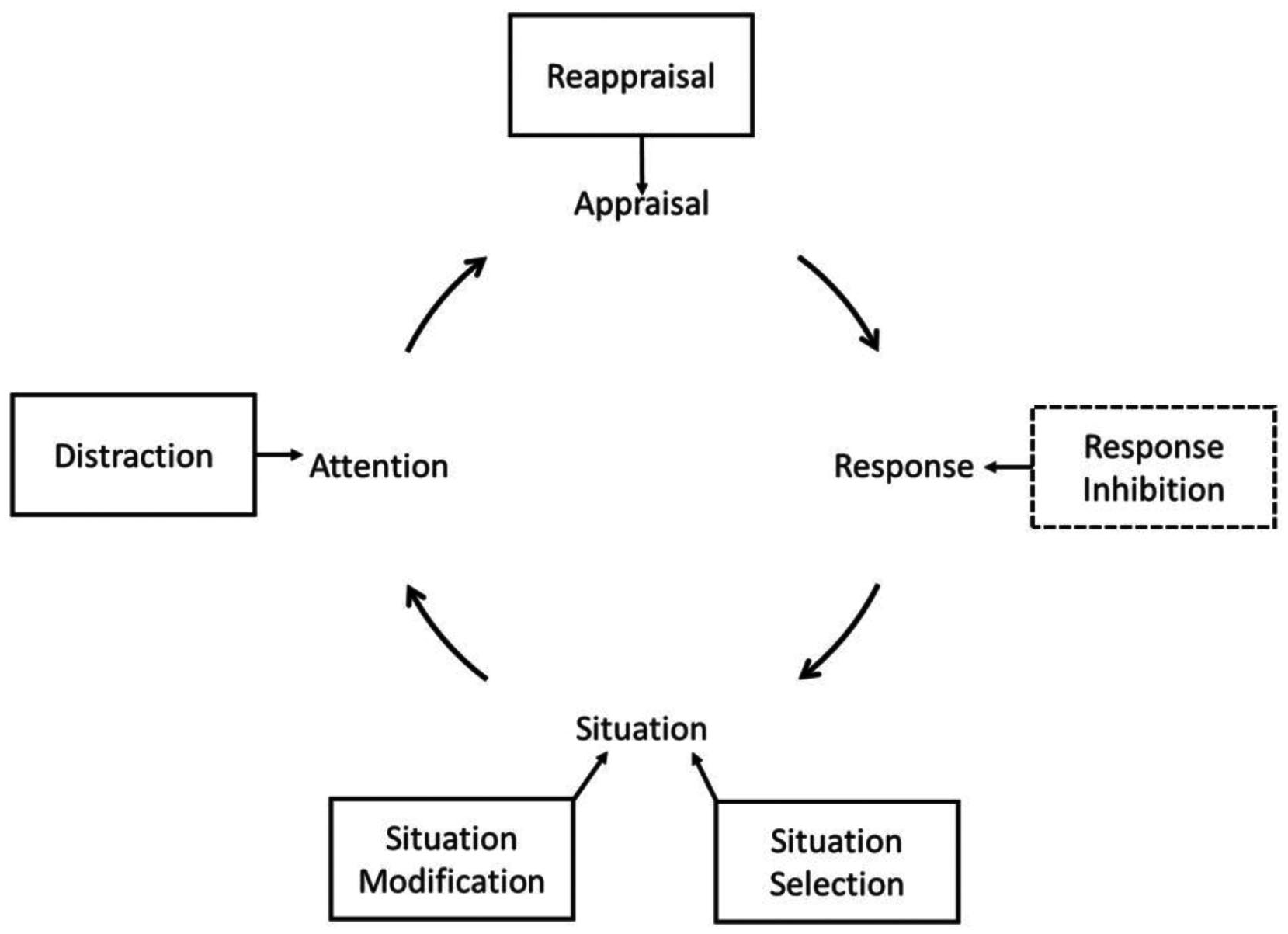
The process model of impulse generation and self-control.
According to this model, a person must pass through several stages before they can respond to a tempting stimulus. First, a person must enter a situation containing a tempting stimulus (e.g., a holiday party where cookies are present). Second, they must allocate attention to tempting stimulus (e.g., look at the cookies). Third, they must appraise the stimulus as desirable (e.g., think about how good the cookies would taste). In the final stage, a person can respond to the temptation (e.g., eat the cookies). Collectively, the impulse generation cycle describes the stages through which an impulse generates (i.e., during the situation stage), strengthens (i.e., during the attention, appraisal stages), and produces a behavioral output (i.e., the response stage; Gross, 1998).
In this framework, self-control can intervene at any of these stages. Using Gross’s (1998) distinction between antecedent-focused and response-focused emotion regulation, we refer to strategies initiated before the response stage (i.e., situation-selection, modification, distraction, and reappraisal) as antecedent-focused because they target the antecedents to the behavioral output that occurs during the response stage (i.e., enacting or resisting a temptation). Strategies initiated during the response stage are called response-focused because they focus on altering one’s response to temptation. From this viewpoint, response-inhibition becomes just one of many possible self-control strategies. The fact that it intervenes at a relatively late stage may make it less effective than earlier strategies as temptations should strengthen the longer an individual remains in this cycle (Duckworth et al., 2016a).
A first antecedent-focused strategy is situation-selection—defined as avoiding situations where temptation is present. If a dieter knows the cookies are in the kitchen, they may remain in the living room (Mahoney & Thoresen, 1972). Situation-selection might be an especially effective self-control strategy given the strong influence situations have on behavior. For example, previous studies have shown that situations sometimes lead people to engage in unhealthy eating behaviors (Meyers & Stunkard, 1980). Qualitative studies also show that individuals will avoid situations with unhealthy foods to manage their weight (Gatzemeier, Price, Wilkinson, & Lee, 2019).
A second strategy is situation-modification—defined as altering one’s situation to minimize the influence of temptation on behavior. If our dieter must remain in the kitchen to help cook, they may politely ask their host to move the cookies to the living room. Instances of situation-modification are well-documented in research on self-regulated learning. For example, Zimmerman (1989) found that students sometimes engage in environmental structuring (e.g., turning off one’s phone and placing it far away from them) to help them study. Directly related to this study, Duckworth et al. (2016b) found that instructing students to use situation-modification strategies (i.e., “removing temptations from sight rather than trying to resist them directly,” p. 335) helped them achieve academic goals.
A third strategy is distraction—defined as diverting one’s attention away from tempting stimuli. For example, the dieter may choose to not look at tempting cookies, even while they remain directly in front of him. Famously, in Walter Mischel’s delay-of-gratification studies (Mischel & Ayduk, 2004), children who were instructed to look away from a marshmallow were more capable of delaying consumption to receive a larger reward later. Recent studies suggest that individuals will also attempt to distract themselves when they feel tempted to eat high calorie foods (e.g., thinking of sports rather than tempting foods; Gatzemeier et al., 2019).
A fourth strategy is reappraisal—defined as changing the way one thinks about a temptation to make it seem less appealing. For example, the dieter might tell himself that cookies are disgusting and will upset his stomach. In Mischel’s delay-of-gratification studies, children instructed to think of marshmallows as “fluffy clouds” (rather than a tasty treat) were better at delaying consumption (Mischel & Ayduk, 2004). Additional research suggests that individuals will reframe indulgent foods by thinking of food as “fuel” rather than focusing on the enjoyableness of a specific food (Gatzemeier et al., 2019).
A fifth and final strategy is response-inhibition—using effort to inhibit one’s response to the tempting stimulus itself (e.g., don’t eat the cookie). As discussed earlier, this strategy is arguably the most widely studied self-control strategy (Fujita, 2011). However, there are indications that it may not always be effective (Milyavskaya & Inzlicht, 2017).
In the current studies, we investigated the theorized precursors to and consequences of these five self-control strategies on goal-progress in daily life. Regarding the theorized precursors to self-control, we investigated whether self-control was ever the result of self-control planning or if it was always a direct reaction to temptation. If people are inept planners or extraordinarily reluctant to engage in planning, then no evidence of proactive self-control should emerge. Drawing off past research, however, we hypothesized that we would find evidence for both proactive and reactive self-control (Kleiman et al., 2016). Regarding the theorized consequences, we investigated which of these self-control strategies reliably supported goal-progress.
Current Investigation
We conducted two studies to examine the theorized precursors to and consequences of five self-control strategies (i.e., situation-selection, modification, distraction, reappraisal, and response-inhibition) in daily life. Concerning the theorized precursors, we examined the effects of both self-control planning (i.e., proactive self-control) and temptation (i.e., reactive self-control) on the initiation of each self-control strategy. Concerning the theorized consequences, we examined the associations of these five self-control strategies with goal-progress in daily life.
It should be acknowledged that although our methodology is intensive and ecologically valid, it does not permit for causal conclusions. We therefore refer only to the “theorized” precursors and consequences of self-control, relying on past theory and experimental work to classify variables in this regard.
At the beginning of each study, participants identified three long-term goals. They then reported on the relevant processes for each goal (i.e., temptation, planning, self-control-strategies, and goal-progress) during a subsequent experience-sampling protocol. In Study 1, we report a series of exploratory analyses. In Study 2, we report confirmatory analyses. Study 2 also included a prospective measure of goal-progress to better establish effects of self-control on goal-progress. Because of their similarity, we report both studies together.
Studies 1–2
Method
Participants
Study 1
A total of 76 undergraduate students (44 female; M age = 21.23) completed the study for partial course credit. Participants needed to own a smartphone to complete the study. They provided 2,199 usable daily reports on 228 goals, resulting in 6,597 observations for analyses. More information on data reduction and exclusion procedures are reported in Supplemental materials (Sections 2 and 6). Both studies were designed to ensure at least 95% power to detect a small effect size (d = .2) at the “observation” level of analysis (i.e., the level of interest Study 1).
Study 2
A total of 103 undergraduate students (64 females, M age = 20.55) completed Study 2. They provided 1,940 daily reports on 309 goals, resulting in 5,820 observations to replicate the effects from Study 1.
Procedures
Study 1
Several measures were included to test multiple unrelated hypotheses. We only describe measures relevant to the current hypotheses, but report all additional materials in Supplementary materials (Sections 1 and 6).
Orientation Session
After providing informed consent, participants were asked to complete a computer-administered survey. In this survey, participants were first asked to identify three long-term goals they were pursuing in their day-to-day lives. Participants were instructed to choose three goals that (a) they were going to pursue through the end of the semester or further, (b) they were working toward on most days of their life, and (c) were truly distinct from one another. Participants were then asked to provide a brief description of each goal. In total, 39% of goals were academic (e.g., “improve my gpa”), 26% were related to health or athletic performance (e.g., “run a half marathon”), 13% were social (e.g., “help others succeed”), 18% were financial or career focused (e.g., “to live frugally”), and 6% were categorized as others (e.g., religious or traveling goals).
A research assistant next explained the experience-sampling protocol. Participants were told they would receive six text messages per day for 7 days and that they needed to complete 30 out of the 42 possible surveys within 10 min of the text message to receive full credit for the study. Texts were distributed between 9 a.m. and 11 p.m. and were sent at a random time during each 2-h window (e.g., between 9 and 11 a.m.), with the constraint that no two texts could be sent within 30 min. Each text contained a link to an online survey, along with descriptions of the participant’s three goals.
General Procedures
Upon accessing the survey, participants provided their name and short descriptions of their goals. Participants then completed two sections (focused on long-term goals and desires, respectively) in random order.
Goal-Specific Questions
In this section, participants were first asked about their use of self-control strategies. Specifically, they were asked whether they engaged in Self-Control Planning (“I thought of new or better plans for how I would resist temptation that would interfere with my goal”), as well as their use of Situation-Selection (“I avoided situations because they had temptations that would have interfered with my goal”), Situation-Modification (“I changed my situation to get rid of temptations that would have interfered with my goal”), Distraction (“When I was tempted to do something that would have interfered with my goal, I ignored it”), Reappraisal (“When I was tempted to do something that would have interfered with my goal, I changed the way I was thinking about it”), and Response-Inhibition (“When I was tempted to do something that would have interfered with my goal, I simply tried to resist doing it”). 1
All items were adapted from measures of these regulatory strategies used in the emotion regulation literature (Gross & John, 2003; Treynor, Gonzalez, & Nolen-Hoeksema, 2003). These frequently used measures are well-validated, and there is a great deal of evidence for their discriminant validity (e.g., Gross, 2015; Nolen-Hoeksema, Wisco, & Lyubomirsky, 2008). Situation-selection and situation-modification have unfortunately received less research attention. Thus, we adapted our existing items to describe these earlier regulatory strategies. We worked closely with several students from the target population while developing these items to ensure that they were comprehensible and conveyed the intended meaning. Participants answered all the aforementioned questions using a 0 (Not at all) to 4 (Extremely) response scale.
Finally, participants were asked about Goal-Progress (“During the last time period, how much closer did you move toward (or how much farther did you move away from) your goal”). This was assessed on a −4 (Extremely further) to 4 (Extremely closer) scale. Participants answered these questions for all three goals.
Desire-Specific Questions
As is typical of research on self-control in daily life (e.g., Hofmann et al., 2012), we assessed the experience and enactment of recently experienced goal conflicting desires. To do so, desires were first defined for participants as, “The urge to perform an action because it leads to an immediate feeling of satisfaction or immediate relief of distress.” Participants were asked to think of a desire they experienced within the last 30 min (N desires = 2,616) and select if from a dropdown menu based off Hofmann et al.’s 15 desires (see Supplemental Section 2).
After identifying a desire, participants were asked to indicate the strength of the desire (“How strong is this desire?”) using a 0 (No desire at all) to 7 (Irresistible) scale. To assess temptation, participants were asked, “Is this desire a temptation that would interfere with your goal to . . . ?.” This question was asked three times, once in relation to each of the participant’s goals. Participants were then asked if they tried to resist their desire (“Did you attempt to resist this desire?”) and their enactment of the desire (“Did you act on this desire at least to some extent?”). Temptation, resistance, and enactment were all assessed using a 0 (Not at all) to 4 (Extremely) response scale.
Participants were then given an opportunity to report on two more desires. If participants reported experience no desires, they were asked nine “bogus questions” (not intended for analysis) to discourage participants from reporting zero desires simple to finish the survey earlier. On average, participants reported 1.19 desires per report. Overall, the response rate was also quite high, as participants completed an average of 68.88% (M = 28.93) of the 42 possible surveys or 96.4% of required 30 surveys.
Study 2
Procedures and measures in Study 2 were largely identical to Study 1, with the following modifications.
Prospectively-Identified Goal-progress
We included a more objective measure of goal-progress used in previous studies (Sheldon & Elliot, 1998), which was primarily based off goal-attainment scaling (Kiresuk, Smith, & Cardillo, 1994). After identifying each goal during the baseline session, participants were asked to identify five outcomes representing “no progress,” “a little progress,” “moderate progress,” “quite a bit of progress,” and “exceptional progress.” Participants were instructed to ensure each outcome was attainable in the following week and concrete enough so that another person could tell if was obtained. They were further asked to ensure that differences between each outcome were equally spaced. Computerized instructions were used to guide participants through this process. Follow-up questions were used to ensure that participants were following the instructions.
At the end of the study, participants returned to the lab to identify the outcome they attained. We provided each participant with a list of the outcomes they identified for each goal. Participants were then asked which outcome they attained for each goal.
Goal-Specific Measure of Temptation
We included a goal-specific measure of temptation in Study 2’s Experience-Sampling protocol (i.e., “Were you tempted to do things which would interfere with this goal?”; 0 [Not at all] to 4 [Extremely]) to address issues with the Study 1 Temptation measure (discussed below).
Changes to General Procedures
The experience-sampling protocol was shortened to accommodate for the extra time needed to complete the prospective goal-progress procedure. Participants received six text messages for 6 days, distributed between 10 a.m. and 8 p.m. They needed to complete 23 surveys and the final session to receive full credit. The content of participants’ self-selected goals was quite similar to Study 1 (39% academic, 31% health/athletic, 12% social, and 10% financial/career). Compliance was acceptable, as participants completed 52.3% (M = 18.83) of the 36 requested surveys or 81.86% of the 23 required surveys.
Results
General analytic procedures
We used multilevel modeling (MLM) to account for the nested structure of our data (Nezlek, 2008). All analyses were conducted using SAS Proc Mixed. We report 95% confidence intervals (CIs) for unstandardized beta coefficients. Any interval that does not overlap with zero provides evidence for statistical significance at a 95% confidence level (Cumming & Finch, 2005).
Nested structure
The data exhibited a complex nested structure. Each observation (e.g., progress made by participant 1 on their dieting goal during Tuesday at 3 p.m.) was simultaneously nested within a goal (e.g., Participant 1’s dieting goal) and a timepoint (e.g., Participant 1’s experiences Tuesday at 3 p.m.), which were in turn nested within a participant (Participant 1). To account for this, we estimated three-level cross-classified models. In these models, observations were modeled at level 1; goals were modeled at level 2; timepoints were modeled via a cross-classification at level 2; and participants were modeled at level 3.
Centering
Centering around cluster-means is commonly recommended in MLM (Enders & Tofighi, 2007). However, this was not possible due to complex structure of our data. As such, we employed an alternative strategy in which observation-level predictors were centered around the sample’s grand mean, and then the mean value of each predictor at a specific level was added as a covariate (Enders & Tofighi, 2007; Kreft, de Leeuw, & Aiken, 1995). For example, to examine the effect of distraction on goal-progress, the observation-level value of distraction was entered as the main, substantive predictor of goal-progress. To separate this from effects at other levels, covariates were added representing the average level of distraction for that goal (averaged across timepoints), timepoint (averaged across goals), and participants (averaged across both goals and timepoints). Although these effects are not of theoretical interest, we report them in Supplemental materials (Sections 3 and 8).
Effect sizes
To provide effect estimates, we calculated the within-cluster variance explained by a predictor, R2(f1) W , or set of predictor variables (Rights & Sterba, 2018). Additional effect size indices are reported in Supplemental Sections 4 and 8, as they are not of direct theoretical interest. These procedures for estimating effect sizes are relatively new, so we were unable to estimate effect sizes in the full three-level cross-classified models. Instead, we used a two-level model where each predictor was person-mean centered (Enders & Tofighi, 2007). We used Cohen’s (1988) benchmarks for interpreting effects, specifically, R2 values of .02, .13, and .26 can be considered small, medium, and large, respectively. However, these guidelines were originally developed for ordinary least squares (OLS) regression, and even Cohen himself admitted they were selected somewhat arbitrarily.
Descriptive statistics
Descriptive statistics are reported in Table 1. As can be seen there, the five self-control strategies examined in our studies were all used occasionally. Although there were many instances where participants did not report using a strategy, greater than 50% of reports indicated use of a strategy. Reports of self-control-strategy-usage were higher in Study 2 than Study 1. This is surprising given these studies’ similarity, even in terms of time of year. It is possible that the addition of the goal-specific temptation question in Study 2 may have better highlighted the need to engage in self-control (Inzlicht, Legault, & Teper, 2014).
Descriptive Statistics from Study 1 (and Study 2).
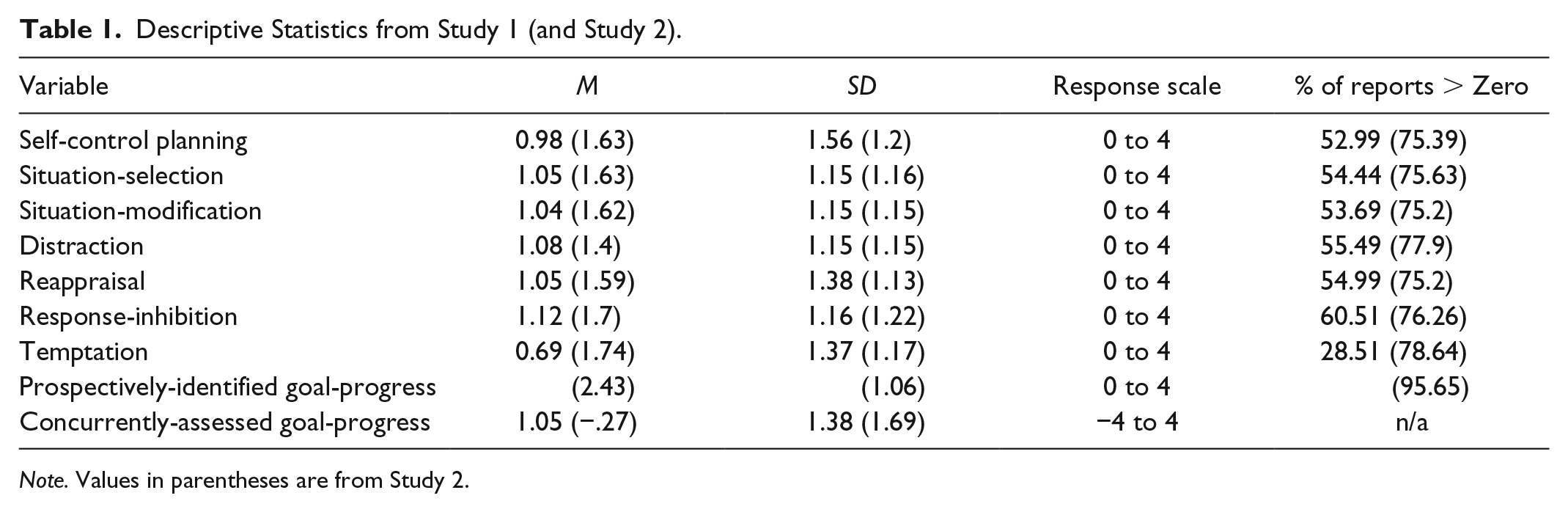
Note. Values in parentheses are from Study 2.
Distinguishing self-control strategies
Analytic procedures
We first examined the amount of shared variability between the self-control strategies assessed in both studies. We expected clear evidence of overlap between self-control strategies, as many instances of real-world goal-pursuit undoubtedly combine multiple self-control strategies (e.g., modifying a situation to help one ignore a tempting stimulus). Nonetheless, we did not expect overlap to be so strong as to suggest equivalence. If this was the case, it would demonstrate the constructs were not redundant, and they could be considered separate predictors of goal-progress. To do so, we calculated a series of R2(f1) W (Rights & Sterba, 2018) statistics to determine the amount of observation-level (i.e., level 1) variance shared between self-control strategies. In Study 2, the important outcome of prospectively-identified goal-progress was measured at the goal level (i.e., only measured once per goal). We thus also calculated shared variance at the goal level to determine if self-control strategies could serve as independent predictors of this outcome. Although no analyses were conducted at the goal level in Study 1, we also provide this statistic in Study 1 for the interested reader.
Results
As shown in Table 2, we found consistent evidence that the five self-control strategies of primary interest (i.e., situation-selection, modification, distraction, reappraisal, and response-inhibition) overlapped in both studies (i.e., all R2(f1) W values exceeded Cohen, 1988, benchmark for a large effect). However, at the analytic level of primary interest (i.e., observation level 1), none of the R2(f1) W values were so high as to suggest equivalence. Across all strategies and studies, the majority of variance was unshared. This suggests these self-control strategies are related but separable constructs when assessed at the observation level.
Variance Shared Between Self-Regulatory Processes.

Note. Values shown in parentheses are at the goal level. All other values are at the observation level.
In Study 2, however, strategies shared greater variability at the goal level. Specifically, 42% to 55% of the variability between any two strategies was shared. These values were high enough that they could lead to problems understanding the unique contribution of each strategy to goal progress (i.e., they are equivalent to an r > .70). Variance-shared statistics at the goal level were generally similar in Study 1, with between 33% and 61% of the variance shared. This could suggest that goals differ in the extent to which people use self-control and not in the specific self-control strategies used (Milyavskaya & Werner, 2018).
Table 2 also indicates that the self-control strategies shared variance with self-control planning (between 16% and 27% at the observation level). This establishes that self-control planning is not only independent of the other self-control strategies but also meaningfully related.
Reactive and proactive precursors to self-control
Analytic procedures
We next sought to determine if people sometimes engage in self-control both reactively (i.e., in reaction to temptation) and proactively (i.e., as a result of self-control planning). To do so, we first entered Temptation and Self-Control Planning as the sole predictor of each self-control strategy in separate MLMs. This provided the total or zero-order effect of Temptation and Self-Control Planning on each strategy. We next sought to determine if each variable predicted the self-control strategies independently of each other. To estimate these unique-effects, Temptation and Planning were simultaneously entered as predictors of each strategy.
Results
Table 3 presents results involving Self-Control Planning. In both studies, Planning exhibited a significant, positive relationship with each self-control strategy at the zero-order level and after controlling for Temptation. According to Cohen’s (1988) benchmarks, these effects would be considered small to medium in magnitude. Such results suggest that people sometimes engage in self-control in a truly proactive and planned manner (and not always as a direct reaction to temptation). Interestingly, Planning’s relationship with earlier strategies (e.g., situation-selection and modification) appeared stronger than its relationship with later strategies (e.g., response-inhibition) (as indicated by the minimal overlap between confidence intervals). This suggests that planning is more critical for earlier strategies, even if it can usefully facilitate all strategies we examined.
The Effects of Self-Control Planning on Self-Control Strategy-Use.
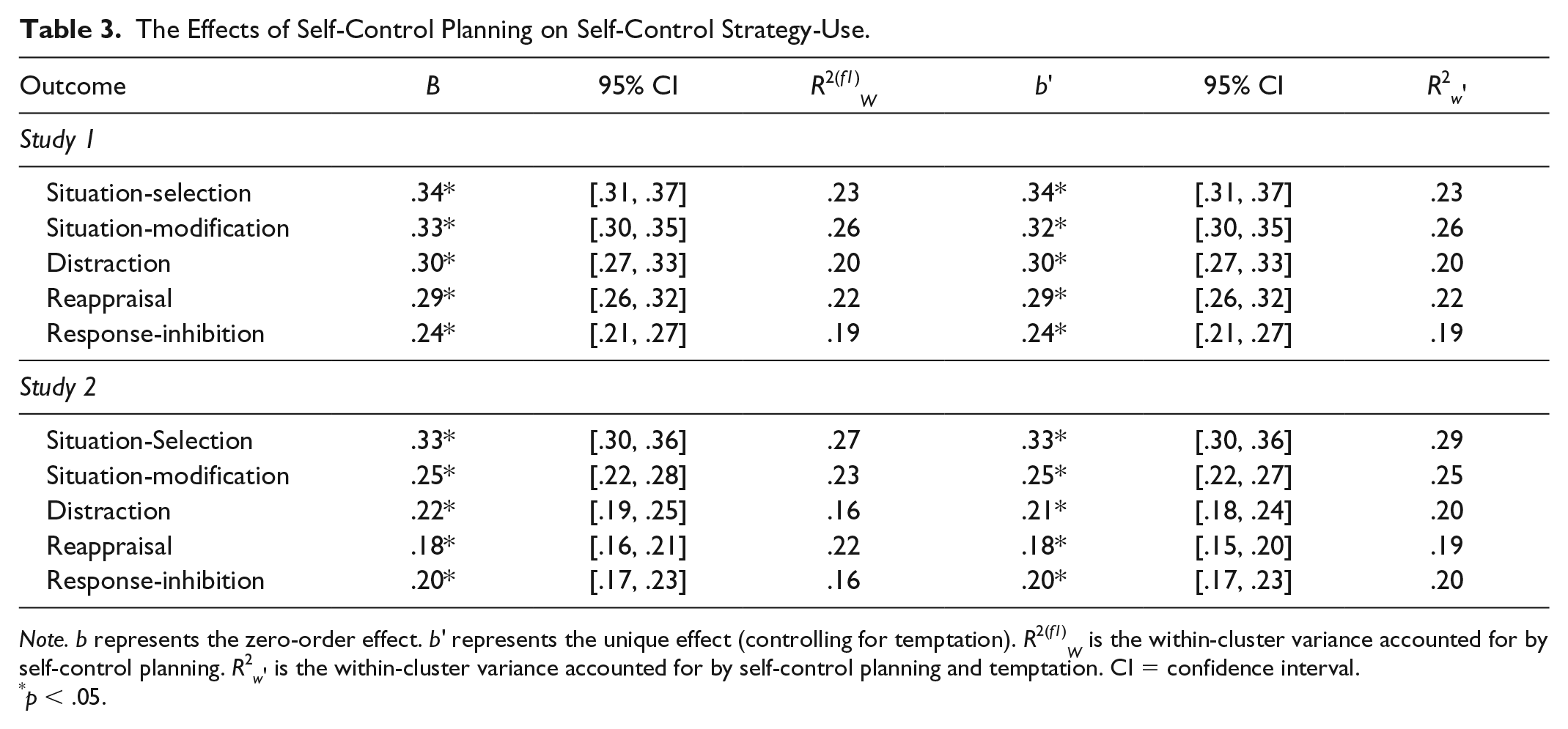
Note. b represents the zero-order effect. b’ represents the unique effect (controlling for temptation). R2(f1) W is the within-cluster variance accounted for by self-control planning. R2w’ is the within-cluster variance accounted for by self-control planning and temptation. CI = confidence interval.
p < .05.
Results involving Temptation are presented in Table 4. In Study 1, Temptation only exhibited significant relationships with Situation-Modification and Response-Inhibition. The significant relationship with inhibition is of course consistent with previous research (e.g., Hofmann et al., 2012). However, it was quite small in magnitude (explaining <1% of variance) and did not generalize to three of the other strategies. We became concerned that these effects were so weak because temptation was not directly assessed in relationship to a goal (as the self-control strategies were), but was instead assessed in terms of conflict between a desire and a goal.
The Effects of Temptation on Self-Control Strategy-Use.
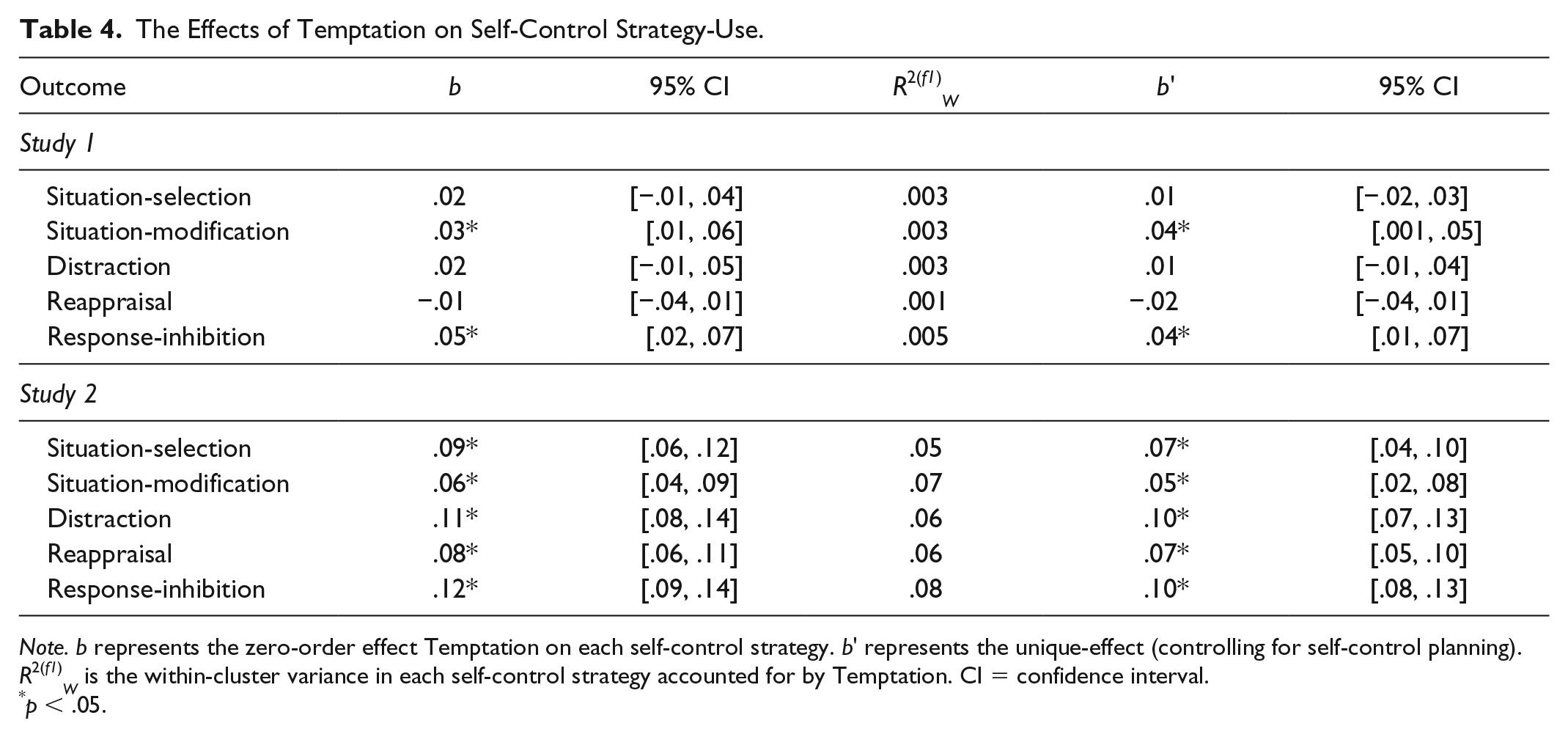
Note. b represents the zero-order effect Temptation on each self-control strategy. b’ represents the unique-effect (controlling for self-control planning). R2(f1) W is the within-cluster variance in each self-control strategy accounted for by Temptation. CI = confidence interval.
p < .05.
In Study 2, we therefore added a goal-specific measure of temptation adapted from Wilkowski and Ferguson (2016). As can be seen in Table 4, this measure exhibited significant zero-order and unique relationships with each self-control strategy. Such results suggest that all self-control strategies can be initiated in reaction to temptation. Interestingly, this effect appeared to be stronger for later strategies (e.g., response-inhibition) compared with earlier strategies (e.g., situation-modification) (as indicated by the minimally overlapping error bars). This suggests that later strategies are more likely to be implemented in a reactive fashion. Perhaps more importantly, though, planning was a significant predictor of strategy-use even after controlling for this improved temptation measure (see Table 3). Thus, self-control can also be initiated in a proactive manner.
Theorized consequences of self-control strategies: Goal-progress
Analytic procedures
We next examined which self-control strategies predicted Goal-Progress. To do so, we first estimated five separate MLMs in which each self-control strategy was entered as the sole substantive predictor of Goal-Progress. This provided the zero-order effect. To estimate the unique-effect, we estimated a model in which all five self-control strategies were simultaneously entered as predictors.
Results
As can be seen in Table 5, all five self-control strategies exhibited significant, positive relationships with Goal-Progress at the zero-order level in both studies. Moreover, all such effects were non-trivial in nature (i.e., all R2(f1) W values exceeded Cohen, 1988, benchmark for a small effect). Although some might dismiss such effects as explaining only a small amount of variance, such effects could be important as people consistently pursue goals and effects accumulate over time (Prentice & Miller, 1992).
Self-Control Strategy-Use Predicting Concurrently-Assessed Goal-Progress.
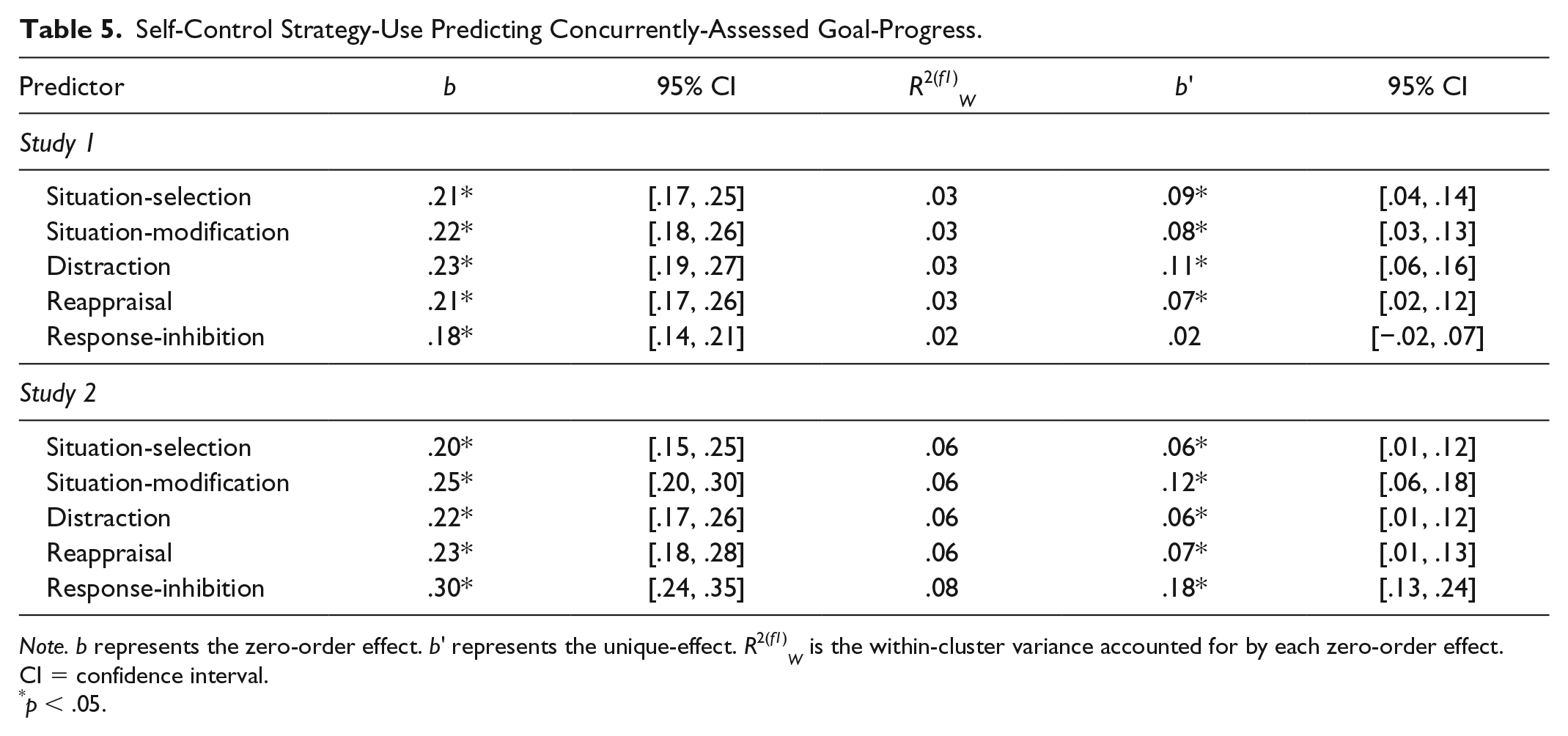
Note. b represents the zero-order effect. b’ represents the unique-effect. R2(f1) W is the within-cluster variance accounted for by each zero-order effect. CI = confidence interval.
p < .05.
When we calculated the unique-effects of each self-control strategy on Goal-Progress, the full model (containing all self-control strategies) explained a non-trivial amount of variance in Goal-Progress R2 (f1) W = .045, R2(f1) W = .100 in Studies 1 and 2, respectively. Furthermore, all antecedent-focused strategies (i.e., Situation-Selection, Situation-Modification, Distraction, and Reappraisal) uniquely predicted Goal-Progress, even after controlling for other strategies.
Although Response-Inhibition’s unique relationship with Progress was not significant in Study 1, both the zero-order and unique relationships were significant in Study 2. These results indicate that Situation-Selection, Situation-Modification, Distraction, and Reappraisal exhibit robust and replicable relationships with Concurrently-Assessed Goal-progress. In contrast, Response-Inhibition’s effects are less consistent, but still sometimes apparent. We discuss possible reasons for this discrepancy below.
Self-control strategies and prospectively-identified goal-progress
Analysis strategy
We next turned to the prospectively-identified measure of goal-progress. Although this measure of goal-progress is arguably more objective than the concurrent assessments, these analyses have considerably less power. Because this measure was only collected once for each goal (i.e., during the final session), fewer observations were available (i.e., 276 goals obtained from 92 participants who attended the final session). To conduct these analyses, we aggregated scores for each self-control strategy to the goal level. A simpler two-level model was estimated, where goals were nested within participants. Because of the simplified model, we reverted to the commonly-recommended (and now feasible) practice of person-mean centering predictor variables (Enders & Tofighi, 2007). As in previous analyses, we examined both the zero-order and unique-effects of each strategy.
Results
As can be seen in Table 6, all five self-control strategies exhibited significant relationships with Prospectively-Identified Goal-Progress at the zero-order level, which can be considered non-trivial in size (i.e., all exceeded Cohen, 1988, benchmark for a small effect). When all strategies were simultaneously entered as predictors, they continued to collectively explain a non-trivial amount of variance, R2(f1) W = .059. However, no strategies uniquely predicted this progress measure. As we noted earlier, however, this could be because these strategies shared a great deal of variance at the level of analysis considered here (i.e., the goal level). Thus, it may be that the variance shared between these constructs is the strongest predictor of Prospectively-Identified Goal-progress. Consistent with this, a Composite Self-Control variable (which represented the average of all five strategies) exhibited a significant relationship with Prospectively-Identified Goal-Progress, b = .79, 95% CI [.365, 1.217] that was non-trivial in magnitude R2(f1) W = .046. This might suggest that the combined use of several self-control strategies might best support goal attainment above and beyond the use of specific self-control strategies.
Self-Control and Prospectively-Identified Goal-Progress.
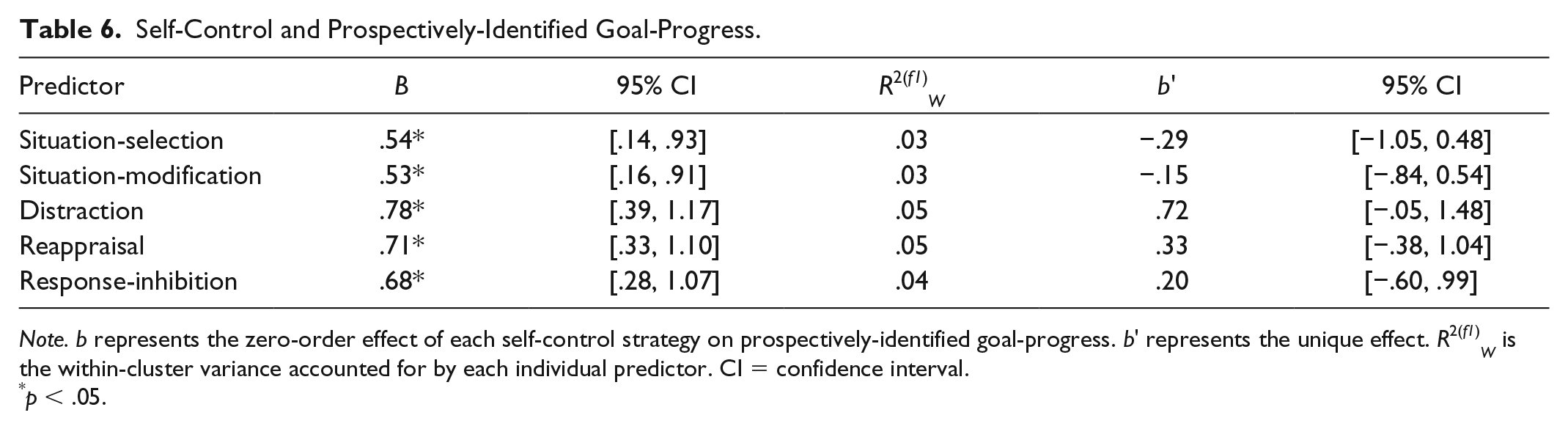
Note. b represents the zero-order effect of each self-control strategy on prospectively-identified goal-progress. b’ represents the unique effect. R2(f1) W is the within-cluster variance accounted for by each individual predictor. CI = confidence interval.
p < .05.
General Discussion
General Summary of Results
The majority of previous self-control-research has focused on the strategy of effortful response-inhibition (Fujita, 2011). However, there are increasing signs that this strategy may many times be ineffective (Milyavskaya & Inzlicht, 2017). Several theorists have therefore proposed that antecedent-focused self-control strategies (including situation-selection, modification, distraction, and reappraisal) may be more effective (Duckworth et al., 2016a); and such strategies may be planned prior to experiencing temptation (Fishbach & Hofmann, 2015).
To assess these possibilities, we conducted two studies to examine the theorized precursors to (i.e., self-control planning and temptation) and consequences of (i.e., goal-progress) such self-control-strategies in daily life. Five general patterns emerged. First, response-inhibition was inconsistently related to goal-progress. Thus, there are some indications that this strategy can be effective, but it is also difficult to claim that it is the most effective. Second, antecedent-focused self-control strategies (situation-selection, modification, distraction, and reappraisal) consistently (and independently) predicted goal-progress which indicates that these strategies facilitate goal-pursuit. Third, all five self-control strategies were clearly distinguishable at the observation level but shared considerably more variance when aggregated to the goal level. This suggests that these strategies are distinct as they are carried in daily life but tend to be more closely related when carried out in support of specific goals. Fourth, there was consistent evidence that planning predicted the initiation of all self-control strategies and did so independently of temptation. Thus, it appears that people can initiate self-control in a proactive fashion. Finally, temptation also predicted the use of self-control independently of planning. Thus, all self-control strategies examined here can also be initiated in a reactive fashion as well.
Response Inhibition’s Inconsistent Relationship with Goal-Progress
We found inconsistent evidence linking response-inhibition to goal-progress. Inhibition uniquely predicted goal-progress in Study 2, but not Study 1. This echoes inconsistencies in previous research. For example, Wilkowski and Ferguson (2016) found that attempting to resist temptations supported goal-progress, but Milyavskaya and Inzlicht (2017) did not. Although neither study explicitly assessed response-inhibition, they both followed a conceptualization consistent with this strategy (from Hofmann et al., 2012).
What could explain these inconsistencies? One possibility is that it reflects the normal and inevitable errors that occur during the research process (Cumming, 2013). Study 1 might represent a false-negative (type 2 error); or Study 2 might represent a false-positive (type 1 error). Additional research could help resolve this.
However, it is important to consider the possibility that this is not an error, and that it may illuminate the conditions when inhibition does (and does not) aid goal-pursuit. Perhaps even the seemingly minor modifications made to Study 2 could explain the variation. For example, in Study 2, participants were explicitly asked if they were tempted to do anything that might work against their goals (i.e., the goal-specific temptation measure). They were also asked to develop concrete outcomes for their goals (as part of the prospectively-identified progress measure). It is possible that one of these procedures (or both) may have made the utility of response-inhibition more apparent, and thus increased the effort participants invested in inhibition (Inzlicht et al., 2014). Clearly, more research would be needed to support such an account. For now, we can only say the evidence for response inhibition’s effectiveness is mixed.
The Effectiveness of Antecedent-Focused Strategies
It is often assumed that self-control should support goal-achievement. However, we consider it important to establish a relationship between antecedent-focused self-control strategies and progress for multiple reasons. Although trait self-control is consistently related to goal-achievement (de Ridder et al., 2012), these effects may not be due to the engagement of effortful self-control (de Ridder, Kroese, & Gillebaart, 2018). Thus, it is important to demonstrate that state self-control (i.e., in-the-moment acts of self-control) facilitates goal-pursuit, as it is not clear how state self-control relates to trait self-control (Milyavskaya, Berkman, & de Ridder, 2018). Beyond this, recent studies (Milyavskaya & Inzlicht, 2017) have failed to find evidence of an association between traditional conceptualizations of self-control and goal-progress.
In two studies, we found consistent evidence that antecedent-focused self-control predicted goal-progress. In Study 2, we also found evidence that these strategies predicted a prospective measure of goal-progress. Although we cannot make causal claims, these results are nonetheless consistent with claims that antecedent-focused self-control strategies support goal-attainment (Duckworth et al., 2016b).
It is natural to ask which antecedent-focused self-control strategy best supports goal-pursuit. Duckworth et al. (2016a) suggested that “situational strategies” (i.e., situation-selection and modification) might be more effective than even distraction or reappraisal. In contrast to such proposals, a visual inspection of our estimates does not suggest that any particular antecedent-focused strategy produces substantially larger effects on goal-progress (i.e., the confidence intervals were strongly overlapping; Cumming & Finch, 2005; see Tables 5 and 6). Instead, all four antecedent focused strategies reliably predicted goal-progress.
It is possible that several factors determine the effectiveness of a self-control strategy. In the emotion regulation literature, for example, reappraisal is generally effective at reducing negative emotions (Gross, 2015). However, Troy, Shallcross, and Mauss (2013) found that this strategy was quite ineffective at managing controllable stressors (which might be better addressed using situation-modification). If similar interactions occur as people regulate temptations, then it might be better to employ self-control strategies that match the demands of a situation.
Distinguishing between Self-Control Strategies
In both studies, we consistently found evidence supporting the distinction between the self-control strategies proposed by the process model (Duckworth et al., 2016b). Specifically, the variance shared between strategies was not high enough to suggest an equivalence. Interestingly, the overlap between strategies increased considerably when we aggregated to the goal level and this pattern held in both studies.
Why does this occur? One possibility is that goal-level differences in motivation may lead to the initiation of multiple self-control strategies as opposed to a single self-control strategy. For example, if a student turned down an offer to skip class and did so because they enjoyed the class and considered the class important (i.e., want-to motivation: Werner & Milyavskaya, 2019) they may use a combination of self-control strategies as opposed to relying on a single strategy. Perhaps this person would use situation-selection by arriving to campus early, while using distraction to help further control their temptation (e.g., ignoring text messages). Such a combination of strategies might be more effective than simply relying on a single strategy. This may explain why the variable representing the average of all self-control strategies predicted prospectively-identified goal-progress while only one strategy (i.e., distraction) uniquely predicted prospectively-identified goal-progress. In line with our emphasis on strategy-by-situation interactions, this could suggest that it is best to have a large repertoire of self-control strategies at one’s disposal as they pursue long-term goals.
Proactive Planning and the Initiation of Self-Control
Several theorists have proposed that self-control need not occur in direct response to temptation but can be initiated in a proactive and planned manner (e.g., Fishbach & Hofmann, 2015). In the current studies, we found evidence suggesting that participants sometimes formed plans for how to manage temptations and that these plans were indeed related to the initiation of diverse self-control strategies.
How might these plans improve self-control? Although planning requires effort (Sjåstad & Baumeister, 2018) we suggest that self-control planning might support self-control by making it less effortful during challenging situations. Previous studies suggest that simple acts of planning (Gollwitzer, 1999) support self-control by facilitating automaticity and making self-control more efficient and less dependent on limited resources (Webb & Sheeran, 2003). Planning of this type might act as a “bridge” to specific self-control strategies by making the initiation of these strategies contingent upon encountering specific cues (Duckworth et al., 2019). If this is the case, then planning ahead may eliminate the amount of deliberation and effort needed to initiate and carry out a self-control attempt in the moment.
It must be acknowledged, however, that the protocols used in the current studies may have encouraged participants to create these plans. If so, it suggests that relatively simple monitoring procedures could be used to enhance self-control planning in people’s lives. Clearly, this would be useful in helping people to effectively overcome their temptations (Fishbach & Hofmann, 2015; Inzlicht et al., 2014). Future research should examine this possibility more systematically.
However, our results suggest an important scientific question—do people naturally form plans for how to employ self-control? Planning is often experienced as effortful, so people will sometimes avoid planning (Sjåstad & Baumeister, 2018). Nonetheless, mind-wandering studies indicate that people’s thoughts are often about the future. As much as 50% of people’s daily thoughts are not focused on their current task (i.e., mind-wandering). Of these, a clear majority tend to be focused on the future and are often related to goals (Baird et al., 2011). Thus, people occasionally consider and plan for the future. Future research should employ less directive questions (e.g., ask for open-ended descriptions of participants’ thoughts) to better measure the true frequency and efficacy of self-control planning in daily life.
Antecedent-Focused Self-Control and the Reduction of Temptation
Beyond the enactment of temptation (e.g., actually eating too many cookies), an important question is what effect antecedent-focused self-control strategies have on the strength of temptation (e.g., feeling the urge to eat too many cookies). As antecedent-focused self-control strategies target the processes involved in generating and strengthening temptations, it seems likely that they may reduce the strength of experienced temptations.
We suspect this hypothesis may be correct. Nonetheless, the current experience-sampling design does not appear to be well-suited to test it. One reason for this is that the relationship between antecedent-focused self-control and the strength of temptation is likely bidirectional and dynamic, such that it varies rapidly across time. Previous research has generally emphasized how self-control attempts can be initiated in reaction to temptation experiences (e.g., Hofmann et al., 2012). For example, one may first feel the urge to eat an excessive number of cookies and then try to resist that urge. Antecedent-focused strategies could be employed as part of such efforts. After seeing cookies and feeling the urge to binge upon them, one may avert one’s attention from those cookies. Once this is done, antecedent-focused strategies may subsequently reduce or eliminate the urge to eat the cookies. In this way, temptation experiences may be an initial cause of a self-control act, but the self-control act may lead to subsequent reductions in temptation experiences.
In our studies, we asked about participants’ experiences over the last 30 min. Such a broad timespan may be too coarse to capture all aspects of this dynamic and rapidly varying relationship. It appears that the effect of temptation on antecedent-focused self-control dominated results within this protocol. After all, temptation was positively related to the use of these strategies (especially, in Study 2, where a goal-specific temptation measure was employed). We again emphasize that causal conclusions cannot be made on the basis of the current studies. Nonetheless, we think this is a plausible interpretation of such results.
We therefore suggest that other methods will be needed to determine the effects that these strategies have on temptation. Laboratory-based paradigms have been successfully employed to study the dynamic timecourse of temptation over shorter time periods. Mouse-tracking methodologies may prove useful, as they are capable of tracking decision-making processes under more microscopic time frames (Stillman, Medvedev, & Ferguson, 2017).
Conclusion
In two studies, we found that proactive and antecedent-focused self-control strategies were critically involved in the pursuit of long-term goals in daily life. Self-control planning predicted the use of multiple self-control strategies, and it did so independently of temptation. This suggests people can proactively initiate self-control. Perhaps more importantly, though, four antecedent-focused self-control strategies (situation-selection, modification, distraction, and reappraisal) consistently predicted goal-progress. Such results suggest that there is more to self-control than effortful inhibition in direct response to a temptation.
We encourage future researchers to examine a diversity of self-control strategies in specific contexts. To assess self-control in many domains we assessed these self-control strategies at a relatively high level of abstraction (e.g., situation-selection vs. avoiding fast food), it is quite possible that a more specific analysis of these self-control strategies could provide a better account of how self-control supports goal pursuit. Most importantly, we recommend an interactionist approach to understanding the effectiveness of different self-control strategies, as several moderators may influence the effectiveness of any self-control strategy.
Supplemental Material
Williamson_OnlineAppendix – Supplemental material for Nipping Temptation in the Bud: Examining Strategic Self-Control in Daily Life
Supplemental material, Williamson_OnlineAppendix for Nipping Temptation in the Bud: Examining Strategic Self-Control in Daily Life by Laverl Z. Williamson and Benjamin M. Wilkowski in Personality and Social Psychology Bulletin
Footnotes

Declaration of Conflicting Interests
The author(s) declared no potential conflicts of interest with respect to the research, authorship, and/or publication of this article.
Funding
The author(s) received no financial support for the research, authorship, and/or publication of this article.
Supplemental Material
Supplemental material is available online with this article.
Notes
References
Supplementary Material
Please find the following supplemental material available below.
For Open Access articles published under a Creative Commons License, all supplemental material carries the same license as the article it is associated with.
For non-Open Access articles published, all supplemental material carries a non-exclusive license, and permission requests for re-use of supplemental material or any part of supplemental material shall be sent directly to the copyright owner as specified in the copyright notice associated with the article.
