




Abstract
The status-legitimacy hypothesis proposes that people with lower socioeconomic status (SES) are more likely to justify the social system than those with higher SES. However, empirical studies found inconsistent findings. In the present research, we argue that at least part of the confusion stems from the possibility that objective and subjective SES are differently related to system justification. On one hand, subjective SES is more related to status maintenance motivation and may increase system justification. On the other hand, objective SES is more related to access to information about the social reality, which may increase criticism about the system and lead to lower system justification. These hypotheses were supported by evidence from five studies (total N = 26,134) involving both adult and adolescent samples in China. We recommend that future research on status-related issues needs to distinguish the potential divergent roles of objective and subjective SES.
Keywords
Despite the prevalence of social inequality on the global level, people seem to underestimate the degree of inequality (Norton & Ariely, 2011), overestimate their ability to move upward in the social hierarchy (Kraus & Tan, 2015), and tend to legitimize the social system (Jost, Banaji, & Nosek, 2004). These biased beliefs may have some potential negative consequences, but they can satisfy people’s psychological needs and facilitate political and social stability (Jost, 2017). In the past several decades, researchers have been dedicated to resolving the puzzle of when and why people justify the social system by focusing on a number of dispositional and situational factors (Jost et al., 2004; Jost & Hunyady, 2005). One important, yet unresolved, question is how one’s socioeconomic status (SES) relates to system justification. The status-legitimacy hypothesis predicts that compared with people from higher status groups, people from lower status groups are more prone to legitimize the social system (Brandt, 2013; Jost, Pelham, Sheldon, & Sullivan, 2003). Yet, extant research on social status and system justification is mainly restricted to Western societies and has shown inconsistent support for the status-legitimacy hypothesis (e.g., Brandt, 2013; Vargas-Salfate, Paez, Liu, Pratto, & Gil de Zúñiga, 2018).
Here, we sought to revisit the status-legitimacy hypothesis in China, an understudied non-Western country. Indeed, the income inequality in China has reached very high levels over the past four decades, and this is clearly demonstrated in the rising Gini coefficient from around 0.3 in the late 1980s to more than 0.5 in the 2010s (Xie & Zhou, 2014). Therefore, understanding how Chinese people who vary in their SES justify the social system would enrich the current theory and research on system justification across disciplines. In the present research, we distinguish between objective and subjective SES, and propose that at least part of the confusion regarding the status-legitimacy hypothesis stems from the possibility that these two constructs may relate to system justification differently.
System Justification and the Status-Legitimacy Hypothesis
System justification theory (SJT) posits that people are motivated to defend, justify, and uphold the status quo, and tend to think of themselves, their own group, and the social system as good and fair, which reflect the motives of ego justification, group justification, and system justification, respectively (Jost & Banaji, 1994). According to SJT, the dynamic process between these three motives is different among high- and low-status groups. It is unsurprising that people from high-status groups would accept the social system as legitimate, because this is consistent with their ego and group justification motives. Yet, for members of low-status groups, their tendency to accept the system as fair is clearly at odds with the motives for self-enhancement and ingroup favoritism. That is, if they regard the social system as fair, then they should blame themselves and their ingroup for their disadvantaged situation; if they consider themselves and their ingroup as good, then there must be an illegitimate system that causes their disadvantageous situation (Jost et al., 2001). Such conflicts between ego, group, and system justification motives make low-status individuals experience psychological conflicts and cognitive dissonance (Festinger, 1957). One solution for low-status individuals to reduce this dissonance is to hold a stronger belief that the social system is fair (Jost, Pelham, et al., 2003). Thus, one prediction derived from SJT and cognitive dissonance theory is that compared with members of high-status groups, members of low-status groups would be more prone to justify the social system (i.e., the status-legitimacy hypothesis; see Brandt, 2013). This phenomenon is particularly more prevalent under certain circumstances, such as in societies with democratic system, high economic inequality, and meritocratic culture, given that these contexts would make low-status people feel more responsible for their disadvantaged positions, and intensify the dissonance between ego, group, and system justification motives (Brandt, 2013; Jost, Pelham, et al., 2003).
Empirical Tests of the Status-Legitimacy Hypothesis
Despite a growing body of research testing the status-legitimacy hypothesis on the relation between social status and system justification, this hypothesis has received inconsistent empirical support. For example, Jost and colleagues (2003) found in U.S. national samples that low-income respondents were more likely to justify the social system, as they believed in the necessity of income differences and were less prone to criticize the government (Jost, Pelham, et al., 2003). A recent study using a probability sample in New Zealand also demonstrated that compared with members from high-status ethnic groups (Europeans), members from low-status ethnic groups (Asians and Pacific Islanders) perceived ethnic-group relations as fairer (Sengupta et al., 2015). Similarly, another study in China revealed that individuals with higher income and education level are more prone to criticize social unfairness (Whyte, 2009). Notably, this pattern of results seems to have emerged during late childhood and early adolescence, as evidence in Bolivia shows that 10- to 15-year-old children and adolescents from low-status ethnic groups endorse a stronger belief that the government is effective (Henry & Saul, 2006).
Other work, however, has revealed no relation or a positive relation between SES and system justification, and thus challenges the status-legitimacy hypothesis (Brandt, 2013; Caricati, 2017; Davidai, 2018; Vargas-Salfate et al., 2018). For example, using representative data from the United States and worldwide, Brandt (2013) found an overall weak negative or even positive relation between (objective and subjective) SES indicators and system justification that is measured by government trust and confidence in societal institutions. A cross-national study involving 36 countries showed that compared to people with lower subjective SES and objective SES (measured by income), those with higher SES perceived income distribution as fairer (Caricati, 2017). Some recent studies similarly revealed that subjective SES positively predicted system justification in both a cross-national sample involving 19 countries (Vargas-Salfate et al., 2018), and an income-stratified U.S. resident sample (Davidai, 2018, Study 3).
Clearly, these inconsistent findings call for more research into why SES sometimes facilitates but other times impedes system justification. Indeed, some studies have tried to reconcile these inconsistencies by testing some country-level moderators, such as the level of economic inequality and civil liberties (Brandt, 2013; Vargas-Salfate et al., 2018). In the present research, we tested another possibility that objective SES and subjective SES might relate to system justification differently, which was largely overlooked in previous studies.
Divergent Effects of Objective and Subjective SES
One’s SES is often revealed in two indicators: objective SES and subjective SES. Objective SES refers to one’s material conditions that are often captured by one’s financial resources, educational attainment, or occupational prestige (Kraus et al., 2009). Notably, two commonly used indicators of objective SES in previous research are income and education level (e.g., Carvacho et al., 2013; Kraus et al., 2009; Snibbe & Markus, 2005), which we will use in the present research. Subjective SES reflects the perception of one’s SES relative to others in the social class hierarchy (Adler et al., 2000; Kraus et al., 2011). Although both objective and subjective SES reflect a person’s social status, the statistically weak or moderate correlation between the two suggests that they are relatively independent aspects of social status (Kraus et al., 2012). Research suggests that individuals’ subjective feeling of SES depends in part on their objective positions, and the effects of income and occupational prestige on subjective SES change over time (Cohen et al., 2017). People perceive their relative SES based on the immediate social cues (i.e., “availability heuristic”), so they tend to see themselves in the middle of the hierarchy (Evans & Kelley, 2004). Therefore, objective SES and subjective SES are two related but independent aspects of status that may affect status-related outcomes differently (Kraus & Tan, 2015).
On one hand, high-status people, particularly those who subjectively feel that they occupy more dominant positions than others, are motivated to maintain their advantaged positions (Brown-Iannuzzi et al., 2015; Kraus & Keltner, 2013). As subjective SES is only weakly to moderately correlated with objective SES (Kraus et al., 2012), people with high objective SES may not necessarily consider that they occupy high status. Thus, high objective SES may not elicit a motivation to maintain one’s status. Supporting this argument, previous evidence reveals that only subjective SES increases people’s tendency to resist redistribution policies, whereas objective SES indicators have no such effects (Brown-Iannuzzi et al., 2015). Similarly, subjective SES positively relates to one’s essentialist beliefs about social class (i.e., belief that social class has an underlying, inherent, or natural foundation), whereas objective SES is not, or even negatively, correlated with such beliefs in some samples (Kraus & Keltner, 2013). On the other hand, objective SES indicators also capture other aspects of status that subjective SES cannot represent. People with high objective SES might have more access to information about the imperfections of the social system, which is not necessarily exposed to those with high subjective SES. In line with this reasoning, previous studies found that subjective SES relates to greater overestimation of social mobility, whereas education relates to lower social mobility overestimation (Kraus, 2015; Kraus & Tan, 2015).
Here, we propose that people’s willingness to justify the system is not only affected by their motivation to maintain advantaged positions, but also affected by their knowledge and values. As argued earlier, people with higher subjective SES are more motivated to maintain their status, and therefore should be more likely to justify the system. However, people with higher objective SES are more exposed to information about the shortcomings of the current system and thus are more critical about it. Although previous studies testing the status-legitimacy hypothesis did not explicitly distinguish the roles of objective and subjective SES, some studies using both measures may provide us with some insights. For example, Brandt (2013) found that despite an unstable relation between objective SES and system justification, subjective SES showed consistent positive relation with system justification. A recent 19-nation study also revealed that subjective SES positively predicted system justification, but income negatively predicted system justification after controlling for other individual-level variables (Vargas-Salfate et al., 2018). Another study in China revealed that both income and education were linked to more criticism of social unfairness, whereas subjective SES was linked to less criticism of social unfairness (Whyte, 2009). These patterns of findings suggest a necessity to distinguish the roles of objective SES and subjective SES when testing the status-legitimacy hypothesis. Moreover, objective SES and subjective SES might relate to system justification through different mechanisms.
Objective SES, Conservatism, and System Justification
We propose that objective SES negatively predicts system justification in China, because people with lower objective SES in China tend to be more conservative (Pan & Xu, 2018), and conservatism is a typical belief that supports system justification (Jost & Hunyady, 2005). Different from that in Western countries, conservatism in China reflects one’s preference for authoritarian rules, nationalism, traditional values, social welfare, and state intervention in the economy (Mulvad, 2018; Pan & Xu, 2018). Thus, although conservatism in both Western countries and China emphasizes nationalism and traditional social values, there is one critical difference between these two: conservatism in Western countries means supporting low tax rates and less government intervention in the economy, whereas conservatism in China means supporting a strong government and high social welfare, which is partly due to the socialism system in current China (Nathan & Shi, 1996). A recent large-scale online survey in China shows that those with lower education and income tend to be more conservative (Pan & Xu, 2018). One explanation for this finding is that under authoritarian regimes, people with higher education and income have more access to liberal media, are more inclined to hold modern values (e.g., democracy and political freedom), and thus tend to embrace liberalism. In contrast, those with lower education and income are more inclined to hold traditional values and thus tend to embrace conservatism. Moreover, people with lower education and income may also embrace conservatism for personal interest (e.g., public health insurance), given that conservatism in China emphasizes state intervention in the economy and social welfare policies (Nathan & Shi, 1996).
In addition, a motivated social-cognitive perspective posits that conservatives have greater needs to reduce uncertainty and threat, and thus tend to resist social change and justify the status quo (Jost et al., 2003; Jost & Hunyady, 2005). Indeed, conservatism is often viewed as a legitimizing ideology (Jost, Glaser, et al., 2003), and has been shown to positively relate to system justification (Feygina et al., 2010; Jost et al., 2017). Thus, it is plausible that objective SES negatively predicts system justification through the mediation of conservatism.
Subjective SES, Perceived Social Mobility, and System Justification
To some extent, people higher in subjective SES have a greater motivation to justify the social system because they need to defend their dominant positions as fairly achieved through personal effort. This motivation can lead to biased perceptions of the social system. Experimental research manipulating subjective SES found that people higher in subjective SES were more likely to overestimate social mobility, whereas education negatively predicted such overestimation (Kraus & Tan, 2015). Moreover, higher perceived social mobility in turn increases people’s intention to legitimize the social system (Day & Fiske, 2017). It is worth noting that empirical studies failing to support the status-legitimacy hypothesis generally measured SES using subjective indicators (e.g., Brandt, 2013; Vargas-Salfate et al., 2018; Yang et al., 2016). Thus, we predict that subjective SES positively predicts system justification through the mediation of perceived social mobility.
The Present Research
The status-legitimacy hypothesis proposes that people with lower status are more likely to justify the social system, particularly under certain circumstances. Yet, previous studies testing this hypothesis are largely restricted to Western societies, which limit theory development in terms of generalization to non-Western societies (Osborne et al., 2019). Here, we sought to extend previous research by testing the relations between different SES indicators and system justification in China, a non-Western country. As noted earlier, China has a relative high level of economic inequality, as data suggest that the Gini coefficient of China has surpassed that of United States (Xie & Zhou, 2014). In addition, China has a long history of meritocratic culture rooted in Confucianism, and this tradition has led to a civil service examination system (the Keju) with a history of more than 1,000 years (for a review, see Liu, 2016). According to the rationale of status-legitimacy hypothesis, low-status people would feel more responsible for their disadvantaged positions, and experience more cognitive dissonance between ego, group, and system justification motives in highly unequal and meritocratic cultures (Brandt, 2013). Thus, the high level of inequality and long history of meritocratic culture make China a favorable place to test the status-legitimacy hypothesis.
The present research also goes beyond testing the status-legitimacy hypothesis in China by also examining the possibility that objective and subjective SES are differently related to system justification. We propose that Chinese people with lower objective SES tend to be more conservative, which increases system justification, while those with lower subjective SES tend to perceive less social mobility, which decreases system justification. To test these hypotheses, we conducted five studies with large samples of both adults and adolescents from China. Studies 1a and 1b utilized two nationally representative datasets in China to test the relation between objective SES, subjective SES, and system justification in adult populations. Study 2 further examined this relation in a large adolescent sample. Finally, we investigated the mediating role of conservatism in Study 3 and the mediating role of perceived social mobility in Study 4, and then tested both mediators in one model in Study 5.
Studies 1a and 1b
Method
Participants
We used nationally representative data from the 2012 and 2013 Chinese General Social Survey (CGSS; http://cgss.ruc.edu.cn/) in Studies 1a and 1b. Applying stratified sampling method, CGSS 2012 investigated 11,765 participants aged from 17 to 94, and CGSS 2013 investigated 11,438 participants aged from 17 to 97. Following statistical advice that missing data below 10% can generally be ignored (Hair et al., 2010, p. 47), we deleted individual cases with missing data in further analysis. 1 The final samples were 10,585 participants (52% males; Mage = 49.29 years, SD = 15.93) in Study 1a and 10,189 participants (51% males; Mage = 48.99 years, SD = 16.08) in Study 1b.
Procedure and measures
Participants completed the measures of objective SES (i.e., education level and income), subjective SES, and perceived social fairness. Education was coded into seven categories (1 = lower than elementary school, 2 = elementary school, 3 = middle school, 4 = high school, 5 = junior college, 6 = bachelor’s degree, 7 = master’s degree or higher). Participants reported their total income in the previous year (in Chinese Yuan, CN¥1 = US$0.15 when the survey was conducted). Because income was severely positively skewed, we log-transformed it for subsequent data analysis. Participants also responded to the MacArthur Scale of subjective SES (Adler et al., 2000). They were shown a picture of a 10-rung ladder representing social status and were asked to indicate their position on the ladder (1 = the lowest, 10 = the highest). In addition, they rated one item (i.e., “Generally speaking, do you think the Chinese society is fair?”) about perceived social fairness on a 5-point scale (1 = completely unfair, 5 = completely fair).
Results and Discussion
Descriptive statistics and bivariate correlations were shown in Table 1. As hypothesized, correlational analyses in both studies revealed that perceived social fairness was negatively correlated with participants’ education level and income, but was positively correlated with subjective SES. We further ran multiple linear regressions on perceived social fairness with participants’ education level, income, and subjective SES as predictors, while controlling for their gender and age. These analyses indicated that participants’ education level and income negatively predicted perceived social fairness, but subjective SES positively predicted perceived social fairness (see Table 2).
Descriptive Statistics and Bivariate Correlations of the Key Variables in Studies 1a and 1b.
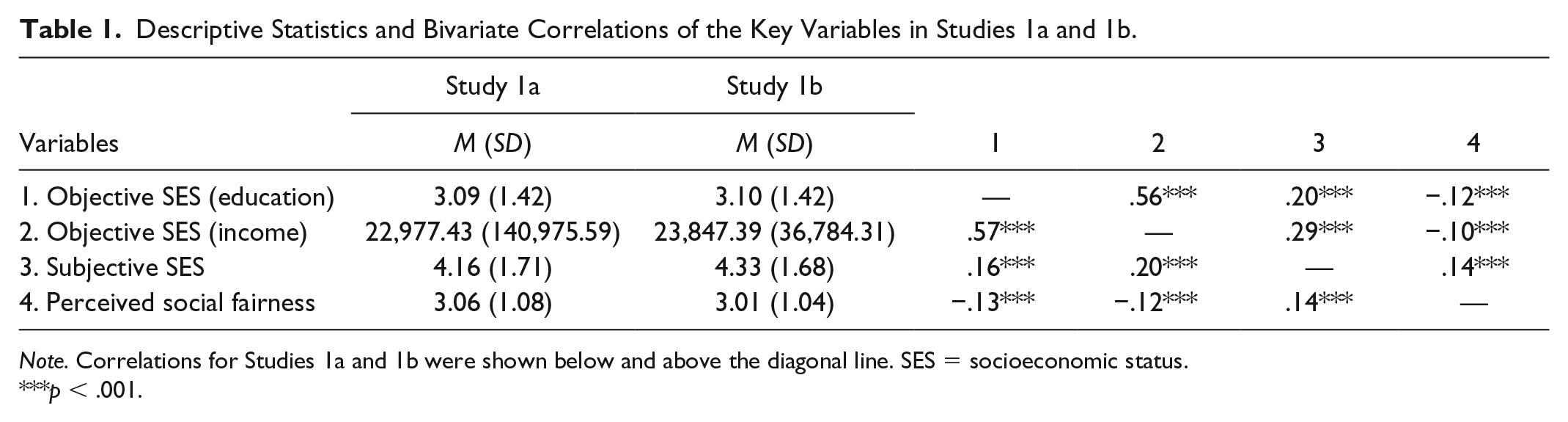
Note. Correlations for Studies 1a and 1b were shown below and above the diagonal line. SES = socioeconomic status.
p < .001.
Multiple Regression Analysis Predicting Perceived Social Fairness in Studies 1a and 1b.
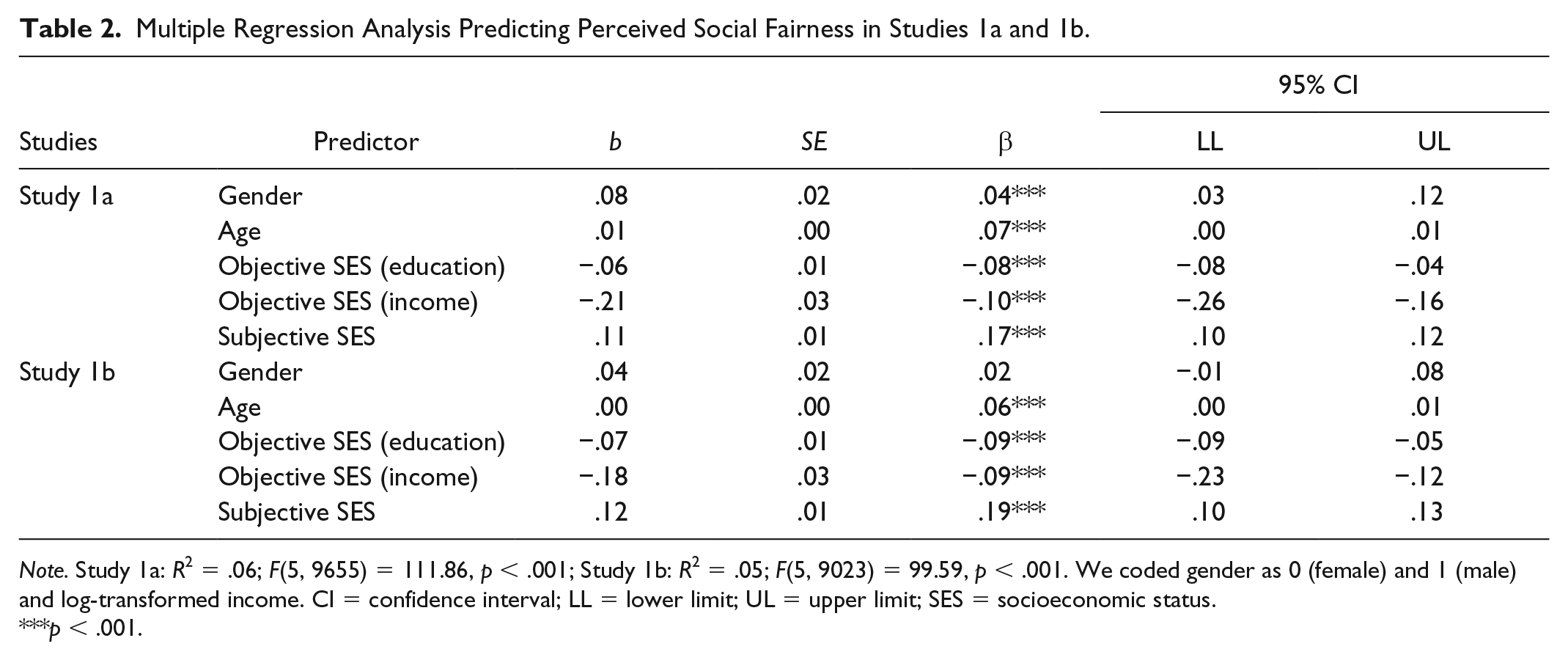
Note. Study 1a: R2 = .06; F(5, 9655) = 111.86, p < .001; Study 1b: R2 = .05; F(5, 9023) = 99.59, p < .001. We coded gender as 0 (female) and 1 (male) and log-transformed income. CI = confidence interval; LL = lower limit; UL = upper limit; SES = socioeconomic status.
p < .001.
Thus, using two nationally representative datasets from China, Studies 1a and 1b preliminarily confirmed our hypotheses that objective SES was negatively associated with system justification, which was captured by perceived social fairness, whereas subjective SES was positively associated with it. In Study 2, we further tested whether the different roles of objective and subjective SES in predicting system justification also occur among adolescents in China.
Study 2
Although previous studies on system justification were mainly conducted among adult population, several studies did investigate the system justification process in nonadult samples (e.g., Henry & Saul, 2006; Vargas-Salfate, 2017). A recent study indicates that adolescents have already noticed and started making attributions about social inequality (Flanagan et al., 2014). Moreover, adolescents’ family SES relates to their perception of economic inequality and attitudes toward the government (Flanagan & Kornbluh, 2019; Henry & Saul, 2006). In this study, we tested whether the associations between objective SES, subjective SES, and system justification that were observed in Studies 1a and 1b could generalize to adolescent samples.
Method
Participants
The data used in Study 2 were collected in 2015 as part of a large research project aiming to investigate adolescents’ social attitudes. A total of 4,696 adolescents aged between 11 and 17 were recruited from 18 public middle schools in Beijing. Before data collection, the investigators explained the research purpose to the school principals and adolescents’ parents and obtained their approval. All adolescents were asked whether they would like to participate in an anonymous survey about their attitudes and feelings about daily life, and provided their informed consent. They received small gifts (e.g., colored pencils or notebooks) for completing the study. The data of 4,058 adolescents (51% boys; Mage = 12.94 years, SD = 0.93) with complete responses were used for analysis.
Procedure and measures
The measures in this study were adolescents’ objective family SES, subjective family SES, and system justification. Participants reported their family monthly income (1 = less than CN¥2,000, 2 = CN¥2,000–CN¥5,000, 3 = CN¥5,000–CN¥10,000, 4 = CN¥10,000–CN¥20,000, 5 = over CN¥20,000) and their parental education level (1 = middle school or lower, 2 = high school, 3 = junior college, 4 = bachelor’s degree, 5 = master’s degree or higher) on 5-point scales. We took the higher education level of the mother or father to represent their parental education level (see also Rai et al., 2012). Adolescents’ subjective perception of their family SES was measured with one item (i.e., “How do you feel about your family’s living standard”) rated from 1 (very poor) to 5 (very rich).
We measured adolescents’ perceived social fairness and trust in government institutions to indicate their system justification. Perceived social fairness was assessed with five items (α = .60; for example, “Generally speaking, Chinese society is fair”). Trust in government institutions was measured with four items (α = .69; for example, “Public security organs in China are strict and impartial”). Participants rated their agreement with each item on a 6-point scale (1 = completely disagree, 6 = completely agree). We calculated their average scores for perceived social fairness and trust in government institutions.
Results and Discussion
Descriptive statistics and bivariate correlations were shown in Table 3. Similar to Studies 1a and 1b, adolescents’ perceived social fairness and trust in government institutions were negatively correlated with their parental education level and family monthly income, but were positively correlated with their subjective family SES. We further conducted multiple linear regressions on perceived social fairness and trust in government institutions. These analyses revealed that parental education level and family monthly income negatively predicted perceived social fairness and trust in government institutions, but subjective family SES positively predicted perceived social fairness and trust in government institutions (see Table 4).
Descriptive Statistics and Bivariate Correlations of the Key Variables in Study 2.
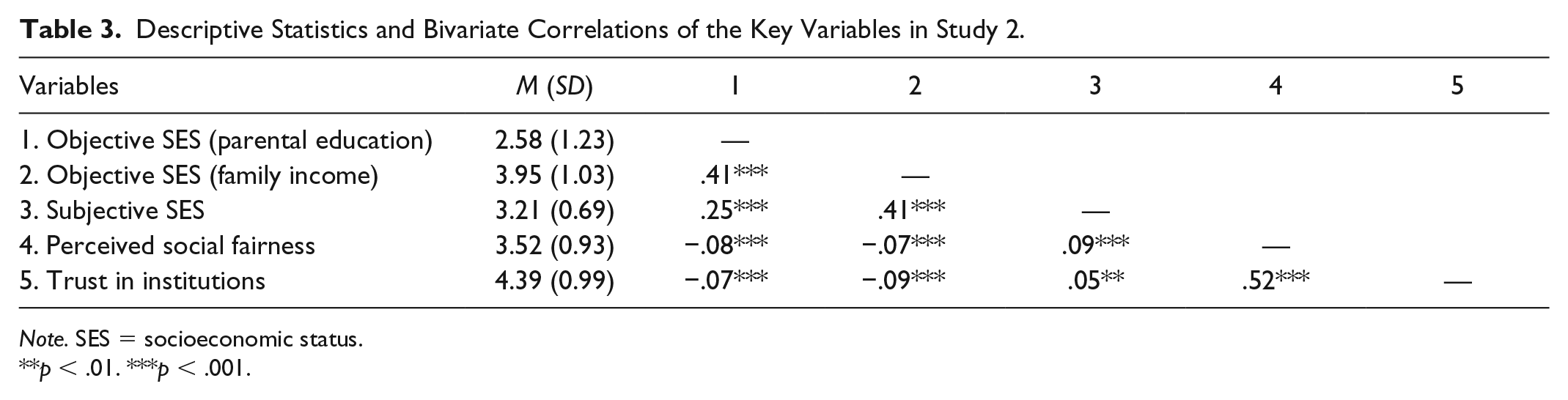
Note. SES = socioeconomic status.
p < .01. ***p < .001.
Multiple Regression Analyses Predicting Perceived Social Fairness and Trust in Government Institutions (Study 2).
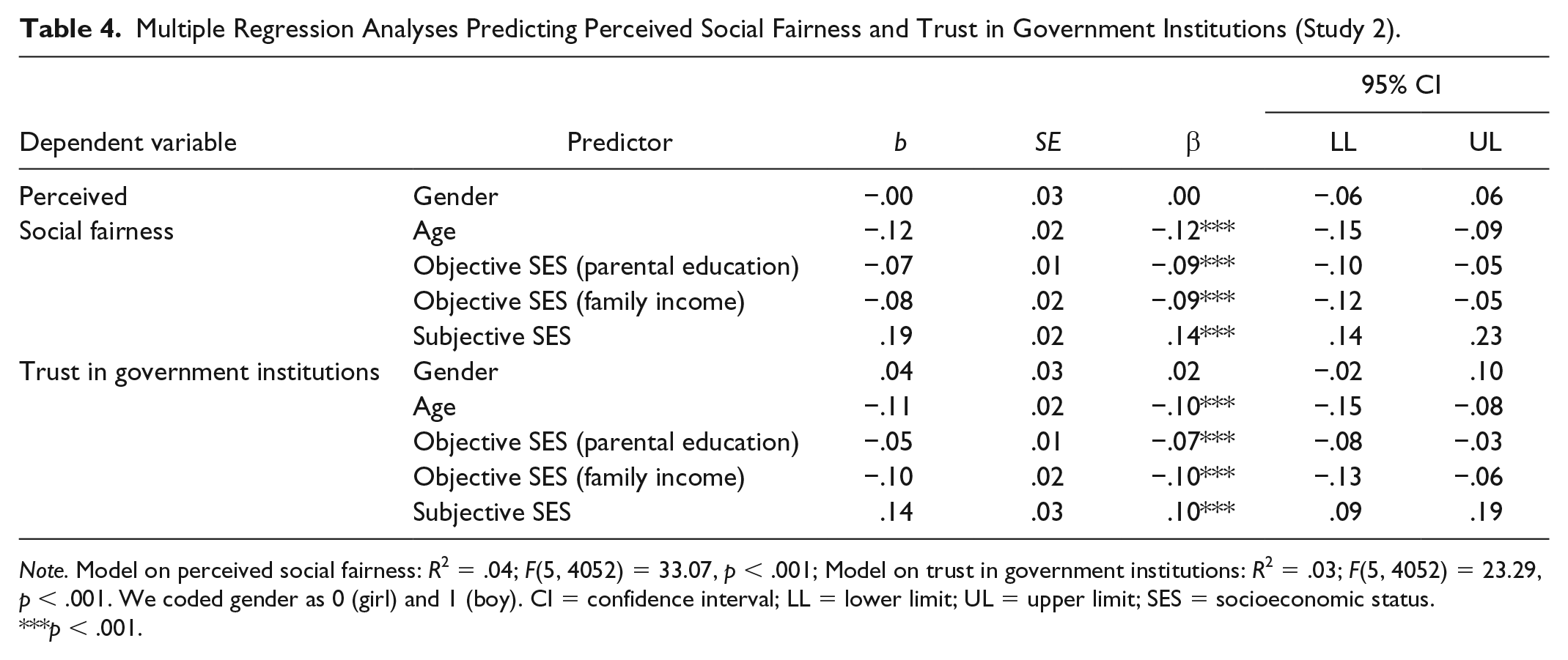
Note. Model on perceived social fairness: R2 = .04; F(5, 4052) = 33.07, p < .001; Model on trust in government institutions: R2 = .03; F(5, 4052) = 23.29, p < .001. We coded gender as 0 (girl) and 1 (boy). CI = confidence interval; LL = lower limit; UL = upper limit; SES = socioeconomic status.
p < .001.
Thus, Study 2 further supported our hypotheses that objective and subjective SES differently predicted system justification using a large adolescent sample. In the following studies, we would further test the psychological mechanisms underlying the relations between SES indicators and system justification.
Study 3
Method
Participants
An a priori power analysis revealed a required sample of 340 participants to have adequate power (1 − β = .80) to detect a small-to-medium effect of r = .15 (Faul et al., 2007). We recruited participants by distributing survey links through university online forums or social media like WeChat. A total of 342 Chinese adults completed a Qualtrics survey for CN¥5. After excluding 16 participants who failed the attention check question (i.e., “please select completely agree to show that you are paying attention to the survey”), we obtained a final sample of 326 participants (46% males; age 19–72, Mage = 28.92 years, SD = 9.37).
Procedure and measures
All participants completed the measures of objective SES (i.e., education level), subjective SES, conservatism, and system justification.
Objective and subjective SES
Participants rated their education level on a 5-point scale (1 = middle school or lower, 2 = high school, 3 = junior college, 4 = bachelor’s degree, 5 = master’s degree or higher). We did not measure income because many participants were university students with no income themselves. Participants’ subjective SES was assessed with the same measure in Study 1a.
Conservatism
Historically, Chinese people whose political orientation contradicts with the mainstream ideology might have inferior job opportunities and less favorable interpersonal relationships (e.g., Esherick et al., 2006). Because of this, people are reluctant to state their own political orientation explicitly when responding to relevant surveys. To address this issue, we generated 14 items (α = .74; see the supplementary materials for all items) based on the ideological spectrum in China (Pan & Xu, 2018). Sample items were “Internet contents, which are intermingled with good and bad things, need to be controlled by the government” and “Homosexuals and heterosexuals should be treated equally” (reverse-scored). Participants rated their agreement with each item on a 7-point scale (1 = completely disagree, 7 = completely agree). Higher average score indicated a higher level of conservatism. Previous research found that Chinese people’s ideology could be divided into three dimensions, but these dimensions are highly correlated (r ranges from .94 to .99; Pan & Xu, 2018). Therefore, we treat conservatism as a one-dimensional latent variable.
System justification
We used an eight-item modified System Justification Scale (α = .77; e.g., “In general, I find Chinese society to be fair”; Kay & Jost, 2003) to assess the degree to which participants perceived the Chinese social system as legitimate and fair. Participants rated each item on a 7-point scale (1 = completely disagree, 7 = completely agree).
Results and Discussion
Descriptive statistics and bivariate correlations were shown in Table 5. As hypothesized, system justification was negatively correlated with education level, but was marginally positively correlated with subjective SES. In addition, conservatism was negatively correlated with education level, and was positively correlated with system justification. Notably, conservatism did not significantly correlate with subjective SES, r(324) = .03, p = .55. We further put the objective and subjective indicators of SES into a regression model to predict system justification, while controlling for age and gender. The overall model was significant, R2 = .05; F(4, 320) = 4.47, p = .002 (see Supplemental Table S4). Specifically, system justification was negatively predicted by education level, β = −.23, t(321) = −3.37, p = .001, but was positively predicted by subjective SES, β = .13, t(321) = 2.42, p = .02.
Descriptive Statistics and Bivariate Correlations of the Key Variables in Study 3.
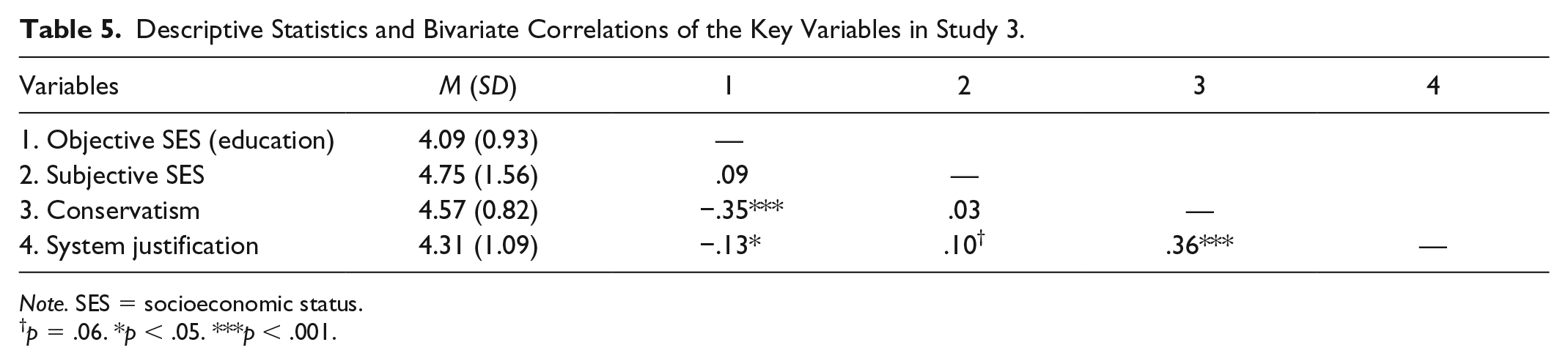
Note. SES = socioeconomic status.
p = .06. *p < .05. ***p < .001.
Next, we conducted mediation analysis to test whether conservatism mediated the relation between objective SES (i.e., education level) and system justification while controlling for age, gender, and subjective SES. We tested our hypotheses using structural equation modeling (SEM) procedures in Mplus 7.0 with maximum likelihood estimation. Three parcels were created to represent the latent variables of conservatism and system justification using the item-to-construct balance technique (Little et al., 2002). The measurement model for the two latent variables revealed a good fit to the data: χ2(8) = 18.20, p = .02; comparative fit index (CFI) = .98; Tucker–Lewis index (TLI) = .97; root mean square error of approximation (RMSEA) = .06, 90% confidence interval (CI) = [.02, .10], standardized root mean square residual (SRMR) = .04. All the standardized factor loadings for the indicators on the latent variables were statistically significant (λ ranging from .50 to .90, ps < .001). Thus, the two latent variables were well represented by their respective indicators.
Then we tested the mediation model using bootstrapping method with 5,000 resamples and 95% bias-corrected CIs. The structural model showed acceptable fit to the data: χ2(24) = 62.58, p < .001; CFI = .95; TLI = .91; RMSEA = .07, 90% CI = [.05, .09], SRMR = .04. This analysis revealed that the negative association between education and system justification (β = −.25, p = .001) became nonsignificant (β = −.11, p = .10) when conservatism was included in the model (see Figure 1). Moreover, the indirect effect through conservatism was significant, β = −.13, 95% CI = [−.22, −.04].
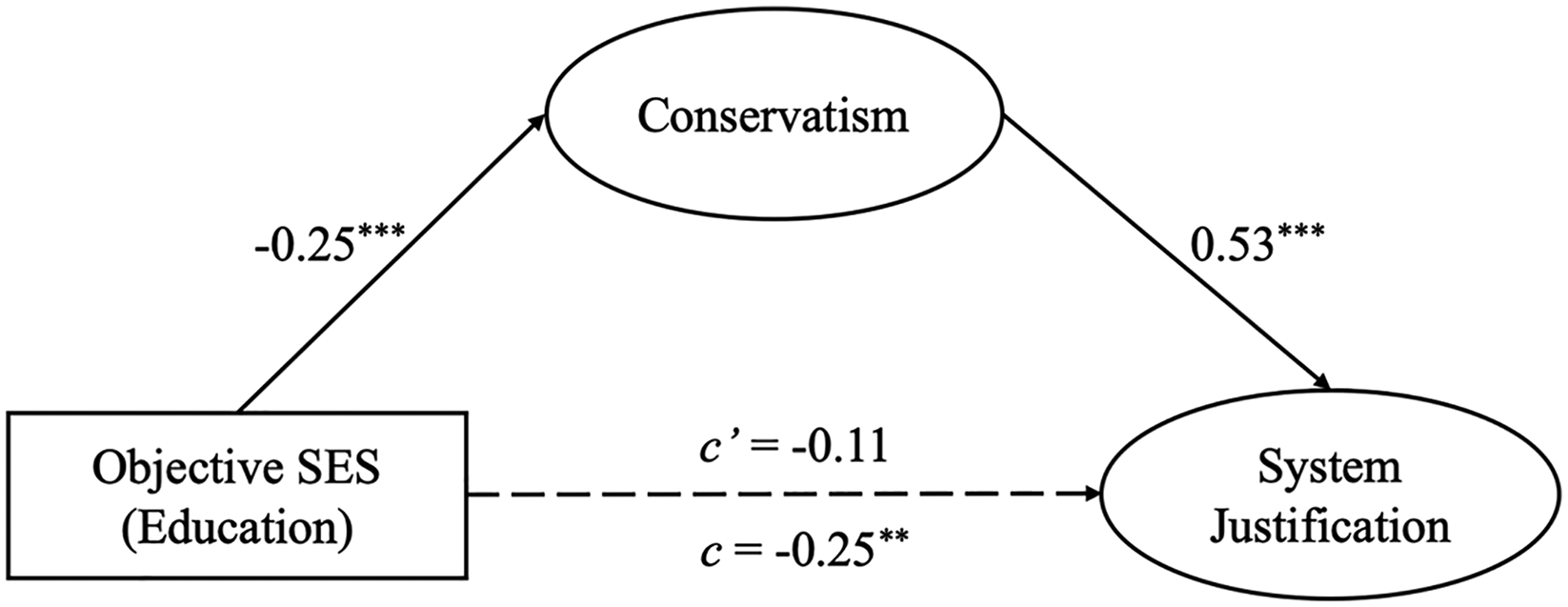
The mediating role of conservatism between objective SES and system justification (Study 3).
Thus, Study 3 again confirmed our postulation that system justification was differently associated with objective and subjective SES. It also demonstrated that Chinese people with lower objective SES are more likely to justify the status quo, partly due to their higher level of conservative beliefs. In Study 4, we would test our hypothesis that perceived social mobility mediated the relation between subjective SES and system justification.
Study 4
Method
Participants
As in Study 3, we needed 340 participants to have adequate power. To guarantee that participants’ self-reported income accurately represented their objective SES, we only recruited participants who had worked for more than 3 years. A total of 376 participants completed the survey through the survey link posted on social media platforms. The final sample included 353 participants (36% males; age 18–69, Mage = 33.80 years, SD = 9.06) after we excluded 23 participants who failed an attention check.
Procedure and measures
To measure objective SES, we assessed participants’ education level using a 6-point scale (1 = elementary school or lower, 6 = master’s degree or higher). They also indicated their monthly income on a 9-point scale (1 = less than CN¥1,000, 2 = CN¥1,000–CN¥2,000, 3 = CN¥2,000–CN¥3,000, 4 = CN¥3,000–CN¥5,000, 5 = CN¥5,000–CN¥8,000, 6 = CN¥8,000–CN¥12,000, 7 = CN¥12,000–CN¥15,000, 8 = CN¥15,000–CN¥20,000, 9 = over CN¥20,000). Subjective SES was assessed with the same measure in previous studies (Adler et al., 2000).
We assessed participants’ perceived social mobility using six items (α = .68; for example, “It is not too difficult for people to change their position in society”) adapted from Day and Fiske (2017). Participants rated each item on a 7-point scale (1 = completely disagree, 7 = completely agree). The measure of system justification (α = .83) was the same as Study 3.
Results and Discussion
Descriptive statistics and bivariate correlations were shown in Table 6. Consistent with previous studies, subjective SES was positively correlated with system justification. Unexpectedly, neither education level nor income was significantly correlated with system justification. As hypothesized, perceived social mobility was positively correlated with subjective SES and system justification. Perceived social mobility was negatively correlated with education, but did not correlate with income. We then put both objective and subjective indicators of SES into a regression model to predict system justification, while controlling for age and gender. The overall model was significant, R2 = .04; F(5, 347) = 2.84, p = .016 (see Supplemental Table S5). Specifically, subjective SES positively predicted system justification, β = .16, t(347) = 2.83, p = .005, but neither education level, β = .03, t(347) = 0.45, p = .66, nor income, β = −.00, t(347) = −0.03, p = .98, significantly predicted system justification.
Descriptive Statistics and Bivariate Correlations of the Key Variables in Study 4.

Note. SES = socioeconomic status.
p < .01. ***p < .001.
Similar to Study 3, we further conducted mediation analysis to test whether perceived social mobility mediated the relation between subjective SES and system justification while controlling for participants’ gender, age, education, and income (see Figure 2). The positive association between subjective SES and system justification (β = .16, p = .005) became nonsignificant (β = .05, p = .33) when perceived social mobility was included in the model. The indirect effect through perceived social mobility was significant, β = .10, 95% CI = [.06, .16], suggesting that perceived social mobility mediated the relation between subjective SES and system justification.

The mediating role of perceived social mobility between subjective SES and system justification (Study 4).
Study 4 confirmed our hypothesis that subjective SES positively predicted system justification through a higher level of perceived social mobility. However, this study failed to replicate the negative associations between objective SES indicators and system justification. One potential explanation for this result may be the relatively high means and low variance of education level in our sample, which prevent us from observing meaningful relations between objective SES measures and system justification.
Study 5
In Studies 3 and 4, we tested the mediations of conservatism and perceived social mobility respectively in two separate samples. Here, we aim to test whether the observed patterns of results would still hold when objective and subjective SES and their respective mediators are included simultaneously in one model.
Method
Participants
We aimed to collect more participants than Studies 3 and 4. Similar to Study 4, we only recruited participants who had worked for more than 3 years, and collected data by distributing survey links on social media. To avoid recruiting those who had participated in our previous studies, we distributed links using different social media accounts with different followers. We stopped collecting data at the end of the day when we had more than 600 participants. A total of 647 participants completed the survey for CN¥3. The final sample included 623 participants (44% males; age 18–61, Mage = 32.32 years, SD = 8.18) after we excluded 24 participants who failed an attention check.
Procedure and measures
We measured participants’ education level (5-point scale), monthly income (9-point scale), and subjective SES (10-point scale) as objective and subjective SES indicators. We used the same measures of conservatism (α = .78), perceived social mobility (α = .65), and system justification (α = .86) as in Studies 3 and 4.
Results and Discussion
The descriptive statistics and bivariate correlations were presented in Table 7. Consistent with previous studies, subjective SES was positively correlated with system justification. However, income and education level did not significantly correlate with system justification. As hypothesized, income and education level were negatively correlated with conservatism, and subjective SES was positively correlated with perceived social mobility. We then put both objective and subjective indicators of SES into a regression model to predict system justification, while controlling for age and gender. The overall model was significant, R2 = .05; F(5, 610) = 6.55, p < .001 (see Supplemental Table S6). Specifically, subjective SES positively predicted system justification, β = .21, t(617) = 5.13, p < .001, income negatively predicted system justification, β = −.12, t(617) = −2.81, p = .005, but education level did not significantly predict system justification, β = .002, t(617) = 0.30, p = .98.
Descriptive Statistics and Bivariate Correlations of the Key Variables in Study 5.
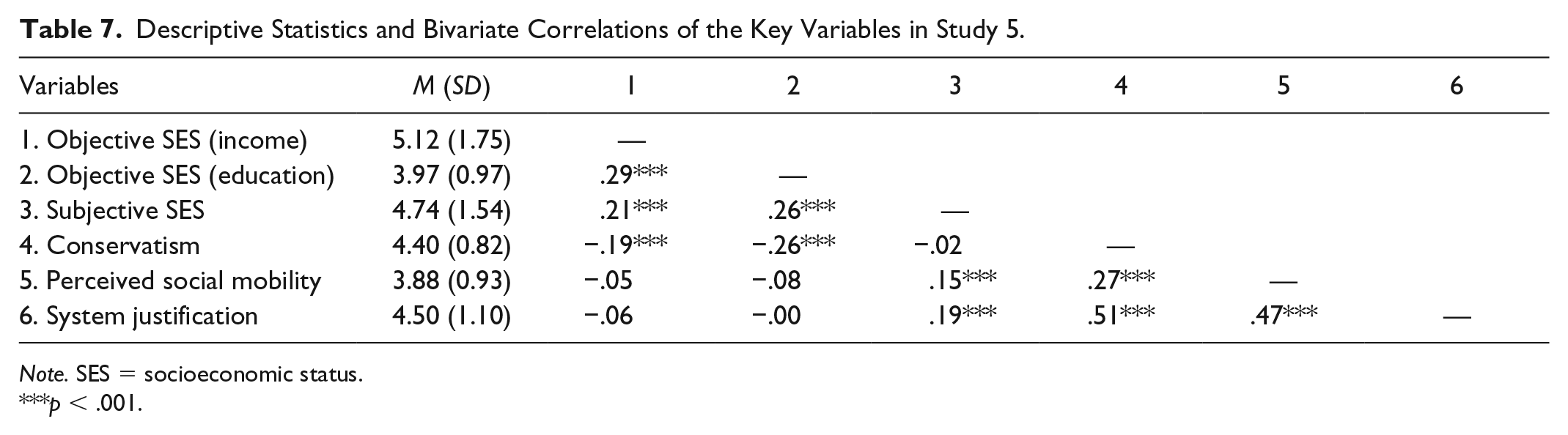
Note. SES = socioeconomic status.
p < .001.
We further tested the mediations of conservatism and perceived social mobility using SEM (see Figure 3). 2 We first created three parcels to represent each latent variable (i.e., conservatism, perceived social mobility, and system justification) with the item-to-construct balance technique. The measurement model for the three latent variables revealed a good fit to the data: χ2(24) = 98.89, p < .001; CFI = .97; TLI = .95; RMSEA = .07, 90% CI = [.06, .09], SRMR = .04. All the standardized factor loadings for the indicators on the latent variables were statistically significant (λ ranging from .63 to .92, ps < .001), indicating that the three latent variables were well represented by their respective indicators. Then we tested the structural model using bootstrapping method with 5,000 resamples and 95% bias-corrected CI. The structural model showed acceptable fit to the data: χ2(59) = 243.19, p < .001; CFI = .93; TLI = .90; RMSEA = .07, 90% CI = [.06, .08], SRMR = .04. As hypothesized, the indirect effects of income (β = −.07, 95% CI = [−.11, −.02]) and education level (β = −.07, 95% CI = [−.11, −.02]) on system justification through conservatism were significant. Besides, the indirect effect of subjective SES on system justification through perceived social mobility was significant (β = .07, 95% CI = [.02, .11]).
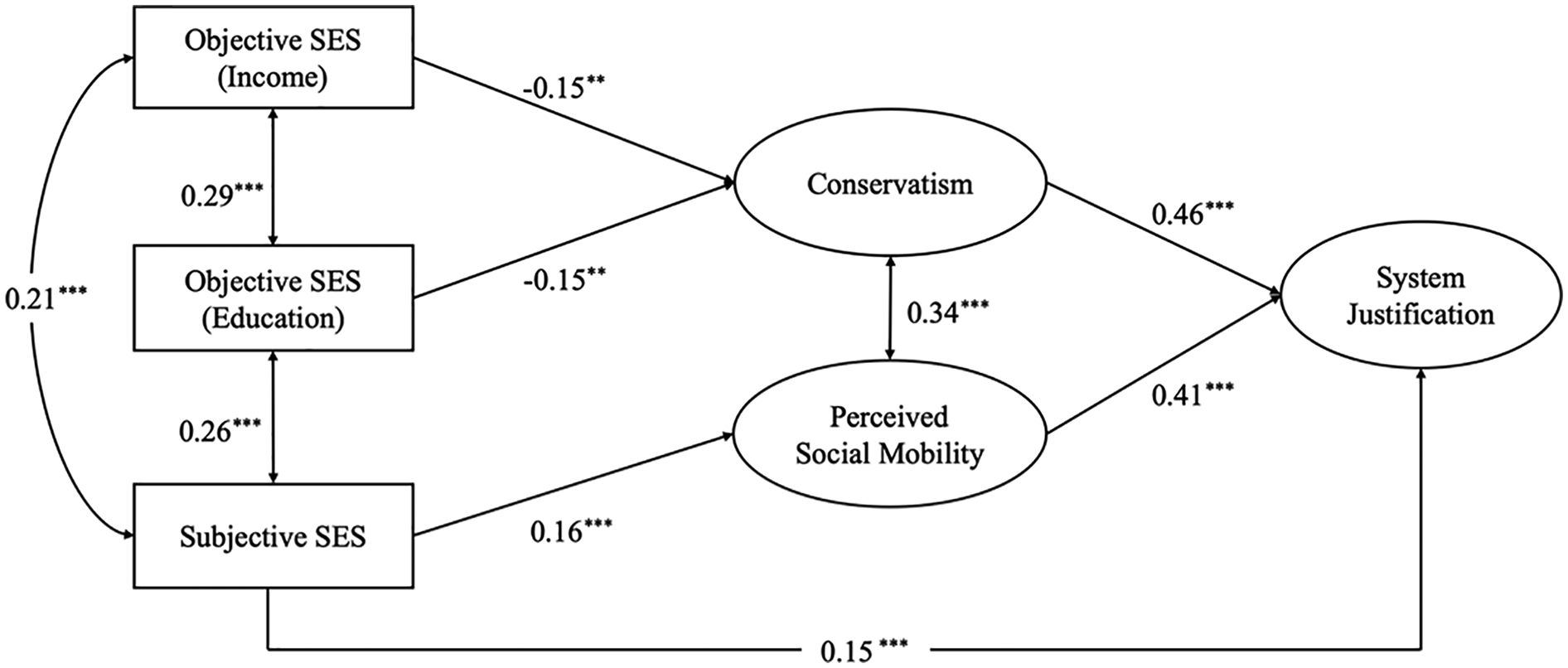
The mediating roles of conservatism and perceived social mobility between SES indicators and system justification (Study 5).
Thus, replicating previous studies, Study 5 further supported our hypotheses that people with lower income and education are more conservative, and thus are more likely to justify the social system. However, people with lower subjective SES perceived lower social mobility, which induces a lower level of system justification. It should be noted that the nonsignificant correlation between income and system justification became significant after we included other variables (e.g., subjective SES) in the regression model predicting system justification. This was similar to Vargas-Salfate et al.’s (2018) finding that income negatively predicted system justification only after including subjective SES in the model. We again found that education level did not significantly predict system justification, although education level had a significant indirect effect on system justification through conservatism. Similar to Study 4, the relatively high mean and low variance in participants’ education level in this study may explain its nonsignificant correlation with system justification.
Meta-Analytic Overview
To summarize our findings and provide an additional test of our hypotheses on the associations between the two SES indicators and system justification, we performed a random-effects meta-analysis of our five studies (N = 26,134). As we measured two indicators of system justification in Study 2, we first computed the mean effect size and variance of them, and then used the synthetic score to conduct the meta-analysis (see Borenstein et al., 2009). Overall, the meta-analysis revealed that both education level, r = −.09, 95% CI = [−.13, −.06], and income, r = −.08, 95% CI = [−.11, −.04], were negatively correlated with system justification, whereas subjective SES was positively correlated with system justification, r = .13, 95% CI = [.10, .16]. Thus, although the effect sizes (r) of the associations between the objective and subjective indicators of SES and system justification were relatively small, these effects were robust and were further qualified by an internal meta-analysis.
General Discussion
Derived from SJT and cognitive dissonance theory, the status-legitimacy hypothesis proposes that lower SES people are more likely to justify the social system, particularly under certain circumstances (Brandt, 2013). However, there has been inconsistent empirical support for this hypothesis. In the present research, we sought to resolve this inconsistency and extend previous research by testing the different roles of objective and subjective SES. Five studies using large representative adult and adolescent samples in China revealed two key findings. First, in line with the status-legitimacy hypothesis, we found that education level and income, which reflected one’s objective SES, negatively predicted system justification. This finding was consistent with previous evidence on the positive correlation between objective SES and perceived social unfairness in China (Whyte, 2009), as well as evidence from other countries, such as New Zealand and Bolivia (Henry & Saul, 2006; Jost, Pelham, et al., 2003; Sengupta et al., 2015; Vargas-Salfate et al., 2018). We also proposed that conservatism may explain the relation between objective SES and system justification. Consistent with previous research (Pan & Xu, 2018), we found that Chinese people with lower objective SES are more conservative. The motivated social-cognitive perspective suggests that political conservatism increases rationalization of status quo by providing people with motivational and intellectual support (Jost, Glaser, et al., 2003). Indeed, SJT has noted the phenomenon of working class conservatism (Jost, 2017), and suggests that legitimizing the status quo satisfies low-SES individuals’ epistemic, existential, and relational needs and reduces uncertainty and threat (Hennes et al., 2012). Notably, we found no association between subjective SES and conservatism, although previous studies suggest that subjective SES more consistently and strongly predicts status-related outcomes (Adler et al., 2000; Singh-Manoux et al., 2005). Our research demonstrated that objective SES indicators can predict conservatism above and beyond subjective SES. Future research could investigate why objective SES outperforms subjective SES in shaping Chinese people’s political ideology, and the mechanisms underlying the relation between objective SES and conservatism.
Importantly, the negative association between objective SES and system justification was not found in some countries. This inconsistency may be driven by the complex patterns of relations between objective SES and conservatism, and between conservatism and system justification, in different cultures. For example, an analysis of nationally representative U.S. samples reveals that income positively relates to economic conservatism but does not relate to social conservatism, and that higher education levels relate to greater economic conservatism and less social conservatism (Feldman & Johnston, 2014). In contrast, research in China suggests that Chinese people with lower education levels and income are more conservative in all dimensions (Pan & Xu, 2018). In addition, although both our data collected in China and previous studies conducted in the United States found that conservatives show higher levels of system justification, this relation might also be culturally specific. Indeed, Caricati (2019) found a quadratic relationship between conservatism and system justification (i.e., lower system justification among political extremists on both sides) in non-U.S. samples. These complex relations between objective SES, conservatism, and system justification might explain why objective SES does not consistently predict system justification. Future research needs to test the relations between objective and subjective indicators of SES, conservatism, and system justification across cultures with different political and economic environments. It is also imperative to investigate whether different dimensions of conservatism play different roles in system justification processes.
Second, we found that subjective SES positively predicted system justification. Although this finding was contrary to the status-legitimacy hypothesis, similar patterns of results have also been found in other research conducted in China (Yang et al., 2016), the United States (Davidai, 2018; Zimmerman & Reyna, 2013), and across the world (Brandt, 2013; Vargas-Salfate et al., 2018). Thus, the positive relation between subjective SES and system justification may generalize across cultures. Our research also suggests that perceived social mobility serves as an important mechanism explaining this relation. That is, people higher in subjective SES perceive greater chance to move upward in the social hierarchy (Kraus & Tan, 2015), which increases their tendency to justify the social system (Day & Fiske, 2017). Compared with objective SES, subjective SES is closer to the concept of status within the framework of the status-legitimacy hypothesis, because cognitive dissonance between ego, group, and system justification motives should be more likely to occur when people subjectively perceive their status as low (Vargas-Salfate et al., 2018). This opposite result on subjective SES and system justification calls into question the status-legitimacy hypothesis. Similarly, recent research using a novel pupil dilation paradigm also challenges the cognitive dissonance rationale within the status-legitimacy hypothesis (Owuamalam & Spears, 2019). Thus, future research needs to go beyond the cognitive dissonance rationale and construct a broader theoretical model involving not only motivational and cognitive processes, but also contextual factors, to explain the relation between status and system justification.
Notably, we observed similar results in a younger age group (i.e., adolescents). Indeed, previous research demonstrates that family SES affects adolescents’ development in multiple domains, such as physical and mental health (Chen et al., 2006), as well as academic achievement (Sirin, 2005). Moreover, family SES is associated with adolescents’ perception of inequality and attitudes toward the government (Flanagan & Kornbluh, 2019; Henry & Saul, 2006). Here, we also provide robust evidence that family SES relates to adolescents’ attitudes toward social issues. Future research could explore why and how objective and subjective family SES impact children and adolescents’ social attitudes. In addition, longitudinal designs can be used to test how family SES affects adolescents’ subjective perceptions of their own SES and their system justification over time across different stages of development till their adulthood.
The present research highlights the different roles of objective and subjective SES in predicting system justification. Five studies demonstrated that objective SES indicators (i.e., education level and income) and subjective SES are weakly or moderately correlated (rs range from .09 to .41). This suggests that one’s subjective perception of social status depends only in part on objective indicators (Cohen et al., 2017; Evans & Kelley, 2004), and that objective and subjective SES can independently predict status-related outcomes (Kraus & Tan, 2015). In Studies 3 and 5, we observed that the divergent roles of objective and subjective SES became more pronounced after including each other as a covariate. Similarly, Vargas-Salfate et al. (2018) also found that income negatively predicted system justification only after including subjective SES as a covariate, and this negative association was stronger in highly unequal countries. This pattern indicates that sometimes it might be necessary to control for other SES indicators in the model to observe the unique effect of a single SES indicator. Based on these findings, we propose that although both objective and subjective SES indicators can reveal one’s status, each indicator contains some unique aspects and has distinct effects. Specifically, people with higher objective SES (i.e., education level and income) might have more access to diverse information that is important for the development of values related to expectations about a desirable society, and as a result, they may perceive the current system as less satisfactory. However, subjective SES is more relevant to individuals’ motives to justify their dominant positions, and accordingly, people with higher subjective SES are more likely to perceive the system as satisfactory.
Although the present research focuses on the distinction between objective and subjective SES, some previous studies demonstrated that the difference within objective SES indicators should not be overlooked. Take income and education for example, it has been found that income is more strongly related to unethical behavior (Dubois et al., 2015), whereas education is more strongly related to prejudice (Carvacho et al., 2013). Therefore, it is necessary to examine the potential differences between objective and subjective SES indicators, as well as within these two categories.
Strengths, Limitations, and Directions for Future Research
Our studies harnessed the strength of large adult and adolescent samples to guarantee sufficient statistical power across five studies. Although these studies showed consistent results on the different roles of objective and subjective SES, they were essentially correlational studies, and could not test causal effects. Future research could directly manipulate subjective SES or use longitudinal designs to test the causal effects of objective and subjective indicators of SES on system justification.
Second, the relatively high means and low variance in participants’ education level in Studies 4 and 5 might explain why we did not replicate the negative associations between objective SES indicators and system justification. It is important for future studies to collect more diverse and representative samples when testing status-related issues. Besides, the internal reliability of some measures (e.g., perceived social fairness and trust in government institutions in Study 2, and perceived social mobility in Studies 4 and 5) in our research was relatively low (αs < .70). Future research needs to address this limitation by developing more reliable measures.
Third, we extend previous research on system justification by examining this phenomenon among Chinese participants, an understudied population in psychological research on status-related issues. Although research conducted in other countries have showed similar findings that objective SES negatively predicted system justification, whereas subjective SES positively predicted system justification (e.g., Vargas-Salfate et al., 2018), we should be cautious when generalizing our conclusions to other cultures. Future research needs to directly compare China with other Western societies that differ in economic or political environments when testing the effects of objective and subjective SES.
Finally, in addition to conservatism and perceived social mobility, other mechanisms may also account for the relation between objective (or subjective) SES and system justification. For example, SJT suggests that when people are highly dependent on the system, they would have more incentives to justify this system (Van der Toorn et al., 2011). As people with low objective SES depend heavily on the public welfare mainly provided by the government, perceived system dependence may also explain the negative relation between objective SES and system justification. Regarding the role of subjective SES, some evidence suggests that people high in subjective SES are more likely to hold essentialist beliefs that social class is determined by genetic differences and is unlikely to change (Kraus & Keltner, 2013). They also tend to use dispositional attributions for inequality and attribute the perishing situations of low-status groups to their lack of competence or efforts (Brown-Iannuzzi et al., 2015; Kraus et al., 2009). Essentialist beliefs and dispositional attributions are also frequently used to justify unequal situations (Heine et al., 2016; Keller, 2005). Thus, future research can test whether essentialist beliefs and dispositional attributions can account for the relation between subjective SES and system justification.
Concluding Remarks
The present research sought to shed light on the ongoing debate about the status-legitimacy hypothesis by distinguishing the roles of objective and subjective SES. Findings across five studies suggest that objective SES negatively predicts system justification, whereas subjective SES positively predicts system justification, and this conclusion holds for both adults and adolescents. Our results also indicate that lower objective SES relates to more conservatism, which is linked to greater tendency to justify the social system. However, higher subjective SES relates to higher perceived social mobility, which is linked to more willingness to justify the status quo. Thus, we recommend that future research should take a deeper look into the conceptual similarities and differences between objective SES and subjective SES, and analyze their distinct effects on status-related issues.
Supplemental Material
Kou_OnlineAppendix – Supplemental material for Testing the Status-Legitimacy Hypothesis in China: Objective and Subjective Socioeconomic Status Divergently Predict System Justification
Supplemental material, Kou_OnlineAppendix for Testing the Status-Legitimacy Hypothesis in China: Objective and Subjective Socioeconomic Status Divergently Predict System Justification by Wenqi Li, Ying Yang, Junhui Wu and Yu Kou in Personality and Social Psychology Bulletin
Footnotes
Declaration of Conflicting Interests
The author(s) declared no potential conflicts of interest with respect to the research, authorship, and/or publication of this article.
Funding
The author(s) disclosed receipt of the following financial support for the research, authorship, and/or publication of this article: This research was supported by the National Natural Science Foundation of China (31971011), the Ministry of Education (MOE) Project of Key Research Institutes of Humanities and Social Science at Universities (16JJD880007), the Research Institute of Wang Yangming’s Philosophy of Mind & Current Social Mentality of Confucius Academy (KXTXT201704), and Shanghai Sailing Program (19YF1413400).

Supplemental Material
Supplemental material is available online with this article.
Notes
References
Supplementary Material
Please find the following supplemental material available below.
For Open Access articles published under a Creative Commons License, all supplemental material carries the same license as the article it is associated with.
For non-Open Access articles published, all supplemental material carries a non-exclusive license, and permission requests for re-use of supplemental material or any part of supplemental material shall be sent directly to the copyright owner as specified in the copyright notice associated with the article.
