




Abstract
How have attempts at political persuasion changed over time? Using nine corpora dating back through 1789, containing over 7 million words of speech (1,666 documents in total), covering three different countries, plus the entire Google nGram corpus, we find that language relating to togetherness permanently crowded out language relating to duties and obligations in the persuasive speeches of politicians during the early 20th century. This shift is temporally predicted by a rise in Western nationalism and the mass movement of people from more rural to more urban areas and is unexplained by changes in language, private political speech, or nonmoral persuasion. We theorize that the emergence of the modern state in the 1920s had psychopolitical consequences for the ways that people understood and communicated their relationships with their government, which was then reflected in the levers of persuasion chosen by political elites.
It was possible to think, in 1867, of the public responsibility primarily in terms of state responsibility. The new challenges, which we must and will meet, require the involvement of the whole society and the efforts of all our people.
As cultures change, understanding history matters for understanding how and why people think and do what they do (e.g., Gergen, 1973). Cultures help people define their selves and their place in the world (e.g., Markus & Kitayama, 2010), and changes in cultures, which are in constant flux (e.g., Chiu & Kwan, 2016; Kashima, 2000), reshape the ways that people relate to themselves and each other. Cultural change can come from any number of levels, all of which can be read out in individual and group psychology. For example, researchers have documented how changes in the economic relationships between people, as a function of the slow dissolution of European feudalism starting in the late Medieval period, led to a softening of previously rigid social roles, which, in turn, changed the ways that Westerners construed their increasingly problematic selfhood (Baumeister, 1987). Similarly, researchers have shown how a less dramatic change, the American demographic shift from a primarily agrarian society to one based in cities, predicted a shift toward increased materialism and individualism (Greenfield, 2013). Researchers have even shown how the effect of smaller changes, such as the rise of modern medicine and the concomitant decrease in pathogen prevalence, can predict societal changes such as a long-term trend toward gender equality in America (Varnum & Grossmann, 2017).
Changes in the psychology of a culture can also lead to changes in material culture, as was shown in the pioneering work of David McClelland (1961), who, for instance, used changes in the complexity of ancient Greek vase design and changes in imagery within elementary school textbooks from the 1920s to demonstrate that societal increases in the need for achievement predicted later economic growth.
Cultural change is somewhat uneven, however—not all parts of a culture change at the same time or at the same rate (e.g., Hamamura, 2012; Inglehart et al., 2017). Some aspects of a culture may stay fairly well-conserved across generations even as the underlying material factors which originally shaped the culture have changed (e.g., Inglehart & Baker, 2000), such as the conservation of the individualism/collectivism divide across wheat- and rice-growing regions in China (Talhelm et al., 2014), or the persistence of tightness or looseness within a culture (Gelfand et al., 2011). Other aspects may change across years or even months. For example, Japanese attitudes toward child rearing have changed substantially from the 1950s, with an increasing stress on independence, whereas Japanese attitudes toward parents have not notably changed during the same period of time (Hamamura, 2012).
Even within a culture, some aspects may change at different rates for different parts of society (e.g., Fernández et al., 2004; Young, 2009). For example, while attitudes toward same-sex marriage in the United States have, over the last 20 years, broadly swung in favor; from ~35% of Americans supporting same-sex marriage in 2001 to ~62% supporting in 2017 (Pew, 2017), this support is not homogeneously distributed throughout American society. Conservative Republicans are still largely opposed to same-sex marriage (58% oppose), and even those living in majority Democratic states aren’t unanimous in their support, with about a quarter of Californians or Illinoians, for example, still opposed (Bacon, 2018). To live in some social landscapes in America, LGTBQ rights are taken as a given, while in others, attitudes appear not to have changed meaningfully for generations.
As cultures change, one clear place to look for the effects of history on individual actors is in changing conceptions of morality. Morality is at the core of personal identity (Strohminger & Nichols, 2014) and powerfully motivates individual actions (e.g., Hitlin & Vaisey, 2013). Morality, in turn, is shaped by one’s culture (even if that shaping molds from some shared underlying commonalities, for example, Barrett et al., 2016). The great sociologist Émile Durkheim argued that the morals of a society reflected the way that society was organized and changed as the requirements of the society changed (Durkheim, 1906). Sociologists have argued that person’s moral worldview differs as a function of the culture in which one was raised (even across superficially similar Western cultures, see, for example, Lamont & Thévenot, 2000), and as a function of one’s role or socioeconomic status within that society (e.g., Sayer, 2005; Svallfors, 2006; see Hitlin & Vaisey, 2013, for a general review). These moral understandings are not themselves static, of course—they change as the underlying societal conditions change, as can be seen, for example in the changing moral status accorded to markets as a product of the rise of the neoliberal consensus (Fourcade & Healy, 2007; Hirschman, 1982). Knowing what a culture deems to be appropriate and inappropriate is fundamental to the understanding of the culture (e.g., d’Andrade & Strauss, 1992; Shweder, 1982), and tracking changes in the deployment of morality provides a potentially powerful window into changes in the culture at large.
One useful tool to think about changes in morality comes from Moral Foundations Theory (Graham et al., 2013). Moral Foundations Theory is a descriptive framework for analyzing the ways that people and cultures think about morality. It takes a pluralist approach, seeking to identify the roots upon which moral judgments are formed, ultimately settling on five basic foundations which together generate and constrain moral thought and action. A moral foundations approach looks at the ways that people conceptualize the primary moral components of harm (concerns about suffering and the care of others), fairness (concerns about inequity, justice, and cheating), obedience to authority (concerns about order, tradition, and respect), loyalty and the rights of ingroups (concerns about togetherness in its various forms), and insults to purity (concerns about sanctity and disgust). The importance of these foundations differs both across and within cultures, and research, for example, has shown that historical trends in pathogen prevalence and the ensuing worries about disease transmission are associated with a cultural embrace of authority, ingroupishness, and purity (Van Leeuwen et al., 2012; see Graham et al., 2016, for a review). By looking at a society’s foundational emphases, researchers can better understand what parts of a society are valued and what moral trade-offs a society is willing to make.
These moral trade-offs are reflected in politics, and moral psychologists have found political speech an especially useful place to understand morality and moral norms (e.g., Garten et al., 2016; Graham et al., 2009; Haidt et al., 2009). Morality is a crucial battleground for political argumentation, and moral understandings have special force in motivating political action (e.g., Haidt, 2012; Steensland, 2006). When making political arguments, grounding one’s language in the moral foundations of the intended audience are especially persuasive (Miles, 2016), and as politicians try to attempt to persuade the public about political action, the morality of a society may find a particularly clear expression in its persuasive political speech.
Using language to understand historical changes in culture is a powerful psychological tool more generally. By recording changes in cultural production, such as the frequency of words in books relating to the self or changes in personal pronoun usage, psychologists have been able to track changes in psychology, even in the absence of direct psychological measures (e.g., Greenfield, 2013; Kesebir & Kesebir, 2012; Oishi et al., 2013; Twenge et al., 2012; Zeng & Greenfield, 2015). In using these techniques, researchers can unlock the psychology of whole swaths of a culture, not just undergraduate convenience samples, and can analyze those changes across a far broader range of time—as long, potentially, as written history itself.
Advances in Time-Series Analysis
In this article, we apply contemporary time-series analyses to track changes in moral language across time. Traditional approaches to word-frequency analyses either use visual inspection of graphs or basic regression approaches to determine change over time. These methods, however, either do not offer rigorous statistical evidence of word-frequency related effects, or do not account for dynamic, time-lagged, and autocorrelated effects over time.
Recent advances in time-series analyses, however, have produced analytic techniques which can more powerfully identify trends in our data. We take advantage of two such advances, nonparametric change point analysis to identify inflection points in cultural production and graphical autoregressive modeling to understand how various time series relate to each other. With these two tools, we can identify key moments in time when speakers shifted their use of moral language and can then test potential explanations for this shifting production, giving us a better picture of both when and why moral speech changes in a culture.
Modeling Inflection Points
Traditional analyses of inflections in time-series data rely on the modeling of regression discontinuities (e.g., West et al., 2000), in which two linear regressions are fit to one’s data, one fit to the data before a pre-specified point and one to the data after that point. Any change in the mean values of those lines or in their slopes can be interpreted as indicating a regression discontinuity and therefore a change in the time series across the point of interest. While this approach can be powerful when one has a theory-driven reason to suspect differences at a particular moment (as with, for example, quasi-experimental designs), regression discontinuity analysis has only limited utility without such a prespecification, as it is limited to testing the points in time identified, a priori, by the researcher. Historical changes in a culture rarely turn upon a widely agreed-upon moment in time and therefore regression discontinuities may be inappropriate for modeling cultural changes.
More recently, algorithms have been developed which, given assumptions about the underlying distribution of a single time series and the number of points of change, can identify the moments at which changes in that series occur (e.g., Hawkins, 2001). These exploratory models free up researchers from having to pick out specific points of change a priori, letting the data speak for itself. In using these models, however, a researcher is limited to the modeling of a single time series at a time, and these models may be especially difficult to specify when it comes to the complex mechanisms of cultural change. For these models, a researcher still needs to know the number of inflections in their data, information which may not be knowable before visual inspection of the data. Furthermore, cultural change processes are likely multiply-determined, the product of several interacting time series, and which therefore likely come from an underlying distribution that may be especially difficult to determine a priori.
We, therefore, use newly developed nonparametric E.Divisive algorithm (Matteson & James, 2014) for our change point modeling. E.Divisive is a time-series bisection algorithm which iteratively breaks up a time series into a number of qualitatively different regions separated by change points, testing at each step if this newly detected change point is statistically significant through the use of random permutation testing within each cluster broken up by a previously detected change point, therefore simultaneously determining both the number of change points within a given time series and the location of these change points. In so doing, the algorithm frees us from the necessity of specifying an underlying distribution and from artificially imposing a number of change points on our data, while allowing us to model the joint change across multiple time series. This lets us look at changes in multiple factors simultaneously, and to find when they change as a unit, not just when they change individually, providing a better picture of the unfolding of cultural objects over time.
Predicting Changes in Time
In addition to knowing when things change, researchers are often interested in why things change. In a time-series framework, this usually means looking to see how changes in one time series predict later changes in other time series. Commonly, this is assessed using Granger causality, which tests whether past values of the predicting time series explain future values of the predicted time series above and beyond past values of the predicted time series by itself. A time series X is considered to have a Granger causal relationship to time series Y if current values of X can meaningfully predict future values of Y above past values of Y.
Individuals have attempted to establish such a relationship using general linear modeling methods such as correlation analysis or repeated-measures analysis of variance (ANOVA) models. These methods, however, have a number of assumptions that make establishing causal inferences from such models difficult. Mainly, these methods rely only on contemporaneous associations (i.e., lag 0) between time series and, given multivariate time series, do not estimate all relationships between all variables simultaneously. By not accounting for lagged time effects, these methods fail to uncover relationships between systems that either regulate one another or show bi-directional relationships; and by not estimating all effects simultaneously, the problem of multiple comparisons will affect p-value estimates obtained from general linear modeling techniques. These problems, and others, could lead to invalid inferences between time series. To account for the relationships between multiple time series, a statistical method that accounts for lagged relationships, bidirectional relationships, and estimates all model parameters simultaneously is needed.
We therefore use graphical vector autoregression models to determine the multivariate relationship between time series (Eichler, 2007; Wild et al., 2010). This approach allows for the detection of Granger causality in multivariate data series. Using this approach, we can show that one construct, changing in time, predicts multiple additional constructs, simultaneously and dynamically, all while taking into account the autoregressive nature of the underlying data (which techniques such as simple correlation or analysis of covariance [ANCOVA] fail to do). Compared to standard autoregressive models (e.g., autoregressive integrated moving average [ARIMA] models) which are univariate, graphical vector autoregression models are multivariate (i.e., model multiple outcome variables simultaneously) and thus are less prone to errors associated with employing multiple statistical tests. Graphical vector autoregressive models search through all possible vector autoregressive models for a model of best fit to a given data source. In a graphical vector autoregression model, these variables are represented as nodes with directed arrows displaying the time-based influence of each variable on each other variable.
While graphical vector autoregressive models are more complicated than standard ARIMA, correlational, or regression techniques, models should be as complicated as the system that they seek to model. While creating over-complicated models reduces statistical power, creating under-complicated models increases the rate of false-positives, and may generate parameter estimates that miss the true relationships between all variables studied (i.e., model misspecification, see Hu & Bentler, 1998, for a discussion). Given the complexly recursive nature of our variables, we decided it would be better to have reduced power than to make erroneous claims.
The Current Research
Using nonparametric E.Divisive algorithm and graphical vector autoregression models, we aim to identify both the key moments in the history of moral language and the constructs which predict these changes in language over time. It is important to note up front that these analyses are purely exploratory and that the interpretation of their findings is fully data dependent. Nevertheless, if the same patterns are seen across multiple independent corpora, they can provide convergent evidence for an underlying phenomenon. We analyzed nine corpora dating back through 1789, containing over 7 million words of speech (1,666 documents in total) and covering three different countries, plus the American nGram corpus, which covers the text of millions of American books. We start with an analysis of American State of the Union speeches, an address in which the U.S. President makes a political appeal to the general public, which allows us to take a deep dive into one of the most stable records of American cultural production. Then, to assess the generalizability and specificity of our findings, we turn to a broad range of text corpora, from those with a similarly public-focused politically persuasive rhetorical purpose made by similar political actors, both within the United States (American Inaugural Addresses and political platforms) and cross-nationally (Canadian and New Zealander equivalents to the State of the Union); those by similar political actors, but with a more private politically persuasive rhetorical purpose (U.S. Senate floor speeches and U.S. Supreme Court opinions); those by different actors, but with a nonpolitical persuasive purpose (Commencement Addresses); and corpora of more general speech (lyrics of top-5 U.S. Billboard songs and the Google nGram corpus). This approach can allow us to triangulate the stratum of society expressing changes in language, to determine whether it is unique to a particular set of speakers with a particular political or persuasive purpose or whether it is shared by the culture more broadly, and to identify potential mechanisms underlying the change.
Study 1a: Identifying Change Points in the State of the Union Address
As our first corpus to investigate, we turn to the most reliable political document in America. The State of the Union address by the President of the United States has been delivered almost every year since 1790 (save 1933), making it one of the few cultural artifacts of American history with such a historical sweep, and, as a key marker of broader political currents (e.g., Rodgers, 2012), it provides fertile ground to look at changes in American culture (e.g., Lim, 2002; Oishi et al., 2013; Rule et al., 2015). We used Moral Foundations Theory as a guide to investigate changes in discourse across American history.
Method
We downloaded the text of all State of the Union addresses from 1790 to 2016 (247 documents) from the American Presidency Project at the University of California, Santa Barbara (http://www.presidency.ucsb.edu/sou.php). Text coding was done using the Moral Foundations Dictionary (MFD) from moralfoundations.org, based on the work of Graham et al. (2009), loaded into the Linguistic Inquiry and Word Count (LIWC) program (Pennebaker et al., 2015). 1 See https://osf.io/wdnqf for the full list of words. While LIWC simply counts the number of matching words in a text and therefore cannot distinguish sentiments such as “authority is great!” from “authority should be destroyed!,” previous work with the MFD has shown that it is sensitive to differences in language generated in response to prompts that vary across moral foundations (Day et al., 2014), can distinguish between texts that have been written by laypeople to contain different moral content (Frimer et al., 2019), and its results predictably track arguments in newspaper articles made by political actors across the ideological divide (Clifford & Jerit, 2013).
To determine inflection points in the use of the various moral foundations, we ran an exploratory automated change point detection using the E.Divisive nonparametric multivariate change point analysis algorithm (Matteson & James, 2014).
All analyses were run using the “ecp” package in R. In total, 250 random permutations were used at each step and only statistically significant (p < .05) break points were retained. Each section was constrained to have at least five observations and the ALPHA parameter was set to 1, as shown in James and Matteson (2014). All data and analysis scripts for this and all other analyses in this article can be found at https://osf.io/aybsz.
Results
An automated multivariate change point analysis looking at all five moral foundations simultaneously (Harm, Fairness, Ingroup, Authority, and Purity), both framed positively (as virtues) and negatively (as vices), identified a significant multivariate discontinuity in 1934, p = .005. This change appears to be largely driven by changes in the use of positive frames of Authority and Ingroup words which have a joint multivariate discontinuity in 1932, p = .004. Before 1932, presidents used the words associated with positive frames for Authority and Ingroup equally frequently. As can be seen in Figure 1, from this point on, presidents used the words associated with Authority (most commonly: “duty,” “law,” “order,” and “authority”) less and the words associated with Ingroups (most commonly: “together,” “nation,” “community,” and “unite”) more.
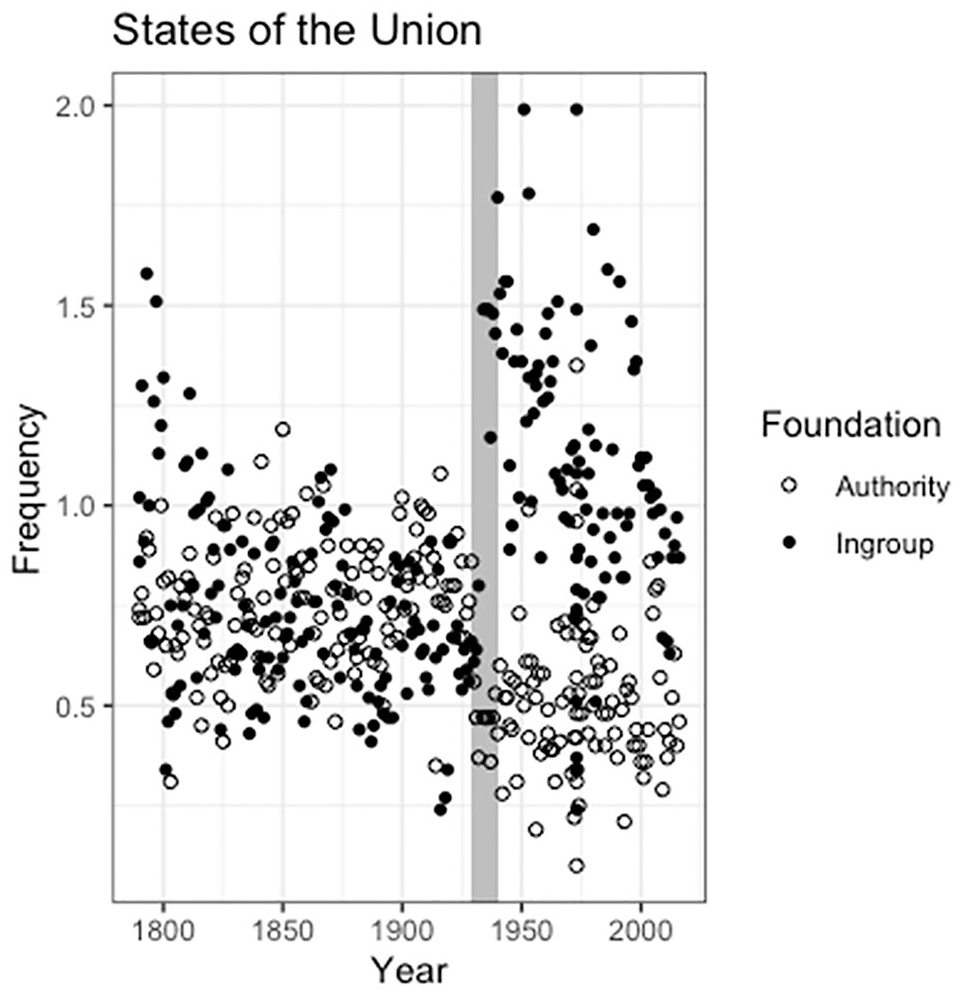
Frequency of Authority-positive and Ingroup-positive words in State of the Union Addresses by year. The gray box indicates the years 1929–1940.
During the same period of time, we also found univariate inflection points for increases in positive Purity language, and for changes in overall language about Harms, both positively and negatively charged. However, the language related to Harms appears to be part of a cyclical trend in language, as Harm-related language appears to fall back to its pre-1930s baseline by the 1960s. Similarly, the positive Purity language does not appear to change to nearly the same degree as the Authority or Ingroup series (though quantifying the difference in change is admittedly subjective as there is currently no established way of extracting effect-size estimates from these analyses, because they measure any differences between distributional qualities of a time series, not just mean-level differences). See the Supplemental Online Material for more details, including change point plots for all foundations, and for dynamic plots of the changes in frequency for the specific Ingroup and Authority words, see https://bit.ly/2QIgzmf for Authority words and https://bit.ly/2QG5wtG for Ingroup words.
Discussion
Using 226 years worth of the State of the Union Addresses (over 2 million words), we find a shift in the language used by Presidents around 1934, in which words related to Authority and obligation were replaced with appeals related to Ingroups and togetherness.
Study 1b: Predicting Changes in the State of the Union Address
The period during which Authority-laced appeals was replaced by Ingroup-laced appeals has been previously identified by psychologists as the time when the United States became psychologically modern (Oishi et al., 2013). During this time, as a function of the rapid urbanization of the country, American society shifted from being based on repeated small-scale interactions with close neighbors, in which the primary way a person identified themselves was with one’s town or village and where one’s duties and obligations to others were prioritized; to a social basis in the weak ties of urban life and personal identification with one’s nation (Greenfield, 2013). This changing state of interpersonal relations, from a psychology based in small communities to one based in a broader society, may similarly change the relationships of governments to their people, from a more local conception of government to a more national sense.
Nationalism, or the understanding of citizens that they live in a shared society, broadly tends to change people’s understanding of their relationship to each other and to their government (e.g., Bonikowski, 2016; Fox & Miller-Idriss, 2008). National identity can be conceptualized as a set of interlocking cognitive schemas comprising ideas about one’s broader identification with the nation, thoughts about who gets to be a citizen, national pride, and feelings about how one’s nation compares with other nations. The patterns of these identities differ across nations with the majority of citizens in some nations, for example, espousing a nationalism which is characterized by strong identity, restrictive membership, and both high pride and high chauvinism (such as contemporary Austria); while citizens of other nations, for example, have more moderate identities, more welcoming definitions of citizenship, more equivocal feelings about their nation’s place relative to other nations, and less overwhelming pride in their countries (such as the Nordic countries). These schemas, in turn, shape the way that people think about politics and issues of political power (Bonikowski, 2019).
As the United States transitioned into a more urbanized state, with a more ardent nationalism, we should therefore expect to see changes in the way that people schematized national identity and the role of government in their lives, shifting from a more locally-defined, passive nationalism to a stronger understanding of the country as a broader nation, with stronger boundaries between citizens and noncitizens and therefore stronger appeals to the nation as one large ingroup. We therefore investigated whether the moral-linguistic shift in Study 1a was predicted by changes in American sociodemographics and national identity.
Method
We used the same data as in Study 1a.
To measure the degree of nationalism in the country, we used the Google nGram American English corpus (Michel et al., 2011), which contains the texts of millions of books published every year from 1790 to 2008. We chose to use the combined frequency of the words “America” and “American” in each year as a face-valid index of national identity (e.g., Billig, 1995; Merritt, 1965). Prior to the 1934 address of Franklin Roosevelt, the State of the Union was traditionally delivered in December, while every address since has been delivered in either January or February. Therefore, for years prior to 1934, we use the Nationalism index associated with that year, while for 1934 and afterward, we use the Nationalism index from the previous year.
To measure changes in the urbanization of the United States, we used decennial U.S. Census estimates of the percentage of the country living in rural areas (https://www.census.gov/programs-surveys/geography/guidance/geo-areas/urban-rural.html), using spline imputation to fill in estimates for years between censuses.
To understand both the contemporaneous and time-lagged dynamic association between nationalism and our other variables of interest, we employed a graphical vector autoregression (graphicalVAR) model (Epskamp, 2017; Wild et al., 2010). GraphicalVAR is a regularized extension of the vector autoregressive time-series model to the structure of network models. In the graphicalVAR framework, a Kappa matrix representing contemporaneous relationships between variables is estimated along with a Beta matrix representing a time-lagged relationships between variables. These matrices are then used to estimate the partial contemporaneous correlations (PCC) between all variables of interest as well as the partial directed correlations (PDC). Both the PCC and PDC matrices can then be represented as an undirected and a directed network model, respectively.
All analyses were conducted with the “graphicalVAR” package in R, using the default model-selection approach, which picks models with LASSO-regularized parameters that optimize an extended Bayesian information criterion (EBIC) value. LASSO regularization is a method for estimating parameters of a given equation which sets unimportant and/or noninfluential parameters of a given equation to 0, in order not to overfit to a given data set. All remaining nonzero parameters can then be treated as statistically significant at the p < .05 level.
Results
In our first graphicalVAR analysis, looking at the relationship between the population distribution of the United States and our Nationalism index (EBIC = −1,745.18), we found that decreases in the percentage of the country living in rural areas predicted increases in the next year’s Nationalism index, above and beyond the previous year’s Nationalism index (partial r = −.02). We found no significant within-year relationship between the two variables.
In our second graphicalVAR analysis, we looked at the relationship between our Nationalism index and the frequency of Ingroup and Authority words. Again, we found directed (time lag of 1 year) effects but not contemporaneous effects (EBIC = 4.91). Nationalism index scores predicted the following year’s use of Authority words above and beyond the previous year’s use of Authority words (partial r = −.08), and predicted the use of Ingroup words above and beyond the previous year’s use of Ingroup words (partial r = .06). Within the corpus itself, the prevalence of Authority words in one year negatively predicted the next year’s use of Ingroup words above and beyond the previous year’s use of Ingroup words (partial r = −.18), and the prevalence of Ingroup words negatively predicted the next year’s use of Authority words above and beyond the previous year’s use of Authority words (partial r = −.11). See Figure 2 for the graphical model.

Parameter estimates for the graphical vector autoregressive analysis of Study 1b analyzing the relationship between the Nationalism index and word use in the State of the Union addresses. Parameters reflect relationships with the document from the next year. All parameters are significant at the p < .05 criterion.
In our third graphicalVAR analysis, we looked at whether changes in U.S. population distribution also predicted changes in Ingroup and Authority language. Again, we found directed (time lag of 1 year) effects but not contemporaneous effects (EBIC = −766.69), albeit ones far weaker than for the more proximal Nationalism index. A decrease in the percentage of the country living in rural areas predicted a decrease in the following year’s use of Authority words above and beyond the previous year’s use of Authority words (partial r = .0092) and also predicted the increased use of Ingroup words above and beyond the previous year’s use of Ingroup words (partial r = −.0024).
Finally, in our fourth graphicalVAR analysis, we looked at the predictive effect of both our predictors, U.S. population distribution and our Nationalism index, on the use of Authority and Ingroup language. In line with the previous models, we found directed (time lag of 1 year) but not contemporaneous effects (EBIC = −1,115.05). A decrease in the percentage of the country living in rural areas predicted an increase in the next year’s Nationalism index (partial r = −.02), but, controlling for the effects of the Nationalism index, only weakly predicted the increase in the next year’s use of Authority language (partial r = .007) and did not predict changes in the next year’s Ingroup language. Controlling for the effect of the change in population distribution, an increase in our Nationalism index still predicted a decrease in next year’s Authority language (partial r = −.03) and an increase in next year’s Ingroup language (partial r = .06). See Table S1 in the online supplement for the partial contemporaneous and PDC matrices for all models.
Discussion
We found that a Nationalism index, simply measuring the frequency of the words “America” and “American” in American books, was significantly predicted by changes in American urbanization and significantly predicted the switch from moral language reliant on authority (e.g., “duty,” “law,” “order”) to language reliant on ingroups (“together,” “nation,” “community”). Partial directed correlations showed that an increase in urbanization predicted an increase in American national identity and that increase in American national identity both significantly predicted the decrease in the frequency of the next year’s use of Authority-related moral speech and significantly predicted the increase in the next year’s use of Ingroup-related moral speech. We additionally found an inverse relationship between the use of Authority-related and Ingroup-related moral speech, where the use of Authority words negatively predicted the next year’s use of Ingroup words, and the use of Ingroup words negatively predicted the next year’s use of Authority words. As Presidents were talking to a more urbanized population, they spoke more about America in their speeches, and to the extent they increased their use of “America” and “American” in their speeches, they also used more Ingroup-based frames and reduced their use of more duty-focused language, as would be expected from an evolution of national identity originally rooted in a stable small communities defined by obligations to other community members into a well-defined broader-scale nationalism, with its stronger delineation between ingroup Americans and outgroup non-Americans.
Unexpectedly, partial contemperaneous correlations showed that Nationalism index was uncorrelated with the moral content in the speech of the year in which it was written. We speculate that this pattern may be a function of the difficulty of determining the contemporary mood of the electorate (Achen & Bartels, 2016), exacerbated by the laborious months-long drafting process of the State of the Union (e.g., Litt, 2017). If the State of the Union is generally slower to evolve than other cultural artifacts, then it may naturally be more strongly related to the moral tenor of the immediate past (when it was written) than to the present (when it was delivered).
Study 2: Assessing Generalizability and Specificity
Having established a change in the moral language used in the States of the Union and identified a potential predictor, we examined the generalizability and specificity of the broader linguistic shift by analyzing additional sets of historical documents. The State of the Union may be subject to unique pressures, as the format, nature, and purpose of the address has changed numerous times since George Washington delivered the first one in 1790; changes in word use may possibly be more reflective of idiosyncratic factors than of changing cultural mores (Shogan & Neale, 2009; Teten, 2003). We therefore sought out a series of alternative data sets: of public and private political speech, of American and non-American public political speech, of nonpolitical persuasive speech, and of popular culture more generally, to better understand this shift.
Method
We started with American Inaugural Addresses as a replication data set, because, like the States of the Union, they involve American Presidents making political speeches to the general public. We downloaded American Inaugural Addresses (57 documents) for all American Presidents from George Washington through Barack Obama (1789–2013) from http://www.presidency.ucsb.edu/inaugurals.php.
We looked at the language of U.S. political platforms for similar reasons, as they too involve political actors making policy arguments to the public, albeit less directly than political speeches and directed more to an audience of party insiders. Platforms, therefore, provide an interesting edge case—they are publicly directed political speech, but aimed more at elites than the general public. Our text for American political platforms (84 documents) was downloaded from http://www.presidency.ucsb.edu/platforms.php, covering American Presidential elections from 1840 to 2012.
To identify whether the trend was unique to the United States, we also analyzed Speeches from the Throne from both Canada and New Zealand. The Speech from the Throne is an address at the opening of a session of Parliament, read by a country’s Governor General and written by the ruling party, which acts in a similar political role as the State of the Union (Jennings et al., 2011). Canadian Speeches from the Throne (147 documents) were downloaded from https://lop.parl.ca/ParlInfo/compilations/parliament/ThroneSpeech.aspx?Language=E. New Zealand Speeches from the Throne (165 documents) come from a data set analyzed by Liu and Robinson (2016) and cover 1854–2014.
To determine whether the trend permeates all political speech or just political speech aimed at the public, we analyzed both a compendium of speeches from the floor of the U.S. Senate and a set of decisions made by the U.S. Supreme Court. To look at American Senate speeches (46 documents), we digitized a collection of classic speeches of the Senate, collected by Senator Robert Byrd (1994), covering 1830–1993. For Supreme Court opinions (211 documents), the lead researcher took the text of the most cited opinion in each year from 1803 to 2014, according to Google Scholar, except when a more subjectively important case was roughly comparable, citation-wise, for example, for 1973, substituting Roe v Wade (33,833 citations) for McDonnell Douglas v Green (36,606 citations).
To determine whether the trend was shared across all persuasive speech or unique to persuasive political speech, we analyzed the Commencement Addresses of two separate universities (chosen for convenience). We gathered commencement addresses (117 documents) from Stanford University (1893–2014) via https://library.stanford.edu/spc/university-archives/stanford-history/commencement-addresses; and from the University of Virginia (1859–2014), thanks to help from the UVa Special Collections Library.
Finally, to determine whether the trend simply reflects changes in word use arising from general linguistic shifts, we analyzed two additional sets of data: one corpus tracking popular culture broadly, the lyrics of the top five most popular songs on the U.S. Billboard music charts; as well one tracking linguistic norms more generally, the American English Google nGram corpus (1790–2012). Songs (592 documents) are from the year-end Billboard Pop charts and cover 1891–2013.
All data sets were analyzed using the same modeling approach and technique, with the same analytic choices, as in Studies 1a and 1b. To assess the degree of relatedness with our primary data set, we additionally ran lag-0 cross-correlations with each corpus against the State of the Union, allowing us to see how the frequency patterns of Authority and Ingroup words in the selected corpora correlate with those in the contemporaneous States of the Union.
Results and Discussion
In our analyses of nine additional corpora selected to represent a range of historical speech, we find a linguistic shift matching that found in Study 1 only in the language of politicians speaking to the public. Inaugural Addresses, Political Platforms, and international Speeches from the Throne all show the same basic pattern of change as the State of the Unions, initiated sometime in the Great Depression, in which appeals to Authority are replaced by appeals to Ingroups (see Figure 3). For both international Speeches from the Throne, this pattern is significantly explained by an increase in nationalism. This pattern is not apparent in any other Foundations or in any of the other selected data sets, indicating that the shift in language appears to be limited only to public persuasive speech, not political speech in general, persuasive speech in general, changes in popular culture, or word-use norms, and is therefore unexplained by other changes in American sociodemographics which do not share this particular time course.
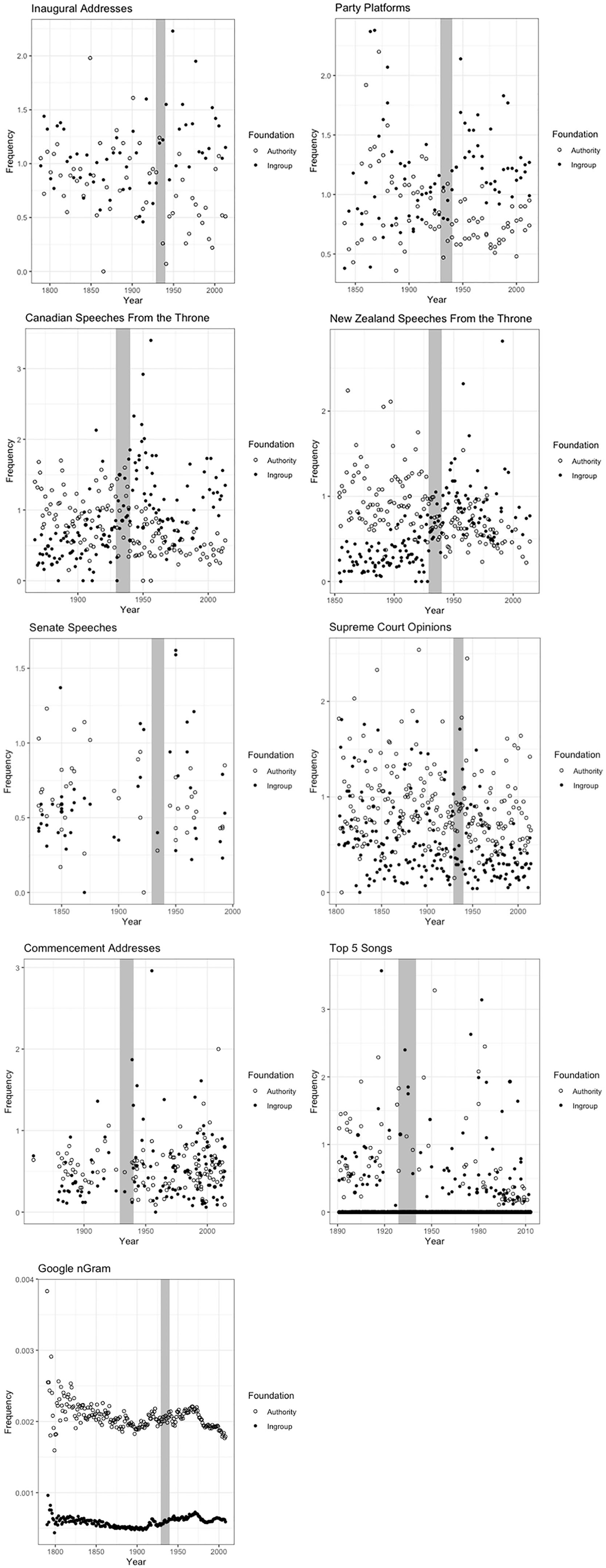
Frequency of Authority-positive and Ingroup-positive words in comparison corpora by year. The gray box indicates the years 1929–1940.
Of the nonpersuasive political speech corpora, the one that most closely matched the patterns of Studies 1a and 1b was the Google nGram corpus, which tracked a similar rise in the use of Ingroup words and a similar fall in the use of Authority words, but, unlike the States of the Union, did now show a replacement of one by the other. To further probe this similarity, we ran an additional analysis of the Google nGram corpus using just the set of Authority and Ingroup words that appear with above-average frequency in the States of the Union (“Authorit*,” “Class,” “Command,” “Control,” “Duti*,” “Duty,” “Honor,” “Law,” “Leader,” “Legal,” “Order,” “Permit,” “Position,” “Preserve,” “Respect,” “Serve,” and “Submi*” for Authority; “Communi*,” “Nation,” “Together,” and “Unite” for Ingroup) and found that, within this restricted word-set, our Nationalism index does not predict either changes in Authority words or Ingroup words.
Our Nationalism index also did not predict changes in the Inaugural Addresses or in Party Platforms. We believe this is largely an issue of sample size—as Inaugural Addresses (57 documents) and Party Platforms (84 documents) only appear, at best, every 4 years, we have limited power to detect effects, especially as compared to the annual State of the Union (247 documents), or the New Zealand and Canadian Speeches from the Throne (165 and 147 documents, respectively). To that point, we do find that the corpora indexing publicly directed political speech (Inaugural Addresses, rAuthority = .42 [.16, .62], p < .001, rIngroup = .51 [.28, .69], p < .001; and the international Speeches from the Throne: New Zealand, rAuthority = .48 [.34, .60], p < .001, rIngroup = .66 [.55, .75], p < .001; Canada, rAuthority = .35 [.17, .50], p < .001, rIngroup = .59 [.46, .70], p < .001) are correlationally similar to the State of the Union in a way that the other corpora are not. Party Platforms, befitting their edge-case status, appear to be only loosely related to the State of the Union, rAuthority = .29 [−.02, .55], p = .062, rIngroup = .32 [.007, .57], p = .046, but are more strongly jointly related to both the Authority and Ingroup series of the State of the Union than the nonpublic and nonpolitical corpora (which are either uncorrelated with the State of the Union or only correlated in the Ingroup series). See Table 1 for full statistics and Table S2 in the online supplement for the full PDC and PCC matrices.
Time-Series Analyses of Comparison Corpora.

Note. 95% confidence intervals are displayed in brackets. gVAR = Graphical Vector Autoregressive model; EBIC = extended Bayesian information criteria for model selection; SotU = State of the Union; CCF = cross-correlation function.
General Discussion
In total, we analyzed over 7 million words of speech contained in 1,666 documents from nine data sets across three countries (plus the entire American Google nGram corpus), with historical coverage back to 1789, to identify a cultural shift in public-directed political persuasion using a nonparametric multivariate change point detection algorithm followed by a graphical vector autoregressive model. As seen in Table 1, these analyses identify the specific year in which a linguistic shift occurs and then allows us to predict that change. To our knowledge, this is the first time these advanced analytics have been applied to explore cultural changes.
In these corpora, which cover political and nonpolitical speech aimed to persuade elites or members of the general public, we find a consistent shift specific to political speech meant to persuade the public, which happens in time with an increase in “national” language (indexed by use of the words “America” and “American”). Sometime during the Great Depression, with the rise of a truly pan-national consciousness, politicians in at least three countries simultaneously changed the language of their arguments—turning from discussions of hierarchy and obligation and turning toward ingroups and national togetherness—a change which has held constant to the present. Importantly, this pattern does not show up in contemporaneous nonpolitical elite persuasive speech, nor in internally directed political speech, nor popular media. While the frequency of moral language overall has declined across the American 20th century (Kesebir & Kesebir, 2012; though see Wheeler et al., 2019, for trends for Moral Foundations-based language), our findings cannot be explained simply by changes in general rhetorical form or linguistic modernization; rather they are unique to the acts of politicians talking to the country at large.
Previous work looking at the evolution of American culture has also identified the early decades of the 20th century as a formative time for the emergence of the psychologically modern state. Greenfield (2013) hypothesized that the roots of this change emerged in the movement from the largely agrarian society of the 18th and 19th centuries to the more urban nation that we currently live in, and we find that our Nationalism index is significantly predicted by changes in American urbanization levels. Psychological traits that are well situated to a more rural, community-based world, such as obligation and respect for authority, may not be as adaptive in more anonymous overloading cities (e.g., Milgram, 1970), and accordingly Greenfield (2013) finds that, as the percentage of Americans living in rural areas declines across time, so too does usage of words like “obliged” and “give” in text corpora, replaced in turn by words like “choose” and “get.”
Analyzing the replacement of “obliged” with “chose” and “give” with “get” using the analyses of Studies 1 and 2 finds that these transitions (1937 and 1934, respectively) occur at a similar time to the moral shift described above, and our nationalism index predicts the decline of “obliged” (but not the rise of “chose”), and predicts both the fall of “give” and, indirectly, the rise of “get.”
Political speech does evolve, as politicians try different approaches to persuasion (e.g., Lim, 2002), and accordingly, politicians are often successful in their attempts to persuade the public to change their beliefs about the issues (e.g., Canes-Wrone, 2004; Cavari, 2013; Tedin et al., 2010). As Americans began identifying themselves as “American” (instead of as members of states or cities), our data suggest that politicians altered their arguments in turn, framing them more in nationalist language.
It is worth noting several limitations of the current research. One primary limitation is in the corpora used for analysis. A stronger test of our hypothesis would be to look at additional sources of persuasive moral language, such as sermons, to broaden our argument out of the political and to potentially address the power issues of Study 2. Sadly, we were unable to identify any source with suitable historical coverage. In addition, being able to track the rise of specifically Canadian or New Zealander nationalism, matched against the documented linguistic shift, would have strengthened our claims. Google nGram only covers American and British corpora, and so we could not construct an equivalent measure.
A second limitation comes from the way that we extracted moral concepts from our text corpora. By using a simple word-counting approach, we miss the linguistic context of those words which prevents us from knowing entirely whether these concepts are being celebrated or denigrated—all we can really know is that they’re being talked about using words that are generally positively valenced. More sensitive topic-modeling-based approaches to studying moral language (e.g., Garten et al., 2016; Sagi & Dehghani, 2014) may be able to further clarify these relationships.
A third limitation comes from the inherently exploratory nature of the analytic techniques we used, especially the change point analyses. While we use the same specifications for all 10 corpora, our tests are largely data driven and may therefore be more likely to capitalize on chance than more constrained tests.
Finally, we understand that our data are nonexperimental, and thus it is always possible that a third variable is driving both changes in nationalism, and, on a lag, changes in persuasive political speech. Using comparable data from countries that urbanized at a different historical moment than the three countries in our data set (such as Brazil, which didn’t hit 50% urbanization until the 1960s), or that are currently deurbanizing (such as Austria, which has gone from ~65% urbanized in 1960 to ~57% urbanized in 2018; World Bank, 2019), would help us disentangle mechanisms based on worldwide macro-historical trends (such as changes in the technologies used for communication and transportation) from mechanisms based specifically in the movement of people from rural to urban places.
Constraints on Generality
The stimuli in this study consist of text corpora from three English-speaking countries, all of which share a cultural background, analyzed using a word-counting paradigm. We expect that our findings would generalize to other corpora of political speech aimed toward convincing the public (e.g., U.S. state inaugural addresses; op-eds written by political actors) within the rhetorical history of other countries with elites that are primarily Western, Educated, Industrialized, Rich, and Democratic (i.e., WEIRD; Henrich et al., 2010) and would generalize to text analyses of these corpora that use more embedded approaches. However, we have no evidence whether these findings will extend to non-WEIRD political cultures.
Conclusion
Cultures do change over time, and understanding the course of that evolution speaks to the way that things are organized in the present. By tracking the evolution of political language in the United States and other Western nations, we show that the changes in nationalism and national identity in the 1920s, likely driven by shifts in the concentration of people into cities, are linked to the present day in the form of a political discourse which emphasizes group identity over rule-following.
Supplemental Material
Buttrick_Online_Appendix – Supplemental material for Historical Change in the Moral Foundations of Political Persuasion
Supplemental material, Buttrick_Online_Appendix for Historical Change in the Moral Foundations of Political Persuasion by Nicholas Buttrick, Robert Moulder and Shigehiro Oishi in Personality and Social Psychology Bulletin
Supplemental Material
HCMF_SI_Text_Final – Supplemental material for Historical Change in the Moral Foundations of Political Persuasion
Supplemental material, HCMF_SI_Text_Final for Historical Change in the Moral Foundations of Political Persuasion by Nicholas Buttrick, Robert Moulder and Shigehiro Oishi in Personality and Social Psychology Bulletin
Footnotes

Declaration of Conflicting Interests
The author(s) declared no potential conflicts of interest with respect to the research, authorship, and/or publication of this article.
Funding
The author(s) received no financial support for the research, authorship, and/or publication of this article.
Supplemental Material
Supplemental material is available online with this article.
Notes
References
Supplementary Material
Please find the following supplemental material available below.
For Open Access articles published under a Creative Commons License, all supplemental material carries the same license as the article it is associated with.
For non-Open Access articles published, all supplemental material carries a non-exclusive license, and permission requests for re-use of supplemental material or any part of supplemental material shall be sent directly to the copyright owner as specified in the copyright notice associated with the article.
