



Abstract
The present research conceptualizes open-minded cognition as a cognitive style that influences how individuals select and process information. An open-minded cognitive style is marked by willingness to consider a variety of intellectual perspectives, values, opinions, or beliefs—even those that contradict the individual’s opinion. An individual’s level of cognitive openness is expected to vary across domains (such as politics and religion). Four studies develop and validate a novel measure of open-minded cognition, as well as two domain-specific measures of religious and political open-minded cognition. Exploratory and confirmatory factor analysis (controlling for acquiescence bias) are used to develop the scales in Studies 1 to 3. Study 4 demonstrates that these scales possess convergent and discriminant validity. Study 5 demonstrates the scale’s unique predictive validity using the outcome of Empathic Concern (Davis, 1980). Study 6 demonstrates the scale’s unique predictive validity using the outcomes of warmth toward racial, religious, and sexual minorities.
Keywords
Open-minded cognition can be conceptualized as a bipolar psychological continuum ranging from closed-mindedness to open-mindedness. An open-minded cognitive style is marked by a willingness to consider a variety of intellectual perspectives, values, attitudes, opinions, or beliefs, even those that contradict the individual’s prior opinion. Open-minded individuals attend to a variety of viewpoints, consider numerous competing perspectives, and elaborate upon information in an unbiased manner. In contrast, a closed-minded or dogmatic cognitive style is characterized by confirmatory bias: a tendency to process information in a manner that reinforces the individual’s prior opinion or expectation, and a lack of attention paid to competing perspectives and viewpoints (e.g., Eagly, Chen, Chaiken, & Shaw-Barnes, 1999; Nickerson, 1998). Closed-minded cognition reflects a directionally biased tendency to select, interpret, and elaborate upon information in a manner that reinforces the individual’s prior opinion or expectation. Open-minded cognition reflects a tendency to process information in a manner that is not biased in the direction of the individual’s prior opinion or expectation.
The study of open-minded cognition reflects a core concern within social psychology. Cognitive dissonance research documents the presence of selective attention and selective avoidance biases that enable individuals to maintain their prior attitudes (Cooper, 2007). The MODE Model of attitudes proposes that previously existing attitudes bias interpretations or perceptions of the qualities of the object (Fazio & Towles-Schwen, 1999). The Elaboration Likelihood Model documents the role of biased elaboration in persuasion contexts (Petty & Cacioppo, 1986; Petty & Wegener, 1991). Impression formation research indicates prior impressions of a target person can bias the encoding, interpretation, and retrieval of subsequent information pertaining to the target person (Wyer & Srull, 1979). Stereotyping research indicates stereotypes elicit biases when individuals selectively process information pertaining to a group member (Bodenhausen, 1988; Ottati, Claypool, & Gingrich, 2005). Core psychological motivations (e.g., need for self-esteem, need for security) can also elicit directionally biased cognitive processing (Showers & Cantor, 1985).
The study of open-minded cognition is also of practical significance. Research suggests that political polarization is increasing in the United States (Abramowitz & Sanders, 2008; Druckman, Peterson, & Slothus, 2013). In the United States, polarization is often reflected in conflict between religious traditionalists and an increasingly large group of Americans who eschew membership in any institutional religion (Layman & Green, 2005). Political and religious polarization can produce negative social outcomes. These include a decrease in substantive policy reasoning (Druckman et al., 2013), political gridlock that impedes legislation (Binder, 1999; Jones, 2001), economic damage incurred by stalemate and government shutdown (Macroeconomic Advisers, LLC, 2013), economic inequality (Hetherington, 2009), as well as violence within and between nation states (Esteban & Schneider, 2008). These forms of polarization are presumably exacerbated by dogmatic, closed-minded thinking and a failure to consider others’ perspectives or feelings. Increased understanding of open-minded cognition may foster the development of social interventions designed to decrease polarization, conflict, and human aggression; as well as increase empathy, tolerance, acceptance, and pro-social behavior.
General and Domain-Specific Open-Minded Cognition
We conceptualize open-minded cognition as possessing both a dispositional and situational component. Individuals vary in terms of their chronic level of open-mindedness (dispositional variation). In addition, open-minded cognition may vary across situations. For example, individuals may be open-minded toward arguments that advocate a new teaching style, but closed-minded toward arguments that encourage racial discrimination. An individual’s chronic level of open-mindedness can be conceptualized as the individual’s average level of open-mindedness across situations. In contrast, the temporary component of open-mindedness captures malleability in open-minded cognition across situations, yielding elevated levels of open-mindedness in situations that merit such a reaction, and low levels of open-mindedness in situations that do not merit such a reaction (see Conway, Schaller, Tweed, & Hallet, 2001; Epstein, Lipson, Holstein, & Huh, 1992; Zukier, 1986; and Samuelson & Church, 2014, for related work regarding Personal Humility).
Domain-specific open-mindedness refers to an individual’s level of open-minded cognition within a category of situations (e.g., politics, religion). Because polarization and conflict frequently emerge in politics and religion, we focus on these two domains when assessing domain-specific open-mindedness. We hypothesize that General (OMC-G), Political (OMC-P), and Religious (OMC-R) Open-Minded Cognition are correlated, yet distinct constructs that can exhibit unique associations with other predispositions. Moreover, mean levels of OMC-G may exceed mean levels of domain-specific open-mindedness. These predictions are compatible with research that demonstrates general and domain-specific cognitive predispositions are correlated, yet distinct variables (e.g., Baer, 2012; Conway et al., 2001; Luskin, 1990), and research that suggests citizens tolerate freedom of expression in general, but are less likely to tolerate freedom of expression for members of specific social groups (a phenomenon referred to as “slippage,” Sullivan, Piereson, & Marcus, 1982).
Measuring Open-Minded Cognition
In measuring open-minded cognition, we pursued five objectives. The first was to select items that specifically assess the tendency to select, interpret, or elaborate upon information in a directionally biased versus directionally unbiased manner. The second objective was to develop correspondent measures of OMC-G, OMC-P, and OMC-R that possess virtually identical item content and factor structure. This enables one to compare the three scales while holding item content constant. With minor alteration, one can create future scales that assess open-minded cognition in virtually any domain or situation. Third, the scales should be derived using a procedure that controls for acquiescence/agreement bias, yielding balanced scales possessing an equal number of “open” (e.g., “I am willing to listen to other [political/religious] perspectives”) and “closed” items (e.g., “I often ignore information that contradicts my opinion”). This prevents the open-minded cognition score from being confounded with acquiescence/agreement bias . The fourth objective was to create short scales that can be administered in research studies that require succinct measurement (e.g., repeated measures experiments, large nationally representative surveys). The fifth objective was to ensure the open-minded cognition measures possess adequate statistical fit.
Pre-existing measures do not satisfy the aforementioned criteria. Although, some psychological scales include items that assess open-minded cognition (i.e., Actively Open-Minded Thinking, Stanovich & West, 2007; Dogmatism, Trodahl & Powell, 1965; Closed-Minded subscale of Need for Closure, Webster & Kruglanski, 1994), these scales also include items that do not specifically assess directionally biased versus unbiased information processing (e.g., “There are a number of people I have come to hate,” “I feel irritated when one person disagrees with what everyone else believes”). The same is true of pre-existing religious and political scales (e.g., Spiritual Openness, Genia, 1997; QUEST, Batson & Schoenrade, 1991; Religious Fundamentalism, Altemeyer, 2006; Dogmatism, Trodahl & Powell, 1965). Thus, the presently developed measures of open-minded cognition should be associated with these related measures, but should not be identical to them.
Many of the previously described scales also exceed 10 items, and as such, are not easily used in research designs that require more succinct forms of measurement (e.g., actively open-minded thinking, 42 items; need for closure, 20 items). Moreover, many of these measures are composed of unbalanced scales that are potentially confounded with acquiescence/agreement bias, making it difficult to isolate the effect of open-minded cognition when predicting other individual difference variables (e.g., femininity, political tolerance). Finally, none of the pre-existing measures provide correspondent measures of general and domain-specific open-minded cognition that enable the researcher to perform cross-domain comparisons while holding item content constant.
Open-Minded Cognition and Other Psychological Orientations
Although conceptually distinct, open-minded cognition may be related to a variety of psychological orientations. An open-minded cognitive style may engender (or be engendered by) Openness to Experience (Big 5), Agreeableness (Big 5), Need for Cognition (Cacioppo & Petty, 1982), or Personal Humility (e.g., “I am far from perfect,” Elliot, 2010; “I feel I do not deserve more respect than other people,” Kruse, Chancellor, & Lyubomirsky, 2014). Open-minded cognition should also be negatively associated with cognitive style variables that reflect rigid or biased processing (e.g., need for closure, Webster & Kruglanski, 1994; intolerance of ambiguity). Relations between open-minded cognition and other psychological orientations are more difficult to ascertain on a priori grounds, but are nevertheless worth exploring (e.g., relations with extraversion, neuroticism).
Because it entails an unbiased consideration of alternatives, open-minded cognition may increase skepticism toward traditional or hierarchical social arrangements (e.g., System Justification, Kay & Jost, 2003; Political Conservatism, Dogmatism, Trodahl & Powell, 1965). OMC-P may be positively associated with support for democratic values, political tolerance, and attention to political news. Related research suggests OMC-P will be positively associated with a politically liberal or democratic orientation (e.g., Jost, Glaser, & Kruglanski, 2003a, 2003b), and negatively associated with support for the status quo (e.g., American System Justification, Kay & Jost, 2003). The direction of the relation between OMC-P and political knowledge (i.e., Political Expertise) is difficult to ascertain a priori, but worthy of exploration. OMC-R may be positively associated with religious orientations that emphasize exploration and learning (e.g., QUEST, Batson & Schoenrade, 1991; Spiritual Openness, Genia, 1997), but negatively associated with dogmatic, fundamentalist religious orientations (e.g., Religious Fundamentalism).
It is expected that within-domain relations (e.g., OMC-P and political knowledge) will be stronger than cross-domain relations (e.g., OMC-R and political knowledge). Also, when examining within and cross-domain correlations, relations should be stronger when the measures assess semantically similar constructs (e.g., OMC-R and OMC-P) than semantically dissimilar constructs (e.g., OMC-R and Political Tolerance).
Overview
Studies 1 to 3 were designed to develop the correspondent measures of OMC-G, OMC-P, and OMC-R scales. In developing these scales, our objectives were to (a) specifically assess the tendency to select, interpret, or elaborate upon information in a directionally biased versus directionally unbiased manner; (b) develop three correspondent scales that possess virtually identical item content and factor structure; (c) use a statistical procedure that controls for acquiescence/agreement bias and yields a balanced scale (equal number of “open” and “closed” items); (d) develop scales containing a small number of items; and (e) ensure the scales possess adequate statistical fit. Study 4 examined the inter-relation between these three open-minded cognition scales, as well as the relation between these scales and measures of other constructs (e.g., need for cognition, political knowledge, and religiosity). Studies 5 and 6 examined the unique predictive validity of open-minded cognition when predicting affective outcomes (i.e., Empathic Concern, emotional reactions to outgroups).
Study 1: Item Generation and Testing
Item Generation
Items from previously existing psychological (e.g., need for closure, intolerance of ambiguity), political (e.g., authoritarianism, tolerance), and religious measures (e.g., fundamentalism, QUEST Orientation) were selected and pooled for analysis (Clark & Watson, 1995; Rattray & Jones, 2007). Based upon our conceptual definition of open-minded cognition, new items were also created. All items were edited to ensure they could, with minor alteration, be worded to created correspondent measures of OMC-P and OMC-R. This initial set of 79 were designed to assess multiple facets of open-minded cognition, including directional bias with regard to attention, encoding, retrieval, interpretation, and elaboration of information; as well as the respondent’s self-reported tendency to adopt the perspective of others and be open to attitude change. Items worded in the “closed” and “open” direction were both included in the item pool
Participants and Procedure
Participants’ mean age was 34.84 years (SD = 12.20). In all, 49.8% of participants were female. Most participants reported having a college education or more. See Table 1 for an extensive list of participant demographics, including race and religious affiliation. Fifteen participants were removed from analyses for failure to answer all attention-check items correctly (N = 600 for analyses).
Participant Demographics.

The 79 items were administered in randomized order to a large sample of U.S. participants using mTurk in the summer of 2013 (see online appendix for items). In exploratory and confirmatory factor analyses, a subject-to-variable ratio of 5 or greater is considered acceptable, to ensure sufficient power (in our case, 79: 600 greatly exceeded this cutoff; see Bryant & Yarnold, 1995). Response options ranged from 1 (strongly disagree) to 7 (strongly agree). Interspersed throughout the survey were six attention-check items (e.g., “Please select ‘strongly agree’”). Finally, participants completed demographic items (e.g., race, gender, income, education).
Results
Survey responses were analyzed using an iterated exploratory principal components analysis (PCA) with an orthogonal (varimax) rotation. Initial results indicated that the primary factor accounted 31.82% of the variance in item responses, with an initial eigenvalue (derived from the unreduced correlation matrix) of 25.13. The second potential factor had an eigenvalue of 6.17 and accounted for only 7.8% of the variance; Factor 3 had an eigenvalue of 3.35 and accounted for 4.25% of the variance; Factor 4 had an eigenvalue of 3.22 and accounted for 4.08% of the variance; Factor 5 had an eigenvalue of 2.17 and accounted for 2.76% of the variance; Factor 6 had an eigenvalue of 1.37 and accounted for 1.74% of the variance; additional factors contributed negligible amounts of the variance in responses and were not ultimately considered crucial component of the construct. Scree plot results supported a unifactorial structure (“elbow test”; Cattell, 1966). The Perspective Taking and Openness to Attitude Change item clusters did not load strongly on the single factor, or any other independent factor. Upon further reflection, these items were determined to be conceptually distant from the open-minded cognition construct, and thus were eliminated from the item pool.
PCAs were then repeated 1 with the intention of reducing the item set by removing items that did maximize internal reliability and discriminant validity of the factors (see Rattray & Jones, 2007 for this procedure). Survey items were removed that had a factor loading of less than <.40 (maximizing internal reliability) or that had >.40 on multiple factors (maximizing discriminant validity). This led to the removal of 13 items, after which analyses were repeated with the new item set. Again, scree plot results supported a unifactorial structure; the initial factor exhibited an eigenvalue of 14.353 and accounted for 51.26% of the variance in responses. Using the results of this analysis, the item set was reduced again, using a more strict cutoff criterion (items with factor loadings <.50 were removed from analyses, as well as items that loaded >.35 on more than one factor). This led to the removal of an additional 9 items. With this reduced set of items, a final analysis was performed. Results indicated that the first factor accounted for 56.97% of the variance in item responses, and had an eigenvalue of 10.825. The second factor had an eigenvalue of 0.888 and accounted for 4.68% of the variance; the third had an eigenvalue of .750 and accounted for 3.95% of the variance; the fourth factor had an eigenvalue of 0.664 and accounted for 3.50% of the variance; all remaining factors contributed negligibly. Scree plot results supported a unifactorial structure once again. Ultimately, scale items with loadings of 0.40 on multiple factors and scale items with weak loadings (i.e., < 0.70) on the first factor were removed. This loading cutoff was designed to be particularly onerous, as the goal of this study was to greatly reduce the pool of items (the standard cutoff is <.39; Rattray & Jones, 2007).
This method yielded a 19-item scale; however, all items were worded in an “open-minded” fashion. To maintain a balanced scale with an equal number of “closed” and “open” items, a relaxed set of standards was applied to closed-minded items. The 19 closed-minded items that loaded most strongly on the first factor (> .40) were selected and added, and PCA was performed again. The resulting 38-item scale retained a unifactorial structure, with the primary factor accounting for over 40% of the variance and possessing an eigenvalue of 15.751. This scale also exhibited high reliability (Cronbach’s alpha = .959). This 38-item scale provided the basis for Study 2 (see online appendix).
Discussion
Study 1 was exploratory, and its results are therefore preliminary. However, results suggest that open-minded cognition may be appropriately conceptualized in terms of one factor. However, although Study 1 reduced the item pool from 79 to 38 items, it would be useful to develop a scale possessing an even smaller number of items. Second, exploratory factor analytic techniques are not sufficient to demonstrate a scale exhibits a particular structure. It is necessary to use confirmatory factor analysis to provide more compelling evidence regarding latent factor structure. Third, exploratory factor analysis does not enable one to control for acquiescence/agreement bias when deriving a factor solution (Billiet, 1998). Fourth, a primary objective of the present research was to construct three syntactically equivalent open-minded cognition scales (General, Political, and Religious). Thus, it was imperative that the factor structure observed in the OMC-G scale be evident in the OMC-P and OMC-R scales as well. Study 2 addresses these limitations.
Study 2: Preliminary Confirmatory Factor Analyses
The first goal of Study 2 was to test the factor structure of the OMC-P and OMC-R scales, using the 38 items identified in Study 1. The second goal was to confirm the latent factor structure determined in Study 1, utilizing confirmatory factor analysis. The third goal was to reduce the 38-item set substantially for all three subscales while maximizing loadings and maintaining adequate fit.
A fourth goal of Study 2 was to control for acquiescence/agreement bias. Individual differences in acquiescence bias produce an artifactual positive correlation between all survey items. This inflates the inherent positive correlation for the “open-open” and “closed-closed” item pairs, but deflates the magnitude of the inherent negative correlation between the “closed-open” pairs (Feldman, personal communication, April 4, 2014). This can produce a biased factor solution with “open” items loading on one factor and the “closed” items failing to load (with opposite signs) on the same bipolar factor (Feldman, personal communication, April 4, 2014).
To address this problem, Study 2 utilized confirmatory factor analysis controlling for acquiescence (see Billiet & Matsuo, 2012; Billiet & McClendon, 1998, 2000). This procedure involves adding a second acquiescence method factor to the model. All items (both “open” and “closed”) are forced to load with the same unstandardized positive loading on this factor. Individuals who tend to agree with any and all survey items score high, whereas individuals who tend to disagree with any and all items score low on this acquiescence method factor. The confirmatory factor analysis is run forcing the substantive open-mindedness factor to be orthogonal to the acquiescence method factor, yielding a substantive factor solution that controls for (i.e., orthogonal from) acquiescence bias. In this fashion, acquiescence bias is “eviscerated” when estimating the substantive open-minded cognition solution.
Item Generation
Using the 38 items identified in Study 1 (see online appendix), the political and religious open-minded scales were written. Each general item was minimally altered to produce corresponding religious and political items (e.g., “I have no patience for arguments I disagree with” became “I have no patience for political arguments I disagree with,” and “I have no patience for religious arguments I disagree with”).
Participants and Procedure
Participants (N = 557) were recruited online in the summer of 2013 using mTurk. Participants were 34.9 years of age, on average (SD = 11.56). Fifty-two percent of participants were female. Most participants reported having a college degree or higher level of education (see Table 1 for additional participant demographics). Participants who missed more than two of the six attention-check items were removed from analyses (n = 19; final N = 557). Again, our subject-to-variable ratio vastly exceeded 5, indicating sufficient power.
All participants responded to the three 38-item scales (the items were again in a randomized order, within scale). Response options ranged from 1 (strongly disagree) to 7 (strongly agree). Additional attention-check items were interspersed throughout the survey. Finally, participants responded to several demographic measures (race, gender, education level, income level).
Results
The unifactorial structure apparent in Study 1 was imposed on all three versions of the Open-Minded Cognition scale and tested for model fit, using confirmatory factor analysis in LISREL (Jöreskog & Sörbom, 2006). To eliminate acquiescence bias, a one- (substantive) factor structure solution was imposed on each 38-item scale, with a second acquiescence method factor (see Billiet & Matsuo, 2012; Billiet & McClendon, 1998, 2000). For the substantive open-minded cognition factor, all items were permitted to load freely. For the acquiescence method factor, all items were forced to load with a positive, unstandardized value of 1.0. These two factors were not permitted to correlate, ensuring the substantive open-minded factor was not confounded with acquiescence. This controls for acquiescence bias when estimating the substantive open-minded cognition factor solution (Billiet & Matsuo, 2012; Billiet & McClendon, 1998, 2000). In all cases, analyses performed with this acquiescence method factor imposed on the model yielded significantly greater model fit, compared with an equivalent one-factor model that lacked the method factor, and item loadings onto the method factor as well as method factor variance were found to be significant at the p < .05 level (see below).
Each model was analyzed using both relative and absolute fit indices calculated by LISREL (following Tabachnik & Fidell, 2007). The relative fit indices contrast the model with the worst possible model, and include the non-normed fit index (NNFI), the comparative fit index (CFI), and the normed fit index (NFI). Absolute fit indices contrast the model with the best possible model and included chi-square, root mean square error of approximation (RMSEA), standardized root mean square residual (SRMR), and the root mean square residual (RMR). Item factor loadings were also analyzed to ensure that items with poor loadings were not included in the final scales.
Confirmatory factor analyses: 38-item scales
Confirmatory factor analysis for the 38 General items revealed that the scale possessed high inter-item reliability (α = .963), but unacceptable fit on several indices (see Table 2). In terms of absolute fit, the scale exhibited adequate to strong fit on all absolute and relative measures (see Table 2). The method factor’s parameter estimate of variance was 0.068 (SE = .006) and all loadings onto the method factor were significant at the p < .05 level. The 38-item OMC-P scale possessed high reliability (α = .945) and adequate fit (see Table 2); the method factor’s parameter estimate of variance was 0.101 (SE = .008) and all loadings were significant at the p < .05 level. The OMC-R scale possessed adequate reliability (α = .942), and possessed adequate fit on all indices (see Table 2). The method factor’s parameter estimate of variance was 0.135 (SE = .010) and all loadings were significant at the p < .05 level.
Open-Minded Cognition Scale Fit Indices in Study 2 and Study 3.
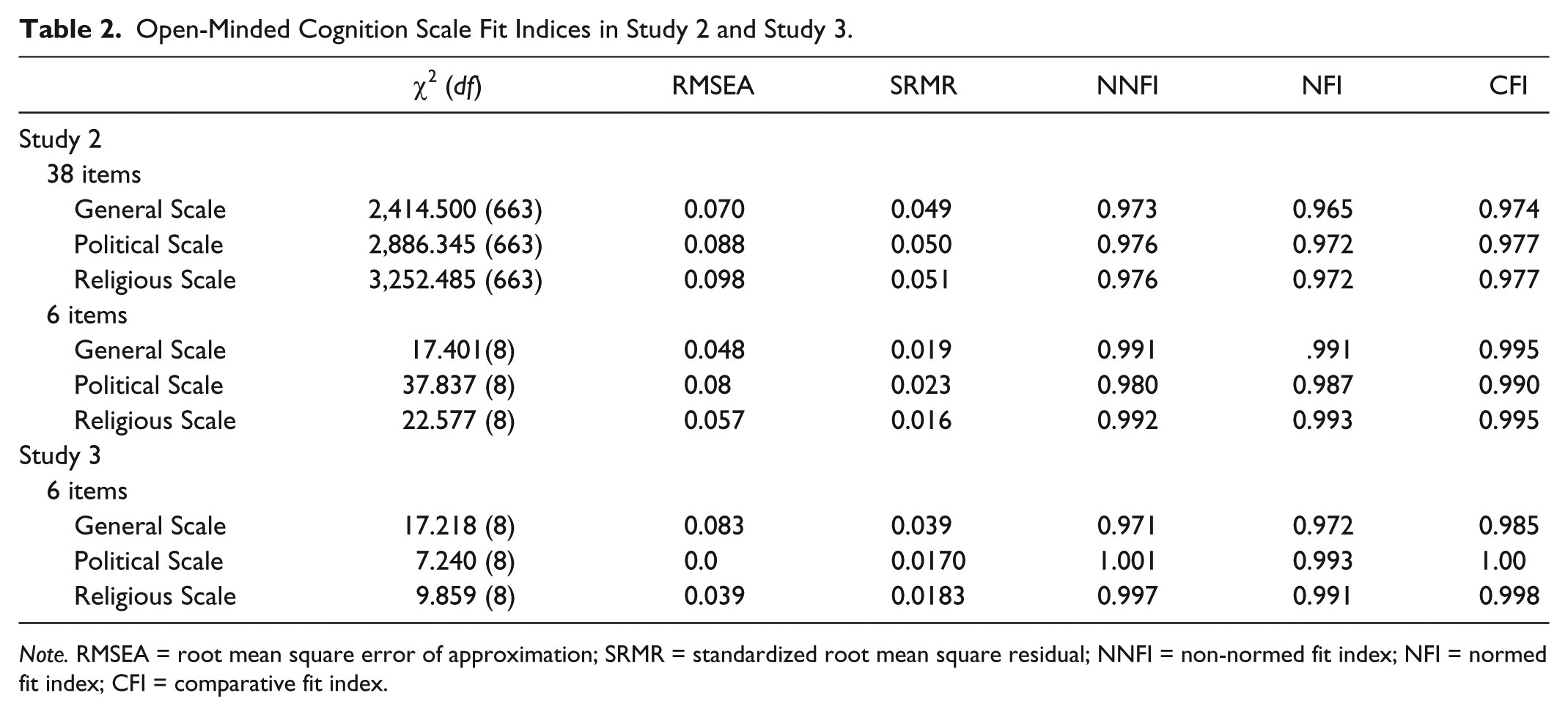
Note. RMSEA = root mean square error of approximation; SRMR = standardized root mean square residual; NNFI = non-normed fit index; NFI = normed fit index; CFI = comparative fit index.
Reducing scale size and improving fit
To reduce the size of the scales and improve model fit, items with low factor loadings or low squared multiple correlations were removed (see Clark & Watson, 1995; Rattray & Jones, 2007; and Ferguson & Cox, 1993, for a comparable approach). Scale items with squared multiple correlations of less than 0.44 on any of the three open-minded cognition measures were removed from all three scales. In all cases, if a survey item performed poorly on one of the three scales, it also had a low factor loading or squared multiple correlation on the other two scales, and so removal of the item from all three scales was justified. Every time a survey item was removed from the original pool of 38 scale items, a new confirmatory factor analysis was performed with the remaining items (for all three subscales). These new confirmatory factor analysis results were used to determine which scale item would be removed next.
The final model comprised three six-item open-minded cognition scales with correspondent content (see Table 3). The six-item scales contain an equal number of “open” and “closed” items. The OMC-G and OMC-P scales exhibited strong absolute fit and relative fit, and the OMC-R scale exhibited adequate fit on the absolute and relative indices (Table 3). For the OMC-G, the method factor’s variance was 0.155 (SE = .030); for the OMC-P, the method factor’s variance was 0.242 (SE = 0.039); for the OMC-R, the method factor’s variance was 0.201 (SE = 0.042). In all cases, item loadings onto the method factor were significant at p < .05.
Items and Factor Loadings in Study 2.
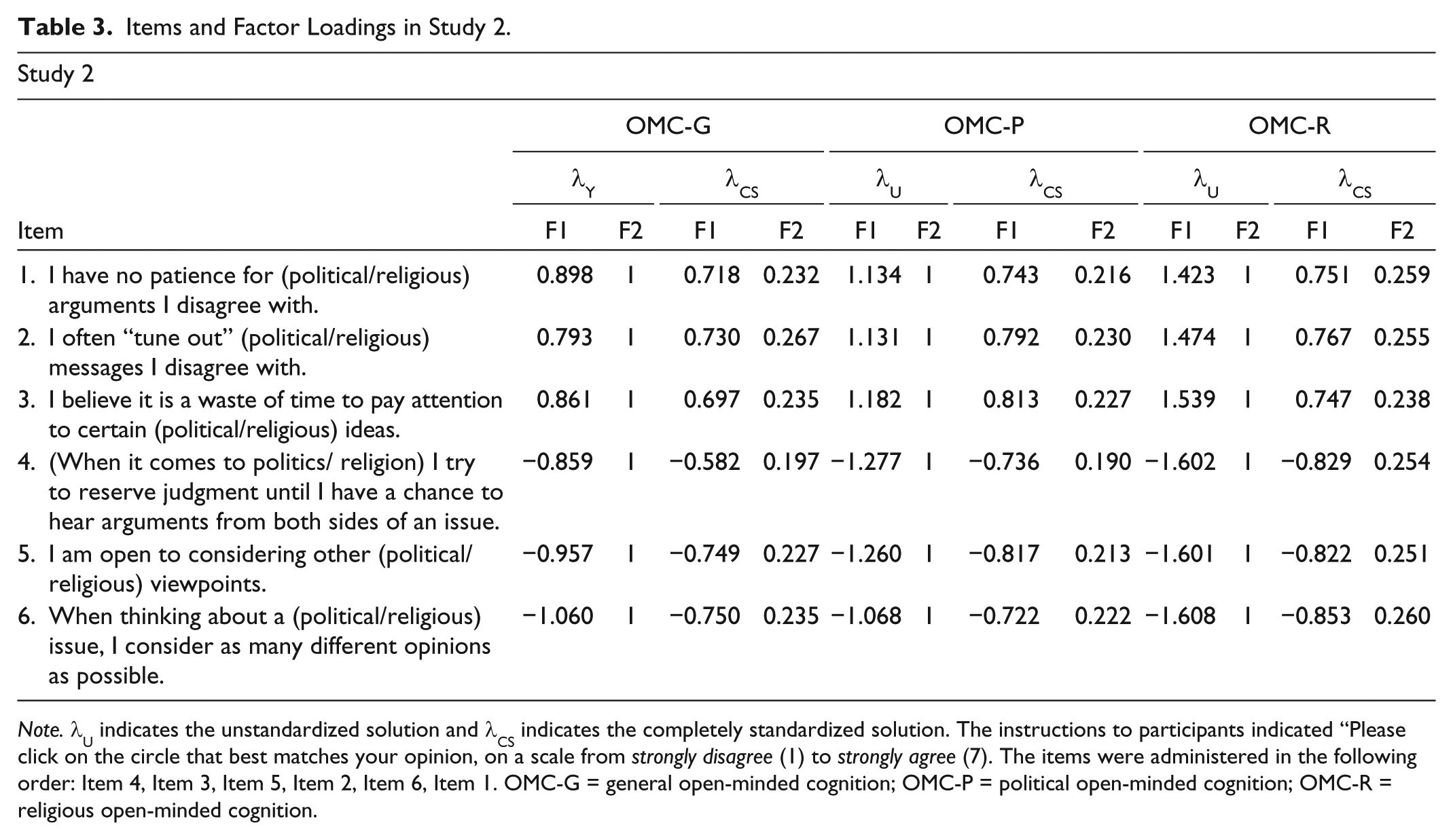
Note. λU indicates the unstandardized solution and λCS indicates the completely standardized solution. The instructions to participants indicated “Please click on the circle that best matches your opinion, on a scale from strongly disagree (1) to strongly agree (7). The items were administered in the following order: Item 4, Item 3, Item 5, Item 2, Item 6, Item 1. OMC-G = general open-minded cognition; OMC-P = political open-minded cognition; OMC-R = religious open-minded cognition.
Bivariate relations between scales
While the OMC-G, OMC-P, and OMC-R scales were positively correlated, they also possessed a considerable amount of unique variance (Table 5). OMC-G was positively correlated with OMC-P (r = .617, p < .001) and OMC-P (r = .473, p < .001). OMC-P and OMC-R were correlated (r = .500, p < .001). A within-subjects analysis of variance (ANOVA) revealed that there was an effect of domain type on open-minded cognition (F = 78.264, p < .001). Planned contrasts revealed that OMC-G (M = 5.05) was greater than OMC-P (M = 4.64; F = 67.255, p < .001) and OMC-R (M = 4.31; F = 137.410, p < .001). In addition, OMC-P was significantly higher than OMC-R (F = 27.962, p < .001). These results indicate that open-minded cognition significantly varies across domains, and that “slippage” is evident when comparing OMC-G with domain-specific open-minded cognition.
Discussion
Study 2 yielded correspondent scales designed to assess OMC-G, OMC-P, and OMC-R. All three scales possessed a unifactorial factor structure with strong positive loadings for the “open” items and strong negative loadings for the “closed” items. All three scales also possess adequate levels of fit. Each contains only six items, with three “open” and three “closed” items. This enables one to efficiently measure open-minded cognition and to effectively isolate the effect of this variable when predicting other individual difference characteristics. Study 2 also revealed that OMC-G, OMC-P, and OMC-R are correlated, yet distinct.
However, the results of Study 2 are not truly confirmatory. Although confirmatory factor analysis was used to test the factor structure of the scales, it was also used to reduce the size of the scales in an empirically driven, somewhat exploratory manner. Accordingly, it was necessary to perform an additional, truly confirmatory study.
Study 3: Final Confirmatory Factor Analyses
The goal of Study 3 was to replicate the final confirmatory factor analysis results performed in Study 2, indicating that all three open-minded cognition scales are unifactorial and that the six-item scale exhibits adequate model fit and inter-item reliability.
Participants and Procedure
Using mTurk, 200 participants were recruited to participate. Four participants were removed from analyses due to incorrect answers on attention-check items (final N = 196). Again, our subject-to-variable ratio exceeded 5, indicating adequate power for factor analyses. Demographic characteristics of the participants were similar to those in Studies 1 and 2 (see Table 1). Participants completed the three six-item Open-Minded Cognition scales (General, Political, and Religious). In addition, participants completed several attention-check items.
Results
Using LISREL, confirmatory factor analyses were performed for each six-item scale (General, Religious, and Political), in a manner identical to Study 2. Each confirmatory factor analysis was reviewed for model fit statistics, as well as individual items factor loadings and squared multiple correlations (see Table 4). Confirmatory factor analysis of the OMC-G items yielded good fit in terms of both absolute fit and relative fit (see Table 2). On the substantive factor, all items possessed sufficiently high squared multiple correlations (>.30) and high factor loadings (absolute value >.64 in all cases). The substantive OMC-G factor was clearly bipolar, with the “open” items loading positively and the “closed” items loading negatively. In addition, the OMC-G scale exhibited high inter-item reliability (α = .92).
Items and Factor Loadings in Study 3.

Note. λU indicates the unstandardized solution and λCS indicates the completely standardized solution. The instructions to participants indicated “Please click on the circle that best matches your opinion, on a scale from strongly disagree (1) to strongly agree (7). The items were administered in the following order: Item 4, Item 3, Item 5, Item 2, Item 6, Item 1. OMC-G = general open-minded cognition; OMC-P = political open-minded cognition; OMC-R = religious open-minded cognition.
Confirmatory factor analysis of the OMC-P items yielded excellent fit in terms of both absolute fit and relative fit (see Table 2). On the substantive factor, all items possessed sufficiently high squared multiple correlations (>.30) and high factor loadings (absolute value >.71 in all cases). Again, the substantive OMC-P factor was clearly bipolar. In addition, the OMC-P scale exhibited high inter-item reliability (α = .94).
Confirmatory factor analysis of the OMC-R items yielded good fit in terms of absolute fit and relative fit (see Table 2). On the substantive factor, all items possessed sufficiently high squared multiple correlations (>.30) and high factor loadings (absolute value >.76 in all cases). The substantive OMC-R factor was clearly bipolar, and exhibited high inter-item reliability (α = .95).
Importantly, although the three scales were correlated (see Table 4), they remained distinct constructs with unique variance. Also, replicating Study 2, there was an effect of domain type on open-minded cognition (F = 103.61, p < .001). OMC-G (M = 5.65) was greater than OMC-P (M = 5.20; F = 44.240, p < .001) and OMC-R (M = 4.35; F = 172.459, p < .001). In addition, OMC-P was significantly higher than OMC-R (F = 66.64, p < .001). Once again, these results indicate that open-minded cognition significantly varies across domains. Moreover, “slippage” is evident when comparing OMC-G with domain-specific open-minded cognition.
Discussion
Study 3 replicated the results of Study 2 using more strict confirmatory methods. All three scales yielded a bipolar, unifactorial substantive factor solution with adequate levels of fit. Again, each analysis yielded a balanced six-item scale composed of three “open” and three “closed” items. Again, although the OMC-G, OMC-P, and OMC-R scales were positively correlated, it was clear that these measures possessed unique variance and significantly differed from each other.
Study 4: Assessing Convergent and Discriminant Validity
The primary goal of Study 4 was to demonstrate that the measures of open-minded cognition possess both convergent and discriminant validity. A valid measure of a construct should be correlated with other constructs that are theoretically related, but not so strongly correlated that the scales can be said to measure the same thing. In addition, a valid measure should differentiate itself from constructs that should not to be related theoretically.
Participants and Procedure
Participants were recruited via mTurk and asked to participate in a survey of their personal opinions. Participants (N = 121) were 36.05 years of age on average (SD = 11.85). In all, 54.4% were female. The majority of participants (66.0%) had a college degree or higher (see Table 1 for more extensive demographics). Four participants were removed from analyses due to failure of multiple attention-check items (Final N = 121).
First, participants responded to the six-item OMC-G scale. Next, participants responded to a battery of scales, as well as the OMC-P and OMC-R scales (see Table 6). This battery of questions also included a number of scales that informed the initial scale development process (e.g., all four subscales of Stanovich and West’s [2007] Actively Open-Minded Thinking scale, Dogmatism, Need for Closure, etc.) as well as measures that assess constructs less directly linked to open-minded cognition (e.g., Fundamentalism, Openness to Experience). Participants completed several demographic measures at the very end of the session.
Results and Discussion
All three scales were highly reliable. Cronbach’s alpha was high for OMC-G (.835), OMC-P (.897), and OMC-R (.936).
Inter-relations between open-minded cognition scales
Table 5 reveals that OMC-G was positively correlated with OMC-P (r = .735, p < .001) and OMC-R (r = .475, p < .001). OMC-P and OMC-R were also moderately correlated (r = .492, p < .001). These analyses reveal that the three scales are distinct, yet positively correlated.
Correlations Between General, Political, and Religious Open-Minded Cognition.
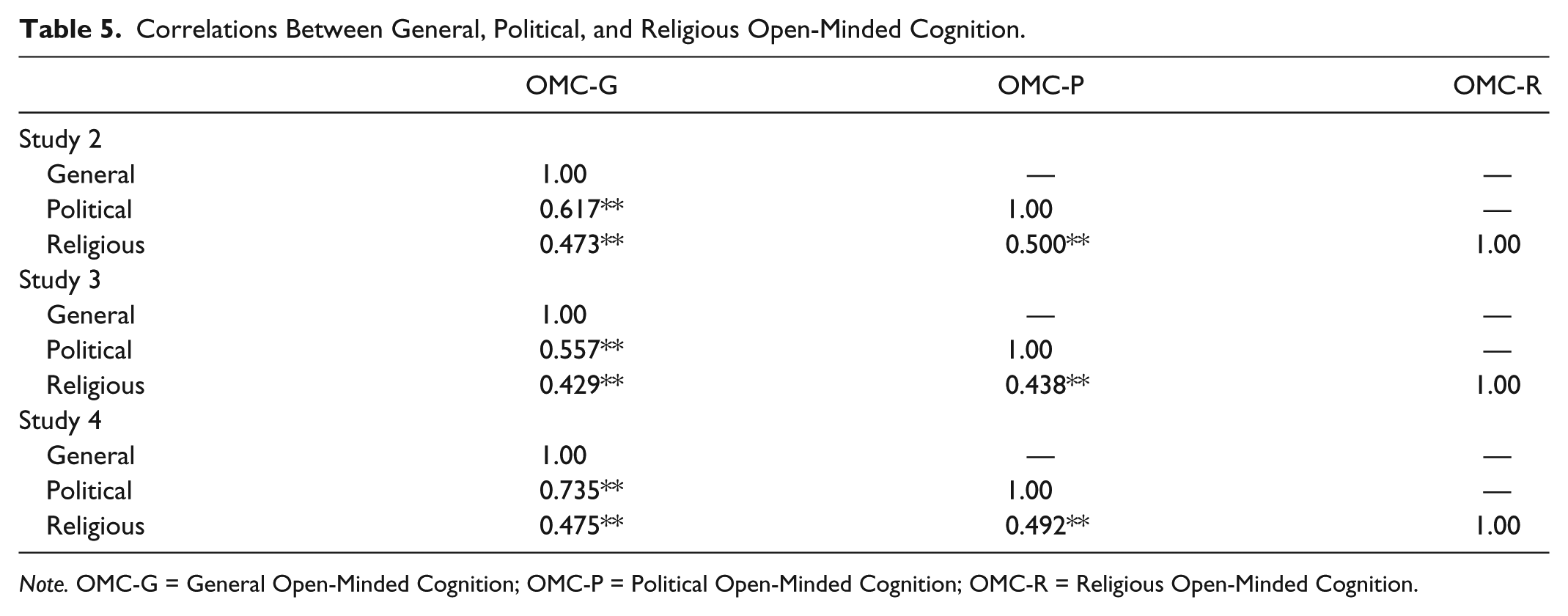
Note. OMC-G = General Open-Minded Cognition; OMC-P = Political Open-Minded Cognition; OMC-R = Religious Open-Minded Cognition.
Predicting other variables with open-minded cognition
All three scales were moderately positively correlated with several other cognitive style variables that are conceptually close to open-minded cognition. All three scales were positively correlated with Actively Open-Minded Thinking Factor 1, which assesses dogmatic and categorical thinking, as well as Factor 2, which assesses flexible thinking and openness to values, and Factor 3, which assesses perseverance in one’s beliefs (see Table 6). Open-minded cognition was not associated with the Closed-Minded subscale of Need for Closure. The General and Political scales were negatively correlated with Dogmatism, though the Religious scale was not. Need for cognition was not correlated with any of the three open-minded cognition measures. The global measure of need for closure did not correlate with the Political or Religious measures, but was positively correlated with the General measure. Intolerance of Ambiguity was negatively correlated with all three scales. Support for Change (the obverse of System Justification; Kay & Jost, 2003) was positively correlated with open-minded cognition on all three scales. Importantly, however, all of the significant correlations were moderate. Thus, each open-minded cognition index assesses a construct that is distinct from those assessed by these other measures (see Table 6 for all correlations described above).
Relation Between Open-Minded Cognition and Participant Characteristics (Study 4).

Note. OMC-G = General Open-Minded Cognition; OMC-P = Political Open-Minded Cognition; OMC-R = Religious Open-Minded Cognition.
Open-minded cognition was positively associated with a variety of personality traits. These include Openness to Experience, Agreeableness, Emotional Stability (the obverse of neuroticism), and Conscientiousness (see Table 6).
Open-minded cognition was positively associated with support for democratic values, and negatively correlated with conservative ideology and Republican political party identification (see Table 6). OMC-P was significantly positively correlated with political interest; however, the other two scales were not. A similar pattern emerged for frequency of political discussion with family or friends and attention to political News—OMC-P was significantly correlated, while the OMC-G and OMC-R were not (see Table 6).
Psychological measures not specifically linked to politics or religion should presumably exhibit a stronger relation with OMC-G than the domain-specific measures. This hypothesis was supported when predicting the personality variables (Openness to Experience, Agreeableness, Conscientiousness, and Emotional Stability), but not when predicting some of the cognitive style variables (e.g., Active Open-Mindedness, Dogmatism).
It was hypothesized that within-domain correlations would be stronger than cross-domain correlations. This prediction was often supported when predicting the political outcome variables (see Table 6). That is, only OMC-P was significantly associated with attention to political news, political interest, and frequency of political discussion with family and friends. But contrary to this prediction, effects on support for democratic values and ideology were evident when using both the Political and Non-Political measures of open-minded cognition.
OMC-R could not be distinguished from the OMC-G or OMC-P measures when predicting the other religious constructs assessed in Study 4 (e.g., Religious Fundamentalism, QUEST). However, this is simply because the other religious constructs assessed in Study 4 were, in large part, uncorrelated with all of the open-minded cognition measures. OMC-R was, however, distinct in terms of its positive relation to Personal Humility (Elliot, 2010). OMC-G and OMC-P were not significantly related to this trait. Thus, it appears that Personal Humility (“I am far from perfect”) is a trait that is primarily associated with the religious form of open-minded cognition.
Finally, it is important to note all three open-minded cognition measures were unrelated to political tolerance. This indicates that tolerance regarding the expression of opinion is not synonymous with openly considering a wide range of opinions. Thus, for example, an individual may believe the Ku Klux Klan (KKK) has the right to speak out publicly, but refuse to listen to the opinions expressed by members of the group.
Studies 5 and 6: Demonstrating Unique Predictive Validity
To demonstrate that a new measure exhibits strong predictive validity, it is useful to demonstrate that the new measure predicts meaningful outcome variables when controlling for previously established measures of similar constructs (Cronbach & Meehl, 1955). Studies 5 and 6 predicted meaningful outcomes while controlling for five variables. These included the two variables assessed in Study 4 that exhibited the highest correlations with open-minded cognition: Flexible Thinking and Openness to Values (Factor 2 of Actively Open-Minded Thinking) and Openness to Experience (from Big 5); as well as three additional constructs that share conceptual linkages with open-minded cognition (Need to Evaluate, Jarvis, Blair, & Petty, 1996; Defensive Confidence, Albarracín & Mitchell, 2004; Preference for Consistency, Cialdini, Trost, & Newsom, 1995).
Studies 5 and 6 examine the unique predictive validity of open-minded cognition when predicting outcomes that are primarily affective in nature. Study 5 specifically focused on the unique role of open-minded cognition when predicting the affective component of empathy, Empathic Concern (Davis, 1980). Although conceptually distinct, there is reason to believe that open-minded cognition will be positively associated with Empathic Concern. That is, open cognitive consideration of another person’s viewpoints should be associated with a tendency to attend to and empathize with another person’s emotional state. That is, open-mindedness is a cognitive style that should facilitate emotional empathy. Because open-minded individuals attend to and patiently consider ideas they disagree with, open-minded cognition should also be associated with more positive emotional reactions to outgroup members. Thus, Study 6 examined the unique role of open-minded cognition when predicting overall affective reactions to members of social outgroups. Specifically, Study 6 examines the unique role of open-minded cognition when predicting thermometer ratings of Muslims, Atheists, Asians, Hispanics, African Americans, Gays, and Transgender people.
Participants and Procedure
Participants (N = 219, Study 5; N = 219 Study 6) were recruited via mTurk and asked to participate in a survey of their personal opinions. A total of 47.7% of participants were female in Study 5, and 39.3% of participants were female in Study 6. Due to failure of multiple attention-check items, three participants were removed from analyses in Study 5 (Final N = 216, Study 5).
In Study 5, participants initially completed the seven-item Empathic Concern scale (Davis, 1980), and then completed the six-item measure of OMC-G as well as measures of the control variables (Preference for Consistency, Openness to Experience, Defensive Confidence, Need to Evaluate, and Subscale 2 of Actively Open-Minded Thinking). In Study 6, participants initially completed the OMC-G scale as well as the measures of the (same) control variables. They then rated how warm or favorable they felt toward Muslim people, Atheist people, Asian people, Hispanic or Latino people, Black people, Gay people, and Transgender people using a thermometer scale, ranging from 0 (very cold or unfavorable) to 100 (very warm or favorable). Finally, participants reported their gender, religion, race, and sexual orientation. To focus on emotional reactions toward “outgroup” members, self-identified members of each group were excluded when predicting thermometer ratings for each group.
Results and Discussion: Study 5
OMC-G possessed high reliability (α = .830). OMC-G was positively correlated with Openness to Experience (r = .390, p < .001) and Subscale 2 of Actively Open-Minded Thinking (r = .419, p < .001), replicating the results of Study 4. No other predictor variables were significantly correlated with open-minded cognition (see Table 7). Empathic Concern was positively correlated with open-minded cognition (r = .476, p < .001), Openness to Experience (r = .371, p < .01), Actively Open-Minded Thinking (r = .240, p < .01), and gender (r = .336, p < .01, women possessed higher empathic concern than men).
Bivariate Relation Between Variables in Study 5.
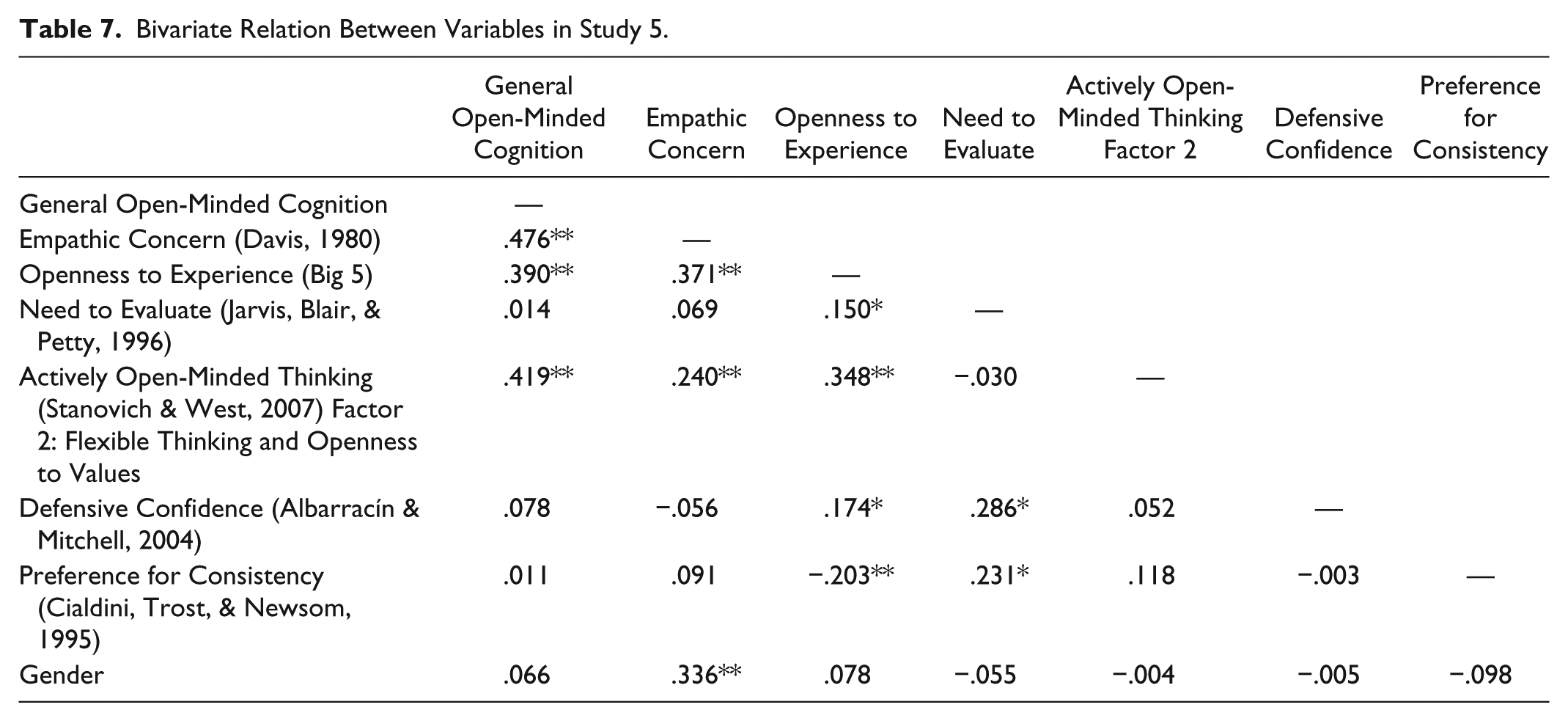
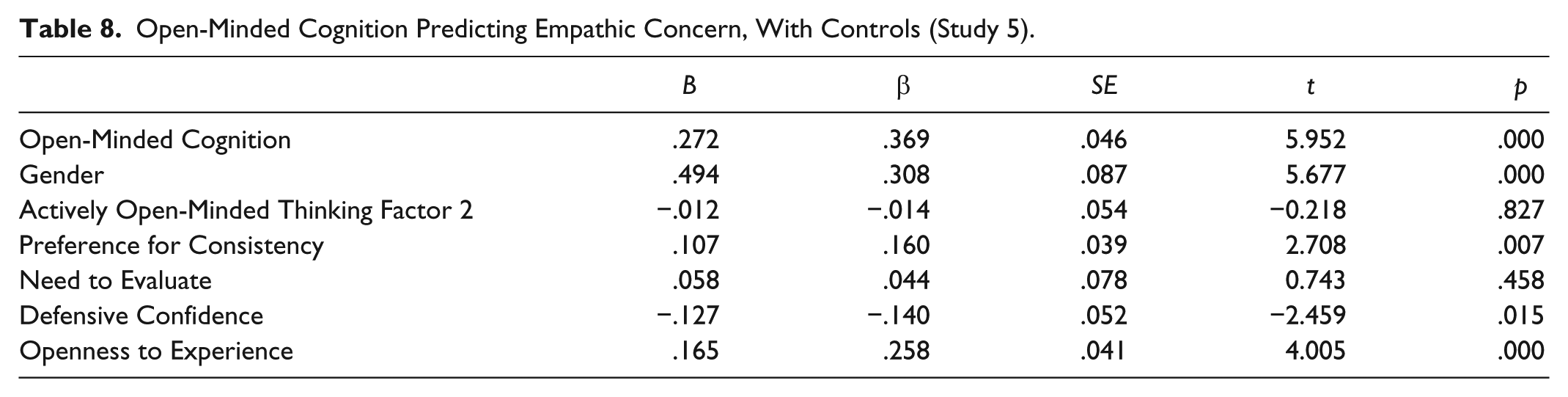
Using regression, open-minded cognition was entered as a predictor of Empathic Concern, along with the five control variables and gender (as gender was correlated with Empathic Concern). Even after controlling for all of these variables, open-minded cognition served as a strong unique predictor of Empathic Concern (B = .272, β = .369, SE = .046, t = 5.951, p < .001; see Table 8). Individuals possessing an open-minded cognitive style are more likely to envision and feel the feelings of other people. This relationship holds even when controlling for a number of other closely related psychological orientations.
Open-Minded Cognition Predicting Empathic Concern, With Controls (Study 5).
Results and Discussion: Study 6
Again, OMC-G possessed high reliability (Cronbach’s α = .817). OMC-G was positively correlated with Openness to Experience (r = .339, p < .001) and Subscale 2 of Actively Open-Minded Thinking (r = .430, p < .001), replicating the results of Study 4. No other predictor variables were significantly correlated with open-minded cognition.
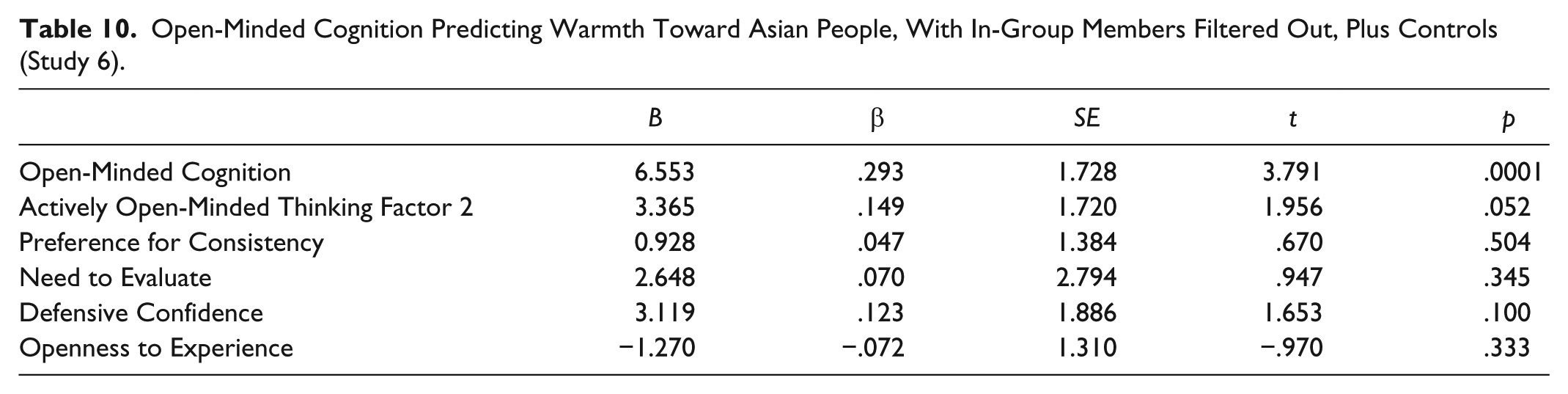
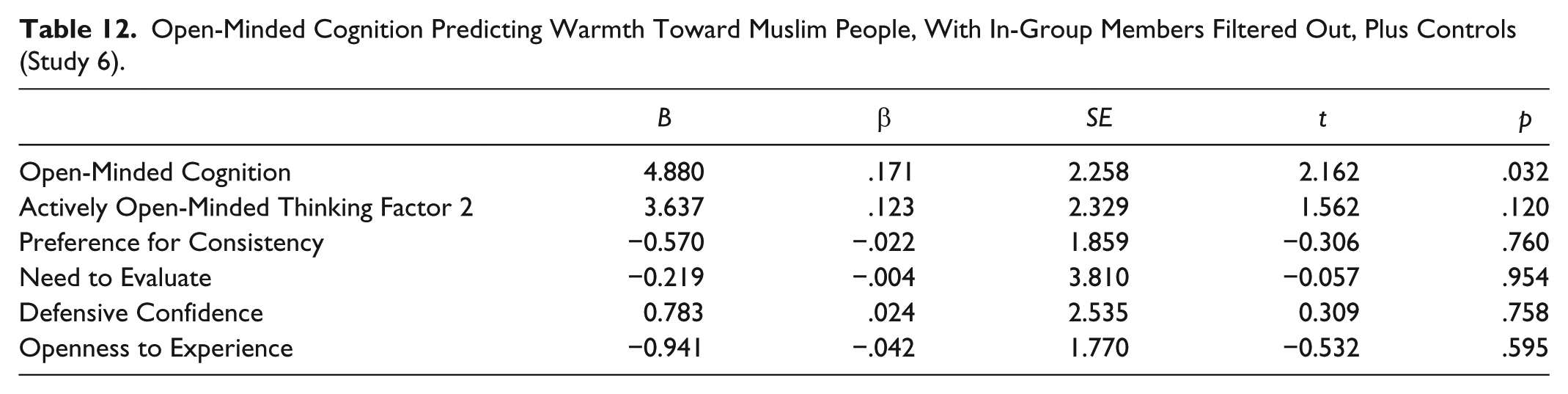
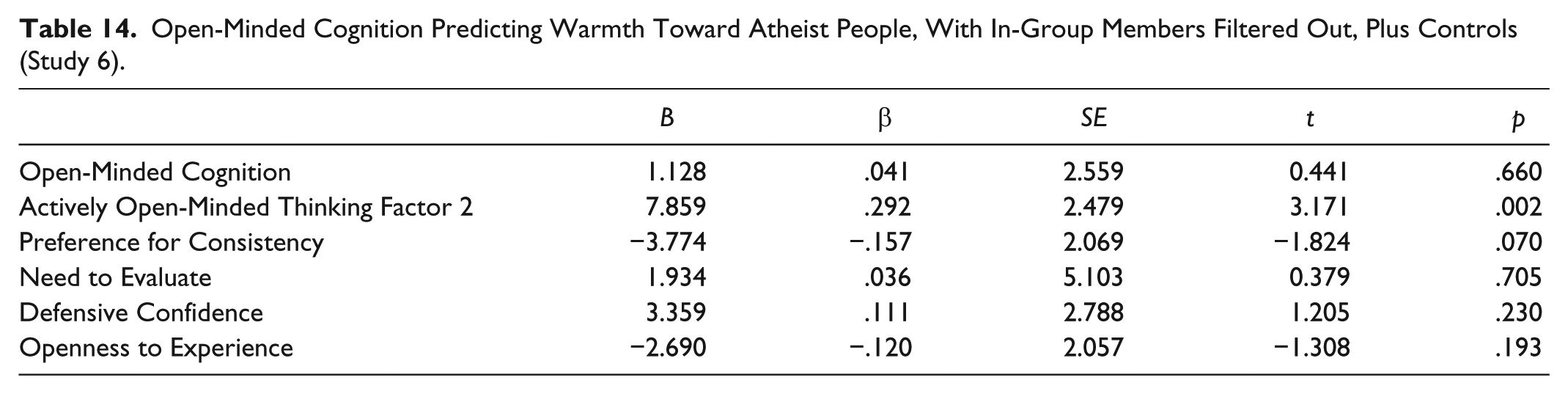
Predicting thermometer ratings of each group, open-minded cognition was entered along with the five control variables. Open-minded cognition uniquely predicted ratings of Black people (B = 4.969, β = .195, SE = 2.107, p < .019; see Table 9), Asian people (B = 6.553, β = .293, SE = 1.728, p < .001; see Table 10), Hispanic people (B = 3.960, β = .175, SE = 1.766, p < .026; see Table 11), and Muslim people (B = 4.880, β = .171, SE = 2.258, p < .032; see Table 12). The unique effect of open-minded cognition achieved marginal significance when predicting ratings of Transgender people (B = 3.622, β = .134, SE = 2.038, p < .077; see Table 13). 2 Only when predicting ratings of Atheists and Gay people did open-minded cognition fail to exert a unique effect (p > .60 in both cases; see Tables 14 and 15). In sum, individuals possessing an open-minded cognitive style often respond to outgroup members in a more positive emotional manner. For five of the presently investigated target groups (Black, Asian, Hispanic, Muslim, and Transgender people), this relationship held even when controlling for many closely related psychological orientations.
Open-Minded Cognition Predicting Warmth Toward Black People, With In-Group Members Filtered Out, Plus Controls (Study 6).

Open-Minded Cognition Predicting Warmth Toward Asian People, With In-Group Members Filtered Out, Plus Controls (Study 6).
Open-Minded Cognition Predicting Warmth Toward Hispanic People, With In-Group Members Filtered Out, Plus Controls (Study 6).

Open-Minded Cognition Predicting Warmth Toward Muslim People, With In-Group Members Filtered Out, Plus Controls (Study 6).
Open-Minded Cognition Predicting Warmth Toward Transgender People, Plus Controls (Study 6).

Open-Minded Cognition Predicting Warmth Toward Atheist People, With In-Group Members Filtered Out, Plus Controls (Study 6).
Open-Minded Cognition Predicting Warmth Toward Gay People, With In-Group Members Filtered Out, Plus Controls (Study 6).

General Discussion
We conceptualize open-minded cognition as a cognitive style that varies along a continuum ranging from closed-minded thinking at one extreme to open-minded thinking at the other extreme. Closed-minded cognition reflects directionally biased information processing. It involves a tendency to select, interpret, and elaborate upon information in a manner that reinforces the individual’s prior opinion or expectation. Open-minded cognition reflects directionally unbiased information processing. It involves a tendency to select, interpret, and elaborate upon information in a manner that is not biased toward (or against) the individual’s prior opinion or expectation.
Although previously existing measures include some items that assess open-minded cognition, they also include items that do not specifically assess the tendency to cognitively process information in a directionally biased versus directionally unbiased manner. Therefore, variance in scores on these measures may be attributable to concepts completely distinct from unbiased processing (e.g., “It is better to be a dead hero than a live coward,” Dogmatism scale, Trodahl & Powell, 1965). Moreover, existing scales often contain a large number of items or unbalanced sets of items. This precludes efficient measurement of open-minded cognition, and produces problems when attempting to rule out alternative explanations for effects involving open-minded cognition (i.e., acquiescence). Moreover, pre-existing measures do not provide correspondent measures of General and domain-specific open-minded cognition that enable the researcher to perform cross-domain comparisons while holding item content constant.
Development of the Open-Minded Cognition Scales
In Study 1, 79 survey items potentially relevant to OMC-G were administered to a large and diverse sample of American participants. PCA revealed that a unifactorial solution was most compatible with the data. Through repeated analysis, the number of items was slowly and systematically reduced to identify 19 open-minded and 19 closed-minded items possessing unique and strong loadings on the open-minded cognition factor.
Study 2 administered these 38 General items to a second sample, along with correspondent items designed to assess OMC-P and OMC-R. Confirmatory factor analysis controlling for acquiescence bias replicated the unifactorial structure observed in Study 1 on all three scales. To increase model fit and reduce the number of items, confirmatory factor analyses were performed multiple times, removing items that loaded poorly on the three scales with each iteration. This culminated in three correspondent scales possessing adequate statistical fit, strong loadings, high levels of internal reliability, and balanced item composition. Study 3 replicated these findings when performing a truly confirmatory factor analysis on a third sample.
The Relation Between Open-Minded Cognition and Other Constructs
As hypothesized, OMC-G, OMC-P, and OMC-R are correlated yet distinct constructs (unique variance ranging from 45% to 82%). Thus, an individual can possess a high level of open-minded cognition in one domain (e.g., politics), but a low level of open-minded cognition in another domain (e.g., religion). OMC-G tends to be higher than the domain-specific forms of open-minded cognition. This finding echoes related work that suggests political tolerance is high when considered in general or abstract terms, but relatively low when considered in more specific terms. All of these findings confirm that open-minded cognition can vary across domains.
We also observed that open-minded cognition is correlated with, yet distinct from, pre-existing measures of similar constructs (e.g., Active Open-Mindedness, Dogmatism). Open-minded cognition is positively correlated with Openness to Experience, Conscientiousness, Emotional Stability, Liberalism, and Support for Democratic Values. Interestingly, open-minded cognition is unrelated to Personal Humility (e.g., “I am far from perfect”), age, and gender. Study 5 demonstrated that OMC-G predicts Empathic Concern, even when controlling for Need to Evaluate, Actively Open-Minded Thinking Subscale 2, Defensive Confidence, Preference for Consistency, and Openness to Experience. Study 6 further demonstrated the unique contribution of open-minded cognition when predicting thermometer ratings of Black, Asian, Hispanic, and Muslim people, again while controlling for the variance explained by these five other constructs. This makes the psychometric import and practicality of the Open-Minded Cognition measure all the more clear.
Conclusion
The present research provides a specific conceptualization and operationalization of open-minded cognition that has not been precisely isolated or identified in previous research. Using advanced statistics that control for survey biases, we developed correspondent scales that assess general and domain-specific (Political, Religious) Open-minded cognition. These scales can be adapted to apply to virtually any domain or situation. The present research provides strong support for the validity and reliability of these measures, and supports their use in future experimental and survey-based research designs.
Footnotes
Authors’ Note
The opinions expressed in this publication are those of the authors and do not necessarily reflect the views of the Fuller Thrive Center or the John Templeton Foundation.
Declaration of Conflicting Interests
The author(s) declared no potential conflicts of interest with respect to the research, authorship, and/or publication of this article.
Funding
The author(s) disclosed receipt of the following financial support for the research, authorship, and/or publication of this article: This project was made possible through the support of a Grant 3418 from the Fuller Theological Seminary/Thrive Center in concert with the John Templeton Foundation. The grant provided supplies funds, research assistance funds, and stipend for one postdoctoral researcher for 1 year, and two graduate research assistants for 1 year.

Notes
References
Supplementary Material
Please find the following supplemental material available below.
For Open Access articles published under a Creative Commons License, all supplemental material carries the same license as the article it is associated with.
For non-Open Access articles published, all supplemental material carries a non-exclusive license, and permission requests for re-use of supplemental material or any part of supplemental material shall be sent directly to the copyright owner as specified in the copyright notice associated with the article.
