



Abstract
Researchers have assumed that people judge their own true selves, or their authentic and fundamental nature, to be no better than that of others. This assumption conflicts with self-enhancement perspectives, and with studies on comparative biases in self and social judgment, which assume that people tend to view their characteristics and life prospects more favorably than those of others. The five studies in this article demonstrate that comparative bias operates in self versus other true self comparisons, both with regard to traits (Studies 1–3), and morally relevant behaviors (Studies 4 and 5). Implications for the true and authentic self constructs are discussed.
The true self is at once a tautology and an aspiration. People are necessarily their true selves because what else would they be? Nevertheless, they may aspire to be something different, or feel that their true self is hindered or shrouded, or believe that they are on the inexorable path to glory. Extant research suggests that the true and actual selves are not isomorphic, but rather, that the true self represents “the deepest, most essential aspect of [one’s] being” (Newman et al., 2014). This definition of the true self implies that one’s everyday actions and decisions, and the abilities and characteristics they reflect, are mere facsimiles of the real, presumably better, person buried inside.
Past research indicates that the true self is perceived as moral and good. Newman and colleagues (2014) demonstrated that people tend to attribute morally good decisions and behaviors to a person’s true self. When provided with a series of scenarios in which an individual was described as having undergone behavioral change in a morally good or bad direction, participants tended to view morally good changes to be generated from the true self, and morally bad changes to originate from the surface self. Similarly, Jongman-Sereno and Leary (2016) found that people rated their behavior as more authentic when they imagined behaving in positive as compared to negative ways, even when the behaviors were described as equally congruent with their desires.
In addition to believing that their subterranean selves are inherently good and moral, people also extend this beneficence to others (Strohminger et al., 2017). The belief in others’ basic goodness has emotional benefits, in that it is more comforting to believe that the world comprises decent rather than malevolent people. Such beliefs also promote psychological well-being and facilitate social interaction (Heiphetz et al., 2017). Even more fundamentally, people generally evaluate the essence of things favorably, including human essences, such as true selves (De Freitas et al., 2018).
Although direct comparisons between own and others’ true selves have not previously been reported, the assumption that favorable true self attributions are perspective-independent is consistent with the person positivity bias (Sears, 1983), which demonstrates a general tendency to view others favorably. More specifically, Bench et al. (2015) found that positive behavioral changes in both self and others were associated with beliefs in self-discovery (akin to true selves). Research has also shown that people are more likely to ascribe others’ good than bad behaviors to their true selves (Newman et al., 2014). Based on findings such as these, Strohminger and colleagues (2017) have argued that true self estimations are “perspective-independent,” meaning not only that people view others’ true selves favorably, but that they view them just as favorably as their own true selves.
The perspective independence claim challenges self-enhancement theories in general (Sedikides & Alicke, 2012), and comparative bias findings more specifically (Chambers & Windschitl, 2004). Whereas self-enhancement is the tendency to evaluate oneself more favorably than objective measures warrant, comparative bias refers to the tendency to evaluate one’s own actions and characteristics more favorably than those of others. A large research literature demonstrates that people believe that they fare more favorably on positive characteristics, and less unfavorably on negative ones, than others (Alicke & Sedikides, 2011). From a self-enhancement perspective, the belief in a true self affords people the opportunity to construe their average characteristics as a skewed representation of the more scintillating package within. The claim that a better me resides “deep down” implies that appearance is not reality: the me you see only approximates the person I really am. From the comparative bias vantage, this optimism about one’s true self should apply more to judgments of self than to others.
Although self-other differences in true self attributions have not been systematically explored, there is reason to expect that true self beliefs, at least to some extent, reflect comparative bias. First, Bench et al. (2015) have shown that people evaluate self changes more favorably than similar changes in a close friend. Second, in research that included only self-judgments, Jongman-Sereno and Leary (2016, Study 2) found that when participants were asked to imagine themselves resolving moral dilemmas in ways that were consistent with experimentally manipulated inclinations, they viewed their actions as more authentic when they represented morally superior versus inferior options. Finally, individual differences moderate true self attributions in a way that is consistent with self-enhancement assumptions. Newman and colleagues (2014) found, for example, that liberal participants were more willing to view homosexual urges as an expression of their true selves than were conservative participants.
There are also compelling theoretical reasons to expect self-enhancement to obtain in true self judgments. In particular, self-enhancement is maximized on central self-characteristics (Pedregon et al., 2012; Sedikides et al., 2016), and the true self is the exemplar of centrality. In addition, the true self is a somewhat amorphous concept, which affords people the latitude to construe it to their own advantage (Alicke & Govorun, 2005; Dunning et al., 1989).
In this article, we report the results of five studies that were designed to assess whether people evaluate their own true selves more favorably than the true selves of others. We approached this issue from two directions. True selves can be defined with reference to behaviors or characteristics. That is, one can ask whether a specific behavioral episode reflected, or would reflect, an individual’s true self. Most extant research on the topic addresses specific behaviors. For example, Newman and colleagues (2014) presented participants with a series of behavioral scenarios, and asked them to indicate whether shifts from moral to immoral behavior, or the reverse, reflected the agent’s true or surface self. For comparison with this previous literature, we used a behavioral methodology in Studies 4 and 5.
We began, however, with a series of studies designed to assess true self judgments at the trait level. Investigators have posited that people are ecumenical in true self estimations, and if so, they should be as generous in characterizing others’ true traits as their own. For example, while recognizing that they, and their peers,’ actual selves fall short of their potential on traits such as “ambitious,” they should ascribe equal levels of “true self” ambition to themselves and others. As noted, however, such attributional generosity would conflict with comparative bias findings, such as those obtained in research on the better-than-average effect (Alicke, 1985; Alicke & Govorun, 2005), which demonstrate that people maintain a positive distance between themselves and others in trait comparisons. To assess comparative true self judgments, we asked participants in our first two studies to compare how characteristic various personality traits were of their own true selves versus those of an average person (Study 1 and 2), or a close friend (Study 2).
In the next three studies, we investigated whether self-enhancing evaluations of the true self extended to the most constitutive feature of the true self, namely morality. Specifically, Study 3 included moral traits ratings, whereas Study 4 and 5 assessed hypothetical and realistic moral scenarios.
Study 1
In the first study, we assessed comparative judgments (self versus average peer) on a series of positive and negative traits in a within-subjects design. We expected, in accord with previous findings in the comparative bias literature, that people would evaluate their positive true self traits more favorably than those of an average peer, and their negative true self traits less negatively.
Methods
Participants
We initially recruited 100 U.S. participants from Amazon’s Mechanical Turk (MTurk) but one participant failed to complete more than half of the survey, and was excluded from final analyses. The final sample consisted of 99 MTurk workers (66 men, 32 women, and 1 others) aged from 18 to 39 (M = 32.50, SD = 10.35). They were paid $0.20 for their participation. The sample was diverse (53.1% White, 36.7% Asian, 3.1% Black, and 7.1% Others). A sensitivity power analysis conducted on GPower 3.1 (Faul et al., 2009) revealed that 100 participants would yield 80% power to detect a small effect (Cohen’s f = .12; assuming α = .05).
Measures
A total of 10 positive traits (Kind, Dependable, Pleasant, Intelligent, Lively, Ambitious, Virtuous, Persistent, Imaginative, and Perceptive; α = .90) and 10 negative traits (Disrespectful, Cold, Impolite, Lazy, Unethical, Spiteful, Revengeful, Untruthful, Greedy, and Shallow; α = .96) were selected from Rothbart and Park (1986) and Alicke (1985) to represent different levels of desirability and controllability. See Supplemental Materials for copies of all original questionnaires.
Procedures
The experiment was conducted on Qualtrics. Participants were asked to compare how well each trait (presented in a random order) described their true self and an average peer’s true self, “the authentic and fundamental nature of oneself” (Strohminger et al., 2017), on a 7-point scale (1 = “extremely uncharacteristic”; 7 = “extremely characteristic”). Half the participants rated their true selves and then an average peer, and the other half made these judgments in reverse order.
Results
A repeated measures analysis of variance (ANOVA) was conducted with valence (positive vs. negative) and comparison target (self vs. an average person) as within-subject factors. Both main effects were significant. Participants rated positive attributes (M = 5.17, SD = .75) as more true-self-characteristic than the negative attributes (M = 3.65, SD = 1.33), F(1, 98) = 87.89, p < .001, ηp2 = .47, and these ratings were higher for the others (M = 4.49, SD = .71) than for selves (M = 4.34, SD = .82), F(1, 98) = 7.59, p = .007, ηp2 = .07. More importantly, the expected interaction was also significant, F(1, 98) = 62.11, p < .001, ηp2 = .39. A simple main effect analysis showed that participants rated the positive traits as more characteristic of their own true selves (M = 5.33, SD = .83) than of an average peer’s true self (M = 5.02, SD = .81), t(98) = 4.65, p < .001, d = .47, 95% confidence interval (CI) = [.18, .44]. However, the pattern reversed for the negative traits: participants rated negative attributes as more true-self characteristic of the average peer (M = 3.96, SD = 1.25) than of themselves (M = 3.34, SD = 1.55), t(98) = 6.69, p < .001, d = .67, 95% CI = [.43, .79] (see Figure 1).
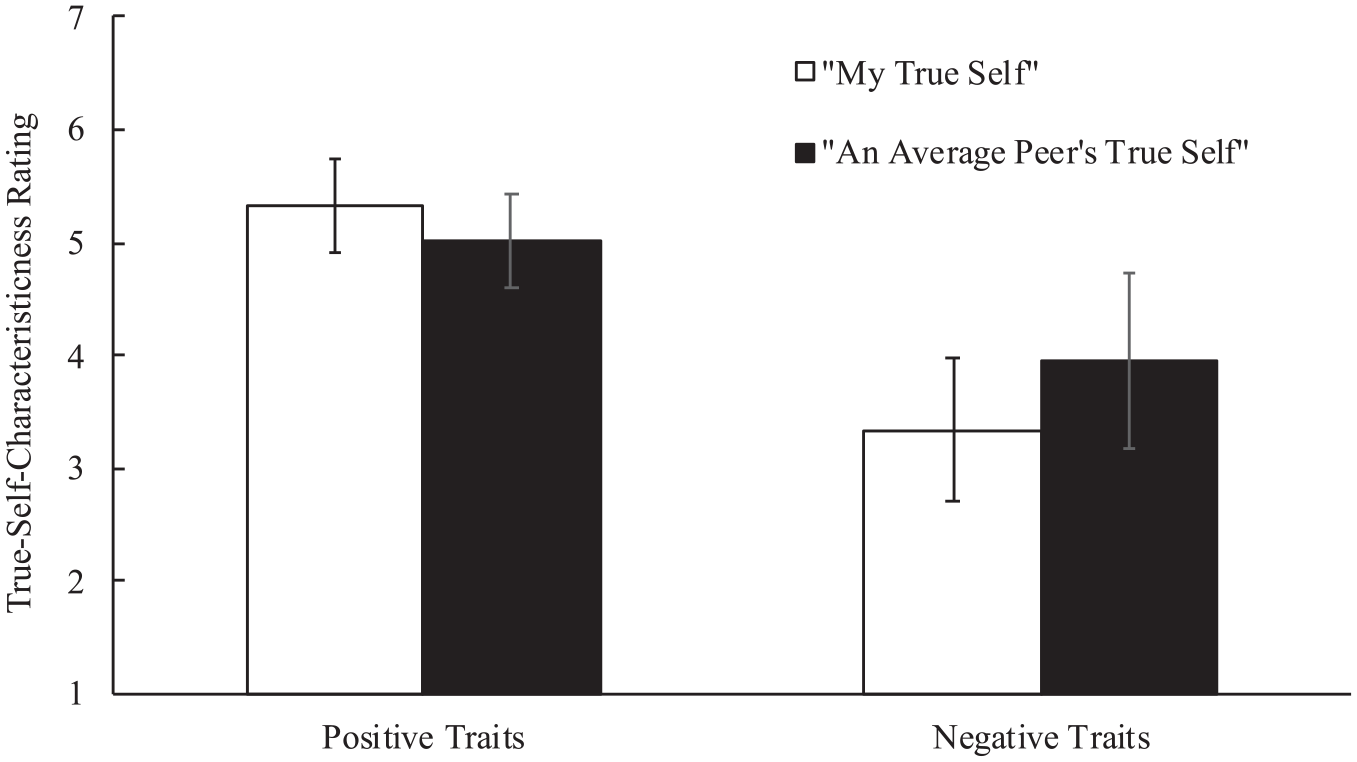
Means with standard deviation bars of traits ratings as a function of valence (positive vs. negative traits) and comparison target (“my true self” vs. “an average peer’s true self”) in Study 1 (N = 99).
Discussion
Study 1 provides one source of support for the hypothesis that self-enhancement operates in comparative true self judgments. Specifically, we found that people view their own true selves more positively and less negatively than their peers’ true selves. The findings are consistent with previous findings that positive attributes are more likely to be considered as reflections of the true self (e.g., Jongman-Sereno & Leary, 2016), but extend previous research to comparisons with others.
Study 2
In Study 2, we provided a more stringent test of self-enhancement by including close friends as the comparison other in addition to the average college student. Previous research indicates that self-enhancement effects are reduced in comparisons with specific people (Alicke et al., 1995), and especially with close others (Perloff & Fetzer, 1986). We also increased the number of traits from 20 to 40, added a between-subjects design, and changed the nature of the task. Specifically, instead of making direct trait comparisons, we asked participants to indicate, for each trait, whether it was more characteristic of themselves, a close friend/average person, or neither, thereby providing participants with the opportunity to deny that a given trait characterized themselves or others (Newman et al., 2014).
Method
Participants
A total of 200 college students (164 women, 34 men, and 2 others) aged from 18 to 31 (M = 18.89, SD = 1.42) were recruited from a large public Midwestern University. About 89% of the sample was White (1.0% Asian, 7.5% Black, and 2.5% Others). A sensitivity power analysis conducted on GPower 3.1 (Faul et al., 2009) revealed that 200 participants would yield 80% power to detect a small effect (Cohen’s f = .10; assuming α = .05).
Measures
We used 40 personality traits, selected from Alicke (1985) with desirability and controllability balanced, including 20 positive traits (Intelligent, Perceptive, Honorable, Imaginative, Cooperative, Considerate, Responsible, Friendly, Respectful, Polite, Dependable, Trustful, Kind, Fearless, Attractive, Neat, Contented, Wise, Self-disciplined, and Self-concerned; α = .79) and 20 negative traits (Insecure, Lazy, Mean, Humorless, Unforgiving, Deceptive, Disrespectful, Snobbish, Spiteful, Uncivil, Unkind, Rude, Dishonest, Irresponsible, Uncultured, Dissatisfied, Jealous, Unskilled, Self-centered, and Eccentric; α = .85).
Procedure
All participants read the same intro that explained the true self as “the authentic and fundamental nature of the self,” as Study 1. Then, they were randomly assigned to one of the two experimental groups: a close friend or an average person. For the close friend group, participants were first asked to write down the first name of a close friend before the nature of the task was described. As in the previous study, average person ratings were made with an average person of their same sex and age.
All the participants were asked to indicate whether each of the 40 traits (presented in a random order) was more characteristic of “my true self,” “my close friend’s/an average person’s true self,” or “neither.”
Results
To assess the overall pattern of the results, we recoded the options into a scale that reflects the degree of self-enhancement. For the positive traits, we recoded the responses of “my true self” as 2, “my close friend’s/an average person’s true self” as 0, and “neither” as 1, and for the negative traits, the responses of “my true self” was recoded as 0, “my close friend’s/an average person’s true self” as 2, and “neither” as 1. We then summarized the scores across all 40 traits to produce the self-enhancement score, ranging from 0 (no self-enhancement at all) to 40 (extreme self-enhancement), with the midpoint of 20 (neutral).
A repeated measure ANOVA was conducted on the self-enhancement score, with valence (positive vs. negative) as the within-subject factor and condition (an average person vs. a close friend) as the between-subject factor. Both the main effects were significant. The participants self-enhanced more for the positive attributes (M = 24.41, SD = 6.57) than for the negative attributes (M = 23.25, SD = 5.66), F(1, 198) = 6.10, p = .014, ηp2 = .03. The self-enhancement score was higher for the average person condition (M = 25.99, SD = 6.36) than for the close friend condition (M = 21.59, SD = 4.85), F(1, 198) = 45.47, p < .001, ηp2 = .19. The interaction was also significant, F(1, 198) = 4.33, p = .039, ηp2 = .02. A simple main effect analysis revealed that for the average person condition, there was no significant difference in the self-enhancement scores between the positive (M = 26.08, SD = 7.07) and the negative traits (M = 25.89, SD = 5.66), t(101) = .23, p = .82, d = .02, 95% CI = [−1.45, 1.83]. For the close friend group, however, the participants self-enhanced more for the positive attributes (M = 22.67, SD = 5.54) than for the negative ones (M = 20.50, SD = 4.17), t(97) = 4.74, p < .001, d = .48, 95% CI = [1.26, 3.08] (see Figure 2).
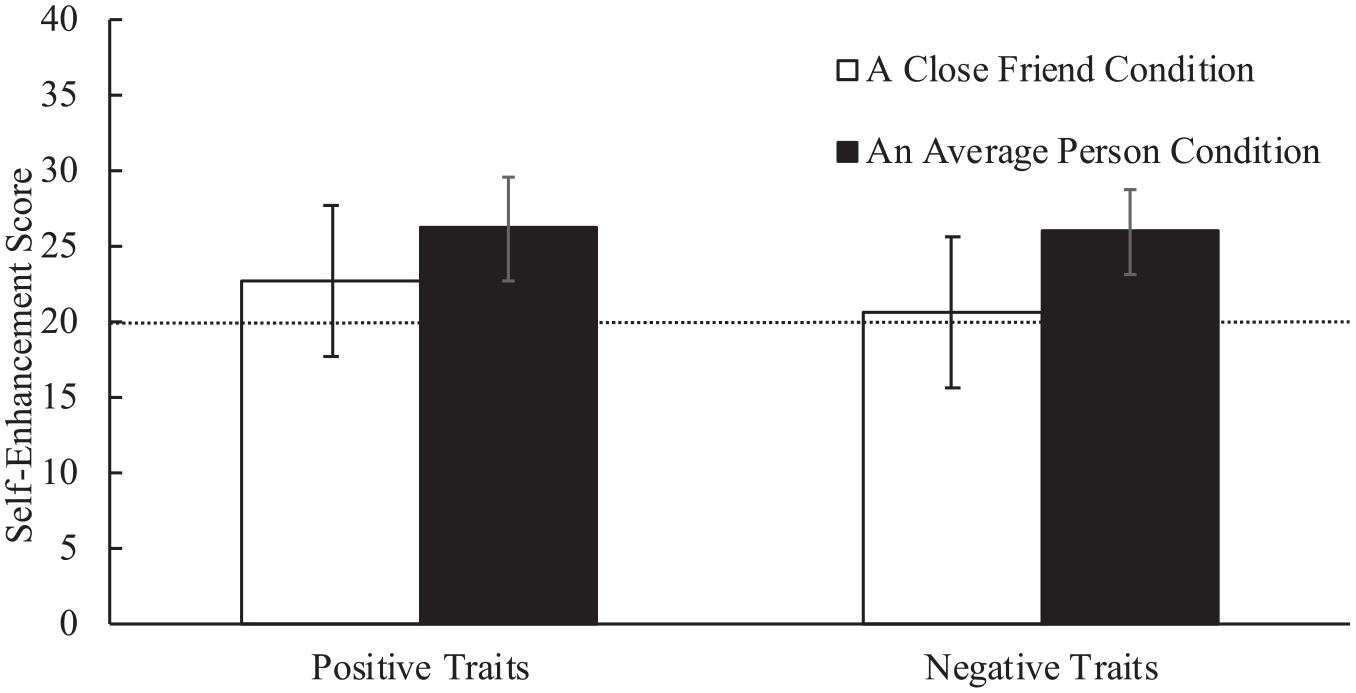
Means with standard deviation bars of self-enhancement scores as a function of valence (positive vs. negative traits) and condition (an average person vs. a close friend), Study 2 (N = 200).
We then compared the self-enhancement score to the midpoint 20. One sample t-tests showed that participants self-enhanced overall for both the positive and the negative traits, ts ≥ 8.12, ps < .001, ds ≥ .57. We next analyzed self enhancement within the two groups. Within the average person condition, participants self-enhanced on both positive and negative traits, ts ≥ 8.69, ps < .001, and ds ≥ .86. However, within the close friend condition, they self-enhanced on the positive traits, t = 4.78, p < .001, d = .48, 95% CI = [1.56, 3.78], but not on the negative traits, t = 1.19, p = .24, 95% CI = [−.34, 7.00].
We next conducted a frequency analysis on the frequencies of choosing each option (i.e., “my true self,” “a close friend’s/an average peer’s true self,” and “neither”), and constructed three counts for positive traits and three counts for negative traits, for each individual (i.e., six total counts per participant; see Table 1 for descriptive statistics). A repeated measure ANOVA was performed on total counts, with valence (positive vs. negative) and option (“my true self” vs. “a close friend’s/an average person’s true self” vs. “neither”) as the within-subject factors, and condition (an average person vs. a close friend) as the between-subject factor.
Mean and Standard Deviations for Total Counts of Three Options by Valence and Condition in Study 2 (N = 200).

Note. Numbers in parentheses are standard deviations. Cells with the same subscripts are not significantly different from each other, ps > .05. All cells are significantly different from each other within the same column, ps < .05.
Mauchly’s tests of sphericity were significant for option, W = .80, χ2(2) = 44.37, p < .001, and for the interaction between option and valence, W = .94, χ2(2) = 12.28, p = .002. Thus, all the corresponding results were reported with a Greenhouse and Geisser (1959) adjustment. The results revealed the interactions between option and condition, F(2, 396) = 23.12, p < .001, ηp2 = .11, option and valence, F(1.89, 373.44) = 290.65, p < .001, ηp2 = .60, and three-way interaction, F(2, 396) = 28.83, p < .001, ηp2 = .13, were all significant. The interaction between valence and condition was not significant, F(1, 198) = 2.00, p = .16. No main effects were significant, Fs ≤ 2.10, ps ≥ .12.
The three-way interaction among valence, option, and condition was the most relevant to the research question. Post hoc pairwise comparisons with Bonferroni correction showed that all pairwise comparisons were significant within valences, ps < .001, ds ≥ .35, except for the comparison of “An average person’s true self” and “Neither” in negative traits, and the comparison of “My true self” and “A close friend’s true self” in negative traits, ps ≥ .936. For the positive traits, both conditions chose “My true self” most frequently, followed by “Other’s true self” and “Neither.” However, for the negative traits, “Neither” was the most frequently selected option in a close friend condition (see Figure 3).

Means with standard deviation bars of total counts as a function of valence (positive vs. negative tratis), option (“my true self” vs. “other’s true self” vs. “neither”), and condition (an average person vs. a close friend), Study 2 (N = 200).
Discussion
Study 2 not only replicated the findings of Study 1 but also provided strong evidence of self-enhancement in true self comparisons by showing that people self-enhanced on positive trait dimensions even in true self comparisons with their close friends. The fact that the “Neither” option was the most chosen for negative traits in the close friend group suggests that self-enhancement tendencies are reduced in close friend comparisons because individuals are reluctant to attribute negative characters either to themselves or their close friends.
Study 3
Studies 1 and 2 provided evidence of self-enhancement in true self comparisons, on both positive and negative traits, and in relation to average peers and close friends. In Study 3, we extended these findings in a number of directions.
First, true self studies, and assumptions about the nature of true self perceptions, have centered primarily on moral characteristics and actions. In the first two studies, we included various traits for generality. For consistency with previous research, we focused on Study 3 on positive and negative moral characteristics. We expected, as in the previous studies, to obtain evidence of comparative bias on both positive and negative morally related traits.
Second, we included measures of the actual self (Study 3a and 3b) and the potential self (Study 3a) to assess previous assumptions that the true, actual, and potential selves were distinct constructs. The true self is assumed to be a unique construct, a representation of a “deeper” self, one that is independent of the actual self reflected in everyday behavior (Christy et al., 2019; Schlegel et al., 2009). It should be noted that the actual self in the literature on this topic is, like the true self, a hypothetical construct, representing a presumed amalgam of behavior. Our treatment of the actual self contrasts with the more familiar actual self by Higgins (1987) self-discrepancy theory, which represents people’s reported beliefs about their actual selves.
Extant views of the true or authentic self assume, implicitly or explicitly, that the true self is an internal representation of the actual self—who a person truly is—rather than an idealized vision of a hypothetical future or potential self (Bargh et al., 2002; Markus & Nurius, 1986). To assess comparative bias in alternatives to the actual self, therefore, we also included, in Study 3a, a group that evaluated their potential selves, defined as the self that they believed they could realistically become, rather than the self based on ideal images, hopes, or aspirations (Higgins, 1987).
Study 3a
Study 3a aimed to assess directly how true selves are evaluated compared to actual and potential selves. From a self-enhancement perspective, one would expect individuals to rate both their true and actual selves more favorably than those of average peers. Furthermore, participants should rate their true selves even more favorably than their actual selves. This finding would indicate that people believe that their best selves are better than both their own and others’ actual selves. Moreover, we assume a hierarchy of positivity in counterfactual selves related to their grounding in objective facts and circumstances. Based on research showing that people self-enhance most on characteristics that are difficult to assess objectively (Alicke & Govorun, 2005; Dunning et al., 1989), and with regard to judgments that are difficult to invalidate, we expected participants to provide the most favorable ratings to their potential selves, followed by their true selves, and then their actual selves, with the average peer’s true self being the bottom-feeder in the hierarchy.
Method
Participants
A total of 134 college students (104 women, 29 men, and 1 transgender man) aged from 18 to 48 (M = 20.27, SD = 3.60) were recruited from a large public Midwestern University. The sample consisted of 89.55% White, 3.73% Asian, 8.21% Black, and 2.99% Others (participants were allowed to select multiple races). An a-priori sensitivity power analysis conducted on GPower 3.1 (Faul et al., 2009) revealed that 100 participants would yield 80% power to detect a medium effect (Cohen’s f = .10; assuming α = .05). 1
Measures
Nineteen personality traits that were rated the most relevant to morality were selected from a study by Goodwin et al. (2014). Due to a lack of negative traits, we used online dictionaries, such as wordhippo.com and thesaurus.com, to obtain antonyms of those positive traits. We also included authentic as a positive trait since researchers tend to use the true self and the authentic self interchangeably (Newman, 2018). Thus, the final list of traits consisted of 10 positive traits (Trustworthy, Respectful, Just, Forgiving, Caring, Selfless, Compassionate, Empathetic, Loyal, and Authentic; α = .86) and 10 negative traits (Dishonest, Violent, Unprincipled, Prejudiced, Insincere, Unkind, Greedy, Irresponsible, Unfair, and Unhelpful; α = .91).
Procedure
After reading the introduction, participants read the definitions of all four self-concepts. We incorporated the definitions of the true self and the actual self from the past literature to make our instructions as comprehensive as possible (e.g., Christy et al., 2019; Newman et al., 2014). For the true self, they read Your true self is who you really are at the most basic level or at the “core.” It is who you really are even if you aren’t able to express this self in all your daily activities. In other words, the true self is the authentic and fundamental nature of yourself. You can think of it as the deepest, and most essential aspect of your being.
Then, as in the previous studies, average person ratings were made with an average person of their same sex and age. Participants were told that their self, or their actual self is “Your actual self is how you actually behave in daily life, even if you sometimes do things that aren’t representative of who you really are.” Finally, for the potential self-definition, participants read “your potential self is the self that you can realistically become.”
All the participants were asked to indicate whether each of the 20 traits (presented in a random order) was more characteristic of the all four self-concepts on a 7-point scale (1 = “extremely uncharacteristic”; 7 = “extremely characteristic”).
Results
A repeated measures ANOVA was conducted on the mean trait characteristic ratings, with valence (positive vs. negative) and judgment (the true self vs. an average person’s true self vs. the actual self vs. the potential self) as the within-subject factors. Table 2 summarizes descriptive statistics. The main effect of valence was significant, F(1, 133) = 832.07, p < .001, ηp2 = .86. Participants rated the positive traits (M = 5.68, SD = .46) more characteristic of different self-concepts than the negative attributes (M = 2.83, SD = .93). The main effect of judgment was also significant, F(3, 399) = 3.77, p = .011, ηp2 = .03. Post hoc tests with Bonferroni adjustment revealed that traits were significantly more characteristic of the potential self (M = 4.32, SD = .54) than of the actual self (M = 4.17, SD = .52), p = .017, d = .30, 95% CI = [.01, .21]. Traits were also more characteristic of the true self (M = 4.25, SD = .52) than of the actual self, p = .015, d = .35, 95% CI = [.01, .11].
Mean and Standard Deviations for Trait Characteristicness Rating by Valence and Judgment in Study 3a (N = 134).
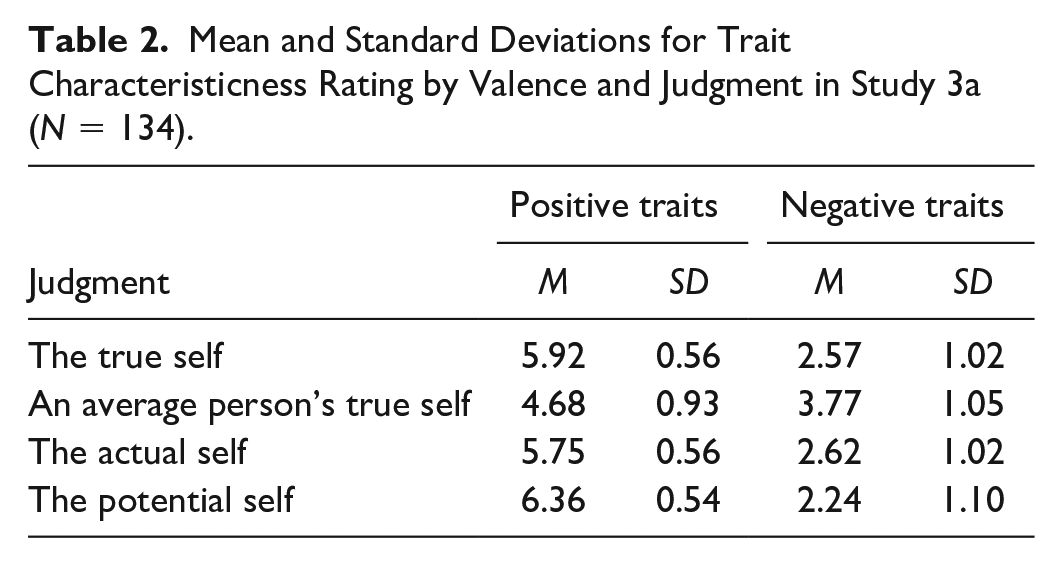
In addition, the interaction between valence and judgment was also significant, F(3, 397) = 228.86, p < .001, ηp2 = .63. Post hoc tests with Bonferroni adjustment showed that all pairwise comparisons were significant within valences, ps < .001, except for the actual self and the true self comparison for negative traits, p = .806, 95% CI = [−.04, .14]. Specifically, positive traits were rated the most characteristic of the potential self, followed up by the true self, the actual self, and other’s true self, ps < .001, ds ≥ .47. However, negative traits were most characteristic of other’s true self, followed by the true self or the actual self, and the potential self, ps < .001, ds ≥ .39 (see Figure 4).
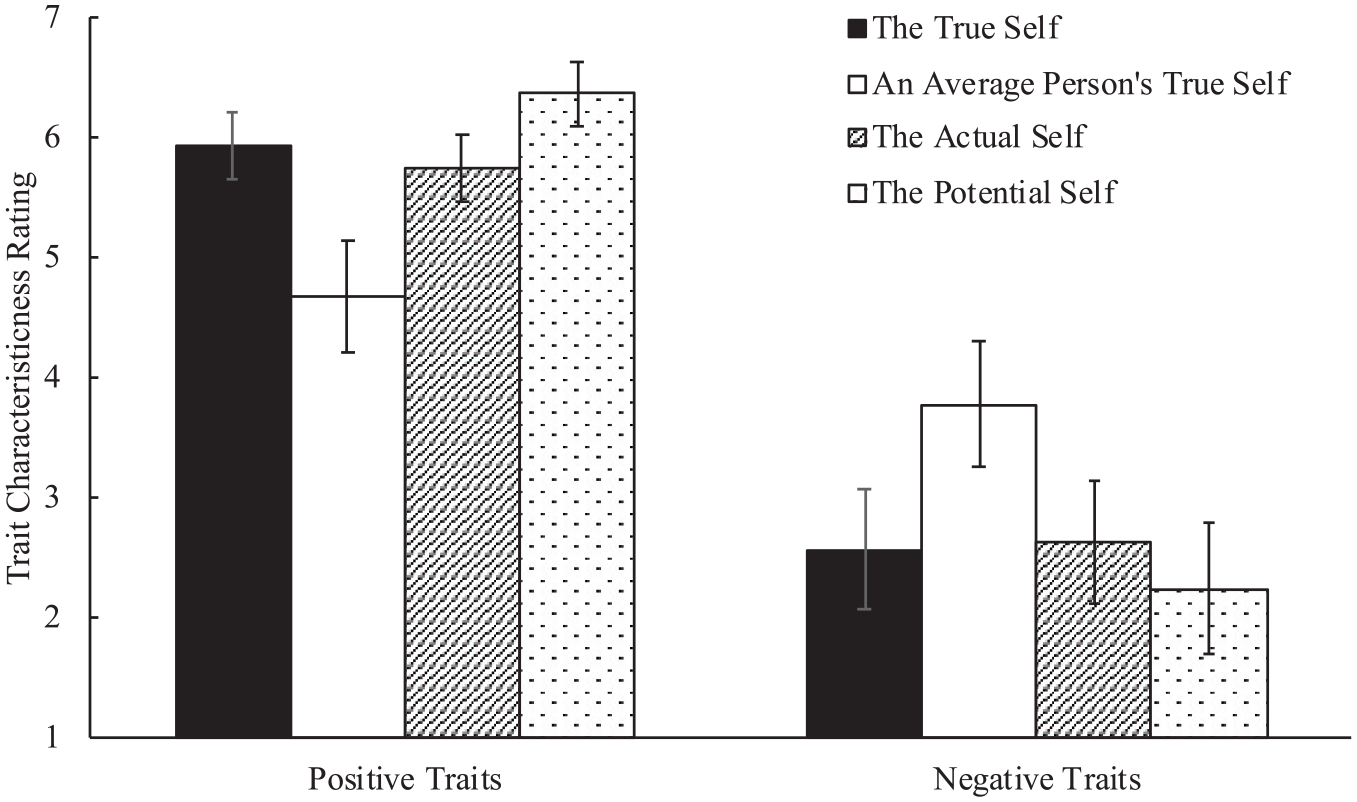
Means with standard deviation bars of trait characteristic ratings as a function of valence (positive vs. negative traits) and judgment (the true self vs. an average person’s true self vs. the self vs. the potential self), Study 3a (N = 134).
Discussion
Study 3a replicated our previous findings and found that people believed that moral traits were more characteristic of their own true selves than those of average persons’ true selves. In addition, we found that the potential self was the most favorably rated target and that the true self was not perceived differently from the actual self when judging negative traits. We assume that the elevation of the potential self occurs because it is a hypothetical projection, and thereby protected from invalidation, whereas true self estimations are likely to include a stronger dose of accurate self-knowledge (Jongman-Sereno & Leary, 2019). Although the lack of difference between actual and true self ratings on negative moral traits might represent a floor effect (given the low ratings for each target), this finding suggests, nonetheless, that people may generally draw a greater distinction between the actual and true selves on positive versus negative moral traits. We return to this issue in the General Discussion.
Study 3b
Study 3a included direct comparisons among true self, actual self, potential self, and average student ratings. That is, each participant made each of these ratings. The resultant design leaves open the question regarding true and actual self ratings when each of these are made separately, in relation to an average peer. The finding in Study 1 that participants rated their own true selves higher than an average peer’s on both positive and negative traits has two possible interpretations. First, true self judgments could be part of a general self-enhancement bias that emerges in self versus average peer comparisons, one that extends equally to actual self judgments. Second, as in Study 3a, true self ratings could be more positive than actual self ratings even when compared indirectly; that is, under conditions in which one group compares the true self to an average peer, and the other group compares the actual self to an average peer. This second interpretation would indicate something more unique about the true self construct and would extend the previous study’s findings to the context of self versus average peer comparisons.
Method
Participants
Participants were 203 U.S. MTurk workers (104 men, 98 women, and 1 others), aged from 24 to 73 (M = 40.5, SD = 11.24). Each was paid $0.50 for participating. The sample consisted of 80.2% White, 8.4% Asian, 8.4% Black, and 3.0% Others. An a priori sensitivity power analysis conducted on GPower 3.1 (Faul et al., 2009) revealed that 200 participants would yield 80% power to detect a small effect (Cohen’s f = .08; assuming α = .05).
Measures and procedure
Participants were randomly assigned to one of the two groups: the actual self comparison or the true self comparison. For the actual self comparison group, participants read the definition of the actual self from Study 3a regarding their own and an average person’s actual self. For the true self comparison group, participants read the definition of the true self from Study 3a regarding their own and an average person’s true self. As in the previous studies, average person ratings were made with an average person of their same sex and age. Then, they were asked to indicate whether each of the 10 positive morality-related traits (α = .91) and 10 negative morality-related traits (α = .89) from Study 3a (presented in a random order) was more characteristic of the actual self or the true self on a 7-point scale (1 = “extremely uncharacteristic”; 7 = “extremely characteristic”).
Results
A repeated measure ANOVA was conducted on the mean trait characteristic ratings, with valence (positive vs. negative) and comparison target (self vs. an average person) as the within-subject factors, and condition (the true self vs. the actual self) as the between-subject factor. Table 3 summarizes descriptive statistics. The main effect of valence was significant, F(1, 201) = 521.83, p < .001, ηp2 = .72. Participants rated the positive traits (M = 5.20, SD = .79) as more characteristic of self-concepts than the negative attributes (M = 2.75, SD = .85). The main effect of comparison target was also significant, F(1, 201) = 27.42, p < .001, ηp2 = .12. Participants rated the traits more characteristic of an average person (M = 4.04, SD = .35) than of themselves (M = 3.91, SD = .35).
Mean and Standard Deviations for Trait Characteristic Rating by Valence, Comparison Target, and Condition in Study 3b (N = 203).

The interaction between valence and comparison target was also significant, F(1, 201) = 81.41, p < .001, ηp2 = .29. Post hoc tests with Bonferroni adjustments showed that participants rated positive traits as more characteristic of themselves (M = 5.39, SD = .92) than of the average person (M = 5.01, SD = .87), p < .001, d = .48, 95% CI = [.27, .50], whereas negative traits were viewed as more characteristic of the average person (M = 3.07, SD = .99) than of the themselves (M = 2.44, SD = .94), p < .001, d = .69, 95% CI = [.51, .76] (see Figure 5). The main effect of condition (true self versus actual self) and its interactions were not significant, Fs ≤ 1.03, ps ≥ .312.
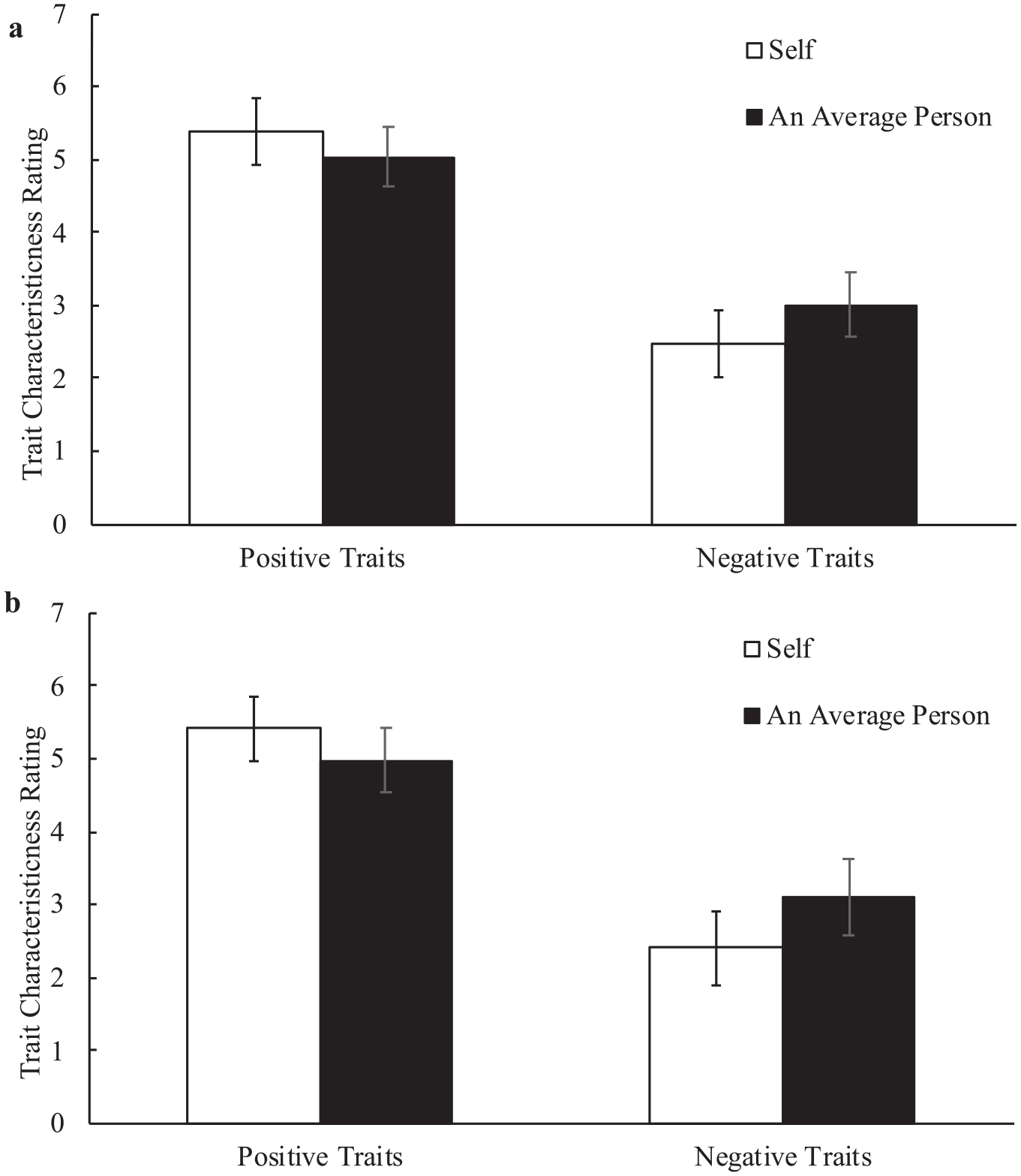
Means with standard deviation bars of trait characteristic ratings as a function of valence (positive vs. negative traits), comparison target (self vs. an average person), and condition (the true self vs. the actual self) Study 3b (N = 203). Panel a contrasts valence and comparison target among participants assigned to the true self condition. Panel b contrasts valence and comparison target among participants assigned to the actual self condition.
Discussion
Study 3b replicated the previous findings that positive traits were viewed as more characteristic of participants’ true selves than of the average persons’, whereas negative traits were viewed as more characteristic of average persons’ true selves than those of participant’s own. Inconsistent with Study 3a, however, we found an equivalent degree of self-enhancement in the true and actual self comparison conditions. This finding suggests that the comparative bias found in the true self judgments is part of a more general self-enhancement tendency that extends to actual self judgments. We consider this issue further in the General Discussion.
Study 4
The first three studies demonstrated comparative bias in traits comparisons with average peers and close friends (the latter, on positive traits). In the fourth study, we wanted to extend our findings to perceptions of moral behaviors, modeled on previous studies (e.g., Jongman-Sereno & Leary, 2016; Newman et al., 2014). Consistent with self-enhancement assumptions, we expected people to view moral behaviors as more reflective of their own true selves than of others’ true selves, and immoral behaviors as less characteristic of their own true selves than of others’.
Methods
Participants
Participants were 304 college students from a large public Midwestern University (241 women, 60 men, and 3 others) aged from 18 to 39 (M = 19.18, SD = 1.96). Around 89.1% of the sample was White (5.6% Asian, 2.3% Black, and 2.9% Others). A sensitivity power analysis conducted on GPower 3.1 (Faul et al., 2009) revealed that 300 participants would yield 80% power to detect a small effect (Cohen’s f = .08; assuming α = .05).
Measures
We modified three moral scenarios from previous research (Alicke, 1993). The scenarios involved decisions regarding whether to: keep lost money, cheat on an exam, and cheat on a spouse. For each scenario, they were asked to imagine that they chose one resolution to the decision dilemma (either to keep the money or return it; cheat on exam or not cheat; cheat on a spouse or not cheat). See Appendix for the complete scenarios.
Procedures
The experiment was conducted using Qualtrics. Participants were randomly assigned to one of the three scenarios. For each, participants were asked to imagine having chosen one resolution to the dilemma (moral or immoral decision). They were asked to rate how characteristic the decision was of their true selves as compared to an average, typical person’s true self on a scale of 1 to 7 (1 = “extremely uncharacteristic”; 7 = “extremely characteristic”). All participants were given the definition of the true self as the self who someone really is. The questionnaire was order balanced (i.e., half of the participants rated their true selves first, and were asked to imagine an average person making the same decision).
Results
We calculated the means of true-self-ratings in the moral and immoral scenarios across all three scenarios. The means of the true-self-rating of self and an-average-person across all scenarios were also calculated. Then, we conducted a repeated measures ANOVA on true self ratings, with decision (moral vs. immoral) as the between-subject factor and comparison target (self vs. an average person) as the within-subject factor.
Both main effects were significant. Participants rated the moral decisions (M = 5.05, SD = 1.51) as more true-self-characteristic than the immoral decisions (M = 3.80, SD = 1.52), F(1, 302) = 52.39, p < .001, ηp2 = .15. They also rated the decisions as more characteristic of an average person’s true self (M = 4.63, SD = 1.74) than of their own true selves (M = 4.22, SD = 2.05), F(1, 302) = 13.66, p < .001, ηp2 = .04.
The predicted interaction was also significant, F(1, 302) = 5.69, p = .018, ηp2 = .02. The interaction was decomposed into simple main effect analyses. Results indicated no significant difference in true-self-ratings between themselves (M = 4.98, SD = 1.88) and an average person (M = 5.13, SD = 1.74) in the moral decisions, t(151) = .89, p = .375, 95% CI = [−.47, .18]. For the immoral decisions, however, the participants rated the decisions as more characteristic of an average person’s true self (M = 4.13, SD = 1.60) than of their own true selves (M = 3.46, SD = 1.93), t(151) = 4.50, p < .001, d = .36, 95% CI = [.38, .97] (see Figure 6).
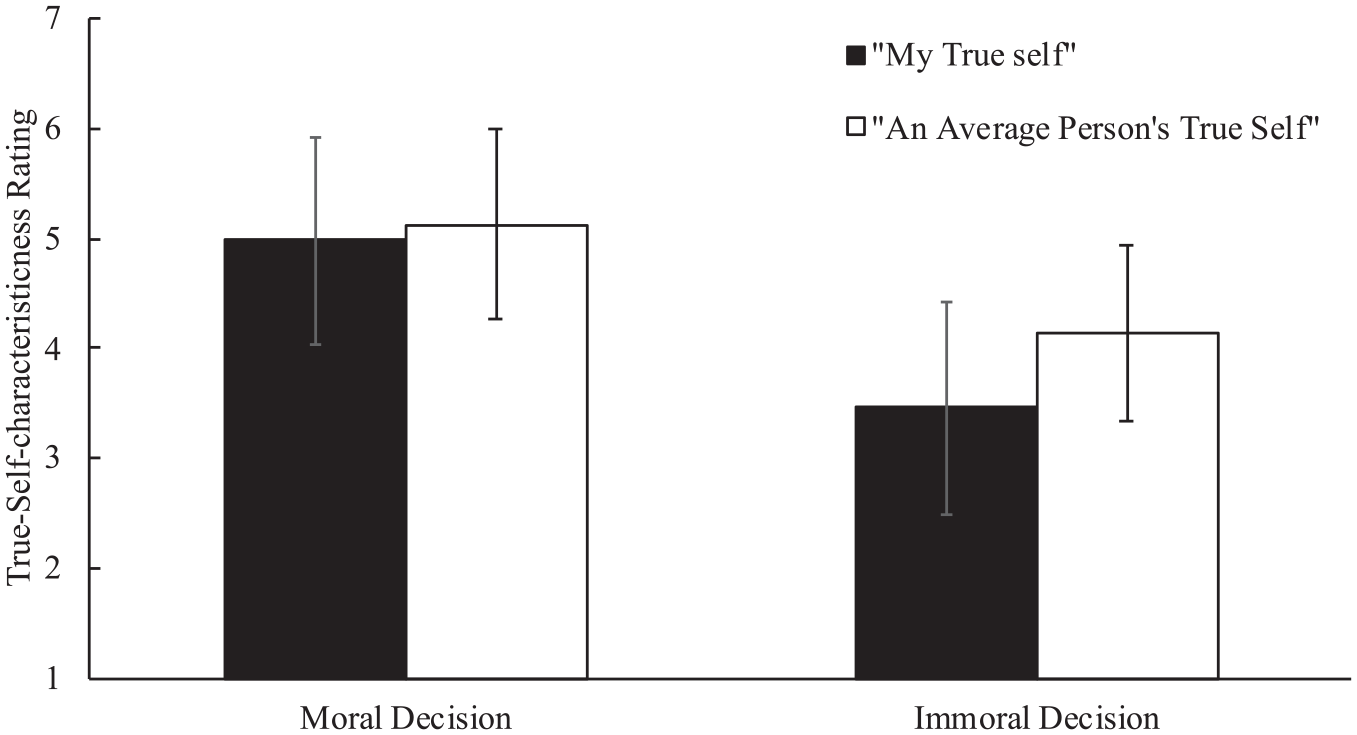
Means with standard deviation bars of the true self ratings as a function of decision (moral vs. immoral decisions) and comparison target (“my true self” vs. “an average person’s true self”) in Study 4 (N = 304).
Discussion
Study 4 extended the findings of the first three experiments to behavior perceptions in moral decision dilemmas. Participants viewed negative moral decisions as less characteristic of their own true selves than of others’. They did not, however, view positive decisions to be more true self characteristic. This asymmetry on positive and negative dimensions suggests a middle ground between the claim that people are equally generous in assessing all true selves, versus favoring their own. On trait comparisons, self-enhancement emerges on both positive and negative characteristics, although only on positive characteristics in comparisons with close friends. However, with regard to behaviors that reflect moral character—what researchers have seen as the essential component of the true self—universality and self-enhancement split the difference: People see immorality as more true self characteristic of others but do grant the same true self positivity to others as to themselves on moral behaviors.
Study 5
In Study 4, participants were asked to imagine having engaged in morally superior or inferior resolutions to decision dilemmas. As others have noted (Jongman-Sereno & Leary, 2016), this study design can be a somewhat artificial procedure if participants do not actually think that they would resolve the dilemma in the way they are asked to imagine. In Study 5, therefore, participants were asked to make judgments regarding moral options that previous research (Christy et al., 2016) has shown to be relatively common among college students. We expected to replicate the comparative bias findings from the previous study. We also explored further whether comparative bias in this context applies to both positive and negative behaviors.
Method
Participants
Participants were 204 college students from a large public Midwestern University (159 women, 45 men) aged from 18 to 59 (M = 19.61, SD = 3.12). Around 90.7% of the sample was White (2.0% Asian, 5.9% Black, and 1.5% Others). An a-priori sensitivity power analysis conducted on GPower 3.1 (Faul et al., 2009) revealed that 200 participants would yield 80% power to detect a small effect (Cohen’s f = .20; assuming α = .05).
Measures
Five moral and five immoral behavior statements with the highest commitment frequencies were selected from Christy et al. (2016) that are based on the Conventional Morality Scale (Tooke & Ickes, 1988), the Moralization of Everyday Life Scale (Lovett et al., 2012), and the Aggression Questionnaire (Buss & Perry, 1992). The immoral behaviors included: “I have lied to my parents about something”; “I have decided to keep money for myself rather than giving to charity”; “I have gotten into arguments when people disagreed with me”; “I have done something that went against my values”; “I have let down people who were counting on me.” The moral behaviors comprised: “I have been supportive of a friend during a difficult time in their life”; “I have helped make sure that a fair outcome was reached in a disagreement”; “I have been kind to others without thinking of what they might do for me in return”; “I have been kind to someone I knew was having a bad day”; “I have taken responsibility for a mistake that I made.” More than 75% of the participants from Studies 2 and 3 by Christy et al. (2016) reported that they had committed the five immoral behaviors, and more than 90% of these participants had committed the five moral behaviors.
Procedure
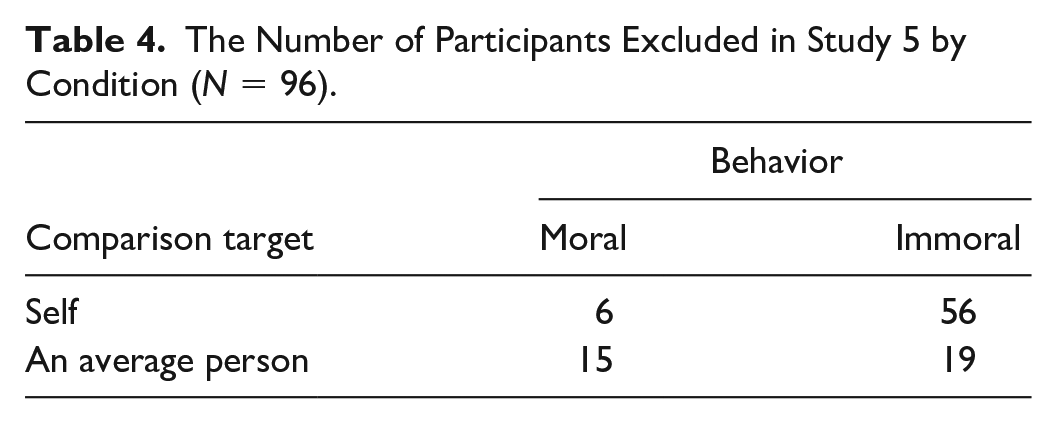
This study was a 2 (comparison target: self vs. an average person) × 2 (behavior: moral vs. immoral) completely between-subject design. All participants began by reading an intro which described the true self as the self who someone really is. Then, they were randomly assigned to read five moral or immoral behavior scenarios. They were asked to imagine (for 7 seconds) themselves or an average person of their same sex and age committing those behaviors. Next, they indicated how characteristic each of those behaviors was of their own or an average person’s true self, defined as the authentic and fundamental nature of oneself, on a 7-point scale (1 as “Extremely uncharacteristic” and 7 as “Extremely characteristic”). Finally, they indicated whether they had committed those behaviors in the past, or whether they believed that an average person had done so, and then completed basic demographic questions. We excluded participants who had not committed all five of those moral or immoral behaviors, and continued collecting responses until reaching the proposed sample size (see Table 4 for the numbers of excluded participants by conditions). We reran the analysis including the excluded participants. The same significant patterns of results were still obtained, and therefore, we only reported the results without excluded participants in Study 5.
The Number of Participants Excluded in Study 5 by Condition (N = 96).
Results
We began by conducting a 2 × 2 factorial ANOVA to compare mean true-self-ratings in all four conditions. As expected, results revealed a significant main effect of behavior, F(1, 200) = 309.11, p < .001, ηp2 = .61. Participants rated the moral behaviors (M = 5.77, SD = .73) more characteristic of the true self than the immoral behaviors (M = 3.91, SD = 1.00). The main effect of comparison target was significant, F(1, 200) = 16.25, p < .001, ηp2 = .08. The interaction between behavior and comparison target was also significant, F(1, 200) = 57.29, p < .001, ηp2 = .22. Simple main effect analyses showed that for moral behaviors, the true self ratings were higher for participants’ own true selves (M = 5.96, SD = .61) than for an average person’s true self (M = 5.59, SD = .80), t(99) = 2.63, p = .01, d = .52, 95% CI = [.09, .65]. Participants rated immoral behaviors significantly more characteristic of an average person’s true self (M = 4.54, SD = .67) than their own true self (M = 3.32, SD = .89), t(101) = 7.84, p < .001, d = .52, 95% CI = [.91, 1.53] (see Figure 7).
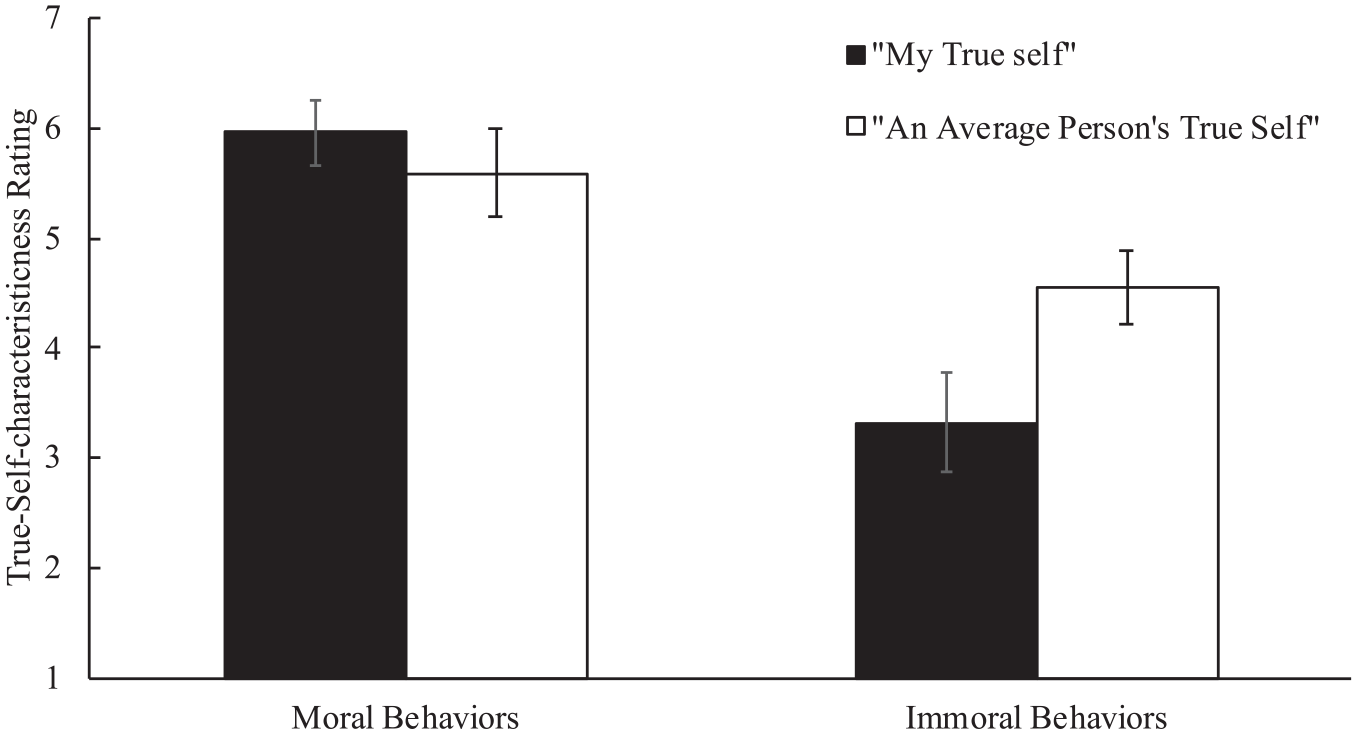
Means with standard deviation bars of the true self ratings as a function of behavior (moral vs. immoral behaviors) and comparison target (“my true self” vs. “an average person’s true self”) in Study 5 (N = 204).
Discussion
Consistent with Study 4’s findings, participants considered immoral behaviors to be more characteristic of an average person’s true self rather than of their own. In this study, however, we also obtained evidence of comparative bias on moral behaviors, in which participants rated their own true selves more favorably than an average person’s. These findings provide strong evidence for comparative bias in true self comparisons when the moral issues represent actual past behaviors rather than hypothetical ones.
General Discussion
Being authentic, or true to oneself, is not only a popular mantra, but the cornerstone of many intellectual traditions. In fact, the modern concept of “self” derives, arguably, from the emerging notion in the 17th century that people have natural rights (Taylor, 1989), which provides a basis for the belief in being true, or untrue, to one’s nature. For philosophers who embraced the term “existentialism,” such as Sartre, and those for whom the label was posthumously applied, such as Kierkegaard, authenticity had strong moral connotations. Kierkegaard (1849/1954) advocated a radical subjectivity, the absolute freedom to make self-defining choices. Inauthenticity is the failure to exercise this freedom. Sartre (1943), just as radically, proposed that “existence precedes essence,” which can be interpreted to mean that individuals are completely free to create themselves. Inauthenticity for Sartre derives from a retreat to “facticity”; that is, defining self with reference to given rather than created circumstances.
Whether a true self exists, and if so, what it entails, is an ongoing topic of philosophical debate. It seems clear, though, that people believe they have a true self, or at least endorse true self beliefs, when queried in psychological experiments. Recent research suggests that true self beliefs reflect “psychological essentialism,” which as the name implies, is an aspect of self that remains invariant through surface changes (Christy et al., 2019). Some of the most interesting applications of the true self construct in empirical research have been to show that people believe that their true selves are morally superior to their actual behavior (e.g., Newman et al., 2015). Research findings suggest that when people fall short of their behavioral ideals, they believe that there is a superior essence within that reflects their true selves more accurately.
The question we pursued in the studies described in this article is whether all essences, or true selves, are considered equal. If people believe in an essence that characterizes all human species members, then it seems reasonable to assume that all essences are evaluatively equal. Accordingly, researchers have suggested that true or authentic self judgments are “perspective-independent,” meaning that people view their own and others’ true selves similarly (Kernis & Goldman, 2006; Strohminger et al., 2017). By contrast, the extensive literature on self-enhancement in general, and comparative bias in particular, provides ample reason to question whether true self judgments are immune from the ubiquitous self-serving tendencies that are reflected in many trait and behavior judgments (Alicke & Sedikides, 2011).
As the comparative bias literature primarily encompasses trait judgments, we assessed true self comparisons on various traits dimensions in the first two studies. Study 1 established the basic finding that people evaluate their own true selves more favorably than those of others, on both positive and negative trait dimensions. Study 2 replicated these findings and extended them to comparisons with close friends, with one qualification: whereas participants evaluated their own true selves more favorably on positive dimensions than those of average peers and close friends, they did not evaluate themselves more favorably than their close friends on negative trait dimensions. We also replicated previous findings (e.g., Jongman-Sereno & Leary, 2016; Newman et al., 2014) showing that positive attributes are generally considered more characteristic of true selves than negative ones.
In Study 3a, we compared trait judgments made with reference to four targets: actual self, true self, average peer’s true self, and potential self. As investigators have considered morality to be the fundamental component of the true self (Strohminger et al., 2017), we concentrated exclusively on morally-related trait dimensions in Studies 3a and 3b. Previous research suggests that the true and actual selves are distinct constructs. Christy and colleagues (2019), for example, have found that participants view true selves as more essential than actual selves. The findings of Study 3a demonstrated an elevation of the true self over the actual self, thereby supporting investigators’ assumption that true selves are distinguished from actual selves, and that they are evaluated more favorably than actual selves (e.g., Strohminger et al., 2017).
Whereas true selves afford an improvement to actual selves, from a self-enhancement perspective, they are not the most favorable selves available. In Study 3a, we were interested in exploring whether another self construction—the potential self—would be even more favorably evaluated than the true self. As potential selves point to a hypothetical future, they provide considerable latitude for construction. In essence, people are free to fantasize at will about how events will unfold in the future, with no immediate prospect for invalidation. Consistent with this reasoning, we found that the potential self was evaluated more favorably than any other comparison standard.
Our explanation for the increasing levels of self-enhancement in Study 3a is based on the assumption that the degree to which people self-enhance depends on the nature of the judgment. As has been widely demonstrated, people are least self-serving on dimensions that are objectively assessed, or in circumstances in which invalidation is possible (Alicke & Govorun, 2005; Dunning et al., 1989). From this vantage, judgments about the true self are more subjectively based than those about the actual self, as this judgment standard allows for some degree of hypothetical reasoning about the current state of one’s characteristics and abilities. The potential self allows even more latitude, as it encourages speculation about the best level of functioning individuals can attain on these characteristics. The pattern of findings in Study 3a supported this reasoning: average peer ratings were lowest, followed by actual self judgments, true self ratings, and potential self-ratings.
In Study 3a, each participant rated each of the four comparison targets. In Study 3b, we assessed whether true and actual self judgments differed when, instead of directly comparing the true self to the actual self, each of these judgment targets was evaluated with reference to an average peer. If the difference between true self and average peer ratings was greater than that between actual self and average peer ratings, this would suggest that the true self is viewed more favorably than the actual self even in indirect comparisons, and that it is a unique evaluative construct. If these two differences were comparable, however, this would suggest that the true self is evaluated more favorably than the average self only when they are directly compared but not when each was compared separately to a different judgment standard (i.e., to the average peer). We found, as usual, that the true self was evaluated more favorably than an average peer, but under these circumstances, we also found roughly the same degree of difference between the actual self and an average peer. Furthermore, true and actual self ratings did not differ significantly from each other in this indirect comparison.
These findings raise questions regarding the prominence, or cognitive availability, of true-self conceptions, and of their spontaneous influence in ordinary judgment. When asked to make direct comparisons between the true and actual selves, the true self provides an opportunity to imagine a better self within, and results in elevated trait ratings. The same occurs in comparisons to an average peer, but in this instance, to an equivalent degree regardless of whether true or actual selves are compared to the average peer. From a self-enhancement standpoint, these results are not surprising. Self-enhancement typically occurs within reality constraints: People are only as self-serving as a particular judgment requires, and generally avoid straining credulity to themselves or to others (Alicke & Sedikides, 2011). When asked to compare themselves to an average peer, they maintain a positive difference, consistent with one of the strongest and most reliable effects in the social-psychological literature (Zell et al., 2020). Study 3b is the first we know of to compare different types of self-standards to an average peer, and it seems, interestingly, that they may all provide comparable degrees of self-enhancement. Alternately, it may simply be that unless direct comparisons are made, people simply do not differentiate between their actual selves and other possible self-constructions. The spontaneity of true self conceptions is an important issue for future research.
Having demonstrated that people evaluate their own true selves more favorably than those of others on trait dimensions, we transitioned from traits to morally relevant behaviors in the final two studies. In Study 4, we presented participants with hypothetical moral dilemmas, whereas in Study 5, we asked them about behaviors they have actually performed. In both studies, we found that people view immoral behaviors as more characteristic of others’ true selves than of their own. In Study 5, participants also viewed moral behaviors as more reflective of their own true selves than of others’ true selves, although this comparison was not significant in Study 4. With this one exception, the findings of these studies mirrored those in the trait studies, demonstrating that people evaluate their own true selves more favorably than those of others on both trait and behavior dimensions.
Theoretical Implications
Most individuals have a vested interest in believing that there is a better self within than the one that is outwardly manifested. Even the moral athletes among us have presumably, on occasion, done things they regretted, or failed to live up to their expectations. Both theory (Strohminger et al., 2017), and the empirical results of Study 3a, suggest that the true self is perceived as an improvement to the actual self, at least when directly compared. Although individuals’ precise interpretation of their true selves is an ongoing research topic, Christy et al. (2019) have made important strides in suggesting that people construe it as an enduring and essential aspect of identity. In comparing their actual selves to their true ones, therefore, participants may be thinking of a core essence that is better in many respects to its surface appearances.
The present studies, however, call into question the strongest claim that has been made for true selves, namely, that people evaluate them equally regardless of whether they belong to themselves or others. The findings in this article raise the larger question about the implication of our findings for the true self construct. One possible interpretation is that while the present results contradict the strongest true self claims, they pose no particular problem for the way investigators have construed the basic concept. It is possible, for example, that people believe in a true human essence, but simply evaluate their own essence more favorably than others’. Research has clearly established that observers generally believe that others are more authentic when behaving morally rather than immorally (Newman et al., 2014). Our findings, then, might simply provide a qualification, such that the authenticity people ascribe to moral behavior is greater for self than for others.
A different possibility is that self-enhancement is an integral part of the true or authentic self construct for any type of comparative, evaluative judgment. The assumption that people general harbor positive views of others is well established (person positivity bias; Sears, 1983). This person positivity bias creates a substantial hurdle for self-ratings, in that to exhibit comparative bias, they must exceed the already favorably evaluations people accord to others. Nevertheless, our studies clearly indicate that people do evaluate their own true selves more favorably than those of others, including their close friends (on positive trait dimensions). In the context of considering their abilities, preferences, characteristics, and actions vis-à-vis others, therefore, self-enhancement may be intrinsic to how people construe any counterfactual self, whether it be true, authentic, or potential.
The possibility that self-enhancement is a fundamental component of the true self raises doubts about a main assumption in research and theory involving the nature of true selves and authenticity, namely, that they involve a relatively unbiased self-reckoning, one based on accurate self-knowledge and objective analysis. Kernis and Goldman (2006), for example, suggest that authenticity entails the absence of self-serving mechanisms. Other research, by contrast, does indicate that authenticity judgments are influenced by the valence of behavior (e.g., Christy et al., 2016; Jongman-Sereno & Leary, 2016). Specifically, morally good (vs. bad) behaviors are considered as more authentic even when both behaviors are described as congruent with people’s self-desires.
Limitations
There are, as always, limitations to the present set of findings and to the conclusions that can be drawn. First, although we found consistent evidence that participants evaluated their own true selves more favorably than those of others, the tendency to view true selves favorably for both self and other was an even stronger effect. Clearly, as others have claimed, there is a general tendency to view all true selves favorably. The present findings provide an important qualification in that this tendency is greater in self than in other ratings.
We did not ask participants in these studies to rate the positivity or negativity of the traits and moral behaviors. Newman and colleagues (2014) found that participants’ evaluations of moral behaviors depended, to some extent, on their own moral values. Although the valences of the traits and moral behaviors in our studies were established by past research (e.g., Christy et al., 2016), we did not account for individual differences in moral perceptions and could not assess the extent to which they might have moderated the results.
Conclusion
Our data suggest that the belief in a more authentic or true self can provide a convenient excuse for subpar moral behavior, and more generally, an avenue for enhancing the self versus others, namely, via the belief that one’s true or authentic self is better than others’. Resolving the role of self-enhancement in true and authentic self judgments will require further research, but we close in speculating that essential selves, and true or authentic selves, may be distinct constructs. Previous findings clearly establish that humans believe that their nature tends toward the good, and our findings show that people believe that “my good is better than yours.” Asking people to evaluate their “true” or “authentic” abilities, or goodness, or to compare their true characteristic to others’, seems destined to prime self-enhancement concerns. Further research will hopefully help to clarify the nature of true and authentic selves, both in terms of their precise interpretation by individuals, and their implications for social judgment and behavior.
Supplemental Material
Zhang_Online_Appendix – Supplemental material for My True Self is Better Than Yours: Comparative Bias in True Self Judgments
Supplemental material, Zhang_Online_Appendix for My True Self is Better Than Yours: Comparative Bias in True Self Judgments by Yiyue Zhang and Mark Alicke in Personality and Social Psychology Bulletin
Footnotes
Appendix
Moral scenarios in Study 4 (first-person account)
Moral scenarios in Study 4 (third-person account)
Declaration of Conflicting Interests
The author(s) declared no potential conflicts of interest with respect to the research, authorship, and/or publication of this article.
Funding
The author(s) received no financial support for the research, authorship, and/or publication of this article.

Supplemental Material
Supplemental material is available online with this article.
Notes
References
Supplementary Material
Please find the following supplemental material available below.
For Open Access articles published under a Creative Commons License, all supplemental material carries the same license as the article it is associated with.
For non-Open Access articles published, all supplemental material carries a non-exclusive license, and permission requests for re-use of supplemental material or any part of supplemental material shall be sent directly to the copyright owner as specified in the copyright notice associated with the article.
