



Abstract
With a growing body of relationship research relying on dyadic data (i.e., in which both members of a couple are participants), researchers have raised questions about whether such samples are representative of the population or unique in important ways. In this research, we used two large data sets (Study 1: n = 5,118; Study 2: n = 5,194) that included participants with and without a romantic partner participating to examine if co-participation status has substantive relationship implications. Results showed that co-participation status predicted breakup even after controlling for other known predictors such as satisfaction, although the effect weakened over time (Study 2). There was also tentative evidence that factors such as conflict may be differentially related to breakup among couples in which one versus both partners participated. These findings raise caution in interpreting effects found in dyadic studies and highlight the need to be mindful of potential bias in recruitment.
Given the dyadic nature of most romantic relationships, relationship researchers often recruit both members of a couple to explore the full relationship dynamic (Kammrath et al., 2018). The importance of and reliance on dyadic data in studying relationships are clearly seen in the increasing number of meta-analyses that include partner effects (e.g., Le et al., 2018) and greater attention paid to dyadic data analysis in relationship journals (e.g., Kammrath et al., 2018). Notwithstanding the benefits dyadic data can provide, these data may come with limitations. One such limitation is that analyses are necessarily limited to couples in which both partners have agreed to participate. If such couples systematically differ from couples in which only one individual participates, then conclusions drawn from dyadic research may suffer from issues surrounding biased estimation or generalizability of effects.
Recruitment bias in relationship research has received some attention from clinical/counseling perspectives (Doss et al., 2003; Wittenborn et al., 2013). Researchers have not only examined couples’ characteristics associated with participation in relationship education programs (e.g., higher commitment; Blair & Córdova, 2009) but have also demonstrated that by applying specific selection criteria, researchers can end up recruiting different types of couples (i.e., researcher-selection effect; Rogge et al., 2006). For example, limiting participants to those in a first marriage or to the first 6 months of marriage can exclude couples from particular demographic groups (e.g., with children at marriage) or select for couples with higher relationship quality. However, it is not only in the context of couple interventions that selection bias can be a potential issue. Across relationship topics, researchers have shared a concern that observed effects may be limited to couples who have participated in research (e.g., Farrell et al., 2016; Lavner & Bradbury, 2010; Pagani et al., 2020). Thus, there is a need for empirical examination of selection bias in dyadic studies outside of clinical settings.
A key way to test for such selection bias is examining differences in samples in which both versus only one member of a couple participate in the research. Using the distinction between those with and without available partner data in such studies, it is possible to examine if there are systematic differences between couples in which both partners versus only one partner consent to participate in a way that may provide insight into the generalizability of dyadic data. Three studies to date have examined the nonresponse of romantic partners in such studies in which primary participants either had or did not have a co-participating partner, with a particular focus on factors that are associated with the partner’s participation. Using German Family Panel data (pairfam), Schröder and colleagues (2013) showed that relationships with one versus both partners’ data were different primarily in the degree of relationship institutionalization; those who were married or cohabitating were more likely to have a partner participating than those who were living apart. In a follow-up study, Müller (2017) showed that this effect was largely driven by differences in cohabitating status (i.e., those living together were more likely to have a participating partner than those living apart) rather than differences in marital status. Finally, Barton et al. (2020) compared unmarried individuals who were asked to invite their partner and whose partner participated (two-partner responders) with those who were asked to invite a partner but whose partner did not participate (single-partner responders) on a variety of demographic, individual, and relationship characteristics. They found that the two groups were different particularly in constructs grounded in commitment (own commitment, perceived partner commitment, and perceived breakup potential), such that two-partner responders were in more committed relationships. Relatedly, two-partner responders also reported lower levels of attachment anxiety and avoidance compared to single-partner responders.
Although these initial findings provide some insights into what differentiates participants in relationship research with and without a participating partner, they do not make clear how results from dyadic versus nondyadic research can differentially inform our understanding of relationships. In the field of epidemiology where selection bias in terms of survey participants versus nonparticipants has a longer history (Heilbrun et al., 1991; Jousilahti et al., 2005), researchers have suggested that such bias can manifest in three different ways (Batty & Gale, 2009): in the biased estimation of baseline characteristics (risk factors), in outcomes such as mortality rate, and in the link between risk factors and outcomes (e.g., the strength of the relation between baseline risk factors and mortality). Although, relationship researchers have begun to examine how individuals differ in baseline characteristics (e.g., commitment; Barton et al., 2020) depending on partner participation status, whether there are differences in longer term outcomes (e.g., dissolution), and in the predictors of such outcomes (e.g., the strength of the relation between baseline conflict and dissolution) remain unexplored.
In the present research, we analyzed two large data sets to examine how individuals with and without a co-participating partner differ in the likelihood of breakup and processes associated with breakup. In Study 1, we examined data from the National Survey of Families and Households in which all primary participants had a co-residing partner; in Study 2, we analyzed data from the aforementioned pairfam study, which included participants with a broader range of relationship types. Across the two studies, we examined whether co-participation status can predict breakup over and above previously known predictors such as satisfaction. Furthermore, we tested if the predictive power of known predictors of dissolution differs between individuals who participated with and without a partner. We selected variables as predictors of relationship dissolution that have been identified in a previous meta-analysis (Le et al., 2010) and were available in the data (conflict and satisfaction in Study 1; commitment, conflict, satisfaction, and self-disclosure in Study 2).
Study 1
Method
Study sample
We analyzed two waves of the National Survey of Families and Households (Wave 1 fielded in 1987−1988 and Wave 2 in 1992−1994). The National Survey of Families and Households (NSFH) includes detailed in-person interviews and self-administered questionnaires covering a broad range of topics related to family and relationship processes collected from a national, probability sample of adult respondents (aged 19 and older) in the United States. After one person per household was randomly selected as a primary participant, their spouse or partner (if any) were asked to also participate in the study by completing a similar self-administered questionnaire as that of the primary participant. The partners completed the survey in another room at the time of the primary participant’s initial interview or the interviewer left the survey for the partner to complete later. Participants were told that they may be contacted again for a survey in about 5 years. Although not initially planned, participation payment of $10 was instituted halfway through interviewing at Wave 1; no payment was provided for the partner’s participation (see Sweet et al., 1988 for more information about the study design).
At Wave 1, there were 7,448 participants who had a husband/wife, lover/partner, or same-sex partner as a household member. For this study, we analyzed 5,118 participants who had data on our predictor relationship variables and participated in the follow-up survey roughly 5 years later. Participants whose relationship status changed to widow/widower were not included as the end of their relationship could not be classified as a breakup. Our sample was mostly White (n = 4,188; 82%). There were 550 participants who identified as Black (11%), 230 Mexican/Chicano/Mexican American (4%), 48 Asian (0.9%), 41 Puerto Rican (0.8%), 30 other Hispanic (0.6%), 14 American Indian (0.3%), and 11 Cuban (0.2%). When using a two-sided test at α = 0.05 and assuming the observed probability of breakup for those with a co-participating partner, this sample size provided more than 99% power to detect an odds ratio (OR) = 2.0, a recommended minimum effect size representing a “practically” significant effect (Ferguson, 2009). This effect size indicates that not having a co-participating partner is associated with twice greater odds of experiencing a breakup. In terms of the minimum effect size we could detect with adequate power, this sample size provided 80% power to detect an effect of OR = 1.22. Power analyses were conducted using WebPower package in R (Zhang & Mai, 2018) and the R code used for all our analyses including the power analyses is available at https://osf.io/fyw49/.
Key variables
Co-participation
A co-participation variable was created by examining the available partner data at Wave 1. Of the 5,118 participants in our sample, 85% (n = 4,358) had a partner who completed the survey.
Relationship dissolution
A dissolution status variable was created based on the union history data. Individuals whose relationship with a partner at Wave 1 changed to separation or divorce were coded as having broken up. Fourteen percent of the participants (n = 726) broke up by the second wave. The second survey was completed as long as 88 months after the baseline survey (Wave 1 survey was completed as early as March of 1987 and Wave 2 survey was completed as late as December of 1994).
Predictors of breakups
We used all variables included in the NSFH survey that were found as significant predictors of breakup in previous research (see Le et al., 2010; Table 1).
Sample Characteristics at Wave 1.
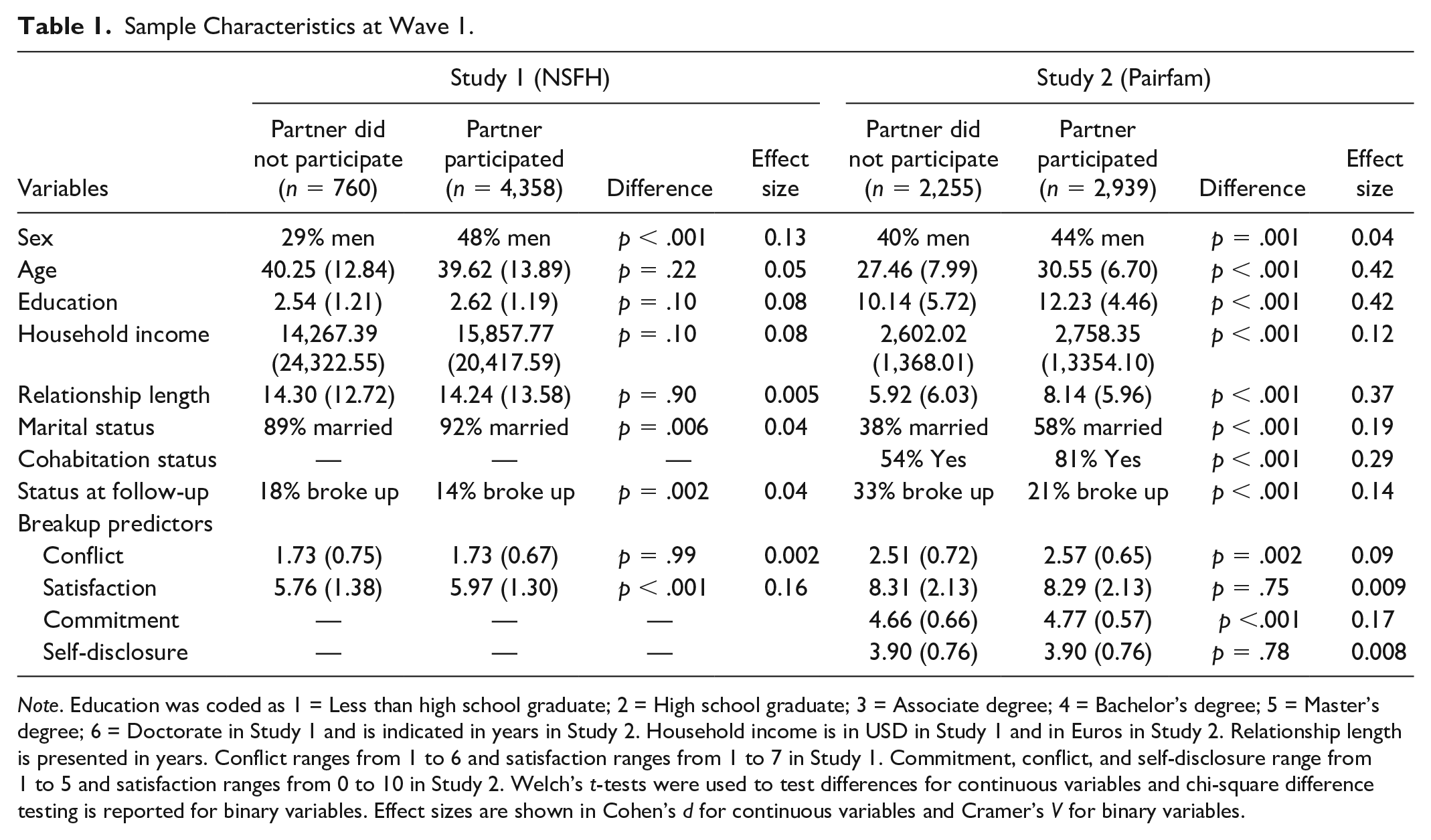
Note. Education was coded as 1 = Less than high school graduate; 2 = High school graduate; 3 = Associate degree; 4 = Bachelor’s degree; 5 = Master’s degree; 6 = Doctorate in Study 1 and is indicated in years in Study 2. Household income is in USD in Study 1 and in Euros in Study 2. Relationship length is presented in years. Conflict ranges from 1 to 6 and satisfaction ranges from 1 to 7 in Study 1. Commitment, conflict, and self-disclosure range from 1 to 5 and satisfaction ranges from 0 to 10 in Study 2. Welch’s t-tests were used to test differences for continuous variables and chi-square difference testing is reported for binary variables. Effect sizes are shown in Cohen’s d for continuous variables and Cramer’s V for binary variables.
Conflict
At Wave 1, participants indicated how often they had had open disagreements about six domains—household tasks, money, spending time together, sex, having a(nother) child, and in-laws—in the previous year (α = .75). Responses were made on a scale ranging from 1 (never) to 6 (almost every day).
Satisfaction
Participants were asked to describe how happy their relationship/marriage was on a scale ranging from 1 (very unhappy) to 7 (very happy).
Analysis plan
All analyses were conducted using R (R Core Team, 2018). We ran a logistic regression model to examine if the sample with and without the partner data at Wave 1 differed in breakup status at the follow-up. We first ran a model predicting breakup from co-participation status, then additionally included previously known predictors of breakup (conflict and satisfaction) to test for the unique breakup risk associated with co-participation status. All continuous predictors were standardized. Next, we examined whether the links between conflict/satisfaction and actual breakup differed between the sample with and without the partner data at Wave 1. We ran a separate model for conflict and satisfaction such that we had two different models with either of the two predictors, co-participation status, and their interaction included as predictors.
Results
Table 1 presents differences in sociodemographic and relationship characteristics between the sample with and without the partner data. Welch’s t-tests and chi-square tests were used for significance testing.
Co-Participation Status and Breakup Risk
We first examined whether co-participation status at Wave 1 was associated with breakup status at Wave 2. We found that not having a co-participating partner was significantly associated with the likelihood of breakup, OR = 0.73, 95% confidence interval (CI) = [0.59, 0.89], p = .002. Specifically, the probability of breakup was 14% for those with a co-participating partner and 18% for those without a co-participating partner. In a model additionally including conflict and satisfaction, both emerged as significant predictors of breakup (OR = 1.34, 95% CI = [1.25, 1.44], p < .001 for conflict and OR = 0.72, 95% CI = [0.67, 0.77], p < .001 for satisfaction), suggesting that participants who had more frequent conflicts or were less satisfied in the relationship at baseline were more likely to break up. However, co-participation remained a significant predictor of breakup (OR = 0.77, 95% CI = [0.62, 0.95], p = .01) over and above the effects of conflict and satisfaction.
Co-Participation Status and Breakup Risk Associated With Known Predictors of Breakup
Next, we examined whether the links between conflict/satisfaction and breakup were different for those with and without the partner participating at Wave 1. However, neither an interaction between conflict and co-participation status (interaction estimate = 0.01, 95% CI = [−0.16, 0.18], p = .91) nor that between satisfaction and co-participation status (interaction estimate = 0.14, 95% CI = [−0.04, 0.32], p = .13) was significant, suggesting that there was no difference in the predictive power of conflict or satisfaction between the two samples. None of the reported results changed when we included covariates (sex, age, education, household income, marital status, and relationship length). 1
Study 2
Method
Study sample
In Study 2, we sought to replicate and extend the effects found in Study 1 using 10-year longitudinal data that included a wider range of relationship types at baseline. In 2008 (Wave 1), a total of 12,402 individuals, representing a nationwide random sample from three different birth cohorts (1971−1973, 1981−1983, and 1991−1993), participated in the German Family Panel (pairfam) study. This ongoing, longitudinal study focuses on the themes of couple relationships and family dynamics and collects data through computer-assisted personal interviewing from the focal participants (referred to as “anchors”) annually. All focal participants who reported having a partner were asked for their consent to survey partners who were then contacted and sent a paper-and-pencil drop-off questionnaire. Partners could either mail the questionnaire back (free of charge) or have the interviewer pick it up. For compensation, focal participants received 10 Euro in cash after the personal interview, and partners who completed a survey were given a 5 Euro lottery ticket. Each year, participants indicated whether they want to be contacted again the following year (see Huinink et al., 2011 for more information).
At Wave 1, 7,234 anchors were involved in a romantic relationship, and 5,405 of the anchors (2,279 men and 3,126 women) with at least one follow-up report were included in the present analyses. Anchors were 29.07 (SD = 7.49) years old on average. The majority of the anchors (n = 4,090; 76%) were German natives with no migration background, 466 (9%) were of other non-German background, 285 (5%) were half-German, 260 (5%) were Ethnic-German immigrants (Aussiedler), and 183 (3%) had Turkish background. To examine how large an effect we could detect with adequate power, we first simulated data assuming a decreasing hazard over time (τ = 0.5) and a co-participation effect of different sizes on clog-log scale, then discretized the time in nine intervals (see Moerbeek & Schormans, 2015). Having 2,255 participants in each group would provide us 80% power to detect an effect of −0.19 (indicating that having a co-participating partner was associated with 17% smaller breakup risk).
Key variables
Co-participation
As in Study 1, a co-participation variable was created by examining the available partner data at Wave 1. Of the 5,194 participants who were in a romantic relationship (and had at least one follow-up report), 57% (n = 2,939) had a partner who was recruited and completed the survey at Wave 1.
Relationship dissolution
At each wave, participants indicated any changes in their relationship status in an event history calendar format. We tracked all their responses regarding their relationship with the partner at Wave 1 over the following 9 years. Participants responded to this question an average of five times (out of nine possible responses). By the 10th wave, 27% of the participants (n = 1,382) had broken up with their partner.
Predictors of breakups
As in Study 1, we used all variables included in the pairfam survey that were found as significant predictors of breakup in Le et al. (2010). 2
Commitment
Two items were used to assess commitment, and in particular, future orientation in the relationship (α = .66): “I would like for our partnership to last for a long time” and “I’m counting on a long-term future together with my partner.” Participants responded to the items on a 5-point Likert-type scale ranging from 1 (not at all) to 5 (absolutely).
Conflict
Frequency of conflict was assessed using the shortened Network of Relationships Inventory (NRI; Furman & Buhrmester, 1985). Participants responded to the following two questions: “How often do you and your partner disagree and quarrel?” and “How often are you and your partner annoyed or angry with each other?” Internal reliability was α = .76. Participants responded to the items on a 5-point Likert-type scale ranging from 1 (never) to 5 (always).
Satisfaction
Global satisfaction with the relationship was assessed using one item, “All in all, how satisfied are you with your relationship?” Participants responded to the item on a scale ranging from 0 (very dissatisfied) to 10 (very satisfied).
Self-disclosure
Self-disclosure was captured using two items in the NRI (α = .63): “How often do you tell your partner what you are thinking?” and “How often do you share your secrets and private feelings with your partner?” A 5-point Likert-type scale ranging from 1 (never) to 5 (always) was used.
Analysis plan
Given the time intervals in the pairfam follow-up surveys (i.e., annual reports), we used discrete-time survival analysis models (Willett & Singer, 2004) to examine the link between co-participation status and relationship dissolution. As the underlying latent time variable is nevertheless continuous, we used a complementary log–log transformation, a conceptual parallel to the continuous-time model (Jenkins, 1995; Singer & Willett, 2003). The coefficient of co-participation status in this model refers to the weighted average effect of co-participation status on breakup over time, and a hazard ratio (HR) can be obtained by exponentiating the coefficient. We also examined whether the effect of co-participation status differs over time by running two different models including an interaction between time and co-participation variable (Singer & Willett, 2003): a general interaction model that allows the co-participation effect to differ in every nine intervals and a parsimonious model which allows the co-participation effect to vary linearly over time. As the model fit did not significantly differ from each other, we report results from the general interaction model for brevity.
Finally, we examined whether the link between previously known breakup predictors and actual breakup differs between the sample with and without the partner data at Wave 1. We ran a separate model for each predictor such that we had four different models with one relationship predictor, co-participation status, and their interaction added to the baseline model.
Results
Table 1 shows differences in sociodemographic and relationship characteristics at Wave 1 between the sample with and without the partner data.
Co-Participation Status and Breakup Risk
We first examined whether co-participation status at Wave 1 was associated with breakup risk over the following 9 years. The results showed that not having a co-participating partner was associated with breakup risk (HR = 0.52, 95% CI = [0.47, 0.58], p < .001), such that the estimated odds of breakup were approximately twice (1.91 times) as high for those who participated without a partner in comparison to those who participated as a couple. However, a model allowing an effect of co-participation status to differ in each interval (i.e., a general interaction model) suggested a significant improvement in fit compared to a model assuming proportionality in hazard (i.e., a model in which the co-participation effect remains constant), χ2 (8) = 33.62, p < .001. Indeed, as shown in Table 2, the effect of co-participation status varied over the 9-year period. As a conservative test of the predictive power of co-participation status, we also tested a model that included time-dependent effects of all other known predictors of breakup (commitment, conflict, self-disclosure, and satisfaction). Results showed that co-participation status remained a significant predictor of breakup over and above all of the other predictors in at least the first 5 years after the baseline survey (HR = 0.39, 95% CI = [0.32, 0.47], p < .001 in Wave 2, HR = 0.54, 95% CI = [0.42, 0.68], p < .001 in Wave 3, HR = 0.71, 95% CI = [0.53, 0.95], p = .02 in Wave 4, HR = 0.63, 95% CI = [0.44, 0.90], p = .01 in Wave 5, and p > .06 in Waves 6–10).
Breakup Likelihood Associated With Co-Participation Status Each Follow-Up Year.
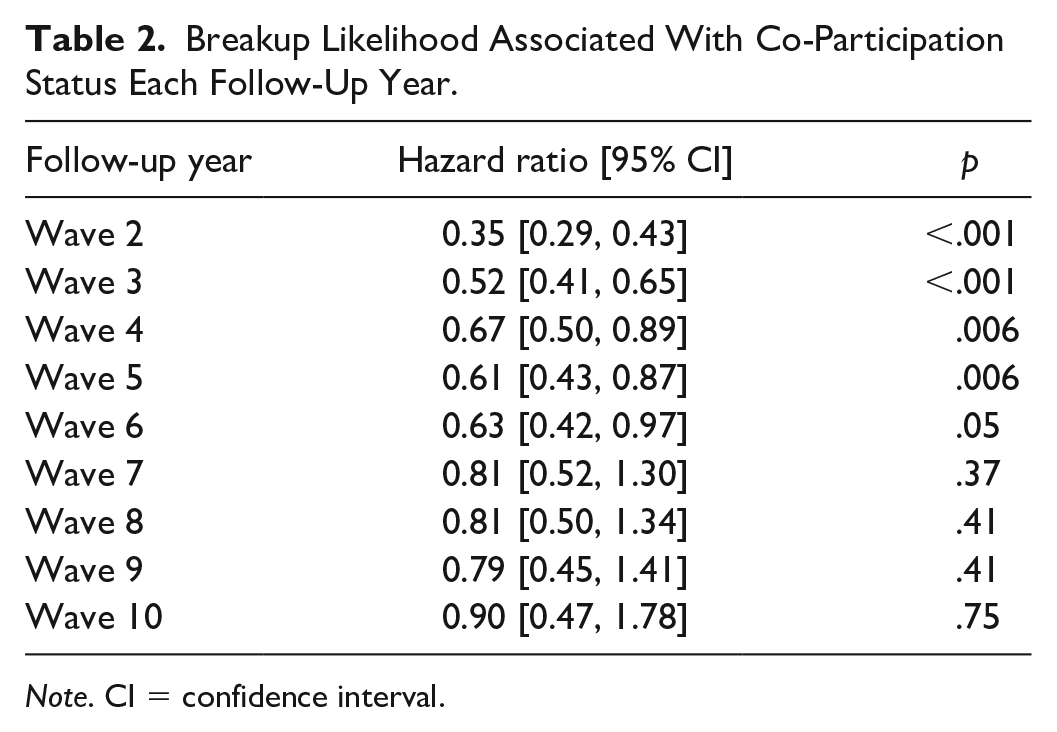
Note. CI = confidence interval.
Co-Participation Status and Breakup Risk Associated With Known Predictors of Breakup
Next, we examined whether the extent to which previ-ously known predictors of breakup can predict breakup was different between those with and without the partner participating at Wave 1. We ran four separate models with an interaction term between co-participation and each predictor included. Our results for commitment and self-disclosure showed that the predictive power of these constructs in predicting breakups was not significantly different in the sample with and without a co-participating partner (interaction estimate = −0.05, 95% CI = [−0.17, 0.06], p = .38 for commitment; interaction estimate = −0.02, 95% CI = [−0.16, 0.12], p =.80 for self-disclosure). However, there were significant differences in the predictive power of conflict and satisfaction depending on co-participation status (interaction estimate = 0.36, 95% CI = [0.21, 0.52], p < .001 for conflict; interaction estimate = −0.05, 95% CI = [−0.09, −0.009], p = .02 for satisfaction). Specifically, conflict predicted breakup in the sample with the partner data (HR = 1.43, 95% CI = [1.27, 1.60], p < .001), such that the estimated odds of breakup were about 43% higher for individuals who reported one unit higher on conflict. However, conflict did not predict breakup among those whose partner was not recruited at baseline (HR = 0.99, 95% CI = [0.89, 1.09], p = .80). Similarly, satisfaction predicted breakup in the sample with the partner data (HR = 0.92, 95% CI = [0.89, 0.94], p < .001), such that the estimated odds of breakup were about 8% lower for individuals who reported one unit higher on satisfaction. However, satisfaction was less strongly predictive of breakup among those whose partner was not recruited at Wave 1 (HR = 0.97, 95% CI = [0.94, 0.996], p = .02).
Discussion
Across two studies, couples in which both versus one member agreed to participate differed such that those who participated with a partner were significantly less likely to experience a breakup over time. Furthermore, although there was no evidence that breakup processes (related to conflict and satisfaction) were different depending on co-participation status in Study 1, Study 2 showed that conflict and satisfaction at baseline were weaker predictors of breakup among those without (vs. with) a co-participating partner. These findings suggest that couples jointly participating in research may embody systematic differences from those not jointly participating not only in baseline characteristics, as has also been found in previous research (Barton et al., 2020) but also in their level of breakup risk and possibly the dynamics underlying the predictors of breakup. This is important because the differences we found may not be something for which researchers can account simply by statistically controlling for relevant variables.
Our results have several implications for the increasing number of studies relying on dyadic data. First, although researchers using dyadic data have been aware that observed effects among participating couples may not generalize to the broader population (e.g., Farrell et al., 2016), their concerns have remained somewhat speculative, given the lack of empirical support for this possibility. In this research, we demonstrated that relationship dynamics may indeed be different among couples not participating in a study as a dyad, highlighting the need to interpret findings in relationship research with reference to the population (not) examined. Furthermore, our work suggests that sample bias must be considered not just in terms of self-selection (e.g., dissatisfied couples are less likely to participate) but also in terms of inadvertent researcher-selection effects (e.g., dissatisfied couples are less likely to participate in a dyadic study). This change in perspective helps highlight the impact methodological decisions can have on results and their interpretations.
Relatedly, the present results suggest that relationship researchers need to consider diverse recruitment strategies in conducting dyadic studies. In clinical research, particularly in the domain of marriage and relationship education, recruitment strategies have been of great interest as they are critical to reaching out to specific populations (e.g., low-income couples; Carlson et al., 2014). One clear lesson from clinical research is that it requires knowledge about specific barriers to participation (e.g., unavailability on the weekdays, a lack of child care) to reduce those barriers (e.g., holding sessions on weekends, providing child care; Hawkins & Ooms, 2012). To implement successful strategies to recruit more generalizable samples in couple research, it will be essential to gain insight into why some partners are less likely to participate together than others.
Although it was beyond the data available for this research to determine what specific factors can explain partners (not) participating in a study together and their related degree of breakup risk, 3 there are several possible avenues worth exploring in future research. First, there may be individual differences associated with one or both partners’ decision not to participate in the study that can affect a breakup. As found by Barton and colleagues (2020), people high in attachment avoidance who feel discomfort with intimacy (Mikulincer & Shaver, 2016) may be more reluctant to suggest or agree to participating in a dyadic study; and both being and having an avoidantly attached partner are risk factors for breakup. Relatedly, there may be differences at the relationship level associated with the couples’ co-participation status. For example, couples in asymmetrically committed relationships (ACRs; relationships where one partner is more committed to a relationship than the other; Stanley et al., 2017) may be less likely to jointly participate in a study because the less-committed partner perceives the co-participation as a burden; and research has shown that ACRs are also more likely to end than relationships characterized by mutual commitment (Stanley et al., 2017). Third, there may be practical constraints associated with couples’ co-participation status such as being a dual-career couple. It may be harder for these couples to coordinate the time for joint participation, and these couples may also face unique challenges (e.g., one partner’s decision to relocate) in maintaining their relationship (Harvey, 1998). This perspective is also useful in explaining our finding that conflict and satisfaction were less robust predictors of breakup among those who did not participate as a couple; perhaps, their relationships are more likely to encounter external influences on breakups such that relationship-related factors end up playing a less important role.
In future research, it will be important to investigate precisely what underlies couples’ decisions to (not) participate in dyadic research to inform development of effective recruitment strategies. If participants are concerned about the commitment participation in a couples study may signal, researchers can consider framing the study as focusing on issues other than relationships. Of course, such a change in framing may create its own problems. What increases the attractiveness of the study for some participants may simultaneously undermine the motivation to participate for others (e.g., a study framed as being about “life” may not be as appealing as one about “relationships” for individuals passionate about their relationships). Thus, although some degree of bias might be inevitable, it is important to think about how specific recruitment strategies can affect sample composition and to replicate findings across samples recruited through different techniques. Operating in this way may not only increase the generalizability of findings but also reveal moderators of effects researchers may not have considered otherwise.
Of course, what should precede any decisions about recruitment strategies is evaluating how justifiable certain types of study designs are for the particular research goal. For example, despite the additional information they offer, dyadic data are costlier and more time-consuming to collect, and may consist of more committed couples as suggested by both their self-report and the actual likelihood of breakup over time in our data. As such, there may indeed be cases in which collecting data from both members of couples is not ideal (e.g., when researchers are interested in tracking participants’ breakup over time; e.g., Joel et al., 2018). Accordingly, we suggest that researchers clearly delineate who the targeted sample is prior to collecting any type of data, as this can help them find the best study design or recruitment strategy. For example, if commitment is expected to be a key moderator of the effects in which one is interested (as is often the case in relationship research; e.g., Li & Fung, 2013), a design that includes both couples and individual data may be important to ensure that there is a broad range of that moderator. Making such clear justification in a preregistration or manuscript about why dyadic data were necessary and how the choice of recruitment strategies was tailored for recruiting the targeted sample will be useful for future researchers and essential for advancing our research practice.
One major strength of our research was that the primary effect (co-participation status predicting breakup) was replicated in two data sets composed of individuals differing in many aspects of their demographics and relationship status. We also examined for the first time the effect of partner nonparticipation on the link between baseline characteristics and eventual dissolution although the results here were less consistent across the two data sets. On one hand, we did not find consistent evidence that the link between previously known predictors of breakup and actual breakup was different among couples in which one versus both members participated. These effects are reassuring to the extent that they suggest researcher-selection effects may not have (had) robust, strong effects on research findings. On the other hand, there was indeed some evidence for differing effects of conflict and satisfaction on breakup between participants participating as an individual and as a couple, casting some questions on their generalizability as predictors of breakup. Although our results cannot provide any sort of final word on generalizability with relation to links between baseline characteristics and dissolution, our work highlights the importance of future research collecting data relating to sample composition and such longitudinal effects.
Finally, our work has limitations of its own. In particular, as suggested by our findings, the specific composition of a study’s sample has the potential to influence the conclusions drawn. The present findings were based on studies in which there is one participant with an ongoing commitment to participation as part of longitudinal data collection. The types of individuals or relationships that are captured in our data sets may thus differ from those in briefer, cross-sectional dyadic studies in which both partners are recruited simultaneously. For example, individuals higher in conscientiousness may be more inclined to sign up for and continue participating in longitudinal research. More typical dyadic studies would not face this barrier (or others not considered here) and thus may have a somewhat different sample composition. Furthermore, we do not know how our results may generalize to couples where neither person participates, a question that may require examining data collection efforts in which participation is essentially mandatory (e.g., census data). Such considerations suggest that research focused on basic characteristics of samples recruited for various types of studies (e.g., one-off lab studies, short surveys, daily diary studies, and longitudinal studies) including information such as demographics, Big Five personality variables, and relationship characteristics would be useful to researchers attempting to design studies and interpret data. Finally, our samples in both studies were from Western industrialized countries (United States and Germany). Just as countries differ in study participation rates (e.g., health surveys; Tolonen et al., 2015), they may also differ in characteristics associated with a couple’s joint participation and our results should not be over-generalized to other populations. Overall, we emphasize that our findings need to be interpreted with the specific study contexts in mind.
Conclusion
The present findings demonstrate that relationships in which partners do or do not participate in a study together can be different in meaningful ways, suggesting that researchers should be mindful of potential bias in recruitment. Future studies should examine what obstacles there are to a couple’s full participation in relationship research so that strategies can be developed to recruit more generalizable samples.
Supplemental Material
Park_Online_Appendix – Supplemental material for Generalizability of Results From Dyadic Data: Participation of One Versus Two Members of a Romantic Couple Is Associated With Breakup Likelihood
Supplemental material, Park_Online_Appendix for Generalizability of Results From Dyadic Data: Participation of One Versus Two Members of a Romantic Couple Is Associated With Breakup Likelihood by Yoobin Park, Emily A. Impett and Geoff MacDonald in Personality and Social Psychology Bulletin
Footnotes
Declaration of Conflicting Interests
The author(s) declared no potential conflicts of interest with respect to the research, authorship, and/or publication of this article.
Funding
The author(s) received no financial support for the research, authorship, and/or publication of this article.

Supplemental Material
Supplemental material is available online with this article.
Notes
References
Supplementary Material
Please find the following supplemental material available below.
For Open Access articles published under a Creative Commons License, all supplemental material carries the same license as the article it is associated with.
For non-Open Access articles published, all supplemental material carries a non-exclusive license, and permission requests for re-use of supplemental material or any part of supplemental material shall be sent directly to the copyright owner as specified in the copyright notice associated with the article.
