



Abstract
Nostalgia is an emotion that confers psychological benefits. The literature has neglected romantic nostalgia—that is, nostalgia specifically for past experiences shared with one’s partner—and its potential advantages for relationships. We examined romantic nostalgia in one correlational study, two experiments, and one daily diary study (N = 638). Romantic nostalgia was positively associated with greater relationship commitment, satisfaction, and closeness (Study 1). Additionally, inducing romantic nostalgia via a writing task (Study 2) or music (Study 3) strengthened relational benefits. Finally, participants reported more positive relationship-specific experiences on days when they felt greater romantic nostalgia (Study 4). We discuss contributions to the nostalgia and relationships literatures.
Romantic relationships are vital to psychological well-being and physical health (Simpson & Campbell, 2013), and it is therefore crucial to understand how romantic partners can restore, maintain, and enhance relationship functioning. One potential arrow in their quiver is romantic nostalgia, defined as nostalgia specifically for past experiences shared with one’s current romantic partner. Nostalgia, more generally, entails several psychological benefits, including social connectedness and meaning in life (Sedikides et al., 2015). We built on this theoretical and empirical foundation to investigate whether romantic nostalgia brings about relationship-specific benefits.
Romantic relationships
Humans have a fundamental need to belong that is met, at least in part, through initiating and maintaining interpersonal bonds, including romantic relationships (Baumeister & Leary, 1995). Romantic relationships frequently become an integral part of one’s self-concept (Aron et al., 1992; 1995; Mattingly et al., 2020) and confer psychological advantages, including emotional support (Cramer, 2004), affection (Gulledge et al., 2003), and companionship (Sedikides et al., 1994). Romantic relationships greatly impact romantic partners and can enhance the quality of their lives (Braithwaite et al., 2010; Bucher et al., 2019).
The literature has identified several indicators of relationship quality. Closeness (often referred to as intimacy) is the degree to which partners feel bonded to one another (Dibble et al., 2012; Sternberg & Grajek, 1984). Satisfaction is the level of positive emotions experienced in the relationship (i.e., how happy the relationship makes the partners; Rusbult, 1980, 1983). Finally, commitment is the intent or desire to maintain one’s romantic relationship and work toward making the relationship last (Rusbult, 1980, 1983). Closeness, satisfaction, and commitment are interrelated indicators of relationship quality (Maxwell, 1985; Rusbult et al., 1998).
The literature has also identified two distinct and positive types of romantic love: compassionate and passionate. Compassionate love is characterized by respect, trust, affection, and care when one’s partner is suffering or in need (Sprecher & Fehr, 2005). Passionate love (also known as the “Eros” love style; Hendrick & Hendrick, 1986) is characterized by a deep desire or yearning to be with one’s romantic partner (Hatfield & Walster, 1978). Compassionate and passionate love are highly correlated and are additional indicators of relationship quality. Both are associated with higher levels of satisfaction and commitment (Acevedo & Aron, 2009; Fehr et al., 2014; Lemieux & Hale, 1999; Neto, 2021; Neto & Wilks, 2017). Additionally, compassionate love is linked to increased closeness (Fehr et al., 2014) or intimacy (Neto, 2021), and passionate love is linked to greater self-disclosure (Kito, 2005), a key component of closeness (Aron et al., 1997; Sedikides et al., 1999).
To maintain, restore, or enhance relationship functioning, partners deploy various resources, including trust, empathy and perspective-taking, and gratitude for the partner. Researchers have extensively documented the beneficial impact of these relationship maintenance strategies on closeness (Murray & Hazelwood, 2011), satisfaction (Algoe et al., 2010; Cramer & Jowett, 2010; Davis & Oathout, 1987; Franzoi et al., 1985; Schröder-Abé & Schütz, 2011), and commitment (Gordon et al., 2012). We posit that nostalgia for past experiences shared with one’s current romantic partner also improves relationship quality. We begin with a brief exposition to the nostalgia literature.
Nostalgia
Nostalgia is a “sentimental longing or wistful affection for the past” (The New Oxford Dictionary of English, 1998, p. 1266). Prototype analyses have illustrated that the central features of nostalgia include reminiscence, longing, fond and rose-colored memories, happiness and enjoyment, as well as desire to re-live to the past. Narrative analyses have revealed that, when nostalgic, people commonly recall meaningful life events (family re-unions, graduations, and weddings), time periods (e.g., childhood and college), and places (e.g., grandma’s house and vacation resort); moreover, in nostalgic narratives, people nearly always place themselves among close others (family, friends; Abeyta et al., 2015; Wildschut, Sedikides, Arndt, & Routledge, 2006). Further, multidimensional scaling analyses have revealed that nostalgia is a positively valenced, approach-oriented, and low arousal emotion (Van Tilburg et al., 2018). Although nostalgia is largely positive, nostalgic reverie is frequently bittersweet: It can contain traces of sadness, as people desire to re-experience the past (Madoglou et al., 2017; Sedikides & Wildschut, 2016).
Nostalgia bears several psychological benefits. For example, it strengthens a sense of meaning in life (Sedikides & Wildschut, 2018), optimism (Cheung et al., 2013), self-continuity (Sedikides et al., 2016), positive self-regard (Vess et al., 2012), and social connectedness (Frankenbach et al., 2021). Additionally, nostalgia is a psychological resource to which people turn when they face psychological adversity (Routledge et al., 2013; Wildschut & Sedikides, 2022). For example, meaninglessness (Routledge et al., 2011), death thoughts (Juhl et al., 2010), and loneliness (Zhou et al., 2008) increase nostalgia.
Romantic Nostalgia
As mentioned, people are nostalgic for many aspects from their past (e.g., events, time periods, and places). One of the most frequent targets of nostalgic reflection is others: friends, family, and romantic partners (Abeyta et al., 2015; Madoglou et al., 2017). In this article, we put a microscope on nostalgia, focusing on past experiences that are shared with one’s current romantic partner—that is, romantic nostalgia. Just as nostalgia in general (henceforth, referred to as general nostalgia), 1 bears psychological benefits (e.g., meaning in life and social connectedness), so does romantic nostalgia have relationship-specific benefits.
The rationale for this proposal is as follows. First, general nostalgia, which largely contains thoughts about others, increases perceptions of connectedness with others (Frankenbach et al., 2021). It stands to reason that romantic nostalgia, which entails directly reflecting on one’s romantic partner, should similarly increase perceptions of closeness with one’s romantic partner. Second, general nostalgia elevates perceived meaning in life (Routledge et al., 2011). In the same vein, romantic nostalgia should elevate the perceived meaningfulness and value that partners place on their romantic relationship. Third, when nostalgic, people primarily ponder positive events often through rose-colored glasses (Wildschut et al., 2006). They may also ponder ambivalent events, but the relevant narratives typically follow a redemption sequence (McAdams, 1996) whereby initial adversity gives way to increased positivity and a happy ending (e.g., life lessons learned; Wildschut et al., 2006). Thus, when experiencing romantic nostalgia, it is likely that partners focus on positive relationship experiences or frame relationship experiences in a redemptive trajectory. This should, in turn, increase relationship closeness, satisfaction, and commitment. Finally, nostalgizing about one’s romantic relationship may heighten the accessibility of one’s investment into their relationship. According to the investment model of relationships (Rusbult, 1980), greater relationship investment strengthens relationship commitment.
The literature provides indirect evidence for our proposal that romantic nostalgia improves perception of relationship quality. For example, people who enjoy telling the story of their romantic relationships and view the course of their relationships as a coherent narrative report higher relationship satisfaction (Dunlop, 2019). Indeed, those who mention emotionally positive experiences when telling the story of their romantic relationship, evince greater relationship satisfaction (Dunlop et al., 2020). Also, those who discuss intimate topics with their partner while telling stories of relationship events report greater relationship satisfaction and closeness, and fewer thoughts of breaking up (Frost, 2013). In somewhat more direct evidence for our proposal, when recalling relationship-defining memories, people experience an enhanced sense of intimacy, commitment, and relationship satisfaction (Alea & Bluck, 2007; Alea & Vick, 2010; Guilbault & Philippe, 2017).
Yet, direct evidence on romantic nostalgia is scarce. Muise et al. (2020) investigated sexual nostalgia. On the surface, sexual nostalgia might be considered a subtype of romantic nostalgia, as sexual experiences frequently occur with romantic partners. However, the authors defined sexual nostalgia as “reflection on positive sexual experiences with past partners” (italics added, p. 1538) and found that it occurs among people with unmet sexual needs in their current relationships. Perhaps most directly relevant to our proposal, Mallory et al. (2018) developed a self-report measure of romantic nostalgia and examined its association with indices of relationship functioning in two studies. Their findings were mixed and difficult to interpret. Cross-sectional Study 1 tested college students who were in an exclusive dating relationship. Romantic nostalgia was positively associated with relationship satisfaction but negatively associated with benign attributions about one’s partner. Longitudinal Study 2 tested college students involved in committed relationships. They completed measures of romantic nostalgia and relationship satisfaction at three time points. In cross-lagged analyses, Time 1 relationship satisfaction predicted decreased romantic nostalgia at Time 2, and Time 1 romantic nostalgia predicted decreased relationship satisfaction at Time 2. Inconsistent with our proposal, these findings suggest a negative reciprocal relationship between romantic nostalgia and relationship satisfaction. Yet, analysis of Time 3 data failed to replicate these results. Interpretation of these findings is further clouded by the assessment of romantic nostalgia. Participants rated the degree to which they missed various aspects of the early parts of their relationship with their current partner (e.g., “Times when this person made you laugh,” “Times you spent talking with this person”; 1 = do not miss at all, 5 = miss very much/very frequently). Endorsement of these items implies a sense of loss or relationship deterioration, and although “missing” is a prototypical feature of nostalgia, it is not a highly central one (Hepper et al., 2012, 2014). Therefore, the focus of these items is on the relatively narrow negative scope of nostalgia, rather than the more prominent positive experience of the emotion (Hepper et al., 2021; Layous et al., 2021). In addition, the correlational nature of both studies limits causal inferences. In summary, there is solid ground to expect that romantic nostalgia improves perceptions of relationship quality. We turn to an examination of this proposal.
Overview
In four studies, we examined correlates and benefits of romantic nostalgia, capitalizing on validated measures and experimental manipulations from the nostalgia literature. Our investigation focused on perceptions of relationship quality—an important facet of actual relationship quality (Maxwell, 1985; Rusbult et al., 1998). In Study 1, we tested associations between self-reported romantic nostalgia and indicators of relationship quality (i.e., closeness, satisfaction, and commitment). In Studies 2 and 3, we assessed the causal effect of romantic nostalgia—induced via writing and music, respectively—on perceived relationship quality. Lastly, in Study 4, we examined romantic nostalgia in daily life. We offer specific hypotheses in each study’s introduction. We provided complete stimulus materials in Supplementary Material and deposited all data at https://osf.io/ybptk/. 2
Study 1
Study 1 served as an empirical foray into the correlates of romantic nostalgia. We measured romantic nostalgia as well as perceived relationship closeness, commitment, and satisfaction—three of the six components of relationship quality (Fletcher et al., 2000). We hypothesized that self-reported romantic nostalgia would be positively associated with relationship closeness, satisfaction, and commitment. 3
Method
Participants
We recruited 251 MTurk workers from the United States, who participated in exchange for $0.50. Participants had to be at least 18 years old and currently in a romantic relationship. To determine sample size, we relied on Schönbrodt and Perugini (2013), who found that correlations between r = 0.1 and r = 0.2 stabilize between 238 and 252 participants. Therefore, we aimed for 250.
We removed from analyses four participants who were not currently in a romantic relationship and two participants for inattentive responding. The final sample comprised 245 participants (127 cisgender men, 116 cisgender women, 2 nonbinary; age: M = 32.38 years, SD = 9.10 years; relationship duration: M = 82.93 months, SD = 92.34 months; 75.5% White, 11.0% Hispanic/Latinx, 10.2% Asian American/Pacific Islander, 6.9% Black/African American, 3.0% Native American, 0.4% Arab American 4 ). A sensitivity analysis (G*Power 3.1; Faul et al., 2013) indicated that our sample size allowed us to detect small-to-medium effects (r = 0.13) with acceptable power of (1 − β) = 0.80 at α = 0.05 (two-tailed).
Materials and procedures
Participants completed the key measures of romantic nostalgia, closeness, satisfaction, and commitment in random order.
Romantic Nostalgia: To measure romantic nostalgia, we adapted items from the 7-item Southampton Nostalgia Scale (Sedikides et al., 2015). Although the original Southampton Nostalgia Scale assesses the importance of nostalgia to participants as well as the frequency with which they experience nostalgia, it was recently shown to be unidimensional (Biskas et al., 2021). Even so, we additionally tested and confirmed the satisfactory model fit of the single-factor structure model for the adapted romantic nostalgia measure (see Supplementary Material for model fit indices and factor loadings). Participants read a definition of nostalgia (“a sentimental longing for the past”) and responded to the seven items, modified such that each referred to romantic nostalgia. The items assessed the importance that participants placed on romantic nostalgia (e.g., “How valuable is romantic nostalgia to you?”) and the frequency with which they experienced romantic nostalgic (e.g., “How often do you experience nostalgia about your romantic partner and/or romantic relationship?”; 1 = not at all, 7 = very much). Thus, departing from Mallory et al. (2018), our measure did not focus exclusively on the early parts of participants’ relationships and did not ask participants to rate how much they “miss” those experiences. We averaged responses to compute romantic nostalgia scores (M = 4.40, SD = 1.47, α = 0.93).
Relationship Closeness: To measure closeness, we used the 11-item Unidimensional Relationship Closeness Scale (Dibble et al., 2012; e.g., “My relationship with my romantic partner is close”; 1 = strongly disagree, 7 = strongly agree). We averaged responses to calculate relationship closeness scores (M = 5.91, SD = 1.02, α = 0.94).
Relationship Satisfaction: We used the Satisfaction subscale of the Investment Model Scale (Rusbult et al., 1998) to measure relationship satisfaction. Participants indicated the extent to which they agreed with five items (e.g., “I feel satisfied with our relationship”; 1 = strongly disagree, 7 = strongly agree). We averaged responses to compute relationship satisfaction scores (M = 5.60, SD = 1.20, α = 0.90).
Relationship Commitment: We assessed relationship commitment with the Commitment facet of the Investment Model Scale (Rusbult et al., 1998). Participants indicated the extent to which they agreed with seven items (e.g., “I want our relationship to last for a very long time; ” 1 = strongly disagree, 7 = strongly agree). We averaged responses to compute relationship commitment scores (M = 5.85, SD = 1.19, α = 0.86).
Results and discussion
Correlations between romantic nostalgia and relational benefits in Study 1.
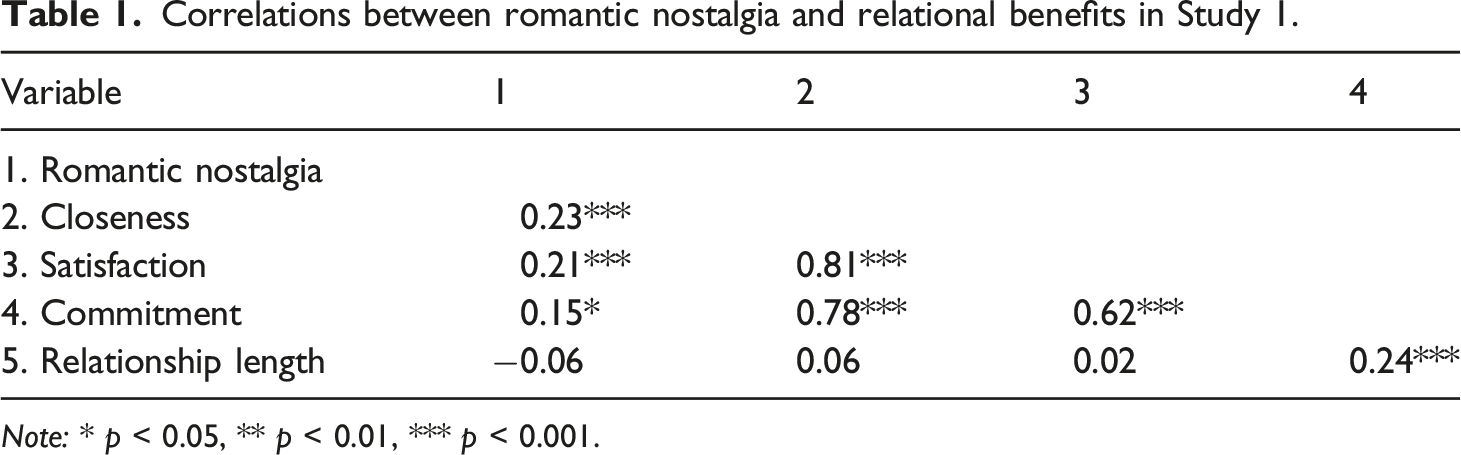
Note: * p < 0.05, ** p < 0.01, *** p < 0.001.
Study 1 provided initial support for an association between romantic nostalgia and benefits: Partners who were more romantically nostalgic reported greater closeness, satisfaction, and commitment. However, given that we measured rather than manipulated romantic nostalgia, we could not make claims about its causal influence on relational benefits. We addressed this limitation in Study 2.
Study 2
To test the causal effects of romantic nostalgia, we experimentally induced it and measured ensuing relational benefits. We hypothesized that romantic nostalgia (vs. control) would bolster perceived relationship closeness, satisfaction, and commitment.
Method
Participants
We determined the sample size for Study 2 by conducting a power analysis (G*Power; Faul et al., 2013). Previous research has indicated that nostalgia manipulations produce medium effect sizes (Evans et al., 2021; Juhl et al., 2021; Sedikides et al., 2015). Our power analysis revealed that the minimum sample size to detect an effect size of f = 0.25 at power = 0.80 and α = 0.05 (two-tailed) was 128. We initially recruited 186 students from a large Southwestern university in the United States (for course credit), anticipating attrition. We removed the data of 18 participants who were not involved in a romantic relationship at the time of the study and 34 participants who did not complete the manipulation task (e.g., wrote nothing) or the dependent measures. The final sample consisted of 134 participants (98 women, 36 men; M = 20.31 years, SD = 3.22 years; 91.8% Hispanic/Latinx, 11.9% White, 2.2% Black/African American, 2.2% Asian American/Pacific Islander, 0.7% Middle Eastern, 0.7% unspecified Multi-ethnic/Multi-racial). 5
Procedures
We administered the experiment on Qualtrics, which participants were able to complete on their own time. Participants first filled out a demographics questionnaire. Next, they were randomly assigned to the romantic nostalgia (n = 57) or control (n = 77) condition. Subsequently, they responded to a manipulation check and the relationship closeness, commitment, and satisfaction scales. 6
Materials
Romantic Nostalgia Induction: The Event Reflection Task, for which participants reflect on and write about either a nostalgic or ordinary autobiographical memory, is the most commonly used technique to induce nostalgia (Leunissen et al., 2021; Sedikides et al., 2015). We adapted this technique to elicit romantic nostalgia. In the romantic nostalgia condition, we first provided the formal definition of nostalgia (The New Oxford Dictionary of English, 1998). We then instructed participants to reflect on a nostalgic experience with their current romantic partner, and to write about it for 3 minutes. We instructed those in the control condition to reflect on an ordinary experience with their current romantic partner, and to write about it for 3 minutes. Subsequently, participants automatically progressed to the manipulation check.
Manipulation Check: Participants responded to two statements (i.e., “Right now, I am feeling quite nostalgic,” “Right now, I’m having nostalgic feelings”) gauging their levels of felt nostalgia (1 = strongly disagree, 5 = strongly agree). We averaged responses to produce manipulation check scores (M = 3.96, SD = 1.09, r = 0.86).
Closeness: Participants then completed the Unidimensional Relationship Closeness Scale described in Study 1 (Dibble et al., 2012; M = 6.26, SD = 0.75, α = 0.92).
Satisfaction and Commitment: Finally, participants filled out the Satisfaction (M = 5.95, SD = 0.99, α = 0.87) and Commitment (M = 5.97, SD = 0.97, α = 0.81) facets of the Investment Model Scale described in Study 1 (Rusbult et al., 1998).
Results and discussion
Preliminary analyses
We expected the dependent variables (i.e., closeness, satisfaction, and commitment) to be intercorrelated. Indeed, this was the case. Closeness correlated significantly with satisfaction, r (129) = 0.70, p < 0.001, and commitment r (128) = 0.77, p < 0.001; satisfaction correlated significantly with commitment, r (131) = 0.63, p < 0.001. To test the effectiveness of the manipulation, we conducted a one-way (romantic nostalgia vs. control) Analysis of Variance (ANOVA) on the manipulation check. As intended, participants in the romantic nostalgia condition (M = 4.32, SD = 0.82) felt more nostalgic than those in the control condition (M = 3.69, SD = 1.18), F (1, 132) = 11.84, p < 0.001, η2 = 0.082, 90% CI [0.023, 0.165]. 7
Effects of romantic nostalgia
Effect of romantic nostalgia on relational benefits in Study 2.

Note: * p < 0.05, ** p < 0.01, *** p < 0.001.
Study 3
In Study 3, we sought to replicate and extend Study 2 findings by using a different technique to manipulate romantic nostalgia. Research has established that music is a potent nostalgia trigger (Barrett et al., 2010; Cheung et al., 2013; Stephan et al., 2015). Thus, in the present study, we induced romantic nostalgia through songs that hold nostalgic significance to participants’ romantic relationships.
As in Study 2, we measured closeness, satisfaction, and commitment after the romantic nostalgia induction. However, we also intended to examine whether romantic nostalgia confers other putative benefits. In particular, we tested whether romantic nostalgia augments connectedness to one’s romantic partner (i.e., romantic connectedness) and boosts optimism regarding the future of one’s relationship (i.e., relationship optimism). We considered romantic connectedness an additional measure of relationship closeness. Relationship optimism is a component of relationship commitment; it reflects a long-term orientation toward one’s relationship and the sense that a relationship will be sustained over time (Arriaga & Agnew, 2001; Rusbult & Buunk, 1993).
Additionally, we assessed the two distinct types of romantic love: compassionate (Sprecher & Fehr, 2005) and passionate (Hatfield & Walster, 1978). Although these types of love are often measured as more stable characteristics, both can be assessed as states that ebb and flow based on external influences (Hatfield & Sprecher, 1986; Sprecher & Fehr, 2005). They map, respectively, onto the love and passion components of relationship quality, meaning that Study 3 covered five of the six components (Fletcher et al., 2000). We hypothesized that participants who listened to a romantically nostalgic song (vs. control: non-nostalgic song) would experience stronger closeness, satisfaction, commitment, romantic connectedness, relationship optimism, compassionate love, and passionate love.
Method
Participants
We determined the minimal sample size (N = 172) based on the same effect size as Study 2 (f = 0.25) at power = 0.90 and α = 0.05 (two-tailed). However, due to COVID-19, we could only recruit 151 students (earning course credit) from a large Southwestern university in the United States before all studies were shut down. All participants were currently in romantic relationships (124 cisgender women, 27 cisgender men; age: M = 21.43 years, SD = 4.30 years; relationship duration: M = 29.83 months, SD = 27.75 months; 93.4% Hispanic/Latinx, 25.8% White, 1.3% Black/African American, 0.6% Native American, 0.6% Middle Eastern). Due to our lower than desired sample size, we conducted a sensitivity analysis (G*Power 3.1; Faul et al., 2013), which indicated that our sample size allowed us to detect small-to-medium effects (f = 0.23) with acceptable power of (1 − β) = 0.80 at α = 0.05 (two-tailed), matching Study 2’s power.
Procedure and materials
Romantic Nostalgia Music Induction: We randomly assigned participants either to a romantic nostalgia (n = 75) or control (n = 76) condition. In the romantic nostalgia condition, we first provided the formal definition of nostalgia. Then, we asked participants to think of a song that reminded them of their romantic relationship and made them feel nostalgic. In the control condition, we asked participants to think of a song they enjoyed and was unrelated to their romantic relationship. In both conditions, we instructed participants to write the name of the song and the artist who performs it on a sheet of paper next to the computer, and notify the experimenter. The experimenter opened Spotify® and cued up each participant’s song. Participants then listened to the entire song on Sennheiser headphones.
Manipulation Check: Participants completed the same two-item manipulation check as in Study 3, indicating their response using a slider (0 = strongly disagree, 100 = strongly agree; M = 61.67, SD = 33.09, r = 0.91).
Closeness: Participants completed the Unidimensional Relationship Closeness Scale as in Studies 1 and 2 (Dibble et al., 2012) using a slider (0 = strongly disagree, 100 = strongly agree). We averaged responses to create an index of relationship closeness (M = 88.04, SD = 12.38, α = 0.89).
Satisfaction and Commitment: Participants filled out the Investment Model Scale as in Studies 1 and 2 (Rusbult et al., 1998), using a slider (0 = strongly disagree, 100 = strongly agree), to assess satisfaction (M = 84.76, SD = 15.27, α = 0.85) and commitment (M = 88.93, SD = 14.82, α = 0.85).
Romantic Connectedness and Relationship Optimism: We adapted prior measures of social connectedness (Wildschut et al., 2006) and optimism (Cheung et al., 2013) to assess romantic connectedness (e.g., “With this song in mind, I feel connected to my romantic partner”) and relationship optimism (e.g., “With this song in mind, I feel optimistic about my future with my romantic partner”). For each measure, participants indicated their agreement with four statements using a slider (0 = strongly disagree, 100 = strongly agree). We averaged responses to compute romantic connectedness (M = 60.98, SD = 38.16, α = 0.97) and relationship optimism (M = 65.36, SD = 35.04, α = 0.96) scores.
Compassionate Love: Participants filled out the Compassionate Love Scale (Sprecher & Fehr, 2005). They indicated their agreement with 21 statements (e.g., “I feel considerable compassionate love for my romantic partner”) using a slider (0 = strongly disagree, 100 = strongly agree). We averaged responses to compute compassionate love scores (M = 87.66, SD = 10.58, α = 0.90).
Passionate Love: Participants completed the shortened version of the Passionate Love Scale (Hatfield & Sprecher, 1986). They indicated their agreement with 15 statements (e.g., “For me, my romantic partner is perfect”) using a slider (0 = not at all true, 100 = definitely true). We averaged across responses to compute passionate love scores (M = 76.30, SD = 15.60, α = 0.88).
Results and discussion
Preliminary analyses
Correlations among relational benefits and relationship duration in Study 3.
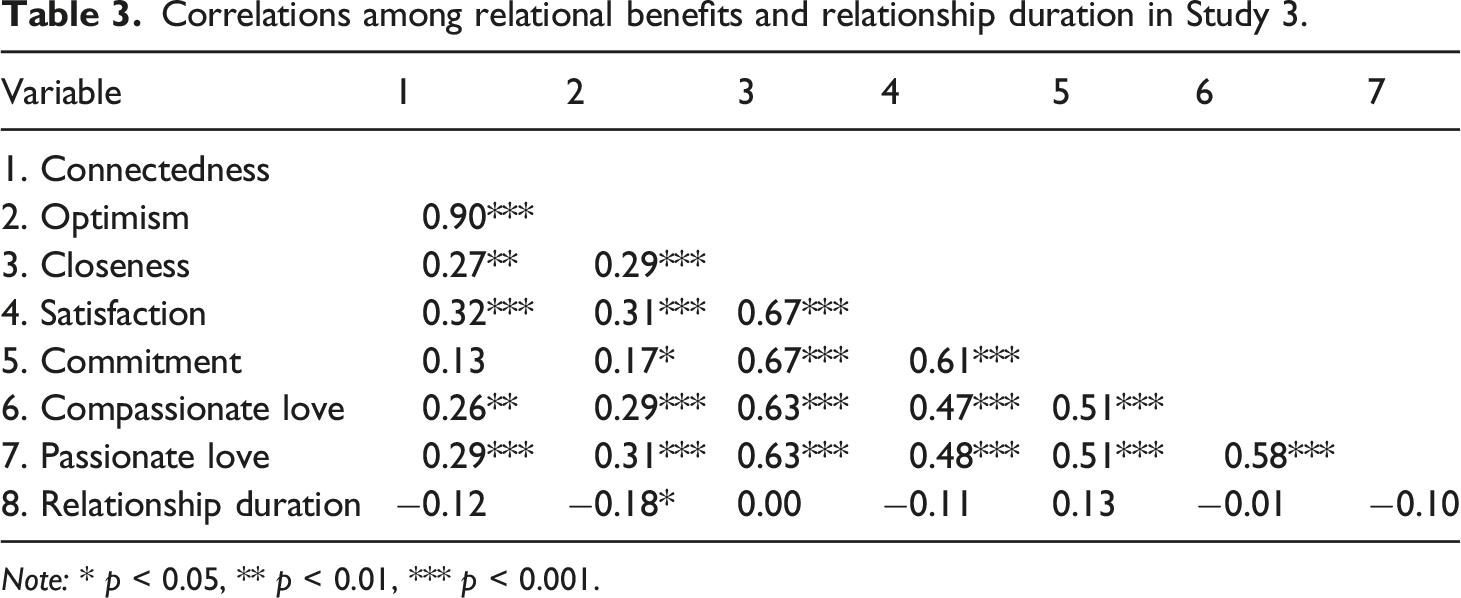
Note: * p < 0.05, ** p < 0.01, *** p < 0.001.
Effects of romantic nostalgia
Effect of romantic nostalgia on relational benefits in Study 3.
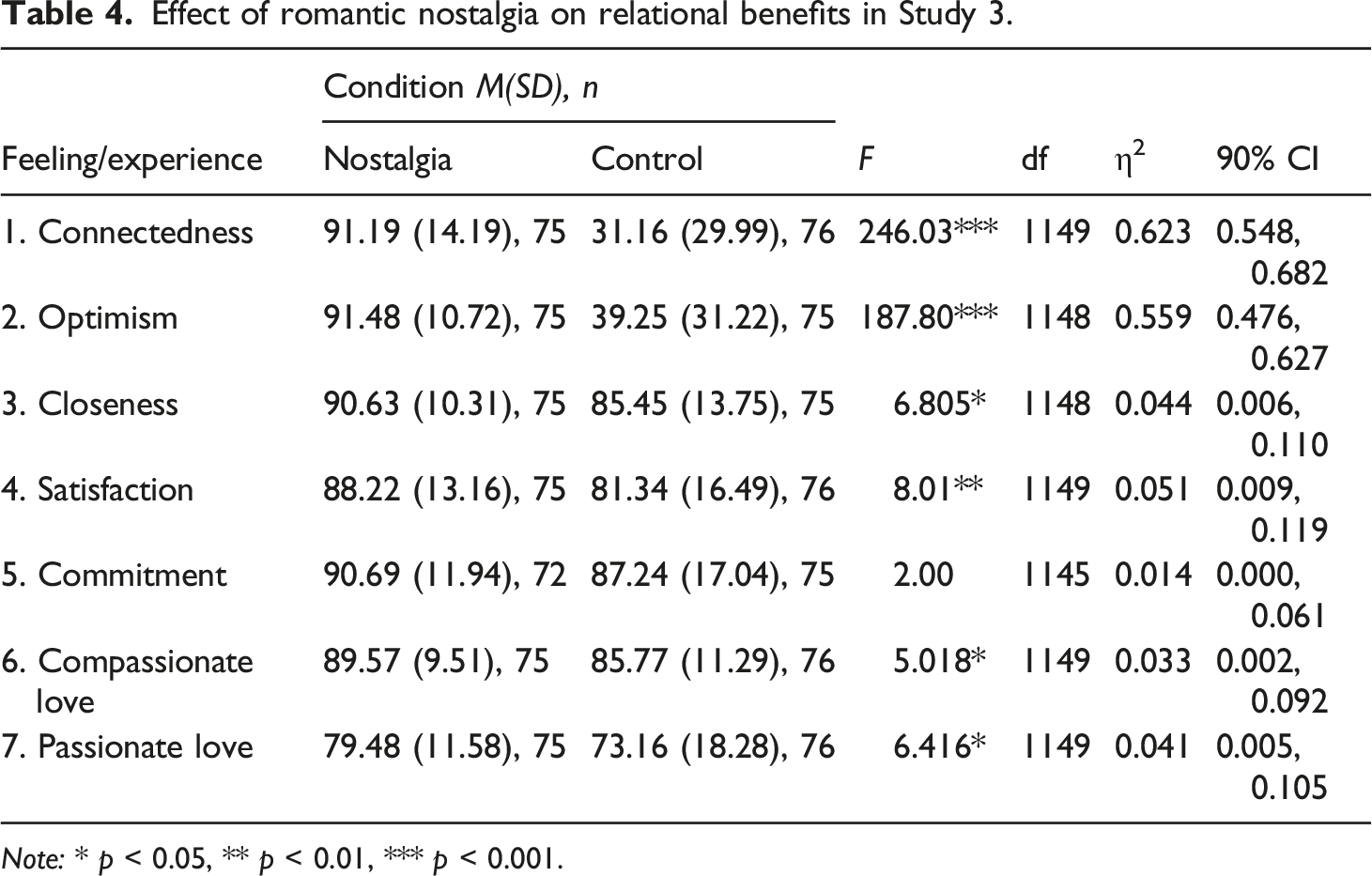
Note: * p < 0.05, ** p < 0.01, *** p < 0.001.
Study 4
In Study 1, we showed that romantic nostalgia is prognostic of better relationship quality, and, in Studies 2–3, we provided evidence for the causal role of romantic nostalgia in producing these relational benefits. In Study 4, we used a daily diary design to examine the link between romantic nostalgia and relationship functioning in daily life. As in Study 3, we assessed romantic connectedness and relationship optimism. Unique to this study, we were also concerned with a behavioral intention indicative of relationship (dis)satisfaction. Specifically, we assessed participants’ desire to leave their romantic partner. We also assessed, as a control variable, the amount of time participants spent time with their romantic partners. We hypothesized that, when controlling for time spent with one’s romantic partner, daily romantic nostalgia would be positively associated with romantic connectedness and relationship optimism, and negatively associated with the desire to leave one’s romantic partner. 9
Method
Participants
We followed the sampling plan of prior investigations that have used similar daily diary designs (Fetterman et al., 2018; Lenton et al., 2016); that is, we aimed to collect data from approximately 100 participants, a typical sample size used in daily diary research (Ohly et al., 2010). Accordingly, we collected data from 108 students from a large Southwestern university in the United States (86 cisgender women, 22 cisgender men; age: M = 20.46 years, SD = 3.65 years; 90.7% Hispanic/Latinx, 26.9% White, 0.9% Black/African American, 1.9% Asian American/Pacific Islander, 0.9% Native American), all of whom were currently in a romantic relationship (duration: M = 29.58 months, SD = 33.87 months). All participants, who earned extra course credit, completed at least one daily survey (out of a possible 14). On average, they completed 9.89 daily surveys, producing 1068 observations.
Materials and procedures
We advertised the study for 1 week. Upon signing up, participants filled out an initial assessment, which comprised several individual difference measures and a demographic questionnaire. 10 Then, they completed the same daily survey for 14 days, starting the Monday after the recruitment week. Participants received an email at 5:00 p.m. on each of these 14 days. This email contained a link to that day’s survey, which was available until 3:00 a.m. the next morning. We randomized the daily items every day for each participant.
We measured each daily construct with a single, face-valid item. For romantic nostalgia, participants responded to the item: “Today, I thought back to a special time with my romantic partner” (1 = strongly disagree, 4 = strongly agree; M = 2.80, SD = 1.09). For romantic connectedness, participants rated the item: “Today, I felt connected to my romantic partner” (1 = not at all, 4 = very much; M = 2.93, SD = 1.09). We assessed relationship optimism with the item: “Today, I felt optimistic about my romantic relationship” (1 = not at all, 4 = very much; M = 3.02, SD = 1.05). Desire to leave their romantic partner was captured by the item: “Today, I considered leaving my romantic partner” (1 = strongly disagree, 4 = strongly agree; M = 1.53, SD = 0.95). Finally, to index time spent with their partner, participants responded to the item: “Today, I spent time with my romantic partner” (1 = not at all, 4 = very much; M = 2.48, SD = 1.22).
Results
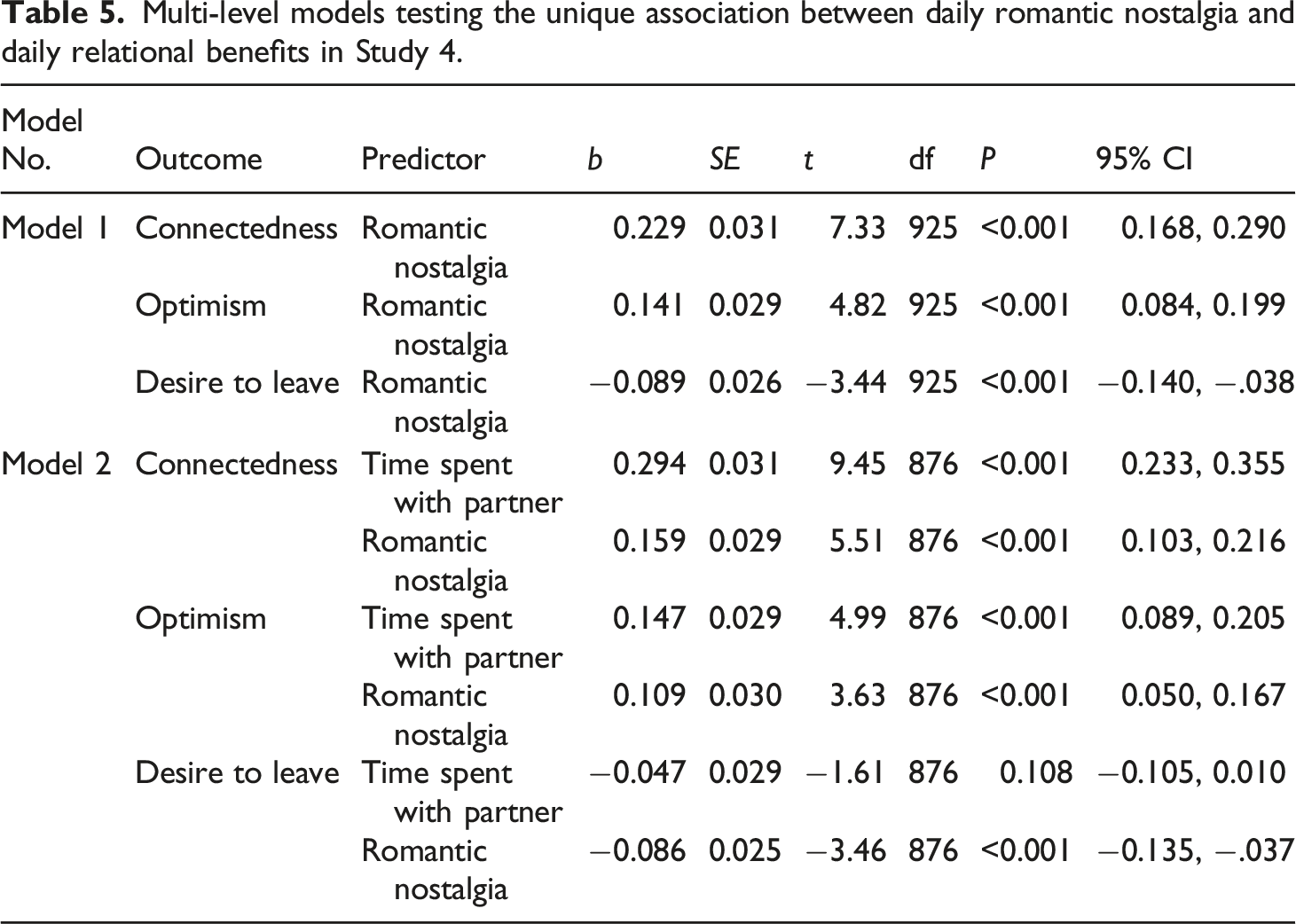
To test our hypotheses concerning the within-person (i.e., daily) associations, we employed a multi-level modeling (MLM) approach (Raudenbush & Bryk, 2002). This approach allowed us to distinguish within-person from between-person sources of variance (Enders & Tofighi, 2007). We used the “lme” function within the “nlme” package (Pinheiro et al., 2020) in R. In addition to our fixed effects, we included corresponding random effects to specify standard errors regarding our Level 1 (within-subject) predictors (Barr et al., 2013). To account for individual differences in daily experiences of romantic nostalgia and amount of time spent with romantic partners, we centered these two variables around each person’s mean scores (Enders & Tofighi, 2007). Moreover, the analyses included a first-order autoregressive error structure to account for similarities between adjacent days. We tested the unique link between daily romantic nostalgia and, respectively, daily romantic connectedness, daily relationship optimism, and daily desire to leave, with and without controlling for time spent with one’s romantic partner each day. Therefore, we tested two models for each daily relationship outcome: Model 1 Model 2
Multi-level models testing the unique association between daily romantic nostalgia and daily relational benefits in Study 4.
General discussion
We examined, in four studies, whether romantic nostalgia conveys relational benefits. In Study 1, we showed that romantic nostalgia is positively associated with perceived closeness, satisfaction, and commitment. In the next two studies, we experimentally induced romantic nostalgia, via written narratives (Study 2) and music (Study 3), to test its causal effect on relational benefits. In Study 2, romantic nostalgia strengthened closeness, satisfaction, and commitment. In Study 3, romantic nostalgia had similar effects on closeness and satisfaction (but not on commitment), while also augmenting perceptions of romantic connectedness, relationship optimism, compassionate love, and passionate love. These effects remained significant after controlling for positive affect, demonstrating that the benefits of romantic nostalgia are more than simple positivity. In Study 4, we conceptually replicated these findings in an ecologically valid context. On days when participants reported feeling more nostalgic for their relationship, they also reported stronger connectedness to their partner, greater optimism about the future of their relationship, and a weaker intention to terminate their relationship. These associations remained significant when controlling for the time participants spent with their romantic partner throughout the day.
Implications
Our research fits within and expands on the nostalgia literature. Prior work has shown that general nostalgia fosters social bonds (Frankenbach et al., 2021; Sedikides & Wildschut, 2019). However, the relevance of romantic nostalgia for specific close relationships has been relatively unexplored. The results highlight romantic nostalgia’s positive role in close relationships. Our findings, therefore, point to new empirical directions regarding relationship-specific benefits of romantic nostalgia. For example, given that romantic nostalgia promoted compassionate love (Study 3), it might increase empathy (cf. Juhl et al., 2020) and motivate helping of one’s romantic partner (Sprecher & Fehr, 2005). Romantic nostalgia may also serve as a resource to buffer relationship threats: it might help partners maintain intimacy and commitment when they are separated for long periods, or help partners respond to romantic conflict in a constructive rather than destructive manner (cf. Abeyta et al., 2015). Finally, partners might turn to romantic nostalgia when feeling dissatisfied. Muise et al. (2020) reported that individuals nostalgize about sexual experiences in past relationships when their sexual needs in the current relationship are unmet. Although such sexual nostalgia does not seem to enhance (and may even hinder) sexual or relationship satisfaction, nostalgia for sex with one’s current romantic partner may revitalize one’s sexual life and enhance relational benefits.
Our findings have applied implications. Most notably, romantic nostalgia could be harnessed in a therapeutic setting to manage relationship woes. For example, when the bond between romantic partners cracks and relationship dissatisfaction sets in, one’s well-being will inevitably suffer. Rather than ruminating on relationship dissatisfaction (Jostmann et al., 2011), our work suggests that nostalgizing about the relationship entails the potential to restore perceptions of relationship quality. Indeed, individuals experiencing relationship dysfunction might derive the greatest benefit from romantic nostalgia. The current studies provide empirical support for the utility of romantic nostalgia as a resource for healthy relationship functioning. Assuming replication and extension of our findings, relationship and marital counselors might be encouraged to incorporate romantic nostalgia as a tool for re-instating relationship functioning. By building on the ensuing literature, nostalgia and relationship researchers may foster a new means of approaching relationship conflict in a therapeutic setting.
Limitations and future directions
The studies in which we experimentally induced romantic nostalgia through writing (Study 2) and music (Study 3) provide causal evidence for the effect of romantic nostalgia on perceptions of relationship quality. However, our findings do not rule out the possibility that the direction of causality could also run in the opposite direction. That is, greater relationship quality could cause people to be more nostalgia about their relationship. In turn, romantic nostalgia, as we have shown, should then further increase perceptions of relationship quality, resulting in a cyclical pattern. Future work should investigate this possibility.
Prior research has shown that thoughts about negative experiences in one’s relationship are associated with unfavorable perceptions of one’s relationship (Fincham & Linfield, 1997; Fincham & Rogge, 2010; Mattson et al., 2013). In light of the present research, however, reflecting on negative relationship experiences nostalgically may not produce such unfavorable consequences. As previously mentioned, nostalgic memories are largely, but not wholly, positive. Some nostalgic narratives contain negative past experiences. However, when they do contain negative experiences, they typically follow a redemptive sequence wherein an individual reflects on overcoming adversity or personal growth (Wildschut et al., 2006). For example, if a person nostalgically recalls a time when they had a fight with their partner, they would likely reframe it as surviving through adversity. Future research should examine this possibility.
Our studies focused on one partner’s perceptions of relationship quality, and more specifically relational closeness, satisfaction, commitment, and love. Although such perceptions are key components of relationship quality, and arguably the most valid indicator for that individual (Fletcher et al., 2000), they form only part of the story of relationship functioning. Future research ought to examine additional processes such as support, conflict, accommodation, and forgiveness, and additional measures such as partner perceptions, coded couple behaviors, and breakup rates in order to ascertain the reach of romantic nostalgia.
We mentioned the therapeutic potential for romantic nostalgia to address and tackle relationship woes. However, to lay the groundwork for this, future research needs to take several steps. First, participants in our studies were generally satisfied with their relationships (i.e., they consistently scored above the midpoint on our outcome measures). It is thus possible that the benefits of romantic nostalgia only ensue when relationship satisfaction is relatively high. Future research should seek to replicate our findings among those with below average relationship satisfaction. Second, we assessed positive indicators of relationship quality. However, in a therapeutic context, romantic partners are likely to engage in reparative behaviors such as sacrifice, accommodation, and forgiveness. Assessing these outcomes in the future would provide a more comprehensive understanding of romantic nostalgia’s utility as a therapeutic resource. Third, our studies examined the short-term benefits of romantic nostalgia. That is, we briefly induced romantic nostalgia and then immediately measured relationship outcomes. If romantic nostalgia is to be implemented in therapeutic settings, researchers need to develop and test romantic nostalgia interventions that produce long-term benefits. Fourth, we only induced romantic nostalgia in one partner. However, therapeutic interventions will often involve both partners. Prior work investigating collaborative remembering between romantic partners provides some preliminary evidence that points toward the potential for co-nostalgizing to serve relationship benefits. For example, romantic dyads co-reminiscing on shared laughter experiences report higher levels of relationship satisfaction relative to control romantic dyads (Bazzini et al., 2007). Therefore, future work could build on these findings to examine how partners’ co-nostalgizing in conversation (cf. Dodd et al., 2021) influences their relationship.
Additionally, a promising direction for future research is to test how attachment orientations shape the effects of romantic nostalgia. Attachment avoidance moderates how general nostalgia serves its social-oriented function. That is, participants low in avoidant attachment are particularly likely to rely on nostalgia to garner social connectedness when feeling lonely (Abakoumkin et al., 2017; Wildschut et al., 2010). More relevant to the current article, Juhl et al. (2012) found that, when experiencing general nostalgia, those low (vs. high) in attachment avoidance reported higher relationship satisfaction. Individuals low in attachment avoidance, then, may be most likely to leverage romantic nostalgia in order to reap its relational benefits.
Finally, for three of our four studies (Studies 2–4), we recruited college students. Future research should seek to use samples that are more representative of the general population. Relatedly, in these three studies, participants had been in their relationships for a relatively short time. Attaining samples more representative of the general population will enable researchers to capture the effects of romantic nostalgia in longer-term relationships. Similarly, we did not assess several participant characteristic variables, such as class, socioeconomic status, or disability information. Although we had no theoretical rationale as to how these variables might affect our findings, future research on romantic nostalgia would nevertheless benefit from measuring these demographics.
Conclusion
In four methodologically diverse studies, we took steps to lift the shroud of uncertainty that has so far obscured the role of romantic nostalgia in relational context. Our findings documented the multifaceted benefits of romantic nostalgia for relationship functioning in both laboratory and naturalistic settings. We hope that this work inspires efforts to understand and harness this powerful resource for restoring, maintaining, and enhancing romantic relationships.
Supplemental Material
sj-pdf-1-spr-10.1177_02654075221075773 – Supplemental Material for Romantic nostalgia as a resource for healthy relationships
Supplemental Material, sj-pdf-1-spr-10.1177_02654075221075773 for Romantic nostalgia as a resource for healthy relationships by Nicholas D. Evans, Jacob Juhl, Erica G. Hepper, Tim Wildschut, Constantine Sedikides and Adam K. Fetterman in Journal of Social and Personal Relationships
Footnotes
Authors’ Note
Data from Study 2 were presented as a poster at the 2019 annual convention of the Society for Personality and Social Psychology, Portland, OR. Data from Studies 1 and 4 were presented as a poster at the 2020 annual convention of the Society for Personality and Social Psychology, New Orleans, LA.
Funding
The author(s) received no financial support for the research, authorship, and/or publication of this article.
Open research statement
As part of IARR’s encouragement of open research practices, the authors have provided the following information: Studies 1 and 3 of this research were pre-registered. The aspects of the research that were pre-registered were the design/method, hypotheses, and analysis plans. The registration was submitted to: The Open Science Framework (Study 1: https://osf.io/d2k5y; Study 3: https://osf.io/n7k8m). The data used in the research are publicly posted. The data can be obtained at: https://osf.io/ybptk/or by emailing:  or by emailing:
Supplemental material
Supplemental material for this article is available online.
Notes
References
Supplementary Material
Please find the following supplemental material available below.
For Open Access articles published under a Creative Commons License, all supplemental material carries the same license as the article it is associated with.
For non-Open Access articles published, all supplemental material carries a non-exclusive license, and permission requests for re-use of supplemental material or any part of supplemental material shall be sent directly to the copyright owner as specified in the copyright notice associated with the article.
