




Abstract
The transition to college is a stressful experience. For members of underrepresented minority groups, the usual stresses are frequently accompanied by ethnicity-based stressors, including discrimination. This longitudinal study extends prior work on discrimination by examining the prospective associations between anticipated and experienced ethnic/racial discrimination and sleep, a ubiquitous and basic biological need critical for optimal functioning. In a sample of 274 low-income/first-generation Latinx students, results from a cross-lagged panel model revealed that both the anticipation and experience of discrimination at the beginning of college uniquely predicted worsening sleep quality over the second half of freshmen year, controlling for relevant covariates. There was also some evidence for bidirectionality, with poor sleepers experiencing more discrimination. These findings add to the literature linking discrimination and sleep, both of which play large roles in mental, physical, social, and academic outcomes.
The transition to college is a stressful experience for most students. For students who are members of underrepresented minority groups, the usual stresses of entry to college are frequently accompanied by unique racial/ethnicity-based stressors, including both concerns about, and actual experiences of, discrimination (Crocker et al., 1998). A significant body of research documents the negative effects of discrimination concerns and experiences on academic success, social integration, psychological well-being, and health outcomes (Crocker et al., 1998; Major et al., 2018; Williams & Mohammed, 2009). The current research extends this literature by using a longitudinal design with racial/ethnic minority students to prospectively examine the extent to which anticipating and experiencing ethnic/racial discrimination across the first year of college uniquely contribute to an important determinant of a number of life outcomes—sleep.
An emerging literature highlights sleep as an important but seldom acknowledged contributor to risk versus resilience in the presence of life stressors. Sleep is a ubiquitous and basic biological need critical for optimal functioning. Sleep problems wreak havoc on our mental and physical health. Poor sleep, as characterized by short sleep duration, poor sleep continuity, or poor subjective sleep quality, is a top risk factor for a number of negative mental and physical health outcomes, including mood disorders, depression, obesity, heart disease, hypertension, metabolic conditions (e.g., Type 2 diabetes), inflammation, increased susceptibility to infectious illness, and premature mortality (Cappuccio et al., 2010a, 2010b; Irwin et al., 2015; Prather et al., 2015; St-Onge et al., 2016). Furthermore, poor sleep has also been shown to undermine work performance (Barnes & Watson, 2019), academic achievement (Curcio et al., 2006), and social functioning (Gordon et al., 2017). Thus, students who are sleeping poorly are especially likely to face psychological, physical, social, and academic difficulties as they transition to college.
Discrimination and Sleep
Causes of poor sleep are complex and multifaceted; however, discrimination appears to be a clear contributor. Experiences of discrimination can lead to both cognitive and physiological arousal (e.g., threat vigilance, rumination, and sympathetic nervous system activation) as well as psychological distress, all of which negatively affect sleep (for a review, see Slopen et al., 2016). Indeed, more frequent experiences of unfair treatment and chronic discrimination are associated with both poorer overall sleep quality and several objective measures of poorer sleep, including greater wake after sleep onset assessed by in-home polysomnography and shorter sleep duration and poorer sleep continuity as measured by actigraphy (e.g., Beatty et al., 2011; Lewis et al., 2013; Slopen & Williams, 2014; Thomas et al., 2006; Tomfohr et al., 2012). A recent cross-sectional study of a multiethnic sample of 300 adults in midlife derived from the Midlife in the United States (MIDUS) cohort found that greater reports of lifetime discrimination were associated with poorer overall global sleep quality and higher levels of several markers of systemic inflammation (Ong & Williams, 2019). Mediation analyses revealed that poorer global sleep quality served as a significant pathway linking lifetime exposure to discrimination and markers of inflammation, underscoring the importance of sleep in understanding some of the known consequences associated with experiences of discrimination.
Bidirectional Links Between Discrimination and Sleep
Although prior work has established an association between discrimination and sleep, most of this work has been cross-sectional in nature. In one of the only prospective studies to examine this association, greater reports of chronic everyday discrimination were associated with more wake after sleep onset and more subjective sleep complaints (Lewis et al., 2013). Given the largely cross-sectional nature of prior work, it is important to carefully consider the directionality of the association between discrimination and sleep. Most of the research theorizes that experiences of discrimination will lead to sleep disruptions. However, several lines of evidence suggest that insufficient sleep may also influence the experience of discrimination. Indeed, the links between sleep and experiences of discrimination are likely bidirectional and recursive. For example, compared with non-disturbed sleepers, experimentally sleep-deprived individuals show greater amygdala reactivity in response to threatening stimuli (Yoo et al., 2007) and have a lower threshold for what they perceive as stressful (Minkel et al., 2011). People who tend to sleep poorly are also more reactive to social rejection, showing increased autonomic arousal and greater negative affect in response to receiving rejecting feedback from others (Gordon et al., 2019). Thus, poor sleepers may have a lower threshold for perceiving negative information in their environment, such as discriminatory behaviors. They may also be more strongly affected by experiences of discrimination.
In addition, sleep loss may influence discrimination by reducing people’s ability to engage in protective behaviors. Individuals who face discrimination, particularly those who chronically anticipate discrimination, often regulate their behavior and appearance to minimize the likelihood of re-experiencing discrimination (Hicken et al., 2013; Shelton et al., 2006). For example, they might alter their behavior to avoid stereotype confirmation or be more careful with how they dress. Many of these types of behaviors, such as constantly monitoring one’s speech or appearance, are effortful. Poor sleep is associated with reduced executive functioning, including decreased self-regulation (for a review, see Krizan & Hisler, 2016), which may make it more difficult for poor sleepers to engage in such protective behaviors. Thus, while people who experience more discrimination are likely to sleep worse, poor sleep may also lead people to be more attuned to, aware of, and vulnerable to discrimination in their environment. By using a longitudinal design with multiple waves of data, the present research sought to model and test the possibility of this bidirectional association between discrimination and sleep, exploring the ways in which each uniquely influences the other across time.
Considering the Role of Anticipated Discrimination
Another important and relatively unexamined issue concerns the effects of anticipating versus experiencing discrimination on health-relevant outcomes such as sleep. Discrimination is increasingly recognized as a major determinant of health across the life course and a contributor to health disparities (Major et al., 2018; Pascoe & Richman, 2009; Williams & Mohammed, 2009). Chronic anticipation of discrimination, or vigilance, has been proposed as a unique source of stress and poorer health among stigmatized populations given their disproportionate exposure to discrimination (Hunger & Major, 2015; Sawyer et al., 2012; Williams & Mohammed, 2009). Indeed, Williams and Mohammed (2009) hypothesized that anticipating discrimination could be as strong of a predictor of adverse health outcomes as actual experiences of discrimination. In line with this theorizing, ethnic/racial minority college students who have a greater tendency to chronically anticipate discrimination experience greater discomfort during the college transition, have less trust in the university, and show relative declines in grades over a 2- to 3-year period (Mendoza-Denton et al., 2002). They are also less satisfied at their universities (Mendoza-Denton & Page-Gould, 2008). Individuals high in chronic anticipation of discrimination also show stronger stress responses, including increased cortisol, when interacting with outgroup members (Mendoza-Denton et al., 2002; Page-Gould et al., 2008; Sawyer et al., 2012; Shelton et al., 2006; Townsend et al., 2011), and increased sensitivity to subtle prejudice cues (Kaiser et al., 2006). Almost no research, however, has simultaneously tested the effects of anticipated versus experienced discrimination on health outcomes. Sleep may be one outcome particularly susceptible to anticipated discrimination: Anticipating discrimination requires mental preparation that can lead to over-activation of the biological system and induce cognitive perseveration (Brosschot et al., 2006). The mental exertion and perseveration that comes with anticipating discrimination may make it particularly hard to sleep.
In the only study to our knowledge linking anticipated discrimination to self-reported sleep, Hicken and colleagues (2013) found in a cross-sectional study that Black, White, and Hispanic participants high in racism-related vigilance (i.e., who reported spending more time preparing for possible insults from other people, feeling that they had to be careful about their appearance, and avoiding certain social situations or places) reported having more trouble getting to sleep and staying asleep. Importantly, participants’ anticipatory behaviors were associated with sleep difficulties even after accounting for experiences of discrimination. A primary goal of the current research was to examine whether anticipated discrimination, assessed at the start of the school year, prospectively predicted poorer global sleep quality over and above experiences of discrimination across the first year of college. We expected that ethnic/racial minority students prone to anxiously anticipating discrimination would exhibit poorer sleep, even after accounting for their experiences of discrimination and potential confounding variables.
In summary, the aims of the present research were first, to test the directionality of the association between discrimination and sleep by using a path model to examine whether (a) self-reported experiences of discrimination (experienced discrimination) prospectively predicted poorer global sleep quality among ethnic/racial minorities over their first year of college and (b) there was any evidence of bidirectional effects (i.e., sleep also prospectively predicting experiences of discrimination). Second, to examine whether anticipated discrimination uniquely predicted worsening sleep above and beyond experiences of discrimination. Third, to control for potentially confounding psychological and individual difference factors that might lead people to both anticipate and experience discrimination and sleep poorly. Specifically, we accounted for symptoms of depression and anxiety, perceived stress, neuroticism, and body mass index (BMI), which have all been highlighted in prior literature as important factors that influence both discrimination and sleep (e.g., Duggan et al., 2014; Huebner et al., 2005; Slopen et al., 2016). Discrimination and sleep are also strongly affected by demographics such as ethnicity/race, socioeconomic status (SES), and age; by focusing on a specific population with similar demographics (Latinx first-generation/low-SES college freshmen), we removed potential demographic confounds.
Overview of Study
We conducted a longitudinal study of low SES (either low income or first in their family to college) Latinx college students’ experiences of ethnic/racial discrimination and sleep quality during their first year at a 4-year university. By focusing on low SES Latinx students, this research targeted a unique and fast-growing group that has been underrepresented in research on discrimination and health. By targeting the transition to college, this research focused on a period of time that has long-term implications for adjustment and health outcomes. Measures were assessed at three time points. Relevant to this research, during the first 3 weeks on campus (T1), we measured anticipated ethnic/racial discrimination as well as body mass index (BMI). At the beginning of the students’ second quarter on campus (T2), we measured experiences of discrimination since arriving on campus; global sleep quality; and the potential confounds of depression and anxiety symptoms, perceived stress, and trait neuroticism. At the end of the school year (T3), we reassessed discrimination experiences and global sleep quality. As depicted in Figure 1, we tested the directionality of the links between sleep and experiences of discrimination by using structural equation modeling to simultaneously examine the associations between sleep and both anticipated and experienced ethnic/racial discrimination across time points, accounting for the stability of these effects over time, as well as potential confounds.

Simple depiction of the cross-lagged panel model of discrimination and global sleep quality with T1 and T2 covariates.
The following hypotheses were tested:
Method
Participants
All participants were undergraduates at a west coast public university. Sample size was a function of feasibility and funding available for participant compensation. Several weeks before the start of the school year, all incoming freshmen students identified by the university as Latinx and either a first-generation college student or from a low-income background (family income under US$50,000) were invited by email to participate in a study of college transition (N = 818). This sample was selected because we assumed these students might be particularly likely to experience the transition to college as stressful. All students who indicated interest (N = 404) were contacted; the first 300 who responded were scheduled to participate during the first 3 weeks of the academic quarter (T1). Two hundred and seventy-four (87 male, 186 female, 1 missing) Latinx students participated. 1 All participants consented to be followed up; 259 students (172 female) participated in the T2 mid-year assessment, and 233 (164 female) participated in the T3 end-of-year assessment. Participant ages ranged from 18 to 20 years; the majority were women (70.8%) and first-generation college students (64.4%); self-reported family income ranged from US$3,000 to US$165,000 (Median = US$35,000, M = US$41,926, SD = US$27,046). Over 75% of the sample were from a low-income background. Approval for this study was obtained from the University’s Institutional Review Board (IRB).
Procedures
T1 assessment occurred during the first 3 weeks of the school year. Participants came to a lab on campus where the study was described, consent obtained, and measures of demographic information and anticipated discrimination (see below) were completed, as well as other measures unrelated to this article. Participants’ height (to the nearest 0.5 cm) and weight (to the nearest 0.25 lb) were measured to calculate BMI. Participants were compensated US$40 at the end of the lab session.
T2 assessment occurred approximately 10 weeks after T1, during the first 2 weeks of winter (second) quarter. Participants were invited by email to participate and completed online measures of discrimination experiences since arriving on campus, global sleep quality, depression and anxiety symptoms, neuroticism, and perceived stress, as well as other measures unrelated to this article in return for a US$10 Amazon.com gift card.
T3 assessment occurred approximately 8 months after T1, during the end of the school year (i.e., sixth and seventh weeks of the spring [third] quarter). Participants came to the laboratory where they completed measures of discrimination experiences during the school year and global sleep quality as well as measures unrelated to this article. They were compensated US$40 at the end of the lab session.
All measures, syntax, and results related to these analyses are included in the Methodological Supplement and have also been made available online: https://osf.io/bmfxu/. Data are available upon request: https://osf.io/ft62w/.
Primary Measures
Discrimination
The nine-item Everyday Discrimination Scale (Williams et al., 1997), a widely used measure of interpersonal discrimination, was used to assess discrimination at both T2 and T3. Participants indicated how often they had experienced discriminatory events in their day-to-day life because of their race or ethnicity, such as “you are treated with less courtesy than other people are” and “you are called names or insulted.” Items were answered on a scale ranging from 1 (never) to 5 (all the time). The T2 scale was worded to assess how often participants had experienced discriminatory events based on their race or ethnicity since arriving at the university in the fall. At T3, participants reported on experiences of discriminatory events based on their race or ethnicity since becoming a student at the university (α = .90 and .92).
Anticipated discrimination
We assessed anxious anticipation of ethnic/racial discrimination at T1 with a shortened version of the Race-Based Rejection Sensitivity (RS-Race) scale (Mendoza-Denton et al., 2002). This 12-item scale assesses anxious expectations of rejection based on race/ethnicity. Respondents were presented with six situations (e.g., “Imagine that you are in class one day and the professor asks a particularly difficult question. A few people, including yourself, raise their hands to answer the question.”). They are then asked how concerned/anxious they are about being treated unfairly based on their race/ethnicity (e.g., “How concerned/anxious would you be that the professor might not choose you because of your race/ethnicity?”) on a scale from 1 (very unconcerned) to 6 (very concerned), and how much they expect this to occur (e.g., “I would expect that the professor might not choose me because of my race/ethnicity”), answered on a 1 (very unlikely) to 6 (very likely) scale. Responses were multiplied and averaged, with higher scores indicating greater anxious expectations of race-based rejection. RS-Race scores ranged from 1 to 36 (α = .88).
Global sleep quality
The Pittsburgh Sleep Quality Index (PSQI; Buysse et al., 1989) was used to assess participants’ overall sleep patterns during the previous month at T2 and T3. The PSQI is a widely used index of subjective global sleep quality which assesses prior month sleep using seven components of sleep: sleep duration, sleep efficiency, sleep quality, sleep disruptions, sleep onset latency, daytime dysfunction, and use of sleep medication. Scores for each component range from 0 (better) to 3 (worse) and are summed to create a global sleep quality composite (possible range 0–21), with higher scores indicating worse overall sleep. At T2, 11 participants (4%) did not have a global score on the PSQI due to missing one of the seven components. The data appeared to be missing completely at random (MCAR; Little’s MCAR test p value = .218). Therefore, we predicted each scale item with missing values from all other subscales. We then used the resulting regression equations to impute the predicted score for each missing value based on that participant’s scores on the other subscales. At T3, there was no missing data due to partial responses.
Covariates
T2 Depression and anxiety
Depression and anxiety symptoms were indexed with the four-item Ultra-Brief Screening Questionnaire for Depression and Anxiety (Kroenke et al., 2009). Participants reported how often they had experienced symptoms in the past month. The four items were the following: “feeling nervous, anxious, or on-edge,” “not being able to stop or control worrying,” “feeling down, depressed, or hopeless,” and “little interest or pleasure in doing things.” Responses ranged from 1 (not at all) to 4 (nearly every day) and were averaged to compute an index of depression and anxiety symptoms (α = .83).
T2 Perceived stress
T2 perceived stress was assessed with the four-item global perceived stress scale by Cohen et al. (1983) at T2 and T3. Participants were asked how often in the last month they had thoughts or feelings such as “felt difficulties were piling up so high that you could not overcome them.” Items were answered on a scale from 1 (never) to 5 (very often). Scores on the four items were averaged (α = .74).
T2 Neuroticism
T2 neuroticism was assessed at T2 with the 12 neuroticism items from the Big Five Inventory (BFI-2; Soto & John, 2017). Respondents indicate how much they see themselves as someone who, for example, can be tense, worries a lot, or often feels sad on 1 (disagree strongly) to 5 (agree strongly) scales. Scores on the 12 items were averaged (α = .87).
Results
Data Analysis Strategy
To test our hypotheses, we analyzed our data using a cross-lagged panel model in the Lavaan package in R (Rosseel, 2012). This model (shown in Figure 1) estimates the path from discrimination at T2 to sleep at T3, the reverse path (from sleep to discrimination), as well as the correlations between sleep and discrimination within each time point (e.g., correlation between sleep and discrimination at T2) and the stability of each variable across time (e.g., path between discrimination measures from T2 to T3). This approach allowed us to test Hypothesis 1: that people who experienced more discrimination would have worse subjective sleep quality across the first year of college. To account for possible confounding variables, depression and anxiety symptoms, perceived stress, and neuroticism were included as covariates at T2 and as predictors of discrimination and sleep from T2 to T3. Given the conceptual overlap between the measures of depression and anxiety symptoms and perceived stress (Epel et al., 2018) and the fact that the scales were highly correlated (see Table 1), we modeled these variables as indicators of a latent “Psychological Distress” variable. BMI was initially included as a covariate, but inspection of initial correlations revealed that BMI was not significantly associated with any of the other variables at any time point (r < .10) and thus was not included in the final model. To test Hypothesis 2, that anticipated discrimination at college entry would predict poorer global sleep quality beyond experiences of discrimination, paths were included between RS-Race, measured at T1, and all T2 and T3 variables. This model also allowed us to test Hypothesis 3 that poorer global sleep quality at the end of the first quarter of college (T2) would predict greater experiences of discrimination across the first year of college (measured at T3). To deal with missing data, we used all available data from our participants and utilized Full Maximum Likelihood Estimation, which has been shown to produce unbiased parameter estimates and standard errors under assumptions of data missing at random. 2
Means, SDs, and Correlations Between Main Variables.
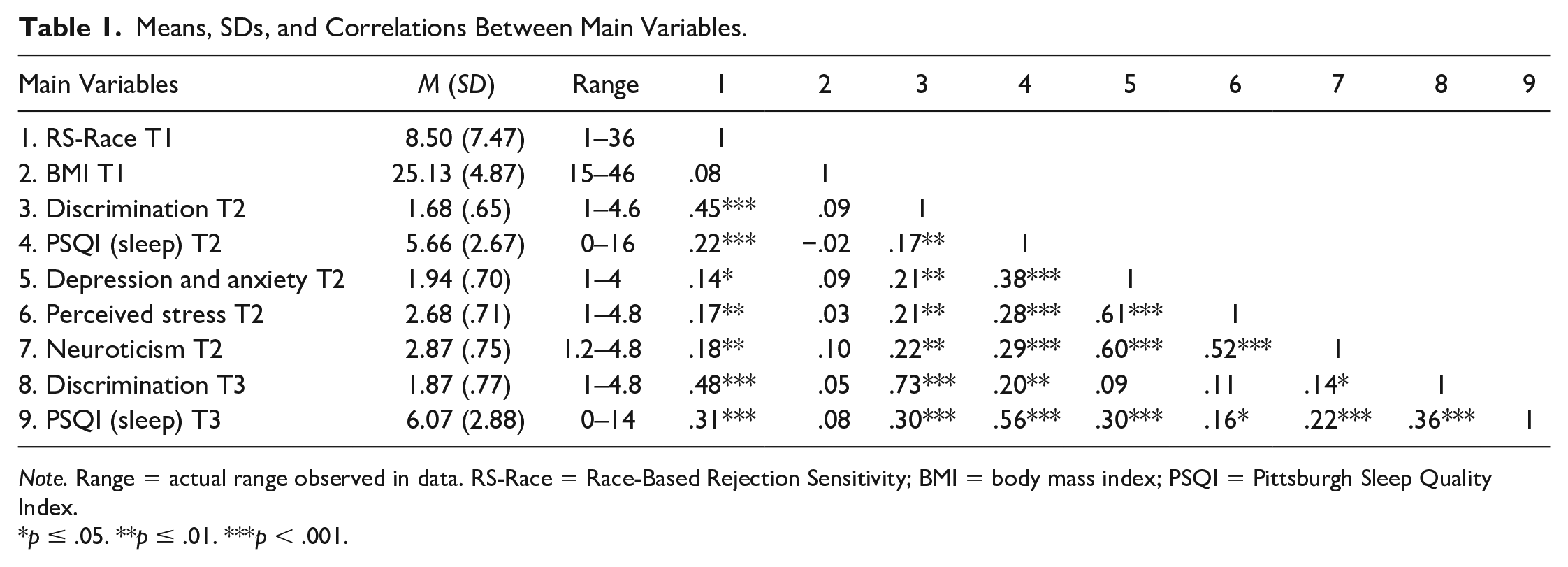
Note. Range = actual range observed in data. RS-Race = Race-Based Rejection Sensitivity; BMI = body mass index; PSQI = Pittsburgh Sleep Quality Index.
p ≤ .05. **p ≤ .01. ***p < .001.
Given that sample size was determined by feasibility constraints and this study utilized a novel design for this area of research, we were not able to conduct a priori power analyses. To address this issue and test the robustness of our results, we conducted several sensitivity analyses. We report findings from these analyses at the end of the “Results” section.
Main Results
Means, standard deviations, and correlations between variables are shown in Table 1. As hypothesized, both anticipated and experienced discrimination were negatively related to global sleep quality at both mid-year and the end of the year. Anticipated discrimination when entering college was also significantly and positively related to experiences of discrimination at both mid-year and the end of the year. Depression and anxiety symptoms, perceived stress, and neuroticism were positively correlated with both sleep and discrimination, highlighting the importance of controlling for these potential confounds when examining the associations between discrimination and sleep.
Do experiences of discrimination prospectively predict poorer sleep, controlling for potential confounds?
As shown in Table 2 and depicted in Figure 2, the results from the cross-lagged panel model provided support for our first hypothesis: Experiencing discrimination based on one’s ethnicity/race in college predicted worsening global sleep quality over the school year. The more participants reported (at T2) having experienced discrimination during their first quarter in college, the more they experienced declines in global sleep quality across the second half of their freshmen year (i.e., changes in sleep from T2 to T3). Notably, this was true controlling for RS-Race, psychological distress (depression and anxiety symptoms and perceived stress), and trait neuroticism. This effect appeared even with the model accounting for the stability of sleep across time points (i.e., the correlation between sleep at T2 and T3). Importantly, the effect of discrimination at T2 on sleep at T3 also held accounting for the correlations between sleep and discrimination within each time point (e.g., T2 discrimination predicting sleep at T3 controlling for discrimination at T3). These aspects of the cross-lagged model provide strong evidence of a robust prospective effect in which experiencing greater discrimination predicts declines in global sleep quality over time.
Results for Primary Paths in the Cross-Lagged Panel Model Shown in Figure 1, With 95% CIs for Unstandardized Estimates and Effect Sizes for Each Path (βs).
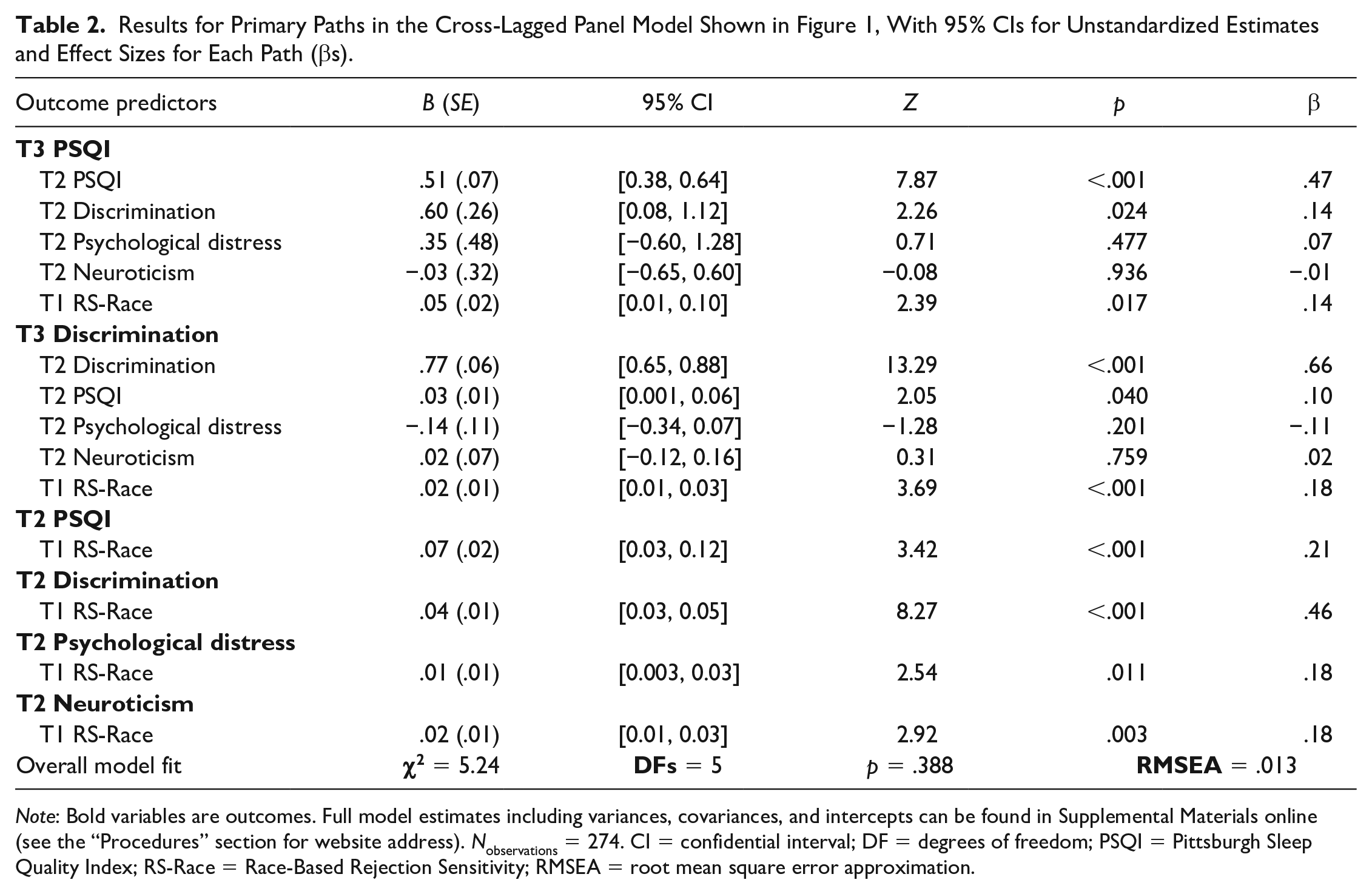
Note: Bold variables are outcomes. Full model estimates including variances, covariances, and intercepts can be found in Supplemental Materials online (see the “Procedures” section for website address). Nobservations = 274. CI = confidential interval; DF = degrees of freedom; PSQI = Pittsburgh Sleep Quality Index; RS-Race = Race-Based Rejection Sensitivity; RMSEA = root mean square error approximation.

Model depicting standardized path estimates for primary variables of interest (also shown in Table 2) and 95% confidence intervals.
Does anticipated ethnic/racial discrimination have a unique effect on sleep beyond experiences of discrimination?
As shown in Table 2 and Figure 2, participants high in anticipated discrimination at college entry (i.e., who anxiously expected to encounter race/ethnicity-based rejection) reported experiencing more discrimination during their first quarter on campus and at the end of their first year. Consistent with our second hypothesis, these participants also reported worse global sleep quality at mid-year relative to participants who were not anticipating discrimination. Furthermore, their global sleep quality declined further from mid-year to the end of the school year. This effect of anticipated discrimination on worsening sleep was significant over and above the effects of experienced discrimination at each time point.
Does poor sleep predict changes in experiences of discrimination?
Our final analysis tested our third hypothesis: that poor sleepers would report experiencing more discrimination. Indeed, participants who had poorer global sleep quality at the beginning of their second quarter in college reported experiencing more discrimination across the second half of the school year relative to participants who reported sleeping better.
Sensitivity Analyses
To test the robustness of our path estimates, we ran several reasonable alternative models. In addition to running our model on all available data, we also ran it for the 220 participants with complete data at all three time points. We ran a model in which depression and anxiety and perceived stress were modeled as separate observable factors, rather than indicators of a latent “Psychological Distress” factor. We also ran a model in which the seven subscales of the PSQI were modeled as indicators of a latent “Sleep” factor (constraining the subscales to have the same influence on the latent sleep factor at T2 and T3). Finally, we ran a model with no covariates included (i.e., removing stress, anxiety and depression, and neuroticism). The results for the alternative models are available in the Supplemental Materials and on the OSF website listed in the procedures. Across all models, the pattern of results was similar, with the following changes: With no covariates in the model, the path from T2 sleep to T3 discrimination was no longer significant (95% confidence interval [CI] for standardized estimate = [−0.020, 0.153]), suggesting that including these potential confounds helps clarify the association. With sleep modeled as a latent variable, the path from anticipated discrimination at T1 to latent sleep at T3 was no longer significant (95% CI for standardized estimate = [−0.051, 0.249]). Otherwise, there were only minor changes in effect sizes, with some of our primary paths becoming larger, suggesting that the size of these paths is relatively robust to model specification.
We also conducted sensitivity power analyses. To do this, we identified the minimum standardized estimate needed for each of our primary paths of interest to achieve 80% power (α < .05) for our given sample size (using the original model). We did this separately for each primary path estimate, constraining all other parameters to the observed estimates. We used bootstrapping with 1,000 resamples to identify the proportion of times a significant result was achieved for the path estimate and retested with different estimates until we achieved 80%. We did this using R code developed by Wang and Rhemtulla (2020). The results of these analyses included the following minimum standardized path estimates: T2 discrimination –> T3 sleep = .16, T2 sleep –> T3 discrimination = .13, T1 anticipated discrimination –> T2 sleep = .17, and T1 anticipated discrimination –> T3 sleep = .16. Our observed estimates were smaller than the minimum effect sizes for three out of the four paths (only T1 anticipated discrimination –> T2 sleep was larger), suggesting we were underpowered to detect these effects. However, all four paths were significant in our models. These analyses should be interpreted with caution given that our models included more than 40 parameters (path estimates, variances, covariances, and intercepts) and we used observed data for the non-focal parameters as these were the best estimates we had.
Taken together, these sets of sensitivity analyses suggest that the path model we used may have been underpowered to detect the specific paths we were interested in (pathways between discrimination and sleep). However, the paths were significant in our main analyses, which controlled for key covariates, as well as across several different specifications of our model. The robustness of these analyses suggests that the effects are small (βs = .1–.2) but persistent.
Discussion
Discrimination is increasingly recognized as a major determinant of psychological and physical health across the life course, as well as academic and social outcomes. An emerging literature implicates poorer sleep as a significant consequence of discrimination that may contribute to group disparities in health and educational outcomes (Slopen et al., 2016). The current research sought to address limitations of the fledgling literature on discrimination and sleep by using a prospective, longitudinal design to examine the bidirectional links between both anticipated and experienced ethnic/racial discrimination and global sleep quality. We examined these relationships among a sample vulnerable to experiencing discrimination—low-income or first-generation Latinx students transitioning to college. As hypothesized, students who reported experiencing more ethnic/racial discrimination during their first quarter of college had worsening global sleep quality across the second half of the year, as measured by self-reports that included multiple facets of sleep (e.g., duration, efficiency, quality). Students who anxiously expected to encounter ethnic/racial discrimination at the start of college also reported worse sleep over time. Importantly, the effects of anticipated and experienced discrimination on global sleep quality were unique—both significantly predicted changes in sleep when accounting for the other. In the reverse direction, we also found evidence for an association between sleep and later reports of discrimination, such that Latinx freshmen who slept poorly at the beginning of their second quarter reported experiencing more discrimination on campus over the second half of the year. All results held accounting for several potentially confounding factors related to both discrimination and sleep, including depression and anxiety symptoms, perceived stress, and neuroticism.
Implications
This study advances the prior literature on discrimination and sleep in a number of ways. First, whereas most prior work on this relationship has been cross-sectional, this study looked prospectively at changes in sleep and discrimination over time, while accounting for the associations between sleep and discrimination within each time point. Findings show clearly that experiences of discrimination predict subsequent global sleep quality. Second, it extends prior work by examining this relationship controlling for a number of potential confounds related to psychological functioning typically absent in prior research (Slopen et al., 2016), including depression and anxiety symptoms, perceived stress, and neuroticism. Given the well-documented relationships between discrimination and depression and depression and sleep, it is noteworthy that the relationship between discrimination and sleep is robust controlling for these variables. Indeed, prior work has suggested psychological distress as one potential pathway through which discrimination affects sleep. However, in our results, psychological distress and neuroticism were associated with sleep concurrently, but only discrimination (experienced and anticipated) predicted changes in sleep over time. Third, this study significantly advances the literature by showing prospectively the unique effects of anticipated as well as experienced discrimination on changes in global sleep quality. Although scholars have speculated on the detrimental health effects of anticipating, or being vigilant for, discrimination, there has been limited attention to this issue to date. And finally, this study builds on prior work by examining the reverse association between sleep and discrimination.
The finding that discrimination predicts changes in sleep over time has implications for understanding how discrimination may influence other downstream outcomes, from academic performance to physical health. Although the deleterious effects of perceived discrimination on these outcomes are now well documented, the pathways by which discrimination impairs them are still relatively unexamined. Prior literature suggests that discrimination affects social cognitive processes in ways that can set in motion a vicious cycle of negative effects (see Brondolo et al., 2018). For example, discrimination is linked to increased threat appraisals and decreased ability to modulate subsequent stress responses, which in turn heightens stress reactivity and impairs recovery (Brondolo et al., 2018). This study builds on this literature by highlighting poorer sleep, which may be affected by such social cognitive processes, as a potential mechanism by which discrimination may have negative downstream consequences on a whole cadre of negative outcomes. Sleep disorders and deprivation have been found to increase mood disorders, substance abuse, obesity, diabetes, heart disease, and mortality, among other factors (for recent reviews, see Barnes & Drake, 2015; Buysse, 2014). Our findings also have implications for understanding how and why groups who are vulnerable to experiencing discrimination may experience more difficulties during the transition to college. Sleep is critical for work performance (Swanson et al., 2011) and academic achievement (Curcio et al., 2006) as well as social functioning (Gordon et al., 2017). Students who are sleeping worse due to experienced discrimination may be especially likely to face social and academic difficulties as they transition to a new and demanding environment.
The finding that people who anxiously expected to be rejected based on their ethnicity/race assessed right at the start of college slept worse across the first year of college, even accounting for their reported experiences of discrimination, is consistent with claims that the health effects of vigilance for discrimination may be as damaging as those of experiencing discrimination (e.g., Williams & Mohammed, 2009). To our knowledge, only one other, cross-sectional, study has examined the relationship between anticipated discrimination and sleep (Hicken et al., 2013). Our findings are consistent with theirs in showing that the concept and measurement of anticipated discrimination is distinct from the concept and measurement of interpersonal discrimination; they also advance that study by showing that both contribute to poor sleep prospectively and uniquely. Anticipation of discrimination can lead people to constantly prepare for and ruminate about future experiences of discrimination even before they have occurred (Hatzenbuehler, 2009; Sawyer et al., 2012). This can lead to a state of hypervigilance (e.g., Kaiser et al., 2006), making it difficult to relax and achieve the sense of security needed to sleep soundly at night. More significantly, the findings with anticipated discrimination suggest that discriminatory experiences themselves are not a necessary ingredient for worse sleep; people who come to college concerned about discrimination due to prior experiences or a perceived hostile environment may sleep worse and subsequently perform worse as a result of this apprehension, even if they do not encounter any discrimination once they arrive on the campus. Being aware of how these prior experiences and individual vulnerabilities shape sleep once people arrive on campus is important when thinking about resources to help people achieve high quality sleep and function effectively.
Finally, a novel finding of this research is that people who tended to sleep worse reported experiencing more discrimination across the second half of college. To our knowledge, this is the first study to show this relationship prospectively. This finding is consistent with emerging evidence of a recursive and spiraling association between social processes and sleep (Gordon et al., 2017). People who anticipate or perceive discrimination sleep worse, which may make them more vulnerable to experiences of discrimination, which in turn may further influence sleep, and so on and so forth. Whether the pathway from poorer sleep to increased discrimination is a result of differences in how poor sleepers interpret other people’s behavior, or in the actual behavior of others, however, remains to be seen. Prior research has shown that poor sleep leads to greater negative affect (Kahn et al., 2003), more negative interpretations of ambiguous stimuli (Killgore et al., 2017), and more negative reactions to rejection (Gordon et al., 2019). These findings suggest the possibility that after sleeping poorly, people may have increased vigilance for, and awareness of, discrimination than they would when well-rested. However, poor sleep also undermines self-regulation (Krizan & Hisler, 2016). People who experience discrimination may engage in self-protective behaviors to minimize exposure, such as being extra careful with their appearance or speech, but they may be less able to do so when poorly rested, making them more vulnerable to discrimination (Shelton et al., 2006). Given the relatively small body of work focused on this question, more work is clearly needed to understand whether, when, and how poor sleep may have downstream consequences for experiences of discrimination.
A related question involves whether sleep may influence the anticipation of discrimination. The measure we used (RS-Race) captures people’s chronic tendencies to anxiously expect discrimination based on ethnicity/race, but it is possible that sleeping poorly may exacerbate this tendency. We only measured RS-Race at the beginning of the study, but given that prior work has shown sleep makes people more reactive, particularly to threatening stimuli (e.g., Yoo et al., 2007), it is quite possible that after sleeping poorly people become more anxious about the possibility of discrimination.
Constraints on Generality
This study adds to and advances the growing body of work showing a relationship between discrimination and sleep and points to several directions for future research. However, we must consider the generalizability of our findings. Foremost, this study focused on a homogeneous sample: Latinx college freshmen who were first-generation college students and/or low income. The study was also predominantly female (70%). Although the measures we used were standard measures of discrimination and sleep, we cannot conclude whether these results will generalize to other populations without further research. To understand who in the sample was anticipating and experiencing discrimination, we examined whether several sociodemographic factors that had the potential to differ within the sample—age, gender, SES, relationship status (married or not), and sexual orientation—predicted discrimination. Individuals lower in SES tended to report anticipating more discrimination (r = .18), but all other correlations were <.10. This lack of effects may be partly due to the homogeneity of the sample and corresponding low variance in these variables, but it provides some information that it is not a specific subgroup of participant who are anticipating and experiencing discrimination as they transition to college.
We must also note that the nature of our methodology places some constraints on generalizability. Although a strength of the data are their longitudinal nature, they are nonetheless correlational. Despite looking at changes in discrimination and sleep over time and controlling for several potential confounds, there may be other possible confounds for which we have not accounted. Experimental data in which discrimination is manipulated and both short- and long-term effects on sleep are measured are needed to establish a definitive causal effect of discrimination on sleep or sleep on discrimination. Along similar lines, effects are not always the same in daily life and in the lab; thus, it is important that future work seeks to identify whether these effects are generalizable across methods of measurement. This study also relied on self-report data for both discrimination and sleep, as have most of the prior studies on this topic. Longitudinal or experimental studies using objective methods to capture sleep, such as polysomnography or actigraphy, are needed. Finally, an important direction for future research is to investigate modifiers of the relationship between discrimination and sleep to identify the social, personal, or biological factors that may protect people from the potentially pernicious effects of discrimination on sleep.
Notably, this sample had a high level of stability in perceived discrimination from mid-year to the end of the school year. Some of this may be due to the fact that the prompt at the end of the year asked participants to report on discrimination over the entire first year, leading to some overlap with what they were reporting on at mid-year. The presence of an effect in the face of such a high level of stability suggests that we may in fact be underestimating the size of our effects, particularly the relationship between sleep and changes in discrimination over time. Studies assessing discrimination in a more sensitive way (e.g., an experience sampling study) may help us identify the true association between these effects in daily life.
Sample size was constrained by the challenges associated with recruiting, retaining, and meaningfully compensating lower SES ethnic minority college students across a year-long longitudinal study. Sensitivity power analyses suggested that our primary effects may have been smaller than those reliably detected at 80% power for our sample size, but that they were robust to model specification. Given the nature and complexity of the cross-lagged panel model, it is hard to know how these effect sizes would translate into other studies not using an identical model or the same homogeneous sample. Thus, we believe that more work is needed to replicate and build on these effects, and that researchers should use some caution when considering these effects as a basis for future power analyses. With that limitation in mind, however, we believe the current work makes an important contribution to understanding the effects of discrimination on sleep among a population that is underrepresented in psychological research.
Conclusion
Discrimination brings with it a host of negative outcomes, from poorer mental and physical health to reduced academic success and social functioning. The current findings advance an emerging body of research showing that poor sleep may be one important outcome affected by not just by the experience of discrimination, but also by anxious expectations of it. Moreover, the findings suggest poor sleep may make individuals more aware of and vulnerable to discrimination. Given the significant negative outcomes associated with both poor sleep and discrimination, understanding and quantifying these bidirectional links between discrimination and sleep is a critical area of research.
Supplemental Material
Gordon_Online_Appendix – Supplemental material for Anticipated and Experienced Ethnic/Racial Discrimination and Sleep: A Longitudinal Study
Supplemental material, Gordon_Online_Appendix for Anticipated and Experienced Ethnic/Racial Discrimination and Sleep: A Longitudinal Study by Amie M. Gordon, Aric A. Prather, Tessa Dover, Kathy Espino-Pérez, Payton Small and Brenda Major in Personality and Social Psychology Bulletin
Supplemental Material
Supplement_Syntax_and_Results – Supplemental material for Anticipated and Experienced Ethnic/Racial Discrimination and Sleep: A Longitudinal Study
Supplemental material, Supplement_Syntax_and_Results for Anticipated and Experienced Ethnic/Racial Discrimination and Sleep: A Longitudinal Study by Amie M. Gordon, Aric A. Prather, Tessa Dover, Kathy Espino-Pérez, Payton Small and Brenda Major in Personality and Social Psychology Bulletin
Footnotes
Declaration of Conflicting Interests
The author(s) declared no potential conflicts of interest with respect to the research, authorship, and/or publication of this article.
Funding
The author(s) disclosed receipt of the following financial support for the research, authorship, and/or publication of this article: This research was supported by a Russell Sage Grant (RSF #96-18-02) to B.M. and T.D. and a UC Health Psychology Consortium Grant to B.M. and A.A.P.

Supplemental Material
Supplemental material is available online with this article.
Notes
References
Supplementary Material
Please find the following supplemental material available below.
For Open Access articles published under a Creative Commons License, all supplemental material carries the same license as the article it is associated with.
For non-Open Access articles published, all supplemental material carries a non-exclusive license, and permission requests for re-use of supplemental material or any part of supplemental material shall be sent directly to the copyright owner as specified in the copyright notice associated with the article.
