



Abstract
Email and text-based communication have become ubiquitous. Although recent findings indicate emotional equivalence between face-to-face and email communication, there is limited evidence of nonverbal behaviors in text-based communication, especially the kinds of unintentional displays central to emotion perception in face-to-face interactions. We investigate whether unintentional emotion cues occur in text-based communication by proposing that communication mistakes (e.g., typos) influence emotion perception. Across six studies, we show that communication errors amplify perceptions of email sender’s emotions—both negative (Studies 1A–2, 4, 5) and positive (Study 3). Furthermore, by contrasting perceptions of message senders who make mistakes in emotional versus unemotional contexts (Study 5), we show that people partially excuse message sender communication errors in emotional (versus unemotional) contexts, attributing such mistakes to the sender’s emotional state rather than solely their intelligence level. These studies suggest that nonverbal behavior in text-based and face-to-face communication may be more comparable than previously thought.
The proliferation of email and other text-based communication technologies has transformed the way people interact with one another (Barley et al., 2011; Radicati & Levenstein, 2013). Yet, one historically cited drawback of such forms of communication is that they are devoid of the rich emotional cues associated with face-to-face and auditory communication, such as facial expressions and tone of voice (Daft & Lengel, 1986; Kiesler et al., 1984). In email, communicators may intentionally attempt to convey their sentiments with explicit signals such as emoticons and capitalization (Byron & Baldridge, 2007; Thompsen & Foulger, 1996; Walther & D’Addario, 2001). However, unintentional emotion cues, which are typically considered some of the most informative emotion signals because they are difficult to fake (Ekman et al., 1990; Grandey et al., 2005), have been generally overlooked or thought not to exist within text-based media (Daft & Lengel, 1986). Despite this theoretical absence of unintentional text-based emotion cues, a more contemporary body of research has developed, which finds affective equivalence between textual and in-person interactions (e.g., Cheshin et al., 2011; Derks et al., 2008; D’Urso & Rains, 2008; Walther et al., 2005).
How might affective equivalence be achieved if email does not contain unintentional emotion cues? The present research begins to help resolve this theoretical puzzle by proposing that communication mistakes (e.g., typos) influence emotion interpretation. Across six experiments, we demonstrate that people make emotional inferences when they perceive unintentional communication errors made by message senders.
Emotion Perception in Text-Based Communication
As email and other forms of text-based communication have become a mainstay of modern-day interactions (Mazmanian et al., 2005; Radicati & Levenstein, 2013), the importance of emotion perception in such media has grown; even slight changes in how emotion is interpreted can have significant consequences. For example, after United CEO Oscar Munoz’s written apology for a violent passenger reaccommodation was perceived as insufficiently emotional, United stock lost 4% of its value (Kottasova, 2017). Similarly, prior research finds that emotion (mis)perception influences cooperation, conflict, and even task performance (Wang et al., 2018; Wubben et al., 2009).
Initial work on text-based communication suggested that it lacked the emotional nature of face-to-face interactions (Sproull & Kiesler, 1986; Williams, 1977) due to the limited number of cues (modes of expression, such as body language) available within the medium (Daft & Lengel, 1986; Dennis & Valacich, 1999; Kiesler et al., 1984). However, recent empirical research has countered prior thinking that text-based communication lacks emotion and provides evidence for affective equivalence between the communication media (Cheshin et al., 2011; Derks et al., 2008; Walther et al., 2005). Research in this domain has found that text-based message recipients perceive emotion from intentional elements of the messages’ content, such as the use of emotion words, capitalization, emoticons, and punctuation (Byron & Baldridge, 2007; Thompsen & Foulger, 1996; Walther & D’Addario, 2001).
Although this focus on explicit emotion cues has furthered the collective understanding of emotion perception in text-based communication, it has failed to consider perhaps the primary means by which people otherwise interpret emotion: through unintentional cues. That is, elements of the message composition that communicators do not consciously include. Spontaneous sentiments are widely viewed to reveal more about one’s true state of mind than intentional, deliberate thought (Morewedge et al., 2014). Relatedly, in the realm of emotion perception, spontaneous, unintentional behaviors are seen as more accurate than other cues. A primary reason for this perception is that such unintentional behaviors are typically more apparent to a message recipient than to the messenger, who often engages in them unconsciously, without the ability to suppress them (DePaulo, 1992; Ekman, 2003). Prioritization of these unconscious signals in emotion perception is functional given evidence of “nonverbal leakage,” body language and facial expressions that are indicative of true underlying emotions and may contradict what is more intentionally said (Ekman, 2003; Grandey, 2003). People’s abilities to interpret “true” emotions via unintentional signals can have significant repercussions given the role that emotion perception plays in guiding social behavior (Van Kleef, 2009). For example, customers interpret the sincerity of service actors’ emotions, and respond with reduced loyalty when such emotional displays are deemed inauthentic (Grandey et al., 2005; Groth et al., 2009).
Prior research has generally overlooked or dismissed the possibility that text-based communication could contain unintentional emotion cues, assuming messengers would spot and filter out unintentional cues given the medium’s opportunities for review and revision. Despite the opportunity to edit text-based communications, however, there is significant evidence of unintentionality within text-based communication (Schaerer et al., 2018), such as text-based communication errors (Asghar, 2014; McAndrew & De Jonge, 2011; Vignovic & Thompson, 2010) and atypical response times and delays (Walther & Tidwell, 1995). The presence of unintentional cues in text raises the question of whether there might be unintentional cues of emotion in text-based communication.
The lack of attention to the possibility of unintentional emotion cues in text-based messages is problematic in multiple ways. First, the focus on deliberate emotion cues in text-based communication has likely underestimated the potential for emotion perception within the medium. Past work suggesting that people’s inability to effectively convey emotions over email has utilized experiments that instruct participants to display an emotion that they may not have actively been experiencing (Kruger et al., 2005). Such experimental designs would reduce or eliminate unintentional emotion cues, as participants may not have felt the examined emotions. Furthermore, building a better understanding of unintentional nonverbal behaviors in text-based communication could improve the accuracy of discourse analysis (Cheshin et al., 2011; Fairclough, 2001; Pennebaker et al., 2001). From a practical perspective, identifying how emotions can be unintentionally conveyed via text could allow people to better manage their virtual communications.
Attributions of Communication Errors
Because we are interested in the associations that individuals might make of unintentional errors, in a cause-and-effect manner, we ground our hypotheses in attribution theory. As substantial work on attribution theory has shown, when individuals observe or experience something unexpected, they seek to assign a reason or cause for the occurrence (Clary & Tesser, 1983; Lalljee et al., 1982; Weick, 1995). Given the emphasis on proper writing in educational and professional contexts, counter-normative communication errors (e.g., errors that are not normalized parts of the colloquial language or slang within a given context) would likely be unexpected. Accordingly, we predict that when message senders make an error, such as a typo, “an error (as of spelling) in typed or typeset material” (Typo, 2005), message recipients or third-party observers would be likely to search for reasons for the error. By this definition, our focus on typos would not include errors that are normalized within the context (e.g., normal slang used by one high-schooler communicating to another), which we would argue are not errors as we have defined them, given that they would have been utilized intentionally.
Attribution theory asserts that people may attribute others’ behaviors along two dimensions: (a) internal or external, and (b) stable or unstable (Heider, 2013; Kelley, 1967; Weiner, 1972). Classic research on the fundamental attribution error indicates that people evaluating the behavior of others tend to overemphasize internal (rather than external) causes (Harvey et al., 1981; Jones & Harris, 1967; Krull et al., 1999). In this vein, prior examinations of text-based communication have shown typos to be associated with more stable internal traits, such as a sender’s lack of intelligence (Morgan, 2012; Vignovic & Thompson, 2010). Given this past emphasis on internal attributions, we similarly focus on internal attributions others make when observing a message with or without typos. However, we diverge from past work and examine whether typos can drive unstable, state-based attributions; specifically, attributions of emotion. In doing so, we expand theory of emotion perception in virtual communication by demonstrating that one—and, consequently, potentially other—categories of unintentional cues of emotion in email exist, which would indicate that emotion processes in face-to-face and computer-mediated communications may be meaningfully more comparable than realized.
We predict that, in the presence of salient emotion information, errors may be attributed to emotion interfering with a messenger’s normal cognitive processes, such as self-regulation, a process we refer to as emotional interference. The concept of emotional interference is widespread in popular culture. In addition to popular books on the topic (Kahneman, 2011; Vohs et al., 2007), there are a multitude of cultural examples of characters losing their abilities to function normally when they become overwhelmed by emotion, such as Othello (a Shakespearean character so overcome by jealousy that he becomes murderous) and the Hulk (a superhero so overcome by anger that he blindly smashes things). Similarly, lottery winners are stereotypically viewed as so overcome by happiness that they make hasty, suboptimal decisions (Godfrey, 2015). In a more serious realm, criminal defendants have successfully used overwhelming emotion to justify their illegal decisions (Covey, 2011). We argue that cultural acceptance of the link between emotion and cognitive processing indicates that people may attribute unexpected errors, such as making a typo, to overwhelming emotion.
This is not to say that typos will independently signal specific emotions; we believe that, removed from other information, communication errors are emotionally neutral (typos can appear in an angry, happy, or neutral message). We propose that like many nonverbal behaviors in face-to-face interactions, communication errors act as an amplifier of the perceived intensity of an otherwise expressed emotion (Aviezer et al., 2008; Tamir et al., 2004). For example, speaking at a high volume or raising a fist in the air might be meaningless on its own, but depending on the emotional context of the interaction, these behaviors could signal high levels of pride, happiness, or anger. Similarly, we propose that typos do not influence emotion type, valence (i.e., how positive or negative an emotion is), or arousal (i.e., the emotion’s physiological activation pattern; Russell, 1980), but rather that they signal a higher level of intensity of a given emotion (e.g., is the person slightly or very angry). Then, when cues of a specific emotion are salient, typos will be attributed to overwhelming emotion, amplifying perceptions of the degree to which the sender is experiencing the specific underlying emotion. This logic aligns with a central tenet of attribution theory: that attributions are formed based on salient information (Fiske et al., 1982; Pryor & Kriss, 1977; Smith & Miller, 1979). As emotion cues are salient and highly consequential (Van Kleef et al., 2010), we propose that their presence would be likely to alter attributions made from the communication.
Accordingly, we hypothesize that regardless of whether emotions can in fact lead to communication errors, the mere perception that typos may be driven by emotional interference will result in an emotion-amplification effect:
H2 implies a mediator-based approach to test why individuals may make a state-based attribution of typos (perceptions of emotion interference). However, we can also test the theorized process via moderation. If the processes behind attribution theory are driving these effects, in unemotional contexts, in which emotion (a state explanation) is no longer available, then the attribution of typos should shift to a trait-based attribution (e.g., intelligence or fluency). In other words, when a state-based attribution is available (e.g., emotional interference), the impact of typos on the trait-based attribution (e.g., intelligence) should be weaker. Thus, the presence of emotion, which provides a plausible alternative explanation for typos, may result in message senders being “punished” (i.e., rated as unintelligent) less for making errors. This is not to suggest that email writers should add emotion to their emails to avoid being penalized for typos, as the presence of emotion in a message itself may decrease perceptions of intelligence (Kramer & Hess, 2002; Szczurek et al., 2012). But rather, if our hypothesized mechanism is accurate, then the intelligence penalty for including typos within an email will be smaller for emails with emotion than for emails without emotion (after accounting for any main effects of the presence of emotion on intelligence perceptions). Although a number of trait-based attributions may be made from typos—such as laziness, intelligence, or low attention to detail—we operationalize this hypothesis by specifically examining intelligence, as it is a commonly examined trait associated with errors across differing types of communication including emails (Vignovic & Thompson, 2010), written essays (Kreiner et al., 2002), and audio (Aronson et al., 1966).
Notably, our hypotheses do not distinguish between emotional inferences made by message recipients and third-party observers of a message. Indeed, we believe that, in emotional contexts, both third-party observers as well as message recipients will attribute communication errors to message senders’ emotional interference. Accordingly, the tests of our hypotheses vary the perspective from which participants are asked to evaluate the message (e.g., as an outsider or “taking the role” of a recipient). However, to enable us to isolate the influence of errors on emotion perception, our studies do not take into account the potential impact of significant existing relational information. We view this approach as a cleaner test of our hypotheses, but it also represents an important boundary condition, which we discuss more deeply in the concluding sections of this article.
Overview of Studies
Six experiments provide evidence of unintentional emotion cues in text-based communications. Studies 1A and 1B document the basic effect, that recipients make emotional inferences from typos. Study 2 provides evidence that our model is consistent with our proposed mechanism: emotional interference. In Study 3, we replicate the findings from Studies 1A-2 with a different emotional valence, and directly test the assumption that people perceive communication errors to be unintentional. Study 4 considers the downstream effects of emotional inference resulting from typos. In Study 5, we more deeply link our findings with attribution theory by considering whether communication mistakes reflect differently on messengers in emotional versus unemotional contexts. For each study, we pre-specified our sample sizes, and report all data exclusions, all manipulations, and all measures. We provide the data and stimuli from each study at https://osf.io/c7nk6/.
Study 1A
Method
Two hundred eight participants (59.5% male, Mage = 33.4, SD = 10.8) completed this study on Amazon Mechanical Turk, which offers access to a more diverse sample of email users than more traditional university participant pools (Buhrmester et al., 2011). As we did not have a strong prior estimate of the effect size, we targeted a sample of 100 participants per condition (Simmons et al., 2011; minimum effect size d = 0.40 with 80% power). Participants were told that they would be evaluating an email “sent from Ryan, a managing director of an investment bank, to James, one of the lower level analysts who works for him.” Next, participants were randomly shown an email that had no communication mistakes or three subtle typos (see Appendix A for full stimuli).
Participants then rated how much they thought the email sender experienced 10 emotions on a scale of 1 = none to 7 = an extreme amount, three of which comprised a measure of the target emotion, perceived anger (anger, outrage, and fury, Scherer, 2005; Shaver et al., 1987; α = .85). The other emotions (e.g., happiness, sadness, and fear) were included to reduce experimenter demand effects. Finally, participants completed a manipulation check (“Were there any errors in the email that you read?”) and demographic information (age and gender).
Results and Discussion
Participants who read the email with errors rated the sender as marginally angrier (M = 4.84, SD = 1.25) than those who read the email without errors (M = 4.51, SD = 1.11), t(206) = 1.96, p = .051, d = 0.27, 95% confidence interval (CI) = [0.00, 0.64]. These differences increased slightly when we considered only participants who passed the manipulation check (93.5% in the no errors condition and 64.4% in the errors condition: Merrors = 4.87, SDerrors = 1.26; Mno errors = 4.50, SDno errors = 1.09), t(163) = 2.00, p = .047, d = 0.31, 95% CI = [0.01, 0.73]. These analyses suggest that even very subtle errors, which more than one-third of participants did not consciously notice, may increase the perception of messenger anger (H1).
Study 1B
In Study 1B, we aimed to increase both the internal and external validity of our findings by testing our main hypothesis in a preregistered study using a real email drawn from an archival email database (Wikileaks Sony Email Archives), increasing our sample size (our initial study may have been underpowered), recruiting from a different participant population, and asking participants to take the perspective of the email recipient.
Method
Study 1B was preregistered at https://osf.io/c7nk6/. To enable us to detect an average effect size of .2 with 80% power, we targeted recruitment of 800 participants from Prolific Academic, a company that provides participants for academic research. As per our preregistration, we excluded 21 (2.6%) of recruited participants who failed an attention check (failure rate did not differ between conditions, χ2 = .448, p = .504), resulting in a final sample of 792 participants (40.1% male; Mage = 33.6, SD = 12.0).
Participants were told to take the role of a U.S. entertainment company executive receiving an email from a colleague who was a Hollywood producer. They were further told that the email they were receiving was “a real email sent in this context.” Then, participants read a real email sent in this business context sourced from the Wikileaks Sony Email Archive (https://wikileaks.org/sony/emails/, see Appendix A). In the typos condition, the email was edited to include three typos. Next, participants rated the message sender’s anger using the same scale as Study 1A (α = .84) as well as eight other filler emotions to reduce demand effects, and completed an attention check (“select none for this question,” which we used to exclude inattentive participants according to our preregistration, as noted above). Participants finished the study by completing a manipulation check (“Did the email you received contain any typos?”) and indicated demographic information (age and gender).
Results and Discussion
Participants who received the email with typos rated the message sender as significantly more angry (M = 5.75, SD = 1.04) than those who received the email without typos (M = 5.57, SD = 1.00), t(790) = 2.57, p = .010, d = 0.18, 95% CI = [0.04, 0.33], replicating our findings from Study 1A, with the recipient perspective of a real email (H1). The effect of errors on emotion perception was slightly strengthened when we considered only participants who passed the manipulation check (98.0% in the errors condition and 71.6% in the no errors condition: Merrors = 5.76, SDerrors = 1.04; Mno errors = 5.52, SDno errors = 0.99), t(670) = 2.90, p = .004, d = 0.23, 95% CI = [0.07, 0.39].
Study 2
Study 2 tested our hypothesized mediator, whether perceptions of emotional interference are associated with evaluating a message sender as more emotional. In addition, in Study 2, we sought to address alternative explanations of our effect. First, because displays of strong emotion are often anti-normative, and thus likely to be viewed as evidence of one’s poor ability to encode or follow appropriate display rules (Kramer & Hess, 2002; Lewis, 2000; Russell & Barrett, 1999), people are likely to perceive those who make emotional displays as less intelligent. Thus, lower intelligence could simultaneously cause both (i.e., be a confound for) communication errors and emotional displays. Accordingly, in Study 2 and all remaining studies, we evaluated the effect of typos on emotion with and without controlling for perceived intelligence. Doing so also allowed us to analyze whether the unstable (emotion) attribution was independent from the more stable attribution (intelligence). Second, in Study 2 we also assessed recipient perceptions of how long it took the sender to write the message to rule out the perception that the sender was rushed as a confounding explanation.
Method
Five hundred ninety-eight full-time employees (46.7% male; Mage = 36.8, SD = 9.8) were recruited from Prolific Academic. We targeted the recruitment of 600 participants (minimum effect size d = 0.23 with 80% power). For this study, we utilized the materials from Study 1A, which were more straightforward yet had not been tested with appropriate power and updated the error conditions to examine three different errors (see Appendix A). Then, in addition to rating the email sender’s anger (anger, outrage, and fury), as well as three filler emotions (happiness, sadness, and fear) on a scale of 1 = none to 7 = an extreme amount (α = .87), participants also rated the email sender’s emotional interference (e.g., “His emotions got in the way of thinking clearly”) on a scale of 1 = strongly disagree, 7 = strongly agree (α = .86), intelligence (e.g., “is clever, sharp witted”) (Paulhus et al., 1998) on a scale of 1 = strongly disagree to 7 = strongly agree (α = .88), and time spent writing the email, using a slider anchored at zero minutes on the left and 5 minutes on the right. The order of these measures was counterbalanced.
Results and Discussion
Full-time workers in the typos condition rated the email sender as significantly angrier (Merrors = 5.12, SDerrors = 1.29; Mno errors = 4.75, SDno errors = 1.33), t(596) = 3.44, p = .001, d = 0.28, 95% CI = [0.16, 0.58]. Those in the typos condition also rated the email sender as less intelligent (Merrors = 3.13, SDerrors = 1.13; Mno errors = 3.76, SDno errors = 1.05), t(596) = 7.03, p < .001, d = −0.58, 95% CI = [–1.18, –0.08]. However, the effect of typos on anger remained significant when controlling for perceived sender intelligence, βerrors = .25, t(596) = 2.27, p = .024 (see Table 1, for additional study statistics see Table 2; H1). Participants in the typos condition also rated the email sender as experiencing more emotional interference (Merrors = 5.46, SDerrors = 1.17; Mno errors = 4.88, SDno errors = 1.33), t(596) = 5.64, p < .001, d = 0.46, 95% CI = [0.38, 0.78], and as spending less time writing the email (Merrors = 1.43, SDerrors = 0.89; Mno errors = 1.75, SDno errors = 1.04), t(596) = 4.09, p < .001, d = −0.33, 95% CI = [–0.17, –0.48].
Communication Errors Predict Perceptions of Anger and Emotional Interference Controlling for Perceived Intelligence (Study 2).
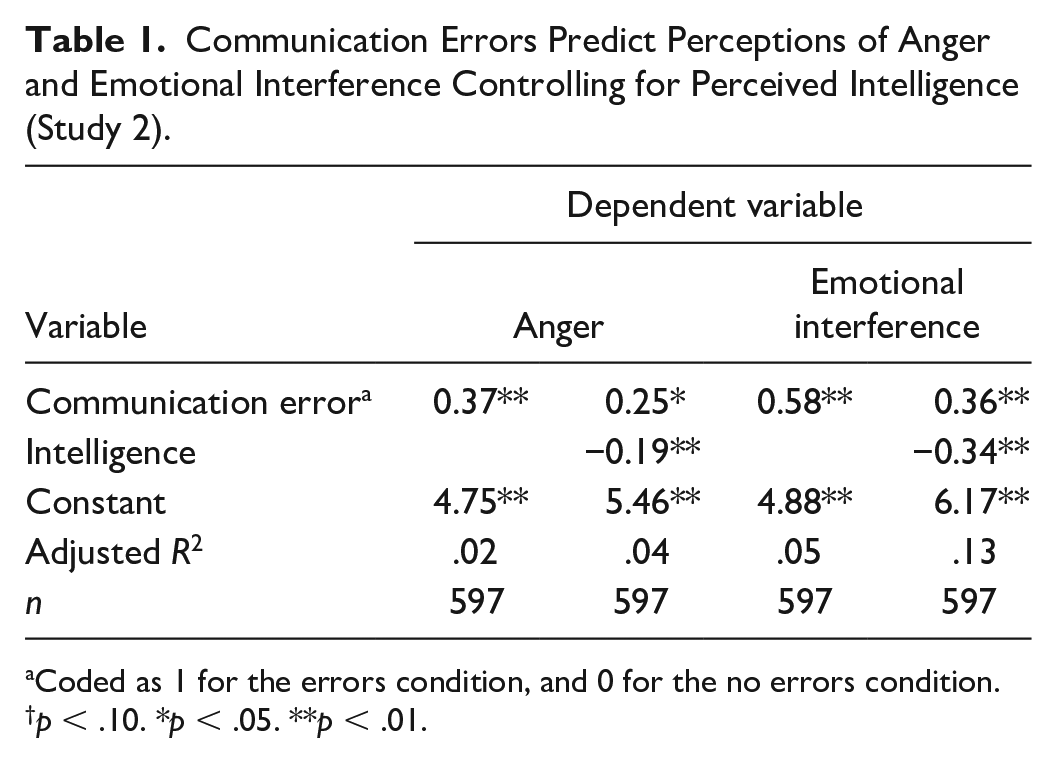
Coded as 1 for the errors condition, and 0 for the no errors condition.
p < .10. *p < .05. **p < .01.
Means and Correlations Among Study 2 Variables.

Coded as 1 for the errors condition, and 0 for the no errors condition.
p < .10. *p < .05. **p < .01.
Using the bias-corrected bootstrap method recommended by Preacher and Hayes (2004) to test mediation, we found that emotional interference significantly mediated the relationship between errors and perceptions of anger (indirect mediation model 95% CI = [0.1820, 0.4053]). This effect remained significant when we controlled for perceived time spent writing the email (indirect mediation model: 95% CI = [0.1485, 0.3658]), addressing the possibility that our results were driven by perceptions that the email sender was rushed. These results persisted when we removed those who failed the manipulation check (13.3% in the no-errors condition and 16.4% in the errors condition; failure rate did not differ between conditions, see Appendix B). When the messenger made errors, he appeared overwhelmed by his emotions and was perceived as angrier (H2). This mediation path is shown in Figure 1.
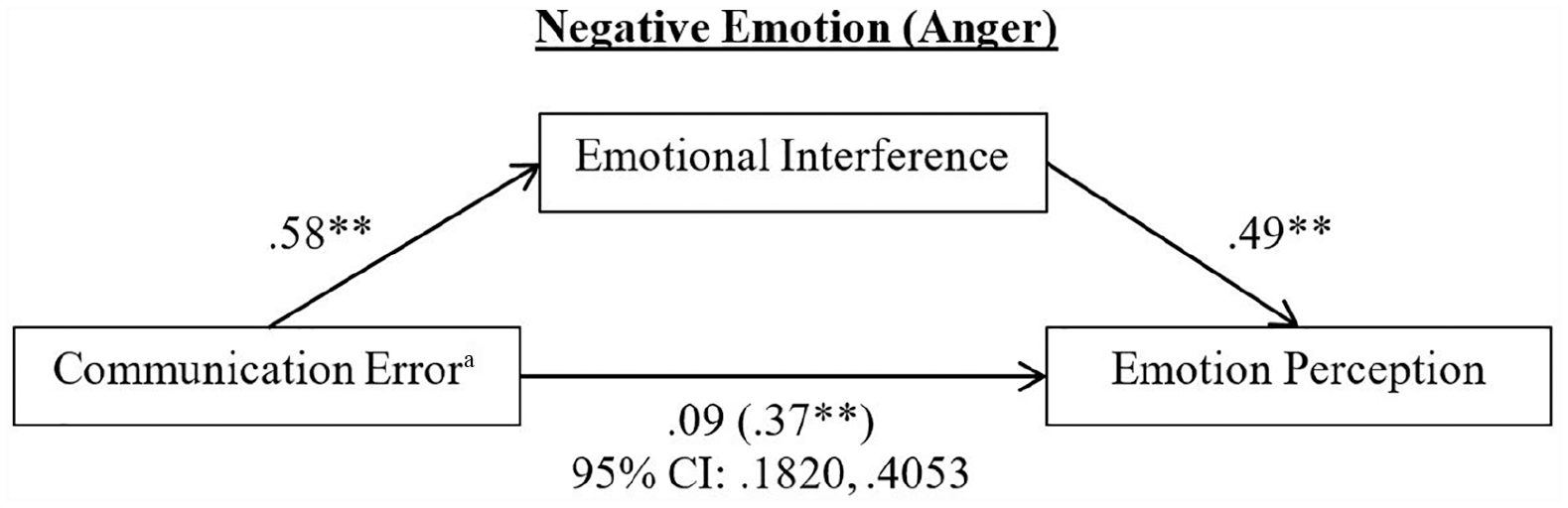
Emotional interference mediates the effect of communication errors on emotion perception (Study 2).
Study 3
In Study 3, we further explored the generalizability of these findings by varying the communication context and testing whether communication errors alter the perception of a positive emotion: joy. In addition, Study 3 directly tested the assumption that people perceive communication errors to be unintentional.
Method
Seven hundred six adults (54.5% male; Mage = 31.1, SD = 11.4) from Amazon Mechanical Turk completed this study. We targeted the recruitment of 700 participants to help us detect an effect in a different emotional context (minimum effect size d = 0.22 with 80% power). Participants were told that they would be evaluating an email “sent from Emily, a marketing employee for a large technology firm, to one of her team members named Julie.” Then, as in Studies 1A–2, participants were randomly shown an email with no communication mistakes or with three typos (see Appendix A).
Next, participants rated the email sender’s target emotion of joy (joy, ecstasy, elation, and glee, Scherer, 2005, α = .86), and three filler emotions (anger, sadness, and distress), to account for experimenter demand effects, on a scale of 1 = none to 7 = an extreme amount. Participants also rated the email sender’s emotional interference (α = .83) and intelligence (α = .92), both as measured in Study 2. Participants next completed a manipulation check (whether the email included typos), and those in the errors condition were asked to indicate whether they thought the message sender had included the errors intentionally.
Results and Discussion
Participants in the typos condition rated the email sender as marginally more joyful (Merrors = 4.97, SDerrors = 1.23; Mno errors = 4.80, SDno errors = 1.26), t(704) = 1.78, p = .075, d = 0.13, 95% CI = [–0.02, 0.35]. Those in the typos condition also rated senders as less intelligent (Merrors = 3.97, SDerrors = 1.01; Mno errors = 4.92, SDno errors = 0.90), t(704) = 13.17, p < .001, d = −0.99, 95% CI = [–1.09, –0.81]. The effect of typos on perceptions of joy became significant when controlling for perceived sender intelligence, βerrors = .38, t(704) = 3.70, p < .001 (see Table 3, for additional study statistics see Table 4; H1). Participants who saw the message with errors also perceived the email sender to be experiencing more emotional interference (Merrors = 4.19, SDerrors = 1.28; Mno errors = 2.81, SDno errors = 1.16), t(704) = 14.95, p < .001, d = 1.13, 95% CI = [1.20, 1.56]. Furthermore, 98.6% of participants (355 of 360 participants) in the errors condition indicated that they believed that the message sender’s errors were unintentional, supporting our contention that communication errors are likely to be perceived as an unintentional cue.
Communication Errors Predict Perceptions of Joy and Emotional Interference Controlling for Perceived Intelligence (Study 3).
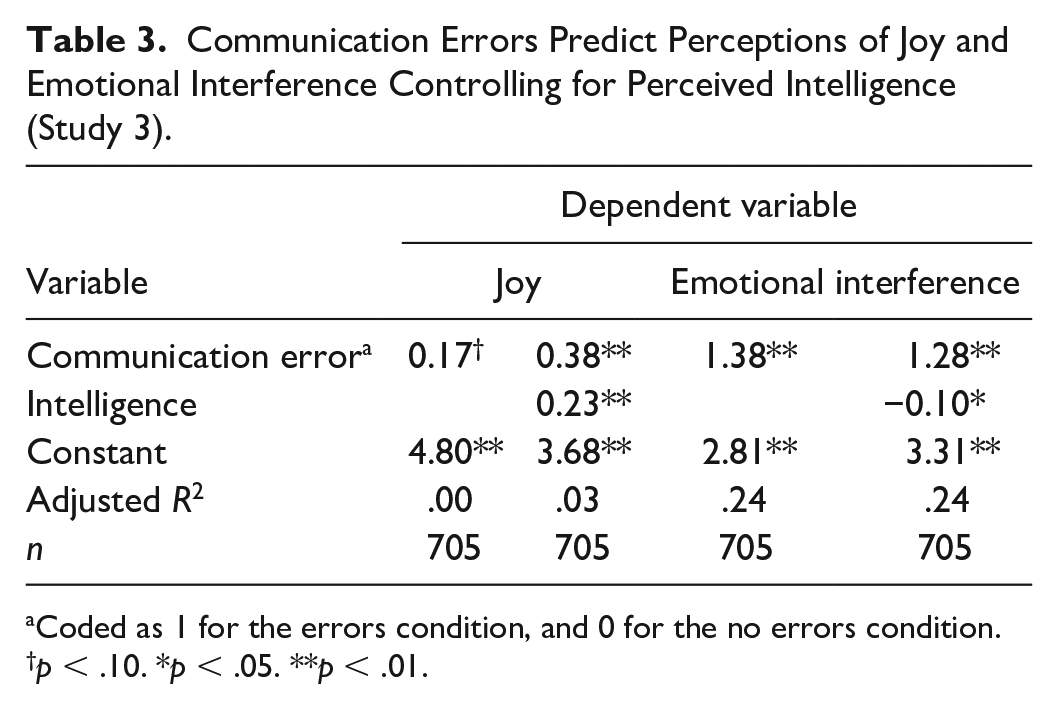
Coded as 1 for the errors condition, and 0 for the no errors condition.
p < .10. *p < .05. **p < .01.
Means and Correlations Among Study 3 Variables.
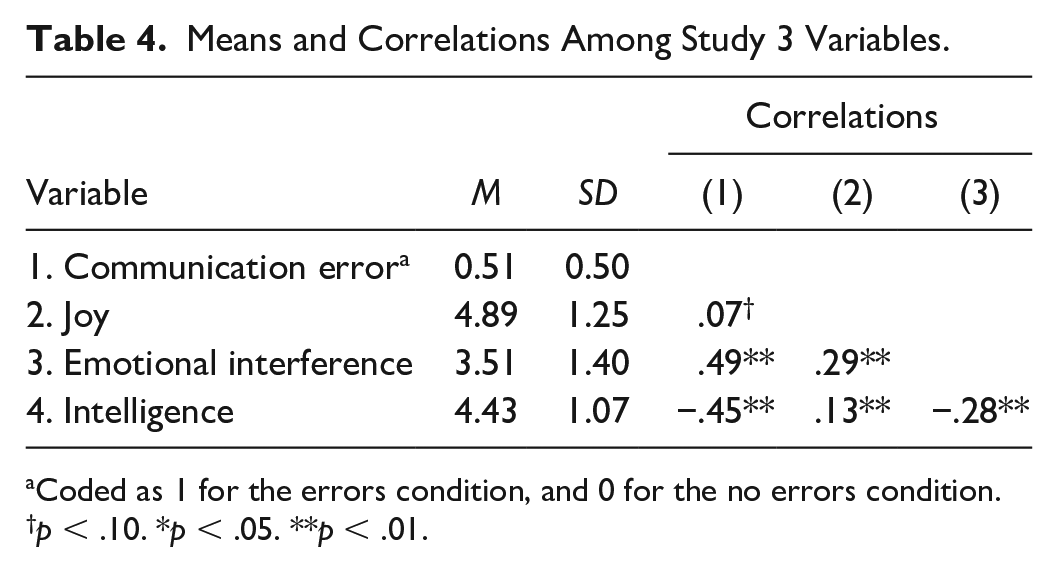
Coded as 1 for the errors condition, and 0 for the no errors condition.
p < .10. *p < .05. **p < .01.
Using the bias-corrected bootstrap method recommended by Preacher and Hayes (2004), we again found that emotional interference significantly mediated the relationship between errors and perceptions of emotion (joy in this case; indirect mediation model 95% CI = [0.3042, 0.5422]; H2). When those who failed the manipulation check (8.1% in the no errors condition, and 3.3% in the errors condition) were removed, all of the results were similarly significant (see Appendix B).
Study 4
In Study 4, we consider one potential downstream effect of increased emotional perception resulting from typos: how recipients prioritize responding to the message.
Method
Study 4 was preregistered at https://osf.io/c7nk6/. To enable us to detect an average effect size of .22 with 80% power, we targeted recruitment of 700 participants from Prolific Academic. As per our preregistration, we excluded 90 (12.8%) recruited participants who failed an attention check (failure rate did not differ between conditions, χ2 = .039, p = .844), resulting in a final sample of 614 participants (45.4% male; Mage = 35.9, SD = 11.4).
Participants took on the role of a manager of a team of technology specialists at a technology solutions firm. They learned that, although their company had announced a pay freeze, they had gained an exemption for their team. Then, participants were told that they would be receiving emails from two of their subordinates who had learned of the pay freeze but had not yet learned that they would be exempted from it. Furthermore, participants were told they would have to choose which email to respond to first, and that they would not be able to respond to both quickly due to travel constraints. As the manager, participants were instructed to make their response choice to minimize the possibility that a subordinate would act on the issues (i.e., reply to the angrier email first).
Next, participants received two angry emails from their subordinates. The first email either contained three typos (the errors condition) or did not contain any errors (the no errors condition), and the second email always contained no errors (see Appendix A). This design enabled us to compare how many managers would choose to respond to the first (versus the second) email depending on whether the first email contained errors.
After choosing which email to respond to, participants rated Subordinate 1’s (the author of the manipulation email): (a) anger using the same scale as Studies 1A to 3 (α = .88), (b) eight other filler emotions (to reduce demand effects), and (c) intelligence, using the same measure as Studies 2 and 3 (α = .91). Next, participants completed a manipulation check (“Did Email 1 [from Pat] contain any typos?”). Then, participants completed the same measures for their perceptions of Subordinate 2 (the author of the email that remained consistent, without typos, and across conditions). Participants additionally completed an attention check embedded in the intelligence scale (“select none for this question,” which we used to exclude inattentive participants according to our preregistration, as noted above). Finally, participants indicated their age and gender, and exited the study.
Results and Discussion
Those in the errors condition (M = 5.98, SD = 0.85) rated Subordinate 1 as having significantly more anger than those in the no errors condition (M = 5.78, SD = 0.95), t(612) = 2.73, p = .007, d = 0.22, 95% CI = [0.06, 0.34]; H1). Those in the typos condition also rated the subordinate as less intelligent (Merrors = 4.27, SDerrors = 1.33; Mno errors = 4.69, SDno errors = 1.23), t(612) = 4.06, p < .001, d = −0.33, 95% CI = [–0.62, –0.22]. The effect of errors on emotion perception persisted when controlling for subordinate intelligence, βerrors = .22, p = .003 (see Table 5, for additional study statistics see Table 6).
Communication Errors Predict Perceptions of Anger Controlling for Perceived Intelligence (Study 4).
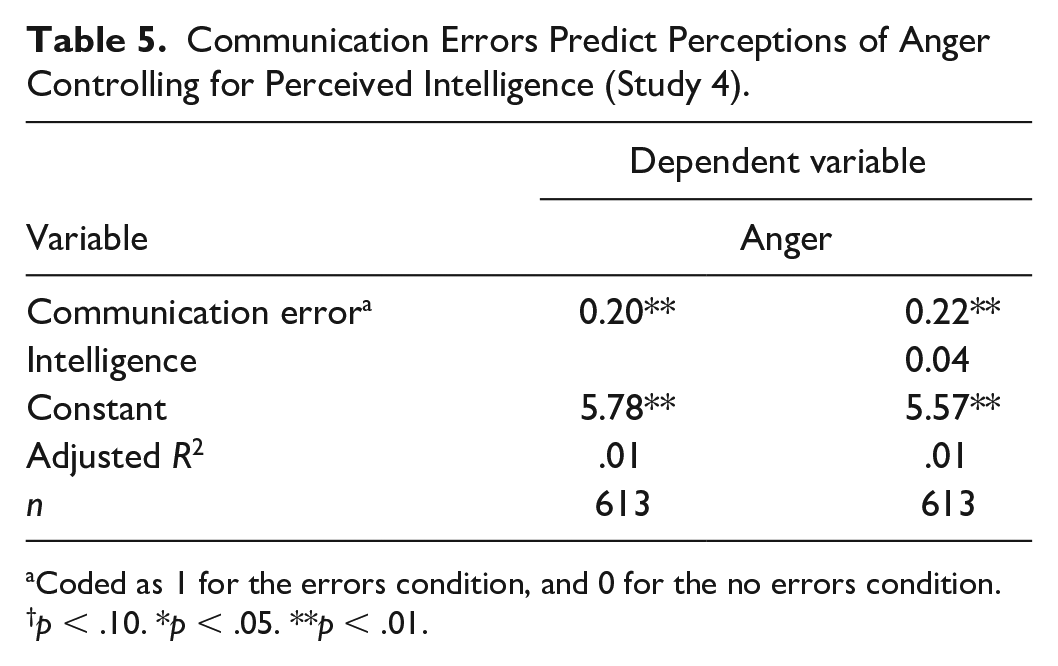
Coded as 1 for the errors condition, and 0 for the no errors condition.
p < .10. *p < .05. **p < .01.
Means and Correlations Among Study 4 Variables.
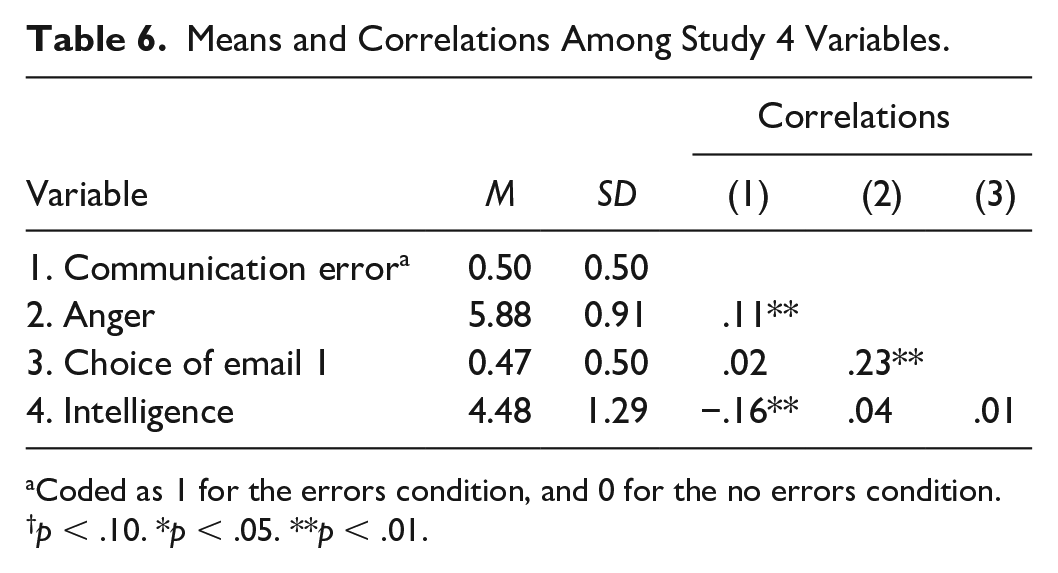
Coded as 1 for the errors condition, and 0 for the no errors condition.
p < .10. *p < .05. **p < .01.
Although perceptions of anger would increase the likelihood that an email would be prioritized, other negative trait attributions (e.g., of [reduced] intelligence) would decrease this likelihood. Accordingly, as per our preregistration, rather than predicting a main effect of typos on response prioritization, we predicted an indirect effect of typos on response prioritization through increased anger perceptions. As expected, we did not find a main effect of typos on response choice (Merrors–chose email 1 = 49%, SD = 0.50; Mno errors–chose email 1 = 46%, SD = 0.50; logistic βerrors = .09, p = .572). However, using the bias-corrected bootstrap method recommended by Preacher and Hayes (2004), we indeed found a significant indirect effect of typos on email choice through anger perceptions (indirect mediation model: 95% CI = [0.0320, 0.2232]). When those who failed either manipulation check (24.1% in the no errors condition, and 15.6% in the errors condition) were removed, all of the results were similarly significant (see Appendix B).
Thus far, we have shown that in emotional contexts, errors amplify perceptions of emotion. Study 4 illustrates that error-driven emotion perception can be consequential; it can influence recipients’ response decisions.
Study 5
In Study 5, we test H3 and more directly link our findings with attribution theory by considering whether the context—either neutral or emotional—can shift attributions from a stable (intelligence) to unstable (emotion) cause. Specifically, we test whether errors may reflect less negatively on message senders in emotional contexts because message readers may partially assume the error is caused by the sender’s emotional state.
Method
Eight hundred three adults (58.4% male; Mage = 33.1, SD = 11.8) from Amazon Mechanical Turk were randomly assigned to evaluate the message sender of an email that was emotional or not, and contained errors or not, yielding a 2 × 2 experimental design. We targeted recruitment of 800 participants to ensure we could detect a small effect (minimum effect size f = .10 with 80% power).
Participants were told that they would be evaluating an email “sent from Jake, an analyst at a marketing firm, to Sean, one of his teammates.” Then, participants were shown an email corresponding with one of the four conditions (see Appendix A).
Participants next rated the email sender’s emotions on a scale of 1 = none to 7 = an extreme amount (anger, outrage, and fury; α = .98; joy, ecstasy, elation, and glee; α = .92, and distress, surprise, sadness, and amazement). Participants also evaluated the message sender’s emotional interference (α = .95) and intelligence (α = .93), as measured in Studies 2 and 3.
Results and Discussion
Our emotion manipulation was successful. In the neutral condition, the mean emotion scores were on the very low end of the 1 to 7 scale (Manger = 1.57, Mjoy = 1.63, Mdistress = 2.44, Mamazement = 1.67, Msadness = 1.77, Msurprise = 2.02), and in the angry condition, participants rated anger on the high end of the scale (Manger = 5.59), F(1, 802) = 3,001.06, p < .001, η2 = .78, 95% CI = [0.77, 0.81].
Consistent with our prior findings, within the angry conditions, there was a main effect of typos on anger perceptions (Merrors = 5.68, SDerrors = 0.96; Mno errors = 5.49, SDno errors = 1.05), t(406) = 1.98, p = .048, d = 0.20, 95% CI = [0.00, 0.39], which persisted when we controlled for perceived intelligence (intelligence perceptions: Merrors = 3.45, SDerrors = 1.14; Mno errors = 4.11, SDno errors = 1.06), t(406) = 6.04, p < .001, d = −0.60, 95% CI = [–0.88, –0.45]; βerrors = .21, t(406) = 1.98, p = .049 (H1). This effect was again mediated by perceptions of emotional interference (indirect mediation model: 95% CI = [0.0283, 0.1436]; H2).
A two-way analysis of variance on intelligence perceptions revealed two main effects and an interaction. In line with the aforementioned work showing that displays of anger are anti-normative and decrease perceptions of intelligence and competence (Kramer & Hess, 2002; Lewis, 2000; Russell & Barrett, 1999), those in the angry conditions rated the message sender as significantly less intelligent (Mangry = 3.76, SDangry = 1.15; Mneutral = 4.32; SDneutral = 1.29), F(1, 802) = 50.75, p < .001, η2 = .05, 95% CI = [0.03, 0.09]. Those in the errors conditions also rated the message sender as significantly less intelligent than those in the no errors conditions (Merrors = 3.55, SDerrors = 1.23; Mno errors = 4.56; SDno errors = 1.04), F(1, 802) = 166.02, p < .001, η2 = .16, 95% CI = [0.13, 0.22].
Importantly, these effects were qualified by a significant interaction, F(1, 802) = 19.35, p < .001, η2 = .02, 95% CI = [0.01, 0.05] (Figure 2). Both emotional and unemotional senders suffered a perceived intelligence penalty for typos; typos significantly decreased intelligence perceptions in both the angry conditions (as previously noted, Merrors = 3.45, SDerrors = 1.14; Mno errors = 4.11, SDno errors = 1.06), t(406) = 6.04, p < .001, d = −0.60, 95% CI = [–0.88, –0.45], and within the neutral conditions (Merrors = 3.66, SDerrors = 1.32; Mno errors = 5.01, SDno errors = 0.81), t(393) = 12.14, p < .001, d = −1.23, 95% CI = [–1.56, –1.13]. However, comparing the relative effect sizes across the emotional and unemotional conditions reveals that errors by unemotional messengers (compared with emotional messengers) resulted in an intelligence penalty over twice as large. Put another way, although intelligence perceptions of unemotional messengers who did not make errors (Mno errors–neutral = 5.01, SDno errors–neutral = 0.81) were significantly higher than intelligence perceptions of angry messengers without errors (Mno errors–angry = 4.11, SDno errors–angry = 1.06), t(380) = 9.33, p < .001, d = −0.95, 95% CI = [–1.09, –0.71], both neutral and angry messengers who made errors were perceived as similarly intelligent (Merrors–angry = 3.45, SDerrors–angry = 1.14; Merrors–neutral = 3.66, SDerrors–neutral = 1.32), t(419) = 1.77, p = .078, d = −0.17, 95% CI = [–0.45, 0.02]; when they made typos, intelligence perceptions of unemotional messengers fell further. This effect was, again, similar when we excluded participants who incorrectly indicated whether they viewed a message with typos (see Appendix B).

Communication errors reduce perceptions of message sender intelligence less in emotional than in unemotional contexts.
This evidence suggests that people partially excuse message sender communication errors in emotional contexts because they attribute such mistakes to the sender’s emotional state rather than solely the sender’s level of intelligence (a stable, trait-based attribution; H3).
General Discussion
Across six studies, we provide evidence of unintentional emotion cues in text-based communications. When messengers made communication errors, people made attributions that the messengers’ emotions were interfering with their normal cognitive functioning, and consequently perceived them as more emotional. Although the effect size of typos on emotion perception is small based on Cohen’s (1977/2013) historical definitions, within the context of social psychology and nonverbal behavior, it is meaningful. Benchmarking these effects using Bosco and colleagues’ (2015) meta-analysis of effect sizes across 20 domains in applied psychology, the main effect of typos on emotion perception would correspond to the 60th percentile of effect sizes observed, and the effect size of typos on perceptions of emotional interference would correspond to the 80th percentile. On an absolute basis, it is quite intriguing that typos, given their subtle nature, can still account for a shift of more than 20% of a standard deviation in emotion perception (Prentice & Miller, 1992). Yet beyond the assessment of this particular nonverbal behavior (typos), these effects are theoretically meaningful because they advance the notion that unintentional cues of emotion exist within email. Thus, the present research serves to uncover a new category of nonverbal behavior (i.e., unintentional emotion cues) within text-based communication that many have thought not to exist.
These findings suggest that email and other text-based communications have a significantly greater variety of emotional cues than historical theories of virtual communication propose (Daft & Lengel, 1986; Dennis & Valacich, 1999; Kiesler et al., 1984). Moreover, they demonstrate that text-based communication can allow for the transmission of one of the most consequential categories of emotion cues: unintentional cues of emotion (DePaulo, 1992; Ekman, 2003). In contrast to prior characterizations of text as a relatively deliberate medium, in which message senders can easily edit out content they do not intend to relay (Dennis et al., 2008; Walther & D’Addario, 2001), these findings suggest that text may offer more opportunities for authentic expression than previously thought—a consequential factor in domains ranging from negotiation outcomes to leadership effectiveness (Côté et al., 2013; Gardner et al., 2009). This work also highlights the potential for message readers to make unstable (e.g., emotion) attributions from typos, rather than stable trait-based attributions (e.g., intelligence), which have been the focus of prior work (Vignovic & Thompson, 2010). This research thus helps resolve a theoretical puzzle: whereas prior research on emotion in text-based communication—which asked participants to intentionally relay an emotion that they were not experiencing—has suggested text has a reduced capacity for emotion signaling (Kruger et al., 2005), other empirical work has demonstrated affective equivalence across text-based and in-person contexts (Derks et al., 2008; Walther et al., 2005). Evidence of unintentional emotion cues in text-based communication, which might only appear if senders are experiencing (rather than simulating) an emotion, may explain why in-person and text-based communication may operate more similarly than previously considered.
These studies also contribute to theory of emotion perception by providing further evidence that people may display more emotion than they are aware of (DePaulo, 1992; Ekman & Friesen, 1981). If it is widely believed that text-based communication only includes deliberate emotion cues, then individuals will be largely unaware of and inattentive to the unintentional cues they may include, ultimately underestimating the level of emotion they are actually communicating. Consequently, the oft-reported misinterpretation of emotion (Byron, 2008; Kruger et al., 2005) may not only be due to individuals’ inability to relay emotion via text, but also to individuals’ potential lack of awareness of the amount of emotion they are actually relaying.
Limitations and Future Directions
We have provided evidence of the presence of unintentional emotion cues within text-based media, yet our findings tested our hypotheses within a specific context and population. Our studies purposefully examined evaluations by strangers (“taking the role” of both a third-party and message recipient) recruited from online panels to assess base perceptions without overpowering contextual factors. Although online panels are meaningfully more diverse than traditional laboratory and single-organization samples (Landers & Behrend, 2015), they are not fully representative of the population (Paolacci & Chandler, 2014). Future research could examine how demographic, relational, and contextual elements may affect these findings. We expect that the extent to which each party’s viewpoint provides access to the emotional nature of the situation would likely influence the relative strength of our findings. For example, if a message would be interpreted as emotional by a recipient, but not necessarily a third party, error-driven emotion perception would likely be larger for message recipients (and vice versa). Similarly, signaling theory research shows that when parties’ interests are aligned (i.e., when there is limited value to deception), they are less attentive to costly signals (Bergstrom & Lachmann, 1998). Thus, costly signals (such as typos) may have a reduced impact on emotion perception in correspondence between friends than between more distant parties. Similarly, prior work suggests that virtual communication may be interpreted differently when it is conducted within a cooperative versus competitive context (Swaab et al., 2012). A reader’s cooperative orientation may also reduce attention to costly signals and weaken the effect.
Although our investigation prioritized internal attributions to highlight the presence of unintentional emotion cues in text-based communications, the context in which a message is sent could also influence the extent to which others attribute errors to external factors. For example, Vignovic and Thompson (2010) found that when people were aware that a message sender was from a different culture (a potential external attribution), they attributed typos less to internal causes (although this work only considered trait-based attributions, such as conscientiousness). We have also focused on messages in a variety of hierarchical professional contexts where typos would be unexpected. In contexts and relationships where typos are not as anti-normative, it is plausible that external attributions may be more likely. For instance, people evaluating messages between two friends may assume that typos may be driven by relational norms rather than individual factors.
Finally, as a means of assessing the possibility for unintentional emotion cues in text, the studies in this article tested our hypotheses in two emotional contexts: joy and anger. Although we believe errors would still be likely to amplify emotion perception within other emotional contexts, we anticipate the strength of the effect would vary. For instance, we expect the effect would weaken within lower valence or lower arousal emotions (e.g., if someone was perceived as so incredibly calm, relaxed, or bored they did not care, did not notice, or were not concerned with making typos), as these emotions may be less associated with being “overwhelming.” Given that the value of—and information interpreted from—signals is determined partially by the context (Barrett et al., 2011), future research should determine how these types of emotional cues differ across differing emotional contexts.
Practical Implications and Conclusion
Emotion is central to human interaction (Clark & Isen, 1982; Heerdink et al., 2015; Pietroni et al., 2008), and people’s ability to accurately interpret and display emotions can have a significant impact on social outcomes, performance, and well-being (Mayer et al., 2008; Van Kleef et al., 2004). As more and more communication is conducted via electronic means (Purcell & Rainie, 2014; Roghanizad & Bohns, 2017), these outcomes will increasingly be determined by perceptions of text-based conversations. If people are unaware of how their behaviors, such as making typos, might be interpreted by others, then they will be more likely to achieve suboptimal outcomes in both personal and professional interactions. For example, if a manager wanted to communicate what she considered an appropriate amount of anger over poor results, she may be more apt to triple check her email knowing that errors would amplify perceptions of her anger. By increasing knowledge of emotion signals that individuals may unknowingly send, people may be better able to transmit their desired emotions.
By demonstrating that communication mistakes can operate as unintentional emotion cues within text-based communications, our research suggests that communication across all media may operate more similarly than previously thought. Whereas, with respect to emotions, text-based communication was previously considered to be a deliberative medium (Dennis et al., 2008; Walther & D’Addario, 2001), our studies demonstrate that unintentional emotion cues can leak through and affect perceptions within this medium. We hope that greater attentiveness to potentially unintentional emotion cues in text-based communication will facilitate future scholarship and more optimal communication practices alike.
Supplemental Material
Blunden_Online_Appendix – Supplemental material for Beyond the Emoticon: Are There Unintentional Cues of Emotion in Email?
Supplemental material, Blunden_Online_Appendix for Beyond the Emoticon: Are There Unintentional Cues of Emotion in Email? by Hayley Blunden and Andrew Brodsky in Personality and Social Psychology Bulletin
Footnotes
Appendix A
Appendix B
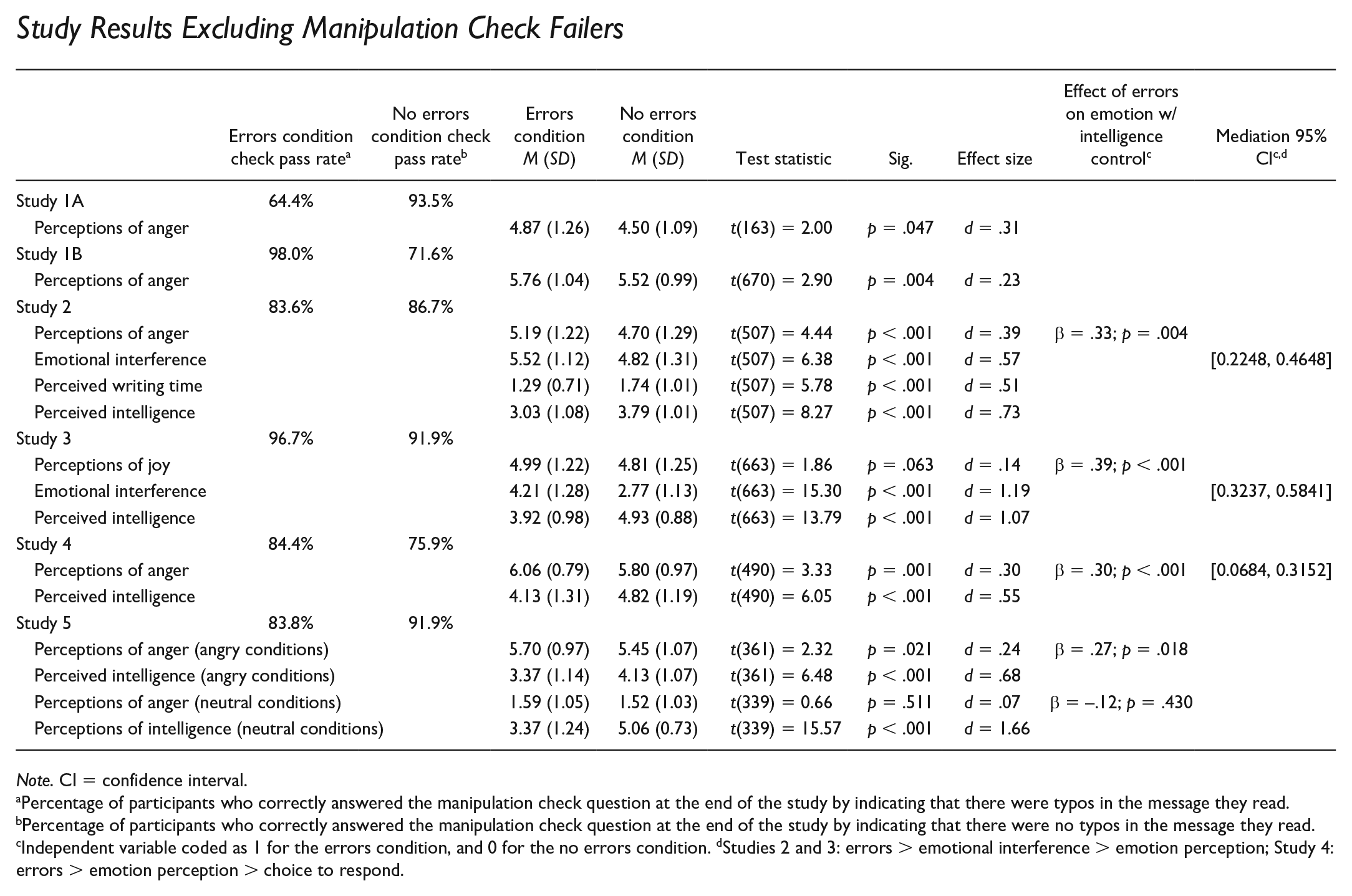
Study Results Excluding Manipulation Check Failers
| Errors condition check pass rate a | No errors condition check pass rate b | Errors condition |
No errors condition |
Test statistic | Sig. | Effect size | Effect of errors on emotion w/intelligence controlc | Mediation 95% CIc,d | |
|---|---|---|---|---|---|---|---|---|---|
| Study 1A | 64.4% | 93.5% | |||||||
| Perceptions of anger | 4.87 (1.26) | 4.50 (1.09) | t(163) = 2.00 | p = .047 | d = .31 | ||||
| Study 1B | 98.0% | 71.6% | |||||||
| Perceptions of anger | 5.76 (1.04) | 5.52 (0.99) | t(670) = 2.90 | p = .004 | d = .23 | ||||
| Study 2 | 83.6% | 86.7% | |||||||
| Perceptions of anger | 5.19 (1.22) | 4.70 (1.29) | t(507) = 4.44 | p < .001 | d = .39 | β = .33; p = .004 | |||
| Emotional interference | 5.52 (1.12) | 4.82 (1.31) | t(507) = 6.38 | p < .001 | d = .57 | [0.2248, 0.4648] | |||
| Perceived writing time | 1.29 (0.71) | 1.74 (1.01) | t(507) = 5.78 | p < .001 | d = .51 | ||||
| Perceived intelligence | 3.03 (1.08) | 3.79 (1.01) | t(507) = 8.27 | p < .001 | d = .73 | ||||
| Study 3 | 96.7% | 91.9% | |||||||
| Perceptions of joy | 4.99 (1.22) | 4.81 (1.25) | t(663) = 1.86 | p = .063 | d = .14 | β = .39; p < .001 | |||
| Emotional interference | 4.21 (1.28) | 2.77 (1.13) | t(663) = 15.30 | p < .001 | d = 1.19 | [0.3237, 0.5841] | |||
| Perceived intelligence | 3.92 (0.98) | 4.93 (0.88) | t(663) = 13.79 | p < .001 | d = 1.07 | ||||
| Study 4 | 84.4% | 75.9% | |||||||
| Perceptions of anger | 6.06 (0.79) | 5.80 (0.97) | t(490) = 3.33 | p = .001 | d = .30 | β = .30; p < .001 | [0.0684, 0.3152] | ||
| Perceived intelligence | 4.13 (1.31) | 4.82 (1.19) | t(490) = 6.05 | p < .001 | d = .55 | ||||
| Study 5 | 83.8% | 91.9% | |||||||
| Perceptions of anger (angry conditions) | 5.70 (0.97) | 5.45 (1.07) | t(361) = 2.32 | p = .021 | d = .24 | β = .27; p = .018 | |||
| Perceived intelligence (angry conditions) | 3.37 (1.14) | 4.13 (1.07) | t(361) = 6.48 | p < .001 | d = .68 | ||||
| Perceptions of anger (neutral conditions) | 1.59 (1.05) | 1.52 (1.03) | t(339) = 0.66 | p = .511 | d = .07 | β = –.12; p = .430 | |||
| Perceptions of intelligence (neutral conditions) | 3.37 (1.24) | 5.06 (0.73) | t(339) = 15.57 | p < .001 | d = 1.66 | ||||
Note. CI = confidence interval.
Percentage of participants who correctly answered the manipulation check question at the end of the study by indicating that there were typos in the message they read. bPercentage of participants who correctly answered the manipulation check question at the end of the study by indicating that there were no typos in the message they read. cIndependent variable coded as 1 for the errors condition, and 0 for the no errors condition. dStudies 2 and 3: errors > emotional interference > emotion perception; Study 4: errors > emotion perception > choice to respond.
Acknowledgements
We thank Teresa Amabile for her advice and support throughout the development of this article.
Declaration of Conflicting Interests
The author(s) declared no potential conflicts of interest with respect to the research, authorship, and/or publication of this article.
Funding
The author(s) disclosed receipt of the following financial support for the research, authorship, and/or publication of this article: This research was funded in part by the Texas McCombs Research Excellence grant.

Supplemental Material
Supplemental material is available online with this article.
References
Supplementary Material
Please find the following supplemental material available below.
For Open Access articles published under a Creative Commons License, all supplemental material carries the same license as the article it is associated with.
For non-Open Access articles published, all supplemental material carries a non-exclusive license, and permission requests for re-use of supplemental material or any part of supplemental material shall be sent directly to the copyright owner as specified in the copyright notice associated with the article.
