



Abstract
Although research suggests distressed individuals benefit from others’ empathy, it is unclear how an individual’s level of empathy influences dyadic responses during emotional situations. In the current study, female participants (N = 140; 70 dyads) were paired with a stranger. One member of each dyad (the experiencer) was randomly assigned to undergo a stressful task and disclose negative personal experiences to their partner (the listener). Experiencers paired with listeners higher in dispositional emotional empathy had less negative affect during emotional disclosure and lower sympathetic nervous system reactivity during the stressful task and disclosure. Listeners higher in emotional empathy reported more negative affect in response to their partner’s distress. Furthermore, for listeners higher in emotional empathy, those who more accurately rated their partner’s emotions were more physiologically influenced by their partners. Findings shed light on interpersonal functions of empathy and suggest a stranger’s level of emotional empathy regulates distressed partner’s emotions and physiology.
Keywords
In times of distress, we often find someone who will empathize with us by sharing our emotional experience. These kinds of interactions are common across health care, emergency, and service industries. Even within our everyday relationships, we seek support from people in our social networks who report the highest levels of empathy (Morelli et al., 2017). For individuals experiencing distress, interacting with an empathic listener can be beneficial (Brown et al., 2018; Brown, Wells, et al., 2020; Decety et al., 2014; Halpern, 2003). For example, patients dealing with distressing medical or psychological symptoms have better physical and mental health outcomes if their health care provider is more empathic (Decety & Fotopoulou, 2015; Elliott et al., 2018). However, for listeners interacting with a distressed partner, there may be costs associated with high empathy such as compassion fatigue and burnout (Klimecki & Altruism, 2012). These aforementioned costs (for listeners) and benefits (for distressed individuals) related to a listener’s level of empathy likely result from the emotional and physiological processes that occur during dyadic interactions, yet these processes remain poorly understood. Here, we directly address the question of how a listener’s level of empathy influences emotional and physiological responses within newly acquainted dyads in the context of distress.
Potential Benefits of an Emotionally Empathic Listener for Distressed Individuals
Empathy is a multidimensional construct that encompasses our ability to share, understand, and respond appropriately to others emotions (Decety & Jackson, 2004). Dispositional emotional empathy refers to the tendency to share others’ emotions (i.e., feeling what someone else feels), and is thought to depend on a phylogenetically early emotion contagion system that enables us to embody other’s emotions (Preston & de Waal, 2002). In contrast, dispositional cognitive empathy refers to the tendency to understand another’s emotions or perspective, and is thought to depend on more advanced perspective-taking systems (de Waal, 2008). By definition, individuals high in emotional empathy are more likely than individuals low in emotional empathy to share and embody a partner’s emotions (including partner’s distress and negative affect) whereas cognitive empathy does not necessarily require sharing a partner’s emotional experience (Davis, 1983a, 1983b). Emotional empathy is thought to underpin our ability to respond appropriately to other’s distress (Davis, 1983a), and researchers have theorized that without emotional empathy, cognitive facets of empathy (such as perspective-taking) would be “cold” phenomena that do not necessarily promote attention and concern toward others’ in distress (de Waal, 2008). In line with theory, we propose that emotional empathy, more so than cognitive empathy, will benefit distressed partners.
How does emotional empathy benefit distressed partners during interactions? Clinical psychological theories argue that empathy regulates a distressed partner’s negative affect and arousal (Fosha, 2001; Paivio & Laurent, 2001). Emotionally empathic individuals are thought to promote awareness and disclosure of emotion (Halpern, 2003; Suchman et al., 1997; Rime, 2009), which can encourage emotion labeling and describing—two processes known to attenuate negative affect (Pennebaker, 1997; Torre & Lieberman, 2018). For these reasons, we propose that more emotionally empathic individuals may lessen distressed partners’ negative affect, particularly during conversational interactions in which negative emotion is disclosed and discussed. However, conversation may not be necessary for emotional empathy to wield interpersonal benefits. Even when a listener simply shares and mirrors their partner’s distress via emotional empathy, this process is theorized to normalize their partner’s emotional experience, reduce anxieties of being overwhelmed or judged, and show that emotions are appropriate and warranted (Paivio & Laurent, 2001). Therefore, we also propose that listeners higher in emotional empathy could reduce a distressed partner’s negative affect without conversing, when the listener is present and visible as their partner undergoes a stressor.
The psychological effects of empathy may “get under the skin,” affecting physiological responses of distressed partners (Decety & Fotopoulou, 2015; Decety et al., 2014). This proposal is based on a large body of research that suggests supportive partners can alter physiological reactivity to stress (Brown & Coan, 2016; Eisenberger et al., 2007; Thorsteinsson & James, 1999). However, the vast majority of work examining the effects of supportive partners on physiological reactivity has focused on close relational partners and examined how the established qualities of those relationships affect physiological reactivity to stress (Brown et al., 2017; Coan et al., 2017; Thorsteinsson & James, 1999). Although features of relationships and characteristics of supportive partners, such as general “likeability,” may reduce a partner’s reactions to distress (Bodie et al., 2013), dispositional emotional empathy may have more potent distress-reducing effects than likeability, because emotional empathy promotes shared distress.
In the present research we examine, among strangers who are newly acquainted, whether individual differences in listeners’ dispositional emotional empathy affect distressed partners’ negative affect and physiological reactivity. We compare emotional empathy with other potentially distress-reducing factors such as cognitive empathy and likeability, and focus on physiological sympathetic nervous system (SNS) reactivity, which has been linked to broad dimensions of negative affect and distress, including intensity, arousal, and cognitive effort (Goldstein, 1987; Levenson et al., 2017).
Potential Costs of Being an Emotionally Empathic Listener
Emotionally empathizing with a distressed partner is theorized to come with emotional costs of heightened negative affect. Emotionally empathic individuals report proneness to take on the emotions of a partner and demonstrate heightened sensitivity to other’s negative emotions (Chikovani et al., 2015; Davis et al., 1987). Thus, more emotionally empathic listeners may experience greater levels of negative affect when interacting with a distressed partner.
Listeners higher in emotional empathy are also theorized to experience greater physiological stress contagion (i.e., greater physiological linkage to a distressed partner; Dimitroff et al., 2017; Engert et al., 2014). Physiological linkage to a partner occurs when an individual “catches” their partner’s physiological arousal (indexed via the influence of a partner’s physiological state on one’s own physiological state). More empathic listeners may have greater physiological linkage to a distressed partner, either as a result of emotion contagion because they simulate and share their partner’s distress (Chen et al., in press), or simply because they are motivated to put forth greater attention and cognitive effort toward a distressed partner’s emotions during an interaction (Engert et al., 2014; Weisz & Zaki, 2018; Zaki, 2014). Thus, we examined whether higher emotional empathy is associated with heightened physiological stress contagion (indexed via SNS physiological linkage) to a distressed partner.
Theorists have also argued that one must accurately recognize a partner’s emotions to share and embody that partner’s physiological state and link physiologically to that partner (Dezecache et al., 2015; Hatfield et al., 1993). Thus, an accurate perception of a distressed partner’s changing emotions may be required for emotionally empathic individuals to link physiologically to a distressed partner. But to date, little empirical evidence has emerged supporting a clear one-to-one relationship between interpersonal accuracy and physiological linkage (for a review see Thorson, 2018). Taken together, research and theory suggest positive associations between physiological linkage and accuracy may be best captured in social–emotional contexts in which individuals are likely to attend to relevant expressive behavioral cues suggestive of negatively valenced affective states (Funder, 1995; Levenson & Ruef, 1992; Thorson, 2018; West & Kenny, 2011). We explore whether individuals higher in emotional empathy who are interacting with a distressed partner have greater physiological stress contagion (more linkage to the distressed partner) when they accurately perceive their distressed partner’s emotional experiences.
Current Study
The present study utilizes a multimethod approach to investigate the effects of a listener’s dispositional emotional empathy on affective and physiological processes during dyadic interactions involving a distressed partner. After reporting on their levels of emotional empathy and cognitive empathy, strangers briefly interacted in the laboratory in pairs to get acquainted and rate their partner’s likeability. One member of the dyad (who we refer to as the experiencer) was randomly assigned to undergo a distressing emotion induction without their partner (the listener). Experiencers then underwent a stressful task in the presence of the listener and then disclosed negative personal experiences to the listener during a conversational interaction. Thus, we created a paradigm in which, to the greatest extent possible, distress originated from the experiencer and was shared with the listener. We measured each dyad member’s negative affect, physiological SNS responses, and ability to accurately identify their partner’s emotions.
Our design and methods enabled us to address role-specific (i.e., experiencer versus listener) hypotheses related to listener’s dispositional emotional empathy. First, we hypothesized that experiencers paired with listeners higher in dispositional emotional empathy would report less negative affect and exhibit lower SNS reactivity during both the stressful task and emotional disclosure. We expected physiological effects would be task-specific (i.e., we did not expect to find effects when dyads interacted before experiencers underwent distressing tasks or when they were separated from their partner). Second, we hypothesized that listeners higher in dispositional emotional empathy would have greater negative affect and greater physiological linkage to the experiencer. All hypotheses were planned a priori.
In addition, we conducted exploratory analyses examining whether, for listeners higher in empathy, greater physiological linkage would be related to increased accuracy in rating the experiencer’s affect. We also explored whether effects are specific to emotional empathy, or whether they extend to other factors such as cognitive empathy (i.e., perspective-taking) and “likeability” that may be similarly stress reducing, but do not necessitate emotion sharing. Our design enabled us to examine the validity of theoretical perspectives on the interpersonal functions of emotional empathy in the context of another’s distress, across a variety of conversational and non-conversational situations.
Method
Materials, data, and syntax used for the current manuscript are available through the Open Science Framework (OSF) at https://osf.io/7ujyg/?view_only=3dfcb9b02a404cd1853bc87771c94a7f.
Participants
Participants (N = 140, all females; n = 70 dyads) between the ages of 18 and 35 (M = 25.24, SD = 4.02) were recruited from the San Francisco Bay area via flyers and online advertisements. All participants were native English speakers. Approximately 44% of participants identified as White, 17% identified as Asian, 23% identified as Hispanic, 5% identified as Black, and 10% identified as mixed or other race. Income levels varied, with 22.9% of the sample earning <US$20,000, 27.9% earning US$20,000–US$50,000, 25% earning US$50,000–US$100,000, 20.7% earning US$100,000–US$200,000, and 3.5% earning >US$200,000.
Given research that suggests gender differences in emotional disclosure (with females tending to disclose more emotion than males, particularly to other female listeners; Dindia & Allen, 1992; Mendes et al., 2003), we recruited same-sex female dyads to optimize power. We had a minimum goal of 70 dyads and stopped data collection at this point due to staffing constraints. Our minimum goal of 70 dyads was based on a combination of power analyses for multilevel models (see Supplemental Section 1 for a full description and OSF for SAS Syntax) and on our past dyadic research with samples ranging from 35 to 80 participants per cell (Karnilowicz et al., 2019; Kraus & Mendes, 2014; Thorson et al., 2019; West et al., 2017). We aimed for the upper end of this spectrum given our desire to explore continuous moderators of physiological outcomes.
Procedure
Figure 1 depicts the procedural timeline. Participants first completed an online survey, including questionnaire assessing empathy, and a series of 11 questions that asked them to briefly describe and rate the emotional intensity of a variety of negative personal experiences (e.g., “What is the saddest thing that ever happened to you?” and “How emotionally intense was it for you to think and write about this experience?”).
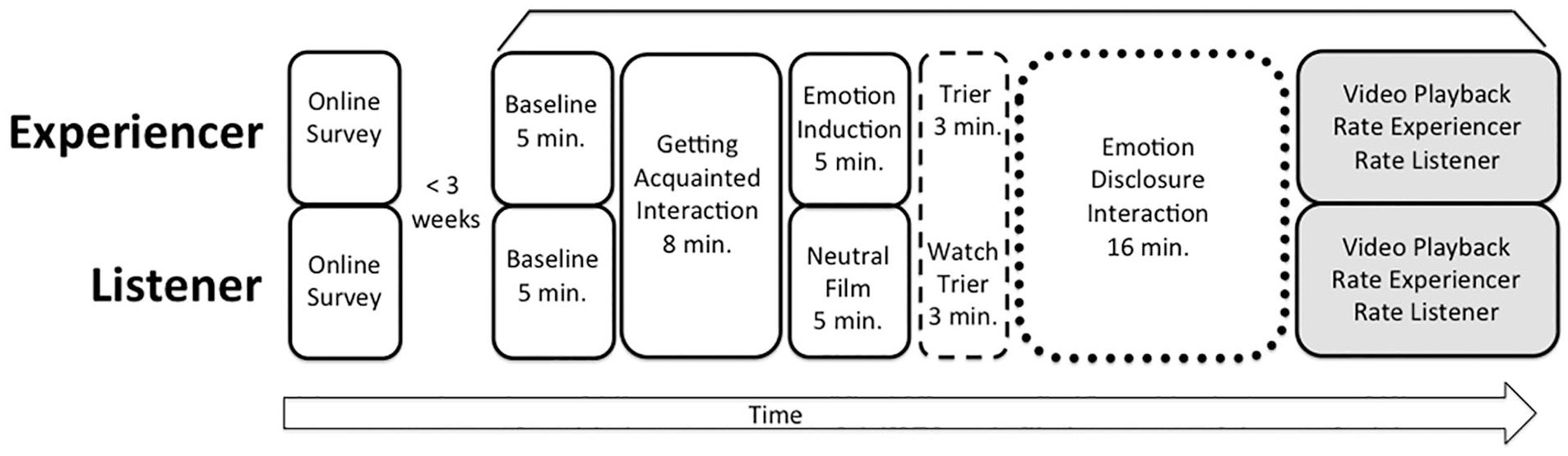
Overview of experimental procedure.
Within 3 weeks of filling out the online survey, participants visited the laboratory in dyads. Dyads were strangers, matched within 5 years of age. Given possible differences due to cross-race pairing, we assigned participants to interact with someone from a similar race/ethnic categories (West et al., 2017). Participants were randomly assigned to the role of experiencer or listener. Participants were consented in separate rooms, and were informed that some laboratory tasks would involve interacting with another participant. During consent, participants who were assigned to the role of “experiencer” were asked if they would be willing to share their personal stories they described in their online questionnaires with their interaction partners. Participants were given several minutes to review the responses they provided to the prompts in the online questionnaires. During consent, to further encourage genuine emotional disclosure, experiencers were monetarily incentivized to be as open and honest as possible and to share their true emotional experiences with their partner (unbeknownst to listeners; see Supplemental Section 2 for details).
Following consent, participants were brought to a large experiment room and seated on opposite sides of a black curtain. Before participants were introduced to their partners, physiological sensors were attached and participants were asked to sit quietly for 5 min for a physiological baseline recording. Following the baseline period, the curtain was opened, participants were introduced and they engaged in an 8-min “getting acquainted” conversation with their partner. Following the conversation, the curtain separating the participants was closed, and participants responded to several questions regarding how “nice” and “likeable” partners were (“likeability”; see Supplemental Section 5). This interaction provided a comparison interaction task in which distress was not shared, and allowed us to measure likeability of the listener prior to the emotion induction.
Next, during the emotion induction period, partners were separated, and listeners were given earbuds and noise-canceling headphones. Listeners watched a nature documentary describing hiking the Appalachian Trail. While the listener watched the neutral film, the experiencer underwent a distressing emotion induction. Specifically, the experiencer watched a series of emotional film-clips designed to elicit negative emotion and distress while simultaneously engaging in a variety of sensorial manipulations aimed to heighten felt negative emotions. First, experiencers watched a scene from the movie Trainspotting depicting a man defecating in a dirty bathroom. As experiencers watched the film, they were instructed to drink from a glass cup filled with brown water (dyed with tasteless brown food color), containing a realistic (plastic) cockroach visible within an ice cube. Next, experiencers viewed a scene from American History X, depicting a man stomping another man’s head on a curb. Finally, experiencers watched a scene from the foreign film Dogtooth, in which a woman stands in a bathroom and repeatedly strikes her face with a hand-weight. During this final film clip, experiencers immersed their hand in an ice bucket to facilitate feelings of distress. Thus, we created novel, intense, and varied distressing emotional reactions, and ensured that experiencers would have distressing experiences to describe later in nuanced and vivid details to the listener during the emotion disclosure. The task also provides an interesting comparison of a distressing context for the experiencer in which the listener is not present. However, the primary goal of these tasks was to induce negative affect and arousal, to observe buffering effects of listener’s emotional empathy on experiencer’s negative affect and arousal in the subsequent tasks.
Following the films, the curtain was opened and the experiencer was asked to undergo a Trier Social Stress Test (TSST) while the listener watched (in view of the experiencer). Specifically, the experiencer was asked to give a speech about their strengths and weaknesses in front of two evaluators, one male and one female. Following 2 min of speech, the male evaluator asked the experiencer to “count backwards by seven starting at the number 23,485 as fast as you can with as few errors as possible.” The TSST is a stressful task known to reliably elicit responses from the two primary stress systems (hypothalamic–pituitary–adrenal [HPA] and sympathomedullary pathway [SAM]) in healthy individuals (Henze et al., 2017; Kirschbaum et al., 1993). The goal of the TSST was to create a stressful situation for the experiencer in which the listener is present and observable, but not personally undergoing the stressor or conversing.
After 1 min of counting backwards in the TSST, listeners were given a stack of cue cards, and the evaluators left the room. The cue cards were used for a 16 min emotion disclosure interaction and included three prompts related to the negative emotion induction the experiencer experienced in the laboratory alone, as well as the prompts from the online questionnaire regarding emotionally negative personal experiences from the experiencer’s life. The cue cards were ordered based on the experiencer’s own ratings of the intensity of the topics from the online questionnaire (highest intensity to lowest intensity; see Supplemental Section 3 for conversational prompts). The listener was asked to read the prompt/question on each card aloud, and move through the stack of questions one at a time, allowing 1–3 min for the experiencer to respond to each card. The listener was asked to “respond naturally as if you were conversing with a friend.” The long duration of the interaction (16 min) enabled more reliable estimates of physiological linkage, and the emotion disclosure task also provides a theoretically relevant interaction in which the experiencer describes their distress and the listener responds conversationally (in contrast to the TSST, where the listener is also visible, but not conversing). 1
During the TSST and emotion disclosure interaction, a video recording was made of each participant. Following the dyadic interaction, the curtain between participants was closed, and participants retrospectively rated their own and their partner’s emotional valence during the TSST and during the interaction using a slider while watching the video playback. The slider ranged from extremely negative on the left, to extremely positive on the right, with neutral in the middle. First, both participants watched the video recording of the experiencer and rated the experiencer’s emotional experience. Next, this was then repeated with the video recording of the listener. The goal of this task was to derive an objective measure of interpersonal accuracy.
Measures
Emotional empathy
During the online assessment participants completed the Balanced Emotional Empathy Scale (BEES; Mehrabian & Epstein, 1972), which measures self-perceived emotional empathy. This 30-item scale is thought to capture individual’s tendency to vicariously experience other’s emotions, and includes items related to the positive feelings and negative feelings like sadness and distress that are relevant to our hypotheses. Participants also completed the empathic concern subscale from the Interpersonal Reactivity Index (IRI; Davis, 1983a; which yielded results similar to the BEES; see Supplemental Section 4).
Cognitive empathy
During the online assessment participants completed the IRI (Davis, 1983a), which includes a subscale on perspective-taking (i.e., cognitive empathy).
Likeability
Following the “getting acquainted” interaction, participants responded to 17 items related to qualities of their partner and their interaction on a 5-point scale ranging from strongly disagree to strongly agree (e.g., “This person seemed nice.”; “This person was not likeable.”; “I enjoyed the conversation.”; see Supplemental Section 5 for a full list of items). Items were reversed where appropriate and averaged, with higher scores reflecting greater likeability (α = .86).
Self-reported affect during TSST and emotion disclosure interaction
In the questionnaire completed by experiencers and listeners following the emotion disclosure interaction, experiencers rated two items regarding their emotional valence during the TSST on a scale of 1 “very negative” to 5 “very positive,” “How did you feel giving your speech?” and “How did you feel during the mental arithmetic.” Similarly, listeners rated their emotional experience for the TSST, “How did you feel watching your partner give a speech?” and “How did you feel watching your partner do the mental arithmetic?” For each participant, their two ratings were averaged to reflect self-reported valence during TSST, r = .576, p < .001. In the questionnaire, experiencers and listeners also rated their emotional valence during the emotion disclosure interaction on the same scale. Experiencers responded to the item “Overall, how did you feel sharing your emotional stories.” Listeners responded to the item, “Overall, how did you feel listening to your partner’s emotional stories.” The scale mirrors the affective circumplex model of perceived emotional valence (Posner et al., 2005), which encompasses both positive and negative affect on a unidimensional scale.
SNS reactivity
Participants’ autonomic nervous system responses were obtained during all tasks. We measured electrocardiography (ECG) and impedance cardiography (ICG) using Biopac hardware (ECG, NICO modules) and integrated into an MP150 system. All channels were sampled at 1000 Hz. To calculate pre-ejection period (PEP), the ECG and first-derivative of the dz/dt waveform from the impedance module are superimposed on each other using Mindware software (IMP 2.6). We used a 30-s ensemble window to calculate PEP, a primary measure used in dyadic physiologic synchrony studies (Kraus & Mendes, 2014; Thorson et al., 2018; Waters et al., 2014, 2017; West et al., 2017). PEP is a measure of SNS activity measured as the time from the electrical impulse initiating ventricle contraction to the aortic valve opening (Brownley et al., 2000). PEP is a noninvasive cardiac measure of pure SNS activation that is not influenced by PNS activity and has been validated via pharmacological blockade (Bernston et al., 1994). Unlike other biological indices of stress (e.g., hormones), PEP responds quickly and can be measured dynamically and continuously, in vivo, during a social interaction. Shorter PEP intervals are due to greater contractile force and indicate greater SNS activation. To calculate PEP reactivity, we used the 30-s PEP values from the last minute of baseline and subtracting each PEP value from the tasks. Lower PEP reactivity values indicate greater SNS reactivity to the task. It is important not to equate PEP, which indexes SNS arousal more generally, with distress, however, instead PEP reactivity provides a general indication of intensity of felt experiences and general arousal, so increased distress in distressing contexts but also increased joy in positive contexts (Mendes, 2016).
Physiological linkage
We calculated a PEP physiological linkage score for each person during the emotion disclosure interaction. Linkage scores represented the extent to which one person was physiologically influenced by their partner. To calculate these linkage scores, we conducted a regression model for each person in each dyad, where the listener’s physiology at time T+1 was predicted by their partner’s (experiencer’s) physiology at time T and their own physiology at time T. We adjusted for stability—listeners’ own prior physiology—when calculating linkage, based on the approach outlined in (Thorson et al., 2018). Thus, each individual’s linkage score reflects the extent to which their PEP reactivity is influenced by their partner’s PEP reactivity in the prior bin, while adjusting for their own prior physiology. We made two a priori decisions regarding the linkage scores: One, we would remove participants’ linkage scores if they had more than 50% of the data missing within the task; two, we removed scores that were extreme outliers (3 SDs above/below the mean linkage score). One dyad was removed following this protocol. Critically, in all our empirical work examining physiologic linkage during active tasks, we focus on PEP because it is a pure measure of SNS activation, responds within seconds of an affective state, and is linked to broad dimensions of affect, specifically intensity and effort (e.g., Kraus & Mendes, 2014; Waters et al., 2014; West et al., 2017).
Accuracy
Accuracy scores were computed for each participant using slider ratings obtained during the video playback of the emotion disclosure interaction. Slider position was averaged each second, resulting in second-by-second time-series for each participant reflecting affect ratings of the partner and ratings of the self. Time lagged cross correlations were computed between ratings of the partner and partner’s self-ratings, which capture the extent to which individuals accurately perceive changes in their partner’s emotional valence. The maximum cross-correlation coefficient was selected from a lag window of −2 to +2 to account for differences in slider use between participants. 2 Thus, for each participant, we select their best accuracy score within a limited time window. Accuracy scores were missing for 11 dyads due to technological difficulties during the playback of the interaction.
Analytic Strategy and Predictions
Experiencers’ self-reported affect
We used correlations to examine whether experiencers paired with listeners higher in dispositional emotional empathy reported less negative affect.
SNS reactivity
To examine whether experiencers paired with listeners higher in dispositional emotional empathy exhibited lower SNS reactivity during the stressful task and emotion disclosure, we estimated two-level crossed dyadic models (individuals nested within dyads, crossed with time; Kenny et al., 2006). We treated dyad members as indistinguishable (using methods described in West et al., 2014). We estimated five random effects: intercepts (i.e., average levels of PEP reactivity), linear slopes (which capture variance in changes in reactivity over the course of the study), the within-person slope–intercept covariance (one person’s linear change with their own intercept), the between-person intercept covariance (i.e., one person’s intercept with their partner’s intercept), and slope covariance (i.e., one person’s slope with their partner’s slope).
For the fixed effects, we examined differences in reactivity as a function of task (five level variable: getting acquainted, emotion induction, TSST, emotion disclosure interaction, and play back), role (experiencer vs. listener), and listener and experiencer empathy. Models included the main effects of these variables and all two-way interactions between task, role, and listener empathy, and task, role, and experiencer empathy. We also included the three-way task × role × actor empathy interaction, and the three-way task × role × partner empathy interaction. The latter interaction is of key theoretical interest, as this interaction tests whether experiencers and listeners had different levels of reactivity as a function of their partner’s level of empathy during certain tasks.
Exploring reactivity over time within the TSST
In an exploratory analysis, we examined whether the hypothesized association between partner empathy and experiencer reactivity changed over time during the TSST (i.e., became stronger or weaker). The model included the main effect of linear time, and all two-way interactions between time, role, and partner empathy, as well as the three-way role × partner empathy × time interaction, on the TSST SNS reactivity data.
Listeners’ self-reported affect
We used two correlations to examine whether listeners higher in dispositional emotional empathy had (a) greater negative affect during the TSST, and (b) greater negative affect during the emotion disclosure.
Physiological linkage
To examine whether listeners higher in dispositional emotional empathy had greater physiological linkage, we estimated dyadic models in which the participants’ linkage scores to their partner were treated as the outcome, treating dyad as unit of analysis to adjust for nonindependence in linkage scores (Kenny et al., 2006). We included the main effect of role, actor empathy, partner empathy, and all interactions between role, actor empathy, and partner empathy. The key effect of interest is the two-way actor empathy × role interaction, which tests whether the relationship between one’s own empathy and linkage varies by role.
Physiological linkage and accuracy
To examine whether listener empathy moderates the relationship between listener’s physiological linkage and accuracy in rating experiencers, we estimated dyadic models in which participants’ accuracy scores were treated as the outcome, treating dyad as unit of analysis to adjust for nonindependence in dyad members’ accuracy scores (Kenny et al., 2006). We included the main effect of the participants’ own linkage to their partner (the actor effect), which tests whether people whose physiology moves in response to their interaction partners’ physiology are more accurate in reading those partners. We also included the main effects of role, actor empathy, and partner empathy, and all interactions between actor linkage, role, and actor empathy (and partner linkage, role, and partner empathy). The key effect of interest is the three-way actor linkage × actor empathy × role interaction, which tests whether the effect of one’s own empathy on the association between one’s own linkage and accuracy differs by role.
Exploring the Specificity of Emotional Empathy
To examine whether observed effects were specific to emotional empathy, when hypotheses related to emotional empathy were supported, we re-ran analyses replacing emotional empathy with (a) cognitive empathy and (b) partner likeability.
Results
Descriptive statistics for key variables of interest are presented in Table 1, and mean PEP reactivity across tasks for experiencers and listeners is presented in Figure 2. We report effect sizes for fixed effects as partial-R2s, which are appropriate for multilevel models (
Descriptive Statistics for Key Variables of Interest.
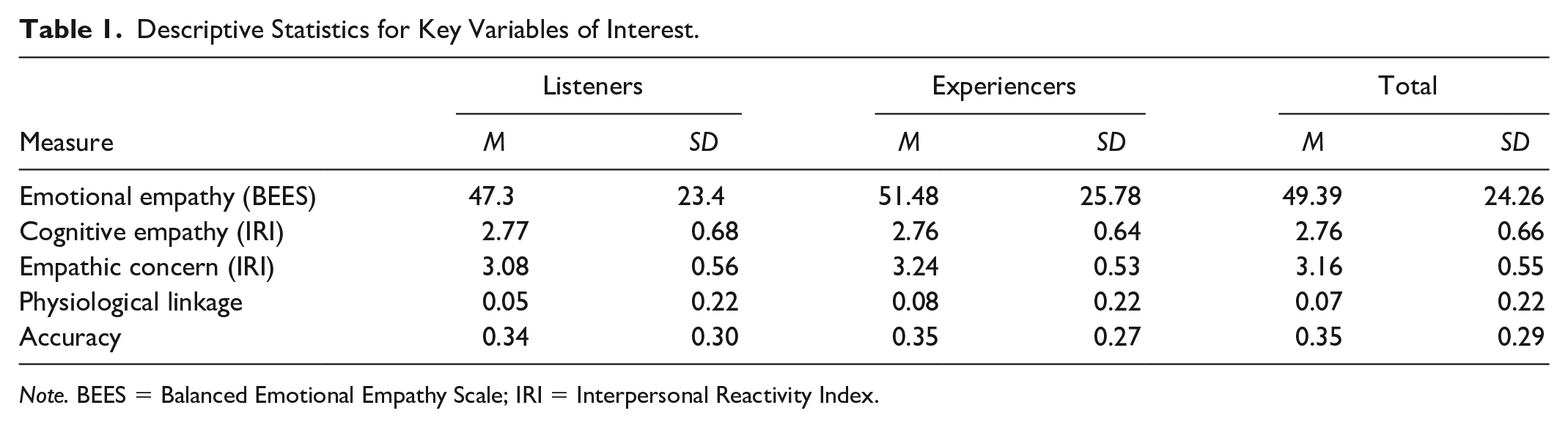
Note. BEES = Balanced Emotional Empathy Scale; IRI = Interpersonal Reactivity Index.

Average PEP reactivity for experiencers and listeners across the study.
Experiencers’ Self-Reported Affect
Experiencers paired with listeners higher in empathy did not report less negative affect during the TSST, r(63) = −.08,p = .555, however, in line with hypotheses, experiencers reported significantly less negative affect during the emotion disclosure interaction if the listener was higher in empathy, r(64) = .34, p = .005.
SNS Reactivity
A main effect of role was found, F(1, 88) = 9.11, p = .003,
For the TSST, the two-way role × partner empathy interaction was significant, (b = 0.08, SE = 0.02, Upper CI = 0.13, Lower CI = 0.04), t(192) = 4.05, p < .001,
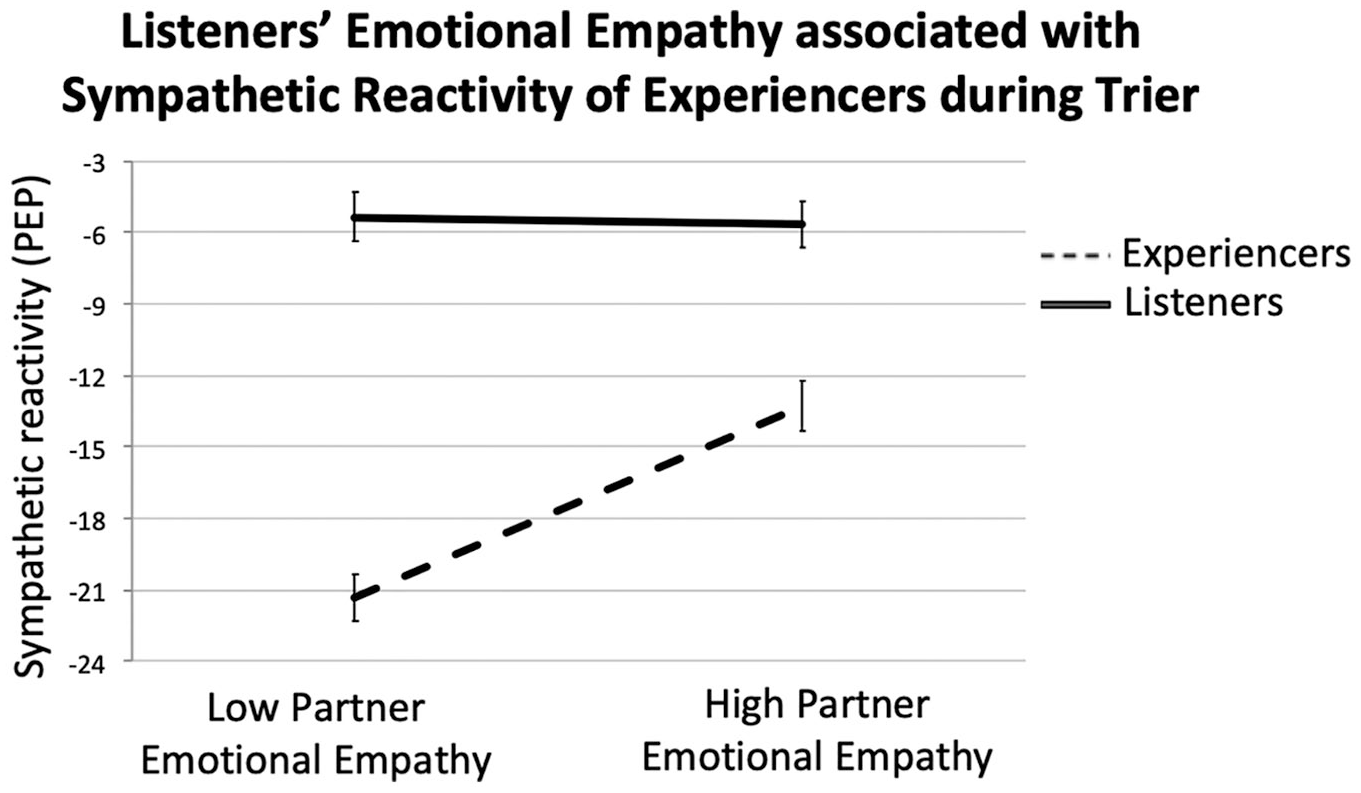
Experiencers paired with listeners higher in emotional empathy had lower SNS reactivity (relatively higher pre-ejection period) during the Trier Social Stress Task.
The same pattern was observed for the emotion disclosure interaction, for which the two-way role × partner empathy interaction reflected a nonsignificant trend (b = 0.04, SE = 0.02, Upper CI = 0.08, Lower CI = −0.01), t(163) 1.70, p = .09,
Exploring Reactivity Over Time Within the TSST
There was a main effect of time, (b = 0.46, SE = 0.16, Upper CI = 0.78, Lower CI = 0.14) t(63.70) = 2.87, p < .01,
The role by partner empathy interaction obtained in the previous analysis remained significant (b = 0.16, SE = 0.08, Upper CI = 0.31, Lower CI = 0.01), t(122) = 2.11, p = .037,
Listeners’ Self-Reported Affect
Listeners higher in emotional empathy reported significantly greater negative affect during the emotion disclosure interaction, r(67) = −.29, p = .018. A similar pattern was observed during the TSST, although this was at nonsignificant trend level, r(67) = −.20, p = .099. Thus, similar to the experiencers, listeners’ empathy was associated with negative affect, but only during a task that required direct exchange between the experiencer and the listener (i.e., the emotion disclosure task) and not during the TSST when the listener is merely observing the experiencer complete the task.
Physiological Linkage
During the emotion disclosure, overall linkage was positive (b = 0.06, SE = 0.02, Upper CI = 0.10, Lower CI = 0.02), t(57.02) = 2.87, p = .006,
Linkage and Accuracy
We observed a significant three-way actor linkage × actor empathy × role interaction, (b = −0.02, SE = 0.01, Upper CI = −0.004, Lower CI = −0.03), t(90.02) = −2.58, p = .011,
For listeners, however, there was a significant actor linkage × actor empathy interaction, (b = 0.03, SE = 0.01, Upper CI = 0.05, Lower CI = 0.01), t(84.33) = 2.49, p = .015,
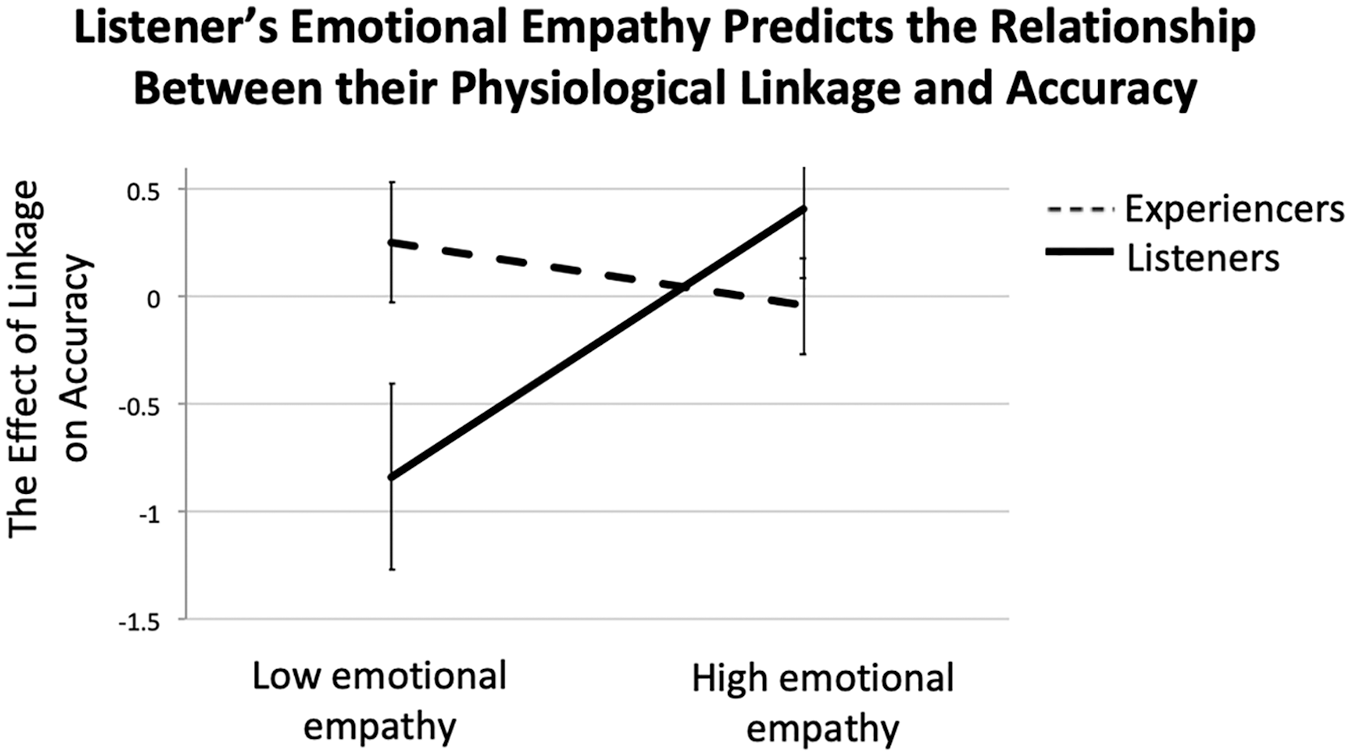
For listeners higher in emotional empathy, greater physiological linkage was associated with better accuracy in rating their partner’s emotions.
Exploring the Specificity of Emotional Empathy
To explore the specificity of the findings as they relate to emotional empathy versus potentially related constructs like cognitive empathy or general likability, we re-ran analyses, using cognitive empathy and likeability rather than emotional empathy in our models. Across analyses, neither cognitive empathy nor likeability yielded the same associations as emotional empathy, with one exception. Experiencers reported significantly less negative affect during the emotion disclosure interaction if the listener was higher in likeability, r(64) = .31, p = .011. Given this significant effect of listener likeability, we ran a regression with both listeners’ likeability and emotional empathy included as predictors of experiencers’ affect during the emotion disclosure interaction to account for their shared variance. Results suggest that likeability, ß = .24, t(62) = 2.07, p = .044 (b = 0.49, SE = 0.24, Upper CI = 0.96, Lower CI = 0.01), and emotional empathy, ß = .29, t(62) = 2.39, p = .020 (b = 0.11, SE = 0.01, Upper CI = 0.02, Lower CI = 0.002), each independently predicted experiencers’ affect during the emotional disclosure interaction. However, neither listeners’ likeability nor cognitive empathy were associated with experiencers’ SNS reactivity during the TSST or emotion disclosure, and neither listeners’ likeability nor cognitive empathy moderated the association between listeners’ linkage and accuracy (see Supplemental Sections 6 for details).
Discussion
The current study examined how an individual’s level of dispositional emotional empathy affects their interactions with a distressed partner. We utilized a dyadic design wherein strangers interacted in the laboratory and were randomly assigned to the role of an experiencer (who experienced and disclosed distressing negative emotions) or a listener (who observed and responded to another’s distress).
We highlight four key findings. First, experiencers reported less negative affect when disclosing emotion, and had less SNS reactivity during a stressful task and when disclosing emotion if they were paired with a listener higher in emotional empathy. That is, empathic listeners “buffered” their distressed partners’ negative affect and sympathetic reactivity. Second, we found that listeners who reported higher dispositional emotional empathy experienced greater negative affect in response to their partners’ distress in the laboratory. That is, highly empathic individuals experienced an affective cost of interacting with a stranger who just experienced a negative and stressful experience. Third, we hypothesized, but did not find that listeners higher in empathy were more likely to link physiologically to their partners. We did find a strong main effect that dyads linked physiologically during their interaction, but it was not moderated by listener empathy. Our fourth and final observation is that when more empathic listeners showed greater accuracy in rating their partner’s emotions, they had stronger physiological linkage to their partners. These findings suggest that listeners higher in emotional empathy are influenced by their distressed partner’s SNS arousal if they have better accuracy in identifying their distressed partner’s emotions. These effects of listener’s emotional empathy were not attributable to listener’s cognitive empathy or likeability.
Benefits of Partner Empathy for the Distressed Individual
Our findings that experiencers paired with more emotionally empathic listeners’ had less negative affect and lower sympathetic reactivity suggest that more empathic listeners can make distress less harmful, and highlight direct benefits of partner’s emotional empathy. Because we measured SNS reactivity continuously, in exploratory analyses, we examined the effects of listener’s empathy on experiencer’s SNS across the entire stress task and found that the effect of listener empathy on SNS reactivity was consistent throughout the entire TSST. Experiencers were initially (within the first 30 s of the task) less physiologically reactive to the stress of a TSST if the listener they were paired with had higher emotional empathy, and this effect was consistent throughout the task.
The main effect of listeners’ emotional empathy on experiencers’ sympathetic reactivity was also significant during the emotion disclosure task, but as hypothesized, was not found when partners interacted to get acquainted, or during the emotion induction when partners were separated. These findings suggest that the presence of an emotionally empathic listener dampens SNS reactivity to a stressor almost immediately, within the first 30 s of a stressful task. It is possible that listeners higher in empathy immediately conveyed shared distress at the start of the TSST, which served to reduce experiencers’ sympathetic reactivity. However, given that participants interacted for 8 min to get acquainted before experiencers underwent the TSST, it is also possible that experiencers paired with listeners higher in empathy perceived the task as less demanding because of perceived supportiveness from their partner (Allen et al., 2002; Kamarck et al., 1990). Yet, the likeability of listeners, which has also been associated with supportiveness (Bodie et al., 2013), was not associated with less SNS reactivity to the TSST, nor were listener’s tendencies for cognitive empathy. These observations provide support for theories on empathy that predict emotional empathy, more so than cognitive empathy, benefits distressed others.
Interestingly, listeners’ empathy was also related to experiencers’ reports of affect during the emotion disclosure, but not during the TSST. It is possible that empathic listeners only affect distressed partners’ affective experience during conversational interactions. During conversation, empathic listeners may be better able to encourage emotional disclosure and promote affective labeling and describing, processes that attenuate negative affect (Pennebaker, 1997; Torre & Lieberman, 2018). However, empathic listeners had an effect on experiencers’ SNS reactivity during the TSST, and it is possible we did not find a relationship between empathy and negative affect during the TSST because experiencers’ retrospective affective reports for TSST were biased by their performance (e.g., remembering that they, in fact, performed poorly during the public speaking or arithmetic tasks).
We believe the emotion induction and TSST are crucial aspects of the study design that allowed us to mimic emotional disclosure as it often occurs in the real world—in the midst of negative affect and arousal. If we removed the arousing emotion induction and stressful trier, and conducted a laboratory paradigm in which participants simply disclose past emotional experiences that lack current emotional salience, we think we would be unlikely to observe strong effects of listener empathy on physiology. That is, for newly acquainted dyads, we only expect to observe strong buffering effects of an empathic listener when their partner is actively experiencing negative affect and physiological arousal. While the current data lend some support to this proposition (e.g., we did not see an effect of listener empathy during the initial interaction where partners became acquainted), future research could further test these ideas by counterbalancing tasks.
Listeners’ Negative Affect, Linkage, and Accuracy
Our results suggest that high emotional empathy may come at some cost for the listener. Listeners higher in emotional empathy experience heightened negative affect in response to a partner in distress when the distressed partner was disclosing negative personal experiences. Yet subjective experience of emotion does not always map onto physiological processes (Brown et al., 2019), and in the current study, the costs of high emotional empathy were limited to subjective affect and did not extend to physiology. Contrary to expectations, listeners higher in emotional empathy were no more likely to experience physiological linkage to their partners (compared with individuals lower in empathy). Although it is possible that no relationship exists between dispositional emotional empathy and physiological linkage to a partner in distress, it also seems possible that the variability in the expressivity or clarity of emotional content shared by experiencers could have affected the relationship between emotional empathy and linkage. Future research should address potential moderators of the relationship between dispositional emotional empathy and linkage.
Here, we observed that, for listeners higher in dispositional emotional empathy, the more accurate they were in rating their partner’s emotions, the more they linked physiologically to their distressed partner. Scholars have reasoned that for emotions and the associated physiological activation to spread from one person to another, one must accurately recognize a partner’s emotions (Dezecache et al., 2015; Hatfield et al., 1993). Thus, at a surface level, it is understandable that accuracy may promote linkage, but only for emotionally empathic individuals who share and embody their perception of a partner’s emotional and physiological state. For individuals high in empathy, accuracy may promote physiological linkage, but in the reverse direction, linkage may promote accuracy. Individuals high in emotional empathy may utilize changes in their own physiology as a representation of how another person feels, leading to a more positive correlation between their physiological linkage to a partner and their accuracy in rating that partner’s emotions. In contrast, individuals low in emotional empathy, who believe they are not prone to share others’ emotions, seem unlikely to trust their own bodily or physiological responses as an indicator of another person’s emotions. Therefore, dispositional emotional empathy may moderate the relationship between linkage and accuracy because beliefs about our tendency to share others’ emotions affect the ways we interpret our own physiology (Fukushima et al., 2011; Grynberg & Pollatos, 2015).
Alternatively, for listeners low in emotional empathy, increased SNS physiology in response to a distressed partner may negatively impact their ability to accurately identify a partner’s emotions. Individuals lower in emotional empathy may feel less comfortable, and even anxious when sharing another’s distress. Linking physiologically to a partner has been shown to come at a cost to people’s own physiological stability (Thorson & West, 2018), and this lack of physiological stability may negatively affect listeners’ cognitive capacity to rate their partners’ emotions if they are low in emotional empathy. However one chooses to interpret these results, they advance our understanding of the relationship between physiological linkage and affective accuracy, adding to our understanding of when (interacting with a distressed partner) and for whom (individuals higher in emotional empathy) physiological linkage and accuracy are most positively related.
Strengths and Implications
Our work is unique in that it considers dyadic effects of empathy in an emotionally evocative interpersonal setting. The present study diverges from typical laboratory paradigms designed to capture empathy, which frequently involve computerized paradigms or videos, low intensity (if any) felt emotions, and a lack of naturalistic social interaction. Our innovative paradigm allowed us to simultaneously explore the responses of both members of the dyad and the dyadic effects of empathy across a variety of situations.
Taken together, findings suggest we experience less distress in the presence of an emotionally empathic listener, in terms of subjective affect during conversation, and physiological reactivity. These findings respond to calls in the literature seeking empirical work at both behavioral and neurobiological levels to explain how empathy promotes positive clinical health outcomes (Decety & Fotopoulou, 2015). Our effects could help to explain why more empathic health care providers have patients with better mental and physical health outcomes. By reducing sympathetic responses to stressful conditions and reducing negative affect during emotional disclosure, empathic listeners could reduce the deleterious effects of chronic stress on health (Juster et al., 2010), and enable patients to cope with their problems better.
Results pinpoint emotional empathy as a specific individual difference that benefits newly acquainted distressed partners (more so than cognitive empathy and likeability). We found strong role effects (listener versus experiencer) across all of our analyses. Listeners and experiencers did not have variability in affect or physiological reactivity as a function of experiencer’s empathy. Moreover, experiencers higher in empathy did not gain an advantage of increased accuracy when they linked physiologically to the listener. These findings highlight that the interpersonal benefits and costs of high emotional empathy occur when faced with a partner experiencing heightened emotion, and help to explain why empathic listeners are sought out when bad things happen and support is needed (Morelli et al., 2017).
Our findings have additional theoretical implications. Findings add to the growing body of literature in support of Social Baseline Theory, which suggests that humans evolved in the presence of other people, and we are more reactive to stressors when we lack responsive conspecifics (Brown & Coan, 2016; Coan et al., 2014; Coan & Maresh, 2014). Findings also fit with the Stress Buffering Hypothesis of Social Support, which argues that support buffers against the adverse effects of stress (Cohen & Wills, 1985), and findings have implications for the role of empathy in the health and well-being of close relational partners. Emotional empathy appears to help a partner cope with acute stressors and negative affect, and when dyads have a rich history together, empathy could build a sense of perceived support within relationships. However, when one partner’s stress or negative affect becomes chronic due to disease or illness, this may take a toll on a highly empathic close relational partner. Future research should examine these processes in close relational partners.
Limitations and Future Directions
The present study is not without limitations. First, we chose to include only women in our sample because our paradigm relied on emotional disclosure. Thus far we have focused on same-sex stranger dyads in our studies examining physiologic synchrony (e.g., Kraus & Mendes, 2014; West et al., 2017) which allows us to control as many similarity aspects of dyads as possible, such as similarity in age and race/ethnicity. In a previous study examining sartorial cues of status, for example, we chose to run only male dyads. For the current study, the literature suggested that there might be gender differences in emotional disclosure (for reviews, see Dindia & Allen, 1992; Reis, 1998) so we made the decision to optimize power by running one gender. Evidence guided our decision to focus on same-sex female dyads, for example, men retrospectively describe themselves less emotionally than do women (Barrett et al., 1998), and report greater emotional suppression (Flynn et al., 2010). In previous work with strangers, same-sex dyads disclosed more emotionally evocative personal information during interactions than opposite-sex dyads (Dindia & Allen, 1992; Mendes et al., 2003). Moreover, individuals are known to assume gender-role stereotypes to fit the social context (Baez et al., 2017; Clarke et al., 2016), which may lead men to inhibit empathy in the laboratory context. Therefore, the current findings may not generalize to men or opposite-sex dyads. Although we suspect that men also benefit from having an empathic listener in times of distress, concerns about potential vulnerability may inhibit emotional disclosure, and people may generally be more comfortable sharing private emotions with familiar others (Hatfield, 1995; Rimé et al., 1991). Thus, researchers may need to examine close relationships such as male caregiving relationships (e.g., father–son dyads) or contexts in which emotional disclosure is expected and encouraged (e.g., therapeutic relationships) to observe equivalent effects in men.
Women were paired with other women in a similar age range and race/ethnic category to avoid biases. Research suggests racial biases occur in empathic responses, with empathy being higher for one’s ingroup (Chiao & Mathur, 2010). Future research should extend these findings and examine whether these effects extend to interactions with men or outgroup members.
Future work could examine the specific behavioral cues and psychological processes through which highly emotionally empathic individuals buffered experiencer’s negative affect and sympathetic reactivity. Individuals higher in emotional empathy may feel more motivated to reduce a partner’s negative affect (because they experience greater negative affect on behalf of the distressed partner). In the current study, we suspect that individuals higher in emotional empathy conveyed affective cues that led to reductions in their partner’s affect and sympathetic arousal. Recent research suggests affective displays can lead to physiological changes in a partner (Oveis et al., 2020), and listeners higher in empathy in the current study may have displayed affect that mirrored their partner’s distress (reducing feelings of being judged) or displayed nonverbal signs of support. Existing research also suggests that individuals are not always aware of support received from partners, and this “invisible” support may be especially beneficial for reducing stress (Bolger et al., 2000; Zee & Bolger, 2019). Future research should investigate whether matching a partner’s negative affect with behavioral displays of shared emotion serves as a beneficial kind of “invisible” support for a distressed partner.
Conclusion
The present study sheds light on specific benefits derived by an individual in distress when interacting with a person high in emotional empathy and adds to our understanding of individual differences associated with better social regulation of negative emotion. When randomly paired with a listener high in emotional empathy, people react with lower sympathetic physiological reactivity to a stressor and report less negative affect when disclosing emotionally distressing personal experiences. In addition, findings suggest that emotional empathy conveys costs for the listener. More emotionally empathic listeners experience heightened negative affect interacting with a distressed partner, and although empathy is not directly associated with linkage as might be expected, when an emotionally empathic listener is more accurate in rating their partners’ emotions, they catch their distressed partner’s sympathetic physiological arousal. These results were not attributable to cognitive empathy or likeability. Findings suggest immediate interpersonal functions of emotional empathy, and advance our understanding of emotional exchange during social interactions.
Supplemental Material
Brown_Online_Appendix – Supplemental material for Emotional Empathy in the Social Regulation of Distress: A Dyadic Approach
Supplemental material, Brown_Online_Appendix for Emotional Empathy in the Social Regulation of Distress: A Dyadic Approach by Casey L. Brown, Tessa V. West, Amy H. Sanchez and Wendy Berry Mendes in Personality and Social Psychology Bulletin
Supplemental Material
PIE_SupplementalMaterial_7_1_20 – Supplemental material for Emotional Empathy in the Social Regulation of Distress: A Dyadic Approach
Supplemental material, PIE_SupplementalMaterial_7_1_20 for Emotional Empathy in the Social Regulation of Distress: A Dyadic Approach by Casey L. Brown, Tessa V. West, Amy H. Sanchez and Wendy Berry Mendes in Personality and Social Psychology Bulletin
Footnotes
Acknowledgements
We thank our undergraduate research assistants and summer interns from the Emotion, Health and Psychophysiology Lab for helping with this study.
Declaration of Conflicting Interests
The author(s) declared no potential conflicts of interest with respect to the research, authorship, and/or publication of this article.
Funding
The author(s) disclosed receipt of the following financial support for the research, authorship, and/or publication of this article: This research was supported by NSF (BCS 1430799) and NIMH (T32MH020006).

Supplemental Material
Supplemental material is available online with this article.
Notes
References
Supplementary Material
Please find the following supplemental material available below.
For Open Access articles published under a Creative Commons License, all supplemental material carries the same license as the article it is associated with.
For non-Open Access articles published, all supplemental material carries a non-exclusive license, and permission requests for re-use of supplemental material or any part of supplemental material shall be sent directly to the copyright owner as specified in the copyright notice associated with the article.
