



Abstract
People’s default levels of empathy toward members of a distant group tend to be low. The current research shows that favorable perceptions regarding the personality of a group’s leader can stimulate empathy and pro-social behavior toward his or her countrymen. In four experimental studies (N = 884), we found that exposure to a news article that positively (vs. negatively) characterizes a foreign national leader (vs. non-national leader) led to (a) increased levels of empathy toward distressed citizens of that leader’s nation, (b) willingness to help those citizens, (c) motivation to invest time in inspecting additional information elucidating the circumstances that led to this adversity, and (d) an actual monetary donation for the benefit of those people. This effect turned out to be prominent when the national leader’s domestic popularity was perceived as high. The results show that national leaders are in a position to contribute to more empathetic inter-society relations and enhance pro-social behavior.
The world is becoming increasingly global. No more than three decades ago, interactions were mostly limited to members of the same social group or people living in geographic proximity. In recent decades, however, online communication and opportunities for travel have exposed people to other societies, sometimes thousands of miles away. These developments increased people’s exposure to the suffering of individuals or groups in distant places. The most recent example is the spread of the Corona virus worldwide. All over the Western world, the media constantly report data on infection and mortality rates abroad. A person living in Germany, for example, is exposed on a daily basis to information about the spread of the virus not only in his or her country, but also in Italy, France, Spain, the United Kingdom, the United States, Israel, and so on. But in addition to dry numbers, television news and social networks broadcast personal stories about people living in different countries who are ill or have lost their loved ones to the pandemic, as well as about those who have been deprived of all sources of livelihood due to the situation.
Empathy involves sharing and understanding others’ emotional states (Decety & Jackson, 2004), and when it comes to suffering or misfortunate, also feelings of sympathy and compassion for those in need (Batson & Shaw, 1991). Previous research indicates that empathic feelings often arise when one adopts the perspective of a person in need, imagining how that person is affected by his or her plight (see Batson et al., 1997; Coke et al., 1978). Empathy has been linked to pro-social cooperative behaviors (e.g., Batson et al., 1997; Batson & Moran, 1999; Eisenberg & Miller, 1987), and as such, it can potentially serve as a force driving individuals from one group or country to support or actually lend a hand to people in distress from another group, country or even continent.
However, people tend to feel less, if any, empathy toward members of distant groups (e.g., Cikara et al., 2014; Levy et al., 2016; Xu et al., 2009). A major reason for this propensity is, simply put, that we do not normally care about people we do not know, or about people that we do not see as part of our social group. However, it has also been demonstrated that positive feeling toward one member of a distant group can generalize to the entire group, which in turn may lead to higher levels of empathy (or, by contrast, negative feelings) toward other members of that group (Shih et al., 2009). For example, Batson and colleagues (1997) employed empathy manipulation targeting stigmatized groups, such as people with AIDS, homeless, and convicted murderers. They showed that regardless of whether or not the person for whom empathy was induced was responsible for his or her plight, participants felt more positively toward one individual, and this, in turn, inspired positive attitudes toward the entire group. In the current study, we tested whether this causal direction can be reversed: We do not manipulate empathy; instead, we change the portrayal of the personality of one member of the target group (positive vs. negative) and examine whether the level of empathy toward that group changes accordingly. Thus, we argue that empathy toward people from a foreign country may be increased by fostering a positive impression regarding a single individual living in that country. However, two fundamental questions arise in this context: What kind of distant-group member could become such an anchor for generalized perceptions? and Would such perceptions also translate to pro-social behavior toward members of that distant-group?
Previous research has demonstrated that, usually, this role is fulfilled not just by any group member, but by one who stands out the most. In foreign politics, where a distant group or an out-group could be a nation, such a prominent figure is, more often than not, the national leader. Theories dealing with the social identity of leadership (e.g., Hogg, 2001; Hogg et al., 2012; Hogg & van Knippenberg, 2003) contend that we derive our social identity from groups to which we belong and that the most significant and reliable source of information in this regard is the leader of such a group. Therefore, people—both from within a group and external to it—look to leaders to acquire knowledge about the nature and characteristics of that group and its members (Hogg, 2015). Indeed, scholars have found that, over the last 30 years, the media coverage of international affairs has increasingly focused on national leaders and less on other aspects of a country’s character or political life (Balmas & Sheafer, 2013a, 2013b). Moreover, recent work has demonstrated that evaluations of a foreign leader have effects, not only on general perceptions of his or her nation, but also on the formation of stereotypes regarding its citizens (Balmas, 2018).
Integrating all these previous findings, we hypothesized that such stereotypical views of a foreign country’s citizens, formed based on perceptions of its leader, can also affect levels of empathy and pro-social behavior toward individual citizens of that leader’s nation who are experiencing adversity. More concretely, we suggest that, if the leader of Country A is presented by the media to people in Country B (henceforth, P-B) as honest, trustworthy, friendly, peaceful, and so on, and if this image becomes the basis for a stereotype that P-B form in respect of the citizens of country A (P-A), then, when individuals in country A are in distress, P-B will exhibit (a) a higher level of empathy toward P-A and (b) a higher level of pro-social behavior vis-à-vis P-A, expressed as intention to help out.
In what follows we present four experimental studies. The first experiment provides an initial examination of the main effects of negative versus positive perceptions regarding a foreign leader’s personality on (a) levels of empathy toward distressed citizens of that leader’s country and (b) behavioral intentions to help those citizens. The second experiment replicates all the results of the first, while ruling out an alternative explanation: that any prominent figure—and not necessarily the national leader—can affect the levels of empathy toward suffering individuals abroad. Finally, the fourth experiment was designed to replicate the results of the three previous experiments using a different sample: It was conducted in the United States, and not in Israel, as were the first three experiments. It also included additional measurements of actual helping behavior (such as actual monetary donation) and not just behavioral intention to help.
Experiment 1: Positive vs. Negative Leader Perceptions: An Initial Examination
Experiment 1 served as an initial examination of the relations between perceptions regarding a foreign leader’s personality and (a) levels of empathy toward distressed citizens of that leader’s country and (b) behavioral intentions to help those citizens. We hypothesized that exposure to a news article that positively characterizes the leader of a foreign country (henceforth, “the positive article”) would lead to higher levels of empathy and greater willingness to help individual citizens of that leader’s nation who are experiencing distress; and vice versa: exposure to a negative version of the article (henceforth, “the negative article”) would lead to lower levels of empathy and lesser willingness to help.
Method
Participants
Seventy-five (64% women; mean age: 24, SD: 2.3) Jewish Israeli adults (BA students at a major university in Israel) volunteered to participate in the experiment without remuneration. The sample size was determined on the basis of a power analysis which used the effect from a previously published research (Balmas, 2018), which tested the effect of national leaders’ perceived personality on evaluations of personal characteristics projected on the citizens of these leaders’ nations, and used the same manipulation strategy as used in the current paper. In Balmas (2018), the effect size of manipulating national leaders’ perceived personality induced consistently large (Cohen’s d > 1). Accordingly, in the first experiment of the current study, we aimed to achieve 90% power to detect an effect size of Cohen’s d = 0.80 (large but still smaller than the effects observed in Balmas, 2018)—which required a sample of 68 participants. Eventually, a sample of 75 participants was recruited which afforded 90% power to detect an effect of Cohen’s d = 0.76 size. It is, however, important to reiterate at this point that our first experiment was set up as a pilot to enable an initial examination of the main hypotheses, and was based on voluntary participation.
Procedure
Participants were randomly assigned to one of the two experimental conditions and instructed to read a fictitious news article that focused on the behaviors and characteristics of a putative Belgian leader, Charles Michel. The articles in both conditions were identical in length and structure but focused on contrasting traits and behaviors (positive vs. negative) such as trustworthy vs. untrustworthy, modest vs. patronizing, warm vs. cold, calm vs. aggressive, and charismatic vs. uncharismatic. For example, those assigned to the positive condition read a version of the article that describes Michel as a charismatic and trustworthy leader, and a good speaker; he has a vision and takes brave decisions; he is creative; his attitude toward his partners is modest and warm; and his dominant characteristic is reliability. Participants in the negative condition read a contrasting, negative article portraying Michel in quite a different light: as an uncharismatic and untrustworthy leader and a mediocre speaker; he has no vision and does not take brave decisions; he is not creative; his attitude toward his partners is cold and patronizing; and reliability is not Michel’s main asset. Both the positive and the negative versions stated that Michel enjoys a high level of support within Belgium (see Table S1 for a more detailed description of the manipulations).
Measures
Manipulation check. To ensure that the manipulations of the content presented to participants had the intended effect, they were asked, “In your opinion, is the description of Charles Michel projected in the article positive or negative?”
Level of empathy was measured based on six items (Hasson et al., 2018). Participants were exposed to information, in the format of a short news article, regarding Belgian citizens who are experiencing adversity in the aftermath of a terrorist attack in Brussels (see S1 Text for the full news article). Thereupon, participants read the following instruction: Here is a list of different feelings or emotions that one might feel toward the family you just read about. For each, please indicate, on a scale of 1 (not at all) to 6 (to a very large extent), the degree to which you are experiencing it now, after reading the article (α = .92): empathy, compassion, worry, sadness, sympathy, and concern. Additional emotions were also measured as filler items: anger, disgust, disrespect, and indifference.
Willingness to help individual Belgian citizens in distress was measured based on three indicators (Hasson et al., 2018). Participants were presented with the following scenario and asked to comment on it: “Non-profit organizations are collecting donations for the Belgian family you read about in the article and other families in similar situations.” They are appealing to the general public around the world. State how likely you are to take the following steps: share this story on social networks to raise awareness; raise funds for the family; and donate money for the family. Participants were asked to rate their self-assessment on a scale ranging from 1 (not at all) to 6 (very likely; α = .81).
Results
First, we ascertained that participants exposed to the positive article about Michel did indeed find its tone to be more positive (M = 5.80, SD = 0.40) than those who read the negative article, M = 1.85 SD = 1.08; Mean difference = −3.95; t(73) = −20.51, p = .001; 95% CI = [−4.33, −3.56]; Cohen’s d = 4.85.
Positive vs. negative leader perceptions: Differences in empathy experience and willingness to help
In line with our main hypothesis, we found that participants exposed to the positive article reported more empathy (M = 4.55, SD = 0.70) toward Belgian citizens in distress than those exposed to the negative article, M = 2.55, SD = 0.49; Mean difference = −.2.00; t(72) = −14.27, p = .001; 95% CI = [−2.28, −1.72]; Cohen’s d = 3.59. 1 We ran similar analyses to examine the manipulation’s effect on willingness to help Belgian citizens in distress. Once again, our results revealed a significant main effect of the experimental condition (positive vs. negative) on willingness to help out. On average, those exposed to the positive article were more willing to extend help (M = 3.99, SD = 0.88) than those exposed to the negative article, M = 1.98, SD = 0.78; Mean difference = −2.01; t(73) = −10.46, p = .001; 95% CI = [−2.30, −1.62]; Cohen’s d = 2.41.
Mediation analysis
We then tested whether the link between exposure to a news article that favorably characterizes Charles Michel and participants’ willingness to help Belgian citizens in distress was mediated by empathy. We employed the procedure developed by Hayes (2013), namely, PROCESS bootstrapping macro (Model 4). Figure 1 shows that exposure to the positive (coded as 1), as opposed to the negative (coded as 0), article about Michel positively affected participants’ levels of empathy (b = 2.00, SD = 0.14 [1.72, 2.28], p = .001), and the level of empathy was found to positively relate to their pro-social behavioral intentions to help the Belgian family in distress (b = 0.28, SD = 0.16 [−0.03, 0.60], p = .08): the latter part of the model, however, only approaches significance. We should note, however, that the simple correlation (Spearman’s rho) between level of empathy and willingness to help emerged as high (r = .55, p = .001).
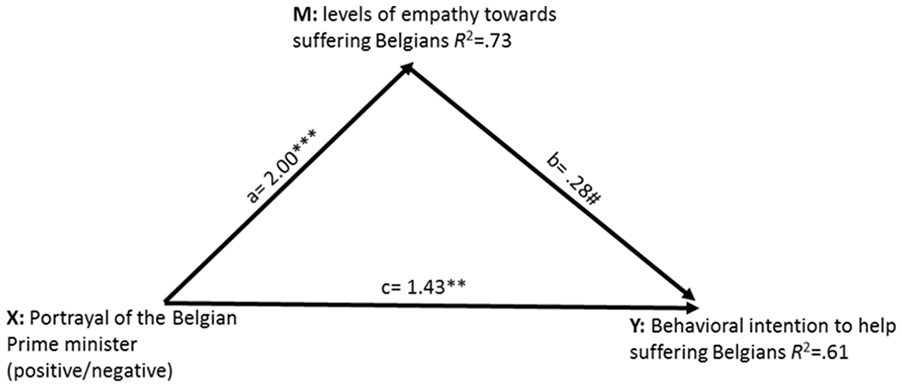
Level of empathy mediates the association between the leader’s personality portrayal and Israeli participants’ willingness to help out.
Experiment 2: Would the Impression of Non-Political Leader Create the Same Effects?
The main limitation of the first experiment is the small sample. In addition to addressing this weakness and replicating the results of Experiment 1, Experiment 2 pursued two other goals. First, we aimed to control for an alternative explanation: that any prominent figure—not necessarily a national leader—can affect the perceptions of, and emotions toward, his or her group (i.e., nation). Such mechanisms, whereby ordinary people, other than leaders, are treated as exemplars, are well established in the field of mass communication (Lefevere et al., 2012; Zillmann, 2002). For example, Lefevere et al. (2012) argued that people without any specific representative function or expertise may affect public perceptions. Indeed, the use of “men and women on the street” as exemplars in television news reports has become a common journalistic practice (Arpan, 2009).
In light of the above, how can we justify the rationale for our hypothesis, according to which the impression made by a national leader would influence levels of empathy toward that nation more than a similar impression made by any other citizen of that same nation? Our basic argument is that the level of empathy people tend to experience toward a distant group based on their familiarity with one of its members depends on whether they believe that the impression they got from that exemplar tells them something meaningful about the entire group. We argue, first, that information people get about national leaders is on average more abundant than about other citizens of the same nation; and second, that people extrapolate the information about a national leader to the nation as a whole—and to every one of its members—more readily than if such information were obtained regarding another citizen. The premise that underlies this logic is anchored in people’s lay belief that, if a group selects someone to lead it, that person should be the most prototypical representative of the group’s traits, values, and character. To test this logic, as an additional control condition, we included stimuli replacing the foreign national leader with a fictitious citizen from the respective country, described as a CEO of a high-tech company. We believe that national leaders would have an effect on empathy for citizens (beyond non-national leader) at least partially because leaders are perceived to represent their citizens in terms of their beliefs, values, and characteristics. Furthermore, we also added an empty control condition (a no-news article from National Geographic) which enabled us to capture the impact of the two storylines (positive vs. negative) both against each other and against the baseline.
Method
Participants
Two hundred and fifty-two (50% men; mean age 42.46 years, SD = 15.96 years) individuals were recruited, using an online survey platform (“The Midgam Panel Project”) that offers monetary compensation in return for participation in surveys. The sample size was determined on the basis of a power analysis which used the effect from the same study we used for that purpose in the first experiment (Balmas, 2018). In the previous paper, the effect size of an interaction between storyline-tone (negative vs. positive) and target type (leader vs. nonleader) was medium, and we anticipated similar results in the present study. Our sample of 252 participants afforded 90% power to detect an effect of f = 0.25 size (medium).
Participants were all Jewish Israelis from the general population, and the survey was conducted in Hebrew. Education level was measured using five values ranging from 1 (some high school) to 5 (graduate degree; M = 4.43, SD = 1.96). Monthly income was measured using 10 values, from less than 3,000 NIS to more than 20,000 NIS (M = 6.31, SD = 2.78). Regarding political orientation, 46% of the respondents defined themselves as Rightists, 32% as Centrists, and 22% as Leftists. In addition to the demographic indices, the pre-reading questionnaire asked to what extent participants had been exposed to a newspaper, internet or TV news report about Belgium or about the Belgian Prime Minister. We also asked if, in the past, participants had visited Belgium and if they were acquainted personally with one or more Belgian citizens.
Procedure
Experiment 2 comprised four experimental conditions in a 2 × 2 factorial design, and a fifth, control, condition in which participants were exposed to a neutral article (i.e., a short article from National Geographic about the danger of owning exotic pets). Participants who were randomly assigned to the experimental conditions were instructed to read either the same versions (positive/negative) of the news article about Belgian Prime Minister Charles Michel as had been used in Experiment 1, or similar positive/negative versions of a news article about a fictitious Belgian citizen, dubbed Stefan Schorel, who was presented as a popular CEO of a Belgian high-tech company; the idea was to frame Schorel as a leader, but not a political representative of all the citizens (see Tables S1 and S4 for a more detailed description of the manipulations).
Measures
All measures, including manipulations checks were identical to the ones used in Experiment 1. Level of empathy (α = .85), willingness to help (α = .71).
Results
Participants exposed to the positive article about the Belgian Prime Minister did indeed find its tone to be more positive (M = 5.80, SD = 0.40) than those who read the negative article (M = 1.58, SD = 0.77; 95% CI = [3.93, 4.52]; f = 2.09). Similarly, those exposed to the positive article about the nonpolitical leader (Belgian CEO Stefan Schorel) found its tone to be more positive (M = 5.72, SD = 0.45) than those who read the contrasting, negative article, M = 1.48 SD = 0.50; 95% CI = [3.94, 4.55]; f = 2.00; F(196) = 948.54, p = .001; overall effect size f = 2.90. No significant differences emerged between participants exposed to the positive articles about Michel and Schorel (Bonferroni’s Mean difference, henceforth, MD = 0.08, SE = 0.11, p = 1.00, 95% CI = [−0.21, 0.38]; f = 0.03), or between those who read the negative articles about the same protagonists (MD = 0.10, SE = 0.11, p = 1.00, 95% CI = [−0.20, 0.40]; f = 0.04). No interaction effect was found between Exemplar status (political vs. nonpolitical leader) and Storyline tone (positive vs. negative) on the extent to which the exemplar was perceived in the positive light, F(196) = 0.01, p = .921, see Figure S1. The intensity of feelings induced by both positive conditions was the same (equally positive), as was the intensity of feelings induced by both negative conditions (equally negative). These results confirm that all the manipulations were perceived as intended and yielded no cross-effects, which are frequent in similar 2 × 2 designs.
The Interaction Effect of Exemplar-Status (Political Leader-Prime Minister vs. Non-Political Leader-CEO) × Storyline-Tone (Negative vs. Positive) on Levels of Empathy Experience and Willingness to Help
The analysis revealed a significant effect of the Exemplar-status (Prime Minister vs. CEO) × Storyline-tone (negative vs. positive) interaction on participants’ level of empathy, F(193) = 131.17, p = .001, see Figure 2a; for full results for the interaction model see Table S5. The results show that participants exposed to the positive article regarding the Prime Minister were significantly more empathetic (M = 4.18, SD = 0.57) than those exposed to the negative article (M = 2.66, SD = 0.41; MD = 1.52, SE = 0.10, p = .001; 95% CI = [1.23, 1.80]; effect size is f = 0.68). No significant differences emerged between participants exposed to the positive article regarding the non-political leader-CEO (M = 2.80, SD = 0.35) and those exposed to the negative article (M = 2.94, SD = 0.64; MD = −0.13, SE = 0.10, p = 1.00; 95% CI = [−0.44, 0.16]; effect size is f = 0.06). The levels of empathy reported by participants of the control group, which represented the baseline (who were not exposed to any such information but rather to a National Geographic item) were significantly lower (M = 3.07, SD = 0.52) than by those who had read the positive article regarding the Prime Minister (MD = −1.12, SE = 0.09, p = .001; 95% CI = [−1.39, −0.83], effect size is f = 0.50); significantly higher than by those exposed to the negative article regarding the Prime Minister (MD = 0.40, SE = 0.09, p = .001; 95% CI = [0.12, 0.68], effect size is f = 0.18); and similar to those exposed to both the positive (MD = 0.26, SE = 0.10, p = .077; 95% CI = [−0.01, 0.55]; effect size is f = 0.12) and the negative (MD = 0.12, SE = 0.10, p = 1.00; 95% CI = [−0.16, 0.42]; effect size is f = 0.05) articles regarding the nonpolitical leader, F(247) = 71.65, p = .001; overall effect size f = 0.77. A comparison to the baseline indicates that the effects emerged only among those exposed to the articles about the political leader. 2

Effect of exemplar status (political leader—prime minister vs. non-political leader—CEO) × storyline-Tone (negative vs. positive) on Israeli participants’ (a) level of empathy and (b) willingness to help suffering Belgian citizens.
We ran a similar analysis to test participants’ willingness to help Belgian citizens in distress. Figure 1b revealed a significant effect of the Exemplar-status × Storyline-tone interaction on participants’ willingness to help (F(184) = 24.22, p = .001, see Figure 2b; for the full results for the interaction model see Table S5). We found that participants exposed to the positive article regarding the Prime Minister were more willing to help (M = 4.05, SD = 0.62) than those exposed to the negative article (M = 2.55, SD = 1.09; Mean difference = 1.49, SE = 0.18, p = .001; 95% CI = [0.96, 2.02]; effect size is f = 0.49). However, no significant differences emerged between those exposed to the positive article regarding the CEO (M = 2.53, SD = 0.68) and those exposed to the negative article (M = 2.40, SD = 1.34; Mean difference = 0.12, SE = 0.19, p = 1.00; 95% CI = [−0.43, 0.68]; effect size is f = 0.04). The levels of empathy reported by participants in the control group (M = 2.40, SD = 0.86) were significantly lower than by those exposed to the positive article regarding the Prime Minister (MD = −1.65, SE = 0.18, p = .001; 95% CI = [−2.17, −1.12]; effect size is f = 0.55); and similar to all the other three conditions (MD with: Negative: Prime Minister = −0.15, SE = 0.18, p = 1.00; 95% CI = [−0.67, 0.32], effect size is f = 0.05; Positive CEO = −0.13, SE = 0.18, p = 1.00; 95% CI = [−0.65, 0.39]; effect size is f = 0.04; Negative CEO = −0.00, SE = 0.19, p = 1.00; 95% CI = [−0.55, 0.53], effect size is f = 0.00; (F(247) = 25.52, p = .001; overall effect size f = 0.66).
Mediation Analysis (DV: Willingness to Help)
We tested here whether the link between exposure to a news article that favorably / unfavorably characterizes an exemplar (the political leader Prime Minister vs. nonpolitical leader CEO) and participants’ willingness to help Belgian citizens in distress was mediated by empathy. Figures 3a shows that exposure to the positive (coded as 1), as opposed to the negative (coded as 0), article about Michel positively affected participants’ levels of empathy (b = 2.00, SE = 0.14 [1.72, 2.28], p = .001) and behavioral intentions to help the Belgian family in distress (b = 1.32, SE = 0.32 [0.78, 1.86], p = .001). However, the relationship between the level of empathy and willingness to help was not significant (b = 0.11, SE = 0.17 [−0.18, 0.40], p = .52). Figure 3b shows that exposure to the article about the Belgian CEO did not affect either participants’ levels of empathy (b = −0.13, SE = 0.10 [−0.31, 0.03], p = .19) or their behavioral intentions (b = 0.12, SE = 0.21 [−0.24, 0.48], p = .58). The relationship between empathy levels and willingness to help was not significant either (b = −0.01, SE = 0.21 [−0.37, 0.33], p = .93).
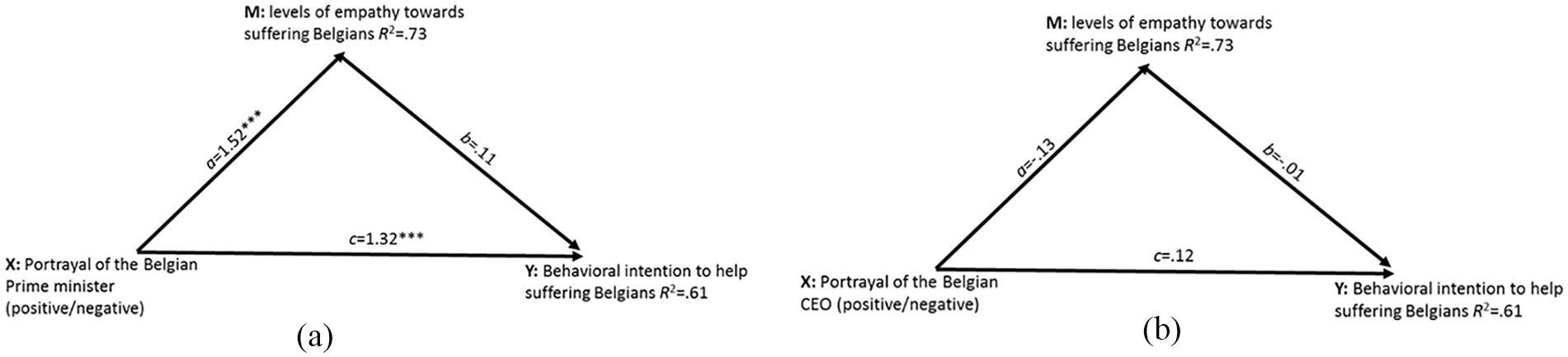
Level of empathy mediates the association between the political leader’s/non-political leader’s personality portrayal and Israeli participants’ willingness to help out.
It should be noted that, although the mediated models point to no relationship between level of empathy and willingness to help, we found a significant correlation (Spearman’s rho) between these two variables (r = .34, p = .001). We believe that the direct effect of the IV (the manipulation) on the DV (willingness to help), and on the mediator (level of empathy), is so strong that it eliminates the influence of the mediator on the dependent variable. The mediation model takes into account the relationships among three variables while the correlation takes into account only two variables.
Experiment 3: The Moderating Role of a National Leader’s Popularity
Experiment 2 provided evidence indicating that it is the national leader that has the potential to affect levels of empathy toward his or her suffering compatriots, and not just any prominent national exemplar presented to audience. The question that should be asked next is whether any national leader can inspire such feelings. An important element which may have a bearing on that issue, but has by and large been ignored in the existing literature, is the level of a leader’s domestic support. If a leader, say, of a foreign Western democratic state was elected by the majority and presented by the media—and thus also perceived by the foreign publics—as popular in his or her country, it would be logical to identify him or her as the prototypical exemplar. However, if a foreign leader is presented—and seen—as unpopular within her or his country (even if she or her was elected by the majority or democratically), it is less likely that, abroad, she or her will be identified as that country’s prototypical exemplar. According to Hogg (2015), people look to and are influenced more by prototypical than non-prototypical group members. Accordingly, in Experiment 3, we assigned participants to two levels of domestic support: low and high. We had good reason to believe that a foreign leader’s perceived domestic popularity would moderate the effect of the storyline tone on empathy levels. Furthermore, to supplement self-report measures, we added to behavioral intentions, used in the first experiment, another measure that captures actual behavior.
Method
Participants
Two hundred and fifty-four (50.4% men; mean age 41.88, SD = 16.17) individuals were contacted and recruited using the same online survey platform (The Midgam Panel Project) as used in experiment 2. We used the same power analysis as in Experiment 2, and therefore, our sample of 254 participants afforded 90% power to detect medium effect size (f = 0.25). Participants were all Jewish Israelis from the general population, and the survey was conducted in Hebrew. Education level was measured using five values ranging from 1 (some high school) to 5 (graduate degree; M = 4.37, SD = 1.96). Monthly income was measured using 10 values, from less than 3,000 NIS to more than 20,000 NIS (M = 5.46, SD = 2.79). Regarding political orientation, 51% of the respondents defined themselves as Rightists, 34% as Centrists, and 15% as Leftists. In addition to the demographic indices, the questionnaire included the same items as in Experiment 2 dealing with exposure, visits, and Belgium friends.
Procedure
Experiment 3 comprised four experimental conditions in a 2 × 2 factorial design, and a fifth, control, in which participants were exposed to a neutral article (i.e., a short article from National Geographic about the danger of owning exotic pets). In the four experimental conditions participants were instructed to read the same positive/negative news article about Belgian Prime Minister Charles Michel as had been used in Experiments 1 and 2. However, while in both the positive and the negative conditions of Experiments 1 and 2, the articles stated that Michel enjoyed a high level of support within Belgium, in Experiment 3 we randomized two levels of domestic support: low and high. Thus, in the negative condition, a participant may have read a description of Michel as either an unpopular or a popular leader inside Belgium. The same two options were implemented for the positive condition (see Table S1 for a more detailed description of the manipulations).
Measures
Manipulation Checks were implemented as detailed for Experiments 1 and 2. However, to examine whether the popularity manipulation actually yielded the desired effect, we assessed the following item: “Would you say Charles Michel has low, medium or high support in Belgium?” Since none of the participants chose the answer “medium,” we recoded the responses as low (0) and high (1).
Level of empathy (α = .85) and willingness to help (α = .71) were measured as detailed above for Experiments 1 and 2.
Motivation to glean more information At the end of the experiment, participants were told that they could choose between two options to proceed: They could either complete and submit the questionnaire (coded as 0), or they could read additional information describing in more detail the adverse circumstances in which the people they had already read about in the article currently found themselves (coded as 1), without being reimbursed for that extra time (additional details are provided in S2 Text). Those who asked for more information were provided with a link to another page containing a report of approximately 800 words (see Cohen-Chen et al., 2014).
Results
Under the condition in which Charles Michel was described as popular, participants exposed to the positive article found its tone to be more positive (M = 5.48, SD = 0.81) than those exposed to the negative article (M = 2.23, SD = 1.21; MD = 3.24, p = .001; 95% CI = [2.65, 3.84]; f = 1.09). Similarly, when Charles Michel was described as unpopular, participants exposed to the positive article found its tone to be more positive (M = 5.10, SD = 1.19) than those who read the negative article, M = 2.00, SD = 1.22; MD = 3.10, p = .001; 95% CI = [2.50, 3.71]; f = 1.03; F(201) = 134.22, p = .001; overall effect size f = 1.51. It should be noted that no significant mean difference emerged between those exposed to the two positive articles that described Michel as either popular or unpopular (MD = .37, SE = .22, p = .581), and also between those who read the two negative descriptions of Michel as either popular or unpopular (MD = .23, SE = .22, p = 1.00). We found no interaction effect of Domestic-support level (low vs. high) × Storyline-tone (positive vs. negative) on the extent to which participants perceived the leader in a positive light, F(197) = 0.21, p = .644 (see Figure S2a).
In addition, participants exposed to both the positive and the negative articles that described Michel as a popular leader ranked him as popular (respectively: M = 1.00, SD = 0.00; M = 0.90, SD = 0.29; MD = 0.09, SE = 0.06, p = 1.00; 95% CI = [−0.08, 0.27]; f = 0.06), while those exposed to both the positive and the negative articles that described Michel as unpopular ranked him as unpopular (respectively: M = 0.22, SD = 0.42; M = 0.16, SD = 0.37; MD = 0.06, SE = 0.06, p = 1.00; 95% CI = [−0.11, 0.24]; f = 0.04), F(201) = 79.07, p = .001; overall effect size f = 0.73. Here, too, we found no interaction effect of the Popularity level (low vs. high) × Storyline-tone (positive vs. negative) on the level of the leader’s perceived popularity, F(197) = 0.12, p = .724 (see Figure S2b).
The interaction effect of popularity level (low vs. high) × storyline-tone (negative vs. positive) on levels of empathy experience and willingness to help
As expected, the analysis revealed a significant interaction effect of the Popularity level (low vs. high) × Storyline-tone (negative vs. positive) on participants’ level of empathy, F(187) = 49.9, p = .001, see Figure 4a; for full results for the interaction model see Table S9. The results show that when the leader was described as popular, participants exposed to the positive article were more empathetic (M = 4.68, SD = 0.95) compared with those who had read the negative article (M = 2.98, SD = 0.58; MD = 1.69, SE = 0.12, p = .001; 95% CI = [1.34, 2.05]; effect size is f = 0.68). However, among participants exposed to the article describing Michel as an unpopular leader, no mean differences emerged between those who had read the positive (M = 3.70, SD = 0.49) and the negative (M = 3.42, SD = 0.55) articles (MD = 0.28, SE = 0.12, p = .263; 95% CI = [−0.07, 0.65]; effect size is f = .11). Participants of the control group reported a level of empathy (M = 3.29, SD = 0.48) which was significantly lower than those exposed to the positive articles describing Michel as either popular (MD = −1.39, SE = 0.12, p = .001; 95% CI = [−1.74, −1.03]; effect size is f = 0.56) or unpopular (MD = −41, SE = 0.12, p = .011; 95% CI = [−0.77, −0.05]; effect size is f = 0.16). However, as can be clearly seen in the graph, the mean difference and the effect size are significantly lower in the latter case (i.e., positive-unpopular). We found no significant differences between the level of empathy in the control group and among those exposed to the negative articles describing Michel as either popular (MD = −0.30, SE = 0.12, p = .144; 95% CI = [−0.04, 0.65], effect size is f = 0.12) or unpopular, MD = −0.13, SE = 0.12, p = 1.00; 95% CI = [−0.48, 0.22]; effect size is f = 0.05; F(253) = 52.57, p = .001; overall effect size f = 0.74. 3

Effect of the popularity level (low vs. high) × storyline-tone (positive vs. negative) interaction on Israeli participants’ (a) level of empathy and (b) willingness to help suffering Belgian citizens.
We ran a similar analysis to test the interaction effects on willingness to help Belgian citizens in distress. Figure 4b reveals a significant interaction effect of the Popularity level (low vs. high) × Storyline-tone on participants’ willingness to help, F(187) = 32.44, p = .001, see Figure 4b; for full results for the interaction model, see Table S9. When the leader was described as popular, participants exposed to the positive article were more willing to lend a hand (M = 3.3, SD = 0.62) compared with those exposed to the negative article (M = 1.82, SD = 0.90; MD = −2.01, SE = 0.20, p = .001; 95% CI = [1.43, 2.59]; effect size is f = 0.64). Among participants exposed to the article describing Michel as an unpopular leader we found significantly lower mean differences (and smaller effect size) between those who had read the positive (M = 2.36, SD = 1.40) and the negative article (M = 1.78, SD = 0.87; MD = 0.58, SE = 0.20, p = .056; 95% CI = [−0.00, 1.17]; effect size is f = 0.18). Participants in the control group reported lower levels of willingness to help (M = 2.03, SD = 1.15) than those exposed to the positive article describing Michel as popular (MD = −1.79, SE = 0.20, p = .001; 95% CI = [−2.36, −1.21]; effect size is f = 0.57). No significant differences were found between the control condition and those exposed to the positive article describing Michel as unpopular (MD = −0.32, SE = 0.20, p = 1.00; 95% CI = [−0.90, 0.24], effect size is f = 0.10) or to the two negative articles describing Michel as either popular (MD = 0.22, SE = 0.20, p = 1.00; 95% CI = [−0.34, 0.78], effect size is f = 0.07) or unpopular, MD = 0.25, SE = 0.20, p = 1.00; 95% CI = [−0.32, 0.82]; effect size is f = 0.08; F(252) = 34.23, p = .001; overall effect size f = 0.76. As can be seen, willingness to help is uniform and relatively low in all conditions, except for the one in which Michel was presented in a positive light and as popular.
Moderated-mediation analysis (DV: Willingness to help)
We tested here whether the link between exposure to a news article that favorably characterizes Charles Michel and participants’ willingness to help Belgian citizens in distress was mediated by empathy, and whether the link between exposure to the same news article and empathy was moderated by the perceived level of Michel’s domestic popularity. To this end, we employed the procedure developed by Hayes (2013): PROCESS bootstrapping macro (Model 8; 5,000 iterations). Figure 5 shows that exposure to the positive (coded as 1), as opposed to the negative (coded as 0), article about Michel positively affected participants’ levels of empathy (b = 0.29, SE = 0.14 [0.01, 0.57], p = .037). In addition, as expected, the relationship between exposure to the news article and levels of empathy was moderated by the perceived level of Michel’s popularity (b = 1.40, SE = 0.20 [1.01, 1.80], p = .001). Furthermore, the level of empathy was found to positively affect Participant’s pro-social behavioral intentions to help the Belgian family in distress (b = 0.21, SE = 0.10 [0.01, 0.42], p = .039). Direct effects of the interaction between exposure to the news article (negative vs. positive) and level of popularity (low vs. high) on behavioral intentions were found to be positive and significant (b = 1.30, SE = 0.31 [0.66, 1.94], p = .001). The total indirect effect of exposure to the news articles on willingness to help through level of empathy was found to be moderated by the level of the leader’s domestic popularity (Index = 0.30, SE = 0.16 [0.03, 0.65]).
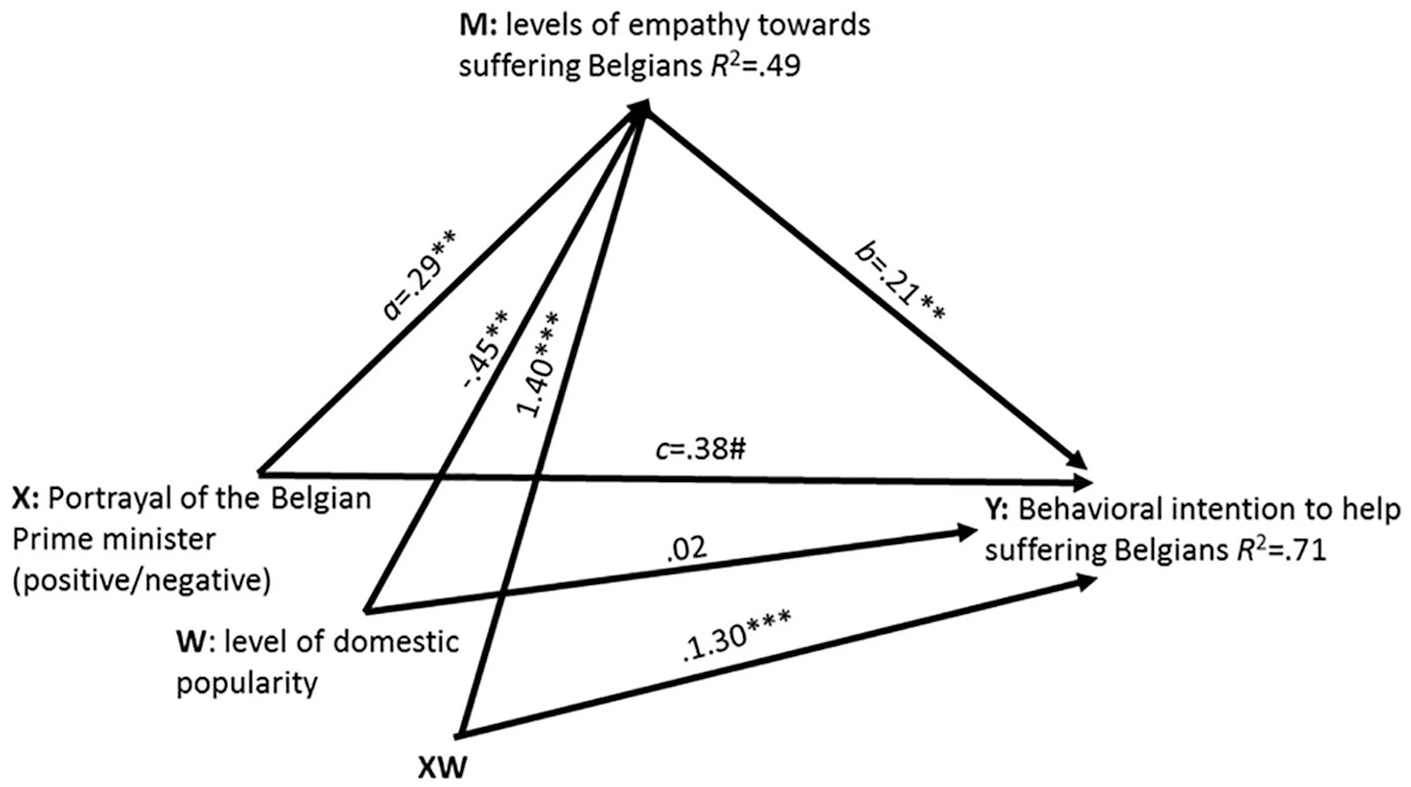
Level of empathy, moderated by the level of domestic popularity, mediates the association between the leader’s personality portrayal and Israeli participants’ willingness to help out.
Motivation to glean more information
Figure 6 reveals a significant interaction effect of the Popularity level × Storyline-tone on participants’ motivation to receive additional information about the family in distress (F(186) = 10.91, p = .001; for full results for the interaction model see Table S11). When the leader was described as popular, Israeli participants exposed to the positive article were more motivated to receive additional information (M = 0.64, SD = 0.48) compared with those exposed to the negative article (M = 0.25, SD = 0.43; MD = 0.39, SE = 0.08, p = .001; 95% CI = [0.14, 0.64]; effect size is f = 0.18). Once again, among participants exposed to the article describing Michel as an unpopular leader, no mean differences emerged between those who had read the positive (M = 0.20, SD = 0.41) and the negative (M = 0.20, SD = 0.40) article (MD = 0.004, SE = 0.08, p = 1.00; 95% CI = [−0.24, 0.25]; effect size is f = 0.00). Among those in the control condition, the motivation to receive additional information (M = 0.26, SD = 0.44) was lower than among those exposed to the positive article describing Michel as a popular leader (MD = −0.37, SE = 0.08, p = .001; 95% CI = [−0.62, −0.13]; effect size is f = .18) and similar to those exposed to the positive article describing Michel as unpopular (MD = 0.06, SE = 0.08, p = 1.00; 95% CI = [−0.19, 0.31], effect size is f = .02) as well as to those exposed to the two negative articles describing Michel as either popular (MD = 0.01, SE = 0.08, p = 1.00; 95% CI = [−0.23, 0.26], effect size is f = .00) or unpopular (MD = 0.06, SE = 0.08, p = 1.00; 95% CI = [−0.18, 0.31]; effect size is f = .02; (F(252) = 9.03, p = .001; overall effect size f = .25). As seen, motivation to glean more information is uniform and relatively low in all conditions, except for the one in which Michel was presented in a positive light and as popular. 4

Effect of the popularity level (low vs. high) × storyline-tone (positive vs. negative) interaction on Israeli participants’ motivation to glean more information regarding suffering Belgian citizens.
Correlations among dependent variables
We ran correlations (Spearman’s rho) among all three dependent variables. Results point to a medium to strong correlation between level of empathy and willingness to help (r = .47, p = .001); a low to medium correlation between level of empathy and motivation to glean more information (r = .20, p = .001); and a low to medium correlation between willingness to help and motivation to glean more information (r = .20, p = .001).
Experiment 4: Replication in the U.S. Context
The fourth experiment was designed to replicate the results of Experiment 3 but this time in a different context. While the first three experiments were conducted in Israel, Experiment 4 was run in the United States (N = 304). In addition, we replaced the empathy stories used in Experiments 1–3 with a different version: While in the first three experiments, the protagonists of all the versions of the empathy story were Belgian citizens facing adverse circumstances in the aftermath of a terrorist attack in Brussels (see S1 Text), the empathy story used in Experiment 4 was about a Belgian teenager suffering from a disease, with a focus on his daily coping and a high cost of medications (see S3 Text). The goal was to target universal sentiments rather than emotional responses linked to national identity (in the case in point, a terrorist attack), to enable further generalization of the results. A third difference between this and the previous experiments was that, in addition to capturing participants’ motivation to receive more information, we also targeted an actual monetary donation.
Method
Participants
Three hundred and four (56.3% men; mean age 38.98 years, SD = 10.59) individuals were recruited using Amazon’s Mechanical Turk (MTurk). For this study, we wanted to gain higher power and therefore used the same power analysis as in Experiments 2 and 3, but increased our power to 95%. Our sample of 304 participants afforded 95% power to detect medium effect size (f = 0.25). Participants were all Americans. Education level was measured using eight values running from (1) some high school (less than a high school diploma) to (8) a doctoral degree (e.g., PhD, EdD; M = 4.38, SD = 1.32). Yearly income was measured using 12 values, ranging from less than US$10,000 to US$150,000 and above (M = 5.59, SD = 4.38). Regarding political orientation, 47% of the respondents defined themselves as Democrats, 21% as Republicans, and 31% as Independents. As in Experiments 2 and 3, we also asked several background questions.
Procedure
To examine whether the effects are driven only by content concerning the Prime Minister’s leadership attributes, or alternatively can be induced by any characteristic(s) attributed to that leader, the article in Experiment 4, was slightly different from the ones used in previous experiments, and focused on situations which are not necessarily centered on leadership (see Table S13 for a more detailed description of the manipulations). Thus, while in Experiments 1–3, the news articles emphasized Michel’s political career (i.e., “Michel’s career trajectory—serving as councilor in his native city Jodoigne at the age of 18 years, and at the age of 25 years appointed the youngest minister in the history of Belgium—is a story of a remarkable personal journey. . .”), and cite sources who hold official positions (i.e., advisor to the European Community Presidency and diplomat), the news articles in Experiment 4 made no reference to Michel’s political career, but instead focused on his personality (i.e., “Those who worked closely with Michel, his close friends and relatives, talking about a person with an outstanding personality”; “. . .the Belgian Prime Minister’s outstanding and well-known personality”). Similarly, the sources cited in these news articles are not only officials (i.e., former strategic advisor and diplomat), but also private people (i.e., close friends and relatives). At the same time, as in Experiments 1–3, the articles in Experiment 4 stressed the positive and the negative counterpart traits and behaviors, such as trustworthy vs. untrustworthy, reliable vs. unreliable, peaceful vs. aggressive, displaying modesty vs. the sense of entitlement.
Measures
Level of empathy (α = .88), willingness to help (α = .80), and motivation to glean more information were measured as detailed above for previous experiments. As already explained, the empathy story was different: it concerned a Belgian teenager suffering from rickets, the difficulties of his daily coping, and struggle to make ends meet (see S4 Text). Moreover, another behavioral intention indicator was added in which participants were asked to state (on the same scale as in Experiments 1–3) how likely they were to “sign a petition appealing to the Belgian government to help the teenager and his family.”
Actual monetary donation. At the end of the experiment, participants were offered an opportunity to forfeit half a dollar of their reimbursement fee for the benefit of the people they had read about in the empathy story. Participants could decide between refraining from making a donation (coded as 0) or making a donation (coded as 1). It should be noted that, in the end, participants did not actually lose any money: The experiment ended after they had stated whether or not they were willing to donate money, whereupon all participants were debriefed.
Results
In keeping with the results of Experiment 3, when Charles Michel was described as popular, participants exposed to the positive article found its tone to be more positive (M = 5.03, SD = 1.01) than those exposed to the negative article (M = 1.73, SD = 1.04; MD = 3.03, SE = 0.18, p = .001; 95% CI = [2.81, 3.80]; f = 1.14). Similarly, when Charles Michel was described as unpopular, participants exposed to the positive article found its tone to be more positive (M = 5.48, SD = 0.89) than those exposed to the negative (M = 2.06, SD=1.14) article (MD = 3.41, SE = 0.18, p = .001; 95% CI = [2.92, 3.91]; f = 1.18; (F(244) = 220.99, p = .001; overall effect size is f = 1.65). Once again, we found no significant mean difference between those exposed to the positive articles that described Michel as either popular or unpopular (MD = −0.45, SE = 0.18, p = .10), and no mean difference between those who read the negative descriptions of Michel as either popular or unpopular (MD = −0.33, SE = 0.18, p = .408). As in Experiment 3, we also found no interaction effect of Popularity level (low vs. high) × Storyline-tone (positive vs. negative) on the extent to which participants perceived the leader in a positive light (F(241) = 0.18, p = .671, see Figure S3a).
In addition, participants exposed to the article that described Michel as a popular leader, regardless of its tone (positive vs. negative), ranked him as popular (respectively: M = 0.95, SD = 0.24; M = 0.93, SD = 0.24; Mean difference = −0.01, SE = 0.03; p = 1.00; 95% CI = [−0.10, 0.06]; f = 0.01), while those exposed to the article that described Michel as unpopular, regardless of its tone, ranked him as unpopular (respectively: M = 0.00, SD = 0.00; M = 0.01, SD = 0.12; Mean difference = −0.01, SE = 0.03; p = 1.00; 95% CI = [−0.10, 0.06]; f = 0.00), F(243) = 563.02, p = .001; overall effect size f = 1.23. It should be noted that, here too, we found no interaction effect of Popularity level (low vs. high) × Storyline-tone on the leader’s perceived popularity, F(240) = 0.00, p = .981, see Figure S3a. However, it is also interesting to note that the popularity manipulation influenced both popularity, F(240) = 3,125.00, p = .001, and valence ratings, F(240) = 992.25, p = .020, though popularity more strongly.
The interaction effect of popularity level (low vs. high) × storyline-tone (negative vs. positive) on levels of empathy experience and willingness to help
Figure 7a reveals a significant interaction effect of Popularity level × Storyline-tone on Americans’ level of empathy, F(231) = 175.39, p = .001; for full results for the interaction model see Table S15. When the leader was described as popular, American participants exposed to the positive article were more empathetic (M = 5.04, SD = 0.75) compared with those who had read the negative (M = 2.60, SD = 0.43) article (MD = 2.43, SE = 0.11, p = .001; 95% CI = [2.11, 2.76]; effect size is f = 0.98). Among participants exposed to the article describing Michel as an unpopular leader, lower mean differences, and smaller effect size, emerged between those who had read the positive (M = 3.87, SD = 0.48) and the negative (M = 3.39, SD = 0.87) article (MD = 0.47, SE = 0.11, p = .001; 95% CI = [0.15, 0.80]; effect is f = 0.19). Participants in the control group reported lower levels of empathy (M = 4.34, SD = 0.76) than those exposed to the positive article describing Michel as a popular leader (MD = −0.69, SE = 0.11, p = .001; 95% CI = [−1.02, −0.36]; effect size is f = 0.28). However, surprisingly, and contrary to the findings of Experiment 3, participants in the control group reported significantly higher levels of empathy than those exposed to the positive article describing Michel as unpopular (MD = 0.47, SE = 0.11, p = .001; 95% CI = [0.14, 0.80], effect size is f = 0.18), as well as those exposed to the negative articles describing Michel as either popular (MD = 1.74, SE = 0.11, p = .001; 95% CI = [1.41, 2.07], effect size is f = 0.69) or unpopular, MD = 0.94, SE = 0.11, p = .001; 95% CI = [0.62, 1.27], effect size is f = 0.38; F(303) = 129.59, p = .001; overall effect size f = 1.06. 5 This comparison to the baseline shows that American participants were, to begin with, more empathic than their Israeli counterparts.

The interaction effect of the popularity level (low vs. high) × storyline-tone (positive vs. negative) on American participants’ (a) level of empathy and (b) willingness to help suffering Belgian citizens.
The above interaction pattern was also replicated with regard to participants’ willingness to help Belgians in distress, F(230) = 45.59, p = .001, see Figure 7b. When the leader was described as popular, American participants exposed to the positive article expressed greater willingness to help out (M = 4.20, SD = 0.92) compared with those exposed to the negative (M = 2.13, SD = 0.61) article (MD = 2.07, SE = 0.22, p = .001; 95% CI = [1.42, 2.71], effect size is f = 0.57). Among participants exposed to the article describing Michel as an unpopular leader, no mean differences emerged between those who had read the positive (M = 3.58, SD = 1.41) and the negative (M = 3.45, SD = 1.55) article (MD = 0.13, SE = 0.22, p = 1.00; 95% CI = [−0.51, 0.78], effect size is f = 0.03). Participants in the control group reported a lower level of willingness to help (M = 3.39, SD = 1.53) than those exposed to the positive article describing Michel as a popular leader (MD = −0.81, SE = 0.23, p = .005; 95% CI = [−1.46, −0.15], effect size is f = 0.23), and a higher level than those exposed to the negative article describing Michel as a popular leader (MD = 1.26, SE = 0.23, p = .001; 95% CI = [0.61, 1.91], effect size is f = 0.36). No significant differences were found between the control group and those exposed to the articles describing Michel either as unpopular and positive (MD = −0.19, SE = 0.23, p = 1.00; 95% CI = [−0.84, 0.46], effect size is f = 0.05) or as unpopular and negative, MD = −0.06, SE = 0.23, p = 1.00; 95% CI = [−0.71, 0.58], effect size is f = 0.01; F(303) = 21.97, p = .001; overall effect size f = 0.61.
Moderated-mediated analysis (DV: Willingness to help)
Results shown in Figure 8 fully replicate those of Experiment 3. Exposure to the positive (coded as 1), as opposed to the negative (coded as 0), article about Michel positively affected American participants’ levels of empathy (b = 0.50, SE = 0.10 [0.28, 0.71], p = .001), with the level of Michel’s domestic support (low vs. high) moderating the relationship between exposure to the news article and the empathy levels (b = 1.99, SE = 0.15 [1.69, 2.29], p = .001). Furthermore, empathy feelings affected positively and significantly American participants’ behavioral intentions to help the family of the sick Belgian teenager (b = 0.57, SE = 0.12 [0.33, 0.81], p = .001). Direct effects of the interaction between exposure to the news article (negative vs. positive) and level of popularity (low vs. high) on behavioral intentions was found to be positive and significant (b = 0.82, SE = 0.36 [0.09, 0.54], p = .026). The total indirect effect of exposure to the news article on willingness to help through level of empathy is found to be moderated by the level of the leader’s popularity (Index = 1.14, SE = 0.25 [0.62, 1.65]).
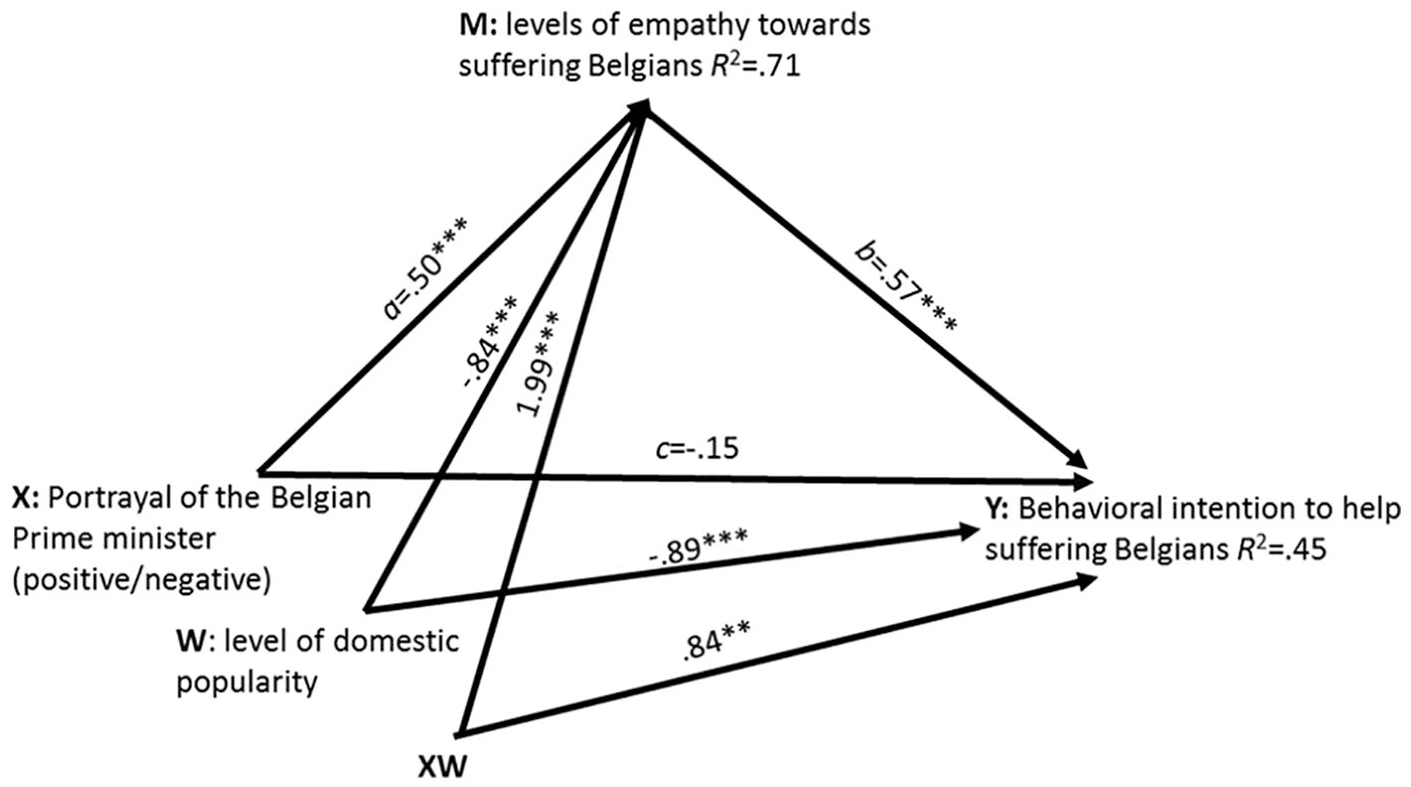
Level of empathy, moderated by level of domestic popularity, mediates the association between the leader’s personality portrayal and American participants’ willingness to help out.
Motivation to glean more information and actual monetary donation
Experiment 4 replicated the results of Experiment 3. Figure 9a reveals a significant effect of the Popularity level × Storyline-tone interaction on motivation to glean more information, F(231) = 15.51, p = .001; for full results for the interaction model see Table S17. Once again, the effect of the positive vs. negative storyline is evident only for participants who were exposed to the articles presenting Michel as a popular leader within his country. Specifically, when the leader was described as popular and endowed with positive characteristics, American participants were more motivated to read additional information (M = 0.54, SD = 0.50) compared with those exposed to the contrasting negative article (M = 0.19, SD = 0.39; MD = 0.34, SE = 0.07; 95% CI = [0.14, 0.55], effect size is f = 0.17). Among participants exposed to the article describing Michel as an unpopular leader, no mean differences emerged between those exposed to the positive (M = 0.12, SD = 0.32) and the negative (M = 0.18, SD = 0.38) article (MD = 0.07, SE = 0.07; 95% CI = [−0.13, 0.28]; effect size is f = 0.03). In line with the preceding experiment (No. 3), participants in the control group reported lower motivation to receive additional information (M = 0.18, SD = 0.38) than those exposed to the positive article describing Michel as a popular leader (MD = −0.38, SE = 0.07, p = .001; 95% CI = [−0.59, −0.18]; effect size is f = 0.19) and similar motivation to those exposed to the positive article describing Michel as unpopular (MD = 0.03, SE = 0.07, p = 1.00; 95% CI = [−0.17, 0.24], effect size is f = 0.01), as well as to those exposed to the negative articles describing Michel as popular (MD = −0.04, SE = 0.07, p = 1.00; 95% CI = [−0.25, 0.16], effect size is f = 0.02) and unpopular, MD = −0.02, SE = 0.07, p = 1.00; 95% CI = [−0.23, 0.18]; effect size is f = 0.03; F(303) = 11.38, p = .001; overall effect size f = 0.24.

The effect of the popularity level (low vs. high) × storyline-tone (positive vs. negative) interaction on American participants’ motivation to (a) glean more information regarding suffering Belgian citizens and (b) actual monetary donation for their benefit.
Probably most importantly, we found a significant interaction effect of the Popularity level × Storyline-tone on the actual monetary donation, F(231) = 5.78, p = .017, see Figure 9b; for full results for the interaction model, see Table S16. With regard to the main effects, the results show that when the leader was described as popular, more American participants exposed to the positive article made a monetary donation (M = 0.54, SD = 0.50) than those who had read the negative (M = 0.23, SD = 0.42) article (MD = 0.31, SE = 0.08; 95% CI = [0.08, 0.55], effect size is f = 0.14). However, among Americans exposed to the article describing Michel as an unpopular leader, no mean differences were observed between those exposed to the positive (M = 0.30, SD = 0.46) and the negative (M = 0.27, SD = 0.45) article (MD = 0.02, SE = 0.08; 95% CI = [−0.21, 0.26], effect size is f = 0.01). The number of participants of the control group who donated money (M = 0.27, SD = 0.44) was lower than among those exposed to the positive article presenting Michel as a popular leader (MD = −0.27, SE = 0.08; p = .014; 95% CI = [−0.51, −0.03], effect size is f = 0.12) and similar to those exposed to the other three versions: positive-unpopular (MD = −0.02, SE = 0.08, p = 1.00; 95% CI = [−0.27, 0.21], effect size is f = 0.01); negative-popular (MD = 0.04, SE = 0.08, p = 1.00; 95% CI = [−0.19, 0.28], effect size is f = 0.01); and negative-unpopular, MD = −0.00, SE = 0.08, p = 1.00; 95% CI = [−0.24, 0.23]; effect size is f = 0.00; F(303) = 4.56, p = .001; overall effect size f = 0.16. Once again, the comparison to the baseline indicates that the strongest effect was obtained among those exposed to the article which presents Michel in a positive light and as popular. 6
Moderated-mediation analysis (DV: Actual monetary donation)
We tested here whether the link between exposure to a news article that favorably characterizes Charles Michel and participants’ actual monetary donation to Belgian citizens in distress was mediated by (M1) empathy, and (M2) willingness to help, and whether the link between exposure to the same news article and the two mediators was moderated by the perceived level of Michel’s domestic popularity. Figure 10 shows that exposure to the positive (coded as 1), as opposed to the negative (coded as 0), article about Michel positively affected participants’ levels of empathy (b = 0.48, SE = 0.10 [0.26, 0.70], p = .001), giving rise to a more willingness to help out—for example, willingness to raise donations and self-donation (b = 0.56, SE = 0.12 [0.32, 0.80], p = .001), which ultimately led to actual increased monetary donation (b = 0.41, SE = 0.15 [0.10, 0.72], p = .008). In addition, as expected, the relationships between exposure to the news article and the two mediators were moderated by the perceived level of Michel’s popularity (levels of empathy: b = 2.01, SE = .15 [1.71, 2.31], p = .001; willingness to help: b = 0.79, SE = 0.36 [0.06, 1.52], p = .032). The total indirect effect of exposure to the news articles on actual monetary donation through the two mediators, as moderated by the level of the leader’s domestic popularity, was found to be significant (Index = .46, SE = 0.26 [0.10, 1.31]).
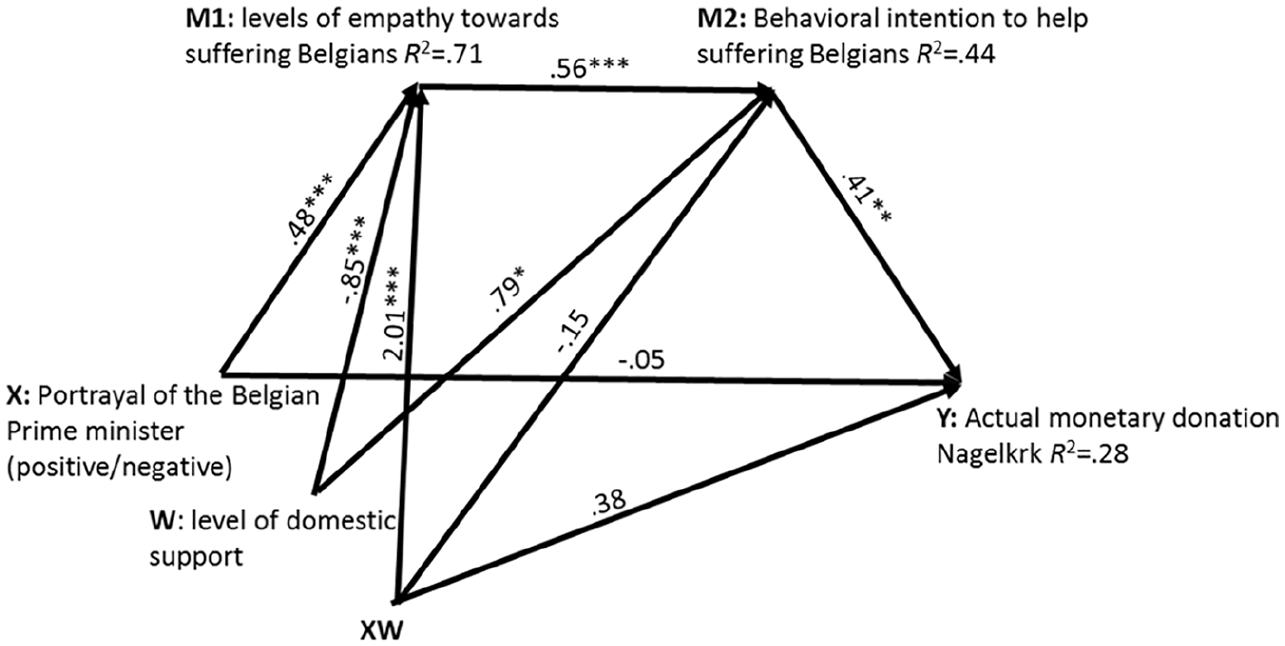
Level of empathy and willingness to help moderated by the level of domestic popularity mediates the association between the leader’s personality portrayal and American participants’ actual monetary donation.
Correlations among dependent variables
We ran correlations (Spearman’s rho) among all four dependent variables. Results point to a medium to high correlation between level of empathy and willingness to help (r = .49, p = .001); a low correlation between level of empathy and (a) motivation to glean more information (r = .18, p = .001) and (b) actual monetary donation (r = .17, p = .002); a low to medium correlation between willingness to help and (a) motivation to glean more information (r = .20, p = .001) and (b) actual monetary donation (r = .29, p = .001); and a medium to high correlation between motivation to glean more information and actual monetary donation (r = .41, p = .001). 7
Discussion
We know that national leaders provide rationale for opinion building regarding their respective nations and contribute to the stereotyping of their citizens—but what are the possible interpersonal and intergroup ramifications of such effects? Do national leaders have the power and wherewithal to arouse, in people living beyond their borders, emotions of empathy or pro-social behavior? In four experimental studies, we found that exposure to a news article that positively characterizes a foreign leader—and especially if that leader is described as popular in his country—led to increased levels of empathy toward this country’s citizens who are in distress, and subsequently also to enhanced willingness to help them. We also provided evidence indicating that it is the national leader that has the potential to affect such levels of empathy, and not just any prominent national exemplar presented to audience. As stated, we believe that national leaders have a stronger effect than non-national leader on empathy and pro-social behavior toward citizens due to the idea that the leader is considered to be a representative, at least to some extent, of the beliefs, values, and characteristics of at least some of the citizens. Moreover, it was found that, when the leader was described as popular, participants exposed to the positive article were more motivated than those exposed to the negative version (a) to invest time, without reimbursement, in inspecting additional information regarding the current adverse circumstances of those people’s lives, and (b) to make an actual monetary donation for the benefit of those people, by forfeiting some of the reimbursement they were entitled to for participating in the experiment.
Theoretically, we know that people’s default levels of empathy toward members of a distant group are bound to be low. In fact, studies show that today we tend to be even less caring than 30 years ago (Zaki, 2019). As discussed above, Batson et al. (1997) showed that increasing empathy toward one group member can improve attitudes toward the entire group. In the present study, we have shown, for the first time, that the reverse causal influence is also possible: Empathy toward a distant group of ordinary people can be induced through changing the impression regarding one particular representative of that group. More specifically, the current research provides evidence that national leaders are in a position to stimulate empathy, which shapes pro-social reactions toward members of a distant group who are in distress.
This study has several limitations. First, we tested holistic positive vs. negative interpretations regarding a leader and hence were not able to determine the relative influence of the various features related to human personality (i.e., attributes, behaviors, values) in the context investigated. Thus, our account of the effect a national leader’s traits may have on attitudes abroad regarding his or her compatriots in distress is framed in broad terms. In a future study, we propose to examine the effect of each specific feature separately. Second, our dependent measures are limited to tapping short-term influences. This issue can likewise be addressed and elucidated through further investigations.
Notwithstanding these weaknesses, the findings presented here provide novel and strong support for the notion that people’s perceptions of national leaders tend to function as integrated schemas. Today, national leaders are more prominent than ever before, and their role in the international arena is becoming increasingly more important (Balmas, 2018; Dragojlovic, 2013). In recent decades, not only have national leaders served as main foci of the media coverage of international affairs (Balmas & Sheafer, 2013a), but nowadays they have followers from all over the world via Twitter. These circumstances place a huge responsibility on their shoulders, above and beyond their official roles as political figures. The results of this study show that national leaders are in a position to contribute to better and more empathetic inter-society relations and raise pro-social behavior around the world.
Supplemental Material
sj-doc-1-psp-10.1177_0146167220987989 – Supplemental material for I Care About Your Plight, But Only If I Like Your Leader: The Effect of National Leaders’ Perceived Personality on Empathy and Pro-Social Behavior Towards Their Citizenry
Supplemental material, sj-doc-1-psp-10.1177_0146167220987989 for I Care About Your Plight, But Only If I Like Your Leader: The Effect of National Leaders’ Perceived Personality on Empathy and Pro-Social Behavior Towards Their Citizenry by Meital Balmas and Eran Halperin in Personality and Social Psychology Bulletin
Footnotes
Acknowledgements
Author would like to thank Joseph H. and Belle R. Braun Lectureship in Social Sciences.
Declaration of Conflicting Interests
The author(s) declared no potential conflicts of interest with respect to the research, authorship, and/or publication of this article.
Funding
The author(s) received no financial support for the research, authorship, and/or publication of this article.

Supplemental Material
Supplemental material is available online with this article.
Notes
References
Supplementary Material
Please find the following supplemental material available below.
For Open Access articles published under a Creative Commons License, all supplemental material carries the same license as the article it is associated with.
For non-Open Access articles published, all supplemental material carries a non-exclusive license, and permission requests for re-use of supplemental material or any part of supplemental material shall be sent directly to the copyright owner as specified in the copyright notice associated with the article.
