



Abstract
This research demonstrates that two- versus one-sided counterattitudinal messages can encourage people with a strong moral basis for their attitudes to be more open to contrary positions. Studies 1A/B demonstrated that the interaction between moral basis and message sidedness was present not just for a controversial issue with balanced views in society but also for a topic with a majority opinion. In Study 2, the relative effectiveness of two- over one-sided messages for people with a moral attitude basis was shown to occur only when the two-sided message respectfully acknowledged the recipient’s side. In Study 3, the effect was replicated in a preregistered experiment. Furthermore, moral bases provided unique predictive power beyond alternative attitude strength indicators. Across all studies, perceived appreciation of the speaker acknowledging the recipient’s view mediated the impact of the independent variables on openness.
Based on a Pew Research Center (2014) survey, Republicans and Democrats in the United States are more divided and polarized along ideological lines than any time in the last two decades. Furthermore, the current online media environment creates echo chambers that enable people to seek out reinforcing information, inhibiting openness to alternative views. Thus, it is important to discover ways to encourage more openness and understanding of those who hold different viewpoints.
In the current work, we examine the use of two-sided messages as a potential way to bridge the divide and encourage openness to counterattitudinal information, especially for those who hold deeply entrenched morally based attitudes. The extent to which contemporary issues have a moral basis varies from person to person (Skitka et al., 2015). Consider the issue of gun control. People on both sides have taken a moral stance in favor of their view (e.g., arguing about lives lost or saved; Witt, 2018). For others, attitudes on this topic are mostly a practical matter (e.g., considering the toll that violence takes on the health care system; Skorton, 2019). Of most importance to the current research, prior studies indicated that when people moralized their attitudes, they were less open to influence (Luttrell et al., 2016; Skitka, 2010). Because it is difficult for people who hold morally based attitudes to accept the other side of the issue, they tend to be quite intolerant of disagreeing others (Wright et al., 2008). Thus, encouraging openness among such individuals is important to examine.
It is notable that recent work suggests that morally based attitudes can be changed if they are targeted with morally based messages (Feinberg & Willer, 2015; Luttrell et al., 2019). However, it is not always possible to construct compelling moral arguments for a position, and the current research examines whether it is possible to get people with morally based attitudes to become more open to considering the other side by using two-sided messages. Our core hypothesis is that as the moral basis of one’s attitude increases, the relative benefit of using a two- rather than a one-sided message will be increased. Before providing the rationale for this interaction hypothesis, we first discuss the importance of studying openness to change.
Why Care About Openness?
Openness refers to a mind-set in which people are willing to consider information from others and potentially change their own perceptions (Riggs, 2010). For people who hold deeply entrenched attitudes, increased openness to change can be an important first step on the road to influence. For example, work on the stages of change in psychotherapy (transtheoretical model) has shown that the stage of contemplation, where one is considering change, is a critical step before actual change takes place (e.g., Norcross et al., 2011). It is not that contemplation or openness will always lead to change, but rather it creates the opportunity and motivation for people to seek contrary information which makes change possible (see also Hare, 2003a, for a similar point in the education literature, and Baron’s, 1993, work on open-minded thinking).
Openness has also been examined as an individual difference. For example, Price et al. (2015) developed a scale to assess open-minded cognition, which is regarded as an important component of the broader construct of intellectual humility (Leary et al., 2017). People who are high in humility tend to think more about counterattitudinal information. More recently, Minson et al. (2019) developed a scale to capture openness to opposing views and showed that it was predictive of relevant behaviors (e.g., rating opposing arguments in a more evenhanded way).
Using Two-Sided Messages to Encourage Openness
In sum, although openness to change has been a key concept in prior influence work both with respect to specific issues and as an individual difference, no prior research has examined whether two-sided messages can be more effective than one-sided communications in promoting momentary openness to contrary views. Two-sided communications were first examined in the classic persuasion studies by Hovland et al. (1953). In this work, a two-sided message not only presented the advocated side but also presented arguments on the opposite side, and typically refuted them (e.g., McGuire, 1964). Early studies suggested that two-sided messages became more effective than one-sided communications as the intelligence and education of the audience increased (Hovland et al., 1949). Later research found that two-sided messages were superior if the audience was higher in need for cognition (Cacioppo & Petty, 1982) or not pressed for time (Kao, 2011). Some reviewers of the literature have suggested that two-sided messages may generally be more effective than one-sided messages because people tend to attribute greater honesty to these sources (Crowley & Hoyer, 1994).
Our prediction is that two-sided messages will become increasingly better in promoting openness over one-sided messages as the moral basis of people’s attitudes increases. Rather than relying on source perceptions, however, we focus on the fact that in a counterattitudinal advocacy paradigm, a two-sided message acknowledges the position taken by the persuasion target, whereas a one-sided message does not. Prior research has shown that acknowledging the target’s resistance (e.g., you may not like this) can enhance agreement (Linn & Knowles, 2002), and thus it may be that giving some credence to the target’s position would likewise enhance openness, especially for those who hold morally based attitudes.
To understand our prediction, consider how a two-sided message acknowledging the target’s opinion is conceptually similar to doing a favor for the target or giving a compliment. Based on the social influence principle of reciprocity (e.g., Cialdini & Goldstein, 2004), if another person does a favor for us, then we should do a favor for them, thereby increasing compliance. Thus, if a speaker seems open to the target’s position, the target should reciprocate by being more open to the speaker’s view. Importantly, acknowledging a strongly held opinion is a larger favor than acknowledging a weakly held opinion much as giving a compliment on an important attribute is more valuable than giving one on an unimportant attribute. The larger the favor or compliment given, the greater the debt owed, and the greater the need to reciprocate. Thus, we hypothesized that acknowledging a person’s morally based opinion would produce more reciprocation than acknowledging a non-moral view. Although reciprocity has been well studied in the compliance (Cialdini et al., 1975) and negotiation (Putnam & Jones, 1982) literatures, it has not been well studied in persuasion contexts. Most importantly, no prior work has made a connection between the reciprocity and the message sidedness literatures.
Another reason that reciprocity might be especially effective in the moral domain is that it is well enshrined in various ethical and religious traditions such as the well-known Christian bible verse, suggesting that people should do unto others as you would have them do unto you (Matthew 7:12). As Cialdini (1993) notes, the moral character of the norm suggests that reciprocity is obligatory rather than a choice and failure to reciprocate would result in guilt. Because of the moral imperative of the norm of reciprocity, when people have a moral basis to an attitude, they may be especially susceptible to it.
In short, our core prediction is that the greater the moral basis to one’s attitude, the more one would appreciate a two-sided communication and reciprocate by being more open. But what about one-sided messages? Based on prior literature, we would expect that the greater the moral basis to one’s attitude, the less open people would be to the typical one-sided messages (e.g., Skitka, 2010). Indeed, when the moral basis is low, it is possible that one-sided messages would even be more effective than two-sided communications. One reason for this is that a two-sided message conveys a conflicting signal about the issue and ambivalence is an uncomfortable state (Priester & Petty, 1996) that people wish to avoid (e.g., Hodson et al., 2001). But, importantly, our framework does not require people who hold non-moral attitudes to reject a two-sided message more than a one-sided message in absolute terms. Our interaction hypothesis based on reciprocity merely requires that as the moral basis of one’s opinion increases, a two-sided message should increase in its relative effectiveness over a one-sided communication. Or viewing this same interaction differently, as the moral basis of one’s attitude is decreased, a one-sided message should increase in its relative effectiveness over a two-sided one.
Finally, although we have argued that people with morally based attitudes would be especially appreciative of a two-sided message and thus be more open to it, we recognize that this is not the only prediction possible. For example, given that people with high moral convictions tend to see things as fundamentally right or wrong, such individuals might be particularly turned off by a source who acknowledges both sides. Despite the plausibility of this notion, we suspected that precisely because those with a moral basis believe their position is the only correct one, they would especially value a source who acknowledged their side and therefore reciprocate.
Overview
Prior research has shown that it is difficult to change people’s morally based attitudes. However, past research has focused on one-sided messages and has not yet examined the possibility that two-sided communications might produce more openness to change. Our novel hypothesis based on the principle of reciprocity was that as the moral basis of attitudes increased, two-sided messages would become relatively more effective than one-sided messages in promoting openness. Using different issues, we examine whether the moral basis of attitudes interacts with message sidedness to predict openness and whether differences in openness are linked to targets appreciating that the source has acknowledged their side. Finally, we consider whether other attitude strength indicators could account for the effects of moral bases.
Studies 1A/B: Interaction of Moral Basis and Message Sidedness
In our first pair of studies, we provide initial evidence for the predicted interactive effect of moral basis and message sidedness on openness for two topics. One topic reflected a balanced view in society (gun control) and another had a clear majority opinion (allowing Nazis’ freedom of speech). It could be that a counterattitudinal two-sided message is especially effective among those with a moral basis when people know that attitudes in society fall on both sides or just one side.
Method
Participants
Data collection took place over 2 months. Study 1A, using the Nazis’ freedom of speech topic, consisted of undergraduate participants from a large Midwestern university. Study 1B, using the topic of gun control, employed Amazon Mechanical Turk (MTurk) workers who received US$0.50 each. Participants were randomly assigned (within each topic) to one of the two experimental conditions. We used the effect size obtained from prior studies (i.e., see supplemental study described in the “General Discussion” section and Study 2, partial η2 = .035, both conducted prior to Study 1) for the predicted interaction. Using G*Power, 220 participants are needed to have 80% power to detect the predicted interaction between the fixed factor with two levels and a continuous variable (i.e., moral basis). After excluding participants who had a positive attitude toward Nazis speaking in U.S. high schools in Study 1A, we ended up with n = 175 for Study 1A and n = 200 for Study 1B. 1 Because the procedure was identical for both topics, results are aggregated for efficiency and to improve power, resulting in a final sample of 375 participants (see Online Supplement for separate analyses for each study).
Procedure
Participants engaged with the study either in-person (1A) or online (1B). Instructions were presented via a Qualtrics survey. Participants first rated the extent to which their attitudes on the topic had a moral basis. They then rated their attitudes toward the topic. In Study 1B, this question was used to assign participants to the corresponding counterattitudinal message. For the sidedness manipulation, participants received either a one- or two-sided counterattitudinal message. Next, participants responded to the measures of openness. Finally, they rank-ordered a list of message titles on the focal issue that they would like to read. 2
Moral basis
Participants reported agreement on two 5-point scale items assessing the perceived moral basis of their attitudes from Skitka and Morgan (2014): Does the issue reflect your core moral beliefs? Is the topic connected to your belief in right and wrong? The overall moral basis score was calculated as an average of the two items (1A: α = .87; 1B: α = .86).
Pre-message attitudes
In Study 1A, participants answered two 7-point semantic differentials regarding allowing Nazis to speak in U.S. high schools (i.e., Negative–Positive, Unfavorable–Favorable). These items were averaged. In Study 1B, participants indicated their attitudes toward having stricter gun laws by answering one 6-point semantic differential item (i.e., Negative–Positive). Participants who responded 1, 2, or 3 on this question were assumed to be anti-gun control and those who responded 4, 5, or 6 were assumed to be pro-gun control.
Message sidedness
Participants were given about 3 min to read the assigned counterattitudinal article. 3 In 1A, the one-sided message presented two strong arguments to explain why Nazis should have the right to speak in U.S. high schools. In the two-sided message, the author of the article first presented these same two arguments and then briefly acknowledged why many might think that White nationalist hate speech is too much for high school students. In both conditions, the author concluded that Nazis should be allowed to speak in U.S. high schools.
In Study 1B, for participants who supported gun control, the one-sided message presented two strong arguments against stricter gun laws. In the two-sided message, these same arguments were presented, and then the author briefly acknowledged that there were reasonable points on the other side and presented some correlational evidence between gun ownership and gun violence. For participants against gun control, the one-sided message presented two strong arguments in favor of stricter gun laws. The two-sided message first presented these same arguments and then the author acknowledged that there are some reasonable points on the other side, addressing how the Second Amendment protects individual rights to have firearms. All messages are in the Online Supplement.
Openness
Each study used four items to assess openness to the other side and they showed good convergence (1A: α = .81; 1B: α = .82). The items assessed the extent to which the message recipients would be willing to dial down their opposition to the given issue, read another article with a similar position as they just read, share the view expressed by the author with their friends, and reconsider their position on the issue (see exact wording in the Online Supplement). Participants answered all questions in a randomized order on 7-point scales anchored at 1 = extremely disagree and 7 = extremely agree. Within each study, the items were standardized and averaged prior to analysis.
Article preference. 4
Participants were given the opportunity to read more articles on the focal topic. They were told that due to the limited time, they should rank-order the titles from the one they would like to read the most (#1) to the one they would like to read the least (#6). Then, a list of six titles appeared in a randomized order. Three of the six were attitude consistent and the other three were inconsistent (see Online Supplement). For each participant, we calculated the average rank of the three articles that were attitude inconsistent and then reverse-coded it such that higher scores indicate more openness to counterattitudinal articles.
Results
Openness
A hierarchical multiple linear regression model was employed. The standardized pre-message attitudes measure within each study was included as a covariate. The message sidedness variable and participants’ standardized moral basis within each study were entered in the first step of the model. In the second step, the two-way interaction between the standardized moral basis and message sidedness variable was entered. The standardized openness measure was the dependent variable. An effect of pre-message attitudes on openness emerged, B = .16, SE = .05, t(371) = 3.08, p = .002, partial η2 = .025, such that people’s more favorable attitudes toward the counterattitudinal position advocated were associated with more openness toward it. Of most interest, there was a trending two-way interaction between moral basis and message sidedness, B = .18, SE = .10, t(370) = 1.80, p = .07, partial η2 = .009 (see Figure 1, top). 5 Decomposing this interaction, there was an effect of moral basis on openness when participants were reading the one-sided message, B = −.15, SE = .07, t(370) = −2.02, p = .04, partial η2 = .011, suggesting that increased moral basis of the topic was associated with less openness toward the other side. However, this effect was eliminated and in the opposite direction for participants exposed to the two-sided message (p > .61).
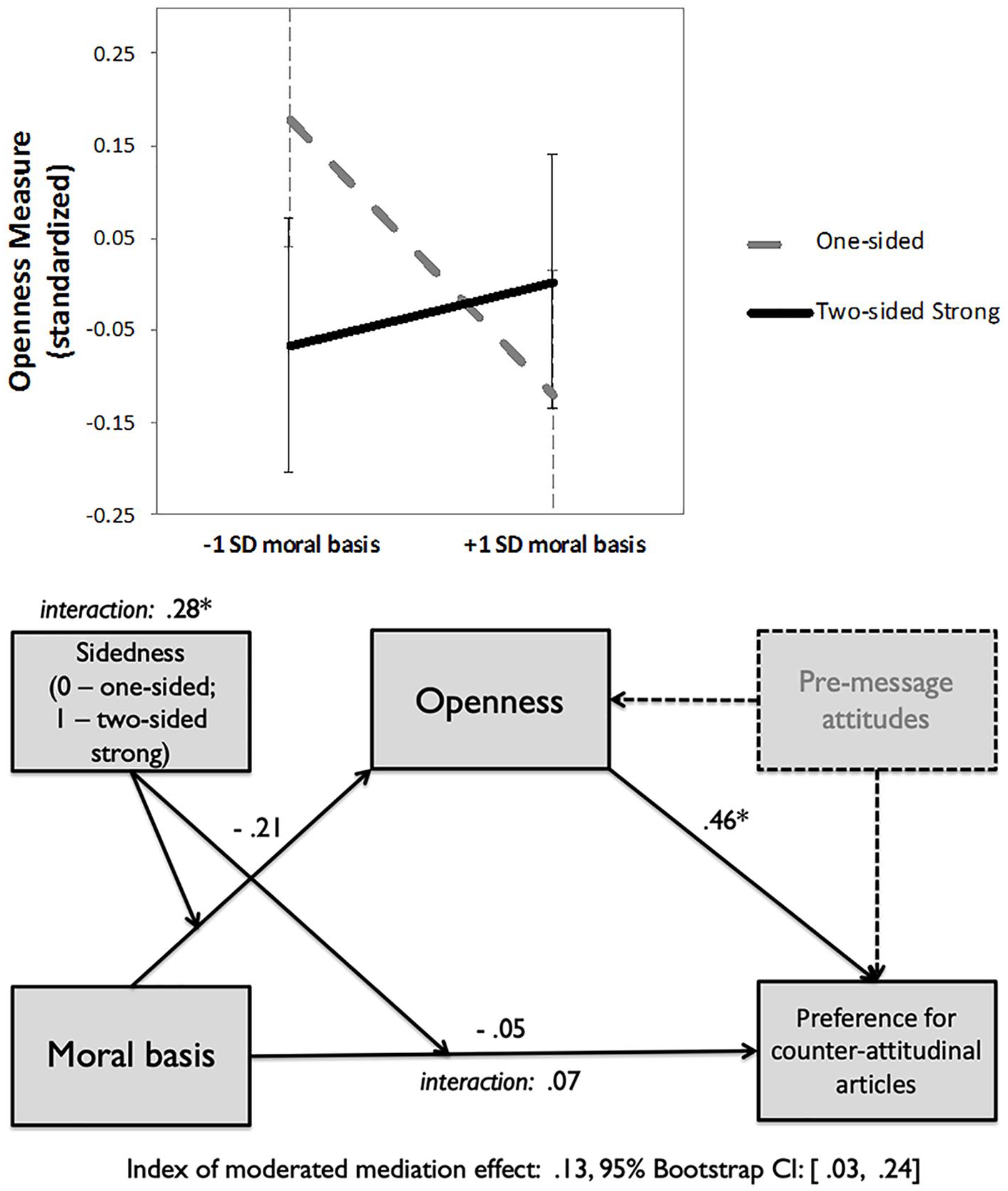
Top panel: Interactive effect between moral basis and message sidedness on participants’ openness to the other side in Studies 1A/B (i.e., collapsed across topic). Bottom panel: Moderated mediation demonstrating the significant indirect path of the Moral Basis × Message Sidedness interaction on preference for reading additional counterattitudinal articles through openness in Studies 1A/B.
Article preference
We examined participants’ preference for reading attitude-inconsistent articles. Using the same hierarchical linear regression model as before (standardized within study), we again found a trending two-way interaction between moral basis and message sidedness, B = .20, SE = .12, t(275) = 1.68, p = .09, partial η2 = .01, in the same direction as for openness.
Moderated mediation. 6
We examined whether openness was a plausible mediator of the preference for exposure to opposite viewpoints. Using PROCESS macro model 8 (Hayes, 2017), message sidedness was the independent variable, moral basis was the moderator, openness was the mediator, and article preference was the dependent variable. Pre-message attitudes were a covariate. A significant moderated mediation effect = .13 emerged, 95% bootstrapping confidence interval (CI) = [.03, .25] (see Figure 1, bottom). This suggested that the interaction of moral basis and message sidedness observed on article preference was plausibly mediated by openness.
Study 2: Manipulating Appreciation
Studies 1A/B suggested an interactive effect of moral basis and message sidedness on people’s openness to a counterattitudinal advocacy across two issues. We next examined a moderator predicted by our postulated mechanism. Given that the participants’ reported openness predicted their actual openness to reading counterattitudinal articles in Studies 1A/B, we only included the self-report of openness in the studies reported next.
As suggested earlier, a two-sided counterattitudinal message clearly acknowledges the recipient’s own attitude, which could result in more appreciation for the author’s point of view and therefore a greater desire to reciprocate by being open to the author’s position. In addition, having another person respectfully acknowledge one’s view might be particularly appreciated the more one’s attitude is based on moral considerations. Therefore, we hypothesized that the relative benefit of a two- over a one-sided message among participants with a high moral basis would be due to their increased appreciation for the message author acknowledging their side. In Study 2, we examined this by measuring and manipulating the extent to which the two-sided message showed appreciation.
To manipulate the level of appreciation expressed for the recipients’ viewpoint, participants were presented with one of four messages: (a) a one-sided message, (b) a two-sided message with strong arguments for the opposite side, (c) a two-sided message with weak arguments for the opposite side, or (d) a two-sided message with a short statement acknowledging the validity of the other side. The two-sided strong message shows the best appreciation for the recipient’s side and was predicted to replicate the interaction pattern found in Studies 1A/B which used similar messages. Because the two-sided weak message does not give much credit to the recipient’s side, it was not expected to elicit much appreciation and be more like the one-sided message. We had no clear prediction for the simple acknowledgment message. It could be as effective as the two-sided strong message if simply showing respect for the other side is sufficient. Or, it may not be very effective if some evidence of respect for the other side is needed.
Method
Participants
Participants were 258 Amazon MTurk workers. Using the effect size of the key interaction from a prior study (i.e., the supplemental study, partial η2 = .031), using G*Power indicated that 245 participants were needed to have 80% power to detect an interaction between the fixed factor with four levels and a continuous variable in an analysis of covariance (ANCOVA). Additional participants were collected in case of the need to exclude participants due to detection of bots, incompletion, and so on.
Procedure
Participants first rated whether they saw the issue of gun control (used in Study 1B) as a moral issue, then rated their attitudes and received the randomly assigned message. After reading the message, participants responded to the measures of openness.
Moral basis and pre-message attitudes
We used an average of the same two items as in Study 1B to assess moral bases (α = .90) and also the same measure of pre-message attitudes.
Message sidedness
Participants were given about 2 min to read their assigned article. For those against stricter gun laws, they received one of four articles arguing that having stricter gun laws is necessary. In the one-sided and two-sided strong conditions, the pro-gun control messages were the same as in Study 1B. The two-sided weak message first presented the same two strong arguments as in the one-sided version and then presented two weak arguments on the other side. For example, it stated that Syria does not have gun control and thus the United States should not. Although this message acknowledged the other side, by presenting only weak reasons for the target’s position, it did not show much appreciation. In the two-sided claimed condition, the same two initial arguments were presented but then the author merely acknowledged that there were some reasonable points on the other side without articulating any.
For participants in support of stricter gun laws, they received one of the four articles arguing that having stricter gun laws is not necessary. The one-sided and two-sided strong messages were taken from Study 1B. The two-sided weak message presented two weak arguments counter to its primary claim. For example, the author mentioned that guns make upsetting loud noises and can result in hearing loss. The two-sided claimed message merely stated that the other side had some reasonable points after presenting the core arguments. All messages are in the Online Supplement. Regardless of the message, the author always concluded by stating the advocated position contrary to the participants’ attitudes. 7
Openness
Four items similar to those used in Study 1B were averaged to measure how open participants were to the other side after reading the counterattitudinal article (α = .85; see Online Supplement).
Results
Pre-message attitudes and moral basis scores were included in an ANCOVA as covariates and the message sidedness variable (four conditions) as a fixed factor. In addition, the interaction between moral basis and message sidedness was included. The only significant effect was a two-way interaction between moral basis and message sidedness, F(3, 249) = 3.56, p = .02 (see Figure 2). Given there are four message conditions, we conducted additional analyses to examine the locus of the overall interaction. The four message conditions were dummy coded. We used the one-sided condition as the reference group. Using a hierarchical multiple linear regression model, we included moral basis along with the three dummy variables in the first step of the model. In the second step, interactions between moral basis and each of the three dummy variables were added.
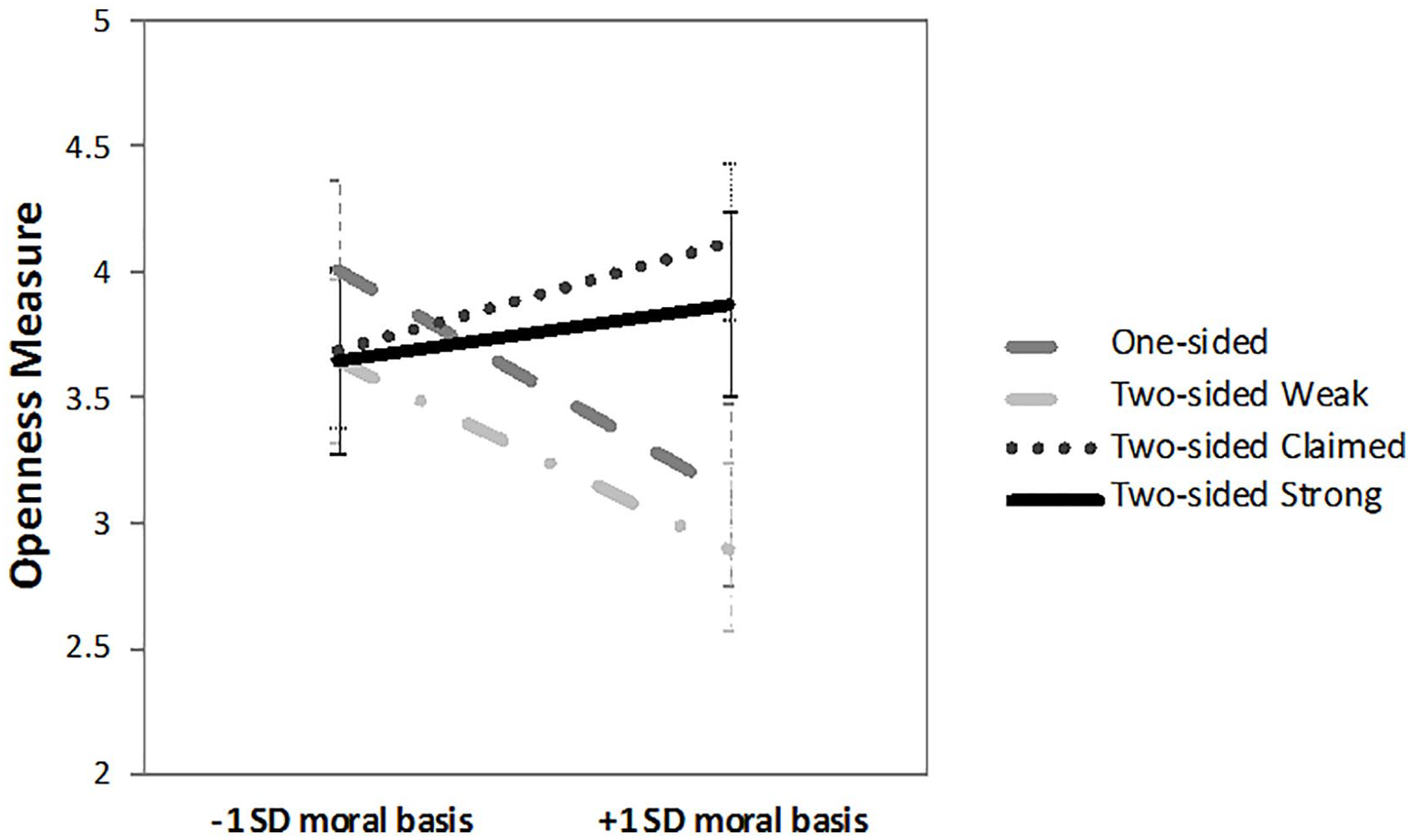
Interactive effect of moral basis and message sidedness (four message conditions) on participants’ openness in Study 2.
A two-way interaction between moral basis and D1 (i.e., comparing the one-sided and two-sided strong conditions) emerged, B = .53, SE = .27, t(249) = 1.99, p = .048, partial η2 = .016, replicating the pattern found in Study 1. There was an effect of moral basis on openness in the one-sided condition, B = −.43, SE = .18, t(249) = −2.34, p = .02, partial η2 = .022, suggesting that increased moral basis was associated with less openness. In the two-sided strong condition, this relationship was non-significant in the opposite direction, B = .10, SE = .20, t(249) = 0.52, p = .60. There was also a two-way interaction between moral basis and D3 (comparing the one-sided and two-sided claimed conditions), B = .64, SE = .24, t(249) = 2.66, p = .008, partial η2 = .028. This interaction was also due to a significant negative slope in the one-sided condition (see above) that was in the reverse direction for the two-sided claimed condition, B = .21, SE = .16, t(249) = 1.29, p = .20.
The interaction between moral basis and D2 (comparing the one-sided and two-sided weak conditions) was not significant, B = .07, SE = .24, t(249) = 0.30, p > .76. In a separate analysis, we used the two-sided claimed condition as the reference group and found that the two-sided claimed condition and the two-sided strong condition did not produce different effects on openness, B = −.11, SE = .25, t(249) = −0.42, p = .67. 8
Discussion
In this study, we replicated the predicted interaction of moral basis and message sidedness on openness from Studies 1A/B when the two-sided message had strong arguments. More interestingly, this interaction did not emerge when the other side was presented with weak arguments. Furthermore, a two-sided message that simply claimed that the other side had reasonable arguments was just as effective as presenting strong arguments on that side.
Study 3: Preregistered Replication
Using two different topics, we demonstrated that moral basis is differentially associated with people’s openness to counterattitudinal information after reading one- versus two-sided messages. Study 2 further showed that the interaction was confined to two-sided messages that respected the other side. However, the evidence for the core interaction on openness in each individual study was somewhat weak, though an overall significant two-way interaction is present in a combined analysis across the common conditions of the studies, B = .25, t(566) = 2.96, p = .003, partial η2 = .015. Nonetheless, because of the relative weak interaction pattern in the individual studies, we conducted a preregistered replication experiment to confirm the interactive pattern between moral basis and message sidedness on openness. In this study, we used a more contemporary and timely issue, face mask wearing during the COVID-19 pandemic. 9 Given that people’s attitudes toward this topic are likely to be more newly formed, we expected that people would be quite open toward mask wearing if reasonable arguments were presented. However, we still expected to observe the interactive pattern between moral basis and message sidedness.
Method
Participants
Our goal was to detect a relatively small interaction effect (partial η2 = .0196, calculated based on Studies 1A/B, 2, and the supplemental study). A power analysis using G*Power revealed that to have 80% to 90% power, we needed 395 to 528 participants. We collected data from 501 Amazon MTurk workers. 10 All participants first answered a prescreening question about their attitude toward wearing a face mask when they leave home during the COVID-19 pandemic. Responses were made on a 6-point extremely negative to extremely positive scale. Because our hypothesis depends on participants receiving a counterattitudinal message and we deemed it unethical to present participants with a message that argued against mask wearing, we decided a priori to exclude participants who indicated that they were already either moderately or extremely positive toward mask wearing (i.e., 5 or 6 on the scale). Because we expected the majority of participants to be quite positive toward mask wearing, to boost sample size we also decided to include those who were only slightly positive toward the issue because they had room to be even more positive. Nonetheless, analyses will also be conducted for only those who opposed wearing face masks.
Procedure
Participants first rated their attitude toward mask wearing. Then, eligible participants rated the extent to which they saw the issue as a moral one. Next, they were randomly presented with a one- or two-sided strong message arguing that the public should always wear face masks when they leave home. After that, participants once again rated their attitudes toward the issue and responded to the measures of openness and behavioral intentions.
Pre- and post-message attitudes
The pre-message attitude question served as a prescreening device and was administered again after the message. Participants indicated their attitudes toward always wearing face masks outside to help slow the spread of COVID-19 on a 6-point scale anchored at 1 = extremely negative and 6 = extremely positive.
Moral basis
Two items from the prior studies were averaged to assess whether participants viewed the topic of mask wearing during the pandemic as a moral one (α = .76).
Message sidedness
Participants were given an initial 2 min to read their assigned article before being allowed to advance to the next page or click a button for more time. 11 Both articles argued in favor of mask wearing. The one-sided message suggested that wearing masks helps stop the spread of disease from infected people and universal mask use could stop asymptomatic carriers from spreading the disease. The two-sided message presented the same arguments and then briefly acknowledged reasons why some people might oppose face mask wearing (see Online Supplement). 12
Openness
Four 7-point scales anchored at 1 and 7 that were similar to those as used in the prior studies were employed to assess participants’ openness to the message. These four items were then averaged (α = .92; see Online Supplement).
Behavioral intentions
One new item was included for exploratory purposes and assessed participants’ intentions to engage in the advocated behavior. Participants rated their likelihood of wearing a face mask the next time they went outside on a 1 (not at all) to 7 (extremely) likely scale.
Results
Openness
The same hierarchical multiple linear regression model as in the prior studies revealed an effect of pre-message attitudes on openness, B = .23, SE = .05, t(497) = 4.61, p < .001, partial η2 = .041, suggesting that more favorable attitudes toward mask wearing were associated with more openness toward mask wearing. There was also an effect of moral basis on openness, B = .56, SE = .06, t(497) = 9.74, p < .001, partial η2 = .16, suggesting that a higher moral basis to one’s attitude was associated with more openness. Most importantly, a two-way interaction between moral basis and message sidedness emerged, B = .48, SE = .11, t(496) = 4.16, p < .001, partial η2 = .032 (see Figure 3), providing a conceptual replication of the findings of Studies 1 and 2 with a new topic. 13 There was a positive moral basis effect on openness for the two-sided message condition, B = .78, SE = .08, t(496) = 10.14, p < .001, partial η2 = .17, suggesting that as the moral basis of the attitude increased, so too did openness. In the one-sided message condition, the effect of moral basis on openness was still positive, though reduced in magnitude, B = .30, SE = .09, t(496) = 3.53, p = .001, partial η2 = .025.

Interactive effect of moral basis and message sidedness on openness in Study 3.
Behavioral intention
Using the same hierarchical linear regression analysis on the intention measure, we obtained similar main effects of pre-message attitudes, B = .30, SE = .06, t(497) = 5.21, p < .001, partial η2 = .05, and moral bases, B = .56, SE = .07, t(497) = 8.39, p < .001, partial η2 = .12. Most importantly, a two-way interaction was observed, B = .58, SE = .13, t(496) = 4.36, p < .001, partial η2 = .037. There was a positive moral basis effect on behavioral intentions for the two-sided message, B = .82, SE = .09, t(496) = 9.26, p < .001, partial η2 = .15, that was reduced in magnitude for the one-sided message, B = .24, SE = .10, t(496) = 2.47, p = .01, partial η2 = .012. 14
Discussion
In Study 3, we replicated the interaction between moral basis and message sidedness on openness in a preregistered and well-powered study. In Studies 1A/B and 2, we saw that when the message was one-sided, as morality increased, openness was reduced, whereas for the two-sided message, this reduction in openness was attenuated. In Study 3, we saw that when the message was two-sided, as morality increased, openness was increased, whereas for the one-sided message, this enhancement in openness was attenuated. It is important to note that once the main effects for morality and sidedness are removed (which can vary from topic to topic), these interactions are in fact of precisely the same form (see Rosnow & Rosenthal, 1989). That is, these interactions all show that the relative benefit of a two-sided message over a one-sided communication is enhanced as the attitude’s moral basis increases, consistent with our core hypothesis.
General Discussion
Conflict and misunderstanding between opposing political views have intensified over the past few decades. Encouraging open-mindedness to alternative views is one way to bridge the divide between people who hold disparate opinions. In the present research, we examined the utility of using two-sided rather than the traditional one-sided counterattitudinal messages as a way to encourage openness among people who hold morally based attitudes. We consistently found that as the moral basis of attitudes increased, the relative benefit of using a two-sided rather than a one-sided message was enhanced. We also demonstrated that the interactive effect of moral basis and message sidedness on openness occurred for a diversity of topics. Across three studies, including a preregistered one, we found that moral bases interacted with message sidedness to predict openness to opposing views. We also showed the same interaction pattern on a behavioral measure of openness to reading articles on the other side (Studies 1A/B) as well as intentions to perform the recommended action (Study 3). In addition, we demonstrated that manipulated message appreciation moderated participants’ openness to counterattitudinal advocacy. That is, two-sided messages that did not respect the other side were more similar to one-sided messages (Study 2). In sum, the present research offers one means by which people with strongly held moral attitudes can be rendered more likely to reciprocate by being open to explore counterattitudinal information—provide them with a two-sided message that respectfully acknowledges their side.
It is also important to reiterate that our interaction hypothesis between moral basis and message sidedness is a relative one. That is, the slopes of the lines relating moral bases with openness should be different for the one- and two-sided messages with the slope for the two-sided message being relatively more positive (or less negative) than the slope for the one-sided message. The specific slopes of the lines could vary, however, depending on the message topic. For example, when attitudes on the topic (such as gun control) are relatively stable and long-standing, results are likely to demonstrate a significant negative relationship between moral basis and openness for a one-sided message that is attenuated for the two-sided message. However, when using a topic that is more novel and malleable like face mask wearing, then results are more likely to show a positive relationship between moral basis and openness for the two-sided message that is attenuated for the one-sided message.
Additional Issues
What about a proattitudinal advocacy?
We focused on counterattitudinal advocacy because presentation of such messages is most helpful when aiming to bridge the gap between people who hold divergent opinions. However, would our results also hold in a proattitudinal context? Our hypothesis based on reciprocity would not expect the interaction to emerge in a proattitudinal context, because there the second side is opposite to the recipient’s position, so recognizing it does not provide any acknowledgment. In a supplemental study, using a similar design to Study 1B, we assigned participants to read either a counterattitudinal or a proattitudinal message on the topic of gun control. The results revealed a three-way interaction between moral basis, message sidedness, and message position, B = −.87, SE = .39, t(196) = −2.23, p = .03, partial η2 = .005. Decomposition of this interaction indicated that we obtained the two-way interaction between moral basis and message sidedness on openness observed in the prior studies in the counterattitudinal context, B = .71, SE = .25, t(196) = 2.84, p = .005, partial η2 = .04 (Figure 4, bottom). However, in the proattitudinal context, the two-way interaction was not significant, p = .60 (Figure 4, top; see the full analysis of this study in the Online Supplement).
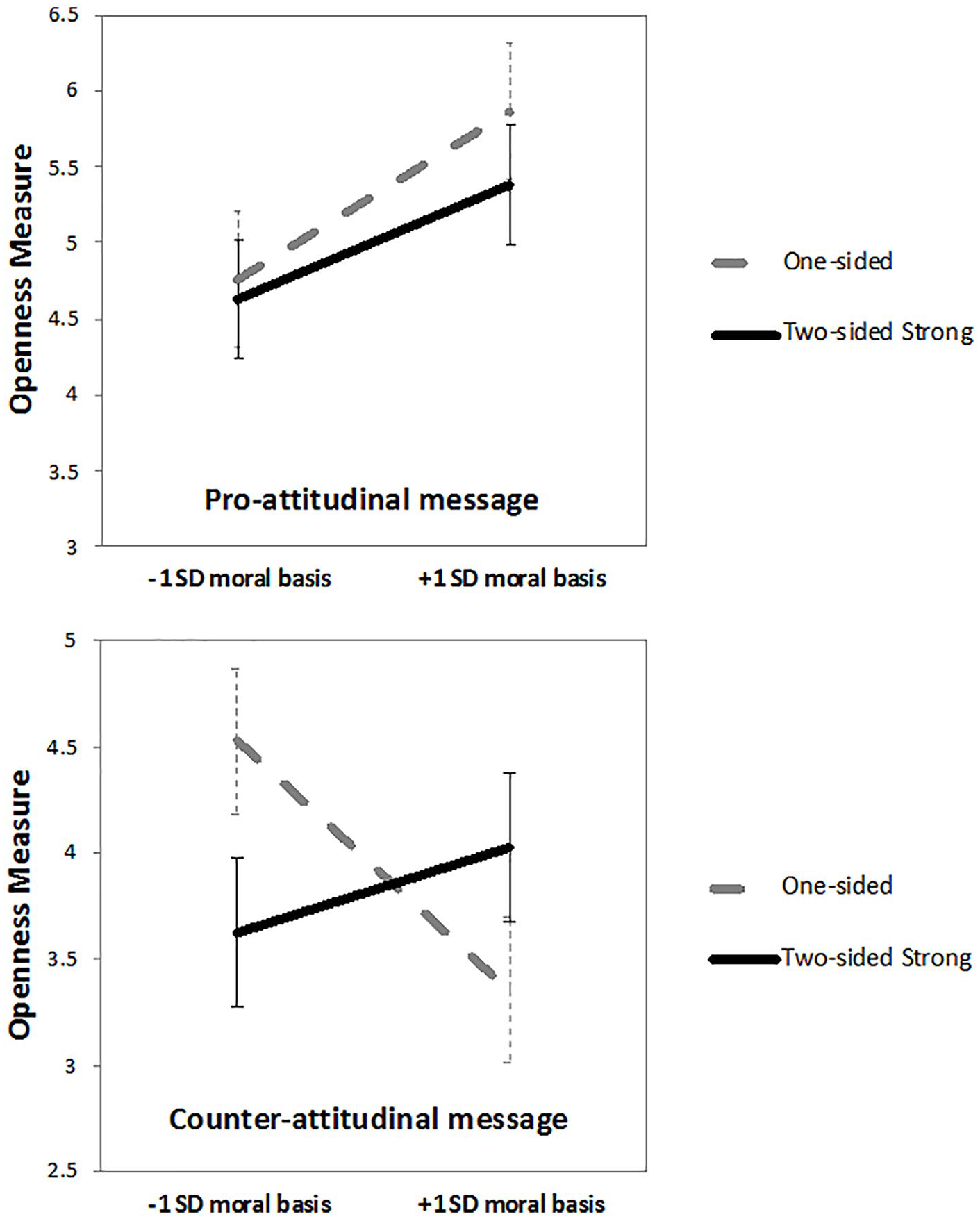
Interactive effect of moral basis and message sidedness on participants’ openness to the other side for both proattitudinal (top panel) and counterattitudinal (bottom panel) conditions in the supplemental study.
Mega-analysis
We combined all of the data presented so far in a mega-analysis of the interaction between moral basis and message sidedness on openness to provide more power to examine simple effects. For Studies 1A/B and 3, we included all data. For the supplemental study just presented, we only included the counterattitudinal condition. For Study 2, we only included the data from the one-sided and two-sided conditions that showed respect for the other side (strong and claimed conditions). An analysis comparable with those conducted for the studies separately revealed main effects for pre-message attitudes, B = .14, SE = .03, t(1183) = 4.91, p < .001, partial η2 = .02, and moral bases, B = .14, SE = .03, t(1183) = 4.88, p < .001, partial η2 = .02, as in most of the individual studies. Furthermore, there was the predicted interaction between moral basis and message sidedness, B = .30, SE = .06, t(1182) = 5.25, p < .001, partial η2 = .023 (see Figure 5, top left). When study was included as a factor in this analysis, it did not further moderate (p > .58). There was a significant moral basis effect on openness for the two-sided message, B = .27, SE = .04, t(1182) = 7.17, p < .001, partial η2 = .04, suggesting that people were significantly more open to this message as they held increasingly more morally based attitudes. For the one-sided message, the effect was in the opposite direction, B = −.03, SE = .04, t(1182) = −0.65, p = .51.

Interactive effect of moral basis and message sidedness (collapsed across topic) on participants’ openness to the counterattitudinal message (top left panel), perceived appreciation (top right panel), and post-message attitudes (bottom left panel) in all studies (including only the counterattitudinal message conditions). Interactive effect of other attitude strength indices and message sidedness (collapsed across topic) on participants’ openness to counterattitudinal messages (bottom right panel).
An alternative way to decompose the interaction is to look at the effect of sidedness at relatively low (–1 SD) and high (+1 SD) moral bases. When moral bases were relatively low, participants were more open to the one- than the two-sided message, B = −.32, SE = .08, t(1182) = −3.95, p < .001, partial η2 = .013. In contrast, when moral bases were high, people were more open to the two- than the one-sided message, B = .28, SE = .08, t(1182) = 3.49, p < .001, partial η2 = .01.
In Studies 1A/B, 2, and 3, we also assessed participants’ perceived appreciation for their side being acknowledged. Participants rated the extent to which they were pleasantly surprised by and appreciative of the arguments and/or that the author had acknowledged their side on 7-point scales anchored at 1 for not at all and 7 for completely/extremely. 15 Within each study, the average of the items used was calculated to serve as the appreciation measure (αs > .72) and standardized. Using the same hierarchical analysis, there were main effects for pre-message attitudes, B = .13, SE = .03, t(1068) = 4.18, p < .001, partial η2 = .016, and moral bases, B = .18, SE = .03, t(1068) = 5.92, p < .001, partial η2 = .032. There was also a trending effect of message sidedness, B = .10, SE = .06, t(1068) = 1.74, p = .08, partial η2 = .003, suggesting that participants were more appreciative of a two- than one-sided message.
Most importantly, there was an interaction between moral basis and message sidedness, B = .30, SE = .06, t(1067) = 5.05, p < .001, partial η2 = .023 (see Figure 5, top right), replicating the pattern on openness. Study did not further moderate the effect (p > .89). For appreciation, there was a positive impact of moral basis for the two-sided message, B = .31, SE = .04, t(1067) = 7.83, p < .001, partial η2 = .054, that was not present for the one-sided message (p > .88). Using PROCESS macro model 8, a significant moderated mediation path emerged, effect = .21, 95% bootstrapping CI = [.12, .30] (see Figure 6, top), suggesting that the interaction between moral basis and message sidedness on openness was mediated by appreciation. 16

Top panel: Moderated mediation demonstrating the significant indirect path of moral basis and message sidedness interactive effect on openness toward the counterattitudinal message through perceived appreciation in all studies. Bottom panel: Moderated mediation demonstrating the significant indirect path of moral basis and message sidedness interactive effect on post-message attitudes through openness in all studies (counterattitudinal context).
What about post-message attitudes?
Our primary focus in this research was on enhancing openness, but in all studies, we also assessed participants’ post-message attitudes toward the advocacy (see Online Supplement). The same hierarchical mega-analysis of all studies described previously produced an effect of pre-message attitude on post-message attitudes, B = .12, SE = .03, t(1183) = 4.06, p < .001, partial η2 = .014. Of most interest, there was also an interaction between message sidedness and moral basis in the same direction as for openness, B = .18, SE = .06, t(1182) = 3.09, p = .002, partial η2 = .008 (see Figure 5, bottom left). Study did not further moderate this (p > .29). There was a positive effect of moral basis on attitudes for the two-sided message, B = .11, SE = .04, t(1182) = 2.98, p = .003, partial η2 = .007, that was absent, and in the opposite direction for the one-sided message, B = −.06, SE = .04, t(1182) = −1.48, p = .14, partial η2 = .002. Using PROCESS macro model 8, a significant moderated mediation path emerged, effect = .18, 95% bootstrapping CI = [.10, .26] (see Figure 6, bottom), suggesting that the interactive effect between moral basis and message sidedness on attitudes was mediated by openness.
Other attitude strength indicators
Having a moral basis to one’s attitude makes the attitude stronger and more consequential (Skitka, 2010). However, research has previously demonstrated that features of attitudes other than their moral basis (e.g., attitude certainty) likewise render them more persistent, resistant, and predictive of behavior (Petty & Krosnick, 1995). That is, moral basis is but one indicator of attitude strength (Philipp-Muller et al., 2020). Thus, we aimed to examine whether some other strength features might account for the impact we observed for moral bases. In all of our studies, along with the moral basis measure, we included alternative attitude strength measures right after the pre-message attitudes and morality items but before the presentation of the message. All strength measures were assessed using 7-point rating scales, and the total scores on all items available in a given study were averaged to form a pre-message non-moral attitude strength score (αs > .51). 17
Using the same dataset as the previous mega-analyses, we used a hierarchical multiple linear regression model as earlier to analyze the effect of pre-message attitude strength and message sidedness on participants’ openness toward counterattitudinal messages. A significant effect of pre-message attitudes on openness emerged, B = .15, SE = .03, t(1183) = 5.18, p < .001, partial η2 = .022. Most interestingly, a two-way interaction between attitude strength and message sidedness was present, B = .16, SE = .06, t(1182) = 2.80, p = .007, partial η2 = .007. This interaction was of the same form as the interaction between moral basis and message sidedness observed in the prior studies (see Figure 5, bottom right). 18
Finally, we conducted a hierarchical multiple linear regression analysis with both moral basis and attitude strength in the same model along with pre-message attitudes and message sidedness and both two-way interactions (i.e., Moral Basis × Sidedness and Attitude Strength × Sidedness). This analysis showed that the two-way interaction between moral basis and message sidedness remained significant, B = .30, SE = .07, t(1180) = 4.44, p < .001, partial η2 = .016. However, the two-way interaction between attitude strength and messages sidedness was not, B = −.004, SE = .07, t(1180) = −0.06, p = .95, suggesting that moral basis has a unique and independent effect (see Online Supplement for additional analyses when controlling for the interaction between attitude extremity and sidedness).
Theoretical Implications
The current work offers several new insights. Most importantly, we demonstrated a new way to open entrenched attitudes to alternative points of view—presenting two-sided rather than one-sided messages. Prior work showed that it can be very difficult to change people’s moral views (Skitka, 2010). Our research suggests that using two-sided counterattitudinal messages that respectfully acknowledge the other side can be an effective way of making people more open to learning about alternative viewpoints and ultimately influencing their attitudes and intentions. Although the current work focused on morally based attitudes, our studies have the potential to be informative for other indicators of closed-mindedness such as dogmatism (Rokeach, 1960) and attitude strength indicators more generally (Petty & Krosnick, 1995). That is, although people high in dogmatism and certainty, like those with morally based attitudes, are generally very resistant to changing their positions, using two-sided messages may be an effective influence technique.
Previous research on openness generally came from the psychotherapy and education literatures. With respect to social influence, recent work on intellectual humility and open-minded cognition has started to investigate the concept of openness as an individual trait factor. Openness has been shown to have important implications when it comes to predicting people’s tendencies to engage in elaboration when encountering counterattitudinal information, people’s reactions to others’ attitude change, as well as the warmth expressed toward outgroup minority members (Leary et al., 2017; Price et al., 2015). The current research suggests that beyond openness as a trait, it can be affected with respect to particular issues and is related to downstream consequences (e.g., attitude change).
The current research also adds to the message sidedness literature by for the first time directly manipulating the quality of the argument in the second side of a two-sided message. Our finding that not all two-sided messages are equal has important implications when attempting to use two-sided communications. By manipulating the argument quality of the second side, one is essentially manipulating the amount of appreciation the author of the message is showing to the recipient and thus the motivation of that person to reciprocate. Moreover, adding to the prior research exploring mechanisms of message sidedness such as perceptions of source honesty, our work suggests that perceived appreciation and the reciprocity norm that it invokes is also a viable mechanism.
Another contribution is to extend the contexts in which two-sided messages are superior to one-sided communications. Past research had shown that two-sided messages were better than one-sided for people who were relatively high in education, intelligence, or need for cognition (Hovland et al., 1949; Kao, 2011). Adding to that, the current research has demonstrated that although one-sided messages may be superior for relatively weak attitudes, when the attitudes are stronger (e.g., based on moral considerations), the relative benefits of two-sided messages emerge.
A final contribution is that the current work adds to the reciprocity literature. Prior research had been confined to showing its effectiveness in enhancing compliance—behavioral change without modifying a person’s attitude. We extend the utility of reciprocity to the traditional persuasion domain. Although some past work has examined moderators of the effectiveness of reciprocity (e.g., the authority of the requester; see Turner et al., 2007), we introduced a new moderator showing that people with morally based attitudes are more susceptible to it.
Limits on Generalizability
The issues we explored in the current research tended to have a substantive moral component. That is, these topics were significantly above the midpoint on a scale asking participants to rate to what extent they think the general public in the United States would view the given topic as a moral one (see Online Supplement). Thus, the interaction between moral basis and message sidedness appears to hold for topics that are generally perceived as moral ones. However, we are unable to claim that this interaction would hold for attitude topics that are relatively low in their moral basis. First, for such topics, there could be insufficient variance in moral bases to detect effects. Or, for such topics, a different indicator of attitude strength (e.g., certainty) might be superior in producing a Strength × Sidedness interaction on openness. Another potential limitation is that in Study 3, we used the timely face mask wearing issue as a topic, aiming to convince people to consider wearing face masks. Because we eliminated people already highly favorable toward mask wearing, we likely had a sample that was more politically conservative than liberal. However, given that in two other experiments (Studies 1B and 2) we included people on both sides of the gun control issue and obtained similar results, it seems unlikely that our effects are limited to conservatives.
Future Directions
In the current research, we focused on appreciation for the two-sided message as the mediator of openness. In future work, it would be of interest to explore the role of additional mechanisms. For example, previous work (e.g., Correll et al., 2004) suggests that self-affirmation reduces defensiveness and thereby enables people to objectively evaluate information that would otherwise evoke a negative reaction. When encountering a two-sided counterattitudinal message, even though the acknowledgment is not of one’s most important values (e.g., see Cohen et al., 2000), it still could potentially help with the recipient’s secure sense of self. Therefore, it would be interesting if acknowledgment of the recipient’s position works in part by affirming the self. In addition, in the mega-analysis, we observed that the one-sided message was preferred at low levels of moral attitude bases. One possible mechanism that future work could explore is whether the motive to avoid the ambivalence or dissonance from a two-sided message is stronger when people have relatively low moral bases (Elliot & Devine, 1994).
Finally, we explored different kinds of two-sided messages by manipulating the argument quality of the second side and by including a statement that merely acknowledges the other side has validity. For future research, it would be important to examine exactly what elements have to be included in the second side of a two-sided message for it to be effective. Also, does the placement of the second side matter (i.e., at the beginning of the message or at the end, as in the current work)? Furthermore, what if the author says that the other side has extremely good reasons or presents such reasons? Such a message might seem as if it is pandering and therefore backfire or be so compelling that the recipient is no longer open to the speaker’s side. As with most new effects, future research is needed to more definitively establish the precise parameters of their operation.
Supplemental Material
sj-docx-1-psp-10.1177_0146167220988371 – Supplemental material for Two-Sided Messages Promote Openness for Morally Based Attitudes
Supplemental material, sj-docx-1-psp-10.1177_0146167220988371 for Two-Sided Messages Promote Openness for Morally Based Attitudes by Mengran Xu and Richard E. Petty in Personality and Social Psychology Bulletin
Footnotes
Declaration of Conflicting Interests
The author(s) declared no potential conflicts of interest with respect to the research, authorship, and/or publication of this article.
Funding
The author(s) disclosed receipt of the following financial support for the research, authorship, and/or publication of this article: Covid-19 Seed Grant, Office of Research, The Ohio State University.

Supplemental Material
Supplemental material is available online with this article.
Notes
References
Supplementary Material
Please find the following supplemental material available below.
For Open Access articles published under a Creative Commons License, all supplemental material carries the same license as the article it is associated with.
For non-Open Access articles published, all supplemental material carries a non-exclusive license, and permission requests for re-use of supplemental material or any part of supplemental material shall be sent directly to the copyright owner as specified in the copyright notice associated with the article.
