



Abstract
The present research examined how the Big Five traits Openness to Experience and Agreeableness predicted general attitudes toward diversity (Study 1) and receptivity to concrete diversity initiatives in the workplace (Study 2). Study 1 found that Openness to Experience positively predicted universal diverse orientation, but not pro-diversity belief or sensitivity to diversity. Agreeableness positively predicted universal diverse orientation and pro-diversity belief. In Study 2, Openness to Experience positively predicted universal diverse orientation, but not support for workplace diversity initiatives. Agreeableness positively predicted universal diverse orientation and support for both existing and potential workplace diversity initiatives. We also showed that universal diverse orientation mediated the links between personality and support for workplace diversity initiatives. We discuss how these findings can shed more light on the types of individuals who are more likely to endorse diversity and inclusion, which can subsequently inform more effective implementation and communication of diversity initiatives.
The issue of diversity and inclusion (D&I) has become increasingly relevant in the workplace, with practitioners and researchers alike increasing their efforts to better understand attitudes toward diversity and diversity initiatives (Fujimoto & Härtel, 2017). Although some work examined the efficacy of particular efforts, others have investigated the role that demographic factors play in employee support of initiatives (Bezrukova et al., 2012). Although there exists an abundance of research on D&I in general, less work has focused on how psychological factors such as individual differences are related to attitudes toward D&I. Moving beyond basic demographic differences, it is worth considering trait personality as one important individual differences factor that can influence employees’ receptivity to D&I. The Big Five model (John et al., 2008) of personality has consistently been related to a variety of significant life outcomes, for example, job/workplace performance, mental health, cognitive abilities, life satisfaction and well-being, and relationship quality (Caspi et al., 2005; Soto, 2019). Furthermore, Big Five traits have been repeatedly linked to important social beliefs and attitudes, such as social (e.g., universalism, security; Caprara et al., 2009) and moral values (e.g., harm, fairness, authority; Hirsh et al., 2010). Personality differences have also been linked to political ideology, with higher Openness to Experience predicting liberalism, and higher Conscientiousness predicting conservatism (e.g., Carney et al., 2008; Rentfrow et al., 2009; Sibley et al., 2012). Thus, in addition to predicting general life outcomes, personality differences play an important role in predicting attitudes and beliefs that are potentially relevant for issues of fairness and diversity (e.g., it is reasonable to assume that someone who values fairness would be more likely to support diversity initiatives). A better understanding of the personality factors underlying attitudes toward diversity and diversity initiatives can therefore paint a clearer picture of the type of person who is more or less likely to endorse D&I in the workplace. A personality-focused approach can help answer the questions of “Which people care about diversity, and why?”
This can have implications for how diversity initiatives are structured and tailored for their respective audiences to increase uptake and participation. Indeed, previous studies have found that people tend to be more receptive to stimuli congruent with their personality. For example, advertisement that targets a person’s personality (e.g., emphasizing exciting and fun aspects of a product to an extraverted consumer) led to higher ratings and purchase intentions for the advertised product (Hirsh et al., 2012). In the political realm, research has shown that voters tended to prefer political candidates who they perceive to have similar personality traits as themselves (Caprara et al., 2007; Koppensteiner & Stephan, 2014). Thus, knowing the specific personality characteristics of people who do (and do not) support diversity can potentially lead to more tailored initiatives that better motivate people to embrace diversity efforts.
Personality and Diversity Attitudes
Early studies examined the relationships between Openness to Experience and positive diversity attitudes among counselor trainees, and they found that trainees high in Openness were more likely to work with a wide range of clients (Thompson et al., 2002). These findings may be due to Openness being characterized by a willingness to explore different perspectives and experiences, that is, the clients’ cultural backgrounds. Similarly, White observers high in Openness to Experience were shown to be less likely to stereotype Black interviewees and were more likely to form positive impressions of them, suggesting that open individuals are more receptive to different perspectives (Flynn, 2005). Openness is also positively related to different measures of attitudes toward diversity, for example, universal diverse orientation (Han & Pistole, 2017; Strauss & Connerley, 2003), sensitivity toward diversity (Zhang & Goldberg, 2014), and pro-diversity beliefs (Homan et al., 2010). Overall, being receptive to new experiences and novel perspectives appears to be more related to accepting attitudes toward diversity.
In addition to Openness to Experience, positive relationships have also been shown between Agreeableness and diversity attitudes, when examining workplace attitudes toward minorities (Strauss et al., 2003). This suggests that agreeable individuals may be more likely motivated by an interest to care for and empathize with others different from them. Agreeableness is also positively related to different measures of attitude toward diversity (Zhang & Goldberg, 2014). Therefore, another individual difference determinant of receptiveness toward diversity may depend on the level of compassion one has for others.
It is possible that Openness to Experience and Agreeableness reflect different underlying motivations for supporting diversity. Given the characteristics associated with each trait, it could be that Openness reflects more cognitive and abstract motivations behind diversity support, by endorsing the ideals and values underlying diversity (e.g., “I believe fairness and diversity is good”). Thus, open individuals may view increased diversity as a positive concept in the workplace.
Agreeableness, however, could reflect more prosocial and concrete motivations, by specifically supporting actionable diversity-promoting initiatives and behaviors (e.g., “I will use my colleague’s preferred pronouns”). An agreeable person may view support for diversity as a means to positively impact someone’s workplace experience and well-being.
These potential differences in underlying motivation and characteristics could lead to differential attitudes and support for diversity initiatives. One way to obtain a more nuanced understanding of why open and agreeable people support diversity could be to examine each trait at a lower level. Past work has shown that each Big Five trait can be divided into lower level aspects or facets (DeYoung et al., 2007; Soto & John, 2017), which provide more detailed analyses of the trait predictors. Work by Soto and John (2017) suggests that Openness to Experience can be divided into three facets: Intellectual Curiosity, which deals with how people think about information; Aesthetic Sensitivity, which pertains to preferences for arts and culture; and Creative Imagination, which consists of traits related to creativity and originality. Agreeableness can be divided into the following: Compassion, which pertains to how people emphasize and feel for others; Respectfulness, which relates to polite social interactions; and Trust, which consists of trustful and forgiving characteristics. If the link between Openness to Experience and diversity support reflects cognitive and abstract motivations, then it is possible that these effects may be specifically due to the relationship that diversity support has with Intellectual Curiosity. However, if open individuals are more likely to support diversity due to the potential for encountering varied cultural and aesthetic experiences, then we may see a link between diversity support and Aesthetic Sensitivity instead. If the association between Agreeableness and diversity support stems from prosocial motivations, then we may observe specific links between Compassion and diversity support. Thus, adopting facet-level analyses of Openness to Experience and Agreeableness could potentially shed further light on the specific dispositions that motivate open and agreeable people to support diversity. This could provide more details on the specific attitudes and initiatives that these individuals support.
Diversity Initiatives in the Workplace
Although studies have explored relationships between these two Big Five traits and self-reported general attitudes toward diversity, many of these studies made use of undergraduate student samples. Fewer studies have directly assessed individuals currently in the workplace. Thus, the generalizability and replicability of these findings in the workplace need to be examined. Furthermore, previous work mainly focused on broad attitudes toward diversity, but did not examine specific workplace diversity initiatives that support historically disadvantaged groups, e.g., mentorship programs. However, it is important to examine potential differences between receptivity to diversity attitudes and receptivity to diversity management, which are action-oriented behaviors. This is in part because there are documented inconsistencies between people’s attitudes and behavior (Ajzen & Cote, 2008). That is, although people may hold positive attitudes and believe in the value and importance of diversity, this attitude may not translate into diversity-supporting behavior, e.g., completing diversity training. Furthermore, people may be externally motivated to publicly express pro-diversity attitudes but may be less willing to take the concrete steps to participate in diversity initiatives, or vice versa. In addition, attitude toward diversity may be general and vague (e.g., I think diversity is good), whereas support for specific diversity initiatives and behaviors can be more specific and actionable (e.g., I will use my coworker’s preferred pronouns). Thus, it is essential to examine workplace support for specific management-led initiatives in addition to general attitudes toward diversity (Soni, 2000).
Among these initiatives, diversity training is the most commonly studied, being a prominent tool adopted by employers to reduce discrimination and prejudice, and to build effective skills in working with diverse groups. A meta-analysis examining factors that affect the effectiveness of diversity training (e.g., context, training design) found that most of the studies focused only on demographic characteristics of the participants (Bezrukova et al., 2012). Women and racial minorities have been shown to report greater perception of discrimination in the workplace and more positive diversity attitudes (Bezrukova et al., 2012; Soni, 2000; Strauss & Connerley, 2003).
Although diversity training is prevalent, it is important to note that they have received criticism for producing varying results. The inconsistency in efficacy may be due to such training’s tendency to emphasize social group categorizations, thereby reaffirming stereotypes instead of disarming them (Fujimoto & Härtel, 2017). A more integrated approach, involving all levels of the organization within diversity efforts, may be more effective. This holistic approach can detail various initiatives (e.g., subsidized childcare and mentorship programs for people of color; Ewoh, 2013), and a national survey further reflected this breadth of diversity efforts, including company vision statements and internal committees dedicated to diversity (Society for Human Resource Management [SHRM], 2014). Thus, it is important to examine employee receptiveness toward a range of diversity initiatives, instead of focusing solely on diversity trainings. Previous work is limited in that they are mostly commentaries, and not empirical studies designed to measure perception of workplace diversity initiatives.
Finally, a very limited number of studies examined trait personality as a factor of interest toward attitudes about diversity initiatives. This presents a significant gap in the literature, as personality variables can further explain resistance to or support of diversity initiatives, beyond what can be explained by demographic variables. We expect that higher Openness to Experience and/or Agreeableness would also positively predict support for concrete workplace diversity initiatives, in addition to more general supportive attitudes toward diversity. Therefore, examining how differences in personality relate to attitudes and support for diversity initiatives can offer new insights into how such initiatives are perceived by people in the workplace.
Present Research
The present research aimed to extend the literature by examining how trait personality related to general diversity attitudes and support of specific diversity initiatives in the workplace. Specifically, we explored whether traits Openness to Experience and Agreeableness predicted employees’ attitudes toward diversity (Studies 1 and 2) and diversity initiatives in the workplace (Study 2). In our studies, general attitudes toward diversity were assessed using measures of universal diversity orientation, sensitivity to diversity, and pro-diversity belief. Universal diverse orientation referred to participants’ overall beliefs and attitudes about diversity-related issues, for example, importance of being around different types of people and cultures. Sensitivity to diversity pertained to how readily people notice differences in diversity around them. Pro-diversity belief entailed how positively people respond to diversity in the workplace. We also extended beyond past work by investigating how these attitudes relate to specific diversity-supporting behaviors in the workplace, by asking participants to indicate their support for concrete examples of workplace diversity initiatives (e.g., using preferred pronouns, attending diversity trainings, etc.). In both studies, we examined whether personality and diversity attitudes would predict participants’ willingness to donate money to a diversity-supporting program. We also provided exploratory analyses examining how Openness to Experience and Agreeableness related to diversity support at the facet level. Finally, we examined whether general attitude toward diversity may in part mediate the link between personality and support for specific diversity initiatives. These studies provided further insights into how employees perceive D&I workplace efforts, which can inform more effective implementations of such initiatives. The present studies were pre-registered on OSF at https://osf.io/qy6dt (See Supplemental Material), which contains datasets, SPSS syntax, and relevant study materials.
Study 1
Study 1 tested the relationships between Big Five traits and employees’ attitudes toward diversity. Participants completed measures of trait personality and attitudes toward diversity. We also assessed and controlled for relevant demographic variables.
Method
Participants and procedure
A total of 200 participants (115 men, 84 women, 1 undisclosed gender) were recruited online via Prolific, and they completed the study materials via the Qualtrics survey platform. Prolific (https://www.prolific.co/) is an online participant recruitment platform designed to collect large amount of data over a relatively short period of time. Peer reviews of the Prolific platform and its generated data suggest that it produces data of good quality, and contains more diverse samples, than other common online participation platforms (e.g., Mechanical Turk; Peer et al., 2017). Sample size was determined based on available budget. Sensitivity analyses using G*Power (Faul et al., 2007) suggest that the sample sizes of Studies 1 and 2 had 80% power to detect ΔR2 ranging from .038 to .062 in our regression analyses. To qualify for the study, participants had to be at least 18 years old, fluent in English, residents of the United States, and currently in or about to enter the workforce. 1 Data were collected during fall 2019, and participants were compensated US$2.75, in line with U.S. minimum wage at the time of data collection (average study completion time = 16.37 min). Participants’ age ranged from 18 to 72 years (M = 37.97 years, SD = 11.27 years), and participants on average received 15.78 years of education (SD = 2.08 years). The majority of the participants were White (n = 160), with 15 Hispanic or Latinx, 12 Asian, nine Black and African American individuals, and four Others. Majority of participants identified as heterosexual (n = 162), 22 identified as bisexual, seven as homosexual, four as asexual, and five selected either “prefer not to say” or “other.”
Materials
General attitudes toward diversity
Universal diverse orientation
Universal diverse orientation was assessed using the Miville-Guzman Universality-Diversity Scale (M-GUDS-S), first proposed by Miville et al. (1999), then readapted by Fuertes et al. (2000) into a shorter form of 15 items on a 6-point Likert-type scale from “strongly agree” to “strongly disagree” (e.g., “I would like to join an organization that emphasizes getting to know people from different countries”). Alpha reliability for this scale was .88.
Pro-diversity belief
A four-item measure was used to measure positive sentiment toward diversity on a 7-point Likert-type scale from “strongly disagree” to “strongly agree” (e.g., “I enjoy working in diverse groups”; Homan et al., 2010; α = .96).
Sensitivity to diversity
This was measured using a nine-item scale rated on a 5-point Likert-type scale (“strongly disagree” to “strongly agree”; Zhang & Goldberg, 2014). Sample items include, “I can easily perceive the gender imbalance in my workgroup, if it exists” (α = .94).
Trait personality
Trait personality was measured using the 60-item Big Five Inventory–2 (BFI-2; Soto & John, 2017), for which participants rated statements about their characteristics on a 5-point Likert-type scale from “disagree strongly” to “agree strongly” (e.g., “Values art and beauty,” “Is compassionate, has a soft heart”). Alphas for the five traits ranged from .85 to .94, with Agreeableness being .85 and Openness to Experience being .90.
Behavioral diversity support
Behavioral diversity support was measured via a money donation item. At the end of the study (prior to debriefing), participants were given the option to donate up to 100% (from US$0.00 to US$2.75) of their survey compensation to the Scientific Workplace Diversity Office, a program that promotes diversity within the workplace through the National Institutes of Health.
Results
Relationship between Big Five traits and diversity attitudes
First, we ran correlations to examine how different variables related to attitudes toward diversity (Table 1). With regard to trait personality, we found that Agreeableness positively correlated with all three diversity measures, and Openness was only positively correlated with universal diverse orientation. Behavioral diversity support, as measured through money donation, was uncorrelated with either Agreeableness or Openness to Experience. It was, however, positively correlated with pro-diversity belief (r = .16, p = .028).
Descriptive Statistics and Correlations for Variables of Interest in Study 1.
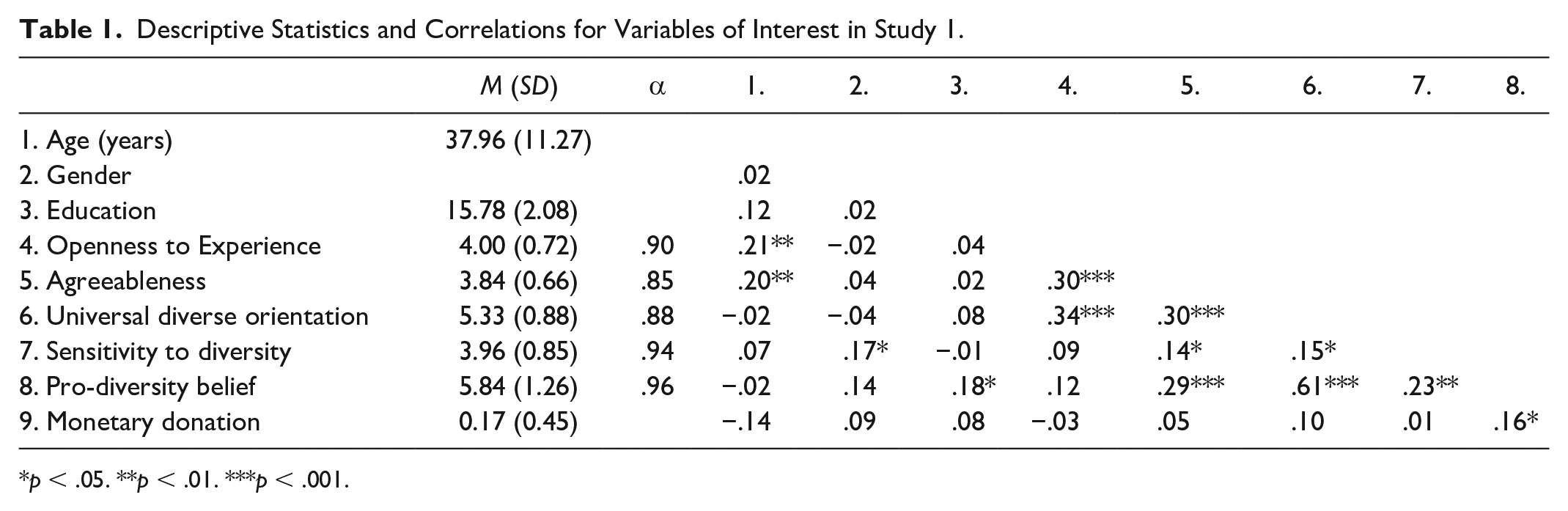
p < .05. **p < .01. ***p < .001.
Predicting diversity attitudes from personality
We ran hierarchical regression analyses to examine the degree to which personality variables predicted the scores on the diversity measures, after controlling for demographic variables (e.g., age, gender, ethnicity, sexual orientation, and education). In each regression analysis, demographics were entered into Step 1 and the Big Five personality traits into Step 2. Separate regression analyses were performed for each diversity measure. We performed separate analyses examining Openness to Experience, Agreeableness, and a third model, which included all five traits 2 (Table 2). To account for potentially inflated Type I error rates due to multiple testing, we report results that are corrected using the Bonferroni p value correction (Mundfrom et al., 2006). This procedure specifies that, instead of using a global critical p value of .05 to determine result significance, each regression model needed to adjust its critical p value against which we compare the p values found in our results. This adjustment is achieved by dividing the critical p value of .05 by the number of predictors in each regression model, and using this subsequent new p value as the criteria for significance level.
Regression Results for Study 1.
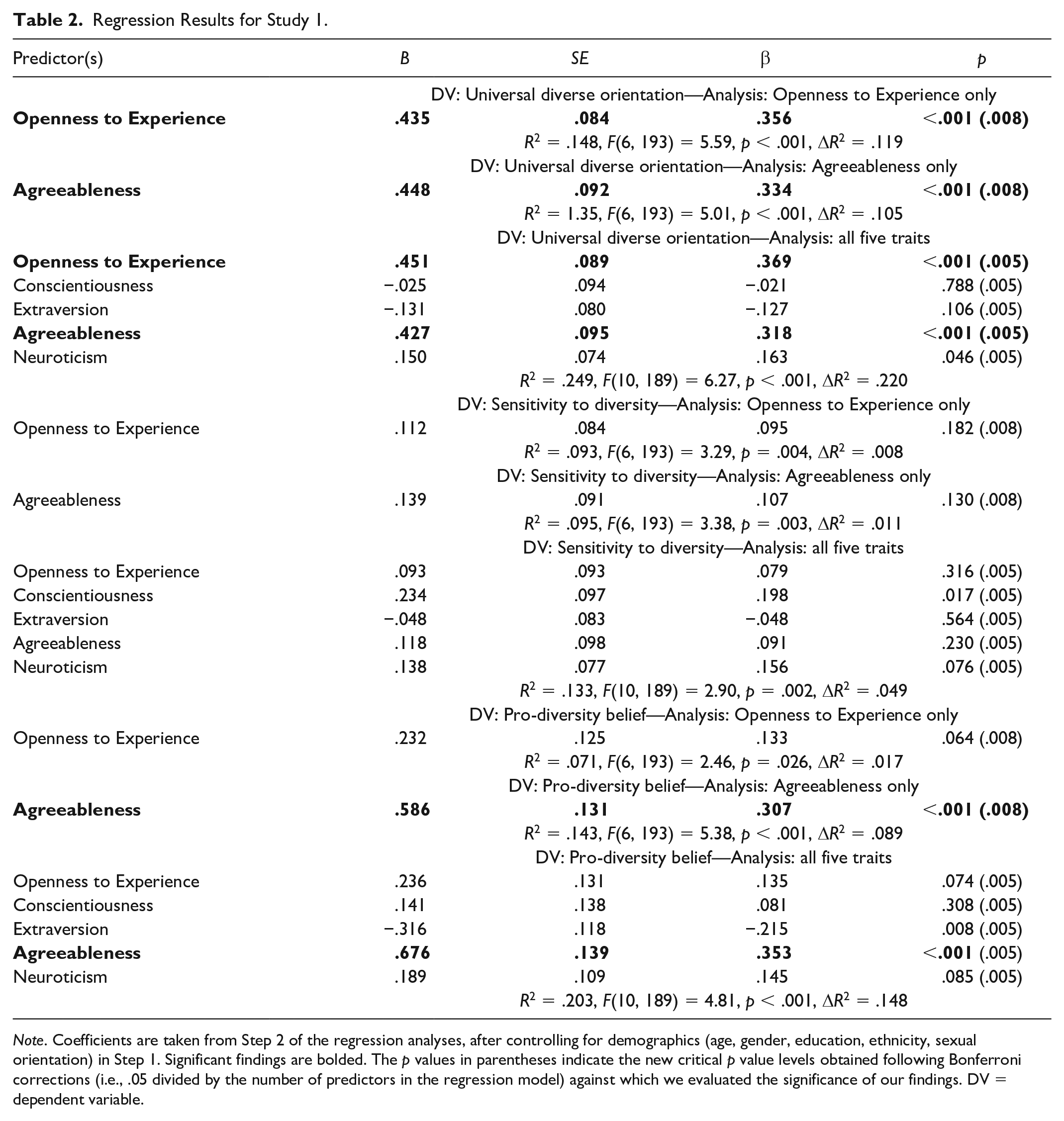
Note. Coefficients are taken from Step 2 of the regression analyses, after controlling for demographics (age, gender, education, ethnicity, sexual orientation) in Step 1. Significant findings are bolded. The p values in parentheses indicate the new critical p value levels obtained following Bonferroni corrections (i.e., .05 divided by the number of predictors in the regression model) against which we evaluated the significance of our findings. DV = dependent variable.
Universal diverse orientation
For universal diverse orientation, Openness to Experience was shown to be a significant predictor (β = .36, p < .001). Agreeableness also significantly predicted universal diverse orientation (β = .33, p < .001). When all Big Five traits were included simultaneously, both Openness to Experience (β = .37, p < .001) and Agreeableness (β = .32, p < .001) predicted universal diverse orientation.
Sensitivity to diversity
Across all analyses, neither Openness to Experience (β = .10, p = .182) nor Agreeableness (β = .11, p = .130) was a significant predictor of sensitivity to diversity.
Pro-diversity belief
Openness to Experience was not a significant predictor of pro-diversity belief (β = .13, p = .064). However, Agreeableness did emerge as a significant predictor of pro-diversity belief (β = .31, p < .001). When all Big Five traits were entered simultaneously, Agreeableness again predicted pro-diversity belief (β = .35, p < .001), but Openness did not (β = .14, p = .074).
Predicting behavioral diversity support from personality
We next examined how personality may predict more behavioral support for diversity, via the monetary donation variable. A histogram of this variable indicated that it was heavily zero-inflated (75% of participants reported US$0.00). Thus, we ran a zero-inflated Poisson regression to examine the personality predictors of this variable. Prior to analysis, the monetary donation variable was multiplied by 100 to convert the unit from dollar to cent, for the variable to consist of integers, which is necessary for a zero-inflated Poisson analysis. We controlled for the same demographic variables as previous analyses. We performed separate analyses examining Openness to Experience, Agreeableness, and a third model with all five traits.
The analyses suggested that, when entered as a predictor on their own, neither Openness to Experience (B = .08, SE = .33, p = .80) nor Agreeableness (B = .25, SE = .35, p = .48) emerged as significant predictors of monetary donation. In the analyses examining all Big Five traits, Conscientiousness (B = –.78, SE = .31, p = .01) emerged as a negative predictor of monetary donation.
Mediation analyses
Although we hypothesize and pre-registered to conduct and report mediation analyses examining whether attitudes toward diversity would mediate the relationship between personality and monetary donation, given the lack of any total effects between personality and monetary donation, we felt that mediation analyses were not necessary.
Exploratory analyses
Our main analyses found that Openness to Experience and Agreeableness were both related to more positive attitudes toward diversity, with Agreeableness appearing to be a more consistent predictor. Given that we assessed personality using the BFI-2, which breaks down each Big Five trait into three facets (Soto & John, 2017), we conducted additional exploratory analyses at the facet level. These analyses can provide more insights into the specific characteristics about Openness and Agreeableness that contribute to people’s attitudes toward diversity.
Openness to experience facets
We first examined how the Openness to Experience facets (Intellectual Curiosity: α = .80, Aesthetic Sensitivity: α = .82, Creative Imagination: α = .82) related to attitudes toward diversity. Correlation analyses showed that higher scores on universal diverse orientation were positively correlated with Intellectual Curiosity (r = .31, p < .001), Aesthetic Sensitivity (r = .35, p < .001), and Creative Imagination (r = .20, p = .004). Pro-diversity belief was positively correlated with Aesthetic Sensitivity (r = .18, p = .013). Sensitivity to diversity and money donation were unrelated to any of the Openness facets.
Similar to our main analyses, we ran hierarchical regression analyses to examine how the Openness facets predicted scores on the diversity measures. In each regression analysis, demographics were entered into Step 1 and the Openness facets into Step 2 (with separate analyses performed for each diversity measure). Intellectual Curiosity (β = .22, p = .024) and Aesthetic Sensitivity (β = .28, p = .002) predicted universal diverse orientation. Aesthetic Sensitivity also predicted pro-diversity belief (β = .21, p = .020). None of the Openness facets predicted sensitivity to diversity or money donation (money donation was predicted using the zero-inflated Poisson analysis).
Overall, then, it appears that Aesthetic Sensitivity was the main predictor of attitude toward diversity. This suggests that people who tend to view diversity as a positive or important issue also tend to place more emphasis on appreciation for other artistic and cultural stimuli.
Agreeableness facets
Next, we examined the relationship between attitudes toward diversity and the Agreeableness facets (Compassion: α = .77, Respectfulness: α = .71, Trust: α = .75). Higher scores on universal diverse orientation were positively correlated with Compassion (r = .30, p < .001), Respectfulness (r = .18, p = .010), and Trust (r = .24, p = .001). Sensitivity to diversity was also correlated with Compassion (r = .17, p = .018) and Respectfulness (r = .19, p = .007). Pro-diversity belief was positively correlated with Compassion (r = .31, p < .001), Respectfulness (r = .19, p = .007), and Trust (r = .22, p = .002). Money donation was only correlated with Trust (r = .16, p = .027).
Regression analyses found that Compassion predicted universal diverse orientation (β = .24, p = .010) and pro-diversity belief (β = .30, p = .001). None of the Agreeableness facets predicted sensitivity to diversity. The zero-inflated Poisson analysis found that money donation was negatively predicted by Respectfulness (B = –.79, p = .019) but positively by Trust (B = .82, p = .010). Thus, it seems that what truly motivates agreeable individuals to care about diversity issues is the aspect of Agreeableness that focuses on empathizing and feeling for other people (i.e., Compassion). However, being more respectful led to decreased willingness to donate money, whereas being more trusting led to higher willingness to donate.
Study 2
Study 2 aimed to replicate and extend the findings of Study 1. In addition to general attitudes toward diversity, participants in Study 2 indicated their support for diversity initiatives that their workplace already had in place or would be implementing in the future. Selection of the diversity initiative items were taken from a survey conducted by the SHRM (2014), which examined D&I practices in varying companies around the United States. The selection of workplace D&I practices was also inspired by popular LinkedIn articles on the Top 10 to 15 current diversity efforts. A key strength of leveraging these sources is that our included workplace initiatives reflect real-life D&I practices currently adopted by numerous companies. Therefore, understanding people’s perceptions toward these initiatives can provide more nuanced insight into how people support real-life workplace D&I initiatives beyond generalized attitudes, and can provide additional external validity to our findings.
We also hypothesized that universal diverse orientation would mediate the links between personality and diversity initiative support.
Method
Participants and procedure
A total of 200 participants (90 men, 107 women, three undisclosed gender) were recruited via Prolific, and completed the study materials through Qualtrics. Sample size was determined based on available budget. Participants had to meet the same qualifications as in Study 1. Data were collected during fall 2019, and participants were compensated US$3.50 (average study completion time = 20.41 min). Age range of participants was 18 to 59 years (M = 32.68 years, SD = 9.45 years), and on average received 15.47 years of education (SD = 3.01 years). Majority of participants were White (n = 140), with 14 African American and Black, 23 Asian, 20 Hispanic or Latinx, and three Others. Most participants identified as heterosexual (156, 78%), while 27 identified as bisexual, 11 as homosexual, one as asexual, and five chose “prefer not to say” or “other.”
Materials
General attitudes toward diversity
Attitudes toward diversity were assessed with Universal Diverse Orientation using the M-GUDS-S (Fuertes et al., 2000; α = .86). Due to the lengthier design of Study 2, we elected to only include universal diverse orientation as the diversity measure, as it provided a more general assessment of attitude toward diversity with a larger and more varied number of items, which we believed would provide a more complete assessment of diversity beliefs.
Trait personality
Big Five personality was measured using the BFI-2 (Soto & John, 2017; alphas ranged from .79 to .89; Agreeableness: α = .79, Openness to Experience: α = .86).
Behavioral diversity support
The same money donation measure from Study 1 was used, with participants being able to donate up to US$3.50.
Support for specific workplace diversity initiatives
Support for specific workplace diversity initiatives was measured by asking participants to indicate their level of support for existing workplace diversity initiatives (i.e., initiatives already in place at their work), as well as potential future workplace diversity initiatives (i.e., initiatives not currently in place, but may or will be implemented in the future), on a 7-point Likert-type scale from “strongly opposed” to “strongly in favor.” Sample initiatives include “inclusive bathroom signs” and “mentorship programs for minorities” (see full list of initiatives on OSF at https://osf.io/qy6dt).
Results
Relationship among personality, universal diverse orientation, and support for workplace diversity initiatives
As in Study 1, we first ran correlational analyses to examine the relationships between variables (Table 3). Both Openness to Experience (r = .43, p < .001) and Agreeableness (r = .33, p < .001) again positively correlated with universal diverse orientation. As in Study 1, the money donation item was uncorrelated with either Agreeableness or Openness to Experience.
Descriptive Statistics and Correlations for Variables of Interest in Study 2.
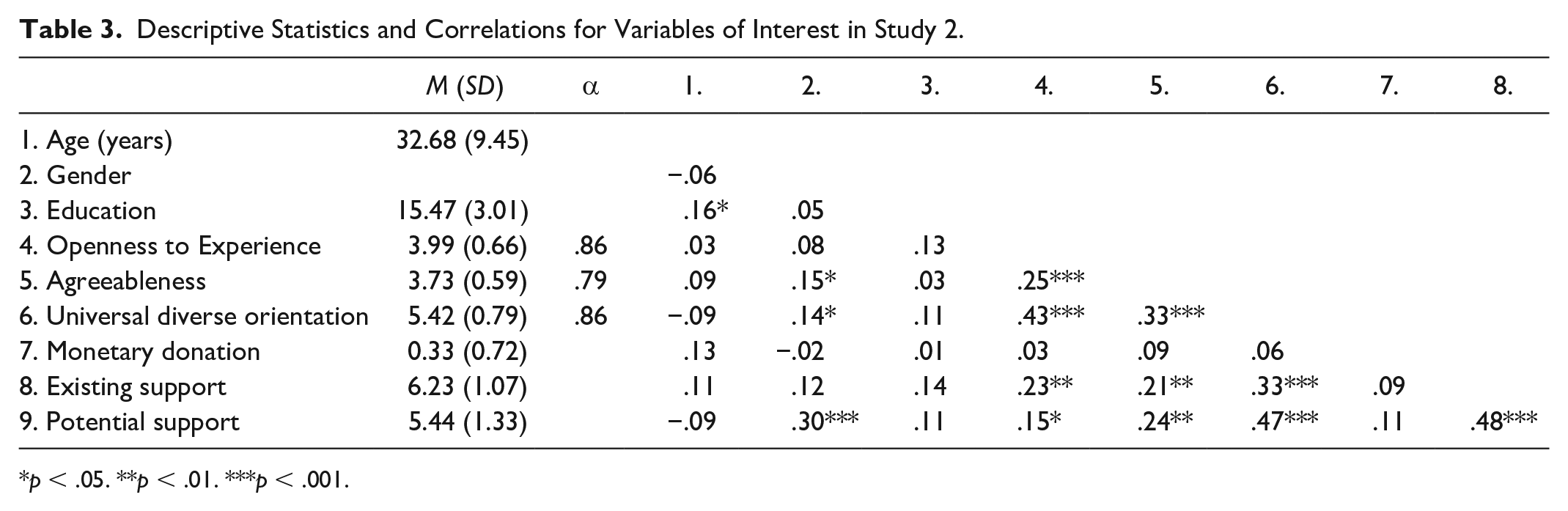
p < .05. **p < .01. ***p < .001.
Support of existing workplace diversity initiatives was positively correlated with support of potential workplace diversity initiatives (r = .48, p < .001). Agreeableness positively correlated with both support for existing (r = .21, p = .005) and potential (r = .24, p = .001) diversity initiatives. Openness to Experience positively correlated with support for both existing (r = .23, p = .001) and potential workplace initiatives (r = .15, p = .040). Finally, universal diverse orientation positively correlated with support for both existing (r = .33, p < .001) and potential initiatives (r = .47, p < .001).
Predicting diversity attitudes and initiative support from personality
We ran hierarchical regression analyses similar to those from Study 1 to examine how personality variables predicted the various diversity measures, after controlling for demographic variables (e.g., age, gender, ethnicity, sexual orientation, and education; Table 4). As with Study 1, we corrected for multiple testing using the Bonferroni p value correction method (Mundfrom et al., 2006).
Regression Results for Study 2.
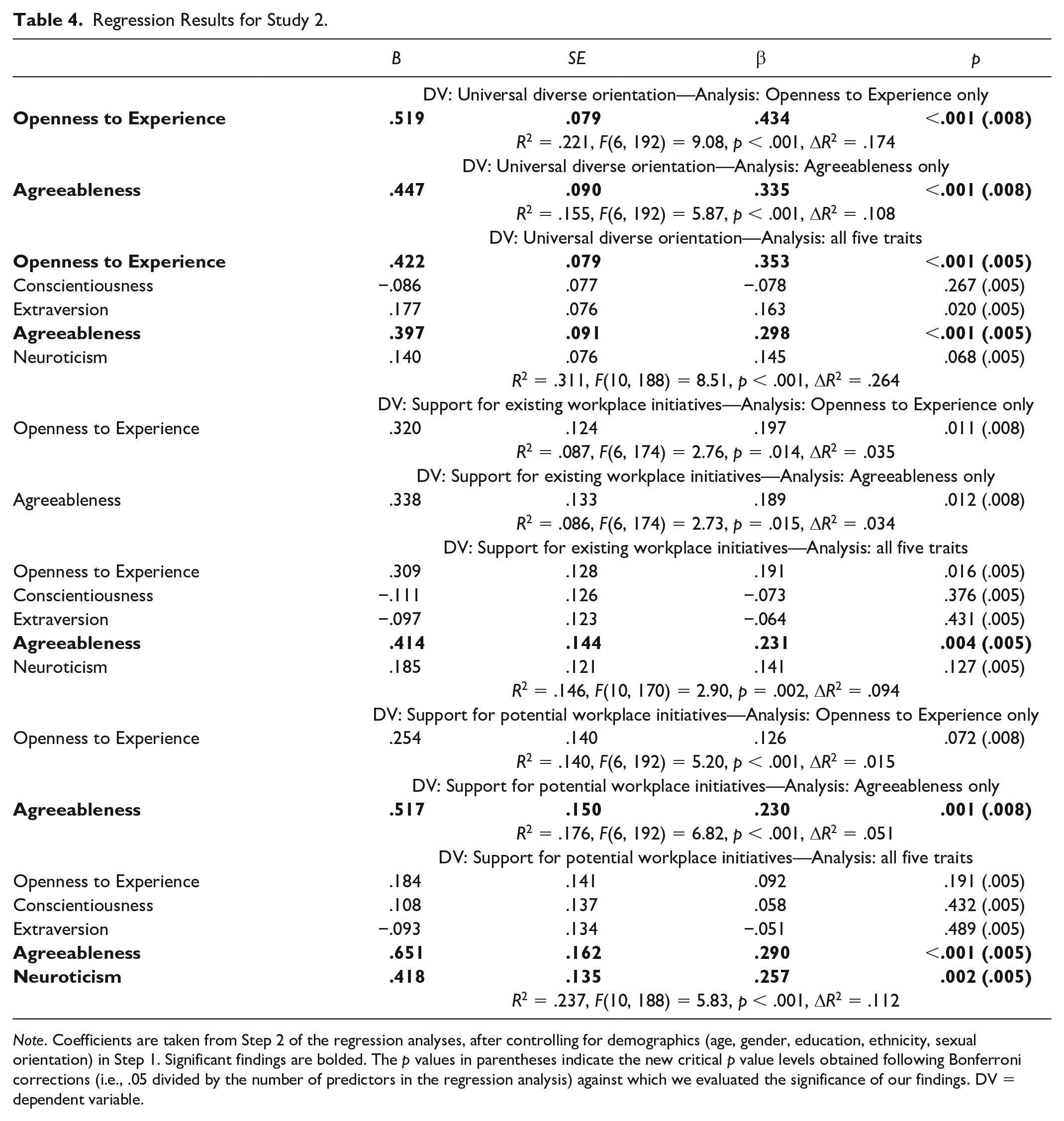
Note. Coefficients are taken from Step 2 of the regression analyses, after controlling for demographics (age, gender, education, ethnicity, sexual orientation) in Step 1. Significant findings are bolded. The p values in parentheses indicate the new critical p value levels obtained following Bonferroni corrections (i.e., .05 divided by the number of predictors in the regression analysis) against which we evaluated the significance of our findings. DV = dependent variable.
Universal diverse orientation
Openness to Experience was a significant predictor of universal diverse orientation (β = .43, p < .001), as was Agreeableness (β = .34, p < .001). When all Big Five traits were entered simultaneously into the model, both Openness to Experience (β = .35, p < .001) and Agreeableness (β = .30, p < .001) again predicted universal diverse orientation.
Support for existing workplace diversity initiatives
Only higher Agreeableness (β = .23, p = .004) predicted support of existing workplace diversity initiatives in the model with all Big Five traits.
Support for potential workplace diversity initiatives
Openness to Experience did not significantly predict support for potential workplace initiatives (β = .13, p = .072), but Agreeableness did (β = .23, p < .001). In the model with all Big Five traits, Agreeableness (β = .29, p < .001), but not Openness to Experience (β = .09, p = .191), was a significant predictor of support for potential initiatives, along with Neuroticism (β = .26, p = .002).
Predicting behavioral diversity support from personality
We next examined how personality predicted monetary donation to diversity-supporting organizations. A histogram of the monetary donation variable indicated that it is again heavily zero-inflated (56% of participants reported US$0.00). We conducted zero-inflated Poisson regressions as in Study 1 to examine the personality predictors of this variable. Prior to analysis, we multiplied the monetary donation variable by 100 to convert the unit from dollar to cent and to obtain integer values. We controlled for the same demographic variables as in previous analyses.
When entered as unique predictors on their own, neither Openness to Experience (B = .13, SE = .30, p = .67) nor Agreeableness (B = .34, SE = .26, p = .20) emerged as significant predictors of monetary donation. In the analyses examining all Big Five traits, however, Agreeableness (B = .46, SE = .23, p = .044) and Conscientiousness (B = –.47, SE = .16, p = .004) emerged as significant predictors of monetary donation.
Mediation analyses
As in Study 1, given the lack of any total effects between personality and monetary donation, we felt that mediation analyses examining the mediating role of attitudes toward diversity was not necessary.
To examine whether attitudes toward diversity mediated the relationship between personality and support for workplace diversity initiatives, we conducted mediation analyses using Model 4 of the PROCESS macro (following guidelines from Hayes, 2018). We separately examined support for existing and potential diversity initiatives. For each diversity initiative support measure, we conducted analyses with both Openness to Experience and Agreeableness as predictors. In our models, we entered Openness to Experience or Agreeableness as the predictor, universal diverse orientation score as the mediator, and diversity initiative support as the outcome variable. Age, gender, ethnicity, sexual orientation, and education were entered as covariates in our model. Each analysis used 5,000 bootstrap resamples.
Support for existing workplace diversity initiatives
Attitude toward diversity mediated the link between Openness to Experience and support for existing workplace diversity initiatives (ab = 0.21, SE = 0.09, 95% confidence interval [CI] = [0.06, 0.41]). Although the total effect between Openness to Experience and initiative support was significant (c = 0.32, SE = 0.12, p = .01, 95% CI = [0.08, 0.56]), its direct effect was no longer significant after accounting for the indirect effect through attitude toward diversity (c’ = 0.11, SE = 0.13, p = .41, 95% CI = [–0.15, 0.37]).
Similar effects were found for Agreeableness (ab = 0.16, SE = 0.07, 95% CI = [0.05, 0.31]). While the total effect between Agreeableness and support for existing initiatives was significant (c = 0.34, SE = 0.13, p = .01, 95% CI = [0.08, 0.60]), the direct effect after accounting for the indirect effect through attitude toward diversity was not (c’ = 0.18, SE = 0.13, p = .18, 95% CI = [–0.09, 0.44]).
Support for potential workplace diversity initiatives
Attitude toward diversity also mediated the link between Agreeableness and support for potential workplace diversity initiatives (ab = 0.28, SE = 0.09, 95% CI = [0.13, 0.49]). Although the total effect between Agreeableness and initiative support was significant (c = 0.52, SE = 0.15, p < .001, 95% CI = [0.22, 0.81]), the direct effect after accounting for attitudes toward diversity was no longer significant (c’ = 0.23, SE = 0.15, p = .12, 95% CI = [–0.06, 0.52]).
Although the present model including the demographic covariates did not find that attitude toward diversity mediated the link between Openness to Experience and support for potential workplace diversity initiatives, attitude toward diversity was found to be a significant mediator in the mediation model without the covariates.
Exploratory analyses
As with Study 1, we conducted exploratory analyses examining how the facets of Openness to Experience and Agreeableness related to diversity attitudes and support for workplace diversity initiatives. Alpha reliabilities for the Openness facets were as follows: Intellectual Curiosity: α = .70, Aesthetic Sensitivity: α = .72, and Creative Imagination: α = .73. Alpha reliabilities for the Agreeableness facets were as follows: Compassion: α = .64, Respectfulness: α = .59, and Trust: α = .64.
Openness to experience facets
First, we found that higher scores on universal diverse orientation were positively correlated with all three Openness facets: Intellectual Curiosity (r = .43, p < .001), Aesthetic Sensitivity (r = .37, p < .001), and Creative Imagination (r = .30, p < .001). Support for existing initiatives was also correlated with all three facets: Intellectual Curiosity (r = .21, p = .005), Aesthetic Sensitivity (r = .24, p = .001), and Creative Imagination (r = .15, p = .040). Support for potential initiatives was only correlated with Aesthetic Sensitivity (r = .22, p = .002). Money donation was unrelated to any of the three facets.
Regression analyses found that Intellectual Curiosity (β = .36, p < .001) positively predicted universal diverse orientation. None of the facets predicted support for existing or potential workplace diversity initiative, nor money donation. Thus, these analyses suggest that both Intellectual Curiosity and Aesthetic Sensitivity were related to diversity support, but these relationships were weaker once we controlled for demographics.
Agreeableness facets
All three Agreeableness facets correlated with universal diverse orientation: Compassion (r = .36, p < .001), Respectfulness (r = .17, p = .015), and Trust (r = .26, p < .001). Support for existing initiatives was correlated with Compassion (r = .25, p = .001) and Trust (r = .16, p = .031). Compassion (r = .30, p < .001) and Trust (r = .18, p = .010) also correlated with support for potential initiatives. Only Trust (r = .16, p = .032) was correlated with money donation.
Regression analyses showed that Compassion was again the unique facet-level predictor of diversity support, positively predicting universal diverse orientation (β = .33, p < .001), as well as support for existing (β = .24, p = .016) and potential initiatives (β = .28, p = .002). Money donation was again predicted by Trust (B = .56, p = .003). Thus, it again appears that an emphasis on empathy and caring for others was what motivated agreeable individuals to support diversity.
Discussion
The present research examined how trait personality, specifically Openness to Experience and Agreeableness, related to general attitudes toward diversity and support for specific diversity initiatives in the workplace. First, we assessed the relationship between these two traits and general attitude toward diversity across a number of different measures. Furthermore, extending beyond past work, we examined how these traits related to support for concrete workplace diversity initiatives. The present studies are the first (to our knowledge) that examined how Openness to Experience and Agreeableness related to attitude toward diversity and diversity initiatives at the facet level of each trait. These analyses provided further details on which specific characteristics of these traits are related to diversity support, thus offering a more nuanced understanding of the relationship between personality and diversity support.
Openness to Experience
After controlling for demographic variables, Openness to Experience significantly predicted universal diverse orientation, but not pro-diversity belief nor sensitivity to diversity. Openness also did not emerge as a significant predictor of the money donation, a behavioral measure of diversity support. Furthermore, although Openness did not predict support for potential diversity initiatives, it did predict support for existing initiatives pre-Bonferroni correction. Finally, positive attitude toward diversity mediated the link between Openness and support for existing workplace diversity initiatives. These findings somewhat supported our hypotheses.
Our exploratory analyses examining the facet-level Openness predictors provide more insight into this relationship. Across both studies, Aesthetic Sensitivity and, to a lesser degree, Intellectual Curiosity, were more consistently associated with diversity support (for both attitudes and workplace initiatives). This suggests that a propensity to value arts, culture, and complex thinking may be why open individuals support diversity. These findings are consistent with previous work showing that universal diverse orientation was related to NEO-PI-3 facets of Openness to Experience that emphasize art, intellectual curiosity, and cultural values (Han & Pistole, 2017). Thus, our present findings suggest that open individuals may view more diversity as a way to allow for different types of culture, aesthetics, thinking, and perspectives to be accepted into society and the workforce.
Agreeableness
Our hypotheses regarding Agreeableness were largely supported by our findings. After controlling for demographics, Agreeableness significantly predicted universal diverse orientation and pro-diversity belief, but not sensitivity to diversity. Again, Agreeableness did not predict money donation; however, Agreeableness positively predicted support for both existing and potential workplace initiatives. Finally, the link between Agreeableness and support for both types of workplace initiatives were mediated by positive attitudes toward diversity through universal diverse orientation.
With regard to the facet-level analyses, the most stable facet-level predictor of diversity support was Compassion, indicating that people who especially care about and empathize with the well-being of others are more likely to support diversity. This makes sense as workplace diversity initiatives are meant to help and improve the livelihoods of employees from underrepresented and less privileged backgrounds. Thus, people who are high in empathy for others would be especially willing to support these acts. We also found that people higher in Trust (characterized by seeing the best in others) were more likely to donate money to a diversity-supporting cause. This finding may suggest that people who are more trusting of others are likely to believe that their donations will be used for a good cause, and thereby are more willing to engage in charitable contributions. Our current findings replicate previous work suggesting that trustful, altruistic, and emphatic facets of Agreeableness were related to higher universal diverse orientation (Han & Pistole, 2017). Thus, compassionate and trustful individuals are more likely to be empathetic and supportive of the needs of others.
Potential Motivations
Our Openness to Experience findings suggest that open individuals may be more supportive of diversity, not necessarily due to cognitive and intellectual motivations, but at a cultural, aesthetic level. This is supported by the facet-level result showing that Aesthetic Sensitivity (more so than Intellectual Curiosity) was the primary predictor of diversity support. Thus, open people may be motivated to support diversity because it reflects their value for diverse cultural and aesthetic experiences. Previous work has shown that open individuals tend to consume more cultural products and prefer more complex and aesthetic media genres (Xu et al., 2013; Xu & Peterson, 2017), and also endorse more liberal ideologies (Sibley et al., 2012). For open individuals, support for increasing diversity in the workplace can not only lead to exposure to new forms of artistic and cultural stimuli but can also be a way for them to express liberal social values.
Our Agreeableness findings support the notion that agreeable people are motivated to support diversity from a prosocial, interpersonal standpoint. That is, they care about the well-being of others and want to contribute in concrete ways to improve the lives of those around them. This is supported by our findings showing Compassion as the most consistent facet-level predictor of diversity support. Compared with open individuals, agreeable people’s motivations appear less concerned with aesthetic processes and more with prosocial, interpersonal actions. They are motivated to care about the well-being of others around them, and they are more likely to empathize with others’ struggles. This may also be due to higher Compassion being linked to both higher liberalism (Xu et al., 2021) and values for fairness (Hirsh et al., 2010). Compassionate individuals may therefore view increased diversity as a means to establish fairer, prosocial values in the workplace.
Although the existing literature focused more on Openness to Experience as the most relevant personality variable to diversity attitudes, the present research suggests that individuals higher in Agreeableness appeared to support diversity in the workplace more so than those who were higher in Openness to Experience. While Openness to Experience reflects an individual’s capacity to consider different perspectives and experiences, diversity initiatives are primarily designed to help and uplift those who would benefit from them. Therefore, Agreeableness appears to have a stronger effect due to its characteristics of compassion, empathy, and willingness to help others (this is further supported by Compassion being the primary Agreeableness facet that predicted diversity support). Although both Openness and Agreeableness were related to support for existing workplace initiatives, this may be why only Agreeableness predicted support for potential workplace initiatives. High Openness may allow an individual to be receptive to already existing policies at work, but this receptiveness may not extend to initiatives not yet in place. Agreeable individuals, however, may be more receptive toward both existing and potential diversity initiatives, as both are designed to help others.
Finally, the mediation analyses suggest that the link between personality and support for diversity initiatives was primarily explained by attitude toward diversity. That is, open and agreeable individuals are more likely to endorse diversity supporting attitudes, translating into increased support for workplace diversity initiatives. This provides a plausible pathway to the mechanism that underlies the relationship between personality and support for diversity.
Different Diversity Attitudes
Although both Openness to Experience and Agreeableness were related to attitudes toward diversity, the effects were the most consistent for the universal diverse orientation measure. With regard to Openness to Experience, the results were less consistent for pro-diversity belief and sensitivity to diversity.
This divergence in findings may be due in part to differences in the three measures. The universal diverse orientation measure contains more items and a variety of items assessing different diversity-related issues, for example, cultures and racial differences. The sensitivity to diversity measure consisted of items asking participants whether they notice gender or race differences in their work, and pro-diversity belief mainly measured whether participants believed that diversity is good in the workplace. Because Openness to Experience is characterized by receptiveness toward novel and complex experiences (Caspi et al., 2005), it may be the case that the contents of the universal diverse orientation measure reflected these characteristics more closely than the other two measures. However, all three measures contain items related to how people accept and interact with different types of individuals. Because Agreeableness is an interpersonal trait emphasizing building closer social relationships with others (Caspi et al., 2005), it is less surprising that this trait was related to all three diversity measures. The effects were more consistent with universal diverse orientation and pro-diversity belief, perhaps due to the fact that these two measures more directly assessed whether participants believed that increasing diversity would be beneficial to others.
Other Personality Traits
Although we were primarily interested in how Openness to Experience and Agreeableness related to attitudes toward diversity and support for workplace diversity initiatives, our analyses also revealed potentially interesting effects with the other Big Five traits. We found that Conscientiousness was negatively related to the money donation variable. Correlation analyses showed that the organization facet (r = –.20, p = .006) was negatively related to money donation in Study 2. One possible explanation for this finding is that Conscientiousness has been linked to a preference for more traditional sociopolitical systems (e.g., Xu et al., 2021), which may extend to a preference for more traditional workplaces. If this is the case, it follows that conscientious individuals may be less willing to donate to organizations aiming to introduce change in the workplace.
Finally, Neuroticism was positively predictive of potential workplace diversity support in Study 2. Correlation analyses showed that Neuroticism was positively related with potential support (r = .23, p = .001). It may be the case that individuals who are more prone to negative emotionality believe that potential initiatives could be beneficial in improving the well-being of employees, and therefore support such causes.
Implications for D&I Efforts
Companies could benefit from considering these individual differences when advertising diversity initiatives to make their workspaces more inclusive. First, our results have implications for diversity trainings and how they are conducted. With this knowledge of individual differences, managers leading trainings could a priori assess their participants’ personality, to have a better sense of which individuals may be more receptive versus defensive toward such training. Then, they will be better equipped to train all employees to learn about each other’s experiences within D&I initiatives, through navigating these supported differences in personality. Employers may also want to consider, as Han and Pistole (2017) suggested, starting trainings out with sharing art from different cultures to mitigate for this defensiveness and to facilitate an open learning environment.
Past work has suggested that the framing of concepts is important in increasing people’s receptiveness (Hirsh et al., 2012; Salter & Roman, 2020). Thus, for those higher in Openness to Experience, it may be more effective to frame diversity initiatives in a cognitive manner, as an opportunity to learn about new experiences and diverse perspectives. Similarly, for those higher in Agreeableness, these initiatives could be framed in a prosocial manner as an opportunity to help their colleagues. Given the seemingly different motivations open and agreeable people have for supporting diversity, organizational leaders designing D&I interventions could frame them differently to better capture the employees’ interest. However, framing is also important for employees lower in Openness or Agreeableness. For these employees, diversity initiatives could be framed in terms of how such programs can uphold a company’s tradition of community and culture, as well as potentially profitability. Of course, it is not feasible to individually tailor diversity initiative messaging for each individual employee, so instead we suggest incorporating all these concepts into a campaign of messaging to best accommodate as many employees as possible.
Although some studies have proposed screening applicants based on their personality traits (Strauss & Connerley, 2003), it may actually be best to work with the diversity of individual differences present in the workplace instead of limiting companies to only recruiting those high in specific traits. However, managers who are high in Agreeableness and Openness to Experience may be more apt to communicate and implement diversity initiatives, and they may be able to teach others the skills related to these personality traits (e.g., perspective taking) through behavioral modeling.
Furthermore, although individuals higher in Openness to Experience and Agreeableness may be more receptive to workplace diversity initiatives, it is likely the case that these are not the people who would especially need diversity training. That is, an open and/or agreeable person likely already sees the value in these initiatives, and thereby may already be more receptive to participating and supporting them in the workplace. Thus, it is equally important to consider individuals who are lower in Openness and/or Agreeableness; these individuals are less likely to be receptive toward and supportive of D&I initiatives, and employers may need to make more of an effort to persuade them of the value in these efforts. Above, we offered some suggestions for framing diversity initiatives to those lower in Openness and/or Agreeableness. But as this group may be especially reticent to endorse diversity initiatives, thought should be put into messaging to ensure that appeals to those high in Openness/Agreeableness do not also alienate those lower in these traits.
In a similar vein, workplaces may also need to rely on other types of more extrinsic incentives to motivate support for diversity initiatives, for example, positive business incentives and personal benefits. Workplaces could also try to reframe the value of diversity trainings and initiatives in ways that are more tailored to these individuals’ traits and values, such that supporting diversity initiatives would then reflect characteristics that they endorse (e.g., in a similar manner as the reframing of political issues to be congruent with the audience’s moral values; Feinberg & Willer, 2013).
Limitations and Future Directions
Although the present studies offer significant insight into the relationship between personality and attitudes toward diversity and diversity initiatives, it is important to note their limitations. The studies’ correlational designs mean that one cannot assume causal relationships between the variables of interest. In addition, some of the personality effect sizes found were lower than what our sensitivity analyses reported, potentially due to the sample having lower statistical power. Thus, future research should make use of larger samples to try and replicate the present findings.
In addition, both studies relied on self-report data, thus making responses susceptible to the social desirability bias. Furthermore, the present research only asked participants to rate their support for workplace diversity initiatives and did not examine their actual participation or engagement with such initiatives. Thus, the present findings describe how general attitudes toward diversity would predict more specific support for concrete workplace initiatives. Although these findings provide new insights into these issues, future work would benefit from examining how personality relates to real-life employee engagement and participation in workplace diversity efforts. As well, our behavioral measure (money donation) may be limited in its internal validity. We found that very few people actually decided to donate money, and that donation was related negatively to Conscientiousness and positively to Trust. Thus, it is possible that our effects were due to participants who were more careless and/or trusting, who therefore may be more easily convinced by the cover story for donations. Future work should make use of more valid and realistic behavioral measures to assess how personality relates to behavioral support for diversity.
With regard to the sample makeup, the present samples may not be representative of the U.S. population in general, as the participants were highly educated (average of ~15 years in school for both studies). Furthermore, the majority of the participants identified themselves as White (70% and 80%) and heterosexual (81% and 78%). While the present studies may more accurately reflect the attitudes of these individuals, it would be of utmost importance for future work to examine how racial and sexual minorities (whom many diversity initiatives aim to serve) view these initiatives, including their effectiveness.
Conclusion
Given D&I’s importance in the workplace, the present research hopes to provide insight into this issue from a personality perspective. The findings that Openness to Experience and Agreeableness are predictors of diversity initiative support, mediated by diversity attitudes, shed light on the types of individuals who may be more likely to support diversity initiatives in the workplace, and thereby have significant applied implications for how workplaces may better implement such initiatives.
Supplemental Material
sj-docx-1-psp-10.1177_01461672211057755 – Supplemental material for How Personality Relates to Attitudes Toward Diversity and Workplace Diversity Initiatives
Supplemental material, sj-docx-1-psp-10.1177_01461672211057755 for How Personality Relates to Attitudes Toward Diversity and Workplace Diversity Initiatives by Sana F. Lall-Trail, Nicholas P. Salter and Xiaowen Xu in Personality and Social Psychology Bulletin
Supplemental Material
sj-docx-2-psp-10.1177_01461672211057755 – Supplemental material for How Personality Relates to Attitudes Toward Diversity and Workplace Diversity Initiatives
Supplemental material, sj-docx-2-psp-10.1177_01461672211057755 for How Personality Relates to Attitudes Toward Diversity and Workplace Diversity Initiatives by Sana F. Lall-Trail, Nicholas P. Salter and Xiaowen Xu in Personality and Social Psychology Bulletin
Footnotes
Acknowledgements
The authors thank Elizabeth Page-Gould, Adrian Bravo, Matthew Hilimire, John Nezlek, and Paul Kieffaber for their advice and feedback on this project.
Declaration of Conflicting Interests
The author(s) declared no potential conflicts of interest with respect to the research, authorship, and/or publication of this article.
Funding
The author(s) disclosed receipt of the following financial support for the research, authorship, and/or publication of this article: This work was supported by a start-up research grant provided to Xiaowen Xu from William & Mary.

Supplemental Material
Supplemental material is available online with this article.
Notes
References
Supplementary Material
Please find the following supplemental material available below.
For Open Access articles published under a Creative Commons License, all supplemental material carries the same license as the article it is associated with.
For non-Open Access articles published, all supplemental material carries a non-exclusive license, and permission requests for re-use of supplemental material or any part of supplemental material shall be sent directly to the copyright owner as specified in the copyright notice associated with the article.
