



Abstract
In the era of technology, smartphone use occupies an important position in our lives. The present research focused on the psychological consequence of frequent smartphone use and possible way to remedy it. We proposed that frequent smartphone use could damage people’s sense of control and in turn trigger nostalgia. Moreover, nostalgia could directly compensate for the low sense of control induced by frequent smartphone use. Five studies (N = 918) were conducted. Study 1 found through a field study that frequent smartphone use increases nostalgia. Studies 2 and 3 found through 14-day tracking and a laboratory experiment that frequent smartphone use decreased people’s sense of control and then triggered nostalgia. Furthermore, nostalgia could enhance the low sense of control, and it worked by increasing self-esteem (Studies 4 and 5). The findings show the negative impact of frequent smartphone use, and nostalgia is an effective way to remedy it without preventing people from using smartphones.
Introduction
The current era is one of continuing technological innovation and development, and the popularity of smartphones has become an obvious symbol. Worldwide, smartphones were used by 3.6 billion people in 2020, and this number continues to grow (Statista, 2020). Smartphones have shown great advantages in mobility and instantaneity. They integrate multiple functions on a small device, including making phone calls, watching videos, chatting through social networks, and so on, to meet people’s daily work, contact, and entertainment needs, anytime and anywhere. In addition to their benefits, as they make communication convenient and push news in real time, they also have a remarkable feature—fragmentation. “Fragmentation” refers to a process whereby a certain thing is divided into several smaller pieces (Hubers et al., 2008), and it reflects the frequent use of smartphones, which breaks people’s daily life and time into small fragments. Recent research has also confirmed that people are usually attracted to using their smartphones by frequent reminders (such as messages) or their dependence on long-term smartphone use (Unsworth et al., 2012) and checking their smartphones every 18 min (Markowetz, 2015). Due to the prevalence of smartphone use, it is important to pay attention to the impact of smartphone use on people’s minds and behaviors. Therefore, the present research focused on the influence of frequent smartphone use and how people lessen its impact.
Frequent Smartphone Use and Sense of Control
Frequent smartphone use has a potential negative side effect, which frequently causes people to stop their current activities and turn their attention to their smartphones (Pielot et al., 2014). For example, people might in principle want to focus on working without browsing social networking sites but might simply fail to do so when constantly exposed to distracting notifications. Previous research has found that smartphone use distracted people from work, study, and face-to-face communication (e.g., Dwyer et al., 2018; Thomée et al., 2012). Moreover, frequent distractions from ongoing tasks to smartphone use occupy people’s cognitive resources (Thornton et al., 2014), thereby influencing the performance of ongoing tasks. For example, increasing smartphone use disturbs traditional family activities (Roberts & David, 2016); frequent smartphone use in class affects the quality of studying (Thomée et al., 2012) and leads to poor academic performance (Junco & Cotten, 2012); and 75% of participants use smartphones while driving, which increases the risk of accidents (Holland & Rathod, 2013).
We speculated that frequent smartphone use might undermine people’s sense of control, which refers to a subjective perception regarding the extent that individuals can control events (Lachman & Weaver, 1998). Frequent smartphone use interrupts and hinders the completion of ongoing tasks so that the entire process is full of uncertainty and unpredictability. Uncertainty and the breakdown of daily tasks are important factors resulting in a low sense of control (Lachman & Weaver, 1998). When ongoing tasks are constantly interrupted by smartphones, the completion process and final performance are uncertain, which might cause people’s sense of control to be greatly reduced. Thus, we tend to expect that frequent smartphone use would decrease the sense of control.
According to compensatory control theory (Landau et al., 2015), as a sense of control is a basic social need of human beings (Williams, 2007), people are motivated to maintain their sense of control in their daily lives. When people’s sense of control decreases, they feel a poor ability to control life events (Lachman & Weaver, 1998) and more negative affects (such as anxiety and aversion; Landau et al., 2015). Then, the aversive experience prompts people to adopt psychological strategies to compensate for the reduced sense of control (Landau et al., 2015). Therefore, when people’s sense of control decreases after frequent smartphone use, they must find an effective way to compensate for the aversive experience.
The Compensatory Effect of Nostalgia on the Low Sense of Control
Nostalgia is defined as “a sentimental longing or wistful affection for the past” in The New Oxford Dictionary of English (Pearsall, 1998). As Bauman (2007) said in his book, “Nostalgia was a disease in the past, but is a remedy today,” much recent research has shown positive psychological functions of nostalgia in helping people to cope with serious threats (e.g., Wildschut et al., 2006). We believe that nostalgia might be an effective way to compensate for the reduced sense of control in two aspects. First, nostalgia serves self-oriented functions, which subsequently lead directly to positive outcomes (Newman et al., 2020). Prior research found that the content of nostalgia often contains self-defining moments and momentous life events characteristic of a redemptive narrative (Abeyta et al., 2015; Hepper et al., 2012). Experiencing nostalgia could enhance people’s self-esteem (e.g., Wildschut et al., 2006, 2010), which is linked with a sense of mastery and control of one’s environment (Lyubomirsky et al., 2006). At the same time, by strengthening feelings of self-esteem, nostalgia enhanced specific growth-oriented behavioral intentions, such as strengthening momentary work effort (Van Dijke et al., 2019). When people feel a sense of losing control, nostalgia might help to improve a poor sense of control in terms of feelings and behavioral intentions by improving self-esteem.
Second, nostalgia includes many positive features that could buffer negative effects. When people’s sense of control is threatened, it has negative effects (such as anxiety and aversion; Landau et al., 2015). Improving overall positive emotions can help people to maintain psychological homeostasis by undoing the physiological arousal induced by negative emotions (Damasio, 1993; Levenson, 1999). Nostalgia is a predominantly positive emotion (e.g., Hepper et al., 2012; Van Tilburg et al., 2018), and it increases meaning in life, social connectedness, self-continuity, and optimism (e.g., Cheung et al., 2013; Hepper et al., 2012; Sedikides et al., 2015). Hence, nostalgia might act to establish psychological homeostasis after the aversion induced by loss of control by improving positive emotions and other benefits.
Moreover, frequent smartphone use often occurs in everyday life, so the means to compensate for a low sense of control should be easy to obtain and not require excessive effort. Nostalgia is a universal and daily emotion that more than 80% of people experience between 1 and 3 times per week (Sedikides et al., 2008; Wildschut et al., 2006), and people report feeling nostalgic in various daily life scenes, including eating, listening to music, being with friends, and so on (Newman et al., 2020). Thus, it might be a highly accessible and effective means to compensate for the low sense of control induced by frequent smartphone use. Building on this idea, we proposed the following hypotheses.
The Specific Mechanism of the Compensatory Effect of Nostalgia
What is the specific mechanism of the compensatory effect of nostalgia on the sense of control? Based on previous studies, we speculate that nostalgia might increase the low sense of control by improving self-esteem or positive emotions and having other positive effects (including meaning in life, social connectedness, self-continuity, and optimism; Cheung et al., 2013; Hepper et al., 2012; Sedikides et al., 2015; Wildschut et al., 2006). However, prior studies have not provided clear evidence regarding which plays a more important role in the process. We explored the specific mechanism of the compensatory effect of nostalgia in Study 5.
Overview
Five studies across various situations (the field experiment in restaurants, daily tracking, and laboratory experiments) were conducted to test these hypotheses. Specifically, Study 1 manipulated smartphone use in a campus restaurant and measured feelings and consumption choices regarding nostalgia, aiming to explore the causal relationship of the direct effect. Studies 2 and 3 further examined the mediating roles of the sense of control between frequent smartphone use and nostalgia. Study 2 was a 14-day diary study recording objective and subjective smartphone use, self-reported daily nostalgia, and the sense of control. Study 3 primed frequent smartphone use through a new manipulation in the laboratory and measured the subsequent sense of control, feelings and consumption choices regarding nostalgia, and distraction. Study 4 manipulated frequent smartphone use and nostalgia to examine the compensatory effect of nostalgia on a low sense of control. Finally, Study 5 manipulated the sense of control to test the causal relationship between the sense of control and nostalgia. We subsequently manipulated nostalgia and measured the sense of control, the psychological benefits of nostalgia, and smartphone use intention to eliminate the effect of the sense of control on smartphone use and explore the specific mechanism of the compensatory effect of nostalgia.
Moreover, we report all data exclusions (if any), all manipulations, and all measurements in the research, and a preliminary correlation study and some supplementary measurements are presented in the Supplemental Material. The data sets of the present research have been made available on Open Science Framework (https://osf.io/m4nst/).
Study 1
Study 1 first examined the direct relationship between frequent smartphone use and nostalgia. To do so, we manipulated smartphone use during a meal with friends in a campus restaurant and measured the participants’ nostalgia. In addition to nostalgia feelings, we also measured nostalgic consumption to increase ecological validity because consumers experience an increased preference for nostalgic consumption (Barnes, 2008); while nostalgic consumption is a type of behavior that often occurs when people experience nostalgia feelings, it also has the psychological benefits of nostalgia (Loveland et al., 2010; Zhou et al., 2013).
Method
Participants
An a priori power analysis using G*Power software, version 3.1 (Faul et al., 2009), with a power of 80% (1 − β), an α level of .05, and a medium effect (d = 0.5; according to previous studies: Dwyer et al., 2018; Kushlev et al., 2019) was conducted to determine the sample size, resulting in a sample size of 128. One hundred thirty-eight undergraduate and postgraduate students with smartphones who were in groups of 3 to 5 friends (37 groups) were recruited from the campus online forum. We excluded the whole group if one person in this group did not follow the frequent smartphone use manipulation because his or her behavior might affect others in the process of social interactions. Finally, two groups (9 participants) were excluded, leaving a sample of 129 (35 groups; 99 women; Mage = 20.47 years, SD = 2.08).
Procedure and measures
Groups of 3 to 5 friends were invited to complete a “dining experience experiment” in the campus restaurant. Each group was randomly assigned to either the smartphone (67 participants; 19 groups) or the smartphoneless (62 participants; 16 groups) condition without revealing the purpose of the study. The manipulation of frequent smartphone use in this study was similar to that of Dwyer et al. (2018), which simulated frequent smartphone use in everyday social situations. As long as smartphones emerges, frequent information reminders and long-term use habits will lead to high-frequency use. Therefore, participants in the smartphone condition were asked to place their smartphones within their field of vision. They were told that they had to provide their demographic information through an online questionnaire using a smartphone after ordering. To receive instructional messages, they were asked to turn on the ringer or vibration reminder and place their smartphones on the table. They could use their smartphones as they usually do in daily social activities during the whole meal. Participants in the smartphoneless condition were told that they had to provide their demographic information through a paper-and-pencil questionnaire after ordering. To avoid being disturbed, they were asked to keep their smartphones silent and put them in their bags. The questionnaire included participants’ age, gender, education level, socioeconomic status (SES), the number of diners, and how long they knew each other.
During the meal (no less than 25 min), research assistants sat at a separate table and did not interfere with the participants. Afterward, all of the participants received paper-and-pencil questionnaires that were disguised as measurements of their dining experience. The key measures of nostalgia feeling, consumption choice of nostalgia, and time percentage of smartphone use (0–100%) were included. Nostalgia feeling was measured using 2 items: “Right now, I am feeling quite nostalgic” and “Right now, I am having nostalgic feelings” (α = .95; Wildschut et al., 2006) on a 7-point scale (1 = strongly disagree, 7 = strongly agree). For the consumption choice measurement of nostalgia (Chen et al., 2016; for the pilot study to examine the measure’s validity, see the Supplemental Material), the participants were presented with a scene which asked them to imagine that “You have obtained a ticket voucher for a concert that can be exchanged for one of two concerts.” The theme of the nostalgic concert was “The voice of the years,” and its advertising slogan was “Recalling songs from memories and telling stories of the passing time”; the theme of the nonnostalgic concert was “Wandering in the sound sea,” and its advertising slogan was “Capturing jumping notes in music and weaving colorful movements.” Then, the participants rated “Which concert do you prefer to exchange for your voucher?” on an 11-point scale (−5 = more inclined toward “The voice of the years,” 0 = equally, 5 = more inclined toward “Wandering in the sound sea”; reverse scoring). The time percentage of smartphone use during the meal was used as the manipulation check index.
Results
Owing to the manipulation of smartphone use that was conducted by the groups, we employed a multilevel model in which the participants were nested within groups. The predictor was treated as fixed effects, allowing only the intercept to vary as a random effect at the person level. Smartphone use (1 = smartphone condition, 0 = smartphoneless condition) was placed in Level 2 as the independent variable, and the time percentage of smartphone use, nostalgic feelings, and preference for nostalgic concerts were standardized.
First, three zero models of percentage of using smartphones, nostalgia feelings and preference of nostalgia concert were created and showed that the intraclass correlation coefficients (ICCs) were .41, .02, and .01, respectively. Second, confirming our manipulation, participants in the smartphone condition (M = 15.75%, SD = 19.48) reported a greater time percentage using smartphones during the meal than did those in the smartphoneless condition (M = 0%, SD = 0), b = 1.01, t = 5.24, p < .001, 95% confidence interval (CI): [0.63, 1.39]. Next, consistent with our hypothesis, participants in the smartphone condition (M = 3.78, SD = 1.77) experienced more nostalgic feelings than those in the smartphoneless condition (M = 3.06, SD = 1.77), b = 0.40 t = 2.32, p = .020, 95% CI [0.06, 0.73]. Similarly, the participants in the smartphone condition (M = 0.22, SD = 3.80) were more likely to prefer the nostalgia concert than those in the smartphoneless condition (M = −1.05, SD = 3.44), b = 0.35, t = 2.17, p = .030, 95% CI [0.03, 0.66].
Discussion
Study 1 provides evidence for the direct causality of frequent smartphone use on nostalgia in the real-world setting of campus restaurants, but the underlying process was not confirmed. In the following study, we examined the direct relationship as well as the mediating role of the sense of control in our daily lives.
Study 2
In this study, we conducted a 2-week-long diary study by recoding the daily smartphone use, nostalgia, and sense of control of the participants. Application software was used to monitor the participants’ objective smartphone use, and other variables were measured in a timely manner to examine the real effects of smartphone use in our daily lives. In addition, as previous research has found that social connectedness is associated with smartphone use (e.g., Dwyer et al., 2018), we also measured social connectedness in Studies 2 and 3, and the detailed measurements and results are presented in the Supplemental Materials.
Method
Participants
To determine the sample size of the diary study, we drew on the experience of previous studies (Dwyer et al., 2018; Van Tilburg et al., 2018) and attempted to recruit 200 participants. Finally, 187 students from China with iOS system smartphones 1 were recruited on the campus online forum (146 women; Mage = 22.37 years, SD = 2.51). They completed online diary questionnaires over a span of 15 days in exchange for ¥30 yuan (approximately US$4.32) and a result report; ultimately, they responded to a total of 2,386 diary surveys (91.1% of surveys sent).
Procedure and measures
The participants were told that the research involved “an app test and psychological tracing research.” Before the formal experiment, participants reported their demographic information (including gender, age, educational level, and SES) and installed an app named RealizD, which could automatically record their objective use time and the use frequency of their smartphones.
The formal experiment lasted a total of 15 days, and the participants received two questionnaire links through WeChat messages, one at 9 a.m. and the other at 9 p.m. From the morning of the 2nd day to the 15th day, they reported app record screenshots of their objective smartphone use and reported their subjective smartphone use of the previous day. To support our cover story, they were also asked to rate the fluency and accuracy of the app. From the evening of the 1st day to the 14th day, they completed the measurements of daily nostalgia and daily sense of control. We ultimately obtained complete tracking data for 14 days.
The measurements are described subsequently; all of the measures were rated on a 7-point scale (1 = strongly disagree, 7 = strongly agree).
Objective smartphone use
The RealizD app was used to track the objective use of iOS system smartphone users. Specifically, the objective use time (time that the smartphone’s screen was active and unlocked; in min) and objective use frequency (number of times that the smartphone was unlocked) were tracked.
Subjective smartphone use
The participants were asked, “Subjectively, I think I used my smartphone for ____ minutes and checked it ____ times in the previous day.” The subjective use time and subjective use frequency were reported in integers.
Daily nostalgia
Four items were used to measure daily nostalgia proneness. The first 2 items were adapted from Wildschut et al. (2006) and were the same as those in Study 1. The other 2 items were adapted from Holbrook and Schindler (1994) to improve the accuracy of measurement. The items measured whether participants compared between the past and their present lives on that day. The 4 items were “Today, I feel quite nostalgic,” “. . .have nostalgic feelings,” “. . . feel they don’t make them like they used to,” and “. . . feel that things used to be better in the good old days” (α = .88). A higher score indicated more feeling of nostalgia.
Daily sense of control
Two items adapted from Lachman and Weaver (1998) were used to measure the participants’ daily sense of control. The items were “Today, I lack control of my life” and “Today, others have too much control over me” (r = .70). The items were reverse-scored, and a higher score indicated a greater sense of control.
Results
Descriptive statistics and correlations are presented in the Supplemental Material. As the ranges of independent variables, dependent variables, and mediation variables are different, we standardized all of the variables in the subsequent analyses. Because of the diary design, we used multilevel linear analysis models in which daily records (Level 1) were nested within participants (Level 2). The predictors were treated as fixed effects, allowing only the intercept to vary as a random effect at the day level.
Effects of smartphone use
First, a zero model of daily nostalgia showed that the ICC was .56; that is, interindividual variation accounted for 56%. Next, standardized daily objective smartphone use and subjective smartphone use variables were separately entered as independent variables in Level 1 to predict daily nostalgia. The results showed that objective use frequency predicted daily nostalgia marginally significantly and positively (γ = 0.11, t = 1.65, p = .098, 95% CI [-0.01, 0.23]); however, objective use time did not have a significant effect (γ = 0.00, t = 0.00, p = .996, 95% CI [−0.08, 0.08]). Moreover, subjective use frequency significantly and positively predicted daily nostalgia (γ = 0.18, t = 3.02, p = .003, 95% CI [0.06, 0.30]); however, subjective use time did not have a significant effect (γ = −0.03, t = −0.66, p = .508, 95% CI [−0.12, 0.06]).
Mediation analysis
Then, multilevel structural equation modeling was used to examine the mediating role of sense of control (see Figure 1). The mediation effect of daily sense of control was significant (indirect effect = 0.014, 95% CI [0.002, 0.026]). Specifically, objective use frequency was significantly and positively related to subjective use frequency (b = 0.50, t = 4.52, p < .001, 95% CI [0.285, 0.721]); subjective use frequency was significantly and negatively related to daily sense of control (b = −0.10, t = −2.40, p = .017, 95% CI [−0.173, −0.017]); and daily sense of control was significantly and negatively related to daily nostalgia (b = −0.29, t = −7.00, p < .001, 95% CI [−0.366, −0.206]). The results showed that objective use frequency could affect daily nostalgia through subjective use frequency and daily sense of control in turn; that is, the more times that individuals checked their smartphones, the greater frequency they felt they used it, and the lower sense of control they experienced; thus, they felt more nostalgia.

The mediation model of sense of control between smartphone use and nostalgia.
Discussion
The results of Study 2 naturalistically validated our hypothesis in real life by finding that daily objective use frequency and subjective use frequency of smartphones were positively related to the participants’ daily nostalgia, and this relationship was mediated by the sense of control. The objective and subjective indices of frequent smartphone use, which better reflect the characteristics of “fragmentation” of smartphone use, decreased people’s sense of control and then triggered nostalgia.
Study 3
In this study, we moved to the laboratory to replicate the effect of frequent smartphone use on nostalgia and the mediating role of a sense of control. A new frequent smartphone use manipulation method was developed in the laboratory, and another consumption choice measurement of nostalgia was used to measure nostalgic consumption. We also measured distraction in this study, which is aimed to examine the idea that frequent smartphone use leads to distraction and then causes a decreased sense of control.
Method
Participants
The sample size was determined with the same standards as in Study 1, resulting in a sample size of 128. A total of 138 participants with smartphones were recruited from China on the campus online forum in exchange for ¥15 yuan (approximately US$2.16). Eight participants were excluded because they failed to complete the smartphone manipulation, and two participants were excluded because they took less than 1 min to complete the questionnaire, leaving a final sample of 128 (107 women; Mage = 21.58 years, SD = 2.36).
Procedure and measures
The frequent smartphone use manipulation in this study simulated the scenarios of frequent smartphone use in working or studying, in which the participants had to complete the requested task in 10 min under two conditions. They were randomly assigned to one of the two conditions, either smartphone (n = 65) or smartphoneless (n = 63), in a between-subjects design. Those in the smartphone condition were asked to place their smartphones on the table with the ringer or vibration on, and they could use their smartphones during the process of the experiment. The participants in the smartphoneless condition were asked to put their smartphones in silent mode and place them in their bags, and they were not allowed to use their smartphones during the entire process of the experiment. All of the participants had 10 min to perform a backward counting task (Wegner, 1994) and report their demographic information. In the backward counting task, 2 they were asked to count down from 350 to 0 in steps of 7. For example, in the first three boxes, they should enter 350, 343, 336, and then continue until 0. Then, the participants in the smartphone condition used their smartphones to complete an online demographic information questionnaire (including gender, age, educational level, and SES), while the participants in the smartphoneless condition completed a paper-and-pencil demographic information questionnaire. The average time of the backward counting task and questionnaire was 4 min, and the participants had to wait after they finished. Most of the participants in the smartphone condition used their smartphones more than once during the task time, while most in the smartphoneless condition checked their answers after they finished counting.
After 10 min, the experimenters gave the participants follow-up paper-and-pencil questionnaires. This questionnaire included our key measures as follows.
Results
Manipulation checks
To test the effectiveness of frequent smartphone use manipulation, an independent sample t test of the percentage of smartphone use was performed. The results showed that the participants in the smartphone condition (M = 33.38%, SD = 18.88) reported a significantly higher percentage of use than the participants in the smartphoneless condition, M = 0%, SD = 0; t(64) = 14.26, p < .001, 95% CI [28.71, 38.06], d = 1.56, indicating that the manipulation was effective.
Effects of frequent smartphone use
We performed a series of independent sample t tests to examine the effects of frequent smartphone use on nostalgia feelings and nostalgic product preferences. As predicted, the participants in the smartphone condition (M = 4.08, SD = 1.63) felt significantly more nostalgia than those in the smartphoneless condition (M = 3.14, SD = 1.56), t(126) = 3.31, p = .001, 95% CI [0.38, 1.49], d = 0.56; participants in the smartphone condition (M = 0.63, SD = 2.51) were also significantly more likely to prefer nostalgic advertisements than those in the smartphoneless condition (M = −0.66, SD = 1.81), t(116.5) = 3.33, p = .001, 95% CI [0.52, 2.06], d = 0.56.
Mediation analyses
We coded the frequent smartphone use manipulation such that the smartphone condition was coded as 1 while the smartphoneless condition was coded as 0. To test the mediating role of sense of control, we applied two mediation analyses through bootstrapping with 5,000 iterations (see Figure 2). Consistent with H1, there were significant indirect effects of the smartphone use condition on nostalgia feeling and nostalgic product preferences through sense of control (ab nostalgia feeling = 0.069, 95% CI [0.020, 0.150]; ab nostalgic product preferences = 0.051, 95% CI [0.004, 0.146]). Specifically, participants in the smartphone condition felt less sense of control than those in the smartphoneless condition (b = −0.25, t = −2.85, p = .005, 95% CI [−0.417, −0.075]), and sense of control was significantly and negatively related to nostalgia feelings and nostalgic product preferences (b nostalgia feelings = −0.28, t = −3.29, p = .001, 95% CI [−0.447, −0.111]; b nostalgic product preferences = −0.21, t = −2.40, p = .018, 95% CI [−0.379, −0.037]). It indicates that frequent smartphone use decreases participants’ sense of control and then increases their feelings of nostalgia and preferences for nostalgic products.
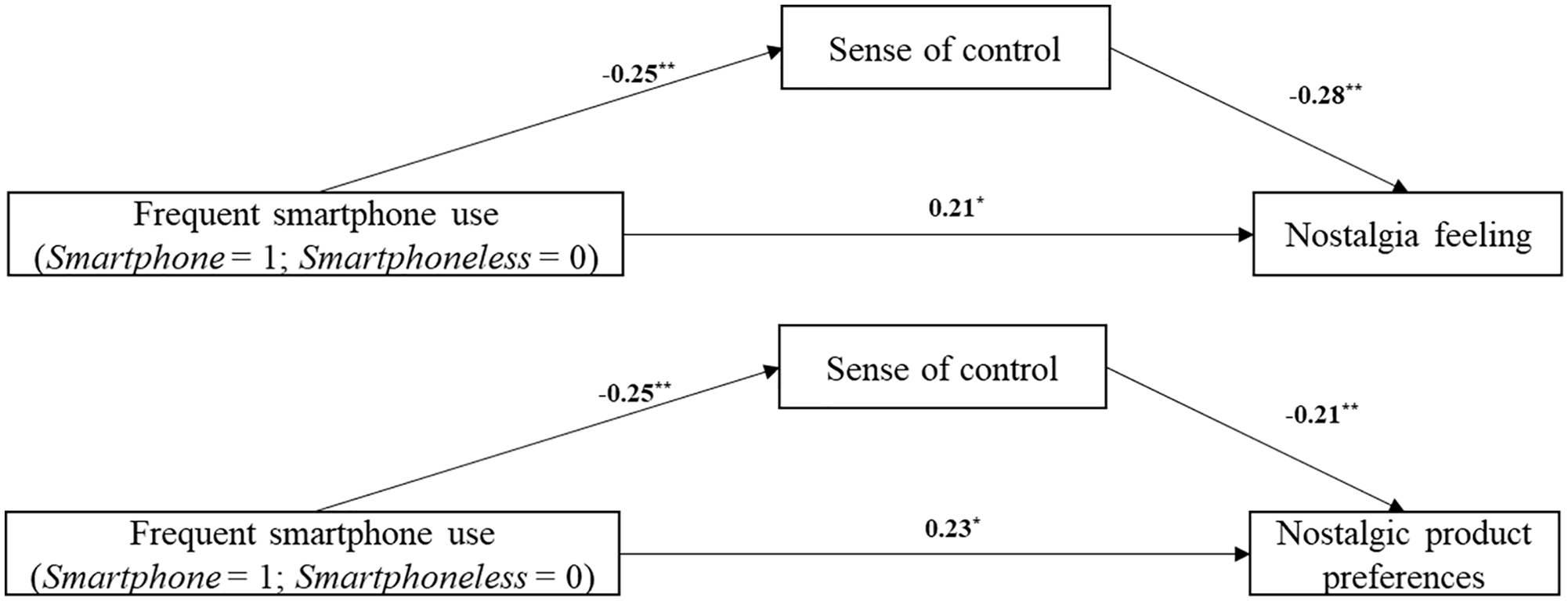
The mediation model of sense of control between frequent smartphone use and nostalgia.
Distraction
We performed the independent sample t test to examine the effect of frequent smartphone use on distraction. The results showed that participants in the smartphone condition (M = 2.28, SD = 0.94) felt significantly more distracted than the participants in the smartphoneless condition, M = 1.88, SD = 0.80; t(126) = 2.57, p = .011, 95% CI [0.09, 0.70], d = 0.45. This result was similar to the prior study (Dwyer et al., 2018). Then, we tested the mediating role of distraction between frequent smartphone use and sense of control through bootstrapping with 5,000 iterations. There were significant indirect effects of the smartphone use condition on the sense of control through distraction (ab = −0.084, 95% CI [−0.157, −0.011]). Specifically, the participants in the smartphone condition felt more distraction than those in the smartphoneless condition (b = 0.22, t = 2.73, p = .006, 95% CI [0.063, 0.383]), and distraction was significantly and negatively related to sense of control (b = −0.38, t = −5.11, p < .001, 95% CI [−0.520, −0.232]). It indicates that frequent smartphone use increases participants’ distraction and then decreases their sense of control.
Discussion
In Study 3, H1 was supported again in the laboratory. After frequent smartphone use manipulation, the participants in the smartphone condition felt a lower sense of control and then reported more feelings of nostalgia and more preferences for nostalgic products than those in the smartphoneless condition. At the same time, we also found that frequent smartphone use led to a poor sense of control through distraction, which supported that frequent smartphone use interrupts and hinders the completion of ongoing tasks so that participants’ sense of control was threatened in the process.
Study 4
Study 4 investigated the potential for nostalgia to recover from the low sense of control evoked by frequent smartphone use. Following the same frequent smartphone use manipulation as that in Study 3, the participants were randomly assigned to groups to give them the opportunity to recall a nostalgic memory or not and then their sense of control was measured. We predicted that frequent smartphone use, in the absence of nostalgia, would reduce the sense of control; however, after experiencing nostalgia, the participants’ levels of a poor sense of control caused by frequent smartphone use would recover to the same level as those who do not use smartphones.
Method
Participants
To determine the sample size, we used an a priori power analysis with a slightly lower medium effect size (f = 0.20; η2 = 0.039; based on the average effects of Studies 1 and 3), 80% power (1 − β) and an α level of .05, resulting in a sample size of 199. A total of 214 participants with smartphones were recruited from China on the campus online forum in exchange for ¥20 yuan (approximately US$3.00). Six participants were excluded because they failed to complete the smartphone manipulation, and two participants were excluded because of double participation in this research, leaving a final sample of 206 (163 women; Mage = 21.56 years, SD = 2.91).
Procedure and measures
The participants were randomly assigned to one of four conditions of a 2 (smartphone, smartphoneless) × 2 (nostalgia, nonnostalgia) between-subjects design. First, the participants completed the same frequent smartphone use manipulation as that in Study 3 (103 participants each in smartphone and smartphoneless conditions). After a 10-min task, they were required to complete an event reflection task (Sedikides et al., 2015) to manipulate nostalgia. The participants assigned to the nostalgia condition (n = 104) were given a definition of “nostalgia” from the Oxford Dictionary and were required to recall a nostalgic event in their lives and to describe the event and their feelings. Those assigned to the nonnostalgia condition (n = 102) were required to recall an ordinary event in their lives and describe the event and their feelings. Finally, the participants completed measures of nostalgia feeling (α = .90), the sense of control (α = .80), and time percentage of smartphone use over the whole experiment. All of the measures were the same as those in Study 3.
Results
Manipulation checks
To test the effectiveness of smartphone use manipulation, a 2 (frequent smartphone use) × 2 (nostalgia) analysis of variance (ANOVA) on the percentage of phone use time was performed. The results showed that frequent smartphone use had a significant main effect, F(1, 202) = 147.03, p < .001, η2 = 0.421. Participants in the smartphone condition (M = 17.60%, SD =14.60) reported a significantly higher percentage of phone use time than the participants in the smartphoneless condition (M = 0.08%, SD = 0.33). The main effect of nostalgia manipulation was not significant, F(1, 202) = 0.23, p = .632, η2 = 0.001. There was no difference between the participants in the nostalgia condition (M = 9.18%, SD =14.91) and the nonnostalgia condition (M = 8.49%, SD = 12.05). The frequent smartphone use × nostalgia manipulation interaction was also not significant, F(1, 202) = 0.23, p = .631, η2 = 0.001. The frequent smartphone use manipulation was effective.
A 2 (frequent smartphone use) × 2 (nostalgia) ANOVA on nostalgia feeling was also performed. The results showed that nostalgia manipulation had a significant main effect, F(1, 202) = 217.12, p < .001, η2 = 0.518. The participants in the nostalgia condition (M = 6.10, SD =1.09) reported significantly greater feelings of nostalgia than the participants in the nonnostalgia condition (M = 3.17, SD = 1.70). The frequent smartphone use main effect was not significant, F(1, 202) = 0.32, p = .574, η2 = 0.002. There was no significant difference between participants in the smartphone condition (M = 4.70, SD =2.08) and those in the smartphoneless condition (M = 4.59, SD = 2.03). The frequent smartphone use × nostalgia manipulation interaction was also not significant, F(1, 202) = 0.10, p = .748, η2 = 0.001. The nostalgia manipulation was effective.
Effects on the sense of control
A 2 (frequent smartphone use) × 2 (nostalgia) ANOVA on the sense of control also yielded a significant main effect of frequent smartphone use, F(1, 202) = 10.56, p = .001, η2 = 0.050. The participants in the smartphone condition (M = 4.17, SD =1.21) felt a significantly lower sense of control than the participants in the smartphoneless condition (M = 4.68, SD = 1.15). The main effect of nostalgia manipulation was also significant, F(1, 202) = 13.81, p < .001, η2 = 0.064. The participants in the nostalgia condition (M = 4.72, SD =1.03) felt a significantly greater sense of control than the participants in the nonnostalgia condition (M = 4.13, SD = 1.29). Importantly, the frequent smartphone use × nostalgia manipulation interaction was significant (see Figure 3), F(1, 202) = 5.86, p = .016, η2 = 0.028. Tests of simple effects further showed that, in the smartphoneless condition, there was no difference between the participants who recalled the nostalgia event (M = 4.78, SD = 1.14) and those who recalled the ordinary event (M = 4.58, SD = 1.16; t = 0.84, p = .361, d = 0.17). However, in the smartphone condition, the participants who recalled the nostalgia event (M = 4.65, SD = 0.92) reported a significantly greater sense of control than those who recalled the ordinary event (M = 3.68, SD = 1.28; t = 18.82, p < .001, d = 0.73). From a different viewpoint, in the nonnostalgia condition, the participants who used their smartphones reported a significantly lower sense of control than those who did not use their smartphones, t = 15.92, p < .001, d = 0.69. In the nostalgia condition, there was no difference between the participants who used their smartphones and those who did not use their smartphones, t = 0.35, p = .556, d = 0.13.

The effects of frequent smartphone use and nostalgia on the sense of control (M ± 1 SE).
Discussion
The results of Study 4 found a compensatory effect of nostalgia for the low sense of control induced by frequent smartphone use. That is, when participants frequently used their smartphones and were not given the opportunity to recall a nostalgic memory, they reported a low sense of control. However, when they were given the opportunity to recall a nostalgic memory after using their smartphones, their sense of control was restored.
Study 5
Study 5 builds upon the findings of Studies 1 to 4 to investigate the causal relationship between sense of control and nostalgia, explore the psychological benefits of nostalgia, and provide evidence to exclude some competing hypotheses. First, we manipulated participants’ sense of control and measured their nostalgia feelings to examine the causal relationship. Second, we subsequently manipulated participants’ recall of nostalgic events and measured participants’ sense of control and the potential psychological benefits (including positive affect, self-esteem, meaning in life, social connectedness, self-continuity, and optimism). This study aimed to examine the compensatory effect of nostalgia on the poor sense of control and the potential psychological mechanisms.
Finally, although we examined the effect of frequent smartphone use on the sense of control in Studies 3 and 4, we attempted to eliminate the influence of the sense of control on smartphone use in Study 5. We asked participants to complete the whole experiment without using smartphones and measured their smartphone use intention at the end of the experiment to test the complete causal relationship between them.
Method
Participants
The sample size was determined with the same standards as in Study 4, resulting in a sample size of 199. To ensure that the final number of participants was sufficient, we recruited 276 participants using monetary compensation through the online questionnaire platform. Six participants were excluded because they failed to complete the sense of control or nostalgia manipulation, and one participant was excluded because of a response time that was too short (less than 5 min), leaving a final sample of 268 (153 women; Mage = 26.49 years, SD = 5.16).
Procedure and measures
All of the participants were restricted to completing the whole experiment through the computer and were prompted not to use the smartphone in the process. The participants were randomly assigned to one of four conditions of a 2 (low sense of control, high sense of control) × 2 (nostalgia, nonnostalgia) between-subjects design.
First, the participants completed the sense of control manipulation through a writing task (Kraus et al., 2009). They were randomly assigned to one of two sense of control conditions in which they were asked to write about a situation in which they either had “very little control” or “a great deal of control,” including what happened, how they felt, and so on. After the manipulation, all of the participants completed the pre-sense of control measure, which was the same as the manipulation check used in Study 3 (α = .85).
Second, the participants were again randomly assigned to the nostalgia condition or the nonnostalgia condition. The participants assigned to the nostalgia condition completed the prenostalgia feeling measure, which was the same as in Study 3 (α = .91), to examine the effect of sense of control on nostalgia, and they completed the same event reflection task as in Study 3 to manipulate their nostalgia experience. Those assigned to the nonnostalgia condition did not complete the prenostalgia feeling measure to avoid the items inspiring nostalgia feelings, and they only completed the nonnostalgia condition of nostalgia manipulation. After the nostalgia manipulation, all of the participants completed the postnostalgia feeling measure, which was the same as in Study 3 (α = .93), as a manipulation check.
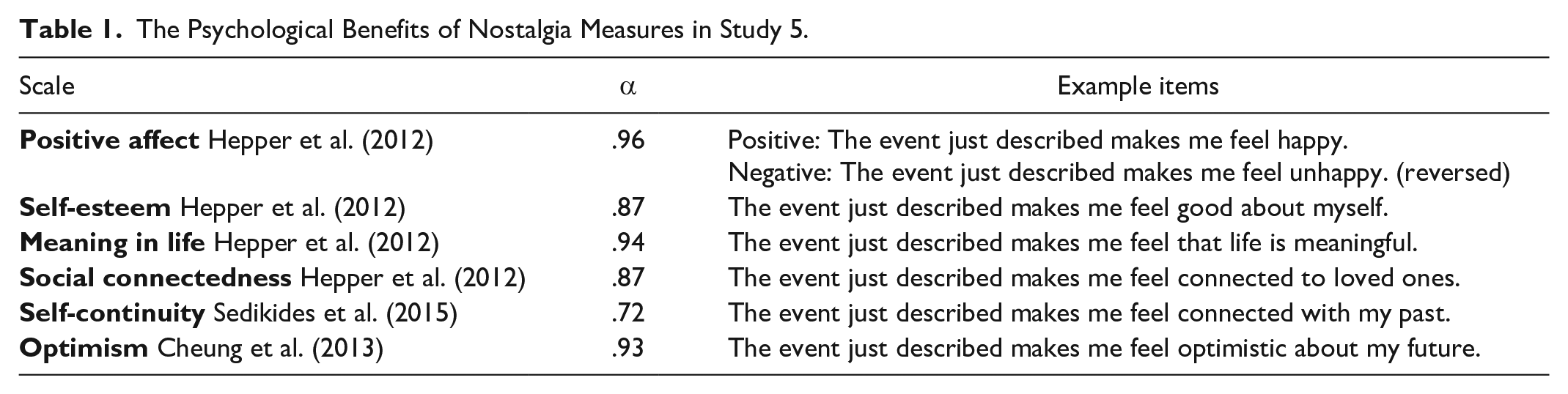
Finally, all of the participants completed measures of post-sense of control (same as Study 3; α = .80) to examine the compensatory effect of nostalgia, the psychological benefits of nostalgia (including positive affect, self-esteem, meaning in life, social connectedness, self-continuity, and optimism), the current smartphone use intention (i.e., “How much do you want to use your smartphone now?” 1 = not at all, 7 = very much), and demographic information (including gender, age, educational level, and SES). The measurements of psychological benefits of nostalgia are described in Table 1, and each variable had 4 items that were rated on a 7-point scale (1 = strongly disagree, 7 = strongly agree).
The Psychological Benefits of Nostalgia Measures in Study 5.
Results
Manipulation checks
To test the effectiveness of the sense of control manipulation, the independent sample t test to examine the effects was performed. The participants in the low sense of control condition (M = 3.53, SD = 1.06) felt a significantly lower sense of control than those in the high sense of control condition (M = 4.94, SD = 1.09), t(266) = −10.75, p < .001, 95% CI [−1.67, −1.15], d = 1.31. The sense of control manipulation was effective.
A 2 (sense of control) × 2 (nostalgia) ANOVA on the post nostalgia feeling was also performed. The results showed that nostalgia manipulation had a significant main effect, F(1, 264) = 158.09, p = .049, η2 = 0.994. The participants in the nostalgia condition (M = 5.77, SD =1.19) reported significantly greater feelings of nostalgia than the participants in the nonnostalgia condition (M = 5.00, SD = 1.46). The sense of control main effect was not significant, F(1, 264) = 9.54, p = .199, η2 = 0.905. There was no significant difference between the participants in the low sense of control condition (M = 5.47, SD =1.34) and those in the high sense of control condition (M = 5.28, SD = 1.43). The sense of control × nostalgia manipulation interaction was also not significant, F(1, 264) = 0.14, p = .709, η2 = 0.001. The nostalgia manipulation was effective.
Effects of sense of control on nostalgia
We performed the independent sample t test to examine the effects of the sense of control manipulation on prenostalgia feelings. As predicted, the participants in the low sense of control condition (M = 5.03, SD = 1.38) felt significantly more nostalgia than those in the high sense of control condition (M = 4.45, SD = 1.58), t(130) = 2.27, p = .025, 95% CI [0.07, 1.09], d = 0.39. This result supported that a poor sense of control could trigger more feelings of nostalgia.
Effects on the post-sense of control
A 2 (sense of control) × 2 (nostalgia) ANOVA on the post-sense of control also yielded a significant main effect of sense of control manipulation, F(1, 264) = 9.56, p = .002, η2 = 0.035. The participants in the low sense of control condition (M = 4.06, SD = 0.95) felt a significantly lower sense of control than the participants in the high sense of control condition (M = 4.46, SD = 1.18). The main effect of nostalgia manipulation was also significant, F(1, 264) = 4.30, p = .039, η2 = 0.016. The participants in the nostalgia condition (M = 4.46, SD =1.18) felt a significantly greater sense of control than the participants in the nonnostalgia condition (M = 4.12, SD = 1.13). Although the sense of control × nostalgia manipulation interaction was not significant, F(1, 264) = 1.13, p = .289, η2 = 0.004, the tests of simple effects supported our hypotheses (see Figure 4). The results showed that, in the high sense of control condition, there was no difference between the participants who recalled the nostalgia event (M = 4.53, SD = 1.14) and those who recalled the ordinary event (M = 4.39, SD = 1.22; t = 0.50, p = .481, d = 0.11). However, in the low sense of control condition, the participants who recalled the nostalgia event (M = 4.26, SD = 0.88) reported a significantly greater sense of control than those who recalled the ordinary event (M = 3.86, SD = 0.98; t = 5.03, p = .026, d = 0.43). From a different viewpoint, in the nonnostalgia condition, the participants who described the low sense of control event reported a significantly lower sense of control than did those who described the high sense of control event, t = 8.76, p = .003, d = 0.49. In the nostalgia condition, there was no difference between the participants who described the low sense of control event and those who described the high sense of control event, t = 2.28, p = .156, d = 0.26. The results supported that nostalgia could compensate for the low sense of control.
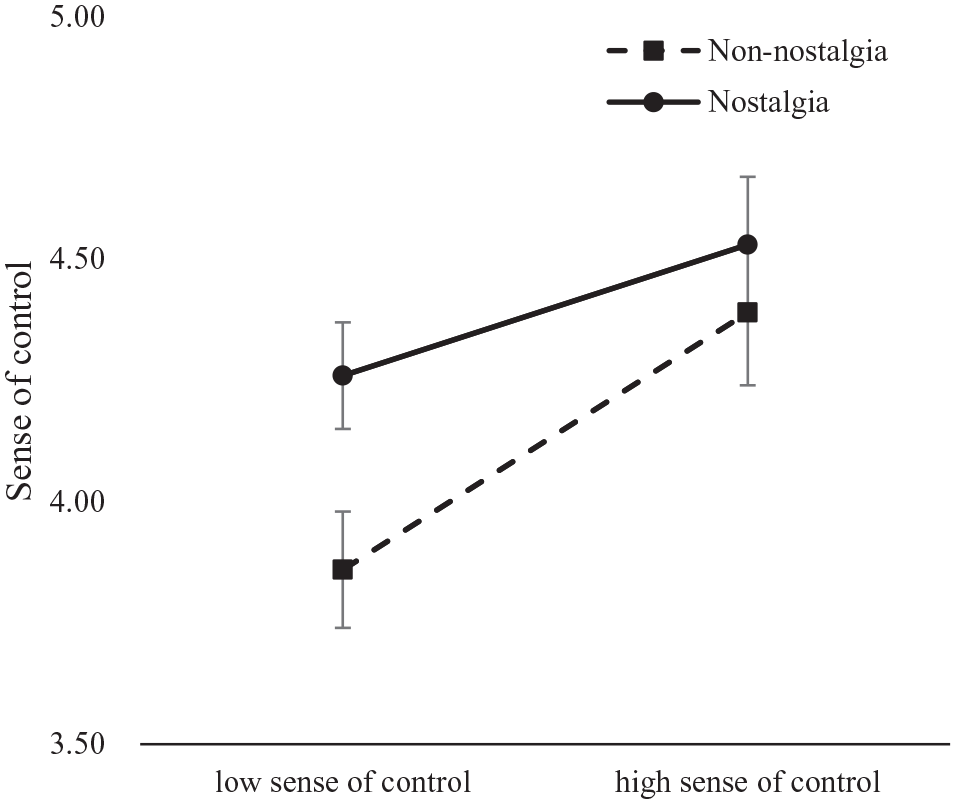
The effects of sense of control and nostalgia manipulation on the post-sense of control (M ± 1 SE).
Psychological benefits of nostalgia
In the low sense of control condition, 3 we first conducted a series of independent sample t tests between the nostalgia and nonnostalgia groups to test whether nostalgia offers psychological benefits. The results found that nostalgia significantly enhanced positive affect, t(135) = 2.48, p = .014, 95% CI [0.15, 1.29], d = 0.42; self-esteem, t(135) = 2.38, p = .019, 95% CI [0.08, 0.92], d = 0.41; meaning in life, t(135) = 2.61, p = .010, 95% CI [0.15, 1.11], d = 0.45; self-continuity, t(135) = 2.68, p = .008, 95% CI [0.10, 0.69], d = 0.46; and social connectedness, t(135) = 2.24, p = .027, 95% CI [0.06, 0.96], d = 0.38. However, the association between nostalgia and optimistic was not significant, t(135) = 1.46, p = .146, 95% CI [-0.12, 0.80], d = 0.25.
Next, we conducted a mediation analysis (Hayes, 2013; Model 4; 5,000 bootstraps) to test the indirect effect of nostalgia on the sense of control through psychological benefits. The psychological benefits (positive affect, self-esteem, meaning in life, social connectedness, self-continuity, and optimism) as mediation variables were added to the model together between nostalgia manipulation (nostalgia condition = 1, nonnostalgia condition = 0) and post-sense of control under the low sense of control condition. We did so because we attempted to explore which psychological benefits play a significant role in increased sense of control while recalling the nostalgic event. We obtained a significant indirect effect of nostalgia conditions via self-esteem on the sense of control, and the indirect effect of nostalgia conditions via other psychological benefits (positive affect, meaning in life, self-continuity, social connectedness, and optimistic) on the sense of control was not significant (see Table 2). These results showed that recall of nostalgic events was associated with a heightened level of self-esteem and, in turn, an increased sense of control.
Indirect Effects of Nostalgia Conditions on Sense of Control via Psychological Benefits in Study 5.

Note. ab = indirect effect; CI = confidence interval.
The current smartphone use intention
Finally, we examined the effects of sense of control and nostalgia on smartphone use intention to eliminate the competition hypothesis. A 2 (sense of control) × 2 (nostalgia) ANOVA on the current smartphone use intention was performed. The sense of control main effect was not significant, F(1, 264) = 0.95, p = .330, η2 = 0.004. There was no significant difference between participants in the low sense of control condition (M = 3.84, SD =1.38) and those in the high sense of control condition (M = 4.00, SD = 1.28). The nostalgia main effect was not significant, F(1, 264) = 2.43, p = .120, η2 = 0.009. There was no significant difference between the participants in the nostalgia condition (M = 3.79, SD =1.41) and those in the nonnostalgia condition (M = 4.04, SD = 1.25). The sense of control × nostalgia manipulation interaction was also not significant, F(1, 264) = 0.06, p = .805, η2 = 0.000. The sense of control and nostalgia manipulation did not influence participants’ intentions of smartphone use.
Discussion
First, combined with the results of Studies 1 to 3, the results of Study 5, which found that a low sense of control increases participants’ feelings of nostalgia, supported the complete causal relationship of H1. Second, we found that, although nostalgia had many psychological benefits (including positive affect, self-esteem, meaning in life, social connectedness, and self-continuity), self-esteem played an important role in nostalgia enhancing the low sense of control. In addition, we found that neither a sense of control nor nostalgia caused increasing intention of smartphone use, which excluded the possibility that a poor sense of control increases people’s intention to use smartphones.
General Discussion
Across five studies, we found that frequent smartphone use decreases people’s sense of control and then triggers people’s nostalgia (H1). These results were examined through a range of methods (including the field experiment, diary tracking, and laboratory experiments) and were captured in various scenes (including a central social activity for people, a 2-week diary study, and a more controlled laboratory setting). At the same time, we also found that nostalgia enhances the sense of control (H2), and the positive effect works through the mediating effect of increasing self-esteem (the exploratory question).
The present research makes some substantive and theoretical contributions to the existing literature. First, although smartphones have penetrated people’s lives and changed our lifestyles, previous research has paid more attention to the causes of problematic smartphone use and its influence on affect and social relationships (e.g., Hong et al., 2012; Lei et al., 2017). The present research focuses on the impacts of frequent smartphone use for the first time. We found that frequent daily smartphone use has a negative effect, that is, reducing people’s sense of control (Studies 1–4), because high-frequency smartphone use causes distractions, which continuously interrupt people’s current tasks and result in a low sense of control (Study 3). It is important to find that the daily use habit of smartphone use has a negative effect that people often ignore. This finding suggests that we should consider changing our frequent smartphone use mode rather than only decreasing our use time to reduce the negative effects, for example, using time management tools to separate daily work and social interactions with smartphone use to avoid distractions.
Second, we found that people experienced more feelings of nostalgia and even chose nostalgic consumption when they felt a low sense of control induced by frequent smartphone use (Studies 1–3), and further nostalgia could compensate for the low sense of control (Studies 4 and 5). This result confirms the viewpoint of compensatory control theory that people are motivated to maintain their sense of control, and when people’s sense of control is threatened, the aversive experience will prompt them to adopt psychological strategies to compensate for it (Landau et al., 2015). The present research extends the application of compensatory control theory to the field of smartphone use and finds a new and effective means to compensate for the reduced sense of control. In practice, we also contribute to the finding that people could spontaneously seek an effective way to lessen the impact. Owing to the prevalence of smartphones, people barely live without them; people could only recall some old memories, buy some food that we tasted in childhood, or listen to old songs to help us regain a sense of control in daily life. In the future, smartphones could also help people to alleviate a low sense of control. When smartphones detect high-frequency use, they can prompt people to do something related to nostalgia.
Third, our findings expanded research in the field of the positive effects of nostalgia. Prior studies have found that nostalgia has various psychological benefits, including enhancing positive emotions, elevating self-esteem, strengthening self-continuity, and fostering meaning in life (e.g., Juhl et al., 2010; Sedikides et al., 2008; Van Tilburg et al., 2018). In the present research, we directly examined whether nostalgia could improve people’s sense of control (Studies 4 and 5) and found that the psychological mechanism of this process was by enhancing their self-esteem (Study 5). In the process of improving the sense of control, the self-oriented function of nostalgia is more critical than its positive features. Although nostalgia enhances both self-esteem and other psychological benefits (including positive affect, meaning in life, social connectedness, and self-continuity), self-esteem plays the only significant mediating role in the effect of nostalgia on the sense of control. This is because that nostalgia contains many self-defining moments and momentous life events (Abeyta et al., 2015; Hepper et al., 2012), which are linked with a sense of mastery and control of one’s environment (Lyubomirsky et al., 2006). This finding provides a more complete picture of the positive functions of nostalgia, and future research could focus on whether nostalgia can help us to cope with more threats based on its likelihood of increasing people’s sense of control.
Finally, the present research gives rise to some interesting issues that are worthy of future attention. We found that frequent smartphone use leads to a decrease in the sense of control, and prior studies have found trait low self-control was related to more problematic smartphone use (e.g., Jiang & Zhao, 2016). However, the relationship among sense of control, trait self-control, and smartphone use still needs further research. We tend to believe that people with low self-control are more likely to use their smartphones at high frequency because they are more easily distracted by smartphone reminders and escape their current tasks. Temporary escape is less helpful for solving problems (Lukoff et al., 2018), and the users finally fall into a state of a poor sense of control. Therefore, trait self-control could be a moderating variable of frequent smartphone use on the sense of control. In addition, we focused on frequent smartphone use in this research, but smartphones have a variety of functions. The influence of smartphone use on the sense of control could have boundary conditions referring to the consistency of usage functions and scenes. When the smartphone use functions are consistent with our expected tasks, for example, using smartphones to inquire relevant information while writing a paper or using smartphones to share photos on social networks with friends that one has met, it possibly does not have negative impacts or might even have a promoting effect. Therefore, future research could pay more attention to the boundary conditions that would help us to understand what a good smartphone use pattern is.
Supplemental Material
sj-docx-1-psp-10.1177_01461672211061935 – Supplemental material for New Technology Evokes Old Memories: Frequent Smartphone Use Increases Feeling of Nostalgia
Supplemental material, sj-docx-1-psp-10.1177_01461672211061935 for New Technology Evokes Old Memories: Frequent Smartphone Use Increases Feeling of Nostalgia by Niwen Huang, Shijiang Zuo, Fang Wang, Yawen Li, Pan Cai and Shun Wang in Personality and Social Psychology Bulletin
Footnotes
Declaration of Conflicting Interests
The author(s) declared no potential conflicts of interest with respect to the research, authorship, and/or publication of this article.
Funding
The author(s) disclosed receipt of the following financial support for the research, authorship, and/or publication of this article: This work was supported by the National Natural Science Foundation of China (grant numbers 31971012 & 31600910).

Supplemental Material
Supplemental material is available online with this article.
Notes
References
Supplementary Material
Please find the following supplemental material available below.
For Open Access articles published under a Creative Commons License, all supplemental material carries the same license as the article it is associated with.
For non-Open Access articles published, all supplemental material carries a non-exclusive license, and permission requests for re-use of supplemental material or any part of supplemental material shall be sent directly to the copyright owner as specified in the copyright notice associated with the article.
