




Abstract
Although Rasch models have been shown to be a sound methodological approach to develop and validate measures of psychological constructs for more than 50 years, they remain underutilized in psychology and other social sciences. Until recently, one reason for this underutilization was the lack of syntactically simple procedures to fit Rasch and item response theory (IRT) models in general statistical software packages. In this article, the authors demonstrate how to fit the standard dichotomous Rasch model and a dichotomous one-parameter logistic IRT model with nested random effects via the easy-to-use GLIMMIX procedure in SAS 9.3. For comparison purposes, the standard dichotomous Rasch model was also fit using the Rasch specialized software, WINSTEPS 3.68.2. The SAS code used to simulate the data on which the Rasch model was fit is provided to allow replication of estimates. Findings suggest that the GLIMMIX procedure may be a viable option for fitting the standard dichotomous Rasch and dichotomous IRT models.
Keywords
In this article, the authors demonstrate how to fit a standard dichotomous Rasch model, using the GLIMMIX procedure in SAS 9.3. For comparison purposes, the same model was refitted using the Rasch specialized software, WINSTEPS 3.68.2 (Linacre, 2009). Although the focus of this article is on the standard Rasch model, the authors also used a dichotomous one-parameter logistic (1-PL) item response theory (IRT) model with nested random effects to demonstrate some of GLIMMIX’s additional capabilities of IRT modeling.
Method
Standard Dichotomous Rasch Model
In the standard dichotomous Rasch equation, the probability of a positive endorsement is a function of person ability (“theta”) minus item difficulty (“b”) (Bond & Fox, 2007; Rasch, 1960):

where


The marginal likelihood of the standard dichotomous Rasch model was approximated using the maximum likelihood estimation (MLE) offered in the GLIMMIX procedure (Schabenberger, 2007; Figure 1). Variances and residuals on the probability scale were outputted from GLIMMIX to calculate person and item infit and outfit mean-square statistics. These fit statistics were computed via the SQL procedure (Figure 2) based on equations provided in the WINSTEPS documentation (Linacre, 2009). An item map is also provided to illustrate the hierarchy of the items along the continuum of the measure (SAS code in Figure 3a), whereas a histogram is provided to show the distribution of person abilities (SAS code in Figure 3b). The standard dichotomous Rasch model was also fit on the same data in WINSTEPS 3.68.2 using joint maximum likelihood estimation (JMLE) for comparison purposes.

SAS code to fit standard dichotomous Rasch model in GLIMMIX
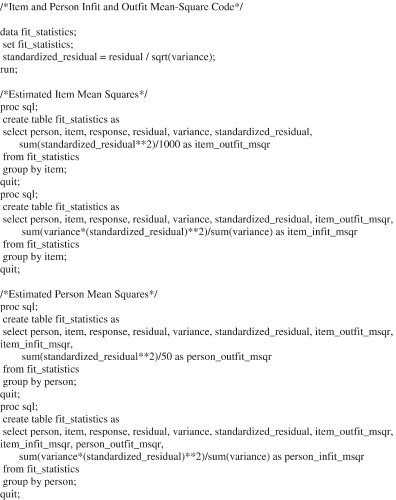
SAS code to produce item and person infit and outfit mean-squares
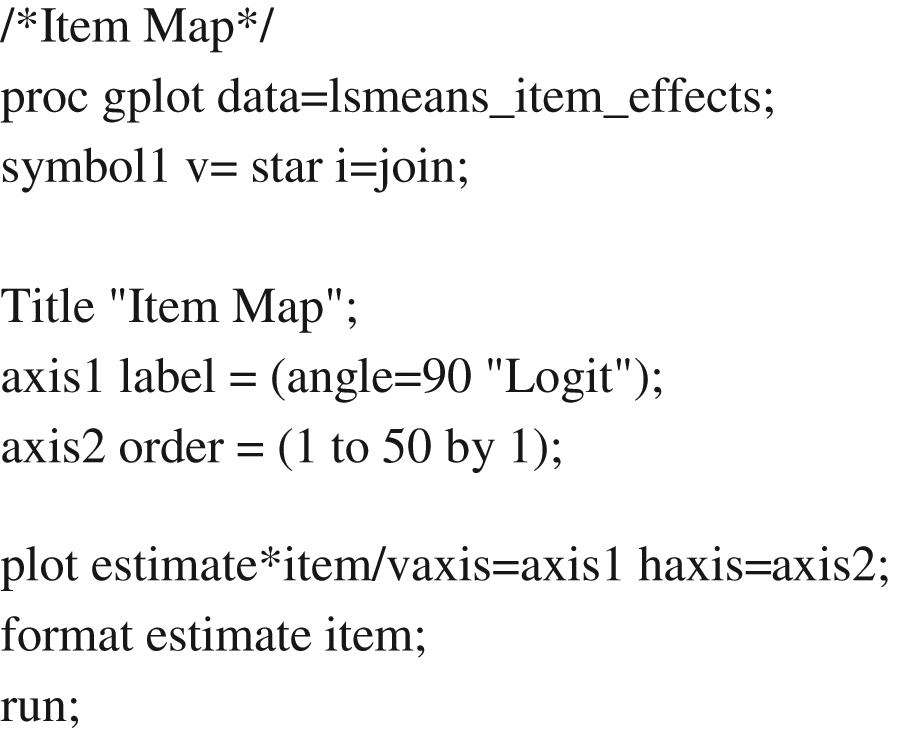
SAS code to generate item map

SAS code to generate person abilities histogram
Data Simulation for Standard Dichotomous Rasch Model
Data were simulated in SAS to approximate a standard dichotomous Rasch model by applying the following specifications: (a) 1,000 persons, (b) responses to 50 dichotomous items from each person, (c) normally distributed person abilities with means of 0 logits and standard deviations of 1.25 logits, (d) item difficulties ranging from a probability of .01 (Item 1—very difficult to endorse) to a probability of .99 (Item 50—very easy to endorse), (e) the log odds of endorsing an item as a function of person abilities (“theta”) minus item difficulty (“b”), and (f) discrimination parameters fixed at 1.0 (Figure 4).
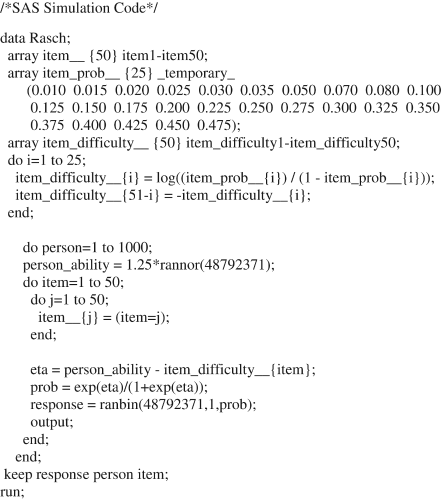
SAS simulation code
Dichotomous 1-PL IRT Model With Nested Random Effects
In a dichotomous 1-PL IRT model with persons nested within a 3rd-level unit (e.g., geographic location), the probability of endorsement is a function of item, person, and 3rd-level unit parameters (e.g., geographic location of person). Notably, item effects were treated as fixed effects, whereas person and location effects were treated as random:

where


The marginal likelihood of this model was approximated using a frequentist approach by employing the Laplace method offered in GLIMMIX (Schabenberger, 2007). 1 The GLIMMIX code was specified to estimate the item difficulties and person abilities in probability units and logits. Given the focus of this article on the standard dichotomous Rasch model, a limited amount of information regarding fit is provided with respect to this model.
Data Simulation for Dichotomous 1-PL IRT Model With Nested Random Effects
Data were simulated in SAS to approximate a dichotomous 1-PL IRT model with nested random effects by applying the following specifications: (a) 250 randomly selected persons nested in each of 50 randomly selected locations (Nperson = 250 × 50 = 12,500), (b) responses to 50 dichotomous items from each person, (c) normally distributed location ability (location random effect) and person ability (person random effect) scores with means of 0 logits and standard deviations of 1.25 logits, (d) item difficulties ranging from a probability of .01 (Item 1—very difficult to endorse) to a probability of .99 (Item 50—very easy to endorse), and (e) the log odds of endorsing an item as a function of location and person abilities minus item difficulty. Data simulation code for this model is available on request.
Handling of Missing Data in GLIMMIX
In the data set, the response variable (1 = endorse, 0 = not endorse) is concatenated vertically and linked to both person and item indicator variables, such that each participant identification number repeats for each item. As a result, if a participant has responded to 45 of the 50 items, for instance, there should be 45 cases with valid response values and 5 cases with missing response values. The 45 cases with valid response data would be used in the parameter estimation from GLIMMIX. That is, all available valid data from a given participant can be used when using the GLIMMIX procedure.
Results
Standard Dichotomous Rasch Model Fit in SAS Using the GLIMMIX Procedure
Convergence and overall fit of models
The standard dichotomous Rasch model using MLE in GLIMMIX converged in 6 min. The −2 × Log Likelihood (−2 × LL) for this model was 37,781. This analysis was run on a 64-bit Windows 7.0 operating system with 8 gigabytes of RAM.
Item-level statistics: Difficulties, standard errors, infit and outfit mean-squares, and item map
Estimated non-centered and centered* item difficulties, standard errors, and item infit and outfit mean-squares are presented in Table 1. Although not shown, 95% confidence intervals for the item difficulty estimates from this model included the true parameter for all 50 items. Also, none of the item infit or outfit statistics produced by GLIMMIX is below 2.0 (Linacre, 2009). The item map (Figure 5a) shows coverage along the entire continuum as specified in the simulation code.
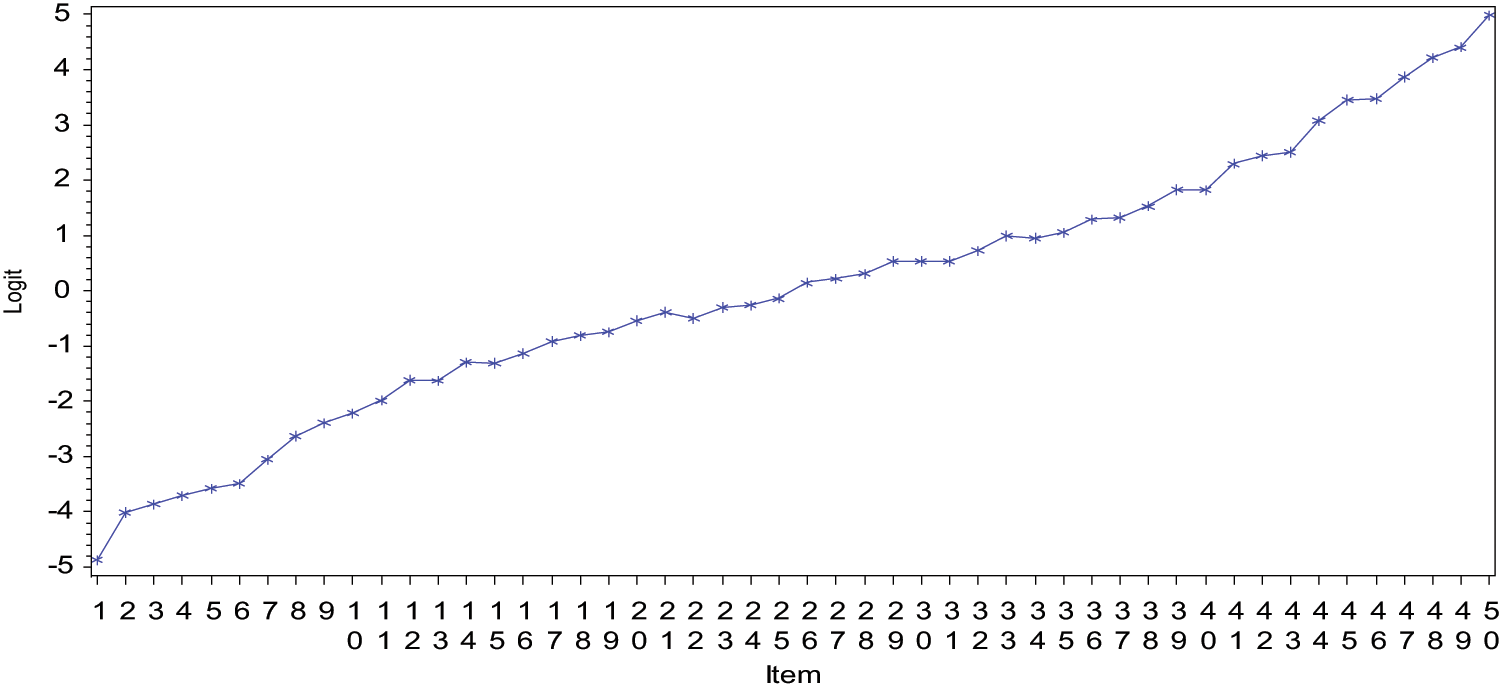
Item map generated from SAS
Item Difficulties (in Logits), Standard Errors, and Infit and Outfit Mean-Squares Estimated From Standard Dichotomous Rasch Models Fitted in SAS-GLIMMIX and WINSTEPS
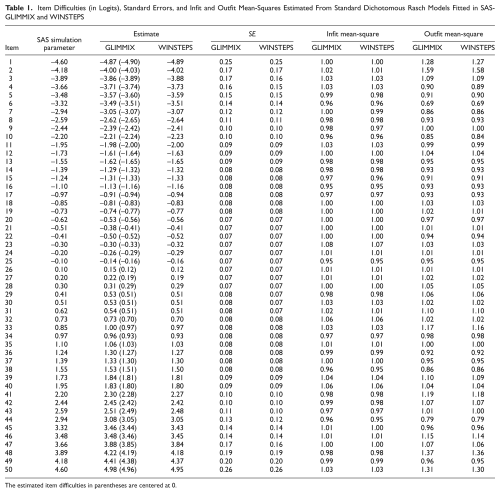
The estimated item difficulties in parentheses are centered at 0.
Person-level statistics: Standard errors, infit and outfit mean-squares, and abilities
In lieu of presenting statistics in a Table for all 1,000 participants, the following is noted: (a) 100% of the infit mean-squares and 94.5% of the outfit mean-squares are below 2.0 and (b) the distribution of person abilities is approximately normal (Figure 5b). 2
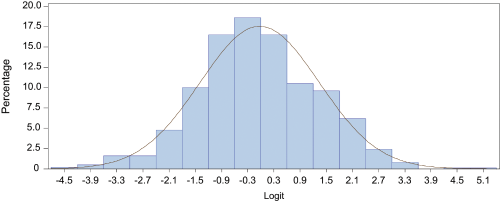
Person abilities histogram generated from SAS
Standard Rasch Model Fit in WINSTEPS
Convergence and overall fit of model
The standard Rasch analysis performed in WINSTEPS 3.68.2 converged in less than 1 min, yielding a fit of −2 × LL = 37,781. Notably, the −2 × LL generated from WINSTEPS is identical (when rounded to the whole number) to the −2 × LL from GLIMMIX.
Item-level statistics: Item difficulties, standard errors, infit and outfit mean-squares, and item map
Estimated item difficulties, standard errors, and item infit and outfit mean-squares are presented in Table 1. As seen in Table 1, the estimates obtained from the standard Rasch model used in WINSTEPS are similar to those obtained from the standard models fit in SAS. 95% confidence intervals for the item difficulty estimates from this model also included the true parameter for all 50 items. Similar to the GLIMMIX results, none of the item infit or outfit statistics reaches the threshold of 2.0. Although not presented here, the item map from WINSTEPS reveals essentially the same hierarchy as the item map produced from SAS.
Person-level statistics: Abilities, infit and outfit mean-squares, and distribution
Similar to GLIMMIX, 100% of the infit and 94.5% of outfit mean-squares were below 2.0, and the distribution of person abilities was approximately normal (not shown). It is also noted that the Pearson correlation between the person abilities and infit and outfit mean-squares produced from WINSTEPS and GLIMMIX were approximately 1.00, 1.00, and 0.98, respectively.
1-PL IRT With Nested Random Effects in GLIMMIX
Convergence and overall fit of model
The 1-PL IRT model with nested random effects using the Laplace method in GLIMMIX converged after 2 hr and 22 min. This model yielded an overall fit statistic of −2 × LL = 482,539.
Item difficulties and person abilities
As seen in Table 2, the estimated item difficulties from the GLIMMIX procedure were similar to the simulation parameters. 95% confidence intervals for the item difficulty estimates from this model included the true parameter for all 50 items. Although not shown, it is noted that person abilities approximated a normal distribution similar to the specifications from the simulation.
Item Difficulties (in Logits) Estimated From the Dichotomous 1-PL IRT Model With Nested Random Effects
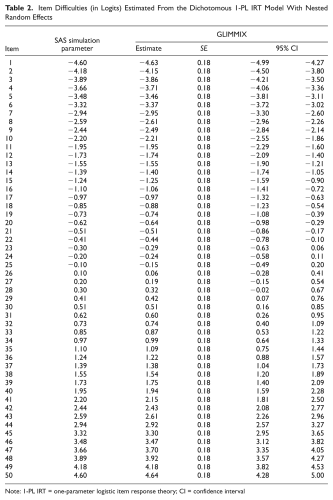
Note: 1-PL IRT = one-parameter logistic item response theory; CI = confidence interval
Discussion
In this article, the authors demonstrated how to fit a standard dichotomous Rasch model via the GLIMMIX procedure in SAS 9.3 and compared the overall fit and item- and person-specific estimates with WINSTEPS. Findings suggest that the GLIMMIX procedure produces estimates that are comparable with WINSTEPS. The authors also used a 1-PL IRT model, which incorporated nested random effects (items nested in persons and persons nested in locations). 3 Although not shown, other similar types of models may be fitted in GLIMMIX such as a model with crossed random effects, and a model that treats item effects as a random sample of a population of items (item random effects) may be employed using the GLIMMIX procedure.
A critical assumption of the Rasch model is unidimensionality, which is commonly assessed by performing an unrotated principal components analysis (PCA) on probability scale residuals obtained from the Rasch model (Linacre, 2006). It is possible to perform an unrotated PCA on probability scale residuals (outputted from the GLIMMIX procedure) using the FACTOR procedure in SAS.
Because this was a simulation experiment, the steps to defining a construct were not discussed. However, it should be noted that defining a construct entails examination of (a) item content, coverage, fit, and hierarchy, (b) person fit (including examination of any atypical patterns of responses) and hierarchy, and finally (c) overall model fit and dimensionality.
In conclusion, it is hoped that this demonstration of how to fit a standard dichotomous Rasch model as well as a hierarchical 1-PL model (e.g., nested random effects) in a generalized linear mixed model procedure using a general software package such as SAS will help the field of measurement move forward.
Footnotes
Acknowledgements
The authors wish to thank Dale F. McLerran, MS, for reviewing the initial draft of the manuscript, providing assistance with the development of the SAS code, and statistical consultation.
The author(s) declared no potential conflicts of interest with respect to the research, authorship, and/or publication of this article.
The author(s) received no financial support for the research, authorship, and/or publication of this article.