



Abstract
The authors examined the effects of two types of motivation, driven to work and enjoyment of work, on managers’ (N = 346) performance, career satisfaction, and psychological strain. Performance was assessed using 360-degree performance ratings. The authors also tested the effects of self-esteem on the two motives. They found that the enjoyment motive was positively related to career satisfaction and performance and negatively related to strain. Driven to work had no main effects but appeared to interact with enjoyment of work to influence performance and strain. When enjoyment of work was high, driven to work was unrelated to performance or strain. When enjoyment of work was low, increases in driven to work were associated with increases in both performance and strain. Self-esteem was positively related to enjoyment of work and negatively related to driven to work. Overall, the authors’ findings suggest that being motivated by enjoyment of work facilitates both effectiveness and well-being.
Keywords
Managerial work is particularly challenging in today’s organizational environment; restructuring, globalization, a focus on short-term results, and advances in technology have increased demands on managers and contributed to long work hours for many (Ohlott, Bhandary, & Tavares, 2003; Porter, 2001). It is obvious that managers must be highly motivated to succeed in this increasingly turbulent environment. Yet, the type of motivation possessed by managers, not simply the amount, may be a critical determinant of their performance and well-being and ultimately the effectiveness of their organizations (Porter, 2001).
The motivation literature, particularly self-determination theory (SDT), suggests that there are different types of motivation that underlie or regulate goal-directed behavior (Ryan & Connell, 1989; Ryan & Deci, 2000). These various types of motivation represent the individual’s perceptions of his or her reasons for acting—the why of behavior (e.g., external contingencies, inner “shoulds,” the fulfillment of personal values and goals, the pursuit of pleasure and interest).
In the present study, we focus on the consequences of two types of motivation among managers. These two types of motivation represent key themes in the workaholism literature (e.g., Burke, 1999; Johnstone & Johnston, 2005; Spence & Robbins, 1992) and mirror motivational types identified by SDT researchers (Deci & Ryan, 2000; Ryan & Connell, 1989). The first entails feeling compelled to work because of an inner sense of obligation or “shoulds.” The second involves working because the work itself is intrinsically pleasurable, enjoyable, and interesting.
Perhaps the best-known and most-researched representations of working to fulfill inner “shoulds” and working to pursue pleasure are the concepts of driven to work and enjoyment of work, respectively. Driven to work and enjoyment of work were first identified by Spence and Robbins (1992) in their efforts to classify workaholics and later refined by McMillan, Brady, O’Driscoll, and Marsh (2002). Recently, some scholars (Burke, 2001; Burke, Richardsen, & Mortinussen, 2004; Johnstone & Johnston, 2005) have used them as we do here, as independent factors that induce individuals to work, sometimes excessively.
Driven to work represents an urge to work that is rooted in inner “shoulds.” Managers who are driven to work feel compelled or obligated to work (Johnstone & Johnston, 2005; McMillan et al., 2002; Spence & Robbins, 1992). Their behaviors are controlled by self-administered consequences; they experience feelings of guilt, anxiety, or shame if they do not work. As described below, driven to work is consistent with the introjected form of motivation defined by SDT (Deci & Ryan, 2000; Ryan & Connell, 1989). Although the everyday usage of driven has positive connotations, our conceptualization does not. Driven to work is not synonymous with the drive to achieve. Nor should it be confused with the drive to satisfy physiological and psychological needs.
Enjoyment of work is the degree to which individuals work because they find the work itself intrinsically interesting or pleasurable (Johnstone & Johnston, 2005; McMillan et al., 2002; Spence & Robbins, 1992). Managers seek pleasure or interest from the nature of the work rather than the act of working (Ng, Sorensen, & Feldman, 2007). Intrinsic motivation (Deci & Ryan, 2000; Ryan & Connell, 1989) is a key aspect of enjoyment of work. Although enjoyment of work contains affective components (i.e., pleasure, interest), it differs from general positive affect toward one’s job or organization (e.g., job satisfaction, organizational commitment).
We view driven to work and enjoyment of work as specific to the work domain; they operate at an intermediate level of generality between stable, personality traits and transient states (Deci & Ryan, 2000; Vallerand, 2000). The workaholism and motivation literatures suggest that driven to work and enjoyment of work may evoke specific patterns of cognition, affect, and behavior that have important consequences for managers (Burke, 1999; Deci & Ryan, 2000; Gagné & Deci, 2005; Ng et al., 2007; Porter, 2001). Driven to work may be linked to increased stress and anxiety, reduced physical and emotional well-being and work satisfaction, and, ultimately, poor performance. In contrast, enjoyment of work may be associated with increases in positive affect, coping, and well-being as well as enhanced work attitudes, learning, adaptability, and performance.
Given the potential consequences of driven to work and enjoyment of work, it is essential to understand how the two types of motivation affect managers’ experiences. To date, evidence on the effects of driven to work and enjoyment of work among managers is limited and the relationship between the two types of motivation and managerial performance remains untested. The present study is designed to address these gaps in the literature. In particular, we examine the effects of driven to work and enjoyment of work on managers’ performance as well as their career satisfaction and psychological well-being.
Theory and Hypotheses
Our theoretical model, shown in Figure 1, depicts the effects of driven to work and enjoyment of work on managers’ outcomes. Driven to work and enjoyment of work are conceptualized as independent dimensions; managers may exhibit varying combinations of the two motivations (e.g., one, both, neither; McMillan et al., 2002; Spence & Robbins, 1992). The possibility of such combinations is based on the idea that each individual’s work behaviors result from a variety of motivations, including inner “shoulds” and/or the desire to pursue personal interests or pleasure (Judge, Bono, Erez, & Locke, 2005; Sheldon & Elliot, 1998). Furthermore, it reflects the fact that managerial work involves a broad set of activities, each of which may be evoked by varying motives. In our model, we account for the combined effects of driven to work and enjoyment of work by assessing both their main and interaction effects.

Hypothesized Model
Our model focuses on three outcomes: performance, career satisfaction, and job-related psychological strain. The inclusion of these outcomes recognizes that managers’ inner reasons for working are likely to have important consequences for their effectiveness, work attitudes, and well-being (Gagné & Deci, 2005). It also allows us to consider the impact of the two motivations from the perspective of both the organization and the individual. Performance provides the perspective of the organization; it is the organization’s assessment of the manager’s effectiveness and future potential. Career satisfaction and psychological strain provide the perspective of the manager. Career satisfaction is the manager’s assessment of his or her overall career success and progress toward meeting career goals (Greenhaus, Parasuraman, & Wormley, 1990). Psychological strain represents poor psychological functioning; it is the extent to which the manager experiences aversive and potentially harmful psychological reactions (e.g., depression, anxiety) at work (Beehr, Jex, Stacy, & Murray, 2000; Caplan, Cobb, French, Harrison, & Pinneau, 1980).
To date, antecedents of driven to work and enjoyment of work have been relatively unexamined (McMillan, O’Driscoll, & Burke, 2003; Ng et al., 2007). Our model includes one possible antecedent, self-esteem, which is the value individuals place on themselves (Baumeister, Campbell, Krueger, & Vohs, 2003). Some evidence links measures of self-concept (e.g., self-esteem, core self-evaluations) to preferences for various types of motivation, suggesting that self-esteem may be an important antecedent of driven to work and enjoyment of work (Deci & Ryan, 1985; Judge et al., 2005).
In discussing the model, we consider the main effects of driven to work and enjoyment of work, followed by their interaction. We then consider the effects of self-esteem.
Effects of Driven to Work and Enjoyment of Work
Although both driven to work and enjoyment of work come from within the manager, the two types of motivations differ in fundamental ways. Drawing on the literatures on workaholism (e.g., Porter, 2001), SDT (e.g., Deci & Ryan, 2000; Sheldon & Elliot, 1998, 1999), and affect (e.g., Fredrickson, 1998, 2001), we discuss these differences and their implications for managers.
Driven to Work
Driven to work implies that individuals work because they feel that they should or must and experience feelings of guilt and anxiety if they do not (Spence & Robbins, 1992). Workaholism scholars typically view driven to work as detrimental, highlighting the sense of inner pressure that characterizes it and sometimes connecting it to work compulsion or addiction (Buelens & Poelmans, 2004; Johnstone & Johnston, 2005). Recent workaholism research links driven to work to increased feelings of stress and pressure at work and to declines in psychological well-being (e.g., Aziz & Zickar, 2006; Burke, 1999; Burke, Burgess, & Oberklaid, 2003; Burke et al., 2004; Spence & Robbins, 1992).
SDT suggests that the harmful consequences of driven to work may arise from the presence of introjected motivation. Consistent with the conceptualization of being driven to work, introjected motivation occurs when individuals experience inner demands to engage in behaviors and suffer ego deficits (e.g., guilt, anxiety) when they do not meet these demands (Deci & Ryan, 2000; Ryan & Connell, 1989; Sheldon & Elliot, 1998).
Introjected motivation typically has negative effects on well-being, attitudes, and performance (see Deci & Ryan, 2000, Gagné & Deci, 2005); such effects are also likely for driven to work. Driven managers may feel coerced by their internal processes. Their work activities are likely to be viewed as a demand rather than a matter of free choice, thereby creating feelings of tension and pressure that increase the likelihood of negative moods (Burke, 1999; Nix, Ryan, Manly, & Deci, 1999; Sheldon & Kasser, 1995). Furthermore, managers may experience work as extraordinarily effortful and feel drained by their efforts (Nix et al., 1999).
Managers who are driven to work may also find it difficult to experience satisfaction with their career accomplishments. Although working hard may allow driven managers to obtain ego enhancements (e.g., pride in working hard), true satisfaction comes from freely pursuing activities that are self-integrated—consistent or aligned with deep values, goals, and interests (Deci & Ryan, 1985, 2000; Judge et al., 2005; Sheldon & Elliot, 1998, 1999). Activities that arise from the “shoulds” are likely to feel “forced” and will not be experienced as coming from the true self. Consequently, managers are unlikely to view such activities as meaningful and truly satisfying.
Being driven to work may also compromise managers’ performance (Sheldon & Elliot, 1998). The negative emotions (e.g., pressure, tension) of introjected motivation may lead managers to withdraw from rather than engage their environments; their patterns of attention, thought, and action are likely to be substantially narrowed (Fredrickson, Mancuso, Branigan, & Tugade, 2000; Lyubomirsky, King, & Diener, 2005). Cognitive activity is likely to be impaired, leading to reductions in cognitive flexibility, creativity, and problem solving (Deci & Ryan, 1985; Gagné & Deci, 2005; Sheldon & Elliot, 1998). The appropriateness and flexibility of their strategies, plans, and actions for attaining goals may suffer (Sheldon & Elliot, 1998), making it difficult for managers to adapt to turbulent or changing environments.
Moreover, the quality of managers’ interpersonal relations with colleagues may be diminished. Pressure and tension may lead managers to withdraw or self-protect in interpersonal interactions (Lyubomirsky et al., 2005). They may avoid being close and open with colleagues to protect themselves from the possibility of additional sources of influence and pressure (Hodgins, Koestner, & Duncan, 1996). Their ability to understand others’ views and learn from them may also be reduced (Sheldon & Elliot, 1999; Sheldon & Kasser, 1995).
Based on the above discussion, we propose,
Hypothesis 1: Driven to work will be positively related to psychological strain and negatively related to managerial performance and career satisfaction.
Enjoyment
As noted earlier, enjoyment of work is associated with pursuing work activities because they are experienced as inherently enjoyable or interesting. Workaholism scholars typically view the enjoyment motive positively, connecting it to notions such as passionate involvement and fulfillment (Buelens & Poelmans, 2004; Porter, 2001). The results of their research link enjoyment of work to reduced stress and enhanced emotional well-being and to more favorable attitudes toward colleagues, job, and career (Aziz & Zickar, 2006; Burke, 1999, 2001; Burke et al., 2003; Burke et al., 2004; Porter, 2001).
Intrinsic motivation, which involves freely engaging in an activity because that activity is personally interesting or enjoyable (Deci & Ryan, 2000; Ryan & Connell, 1989), appears to be a key aspect of enjoyment of work. SDT suggests that the presence of intrinsic motivation is likely to be beneficial.
According to SDT, intrinsically motivated work activities are likely to be consistent with managers’ deep interests and values, deriving from the underlying or true self (Deci & Ryan, 1985, 2000; Gagné & Deci, 2005; Ryan & Deci, 2000). Managers are likely to engage in these self-consistent activities naturally and spontaneously without coercion or reinforcement; their behaviors will be experienced as voluntary or autonomous. The self-consistent, autonomous nature of managers’ behaviors may create feelings of engagement and genuineness, which, in turn, enhance fulfillment of their basic psychological needs, boost psychological well-being, and increase the extent to which work accomplishments are truly satisfying (Judge et al., 2005; Ryan & Deci, 2001; Sheldon & Elliot, 1998, 1999; Waterman, 1993). Feelings of engagement and genuineness may also lead managers to engage in extra efforts and to sustain these efforts over time, increasing the probability of successful performance.
Another potential benefit of enjoyment is the positive emotions (e.g., fun, interest) that are derived from working for enjoyment. Substantial evidence documents the benefits of positive affect and suggests that it leads individuals to possess higher levels of motivation, establish more and better interpersonal relationships, exhibit prosocial behavior (e.g., helping others, mentoring), engage in more creative thinking, and utilize more adaptive strategies for coping with stress (Baron, 2008; Erez & Isen, 2002; Forgas & George, 2001; Fredrickson, 1998; Isen & Baron, 1991; Lyubomirsky et al., 2005).
Positive affect is likely to evoke important changes in managers’ cognitions and behavior (Fredrickson, 2001; Isen & Baron, 1991; Lyubomirsky et al., 2005). In contrast to the withdrawal evoked by negative affect, positive affect may increase the extent to which managers are actively engaged in work roles and goals (Lyubomirsky et al., 2005), enhancing effectiveness. Positive affect may also lead managers to attend to, store, and recall positive (mood-congruent) information, resulting in more positive perceptions of their colleagues, work, and careers (Baron, 2008; Erez & Isen, 2002; Isen & Baron, 1991).
Moreover, positive emotions may help managers build skills and resources that enhance outcomes. Fredrickson’s (1998, 2001) broaden and build theory of positive emotions suggests that positive emotions broaden attention, thinking (e.g., flexibility, openness to information, creativity), and behavior (e.g., variety, array of options). She argues that broadening of thoughts and actions creates long-term benefits by providing the opportunity to build enduring personal skills and resources (e.g., physical, intellectual, psychological, social). For instance, positive emotions may lead managers to reach out to others, thereby facilitating formation of valuable contacts and attachments (i.e., social resources) that enhance task accomplishment and well-being (Baron, 2008; Fredrickson, 1998, 2001; Isen & Baron, 1991). Positive emotions might also create an urge to explore and take in new information, which, in turn, increases knowledge and mastery of complex situations (e.g., intellectual resources; Fredrickson, 1998, 2001). Ultimately, the availability of additional personal resources is likely to increase managers’ ability to meet difficult job challenges, thereby enhancing performance and reducing the likelihood of job-related strain (Fredrickson, 1998, 2001; Fredrickson & Joiner, 2002; Hobfoll, 2002).
Consistent with the arguments above, we propose,
Hypothesis 2: Enjoyment of work will be negatively related to psychological strain and positively related to managerial performance and career satisfaction.
Interaction Effect of Driven and Enjoyment
As noted earlier, driven to work and enjoyment of work may combine in varying ways. Workaholism researchers tested the combined effects of driven to work and enjoyment of work by grouping individuals based on levels of the two dimensions (and related factors) and examining differences in outcomes such as health or work attitudes across groups (e.g., Burke & Matthiesen, 2004; McMillan & O’Driscoll, 2004; Spence & Robbins, 1992). The results of this research show that outcomes vary across combinations of driven to work and enjoyment of work but provide limited information on the manner in which the dimensions work together. In our study, we test the combined effects of driven to work and enjoyment of work more rigorously. Rather than grouping individuals based on levels of the dimensions, we examine the interaction of driven to work and enjoyment of work.
Based on the undoing hypothesis offered by Fredrickson and colleagues (Fredrickson, 2001; Fredrickson et al., 2000; Fredrickson & Levenson, 1998), we propose that driven to work and enjoyment of work will interact such that enjoyment of work protects managers from the detrimental effects of being driven. The undoing hypothesis suggests that positive emotions correct or undo the physiological (e.g., cardiovascular reactivity) and psychological effects (e.g., narrowed attention–thought–action repertoires) of negative emotions. Tests of the hypothesis have shown that positive emotion reduces the harmful physiological effects of negative emotion (Fredrickson et al., 2000; Fredrickson & Levenson, 1998). Moreover, positive affect appears to increase the individual’s ability to find meaning (e.g., benefits, lessons) in crises and everyday events and to use broad-minded coping (e.g., thinking of different ways to deal with problems, stepping back and being more objective about problems), which, in turn, generates more beneficial positive affect (Fredrickson & Joiner, 2002; Tugade & Fredrickson, 2004).
The undoing hypothesis suggests that the positive emotions associated with enjoyment of work may, in part, undo the negative patterns created by the tension and pressure of driven to work. For instance, the interest and pleasure of enjoyment may help managers find benefits and lessons in work demands and develop effective strategies for coping with these demands (Fredrickson & Joiner, 2002; Tugade & Fredrickson, 2004). Managers may be better able to place work demands in the broader context of their lives, making them less detrimental. The interest and pleasure of work enjoyment may also spark broaden-and-build mechanisms that help managers develop resources that enhance their long-term ability to cope with the negative feelings associated with being driven (Fredrickson, 2001). Thus, managers who are high in both driven to work and enjoyment of work may not experience the negative consequences of driven to work to the same degree as managers who are high in driven to work but low in enjoyment of work.
This argument is consistent with some evidence in the workaholism literature indicating that individuals who are high on both dimensions have higher levels of positive affect, well-being, and job satisfaction than individuals who are high in driven to work and low in enjoyment of work (Burke, 2000b; Burke & Matthiesen, 2004). It also coincides with speculation by workaholism researchers that “enjoyment may be a protective factor that buffers” (McMillan & O’Driscoll, 2004: 517) the effects of being driven and that “striving without joy” (Burke & Matthiesen, 2004: 306) has adverse consequences.
Based on the above discussion, we propose,
Hypothesis 3: Enjoyment of work and driven to work will interact such that the detrimental effects of being driven on managers’ performance, career satisfaction, and psychological strain decline as enjoyment increases.
Effects of Self-Esteem
The motivation literature suggests that individuals’ assessments of their own worth affect their preferences for various types of motivation (Deci & Ryan, 1985; Gagné & Deci, 2005; Judge et al., 2005). Furthermore, workaholism scholars have proposed that self-worth plays a key role in determining individuals’ feelings, thoughts, and behaviors related to working (Ng et al., 2007; Porter, 1996, 2004). We believe that self-esteem, perhaps the most fundamental self-evaluation (Judge, Locke, Durham, & Kluger, 1998), is likely to affect driven to work and enjoyment of work.
Self-esteem has been conceptualized as both a state that fluctuates based on social evaluations and external feedback and a stable trait (Kernis, 2003; Trzesniewski, Donnellan, & Robins, 2003). Both of these conceptualizations have merit. Although self-esteem fluctuates with experiences, some evidence suggests that it also displays reasonable stability across time, is related to stable individual difference characteristics, and predicts long-term outcomes (Judge & Bono, 2001; Judge et al., 1998; Trzesniewski et al., 2003). In our work, we focus on the trait-like properties of self-esteem.
We hypothesize that self-esteem will be negatively related to driven to work. This hypothesis is based on the idea that being driven is a means by which some individuals attempt to create a sense of self-worth; driven individuals may work to avoid ego deficits (e.g., guilt about not working, negative feelings or failures in other areas of their lives) and obtain ego enhancements (e.g., self-approval for working hard; Porter, 1996, 2004; Ryan & Connell, 1989; Ryan & Deci, 2000).
Individuals who possess high self-esteem already view themselves as worthy; they have little need to maintain self-worth by being driven to work (Judge et al., 2005). Their positive attitudes toward themselves are secure, well anchored, and not vulnerable to threats (Kernis, 2003; Zeigler-Hill, Chadha, & Osterman, 2008). In contrast, individuals who have low self-esteem have a much greater need for ego enhancement and seek continual validation of their worth (Porter, 2004; Wood, Heimpel, Newby-Clark, & Ross, 2005). They may be driven to pursue “more and more accomplishment, in an attempt to finally feel genuine worth—but to no avail” (Porter, 2004: 435). Of course, some low self-esteem individuals may be so discouraged that they are simply unmotivated; however, such individuals are unlikely to attain managerial positions.
We believe that self-esteem will be positively related to enjoyment of work. A strong sense of self-worth is critical to the self-consistent, autonomous functioning that characterizes work enjoyment (Deci & Ryan, 1985; Elliot & Sheldon, 1997; Gagné & Deci, 2005; Judge et al., 2005; Kernis, 2003). Individuals with positive self-esteem are aware of their personal interests and are likely to pursue behaviors that are consistent with these interests. In contrast, individuals who regard themselves as unworthy typically feel controlled by internal or external pressures and suppress self-integrated behaviors (Judge et al., 2005; Kernis, 2003).
Although there is little evidence on the relationship between self-esteem and driven to work and enjoyment of work, recent findings indicate that individuals who feel they need to continually prove themselves to avoid being judged unworthy by others report higher levels of being driven to work and lower levels of enjoyment of work than those who do not report such feelings (Burke, 2000a, 2001). Thus, we propose,
Hypothesis 4: Self-esteem will be negatively related to driven to work and positively related to enjoyment of work.
Figure 1 also suggests that self-esteem will have direct positive effects on career satisfaction and performance and a direct negative effect on psychological strain. The effects of self-esteem on work attitudes, performance, and psychological health have been reviewed elsewhere (for summaries, see Baumeister et al., 2003; Judge & Bono, 2001). We do not offer new theory regarding these effects but include them in our model for the sake of completeness.
Method
Sample and Procedure
Participants were recruited from 760 managers attending a 5-day leadership development program at a management development organization. A total of 357 (47%) voluntarily participated, completing a research questionnaire and granting us access to the performance ratings that their coworkers had provided just prior to the program. Participants returned their questionnaires directly to the researchers and were assured that all of their responses would be held in complete confidence. There were no significant differences between participants and nonparticipants with respect to gender, race, age, education, organizational level, or years in current job.
Complete data were available for 346 participants (233 men, 113 women). Their average age was 42 (SD = 6.71), with a range of 28 to 69 years. Most were White (83%). Participants were well educated; 48% had a graduate degree. Also, 91% (315) were married and 64% (221) had at least one child at home.
Participants came from 314 different organizations throughout the United States, with no more than three participants from a single organization. They represented middle (29.5%), upper middle (44.4%), and executive (26.2%) levels of management. On average, participants had 9.6 years (SD = 7.44) of experience in their organizations and 4.3 years (SD = 5.1) of experience in their jobs. Their average salary was $123,346 (SD = $63,525). About 18% of the participants worked in the nonprofit sector; the remainder worked for Fortune 500 corporations. On average, they worked 52.5 hours per week (SD = 7.43).
Measures
With the exception of performance, all variables were measured by the research questionnaire completed by participants. The performance measure, which is described following the other measures, was derived from 360-degree feedback ratings provided by managers’ colleagues.
Self-Esteem
Self-esteem was assessed by Rosenberg’s (1965) 10-item (α = .82) Global Self-Esteem Scale, which has been frequently used as a measure of trait-based self-esteem (e.g., Judge & Bono, 2001; Judge et al., 2005) Sample items are, “I feel that I have a number of good qualities” and “On the whole, I am satisfied with myself.” All of the items were measured on 5-point scales (1 = strongly disagree, 5 = strongly agree).
Driven to Work and Enjoyment of Work
Driven to work and enjoyment of work were measured using McMillan et al.’s (2002) revision of Spence and Robbins’s (1992) scales. The rating scales for the two motives were identical to those for self-esteem. The Driven to Work Scale consisted of seven items (α = .69). Sample items are, “I often feel that there is something inside of me that drives me to work hard” and “It is important to me to work hard, even when I don’t enjoy what I am doing.”
Enjoyment of work was assessed by seven items (α = .80). Sample items are, “My job is so interesting that it doesn’t seem like work,” “I do more work than is expected of me strictly for the fun of it,” and “Sometimes when I get up in the morning I can hardly wait to get to work.” The enjoyment items assess whether individuals are motivated by the nature of the work (e.g., doing more work than expected just for fun, anticipating getting to work) and experience their work as interesting or pleasurable (e.g., job is interesting). Although some might question whether items assessing experienced interest or pleasure should be included in a measure of motivation to pursue an activity for interest or pleasure, SDT researchers have long-used the level of interest or enjoyment experienced during an activity as an indicator of underlying intrinsic motivation for that activity (see University of Rochester, Department of Psychology, n.d.). Similarly, workaholism scholars (e.g., Porter, 2001) have used the enjoyment items as an indicator of whether individuals are motivated by enjoyment of work.
Psychological Strain
Our strain measure assessed feelings of depression or unhappiness, which are key components of job-related strain (Caplan et al., 1980; Sevastos, Smith, & Cordery, 1992; Warr, 1990). We used the six-item (α = .84) Depression subscale of Caplan et al.’s (1980) Psychological Strain Scale. Respondents indicated the extent to which they were sad, unhappy, depressed, blue, cheerful (reversed), and good (reversed) on 4-point scales (1 = rarely, 4 = most of the time).
Career Satisfaction
Participants responded to Greenhaus et al.’s (1990) five-item measure (α = .80) of career satisfaction on 5-point scales (1 = strongly disagree, 5 = strongly agree). A sample item is, “Overall, I am satisfied with the success I have achieved in my career.”
Work Performance
The fact that participants worked for many organizations, each with a unique measurement system, precluded the use of organizational performance data. Instead, performance was assessed using Benchmarks, a well-validated multirater feedback instrument (Center for Creative Leadership, 2002; Lombardo & McCauley, 1994; McCauley, Lombardo, & Usher, 1989). Benchmarks measures factors that predict effectiveness in managerial roles. It is based on extensive research on management development (Lindsey, Homes, & McCall, 1987; Morrison, White, & Van Velsor, 1992) and executive derailment (Leslie & Van Velsor, 1996; Lombardo & McCauley, 1988).
Studies have established the content- and criterion-related validity of Benchmarks (Center for Creative Leadership, 2002; Douglas, 2003). It has acceptable to high levels of internal consistency and interrater and test–retest reliability (Center for Creative Leadership, 2002; McCauley et al., 1989) and has been used as a measure of managerial performance and potential in other studies (Brutus, Fleenor, & McCauley, 1999; Lynness & Judiesch, 2008).
In the present study, Benchmarks data were collected for developmental purposes shortly before the leadership development program. Managers’ bosses (n = 342), superiors (higher level, but not direct boss; n = 173), peers (n = 1,218), direct reports (n = 1,141), and others (n = 303) provided ratings.
We created three performance measures from the Benchmarks data. The first measure (Performance 1—skills) was the sum of 115 items (α = .98) that compose Section 1 of Benchmarks. These items measure performance in 16 skills and perspectives: resourcefulness, doing whatever it takes (e.g., taking charge, perseverance), quickly mastering new knowledge, decisiveness, leading employees, confronting problem employees, participative management, change management, building relationships, compassion and sensitivity, straightforwardness and composure, balancing personal and work life, self-awareness, putting people at ease, diversity management, and career management. Respondents responded to the 115 items on 5-point scales (1 = not at all, 5 = to a very great extent). Higher numbers indicated better performance.
The second measure (Performance 2—reversed derailment factors) was the sum of 40 items (α = .98) that compose Section 2 of Benchmarks. These items assess five weaknesses (i.e., poor interpersonal relations, difficulty leading a team, difficulty managing change, failure to meet business objectives, narrow functional orientation) that lead to derailment. Respondents responded to the items on 5-point scales (1 = strongly disagree, 5 = strongly agree). Scores for this measure were reversed prior to the analyses; a high score is associated with fewer career inhibiting characteristics.
The third measure (Performance 3—global rating) was the sum of three items (α = .88) from Section 3 of Benchmarks. These items measured performance in the present job (1 = among the worst, 5 = among the best), performance as a leader (1 = among the worst, 5 = among the best), and likelihood of derailment (1 = not at all likely, 5 = almost certain; reversed).
For each measure, we determined the participant’s average score across all raters (self-ratings excluded). Recent findings support the practice of combining Benchmarks scores across various types of raters (e.g., Scullen, Mount, & Judge, 2003). Moreover, intraclass correlations (McGraw & Wong, 1996) for the three measures (.69, .75, and .71, respectively) indicated that there was sufficient interrater agreement to average across raters. 1
Controls
We assessed demographic variables that might relate to self-esteem, work motives, or outcomes including gender (1 = male, 0 = female), marital status (1 = married or significant other, 0 = no relationship), parental status (1 = dependent children younger than 18 at home, 0 = no children younger than 18 at home), age, and organizational tenure.
Analyses
We performed latent variable structural equation modeling (SEM) using Mplus 4.21 (Muthén & Muthén, 1998-2007) to test the hypotheses. SEM is particularly advantageous for testing causal sequences such as those proposed in the present study; the biasing effects of measurement error are reduced, measurement and structural models are tested, and indices of overall fit are obtained (Coffman & MacCallum, 2005; Kenny, Kashy, & Bolger, 1998; Mathieu & Taylor, 2006). The use of Mplus (Muthén & Muthén, 1998-2007) allowed us to test the interaction between the latent variables representing driven to work and enjoyment of work. Mplus uses quasi-maximum likelihood (QML) estimation to test interactions between latent variables. In a review of approaches for testing such interactions, Marsh, Wen, and Hau (2004) concluded that the QML approach compares favorably to other approaches.
In our structural equation analysis, we initially tested a confirmatory factor analytic (CFA) model to ensure that the indicators adequately represented their intended constructs (Anderson & Gerbing, 1988). Because using all of the survey items as indicators would have resulted in an excessively large number of parameters relative to the sample size, we used parcels (sums) of several survey items as indicators of some of the latent variables. The use of parcels is common in SEM and is particularly appropriate when the primary interest is the relationships among latent variables, as was the case in the present study (Landis, Beal, & Tesluk, 2000; Little, Cunningham, Shahar, & Widaman, 2002).
Because a minimum of three to five indicators per latent variable is helpful for model identification (Kenny, 1977), we did not form parcels for variables that had five or fewer measures (i.e., career satisfaction, three Benchmarks measures). For each latent variable with six or more survey items (i.e., self-esteem, enjoyment of work, driven to work, strain), we used the single-factor procedure (Landis et al., 2000; Mathieu, 1991) to create parcels (i.e., sums of several survey items) that served as indicators of the construct. In this procedure, a factor analysis was performed on the survey items for the construct, specifying a single-factor solution. We then used the resulting factor loadings to develop parcels for the construct; scale items were assigned to parcels in a manner such that the average factor loadings of the items composing the parcels were empirically similar. There were three parcels or indicators each for self-esteem, enjoyment of work, driven to work, and psychological strain. 2
All indicators of the latent variables were standardized prior to the analysis. 3 Standardization facilitated interpretation of the test of the interaction. It also avoided computational difficulties associated with large differences in the scaling of the indicators (Muthén & Muthén, 1998-2007).
The second phase of the structural equation analysis tested the structural relationships between the latent variables. We first tested a linear effects model consisting of all of the effects depicted in Figure 1, except the interaction of driven to work and enjoyment of work. We then used Mplus (Muthén & Muthén, 1998-2007) to create a latent variable representing the interaction of latent driven to work and latent enjoyment of work and tested whether the addition of this interaction to the model improved model fit.
Both the linear and the nonlinear structural models included the demographic control variables, which were represented by observed measures. All of the control variables were purely exogenous and were allowed to influence all of the latent constructs in the model, with the exception of the interaction of driven to work and enjoyment of work.
Fit statistics included the chi-square statistic, the standardized root mean square residual (SRMR), and the comparative fit index (CFI; Bentler, 1990). We balanced Type I and Type II error by adopting cutoff ranges for CFI and SRMR suggested by Mathieu and Taylor (2006): models with CFI values of < .90 and SRMR > .10 deficient, those with CFI values ≥ .90 and < .95 and SRMR > .08 and ≤ .10 acceptable, and those with CFI ≥ .95 and SRMR ≤ .08 excellent. We used the change in chi-square values to test the relative fit of linear and nonlinear structural models.
Results
Table 1 shows the means, standard deviations, and correlations for the scales. As noted above, we used individual scale items or parcels of scale items to represent the latent variables in our Mplus analysis. The fit of the CFA model was excellent (CFI = .96, SRMR = .05), despite a significant chi-square, χ2(155) = 265.04, p < .001. Following Anderson and Gerbing (1988), one indicator (Career Satisfaction 5) was trimmed from the measurement model because of a low standardized loading (< .40). The overall fit of the trimmed measurement model improved slightly, χ2(137) = 232.08, p < .001 (CFI = .97, SRMR = .05). Standardized factor loadings for the indicators ranged from .58 to .96; all were significant (p < .001).
Means, Standard Deviations, and Correlations
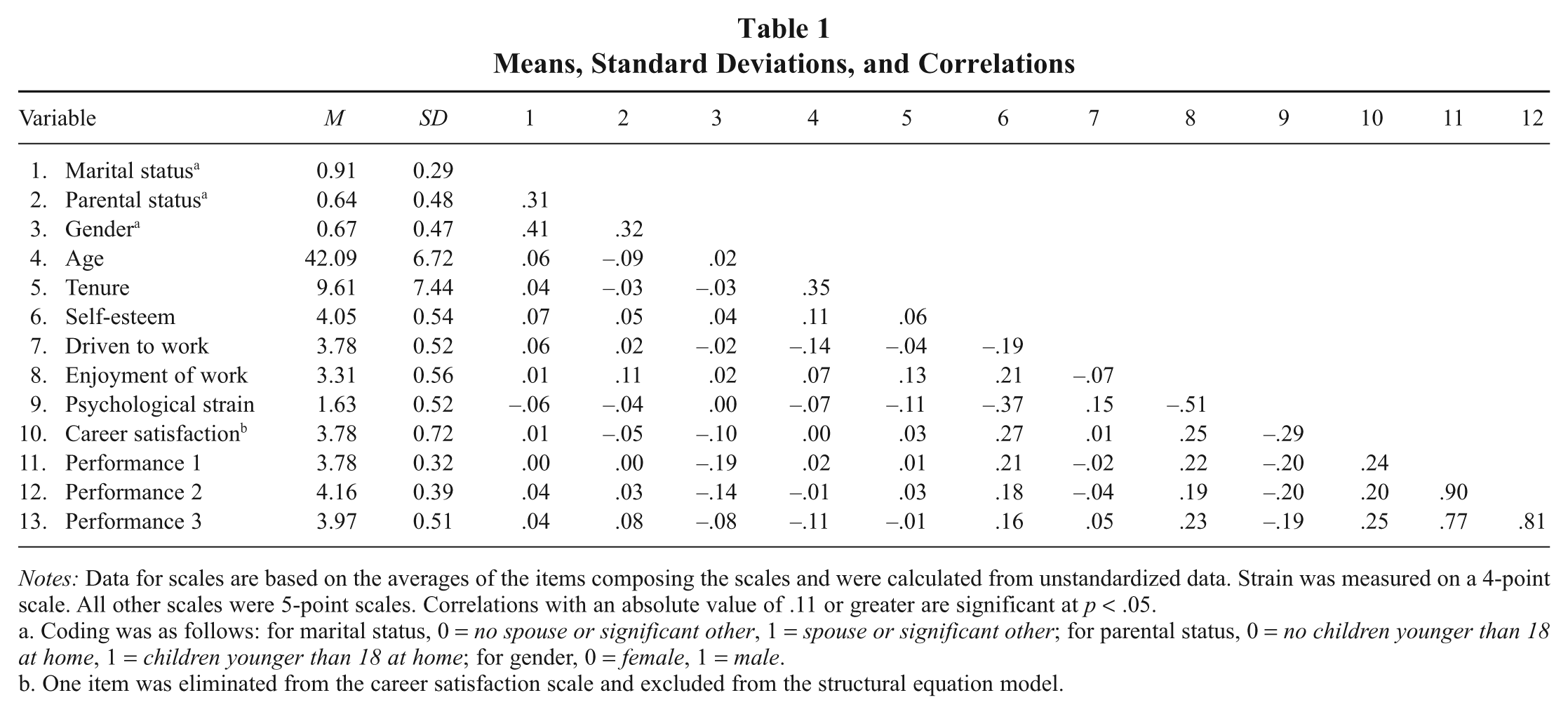
Notes: Data for scales are based on the averages of the items composing the scales and were calculated from unstandardized data. Strain was measured on a 4-point scale. All other scales were 5-point scales. Correlations with an absolute value of .11 or greater are significant at p < .05.
Coding was as follows: for marital status, 0 = no spouse or significant other, 1 = spouse or significant other; for parental status, 0 = no children younger than 18 at home, 1 = children younger than 18 at home; for gender, 0 = female, 1 = male.
One item was eliminated from the career satisfaction scale and excluded from the structural equation model.
We then tested the linear structural model, which included the linear effects and the control variables. Two of the control variables, marital status and parental status, were unrelated to the latent constructs. For simplicity, we removed these variables from the model; their elimination had no impact on the results. Although chi-square for the linear structural model was significant, χ2(180) = 307.91, p < .001, the remaining fit statistics were excellent (CFI = .96, SRMR = .05).
The results for the linear model provided no support for Hypothesis 1; driven to work was unrelated to career satisfaction (B = .09, ns), performance (B = .05, ns), and strain (B = .04, ns). The results, however, supported Hypothesis 2. As predicted, enjoyment of work was positively related to career satisfaction (B = .25, p < .001) and performance (B = .21, p < .001) and negatively related to strain (B = −.48, p < .001). Individuals who reported higher levels of the enjoyment motive had higher performance and career satisfaction and less psychological strain.
Hypothesis 4 was also supported; self-esteem was positively related to enjoyment of work (B = .29, p < .001) and negatively related to driven to work (B = −.25, p < .001). As expected, higher levels of self-esteem were linked to higher levels of enjoyment of work and lower levels of driven to work. The indirect effects of self-esteem through enjoyment were significant for career satisfaction (B = .07, p < .01), performance (B = .06, p < .01), and psychological strain (B = −.14, p < .001). Consistent with the large body of research on self-esteem, our analyses also revealed direct effects of self-esteem on all three outcomes.
The control variables had several significant effects. Age was positively related to self-esteem (B = .12, p < .05); older individuals reported higher self-esteem. Tenure was positively related to enjoyment of work such that individuals with more tenure reported higher levels of that motive (B = .14, p < .05). Gender was significantly related to career satisfaction (B = −.13, p < .05) and performance (B = −.17, p < .01); women had higher levels of both outcomes than did men. Overall, the linear effects of the controls, self-esteem, driven to work, and enjoyment of work accounted for 11.4% of the variance in performance, 48.3% of the variance in strain, and 21.3% of the variance in career satisfaction.
When we added the latent interaction of driven to work and enjoyment of work to the model, a significant improvement in model fit occurred, Δχ2(3) = 10.95, p < .01. 4 The interaction was significant for both performance (b = −.13, p < .05) and strain (b = −.30, p < .01). Figure 2 depicts both the linear and nonlinear effects.

Structural Model with Interaction
We interpreted the interactions by using accepted practices originally developed for moderated regression analysis (Cohen, Cohen, West, & Aiken, 2003). Using parameter estimates for the nonlinear structural model, we created a simple regression equation that expressed the relationship between the dependent variable (i.e., performance or strain) and driven to work as a function of enjoyment of work. We then substituted low (i.e., one standard deviation below mean) and high (i.e., one standard deviation above mean) values of enjoyment of work into this equation to obtain simple equations for the relationship between the dependent variable and driven to work at the two levels of enjoyment. The final set of equations is reported in the text below. We plotted these equations by utilizing low and high values of driven to work. The resulting plots are shown in Figures 3 and 4.

Interaction of Driven to Work and Enjoyment of Work for Performance

Interaction of Driven to Work and Enjoyment of Work for Psychological Strain
Figure 3 depicts the results for performance. As shown in the plot, the highest performance levels were associated with high enjoyment of work. The effects of driven to work seemed to vary as a function of enjoyment of work but were not consistent with Hypothesis 3. We expected being driven to be negatively related to performance when enjoyment was low and believed that this negative relationship would disappear when enjoyment was high. Instead, we found that driven to work was positively related to performance [performance = (.24) (driven to work) −.16] when enjoyment of work was low and unrelated to performance [performance = (−.04) (driven to work) &+.16] when enjoyment of work was high. Thus, being driven seemed to be advantageous for performance when enjoyment of work was absent; its effects disappeared when enjoyment was high.
For psychological strain (see Figure 4), enjoyment of work appeared to be beneficial and the effects of driven to work seemed to vary with enjoyment. When enjoyment of work was low, driven to work had a sizeable relationship with psychological strain such that increases in driven to work were linked to large increases in strain [strain = (.50) (driven to work) &+.88]. However, driven to work had little relationship with strain when individuals had high enjoyment [strain = (−.10) (driven to work) −.88]. Thus, the detrimental effects of being driven to work on psychological strain seem to disappear when the enjoyment motive is high.
In sum, we obtained substantial support for the hypothesized beneficial effects of the enjoyment motive. Although there was no evidence for the main effect of driven to work, it appeared to interact with the enjoyment motive to influence performance and strain. Driven to work had little relationship with performance or strain when enjoyment was high; it was positively related to performance and strain when enjoyment was low. The effects of self-esteem on motives for work were consistent with our hypotheses.
Discussion
Our study contributed to the literature by examining the effects of two underlying motives for work, driven to work and enjoyment of work, among a sample of managers. Integrating the disparate literature on motivation, workaholism, and affect, we developed and tested hypotheses concerning the effects of driven to work and enjoyment of work on managers’ outcomes. We examined the previously untested relationships between the two types of motivation and performance. We also performed an extensive analysis of the combined effects of driven to work and enjoyment of work, examining the notion that enjoyment undoes the negative effects of being driven. Finally, we tested one critical antecedent (i.e., self-esteem) of driven to work and enjoyment of work.
Effects of Driven and Enjoyment
The results provided mixed support for the hypothesized effects of driven to work and enjoyment of work. As predicted, the enjoyment motive was positively related to career satisfaction and performance and negatively related to psychological strain. Although we cannot establish causality, managers who are motivated to work because they find it interesting or pleasurable seem to receive higher performance evaluations from their colleagues and report more career satisfaction and less psychological strain. Managers who report low levels of the enjoyment motive may be at risk; they are viewed as less effective performers and experience more strain and less career satisfaction.
Our findings suggest that being motivated by enjoyment of work is critical for managerial effectiveness and well-being. As noted earlier, the enjoyment motive is associated with the pursuit of inherently enjoyable or pleasurable activities and, consequently, may lead managers to engage in autonomous, self-consistent actions that fulfill basic psychological needs and are satisfying and sustained over time (Judge et al., 2005; Sheldon & Elliott, 1998, 1999). The positive emotions associated with enjoyment may also broaden managers’ thinking and behavior, leading to the generation of personal resources that reduce strain and enhance satisfaction and performance (Deci & Ryan, 1985; Fredrickson, 1998, 2001; Hobfoll, 2002).
With respect to driven to work, there was no evidence of the main effects proposed in Hypothesis 1. The absence of this main effect casts some doubt on our argument that the tension and pressure of driven to work compromise outcomes. Perhaps driven to work simply does not evoke the degree of negative emotion we anticipated. It is also possible that the negative emotion of being driven does not have a substantial influence on some outcomes. For instance, inner pressure to work may not be strongly linked to managers’ perceptions of their career achievements and long-term career success. We cannot evaluate the merit of these explanations because we did not measure the tension and pressure that might have been evoked by driven to work.
Nonetheless, the presence of driven to work by enjoyment of work interactions for both performance and strain suggests that being driven to work does have some influence on managers’ experiences. Its effects, however, depend on the nature of the outcome and the level of enjoyment of work. For performance, we found that driven to work was positively related to performance when the enjoyment motive was low but had little relationship with performance when enjoyment of work was high. We did not anticipate that driven to work, with its wide-ranging negative processes, would be positively related to performance under any circumstances. It is possible that being driven is beneficial for performance when interest in or enjoyment of the work itself is lacking. Managers need some source of motivation to evoke performance; being driven may provide that motivation when the enjoyment motive is absent. Under these circumstances, introjected motivation may be better than no motivation. In contrast, when enjoyment of work is high, performance appears to be evoked by that motive; driven to work has no effect.
The results for strain interaction were somewhat consistent with the idea that enjoyment of work has protective effects. Although there was not a main effect of driven to work to be “undone,” we found that driven to work was associated with steep increases in strain when enjoyment of work was low but unrelated to strain when enjoyment of work was high. Perhaps the positive emotions and additional resources created by high levels of the enjoyment motive enhance coping and reduce the likelihood that being driven to work will be associated with increased strain (Fredrickson, 1998, 2001). These beneficial emotions and resources may be less available when enjoyment is low.
A review of the pattern of results for performance and strain suggests that the best outcomes (superior performance, low strain) are associated with high enjoyment of work and that driven to work has little or no relationship with outcomes when enjoyment is high. When enjoyment of work is low, however, driven to work appears to be associated with better performance but greater strain. It is possible that being driven creates work behaviors (e.g., increased work hours) that facilitate performance but are detrimental to well-being. Because continuing strain may ultimately lead to burnout and ineffective performance (Porter, 1996), it is unclear whether the performance increments associated with driven to work can be sustained over the long run.
In sum, our results suggest that enjoyment of work is preferable to driven to work as a motive for managerial work. Managers who are motivated by enjoyment report less strain and more career satisfaction and receive higher performance ratings. The consequences of driven to work appear to be complex. Driven to work is associated with increases in both performance and strain when the enjoyment motive is low and has no relationship to outcomes when enjoyment is high.
Effects of Self-Esteem
Our results are consistent with the idea that self-esteem is an important antecedent of work motives. Self-esteem appears to be negatively related to driven to work. Compared to individuals with low self-esteem, individuals with high self-esteem may be less driven to work, perhaps because they are less likely to use work as a means to boost their self-worth or to avoid negative feelings in other areas of their lives (Ng et al., 2007; Porter, 1996, 2004).
The relationship between self-esteem and enjoyment of work seems to be positive; higher levels of self-esteem may be associated with higher levels of the work enjoyment motive. As noted earlier, high self-esteem individuals may be more likely to be motivated by enjoyment or interest in the work itself because they possess the sense of autonomy or self-determination needed to pursue activities that are consistent with their own interests. In contrast, low self-esteem individuals typically respond to internal or external pressures and are less likely to engage in behaviors that mirror the underlying self (Judge et al., 2005). Given the apparent positive effects of self-esteem on outcomes through enjoyment, high self-esteem appears to be particularly advantageous for managers.
Implications for Research
Our findings imply that driven to work and enjoyment of work have important effects on managerial outcomes and suggest several areas that require exploration. First, additional research is needed to substantiate our findings, particularly with respect to the previously unexamined effects of the two motives on performance and the nature of their interaction. Moreover, examination of the underlying processes by which driven to work and enjoyment of work influence outcomes would be desirable. Although we theorized that affect is important in determining the effects of the two motives, we did not assess its role. Future research should examine the role of affect, as well as the patterns of thinking, behaving, and resource accumulation that derive from affect, in shaping the effects of work motives.
Given the differences in the results for strain and performance, it would be useful to explore whether motives for work have differential effects on managers’ emotions and psychological well-being than on their performance-related thoughts and behaviors. Longitudinal research would be particularly useful in clarifying the long-term consequences of managers’ work motives for their well-being and effectiveness. Such research could also lead to the development of interventions (e.g., boosting enjoyment) that enhance managerial outcomes.
Further examination of the links between individual difference characteristics and work motives is also needed. Building on our findings for self-esteem, researchers might examine the effects of generalized self-efficacy, neuroticism, and locus of control. These factors, along with self-esteem, reflect individuals’ underlying assessments of their worthiness, competence, and capabilities (e.g., Judge et al., 1998; Judge et al., 2005). Researchers might also explore whether managers’ propensities to view their work contexts as supporting autonomy and/or controlling influence the extent to which they are motivated by the autonomous pleasures of enjoyment and controlled by the inner pressures of driven to work (Gagné & Deci, 2005; Judge et al., 2005). The links between obsessive-compulsive personality traits and being driven might also be explored; some scholars have noted the compulsive nature of driven (Johnstone & Johnston, 2005).
The relationships among individuals’ knowledge, skills, and abilities (KSAs), motives, and outcomes also merit exploration. These relationships are likely to be complex. We would expect individuals’ KSAs to directly affect outcomes; individuals who are highly qualified may perform better, achieve greater career success, and experience less strain. In addition, individuals’ KSAs may influence their work motives; individuals must perceive themselves as possessing task competence for any type of motivation, including enjoyment of work, to occur (Ryan & Deci, 2000). Moreover, over the long run, motives (i.e., enjoyment of work) may affect the development of KSAs, which, in turn, influence performance (Fredrickson, 2001). Future research might attempt to tease out the complex effects of qualifications on motives and outcomes.
A better understanding of the impact of situational factors on driven to work and enjoyment of work would be desirable. Societal (e.g., unemployment rates, laws concerning work hours), cultural (e.g., emphasis on achievement versus nurturing), and organizational (e.g., values concerning work–life integration, norms regarding work hours) factors may influence the degree to which managers and employees exhibit driven to work and enjoyment of work. For example, driven to work might be exacerbated when societal, cultural, or organizational factors (e.g., a high unemployment rate makes it difficult to find another job, the culture values achievement over nurturing, the organization values work over family) increase the focus on work (Johnstone & Johnston, 2005; Kanai & Wakabayashi, 2004).
Our work also has broader implications for researchers seeking to understand the combined effects of various types of motivation. SDT researchers often test the combined effects of different types of motivation by subtracting introjected (and extrinsic) motivation from intrinsic (and identified) motivation. This practice yields little information about the nature of the combined effects of different types of motivation (Bono & Judge, 2003). Our work suggests that an alternative approach, which tests interactions among different types of motivation, may be useful.
Implications for Practice
Our findings also have important implications for managerial development. First, organizations should recognize that the two motives may have different consequences for managers. In particular, working to pursue pleasure or interests may be most advantageous for performance and well-being. When enjoyment is absent, working as a result of internal pressure or tension seems to increase performance but inhibit well-being. Thus, it may be desirable for organizations to create cultures that encourage the expression of enjoyment. Communicating the importance of finding pleasure in work, despite the demands, may bolster the expression of enjoyment. Interventions designed to enhance positive emotions (e.g., identifying things that went well each day; see Seligman, Steen, Park, & Peterson, 2005) may also be helpful, although there is some dissent among management scholars (i.e., Fineman, 2006) concerning the use of these interventions.
Organizations might also use our findings in providing coaching to individual managers. Managers might be advised about the potential benefits of working for enjoyment and may be surprised to learn that enjoyment might inhibit the negative psychological effects of internal tension or pressure to work. Managers who lack the enjoyment motive may be disengaged from their work and may benefit from coaching to assist them in clarifying underlying values and interests, setting self-congruent career goals, and developing and implementing action plans for obtaining goals (Greenhaus, Callanan, & Godshalk, 2000). Given the apparent implications of low self-esteem for driven to work and enjoyment of work, coaching to address esteem issues may also be desirable (e.g., praise for appropriate behaviors, altering individuals’ erroneous interpretations of their successes and failures; Baumeister et al., 2003; Wood et al., 2005).
Limitations and Conclusions
Our study has several limitations common to prior research on driven to work and enjoyment of work. The use of a cross-sectional design made it difficult to establish causality and did not allow us to rule out the possibility of reverse causal effects (Kenny et al., 1998; Mathieu & Taylor, 2006). We also primarily relied on participants’ self-reports, creating the possibility that the relationships between the constructs were inflated by response bias. However, the fact that the performance data came from managers’ colleagues, rather than the managers themselves, boosts the credibility of our findings.
Interpretation of the results is also limited by the constraints of the sample. Our focus on management development program participants provided a large, multicompany sample and access to 360-degree performance data in a common format. The participants, however, were managers who had been encouraged by their organizations to attend an intensive leadership development program. Some were encouraged because they were seen as top talent in their organization and others were “encouraged” because they had a developmental weakness to address. As a group, they tended to work for large, well-known organizations rather than smaller concerns. The results we obtained for these managers may not be as applicable to managers in small organizations. However, it is important to pay attention to the experience of managers in large organizations because their motives for work may affect not only their own experiences but also the experiences of large numbers of employees.
Furthermore, the developmental nature of the Benchmarks measure may have affected our findings. Ratings collected for developmental purposes sometimes do not fully capture all aspects of performance. However, scholars (i.e., Scullen et al., 2003) have recently suggested that developmental ratings reflect the same underlying factors as ratings used for personnel decision making and are less subject to leniency and halo effects.
Another potential limitation of our use of the Benchmarks measure is the fact that the performance data were collected before the participants attended the program and completed the research survey. However, the likelihood that these timing issues influenced the results may have been reduced by the short time (e.g., 1 month) between collection of the performance data and completion of the survey and the fact that participants lacked access to the performance data during this time period. Nonetheless, performance is affected by a myriad of factors; it is certainly possible that ratings obtained before survey completion differed from the ratings that might have been obtained at the time of survey completion or afterwards. In an ideal world, we would have measured performance after (or at least at the same time as) the other variables such that the timing of the measures reflected the temporal relationships of the variables (Mathieu & Taylor, 2006).
In conclusion, we tested the effects of two work motives, driven to work and enjoyment of work, on managers’ psychological strain, career satisfaction, and performance. The effects of these motives on performance had not been examined in prior research. Our findings suggest that working for enjoyment may be “a help” to managerial well-being, career satisfaction, and performance; managers who work for joy appear to experience less strain, report more satisfaction, and perform better than those who do not. Driven to work does not seem to have a main effect on managers’ outcomes but interacts with enjoyment to affect performance and psychological strain. The nature of the interaction of driven to work and enjoyment of work is complex, but our results indicate that managers’ well-being and effectiveness is highest when they are motivated by high levels of enjoyment. When enjoyment of work is not present, being driven to work may facilitate performance but increase strain. Self-esteem appears to be an important antecedent of driven to work and enjoyment of work. Overall, our study suggests that the enjoyment motive strengthens outcomes and that being driven has mixed effects. Organizational practices that encourage the enjoyment motive may boost managerial and organizational effectiveness.
Footnotes
Acknowledgements
This article was accepted under the editorship of Talya N. Bauer. We would like to thank John E. Mathieu for his helpful advice on the data analysis.