



Abstract
In this article, we propose a framework for understanding destructive leadership that summarizes the extant destructive leadership research and extends it in new directions. By reviewing the current literature on destructive leadership and drawing on organizational leadership theory and the more general research on deviant behaviors in organizations, we identify the underlying features and mechanisms that define destructive leadership. Recognizing that each form of destructive leadership currently studied (e.g., abusive supervision, petty tyranny, and pseudo-transformational leadership) addresses aspects of destructive leadership but fails to capture the complete picture of the phenomenon, we clarify the boundaries among the constructs studied within the domain of destructive leadership, address some ambiguities about the nature of destructive leadership, make explicit some characteristics of destructive leadership that set it apart from other forms of leading, and integrate this thinking into a theoretical model that helps us understand the manifestations of destructive leadership, and their antecedents and consequences.
Keywords
Researchers are increasingly paying attention to a variety of forms of leadership that have been characterized as being “destructive” (e.g., destructive leadership, abusive supervision, petty tyranny). A number of studies have been devoted to examining the dimensionality of such forms of leadership (Mitchell & Ambrose, 2007), identifying their antecedents and consequences (Tepper, 2000), and, to a lesser extent, proposing theoretical models explaining the nature of such leadership (Einarsen, Aasland, & Skogstad, 2007; Wang, Sinclair, & Deese, 2010). Despite the fact that research on these forms of leadership has grown in the past few years, it is still plagued with three problems: (a) the lack of a unified definition of “destructive” leadership that would clarify boundaries of the construct and distinguish it from the related phenomena, (b) a multiplicity of constructs used to describe the phenomenon of “destructive” leading (e.g., abusive supervision, petty tyranny, pseudo-transformational leadership, personalized charismatic leadership, strategic bullying, and managerial tyranny), and (c) the lack of the unified theoretical framework (cf. Tepper, 2007) based on a shared understanding of what destructive leadership is and what it is not. These problems reinforce each other and impede efficient scientific communication, progress of empirical research, and accumulation of knowledge about psychological processes underlying “destructive” leadership. Consequently, the purpose of this article is to address these shortcomings and to clarify the nature and process of “destructive” leading.
In examining this phenomenon, we adopted the term destructive leadership for several reasons. First, it appears to capture well the inherently harmful nature of destructive leading that is described in its many forms in the literature (e.g., abusive supervision or tyranny). Second, this term appears to be widely accepted by the scientific community. We find it in the titles of the special issue of the Leadership Quarterly (vol. 18, no. 3, 2007) and the Society for Industrial and Organizational Psychology (SIOP) conference symposia Leading Destructively: A Theoretical and Empirical Examination of Destructive Leaders (SIOP, 2008) and Destructive Leadership: Measurement, Antecedents, and Outcomes (SIOP, 2009).
The current article seeks to make two contributions. First, we review, summarize, and integrate the extant literature on destructive leadership, as well as the more general literature on organizational leadership and research on deviant behaviors in organizations, to identify the characteristic features of destructive leadership and distinguish it from related yet distinct constructs (e.g., counterproductive work behaviors or CWB). Toward that end, we also draw nomological distinctions between the constructs of abusive supervision, petty tyranny, pseudo-transformational leadership, personalized charismatic leadership, strategic bullying, and managerial tyranny, and demonstrate that research on these constructs suggests that destructive leadership can manifest itself in leaders’ pursuit of destructive goals (i.e., goals that contradict the legitimate interests of organizations) and destructive leadership style (i.e., style that involves the use of harmful methods of influence with followers). Second, our review gives rise to our theoretical model that serves to explain the psychological processes that characterize destructive leadership and links those processes to their antecedents and outcomes. The purpose of this model is to parsimoniously integrate diverse conceptualizations of destructive leadership and provide a framework for moving forward with future studies in this area.
Before proceeding, we clarify boundary conditions for our analysis. First, we focus on analyzing leaders’ explicit acts of influencing followers to achieve goals rather than on implicit modeling influences. While leaders may indirectly influence followers’ behaviors by serving as role models (Bandura, 1973), we leave the analysis of such implicit influences beyond the scope of this article.
Second, any act committed by a member of a given organization can be judged as constructive or destructive using different standards—actor’s self-interest, needs of other individuals within the organization, organizational goals, societal norms, or broader moral principles. Evaluations of the same behavior obtained from multiple perspectives do not necessarily converge. Therefore, it is necessary to specify what perspective we are taking when analyzing the nature of destructive leadership. Given that the primary task of organizational leaders is to act in the interests of the organization (i.e., influence followers to achieve goals espoused by the organization and set new goals for the organization that are aligned with its interests; Eisenhardt, 1989; Mumford, Gessner, Connelly, O’Connor, & Clifton, 1993), we adopt the organization and organizational members as key points of reference when assessing whether leadership is destructive. Therefore, in our analysis, we do not address such phenomena as corporate social (ir)responsibility that is concerned with social implications of organizational actions (Bansal & Kandola, 2004) and unethical leadership (Brown & Trevino, 2006) that is focused on the moral (not limited by organizational interests) aspect of leaders’ acts. That said, we realize that actions of organizational leaders have implications not only for organizations and organizational members but also for organizational outsiders (e.g., customers, members of the greater society). Thus, drawing connections among intraorganizational destructive leadership, corporate (ir)responsibility, and principles of business ethics is an interesting direction for further research. One initial step in that direction, however, is to understand destructive leadership as an intraorganizational phenomenon. Therefore, the purpose of the current article is to provide a systematic treatment of destructive leadership as it unfolds within organizations.
Defining Destructive Leadership
We propose that destructive leadership (DL) is defined as volitional behavior by a leader that can harm or intends to harm a leader’s organization and/or followers by (a) encouraging followers to pursue goals that contravene the legitimate interests of the organization and/or (b) employing a leadership style that involves the use of harmful methods of influence with followers, regardless of justifications for such behavior.
This definition builds on the work of Einarsen et al. (2007; also see Aasland, Skogstad, Notelaers, Nielsen, & Einarsen, 2010) by viewing DL as a leader’s behavior that violates the legitimate interests of the organization. However, our definition extends their definition in three ways. First, while the construct of DL overlaps with other harmful constructs (e.g., CWB, workplace aggression), it also represents a specific form of leadership. Thus, we argue that DL should be viewed as harmful behavior imbedded in the process of leading. By doing so, we eliminate behaviors falling under the rubric of CWB (e.g., stealing organizational property, gossiping about coworkers; Bennett & Robinson, 2000; Gruys & Sackett, 2003) from the construct space of DL and thereby depart from the work by Einarsen and colleagues who consider such behaviors manifestations of DL.
Second, although we agree with Einarsen et al. (2007) in that DL harms organizations and/or leaders’ followers, we believe that it is more accurate and more theoretically meaningful to distinguish between two manifestations of DL—encouraging followers to pursue destructive goals and using destructive methods of influence with followers—than simply drawing a surface distinction between the two targets of such leadership. These two manifestations of DL reflect different processes—setting goals for followers and acting to influence followers to achieve these goals, and are likely to have different predictors and consequences, as shown below.
Third, by defining DL as volitional behavior that can harm or is intended to harm the organization or a leader’s followers, we draw a boundary between DL and acts of ineffective leadership (e.g., incompetence) that represent a leader’s inability to achieve goals valued by the organization or mobilize followers to achieve such goals. These unique elements of our definition of DL are discussed in detail in the subsequent sections.
Destructive Leadership as Harmful Behavior Embedded in the Process of Leading
A review of the extant literature reveals that DL is harmful in nature (Einarsen et al., 2007; Lipman-Blumen, 2005b). Therefore, DL overlaps with other forms of deviant behavior at the workplace (e.g., workplace aggression, bullying, CWB). However, for theory development and research purposes, DL needs to be distinguished from harmful behaviors that are not uniquely performed by leaders. We believe that DL research should operate within the same set of concepts and assumptions as more general research on organizational leadership. Therefore, we argue that the distinction between leaders and managers that has long been emphasized in leadership literature (Hickman, 1990; Kotter, 1990) should also be considered by DL researchers. Specifically, if we are studying destructive leadership, then we should focus on harmful behaviors perpetrated by the leader and imbedded in the process of leading. Otherwise, we cannot distinguish DL from other harmful behaviors that could be performed by any employee regardless of his or her leadership status. Consequently, even when such harmful behavior is performed by a person in a leadership position (e.g., manager), it may have nothing to do with the process of leading and thus should not be termed DL. For example, a manager stealing is not DL, rather it is a CWB; a manager directing his or her followers to steal is DL. Thus, the important distinction between CWB and DL is that CWB involves harmful actions that do not involve leading others, whereas DL involves harmful actions performed by leaders in the process of leading followers toward certain goals.
Two Manifestations of Destructive Leadership: Encouraging Followers to Pursue Destructive Goals and Using Destructive Methods of Influence With Followers
The essence of leadership lies in identifying goals and influencing followers to pursue those goals (House & Shamir, 1993; Yukl, 2006). Thus, we propose that DL is manifested in the leader (a) identifying destructive goals and fostering followers’ pursuit of those goals and/or (b) using destructive actions to mobilize followers to attain goals set by the leader. These two manifestations of DL are independent of each other, but could be used jointly by a leader.
The first manifestation of DL occurs when leaders encourage followers to pursue goals that undermine the organization’s legitimate interests (Einarsen et al., 2007). For example, if an organization prioritizes high levels of product safety, a leader who encourages his or her followers to distribute unsafe products to maximize sales has fostered the pursuit of a destructive goal. The second manifestation of DL occurs when a leader uses harmful actions (verbal or nonverbal) to influence followers in the pursuit of goals, harmful to the organization or not (i.e., uses a DL style). For example, a leader who bullies followers to make them focus on greater product safety has used a DL style, even though this leader pursues a goal espoused by the organization.
Researchers have examined a number of constructs that capture the phenomenon of DL. Although these constructs were proposed and studied independently, they overlap in terms of the manifestations of DL they represent. Table 1 organizes these constructs and identifies redundancies and distinctions among them.
Distinctions and Overlaps Among the Constructs Capturing the Phenomenon of Destructive Leadership
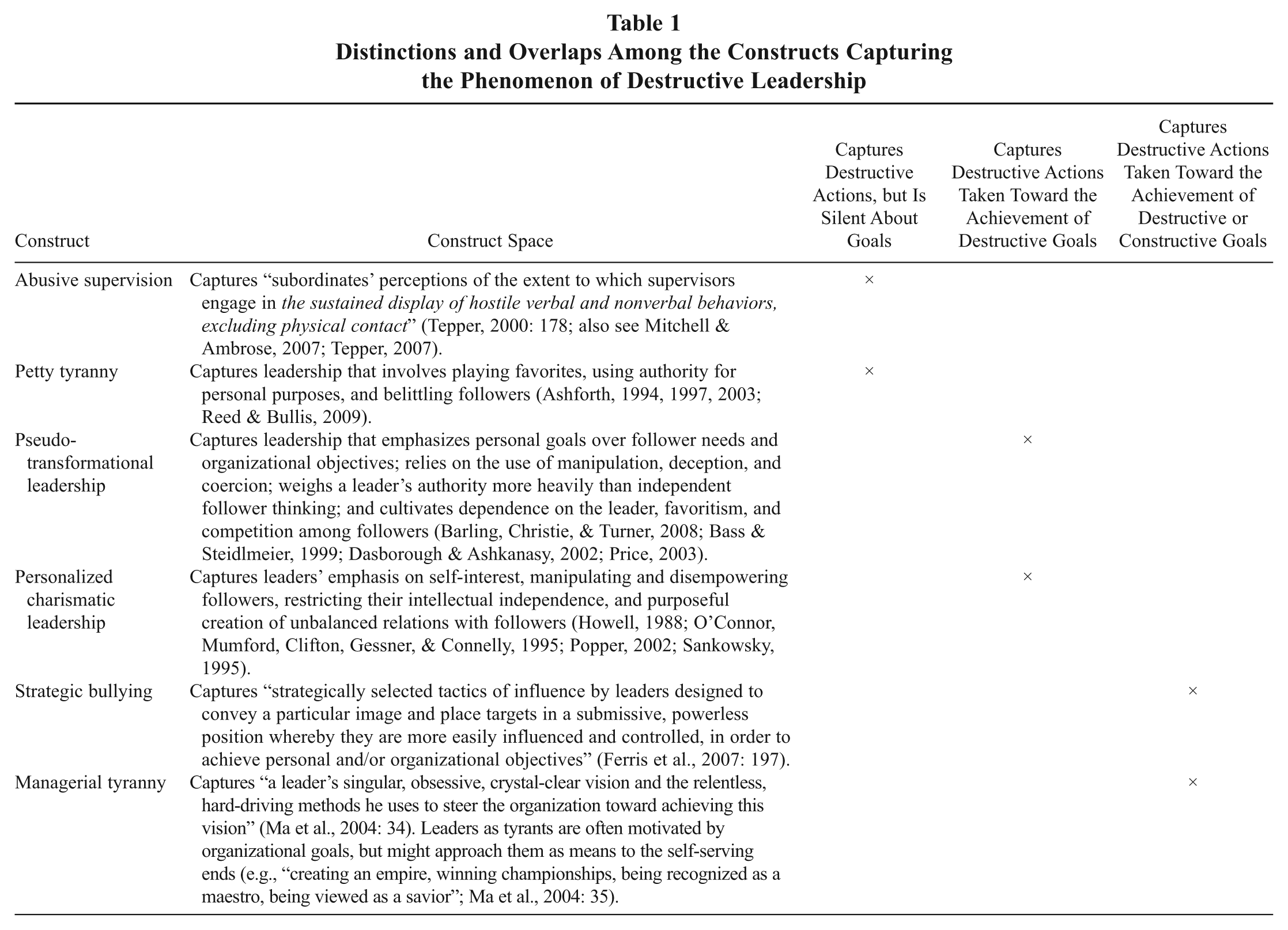
In summary, we see that what has been portrayed as a number of relatively independent lines of DL research is actually a body of empirical research that takes different approaches to studying the two underlying manifestations of DL identified above—setting destructive goals and using destructive methods of influence. Consequently, we argue that DL is more accurately, completely, and parsimoniously defined by recognizing that it represents the leader’s pursuit of destructive goals, the leader’s use of destructive methods of influence, or both.
Destructive Leadership as a Volitionally Harmful Behavior
Extant research is lacking consensus regarding whether DL should be considered intentional in nature or not. DL researchers either exclude intent to harm from their conceptualizations of DL (e.g., Einarsen et al., 2007; Tepper, 2007; Wang et al., 2010) or omit the entire question of intent from their discussions of the phenomenon (e.g., Ashforth, 1994; Ma, Karri, & Chittipeddi, 2004). A number of DL researchers, however, do see value in distinguishing between leadership that is intentionally harmful and leadership that is unintentionally harmful (Craig & Kaiser, in press; Kelloway, Sivanathan, Francis, & Barling, 2005; Lipman-Blumen, 2005b; Thoroughgood, Tate, Sawyer, & Jacobs, 2012). We believe that one way to reconcile this inconsistency is to clearly define what is meant and what is not meant by intentionality of DL. This reconciliation is needed because the lack of consensus regarding intentionality of DL has resulted in ambiguous definitions of DL, prevented DL from being studied as a unique form of leadership, and impeded the evolution of DL literature as independent of the extensive literature on leader (in)effectiveness.
Leaders make choices about what goals to pursue and how to achieve those goals. A DL process will arise if the leader chooses to pursue a goal that can harm the well-being of the organization in some way (e.g., seeking personal wealth at the expense of organization’s earnings). DL also can arise when the leader chooses to pursue a goal, organizationally sanctioned or not, in a way that can harm the well-being of the followers (e.g., bullying them). Of course, both types of intentions and manifestations of DL can occur at the same time. Leader’s choice of a harmful goal and/or harmful methods of influence is in both cases intentional or volitional in the sense that this leader chooses this particular goal and/or action among other available more constructive alternatives. That said, there is nothing in our definition that requires the leader to be consciously aware of this intent to harm. The literature on implicit personality has readily documented that many times, the intent to cause harm occurs outside of conscious awareness (James & LeBreton, 2010, 2012; LeBreton, Barksdale, Robin, & James, 2007). In extreme cases, harming an organization or followers may be the leader’s goal (e.g., a leader may encourage followers to sabotage organizational equipment). In other cases, a leader may pursue legitimate goals but do so in a destructive manner (e.g., bully followers to make them achieve higher levels of performance). In either case, the leader may or may not have a conscious self-perception that he or she is causing harm. Instead, the leader may develop implicit rationalizations for acts of DL to protect one’s ego and sense of self (James & LeBreton, 2010).
Thus, to avoid the confusion between the terms “intent to harm” and “goal to harm,” we define DL as a leader’s volitional behavior that can harm or intends to harm a leader’s organization or followers, thereby emphasizing that such harm-doing is not the leader’s goal in itself (although could be in some cases), but rather the leader’s choice to pursue a goal or enact behavior that is harmful in nature. We also note that acts of intentional harm (i.e., aggression) are often unconsciously rationalized by individuals, thus preserving the conscious self-perception that they are nice, reasonable, nonaggressive individuals (James & LeBreton, 2010). Thus, we make no presumption that destructive leaders will necessarily view themselves, their goals, or their actions as harmful (although this is also possible).
Destructive Leadership versus Ineffective Leadership
The leadership literature already is evolving along two supposedly distinguishable lines of research: research on leader (in)effectiveness (e.g., Antonakis, Avolio, & Sivasubramaniam, 2003; Hinkin & Schriesheim, 2008; Judge & Piccolo, 2004; Kelloway et al., 2005) and research on DL (e.g., Einarsen et al., 2007; Tepper, 2007). The implication is that authors do see DL as a particular form of leading that should be distinguished from just being ineffective. However, a distinct boundary between these two forms of leadership has not been clearly drawn. For a number of reasons addressed below, we believe that the volitional nature of harm-doing underlying DL is a key demarcation line that sets it apart from ineffective leadership.
First, prior leadership theorists provide a precedent for drawing this distinction by splitting the domain of “bad” leadership into two distinct constructs. For example, Kelloway et al. (2005) distinguish between abusive and passive leadership. The former occurs when leaders “engage in aggressive or punitive behaviors toward their employees” (Kelloway et al., 2005: 91). The latter occurs when leaders lack leadership skills and encompasses laissez-faire leadership and passive management by exception. Moreover, Kelloway et al. (2005) draw a parallel between abusive leadership and aggression that is commonly defined as intentional harm-doing (e.g., Geen, 2001; Neuman & Baron, 1998). Lipman-Blumen (2005b: 29) takes a step further and differentiates between intentionally toxic leaders who “deliberately harm others or enhance themselves at other’s expense” and unintentionally toxic leaders who “cause serious harm by careless and reckless behavior, as well as by their incompetence.”
This distinction is echoed in the job performance literature, which has concluded that CWBs should be distinguished from poor task performance (Murphy, 1989; Sackett, 2002). Although CWB and poor task performance are similar in the sense that both are harmful to individuals or an organization (both could impede the production process, involve unsafe behaviors, and damage individual or organizational property), they differ in their natures: The former is a volitionally harmful behavior (Gruys & Sackett, 2003), whereas the latter results from low ability and/or motivation (Campbell, McCloy, Oppler, & Sager, 1993) and therefore is unintentionally harmful. Just as poor task performance could result from incompetence and low motivation, ineffective leadership can be considered a demonstration of a leader’s natural inaptitude and/or low motivation to lead (e.g., Chan & Drasgow, 2001; Craig & Kaiser, in press; Foti & Hauenstein, 2007). DL, on the contrary, does not necessarily imply a leader’s incompetence or low motivation. Rather, it embodies a leader’s choice to lead followers toward goals that harm or intend to harm an organization or to adopt a harmful style of leading followers.
The above-listed features of DL determine its unique position among other constructs capturing forms of deviant behaviors at the workplace and forms of organizational leadership. As shown in Figure 1 and discussed above, DL combines features of deviant behaviors and organizational leadership. As such, DL differs from (a) constructive forms of leading (e.g., transformational leadership) that do not involve harmful behaviors, (b) CWB, aggression, and similar phenomena that do not involve leading others, (c) ineffective leadership that is unintentionally harmful, and (d) poor task performance and accidental harm-doing (e.g., harm-doing due to violation of safety standards) that do not involve leading others and are unintentionally harmful. Based on our reframing of DL, below we propose a preliminary theoretical model of DL.
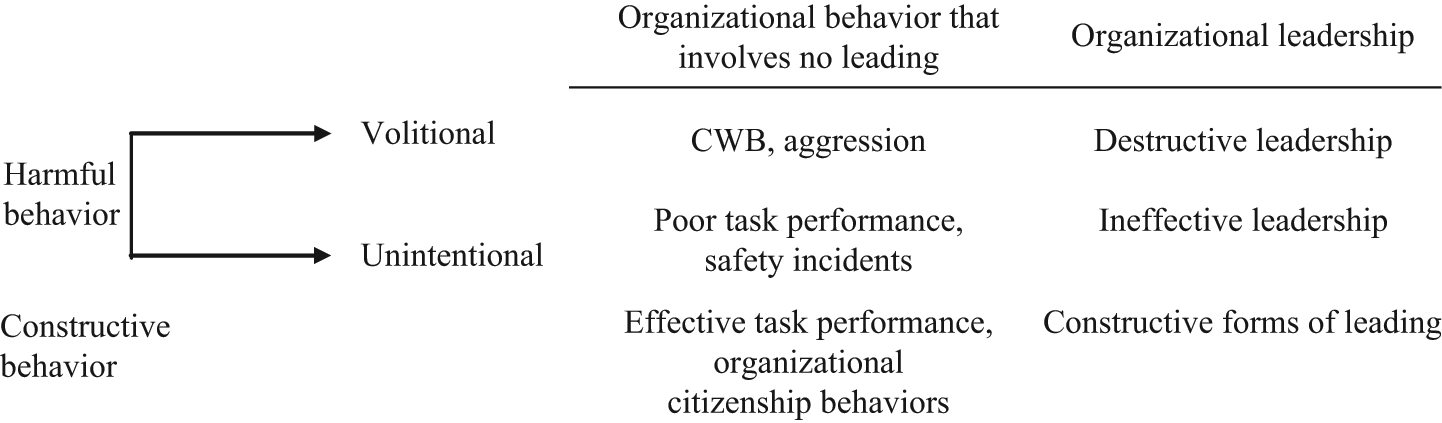
Position of the Construct of Destructive Leadership Among the Related Constructs Capturing Behaviors Performed by Organizational Members and Forms of Organizational Leadership
Toward a Theoretical Model of Destructive Leadership
Figure 2 contains our proposed model of DL. In the sections that immediately follow, we examine antecedents of DL and discuss the processes likely to underlie leaders’ choice to engage in DL. Then, we examine the potential consequences of DL.
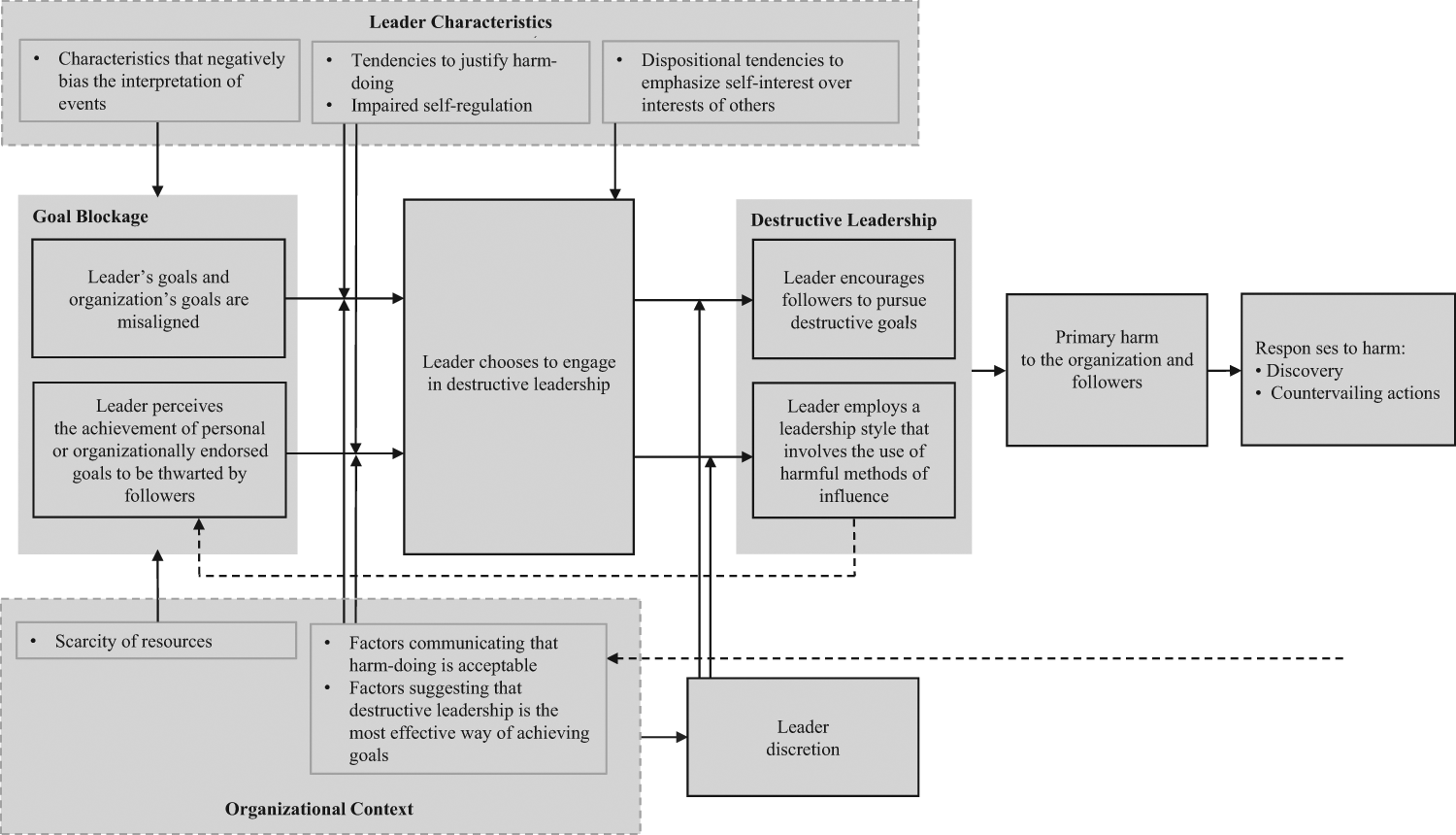
The Proposed Theoretical Model
Factors That Contribute to the Enactment of Destructive Leadership
The proposed model describes DL as a product of dispositional and contextual factors. More specifically, we propose the following. First, leaders are likely to engage in DL when they experience difficulty achieving their goals (i.e., experience goal blockage) or, in the absence of goal blockage, when they are predisposed to harm others. Second, not all leaders are equally likely to experience situations of goal blockage: Some leader characteristics and contextual factors make them more likely to find themselves in such situations. In addition, when goal blockage occurs, not all leaders will react to it with DL: Some characteristics and contextual factors will make them more likely to favor destructive responses over constructive alternatives. Finally, some contextual factors are likely to determine whether leaders’ choice to pursue destructive goals or use destructive actions translates into DL.
Goal blockage as a predictor of choice to engage in destructive leadership
Research on leader motivations to act and motivations for enacting harmful behaviors suggests that a leader’s choice to be destructive is likely rooted in the leader’s perceptions of goal blockage.
Leadership involves setting goals and mobilizing followers to pursue these goals (House & Shamir, 1993; Yukl, 2006). Thus, goals and goal pursuit are the core elements of leadership that set leadership processes in motion (cf. House, 1971). It follows that leaders’ progress toward goal achievement is an important factor that influences their choices and actions. For example, contingency theories of leadership (Hersey & Blanchard, 1982; House & Mitchell, 1974; Vroom & Yetton, 1973) imply that leaders should choose constructive methods of leading, such as participation, delegation, and consultation, when the situation is conducive to such approaches and they will aid goal attainment (e.g., followers are “mature”—Hersey & Blanchard, 1982; decision problems are structured in a certain way—Vroom & Yetton, 1973). The use of less constructive approaches (e.g., directive or autocratic methods of influence or even punishment) is seen as more appropriate when leaders’ goals are being thwarted (e.g., followers are “immature”—Hersey & Blanchard, 1982; followers are not likely to accept a leader’s decision—Vroom & Yetton, 1973). Thus, the broader leadership literature portrays perceived goal blockage as a key motivator for the choices leaders make and the actions they pursue.
Research on goal blockage has found that deviant behavior is a common response to situations when people are thwarted in their attempts to achieve their goals. For example, white-collar crime has been explained in terms of the general strain theory postulating that large-scale manager wrongdoing (e.g., fraud and embezzlement) may be due to blockage of managers’ economic and status goals (Agnew, Piquero, & Cullen, 2009). Similarly, models of aggression often emphasize how frustration may result in aggressive behaviors (Anderson & Bushman, 2002; Berkowitz, 1989). Moreover, goal blockage creates the potential for a leader to fall short of his or her goals, and, perhaps, to be judged as ineffective. Thus, goal blockage can threaten a leader’s positive self-image and perceived professional competence, and is likely to be construed as an ego threat, which has been linked to aggression (Baumeister & Boden, 1998). Finally, goal blockage may also function as a situationally induced stressor. Such stressors have also been tied to deviant and aggressive behaviors (Fox, Spector, & Miles, 2001; Salin, 2003). In sum, goal blockage may motivate the leader to choose harmful approaches to resolving that blockage (cf. Hershcovis et al., 2007).
There are two prototypic scenarios of leaders’ goal blockage that may result in DL. The first scenario involves misalignment of a leader’s personal goals and goals espoused by the organization. In these situations, the leader’s attainment of his or her personal goals is incompatible with the pursuit of organizationally sanctioned goals. When leaders perceive that their personal goals cannot be achieved in the organization using legitimate means, they experience strain and may attempt to alleviate this strain by engaging in deviant, from the organization’s perspective, goal pursuit (Zahra, Priem, & Rasheed, 2005). For example, the discrepancy between the actual and the desired level of compensation may prompt a leader to engage in fraudulent activities (e.g., earnings management; Barton, 2001). Thus, perceived goal blockage may motivate a leader to influence followers to pursue his or her personal goals that are destructive by virtue of undermining organizational interests (Bass & Steidlmeier, 1999).
The second scenario occurs when a leader’s personal goals are aligned with goals espoused by the organization, but achievement of those goals is thwarted by followers’ performing in unacceptable ways. The literature provides examples of how followers block leaders’ goals either intentionally (e.g., to retaliate for perceived mistreatment; Tepper, Duffy, & Shaw, 2001) or unintentionally (e.g., due to incompetence; Kotter, 2003). In such situations, leaders may use harmful methods of influence to stimulate followers’ progress toward the achievement of personal or organizational goals (Ashforth, 2003; Barrow, 1976). Distinguishing between these two forms of leaders’ goal blockage is critical for whether a leader pursues destructive goals or uses DL styles to resolve the perceived goal blockage. Thus, we propose,
Proposition 1: The more a leader perceives his or her personal goals to be misaligned with organizational goals, the more likely he or she is to encourage his or her followers to pursue destructive goals.
Proposition 2: The more a leader perceives that the achievement of his or her goals (personal or organizational) is being thwarted by followers, the more likely he or she is to employ a DL style to influence followers.
Leader characteristics and organizational context as predictors of goal blockage
Dispositional factors that are likely to make leaders perceive that their goals are blocked include characteristics that bias information processing. For example, James and colleagues (James & LeBreton, 2010, 2012; LeBreton et al., 2007) have discussed how one’s general predisposition toward implicitly justifying aggressive behaviors results in biased reasoning such that aggressive individuals are more likely to interpret actions of others as intentionally harmful. More specifically, an implicit motive to aggress predisposes individuals (a) to impute hostile and malevolent intent into the behaviors of others (hostile attribution bias—e.g., followers are not to be trusted; followers are plotting against the leader) and (b) to see oneself as the victim of inequality, exploitation, and injustice by those who are in positions of power (victimization bias—e.g., the organization’s president and board of directors exploit the hard work of the leader for their personal gain, and therefore the leader’s pursuit of goals that contravene the goals of the organization is seen as a warranted act used to rectify the inequities and strike out against the injustice). Thus, a leader’s implicit motive to aggress biases his or her judgment and makes him or her more likely to interpret everyday situations as situations of goal blockage. Similarly, negative trait affectivity has been shown to make individuals see the world in the negative light and perceive life events as more stressful (Spector, Zapf, Chen, & Frese, 2000; Watson & Clark, 1984). In addition, individuals with paranoid tendencies (skeptical or argumentative dimension of personality; Hogan & Hogan, 2001) tend to actively search for and selectively attend to signs of mistreatment in the behaviors of others. Thus, leaders with high negative affectivity and paranoid dispositional tendencies are also likely to perceive their goals as being blocked by their organization or followers.
Proposition 3: Leaders’ characteristics that negatively bias interpretation of events (e.g., implicit motive to aggress, negative trait affectivity, and paranoid tendencies) are positively related to leaders’ perceptions of goal blockage.
Organizational context may also increase the frequency of situations involving blockage of leaders’ goals. Leaders’ goal achievement requires resources, such as information, tools, equipment, materials, budget, and time availability, as well as followers’ services and assistance and followers’ expertise and motivation to pursue leaders’ goals (cf. Peters & O’Connor, 1980). Thus, the organization’s or followers’ inability or unwillingness to supply leaders with these resources creates situations of goal blockage for leaders.
First, organizations are likely to increase the frequency of goal blockage situations by failing to provide resources needed for leaders’ goal achievement. It has been shown that when organizations fail to provide such resources (or provide insufficient amounts of such resources, or provide resources of low quality; Peters & O’Connor, 1980), organizational members’ ability to perform their work responsibilities is impaired (Peters, O’Connor, & Rudolf, 1980). By extension, it could be argued that one’s attainment of a valued goal can be impeded if resources needed for goal achievement are not freely available. A leader may experience a lack of resources when the organizational authorities or his or her peers purposefully restrict his or her access to information and material resources. This could occur as an act of intentional obstructionism (Neuman & Baron, 1998) committed by the leader’s superiors and peers who could be motivated by a desire to repay this leader for mistreatment or undermine the successful competitor (Duffy, Ganster, & Pagon, 2002). Alternatively, a leader’s limited access to resources needed for goal achievement could be due to the organization being unable to provide such resources. This could occur, for example, when goals valued by the leader are not the organization’s priority (cf. Kristof-Brown, Zimmerman, & Johnson, 2005), when resources are limited and the leader has to share them or compete for them with other leaders (Salin, 2003), or when the organization is short of resources because of, for example, being downsized or being on the verge of bankruptcy.
Second, leaders’ followers could be a powerful source of goal blockage if they are unable or unmotivated to assist with leaders’ goal pursuit or purposefully thwart goal achievement. First, followers may block leaders’ goal inadvertently, due to their incompetence or inability to devote sufficient time and effort to pursuing those goals (Kotter, 2003). It is also plausible that followers are not motivated to work toward the achievement of leaders’ goals and thereby unintentionally block their achievement. This could occur, for example, when a leader fails to provide sufficient incentives to motivate goal achievement by followers (as suggested by the literature on transactional leadership linking contingent reward with follower motivation; Judge & Piccolo, 2004) or fails to inspire followers to achieve his or her valued goals (as suggested by research linking transformational leadership with follower motivation and goal commitment; Judge & Piccolo, 2004; Piccolo & Colquitt, 2006). In addition, followers may have low motivation to pursue leaders’ goals due to peer pressure to do so. For example, it has been shown that followers’ acceptance of uniformly low performance standards, also known as “restriction of output,” can decrease followers’ commitment to leaders’ goals (Locke, Latham, & Erez, 1988) thereby promoting goal blockage. Finally, DL literature demonstrates that followers may purposefully block leaders’ goals in an attempt to retaliate for being mistreated by their leaders (Tepper et al., 2001). Therefore,
Proposition 4: Contextual factors that limit leaders’ access to resources needed for goal achievement (e.g., the organization restricts availability of resources, the organization is short of resources, followers are incompetent, unmotivated, or intentionally uncooperative) are positively related to leaders’ experience of goal blockage.
As mentioned above, followers may intentionally obstruct leaders’ goals in response to being abused by leaders (Tepper et al., 2001). Thus, we included a feedback loop linking DL style and goal blockage by followers in our theoretical model of DL (see Figure 2).
Given that DL is not the only option available to leaders experiencing goal blockage (other more constructive alternatives may include abandoning the goal that is blocked or searching for more effective ways to motivate followers to pursue this goal), it is important to determine what leader characteristics and contextual factors facilitate DL when goal blockage occurs.
Leader’s choice to engage in destructive leadership in response to goal blockage
The strain associated with goal blockage is likely to trigger a chain of thoughts about potential ways to resolve the blockage, thoughts that eventually influence a leader’s choice to engage in DL or pursue more constructive alternatives. This sense-making process may vary in duration and intensity such that a destructive response might be chosen almost immediately with minimal conscious cognitive involvement (e.g., choices are more likely to be made implicitly or automatically when a leader’s psychological resources are depleted). Alternatively, when making this choice, leaders may consider a variety of factors ranging from their beliefs and immediate desires to the evaluation of their experiences and assessment of the current situation. These factors may operate independently or in concert within any given episode of DL.
One such factor is a leader’s desire to retaliate for the experienced goal blockage by inflicting harm on the organization or followers (Skarlicki & Folger, 1997). According to the frustration-aggression hypothesis (Berkowitz, 1989; Dollard, Doob, Miller, Mowrer, & Sears, 1939), goal blockage constitutes a negative experience that evokes negative affective reactions (such as frustration or anger), which may in turn result in an aggressive response that pursues only one purpose—to harm the source of frustration (Anderson & Bushman, 2002) or some other target that is less powerful and less costly to harm (Tedeschi & Norman, 1985). The DL literature provides some preliminary evidence that leaders may engage in DL with the purpose of inflicting harm on organizations and followers, as suggested by the studies that examined DL as an act of displaced aggression (Aryee, Chen, Sun, & Debrah, 2007; Hoobler & Brass, 2006).
However, DL is not the only available response to goal blockage. Thus, leaders’ choice of a destructive response to having their goal blocked is likely to depend on their dispositional preparedness to justify harmful behavior as an appropriate reaction to the violation of personal interests. For example, perpetrators’ positive attitude toward revenge that is used to rationalize harming the source of mistreatment has been shown to predict aggressive acts (Douglas & Martinko, 2001). Similarly, external locus of control (Perlow & Latham, 1993) and hostile attributional style (Douglas & Martinko, 2001) used to attribute experienced violation of personal interests to external factors (e.g., subordinates are incompetent, organizational authorities are exploitative) and to make other parties accountable for experienced frustration have been found to predispose individuals to perpetrating aggressive acts. Thus,
Proposition 5: Leaders’ dispositional tendencies to justify harmful behavior in situations when their interests are violated (e.g., positive attitude toward revenge, external locus of control, and hostile attributional style) moderate the positive relationship between goal blockage and leaders’ choice to engage in DL such that leaders with higher scores on such characteristics are more likely to react to goal blockage by choosing to engage in DL.
A related mechanism that could explain a leader’s choice to engage in DL occurs when leaders are unable to produce a more constructive response due to the scarcity of psychological resources (e.g., attention; ability to regulate one’s emotions; Ashforth & Humphrey, 1993) needed to resolve the situation of goal blockage in a constructive way (Wang et al., 2010). When goal blockage occurs, most people will experience strain and negative emotions (Spector & Fox, 2002) and feel the urge to make up for this negative experience by harming the perceived source of goal blockage. Overcoming this immediate desire to harm the source of goal blockage and designing a more constructive response will likely require emotional labor and deliberate processing of relevant information in an attempt to find a constructive solution (e.g., searching for a compromise between personal and organizational goals, identifying a new goal, searching for more effective ways of motivating followers to achieve this goal). Thus, if resources are depleted by personal or work-related stressors (e.g., interpersonal conflict or role overload; Wang et al., 2010) or simply are allocated to other tasks, a leader may not be able or willing to consider more constructive ways of resolving goal blockage and choose to proceed with the simplest, less taxing, and more satisfying at the moment option—pursue a harmful goal or use harmful methods of influence. It is also plausible that a leader is unable to effectively regulate his or her emotional and behavioral responses due to his or her dispositional characteristics. For example, low self-control, one’s inability to regulate one’s reactions, has been shown to predict aggression (Baumeister & Boden, 1998; Douglas & Martinko, 2001). Similarly, individuals with high levels of trait anger who chronically experience intense negative affect that can impair self-regulation (Anderson & Bushman, 2002) have been found to react to anger-provoking cues with aggressive behaviors (Douglas & Martinko, 2001). In both cases, whether a source of leaders’ regulation impairment is temporary or relatively stable (i.e., dispositional), it is likely to make leaders react to goal blockage with destructive goal pursuit and/or actions. Thus,
Proposition 6: Leaders’ temporary or dispositional self-regulation impairment (e.g., depletion of resources, low self-control, trait anger) moderates the positive relationship between goal blockage and leaders’ choice to engage in DL such that leaders with greater self-regulation impairment are more likely to react to goal blockage by choosing to engage in DL.
Furthermore, leaders may be more likely to engage in DL in situations of goal blockage if they previously observed their own leaders engaging in DL or witnessed DL enacted by other leaders in their organization (cf. Bandura, 1973; O’Leary-Kelly, Griffin, & Glew, 1996; Robinson & O’Leary-Kelly, 1998). Given the empirical evidence linking harmful leader behaviors to follower deviance (Mitchell & Ambrose, 2007; Tepper, Henle, Lambert, Giacalone, & Duffy, 2008) along with the evidence linking social learning experiences to leadership styles (cf. Restubog, Scott, & Zagenczyk, 2011; Weiss, 1977), we expect that DL exhibited by a leader’s superiors or peers will positively influence the leader’s choice to engage in DL.
In addition, harmful behaviors are more likely to be learned when perpetrators or other individuals enacting these behaviors face no repercussions and/or achieve desired outcomes via these behaviors (Bandura, 1973; O’Leary-Kelly et al., 1996). This suggests that leaders may engage in DL if they (or other leaders in their organization) have faced no negative consequences for prior displays of DL. Previous research provides evidence that both lack of punishment and presence of positive reinforcement mechanisms promote deviant behaviors (Fox & Spector, 1999; Randall, 1997; Salin, 2003). This realization led us to include another feedback loop in Figure 2—to the extent the organization fails to discover and respond to DL with effective countervailing actions, leaders will be more likely to pursue DL when their goals are blocked. Thus,
Proposition 7: Factors communicating that harmful behaviors are acceptable in the organization (e.g., leaders’ or other employees’ previous success using DL, and lack of punishment mechanisms) moderate the positive relationship between goal blockage and leaders’ choice to engage in DL such that when such factors are present, leaders are more likely to react to goal blockage by choosing to engage in DL.
Also, leaders may choose to engage in DL if they evaluate the context in which they have to act and determine that DL is the most effective way of achieving their goals. For example, contingency theories of leadership suggest that leaders select leadership styles based in part on their subordinates’ levels of ability and motivation, such that subordinates’ “immaturity” in terms of abilities, skills, and motivation (Hersey & Blanchard, 1982), and lack of subordinates’ support for goals valued by the leader (Vroom & Yetton, 1973) will call for more structure, directedness, and even autocracy from the leader. Although the contingency theories were not designed to explain the occurrence of DL, they provide rationale for why destructive leader acts can be expected when subordinates block leaders’ goals. It is plausible that leaders may choose to enact DL in such situations if they believe that followers are incompetent or intentionally uncooperative and therefore should be forced to comply with leaders’ requests.
Finally, organizational reward systems that focus on the outcomes rather than on the ways those outcomes are produced and competition for rewards are likely to make leaders consider DL to be the most efficient way of achieving goals they value. In the previous research, organizational reward systems that emphasize successful task performance over pertinent ethical considerations were linked to managers’ decisions to pay kickbacks (Hegarty & Sims, 1978). Also, unethical behavior among managers was shown to increase when competition for monetary rewards was promoted (Hegarty & Sims, 1978). Similarly, it has been argued that managers are more likely to bully their poorly performing followers when their own performance ratings depend on their followers’ performance, and very highly performing followers when they are perceived as competitors threatening the manager’s own career (Salin, 2003). Thus,
Proposition 8: Factors suggesting that harmful behavior is the most effective way of achieving leaders’ goals (e.g., “immature” or uncooperative followers, organizational reward structures deemphasizing ethical standards, competition for rewards) moderate the positive relationship between goal blockage and leaders’ choice to engage in DL such that when such factors are present, leaders are more likely to react to goal blockage by choosing to engage in DL.
As noted above, goal blockage is not the only factor that could influence a leader’s choice to engage in DL. A leader’s dispositional inclination to harm others may affect his or her engagement in DL in the absence of or in addition to goal blockage.
Leader characteristics as predictors of choice to engage in destructive leadership
Given the centrality of leaders’ personal interests in potentially motivating their engagement in DL, leaders with the dispositional tendency to emphasize their self-interest over interests of others and at the expense of others are more likely to engage in DL. Among other leader characteristics, Machiavellianism, narcissism, and psychopathy (i.e., the “Dark Triad” traits; Williams & Paulhus, 2002) appear to be the most prominent dispositions reflecting preoccupation with self-interest and instrumental approach to people and organizations.
Machiavellianism is a tendency to view others as tools for personal use and manipulate individuals and information to attain self-serving goals (e.g., Dahling, Whitaker, & Levy, 2009). Individuals with a strong Machiavellian disposition endorse self-centered goals of financial success, deemphasize other-centered community and family goals (Geis & Christie, 1970; Hegarty & Sims, 1978; McHoskey, 1999), and engage in economic opportunism in an attempt to maximize their profit at the expense of others (Sakalaki, Richardson, & Thepaut, 2007). In addition, these individuals are less susceptible to social influence, do not care about others’ needs and aspirations (Geis & Christie, 1970), and therefore are unlikely to pursue constructive goals favoring others’ interests over their own. Moreover, Machiavellianism has been linked to the engagement in deviant behaviors in organizations (Giacalone & Knouse, 1990). Therefore, Machiavellian leaders are dispositionally prone to pursuing goals that reflect their self-interest even if it is harmful to the organization and followers and make their followers achieve goals they value using harmful methods of influence.
Individuals with narcissistic personality demonstrate grandiose sense of entitlement, self-focus, inflated self-esteem, and intense competitiveness (Hogan & Hogan, 2001). They are concerned with establishing their status, prestige, and superiority, feel that they are entitled to be served, and tend to use others for their own purposes (Kets de Vries, 1989; Morf & Rhodewalt, 2001). Roberts and Robins (2000) demonstrated that narcissists are likely to set self-centered goals reflecting their desire to get ahead of others. Narcissists were shown to set hedonistic, economic, and political goals (e.g., to achieve a high standard of living and wealth, to have an influential and prestigious occupation) and to avoid prosocial goals. In addition to setting destructive goals, narcissists are also inclined to engage in destructive actions (e.g., CWB; Penney & Spector, 2005). Therefore, leaders high in narcissism are likely to disregard and even counteract others’ needs when setting goals and mobilizing followers to achieve those goals.
Finally, psychopathy weds the most negative aspects of the narcissist to the most negative aspects of the Machiavellian. Psychopaths are characterized as lacking empathy for others and lacking the ability to feel guilt or remorse. Such individuals are also likely to be self-centered, impulsive, manipulative, aggressive, and prone to lying (Cleckley, 1976; Hare, 1999). Thus, it is not surprising that psychopathy is believed to underlie deviance and CWB (LeBreton, Binning, & Adorno, 2006; Wu & LeBreton, 2011). Therefore, we anticipate that leaders scoring higher on measures of Machiavellianism, narcissism, and psychopathy are more likely to identify destructive goals and use destructive methods of influence with followers.
Proposition 9: Leaders’ dispositional tendencies to emphasize self-interest over interests of others and at the expense of others (e.g., Machiavellianism, narcissism, and psychopathy) are positively related to leaders’ choice to engage in DL.
We now turn our attention to contextual factors that are likely to play a role in determining whether leaders’ choice to engage in DL will translate into the actual acts of DL. We focus on the factors that increase or limit a leader’s discretion to act according to his or her intentions.
Role of leader discretion in destructive leadership
Individuals are more likely to act on their intentions when they have actual or perceived control over their behavior (Ajzen, 1991; Ajzen & Fishbein, 2005). Leadership researchers have commonly used the term leader discretion to refer to a leader’s control over his or her goals or actions (Finkelstein & Hambrick, 1990; Kaiser & Hogan, 2007) and have pointed out how various contextual factors that limit leader discretion can materially affect the extent to which the leader engages in certain actions.
Kaiser and Hogan (2007) argued that macro-level factors such as an organization’s size, age, culture strength, and existence of control or retribution mechanisms capable of preventing undesirable organizational phenomena are inversely related to leader discretion. Leader discretion is also negatively related to power distribution within an organization, such that a leader’s decision latitude is minimized when more people are involved in decision making (Kets de Vries, 1989), thus limiting choices the leader might make. Other researchers have examined micro-level factors that can affect the magnitude of a leader’s discretion. It has been shown that discretion increases with a leader’s hierarchical position within an organization (Kaiser & Hogan, 2007), freeing the leader to engage in a broader set of actions. Victimization researchers have identified target characteristics that weaken a target’s resistance to DL and thereby give the leader a sense of greater discretion in harming such victims. These characteristics include target’s introversion, aggressiveness, neuroticism, negative core self-evaluations (Aquino & Bradfield, 2000; Ferris, Zinko, Brouer, Buckley, & Harvey, 2007; Padilla, Hogan, & Kaiser, 2007), and leader–target power imbalance (Salin, 2003). Thus, it can be concluded that when leaders believe they have or actually have more discretion, they are more likely to act on their choices:
Proposition 10: Leaders’ choice to engage in DL is more likely to translate into DL when their discretion is higher.
Having established conditions under which DL is likely to occur, we now discuss the effects of such leadership.
Primary Harm Resulting from the Two Manifestations of Destructive Leadership
Primary harm from destructive goals
We propose that the primary and most proximal outcome of leaders pursuing destructive goals will likely be direct harm to the organization’s legitimate interests (e.g., wasting organizational resources, thwarting or fully blocking the accomplishment of task goals, endangering organization’s reputation). Previous research suggests that when leaders influence their followers to pursue destructive goals, harm to the organization is direct and will occur for a number of reasons. Pursuing destructive goals will divert organizational resources from the pursuit of the firm’s legitimate goals (Mayes & Allen, 1977; Witt, 2003). Also, pursuit of goals that undermine the organization’s goals is likely to delay progress on those legitimate goals and may even fully block their accomplishment (Bargh & Alvarez, 2001; Kets de Vries, 1989). In extreme cases, leaders who influence their followers to pursue destructive goals can align the organization with unethical or illegal goals and activities, thus placing the organization at risk (Kayes, Stirling, & Nielsen, 2007).
The effects of destructive goals on followers, however, are less clear and less predictable. On one hand, pursuit of such goals may lead to harm to the followers. For example, leaders who pursue goals that conflict with the organization’s interests can create ideological or role conflicts (Gray & Ariss, 1985; Yukl, 1999) or a dysfunctional political environment (Drory, 1993), which are stressful and therefore harmful to the followers. In extreme cases, leaders also might put followers at risk for legal action against them for “following orders” (Brief, Dukerich, Brown, & Brett, 1996; Gimein, 2003), again resulting in harm to the followers. Also, the literature provides examples that followers who express their dissent with leaders’ destructive goals are at risk of losing their jobs (Coleman, 1987; Kets de Vries, 1989). On the other hand, followers may be unaware that the leader is asking them to pursue destructive goals and suffer no harm from that goal pursuit or even benefit by pursuing destructive goals on the behalf of the destructive leader. For example, followers who are loyal to the leader and pursue his or her destructive goals vigorously may receive material rewards or the favor of the leader (Anand, Ashforth, & Joshi, 2005). Thus, we predict that the pursuit of destructive goals is quite likely to harm the organization; we cannot make a confident prediction about harm to the followers.
Proposition 11: The proximal outcome of leaders’ pursuit of destructive goals is likely to be negative consequences for the organization (e.g., exhausting organizational resources, thwarting the accomplishment of organizational goals, and creating legal problems for the organization).
Primary harm from destructive methods of influence
In contrast to destructive goals, the primary and most proximal harm from a leader using a DL style will be harm to his or her followers. When leaders use such methods, they explicitly harm followers by negatively affecting their psychological and physical health, family life, and job and life satisfaction (Hoobler & Brass, 2006; Tepper, 2000; Tepper, Moss, Lockhart, & Carr, 2007). However, we find that the effects of DL style on the organization are less predictable. One could argue that DL styles directly harm organizations. For example, when a leader uses such methods, this could create “shocks” in followers and result in immediate turnover (Lee & Mitchell, 1994), a form of proximal harm to the firm. Moreover, one can find examples of cases where a use of such methods appears to actually benefit the organization, especially in the short run. Bullying and abuse can be used to drive followers to higher levels of performance and to achieving legitimate organizational goals (Einarsen et al., 2007; Gimein, 2003; Ma et al., 2004). Thus, destructive leaders can enjoy considerable success even while harming followers. So, with destructive methods of influence, we see a reversal of what is expected when the leader encourages followers to pursue destructive goals:
Proposition 12: The proximal outcome of leaders’ use of destructive methods of influence with followers is likely to be negative consequences for leaders’ followers (e.g., impaired physical and psychological well-being, low job and life satisfaction).
We intentionally focused on the proximal types of harm resulting from DL. We did this for two reasons. First, this focus helped us keep the scope of our model within reasonable bounds. Second, as we will see later in the article, this distinction in the primary types of harm has important implications for how organizations react to destructive leaders. We would be remiss, however, if we did not point out that DL, if ongoing for long enough, also is likely to inflict secondary and indirect harm on the organization’s legitimate interests and leaders’ followers. For example, if a leader pursues destructive goals and undercuts the organization’s legitimate interests severely, this could weaken or destroy the organization, leading to stress or job loss for the leader’s followers, forms of indirect harm to the followers. Similarly, bullying followers can lead to excessive turnover and in turn undercut the legitimate interests of the organization, a form of secondary harm to the organization. So, even though these secondary issues are important, they are beyond the scope of this article, and we leave them for future research.
Organizational Responses to Destructive Leadership
We begin our discussion of the organizational responses to DL with an assumption that if the harm perpetrated by a destructive leader is sufficiently detrimental to the organization, the organization will seek to reduce or eliminate such leadership processes. Drawing from control theory (Carver & Scheier, 1982; Giglioni & Bedeian, 1974), one could argue that the harm engendered by DL represents a deviation from the organization’s desired state of being that the organization would like to identify and correct (Kayes et al., 2007; Lipman-Blumen, 2005a; Zahra et al., 2005). For the organization to do so, it must be able to recognize that DL is occurring and be motivated to take countervailing actions. Below, we examine the likelihood of discovery of DL and the likelihood that the organization will take countervailing actions once it is discovered.
Discovery of destructive leadership
The discussion of harm resulting from DL makes it clear that both the victim of the harmful behavior and the nature of harm experienced will differ conditional on how DL is manifested. This suggests that the likelihood of DL being discovered (i.e., organizational authorities becoming aware of it) also may differ in this regard. For several reasons, we expect that a leader’s use of DL style is more likely to be discovered than his or her pursuit of destructive goals.
First, destructive methods of influence (DL style) used by the leader are often observable by others. Abusive behaviors are often associated with heightened emotions (Anderson & Bushman, 2002; Randall, 1997) and thus tend to be more spontaneous, harder for the leader to control (Baumeister & Heatherton, 1996), and more likely to occur in the presence of witnesses. Also, such abuse is often grist for the office rumor mill, making many aware of such behavior. Second, destructive actions represent behaviors that are salient and vivid, which increases their attentional pull (Jones, 1991; Tversky & Kahneman, 1982). Therefore, organizational members are more likely to notice a leader’s use of destructive methods of influence and consensually view them as harmful. Finally, a leader’s use of destructive methods of influence is more likely to be reported to organizational authorities (e.g., higher level management or human resources department) than his or her pursuit of destructive goals. According to Jones (1991), individuals are more likely to challenge an authority figure when his or her harmful behavior is physically or psychologically proximal. Thus, a leader’s use of destructive methods of influence, having immediate negative effects on the followers and being personally relevant for them, is more likely to be counteracted (e.g., reported to organizational authorities) by victims or observers than destructive goals, which are less personally relevant for followers. We conclude it is plausible that a DL style is more likely to be noticed or reported than pursuit of destructive goals.
A different picture emerges when we consider the likelihood of detecting a leaders’ destructive goals. Specifically, leaders’ pursuit of destructive goals is likely to be less visible within the organization than leaders’ use of destructive methods of influence. When leaders encourage followers to pursue goals that are driven by the leader’s personal motives or gain and undermine the organization’s espoused goals, it would be common for the leader to use deception and information manipulation to hide this fact from followers and casual observers (Anand et al., 2005; Gimein, 2003). For example, it is quite likely that destructive goal pursuit by leaders could be reframed in ways that make those goals appear to be legitimate in the eyes of followers (Gray & Ariss, 1985; Pfeffer, 1981). Thus, it is possible that salience of destructive goals is weakened by uncertainty about the true purpose of the leader or that followers may not even know that destructive goals are being promoted. Finally, the likelihood of others reporting the pursuit of destructive goals by a leader is also complicated by the subterfuge that is likely to surround the pursuit of such goals. If a leader’s goals are hidden from others, reporting of that behavior is not possible. If destructive goals are framed as legitimate goals, or their true purpose is unclear, the chances of others seeing the leader’s behavior as harmful and reporting it are greatly reduced. In the face of uncertainty, decisive actions that might yield negative outcomes (e.g., whistle-blowing) are unlikely (Highhouse & Yüce, 1996). One also must allow for the possibility that followers, or others, who are aware of the leader pursuing destructive goals, may have mixed motives about reporting such behavior. If those people stand to benefit personally from such behavior, they may be complicit in not reporting such leadership to organizational authorities (Anand et al., 2005). Thus, we propose,
Proposition 13: Organizations are more likely to discover leaders’ use of destructive methods of influence with followers than leaders’ pursuit of destructive goals.
Countervailing actions in the face of destructive leadership
The question remains as to whether the organization will confront such leadership when it is discovered. To understand when the organization will confront DL, we consider two major issues that come to bear when the organization is deciding whether to confront such behavior: Is this behavior justifiable, and is the amount of harm done sufficient to merit confronting it?
Harmful behavior can be seen as justified in some circumstances, for example, when it occurs “in the service of achieving some perceived greater good or purpose” (Molinsky & Margolis, 2005: 245). Thus, destructive methods of influence that are used instrumentally by leaders to meet organizationally sanctioned goals or to prompt better performance by followers (e.g., Ferris et al., 2007) may be tolerated or even encouraged by the organization (Anand et al., 2005). The latter is likely to occur when the use of destructive methods of influence by the leader is proven effective for advancing the organization’s legitimate interests (i.e., it made followers achieve organizational goals in the past) or is deemed necessary for organizational survival (Ma et al., 2004; Near & Miceli, 1995). Thus, we can imagine a number of circumstances where a leader uses destructive methods of influence with followers and that manifestation of DL is apparent to authorities in the organization, but is tolerated, even celebrated in some cases. Organizations tolerating a leader pursuing destructive goals as justifiable strikes us as a less likely scenario since, as discussed earlier, such goal pursuit directly undermines the organization’s legitimate interests. Consequently, we expect that destructive methods of influence, even when discovered, are more likely to be seen as justifiable and to be tolerated by the organization than the leader’s pursuit of destructive goals.
When one considers the amount of harm resulting from DL, it follows that more harmful DL is more likely to be confronted. For example, the literatures on sexual harassment and whistle-blowing reveal that organizational tolerance for harmful acts is inversely related to the perceived seriousness of those acts (Bergman, Langhout, Palmieri, Cortina, & Fitzgerald, 2002; Near & Miceli, 1995). This suggests that as the degree of harm increases, countervailing actions become more likely. As noted earlier, a leader pursuing destructive goals directly harms the organization. Thus, destructive goals are likely to incur greater harm for the organization than DL style (which may or may not harm the organization’s goals). Thus,
Proposition 14: Organizations are more likely to take countervailing actions against leaders when they encourage followers to pursue destructive goals than when they use destructive methods of influence with followers.
Directions for Future Research
Our reframing of DL and the proposed model suggest multiple avenues for future research. First, we argued that DL manifests itself in a leader influencing followers to pursue destructive goals and/or a leader using destructive methods of influence with followers. In addition, we showed that these manifestations of DL are likely to occur through separate routes and to have different implications for the organization, followers, and leaders. Thus, an important direction for future research is to validate the distinction between these two manifestations by studying their differential predictors (e.g., different forms of goal blockage and their interactions with leader characteristics and contextual factors proposed in the model) and outcomes (e.g., different likelihood of being discovered and counteracted).
In addition to testing the links proposed in the model, future research could expand and refine this model by considering additional factors affecting leaders’ engagement in DL and its consequences. In our review, we discussed how broad classes of leader characteristics and contextual factors may affect the enactment of DL and provided some examples of variables in each class. Additional dispositional factors (e.g., social dominance orientation—Pratto, Sidanius, Stallworth, & Malle, 1994; other dispositions related to leader derailment—Hogan & Hogan, 2001) and contextual influences (organizational changes—Mishra & Spreitzer, 1998; different types of control mechanisms—Lange, 2008) could also be considered in future studies.
Moreover, we demonstrated how DL unfolds over time in a sequence of leaders’ choices and actions. Thus, one direction for future research is to empirically examine the proposed processes underlying leaders’ choice to engage in DL as they develop over time. Experience sampling methodology (Beal & Weiss, 2003) appears to be especially useful in this respect as it allows examining leaders’ experiences, choices, and emotional and behavioral reactions in an on-line mode. By using event-contingent recording (i.e., recording leaders’ responses to specific events), researchers can assess leaders’ experience of goal blockage, measure affect and thoughts triggered by such experience, and gain insights into how leaders make sense of such experience. The use of this method, however, does not cancel out the utility of surveying leaders and their followers, peers, and even superiors with the purpose of examining the relationships proposed in the model. The usefulness of such traditional surveys depends on whether these surveys are conducted at multiple time points and therefore are able to capture the proposed set of influences on DL in their expected temporal order.
Researchers can further extend the model to examine how negative effects of destructive goals and methods of influence transpire over time. In this article, we discuss how destructive goals are likely to directly harm the organizations (e.g., exhaust organizational resources) and destructive methods of influence are likely to directly harm leaders’ followers (e.g., damage their psychological and physical well-being). Examining how these direct forms of harm incur secondary, indirect harm on followers and organizations respectively (e.g., job loss by followers and increased turnover rates) is another promising line of research.
Furthermore, future research should more extensively examine the role of followers in the processes underlying DL (cf. Padilla et al., 2007). The proposed model could further be expanded to incorporate the effects of followers’ individual differences (e.g., negative core self-evaluations, abrasive personality traits; Aquino & Bradfield, 2000; Hogan & Hogan, 2001) on the enactment of DL. Followers’ responses to manifestations of DL is another interesting and largely unexamined topic. We recommend that the DL literature continues the tradition initiated in the whistle-blowing (e.g., Near & Miceli, 1995) and sexual harassment (e.g., Knapp, Faley, Ekeberg, & Dubois, 1997) literatures and devotes more attention to examining follower reactions to DL (e.g., avoiding or confronting the leader, seeking social support, formally reporting incidents of DL; Knapp et al., 1997), types of considerations that underlie their choice of each particular response (e.g., perceived organizational support for victims of DL, presence of effective complaint mechanisms), and differences in follower responses to destructive goals and methods of influence (e.g., whether followers’ responses are more decisive when they are abused by a leader than when a leader encourages them to achieve a destructive goal).
One additional topic that will require researchers’ attention is the effects of DL on follower performance. Although there is anecdotal evidence that the use of destructive methods of influence may improve follower performance, empirical evidence suggests the opposite. DL style has been negatively related to followers’ performance (e.g., Harris, Kacmar, & Zivnuska, 2007). One potentially useful approach to resolving this inconsistency is to examine the short-term and long-term effects of DL style on follower performance. It is possible that leaders using destructive methods of influence may improve followers’ performance in the short run, with this effect changing in sign over time. Alternatively, researchers might look for moderators of the DL → performance link. For example, this relationship may be positive in contexts that call for more directive and autocratic leadership styles (e.g., in situations that require quick and accurate decisions, such as emergencies and approaching deadlines; in high-stress occupations, such as military personnel and firefighters), and negative in other contexts (e.g., when constructive methods of influence are explicitly and strongly encouraged by the organization).
Future research might also consider how broader social context affects DL. Our model focuses primarily on the interactions between two organizational agents—leaders and followers. While these dyadic interactions deserve being studied in their own right (Krasikova & LeBreton, 2012), it is also important to understand how leaders’ positions within broader intraorganizational networks shape their choices with respect to enacting DL (Balkundi & Kilduff, 2006). Perhaps, leaders with more central positions in a social network will exert greater power and have access to more resources, thus being better able to engage in DL. However, it is also possible that centrality will increase leader visibility and therefore make it more difficult to engage in DL without facing repercussions. Furthermore, network characteristics may influence processes depicted in the model. For example, if networks are sparse, it may weaken follower awareness of and resistance to DL. On the other hand, dense networks may protect followers against the negative effects of DL by serving as a source of social support.
One of the most challenging aspects of our model is examining the volitional nature of DL. Determining if a leader’s goal pursuit or behavior is volitionally harmful is a sensitive research topic, rife with problems, including (a) social desirability bias, (b) inferring intentions (an internal state of the leader) from data collected from or about that leader, and (c) the threatening nature of such research, which could have potentially serious implications for the leader. We also recognize that self-reports of whether DL is volitional contain but one view. Data obtained from subordinates, peers, or supervisors represent alternative views, which may enhance our understanding of DL (cf. Fox, Spector, Goh, & Bruursema, 2007).
Moreover, researchers will likely get better insight into the nature of DL if they use qualitative methods such as including open-ended questions in surveys or conducting interviews with leaders and their superiors, peers, or followers to understand what considerations affected leaders’ choice to engage in DL. Leaders might be more likely to admit that they had been aware of the harmful nature of their goals or actions if they are allowed to elaborate on the reasons why they chose to pursue such goals or use such actions (e.g., if they were guided by the goal of achieving some greater good for the organization or followers).
Our construct development work and theoretical model suggest that future empirical research originating from our framework will likely require development and validation of a measure of DL that takes into account the defining features of the construct. In line with our definition of DL, we suggest that the extant measures should be refined or a new measure should be developed to reflect the harmful nature of DL, distinguish it from the related constructs (e.g., CWB), and focus on the two manifestations of DL. Scale validation efforts should focus on establishing convergent validity with the extant measures of harmful forms of leadership (e.g., Tepper, 2000) and discriminant validity with the measures of other harmful nonleadership behaviors (e.g., Bennett & Robinson, 2000; Neuman & Baron, 1998).
Finally, we do not restrict our analysis of DL to leadership acts performed by employees in formal authority positions and believe the proposed conceptualization and model of DL will be useful also when emergent DL is of interest. However, we also realize that the distinction between leaders and managers gets blurred in organizational practice (Hunt, 2004), given that most of the leading is expected from individuals in the formal leadership positions who are granted the authority and resources needed for the enactment of change. In addition, in empirical research different forms of leadership have been traditionally studied using samples of managers or supervisors (i.e., individuals in formal leadership positions). Therefore, although we expect that our model will be most useful in explaining the occurrence of DL among individuals in the positions of authority, we also suggest that future research examines the emergence of destructive leaders using nonmanager samples.
Implications for Organizational Practice
DL is a harmful behavior and should be regarded by organizations as such. Its harmful nature should not be overlooked even when it is justified by greater good and when harm resulting from it is considered minimal. Even minor acts of DL may incur substantial harm if they are not counteracted immediately and become chronic (cf. Duffy et al., 2002). Thus, organizations should actively seek to reduce the likelihood of DL by minimizing the conditions that promote such leadership and/or minimizing its negative impact if it occurs.
In our model, we demonstrate that blockage of leaders’ goals, leaders’ personal characteristics, organizational context, and leaders’ discretion are four classes of factors that affect leaders’ engagement in DL. Therefore, the incidence of DL can be minimized if organizational control mechanisms target factors within each of these groups. We nest our discussion of the ways organizations may prevent DL in Lange’s (2008) typology of control mechanisms.
The occurrence of DL due to leaders’ dispositional characteristics can be minimized via a mechanism that Lange (2008) named “self-controls.” This mechanism implies that a leader is able to regulate his or her behavior to bring it in accordance with organizational norms and therefore is less likely to engage in behaviors that violate the organization’s legitimate interests. This form of control requires leaders’ strong identification with the organization, internalization of organizational values, and desire to act in accordance with the organization’s interests. One mechanism for facilitating this form of control is personnel selection and placement (Lange, 2008) that should focus on identifying potentially destructive leaders. In our model, we identified three broad classes of characteristics that make leaders prone to engaging in DL. Selecting individuals for leadership positions based on their abrasive personality traits and traits that make them prone to experiencing goal blockage and reacting to goal blockage with destructive acts is likely to reduce the number of leaders who would engage in DL. Furthermore, given that goal blockage is an important motivator of leaders’ choice to engage in DL, interviews and situational judgment tests designed to assess leaders’ potential reactions to goal blockage might also become useful selection and placement tools. Additional mechanisms for aligning leaders’ values and goals with those of the organization include active promotion of organizational expectations during orientations for new employees and continuous exposure of leaders to symbolic representations of organizational values and norms (e.g., organizational language, logos, ceremonies, rituals; Harrison & Carroll, 1991; Lange, 2008).
Second, we believe DL can be prevented if organizational authorities monitor organizational environment, alter its elements that foster DL, and control such behaviors via sociocultural means or administrative channels. Punishment and incentive alignment (Lange, 2008) are two mechanisms that can be used to prevent DL by, respectively, linking destructive acts to undesirable consequences (e.g., demotions, termination of employment) and making constructive behaviors rewarding (e.g., altering reward structures to minimize the pursuit of self-interested goals, adapting performance appraisal methods that simultaneously explore “whether the numbers were met and how the numbers were met”; Anand et al., 2005: 49). A more severe form of control is legal/regulatory sanctioning (Lange, 2008), which can prevent highly detrimental acts of DL (e.g., involving followers in fraud and embezzlement) by imposing severe disciplinary or legal sanctions (e.g., fines or even imprisonment for severe violations) on deviant leaders. In addition, the incidence of DL can be controlled by means of social sanctioning (Lange, 2008) based on organizational norms and expectations regarding acceptable behavior. Social sanctioning can be enacted by developing stronger climates that promote collaboration, justice, and prosocial standards of behavior (Kayes et al., 2007) or by adopting formal ethics codes (Wotruba, Chonko, & Loe, 2001).
One more mechanism is vigilance controls, which provide the opportunity for all employees to monitor and raise their voice against undesirable behaviors in the organization. Given that followers are directly involved in DL, they are more likely to be aware of leaders’ destructive goals and actions than anyone else in the organization. However, evidence exists that followers are reluctant to report DL due to the power difference between themselves and the leader (Knapp et al., 1997) and the fear of retaliation from their leader (Mesmer-Magnus & Viswesvaran, 2005). Thus, organizations should design safe and accessible ways for employees to report incidents of DL. All employees should be familiarized with the availability of such complaint mechanisms (e.g., during orientations for new employees), encouraged to report harmful behaviors, and assured that confidentiality of the information they share will not be broken.
Finally, DL can be prevented if leader discretion to act destructively is reduced by bureaucratic and concertive controls. Bureaucratic controls involve standardization of work practices via establishing rules and policies that bring employee behaviors in line with organizational objectives (Lange, 2008). Such controls may include physical restrictions (e.g., password protecting information resources) and establishing procedures that restrict leaders’ decision making (e.g., requiring leaders to obtain approval from superiors regarding goals they set for followers and procedures they intend to use to stimulate the achievement of those goals). Concertive controls involve normative pressure to behave in a manner accepted by other members of the organization (Lange, 2008). Promotion of such control mechanisms requires shared understanding of what is acceptable in the organization, which can be achieved via orientation programs where employees are familiarized with organizational norms, encouraging participative decision making (Kets de Vries, 1989), especially when decisions involve establishing behavioral norms and regulations regarding misconduct (Lange, 2008), and flattening organizational hierarchies (Pfeffer, 1981).
It is our hope that the proposed conceptualization of DL and theoretical framework offered here will facilitate further development of a unified theoretical model of DL, stimulate progress of empirical research on the phenomenon, and lay a foundation for practical ways organizations may address such a harmful form of leadership.
Footnotes
Acknowledgements
The second author and the third author contributed equally to this article and are listed alphabetically. The authors would like to thank Michelle K. Duffy, four anonymous reviewers, Kelly Schwind Wilson, and Robert B. Kaiser for their valuable comments on the earlier versions of this article.