




Abstract
This research speaks to the ongoing debate regarding the role of self-efficacy in self-regulation. Specifically, we argue that both positive and negative relationships between self-efficacy and resource allocation are part of an adaptive process. We present the results of two empirical studies demonstrating that a negative relationship between self-efficacy and resource allocation is not always maladaptive and, in fact, can lead to positive indirect effects on performance. In Study 1, we observed natural fluctuations in self-efficacy as individuals completed a mathematics test, finding that the tendency to reduce resource allocation with high self-efficacy is most clearly observed when time is scarce. In turn, an inverted-U relationship between resource allocation and overall performance under high time scarcity emerged such that moderate levels of resource allocation resulted in the highest levels of performance. Study 2 used an experimental design in which self-efficacy was manipulated. Replicating core findings from Study 1, individuals drew upon self-efficacy to balance resource allocation across competing demands. We conclude with a discussion of the theoretical and practical implications of our results.
Keywords
Considerable research on self-efficacy—one’s belief in his or her ability to successfully perform a task—indicates that it is positively related to resource allocation (e.g., time and effort) and performance (e.g., Bandura, 1997; Judge, Jackson, Shaw, Scott, & Rich, 2007; Moritz, Feltz, Fahrbach, & Mack, 2000; Multon, Brown, & Lent, 1991; Stajkovic & Luthans, 1998). This research has led to the recommendation that managers attempt to increase employee self-efficacy in the workplace and during training (e.g., Colquitt, LePine, & Noe, 2000; Gist & Mitchell, 1992). However, recent research paints a more complex picture, demonstrating null and even negative relationships of self-efficacy with performance when steps are taken to disentangle the effects of past performance on self-efficacy (e.g., Heggestad & Kanfer, 2005; Sitzmann & Yeo, 2013). Thus, contrary to previous recommendations, increasing employee self-efficacy may actually reduce subsequent performance, at least under some circumstances. This apparent contradiction in research findings is important, as it becomes difficult for managers to know how self-efficacy should be treated in the workplace. Should managers attempt to boost or reign in employee confidence?
In a recent issue of Journal of Management, Bandura (2012) argued for the functional properties of self-efficacy. In making his case, Bandura claimed that negative relationships between self-efficacy and performance were an artifact of the methods used in the studies in question. He characterized negative effects of self-efficacy as “self-debilitating,” suggesting that any such effects, if they were to exist, would be detrimental to human functioning. Following Bandura’s article, several authors (Vancouver, 2012; Yeo & Neal, 2013) responded in defense of their methodology, data, and conclusions. Perhaps more importantly, these authors identified a problem with Bandura’s reasoning, namely, his suggestion that negative statistical relationships between self-efficacy and performance indicate that self-efficacy perceptions are in and of themselves debilitating. From our perspective, a key question is debilitating for what? In the present study, we evaluate the contention that although high self-efficacy may be associated with reductions on some aspects of performance, it can simultaneously facilitate others. As such, both positive and negative self-efficacy effects function as part of an adaptive process of allocating finite resources, such as time and effort (e.g., Bledow, 2013; Vancouver).
Thus, in the current study, we present an empirical demonstration of the functional properties of negative self-efficacy effects. These effects stem from self-efficacy’s role in resource allocation. Specifically, individuals use self-efficacy perceptions when determining the amount of time, effort, and other resources to expend in pursuing a given goal (Beck & Schmidt, 2012; A. M. Schmidt & DeShon, 2010; Vancouver & Kendall, 2006; Vancouver, More, & Yoder, 2008). Because performance is frequently multidimensional (i.e., consisting of multiple subtasks) and resources are often limited (i.e., resources allocated to any one task often come at the expense of others), efficient resource allocation is often essential for maximizing overall performance across the full array of one’s responsibilities. We make the case that self-efficacy plays an instrumental part in this process, part of which includes high self-efficacy signaling that resources can be conserved for subsequent demands. As such, the current study contributes to the literature by demonstrating that, rather than being debilitating, the negative self-efficacy effects are part of an adaptive process whereby individuals strive to allocate finite resources judiciously and efficiently.
Self-Efficacy and Resource Allocation: The Role of Time Scarcity
As stated above, a primary means through which self-efficacy influences performance is via resource allocation. Individuals’ confidence in their abilities informs decisions about how many resources, such as time and effort, should be allocated to a given endeavor. Support for resource allocation as a key mediator of self-efficacy’s effects on performance was found by several of the previously discussed studies examining moderators of self-efficacy’s effects on performance (e.g., Beck & Schmidt, 2012; A. M. Schmidt & DeShon, 2009, 2010). Also, particularly strong evidence for self-efficacy’s role in resource allocation was provided by Vancouver et al. (2008). In their study, participants performed a task in which the objective was to use a computer mouse to “nail” (i.e., click on) “boards” (i.e., squares) that moved randomly around a computer screen. Participants were to nail as many boards as they could within 3 min, with the boards presented one at a time. Self-efficacy was manipulated by having the boards vary in size from trial to trial, ranging from very large and easy to nail to very small and difficult to nail. Before each round, participants were informed which size board would be presented and then chose how much time to allocate to the trial, ranging from 0 s (i.e., skip the trial) to a maximum of 10 s. Vancouver et al. found that the smaller the board—and, thus, the less confident participants were that they could nail the board within 10 s—the more likely participants were to skip the round entirely (i.e., allocate no time). Thus, self-efficacy was positively related to the decision of whether to allocate any time to the task, an effect consistent with self-efficacy’s positive role in the goal setting stage of self-regulation. However, once the decision was made to attempt a round, participants allocated more time to the smaller boards for which they had less confidence, as greater time was likely to be needed to successfully complete those trials.
Thus, self-efficacy appears to play a vital role in determining the level of resource investment necessary to achieve success without wasting resources on unattainable goals, investing insufficient resources to succeed on attainable goals, or investing more than needed on attainable goals. However, an important question remains: Under what conditions are individuals most likely to allocate only the minimum necessary resources and, thus, decrease resource allocation as self-efficacy increases? Although a number of possibilities exist, we argue that a common and critical factor is time scarcity. The availability of resources like time can vary a great deal across situations, and we expect the relative scarcity of time to moderate the relationship between self-efficacy and resource allocation.
When time is scarce, we expect a negative relationship between self-efficacy and resource allocation. Self-efficacy perceptions are a signal of one’s capabilities, including the amount of time and effort needed to complete a goal within a given time frame (e.g., Bandura, 1997; Vancouver et al., 2008). Thus, relative to lower self-efficacy, higher self-efficacy indicates that fewer resources are needed to complete the task. When time is scarce, individuals are more likely to act on the basis of these perceptions of resource needs, as it conserves their limited resources for subsequent use (e.g., Bledow, 2013; Brehm & Self, 1989). In other words, higher self-efficacy signals fewer resources are needed relative to lower self-efficacy, and under scarce time conditions, individuals are motivated to conserve resources. Thus, we predict that under scarce time conditions, self-efficacy will be negatively related to resource allocation.
Conversely, when time is abundant, we expect a positive relationship between self-efficacy and resource allocation to emerge. Motivation researchers have consistently found self-efficacy to be positively associated with the difficulty of goals individuals set for themselves (e.g., Locke, Frederick, Lee, & Bobko, 1984; Seo & Ilies, 2009; Vancouver et al., 2008), and self-set goals are, in turn, positively related to resource allocation (Locke & Latham, 1990). Furthermore, beyond goal setting, self-efficacy is positively related to a number of goal striving processes. For instance, self-efficacy is positively related to goal commitment (Wofford, Goodwin, & Premack, 1992), as well as persistence on difficult (and even impossible) goals (e.g., Cervone & Peake, 1986; Wood & Bandura, 1989). Achieving more than minimally sufficient performance can often yield numerous benefits, such as external rewards, praise, and an internal sense of achievement (e.g., Brunstein, 1993; Howard, 2013). Although doing so typically requires additional time and effort that individuals may be unwilling to allocate under scarce time conditions (as stated in the preceding paragraph), when resources are abundant, the cost of such additional investment is relatively minimal (e.g., there may be no competing goals, or there may be ample resources for all goals). Thus, high self-efficacy fosters a stronger commitment to difficult goals, and the abundance of resources fosters a willingness to invest resources toward pursuing them. As such, increases in self-efficacy are predicted to yield increases in resource allocation when time is abundant.
Hypothesis 1: Time scarcity will moderate the relationship between self-efficacy and resource allocation such that (a) self-efficacy will be negatively related to resource allocation under scarce time conditions and (b) self-efficacy will be positively related to resource allocation under abundant time conditions.
Resource Allocation and Performance
In understanding the link between self-efficacy, resource allocation, and performance, it is important to recognize that performance is typically multidimensional (Beck, Beatty, & Sackett, 2014; Dunnette, 1963; Rotundo & Sackett, 2002; F. L. Schmidt & Kaplan, 1971). That is, “performance” is typically the aggregate of a number of behaviors or “tasks.” Thus, in this article, we make the distinction between “task performance” and “overall performance.” Overall performance may be derived by aggregating multiple instances of the same task, such as summing the total dollar amount of sales generated by a call center employee over numerous individual calls made during a shift. Overall performance may also represent an aggregation of multiple distinct tasks; for instance, university professors are often evaluated on the basis of their teaching, research, and service. When time is limited, more time spent on one task (e.g., closing a sale with a customer) is less time available for another (e.g., placing sales calls to other customers). That is, there are opportunity costs for allocating time to any given task. As such, allocating more time to one task does not necessarily yield better overall performance if it comes at the expense of performance on other tasks. Conversely, allocating less time to one task does not necessarily result in poorer overall performance if it allows for more time and, thus, better performance on another task.
Before determining the consequences of resource allocation for overall performance (aggregated across all tasks), we must first consider the relationship between resource allocation and performance on the individual tasks. Scholars have described the performance-resource function as positive and monotonic (e.g., Kanfer & Ackerman, 1989; Norman & Bobrow, 1975). This indicates that allocating more time and effort to a task will often result in increased performance, a notion that has received considerable empirical support (e.g., Beck & Schmidt, 2012; Kanfer & Ackerman; A. M. Schmidt & DeShon, 2010; Vancouver & Kendall, 2006; Yeo & Neal, 2004). However, this positive monotonic relationship is not necessarily a simple, linear function; rather, it is often better represented as a curvilinear function marked by diminishing returns (e.g., Kanfer & Ackerman; Norman & Bobrow). At the most extreme, allocating little or no time or effort typically yields no performance (e.g., a telemarketer who spends 0 min making calls makes $0.00 in sales). Increases from this minimal level often yield relatively substantial increases in performance. This portion of the performance-resource function is often labeled as resource sensitive or resource limited (e.g., Kanfer & Ackerman; Norman & Bobrow), as task performance depends in large part upon the amount of resources invested. However, there are often diminishing returns such that each additional unit of time invested in a task results in less increment in performance; at some point, even large increases in resources may yield minimal improvements in performance. This situation is often described as resource insensitive or data limited, as the key barrier to improvement stems from characteristics of the task itself and/or the individual rather than a lack of effort and/or attention. This could result from ceiling effects in performance (e.g., a maximum grade on a school assignment) and/or limitations of knowledge, skills, and abilities (e.g., if a person does not know how to solve a math problem, additional time is unlikely to help).
When resources are scarce, the diminishing returns of resource allocation on task performance have important implications for overall performance. To highlight this importance, we first illustrate a scenario in which there are not diminishing returns to serve as a counterpoint. Figure 1a demonstrates that, without diminishing returns of resource allocation on the individual tasks, overall performance is unaffected by how time is split across the two tasks. 1 Because every additional minute spent on one task yields a constant additional gain in performance, the performance gains associated with spending more time on one task fully compensate for the performance gains that could have resulted from spending that time on another task. However, when resource allocation does yield diminishing returns on task performance, a vastly different pattern emerges. The opportunity costs of time spent on one task can eventually outpace the potential benefits that are accrued by working on that task. This notion is illustrated in Figure 1b. In this example, allocating disproportionate time to either of the two hypothetical tasks results in suboptimal overall performance. This occurs because the performance increments of spending additional time on one task (Task A) are smaller than what could be gained by spending that time on the other task (Task B). Thus, although spending more time than necessary on a particular task does not hurt performance on that task, we hypothesize that it will hurt overall performance, resulting in an inverse-U relationship between resource allocation and overall performance.

Hypothetical Implications of Linear and Diminishing Returns for the Relationship Between Time Allocation and Overall Performance
On the other hand, when time is abundant, the diminishing returns of resource allocation on task performance may be of more limited consequence for overall performance, even when one has multiple tasks to perform. This is because the fact that time is abundant means time spent on one task does not necessarily come at the expense of another task. Therefore, there is little downside to allocating greater time than necessary to accomplish a given task. Because time is abundant, the total time allocated across all tasks can expand to accommodate the time individuals choose to allocate to any one individual task. Under such conditions, we expect the relationship between resource allocation and overall performance to mirror the relationship between resource allocation and task performance. That is, allocating a greater-than-necessary amount of time to a task is not likely to hurt overall performance, as allocating more time than necessary to one task does not detract from the time spent on another task. Nonetheless, we expect there to be diminishing returns such that, beyond a certain point, resource allocation has little added benefit for overall performance.
Hypothesis 2: There will be a curvilinear relationship between resource allocation and overall performance, and this curvilinear effect will be moderated by time scarcity.
Hypothesis 2a: Under scarce time conditions, the effect of resource allocation on overall performance will be an inverse U such that moderate levels of resource allocation will yield higher overall performance than very low or very high levels of resource allocation.
Hypothesis 2b: Under abundant time conditions, the effect of resource allocation on overall performance will be positive, but there will be diminishing returns.
Resource Allocation Mediates the Relationship Between Self-Efficacy and Overall Performance
Finally, as implied by our first two hypotheses, we expect resource allocation to mediate the relationship between self-efficacy and overall performance. That is, we have predicted that self-efficacy perceptions lead to resource allocation decisions (Hypothesis 1), which in turn determine performance outcomes (Hypothesis 2). However, given the varying effects of self-efficacy on resource allocation expected across time scarcity conditions, we also expect the mediated effect of self-efficacy on performance to vary across time scarcity conditions. That is, we are hypothesizing moderated mediation (e.g., Edwards & Lambert, 2007). Furthermore, given that we expect the relationship between resource allocation and overall performance to be curvilinear, we also expect the mediated effect of self-efficacy on overall performance to be curvilinear.
In the scarce time condition, self-efficacy is expected to be negatively related to resource allocation, meaning higher self-efficacy is expected to result in lower resource allocation. Yet resource allocation is expected to have a nonmonotonic effect on overall performance. Given that an inverse-U relationship is predicted between resource allocation and performance, moderate levels of resource allocation are expected to be most beneficial in terms of overall performance. Thus, the mediated effect of self-efficacy on performance via resource allocation in the scarce time condition is not expected to simply be negative or positive but, instead, is expected to vary from negative to positive in a curvilinear fashion. This means that negative self-efficacy effects on resource allocation are expected to be adaptive to the extent that they result in a reduction of resource allocation from high levels to moderate levels. Likewise, positive self-efficacy effects are expected to be adaptive to the extent that they result in an increase of resource allocation from high to moderate levels. Nonetheless, negative self-efficacy effects on resource allocation may also be detrimental to performance if resource allocation is reduced from moderate levels to low levels. This may occur when individuals are overconfident in their abilities and, as such, allocate too little time to the task at hand.
On the other hand, with abundant time, uniformly positive mediated effects of self-efficacy on performance are expected, albeit one that decreases in magnitude at higher levels. This prediction follows from our rationale laid out above, as self-efficacy is predicted to be positively related to resource allocation (Hypothesis 1), and the relationship between resource allocation and performance is expected to be positive and monotonic (Hypothesis 2). However, given that we predict that the relationship between resource allocation and overall performance will be curvilinear such that at high levels, resource allocation has diminishing influence on performance, we also expect the indirect effect of self-efficacy on performance to follow this pattern. That is, the mediated effect of self-efficacy on performance will be curvilinear such that a weaker effect is expected at high versus low levels of resource allocation.
Hypothesis 3: Resource allocation will mediate the relationship between self-efficacy and performance such that (a) in the scarce time condition, the mediated effect will vary from negative to positive, and (b) in the abundant time condition, the mediated effect will be positive and monotonic.
Study 1
Method
Participants
The study was administered online to a sample of 82 undergraduate students from a large university in the midwestern United States. At the onset of the study, participants were randomly assigned to one of two between-subjects conditions (time scarcity: abundant vs. scarce). Four of the participants experienced technical difficulties that resulted in unusable data. Eight participants dropped out part way through the study. Participants in the abundant time condition were more likely to drop out of the study than participants in the scarce time condition (nuntimed = 7 vs. ntimed = 1). Individuals who did not complete the study were not statistically distinct from those who did complete the study with regards to self-efficacy (γ = 1.03, SE = 0.80, p = .199). However, participants who dropped out of the study allocated more time per item (γ = 32.84, SE = 12.58, p = .011) yet performed worse than the participants who completed the study (γ = −36.82, SE = 7.75, p < .001). Nevertheless, whether the 8 participants who dropped out of the study are included in the analyses (for the blocks they completed 2 ) has no influence on the interpretation of the results. Thus, we present the results for the 70 participants who completed the study. Given the repeated-measures nature of the design, this means that our hypothesis tests are based on 420 (70 participants × 6 blocks) Level 1 observations. The final sample was 69% female and 72% Caucasian and had a mean age of 20.49 (SD = 2.57). Participants were compensated with extra credit and a chance to earn $50.00 (described below).
Procedure
After they had signed on to the study and given informed consent, individuals were randomly assigned to one of two time scarcity conditions, which are described in detail below. Participants were also informed that the top performing 50% of participants would be entered into a lottery for a chance to win one of three $50 prizes. Before moving on to the experimental trials, participants were required to answer several questions to ensure that they were aware of the cash incentives and how they could earn eligibility. Participants also answered questions indicating that they understood the testing conditions (abundant time vs. scarce time). If any questions were answered incorrectly, participants were returned to the instructions and given another opportunity to pass the manipulation check. Participants then performed six blocks of experimental trials, each consisting of an assessment of self-efficacy 3 and performance of the task. Resource allocation and performance were recorded automatically by the computer program. At the conclusion of the study, demographic variables were measured. Finally, participants were debriefed and logged off.
Task
Participants completed 42 high school–level math problems obtained from the American College Test (ACT) practice test Web site (http://www.actstudent.org/sampletest/). This task was chosen for two primary reasons. First, of the 903 occupations listed in the O*Net database, 644 have an importance rating of at least 50 (which corresponds to the “important” anchor on the rating scale) for “time management skills,” and 473 have an average importance rating of 50 or higher for “knowledge of mathematics.” Thus, the task used in the current study is relevant to a wide cross-section of jobs. Second, we sought to increment previous within-person self-efficacy research by showing that both positive and negative self-efficacy effects are generalizable to tasks other than those that have been used in prior research. Previous work has shown varying self-efficacy effects using puzzles (A. M. Schmidt & DeShon, 2009), a visual-spatial task (Vancouver et al., 2008), anagrams (A. M. Schmidt & DeShon, 2010), and multiple cue probability learning tasks (Beck & Schmidt, 2012). We sought to expand this domain to a complex cognitive task.
Although participants were told that they would be completing high school–level math problems, they were not told that these problems were from the ACT. This was done to limit any effects that preconceptions of standardized tests (e.g., Kuncel & Hezlett, 2010; Sackett, Borneman, & Connelly, 2008) may have had on our results. Test items varied in difficulty and covered predominantly algebra and geometry. There were five response options for each item, resulting in chance-level performance of 20% correct. Participants were told that they may use scrap paper and a calculator to solve the problems. Each block contained seven problems, and blocks were balanced for item difficulty. Although the test was broken into six blocks of 7 items to facilitate repeated measurement of key variables, it was made clear to participants that their eligibility for a lottery entry was based on performance across all 42 items.
It is important to note that only one item could be seen at a time, and participants could not return to an item after submitting an answer. Participants did not know how difficult upcoming items would be, meaning participants in the scarce time condition needed to work quickly on all items. In other words, individuals in this condition had to be as efficient in their resource allocation strategy as possible, being careful not to spend so much time on any particular item that they left insufficient time for later items.
Time scarcity manipulation
Participants randomly assigned to the abundant time condition could spend as much time as they chose on each block of items (and, thus, on the test as a whole). Conversely, participants assigned to the scarce time condition had only 7 min to spend on each block, which is equivalent to the average time per item provided in actual administrations of the ACT. Thus, the degree of time scarcity in this condition matched the degree of time scarcity experienced by students taking the ACT as part of the college admissions process. A clock counting down the remaining time was visible to participants at all times. Participants could allocate their time as they saw fit within a block (e.g., spend 90 s on one item and 30 s on the next item). Thus, participants in the scarce time condition could easily run out of time before seeing all items, making it imperative for these participants to manage their time efficiently to achieve a high score. Participants could not use time remaining at the end of a block on subsequent blocks.
Measures
Self-efficacy
Self-efficacy was measured before each experimental block using a seven-item self-efficacy strength measure (Bandura, 2006) in which participants indicated their confidence for seven different levels of performance. Participants indicated their level of certainty of obtaining each level of performance (e.g., one item correct, two items correct) or better on a scale ranging from 0% to 100% in 10% increments. Self-efficacy was computed as the average of these seven items. The intraclass correlation ICC(1) for self-efficacy was .84, indicating that 84% of the variance in efficacy occurred at the between-person level of analysis, and 16% of the variance occurred within individuals over time (Bliese, 2000).
Resource allocation
The time on each item in seconds was recorded automatically. The average time spent per item for each block was used as the indicator of resource allocation. Although there was an upper limit to this variable in the scarce time condition (60 s), there was still ample variance for testing our hypotheses in both scarce time (M = 41.37, SD = 14.61) and abundant time (M = 78.36, SD = 46.78) conditions. This variance was observed at both between- and within-person levels of analysis with an ICC(1) of .51.
Overall performance
Overall performance was operationalized as the percentage of items individuals answered correctly during each block. Thus, for each block, overall performance was the aggregation of performance across individual tasks (in this case, items). This variable was recorded automatically. ICC(1) was .57.
Analyses
Because observations were nested within individuals, multilevel modeling (e.g., Raudenbush & Bryk, 2002) was implemented via SAS Proc Mixed (Singer, 1998). Between- and within-person self-efficacy effects were modeled separately by within-person centering (Hoffman & Stawski, 2009; Hofmann & Gavin, 1998). We included each participant’s average self-efficacy in our analyses to provide a more complete examination of self-efficacy at both between- and within-person levels of analysis. Yet to disentangle the effects of self-efficacy from the effects of ability (Vancouver, Thompson, & Williams, 2001), this study focuses primarily on within-person self-efficacy relationships.
Given the expectation of curvilinear relationships that would vary across levels of time scarcity, moderated mediation was tested using simple slopes (Edwards & Lambert, 2007). Specifically, for the relationship between self-efficacy and resource allocation, simple slopes and associated standard errors were computed for each condition. For the curvilinear relationship between resource allocation and performance, the simple slopes (and standard errors) at low (–1 SD), moderate (mean), and high (1 SD) levels of resource allocation were computed for each condition (Hayes & Preacher, 2010). This was done by centering resource allocation around each value (–1 SD, mean, and 1 SD) before regressing performance on resource allocation and the quadratic term (i.e., Resource Allocation × Resource Allocation). The linear term in such models is the simple slope between the predictor and outcome at the centered value of the predictor (Cohen, Cohen, West, & Aiken, 2003). Block number, between-person self-efficacy, within-person self-efficacy, and the within-person self-efficacy by condition interaction were included as control variables. Indirect effects were computed as the product of two simple slopes. Specifically, the relationship between self-efficacy and resource allocation was multiplied by the relationship between resource allocation and performance.
The significance of the indirect effects was tested using MacKinnon, Fritz, Williams, and Lockwood’s (2007) distribution of the products confidence limits for indirect effects (PRODCLIN) method. PRODCLIN involves estimating confidence intervals around the indirect effect. In this way, PRODCLIN is similar to traditional tests of the significance of mediated effects, such as the Sobel test. However, whereas traditional methods assume indirect effects are normally distributed and, thus, compute a symmetrical confidence interval, the distributions of indirect effects are skewed (MacKinnon et al.). PRODCLIN provides a more accurate estimate of the significance of an indirect effect by producing asymmetric confidence intervals.
Results
Descriptive statistics
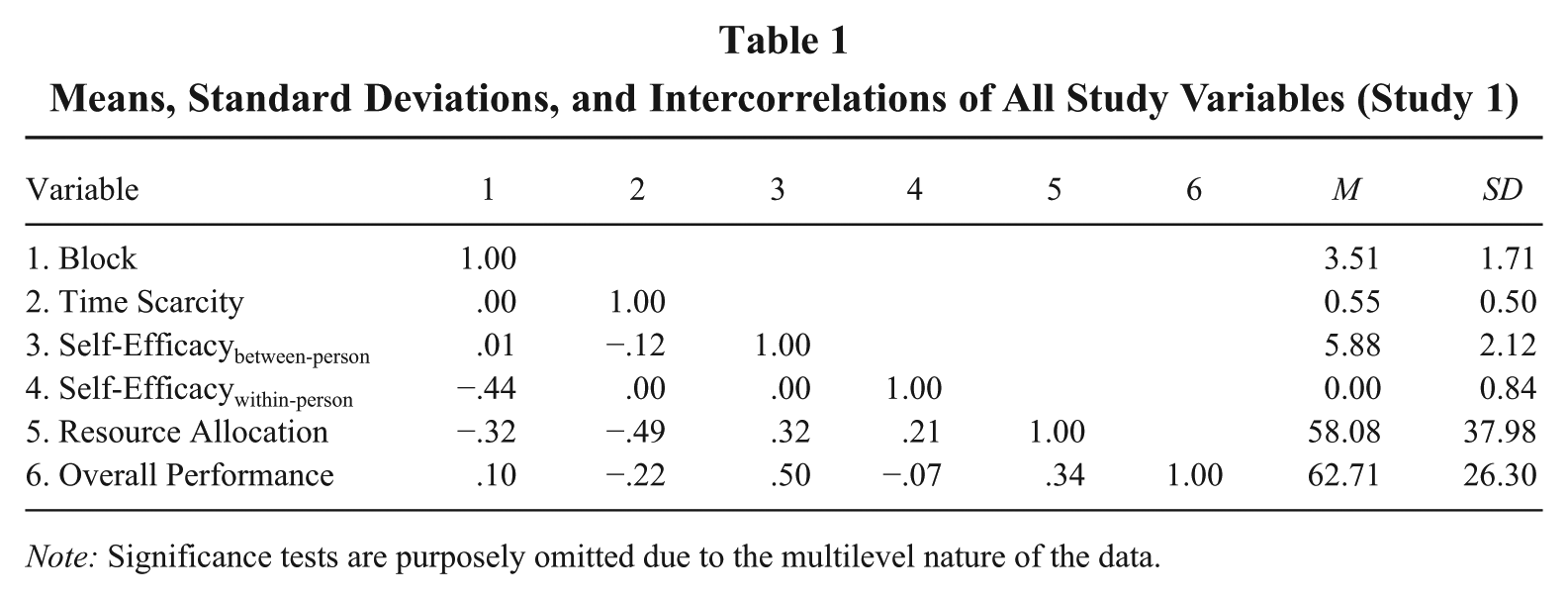
Means, standard deviations, and intercorrelations are reported in Table 1. Significance tests are purposely omitted from this table, as the nested nature of the data causes the standard errors associated with these correlations to be downwardly biased, thus inflating Type I error above the nominal p values. We provide direct tests of our hypotheses below using multilevel modeling. All p values are two-tailed unless otherwise specified.
Means, Standard Deviations, and Intercorrelations of All Study Variables (Study 1)
Note: Significance tests are purposely omitted due to the multilevel nature of the data.
Resource allocation effects on task performance
In developing the rationale for our hypotheses, we have argued that (a) resources allocated to a task often have diminishing returns for performance on that task and (b) these diminishing returns give rise to a nonmonotonic curvilinear relationship between resource allocation and overall performance when resources, such as time, are scarce. Thus, before testing our hypotheses, we assessed the effect that the amount of time allocated to a given math problem had on the probability that the problem would ultimately be answered correctly. We divided the observations into “bins” of 6 s each (e.g., 1 to 6 s, 7 to 12 s, and so forth) and plotted the results. As shown in Figure 2, when between 0 and 30 s were allocated, the probability that a given item was answered correctly rose dramatically. However, beyond 30 s, allocating additional time to an item had relatively little correspondence with whether the item was answered correctly. This pattern is consistent with the diminishing returns relationship described above and, thus, sets the stage for curvilinear relationships between resource allocation and overall performance.

Diminishing Returns of Resource Allocation for Task Performance (Study 1)
Hypothesis 1: Self-Efficacy × Time Scarcity → Resource Allocation
Hypothesis 1 stated that time scarcity would moderate the relationship between self-efficacy and resource allocation. Specifically, it was predicted that self-efficacy would have a negative relationship with resource allocation in the scarce time condition (Hypothesis 1a) and that self-efficacy would be positively related to resource allocation in the abundant time condition (Hypothesis 1b). As shown in Step 3 of Table 2, time scarcity moderated the relationship of self-efficacy with resource allocation (γ = −17.79, SE = 2.42, p < .001). This interaction is plotted in Figure 3. In line with our predictions, results showed that self-efficacy was negatively related to resource allocation in the scarce time condition (γ = −5.30, SE = 1.68, p < .01) and positively related to resource allocation in the abundant time condition (γ = 12.49, SE = 1.92, p < .001). Thus, Hypothesis 1 was supported.
Interactive Effects of Self-Efficacy and Time Scarcity on Resource Allocation (Study 1)

Note: Significance tests are two-tailed.
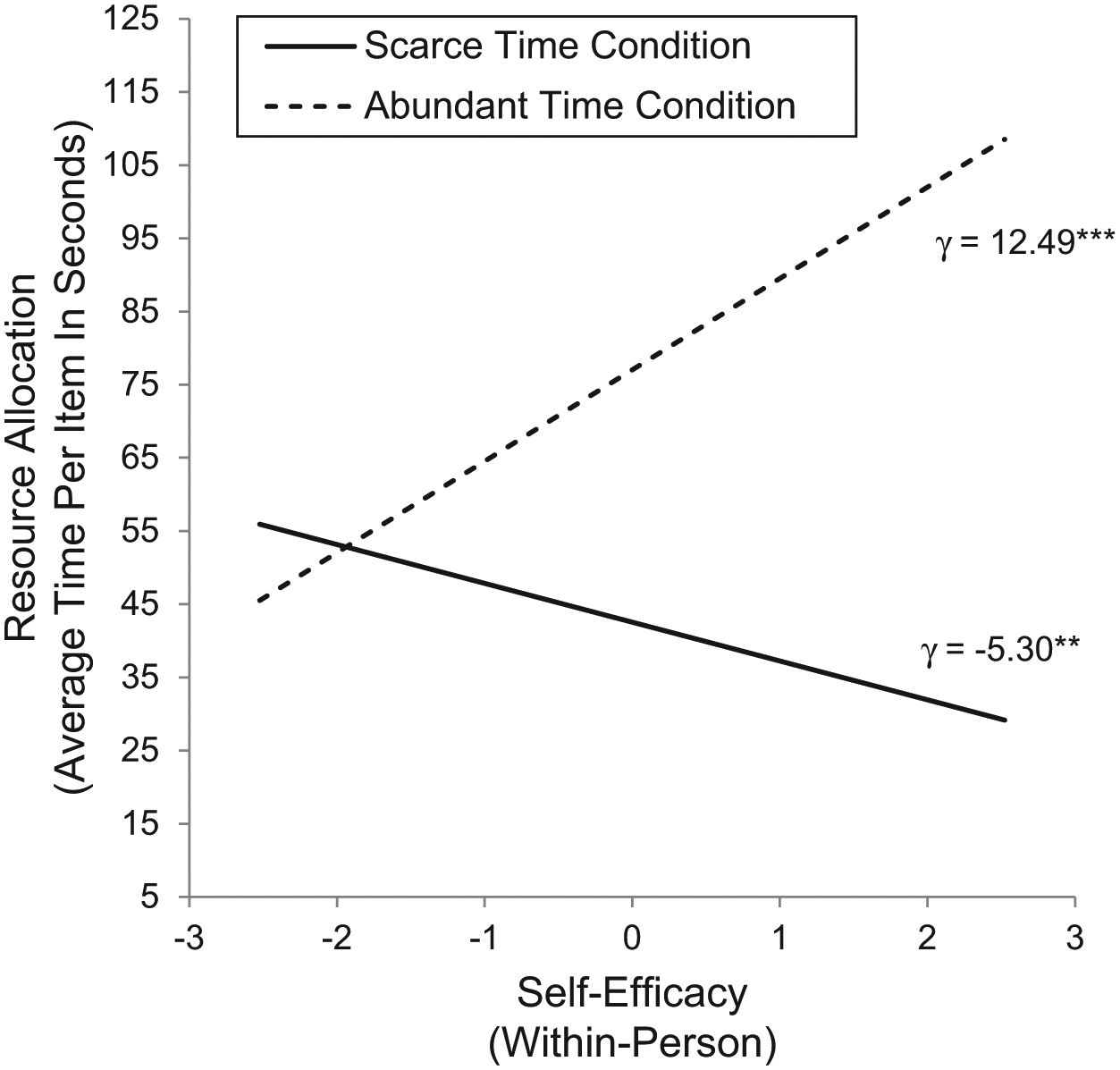
Time Scarcity Moderates the Effect of Self-Efficacy on Resource Allocation (Study 1)
Hypothesis 2: Resource Allocation 2 × Time Scarcity → Overall Performance
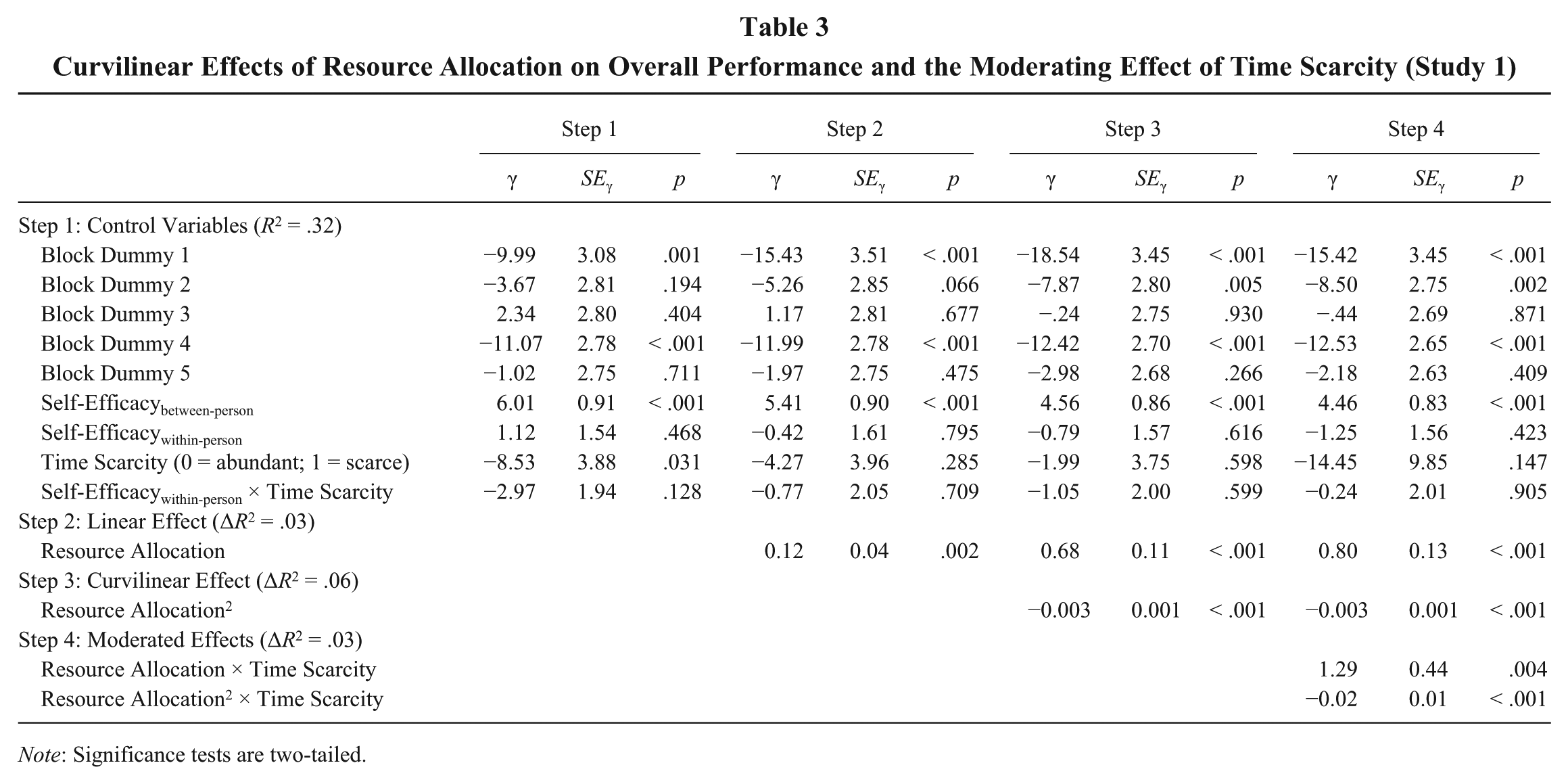
Hypothesis 2 predicted a curvilinear relationship between resource allocation and overall performance and that this curvilinear relationship would be moderated by time scarcity. As shown in Table 3, we controlled for the main effects of self-efficacy and the time scarcity condition, as well as the Self-Efficacy × Time Scarcity interaction, when testing Hypothesis 2. This was done because these variables were causally prior in our theoretical model and because it is necessary to control for the direct effects of self-efficacy and time scarcity when testing mediation in Hypothesis 3. The interpretation of the results for Hypothesis 2 remains the same regardless of whether self-efficacy and time scarcity are included as control variables. A potentially noteworthy result shown in Step 1 of Table 3 is that the Self-Efficacy × Time Scarcity interaction did not directly predict overall performance as might be expected from a mediated model (i.e., no direct linear effect of the independent variable on the dependent variable). However, this lack of a direct linear effect is to be expected given the curvilinear nature of the indirect effects that are predicted. Thus, a better test of the relationship between self-efficacy and overall performance under varying levels of time scarcity is provided in the test of Hypothesis 3 where mediated effects are considered explicitly.
Curvilinear Effects of Resource Allocation on Overall Performance and the Moderating Effect of Time Scarcity (Study 1)
Note: Significance tests are two-tailed.
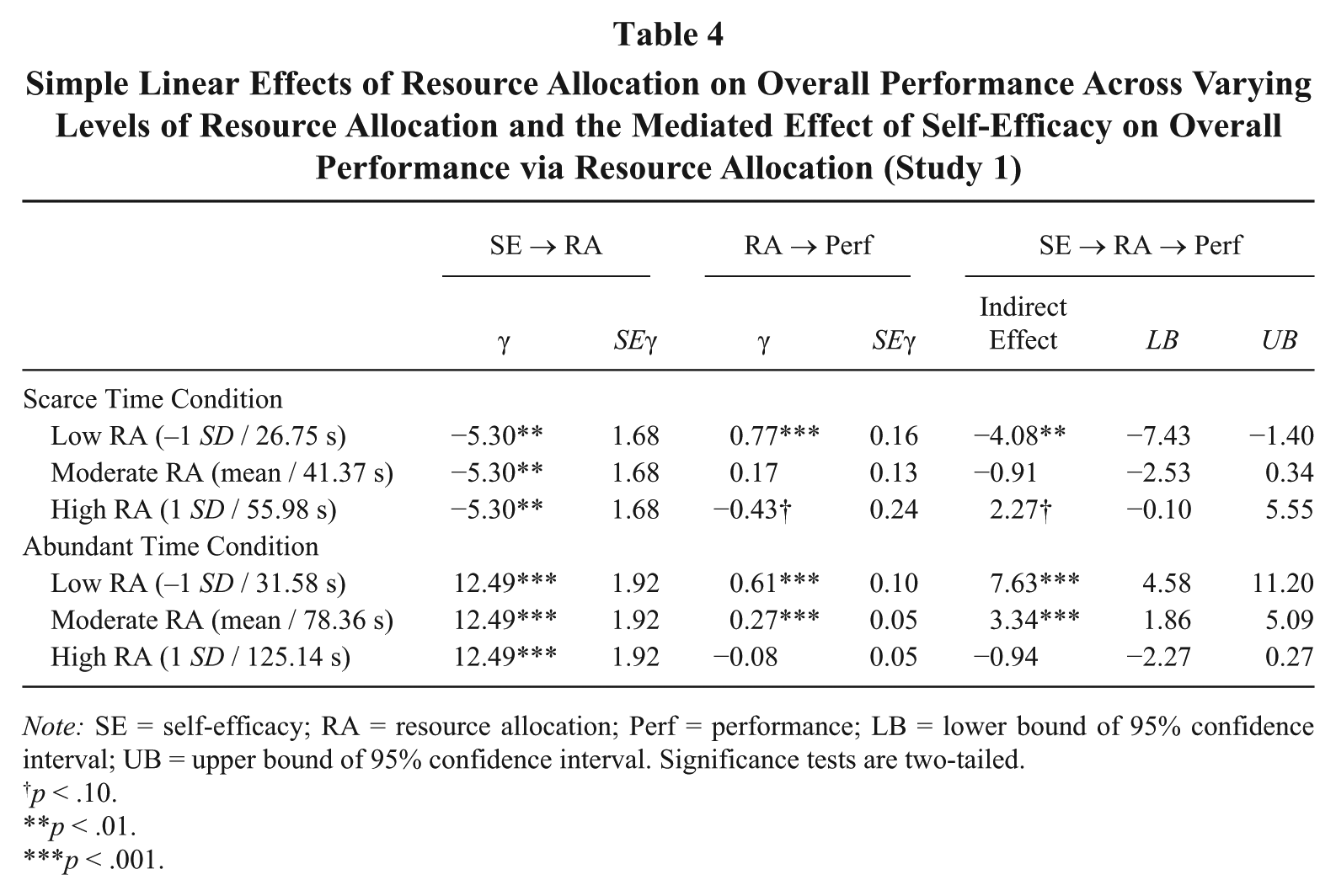
As shown in Step 2 of Table 3, the linear effect of resource allocation on overall performance was positive (γ = 0.12, SE = 0.04, p < .01) indicating that, in general, the more time individuals allocated to each item, the more items that were solved correctly. Yet there was a negative curvilinear effect (γ = −0.003, SE = 0.001, p < .001) indicating a concave relationship between resource allocation and overall performance. Finally, this curvilinear effect was moderated by time scarcity condition (γ = −0.02, SE = 0.01, p < .001). As shown in Figure 4a, in the scarce time condition, resource allocation had an inverse-U relationship with performance such that allocating time to the task was beneficial up to a point, beyond which more time per item actually hurt overall performance. That is, in the scarce time condition, moderate levels of resource allocation were associated with the highest levels of overall performance. Furthermore, as shown in Table 4, the simple linear slope between resource allocation and overall performance shifted from positive (γ = 0.77, SE = 0.16, p < .001) at low levels of resource allocation to negative (γ = −0.43, SE = 0.24, p < .05, one-tailed) at high levels of resource allocation. Taken together, these results support Hypothesis 2a.
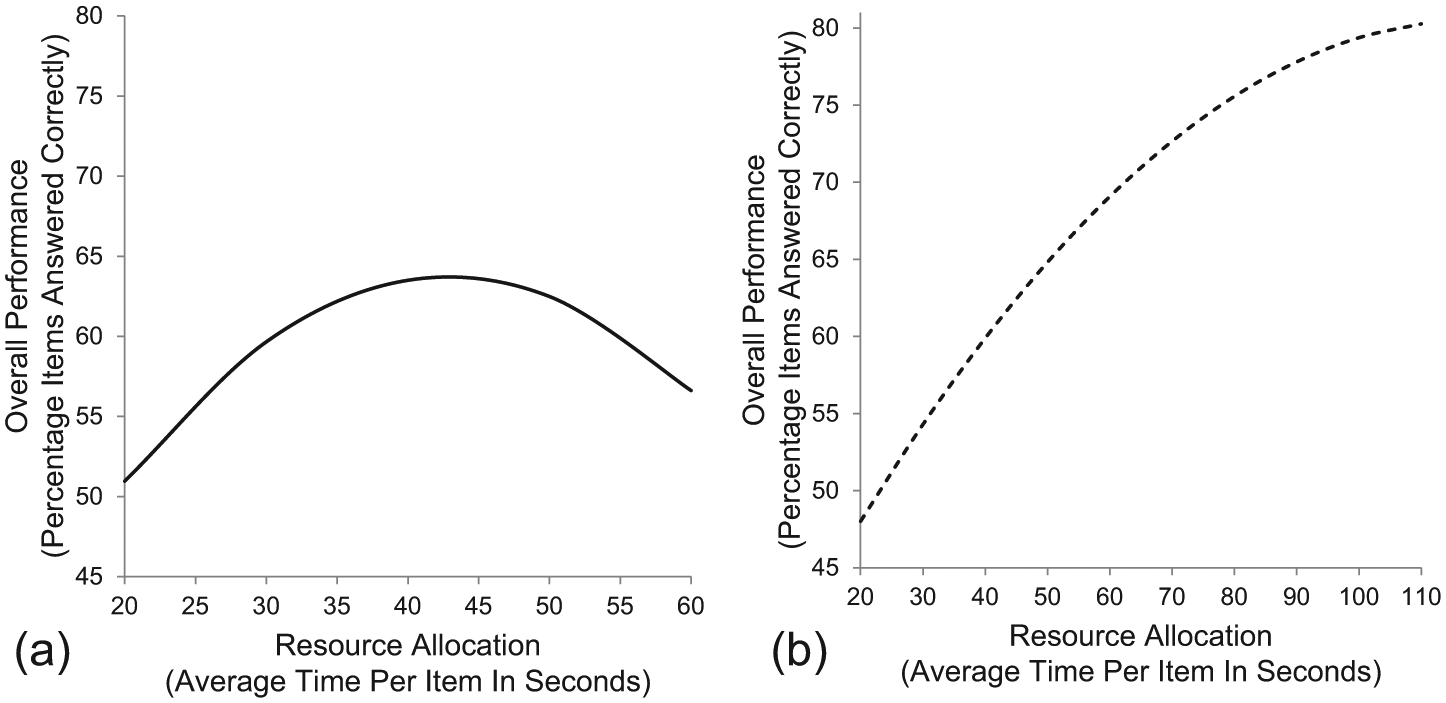
Curvilinear Relationship Between Resource Allocation and Overall Performance Across Levels of Time Scarcity (Study 1)
Simple Linear Effects of Resource Allocation on Overall Performance Across Varying Levels of Resource Allocation and the Mediated Effect of Self-Efficacy on Overall Performance via Resource Allocation (Study 1)
Note: SE = self-efficacy; RA = resource allocation; Perf = performance; LB = lower bound of 95% confidence interval; UB = upper bound of 95% confidence interval. Significance tests are two-tailed.
p < .10.
p < .01.
p < .001.
Conversely, in the abundant time condition, resource allocation had a positive relationship with performance, albeit with diminishing returns. Specifically, as shown in Figure 4b, each additional second allocated to the task yielded fewer performance gains than the previous second. Furthermore, as shown in Table 4, the simple linear slope between resource allocation and performance decreased from positive (γ = 0.61, SE = 0.10, p < .001) at low levels of resource allocation to null (γ = −0.08, SE = 0.05, n.s.) at high levels of resource allocation. Thus, Hypothesis 2b was also supported.
Hypothesis 3: Self-Efficacy × Time Scarcity → Resource Allocation → Overall Performance
Hypothesis 3 predicted that resource allocation would mediate the relationship between self-efficacy and overall performance. Our tests of Hypothesis 1 demonstrated that self-efficacy was significantly related to resource allocation, and our test of Hypothesis 2 showed that resource allocation was significantly related to overall performance. Thus, the first two conditions of mediation are met. The final step for establishing mediation involves demonstrating that the indirect effect from self-efficacy to overall performance is statistically significant. Given the presence of time scarcity as a moderator, as well as the curvilinear relationships between resource allocation and performance, we tested for mediation using simple slopes (Edwards & Lambert, 2007; Hayes & Preacher, 2010). The mediation test results are summarized in Table 4.
In line with Hypothesis 3a, in the scarce time condition, results showed that the indirect effect of self-efficacy on overall performance shifted from negative (indirect effect = −4.08, p < .01) at low levels of resource allocation to positive (indirect effect = 2.27, p < .05, one-tailed) at high levels of resource allocation. For instance, an increase from moderate self-efficacy (0.0) to high self-efficacy (2.5) would result in a decrease in resource allocation from approximately 43 s to 29 s. This can be seen via the solid line in Figure 3. Furthermore, as shown in Figure 4a, a shift in resource allocation from 43 s to 29 s would result in a decrease in performance from approximately 64% correct to 59% correct. Thus, there is a negative indirect effect of self-efficacy on performance via resource allocation. Conversely, an increase from low self-efficacy (–2.5) to moderate self-efficacy (0.0) would result in a shift in resource allocation from approximately 56 s to 43 s, which in turn would result in an increase in performance from approximately 59% correct to 64% correct. This describes a positive indirect effect of self-efficacy on performance via resource allocation. Thus, only increases from low to moderate self-efficacy were adaptive in terms of overall performance, whereas increases from moderate to high self-efficacy actually hurt overall performance. That is, when individuals are overconfident, they may already be allocating too few resources to a task, and further increases in self-efficacy are likely to make matters worse.
Lastly, in the abundant time condition, the mediated effect of self-efficacy on performance was positive at low levels of resource allocation (indirect effect = 7.63, p < .001), less positive yet still statistically significant at moderate levels of resource allocation (indirect effect = 3.34, p < .001), and null at high levels of resource allocation (indirect effect = −0.94, n.s.). This pattern is consistent with the diminishing returns relationship shown in Figure 4b. Thus, when time was abundant, increases in self-efficacy were largely beneficial. This is because increased self-efficacy led to increased resource allocation, which generally led to increased performance. Furthermore, although allocating resources beyond a certain point had little to no effect on performance, there was never a risk of overallocating resources. Thus, under abundant time conditions, increases in self-efficacy were beneficial at best and inconsequential at worst.
Discussion
The results from Study 1 were highly supportive of our hypotheses. Self-efficacy was negatively related to resource allocation under scarce time conditions and positively related under abundant time conditions. In turn, resource allocation was curvilinearly related to overall performance. In the scarce time condition, an inverse-U relationship between resource allocation and overall performance was observed such that allocating a moderate amount of time per item (on average) resulted in higher overall performance than spending very little time or a great deal of time. Conversely, in the abundant time condition, more time spent per item was consistently associated with higher overall performance, although there were diminishing returns. Lastly, resource allocation mediated the relationship between self-efficacy and overall performance. Importantly, given the curvilinear nature of the relationship between resource allocation and overall performance, a negative relationship between self-efficacy and resource allocation actually translated into positive indirect effects on overall performance in some cases.
In Study 2, we sought to assess the generalizability of the findings presented in Study 1 in several ways. First, whereas participants in Study 1 were undergraduate students completing a mathematics exam, Study 2 used a sample of working adults recruited from Amazon’s Mechanical Turk who performed a simulated work task. Thus, we sought to replicate the findings of Study 1 with a sample that better reflects the characteristics of the population of working adults. Second, in Study 2, we used performance on two distinct tasks to represent the multidimensional nature of performance rather than multiple instances of the same task as was done in Study 1. Therefore, in Study 2, we are able to assess the degree to which the results from Study 1 generalize to competing-demands situations.
Third, in Study 2, we experimentally manipulated self-efficacy rather than passively observing natural fluctuations in self-efficacy as in Study 1. By manipulating self-efficacy in Study 2, we sought to make stronger causal attributions about the effects of self-efficacy on resource allocation than could be drawn from Study 1. That is, although the results from Study 1 are suggestive of self-efficacy causing resource allocation decisions, the correlational nature of the data do not allow third-variable causes to be ruled out, which preclude drawing stronger causal inferences. By randomly assigning individuals to low versus high self-efficacy conditions in Study 2, we are able to rule out third-variable explanations and draw clearer inferences about self-efficacy’s causal role in resource allocation.
Finally, by using a between-subjects manipulation of self-efficacy, we are able to join others (Vancouver, Gullekson, Morse, & Warren, 2014) in showing that negative self-efficacy effects are not a within-person phenomenon per se. Rather, self-efficacy is used to efficiently allocate resources, which often includes a reduction in resources when self-efficacy for a task is high. Given the challenges of disentangling self-efficacy effects from past performance and ability at the between-person level of analysis, negative self-efficacy effects have been most consistently demonstrated using within-person designs. Nevertheless, our theoretical argument for the emergence of negative self-efficacy effects—specifically, that negative self-efficacy effects are part of an adaptive process of efficient resource allocation—is not restricted to the within-person level of analysis.
Study 2
In this section, we present results from a study where individuals needed to allocate a finite pool of time across two separate tasks. Time allocation was zero sum, as time allocated to one task (Task A) was time not allocated to the other (Task B). This is similar to the scarce time condition in Study 1, where time spent on one math item could not also be spent on another. As demonstrated in Study 1, negative self-efficacy effects on resource allocation and task performance are more likely to translate into adaptive effects for overall performance when resources must be allocated judiciously. Furthermore, situations in which time must be allocated across multiple competing demands is likely to be the rule in organizations, whereas situations where time is abundant are likely to be the exception, making this a meaningful context for examining self-efficacy effects.
In situations where limited time needs to be allocated across multiple demands, we expect self-efficacy for a given task to be negatively related to resource allocation to that same task. When resources such as time are scarce, individuals are motivated to allocate only the necessary resources because overallocation squanders resources that could be put to use elsewhere (e.g., Bledow, 2013; Brehm & Self, 1989; Kukla, 1972). Furthermore, as was shown in Study 1, as well as several other studies (Beck & Schmidt, 2012; A. M. Schmidt & DeShon, 2010; Vancouver et al., 2008; Vancouver & Kendall, 2006), individuals seem to use self-efficacy perceptions to determine the amount of resources needing to be allocated. Therefore, we predict that self-efficacy for one task will be negatively related to resources allocated to that task.
Hypothesis 4: Self-efficacy for Task A will be negatively related to resource allocation on Task A.
Similar to Study 1, we again expected resource allocation to have an inverse-U relationship with overall performance. Furthermore, by explicitly modeling overall performance as an aggregate of performance on two distinct tasks, we are better able to illuminate how a curvilinear relationship between resource allocation and performance emerges. Specifically, we expect resources allocated to Task A to be positively related to performance on Task A, albeit with diminishing returns. The logic here is similar to that outlined in our development of Hypothesis 2; in general, allocating more time and effort to a task is positively associated with performance (e.g., Vancouver & Kendall, 2006; Yeo & Neal, 2004), and allocating no resources to a task ensures low performance. Yet beyond a certain point, allocating additional time to Task A is unlikely to result in performance increments. Likewise, more resources allocated to Task A necessarily means that fewer resources can be allocated to Task B. As such, we offer the following hypotheses:
Hypothesis 5: Resources allocated to Task A will be (a) positively related to performance on Task A and (b) negatively related to performance on Task B. The relationship between resource allocation and performance on Tasks A and B will be curvilinear such that there will be diminishing returns.
The diminishing returns effects of resource allocation on Tasks A and B sets the stage for an inverse-U relationship between resource allocation and overall performance to emerge (see Fig. 1). Thus, the road to high overall performance is not necessarily to allocate maximum resources to one task, as such a strategy would come at the expense of performance on the other task. In other words, we are predicting an inverse-U relationship between resources allocated to Task A and overall performance.
Hypothesis 6: The effect of resources allocated to Task A on overall performance will be an inverse U such that moderate levels of resources allocated to Task A will yield higher performance than very low or very high levels of resources allocated to Task A.
Finally, as in Study 1, we expect the effects of self-efficacy on overall performance to be mediated by resource allocation.
Hypothesis 7: Resource allocation will mediate the relationship between self-efficacy and overall performance. The mediated effect will shift from negative to positive.
Method
Research design and overview
Here we report a one-factor (Task A self-efficacy: high vs. low) experimental design, with participants randomly assigned to one of the two conditions. 4 Participants were presented with two tasks that were to be completed sequentially: a stock selection task (Task A) and a mathematics exam (Task B), described in greater detail below. Self-efficacy for the stock task was manipulated via false feedback regarding performance during a practice round. During the experiment, participants were assigned a goal of scoring 85 total points between both the stock task and math task (out of a possible 100, with a 50-point maximum for each individual task), attainment of which would result in a $2.50 bonus payment. The time allocated to the stock task 5 , stock task performance, math task performance, and overall performance (stock task performance + math task performance) were the focal dependent variables.
Participants
Study 2 was conducted online with a sample of 106 workers from Amazon’s Mechanical Turk who participated in exchange for $2.00. Only workers within the United States were eligible to participate in the study. Mechanical Turk is a Web-based service provided by Amazon.com that enables Workers to perform short-term tasks (“HITs”) for Requesters for monetary compensation. Mechanical Turk has begun to be used successfully for psychological research, with samples that are generally viewed as more closely representing the broader working population than do samples composed exclusively of undergraduate students (Barger, Behrend, Sharek, & Sinar, 2011).
Twenty participants dropped out prior to completing the study. Because Mechanical Turk provides no means to contact Workers until they have completed and submitted a HIT, we have no information on the reasons for participant dropout. An additional 12 participants were excluded from data analysis for careless responding. Specifically, we embedded three “attention-check” items throughout the experiment (e.g., “If you are paying attention, select ‘Strongly Agree’”). Participants answering any of these questions incorrectly were excluded from analysis.
The hypothesis tests reported below are based on 74 participants who completed the study and responded correctly to all three attention-check items. The sample was 51% male and 90% Caucasian, and participants were on average 36.01 years old (SD = 11.83). Forty-two percent of participants reported having graduated college, with another 26% reporting having “some college education,” and 20% having completed at least some postcollege graduate work. The median annual salary was between $30,001 and $40,000 per year, and on average, participants reported working 30.18 hr per week (SD = 17.91).
Stock task
The stock task was similar to that used in previous research on motivation (e.g., Beck & Schmidt, 2012; Earley, Connolly, & Ekegren, 1989; Fisher & Ford, 1998; Park, Schmidt, Scheu, & DeShon, 2007). During each of 10 trials, participants were presented with four stocks that differed on four attributes (rating, dividend, change in profit, and short-term performance), with return on investment (ROI) of each stock determined by a weighted linear combination of the attributes. Participants sought to use the attribute information to choose the stock with the highest ROI. Participants earned 5 points for choosing the best stock, 3 points for the second-best stock, 1 point for the third-best stock, and no points for choosing the worst stock. There were a total of 10 sets of stock choices, resulting in a maximum of 50 points for the stock task. Aside from a brief initial practice round, participants were not provided feedback on their stock choices until all 10 choices had been made or the time available for the task had expired.
No attribute information was available at the beginning of each trial. Participants could request as much or as little attribute information as they felt necessary to reach a decision on their stock choice. Thus, they could request anywhere from 0 pieces of attribute information to 16 pieces of information (4 stocks × 4 attributes). Seeking more information can facilitate more accurate decision making (e.g., Weiss & Knight, 1980), but it often requires time. To create such a time cost, we incorporated a 1.5-s delay between the request of an attribute and its presentation. Additionally, time is typically required to consider how best to combine the available information to reach the best decision. Thus, as is common with many tasks, participants faced a trade-off between speed and accuracy on the stock task.
Math task
The math task was similar to that used in Study 1. Participants solved up to 10 math problems. Seven of the problems were identical to problems used in Study 1, and 3 problems were Grade 8 problems obtained from ca.ixl.com, a free educational Web site containing thousands of practice mathematics problems. The Grade 8 problems were added to provide sufficient range of difficulty for the broader range of education among the Mechanical Turk workers, which can include individuals with lower (as well as higher) levels of education than the undergraduate student sample. As with Study 1, items were presented one at a time, and five response options were presented for each item. Participants received 5 points for each problem that was answered correctly, with no penalty for incorrect answers, resulting in a maximum score of 50 points on the math task. Participants were not provided feedback on their answers until all 10 problems had been completed or the time available for the task had expired.
Procedure
Upon completing the informed consent process, participants were introduced to the two tasks and informed of the goals and incentives available for their performance during the study (described below). After being introduced to the stock task, participants performed a brief three-trial practice set. This practice included detailed feedback following each stock choice. The feedback contained information about the rank of their choice, the number of points obtained, and the attribute values, ROI, and rank for all four stocks in the portfolio. Participants were then given an introduction to the math task, followed by a brief practice round consisting of five problems of varying difficulty.
After the task introductions and initial practice opportunities, participants were reminded of their assigned goal and the associated incentives available for the study. Participants were then informed they would have a maximum of 25 min to complete both tasks such that more time allocated to the stock task would mean less time available for the math task and vice versa. Next, participants were given a second opportunity to practice the stock task with a full set of 10 stock choices and a 12.5-min time limit. This practice block was used as a means to deliver the self-efficacy manipulation via false feedback, as detailed below. Self-efficacy was then assessed for both the stock task and the math task. Participants then indicated their personal goals 6 for the stock task and the math task and indicated how they would like to allocate their time between the two tasks. Next, participants undertook the performance round of the stock task followed by the performance round for the math task. At the conclusion of the math task, participants were informed whether they met their assigned goal and earned the bonus. Finally, participants were debriefed and thanked for their participation.
Self-efficacy manipulation
Stock task self-efficacy was manipulated via false feedback following the full stock task practice round. Participants in the high self-efficacy condition were told they earned 46 points on the practice round, having chosen the best stock for 8 of the 10 trials and the second-best stock on the remaining 2 trials. In the low self-efficacy condition, participants were told they earned 22 points, having picked the best stock once, the second-ranked stock on 4 trials, and the third-ranked stock five times.
Measures
Stock task self-efficacy was assessed by asking participants to indicate their confidence that they could achieve 10 different levels (e.g., 0 to 5 points, 6 to 10 points). To standardize the frame of reference for these ratings, we asked participants to make the ratings on the basis of their having 5 min to spend on the task. Responses were based on a scale ranging from 0% to 100% confidence in 10% increments. Alpha reliability for stock task self-efficacy was .93. Math task self-efficacy was assessed in the same manner, only referencing the math task. Alpha reliability for the math task self-efficacy scale was .95. Resource allocation was operationalized as the decision participants made regarding how to divide their 25 min between the tasks, with higher values indicating more time allocated to the stock task. Thus, this measure has a minimum value of 0 indicating no time allocated to the stock task (and 25 min allocated to the math task) and a maximum value of 25 indicating all time allocated to the stock task (and no time allocated to the math task). Stock task performance was operationalized as the number of points earned on the stock task, math task performance was operationalized as the number of points earned on the math task, and overall performance was the sum of the points earned across both tasks.
Analyses
Hypotheses were tested using multiple regression. As with Study 1, the significance of indirect effects was assessed using the MacKinnon et al. (2007) PRODCLIN macro. Also, as with Study 1, the simple slopes for the curvilinear effects of resource allocation on performance were tested by centering resource allocation around low, moderate, and high values (–1 SD, mean, and 1 SD, respectively) before regressing performance on resource allocation and the quadratic term (Cohen et al., 2003; Hayes & Preacher, 2010).
Results
Manipulation check
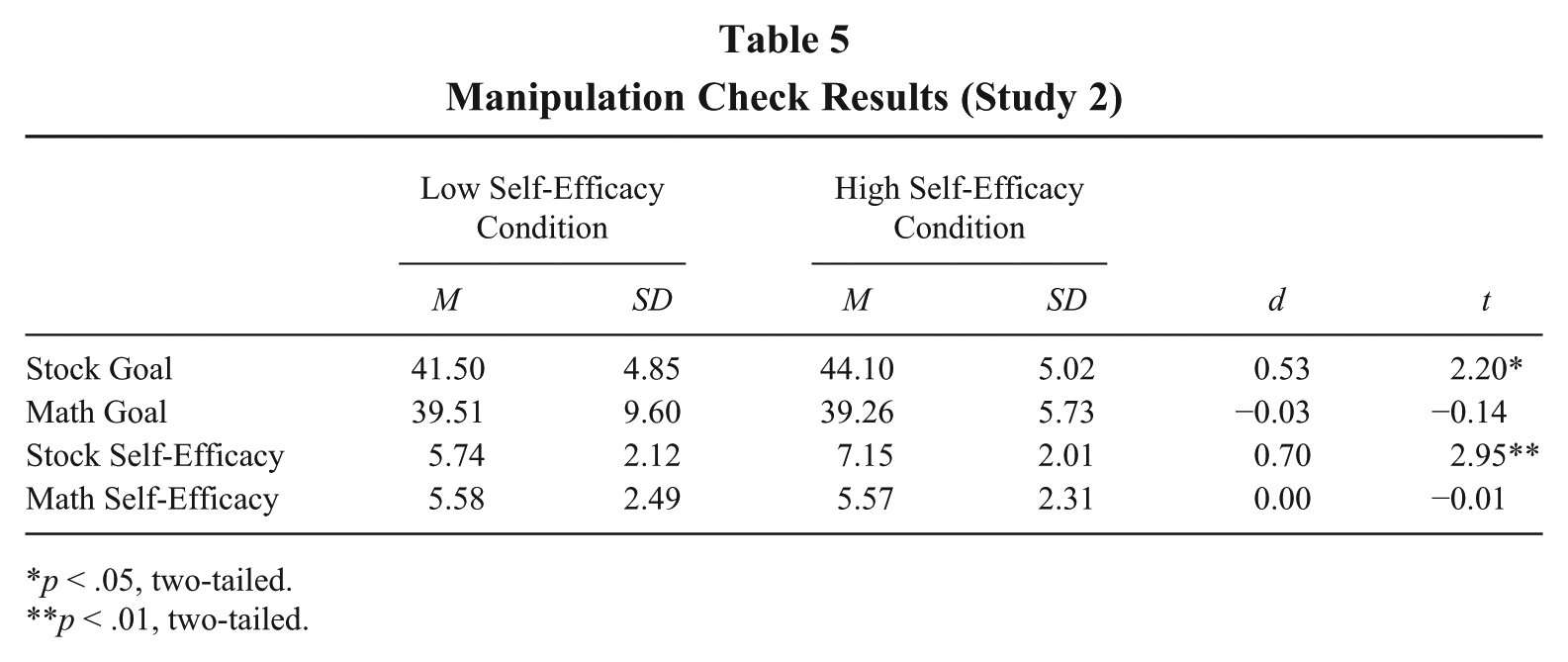
To ensure the internal validity of the self-efficacy manipulation, we administered several manipulation checks. We computed means and standard deviations for the goals and self-efficacy measures within each condition (i.e., low self-efficacy vs. high self-efficacy), along with the associated Cohen’s d and t tests. These results are summarized in Table 5. Importantly, participants in the “high self-efficacy” condition reported higher stock task self-efficacy, d = 0.70, t(72) = 2.95, p < .01, and higher stock task goals, d = 0.53, t(72) = 2.20, p < .05, than participants in the “low self-efficacy” condition. Also importantly, the manipulation did not affect math task self-efficacy, d = 0.00, t(72) = −0.01, n.s., or math task goal, d = −0.03, t(72) = −0.14, n.s. Thus, the self-efficacy manipulation worked as intended, increasing self-efficacy only for the targeted task rather than “in general.”
Manipulation Check Results (Study 2)
p < .05, two-tailed.
p < .01, two-tailed.
Descriptive statistics
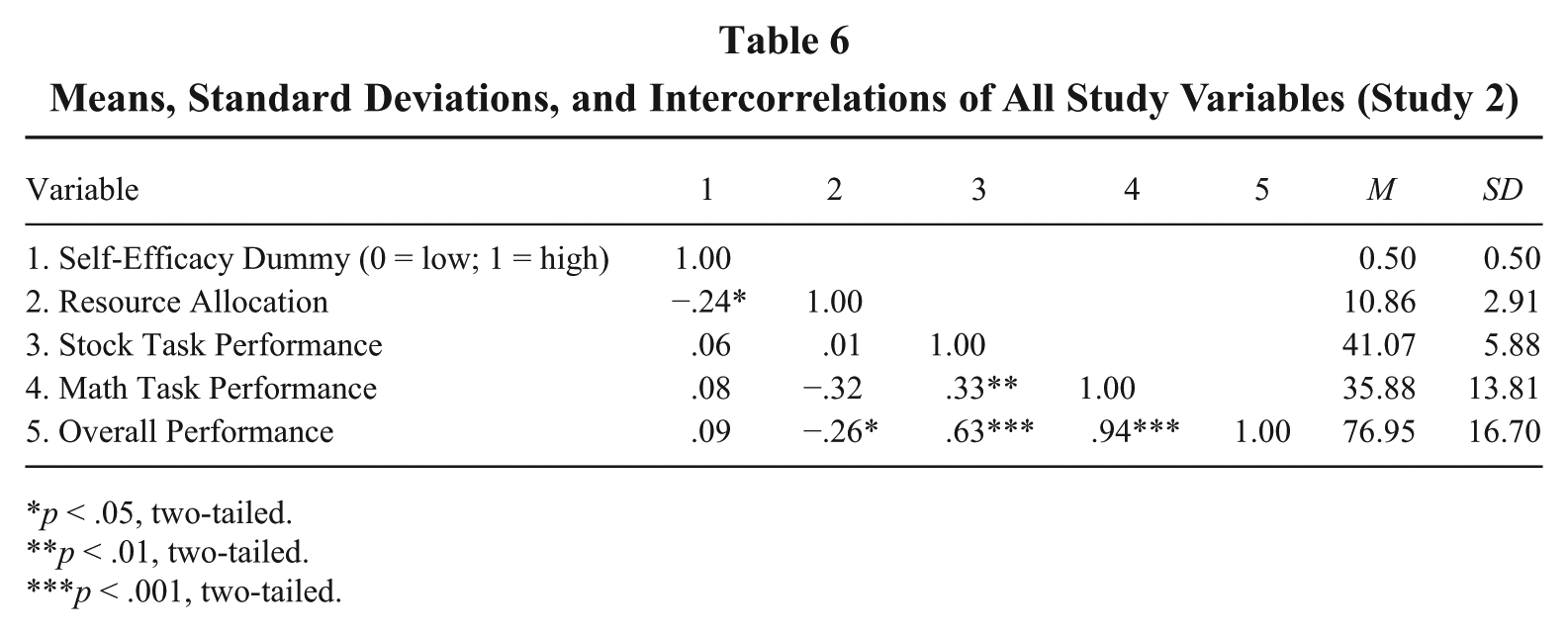
Table 6 contains means, standard deviations, and correlations among the Study 2 variables. 7 The self-efficacy manipulation was negatively correlated with resource allocation (r = –.24, p < .05), providing support for Hypothesis 4. It is also noteworthy that the bivariate relationship between resource allocation and overall performance was negative (r = –.26, p < .05). That is, in general, greater time allocated to the stock task was associated with lower overall performance. However, in Hypothesis 6, we predicted that this relationship would be curvilinear, meaning the bivariate relationship between these variables may not adequately capture the relationship between them. Therefore, below we assess Hypothesis 6 using multiple regression.
Means, Standard Deviations, and Intercorrelations of All Study Variables (Study 2)
p < .05, two-tailed.
p < .01, two-tailed.
p < .001, two-tailed.
Hypothesis 4
Hypothesis 4 stated that self-efficacy for Task A (i.e., the stock task) would be negatively related to resource allocation. As stated above, the bivariate correlation between the self-efficacy dummy variable and resource allocation (r = –.24, p < .05) provides support for this hypothesis. Specifically, participants who were told they had done poorly on the practice trial of the stock task (i.e., the low self-efficacy condition) allocated more time to the stock task (M = 11.56, SD = 2.94) than participants who were told they had done well on the practice trial of the stock task (i.e., the high self-efficacy condition; M = 10.16, SD = 2.44), d = −0.50, t(72) = −2.12, p < .05. Furthermore, because participants were randomly assigned to self-efficacy conditions, this result provides evidence for the causal role of self-efficacy in resource allocation.
Hypothesis 5
Hypothesis 5a stated that resources allocated to Task A would be positively related to performance on Task A, and Hypothesis 5b stated that resources allocated to Task A would be negatively related to performance on Task B. Furthermore, it was predicted that both relationships would be curvilinear such that resources allocated to either task would yield diminishing returns on task performance. When testing these hypotheses, we controlled for the self-efficacy dummy variable, as this was necessary for testing mediation in Hypothesis 7. Nonetheless, the results for Hypotheses 5a and 5b do not change regardless of whether the self-efficacy manipulation is included in the analyses.
When stock task performance was regressed on resource allocation, no significant linear effect emerged (b = 0.06, SE = 0.25, n.s., R2 = .00). However, when the squared resource allocation term was added to the model, a significant curvilinear relationship between resource allocation and stock task performance emerged (b = −0.12, SE = 0.04, p < .01, R2 = .12). This relationship is plotted via the solid line in Figure 5. Next, we examined the simple linear relationship between resource allocation and stock task performance at low (–1 SD, 7.95 min), moderate (mean, 10.86 min), and high (1 SD, 13.77 min) levels of resource allocation. In line with Hypothesis 5a, results showed that resource allocation was positively related to stock task performance at both low (b = 1.15, SE = 0.42, p < .01) and moderate (b = 0.47, SE = 0.27, p < .05, one-tailed) levels of resource allocation, and there was no significant linear relationship between resource allocation and stock task performance at high levels of resource allocation (b = −0.21, SE = 0.25, n.s.). In other words, resource allocation had diminishing returns on stock task performance. Taken together, these results provide strong support for Hypothesis 5a.

Relationships Between Resource Allocation and Individual Task Performance (Study 2)
In line with Hypothesis 5b, results showed that resource allocation was negatively related to math task performance (b = −1.49, SE = 0.55, p < .01, R2 = .10). Yet contrary to Hypothesis 5b, there was no significant curvilinear effect of resource allocation on math task performance (b = −0.13, SE = 0.09, n.s.). In other words, there were no diminishing returns, meaning Hypothesis 5b was supported only partially.
Hypothesis 6
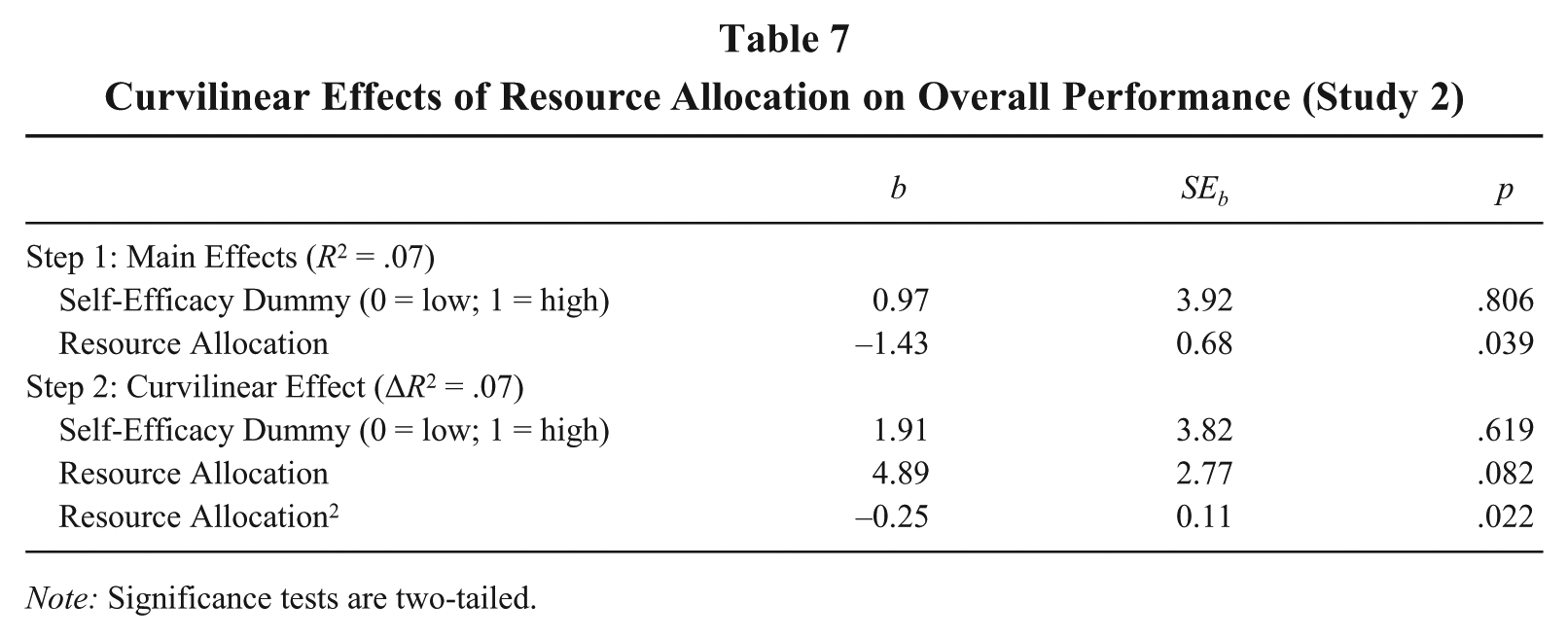
Hypothesis 6 predicted a curvilinear relationship between resources allocated to the stock task and overall performance; such moderate resource allocation would result in the highest overall performance. As shown in Table 7, there was a significant curvilinear effect of resource allocation on overall performance (b = −0.25, SE = 0.11, p < .05). Furthermore, as shown in Figure 6, the nature of this curvilinear effect was an inverse U such that moderate levels of resource allocation resulted in the highest levels of performance. However, contrary to Hypothesis 6, the simple linear relationship between resource allocation and overall performance was nonsignificant at low levels of resource allocation (b = 0.90, SE = 1.19, n.s.), although this slope did shift to negative at high levels of resource allocation (b = −2.01, SE = 0.70, p < .01). Thus, Hypothesis 6 was partially supported.
Curvilinear Effects of Resource Allocation on Overall Performance (Study 2)
Note: Significance tests are two-tailed.
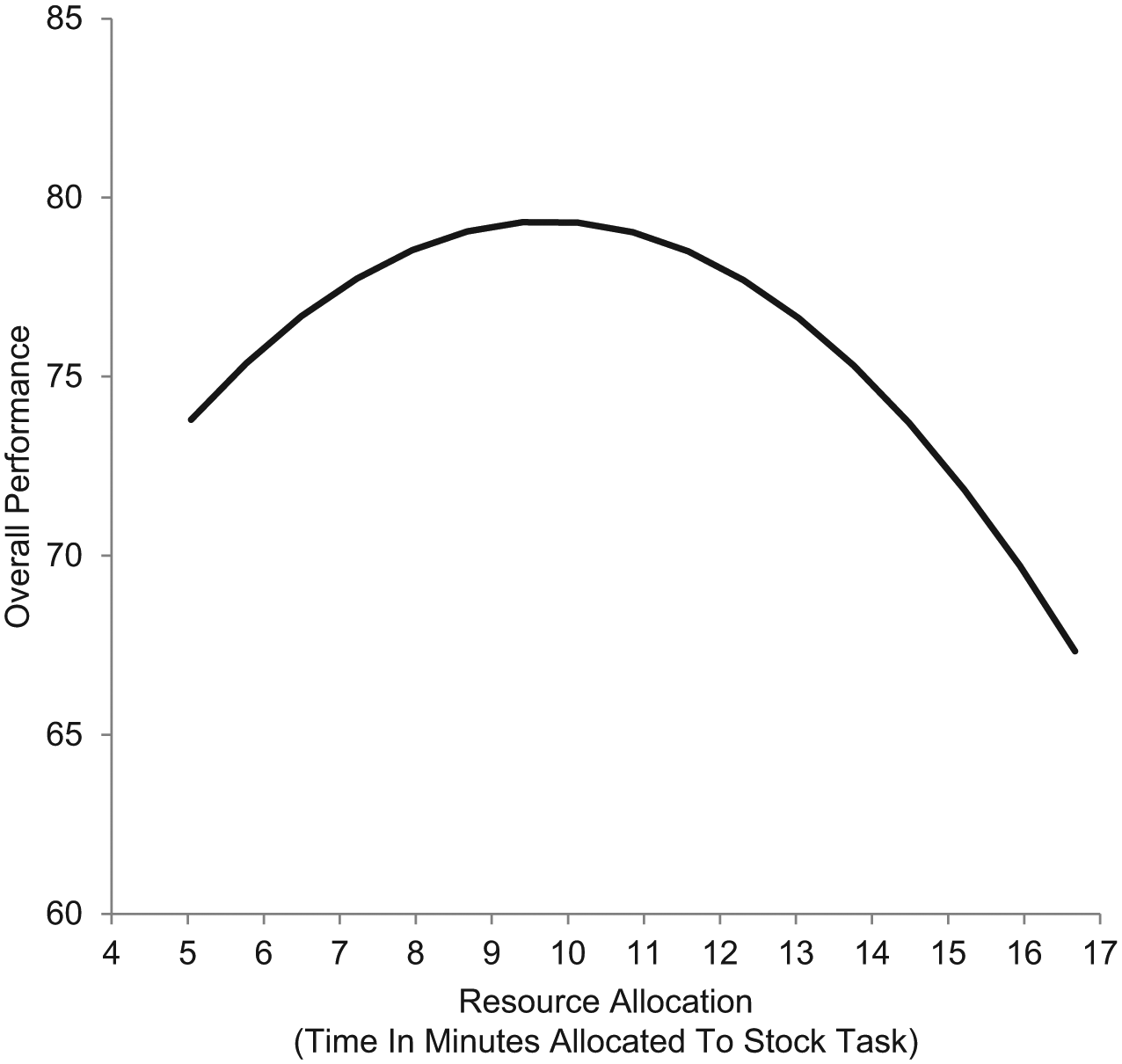
Curvilinear Relationship Between Resource Allocation and Overall Performance (Study 2)
Hypothesis 7
Finally, Hypothesis 7 predicted that the effects of self-efficacy on overall performance would be mediated by resource allocation. Similar to the approach used in Study 1, we tested this hypothesis at low, moderate, and high levels of resource allocation to account for the nonlinear relationship between resource allocation and overall performance. The results are summarized in Table 8. As anticipated, self-efficacy had a positive indirect effect on overall performance (indirect effect = 2.82, p < .05). However, this positive effect occurred only when an increase in self-efficacy resulted in the decrease from high to moderate levels of resource allocation (as was the case in Study 1). Yet, unlike Study 1, a negative indirect effect of self-efficacy on performance did not emerge at low levels of resource allocation (indirect effect = −1.26, n.s.), meaning that, in the current study, an increase in self-efficacy did not result in lower overall performance. In all, Hypothesis 7 was partially supported, as the positive indirect effect of self-efficacy on performance emerged at high levels of resource allocation, yet the indirect effect varied only from null (rather than negative) to positive across levels of resource allocation.
Mediated Effect of Self-Efficacy on Overall Performance via Resource Allocation (Study 2)

Note: SE = self-efficacy; RA = resource allocation; Perf = performance; LB = lower bound of 95% confidence interval; UB = upper bound of 95% confidence interval. Significance tests are two-tailed.
p < .05.
p < .01.
Supplemental analyses: Negative effects of self-efficacy on stock task performance
In testing our hypotheses, we have shown that self-efficacy is negatively related to resource allocation and that resource allocation is positively related to stock task performance (albeit only at low to moderate levels of resource allocation) and negatively related to math task performance. Thus, in this section, we assess whether resource allocation mediated the relationship between self-efficacy and performance on each of these individual tasks. In other words, whereas in the test of Hypothesis 7 we tested the indirect effect (via resource allocation) of self-efficacy on overall performance, here we test the indirect effect of self-efficacy on stock task and math task performance, respectively. At resource allocation levels of 10.23 s or less (which represents 54% of the observations), there was indeed a significant negative indirect effect of self-efficacy on stock task performance (indirect effect = −0.86, p < .05). Likewise, resource allocation also mediated the relationship between self-efficacy and math task performance, albeit in the opposite direction (indirect effect = 2.09, p < .05).
These results are theoretically meaningful, as they indicate that failure to account for the multidimensional nature of performance can lead to mistaken conclusions regarding negative statistical relationships among self-efficacy, resource allocation, and performance. That is, in the current study, high stock task self-efficacy was associated with lower stock task performance. Yet by reducing resources allocated to the stock task (thus sacrificing stock task performance), participants were able to improve math task performance and, thus, overall performance.
Discussion
The results from this study provide additional support for the notion that negative self-efficacy effects on resource allocation can be part of an adaptive process. Like Study 1, the negative effects of self-efficacy on resources allocated to one task translated into positive indirect effects on overall performance. Even though reduced time allocated to the stock task resulted in lower performance on that task, it resulted in improved overall performance (stock task performance + math task performance).
General Discussion
Summary of Results
Across two studies, we have shown that a negative relationship between self-efficacy and resource allocation can be part of an adaptive process. In both studies, positive indirect effects of self-efficacy on overall performance were observed, even when the relationship between self-efficacy and resource allocation was negative. In Study 2, we showed that even though reducing the time allocated to one task (the stock task) resulted in lower performance for that task, allocating only a moderate amount of time to the stock task actually resulted in higher overall performance (i.e., across the stock task and the math task) than did allocating large amounts of time. Thus, reductions in resource allocation (and even performance) with higher levels of self-efficacy (i.e., the negative self-efficacy effect) are not necessarily debilitating. In fact, we suggest that such negative effects are often critical for making efficient use of finite resources, such as time.
Theoretical Implications
Over the past several decades, many authors (e.g., Bandura, 1997; Gist & Mitchell, 1992; Locke et al., 1984) have written extensively about the benefits of self-efficacy beliefs for a host of outcomes, including performance. Along these lines, there are scores of data showing the potential benefits of self-efficacy for human functioning. However, some scholars recently have expressed discomfort with the notion that self-efficacy can be negatively related to resource allocation and, in some cases, performance (Bandura, 2012; Bandura & Locke, 2003). These authors contend that such a process would be self-debilitating, that studies finding negative effects do not fit with the bulk of empirical data and, thus, that these effects must be statistical and methodological artifacts. The idea that negative self-efficacy effects are simply the result of artifacts has been addressed via argument, replication, and reanalysis (e.g., Vancouver, 2012; Yeo & Neal, 2006). Thus, we turn our attention to the idea that negative self-efficacy effects on resource allocation (and even performance) would be debilitating (and, thus, are not likely to actually occur).
The results of the current studies provide additional support to the premise that such processes are, at their core, part of an often adaptive and beneficial approach to conserving limited resources (Vancouver, 2005, 2012; Yeo & Neal, 2013). We believe our data support Bandura’s (e.g., 1997) argument that self-efficacy plays a critical role in self-regulation and human functioning but diverge from Bandura’s (2012; Bandura & Locke, 2003) recent critiques by showing that negative self-efficacy effects also are a critical part of this process. Rather than trivializing self-efficacy’s role in functional self-regulation, our findings indicate that negative self-efficacy effects reflect the breadth and complexity of self-efficacy’s influence and utility. Indeed, determining when to allocate fewer resources is just as critical for effective self-regulation as determining when to allocate more resources, and self-efficacy appears to be instrumental to both. When resources are limited, continuing to invest substantial resources into activities that might be sufficiently accomplished with lower investment of resources may often prove inefficient, reducing one’s overall performance. Indeed, this was the case in the current studies.
However, the strategy of reducing resource allocation in response to high self-efficacy can be risky. For instance, in the scarce time condition of Study 1, the indirect effect of self-efficacy on performance was negative when resource allocation was reduced from moderate to low. In other words, conserving resources helped performance up to a point, but scaling back resource allocation too much hurt performance. Thus, although we argue that negative self-efficacy effects on resource allocation are often part of an adaptive process and are not necessarily related to negative effects on overall performance, negative relationships between self-efficacy and performance nevertheless can and do arise (Beck & Schmidt, 2012; A. M. Schmidt & DeShon, 2009, 2010; Vancouver et al., 2001; Vancouver & Kendall, 2006; Vancouver, Thompson, Tischner, & Putka, 2002; Yeo & Neal, 2006). We conceive of the role of self-efficacy in self-regulation as similar to the role of cognitive heuristics in decision making (e.g., Tversky & Kahneman, 1974). Heuristics are cognitive “shortcuts” that are useful for decision making, as they can be applied to a wide variety of situations rapidly without much cognitive effort. Although heuristics are for the most part an adaptive part of human cognitive functioning, they can lead to errors of judgment in some instances. Similarly, although allocating resources on the basis of self-efficacy may generally provide the adaptive function of aiding appropriate and efficient resource allocation, this process can nevertheless go awry, leading to decrements in overall performance.
Whereas recent work has begun to identify moderators of self-efficacy’s relationship with resource allocation and performance at the task level, we believe an important next step is to begin to identify when positive and negative effects of self-efficacy on resource allocation are adaptive versus maladaptive in terms of overall performance. What factors lead individuals to underinvest their resources, and, conversely, what leads individuals to overinvest? For one, we have already mentioned feedback ambiguity as a moderator of self-efficacy’s relationship with performance (A. M. Schmidt & DeShon, 2010). Relatedly, the frequency and specificity of the feedback individuals receive may have important implications for self-efficacy’s role in self-regulation (Northcraft, Schmidt, & Ashford, 2011). Specifically, tasks with higher quality feedback should allow individuals to more accurately judge their goal progress as well as form more accurate perceptions of self-efficacy, thus reducing resource allocation errors (e.g., underinvesting). Another potentially important factor for determining self-efficacy’s role in self-regulation is the way the goal being pursued is framed, for example, as an opportunity to gain valued outcome or threat of losing a valued outcome. Individuals tend to be more sensitive to threats of loss (e.g., Kahneman & Tversky, 1984) and, thus, may be less willing to reduce resource allocation under such conditions, even when self-efficacy is high. This may lead to overinvestment of resources and, thus, decrements to future performance.
Practical Implications
A question that may arise from this type of research is whether managers should increase or decrease employee self-efficacy, and, if so, when? Unfortunately, the answer to this question is complex and dependent on numerous factors, many of which have likely yet to be fully considered. Thus, there does not seem to be a one-size-fits-all approach to managing employee self-efficacy, and context is key. Nonetheless, we can provide some insights on the matter. Our results indicate that self-efficacy interventions may be a useful way to help individuals effectively spread their time across multiple demands. More concretely, bolstering self-efficacy for a given task may prove beneficial for an employee spending too much time on one aspect of performance to the neglect of others. For example, it may be beneficial for an academic department chair to say a kind word to a junior faculty member about his or her classroom performance, which may help the person see that time can safely be diverted from teaching to research. Although this might result in a reduction in teaching performance (e.g., as evaluated by students), the resulting gains in research productivity could likely result in higher overall performance.
Our results also suggest that caution is needed when evaluating an employee’s performance. It may be tempting to infer that a very confident employee who puts minimal time into a project and subsequently performs below expectations may need to be “brought down a peg.” Yet the current research shows that it is critical to understand the multidimensional nature of performance when trying to evaluate and influence employee motivation. If there are other important tasks requiring time and attention, this may be an adaptive allocation policy; it can often be more effective to spread resources across tasks and responsibilities rather than maximizing performance on one particular dimension of performance to the neglect of others. Therefore, it is important for managers to understand that low performance in one area does not necessarily indicate poor overall performance and, in fact, may be part of an adaptive process of allocating one’s finite resources. Thus, we echo recommendations from the performance appraisal literature and suggest that managers be wary of halo errors when evaluating employee performance (e.g., Landy & Farr, 1980). That said, there are certainly times when maximizing performance on one task might be worthwhile, even if doing so requires partially or fully ignoring other responsibilities. More research is needed to better understand the nuances of such trade-offs.
Lastly, as a general recommendation, the results of the current study suggest it may be unwise to induce vastly inaccurate self-efficacy perceptions. Although participants’ self-efficacy was manipulated in Study 2 with false feedback to enable clearer causal inferences to be drawn, inaccurate self-efficacy perceptions—whether due to inaccurate external cues (such as false feedback) or due to one’s own misperceptions—are likely to decrease the efficiency with which one can allocate their resources. Vastly inflated or vastly deflated self-efficacy perceptions may have a host of unintended negative consequences, such as investing time and energy into goals with little chance of success, investing too little time and effort into goals that require substantial resources, or abandoning important goals altogether that could be attained with sufficient effort.
Conclusions
The results of this research join a growing body of work (Beck & Schmidt, 2012; A. M. Schmidt & DeShon, 2009, 2010; Vancouver et al., 2008) showing that self-efficacy can have both positive and negative effects on resource allocation. More importantly, this research illustrates that rather than being debilitating, negative self-efficacy effects on resource allocation can result from a highly adaptive process of allocating scarce resources efficiently (Vancouver, 2005, 2012; Yeo & Neal, 2013). Specifically, when resources are scarce, a reduction in resource allocation from high to moderate levels can result in higher overall performance, even if one aspect of performance suffers. Thus, rather than indicating that self-efficacy is unimportant or that high self-efficacy is “self-debilitating,” this research demonstrates self-efficacy’s important role in efficient resource allocation. The findings reported above are important because in order for managers, teachers, coaches, and others to provide guidance to their subordinates, students, and clients regarding goal pursuit, a thorough understanding of self-efficacy and its complex relationships with resource allocation and performance is essential.
Footnotes
Acknowledgements
This article was accepted under the editorship of Deborah E. Rupp. We would like to thank Fred Oswald and two anonymous Journal of Management reviewers for their challenging and constructive comments. The manuscript was substantially improved by this review process.
Supplemental material for this article is available with the manuscript on the JOM website.
Notes
References
Supplementary Material
Please find the following supplemental material available below.
For Open Access articles published under a Creative Commons License, all supplemental material carries the same license as the article it is associated with.
For non-Open Access articles published, all supplemental material carries a non-exclusive license, and permission requests for re-use of supplemental material or any part of supplemental material shall be sent directly to the copyright owner as specified in the copyright notice associated with the article.
