




Abstract
This study analyzes differential appointments by gender to the rank of named professorship based on a sample of 511 management professors. This sample represents approximately 90% of our original survey sample of faculty at Tier 1 American research universities, with 10 or more years of experience since receiving their PhD, and whose contact information we could obtain online. Contrary to the tenets of the meritocratic evaluation model, we find that, after controlling for research performance and other factors, women are less likely to be awarded named professorships, particularly when the endowed chair is awarded to an internal candidate. Furthermore, we find that women derive lower returns from their scholarly achievements when it comes to appointments to endowed chairs. Our study suggests that a masculine-gendered environment dominates management departments, leading to shifting standards when it comes to the highest senior appointments in academe.
A large literature spanning over five decades has examined the “glass ceiling” phenomenon in industry (see, e.g., Hoobler, Wayne, & Lemmon, 2009; Powell & Butterfield, 1994; Schein, 1973; Tharenou, Latimer, & Conroy, 1994; Tosi & Einbender, 1985). This metaphor refers to invisible barriers that prevent women from gaining access to top managerial positions, or what some refer to as the corporate elite (McDonald & Westphal, 2011). In a review of the evidence about what they call “a persistent problem,” Hoobler, Lemmon, and Wayne (2011: 151) lament that “women have made few strides in breaking through the glass ceiling when it comes to senior leadership positions.” Although the underrepresentation of women at senior academic levels has been well documented (Bain & Cummings, 2000; European Union, 2008, 2009), research on the glass ceiling in academia is not as highly publicized as research on the glass ceiling in industry. This is unfortunate insofar as “a glass ceiling of unstated norms and distorted expectations is said to hinder women from reaching the top of academe” (Bain & Cummings, 2000: 493).
Understanding gender inequality and the glass ceiling in universities is important for several reasons. First is the issue of the pipeline shrinkage for women in academia, wherein women enter graduate school at about the same rate as men, but are less likely to enter and succeed in academic careers at the same rate as their male counterparts (Bellas & Toutkoushian, 1999; Camp, 1997). Second, restructuring the gender ranks in universities toward a more balanced representation of males and females in all academic ranks, including those in senior positions, has been an important objective of institutions of higher education for decades (Bailyn, 2003; European Union, 2008). Finally, because faculty and students are more comfortable relating to someone of their own gender (Berg & Ferber, 1983), women in fields with few senior scholars are at a distinct disadvantage because there are fewer female mentors at the top.
We posit that academia, a knowledge-intensive industry, is a compelling context within which to examine the glass ceiling, as academic excellence is purported to be a gender-neutral environment; indeed, most universities consider themselves to be a “meritocracy” (Scully, 1997). It has been suggested that excellence is synonymous with the highest level of scholarly achievement (Deem, 2009) and that faculty should be evaluated solely on performance and not on social or demographic characteristics (Merton, 1973). Indeed, the belief that merit can be judged on an objective basis is a fundamental tenet underlying university practices (Bailyn, 2003; Scully, 1997; van den Brink, 2011). But many researchers have countered academia’s claims of meritocracy, suggesting that merit-based systems of academic evaluation and advancement have led to gender inequalities (Krefting, 2003; van den Brink & Benschop, 2011).
One reason why meritocracy in academia may have failed is biased decision making in university appointments. Because institutions of higher education, similar to corporations, have hierarchies at the top that are dominated by men, the gatekeepers who evaluate excellence in the applicant pool for an endowed chair may be making judgments from a male perspective (Acker, 2006). In support of this reasoning, van den Brink (2010) and van den Brink and Benschop (2014), in studies involving the recruitment and selection of full professors in the Netherlands, showed that “gender equality policies based on difference do not match well with a construction of quality based on a meritocratic norm” (van den Brink & Benschop, 2012: 86). Although these authors suggested that the masculine model of the ideal academic remains unchallenged, they concluded that “it is questionable whether women lose the competition because they lack quality points or because decision-makers perceive they lack this quality” (van den Brink & Benschop, 2012: 85). In response to this open question of whether women encounter a glass ceiling in academia because they lack quality points or because gatekeepers perceive they lack this quality, we undertake an empirical investigation of the allocation of endowed chairs in management departments at research universities in the United States. While appointments to full professor (van den Brink & Benschop, 2014) and administrative promotion within a university (Johnsrud & Heck, 1994) have been studied, to our knowledge, no research has examined advancement to the rank of named professorship by gender, the highest senior appointment in a university setting. This is an important gap in the literature, as endowed chairs represent the most prestigious scholars and thought leaders in academia (Gomez-Mejia, Treviño & Mixon, 2009). Understanding whether meritocracies or masculinities (i.e., organizations where excellence is judged from a male gender perspective, leading to disadvantages for women) prevail at this level of academia helps us to close several gaps on the slow pace of change for female scholars.
Beginning with the premise that “faith in meritocracy is at the heart of how inequality is reproduced” (Scully, 1995), we add to the debate on the slow pace of improvement of gender balance in universities by answering the call for “the need for more empirical investigations of diversity in organizational settings” (Zanoni, Janssens, Benschop, & Nkomo, 2010: 17). We agree with these authors that “hard data” can “make visible the ‘inconvenient truth’ of unfairness and discrimination causing vertical segregation and the glass ceiling” (Zanoni et al., 2010: 11). The purpose of the present study is to determine whether meritocracies or gendered practices favorable to males (i.e., masculinities) prevail in the awarding of the highest recognition offered to faculty, namely endowed chairs. We believe that this study is further justified because the only way to deal with injustices in current practices is to make them visible (Lorber, 2005), and making injustices visible is not always possible with field research (Poggio, 2006). As such, we respond with a longitudinal empirical investigation that extends research that has examined gender inequality and the glass ceiling in academia (Bain & Cummings, 2000; Madera, Hebl, & Martin, 2009; van den Brink & Benschop, 2010, 2011, 2012, 2014).
We focus on management professors for several reasons. First, doing so allows us to control for differences across academic fields in citation rates, frequency of publications, labor markets, endowed chair opportunities, and available resources. Second, the Academy of Management, the major academic association in the field, has over 19,000 members, and it represents a key faculty constituency within colleges of business. Third, presumably business students (particularly at the graduate level) are preparing themselves for leadership positions in corporate America and/or the pursuit of an academic career and endowed faculty serve as an exemplar to them. Last, at a more philosophical level, most of the research and teaching dealing with diversity, discrimination, and equal employment opportunity legislation within business schools occurs in management departments, suggesting that faculty therein should be more sensitive and informed about issues concerning gender inequality.
Theoretical Framework and Hypotheses
Excellence is associated with the highest level of academic performance (Deem, 2009), and we can reasonably expect this to be true at the level of advancement to endowed chair status in departments of management. There is widespread agreement that accurate performance appraisals lead to positive outcomes for individuals and organizations (Mount & Thompson, 1987; Murphy, Garcia, Kerkar, Martin, & Balzer, 1982). In the case of faculty advancement to endowed chair status, the performance criteria appear to be rather narrow, objective, observable, quantifiable, and gender-neutral. Indeed, a faculty member’s publication record in top-tier journals and citations to his or her research are considered to be the critical inputs that lead to the awarding of endowed chairs (Gomez-Mejia et al., 2009; Tang, Forrest, & Leach, 1990). Hence, because the performance data are so unambiguous, and because there is wide consensus among leading research institutions, if a hypothetical man and woman have the same research record, under a meritocracy, both should enjoy the same likelihood of attaining a named professorship.
Although earlier glass ceiling literature tended to focus on individual, psychological discriminatory acts that led to gender inequality (Henriques, 1984; Turner, 1987), there is a broad consensus in the literature that it is the structure, culture, and processes within organizations that lead to gender bias (Acker, 2006; van den Brink & Benschop, 2014). It is within this context that we build theory in support of the absence of a meritocratic system that is centered around structural factors in society and organizations (Zanoni et al., 2010) and that may lead to gender inequality regimes (Acker, 1990) in the most senior appointments in academia.
It is well understood that advancement decisions are embedded in a complex and dynamic social context and that gender is one of our culture’s primary frames for organizing social relations (Ridgeway, 1997, 2007). To discern whether women might incur penalties for success in traditionally male-dominated positions (e.g., endowed chairs in management), we turn to expectation states theory (Ridgeway, 2001). Contrary to a meritocratic evaluation system, expectation states theory posits that gender status beliefs create a “network of constraining expectations and interpersonal relations that is a major cause of the glass ceiling” (Ridgeway, 2001: 637). Expectation states theory defines status beliefs as widely held cultural beliefs that link greater social significance and overall competence with one category of social distinction (e.g., men) over another (e.g., women) (Ridgeway, 2001). We explore the possibility that gender may interrupt the meritocratic advancement to named professorship status by creating a culture of social practices for categorizing males and females as different in socially significant ways and, in turn, organizing inequality in terms of those differences (Ridgeway & Smith-Lovin, 1999). Ridgeway (2001) argues that, although status beliefs link the higher-status group with greater overall competence, they are distinct from in-group favoritism (Brewer & Brown, 1998) inasmuch as they are shared by both dominant and subordinate groups (Ridgeway, Boyle, Kuipers, & Robinson, 1998). Ridgeway (2001) argues that it is the presumption of consensuality that gives status beliefs the power to organize social relations unequally. We examine whether this propensity for unequal access to advancement would be amplified within a masculine-gendered environment (in our case management departments).
Due to status beliefs that disadvantage low-status groups (e.g., women), it has been suggested that they must perform at higher levels than members of high-status groups (e.g., men) to be judged as equally competent. In an extension of expectation states theory, Foschi (2000) regards standards as a function of status characteristics that create differential performance expectations. According to double standards theory (Foschi, 1996), these differential performance expectations trigger the use of variable standards for attributing ability and performance. When lower-status individuals (e.g., women) perform well, their performances tend to be highly scrutinized since exceptional performance is unexpected based on their status role. When higher-status individuals (e.g., men) perform well, their performance is consistent with status-based expectations and, as such, is less likely to be scrutinized. In essence, gender status beliefs evoke double standards for evaluating performance, so that performance at the same level is seen as less consistent with ability in a woman than in a man (Biernat & Kobrynowicz, 1997; Foschi, 1996).
Building on the concept that universities are gendered institutions (Martin, 1994; van den Brink & Benschop, 2014), it has been suggested that “the academy is anchored in assumptions about competence and success that have led to practices and norms constructed around the life experiences of men, and around a vision of masculinity as the normal, universal requirement of university life” (Bailyn, 2003: 143). Acker’s (1990) “gendered theory of organizations” is consistent with this view of academia as inherently, not accidentally, gendered. As organizations are increasingly seen as created by and for men, we turn to the literature on masculinities and hegemonic masculinity (Connell, 1987, 1995) to theorize that gendered organizations (as opposed to meritocracies) may explain advancement to senior positions in academia. We believe that the masculinities literature is appropriate for our study of advancement to named professorships, given that over 80% of full professors in departments of management in the United States are men (AACSB International, 2014). While the general population is almost identically sex heterogeneous, most organizations are not, and management departments in academia are no exception. Indeed, management departments in colleges of business are highly sex-segregated when it comes to rank, with the proportion of women decreasing rapidly at more senior levels. As noted by McTiernan and Flynn (2011: 334), “most business school traditions, processes, and practices came about at a time when only males, most with wives who did not work outside the home, were in key positions.” As opposed to viewing management departments as gender-neutral and meritocratic, we theorize that they are systems composed of social practices that categorize men and women as significantly different and that these differences lead to masculinities and inequality (Ridgeway & Correll, 2004).
Because homophily, the tendency for people to prefer to work with colleagues with similar characteristics such as gender or race, is often used to explain gender inequality in organizations (Ibarra, 1992), we focus on the mobilization of masculinities and principles of homophily to theorize whether advancement decisions regarding senior-level academic positions in academia are based on masculine gendered practices, as opposed to meritocracies. These theories are related to the glass ceiling in academia and they draw on the “similarity/attraction model” (Byrne, 1971) and on homosociality (Kanter, 1977), concepts that are based on the simple notion that people prefer to work with others who are similar to themselves. Men advance through similarity with those who are already members of the elite (mostly men) and thus the glass ceiling becomes a self-fulfilling prophecy (Byrne, 1971). That is, because most members of the elite are males, they tend to favor other males, resulting in “homosocial” reproduction. In the words of Tharenou (1999: 113), “women can also advance through similarity but they are rarely similar to those at the top.” Kanter (1977) observes that gender differences in advancement due to dissimilarity should be greatest at higher rather than at lower levels because the proportion of men and women are more uneven in the upper echelons. Consistent with prior research on the glass-ceiling phenomenon in industry, for the most part, men control entry into the academic elite. Selection committees for named professorships are composed primarily of tenured full professors, and in doctoral-granting universities only 18% of full professors who act as judges are women (Mainiero & Sullivan, 2005). When men control access to desirable academic networks, women have difficulty gaining access to them (Gersick, Bartunek, & Dutton, 2000; van den Brink & Benschop, 2014).
A masculine gendered environment, likely the norm in colleges of business, may lead to gender stereotypes that envision faculty in sex-typical social roles. In this environment, a potential for bias exists when gatekeepers hold a stereotype about women that is incongruent with the attributes that are thought to be required for success in certain roles (Eagly & Karau, 2002), such as endowed chairs. When a stereotyped group member (e.g., women) and an incongruent social role (e.g., female endowed chair holder) become conflated in gatekeepers’ minds, this inconsistency lowers the evaluation of the stereotyped group member as a potential occupant of the role (Eagly & Karau, 2002). If these stereotypes are held by gatekeepers, this suggests that the standard that they use when judging a female faculty’s productivity will be different than the standard used to judge male faculty. Biernat, Manis, and Nelson (1991) and Biernat and Manis (1994) developed this model of “shifting standards,” and reasoned that evaluators may differentially adjust the meaning of objective phenomenon when judging males versus females. Biernat and Manis (1994) argued that if gatekeepers rely on a global stereotype that men are more competent than women, then they would interpret objective performance data accordingly. Given that different standards of judgment may be used to evaluate members of each sex, we posit:
Hypothesis 1a: For a given scholarly contribution level, female faculty face a lower probability of holding a named professorship than male faculty.
Hypothesis 1b: Male faculty extract higher returns from their scholarly achievement than female faculty when both genders compete for named professorships.
Although we believe that the primary impact of unconscious gender bias operates within the masculine gendered environment outlined in our main hypotheses (Hypotheses 1a and 1b), this masculine context does not illustrate the entire story of faculty advancement at the highest levels in a university setting. Shifting standards theory has two sides (Biernat et al., 1991; Biernat & Manis 1994), and it suggests that, when judging individuals from different social groups, gatekeepers may apply the same standard to members of a given group but shift to different standards when judging individuals who belong to different groups. Consistent with shifting standards theory, we posit that gatekeepers may make separate judgments within male and female faculty subgroups regarding the allocation of endowed professorships. While we believe that male faculty are more likely to be selected for such positions than women with a similar or better record (as per Hypotheses 1a and 1b), according to shifting standards theory, meritocratic principles may still be applied but only within each of the separate gender groups.
In practical terms, we posit that Female Faculty A, who has a comparatively better research record than Female Faculty B, will be more likely to be awarded an endowed chair, while Male Faculty A, with a comparatively better research record than Male Faculty B, will be more likely to advance to endowed chair status. This “segregated meritocracy,” whereby performance is an important predictor of endowed chair selection within male and female subgroups, may coexist within a masculine-gendered environment when it comes to evaluating men and women against each other. In such an environment, Male Faculty A, who has a weaker research record than Female Faculty A, will be more likely to receive an endowed chair (as per the arguments underlying Hypotheses 1a and 1b), while at the same time this same Male Faculty A is more likely to receive an endowed chair than Male Faculty B, who possesses a weaker record (as per the segregated meritocracy argument). Thus, consistent with shifting standards theory (Biernat et al., 1991; Biernat & Manis 1994), we believe that, within gender categories (i.e., when men compete against other men and women compete against other women), relative performance is used as a metric to rank order candidates for endowed chair positions. Conversely, when evaluating between-gender categories (i.e., when men compete against women) males enjoy a distinct advantage in the selection process that cannot be explained based on superior performance (i.e., absence of a meritocracy). Based on this reasoning, women face a tougher (non-performance-related) hurdle than men in the tournament for obtaining an endowed chair, even though they may be treated equally (based on merit) when competing against other female candidates. This leads to our second hypothesis:
Hypothesis 2: Within male and female faculty groups, scholarly achievement is an equally important predictor of holding a named professorship.
Internal Versus External Candidates
Organizations must decide whether to promote internal candidates into top positions or to recruit candidates from the external labor market. The literature suggests that this choice may influence a woman’s likelihood of advancing to senior positions. In support of this reasoning, Bullard and Wright (1993) report that women heads in the U.S. public sector gained their jobs through external entry, while men were most often promoted from within. In addition, Davies-Netzley (1998) and Schor (1997) found that women executives believe that they advance more when they change employers, as they can rely on female friends and peers external to the organization. Because research involving male and female upward mobility between and within workplaces is limited, Bihagen and Ohls (2006) called for future research to study these relationships. Although, to our knowledge, the issue of internal versus external candidates for senior-level positions has not been studied in the glass ceiling literature, we believe that network theory may allow us to theorize why advancement through external labor markets may weaken the glass ceiling.
Ridgeway and Smith-Lovin (1999) suggested that, because gender is a background identity that is interactionally present, repeated patterns of association may lead to culturally shared beliefs about the differences and inequality between men and women. In essence, the fault lines for established social categorization by gender may be more salient when people know each other and work closely with each other on a daily basis (Bezrukova, Thatcher, Jehn, & Spell, 2012; Thatcher & Patel, 2011). Ridgeway and Smith-Lovin (1999: 206) sum up the effect of intraorganization interactions that we believe may be present in management departments as internal candidates vie for endowed chairs: “‘Doing gender’ . . . argues that gender is an interactional accomplishment, something that must be continually enacted in local situations to persist as a social phenomenon.”
In addition, “compared to their male colleagues . . . women faculty have less developed networks and contacts upon which to draw” (McTiernan & Flynn, 2011: 335), and this may be more true internally since there are fewer women to impress who are in key positions. Because women must network outside of their own organization to acquire gender-homophilous ties, we believe that women will be more likely to hold an endowed chair when the chair was awarded to an external applicant. Hence, controlling for performance and other relevant factors:
Hypothesis 3: Female faculty face a lower probability of holding a named professorship when the chair is filled internally rather than externally.
Job Mobility Related to Willingness of Internal and External Candidates to Move
Both the perception that a faculty member will relocate to accept an endowed chair as well as the perception that he or she will resign in retribution for having been passed over for advancement to endowed chair status are important status-based cues for gatekeepers. These concepts are critically important inasmuch as an experienced professor who voluntarily resigns in retribution for being rejected for a faculty chair can generate a significant loss to a university, as a professor possesses substantial human capital that is likely to be transferable to other universities (Teece, 2003; von Nordenflycht, 2010). Social role norms for each gender are likely to influence how gatekeepers at universities perceive the mobility of candidates for chaired positions that require relocation, or the likelihood of a candidate leaving his or her university after not being selected for an endowed chair. According to social role theory, men are expected to be agentic, assertive, and competitive, while women are expected to be nurturing, expressive, and communal in enacting their roles (Eagly, Wood, & Diekman, 2000; Hoobler et al., 2009). These gender-specific traits suggest that, due to their self-serving, competitive nature, male faculty are perceived to be more likely to resign if passed over for promotion to an endowed chair, while female faculty, who are expected to have strong ties to the local community, are generally perceived to be less prone to take advantage of career opportunities elsewhere. Following this logic, we expect that differential perceptions of exit probability by gender place women (who are perceived to be less mobile) at a disadvantage (Hom & Griffeth, 1995; Hom, Mitchell, Lee, & Griffeth, 2012). Thus, demonstrating evidence of job mobility may improve the advancement prospects for women more than for men because for men the pursuit of market opportunities is taken for granted.
The related literature on gender roles indicates that men tend to place greater emphasis on their work role identity than women, while women place greater emphasis on their family role identity than men (Bem, 1994; Gutek, Searle, & Klepa, 1991; Shockley & Singla, 2011). Thus, when a spouse is asked to move to advance the career of his or her partner, this change in the status quo is more likely to be perceived as a threat to a man’s role identity (which places greater value on the work role) than it would be to a woman’s role identity (which is more balanced between work and family responsibilities). The fear of losing the work role identity by becoming a trailing spouse may explain why males are less cooperative than females when asked to assume that role. Thus, decision makers may use gender as a social role cue to gauge the probability of attracting an external candidate or to retain an internal candidate—and when they do, men are perceived to be both more likely to leave when passed over for promotion and more likely to move when pursuing an opportunity elsewhere.
The theoretical arguments above may be particularly relevant in the case of the glass ceiling in academia for two reasons. First, as noted earlier, a common rationale for awarding a chair to an internal candidate is the fear that a high achiever will be recruited by a competing institution. This seemingly gender-neutral selection criterion may place women at a disadvantage in advancement decisions if they are perceived as embedded in their present institution and the local community, while male faculty are perceived to be less subject to these constraints. That is, until proven otherwise, a top-performing man may present a more credible flight risk than an equally high-performing woman, and thus gender may serve as a social role cue that disadvantages women. Second, when contemplating whether to formally consider an external candidate, a question often debated by search committees is the likelihood that a particular candidate would be willing to relocate. This issue may seem more salient when considering a woman, while for an equally qualified man it may be treated as a moot point, assuming the package is sufficiently attractive. For both of these social role cue reasons, female more than male faculty are likely to enhance their probability of winning the competition for an endowed chair if they can demonstrate job mobility. Hence, controlling for performance and other factors:
Hypothesis 4: Evidence of job mobility will more positively impact a female faculty’s probability of obtaining a named professorship than a male faculty’s.
Motherhood and Advancement: Differential Family Obligations by Gender
Women with children have been perceived to be less competent, and their work has been evaluated less favorably than that of other women (Heilman & Okimoto, 2008). This finding from the person–job fit literature suggests that the negative effects of motherhood may be independent of the disadvantage that results from simply being a woman in a male-gendered environment. Along with the person–job fit theory, expectation states theory (Ridgeway & Correll, 2004) has been used to explain the negative relationship between motherhood and performance perceptions. According to Ridgeway and Correll (2004: 697), motherhood is a status characteristic that “will implicitly lower people’s expectations for a mother’s competence on the job, reduce her perceived suitability for positions of authority, and raise the standards she must meet to prove ability in the workplace.” In attempts to explain the “maternal wall” leading to the glass ceiling, obstacles to advancement have been attributed to the fact that women place a higher priority on fulfilling family obligations and hence prefer to opt out from the competition for more demanding jobs (e.g., Hoobler et al., 2009; Hoobler et al., 2011).
To the extent that entering the elite ranks of endowed faculty is likely to place additional work demands on the incumbent beyond the role expectations of an ordinary tenured professor in academia (i.e., high research productivity, more committee assignments, more out-of-town conferences, etc.), the enduring social roles discussed above may be used as a cue by selection committees to exclude women more often than men (van den Brink & Benschop, 2014) (in our case thinking that in the future women with endowed chairs may not be able to contribute as much as men with endowed chairs). Even if these issues are never discussed in a public setting, they may still be in the back of gatekeepers’ minds (who are mostly men). Men generally believe that they don’t have a choice but to sacrifice family life, if necessary, for career success and that women have a broader repertoire of choices that are socially acceptable, such as taking breaks from continuous career advancement to achieve more work–life balance (Sullivan, 1999). Consistent with this argument, a study on the effects of family on career advancement in organizations by Kirchmeyer (2006) revealed that having children is associated with reduced career success for women but greater career success for men. As an extension, this literature suggests that visible indicators of family responsibilities may dampen a woman’s chances of obtaining an endowed chair. Thus, controlling for performance outcomes and other factors:
Hypothesis 5: Having dependent children in the household is likely to decrease a woman’s probability of securing a named professorship.
Method
This study was conducted in two phases. The data collected in Phase 1 come from an electronic mail survey that was sent to management faculty that are potentially eligible for an endowed chair at “Tier 1 National Universities” in the United States, as classified by U.S. News & World Report’s America’s Best Colleges (2008), and whose contact information we could locate online. We define the eligible group as faculty with at least 10 years of experience past the granting of their doctorate degree, as it is highly unlikely that more junior faculty would receive an endowed chair. To the best of our knowledge, 570 management faculty from Tier 1 national universities met these criteria. Each of the universities under study offers undergraduate, master’s, and doctoral degrees, and is committed to producing research as a core mission. Each individual’s primary specialty was coded as organizational behavior, human resource management, strategic management (which also includes faculty in the related area of organization theory), entrepreneurship, and operations/supply chain management. In addition to our request that they complete the survey, we asked all faculty members to send us a copy of their most recent curriculum vitae. A total of 217 surveys from individuals meeting the “10 years minimum” criterion were returned, generating a response rate of 38%. When surveys with unusable responses (for instance, those without a CV attached) were eliminated, the total N is 211 (i.e., effective response rate of 37%). All publications in premier scholarly outlets that were extracted from the CV of management faculty were verified on the Social Science Citation Index (SSCI). A survey was necessary because the data required to test some of the hypotheses was not available through archival sources and had to be self-reported (kids at home). In addition, not all faculty’s CVs were available via Internet search.
In Phase 2, and in an effort to reduce nonresponse bias, we supplemented the original study with a secondary data collection of faculty members who failed to respond to our electronic survey. This was done by way of separate Internet searches, allowing us to capture information on all of our variables, with the sole exception of the number of dependent children living at home. This process generated an additional 300 usable observations from senior management faculty in the United States. Thus, in what is referred to as the “merged sample,” the total N is 511. This means that, even after an exhaustive search, for 59 faculty members (approximately 10% of the target population of 570) the curriculum vitae could not be located from public sources. However the 90% participation rate means that our sample clearly captures the vast majority of management professors that we identified in our original survey. Variable names and definitions, along with summary statistics from the merged sample, are presented in Table 1.
Variable Descriptions and Summary Statistics
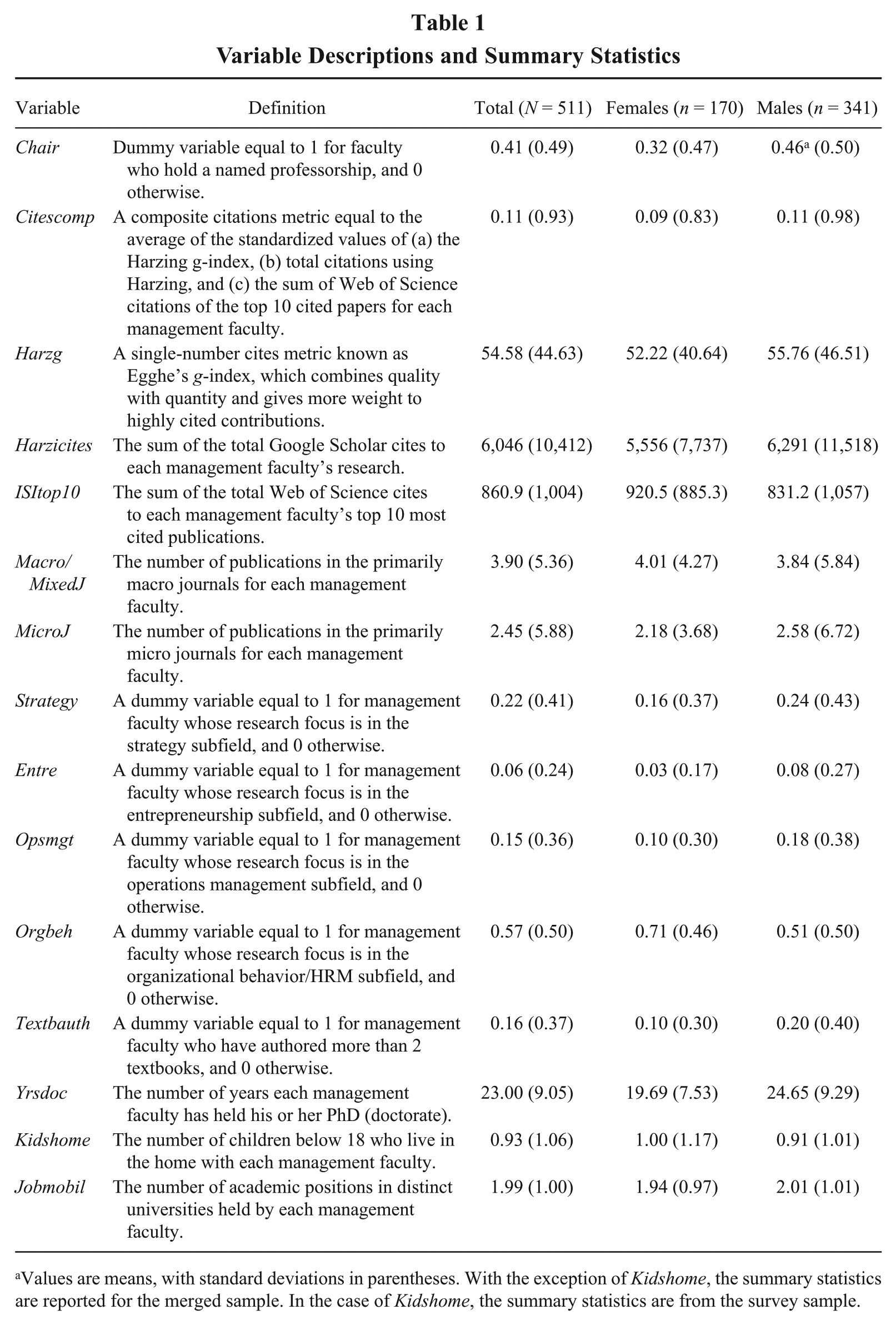
Values are means, with standard deviations in parentheses. With the exception of Kidshome, the summary statistics are reported for the merged sample. In the case of Kidshome, the summary statistics are from the survey sample.
Dependent Variable
Chair
This is a binary variable equal to 1 if a given management professor holds a named professorship and 0 otherwise (Chair).
Independent Variables
Gender
This is a binary variable equal to 1 for women faculty and 0 otherwise (Female).
Job mobility
This variable is proxied as the number of academic positions at different institutions held by each management faculty in our sample (Jobmobil). A behavioral pattern of more frequent moves should provide a cue to the selection committee and administrators that the faculty member is less tied to the focal institution or to the local area and thus more willing to relocate.
Kids in the home
This is equal to the number of dependent children living in each management professor’s household (self-reported in survey) (Kidshome).
Research productivity: Citations
The first performance measure in our study is arguably a direct “market test” in that it accounts for citations of a scholar’s academic publications (Citescomp for short). Use of this measure does not require an ex-ante classification of journals by quality for each faculty member, which may be open to debate.
We examined a number of citation data sources for measuring the impact of faculty research, each with its own advantages and disadvantages. Two well-known approaches are described in Harzing (2007), and each is based on Google Scholar counts of citations to a faculty’s research. The first measure, Harzcites, is the sum of total Google Scholar cites. The second measure, Harzg, also stems from citation counts in Google Scholar; however, in this case the citation count is used to calculate an adjusted single-number metric that measures scholarly impact. The metric used for Harzg is Egghe’s g-index, which combines quality with quantity and allocates more weight to highly cited contributions (Egghe, 2006). There are some distinct advantages in measuring faculty research productivity by way of either Harzg or Harzcites. First, Google Scholar is more comprehensive than competing services (e.g., Web of Knowledge), as it includes citations to books and a wider array of publications that are tagged in the Google system. Hence, it captures the influence of a person’s intellectual contributions on society at large (for instance, on practitioner publications and teaching materials) and does not impose a preconceived structure for citation credits (Harzing & van der Wal, 2008). Second, the Google-based measures are valid from a policy-capturing perspective, given that they exhibit substantial correlations with holding an endowed chair (in our sample, Harzg and Harzcites exhibit correlations of r = .43 and r = .34, respectively, with the Chair variable; see Table 2).
Correlations Among Variables

Note: N = 511 in each case except Kidshome, where N = 211.
All correlations ≥ .09 (in absolute value), with the exception of Kidshome, where all correlations ≥ .14 (in absolute value), are significant at p < .05.
Tetrachoric correlation coefficient.
On the other hand, the advantage of Google-based impact measures (the broader net of citation coverage) also has a downside in that some may believe that it is not sufficiently selective when it comes to citation credits. Thus, to complement the Harzing indicators we collected citation counts of the top 10 most-cited publications for each faculty member in our sample from ISI’s Web of Knowledge, which is more narrowly focused on citations in publications that have an “impact factor” and that appear in a select group of scholarly journals (ISItop10). Because all of the citation indicators are highly correlated (ranging from r = .59 to r = .90; see Table 2), we conducted a factor analysis to determine the extent to which they all tap the same underlying construct. Not surprisingly, the factor analysis results with varimax rotation confirm this (see Table 3). Only one factor emerged with an eigenvalue greater than 1, explaining a high percentage of common variance (73.4%). Factor loadings for all three citation measures are very high, ranging from 0.64 for ISItop10 to 0.95 for Harzcites. The Cronbach’s alpha for all three citation measures was very high (.88), well above the conventional level of .70 for acceptable internal consistency (Nunnally, 1978). In short, faculty members who score high on one citation metric, such as Harzg, also score high on other citation metrics, such as ISItop10. Given these results, we standardized each of the three citation scores and created a composite average score for each faculty member in our sample (Citescomp). Citescomp correlates .41 with Chair, similar to its three constituent elements (.43, .34, and .33 for Harzg, Harzcites, and ISItop10, respectively; see Table 2).
Results of Principal Axis Factor Analysis: Scholarly Impact Measures

Research productivity: Publications in top management journals
We believe that the composite citation factor described above offers the best indicator of scholarly productivity for senior faculty considered for endowed chairs in Tier 1 research institutions, given that any journal classification in terms of quality may be challenged, particularly when multiple subfields are involved. With this caveat in mind, we also considered a faculty member’s publications in select journals that tend to differentiate management faculty that have chairs from those that do not (Gomez-Mejia et al., 2009). These journals consist of a group of premier outlets where macro scholars primarily publish their research and a second group of highly respected outlets that are favored by micro scholars. Premier outlets that are targeted primarily by macro scholars include Academy of Management Review, Academy of Management Journal, Administrative Science Quarterly, Organization Science, and Strategic Management Journal (Macro/MixedJ for short) (Certo, Sirmon, & Brymer, 2010). This group of outlets is referred to as Macro/MixedJ because micro scholars publish regularly in some of these journals. Premier outlets that are targeted primarily by micro scholars include Journal of Applied Psychology, Organizational Behavior and Human Decision Processes, and Personnel Psychology (MicroJ for short) (Certo et al., 2010). Because it is possible for a faculty member to have published in both sets of journals, faculty in the present study are credited for any publication appearing in what Certo et al. (2010) refer to as “big eight” journals. However, by separately classifying the number of publications in each of these two broad journal groupings, we take into account the fact that it is uncommon for macro scholars to publish in the premier micro journals listed above.
Control Variables
Textbook (co)authorship
We calculated a dummy variable equal to 1 for individuals who have authored and/or coauthored more than two textbooks, and 0 otherwise. Textbook authorship represents a competing use of a faculty member’s time and other resources, and therefore it should be negatively related to holding a named professorship, other things being constant (Textbauth).
Discipline subfields
To control for various subfields in the management discipline, we considered a dummy variable series consisting of Strategy, Entrepreneurship (Entre), Organizational Behavior/Human Resources (Orgbeh), and Operations/Supply Chain Management (Opsmgt). The variables in this series are equal to 1 for faculty whose area of inquiry is strategy (Strategy), entrepreneurship (Entre), and operations/supply chain management (Opsmgt), respectively, and 0 otherwise. In constructing this series, the omitted dummy variable is Orgbeh, which, when equal to 1, captures inclusion in the organizational behavior/human resources subfield, and 0 otherwise. The coefficient estimates attached to the variables in this series account for variations in the probability of holding a named professorship due to variations in subfield inclusion. In this particular instance, no a priori judgment is made with regard to the sign or significance of the indicators in the series.
Professional experience
This variable (Yrsdoc) is equal to the number of years that professor i has held his or her PhD degree, keeping in mind that the minimum would be 10 years as this was a criterion for selection into the study.
Analysis
As noted above, Chair is a binary dependent variable equal to 1 if a management professor in our sample holds a named professorship and 0 otherwise. Estimation by ordinary least squares of a model with Chair as the dependent variable would yield biased and inconsistent coefficients. Therefore, maximum likelihood logit is used instead to test the hypotheses in this study (Zelterman, 1999). The model we used to test these hypotheses is shown in equation 1:

When hypotheses involving the type of named professorship (internal versus external hire) are tested, Chair in equation 1 is replaced with Nameproftype, a trichotomous variable coded 3 for those whose named professorships were obtained internally, 2 for those whose named professorships were obtained externally, and 1 otherwise (i.e., no named professorship held). Here, maximum likelihood estimation of equation 1, in this case when Nameproftype replaces Chair as the dependent variable, is employed to obtain unbiased and consistent coefficients. Given the construction of Nameproftype, a multinomial logit model is appropriate (Zelterman, 1999). Interpretation of the coefficient estimates in the case of the multinomial logit model is only slightly more complex than in the traditional or simple logit approach described above. In this case, positively signed (negatively signed) coefficient estimates indicate that the probability of having an internally awarded named professorship rises (falls) with increases in the variables attached to the coefficient estimates. At the same time, positively signed (negatively signed) coefficient estimates indicate that the probability of not having a named professorship of either type falls (rises) with increases in the variables attached to the coefficient estimates. The result of the changes described above on the probability of holding an externally awarded named professorship, which is the “middle” category in our trichotomous construction of Nameproftype, is, in an a priori sense, ambiguous, given that it depends on the relative magnitudes of the aforementioned changes in probabilities that Nameproftype equals 1 and 3. 1 The relationship between changes in the regressors and the probability of holding an externally awarded named professorship is, however, revealed through empirical estimation.
Results
The analysis was conducted separately in the survey sample (N = 211) and the merged sample (N = 511). The means and standard deviations for all variables in the merged sample, both pooled and separated by gender, are shown in Table 1, along with variable descriptions. About 32% of female management faculty hold named professorships, compared to about 46% of their male counterparts (the reader is reminded that all study participants have a minimum of 10 years experience after receiving doctorate). That is, proportionately women are far less likely to hold an endowed chair than men. This pattern of descriptive results is consistent with a gender-disparate hypothesis (Hypothesis 1), which is confirmed by the results of the multivariate logit model discussed below: men seem to enjoy a distinct advantage in entering the academic elite in ways that cannot be explained based on performance or human capital superiority (e.g., meritocracies). Other noteworthy comparisons in Table 1 indicate that there is no difference in the citation composite between men and women, men tend to publish a bit more overall than women in the “big eight” journals, on average (6.05 articles versus 5.53 articles), although the difference (0.52 articles) is not significant, while men, on average, have considerably more years since doctorate than women. The correlation coefficients of all the variables used in the study are shown in Table 2.
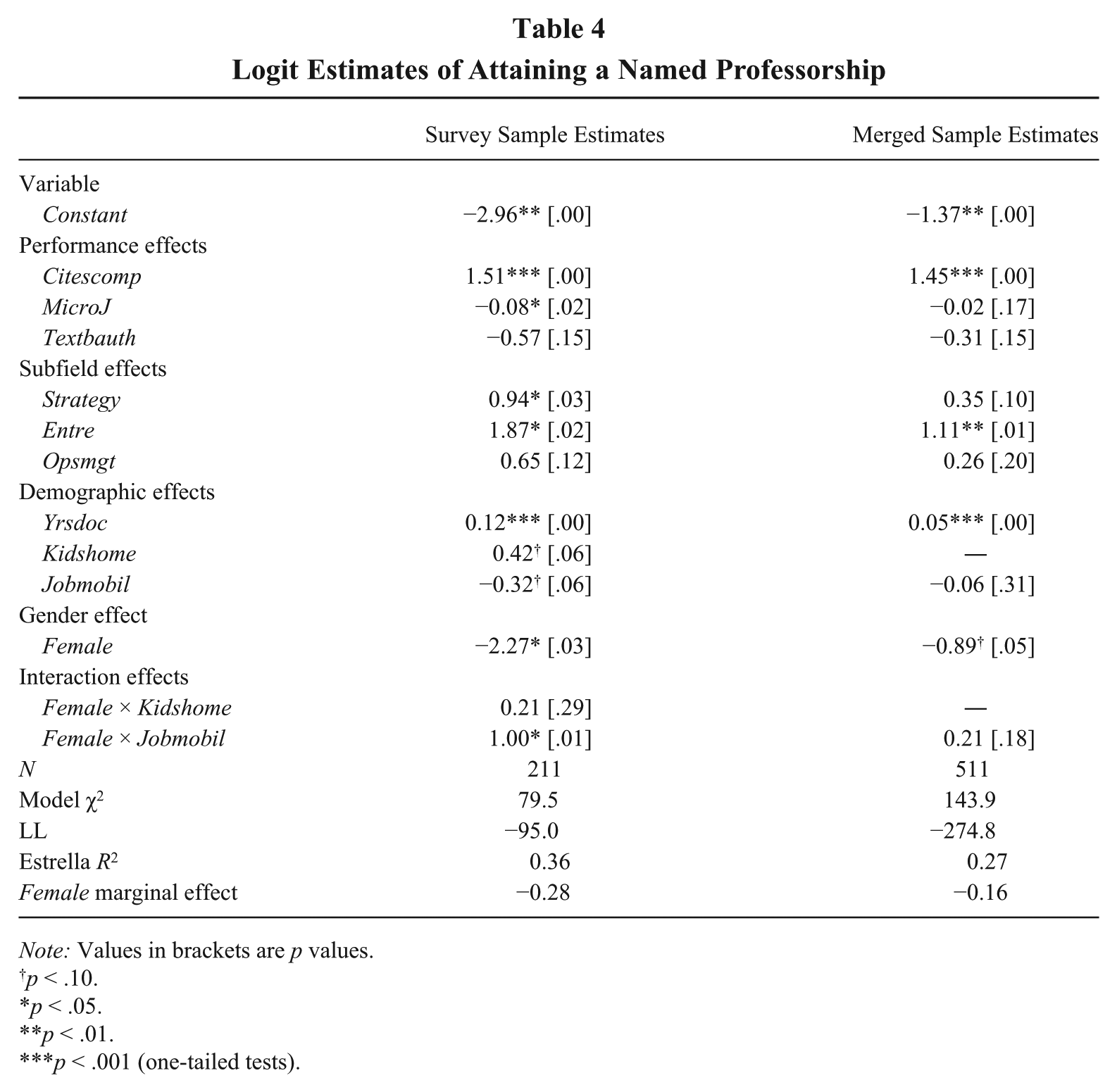
The logit regression results in Models 1 (survey sample) and 2 (merged sample) of Table 4 test our core hypothesis that women face a glass ceiling for advancement to named professorship that is inconsistent with a meritocracy. Given the relatively high correlation (r = .40) between Macro/MixedJ and Citescomp—a result indicating considerable overlap between these two variables—the models in Table 4 exclude Macro/MixedJ to reduce collinearity. The χ2 of 79.5 in Model 1 (survey sample) and 143.9 in Model 2 (merged sample) indicates that the set of regressors in both models is highly predictive of endowed chair status (see Table 4). Both models offer support for Hypothesis 1a. The negative and significant coefficients in Models 1 and 2 (both p ≤ .05) attached to Female, after controlling for research performance and other relevant variables, are consistent with the descriptive statistics discussed above: Women faculty face a lower probability of holding a named professorship than male faculty, while controlling for a host of performance, human capital, and demographic variables. The marginal effects in Table 4 for Female are a robust −0.28 (survey sample) and −0.16 (merged sample). 2
Logit Estimates of Attaining a Named Professorship
Note: Values in brackets are p values.
p < .10.
p < .05.
p < .01.
p < .001 (one-tailed tests).
We also found compelling evidence that women derive lower returns from their scholarly achievement than men when both genders compete in the tournament for endowed chairs (Hypothesis 1b). A hypothetical male faculty who has a scholarly impact of 0 (i.e., Citescomp = 0.00) along with the overall mean values for the other variables in our model faces a probability of having a named professorship equal to 0.44. A similarly qualified female, who also has the scholarly impact score of 0, faces the counterpart probability of only 0.33. As such, the lower probability faced by the female faculty member would have to increase by 34% for her to face the same probability of holding an endowed chair as her male counterpart. Even though both faculty are the same in terms of their scholarly impact, her Citescomp score would have to increase dramatically to achieve such a percentage increase. In addition, the impact of gender is seen clearly in Figure 1, which depicts the probability of holding a named professorship for male faculty and female faculty using the results for the merged sample in Table 4, wherein all of the regressors are held at their means (see Table 1). Last, borrowing from the tournament theory approach to faculty rewards in academe developed by Gomez-Mejia et al. (2009), our model is used to predict success in advancing to named professorship for these same two hypothetical faculty members. For example, given the probability estimate above, if the hypothetical male applies for two separate named professorship posts, the probability that he receives at least one offer (does not receive any offers) is 0.68 (0.32). If, on the other hand, the female faculty applies for three separate named professorship opportunities, the probability that she receives at least one offer (does not receive any offers) is only 0.55 (0.45).
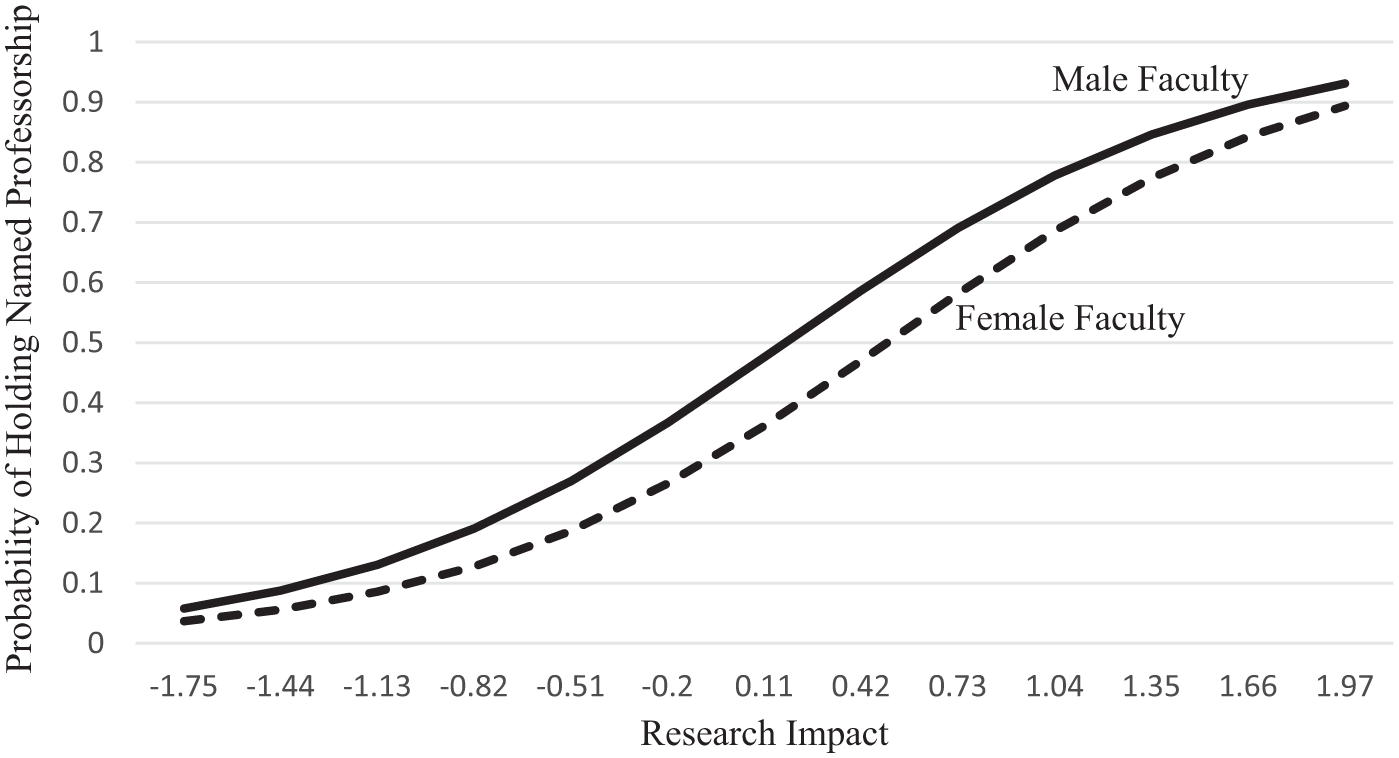
Effect of Research Impact on Probability of Holding Named Professorship
Table 5 provides further evidence for Hypothesis 1b, suggesting that female faculty need to score much higher than male faculty to receive an endowed chair. This table shows the average score for each of the performance indicators for men and women chair holders and those without endowed chairs. The performance indicators are provided in two forms: unadjusted for number of years since obtaining PhD and adjusted for number of years since obtaining PhD (performance score divided by years since obtaining PhD). The rationale for calculating the latter is that both citation counts and number of publications increase with number of years after obtaining PhD and we know from Table 1 that men on average were awarded their PhD 5 years earlier than women. As can be seen in that table, it is obvious that for both genders performance makes a dramatic difference in who gets an endowed chair; however women exhibit far higher performance scores than men when they hold a named professorship. For instance, if we focus our attention on Citescomp (the composite of the various citation measures) on a per year basis, women with endowed chairs show a performance score 67% higher than men (0.57 versus 0.34 respectively). For the same unadjusted performance measure (ignoring years since obtaining PhD, which favors men, as they had 5 more years on average to accumulate their record as compared to women) women with chairs show a performance score 22% higher than men (0.65 versus 0.53 respectively). In short, Table 5 indicates that men with weaker records than women are more likely to receive endowed chairs, or alternatively that women need to have more quality points than men to be awarded a named professorship. Thus, consistent with Hypothesis 1b women derive lower returns than men from their scholarly achievements.
Faculty Performance by Endowment Status and Gender

Note: Values are means, with standard deviations in parentheses.
Performance measures are adjusted for years of experience since PhD.
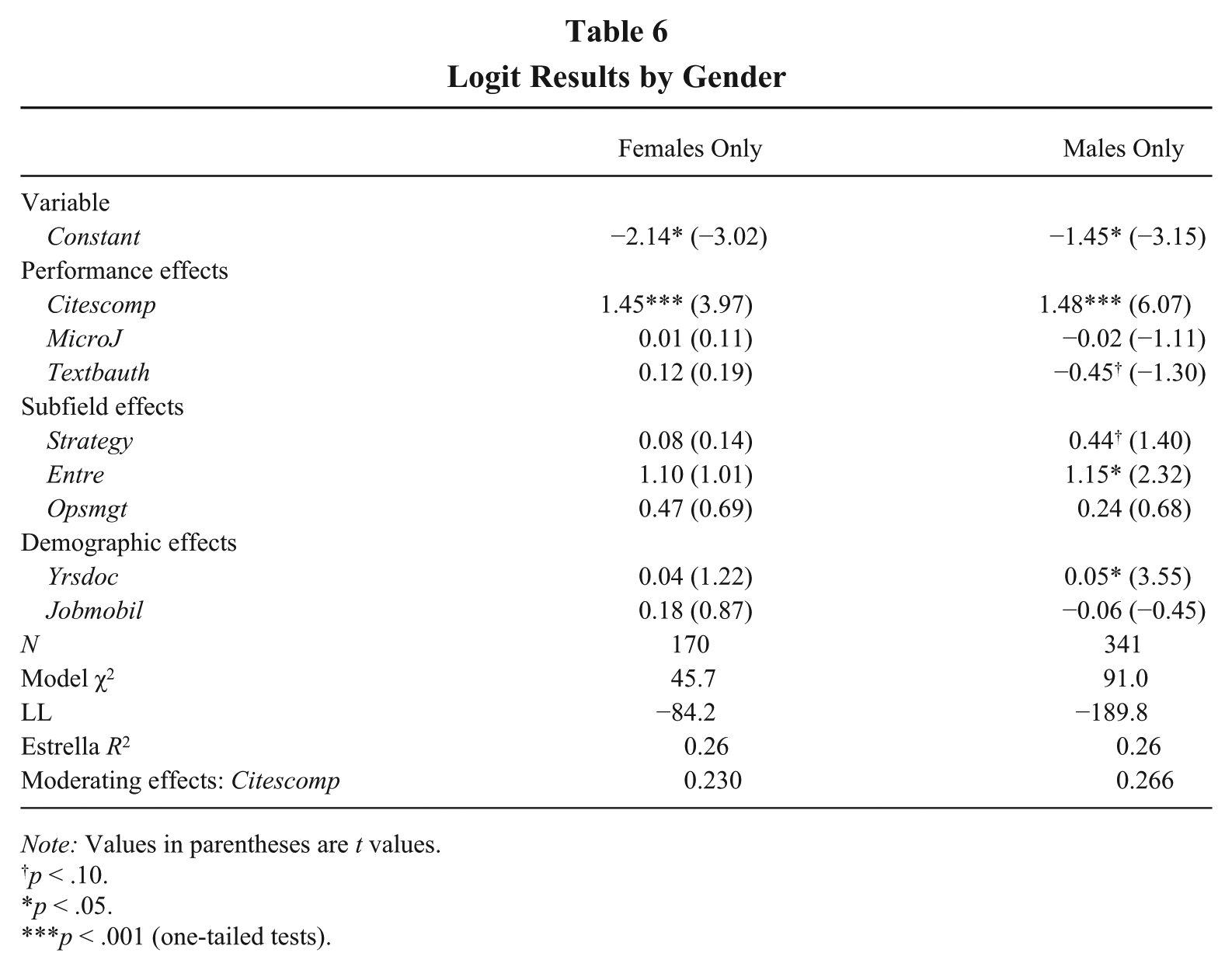
We tested Hypothesis 2 by running the main model separately within the female and male subsamples of the merged sample. As indicated in Table 6, the parameter estimate of Citescomp for males (i.e., 1.48) is slightly larger than that for females (i.e., 1.45), and the difference between these two parameters is not statistically significant. We interpret these results as suggesting that scholarly productivity is playing an appropriate role in the awarding of named professorships from a within-gender perspective. This finding provides support for Hypothesis 2. Gender discrimination, as suggested by the negative sign and significance of Female in our main models, appears to enter the process when females and males compete against each other for named professorships (as per Hypotheses 1a and 1b) but within-gender groups scholarly productivity equally determines which women (when competing against other women) or which men (when competing against other men) receive endowed chairs.
Logit Results by Gender
Note: Values in parentheses are t values.
p < .10.
p < .05.
p < .001 (one-tailed tests).
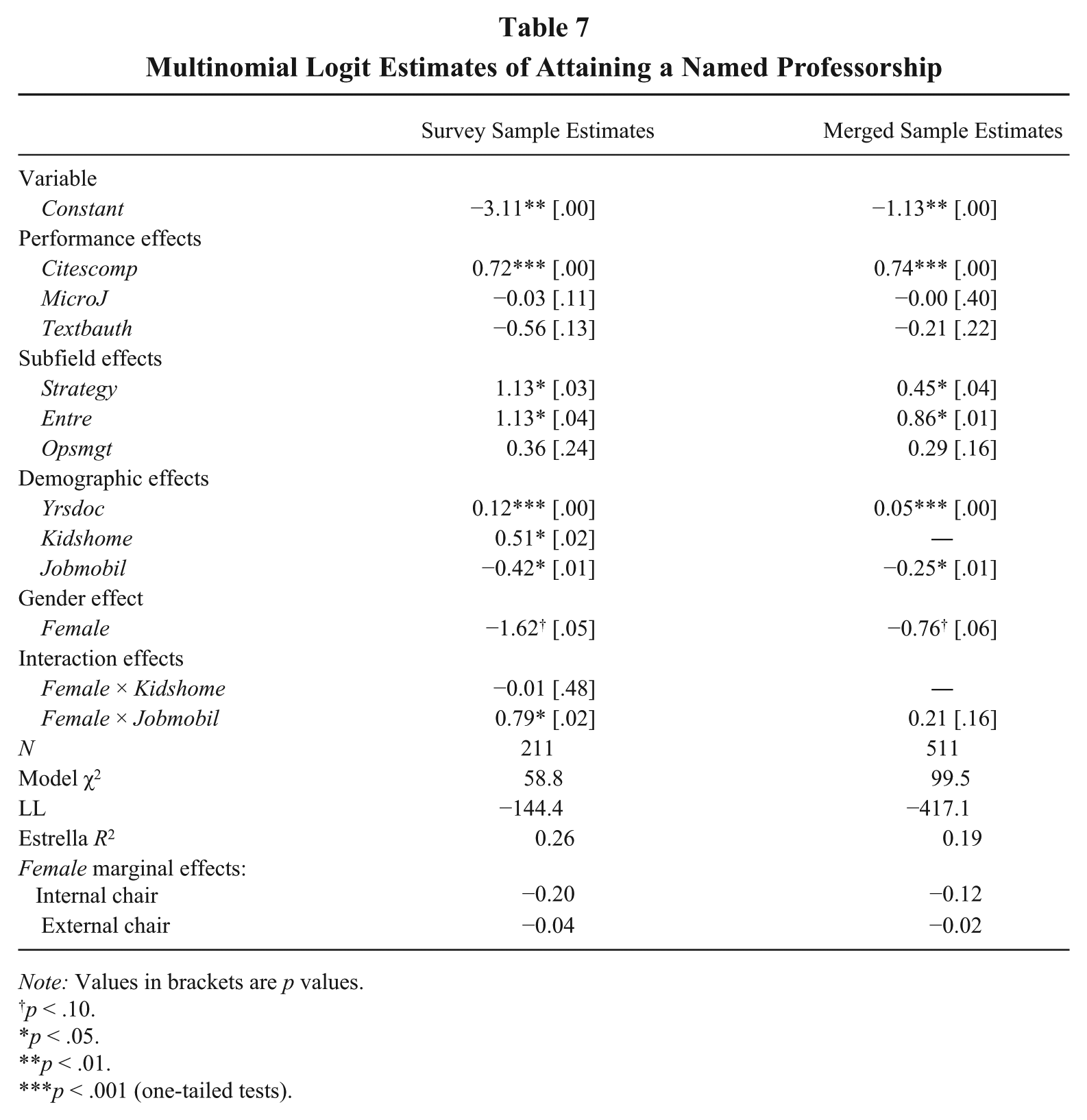
Information on whether one holds a named professorship as a result of advancing within one’s university (internal applicant) or by way of a move from one institution to another (external applicant) was used to test Hypothesis 3. Gender-based effects by internally or externally granted named professorships were examined using a multinomial logit model. The multinomial logit results are presented in Models 1 (survey sample) and 2 (merged sample) of Table 6. The χ2 of 58.8 (survey sample) and 99.5 (merged sample) indicates that the set of regressors in our models predict the choice of internal versus external candidates for endowed chairs. Importantly, the variable of interest, Female, retains a negatively signed coefficient, and it is statistically significant at conventional levels in both the survey sample (Model 1) and the merged sample (Model 2). These results support our hypothesis that the adverse gender effect for women is stronger for internal than external candidates. As shown in Table 7, the marginal effect for Female is a robust −0.20 (survey sample) and −0.13 (merged sample) with regard to named professorships awarded to management faculty from within the institution (category 3), yet a much less robust −0.04 (survey sample) and −0.02 (merged sample) with regard to named professorships awarded to management faculty from another institution (category 2). These results also indicate that females in the sample face probabilities of not having a chair of either type that are about 0.24 (survey sample) and 0.15 (merged sample) greater than those facing their male counterparts. It should be noted that in our sample 74% of all endowed chairs were filled internally, so this greater negative marginal effect for internal women candidates reinforces the depressing gender effect predicted and confirmed by Hypothesis 1a.
Multinomial Logit Estimates of Attaining a Named Professorship
Note: Values in brackets are p values.
p < .10.
p < .05.
p < .01.
p < .001 (one-tailed tests).
The interaction effect Female × Jobmobil is used to test Hypothesis 4. In the first of the two models of Table 4, Female × Jobmobil retains a positively signed and statistically significant coefficient (p < 0.02), supporting Hypothesis 4, which states that evidence of job mobility will weigh more heavily on a female’s probability of securing a named professorship as compared to a male faculty member. A plot of the interaction effect Female × Jobmobil on the probability of holding a named professorship using this model is shown in Figure 2. As can be seen in that figure, information suggesting a propensity to move (as inferred from previous changes in university affiliations) has a more positive effect on being awarded a chair for female than male faculty. In terms of the merged sample model in Table 4, however, the positively signed coefficient estimate attached to Female × Jobmobil falls just outside of conventional significance levels. As such, empirical evidence for Hypothesis 4 is mixed. These results are mirrored by those from the multinomial approach to named professorships by type that are found in Table 7.
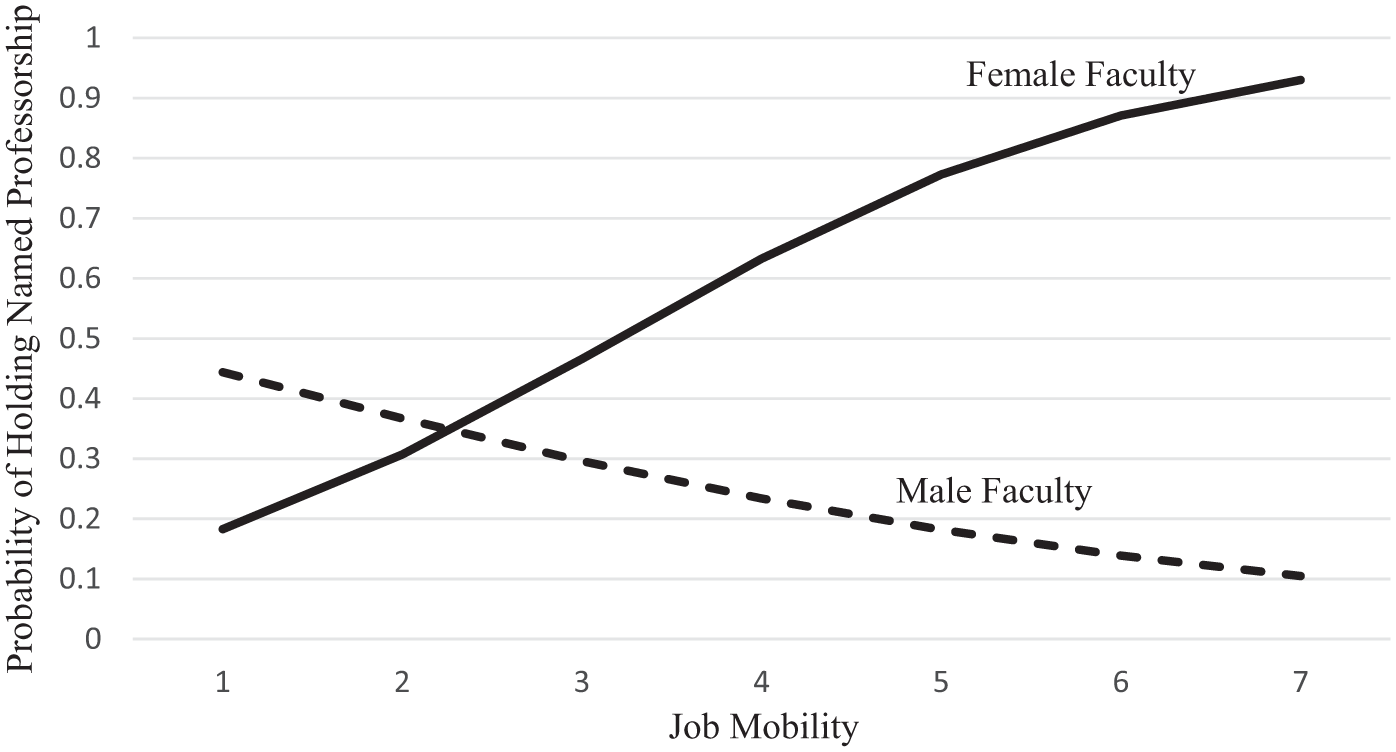
Gender × Job Mobility Interaction Effect on Probability of Holding Named Professorship
The interaction effect for Female × Kidshome, used to test Hypothesis 5, is not statistically significant in Model 1 of Table 4. This suggests that having children at home is not used as a status-based information cue for candidates for endowed chairs. The result for Female × Kidshome from the multinomial model of named professorship type is consistent with this finding.
We conducted some post hoc analyses to determine if other factors influenced the perceived contribution of a faculty member to the public research record. Specifically, we analyzed the survey sample data to determine if female faculty were more likely to publish with a larger number of coauthors (perhaps diluting the value of their contribution) or if males were more likely to be lead authors in pieces coauthored by females. We did not uncover any such evidence. Last, we explored whether or not our results are sensitive to our definition of “seniority” in our study as management faculty who are 10 or more years beyond the date of their PhD. To do so, we compared regression results using 10 or more years of experience beyond the PhD to other options, including 11 or more years, 12 or more years, 13 or more years, and 14 or more years. In each case, our previous results held, including those for Female. In fact, the coefficient estimate for Female, which is −2.27 in Model 1 of Table 4 using 10 or more years to define seniority, ranges from −2.59 to −2.21, and is statistically significant in each case, using the alternative definitions of seniority listed above. In terms of applying the alternative definitions of seniority to Model 2 of Table 4, where the coefficient for Female is −0.89, the new coefficient estimates are again statistically significant, ranging in this case from −0.82 to −0.75.
Discussion
The purpose of the present study is to respond to the open question of whether women lose the advancement competition in academia because they lack quality points or because gatekeepers use nonperformance factors that put them at a disadvantage relative to male faculty. The key contribution of this study is that it clearly illustrates that female faculty face a lower probability of holding an endowed chair than their male counterparts, even after controlling for performance, human capital factors, and other variables normally associated with advancement. By controlling for allegedly gender-neutral performance indicators, we demonstrate empirically that a meritocracy is not as prominent in academia as previously thought, and we add an important piece to the glass ceiling research. Because a faculty’s publication record in top-tier journals and citations to his or her research are the critical inputs that lead to advancement to endowed chair status (Gomez-Mejia et al., 2009; Tang et al., 1990), controlling for publication records and citations allows us to refute the claim that female academics lose the competition for advancement because their records are not equal to their male counterparts. Furthermore, the data suggest that women receive less recognition for their scholarly achievements than men, as reflected in the fact that women with endowed chairs tend to score much higher on performance metrics than men when adjusted for years of experience (see Table 5). In a unique academic setting in which we have been able to reduce putative performance-related causes of gender bias, and thus test the meritocratic explanation favored by many academics, our results support the hypothesis that a socially constructed, masculine-gendered environment explains advancement decisions at the highest level of academia.
To understand the magnitude of the double standards that women face in an academic setting, we consider a female and a male who are equal in every way except scholarly impact. Our empirical results indicate that the average male, who has a Citescomp score of 0.11, faces a probability of having been awarded a named professorship equal to 0.48, while the average female, who has a Citescomp score of 0.09, faces a probability of having been awarded a named professorship equal to 0.36, all else the same. Assuming the male’s Citescomp score remains 0.11, the female mean would have to increase her Citescomp score to 0.44—a score that is 4.83 times greater than her current score, and 3.95 times greater than his current score—to reach the same probability. Our finding is all the more compelling given that it occurs in a field where scholarly records are public and visible and the performance metrics for the awarding of endowed chairs enjoy wide consensus in research institutions.
We extend the career advancement and gender studies literatures in several ways. The adverse gender effect for women is stronger for candidates who were awarded named professorships from within their university of employment, as opposed to women who left their university to accept an endowed chair position. This finding builds on the sociological lens that theorizes how specific socio-demographic identities (e.g., race, gender) function to structure inequality in organizations by incorporating practices that may lead to inequality in the daily interactions of organizations. We posit that it is the recursive nature of the daily interactions between and among men and women that lead to the strengthening of the glass ceiling when women compete for endowed chairs that are awarded internally and the weakening of the glass ceiling when endowed chairs are awarded to external candidates. Because women seldom meet men in status-equal, role-similar interactions (Smith-Lovin & McPherson, 1993), we posit that principles of homophily and homosociality are amplified by intraorganizational daily interactions when advancement competitions take place among internal candidates. Our findings on internal advancement are consistent with research on gender-homophilous ties, in which women were found to require networks outside of their own organization to advance (Ibarra, 1992, 1997).
In our survey sample, we found evidence that a female faculty’s job mobility exerts a positive effect on her probability of receiving a named professorship, while the statistical significance of this relationship did not hold in the merged sample. These mixed findings build on the aforementioned internally and externally granted contexts, and are generally consistent with those of Tharenou (1999), who found that relocation predicted women’s but not men’s entry into management, advancement to middle management, and advancement to upper management, and with those of Bullard and Wright (1993), who found that women agency heads in the U.S. state public sector gained their jobs through external entry more often than men. Our interpretation is that gatekeepers may use gender as a stereotyped and status-based cue to ascertain who among a set of highly successful faculty is most likely to leave or become a recruitment target. It is assumed that men will leave if a better opportunity presents itself (and thus this variable is largely “a given” and hence it has little social role value for promotion purposes), while women may need to demonstrate strong evidence of mobility to be awarded a preemptive endowed chair. Given our mixed findings, further research is warranted.
We posited that the status implications of motherhood would combine with those of gender to negatively impact the likelihood of mothers being awarded an endowed chair in management. According to expectation states theory, if the role of mother is to function as a disadvantaging status characteristic, it must not only lower status, but also competence (Ridgeway & Correll, 2004). We hypothesized and tested this set of linkages in advancement decisions at the highest level of academic appointments, namely endowed chairs in management departments, but we did not uncover any evidence that having children at home was used as a status-based information cue to disadvantage women. Although this finding is consistent with Tharenou’s (1997, 1999) research in a corporate setting, it runs counter to predictions of the theory of social roles in careers. Social roles theory predicts that some qualified female faculty are expected to “opt out” and to avoid seeking career advancement to sustain better work–life balance (Cabrera, 2007; Mainiero & Sullivan, 2005). In addition, van den Brink and Benschop (2012) discussed motherhood as a salient gender inequality practice and provided field evidence that a woman with care responsibilities must convince gatekeepers in academia that work will take priority over family, while a man with family responsibilities need not provide such evidence. In our case failure to support this hypothesis may be due to the “10 year since PhD” criterion for sample selection given that few very young children may be at home for most of our faculty sample.
Limitations and Future Research
One of the main reasons why researchers study gendering practices is to change them (Poggio, 2006), and the present study is no exception. According to Lorber (2005), one of the best ways to respond to injustice in current practices is to make them visible. Consistent with these objectives, and answering the call for “the need for more empirical investigations of diversity in organizational settings,” we believe that we have provided “hard data” that “makes visible the ‘inconvenient truth’ of unfairness and discrimination causing vertical segregation and the glass ceiling” in academia (Zanoni et al., 2010: 17). Although our quantitative study has many strengths, one of its inherent limitations is its inability to capture the context of networking and the relationships that reside within networks (Shaw, 2006). This is especially important in gender theory and glass ceiling studies, as gender practices cannot be completely understood without qualitatively understanding the human behavior behind routinized gender practices (Bluhm, Harman, Lee, & Mitchell, 2010). This is why it is critical for quantitative and qualitative studies to build on one another, fostering the development of a multilevel understanding of how gendered practices lead to gender inequality, and ultimately to the slow pace of change in academia. Another limitation of the present study is its lack of capturing some of the more subtle means by which women may be excluded from advancement circles, such as lack of mentors who have successfully navigated the pipeline and reached the top (van den Brink & Benschop, 2012, 2014).
Last, another limitation of our study is that we use a binary measure of named professorship and this does not take into account the possibility that some professorships are more lucrative than others (this information is not publicly available). We suspect that, even among faculty chair holders, women may not be awarded the most lucrative chairs (e.g., those with the highest endowments). Almost 25 years ago Gomez-Mejia and Balkin (1992) found that, after controlling for performance, more senior women management professors received less pay and lower pay raises than their male counterparts. Hence, coupled with the results of this study, one could hypothesize that the most lucrative endowed chairs may be reserved primarily for men and that the findings reported in this study (based on a binary named professorship measure) actually underestimate the disadvantage that women face in the advancement to named professorship status. 3
Conclusion
Masculine-gendered structures precluding entry into the ranks of the elite in organizations based on the glass ceiling effect are subtle and difficult to disentangle from other factors that impede entry into the upper echelons of organizations. Our results provide empirical evidence demonstrating that, even under conditions where the effects of gender and performance have been isolated, thus refuting the meritocratic rationale for men having easier access to the top than women, there appear to be difficult-to-detect processes based on masculine-typed environments that are likely to result in significant barriers for women seeking admittance to the highest rank in their profession. Indeed, women face biases that are so deeply embedded in these processes that they may not even be noticed until they are eradicated (Meyerson & Fletcher, 2000). It is in the hope that increased awareness of the problem will help to eradicate it (Hoobler et al., 2009; Hoobler et al., 2011) that we present our findings.
Footnotes
Acknowledgements
This article was accepted under the editorship of Patrick M. Wright. The authors would like to thank three anonymous referees and Felipe Massa for guidance and comments on an earlier version of this article. In addition, the authors would like to thank Charles Funk, Francisco Morales, and Kun Zhang for their assistance in collecting data used for the empirical analysis.