



Abstract
We posit that family firms often face a dilemma in their strategic decision making: whether to maintain current socioemotional wealth or pursue prospective financial wealth. Applying such a mixed gamble perspective to acquisitions, family owners assess potential acquisitions with regard to their impact on both wealth dimensions. In line with this reasoning, our results show that family control implies a general reluctance to acquire and, when an acquisition happens, a preference for related targets. Because financial and socioemotional viewpoints lead to largely incompatible predictions about the occurrence and relatedness of acquisitions, family firm owners use their firm’s vulnerability as a signal. Increased vulnerability leads to a heightened propensity to prioritize financial over socioemotional wealth problem framing, which is reflected in the acquisition of unrelated targets. Empirical results are supportive of these predictions.
Introduction
Over the years, researchers have examined why managers engage in acquisitions in substantial detail. The literature features acquisition experience (e.g., Hayward, 2002), market power (e.g., Hitt, Harrison, & Ireland, 2001), cost reductions (e.g., Graham, Lemmon, & Wolf, 2002), resource redeployment (e.g., Capron, Dussauge, & Mitchell, 1998; Uhlenbruck, Hitt, & Semadeni, 2006), and market discipline (e.g., Rhodes-Kropf, Robinson, & Viswanathan, 2005) as important strategic drivers of acquisitions. This well-developed literature is predicated on the idea that agents survey the market for corporate control for economically advantageous acquisition targets (e.g., Barkema & Schijven, 2008b; Deutsch, Keil, & Laamanen, 2007).
More recently, there has been a turn toward behavioral motives of managers to engage in acquisitions (e.g., Iyer & Miller, 2008). This research shows that the likelihood of an acquisition alters depending on whether a firm performs above or below aspiration levels. Interestingly, however, behavioral motives of owners are largely unexplored. Behavioral motives to engage in acquisitions could differ with ownership configuration as dominant owners differ in their goal sets, even among publicly traded firms (e.g., Desender, Aguilera, Crespi, & Garcia-Cestona, 2013; Thomsen & Pedersen, 2000). We address this gap in the literature by examining the acquisition behavior of publicly listed family firms and suggest that family firms differ from their nonfamily counterparts by facing two types of utility dimensions in tandem, financial and socioemotional wealth (SEW; Gomez-Mejia, Haynes, Nunez-Nickel, Jacobson, & Moyano-Fuentes, 2007), which should lead to divergent acquisition behaviors. SEW captures the family’s stock of social, emotional, and affective endowments vested in the firm, such as the opportunity to pass the firm on to future family generations (Zellweger, Kellermanns, Chrisman, & Chua, 2012), reputational advantages from being associated with the firm (Deephouse & Jaskiewicz, 2013), and the preservation of benevolent ties among family members and with other stakeholders (Cruz, Gomez-Mejia, & Becerra, 2010). Thereby, the financial and socioemotional utility dimensions are not fully fungible, and a change in one utility dimension often leads to an opposite change in the other utility dimension (Combs, Penney, Crook, & Short, 2010; Leitterstorf & Rau, 2014). When taking a strategic decision, such as about an acquisition, family business owners are thus caught in a dilemma wherein they have to weigh the anticipated losses and gains (Bromiley, 2009, 2010) in both financial and SEW terms, what we refer to as the mixed gamble of family firm owners. More specifically, family business owners have to weigh the likely gains and losses of strategic decisions in terms of their impact on both the current SEW endowment and future financial wealth.
We propose that facing the horns of this dilemma, family business owners will give strong consideration to the firm’s vulnerability, which results from performance below aspiration levels and/or low levels of slack. This is because financial peril ultimately threatens the survival of the firm, the source of the family’s financial wealth, and SEW. In line with a behavioral perspective of decision making, under normal conditions, actors should be loss averse (Wiseman & Gomez-Mejia, 1998), focus on their current (socioemotional) endowment, and discount more strongly strategies with uncertain upside. Under vulnerability, however, decision makers solve the dilemma by progressively focusing on prospective financial considerations and are thus willing to take risks even if this occurs at the expense of SEW.
We apply this conceptualization of mixed gamble of strategic decision making in family firms to the case of acquisitions and their relatedness. Financial considerations stress the desire to diversify the firm’s portfolio under concentrated ownership, whereby acquisitions, in particular unrelated ones, should appear attractive. In this manner, concentrated owners may create new revenue streams and diversify their risk (e.g., Morck, Wolfenzon, & Yeung, 2005; Shleifer & Vishny, 1986). SEW considerations, in contrast, stress that acquisitions, especially unrelated ones, lead to losses in familial control, water down the family firm’s identity, and weaken social ties linked to the firm. Thus, family firm owners face a dilemma: Should they engage in acquisitions, and in particular unrelated ones, in the pursuit of future financial gains, or should they refrain from acquisitions, in particular unrelated ones, to preserve current SEW?
Under a behavioral agency decision frame that underlies our theorizing, family businesses should be hesitant to acquire, particularly unrelated firms, because the expected financial gains from acquisitions are ultimately uncertain (e.g., Hitt et al., 2001) and the loss in SEW terms is fairly certain (Gomez-Mejia, Makri, & Larraza-Kintana, 2010). Thus, acquisitions are discouraged by family businesses, and if they acquire, they prefer related targets. Vulnerability should weaken the family firm’s overall reluctance to acquire and also the reluctance to acquire unrelatedly because if the firm fails to survive, SEW and financial wealth would disappear altogether.
Seeing strategic decision making in family firms as mixed gambles, we attempt to make four contributions to the literature. First, we extend the literature on the influence of ownership types on strategic actions to encompass acquisitions (e.g., Connelly, Hoskisson, Tihanyi, & Certo, 2010; David, O’Brien, Yoshikawa, & Delios, 2010; Lane, Cannella, & Lubatkin, 1998; Ramaswamy, Li, & Veliyath, 2002). For the case of family firms, we explore how the parallel concern for financial and socioemotional goals biases the occurrence and the relatedness of acquisitions. Second, to family business research, our mixed gamble perspective reconciles the findings by Miller, Le Breton-Miller, and Lester (2010) on the inclination of family firms to prefer unrelated targets with those by Anderson and Reeb (2003) and Gomez-Mejia et al. (2010) on the general preference of family firms to avoid diversification altogether. With our study, we extend the work by Miller et al. and explore the occurrence of acquisitions just as the contingent effect of vulnerability. In contrast to Miller and colleagues, but in line with our mixed gamble theorizing, we find that when a family firm does decide to acquire, it more likely prefers a related firm.
Third, we contribute to research on the utility considerations of family owners. Previous research treats family owners as either concerned with financial goals alone (e.g., Morck & Yeung, 2003), with socioemotional goals alone (e.g., Berrone, Cruz, & Gomez-Mejia, 2012), with the protection of current SEW endowment (Gomez-Mejia et al., 2007), or with socioemotional gains and losses (Gomez-Mejia, Campbell, Martin, Hoskisson, Makri, & Sirmon, 2014). We integrate these scattered conceptualizations of family owners’ goals and portray family owners’ decision making as a dilemma in which anticipated losses and gains in both financial and SEW dimensions are considered in tandem.
Lastly, we introduce the notion of vulnerability, proxied by below-aspiration-level performance and the absence of slack, which has a decisive impact on how actors solve the decision dilemma. Under vulnerability, SEW and financial concerns are aligned or become synoptic as drivers of acquisitions. This is because meeting the firm’s financial obligations is a necessary condition for the family owners to enjoy any SEW and financial utility. Under prosperity, however, SEW and financial goals are at odds as drivers of acquisitions. In the absence of performance hazards, family principals can afford the luxury of remaining undiversified and, thus, avoid sacrificing SEW through diversification. Also, in a mixed gamble, the presence of slack, by reducing vulnerability, does not drive but rather dampens “problemistic search,” such as via an unrelated acquisition, which is contrary to predictions of the behavioral theory of the firm on slack search (Levinthal & March, 1981).
Theoretical Foundations
Behavioral Agency, SEW, and Mixed Gamble
The behavioral agency model (BAM; Wiseman & Gomez-Mejia, 1998) that supports our conceptual frame departs from standard agency arguments in several important ways. Most importantly for the case of our study, BAM sees decision makers not as constantly risk averse but as loss averse. Decision makers are risk takers in the domain of losses to recoup an unsatisfactory situation. In the domain of gains, however, decision makers are risk averse to protect their endowments (Martin, Wiseman, & Gomez-Mejia, 2013). Also, recent developments of BAM relax the assumption that decision makers consider financial utility dimensions alone. For instance, Zona, Gomez-Mejia, and Withers (2018) argue that executives often engage in interlocks to gain prestige and influence in the industry rather than for financial reasons.
The collective set of nonfinancial utilities experienced by family owners have been termed SEW, defined as the family owner’s stock of affect vested in the firm (Gomez-Mejia, Cruz, Berrone, & De Castro, 2011). SEW encompasses such dimensions as transgenerational control, the preservation of family reputation, benevolent ties within the family, and strong emotional attachment to the firm (Berrone et al., 2012). SEW is distinct from the nonfinancial goals of nonfamily firms’ managers, such as empire building, attending to narcissistic needs, and power (Chatterjee & Hambrick, 2007; Finkelstein, 1992; Trautwein, 1990). Managers of nonfamily firms may enjoy nonpecuniary rewards (Chatterjee & Hambrick), but given a contractual relationship with the firm that is subject to rescission, they are less bound to a particular organization. In contrast, the SEW goals of family owners tend to be fully and irrevocably grounded in the family firm. Also, family owners have an extended time horizon that often spans across generations (Zellweger et al., 2012). While nonfamily managers seek to build reputations and empires mainly for themselves, the focus of family owners is on the family group (Deephouse & Jaskiewicz, 2013). In short, the nonfinancial goals of family actors are distinct from those of nonfamily actors as a result of their firm-specific link, extended time horizon, focal group, and dimensionality. 1
There are multiple recent studies that provide compelling evidence for family firms’ concern for SEW (for an overview, refer to Gomez-Mejia et al., 2011). Some of these studies suggest that family firms are concerned with socioemotional goals alone (Berrone et al., 2012), seek to protect their SEW endowment (Gomez-Mejia et al., 2007), or weigh the socioemotional gains and losses in making strategic decisions (Gomez-Mejia, Campbell, et al., 2014). These findings stand in strong contrast to the prominent agency-based research suggesting that family owners are concerned with financial goals alone (Morck & Yeung, 2003). In light of this tension about relevant goals, still other studies have alluded to the interplay of financial and SEW goals (Chrisman & Patel, 2012; Gomez-Mejia et al., 2010; Patel & Chrisman, 2014) and suggest that under strong financial performance, SEW concerns take precedence over financial concerns, while financial duress pushes SEW concerns to the back. Broadly spoken, these studies thus assume that family firms are either concerned with SEW or financial wealth. What is lacking, however, is a reconciliation of these scattered views of family owners’ goals, which at the same time explains the strategic decision making in this type of firm.
In moving towards such an integrated perspective, we theorize that family-controlled firms face a dilemma in their strategic decision making by having to assess the likely gains and losses of their actions in financial and socioemotional terms in tandem. 2 More specifically, we suggest that family owners have to weigh the likely outcomes of strategic decisions in terms of their impact on both the current SEW endowment and future financial wealth. Weighing the upside and downside of a strategic action in these two utility dimensions in parallel is challenging for decision makers for two main reasons: First, the two utility norms are not fully fungible (i.e., convertible), which inhibits a combined consideration along the lines of some “net” effect by summing the expected gain and loss portions of each (Wu & Markle, 2008). Second, a change in one utility dimension often leads to an opposite change in the other utility dimension (trade-off between financial and SEW considerations; Chrisman & Patel, 2012; Gomez-Mejia et al., 2011; Leitterstorf & Rau, 2014).
Being caught in this decision dilemma with potential gains and losses alludes to the idea of mixed gamble. Bromiley (2009, 2010) argues that most strategic choices confronted by managers represent mixed gambles, given the possibility of gains and losses associated with these decisions (MacCrimmon & Wehrung, 1990; March & Shapira, 1987; Martin et al., 2013; Wu & Markle, 2008). Mixed gambles acknowledge the idea that managers rarely confront strategic choices involving win-win or lose-lose outcomes, that is to say pure gambles. While decision makers in family and nonfamily firms alike have to grapple with mixed gambles, family firms face an extra level of complexity in that they are faced with a mixed gamble that entails two not fully fungible currencies, that is financial and SEW, which normally trade off against each other (Combs et al., 2010). The trade-off between financial and SEW considerations will often lead to win-lose or lose-win outcomes, respectively, when these outcomes are assessed in financial and socioemotional terms. For instance, a turnaround measure could result in financial gains but at the same time detract from SEW, while hiring a limitedly qualified family member should lead to an opposite payoff scenario in the two utility dimensions.
We theorize that in the horns of this mixed gamble dilemma, decision makers will give strong consideration to the firm’s vulnerability, which results from performance below aspiration levels and/or low levels of slack. Under low vulnerability, SEW and financial goals are at odds as drivers of strategic change. In absence of financial duress, family business owners should be risk averse and strongly discount the uncertain upside tied to a strategic option while giving more emphasis to the protection of current endowments. Under vulnerability, however, SEW and financial concerns are aligned as drivers of strategic change. This is because meeting the firm’s financial obligations is a necessary enabling condition for family owners to enjoy SEW and financial utilities in tandem. Financial duress should thus emphasize the need for financial improvements, even if this implies accepting transient losses in SEW. Our theorizing thus assumes that because strategic change implies a trade-off between socioemotional and financial outcomes in most cases, SEW and financial concerns are normally at odds as drivers of strategic change. Under vulnerability, however, SEW and financial concerns are aligned as drivers of strategic change since inactivity under threat would mean “throwing the baby out with the bath.” This is because if the firm fails to survive, SEW and financial wealth would disappear altogether. Integrating these arguments, SEW thus serves as a catalyst for strategic change under vulnerability, while it serves as an impediment to strategic change under prosperity.
Occurrence of Acquisitions as Mixed Gamble
An intriguing context to test our theorizing is to analyze acquisitions undertaken by family firms. Firms normally engage in acquisitions in the pursuit of important financial gains, as outlined in a wide array of research (Haleblian, Devers, McNamara, Carpenter, & Davison, 2009; McNamara, Haleblian, & Dykes, 2008). But from many real-life examples and multiple academic studies, we have to conclude that the hoped-for financial gains are rather uncertain (e.g., Capron & Pistre, 2002; D. R. King, Dalton, Daily, & Covin, 2004; Masulis, Wang, & Xie, 2007). Many acquisitions result in lower than expected market power (e.g., Hitt et al., 2001), disappointing cost reductions (e.g., Graham et al., 2002), or inefficient resource redeployment (e.g., Capron et al., 1998; Uhlenbruck et al., 2006) postacquisition.
The literature is more definite, however, about major downsides of acquisitions in terms of SEW losses to the family. First, acquisitions often require external financing. Thus, acquisitions tend to weaken family control and independence, an important component of SEW (Dreux, 1990; Zellweger et al., 2012). Second, the acquirer’s well-established social networks may be disrupted by the acquisition of a new firm (Friedland, Palmer, & Stenbeck, 1990). For example, successful acquisitions require opening up social networks at both the acquiring and the acquired firm (Bergh & Gibbons, 2011; Capron & Pistre, 2002). The family then depends on managers, experts, and consultants from outside the family and most often also the original firm (Gomez-Mejia et al., 2010). This undermines preexisting, close-knit, and benevolent ties, such as the ones with long-time employees of the original firm that are so dear to family owners (Cruz et al., 2010). Third, threats to the firm’s and the family’s reputation may arise from the change in combined product and resource portfolios. In comparison to organic growth, acquisitive growth expands existing products, brands, and markets in a short period of time, which often dilutes a consistent image of the firm and the projection of the family owners onto that image (Deephouse & Jaskiewicz, 2013). Finally, the scenario of a failed acquisition, which may require the divestment of the once-acquired firm, will be seen as a major deterrent for the family who tends to view the firm as an extension of that family. Given the family’s long-term association with the firm, it will avoid decisions that may require it to admit a mistake at a later stage.
Combining these arguments, family owners face a dilemma with acquisitions that pose an uncertain upside in terms of higher future financial wealth and a certain downside in terms of losses in current SEW endowments. In line with BAM predictions about a preference for wealth in hand in the face of uncertainty (Wiseman & Gomez-Mejia, 1998), we suggest that a certain loss in SEW looms larger than the uncertain future financial rents from an acquisition. Under these circumstances, and as our baseline hypothesis, we thus expect that family principals will avoid acquisitions. Thus,
Hypothesis 1: Family control lowers the likelihood of acquisitions.
The nonconvertibility and the dimensionality of SEW and financial goals violate the standard models of optimization, which assume that “there is a common currency for all beliefs and desires, namely, quantitative probabilities and utilities” (Gigerenzer & Todd, 1999: 10). Hence, family actors are prone to seek information that provides signals about how to solve the decision dilemma. Because the worst possible disaster is the loss of total financial wealth and SEW that would result from the failure of the firm, we argue that family firm owners will weigh the financial and socioemotional gains and losses on the basis of the firm’s vulnerability. Two such sources of vulnerability are below-aspiration-level performance and low levels of slack.
If firm performance meets or exceeds expectations, family actors should be risk averse, focus on their current (socioemotional) endowment, and discount strategies with uncertain upside. Under prosperity, the vulnerability of the family owner is low, limiting the need for change. In contrast, as performance falls below aspiration levels, vulnerability increases accordingly (Cyert & March, 1963; Greve, 1998; Iyer & Miller, 2008), and as a result, family firm principals should feel greater pressure to improve the firm’s financial situation and reduce the risk of failure. While “problemistic search” may be triggered for all firms facing performance below aspirations (Cyert & March), this condition should be particularly alarming for firms with higher levels of family control because both the increasing concentration of financial wealth and SEW are at stake. Hence, under the menace of personal and financial ruin, financial and socioemotional concerns become synoptic, inducing family principals to engage in acquisitions hoping to reverse a hazardous situation, even if this requires the family to accept losses to their SEW.
In other words, the change toward acquisition behavior at t + n as a result of performance below aspirations at t + 0 should be more aggressive for family-controlled firms because both concentrated financial wealth and SEW are at stake (Chrisman & Patel, 2012). Thus, family owners will frame the likely outcome of an acquisition as a certain SEW loss with uncertain financial gains if firm performance meets or exceeds aspiration levels (“little to gain, much to lose” framing). In contrast, performance below aspiration levels will reverse the framing to “much to gain (in the form of both higher future financial wealth and the preservation of SEW) and little to lose.” Taken together, we argue that below-aspiration-level performance serves as a signal to family owners about how to solve the decision dilemma, intensifying the need to reverse a deteriorating financial situation to preserve SEW and financial wealth. Family principals should be more willing to engage in an acquisition in this situation, even if the acquisition may require significant risks and transient losses in SEW.
Hypothesis 2: Performance below aspiration levels attenuates the negative effect of family control on the likelihood of acquisitions.
Next to performance relative to aspirations, slack also provides information about the vulnerability of family principals. Slack, defined as unused resources available to the firm (Iyer & Miller, 2008: 811), reduces the risk borne by family owners because it buffers against performance shortfalls (Bourgeois, 1981). To family owners, slack represents the resources to withstand economic jolts, signals stability and wealth security, and provides the opportunity to pursue SEW, even if it also implies certain inefficiencies, such as foregone growth opportunities through acquisitions. Slack should thus reinforce a sense of performance satisfaction and spare its owners a sense of urgency. In such a comfortable position, family owners should be risk averse and strongly discount the promised future financial gains tied to strategic change, emphasize the sure losses to SEW tied to such change, and thereby discourage acquisitions.
Traditional behavioral logic posits that slack should enable experimentation and “slack search” (Levinthal & March, 1981), thereby making acquisitions more likely. According to this view, slack provides maneuvering room with a direct positive effect on experimentation (Cyert & March, 1963). However, more recent research suggests that slack has an indirect effect on firm behavior (Arrfelt, Wiseman, & Hult, 2013), which functions as an inertia-fostering buffer (Hitt, Hoskisson, & Ireland, 1994) that reinforces clinging to the status quo (Kraatz & Zajac, 2001). When slack resources coincide with high levels of family control, family firms should be less inclined to acquire. That is, by reducing vulnerability, slack should intensify the general reluctance among family principals to engage in acquisitions.
Hypothesis 3: Slack strengthens the negative effect of family control on the likelihood of acquisitions.
Relatedness of Acquisitions as Mixed Gamble
Miller and colleagues (2010) argue that the business risk considerations of undiversified family owners should lead to more unrelated acquisitions. In line with this portfolio logic (e.g., Amihud & Lev, 1981; Anderson & Reeb, 2003; Dennis, Dennis, & Sarin, 1997; Shleifer & Vishny, 1986), findings by Miller and colleagues show that although family firms diversify less, those that do choose to acquire prefer unrelated targets. Diversifying acquisitions compensate for performance variance across a portfolio of businesses and are thus an important instrument to reduce overall business risk (Anderson & Reeb). However, while diversified acquisitions benefit family principals by reducing business risk, their performance consequences are less predictable. While some researchers find that diversified firms trade at a discount relative to single-segment firms (e.g., Berger & Ofek, 1996; D. R. King, Slotegraaf, & Kesner, 2008; Lang & Stulz, 1994; Servaes, 1996), others suggest that unrelated diversification results in a premium (Campa & Kedia, 2002; Graham et al., 2002; Villalonga, 2004). Therefore, the overall financial attractiveness of unrelated acquisitions will be challenging to assess. Such a strategy may reduce business risk, but the total financial wealth effects are uncertain because of possible performance shortfalls.
In light of our dilemma reasoning, we expect family firm owners to assess not only the financial but also the socioemotional implications of a diversifying acquisition. For multiple reasons, unrelated acquisitions should diminish SEW for family principals. First, and as noted by Barkema and Schijven (2008b), achieving organizational fit and reaping the rewards from the acquisition (in particular of unrelated firms) often require important restructuring on the part of the acquirer, which erodes familial control. Second, unrelated acquisitions make existing social ties less valuable because new connections with unfamiliar suppliers, clients, and advisors have to be secured (Hitt et al., 2001). Third, a family firm engaging in unrelated acquisitions would probably need to recruit executives who possess diverse skills not available within the family. It would have to adopt new routines that stray from time-proven methods (Eisenmann, 2002; Vermeulen & Barkema, 2001). The value of the long-term established and nurtured explicit and implicit knowledge would be sharply decreasing (Duran, Kammerlander, Van Essen, & Zellweger, in press) and with it the appreciation for long-term trusted employees. Thus, to a greater extent, unrelated acquisitions are prone to disrupt the benevolent ties among family owners and managers. Lastly, when a company bundles dissimilar products and unrelated technologies and serves dissimilar markets through an unrelated acquisition, it becomes more difficult for family members to derive a coherent family identity from the firm (Pratt & Foreman, 2000).
Unrelated diversifying acquisitions thus pose a dilemma for family owners. On one hand, such acquisitions may mitigate business risks and, potentially, protect total family shareholder wealth from unexpected downturns in particular business segments (Miller et al., 2010). On the other hand, for the reasons noted above, this strategic choice will appear unattractive from a SEW perspective. In line with BAM (Bromiley, 2009, 2010; Wiseman & Gomez-Mejia, 1998), we suggest that anticipating a certain loss in SEW looms larger than the overall uncertain future of economic rents from an unrelated acquisition. While the financial payback from an unrelated acquisition is likely to be perceived as similarly uncertain by nonfamily firms, the certain loss in SEW should lead to an even more pronounced preference for related targets when the firm is under family control. Contrary to the predictions of Miller et al., when a family firm does acquire, it should thus more likely opt for a related firm.
Hypothesis 4a: When family-controlled firms decide to acquire other firms, they are more likely to prefer related acquisitions than nonfamily firms.
Despite the negative consequences for SEW, family firms may acquire unrelated targets. In line with our previous arguments on the occurrence of acquisitions, performance below aspiration level should tip the scale in the decision dilemma given that the specter of firm failure implies the loss of both financial wealth and SEW. In other words, the firm’s viability as an ongoing concern is a necessary precondition for the family to enjoy any SEW and financial utility. Thus, one would expect that when performance is below aspiration level, family principals should exhibit an increased willingness to acquire an unrelated firm to reap hoped-for financial benefits, such as a reduced portfolio risk.
If firm performance meets or exceeds aspiration levels, family owners will frame the likely outcome of an unrelated acquisition as little to gain in financial wealth and much to lose in SEW. Above-aspiration-performance family owners will thus contemplate the situation from a gain perspective and have few incentives to take risks and depart from the status quo and their preference for related targets. Performance below aspiration levels, however, reverses this context into a loss framing, so that family firms will tolerate an uncertain financial payback from an unrelated acquisition in order to reap the benefits of reduced portfolio risk, even if this means sacrifices in SEW. Under below-aspiration performance, to ultimately protect the survival of the firm and, hence, all financial wealth and SEW, family control should lead to a particularly strong desire to mitigate business risk and hold an unrelated portfolio of firms (Argote & Greve, 2007; Shimizu, 2007). We argue, therefore, that performance below aspiration level acts as a “fear factor,” whereby SEW and financial concerns join forces towards weakening family firms’ preference for related targets. Put differently, performance below aspiration levels pushes family firms toward more unrelated acquisition targets in order to diversify business risks.
Hypothesis 4b: Under conditions of performance below aspiration level, family-controlled firms that decide to acquire other firms are less likely to engage in related acquisitions than nonfamily firms.
As a further test of our dilemma perspective and the decisive role of vulnerability, we see slack as a driver for choosing a particular type of diversification. Family firms enjoying high levels of slack feel securely positioned and comfortably ensconced in their activities. Similar to our claims regarding the occurrence of acquisitions, we argue that organizations with high levels of slack should prefer to engage in related acquisitions, given the security margin provided by unused resources. More vulnerable family firms, with lower slack, would make more unrelated acquisitions. Put differently, slack in combination with family control should thus strengthen the preference for related targets.
Hypothesis 5: As slack increases, family-controlled firms that decide to acquire other firms are more likely to engage in related acquisitions than nonfamily firms.
Data and Method
We draw on acquisition events by Standard & Poor’s 1500 firms in the manufacturing sector (Standard Industrial Classification, SIC, codes between 20 and 39) during the period from 1997 to 2011. In 1997, the Financial Accounting Standards Board issued new reporting requirements under Statement of Financial Accounting Standards 131, which required firms to report revenues and expenses in industry segments. This new requirement changed reporting on firm diversification. As the relatedness of acquisitions is a key construct in the current study, to derive consistent estimates in the reporting of segments by corporations, we focus on acquisitions after 1997.
As services and utilities sectors are considerably different from manufacturing firms in terms of operational and strategic goals, we focus only on manufacturing firms. We matched firms with information in the Center for Research in Security Prices, COMPUSTAT, ExecuComp, Hoover’s Company records, yearly proxy statements, and the Investor Responsibility Research Center (IRRC). We required that at least 5 years of continuous financial information be available in COMPUSTAT and that stock market trading data be available for at least 100 days for 5 years. This led to a preliminary sample of 834 firms.
Next, we identified ownership information in the IRRC database, which also identifies external institutional blockholders. We triangulated family member presence, including family and founder CEOs, from Hoover’s, ExecuComp, company proxy statements, annual reports (particularly Item 404 or Regulation S-K), and Ancestry.com. Ownership information for a minimum of 5 continuous years was unavailable for 142 firms, resulting in 692 firms (whereof 337 were family firms) representing 8,485 firm-year observations between 1997 and 2011.
Acquisition events during the period of observation are identified from Thomson SDC Platinum. We define an acquisition event as the announcement date when an acquirer owning less than a controlling stake of voting shares before the announcement date increases voting share ownership to the level of controlling stake. We include only acquisitions that involve a change of ownership and, thus, reflect major strategic decisions by the acquirer (Haleblian, Kim, & Rajagopalan, 2006). 3 This led to a preliminary sample of 1,262 acquisition events.
We applied several additional filters. First, the acquisition had to have been completed by the end of 2011 (38 acquisitions dropped). Second, the transaction value had to exceed $10 million and constitute at least 1% of the acquirer’s market capitalization 21 days before the announcement date (217 acquisitions dropped; Asquith, Bruner, & Mullins, 1983; Ushijima, 2010). Finally, we dropped another 140 acquisitions by excluding small and distressed acquisitions in which the target’s closing price 21 days before the announcement date was below $3 per share. Overall, 867 acquisition events were identified from 692 firms, representing 8,485 firm-year observations. Of the 692 firms in the sample, 337 were family firms who acquired 353 targets; the remaining 355 nonfamily firms acquired 514 targets.
Dependent Variables
Likelihood of acquisition
Likelihood of acquisition is represented by time to acquisition announcement, which is coded as 1 in the year of the event and 0 otherwise. Firms with more than one acquisition announcement in a year are also coded as 1 for two reasons: (1) the underlying rationale for acquisition activity according to our theory is the same, irrespective of the number of acquired firms in a given year; and (2) coding single and multiple events as 1 is a more conservative approach. A similar approach is used in Iyer and Miller (2008) when firms make multiple acquisition announcements in a year.
Relatedness of acquisition
Following Wang and Zajac (2007), we operationalized relatedness as follows: If the first four digits of the primary SIC codes of the target and acquirer are the same, we code as 1; if only the first three digits are the same, we code as 0.75; if only the first two digits match, we code as 0.5; if only the first digit is common, we code as 0.25; otherwise, we code as 0. Increasing values thus indicate increasing relatedness. All the predictor variables are lagged by 1 year.
Independent Variables
Family control
Following other family business and SEW studies (Allen & Sharon, 1982; Anderson & Reeb, 2003; Berrone, Cruz, Gomez-Mejia, & Larraza-Kintana, 2010; Chrisman & Patel, 2012; Gomez-Mejia et al., 2010; Villalonga & Amit, 2006), we define family control as a family that owns a minimum of 5% of firm shares with at least one family member serving as a top-level executive or member of the board of directors. The variable is set to 0 if family ownership is less than 5% and/or no family member is involved in executive or board leadership; thus, the family control variable is truncated on the left. If ownership is greater than 5% and at least one family member is involved in leadership, then the percentage of family equity is coded as a continuous variable (Chrisman & Patel; Patel & Chrisman, 2014). In line with the aforementioned studies, our study views family control as a useful proxy for SEW. Indeed, control is an essential component of SEW, since control is what allows owners to replace economic with socioemotional criteria (Zellweger et al., 2012). This measure allows for a more conservative and nuanced assessment of family control in comparison to recent work on family control and SEW concerns, which often uses a binary variable to proxy family control and, hence, the purported presence or absence of SEW concerns (e.g., Strike, Berrone, Sapp, & Congiu, 2015). Also, the 5% cutoff should be interpreted in light of a long stream of research on the control of large publicly traded firms as well as Securities and Exchange Commission reporting requirements that use a 5% ownership threshold as a conventional proxy for a principal’s capacity to exert major influence over the firm’s affairs (e.g., E. Feldman, Amit, & Villalonga, 2013; Hambrick & Finkelstein, 1995; McEachern, 1975; Salancik & Pfeffer, 1980). Lastly, a recent study of the entire population of Swedish firms by Gomez-Mejia, Chirico, Nordqvist, and Hellerstedt (2014) reveals that a continuous family ownership measure correlates in the mid .90s with other indicators of family influence, such as the composition of the top management team, number of relatives working for the firm, and intergenerational transitions. We further assess the degree to which the indicators of family control load on a single factor. The correlation between the two items used to identify family firms (level of control and whether at least one family member is in leadership) ranges from .47 to .59 (p < .001), and the mean correlation is .48.
Performance below aspiration level
We use return on assets (ROA) as a performance benchmark. Following Iyer and Miller (2008), we construct two variables for performance below aspiration levels, historical and social. If the difference is negative, we take the absolute value of the difference in ROA; otherwise, the variable is set to 0. Performance below aspiration level based on historic comparison is the decline in performance at t – 1 relative to performance at t – 2. Performance below aspiration level based on social comparison is the relative discrepancy in firm performance at t – 1 relative to the performance of competitors at t – 1 (Baum & Haveman, 1997; Greve, 1998). For the performance of competitors, we measure the median performance of firms in the relevant three-digit SIC category in t – 1.
Slack
We use three measures proposed by Bourgeois (1981) as proxies for slack (Bromiley, 1991; Iyer & Miller, 2008): absorbed slack, unabsorbed slack, and potential slack. Absorbed slack is the ratio of selling, general, and administrative expenses to sales; unabsorbed slack is the ratio of current assets to current liabilities; and potential slack is the “ratio of debt to equity as an inverse indicator” (Iyer & Miller: 813).
Control Variables
For performance above aspiration levels relative to historic aspiration levels, if the change in ROA from t – 1 to t is positive, then we code the value of ROA change; otherwise, we code it as 0. For performance above aspiration levels relative to social levels, if ROA is above the median industry ROA, then we code the value of ROA change; otherwise, we code it as 0. Altman’s Z score represents distance from bankruptcy (Altman, 1968). As larger firms are more likely to engage in acquisitions, we control for firm size as a natural logarithm of firm assets. Following Iyer and Miller (2008), we control for R&D intensity (ln[R&D]/ln[sales]) and capital intensity (ln[capital expenditures]/ln[sales]). Because learning effects may affect acquisitions (Haleblian et al., 2006), we control for the total number of prior acquisitions in the previous 5 years of the respective acquisition (Barkema & Schijven, 2008a).
As CEO entrenchment could increase the likelihood of unrelated or fewer acquisitions (Walters, Kroll, & Wright, 2007), we control for CEO tenure as years with the firm. Furthermore, as diversification level could affect the likelihood and type of acquisitions, we use a Herfindahl-Hirschmann index of sales concentration in the top three segments of the COMPUSTAT files. Because the firm’s ability to generate cash might affect acquisition decisions, we control for the natural log of free cash flows. We also control for industry using industry dummies (reference category: 39 – miscellaneous manufacturing). Nonfamily blockholders are more likely to be driven by financial motives alone (Thomsen & Pedersen, 2000). Drawing on Anderson and Reeb (2003), we identify outside blockholders who control more than 5% of equity but are not family members. Such owners have no relationship with the firm beyond equity ownership.
Analytical Approach
We test Hypothesis (H)1, H2, and H3 using the likelihood of acquisition as the dependent variable and use random-effects discrete-time logit regression with time-varying covariates. To test H4a, H4b, and H5, we use relatedness as the dependent variable. As firms with different first-digit SIC codes are coded 0, the values of relatedness are left-censored. Because relatedness between acquirers and targets with similar four-digit SIC codes may not be fully captured, relatedness on the right side could be censored as well. As the data consist of pooled cross-sections, using panel specification for two-limit Tobit regressions is most appropriate. Because the Hausman test was not significant after clustering for time and industry effects (p = .233), we use a random-effects two-limit Tobit regression.
To test the degree of target relatedness, we control for self-selection. Acquisition decisions could be driven by several observed and unobserved factors. On the basis of Lee, Maddala, and Trost (1980), we apply a two-step Heckman self-selection model using ROA, distance from bankruptcy, firm size, number of prior acquisitions, and four-digit SIC code (reference industry: 3999) in the first-step probit regression. The resulting inverse Mills ratio is used as a control in the second step. Estimates of the second step appear in our latter two tables below.
Results
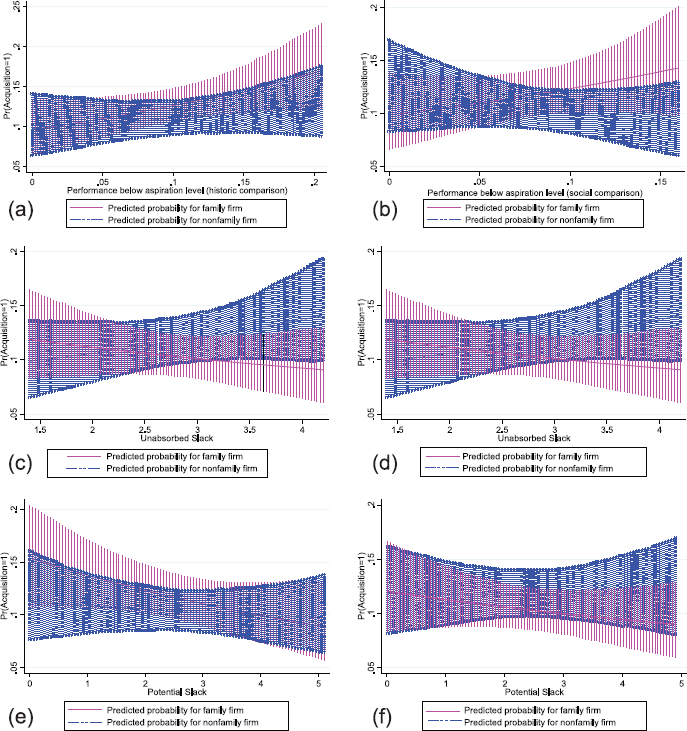
Table 1 shows the means, standard deviations, and zero-order correlations. To limit effects of collinearity, we centered continuous variables. Table 2 shows the results of random-effects discrete-time logit regression to predict the likelihood of acquisition, and Table 3 presents the results of random-effects two-limit Tobit regression that tests for the relatedness of acquisitions. We use a robust option in estimating both models. 4 For the two-limit Tobit model, the Durbin-Watson test was inconclusive, indicating neither positive nor negative autocorrelation. Inconclusive autocorrelation is expected, as acquisitions are not periodic and different unobservable factors drive different acquisitions. 5 To graphically interpret the hypotheses, we draw on G. King, Tomz, and Wittenberg’s (2000) approach in the clarify package (specifically, estsimp routine) by stimulating estimates from the random-effects discrete-time logit model. Specifically, we identify marginal effects from the mfx command in Stata and use these for Monte Carlo simulation. Next, using Zelner’s (2009) intgph, we plot the interactions in Figure 1.
Correlations, Means, and Standard Deviations

Note: Data for 867 acquisition events from 1997 to 2011 representing 692 firms (8,485 firm-years). All correlations above |.11| are significant at .05 or below (two-tailed test). All correlations above |.17| are significant at .01 or below (two-tailed test).
Random-Effects Discrete-Time Logit Regression for Likelihood of Acquisition

Note: The table presents standardized coefficients (standard errors are shown in parentheses) for each measure and provides data for 867 acquisition events from 1997 to 2011 representing 692 firms (8,485 firm-years). H1, H2, and H3 represent Hypotheses 1, 2, and 3, respectively.
p < .05.
p < .01.
p < .001.
Random-Effects Two-Limit Tobit Regression for Relatedness of Acquisition

Note: The table presents standardized coefficients (standard errors are shown in parentheses) for each measure and provides data for 867 acquisition events from 1997 to 2011 representing 692 firms (8,485 firm-years). H4a, H4b, and H5 represent Hypotheses 4a, 4b, and 5, respectively.
p < .05.
p < .01.
p < .001.
Moderation Effects
H1 proposes that family control lowers the likelihood of acquisition. Models 3 and 8 of Table 2 support this hypothesis (historic aspiration: β = −0.79, p < .05; social aspiration: β = −1.89, p < .01). H2, which proposes that performance below aspiration level attenuates the lower likelihood of acquisition under family control, is supported by Models 4 and 9 of Table 2 (historic aspiration: β = 0.68, p < .01; social aspiration: β = 0.87, p < .05). Figures 1a and 1b show that with performance falling below aspiration level, the probability of acquisition is greater in family firms than in nonfamily firms. Figure 1a indicates that the probability of acquisition under below-aspiration-level performance (historic) is stronger for family firms than for nonfamily firms. Interestingly, the probability of acquisition decreases for nonfamily firms facing increasing performance below aspiration level (social) while the relationship is positive for family firms (see Figure 1b). The results from the regression and from these additional tests broadly support our reasoning, namely, that family firms are more sensitive to the “fear factor” in their business decisions and respond by putting a higher priority on sustaining economic wealth (through acquisitions). In H3, we propose that slack strengthens the negative effect of family control on the likelihood of acquisitions. Although the coefficient for absorbed slack multiplied by the family control interaction is insignificant, coefficients for family control/unabsorbed slack (historic aspiration: β = −0.13, p < .01; social aspiration: β = −0.17, p < .05) and family control/potential slack (historic aspiration: β = −0.18, p < .05; social aspiration: β = −0.22, p < .01) are negative and significant (see Models 5 and 10 in Table 2). Figures 1c and 1d indicate that under increasing unabsorbed slack, family firms are less likely to acquire. Figures 1e and 1f show similar effects for increasing potential slack. This lends overall support for H3.
Table 3 displays the estimates for acquisition relatedness. H4a proposes that when family-controlled firms decide to acquire, they prefer related acquisitions, which finds strong support (historic aspiration: β = 0.33, p < .001; social aspiration: β = 0.41, p < .01; see Models 13 and 18). H4b suggests that for performance below aspiration level, family firms that decide to acquire are less likely to engage in related diversification, which is supported for historic aspiration (β = −0.32, p < .01) and weakly supported for social aspiration (β = −0.19, p > .10; see Models 14 and 19). Models 15 and 20 of Table 3 show that with increasing unabsorbed slack (historic aspiration: β = 0.10, p < .05; social aspiration: β = 0.09, p < .01) and potential slack (historic aspiration: β = 0.19, p < .01; social aspiration: β = 0.22, p < .01), family-controlled firms tend to acquire more related targets, which lends overall support for H5.
Robustness Analyses
Performance Above Aspiration Level
We assess whether H3 and H5 are also supported when performance above aspiration level is used as a predictor instead of slack (e.g., Chen & Miller, 2007; Iyer & Miller, 2008). For performance above aspiration level based on historic aspirations, if firm performance at t – 1 is above ROA at t – 2, we subtract firm ROA at t – 2 from firm ROA at t – 1; otherwise, we code it as 0. For performance above aspiration level based on social aspirations, if firm ROA at t – 1 is above industry median ROA at t – 1, we subtract industry median ROA at t – 1 from firm ROA at t – 1. The estimates for performance above aspiration level based on historic aspirations (β = −0.24, p < .01) and social aspirations (β = −0.31, p < .01) are consistent with findings for both H3 and H5 (historic aspiration: β = 0.09, p < .05; social aspiration: β = 0.06, p < .05).
Alternate Definitions of Family Control
We further test the robustness of our findings under alternate specifications of family control and family firms. We classify family firms into three additional categories. The first consists of family firm equity percentage when the founder plays an active role in management or governance (founder-led firm ownership), which allows us to control for the founder effect (Miller, Le Breton-Miller, Lester, & Cannella, 2007). Second, we use family firm equity percentage when members of later family generations are involved in management or governance (later-generation-controlled firm ownership). These two measures are truncated because all nonfamily firms are coded as 0 and the percentage of equity ownership is coded for family firms. We also use a more conservative definition of family control by using a continuous measure of ownership where the family owns at least 20% of the equity and at least one family member is involved in the top management team or the board. Findings remain consistent under these alternate specifications, and the results are available from the authors upon request. To further corroborate correlation among alternate measures of family control, exploratory factor analysis with varimax rotation for the three alternate measures and the measure in the main analysis leads to a single factor explaining 74.55% of the variance.
Alternate Definitions of Acquisition Relatedness
On the basis of Miller et al. (2010), we use an additional operationalization of relatedness: the three-digit SIC code match (1 = related; 0 = unrelated). Findings are consistent, and the results are available from the authors upon request.
Discussion
We set forth theory to argue that family control leads firms to consider two utility dimensions, namely, financial wealth and SEW, in parallel. Financial wealth and SEW are nonfungible utility dimensions that often involve a trade-off. Family firms are thus caught in the dilemma about weighing the gains and losses from their strategic options in two nonfungible currencies, financial wealth and SEW, what we label the mixed gamble of family firm owners. The related decision dilemma should be particularly salient when assessing acquisitions. Family owners will then ask whether they should engage in acquisitions, and in particular unrelated ones, in the pursuit of future financial gains, such as new revenue streams and lower risks, or whether they should refrain from acquisitions, in particular unrelated ones, to preserve current SEW. Under a behavioral decision frame that underlies our theorizing about how actors solve the mixed gamble (Wiseman, Cuevas-Rodrigues, & Gomez-Mejia, 2012; Wiseman & Gomez-Mejia, 1998), family businesses are hesitant to acquire, particularly unrelated firms, because the hoped-for financial gains are ultimately uncertain and the loss in SEW terms is certain. Thus, if they acquire, family firms prefer related targets.
We also showed that the firm’s vulnerability, which we proxy with performance below aspiration levels and/or low levels of slack, alters strategic preferences. Under low vulnerability, which can be seen as the default case, SEW and financial goals are at odds as drivers of strategic change. In absence of financial duress, family business owners should be risk averse and strongly discount the uncertain upside tied to a strategic option, such as an (unrelated) acquisition, while giving more emphasis to the protection of current endowments. Under vulnerability, however, SEW and financial concerns are aligned as drivers of strategic change. This is because meeting the firm’s financial obligations is a condition sine qua non for family owners to enjoy SEW and financial utilities. Integrating these arguments, SEW thus serves as a catalyst for strategic change under vulnerability, while it serves as an impediment to strategic change under prosperity.
Our paper aims to make several contributions to the literature. By exploring preferences for financial and socioemotional goals among family-controlled firms, we extend the literature on the influence of ownership types on strategic actions to encompass acquisition research (e.g., Amihud & Lev, 1981; Connelly et al., 2010; David et al., 2010; Desender et al., 2013; Lane et al., 1998; Ramaswamy et al., 2002; Thomsen & Pedersen, 2000). We thus follow the recent calls to more fully consider governance effects and heterogeneous interests among owners, which likely affect acquisition behavior (Haleblian et al., 2009). We show that social and affective priorities in the form of SEW concerns among family firm owners alter acquisition activity, which represents a new firm-level antecedent.
Also, for family business research, we reconcile the seemingly opposed arguments of Miller and colleagues (2010), who find that if family firms acquire they prefer to diversify, and those of Gomez-Mejia and colleagues (2010) and Anderson and Reeb (2003), who find a general preference for lower diversification among family firms. With our study, we extend the work by Miller et al. and explore the occurrence of acquisitions just as the contingent effect of vulnerability. In contrast to Miller and colleagues, but in line with our theorizing, we find that when a family firm does decide to acquire, it more likely opts for a related firm.
Our theorizing about strategic choices in family firms as a dilemma combines the inconsistent conceptualizations on the impact of nonfinancial goals on strategic actions in family firms. Previous studies have stressed either the predominance of SEW considerations (Gomez-Mejia et al., 2007), the contingent effect of performance hazard (Gomez-Mejia et al., 2010), or the alignment of family and business goals (Chrisman & Patel, 2012). Our dilemma perspective integrates these dispersed effects, suggesting that family firms will assess the likely upside and downside of their strategic choices in both financial and socioemotional terms. This view builds on the burgeoning insight that firms generally make decisions under uncertainty, considering both positive and negative potential outcomes, what Bromiley (2009, 2010) referred to as mixed gambles. We extend the unidimensional view of mixed gambles, in which firms either win or lose in only one currency (i.e., money), to a decision context where strategic actions are assessed in terms of gains and losses along two nonfungible SEW and financial utility dimensions.
To see strategic decision making in family-controlled firms as a decision dilemma speaks to Gavetti, Levinthal, and Ocasio (2007: 527-528), who remind us that the idea of “conflicting interests” has been lost in theory building. We show that even within a dominant coalition (eventually even with the dominant family principal), tension and bargaining exist among competing goals and performance indicators, with the attention focus and preferences changing depending on circumstances (Audia & Brion, 2007; Nordqvist & Melin, 2010). In the end, the outlined decision dilemma represents a difficult choice about whether to adhere to a “family first” or a “business first” decision frame.
In addition, we introduce the notion of vulnerability, proxied by below-aspiration-level performance and/or the absence of slack, which has a decisive impact on how actors solve the decision dilemma. Under vulnerability, SEW and financial concerns are aligned as drivers of acquisitions. This is because meeting the firm’s financial obligations is a necessary condition for the family owners to enjoy any SEW and financial utility.
Including slack as a sign of vulnerability speaks to the behavioral theory of the firm by supporting the argument that behavioral rationales attributable to owners can explain corporate-level phenomena (Audia & Greve, 2006; Cyert & March, 1963). Inconsistent with orthodox contentions of behavioral theory on slack search (Levinthal & March, 1981), we find that family owners consider slack more as a cushion against performance hazard—which enables further pursuit of SEW goals—and less as leeway to experiment with the pursuit of financial wealth.
Implications for Further Research
Our paper introduces the notion of a dilemma to strategic decisions made by family-controlled firms trying to balance the pursuit of multiple utilities that are not fully fungible or interchangeable and not easily mapped along a unidimensional utility continuum. While others have recently applied the intriguing perspective of a “mixed gamble” (where both positive and negative outcomes are possible) to the case of executive compensation (Martin et al., 2013) and resource allocation in multiunit firms (Arrfelt et al., 2013), more needs to be understood about how firms deal with decisions that imply losses and gains in parallel, eventually in goal dimensions with utilities that are not fully fungible.
Our study also speaks to Graebner and Eisenhardt (2004), who frame acquisitions as courtship and, hence, as a social exchange between buyer and seller that is shaped by considerations of long-term fit and not only price. For our own study, this means that when there is an affective fit between buyer and seller (e.g., between two families who know and appreciate each other), family firms may be more likely to acquire, as they have lower fears of losing SEW. It is also possible for an acquisition to be a “pet” project that increases SEW. For instance, a family may buy a firm to strengthen its family reputation (Graebner & Eisenhardt). However, this is unlikely to be a prominent case among publicly quoted family firms. If such an acquisition occurs, the family would most likely control it as a private investment. Still, this may be an interesting avenue for future research.
Even though we do not test for performance impact, socioemotional and financial goals may be mutually supportive. Building on the emerging literature about synergies in paradoxes (Farjoun, 2010; Lewis, 2000), such as change enabled by routines (M. Feldman & Pentland, 2003), investigating the tentative arguments about the synergistic effects between SEW and financial wealth seems promising (Stewart & Hitt, 2010; Zellweger & Nason, 2008). Given the prevalence of family firms and the undiversified wealth positions of their owners, it is unlikely that families systematically undermine the financial performance of their firms in the pursuit of SEW. Some family firms may have found ways to combine the competing worlds. Our theorizing may be useful in moving towards such a positive theory of SEW (Schulze & Kellermanns, 2015). Generally speaking, to move in this direction would require a fine-grained analysis about the trade-offs and potential synergies between SEW and performance. Such theoretical progress should benefit from our insights about the mixed gamble as it will help researchers tease apart the conditions and strategic processes that result in a gain-gain, gain-loss, loss-gain, and loss-loss situation in terms of relative changes in financial wealth and SEW.
Future research could also revisit the question of under which conditions prosperity and slack either act as drivers or obstacles of change. Our argument about the role of slack as a cushion that reduces vulnerability and the need for adaptation resonates with the idea of complacency and inertia (Arrfelt et al., 2013; Kraatz & Zajac, 2001; Sitkin, 1992). These arguments are supported by the results from our alternate framing of prosperity, performance above aspiration levels, which is a test recently called for by Schulze and Kellermanns (2015). Prosperity more broadly, and not only slack resources, is to be seen as a safety cushion necessary to absorb uncertainties in the mixed gamble, which challenges orthodox arguments of behavioral theory on slack search (Levinthal & March, 1981). This area is ripe for further research.
The main limitation of this study is its exclusive reliance on archival proxies. Because we use a rather crude measure for SEW, we are unable to directly investigate the sources of SEW biases, such as the enjoyment of control, binding ties, dynastic succession, identification with the firm, and emotional attachment (Gomez-Mejia et al., 2011). Nevertheless, our measure of family control is superior to studies that examine only family ownership (Anderson & Reeb, 2003; Berrone et al., 2010) in that it captures both family ownership and family involvement. As evidenced by our robustness test, results are stable when using alternate family firm definitions. Some of our arguments may be even more applicable in the context of private firms. But our study follows a long tradition in the finance and strategy literature to assign particular preferences to various types of controlling owners of publicly quoted firms, sometimes at starting levels of ownership of as low as 5% (Chrisman & Patel, 2012; Claessens, Djankov, Fan, & Lang, 2002; Faccio & Lang, 2002; Kroll, Simmons, & Wright, 1990; La Porta, Lopez De Silanes, & Shleifer, 1999; Thomsen & Pedersen, 2000; Wright, Kroll, Lado, & Van Ness, 2002). Also, our results hold at various ownership threshold levels. The strong empirical evidence that we find for our theories, even in the context of publicly quoted firms in the United States, should thus provide a conservative test of our contentions. Furthermore, performance feedback and acquisitions are possibly endogenous (Rumelt, 1974), and endogeneity could also stem from measurement errors related to the effects of family ownership on other predictors (e.g., family ownership could affect the level of slack). We acknowledge that the findings imply correlation but not causation. A complex set of instrumental variables must be used to parse out endogeneity between slack and performance outcomes and the joint effects of these outcomes on acquisitions and related acquisitions. While autocorrelation may not directly address the endogeneity issue, it is further complicated by the interaction terms (Semadeni, Withers, & Trevis Certo, 2014). 6
The institutional context of our study, U.S. public firms, represents a boundary condition for our reasoning. In emerging countries, family firms have been found to perform particularly well and often operate as diversified conglomerates to fill institutional voids (Luo & Chung, 2005; Peng & Jiang, 2010). In such contexts, (diversifying) acquisitions may have less uncertainty and more favorable financial outcomes, which would increase the occurrence and the unrelatedness of acquisitions by family firms. Finally, while manufacturing companies represent an ideal context to study our arguments, the generalizability of our findings may be limited to this particular setting and less so to other industries. Particularly, the measures of slack are more relevant to manufacturing firms than to service firms.
Conclusion
In their strategizing, family firms often face a dilemma of maintaining current SEW versus pursuing prospective financial wealth; this requires an approach that bridges the dialectic between socioemotional and financial goals and explores how actors deal with the competing logics of “money” and “heart” in tandem. Our study thus addresses one of the fundamental challenges in family firms, with wide practical relevance and a potential broader application to organizations that consider more than a single utility dimension (Chen, 2008; Chen & Miller, 2007).
Footnotes
Acknowledgements
This article was accepted under the editorship of Patrick M. Wright.