



Abstract
We conducted two studies to explore integrative, knowledge-centered team mechanisms through which transformational leadership affects team innovative performance. In the first study, using temporarily assembled project teams working on knowledge-intensive tasks, we found that transformational leadership promoted within-team knowledge sharing and team innovative performance through an integration mechanism manifest as team cooperative norms, and such a mediation process was significant even after controlling for another mediation process of team autonomy. In the second study, using permanent work teams in various functional areas, we replicated the integrative mechanism and associated transformational leadership with external team knowledge acquisition, which further moderated the relationship between knowledge sharing and innovation. Our findings point to the importance of the integration function of transformational leadership in enhancing collective innovation.
As organizations have recognized innovation as the critical gateway to gain competitive advantage and maintain prosperity, managers are counted on to be leaders and champions of innovation (Elkins & Keller, 2003; Mumford, Scott, Gaddis, & Strange, 2002). With today’s competitive and fast-changing environment entailing organization of people in teams to tackle ill-defined problems and generate innovative solutions, to what extent leaders can facilitate teams’ innovation processes and outcomes has become a critical question for both theory and practice (Eisenbeiss, van Knippenberg, & Boerner, 2008; Kearney & Gebert, 2009; Shin & Zhou, 2007).
Theories and research on leadership and innovation have generally uncovered two essential processes through which leadership can enhance creativity and innovation, namely, stimulating new ideas and solutions by means of maintaining and enhancing an autonomous work environment and developing integration of ideas and solutions by means of fostering superordinate goals and norms (Amabile, 1988; Van de Ven, 1986; West, 2002; Woodman, Sawyer, & Griffin, 1993). Although the importance of autonomy and integration for innovation is widely recognized, investigations of leadership processes have been predominantly targeted at the former (e.g., G. Chen, Sharma, Edinger, Shapiro, & Farh, 2011; Z. Chen & Aryee, 2007; Srivastava, Bartol, & Locke, 2006; Zhang & Bartol, 2010), with less attention given to the leader’s role in fostering team integrative processes to promote innovation.
In this research, we focus on how transformational leadership, as a result of its emphasis on group-oriented, higher-level needs and goals, can facilitate integrative processes for collective innovation outputs (Bass, 1985; Conger & Kanungo, 1998; House & Shamir, 1993). Traditional leadership work has primarily focused on the leader’s effects on the individual follower (Lowe & Gardner, 2000; Yammarino, Salas, Serban, Shirreffs, & Shuffler, 2012), which may be derived from Western culture that treats individuals as independent, autonomous agents (Hofstede, 2001; Schwartz, 1999) while deemphasizing collective processes. Such an individual-based view of leadership process, however, departs from the original formulation of transformational leadership theory that centers on change and innovation for a whole group and larger collectives (Bass; Bass & Riggio, 2006). As recent investigations indicate that transformational leaders affect team creativity and performance through collective/integrative processes (Kearney & Gebert, 2009; Shin & Zhou, 2007), research is needed to explicate these processes that leaders can foster to support team innovative performance.
Additionally, the literature has long noted transformational leadership to be associated with delegation and developmental behavior (Bass, 1985; Kuhnert, 1994), and empirical work has shown the role of transformational leaders in cultivating a sense of autonomy by granting opportunities to learn and perform (Piccolo & Colquitt, 2006; Z. Wang & Gagné, 2013). To the extent transformational leadership has the potential to foster both integrative and autonomous processes, it is important to investigate them simultaneously and compare their relative strength in stimulating innovation.
Furthermore, as teams need to meet external expectations in dynamic work environments, acquiring information and knowledge outside their boundaries may augment the positive effects of internally focused integrative processes on innovation. Transformational leaders, by stimulating their members’ intellectual interest and encouraging them to search for ideas and solutions broadly to solve challenging tasks, may also foster innovation through motivating external knowledge acquisition across team boundaries.
The current multistudy research attempts to develop and test a comprehensive framework delineating the integration function of transformational leadership for team innovation. In doing so, we seek to contribute to the leadership, team, and innovation literatures in several ways: First, we extend Kearney and Gebert’s (2009) work by investigating an integrative mechanism—team cooperative norms—that links leadership to team knowledge sharing and innovation. Different from Kearney and Gebert’s study on teams’ general performance, we focus on innovative performance and shed light on leadership processes that facilitate internal knowledge sharing and external knowledge acquisition. Compared to general performance, innovative performance centers on the application of new ideas that likely change existing technologies and routines; therefore, leading for innovation may entail distinct integrative processes, such as knowledge-related activities, to generate and implement new ideas.
Second, in addition to the core integrative mechanism of cooperative norms, our study disentangles integrative and autonomous processes. By simultaneously studying both integrative and autonomous processes, we seek to isolate and highlight the critical role of cooperative norms in team innovation. Finally, by incorporating external knowledge acquisition in our model, we emphasize that the positive effects of transformational leadership on internal integrative processes will be further enhanced by its positive effects on external knowledge-related activities. Taken together, these investigations (as summarized in Figure 1) tap into the theoretical potential of transformational leadership, which endows leaders with the capacity to influence followers not only as autonomous individuals but also, more importantly, as well-integrated collectives. We contend that theories and research on team innovation will be benefited by explicating integrative processes that emanate from leaders’ transformational behaviors and result in collective innovation (Rosing, Frese, & Bausch, 2011).

Hypothesized Model
Theory and Hypotheses
Team innovation refers to the intentional introduction and application of ideas, processes, products, or procedures that are new to the team and designed to be beneficial (West & Farr, 1990). It consists of both the generation of new ideas, often referred to as creativity (Amabile, 1988), and the implementation of the ideas into an end product or service (Klein & Sorra, 1996; Nijstad & De Dreu, 2002; West, 2002). This definition of team innovation emphasizes collective processes and outcomes that transcend any single individual in a team (Woodman et al., 1993). Recent theorization of team innovative work has begun to emphasize team processes centered on collective knowledge activities, such as knowledge acquisition, knowledge sharing, and knowledge integration (Argote, Gruenfeld, & Naquin, 2001; Chuang, Jackson, & Jiang, 2016; Gardner, Gino, & Staats, 2012; Jackson, Chuang, Harden, & Jiang, 2006; Taylor & Greve, 2006; S. Wang & Noe, 2010; Wilson, Goodman, & Cronin, 2007). Jackson et al., for instance, highlighted the importance of internal knowledge sharing and external knowledge acquisition within a team or an organization. More importantly, these authors argued that team-level knowledge sharing is more than the aggregation of interpersonal knowledge sharing, in that sharing knowledge at the team level involves the social processes of integrating individual ability and effort through collective missions, norms, and incentives. The Jackson et al. concept of knowledge-centered teamwork, apart from its explicit focus on knowledge, is firmly based on the integrative perspective of team innovative tasks. Moreover, cumulative evidence on information sharing in small groups has shown a positive relationship between information sharing and general team performance (Mesmer-Magnus & DeChurch, 2009). Hence, drawing on the theoretical perspective and extending relevant empirical findings, we associate team innovation with knowledge sharing within the team.
For knowledge sharing to be part of a reliable and continuous process, it needs to be embedded in a more foundational integrative norm of group cooperation. Cohen and Bailey, for example, reviewed the team literature and concluded that internal team processes of cooperation and cohesion act as “group psychosocial traits” (1997: 244) that would generate positive teamwork behaviors and performance, especially those with regard to innovation. Building on prior research, we examine team cooperative norms as a foundational integrative process that leads to knowledge sharing and innovation.
The central purpose of this study is to identify effective leadership behaviors that promote team innovation through integrative group mechanisms. Our focus on transformational leadership is based on its highlighting of leaders’ capacity of inspiring extraordinary performance by articulating a collective vision and aligning members’ self-interest with the higher-order goal (Bass, 1985; Conger & Kanungo, 1998; House & Shamir, 1993). Thus, the ability of such leadership to develop members’ confidence in and bond with their group is conducive to leveraging individual knowledge bases to take on challenging tasks (Jaussi & Dionne, 2003). Furthermore, transformational leadership stimulates intellectual curiosity with questions that challenge the status quo, which also enhances innovative work processes (Jung, Chow, & Wu, 2003; Shin & Zhou, 2003).
Albeit the conceptual promise of transformational leadership for team innovation as outlined above, empirical findings have shown that the relationship is more complex than initially presumed (see Rosing et al., 2011, for a recent review). For example, using a sample of R&D teams, Eisenbeiss and colleagues (2008) found that transformational leadership did not have a direct positive effect on team innovation; instead, the relationship was indirect through team-level support for innovation, and the positive indirect relationship was further enhanced by climate for excellence. In another study of R&D teams, Shin and Zhou (2007) showed that the effect of transformational leadership on team creativity was contingent upon teams’ educational heterogeneity and mediated by teams’ creativity efficacy.
The complex pattern of relationships found in previous studies calls for more research to identify specific pathways linking transformational leadership and innovation, as well as conditions that promote or constrain the mediation processes (Rosing et al., 2011). Responding to this call, in this research, we propose team cooperative norms representing an integrative mechanism connecting transformational leadership with innovation-relevant behaviors and outcomes and present results of two studies establishing integration as an important pathway between transformational leadership and team innovation, which is independent of autonomy (Study 1) and moderated by external knowledge acquisition (Study 2). In the following section, we hypothesize about these relationships.
The Integrative Mechanism
Team cooperative norms and within-team knowledge sharing
Within-team knowledge sharing refers to the process by which team members engage in distributing task-relevant information and technical know-how (Argote et al., 2001; Jackson et al., 2006; Mesmer-Magnus & DeChurch, 2009; S. Wang & Noe, 2010; Wilson et al., 2007). It occurs when team members retrieve knowledge and information and share it with each other via discussion or documentation. In order to effectively share their knowledge, team members must recall it, perceive it as relevant, and be motivated to share it. As pointed out earlier, team knowledge sharing differs from interpersonal knowledge sharing in that whereas knowledge sharing between two members may involve particularistic interpersonal factors, such as mutual attraction and reciprocity (Blau, 1964), pervasive team-wide knowledge sharing requires members’ identification with the leader and the group and the sharing of collective goals, values, and norms, especially when members are dispersed and collaborate virtually (Mesmer-Magnus, DeChurch, Jimenez-Rodriguez, Wildman, & Shuffler, 2011). In this study, we focused on team norms as a result of their strong impact on team processes and the fact that team leaders are among the most critical sources for team norm development (Feldman, 1984; Taggar & Ellis, 2007).
One type of team norms that is closely relevant to team knowledge sharing is team cooperative norms, which refer to the behavioral expectations shared by team members that they work jointly for their pursuit of common interests through the exhibition of cooperative behavior and mutual helping (Chatman & Flynn, 2001; Feldman, 1984; Wageman, 1995). Next, we develop hypotheses for the mediating role of team cooperative norms and knowledge sharing.
The theoretical foundation of transformational leadership (Bass, 1985; Conger & Kanungo, 1998; House & Shamir, 1993) implies that transformational leaders can be most effective in setting cooperative norms because of the self-transcendence effects of their behaviors (De Cremer & van Knippenberg, 2002). For example, through articulating a vision and prioritizing collective over individual needs and interests, leaders create a sense of commonality and interdependence and set the moral foundation for cooperative norms. Furthermore, through charismatic communication and role modeling, leaders set examples of self-transcendence for the accomplishment of collective goals. As a result, cooperative expectations for group-oriented behaviors are likely to emerge. Furthermore, team cooperative norms are positively related to knowledge sharing because norms not only act as expectation pressures on group members to share their knowledge but also take away their concerns of the potential downsides of knowledge sharing (Szulanski, 1996). For example, when group norms are to be mutually helpful and team oriented, concerns about loss of personal status, rivalry, and opportunism will decrease (C.C. Chen, Peng, & Saparito, 2002), removing barriers of knowledge sharing (Quigley, Tesluk, Locke, & Bartol, 2007; Taggar & Ellis, 2007).
The above arguments propose that transformational leadership is positively related to cooperative norms, which in turn are positively related to team-wide knowledge sharing. We further argue that it is cooperative norms that mediate the relationship between transformational leadership and knowledge sharing rather than knowledge sharing mediating between transformational leadership and cooperation norms. This is because cooperative norms are more general as they govern behaviors of mutual help beyond knowledge sharing; moreover, knowledge sharing is more specific and more pertinent to innovation outcomes than cooperative norms (Haas & Hansen, 2007). Similarly, Kearney and Gebert (2009) examined a mediational process linking diversity, leadership, and team performance in which they identified collective team identification and information elaboration as sequential mediators. Thus, we propose:
Hypothesis 1: Transformational leadership will be related to within-team knowledge sharing through team cooperative norms.
Within-team knowledge sharing and innovative performance
Internal team knowledge sharing leads to innovation because it facilitates idea generation and implementation. When team members engage in knowledge sharing activities, such as searching for and providing task-relevant information from members’ expertise and experiences, the existing repertoire of creative thinking may be enriched or adjusted by alternative perspectives from other people, such that cognitive pathways are explored flexibly, with attention given to previously overlooked aspects of the task (Amabile, 1988). Moreover, boundary-spanning team members may transmit external fresh views to the rest of the team, stimulating new ideas and approaches (Ancona, 1990; Marrone, 2010).
Other knowledge sharing activities, such as collectively evaluating potential technical solutions and providing constructive feedback, may be beneficial for idea adoption and implementation. Open exchange facilitates mutual selling of ideas and coalition building among team members (Kanter, 1988). Elaboration of ideas and information makes those ideas salient and, thus, more likely to surpass people’s action thresholds (Van de Ven, 1986).
By and large, knowledge sharing frees up and combines team members’ knowledge stocks and ensures their optimal use for innovative task performance. Previous studies have supported the relationships between knowledge sharing and performance of teams with innovative tasks (e.g., Edmondson, Bohmer, & Pisano, 2001; Ellis, Hollenbeck, Ilgen, Porter, West, & Moon, 2003; Faraj & Sproull, 2000; Haas & Hansen, 2007). A meta-analytic review reported a corrected correlation of .42 for the relationship between information sharing and overall team performance (Mesmer-Magnus & DeChurch, 2009). Thus, we propose:
Hypothesis 2: Within-team knowledge sharing will be positively related to team innovative performance.
Additional Autonomous Mechanism
Besides the core integration function of transformational leadership in the teamwork context, transformational leaders, because of their attention to long-term goals and interests of the organization as well as of team members, also encourage autonomy and individuality within team members and are developmental for their performance and growth (Bass, 1985; Kuhnert, 1994). Intellectual stimulation by seeking new ideas and developing new solutions may enhance members’ perceptions of autonomy, and individualized consideration by coaching and mentoring is associated with more positive feedback and delegation (Piccolo & Colquitt, 2006). Consequently, team members under transformational leadership are allowed to make decisions related to their work more freely.
The resulting autonomy, in turn, can enhance knowledge sharing behaviors among members in the team. For example, a high level of autonomy will motivate team members to turn to each other for ideas and discuss more effective ways of performing tasks. Furthermore, having more discretion at work implies greater responsibility to handle unexpected issues, which also motivates team members to help each other by sharing knowledge in order to obtain new perspectives and generate solutions (Cabrera, Collins, & Salgado, 2006). Thus, we propose:
Hypothesis 3: Transformational leadership will be related to within-team knowledge sharing through team autonomy.
As explained above, cooperative norms and team autonomy are conceptually distinct processes that can both be nurtured by transformational leadership. While the two processes represent separate, valuable leadership functions for knowledge sharing, it is also interesting to examine incremental variance explained by one process while the other is included in the model predicting knowledge sharing.
Team Knowledge Acquisition
Last, we propose that transformational leadership will be positively associated with external knowledge acquisition, which in turn will affect the extent to which internal knowledge sharing sparks creative ideas and enhances innovation adoption. Team knowledge acquisition contains activities by team members to search for and adopt external knowledge in the form of, for example, routines (Zellmer-Bruhn, 2003) or capabilities (Zander & Kogut, 1995).
Transformational leaders stimulate followers’ intellectual curiosity and encourage them to see things differently and to seek new ways for diagnosing and solving problems. These leaders also empower followers to use the new knowledge they acquire by providing socioemotional support and developmental opportunities. They show optimism and inspire confidence in members’ abilities and skills (Shin & Zhou, 2007). Consequently, the developmental and intellectually stimulating leaders transform members to proactively apply knowledge obtained from the outside for making novel connections and integration (Ancona, 1990; Wong, 2004). Thus, transformational leader behaviors function as outward forces that encourage team members to acquire knowledge outside the team’s boundary.
Hypothesis 4: Transformational leadership will be positively related to team knowledge acquisition.
As work environments become increasingly dynamic and complex, teams often juggle multiple demands that call for new solutions based on expertise resident both within and outside their boundaries. To that end, external knowledge acquisition acts as a “centrifugal” force that pulls team members outward in search of novel routines and practices; it complements internal knowledge sharing as a “centripetal” force that integrates team members’ dispersed ideas and information into collective action (Sheremata, 2000). Together, they make teams ambidextrous in meeting innovative task demands (Bledow, Frese, Anderson, Erez, & Farr, 2009).
Since access to external domain-relevant knowledge, through connections with individuals in highly relevant areas, is associated with an enhanced knowledge base (Kanter, 1988; Perry-Smith & Shalley, 2003), acquired knowledge expands the team’s total knowledge pool that is available for sharing among members. More importantly, when internal knowledge sharing is coupled with external knowledge acquisition, team members engage in combining more divergent thinking and perspectives for idea generation and implementation (Amabile, 1988; Mumford & Gustafson, 1988; Perry-Smith, 2006). Previous examinations have provided evidence of the pivotal role played by external communications and the acquisition of information and knowledge from outside the team (e.g., Ancona, 1990; Keller, 2001). Furthermore, external knowledge acquisition may refresh the team’s “thought worlds” (Dougherty, 1992) embedded in its work routines. Sharing built on the depth and breadth of the knowledge pool will likely lead to greater innovation. Thus, we propose:
Hypothesis 5: Team knowledge acquisition will moderate the relationship between within-team knowledge sharing and team innovative performance, such that the relationship will be stronger under higher rather than lower levels of knowledge acquisition.
Overview of the Research
We conducted two studies to test our hypotheses using two different samples. Both studies examined the core integrative mechanism proposed in Hypotheses 1 and 2 (i.e., transformational leadership—team cooperative norms—within-team knowledge sharing—team innovative performance). Furthermore, in Study 1, using temporarily assembled project teams working on knowledge-intensive cross-functional collaborations and project managers as internal leaders, we simultaneously examined the integrative and autonomous pathways (Hypothesis 3). Finally, using permanent work teams in various functional areas and functional heads serving as external leaders, Study 2 investigated the association of transformational leadership with team knowledge acquisition and whether knowledge acquisition moderated the effect of knowledge sharing on innovation (Hypotheses 4 and 5). Therefore, the two studies adopted different, yet complementary, design and sampling strategies in providing a robust examination of the integrative mechanism proposed in our model.
Study 1: Method
Sample and Procedure
Data for Study 1 were from 44 project groups from a Chinese biopharmaceutical firm. To understand the research setting prior to handing out the survey, we conducted semistructured interviews with two senior executives, five project managers, and five group members involved in the projects. These teams were assembled for two types of projects—business development and new product and application development—that require frequent interactions and collaboration among functions such as research and development, production, marketing, business development, and so forth. We studied project managers as the focal leaders, who were actively involved in managing and coordinating their teams’ objectives and work processes, as well as resources and relationships. As a result of novel and complex situations typically facing these groups, finding innovative solutions was the key to successfully accomplishing their missions and tasks.
We first asked two senior executives who supervised business development and product and application development groups, respectively, to identify the leaders of the projects, which generated a list of 54 teams. After initial screening, we removed 4 teams that were too early in their project stage to allow us to assess team process variables. Next, we asked project leaders to identify core members in their teams and then hand-delivered and collected the survey during company work hours. For members who did not show up on the days of data collection, we sent e-mails and follow-up reminders to ask them to fill out an electronic version of the survey. This procedure resulted in 211 members from 49 teams for a response rate of 85%. Three months later, we revisited the company and collected team innovation ratings from the two senior executives who supervised the projects; one executive rated all business development teams and the other rated new product and application development teams.
Among 49 teams, we excluded 3 teams that had not reached the later stage of their project, thus limiting our evaluation of their innovative performance, and 2 teams because the nature of their projects had changed such that members were working on some new tasks. In the end, we were able to match team member surveys with executive surveys for 44 teams, including 16 business development teams and 28 new product and application teams. In order to obtain reliable team-level measures, we adopted a rigorous approach by checking within-group agreement index (rwg; James, Demaree, & Wolf, 1984) of all main study variables for each team (Lance, Butts, & Michels, 2006). Using the criteria recommended by LeBreton and Senter (2008), we dropped the teams with “lack of agreement” (rwg between .00 and .30) and “weak agreement” (rwg between .31 and .50) on any of the variables and retained only those teams with “moderate to strong agreement” (rwg greater than .50) on all the variables. The rwg scores of all main study variables for each team were all above .50, showing good within-team agreement.
These 44 teams contained 3 to 10 members; the average team size was 4.86 (SD = 1.73). Among the managers, 75% were male, 79% were between 31 and 45 years of age, 59% had been with the company for more than 5 years, and 91% had a bachelor’s degree or above. Among team members, 64% were male, 57% were between 31 and 45 years old, 44% had been working in the company for more than 5 years, and 81% had a bachelor’s degree or above.
Measures
Unless otherwise indicated, all measures employed a 5-point response scale ranging from 1 (strongly disagree) to 5 (strongly agree). To ensure equivalence of meaning, we translated and back-translated into Chinese all of the measures (except transformational leadership, for which a Chinese version was available), following the procedure by Brislin (1980).
Transformational leadership
Transformational leadership was measured by using Bass and Avolio’s (1995) Multifactor Leadership Questionnaire Form 5X–Short (MLQ). Using a 5-point Likert response scale ranging from 1 (not at all) to 5 (frequently, if not always), respondents indicated the frequency with which their manager demonstrated idealized influence (eight items), inspirational motivation (four items), intellectual stimulation (four items), and individual consideration (four items). The items were employed with team as the referent (Chan, 1998). Given that we conceptualized and measured leadership at the team level, to align the analysis with the nature of the construct and measurement, we performed a team-level confirmatory factor analysis (CFA) by using aggregated scores for each item (G. Chen, Mathieu, & Bliese, 2004), with items loading on their corresponding factors and four first-order factors loading on an overall second-order factor. Results provided acceptable fit—χ2 = 252.59, df = 166, p < .001, root mean square error of approximation (RMSEA) = .08, comparative fit index (CFI) = .98, standardized root mean square residual (SRMR) = .06. Another CFA with the same factor structure, but using scores at the individual level, also produced adequate fit (χ2 = 350.86, df = 166, p < .001, RMSEA = .08, CFI = .98, SRMR = .05). The fit indices generally fall into the acceptable range recommended by Hu and Bentler (1999). Thus, we created a composite index by averaging all the items (α = .92).
As transformational leadership was measured as a shared group property, within-group agreement and between-group variability were needed to justify data aggregation. In supporting aggregation, mean and median rwg values were, respectively, .88 and .91, indicating strong agreement among members within teams. We also performed a one-way analysis of variance (ANOVA) and computed intraclass correlations (ICCs) to examine between-group variability. ICC(1) represents the proportion of the total variance at the individual level that can be explained by team membership, and ICC(2) indicates the reliability of the team means (Bliese, 2000). Bliese (2000) observed that ICC(1) values typically range from .05 to .20 in the organizational literature. Similarly, an arbitrary, simple heuristic cut point for ICC(2) is .70 (LeBreton & Senter, 2008), whereas other scholars have recommended lower cutoff values (e.g., .60; Glick, 1985). The difficulty in reaching consensus on the acceptable ICC(2) values is because they are affected by a number of factors, such as variance restriction (LeBreton, Burgess, Kaiser, Atchley, & James, 2003) and group size (Bliese, 1998). The ICC(1), ICC(2), and ANOVA F values of the measure were .34, .68, and 3.12 (p < .01), respectively. Overall, these results supported aggregation of individual-level scores to the team level.
Team cooperative norms
The scale for cooperative norms was mainly adapted from Wageman (1995), with one item adopted from Chatman and Flynn (2001). Four items asked respondents about their expectations of each team member’s cooperative behaviors in their teams, including going out of one’s way to help team members, helping team members without being asked, willingness to sacrifice self-interest for the benefit of the team, and working jointly toward task accomplishment (α = .86). We further aggregated individual responses to the team level to form the measure of team cooperative norms. The respective mean and median rwg values were .84 and .95. The ICC(1), ICC(2), and one-way ANOVA F values were .40, .74, and 3.78 (p < .01), respectively. These results supported data aggregation.
Within-team knowledge sharing
To measure knowledge exchange among members in each project group, we drew on Cummings’ (2004) work on knowledge sharing in cross-functional project groups. To ensure the measure fits in our research context, we also validated them with a few group members and leaders during the interviews. This procedure resulted in sharing of four aspects of project-related knowledge, namely, general overviews (e.g., project goals, milestone schedules, member responsibilities), specific requirements (e.g., market forecasts, technical evaluation, quality specifications), technical know-how (e.g., principles and mechanisms, methods and tools, work procedures), and project progress and/or results (e.g., status updates, issues and problems, findings and recommendations). On a 5-point scale ranging from 1 (never) to 5 (a lot), team members indicated the frequency of knowledge sharing within their group (α = .74). The respective mean and median rwg were .79 and .87; the ICC(1), ICC(2), and one-way ANOVA F values were .19, .49, and 1.98 (p < .01), respectively. The relatively low ICC(2) value implied that results about relationships with knowledge sharing might be underestimated (G. Chen & Bliese, 2002; Kozlowski & Hattrup, 1992); however, given that the construct was conceptualized at the team level and measured with team as the referent, and that we found satisfactory within-group agreement (rwg) and significant between-group variation (F value), we proceeded with aggregation of the measure.
Team autonomy
Three items adapted from Langfred (2004) were used to measure autonomy perceived by team members, including having discretion to do their own work, controlling the scheduling of their work on team projects, and being allowed to decide on individual responsibilities once the team made decisions (α = .75). The respective mean and median rwg values were .72 and .80. The ICC(1), ICC(2), and one-way ANOVA F values were .25, .57, and 2.34 (p < .01), respectively.
Team innovative performance
As we define team innovative performance as the extent to which teams produce performance outcomes innovatively, which include various outcomes of members’ innovative behaviors, we adopted four items from Lovelace, Shapiro, and Weingart (2001) to measure the degree of innovativeness. Using a 5-point scale ranging from 1 (much lower than average) to 5 (much higher than average), managers rated their team, compared with other teams they had observed, on four innovation performance aspects, including the innovativeness of the team’s product, the number of innovations or new ideas introduced by the team, the team’s overall technical performance, and the team’s adaptability to changes (α = .79).
Control variable
We considered team size and project type as the control variables because prior studies have shown size to be related to leader behaviors (Bass, 1990) and team innovation (Hülsheger, Anderson, & Salgado, 2009) and because the two types of the projects were fairly different in terms of task and outcome characteristics. Furthermore, previous studies found team diversity may affect team performance and innovation (Kearney & Gebert, 2009; Shin & Zhou, 2007). Therefore, we controlled for gender, age, education-level, and functional diversity measured as proportion of female (gender diversity), coefficient of variation (age and education-level diversities), and Blau’s (1977) index (functional diversity). However, an examination of the correlations between the controls and all main study variables showed that none of the correlations were significant. Given that the sample size is small, to preserve statistical power, we excluded the control variables from the final analysis. 1
Analyses
Assessing discriminant validity
We conducted CFAs to establish discriminant validity of measures collected from team members. Given that all constructs were measured at the team level, we performed a team-level CFA by using aggregated scores for dimension-level transformational leadership and item-level cooperative norms, team autonomy, and within-team knowledge sharing. The predicted four-factor solution achieved acceptable fit (χ2 = 121.40, df = 84, p < .01, RMSEA = .07, CFI = .98, SRMR = .09). Alternative models combining any two, three, or four factors all produced significantly poorer fit (Δχ2/Δdf ranging from 15.39 to 70.41). To further confirm the factor structure, we performed individual-level CFAs on all scores at the individual level. The four-factor model resulted in adequate fit (χ2 = 126.82, df = 84, p < .01, RMSEA = .05, CFI = .98, SRMR = .06), with models combining any two, three, or four factors all producing significantly poorer fit (Δχ2/Δdf ranging from 61.99 to 187.99). Taken together, results of CFAs supported the discriminability of the measures.
Hypothesis testing
Given that all project groups were from a single firm, we ran multiple regression analyses for hypotheses testing. For multistep mediation tests, we used bootstrap analysis (Efron & Tibshirani, 1993) to compute confidence intervals (CIs) for two indirect effects via the integration and autonomy paths, respectively.
Study 1: Results
Means, standard deviations, and correlations are reported in Table 1, which shows that transformational leadership was significantly correlated with all team process variables and that its correlation with innovative performance reached a marginal significance level (p < .10). Furthermore, knowledge sharing was correlated with cooperative norms, team autonomy, and innovative performance.
Study 1: Correlations, Scale Reliabilities, and Descriptive Statistics
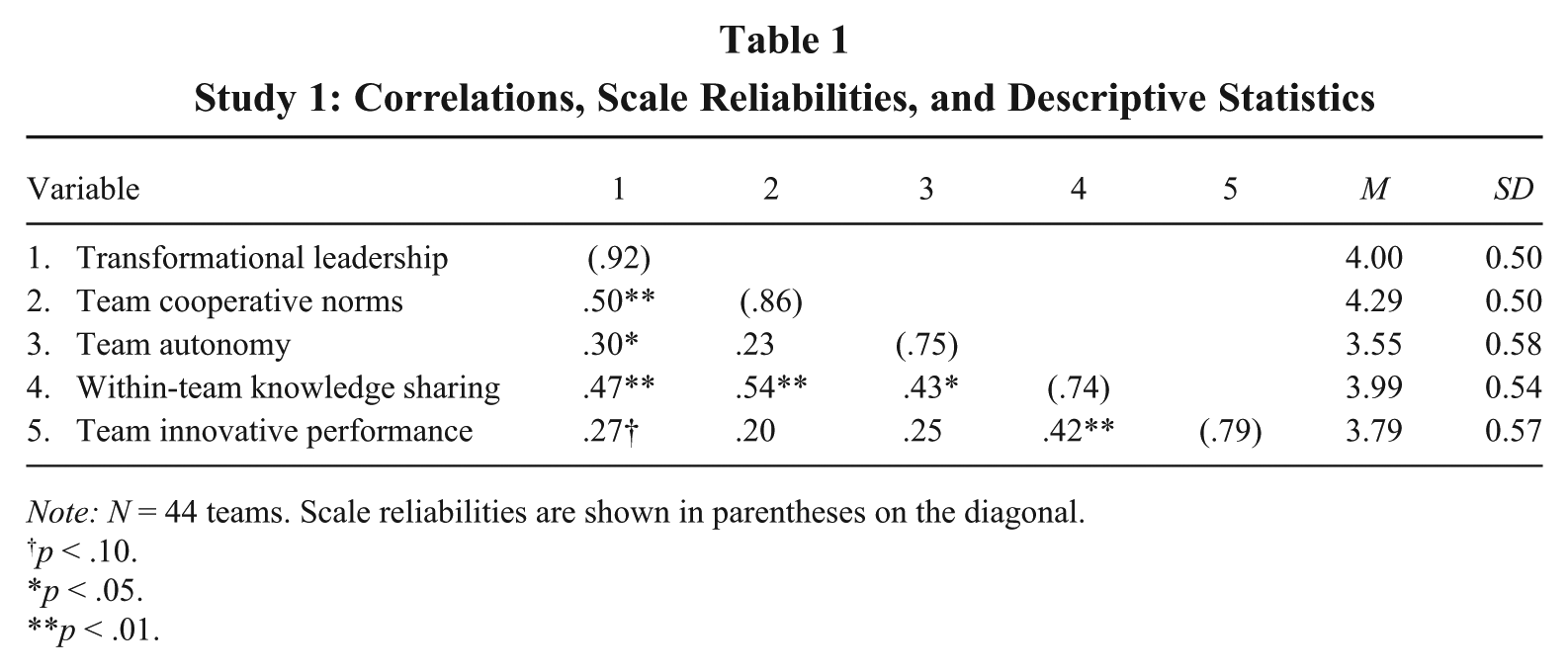
Note: N = 44 teams. Scale reliabilities are shown in parentheses on the diagonal.
p < .10.
p < .05.
p < .01.
Hypothesis 1 proposed a mediation of cooperative norms between transformational leadership and within-team knowledge sharing. Table 2 shows the results of regression analyses. In particular, transformational leadership was related to knowledge sharing (β = 0.56, p < .01; Model 1); adding cooperative norms into the model reduced the effect size and strength of this relationship (β = 0.31, p < .10; Model 2), while cooperative norms was significantly associated with knowledge sharing (β = 0.48, p < .01). Furthermore, when team autonomy was added to predict knowledge sharing (Model 4), the coefficient for leadership became nonsignificant (β = 0.23, n.s.), but that for cooperative norms still remained significant (β = 0.44, p < .05). To provide a more objective account of the mediation effect, we conducted indirect effect tests by using R-based bootstrap analysis (e.g., Biesanz, Falk, & Savalei, 2010) with 2,000 random samples from the original sample. Results showed significant indirect effects of leadership on knowledge sharing through cooperative norms with (95% CI [.027, .423]) or without (95% CI [.013, .436]) team autonomy entered into the model. Taken together, these results fully supported Hypothesis 1.
Study 1: Multiple Regression Results
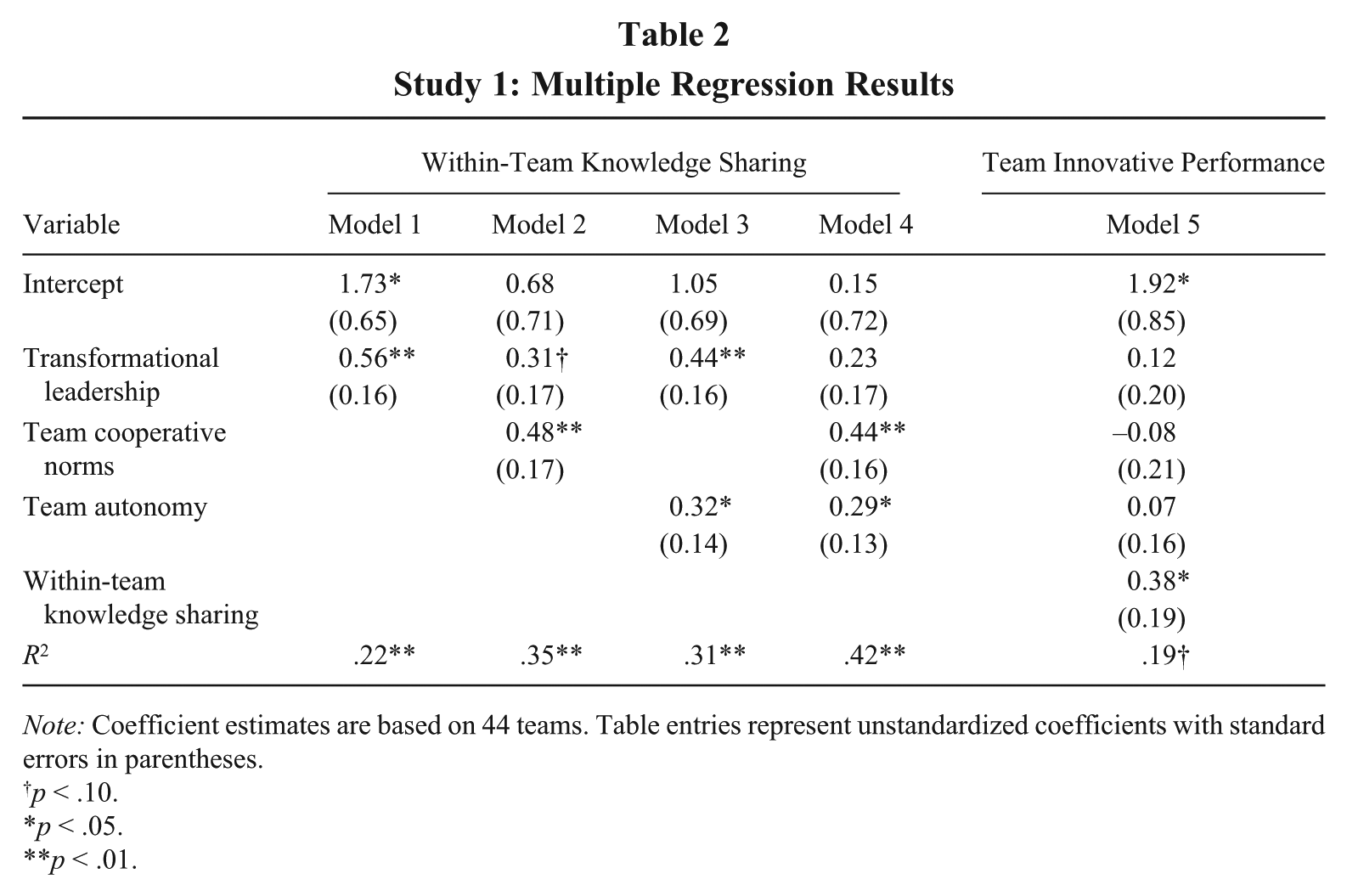
Note: Coefficient estimates are based on 44 teams. Table entries represent unstandardized coefficients with standard errors in parentheses.
p < .10.
p < .05.
p < .01.
Hypothesis 2 predicted a positive relationship between within-team knowledge sharing and team innovative performance. Results of Model 5 confirmed the positive association of knowledge sharing with innovative performance (β = 0.38, p < .05).
Hypothesis 3 proposed a mediation relationship of team autonomy between transformational leadership and within-team knowledge sharing. As shown in Model 3 of Table 2, including team autonomy in the model predicting knowledge sharing yielded a significant coefficient for autonomy (β = 0.32, p < .05) and reduced the effect size of the coefficient for transformational leadership (β = 0.44, p < .01). Indirect effect tests based on bootstrap samples confirmed the mediations with (95% CI [.002, .286]) or without (95% CI [.004, .322]) cooperative norms entered into the model. Thus, Hypothesis 3 was supported.
Supplemental Analysis
To explore the differential effect of cooperative norms and team autonomy, we conducted supplemental analyses regarding the difference of indirect effects. First, we performed bootstrap analyses on two indirect effects of leadership on innovative performance on the basis of Models 1, 4, and 5 in Table 2. Results supported the mediation through cooperative norms and knowledge sharing (95% CI [.005, .164]) but not through team autonomy and knowledge sharing (95% CI [−.001, .113]). Next, to examine whether there was a significant difference between two indirect effects, we conducted another bootstrap analysis to construct the CI for the difference. We found no support of the significant difference (95% CI [−.059, .141]). Together, although cooperative norms served as a stronger link for the leadership-innovation relationship, there was no statistical support for its having a stronger mediation effect than team autonomy. In other words, integration and autonomy represent separate, valuable functions of transformational leadership in fostering team knowledge sharing and innovative performance.
Study 1 provides evidence that transformational leadership influences knowledge sharing and team innovation through integrative as well as autonomous team mechanisms. Furthermore, supplemental analysis reveals that the integrative and autonomous mechanisms are equally important in linking transformational leadership and innovation at the team level. These findings are encouraging in providing initial support for our theoretical predictions. Nonetheless, the results are based on a sample of temporally based project teams in a single company. More replications are needed with samples of other types of teams. Furthermore, project teams, including those in our sample, are typically outward bound because in order to be successful, they need to interact with external constituents to obtain resources and exchange information (Ancona, 1990; Marrone, 2010). However, for teams focusing more on internal activities, their external search and exchange can vary to a large degree, driven by various situational factors (e.g., Chuang et al., 2016). As innovation entails novel ideas that are built on a combination of diverse perspectives, acquiring knowledge from the outside is valuable for internally focused teams, especially those residing within their functional areas. To replicate the main findings and explore the additional effect of external knowledge acquisition, we conducted a second study using permanent work teams residing in various functional areas from a number of companies.
In both studies, we investigated the core integrative mechanism of our model (see Figure 1). Meanwhile, each study adds one extension, with Study 1 including team autonomy and Study 2 external knowledge acquisition. Doing so allows us to maintain the focus and parsimony in each study in testing a complex model.
Study 2: Method
Sample and Procedure
Participants were full-time employees from companies in a variety of industries, including chemical products, electronic and electrical equipment and components, medical and optical devices, banking, and information technology, in China. Data were collected from managers and members of work teams in such functional areas as production and quality control, research and development, sales and marketing, finance and accounting, and human resources. Innovative performance of these teams varied by the nature of their tasks and spanned a wide range from incremental to radical, including examples of manufacturing process improvement, introduction of new management policies, and new medical device development.
Before distributing the questionnaires, we conducted semistructured interviews with company executives or human resource managers to ensure that members of the participating teams carried out tasks and assignments collectively and were evaluated by some collective outputs. The questionnaires were then hand-delivered to team members during their work hours. In addition, managers supervising the teams completed a separate leader survey. These managers were external to the teams but nevertheless involved in helping them set goals as well as monitoring and evaluating performance, thereby knowledgeable about the teams’ task characteristics and the level of innovation.
To achieve both measurement reliability and survey efficiency, we randomly selected half of the team members to complete the questionnaire when the team had more than 10 members. When team size fell between 6 and 9, we randomly selected 5 members to fill out the questionnaire. Finally, when a team included no more than 5 members, everyone in the team completed the questionnaire. In total, we sent questionnaires to 486 employees from 99 teams in 30 companies and to 99 managers who supervised these teams. Among them, 458 employees (94% response rate) and 98 managers (99% response rate) provided usable responses. To ensure reliable responses for aggregation to the team level, we retained teams with at least 3 members completing the survey, which reduced the sample to 414 employees and 76 managers in 76 teams in 29 companies. The response rates of these teams ranged from 60% to 100%.
Furthermore, we adopted the same approach as in Study 1 by evaluating rwg scores of the main study variables for each team. This procedure further reduced the sample size to 72 teams for the final data analysis. Of these, 29 teams had 10 members or more, 32 between 6 and 9, and 11 no more than 5. The average team size was 9.18 (SD = 3.72) with a range from 3 to 23 members. Among the managers, 65% were male, 71% were between 31 and 45 years of age, 76% had been with the company for more than 5 years, and 80% had a bachelor’s degree or above. Compared to managers, there were fewer male members (52%), and team members were also relatively younger (71% were 21–35 years old), with shorter tenure with the company (46% had been with the company for more than 5 years) and less education than their leader (61% had received a bachelor’s degree or above).
Measures
Unless otherwise indicated, we used the same measures as used in Study 1, and participants responded on a 5-point scale ranging from 1 (strongly disagree) to 5 (strongly agree). The additional measure—team knowledge acquisition—was translated following the procedure by Brislin (1980).
Transformational leadership
We measured transformational leadership with the MLQ as we did in Study 1. Results of a team-level CFA, with aggregated item scores loading on their corresponding factors and four first-order factors loading on an overall second-order factor, provided acceptable fit (χ2 = 260.40, df = 166, p < .001, RMSEA = .08, CFI = .98, SRMR = .09). An individual-level CFA with individual-level scores and the same factor structure yielded adequate fit (χ2 = 557.45, df = 166, p < .001, RMSEA = .08, CFI = .97, SRMR = .06). Accordingly, we averaged all the items and created a single index (α = .94). Furthermore, we computed aggregation indices: The respective mean and median rwg values were .98 and .98, and the respective ICC(1), ICC(2), and one-way ANOVA F values were .19, .50, and 2.00 (p < .01). These results supported data aggregation.
Team cooperative norms
We used the same four-item measure as used in Study 1 (α = .71). The aggregation indices were satisfactory for this measure: The respective mean and median rwg were .90 and .92, and the respective ICC(1), ICC(2), and one-way ANOVA F values were .19, .51, and 2.03 (p < .01).
Within-team knowledge sharing
To measure internal knowledge sharing across teams from vastly different functions, we adopted seven items from Chuang et al. (2016): “People in our team share their special knowledge and expertise with one another”; “If a member in our team has some special knowledge about how to perform the team task, he or she will tell other members about it”; “There is virtually no exchange of information, knowledge or sharing of skills among members (reverse-coded)”; “More knowledgeable team members freely provide other members with hard-to-find knowledge or specialized skills”; “Members of our team provide a lot of work-related suggestions to each other”; “There is a lot of constructive discussion during team meetings”; and “Members in our team provide their experience and knowledge to help other members find solutions to their problems.” Reliability analysis revealed the existence of a coding effect of the reverse-coded item: This item exhibited significant low correlations with the other items. Therefore, following Schmitt and Stults (1985), this negatively worded item was excluded. The other six items were averaged (α = .82) and then aggregated. The respective mean and median rwg values were .93 and .96. The ICC(1), ICC(2), and one-way ANOVA F values were .17, .47, and 1.90 (p < .01), respectively.
Team knowledge acquisition
To measure team knowledge acquisition activities, we drew on Wong’s (2004) distal learning scale. The original scale contains a variety of team knowledge activities (e.g., sharing, acquisition, and combination) with individuals external to the team; thus, we used four items that specifically tap into knowledge acquisition: “Our team scans the environment inside and outside the organization for knowledge about the market”; “Our team scans the environment inside and outside the organization for technical knowledge”; “In order to perform tasks, our team seeks ideas/expertise from people external to the team”; and “Our team seeks feedback about the team’s work from people external to the team” (α = .82). The aggregation indices were satisfactory for this measure: The respective mean and median rwg were .89 and .92, and the respective ICC(1), ICC(2), and one-way ANOVA F statistics were .23, .57, and 2.35 (p < .01). 2
Team innovative performance
Managers rated their teams’ innovative performance by using the same four items as used in Study 1 (α = .75).
Control variables
As we obtained a larger sample size in Study 2 than that in Study 1, we were able to include more controls in the analyses. Team size, reported by the team leaders as the total number of team members in their team, was controlled for. Furthermore, since teams in our sample engaged in vastly different tasks, we measured two characteristics of team tasks—task interdependence and task routineness—as both had been found to be related to team processes and outcomes (e.g., Campion, Medsker, & Higgs, 1993; Wong, 2004). Task interdependence was measured by three items from Campion et al. (1993; α = .76); task routineness was measured by four items from Wong (α = .79). Moreover, since teams in the sample varied to a large extent in their utilization of knowledge, we asked managers to respond to the extent of knowledge intensity of tasks performed by the team they led. Two questions were developed to measure knowledge intensity; the first asked “to what extent knowledge was important for the team to accomplish daily tasks” and the second, “considering knowledge-centered behaviors such as sharing and acquiring knowledge, to what extent members in the team had to engage in knowledge-centered behaviors in order to achieve team effectiveness” (α = .67).
We also controlled for gender, age, and education-level diversity. The coefficient of variation was computed for age and education level, and proportion of female was used for gender heterogeneity. Finally, since our sample contained teams from various functional areas, which may be related to different types of innovation, we included type of function as a dummy variable (production function = 1, for teams in production, quality control, and research and development; support function = 0, for teams in sales and marketing, human resources, finance and accounting).
Analyses
Assessing discriminant validity
Similar to Study 1, we evaluated discriminability of the measures all collected from team members by first conducting a team-level CFA by using aggregated scores of dimension-level leadership and item-level cooperative norms, knowledge sharing, and knowledge acquisition. The four-factor model, with indicators loading on their corresponding factors, fit the data well (χ2 = 159.44, df = 129, p < .05, RMSEA = .06, CFI = .99, SRMR = .07). Contrasting the baseline model with all possible two- and three-factor models and a single-factor model revealed that the baseline model fit the data best (Δχ2/Δdf ranging from 19.05 to 57.92), providing support for discriminability of the measures. We further performed the same CFAs using individual-level scores; results also supported the four-factor model (χ2 = 453.65, df = 129, p < .001, RMSEA = .08, CFI = .95, SRMR = .07) better than any alternative two-, three-, or single-factor model (Δχ2/Δdf ranging from 44.80 to 96.21). Taken together, CFA results supported discriminant validity of the measures.
Hypothesis testing
Given that teams in the sample were nested in 29 organizations, we tested hypotheses by using random coefficient modeling (also termed hierarchical linear modeling; Raudenbush & Bryk, 2002) with Version 3.0 of the Nonlinear and Linear Mixed Effects Program for S-PLUS and R (Pinheiro & Bates, 2000). Random coefficient modeling accounts for the nonindependence of nested data and partitions the total variance of the outcome variable into within-unit level (in our case, team level) and between-unit level (in our case, organizational level). Although our models included only predictors at the team level, adopting random coefficient models helps control for any unmeasured organization-level effects. To test the moderation, we centered variables by their grand mean before creating the interaction term (Hofmann & Gavin, 1998). To evaluate the overall fit of each model, we computed Snijders and Bosker’s (1999) pseudo R2 (~R2), which is based on the proportional reduction of errors at all levels after adding predictors into the model.
To establish the mediation proposed in our model, it is essential to demonstrate a significant coefficient for each hypothesized path, without necessarily a significant correlation between the initial predictor and the outcome variable (Kenny, Kashy, & Bolger, 1998). Furthermore, the hypotheses together implied a conditional indirect effect that team knowledge acquisition would moderate the indirect effect of transformational leadership through the two-step mediation of cooperative norms and within-team knowledge sharing. Therefore, we conducted supplemental analyses to test conditional multiple-step models. Since appropriate methods for bootstrap analysis with multilevel data have yet to be developed, we drew on Hayes and Preacher’s work and formula (Hayes, Preacher, & Myers, 2011; Preacher, Rucker, & Hayes, 2007) to construct CIs for indirect effects at both low (–1 SD) and high (+1 SD) values of knowledge acquisition.
Study 2: Results
Table 3 presents descriptive statistics and correlations for the variables of interest. As shown in Table 1, transformational leadership was significantly correlated with team cooperative norms, which was significantly correlated with within-team knowledge sharing; knowledge sharing was also significantly correlated with team innovative performance.
Study 2: Intercorrelations, Scale Reliability, and Descriptive Statistics
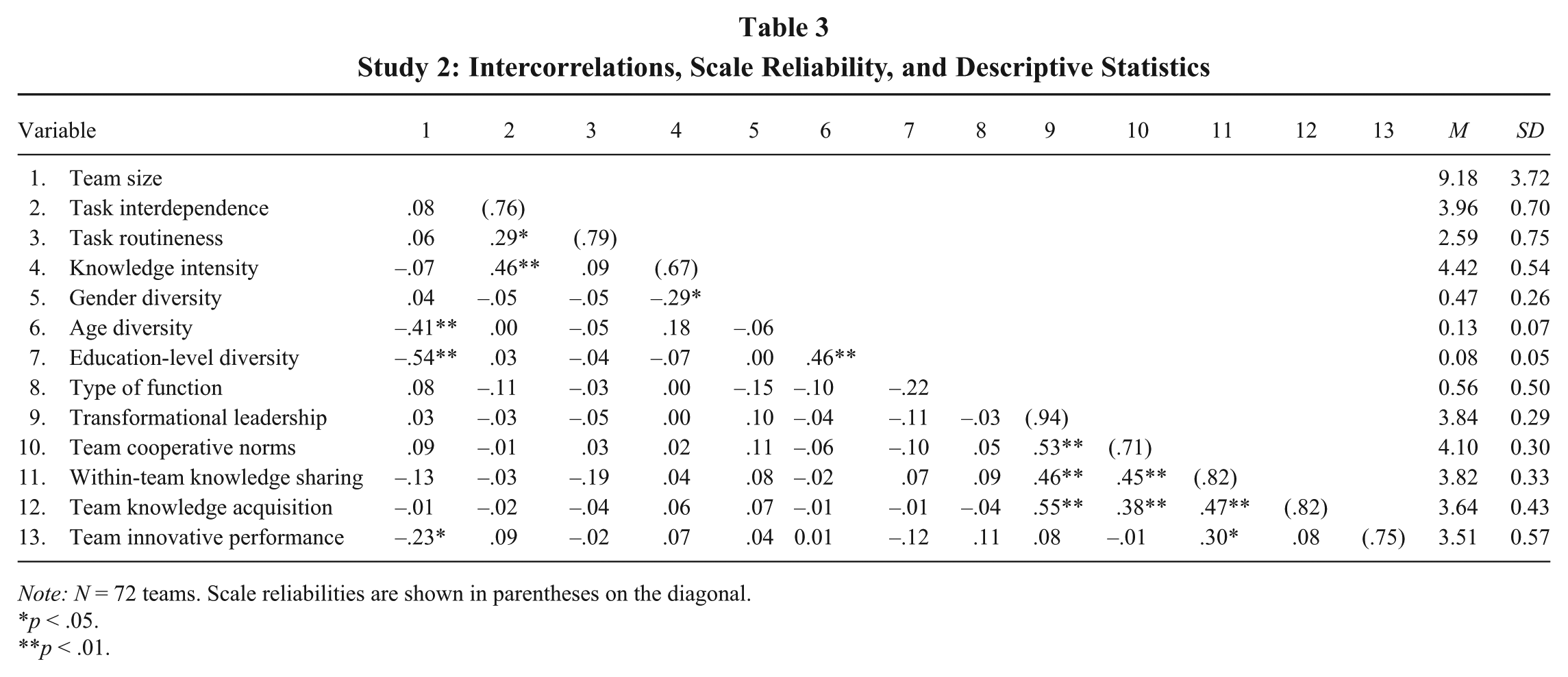
Note: N = 72 teams. Scale reliabilities are shown in parentheses on the diagonal.
p < .05.
p < .01.
Table 4 presents the results of the models for hypothesis testing. Hypothesis 1 predicted that team cooperative norms would mediate the relationship between transformational leadership and within-team knowledge sharing. We found that transformational leadership was positively related to team cooperative norms (β = 0.48, p < .01; Model 1) and knowledge sharing (β = 0.69, p < .01; Model 2). When both transformational leadership and cooperative norms were added to predict within-team knowledge sharing, team cooperative norms was positively related to knowledge sharing (β = 0.25, p < .05; Model 3), and the effect of transformational leadership reduced in size (from β = 0.69, p < .01, in Model 2 to β = 0.57, p < .01, in Model 3). Team cooperative norms explained the additional 5% of variance in knowledge sharing. These results supported team cooperative norms as a partial mediator.
Study 2: Random Coefficient Modeling Results
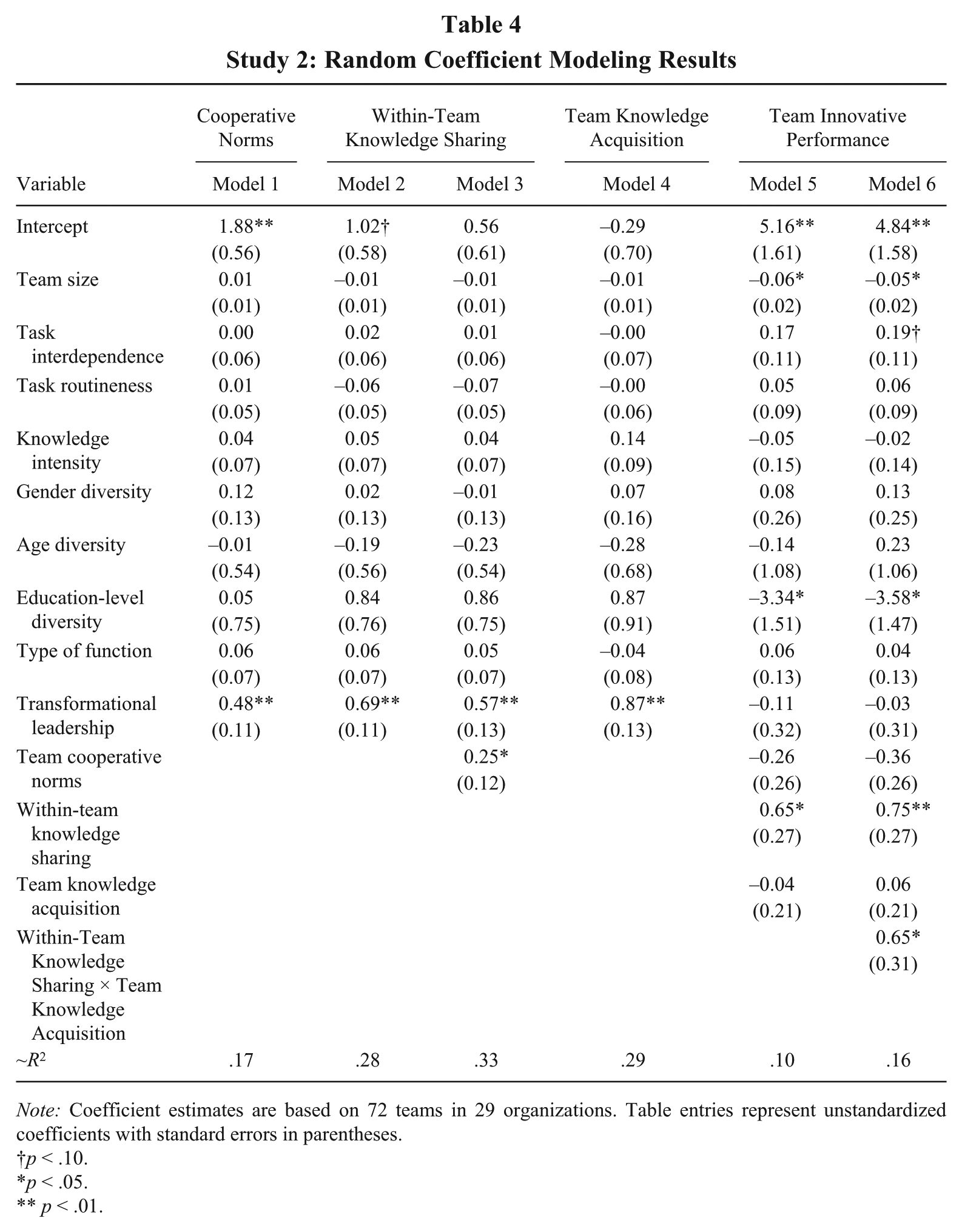
Note: Coefficient estimates are based on 72 teams in 29 organizations. Table entries represent unstandardized coefficients with standard errors in parentheses.
p < .10.
p < .05.
p < .01.
Hypothesis 2 proposed that within-team knowledge sharing would be positively related to team innovation. To the test this hypothesis, we included all the control variables and predictors in the model (Model 5). In support of Hypothesis 2, within-team knowledge sharing was positively related to team innovation (β = 0.65, p < .05).
We further tested two hypotheses related to team knowledge acquisition. Hypothesis 4 predicted that transformational leadership would be positively related to team knowledge acquisition. As shown in Model 4, transformational leadership was strongly related to knowledge acquisition (β = 0.87, p < .01). Finally, Hypothesis 5 proposed that team knowledge acquisition would moderate the relationship between within-team knowledge sharing and team innovative performance. As shown in Model 6, the interaction term (Knowledge Sharing × Knowledge Acquisition) had a significant relationship with team innovative performance (β = 0.65, p < .05). To probe the nature of the interaction, we plotted the relationship following the procedure by Aiken and West (1991). Figure 2 demonstrates that within-team knowledge sharing was positively related to team innovation and that the relationship was stronger for teams engaging in high levels of knowledge acquisition. Simple slope tests revealed that within-team knowledge sharing was related to team innovative performance at both low (β = 0.47, p < .10) and high (β = 1.03, p < .01) levels of knowledge acquisition. Therefore, Hypothesis 5 was supported.
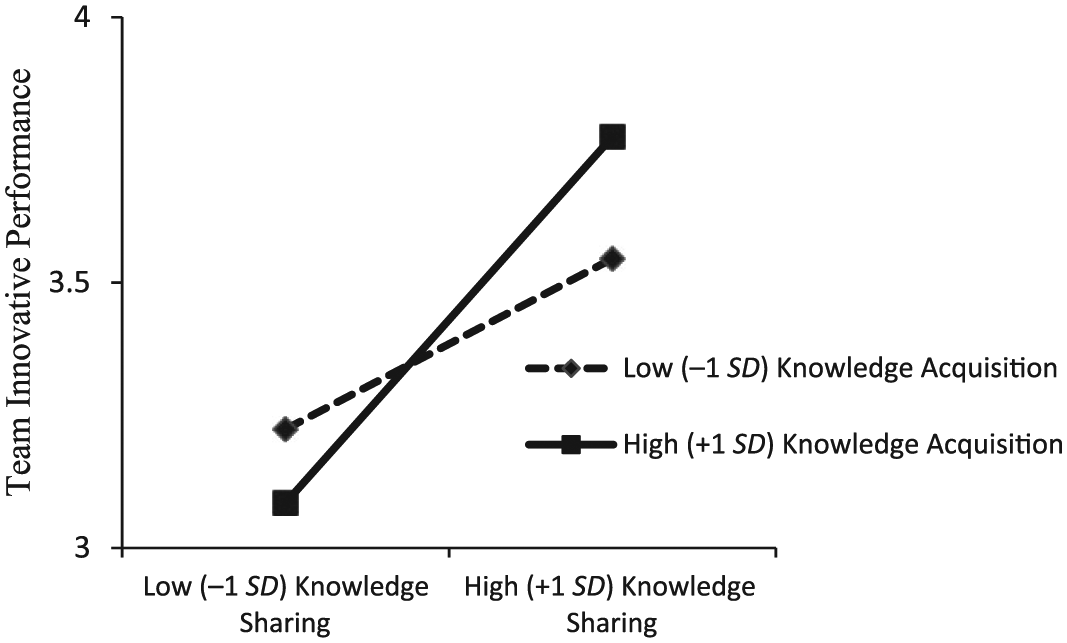
Moderating Effect of Knowledge Acquisition
Finally, we conducted supplemental analyses by calculating the 95% CI for the indirect effects conditioned at low (–1 SD) and high (+1 SD) knowledge acquisition. Results showed that the indirect effect was positive when the level of knowledge acquisition was high (95% CI [.022, .511]) but not when the level of knowledge acquisition was low (95% CI [–.034, .285]). These results supported the moderating effect of knowledge acquisition on the integrative processes linking leadership and innovation.
General Discussion
Recognizing the importance of the integrative mechanism linking transformational leadership and team innovation, we proposed a comprehensive framework adopting a knowledge-centered view of team processes (Argote et al., 2001; Cohen & Bailey, 1997; Jackson et al., 2006; S. Wang & Noe, 2010) and conducted two studies examining team integrative processes. Analyses of temporarily assembled project teams in Study 1 indicated that transformational leadership contributed to team innovative performance through cooperative norms and within-team knowledge sharing, and such a mediation process was significant even after controlling for another mediation process of team autonomy. Study 2 replicated the integrative mechanism by using a sample of permanent work teams from various functional areas. Moreover, the integrative process manifested more strongly when the teams engaged in high levels of external knowledge acquisition, which was also associated with transformational leadership. Overall, although our results did not provide consistent support for a direct relationship between transformational leadership and team innovation, the findings are consistent with Hülsheger and colleagues’ conclusion, based on their meta-analytic review, that “team process variables display substantial and generalizable relationships with innovation” (2009: 1137). Together, the two studies answer important questions about “the mechanisms that link transformational leadership and innovation” (Rosing et al., 2011: 962).
Limitations
Before discussing the theoretical and practical implications of our findings, we acknowledge our study limitations that deserve attention. First, in order to compare performance across teams engaging in different tasks, we adopted subjective supervisory ratings of innovative performance. Although such ratings facilitate cross-team comparison, it is exposed to, as with any survey-based method, human assessment errors. It would be desirable to replicate our study with objective innovation performance measures in future research.
Furthermore, our examination of cooperative norms focuses on a positive team process transformational leadership enhances for innovative performance. Previous research has found that cooperative and competitive group dynamics have distinguishable effects on innovation and performance (e.g., Tjosvold, 1998; Tjosvold, Law, & Sun, 2003). Given that our model was built tightly around transformational leadership theory, which contains primarily a close association with cooperative dynamics, we did not include team competition but, rather, contrasted cooperation and integration against autonomy. Future research extending our study can examine the potential leadership processes that shape teams’ cooperative versus competitive dynamics.
Finally, previous laboratory work on group decision making has highlighted the situations where group members tend to share common information or favor information that supports members’ preferences (Stasser & Titus, 1985), and evidence has shown the association of leadership style with group decision quality (e.g., Larson, Foster-Fishman, & Franz, 1998). Accordingly, another limitation of this study is that our analyses of the impact of knowledge sharing did not include the specific content being shared. Additional research is needed to unpack the processes by which transformational leaders promote sharing of common versus unique information and knowledge among team members.
Theoretical Implications
Our study contributes to the leadership and team innovation literature in two important ways. First, whereas researchers have reported the association of leadership with creativity and innovation through creating an empowering and autonomous environment (e.g., G. Chen et al., 2011; Z. Chen & Aryee, 2007; Zhang & Bartol, 2010), less studied is what leaders can do to facilitate team integrative mechanisms (cf. Kearney & Gebert, 2009). We argued and found support for the prominent effect of transformation leadership on the integrative mechanism via cooperative norms in two studies. Moreover, Study 1 contrasted the integrative mechanism with the autonomous mechanism and found that both were significant mediation processes linking leadership and innovation. In other words, transformational leaders facilitate team innovative performance not only by delegating tasks and decision-making authority to their teams but also by forming a normative expectation of cooperation among team members. Interestingly, the nonsignificant difference between two indirect effects implies that both mechanisms can be equally important in promoting innovation. Thus, our research complements and extends Kearney and Gebert’s work on the integrative processes for team performance by theorizing and testing norms as an integration mechanism for team innovation.
The second contribution of this study lies in shedding light on the effectiveness of knowledge-centered processes in explaining the effects of transformational leadership. Transformational leadership has been identified as an important antecedent of group creativity and innovation, yet research unpacking its influence mechanisms is limited (Eisenbeiss et al., 2008). The indirect effect found through cooperative norms and knowledge sharing demonstrates its key role in connecting transformational leadership and team innovation (Cummings, 2004; Haas & Hansen, 2007). Furthermore, as a result of the complexity of innovative tasks, leaders need to attend to vastly different processes and switch between opening and closing behaviors (Rosing et al., 2011). Prior work has identified transformational leadership as an opening, change-oriented behavioral style (Bass, 1985; Jung et al., 2003; Shin & Zhou, 2003); our findings of Study 2 revealed a dual role such a leadership approach plays in stimulating both internal and external knowledge activities. Knowledge acquisition may have an equally, if not more, important role as knowledge sharing for team innovation under certain circumstances. For instance, scholars have highlighted the importance of communication between team members and their external environment for knowledge-intensive teams (e.g., Ancona, 1990; Keller, 2001). Results of Study 2 corroborate the view that acquiring knowledge from outside can augment the benefits of knowledge sharing for permanent work teams: Without fresh ideas and sometimes even controversial viewpoints acquired from outside, team members may feel comfortable in their daily routines and therefore lose the motivation and momentum to speed up innovation. Further investigations can examine whether and when different dimensions of transformational leadership (e.g., using the MLQ) may differentially influence knowledge-centered processes within teams for innovation.
In addition to the main contributions noted above, we found a difference in the strength of the overall relationship between transformational leadership and innovative performance in two studies. In particular, compared to Study 2, in which leadership was not correlated with innovation, the correlation reached a marginal significance level (.10) in Study 1, in which the relatively small sample size may further constrain the power of detecting a significant correlation. Our speculation is that the overall weak correlation may reveal that the influence of transformational leaders on innovation is more complex than expected. On one hand, strong leaders may cause subordinates’ dependency on leaders (Kark, Shamir, & Chen, 2003), thus reducing their independent initiatives; on the other hand, innovation involves complex processes and even seemingly contrasting actions, which may entail other leader behaviors that also are valuable for ultimate innovative performance (Rosing et al., 2011). With regard to the relatively stronger correlation found in Study 1, it is likely that transformational leadership is most important for teams facing high levels of uncertainty and ambiguity in newly engaged tasks, and the strength of its influence partly depends on the proximity between the leader and the members. That is, when facing uncertain, dynamic situations, internal leaders can leverage transformational behaviors more effectively to foster team innovation, probably by communicating more directly to team members and providing more frequent coaching and intellectual stimulation.
Last but not least, the findings of our research also raise interesting questions on potential differential effects of transformational leadership in different cultural contexts. The relationship between leadership and cooperative norms was fairly strong for Chinese employees in both samples. We surmise that the strong relationship might echo the cultural context of collectivism for the Chinese. Because group-oriented behaviors are more desired in the Chinese context, the motivational consequences of transformational leadership are that it activates and reinforces members’ identification with, and feeling of belongingness to, the groups the leaders represent. Thus, the integrative mechanism uncovered in our studies may prove stronger in collectivistic rather than in individualistic societies, in which people stress personal goals and interest. Future cross-cultural replication of our studies would shed light on understanding these intervening mechanisms in various cultural contexts.
Managerial Implications
Findings of the current studies provide some practical implications for managing team innovation. The intervening mechanism of transformational leadership reveals that team leaders should attend to norms for cooperation and behavior of knowledge sharing when they practice transformational behaviors towards their members engaged in innovative tasks. Since norms develop unconsciously and quickly after the team forms and tend to resist subsequent revisions (MacNeil & Sherif, 1976), leaders can leverage transformational behaviors in early stages of team development to establish norms for cooperation. Furthermore, these positive effects on innovation are better produced when leaders encourage their teams to learn and transfer knowledge across team boundaries. Overall, developing and training managers for transformational behaviors may improve their capabilities to manage innovation-enhancing processes found in our study. Practices such as role plays with the group or on a one-on-one basis and behavioral evaluation and goal setting can help team leaders develop and maintain transformational behaviors (Yammarino et al., 2012).
Finally, data for this research came from China—a country that has experienced rapid economic and cultural changes during the past 3 decades. The ideologies and Confucian values, mixed with emerging market rules and regulations, present a different context than Western countries in which most of leadership theories have their roots (Tsui, Wang, Xin, Zhang, & Fu, 2004). However, as argued by C. C. Chen and Farh (2010), transformational leadership is compatible to the Chinese collective and leader-centric values, and empirical work on transformational leadership in the Chinese context has demonstrated its utility in predicting workplace outcomes (Kirkman, Chen, Farh, Chen, & Lowe, 2009; Liao & Chuang, 2007; H. Wang, Law, Hackett, Wang, & Chen, 2005). Our study explicitly demonstrated that the group-oriented expectations are valuable for leaders to foster knowledge sharing for innovation among Chinese teams. Thus, this study adds to the existing research and suggests that transformational leadership may launch collaborative processes in teams and subsequently result in innovation in the Chinese business environment. This has implications for global managers and managers of global teams: They can develop and leverage their transformational behaviors when they interact with their Chinese subordinates, particularly when leading innovative projects that hinge on the integration of members’ knowledge and ideas.
Footnotes
Acknowledgements
This article was accepted under the editorship of Patrick M. Wright. We would like to thank Susan E. Jackson for providing helpful input and feedback on earlier drafts of this article. We also thank J. Craig Wallace and two anonymous reviewers for their constructive comments. This research was supported by the National Natural Science Foundation of China (no. 71432005).