



Abstract
Sharing knowledge among team members is critical to accomplishing innovation. However, there are motivation and communication barriers to sharing knowledge in teams. In this study of 219 work teams, two mechanisms that have potential for encouraging knowledge sharing (social capital and extrinsic incentives) are examined as they relate to tacit knowledge sharing, explicit knowledge sharing, and team innovation. Tacit knowledge sharing mediated the relationships between cognitive social capital and team innovation as well as between explicit knowledge sharing and team innovation. Explicit knowledge sharing mediated the relationship between relational social capital and team innovation, while both forms of knowledge sharing mediated the relationship between extrinsic incentives for knowledge sharing and team innovation.
Knowledge sharing has been found to be a key mediator through which social capital influences organizational innovation (Maurer, Bartsch, & Ebers, 2011; Wei, 2007; H. M. Xie, Ge, & Wang, 2008; Yli-Renko, Autio, & Sapienza, 2001). However, most innovation research has not made a clear distinction between the two types of knowledge that may be shared (tacit and explicit) and has not explored this distinction as it relates to innovation within teams. Tacit knowledge is difficult to codify and can only be transmitted through experience, while explicit knowledge is easily communicated and transferred (Polanyi, 1962). Compared with explicit knowledge, tacit knowledge can provide organizations with a competitive advantage which cannot be easily imitated by rivals when managed effectively (Nonaka, 1994; Thomas, 2002). Understanding the relationship between knowledge sharing and team innovation is particularly important as teams are often the mechanism through which organizations hope to achieve innovation (Chi, Huang, & Lin, 2009; West, 2002).
Despite its potential value for innovation, individuals may be reluctant to share knowledge with others because of the value and competitive advantage it brings to them personally (Lin, 2007). In an attempt to overcome such barriers to knowledge sharing, corporate decision makers may offer employees incentives for sharing their knowledge (Janowicz-Panjaitan & Noorderhaven, 2009). For example, employees who spend time showing new employees a complicated procedure could be rewarded with merit pay. Extrinsic incentives are widely regarded as a key mechanism for achieving integration among functional areas within teams, which is critical for realizing both knowledge sharing and innovation in teams (Coombs & Gomez-Mejia, 1991; Sarin & Mahajan, 2001). However, offering extrinsic incentives may not achieve desirable results consistently, as it is often difficult to measure and appraise knowledge-sharing behaviors, especially tacit knowledge sharing (Osterloh & Frey, 2000). In addition, extrinsic incentives have been shown to reduce individuals’ satisfaction in engaging in behavior (Deci, Koestner, & Ryan, 1999) and have a somewhat inconsistent relationship with performance-based outcomes in teams (Sarin & Mahajan, 2001).
As an alternative to offering extrinsic incentives for knowledge sharing, intrinsic motivation to engage in knowledge sharing may be encouraged. When teams develop strong social capital among members, the connections, trust, and shared understanding offer intrinsic rewards, such as camaraderie and a sense of achievement from work that involves knowledge sharing (cf., Kalman, 1999).
It is not yet understood whether an extrinsic approach (extrinsic incentives) or an intrinsic approach (social capital) to encouraging knowledge sharing is more effective. In this study, we examined whether social capital is more or less effective than extrinsic incentives in promoting knowledge sharing within a team. Furthermore, we considered two types of knowledge sharing (tacit and explicit) as mediators between social capital and team innovation as well as between extrinsic incentives and team innovation.
Conceptual Background and Hypotheses
In the sections that follow, the dimensions of social capital within teams as well as tacit and explicit knowledge are discussed. Subsequently, hypotheses are proposed regarding the relationships among social capital, tacit and explicit knowledge sharing, extrinsic incentives for knowledge sharing, and team innovation. The relationships among the variables are shown in Figure 1.
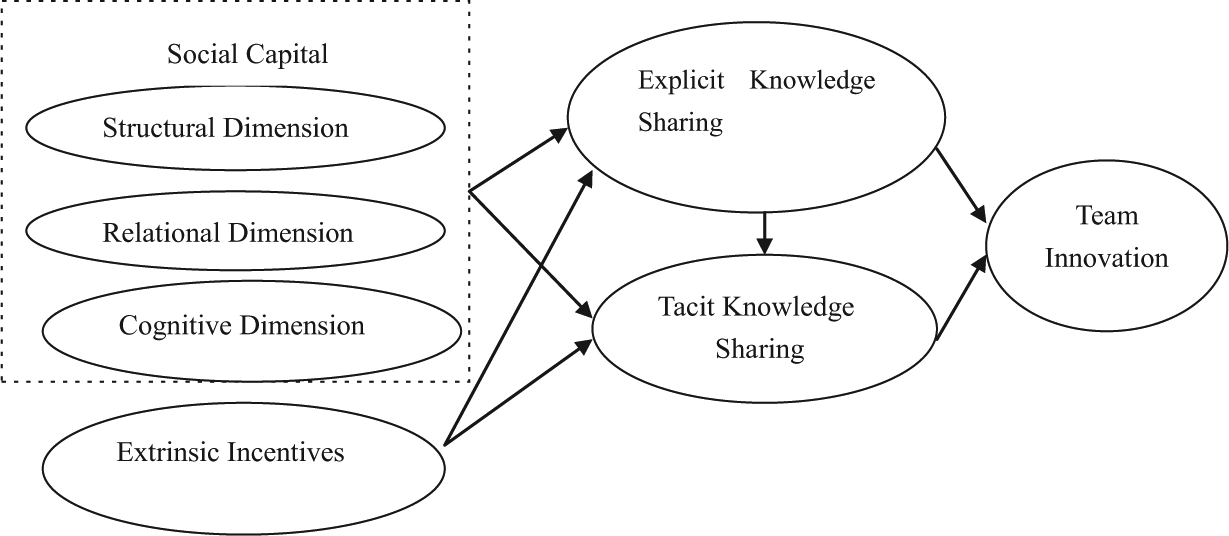
Conceptual model of social capital, extrinsic incentives, knowledge sharing, and team innovation.
Concept and Dimensions of Social Capital Within Teams
Social capital definitions typically include an emphasis on resources that can help accomplish goals as well as how these resources are located in networks of individuals, groups, organizations, or communities (Burt, 2000; Inkpen & Tsang, 2005; Nahapiet & Ghoshal, 1998). The resources that arise from social capital are both actual and potential resources that can be drawn on in the future (Bourdieu, 1986). Social capital within teams specifically involves resources, such as access to information, mutual trust, and emotional support, that are located within the structure of social relationships among team members (Oh, Labianca, & Chung, 2004).
Research on social capital in teams to date has focused on examining the relationship between team social capital and team performance or effectiveness (Gupta, Huang, & Yayla, 2011; Oh et al., 2004; Pil & Leana, 2009; Reagans & Zuckerman, 2001; Reagans, Zuckerman, & McEvily, 2004; van Emmerik & Brenninkmeijer, 2009). All but one of these studies (van Emmerik & Brenninkmeijer, 2009) found support for a positive relationship between team social capital and team effectiveness. Interestingly, none of these studies specifically examined dimensions of social capital and nor did they include any measures of team innovation.
Nahapiet and Ghoshal’s (1998) seminal article on the structural, relational, and cognitive dimensions of social capital has been a foundation of much subsequent research on social capital, with the exception of empirical work on social capital within teams (Bolino, Turnley, & Bloodgood, 2002; Chua, Lim, Soh, & Sia, 2012; Tsai & Ghoshal, 1998). All of these three social capital dimensions are thought to be interrelated, yet they each offer different views of how to capture social capital.
The structural dimension of social capital focuses on characteristics of the configuration of connections among members within a network. For instance, the frequency of interaction among team members and the strength of ties among team members are common indicators of the structural dimension of social capital (Nahapiet & Ghoshal, 1998). Teams in which members know each other well and interact frequently with each other are considered to be dense networks, which encourage cooperation and information sharing (Oh et al., 2004).
The relational dimension involves assets that accompany the connections between or among individuals. Nahapiet and Ghoshal (1998) proposed trust, norms, obligations, and identification to characterize the relational dimension of social capital. For the purpose of knowledge sharing, trust is a critical aspect of relational social capital. Trust allows for a freer exchange of information and for confidence in individuals’ intentions (Inkpen & Tsang, 2005).
The cognitive dimension focuses on the creation of shared cognition among team members. Having a shared understanding or shared context is a resource from which benefits, such as having transmitted information understood easily among team members, can be accumulated. The indicators of cognitive social capital, according to Nahapiet and Ghoshal (1998), are shared language and shared narratives. This research will analyze social capital within teams in terms of the structural, relational, and cognitive dimensions of social capital as they relate to tacit and explicit knowledge sharing and team innovation.
Tacit Knowledge and Explicit Knowledge
Tacit knowledge refers to knowledge possessed by individuals that is difficult to communicate with others via words and symbols (Polanyi, 1962). The tacit aspects of knowledge are those that cannot be easily written down, but instead are best transmitted via training or gained through personal experience (Wagner & Sternberg, 1985). The effective transfer of tacit knowledge often is thought to require extensive personal contact and trust (Brockmann & Anthony, 2002). People often possess a large quantity of valuable tacit knowledge that is hard to imitate, describe, and transfer, so the tacit knowledge possessed by employees can be a source of innovation and sustainable competitive advantage.
Explicit knowledge is knowledge that can be explained and codified using written language (Nonaka, 1994; Polanyi, 1962). Unlike tacit knowledge, there are a variety of ways that explicit knowledge can be transferred, including academic learning, reading documents, on-the-job training, and interacting with others (Boud & Middleton, 2003; Leonard-Barton, 1998). Although codifying knowledge in the form of explicit knowledge often facilitates knowledge sharing, there may be barriers to sharing explicit knowledge, such as when patents protect knowledge and guard against imitation.
Most research on tacit and explicit knowledge focuses on ways to transfer tacit knowledge into explicit knowledge (Nonaka, 1994; Scully, Buttigieg, Fullard, Shaw, & Gregson, 2013; Thomas, 2002). While Nonaka and Konno (1998) explain the stages in which tacit knowledge can be transformed into explicit knowledge, other researchers have emphasized the difficulty of converting tacit into explicit knowledge without losing its value (Jasimuddin, Klein, & Connell, 2005; Voelpel & Han, 2005). Furthermore, people often lack the motivation to transfer their tacit knowledge, as this process takes much time and energy. In addition, transfer undermines the power and authority that individuals’ tacit knowledge provides.
Only a small body of literature addresses the factors that foster tacit knowledge sharing. Much of the work on tacit knowledge sharing has been conceptual (e.g., Brockmann & Anthony, 2002) and has posited that socialization processes play a key role in sharing tacit knowledge. Empirical work has found that affect-based trust positively relates to tacit knowledge-sharing intentions, but these intentions do not bear a strong relationship with actual knowledge-sharing behavior within teams (Yang & Farn, 2009). In a study that examined tacit knowledge sharing in general (not specifically in teams), trust in coworkers and organizational commitment were found to relate positively to tacit knowledge sharing (Lin, 2007). These studies emphasize trust, which is encompassed in the relational dimension of social capital, but they do not consider other dimensions of social capital within the same study.
While sharing explicit knowledge is less difficult than sharing tacit knowledge, due to the ease with which explicit knowledge can be transferred, there still are barriers involved in sharing explicit knowledge. Teams may be launched with the expectation that explicit knowledge will be shared among team members, but such knowledge sharing does not always occur, due to such factors as trying to efficiently move to performing group tasks instead of first elaborating on information that is known (van Ginkel & van Knippenberg, 2008; Zhao & Lavin, 2012). Explicit knowledge sharing is important not only because of its important role in knowledge creation, but also because it has been linked to innovation (at the individual level; Kelley, Ali, & Zahra, 2013; Nonaka, 1994).
Another factor besides trust that has been discussed in the literature as contributing to knowledge sharing is extrinsic incentives (Stenmark, 2001). Extrinsic incentives and social relationships may play quite different roles in tacit knowledge sharing and explicit knowledge sharing. For example, extrinsic incentives may be especially effective in encouraging explicit knowledge sharing, as both are easily exchanged, while social relationships may be of more importance for capturing and understanding tacit knowledge through face-to-face communication.
Social Capital, Knowledge Sharing, and Team Innovation
To establish the mediating role of knowledge sharing in the relationship between social capital and team innovation, it is important to first consider how each of the three forms of social capital is expected to relate to tacit and explicit knowledge sharing. The structural dimension of social capital in teams refers to the strength of ties or frequency of interactions among team members (Tsai & Ghoshal, 1998). Research indicates that the largest obstacle to knowledge sharing is time constraints, which result from a heavy workload (Fong & Chu, 2006). Structural social capital indicates that team members already have connections with one another such that time that otherwise might be needed to establish ties with others in the team can be devoted to other tasks. As a result of contacts that accompany structural social capital, team members have a high likelihood of having informal face-to-face interactions that minimize the potential for misunderstanding and allow tacit knowledge to be effectively observed and understood (Davenport, Harris, & Kohli, 2001). In addition, the frequent direct contacts resulting from structural social capital provide time and opportunities for exchanging explicit knowledge (Adler & Kwon, 2002; Hansen, 2002).
The relational dimension of social capital in teams refers to the quality of the connections among individuals, which includes the degree of liking, trust, and cooperation involved in a relationship (Bolino et al., 2002). Among these elements, trust often is considered to be the most important (Chowdhury, 2005; Fukuyama, 1995; Holste & Fields, 2005; Levin & Cross, 2003). Trust based on reciprocity norms among team members enhances the cohesion of a team and facilitates cooperation among team members (Krackhardt, 1999), leading to increased dialogue and shared communication (Schippers, Den Hartog, & Koopman, 2007). When individuals trust one another, they not only engage in more knowledge sharing, but the knowledge shared includes information that is idiosyncratic or private as can be characteristic of tacit knowledge (Szulanski, Cappetta, & Jensen, 2004; Uzzi & Lancaster, 2003; H. F. Xie & Ma, 2007). Thus, relational social capital is expected to encourage tacit knowledge sharing due to the high-quality relationships involved among individuals (Janowicz-Panjaitan & Noorderhaven, 2009; Stenmark, 2001). The trust, norms, and enhanced cooperation that accompany relational social capital also allow for increased communication, which facilitates explicit knowledge sharing (Krackhardt, 1999; Schippers et al., 2007).
The cognitive dimension of social capital in teams involves the extent to which team members develop a shared perspective or common understanding (Tsai & Ghoshal, 1998). The shared understanding that team members with strong cognitive social capital have allows them to feel comfortable sharing experiences and know-how (Brown & Duguid, 2000). Cognitive social capital helps team members communicate and cooperate more effectively as well as to better express and understand shared knowledge, especially the tacit knowledge embedded in a particular context. Thus, cognitive social capital held by team members determines teams’ ability to share the knowledge that is hard to communicate and understand (Ke, Sun, & Gu, 2007; Leana & Van Buren, 1999). Similarly, cognitive social capital, with its emphasis on shared values and language, also encourages explicit knowledge sharing as communication is easy to engage in when the parties involved have a shared foundation from which to communicate (Brown & Duguid, 2000).
Turning now to the relationship between knowledge sharing and team innovation, research suggests that sharing knowledge among team members stimulates mutual learning, which encourages innovation (Eisenhardt & Tabrizi, 1995). Tacit knowledge is thought to facilitate innovation when it is shared among individuals such that the different perspectives that individuals hold about a challenge create “energy that is channeled into new ideas and products” (Leonard & Sensiper, 1998, p. 118). In addition, tacit knowledge has been found to result in radical innovation when accompanied by a high degree of social capital (Perez-Luno, Medina, Lavado, & Rodriguez, 2011). Perez-Luno and colleagues’ findings suggest that it may be when tacit knowledge is shared that innovation occurs. At the organizational level, tacit knowledge sharing across firms has been shown to result in increased firm innovative performance (Cavusgil, Calantone, & Zhao, 2003); a similar effect may be found within teams. Sharing explicit knowledge allows for the recombination of existing ideas, which is necessary to be innovative (Kogut & Zander, 1992). Explicit knowledge sharing is essential to the collaborative processes involved in innovation, which includes sharing requirements from relevant domains and exchanging details within and across the different areas represented in an innovative team (Bruns, 2013). Thus, we propose the following hypotheses:
Now that relationships among social capital, tacit and explicit knowledge sharing, and team innovation have been proposed, we turn to extrinsic incentives. Extrinsic incentives provide an extrinsic form of motivation for engaging in knowledge sharing. Next, the relationships among extrinsic incentives, the two forms of knowledge sharing, and team innovation are considered.
The Effect of Extrinsic Incentives
Research has found that the majority of employees in organizations are unwilling to share their knowledge (Fong & Chu, 2006). One important reason is that knowledge sharing may undermine the advantages that employees possessing scarce knowledge accrue. Knowledge sharing means spending extra time and energy as well as a loss of an individual’s own competitive advantage with little promise of receiving benefits in return. Furthermore, knowledge-sharing behavior usually is not included in employees’ performance appraisals as it is not easy to observe and measure, which largely decreases people’s motivation to share knowledge (Bartol & Srivastava, 2002; McDermott & O’Dell, 2001).
Rewards have been found to be an effective way of promoting knowledge sharing among employees (Yu, Kim, & Kim, 2004). If an organization encourages knowledge sharing through extrinsic incentives, employees are expected to be motivated to share their explicit or tacit knowledge. This approach taps into extrinsic motivation in which outcomes external to individuals are offered in return for specific behavior (Porter & Lawler, 1968). Extrinsic incentives also fall within the domain of the structures and systems that organizational decision makers put into place to shape behavior (Janowicz-Panjaitan & Noorderhaven, 2009). When systems, such as extrinsic incentives, are put into place, behavior is shaped in accordance with the incentives being offered (Kerr, 1995).
As discussed in relation to the earlier hypotheses, tacit and explicit knowledge sharing are expected to be positively related to team innovation. Sharing tacit knowledge leads to mutual learning and sharing diverse viewpoints that help facilitate team innovation (Eisenhardt & Tabrizi, 1995; Leonard & Sensiper, 1998). When explicit knowledge is shared, team members elaborate on knowledge, allowing for the recombination of existing ideas that serve as a basis from which to create new knowledge (Kogut & Zander, 1992). Because offering extrinsic incentives for a behavior can alter behavior in the desired direction (Kerr, 1995) and because knowledge sharing has been linked with innovation (Bruns, 2013), we propose the following:
Tacit Knowledge Sharing, Explicit Knowledge Sharing, and Team Innovation
Although several researchers have emphasized the role of knowledge sharing on innovation and competitive advantage (Basadur & Gelade, 2006; Caloghirou, Kastelli, & Tsakanikas, 2004), they have less often differentiated between explicit and tacit knowledge sharing. One exception is a study that indirectly examined tacit knowledge sharing and found that communities of practice (groups within an organization that share information and experience related to a common problem) helped teams that collaborate virtually to perform better in the early stages of innovation (Bertels, Kleinschmidt, & Koen, 2011). The relationship among explicit knowledge sharing, tacit knowledge sharing, and team innovation, however, has not been emphasized in the literature.
Although Nonaka (1994) argues that tacit knowledge can be transformed into explicit knowledge just as readily as explicit knowledge can be transferred into tacit knowledge, other researchers more recently have suggested that tacit knowledge cannot always be transformed into explicit knowledge due to the nature of the information involved (Jasimuddin et al., 2005; Voelpel & Han, 2005). Furthermore, the value of tacit knowledge is thought to erode when tacit knowledge is transferred into explicit knowledge (Voelpel & Han, 2005). Building on these arguments, tacit knowledge sharing is expected to mediate the relationship between explicit knowledge sharing and team innovation.
For knowledge sharing to occur, individuals must have at least some degree of shared knowledge (Alavi & Leidner, 2001). The explicit knowledge shared among individuals can form a foundation of knowledge and understanding, which allow team members to comprehend and absorb deep-level tacit knowledge (Brown & Duguid, 2000). In addition, through the interaction involved in sharing explicit knowledge, team members are likely to share and capture tacit knowledge as well (Brockmann & Anthony, 2002). As tacit knowledge represents critical know-how that offers a competitive advantage (Martin & Salomon, 2003), teams that facilitate and utilize tacit knowledge sharing among team members are likely to accomplish innovative outcomes (Mohan & Venkatraman, 2001). Thus, we propose the following:
Method
Procedure and Sample
This study was conducted during a large-scale annual conference at a university in China. Most of the alumni who attended this conference are in the middle or senior management levels of their organization. In a session with the 628 conference attendees, we asked whether they led a team in their organization. We presented the goal of our study (to better understand knowledge sharing among employees) and asked for their consent for participation.
Team leaders were asked to complete a questionnaire that assessed innovation at the team level. There were a total of 412 individuals (out of the 628 conference attendees) who qualified for this study due to their role as team leaders. Following Van der Vegt and Bunderson (2005), we also requested that each team leader ask a random subset of his or her team members to complete a questionnaire that assessed other variables, including social capital, extrinsic incentives, and knowledge sharing. A total of 1,380 team members from 250 teams returned questionnaires directly to the researchers via email. There was an average of 5.52 returned team member questionnaires per team. Teams whose leader did not complete the questionnaire (13 teams) and work teams in which more than 50% of returned surveys included 20% or more incomplete items (18 teams) were excluded from the data set. The data set included 219 work teams, which represent 1,012 team members and 219 team leaders. Thus, the percentage of usable responses yielded a 53.2% response rate (219 out of 412 work teams).
Team size ranged from 3 to 9 (M = 4.62, SD = 2.04), excluding the team leader. Teams’ tenure ranged from 2 months 1 to 42 months (M = 20.6, SD= 7.2). Men comprised 68% of team member participants, while women consisted of 32% of team member participants. The average age of participants was 38.8 years (SD = 6.9). The organizations in which the work teams operate are located in 12 provinces in China, involving various industries, such as software (39%), manufacturing (25%), telecommunications (14%), bio-tech (9%), food processing (8%), and others (5%). The teams are involved in a wide range of activities encompassing a broad spectrum of innovations.
Translation Procedure
The survey instruments were translated from English to Chinese by a member of the research team. To ensure conceptual consistency between the original English survey items and the translated Chinese survey items, a colleague fluent in both Chinese and English back-translated the Chinese survey items (Brislin, 1970). The items were closely checked by the authors to ensure that they retained their original meaning.
Measures
Social capital in teams
Following the work of Tsai and Ghoshal (1998) and Wei (2007), we assessed social capital in teams with three dimensions: structural, relational, and cognitive. Structural social capital was assessed by three items: the frequency of team member communication, the strength of team member ties, and the time spent on team member communication. Relational social capital was assessed by three items: no inclination for profiting oneself at others’ expense, commitment to promises, and cooperation. The first of these relational capital items is intended to capture trust as defined by Porter, Lawler, and Hackman (1975, p. 497) as “the feeling that others will not take advantage of me” and the second of these items parallels one of Tsai and Ghoshal’s (1998, p. 470) two trust-related relational capital items (“will always keep the promises they make to you”). Cognitive social capital was assessed by three items: effective communication based on shared language, shared values, and shared collective objectives. We elicited responses to each question using a five-point scale, ranging from 1 (not at all) to 5 (very much). The coefficient alpha for structural, relational, and cognitive social capital in teams was .76, .81, and .81, respectively. As explained in the scale validation section, our analyses found each of these three scales and the knowledge sharing scales to be independent of one another.
Extrinsic incentives for knowledge sharing
We used the four-item scale developed by Lu and Liang (2005) to measure extrinsic incentives for knowledge sharing: “Employees’ contributions to knowledge sharing are taken into account for promotions or pay raises,” “Employees actively involved in sharing knowledge are publicly recognized and praised,” “Penalties are put on those employees who do not share their knowledge with others,” (reverse coded) and “Financial rewards are given to knowledge-sharing behavior.” Each item is scaled ranging from 1 (not at all) to 5 (very much). The coefficient alpha for extrinsic incentives for knowledge sharing was .84.
Explicit and tacit knowledge sharing
In the survey instrument, we provided a definition of explicit knowledge and tacit knowledge to help respondents understand the difference between these two constructs. Explicit knowledge was defined as “knowledge codified and transferable in formal systematic methods, such as computer programs, codified work procedures, customer databases, and company rules and policies.” Tacit knowledge was defined as “the knowledge which is very difficult to articulate, formalize and communicate, such as technical know-how, tactics for market promotion, managerial techniques, and the way people do things in the company (corporate culture)” (Dhanaraj, Lyles, Steensma, & Tihanyi, 2004; Shenkar & Li, 1999; Zander & Kogut, 1995).
These definitions capture a distinction that has been made in measures of explicit and tacit knowledge with respect to both content and the means by which these types of knowledge are shared (Dhanaraj et al., 2004; Haua & Evangelista, 2007). For example, Haua and Evangelista’s (2007) items reflected how explicit and tacit knowledge are shared and the form that such knowledge sharing often takes (e.g., reading training materials, attending formal lectures, and studying manuals for explicit knowledge along with interacting, observing, and adopting intuitive approaches for tacit knowledge). Because Haua and Evangelista’s examples of the knowledge types were not all applicable to the context of the current study, the measures used in this study built on the examples of the two knowledge types provided by previous researchers. Furthermore, our measure incorporated phrasing from Dhanaraj et al. (2004), such as managerial techniques and marketing know-how.
As the distinction between explicit and tacit knowledge is often viewed as a continuum with the two knowledge types as the poles at either end rather than as completely independent constructs (Inkpen & Dinur, 1998; Makhija & Ganesh, 1997), it is possible that some knowledge will fall between the two knowledge types. The examples provided in the survey were intended to provide respondents with several instances of each type of knowledge that were based on common examples provided in past research along with an understanding of ways in which such knowledge often is shared.
In the survey instrument, we included the following items immediately below the definition of explicit knowledge: “Team members often share this kind of knowledge” and “This kind of knowledge is shared through written documents.” The following items were used to measure the sharing of tacit knowledge: “Team members often share this kind of knowledge” and “This kind of knowledge is shared through observation and informal face-to-face communication and interaction, such as apprenticing and mentoring” (Athanassiou & Nigh, 2000). Each item was assessed on a scale ranging from 1 (not at all) to 5 (very much). The coefficient alpha for explicit knowledge sharing was .75, while the coefficient alpha for tacit knowledge sharing was .73. As explained in the scale validation section, our analyses found both of these scales and social capital scales to be independent of one another.
Team innovation
Team leaders were asked to assess their team’s innovation using Lovelace, Shapiro, and Weingart’s (2001) four-item team innovativeness measure, which was developed based on previous research on the innovative performance of teams (e.g., Ancona & Caldwell, 1992; Van de Ven & Chu, 1989). Lovelace et al.’s (2001) scale includes the following items: “The products of the team are innovative,” “The quantity of innovative products (or ideas) by the team is large,” “The team’s ability of being responsive to changes is high,” and “The overall technical performance of the team is high.” Technical performance refers to the overall performance of the team in applying innovative technology or methods. As our sample involved different kinds of teams and not all teams generate new products, the word “products” in the measure items refers to various forms of outcomes produced by the team, including physical products, service, ideas, and schemes. This definition was explained in the survey instrument as a footnote. Each item was assessed on a scale ranging from 1 (not at all) to 5 (very much). The coefficient alpha for team innovation was .73.
Controls
To reduce the variance caused by other factors, we controlled for team tenure and team size, which have been incorporated as controls previously in studies of team innovation (Chen, Chang, & Hung, 2008; Post, 2012). Team size is thought to impede innovation due to coordination and communication issues (Hackman & Katz, 2010; Katz, 1982). Team size is measured by the number of team members reported by the team leader.
Team tenure may influence team innovation such that team members’ perspectives become more homogeneous the longer team members have worked together (Shin & Zhou, 2007). Homogeneous perspectives, in turn, reduce the potential for generating novel ideas. Team tenure is measured by the number of months the team has been in existence, which also was reported by the team leader.
Aggregation to the Team Level
To assess the appropriateness of aggregating individual-level data to construct team-level measures, we first computed within-group agreement (James, Demaree, & Wolf, 1984). The rwg(j) values for all measures and all teams exceeded the generally accepted .70 for substantial interrater agreement with values at or above .76 (James et al., 1984). Moreover, intraclass correlation coefficients ICC(1) and ICC(2) were calculated to assess aggregate reliability (Bliese & Halverson, 1998). ICC(1) values exceeded the generally accepted cutoff value of .05 with values between .09 and .14. ICC(2) values exceeded the generally accepted cutoff value of .70 with values ranging from .96 to .97 (James et al., 1984). In addition, the results of F tests for all team-level measures were all significant (p < .01). Specifically, for structural social capital, F(218, 793) = 1.89, p < .01; for relational social capital, F(218, 793) = 2.68, p < .01; and for cognitive social capital, F(218, 793) = 2.15, p < .01. For extrinsic incentives for knowledge sharing, F(218, 793) = 1.92, p < .01. For explicit knowledge sharing, F(218, 793) = 3.25, p < .01 and for implicit knowledge sharing, F(218,793) = 3.73, p < .01. The high rwg, high value of ICC(1) and ICC(2), and significant F statistics justified aggregation to the group level.
Scale Validation
An exploratory factor analysis was conducted on social capital items and knowledge-sharing items to ensure that these scales were independent from one another. We randomly selected half of the sample for exploratory factor analysis. The five factors yielded by factor analysis with varimax rotation accounted for 73.66% of the variance and on-factor loadings ranged from .60 to .86, while off-factor loadings were less than .41.
Another half of the sample was used to perform confirmatory factor analysis to assess the convergent and discriminant validity of the seven constructs in our model. As this confirmatory factor analysis was used only for the purpose of scale validation, our sample size is considered within the acceptable range (Harrington, 2009). Fit indices indicated a reasonably good fit for the hypothesized model, χ2(168) = 261.1, p < .01, root mean square error approximation [RMSEA] = .01, comparative fit index [CFI] = .92, incremental fit index [IFI] = .93, Tucker Lewis index [TLI ] = .90. All items loaded significantly on the latent constructs they were designed to measure. The fit of alternative models was also examined to provide further evidence of the discriminant validity of the measures. Specifically, the fit of the hypothesized seven-factor model was compared with the fit of four six-factor models (models that combine: (a) explicit and tacit knowledge sharing, (b) structural and relational social capital, (c) structural and cognitive social capital, and (d) relational and cognitive social capital) as well as a five-factor model (that combined all three of the social capital measures). The hypothesized seven-factor model fit the data better, χ2(168) = 261.1, p < .01, RMSEA = .01, CFI = .92, IFI = .93, TLI = .90, than the other alternative models.
Results
Preliminary Analysis
Table 1 shows the means, standard deviations, reliabilities, and Pearson correlation coefficients related to the variables in this study. Composite reliabilities were all above .70. As some variables in the correlation matrix are highly correlated, we tested the discriminant validity of the constructs by comparing the square root of average variance extracted (AVE) with all corresponding correlations (De Luca & Atuahene-Gima, 2007). As shown in the diagonal in Table 1, the square root of the AVE of each construct was greater than the highest correlation between latent variables, which indicates that the constructs have strong discriminant validity.
Descriptive Statistics, Correlations, and Reliabilities (n = 219).
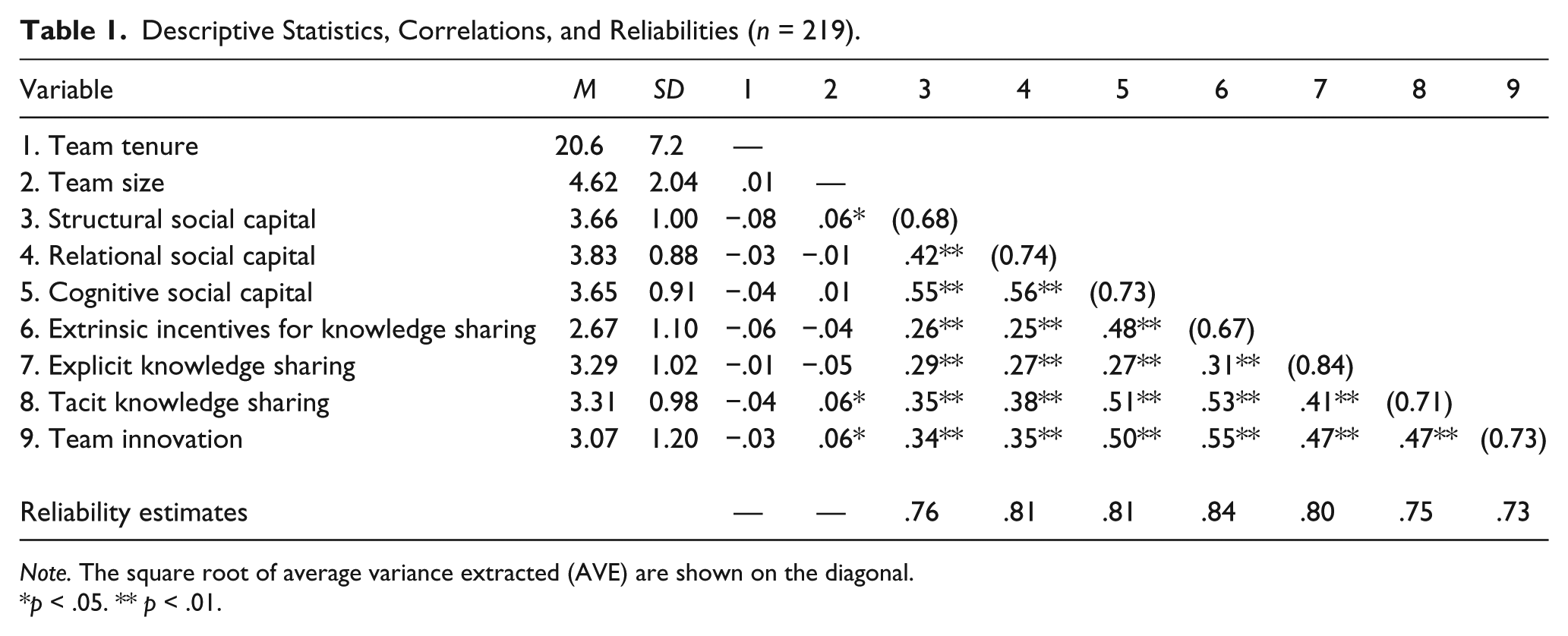
Note. The square root of average variance extracted (AVE) are shown on the diagonal.
p < .05. ** p < .01.
Mediating Effect of Tacit and Explicit Knowledge Sharing
We followed the three-step regression procedure that Baron and Kenny (1986) recommend for examining the mediating role of explicit and tacit knowledge sharing. The results of regression analysis are shown in Table 2. As structural social capital does not have a significant effect on team innovation (in Model 4, β = .06, n.s.), the mediating effects of tacit knowledge sharing and of explicit knowledge sharing between structural social capital and team innovation (Hypothesis 1a) are not supported.
Results of Regression Analysis: Standardized Path Coefficients (t-values).
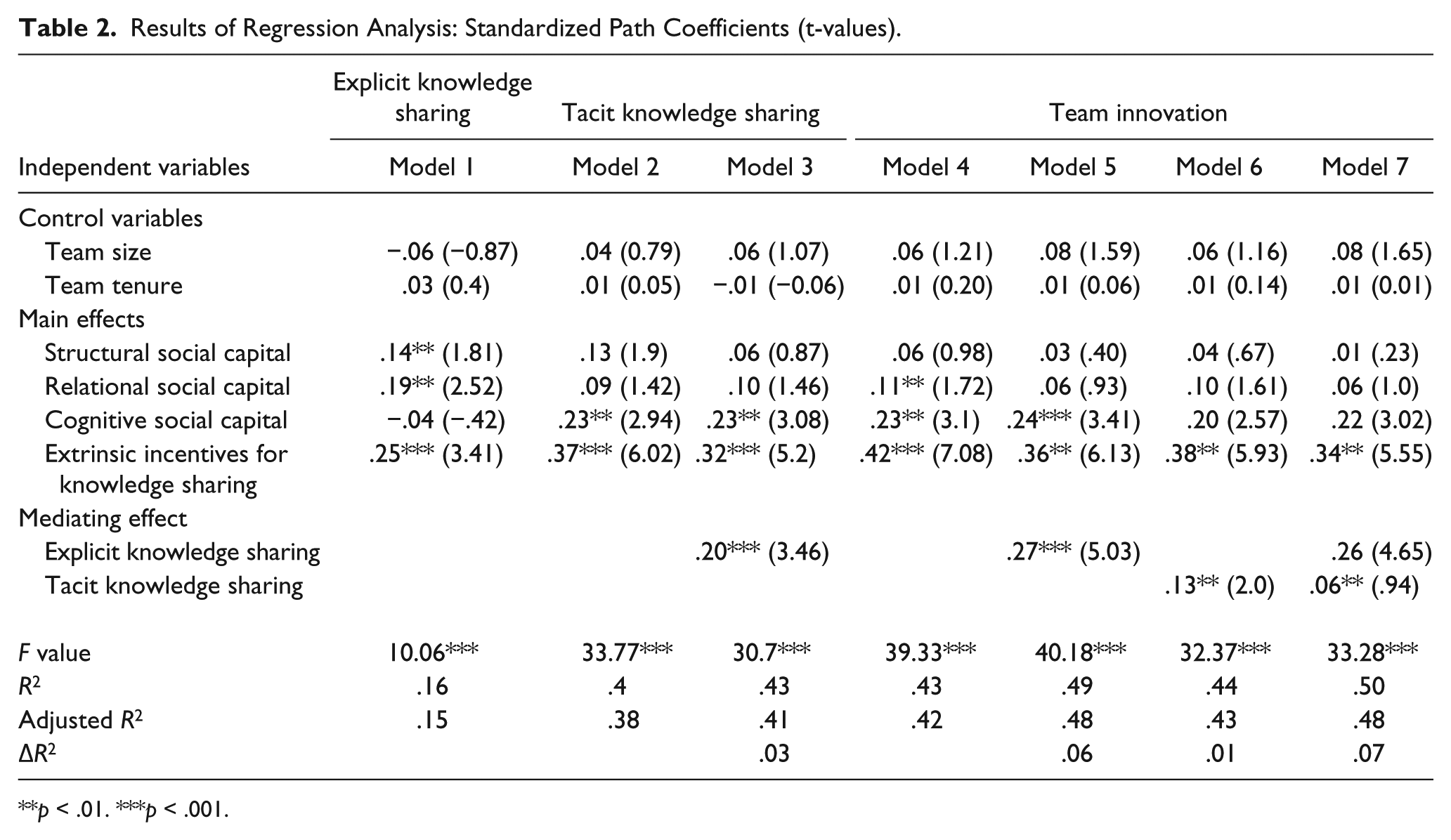
p < .01. ***p < .001.
Relational social capital is not significantly related to tacit knowledge sharing (in Model 2, β = .09, n.s.), so the mediating role of tacit knowledge sharing between relational social capital and team innovation is not supported. However, relational social capital is significantly related to both explicit knowledge (in Model 1, β =.19, p < .01) and team innovation (in Model 4, β = .11, p < .01). When the mediating variable explicit knowledge sharing is entered in Model 5, relational social capital has no significant effect on team innovation (β = .06, n.s.), thus the mediating effect of explicit knowledge sharing between relational social capital and team innovation (Hypothesis 1b) is supported for explicit knowledge sharing (but not for tacit knowledge sharing).
Model 2 and Model 4 indicate that there was a significant effect of cognitive social capital on both tacit knowledge sharing (β = .23, p < .01) and team innovation (β = .23, p < .01). When tacit knowledge sharing is included in Model 6, cognitive social capital does not have a significant effect on team innovation (β =.20, n.s.), indicating support for the mediating role of tacit knowledge sharing in the relationship between cognitive social capital and team innovation. However, as shown in Table 2, cognitive social capital is not significantly related to explicit knowledge sharing (in Model 1, β = −.04, n.s.), so explicit knowledge sharing does not mediate the relationship between cognitive social capital and team innovation. Thus, Hypothesis 1c is supported for tacit knowledge sharing, but not for explicit knowledge sharing.
Extrinsic incentives for knowledge sharing are significantly related to both explicit knowledge sharing (in Model 1, β = .25, p < .001) and team innovation (in Model 4, β = .42, p < .001). The inclusion of explicit knowledge sharing in Model 5 leads to a decrease in the effect size of extrinsic incentives for knowledge sharing on team innovation (from .42 to .36, p < .01), thus the partial mediating role of explicit knowledge sharing between extrinsic rewards for knowledge sharing and team innovation is supported. Similarly, the results in Model 2 and Model 4 show that extrinsic incentives for knowledge sharing are significantly related to tacit knowledge sharing (β = .37, p < .001) and team innovation (β = .42, p < .001). The inclusion of tacit knowledge sharing (in Model 6) leads to a decrease in the effect size of extrinsic incentives for knowledge sharing on team innovation (from .42 to .38, p < .01), suggesting partial mediation of tacit knowledge sharing between extrinsic incentives for knowledge sharing and team innovation. Thus, Hypothesis 2 is supported.
Model 3 and Model 5 indicate that explicit knowledge sharing is significantly related to tacit knowledge sharing (β = .20, p < .001) and team innovation (β = .27, p < .001). When tacit knowledge sharing is included in Model 7, explicit knowledge sharing does not have a significant effect on team innovation (β = .26, n.s.), which supports the mediating effect of tacit knowledge sharing between explicit knowledge sharing and team innovation (Hypothesis 3).
Researchers have suggested that relaxing the first condition of Baron and Kenny’s (1986) procedure (the condition that the independent variable must be significantly related to the dependent variable) is justifiable based on the results of Sobel’s (1982) test (De Luca & Atuahene-Gima, 2007; Preacher & Hayes, 2004). A Sobel test was conducted to examine indirect effect of independent variables, without concern about the significance of their total effects on the dependent variable. The results indicated significant indirect effects for relational social capital (z = 1.7, p < .05) and extrinsic incentives for knowledge sharing (z = 2.82, p < .01) on team innovation via explicit knowledge sharing. The results also indicated significant indirect effects for cognitive social capital (z = 0.9, p < .05), extrinsic incentives for knowledge sharing (z = 0.92, p < .05) and explicit knowledge sharing (z = 0.91, p <.05) on team innovation via tacit knowledge sharing. The Sobel test results support Hypotheses 2 and 3, in addition to partly supporting Hypotheses 1b and 1c, as relational social capital has significant indirect effect on team innovation only via explicit knowledge sharing and cognitive social capital has significant indirect effect on team innovation only via tacit knowledge sharing.
Structural Equation Modeling (SEM) Analysis
SEM using AMOS software was used to examine the robustness of the proceeding results and test the proposed model (shown in Figure 1; Arbuckle, 2006). The model fits the data very well, χ2(154) = 247.8, p < .001, RMSEA = 0.013, CFI = 0.95, IFI = 0.95, TLI = 0.94, but many path coefficients were not significant. To make the model more parsimonious, we eliminated those paths that did not meet the criteria that a path coefficient value should be significant at the p < .05 level. The adjusted model (shown in Figure 2) fits the data better than the proposed model, χ2(143) = 203.4, p < .01, RMSEA = 0.013, CFI = 0.97, IFI = 0.97, TLI = 0.95. Figure 2 shows the standardized path coefficient values of the adjusted model and all the path coefficients are statistically significant at the p < .01 level (critical ratio > 2.65).
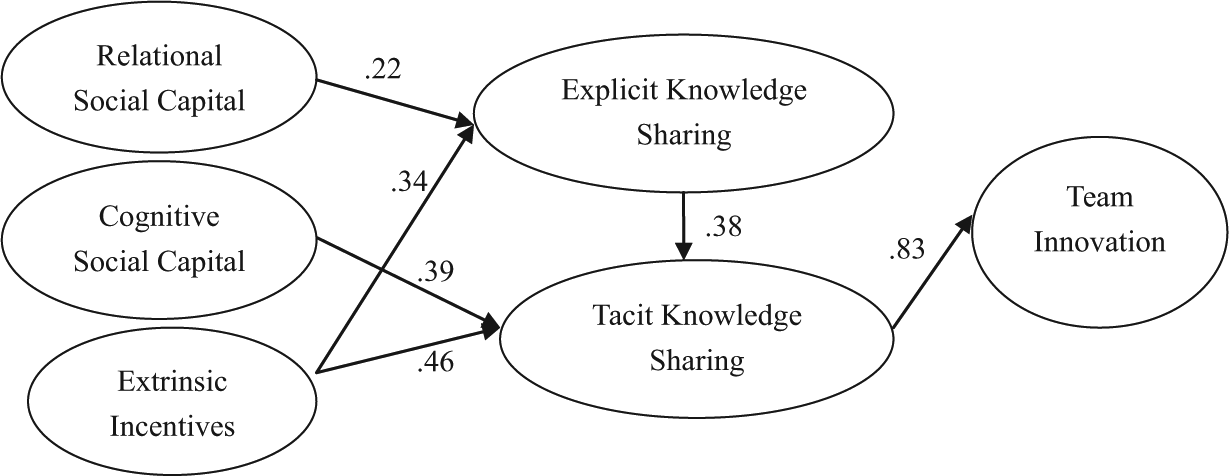
Adjusted path model.
The structural paths in the adjusted model were consistent with the results we obtained from the regression analysis. To provide further justification for the adjusted model, we tested several alternative competing models. In the first alternative model, we removed the two mediators (tacit knowledge sharing and explicit knowledge sharing) and examined the direct effects of social capital and extrinsic incentives for knowledge sharing on team innovation. The fit indices of the first alternative model suggested an equally good fit with the data, χ2(84) = 116, p < .001, RMSEA = 0.013, CFI = 0.97, IFI = 0.95, TLI = 0.97 compared with the adjusted model, but was not significantly better than the adjusted model, Δχ2(59) = −87.4, n.s. The variance explained for team innovation decreased from 68% in the adjusted model to 58% in the first alternative model. The results indicate that the adjusted model is better than the first alternative model.
In the second alternative model, we included three direct paths from relational social capital, cognitive social capital, and extrinsic incentives for knowledge sharing to team innovation in addition to the existing paths in the adjusted model. The model fit of this partial mediation model, χ2(140) = 202.5, p < .01, RMSEA = 0.013, CFI = 0.96, IFI = 0.94, TLI = 0.96, is not as good as the adjusted model and none of the three direct paths were significant. In addition, the adjusted model was more parsimonious. When the three direct paths from relational social capital, cognitive social capital, and extrinsic incentives for knowledge sharing to team innovation were dropped, the variance explained in team innovation stayed constant at 68%, further supporting the adjusted model.
We also considered one additional alternative model that focused on relationships among explicit knowledge sharing, tacit knowledge sharing, and team innovation. In the third alternative model, we tested the possibility that explicit knowledge sharing might mediate the relationship between tacit knowledge sharing and team innovation, by reversing the link between explicit knowledge sharing and tacit knowledge sharing and adding a direct path from explicit knowledge sharing to team innovation. We found that this model had a poorer fit, χ2(143) = 273.9, p < .01, RMSEA = 0.016, CFI = 0.92, IFI = 0.92, TLI = 0.90, than the adjusted model.
In the fourth alternative model, we added a direct path from explicit knowledge sharing to team innovation. The fit indices suggested a similarly good fit with the data, χ2(142) = 202.5, p < .01, RMSEA = 0.013, CFI = 0.96, IFI = 0.95, TLI = 0.97, compared with the adjusted model, but the alternative model was not significantly better than the adjusted model, Δχ2(1) = −0.9, n.s. Furthermore, the variance explained in team innovation remained the same in the fourth alternative model (68%), so the adjusted model (which dropped the direct path from explicit knowledge sharing to team innovation) was more parsimonious than the fourth alternative model.
Compared with all the alternative models, the adjusted model was found to be the best model. Furthermore, the structural paths in the adjusted model were consistent with the results we obtained using regression analysis. The results of this study suggest four conclusions: First, explicit knowledge sharing fully mediates the relationship between relational social capital and team innovation (Hypothesis 1b). Second, tacit knowledge sharing mediates the relationship between cognitive social capital and team innovation (Hypothesis 1c). Third, both explicit knowledge sharing and tacit knowledge sharing mediate the relationship between extrinsic incentives for knowledge sharing and team innovation (Hypothesis 2). Fourth, tacit knowledge sharing mediates the relationship between explicit knowledge sharing and team innovation (Hypothesis 3). However, Hypothesis 1a is not supported. In addition, the mediating role of tacit knowledge sharing stated in Hypothesis 1b and the mediating role of explicit knowledge sharing stated in Hypothesis 1c are not supported.
Discussion
This research focuses on the sharing of tacit and explicit knowledge that is valuable to teams and organizations. Although knowledge sharing is valuable, it is difficult to ensure, as individuals lack motivation or ability to share information that is not easy to communicate. We examined tacit and explicit knowledge sharing as mediators of the relationship between social capital and team innovation as well as between extrinsic incentives and team innovation.
Social Capital and Knowledge Sharing
First, cognitive social capital is the form of social capital that was found to relate to tacit knowledge sharing. This finding highlights the importance of shared language and shared values as a means of encouraging tacit knowledge sharing. Although trust (which is involved in relational social capital) has been emphasized in previous research on factors that contribute to tacit knowledge sharing (Lin, 2007; Yang & Farn, 2009), our results show that cognitive social capital (in the form of shared values and shared language) is the form of social capital that is most conducive to tacit knowledge sharing. Managers interested in facilitating tacit knowledge sharing among team members should provide opportunities for employees to develop shared language and shared values, such as working with coworkers over a period of time or engaging in volunteer projects together.
While cognitive social capital was significantly related to tacit knowledge sharing, the relationship between cognitive social capital and explicit knowledge sharing was not significant in our model. In addition, relational social capital was significantly related to explicit knowledge sharing, but not to tacit knowledge sharing. These findings suggest that relationship-based factors (such as trust, identification, and shared language) do not relate to tacit and explicit knowledge sharing in identical ways. Sharing tacit knowledge depends on the form of social capital in which sharing (values and language) is involved, while the trust involved in relational social capital is helpful in facilitating explicit knowledge sharing.
Extrinsic Incentives and Knowledge Sharing
Extrinsic incentives were found to be positively related to both explicit and tacit knowledge sharing. It appears that individuals benefit from the motivation involved in receiving extrinsic incentives for knowledge sharing to make the additional effort involved in communicating tacit or explicit knowledge. While previous research has questioned whether providing extrinsic incentives to engage in knowledge sharing is inappropriate due to the possibility that individuals could choose not to share knowledge when it is not rewarded (Osterloh & Frey, 2000), our results suggest that there may be value in providing extrinsic incentives to encourage individuals to prevail through the difficulties involved in sharing knowledge.
Mediation Results
Tacit knowledge sharing was found to fully mediate the relationship between explicit knowledge sharing and team innovation, which suggests that encouraging explicit knowledge sharing is yet another way (in addition to cognitive social capital and extrinsic incentives) of facilitating opportunities for tacit knowledge to be shared, which, in turn, yields team innovation. While the linkage between explicit knowledge sharing and tacit knowledge sharing has been discussed in past research (Alavi & Leidner, 2001; Brown & Duguid, 2000), this study provides empirical evidence of the relationship and links it to team innovation as an outcome.
Research has emphasized the particular value that tacit knowledge sharing holds for innovation (Kaser & Miles, 2002). While our research does not refute the value of tacit knowledge sharing for innovation, it shows that explicit knowledge sharing also is effective in achieving team innovation through its effects on tacit knowledge sharing. These findings suggest that managers would be well-advised to encourage both tacit and explicit knowledge sharing to maximize the value they can gain with regard to innovation as a result of knowledge sharing. By focusing exclusively on explicit knowledge sharing (because of the ease involved in simply requiring employees to codify information), opportunities to reap significant innovation gains via tacit knowledge sharing may be lost.
Other mediation results indicated that tacit knowledge sharing mediated the relationship between cognitive social capital and team innovation, but tacit knowledge sharing did not mediate the relationship between other forms of social capital and team innovation. This finding points to the important role that sharing language and values plays in encouraging team innovation through tacit knowledge sharing. In addition, the only form of social capital that resulted in a significant mediation effect for explicit knowledge sharing was relational social capital. The norms, obligations, and/or trust involved in relational social capital seem to encourage explicit knowledge sharing, which facilitates team innovation. While previous research has argued that the components of relational social capital (in particular, trust) are involved particularly in tacit knowledge sharing, our results suggest that relational social capital plays a more important role than commonly understood in encouraging explicit knowledge sharing. Future research may benefit from isolating the components of relational social capital (e.g., trust, norms, obligations, and identification) to determine which of these elements contributes most to encouraging explicit knowledge sharing. Based on the arguments of past research (Brockmann & Anthony, 2002; Lin, 2007), one might expect that norms and obligations may contribute to explicit knowledge sharing to a greater extent than identification does.
Our lack of results for knowledge sharing as a mediator between structural social capital and team innovation suggests that being structurally connected with others is not sufficient to encourage knowledge sharing resulting in team innovation. Instead, it is what happens subsequent to establishing a connection (relational and cognitive social capital) that encourages knowledge sharing, which, in turn, contributes to team innovation.
Both explicit knowledge sharing and tacit knowledge sharing were found to mediate the relationship between extrinsic incentives for knowledge sharing and team innovation. These results speak to the power of directing behavior through reinforcement in the form of extrinsic incentives (Kerr, 1995). Specifically, extrinsic incentives are a way of realizing team innovation through both forms of knowledge sharing. Future research could examine whether these results hold when replicated within a different cultural context or in teams with more balanced gender composition.
Limitations
As is the case with any research, there are limitations to this study. It would have been ideal to have included entire teams in the data set. However, the sampling approach used in this study has been established by research published previously (Van der Vegt & Bunderson, 2005). Data on functional diversity would have provided a way of understanding the nature of the demands involved in knowledge sharing within respondents’ teams. Future research on this topic should consider including functional diversity as a control variable. Also, it could have been advantageous to have included separate measures for extrinsic incentives for tacit knowledge sharing versus explicit knowledge sharing. As managers who determine extrinsic incentives most likely do not structure such rewards with the distinction between tacit knowledge sharing and explicit knowledge sharing in mind, the difference between the two types of knowledge might have been confusing to team leader respondents. If researchers have the opportunity to work with organizations that differentiate between tacit and explicit knowledge sharing when determining their reward structures, including measures that capture rewards for both kinds of knowledge sharing would be helpful in replicating these results.
As the data were collected in China, there is a possibility that culture influenced our results. Studying knowledge sharing in multiple cultural contexts would be a worthwhile endeavor for future research (Tsui, 2007). In addition, there is a possibility that team leaders were biased by social desirability in responding to survey questions about their team’s innovation. Although this possibility cannot be ruled out, the mean for team innovation was near the midpoint of the scale and included a standard deviation of a reasonable size. Future research could include objective measures of team innovation, such as patents or speed of new product development, to avoid the possibility of rater bias.
Our research suggests that organizations that want to achieve team innovation should focus on building shared values and language among team members, offering extrinsic incentives, and fostering trust and cooperative relationships among team members. In this way, employees will have the motivation to share their knowledge and achieve innovation within their team.
Footnotes
Declaration of Conflicting Interests
The author(s) declared no potential conflicts of interest with respect to the research, authorship, and/or publication of this article.
Funding
The author(s) disclosed receipt of the following financial support for the research, authorship, and/or publication of this article: An internal grant from the College of Business Administration at San Diego State University provided funding to the second author. There is no grant number associated with this grant.