



Abstract
Research on trickle effects has proliferated in the past decade. However, the literature has grown in a largely disorganized and fragmented fashion, with the different types of trickle effects (trickle-down, trickle-out, trickle-up, trickle-in, and trickle-around) often examined as independent phenomena. To better understand and integrate this research, we provide a comprehensive review of the empirical literature of trickle effects. In particular, drawing on an indirect social influence perspective, we clarify the definition of trickle effects as a process whereby perceptions, feelings, attitudes, or behaviors of a source affect perceptions, feelings, attitudes, or behaviors of a transmitter, which in turn affect perceptions, feelings, attitudes, or behaviors of a recipient. We then review the works collectively, cataloging them by trickle type. Next, we examine boundary conditions (moderators) of the effects, methodologies utilized, and the theoretical accounts proposed to explain the effects. Finally, we introduce a conceptual framework that allows us to organize trickle-effects research and identify paths for future trickle-effects research.
Keywords
In the past decade, researchers have been increasingly interested in “trickle-down effects” wherein the perceptions, feelings, attitudes, or behaviors of a source (usually a manager) influence the perceptions, feelings, attitudes, or behaviors of a transmitter (usually a supervisor), which in turn influence the perceptions, feelings, attitudes, or behaviors of a recipient (usually a subordinate; e.g., Ambrose, Schminke, & Mayer, 2013; Aryee, Chen, Sun, & Debrah, 2007). Trickle-down effects thus refer to the flow of perceptions, feelings, attitudes, and behaviors down the organizational hierarchy. For instance, a supervisor’s perceptions of the degree of interactional justice received from his or her manager (the source) may trickle down to affect a subordinate’s (the recipient’s) perceptions of interactional justice received from the supervisor (the transmitter; Ambrose et al., 2013; Aryee et al., 2007). Studies have revealed trickle-down effects across a wide variety of research domains, including creativity, leadership, justice, performance management, cooperation, behavioral integrity, psychological contracts violation, ethics, service quality, abusive behavior, CEO safety priorities, perceived organizational support (POS), and voice.
Beyond trickle-down effects, research has also examined how the perceptions, feelings, attitudes, and behaviors of individuals may “trickle out” of organizations (e.g., from supervisor to employee to customer; Lichtenstein, Netemeyer, & Maxham, 2010) and “trickle up” in organizations (e.g., from subordinate to supervisor to manager; Kolk, Vock, & Dolen, 2016). Similarly, perceptions, feelings, attitudes, and behaviors may “trickle in” to organizations (e.g., from customer to employee to coworker; Wo, 2015) and “trickle around” (e.g., from one coworker to another to another; Foulk, Woolum, & Erez, 2016). In this review, we examine and organize the work that has explored various aspects of organizational “trickle effects” from both conceptual and empirical perspectives.
Goal of the Review
As interest in trickle effects has grown, perhaps its most notable feature is the disorganized character of this growth. Because trickle-effect researchers represent so many different domains of organizational study (e.g., justice, leadership, POS), conceptual growth has been organic, with no unifying conceptual framework regarding trickle effects to provide structure to existing research or guidance for future work. Often the different types of trickle effects (down, out, up, in, and around) are examined as independent phenomena, despite some obvious commonalities across these processes. To date, research has focused on what effects “trickle”; the process by which they trickle has not been examined. We believe considering this process—and developing a framework for understanding trickle effects based on it—will benefit trickle-effects researchers by providing a theory-driven road map for understanding the phenomenon and advancing research.
Given the diversity of this literature and its fragmented state, we aim to provide a comprehensive review and to develop an integrative theoretical framework that will benefit the field and allow researchers to investigate the trickle influence in a more holistic and systematic manner. Indeed, two considerable challenges emerge from the review with respect to advancing trickle-effects research: the lack of definitional clarity in the area and the lack of a unifying theoretical framework to guide research efforts. We address each of these issues.
We structure this article in the following way. First, we discuss the importance of trickle effects to the organizational literature. Next, we provide a clear definition of trickle effects and identify relevant work for review. We then provide a comprehensive review of the literature on trickle effects organized into four sections. The first examines the existing research on each type of trickle effect. The second section summarizes the boundary conditions (moderators) that have been examined in the literature. The third describes the methodologies that have been utilized and issues that arise from varying methodological perspectives. The fourth section reviews the dominant theoretical perspectives utilized by trickle-effect researchers. Finally, drawing on existing trickle-effects research and an indirect social influence perspective, we introduce a framework to organize trickle-effects research. We then utilize this framework as a guide for future research.
Why Study Trickle Effects?
Understanding trickle effects is important in an organizational context for both conceptual and practical reasons. Conceptually, we know that employees often interact with one another and with outside stakeholders, forming a complicated social network. It has long been understood that individuals in social networks influence each other. Extant research on interpersonal or social influence largely focuses on the direct influence of one individual on another, known as direct social influence, or when the influence is turned back upon the originator, as reciprocal social influence (Folger, Ford, Bardes, & Dickson, 2010; Wayne, Liden, Graf, & Ferris, 1997). However, trickle-effect research suggests treatment from a source may also influence others indirectly. That is, social influence is not limited to direct effects between a source and a recipient but may carry over through a social network to influence individuals who have no direct interaction with the original source. The influence from the source on the recipient is conveyed through a transmitter as its path for affecting the recipient. Trickle-effects research is important because understanding this indirect social influence is critical for understanding the web of social influence in organizational settings.
Trickle effects are also of notable practical importance because of their indirect nature. Because these trickle effects occur indirectly, managers and employees often are unaware of when and how they take place, who the original source of the effects was, or who the eventual recipient of the effects might be. Scholars exploring trickle-down effects have explicitly embraced this practical challenge, noting the central role that supervisors play in employees’ organizational lives (Ambrose et al., 2013) and the broad impact that trickle effects have across a variety of employee attitudes (Bordia, Restubog, Bordia, & Tang, 2010), as well as “important employee behavior” and “valued organizational outcomes” (Mayer, Kuenzi, Greenbaum, Bardes, & Salvador, 2009: 1, 10). For example, research on the trickle-down effect of negative leadership behavior shows that unfair treatment that is received by individuals at higher levels of the organization has a pronounced impact on lower-level employees as well (Ambrose et al., 2013; Mawritz, Mayer, Hoobler, Wayne, & Marinova, 2012). Research also demonstrates the trickle-down effects of more positive leadership. The trickle-down effect of ethical leadership results in positively valued organization outcomes at lower levels (Mayer et al., 2009). Thus, understanding trickle effects allows organizations to identify and explore practical methods of buffering the flow of negative influence and facilitating the flow of positive effects. In all, understanding trickle effects represents an important conceptual challenge for scholars and a practical challenge for managers, employees, and the organizations in which they work.
The Trickle-Effect Literature: What is a Trickle Effect?
The first task in our review, that of identifying the set of trickle-effect publications for review, highlights the first challenge in the trickle-effects literature: the lack of a clear conceptual and empirical definition of trickle effects.
Social psychologists have defined social influence as that which occurs when an individual’s perceptions, feelings, attitudes, and behaviors are affected by others (Cialdini & Goldstein, 2004; Latane, 1981). Traditionally, research in this area has focused on direct social influence processes (Party A → Party B) and reciprocal social influence processes (Party A → Party B → Party A). However, the trickle-effects literature focuses on the indirect social influence of Party A on Party C via Party B (Party A → Party B → Party C). That is, trickle effects involve how a source influences a transmitter and how that transmitter in turn influences another individual with whom he or she interacts (a recipient). This indirect effect is critical to defining and understanding trickle effects in which the perceptions, feelings, attitudes, or behaviors of a source influence—through a transmitter—a recipient who may have no direct interaction with the source at all (see notes on indirect social influence in the online supplemental material).
Notably, it is the indirect influence of Party A on Party C that distinguishes trickle effects from direct social influence effects like contagion effects and spillover effects (as traditionally studied). In contagion and spillover cases, influence spreads directly from one individual to another. For example, in contagion effects, the “contagious” individual influences other members of the group directly (Barsade, 2002; Pugh, 2001). Similarly, spillover effects traditionally examine the influence of one individual (e.g., a family member) on another individual (e.g., an employee). If these phenomena were extended conceptually and empirically to examine the subsequent influence of the actor on a third party through the effect on the initially influenced individual (i.e., the indirect influence of the source on the recipient through the transmitter), they would be classified as trickle effects.
To identify articles examining trickle effects, we conducted a search via Web of Science, using the following keywords: “trickle-down,” “trickle down,” “trickle-out,” “trickle out,” “trickle-up,” “trickle up,” “trickle-in,” “trickle in,” “trickle-around,” “trickle around,” “trickle,” “skip-level,” “cascading,” “spillover,” “contagion,” and “chain of effect.” Our goal was to identify articles that examined the trickle-effect phenomenon, whether or not it was explicitly called a trickle effect. In addition, to ensure the quality and currency of the publications for our review, we limited our search to 41 highly regarded journals in management (see the online supplemental appendix for the list of journals) and publications since 1980. As there has been an increase in trickle-effects research recently, we also searched the “in press” listings for Academy of Management Review, Academy of Management Journal, Journal of Applied Psychology, Journal of Management, and Personnel Psychology as well as the Dissertation Abstracts database. The initial search resulted in a total of 632 papers that contained one or more of these terms.
Next, the first author and a research assistant read the abstracts of these papers to determine whether the phenomena studied in each fit with the definition of a trickle effect (i.e., indirect social influence effects involving three entities: a source, a transmitter, and a recipient). Among the articles eliminated were 5 articles that self-identified (in the abstract or the title) as trickle effects but examined only the direct influence of one actor on another (Campbell, 2007; Crook, 2002; Johnson, King, Lin, Scott, Walker, & Wang, 2017; J. H. Park, 2012; Schuh, Zhang, Egold, Graf, Pandey, & van Dick, 2012). This filter left a group of 43 empirical papers.
The first and second authors and a research assistant then read each of the articles carefully to verify its appropriateness for the review on the basis of an additional condition. As trickle effects are the indirect influence of one entity on a third, transmitted through a second party (A → B → C), we required empirical studies to include at least two respondents who were positioned sequentially in the trickle chain. In trickle-down research, for example, this was typically a supervisor (B) who assessed a manager (A) and a subordinate (C) who assessed the supervisor (B) and about whom other information was sometimes assessed.
Eight articles were excluded at this point because they relied on a single respondent to assess all three levels involved in the trickle effect. Examples include trickle-down studies in which a subordinate provides ratings regarding both middle management and upper management or trickle-out studies in which an employee provides ratings involving both his or her supervisor and his or her family (L. Andersson, Shivarajan, & Blau, 2005; Fulmer & Ostroff, 2017). These studies conceptually embraced the notion of indirect transmission of effects of Party A on Party C via Party B. However, their reliance on a single source to provide data at all three levels of the trickle effect is problematic. If all responses regarding what is happening at all three levels of the process emerge from the mind of a single individual, such data cannot provide strong evidence of the actual indirect transmission of an effect.
This final requirement left us with the 35 empirical articles that examine trickle effects included in our formal review. Table S1 in the online supplemental material provides a summary of these papers. However, to provide the most complete picture of the current “trickle” literature, Table S2 summarizes papers that are also relevant to the literature in that they (a) explicitly embrace the trickle label (but do not fit the “indirect social influence” requirement) or (b) fit the conceptual model for trickle effects (but do not provide an adequate empirical assessment, such as utilizing only a single respondent).
In Search of Definitional Clarity
A few observations from this process warrant discussion. First, our review of the trickle-effects literature reveals that the field lacks a clear and coherent definition of trickle effects. Although many papers indicate their interest in “trickle-down” effects in the article title, only a few publications provided an explicit definition. (We found only five papers that did so; see Table S3 in the online supplemental material.) Furthermore, in two of these papers, trickle effects are defined in a manner consistent with any type of social influence process, rather than clearly describing the indirect social influence that is the hallmark of trickle effects. In both cases, these papers address—both conceptually and empirically—the indirect social influence processes that are at the heart of trickle effects, yet the definitions provided did not reflect this. For example, Bordia et al. defined the trickle-down effect of psychological contract breach as that which “uncovers the role of supervisor perceptions of breach as an antecedent of subordinate perceptions of breach” (2010: 1580). Although, conceptually and empirically, Bordia et al. address trickle-down effects, their specific definition does not explicitly describe an indirect social influence effect. Similarly, Ambrose et al. define trickle-down effect as “the effect of perceptions of one member of the organization (typically the supervisor) on other members (typically the supervisor’s subordinates)” (2013: 678). As with Bordia et al., Ambrose et al. are interested in and examine the indirect social influence that characterizes trickle-down effects. However, their definition is more consistent with direct social influence.
In contrast, Mawritz et al. (2012) viewed trickle-down effects of abusive supervision in a manner consistent with the requisite indirect effects. Mawritz et al. define trickle-down models as those “that link behaviors of higher levels of management to employees’ attitudes and behaviors through the behaviors of immediate supervisors” (326). Thus, these authors recognize explicitly this key aspect of trickle effects, that they involve the indirect effect of Party A’s perceptions, feelings, attitudes, or behaviors on Party C via the impact of those perceptions, feelings, attitudes, or behaviors on an intermediary transmitter, Party B.
The review of articles for inclusion revealed a second issue as well. Research varies with respect to whether the trickle effect involves a single attitude or behavior throughout the trickle process or whether a demonstrated impact of Party A’s treatment on any attitude or behavior of Party B, and in turn, any attitude or behavior of Party C, reflects trickle effects. The literature has embraced both approaches. For example, a study by Wo, Ambrose, and Schminke (2015) explored how the interactional justice experienced by a supervisor (resulting from the treatment received from his or her manager) trickled down to the interactional justice experienced by the supervisor’s subordinates. Thus, a single construct—interactional justice—trickled down from manager to supervisor to subordinate. However, researchers have examined cross-construct trickle effects as well. For example, Liu, Liao, and Loi (2012) found senior managers’ deviance behavior “trickled down” via its influence on supervisors’ abusive behavior to affect team members’ creativity. Here, the focal construct shifts from deviance to abusive supervision to creativity, but the process retains the critical feature of the indirect effect of Party A’s treatment of Party B influencing Party C’s attitudes or behaviors.
We endorse a general perspective, recognizing that indirect social influence from the source to the recipient may involve the same construct or a shift from the original perception, feeling, behavior, or attitude to the final perception, feeling, behavior, or attitude. We label these two types of trickle effects “homeomorphic trickle effects” (in which the construct remains the same throughout) and “heteromorphic trickle effects” (in which the construct varies across the process). Our review indicates interest in homeomorphic and heteromorphic trickle effects emerged in the literature at about the same time, and research on both homeomorphic and heteromorphic trickle effects is ongoing. Notably, the examination of heteromorphic trickle effects is more common, with about three quarters of the articles examining heteromorphic trickle effects. (A more detailed comparison of homeomorphic and heteromorphic trickle articles can be found in Table S4 in the online supplemental material.)
A Review of Trickle-Effects Research
Trickle-Down Effects
The majority of articles examining trickle effects have investigated the trickle-down phenomenon. Although several articles explore more than one type of trickle effect, 30 of the 35 articles include trickle-down effects. These articles examine a broad range of constructs, including leadership, justice, abusive supervision, psychological contract breach, POS, and behavioral integrity.
Leadership
Leadership has received the most attention with respect to trickle-down effects. Eleven papers address the trickle-down effects of one form of leadership or another. For example, research demonstrates ethical leadership trickled down from upper managers to supervisors’ ethical leadership and, in turn, to the ethical leadership of lower-level followers (Schaubroeck et al., 2012) and group-level subordinates’ organizational citizenship behavior (OCB) and deviance behavior (Mayer et al., 2009). Similarly, transformational leadership trickled down from managers to employees through supervisors (Bass, Waldman, Avolio, & Bebb, 1987) and influenced employees’ job performance (Dvir, Eden, Avolio, & Shamir, 2002; Yang, Zhang, & Tsui, 2010). Empowering leadership trickled down from second-level leaders to first-level leaders, which then influenced subordinates’ task performance, OCB, and social loafing (Byun, 2016) and voice behavior (J. S. Park, 2017). Finally, authentic leadership trickled down to influence employees’ helping behavior through supervisors’ authentic leadership (Hirst, Walumbwa, Aryee, Butarbutar, & Chen, 2016).
Researchers have also examined trickle-down effects of “dark” leadership behavior. For example, managers’ abusive behavior trickled down through supervisors’ abusive behavior to affect employees’ deviance behavior (Mawritz et al., 2012) and team members’ creativity (Liu et al., 2012). Managers’ authoritarian leadership trickled down to influence employees’ voice behavior through supervisors’ authoritarian leadership (Li & Sun, 2015).
Justice
Seven articles examine trickle-down effects of organizational justice perceptions. Supervisors’ perceptions of procedural justice from their managers trickled down to affect their subordinates’ OCB (Tepper & Taylor, 2003) and subordinates’ perceptions of their supervisors’ abusive supervision (Tepper, Duffy, Henle, & Lambert, 2006). Supervisors’ interactional and informational justice perceptions of their managers trickled down to influence subordinates’ interactional and informational justice perceptions of their supervisors (Wo et al., 2015). Interactional justice from managers trickled down to influence subordinates’ organizational OCB, individual OCB, and affective organizational commitment through subordinates’ perceptions of their supervisors’ interactional justice and abusive supervision (Aryee et al., 2007). Similarly, managers’ interactional injustice treatment trickled down to influence subordinates’ psychological distress and insomnia through supervisors’ abusive behavior (Rafferty, Restubog, & Jimmieson, 2010) and influenced subordinates’ negative affect toward others through supervisors’ negative affect and supervisors’ abusive behavior (Hoobler & Hu, 2013). Fair interactional treatment supervisors received from their managers also trickled down to influence subordinates’ perceptions of interpersonal treatment from supervisors at an aggregated level, which affected group-level employee citizenship and deviance behavior (Ambrose et al., 2013).
Other constructs
The literature has revealed trickle-down effects involve a variety of other constructs as well. For example, managers’ service performance trickled down through supervisors’ service performance to influence employees’ service performance (Liao & Chuang, 2004). Research also demonstrated supervisors’ perceptions of psychological contract breach with their managers trickled down to affect subordinates’ perceptions of abusive supervision of their supervisors (Hoobler & Brass, 2006) and subordinates’ citizenship behavior toward customers.
Shanock and Eisenberger (2006) demonstrated supervisors’ POS trickled down to influence subordinates’ POS through subordinates’ perceived supervisor support (PSS) and was positively related to their in-role performance and extrarole performance. Relatedly, Wu, Lee, Hu, and Yang (2014) found managers’ nonwork support from the organization and their bosses trickled down to influence supervisors’ nonwork support toward their subordinates’ and employees’ individual OCB and organizational OCB.
Simons, Friedman, Liu, and Parks (2007) found supervisors’ perceptions of their managers’ behavioral integrity trickled down to influence subordinates’ trust in supervisors, their interpersonal justice perceptions, and their job satisfaction, commitment, and intention to stay through subordinates’ behavioral integrity perceptions of supervisors. Gratton and Erickson (2007) found senior executives’ cooperation trickled down through supervisors’ cooperation to affect employees’ cooperative behavior.
Detert and Treviño (2010) found how senior managers treated voice behavior trickled down via how the supervisors interacted with their employees to affect employees’ speaking-up behavior. Biron, Farndale, and Paauwe (2011) showed senior executives’ promotion of certain performance management practices trickled down to influence employees’ performance management effectiveness through their impact on the performance management effectiveness of middle-level managers.
Trickle-down effects also have been demonstrated to occur from the highest to lowest levels of the organization. Tucker, Ogunfowora, and Ehr (2016), for example, showed that the safety priorities of CEOs trickle down to influence frontline employee injuries, indirectly, through their influence on top management team and supervisory perceptions of safety climate and supervisory support for safety.
Finally, Kolk et al. (2016) performed a comparative case study analysis of trickle effects involved in the formation of corporate social responsibility (CSR) partnerships. They found evidence that higher-level management’s engagement in and support for CSR partnerships trickled down to influence lower-level employee participation in these partnerships via their impact on supervisors’ ability and willingness to facilitate and support that participation.
In all, research provides strong evidence for the existence of trickle-down effects within organizations. These effects emerge across a variety of actors, constructs, and organizational levels.
Other Trickle Effects
Trickle-out effects
Although not as extensive as trickle-down effects, trickle-out effects have also been documented. Trickle-out effects refer to how the perceptions, feelings, attitudes, and behaviors of a source in the organization (e.g., a supervisor) influence the perceptions, feelings, attitudes, and behaviors of a transmitter in the organization (e.g., an employee) and then pass through the organizational boundary to influence the perceptions, feelings, attitudes, and behaviors of an external recipient. This work focuses primarily on effects on customers or family members. Our review identified six papers studying trickle-out effects.
Masterson (2001) is broadly recognized as the first to utilize the term “trickle-down effects” in an organizational research setting, although her paper actually describes a trickle-out process. Masterson found that employees’ (instructors’) perceptions of distributive justice and procedural justice from their supervisors trickled out to influence their customers’ (students’) perceptions of distributive justice and procedural justice from their instructor. Also examining the trickle-out effect on customers, Lichtenstein et al. (2010) found store managers’ organizational identity trickled out through their subordinates’ organizational identity to affect customers’ identification with the organization, ultimately leading to higher financial performance of the organization. Bordia et al. (2010) showed subordinates’ perceptions of their supervisors’ psychological breach trickled out to affect customers’ satisfaction.
Examining trickle effects on families, Hoobler and Brass (2006) found that supervisory perceptions of psychological contract violations trickled out to affect subordinates’ family member perceptions of being undermined via their impact on subordinate perceptions of abusive supervision. Restubog, Scott, and Zagenczyk (2011) found that abusive supervision trickled out to affect family member perceptions of being undermined via its impact on subordinate psychological distress. Hoobler and Hu (2013) showed supervisors’ interactional justice experiences trickled out to subordinates’ family member perceptions of work-family conflict via their impact on subordinate perceptions of abusive supervision and negative affect.
Trickle-up, trickle-in, and trickle-around effects
Trickle effects emerge in other directions as well. Trickle-up effects refer to indirect social influence that is transmitted upward in the organizational hierarchy. We found one paper examining trickle-up effects. A comparative case study by Kolk et al. (2016) suggested employees’ commitment to CSR partnerships trickled up to influence their supervisors’ engagement in the partnership, which, in turn, affects managers’ active participation.
Trickle-in effects refer to the process by which an outside source’s (e.g., a customer or a family member) influence on a transmitter (e.g., an employee) passes through the organizational boundary to affect how the transmitter influences a recipient (e.g., a supervisor or a coworker) in the organization. Although we found no published studies explicitly examining trickle-in effects, a dissertation by Wo (2015) found employees’ perceptions of customer deviance trickled in to influence employee deviance directed at coworkers and toward the organization.
The trickle-around effect refers to an indirect effect transmitting horizontally (at the same organizational hierarchical level). Thus, the perceptions, feelings, attitudes, or behaviors of Employee A influence the perceptions, feelings, attitudes, or behaviors of Employee B, which, in turn, influence the perceptions, feelings, attitudes, or behaviors of Employee C. Our review identified one paper that examined the trickle-around effect. In a negotiation setting, Foulk et al. (2016) found Partner 1’s rudeness toward Partner 2 influences Partner 2’s rudeness toward Partner 3 in subsequent negotiations.
Summary and Future Research Directions
Trickle effects can take place in multiple directions in organizational settings, flowing through the organizational hierarchy and beyond the organizational boundary. The majority of this work has focused on trickle-down effects, which appear robust, cutting across a variety of focal constructs and employee levels. Research on trickle-out, trickle-up, trickle-in, and trickle-around effects is more limited. However, these studies also demonstrate the impact of indirect social influence both within organizational boundaries and across organizational boundaries.
Our review reveals several important points about the trickle-effects literature. First, although we have learned a great deal about trickle-down effects, and a bit about trickle-out effects, little research has explored trickle-up, trickle-in, and trickle-around effects. Future research should investigate how prevalent the latter three types of trickle effects are in organizational settings. One fruitful direction would be to examine whether the same constructs demonstrated in trickle-down and trickle-out effects also trickle in other directions. For example, trickle-down research has accumulated much evidence on the trickle-down effects of justice and leadership (Ambrose et al., 2013; Mayer et al., 2009). Can justice and leadership trickle in other directions too? For instance, research on voice demonstrates its upward influence on supervisors. Does this influence then trickle further up the organizational hierarchy to influence the supervisor’s manager? Similarly, might the justice employees experience from their supervisors influence how fairly employees treat others at home?
It is also possible that some constructs may be transmitted only in certain directions. For instance, leadership and abuse may be more likely to trickle down the organizational hierarchy than up. On the other hand, constructs such as behavioral integrity, cooperation, and deviance may be able to trickle in various directions. It will be fruitful for future research to identify what constructs tend to trickle in multiple ways and what constructs transmit only in specific directions—and why. A construct that can be transmitted in multiple ways is more likely to spread through the social network and, hence, cast more profound influence on the organization.
Second, the asymmetric attention given to trickle-down rather than trickle-up effects may also reflect actual conditions in organizations. Downward indirect influence may be more prevalent in organizational settings than upward indirect influence, regardless of the constructs involved. As many organizations place high value on individual employees, including lower-level employees’ morale and creativity, it is important to understand the conditions under which trickle-up influence is more likely to take place. Contextual factors such as size, structure, climate, and culture of the organization may all play a role in either fostering or impeding trickle-up effects.
Third, although there currently exists more research on trickle-out effects than trickle-in effects, the latter is likely as prevalent in organizational settings, making additional research on trickle-in effects an especially promising venue for scholars. For example, substantial research demonstrates that influence from an outside party can breach the organizational boundary to influence those inside. For instance, experiences at home have been broadly demonstrated to affect employees’ experiences at work (e.g., Crouter, 1984; Grzywacz & Marks, 2000). Similarly, research demonstrates that customer treatment influences employees’ work experience (Shao & Skarlicki, 2014; Sliter, Sliter, & Jex, 2012). However, the bulk of this work has considered only direct social influence processes; it has not extended its reach to indirect social influence by examining how these inbound effects of family or customer interactions extend to indirect influences on coworkers, supervisors, or subordinates.
Fourth, trickle-around effects may function in a way that is quite different from the other four types of trickle effects. One of the characteristics of most of the trickle literature is its emphasis on how these effects may be cast up and down the organizational hierarchy or in and out of the organizational boundary. Trickle-around effects take place horizontally, within the same organizational hierarchical level. They may therefore be subject to less “friction” than the other trickle effects, which must permeate either hierarchical levels or organizational boundaries. Thus, it is possible they may be the most pervasive of all of the trickle effects, despite the scarce literature on the phenomenon. However, it is important to note that similar attitudes and behaviors observed at the same organizational hierarchical level do not always suggest trickle-around effects. Shared perceptions or practices among coworkers might also reflect the influence of organizational climate or shared leadership. Careful methods and design will be required to distinguish climate and leadership effects, which may be due to collective but direct social influence, from trickle-around effects, which are due to the indirect influence of Coworker A on Coworker C through a transmitter, Coworker B.
Finally, our review reveals that the current trickle literature has focused predominantly on cognition-based constructs such as leadership (Mayer et al., 2009) and POS (Shanock & Eisenberger, 2006) rather than affective constructs such as stress and aggression. Therefore, an important future research question is whether cognitive and affective constructs might tend to trickle in different ways. It is possible that strong emotions such as distress and aggression may be more likely to transmit through organizational hierarchies or boundaries and cast more influence on organizational members than cognition-based constructs. It is also conceivable that affect-based constructs may be able to transmit in more directions than cognition-based constructs. Further investigation on affect-based constructs raises interesting research opportunities for the trickle literature.
Methods and Modeling in Trickle-Effects Research
In this section, we first provide a review of methods used in studying trickle effects. Then we summarize boundary conditions (moderators) that have been found to influence trickle effects.
Methods Used to Study Trickle Effects
Trickle researchers typically test their hypotheses using dyadic data (e.g., data from supervisor-subordinate pairs). Our review of the literature reveals that among these empirical papers, the average sample size was 215 (dyads). In total, 13 papers (37%) used the sample of a single organization, whereas 22 papers (63%) collected data from multiple organizations. The trickle phenomenon has been investigated in a variety of industries, including telecommunication, government, military, financial, manufacturing, education, retail, food service, and entertainment. Such a broad spectrum of samples enhances the validity of this collective body of research.
The dominant approach to studying trickle effects is the survey study. A total of 30 articles used a survey study approach, of which 24 studies tested hypotheses using cross-sectional survey data and 9 studies examined their hypotheses using longitudinal survey data. (Note that some articles contained more than 1 study.) Beyond this dominant survey methodology, 4 papers implemented qualitative/case study methods, and 1 paper executed a field experiment.
In the trickle-down context in particular, most evidence has emerged from cross-sectional survey data (22 studies), while the phenomenon also received support using data from longitudinal surveys (3 studies), qualitative/case studies (4 studies), and a field experiment (1 study). For trickle-out researchers, 4 studies utilized data from cross-sectional surveys, and 3 employed longitudinal surveys. Wo (2015; a trickle-in study) utilized time-separated surveys. The single trickle-up article employed the case study approach. The single trickle-around article used a longitudinal survey approach.
Researchers typically utilize the transmitter’s perceptions of the source’s attitudes or behaviors and the recipient’s perceptions of the transmitter’s attitudes or behaviors in exploring the effect on the recipient’s own attitudes or behaviors. Across the empirical papers we reviewed, the average magnitude of the correlation of the trickling construct is .32, ranging from .09 to .74. Two of the highest correlations are observed in the papers that use aggregated scores across different individuals, that is, the trickle effect of interactional justice (.44) in Ambrose et al. (2013) and ethical leadership (.48) in Mayer et al. (2009). Given that aggregated scores may reduce random noise due to particularities of individual participants and, hence, tend to capture the constructs more effectively, the high correlations observed in these studies support the robustness of the trickle effects.
Modeling Trickle Effects: Moderating Effects
Trickle effects are by nature mediation effects; the impact of Variable A on Variable C is mediated by Variable B. However, a number of trickle-effect studies have taken the modeling of trickle effects a step further by exploring boundary conditions (moderating effects) that explain when trickle effects are stronger or weaker.
Sixteen papers we reviewed examined moderators of trickle effects. (Table S1 shows the complete list of moderators examined by each empirical study in our review.) Among these papers, most (11) examined characteristics of the transmitter of trickle effects (i.e., the person who transmits the treatment he or she received from the source to a third-party recipient) as moderators, 3 studied the organizational context as moderators, and 2 tested the characteristics of the recipient of trickle effects (i.e., the individual who received treatment from the transmitter) as moderators.
With respect to transmitter-related moderators, researchers have examined race (Simons et al., 2007), hostile attribution bias (Hoobler & Brass, 2006), source motivation (Liu et al., 2012), attributions of out-group status (Wu et al., 2014), authoritarian leadership style (Aryee et al., 2007), power distance values (Yang et al., 2010), and distress (Rafferty et al., 2010).
With respect to context-related moderators, research has examined work group structure (Ambrose et al., 2013), work group (hostile) climate (Mawritz et al., 2012), and supervisors’ role definition (Tepper & Taylor, 2003). Recipient-related moderators have received the least attention in the literature with researchers examining only subordinate self-esteem (Rafferty et al., 2010) and negative affectivity (Tepper et al., 2006).
Summary and Future Research Directions
Methodology
Researchers have utilized a variety of methods for studying trickle effects. However, the cross-sectional survey approach is by far the dominant method used in studying trickle effects. Given our proposal that trickle effects can take place in different directions, establishing causality rather than mere correlation between independent and dependent variables becomes especially important. For example, the average correlation of the trickling construct is .32. However, when we observe that managers’ perceptions, feelings, attitudes, and behaviors correlate with subordinates’ perceptions, feelings, attitudes, and behaviors, it is important to investigate whether these indirect social influence effects represent trickle-down or trickle-up processes. Correlational studies do not allow for strong conclusions regarding this point.
Cross-sectional survey studies are not the optimal approach to study trickle effects, given their limited usefulness in determining causality (Antonakis, Bendahan, Jacquart, & Lalive, 2010). Longitudinal survey studies (utilized in nine of the trickle studies) alleviate the causality concern to some extent, as these studies temporally separate the measurement of independent and dependent variables and, hence, help in establishing causality (Antonakis et al., 2010). However, an experimental approach provides the most stringent test of causal relationships (Antonakis et al., 2010; Cook, Shadish, & Wong, 2008). Only one trickle study utilized an experimental approach.
One reason for the lack of experimental work may be the difficulties involved in executing a true experimental design in a field setting. However, the focus of the existing research suggests another reason. Researchers have been more interested in demonstrating trickle effects than explaining how and why they occur. Establishing the phenomenon exists is important early in the development of a research area. However, understanding the process by which trickle effects occur is important as the field moves forward. The multiple mediation model utilized by Wo and his colleagues (Wo, 2015; Wo et al., 2015) is one approach. However, carefully designed experiments that complement field surveys would also be useful. Such studies could create the opportunity for indirect social influence to flow through an experimenter-created hierarchy or across coworkers or from customers into the organization. Indeed, experimental work in the persistence of organizational cultures by scholars such as Zucker (1977) and Caldwell and Millen (2009) provides an example of how trickle effects might be examined. Additionally, experiments could be designed to tease apart the relative impact of different theoretical explanations, such as distinguishing social exchange motives from social learning. We also revisit this issue when we discuss research avenues that stem from the new framework we propose.
Another related issue in methodology of current research involves the role of time in understanding trickle effects. This is an important issue, in that the literature recognizes at least conceptually that trickle effects unfold over time as the influence flows from the source through the transmitter to the recipient (Ambrose et al., 2013). For example, in exploring trickle-down effects in performance management systems, Biron et al. (2011) convey how important time is in the trickling down of supervisory feedback. In the Biron et al. paper, an employee recalls how that unfolds over time: [Today] I sit down with my boss, we talk about my performance for the year . . . and we set objectives for the forthcoming year. And at that point in time my boss will decide . . . where he would place me in terms of the spectrum profile. . . . Eventually, I’ll be able to see that in my [personal development plan]. (1304, emphases added).
Mayer et al. also note the role of time in the social learning processes they theorize underlie the trickle down of ethical leadership (i.e., “When subordinates learn over time [emphasis added] that positive behaviors are valued and rewarded. . .”; 2009: 3). Additionally, researchers note that some phenomena, like abusive supervision and ethical leadership, take time to emerge, which may influence how rapidly they trickle down (Hoobler & Brass, 2006; Schaubroeck et al., 2012).
We agree that how long it takes for a trickle effect to take place likely depends on the construct that is being transmitted and the process that underlies the transmission. For example, the forming of justice perceptions and leadership styles takes time, so the same will be true of their trickling down. In contrast, constructs such as rudeness may pass quickly through a trickle chain. Similarly, the transmission of affectively based processes that take little time to process may occur more quickly than transmission via cognitively based processes that require greater thought. To date, however, no research addresses these questions.
Although the role of time has played into several authors’ thinking about how trickle effects unfold and persist, few have formally integrated it into their research designs. Several authors have employed time-separated measures (ranging from 1 week to a few months), but we know of no trickle study designed to shed light on the specific questions of how long it takes trickle effects to play out or how long they persist. (In a post hoc analysis, Foulk et al., 2016, found that how much time had elapsed—up to 7 days—did not affect the trickle effects of rudeness.)
This suggests a significant research opportunity, in that several trickle scholars address—at least implicitly—the important role that time may play in the emergence of trickle effects. One distinction that may be useful in thinking about time and trickle processes is provided by George and Jones (2000). George and Jones distinguish between incremental and discontinuous change processes in organizations. Incremental processes are those in which the relationship between two variables builds up slowly. This describes processes such as social exchange, which typically unfold slowly over time. We might expect time lags of several weeks to be necessary for trickle effects to emerge. Discontinuous processes, on the other hand, are those that are triggered in a much quicker fashion, perhaps even in a single event. This describes processes such as displaced aggression, which often unfolds in a relatively short time window. We might therefore expect shorter time lags, perhaps the same day, to be sufficient for trickle effects to emerge, depending on the specific constructs being focused on. Thus, researchers should be thoughtful about their constructs of interest and the time span in which they are likely to unfold.
Moderators
It is not surprising that most of the moderators identified in the trickle-effect literature focus on characteristics of the transmitter (i.e., the person who is influenced by the source and then influences the recipient). Because the transmitter is the middle link in the chain effect of indirect social influence, his or her disposition to be influenced by the source plays an important role in affecting the magnitude of the trickle effect. However, as both the source and the recipient are also critical parties in the trickle-effect process, attention should be given to their personal characteristics and contextual variables that affect them as well. We discuss potential moderators in more detail as part of our discussion of a framework for examining trickle effects in the final section of this paper.
Theoretical Foundations for Trickle Effects
Our review of trickle-effects research reveals a theoretically fragmented literature. The articles in our review utilize 11 different theoretical perspectives and nearly 10% of the articles offer no theoretical explanation at all. Most of the 11 theories have been utilized in only a single study. Although most papers cited a single theory as the explanatory mechanism for the process, 10 papers proposed multiple theoretical mechanisms. Nearly all papers that proposed theoretical mechanisms failed to provide an explicit test of the theorized process. Table S1 identifies the specific theoretical foundations used by each study in our review. In this section we focus on the 3 theories most frequently cited in the trickle-effect literature: social learning theory, social exchange theory, and displaced aggression.
Social Learning Theory
Our review identifies 18 papers that call on social learning theory (Bandura, 1977, 1986) to account for trickle effects. These papers suggest an individual (e.g., a supervisor) may imitate and model the behavior of another person (e.g., his or her manager) through a vicarious learning process, and this modeled behavior influences how the individual treats a third party (e.g., his or her subordinate). In the context of trickle-down and trickle-out effects, supervisors are often employees’ role models. Emulating how their supervisors treat them, employees may adopt the same behavior when treating their own subordinates or customers.
For example, Ambrose et al. argued supervisors’ perceptions of the interactional treatment received from managers trickled down to influence subordinates’ OCB and deviance behavior because “a supervisor is likely to look to his or her manager to learn the appropriate way to interact with others” (2013: 680). Likewise, Mawritz et al. proposed managers’ abusive behavior trickled down through supervisors’ abusive behavior to influence employees’ interpersonal deviance behavior because “individuals are likely to model the aggressive behavior of those in positions of higher status” (2012: 330).
Social Exchange Theory
Scholars have also explained the trickle-down and trickle-out phenomenon with social exchange theory, cited in 11 papers as the underlying theoretical process. According to social exchange theory (Blau, 1964), the norm of reciprocity is key in regulating social exchanges. When individuals receive a favor or benefit, the norm of reciprocity will propel the recipient of the benefit to discharge the obligations by returning the favor, in the hope that continuing such a relationship will bring more valued benefits (Blau, 1964; Gouldner, 1960). In trickle research, scholars suggest that supervisors who receive fair treatment from their managers feel obligated to reciprocate the fair treatment by treating their subordinates or customers more fairly as well, as doing so ultimately provides a benefit for their exchange partner.
For example, Masterson explained that instructors who received fair treatment from supervisors also treated students more fairly because they felt “obligated to reciprocate by providing the organization with something of value in return” (2001: 596). Tepper and Taylor showed supervisors’ procedural justice perceptions of managers trickled down to influence subordinates’ procedural justice perceptions of supervisors, and they argued that “employees interpret procedural fairness to mean that their employer can be trusted to protect their interest; this, in turn, engenders an obligation to repay their employer in some fashion” (2003: 97).
Most scholars who have relied on social exchange suggest the goal of the behavior of the transmitter (the supervisor) that is focused on the recipient (the subordinate) is to “repay” the source (the manager or organization). Yet work on reciprocity and exchange indicates recipients of benefits do not necessarily return the favor directly to the benefit provider. The phenomenon of generalized reciprocity argues that benefits received from one party may be “repaid” by conferring benefits on a third party (Pfeiffer, Rutte, Killingback, Tarborsky, & Bonhoneffer, 2005). Thus, benefits received by a supervisor from a manager may be “repaid” by conferring benefits on a subordinate without the intent to repay the original benefactor. Blau similarly describes the construct of indirect exchange in which “normative obligations in a group generate indirect chains of exchange” (1964: 259). These conceptualizations provide an explanation for the trickle effects that stem from social exchange.
Displaced Aggression
The third most common theoretical framework used to explain trickle effects is displaced aggression. Eight papers identified in our review have suggested displaced aggression (Marcus-Newhall, Pedersen, Carlson, & Miller, 2000; Tedeschi & Norman, 1985) as an underlying mechanism for trickle effects.
Displaced aggression differs from social learning and social exchange explanations in that it is a more affect-driven mechanism than the other more cognitively based mechanisms. Displaced aggression refers to the “redirection of a [person’s] harm-doing behavior from a primary to a secondary target or victim” (Tedeschi & Norman, 1985: 30). A victim of harmful treatment often experiences frustration, anger, and resentment and as a result, displays aggression and fights back. However, in situations where there exists a power asymmetry between the victim and the harm-doer (e.g., the harm-doer has power over the victim), the victim may not be able to channel his or her aggression or fight back toward the original harm-doer. Instead, the victim tends to vent his or her aggression toward easier targets, usually people who are less powerful (Marcus-Newhall et al., 2000; Tedeschi & Norman, 1985). In trickle-down and trickle-out effects, when supervisors receive mistreatment from their managers, they often feel frustration and anger. These negative emotions prepare them to retaliate by fighting back. However, because managers usually have power and authority over supervisors, supervisors may redirect their aggression toward their own subordinates or family members.
For instance, Aryee et al. found supervisors’ perceptions of the interactional justice practices of their managers trickled down to influence subordinates’ perceptions of the interactional justice practices of the supervisors because “supervisors who experience interactional injustice at the hands of their immediate bosses may take out their frustration on subordinates” (2007: 192-193). Similarly, Wo et al. argued this effect happened because “supervisors are often unable to retaliate toward the source of the mistreatment when it comes from their managers, [and] they release this tension by mistreating their subordinates” (2015: 1852). Hoobler and Brass argued supervisors’ abusive behavior would be transmitted through employees to influence family members and stated that “because subordinates are frustrated by abusive supervision, they transmit their displaced aggression toward their family members” (2006: 1127).
In addition to using these three often-cited theories to explain trickle effects, scholars have also cited climate/culture, social information processing theory, nonconscious processes, signaling theory, attraction-selection-attrition, the social interactionist model, and self-regulation theory as the explanatory mechanisms of trickle effects (Biron et al., 2011; Detert & Treviño, 2010; Foulk et al., 2016; Li & Sun, 2015; Mawritz et al., 2012; Schaubroeck et al., 2012; Wo, 2015).
An Empirical Examination of Trickle-Effects Mechanisms
Although most trickle-effect researchers offer some theoretical framework for the relationships they model, they have rarely explicitly tested the theoretical mechanisms they invoke to explain trickle-down effects. There are three exceptions. In a recent effort to understand the relative efficacy of the three dominant theoretical frames proposed in the trickle-down literature (i.e., social exchange, social learning, and displaced aggression), Wo et al. (2015) tested the three theories simultaneously in a multiple mediator model examining the trickle-down effects of interactional justice. Wo et al. conducted two studies, one cross-sectional and the other longitudinal, with different operationalizations of the theorized mediators. In Study 1, Wo et al. used POS to assess social exchange, role model influence to assess social learning, and anger to assess displaced aggression. In Study 2, they used felt obligation toward the organization as an indicator of social exchange, interactional efficacy for social learning, and both anger and irritation for displaced aggression. Wo et al. found social exchange theory explained the trickle down of informational justice perceptions, while displaced aggression explained the trickle down of interpersonal justice.
In a similar endeavor utilizing a multiple mediator model, Wo (2015) simultaneously examined social learning, social exchange, displaced aggression, self-regulation, and social interactionist explanations for the trickle-in effects of customer deviance behavior toward frontline employees. In two longitudinal studies, Wo found displaced aggression explained how customer deviance behavior toward frontline employees influences these employees’ deviance behavior toward their coworkers, while social learning theory explained how customer deviance behavior toward the organization influences employees’ deviance behavior toward the organization.
Wo and his colleagues’ (Wo, 2015; Wo et al., 2015) findings suggest different theories may explain different types of indirect social influence. For social influence that involves more affect-laden perceptions (e.g., interpersonal justice perceptions, interpersonal deviance behavior), the effects were driven by an affect-based theoretical account (e.g., displaced aggression). For social influence that involves more cognitive perceptions (e.g., informational justice, organizational deviance behavior), the effect was driven by cognition-based theoretical accounts (e.g., social exchange theory, social learning theory).
Finally, Foulk et al. (2016) explicitly examined the role of cognitive processing in their examination of the trickle-around effect. After demonstrating the trickle-around effect of rudeness in Study 1, they demonstrated that rudeness activates a semantic network of related concepts in individuals’ minds (Study 2) and found results consistent with that activation in Study 3. Although Foulk et al. do not explicitly examine their proposed cognitive process in their investigation of the trickle-around effect, the totality of their results suggests semantic activation may play a role in trickle effects.
Future Research Directions
The two issues we identify above—the fragmented theoretical landscape and the lack of explicit examination of theorized mechanisms—highlight multiple opportunities for future research. We know trickle-down effects occur, but we know little about what explains them. Indeed, in the four studies that explicitly examined the most common theoretical mechanisms proposed to explain trickle effects, researchers found only limited support for social learning and social exchange theory.
Because trickle effects represent a complicated, dynamic social influence process, we suspect there may often be multiple mechanisms at work simultaneously. However, we think it is unlikely that there are 11 different processes that explain the trickle-down effect, as suggested in the extant literature. We therefore call for more studies that explicitly test the mediation mechanisms by which trickle effects emerge and that examine these multiple mediating mechanisms simultaneously. Such tests will provide a clearer understanding of which mechanisms do—and do not—drive the effects. (In the next section, we present a general theoretical framework for conceptualizing indirect social influence effects to guide these efforts.)
Our review of the theoretical foundations for trickle effects suggests a second area for future research as well. Although the three most-utilized theories—social learning theory, social exchange theory, and displaced aggression—have all been used to explain trickle-down effects, work on trickle-in, trickle-up, trickle-out, and trickle-around effects has generally lacked strong theoretical foundations. Future research should investigate whether these three theories apply to other types of trickle effects as well. Indeed, given the sparse literature on these other forms of trickle effects, these are questions ripe for investigation and may well lead to the identification of different theoretical explanations for the flow of indirect social influence.
In crafting such inquiries, it is plausible that some theories may apply only to certain kinds of trickle effects, while others may be applicable across multiple types. For example, the limited evidence on theoretical mechanisms suggests different theories may drive trickle-down and trickle-in effects. For instance, in studying the trickle-down effects of justice perceptions, Wo et al. (2015) found support for the social exchange and displaced aggression theories. In another piece that investigates the trickle-in effects of customer deviance behavior, Wo (2015) found social learning and displaced aggression drive the phenomena. These findings highlight the importance of future research to investigate the theoretical mechanisms for different types of trickle effects, which will allow us to build a deeper understanding of how and why trickle effects emerge in different directions.
Finally, examining theoretical mechanisms that underlie trickle effects is also related to our earlier quest for understanding the role of time in the phenomenon because these theoretical perspectives provide a foundation for systematically considering the role of time in trickle effects. Trickle effects driven by social exchange processes are likely to occur slowly over time, as building relationships through exchange takes time, experience, and exposure. Additionally, there is a preference for a temporal separation between receiving the favor and reciprocity, since early discharge of obligation is often viewed as ungrateful (Blau, 1964). Trickle processes that stem from social learning likely also take time to emerge (although most likely not as much time as those stemming from social exchange). According to Bandura (1977), social learning requires four steps: attention, retention, reproduction, and motivation. Each step requires time. Thus, the social learning process takes some time to occur (Bandura, 1977, 1986). On the other hand, the more affect-based trickle effects that emerge through displaced aggression routes could occur much more rapidly. Individuals are likely to vent their frustrations and aggression to less powerful targets in a shorter time period. Developing a proper understanding of the mechanisms driving trickle effects will allow us to better predict the amount of time required for the effects to unfold and how long they might persist. Such insights are significant not only for trickle researchers as they consider how much time is needed to separate the measures of independent and dependent variables but also for practitioners who often need to gauge the speed of indirect social influence when taking measures to encourage or discourage such influences.
Insights from the Social Influence Literature
We now turn to the challenge of creating and applying an overarching theoretical framework for assessing, integrating, and organizing the trickle-effects literature. Throughout this paper, we have characterized trickle effects as indirect social influence. A dominant theory of social influence is the elaboration likelihood model (ELM; Petty, & Cacioppo, 1986), which we suggest provides a robust theoretical foundation for the trickle-effects literature. Below, we describe the ELM. We highlight aspects of the model and related research that are particularly relevant to trickle effects, we adapt the model to an indirect social influence context, and we discuss the implications of the adapted model for trickle-effects research.
The ELM
The ELM was originally developed to address attitude change. However, use of the model has broadened over time and is applicable more generally to how individuals process information when forming judgments and making behavioral choices (Petty & Brinol, 2012), and the same principles may be applied to virtually any judgment (Petty & Cacioppo, 1986). The ELM suggests individuals use one of two paths when processing information: the central route and the peripheral route. When individuals utilize the central route, they engage in elaborative cognitive processing. That is, they spend time thinking about the event and the information it conveys (Petty & Brinol, 2012). When individuals utilize the peripheral route, they rely on heuristic cues or feelings to respond to the event; little thinking (i.e., elaboration) is involved. Although described as two distinct routes, elaboration is best conceptualized as a continuum from no or little elaboration to high elaboration (Petty & Cacioppo, 1986).
Whether individuals engage in central or peripheral processing depends upon two factors: their motivation to process the information and their ability to process the information (Petty & Cacioppo, 1986). Motivation is influenced by factors such as the personal relevance of the issue, accountability for the decision, and the need for cognition on the part of the person making the judgment (Petty & Wegener, 1998). Ability is influenced by factors such as repetition of message, the presence of distractions, and the cognitive load under which the decision maker is operating (Petty & Wegener, 1998). Additionally, the content of the conveyed information can influence both individuals’ motivation and ability.
Differences in information processing are important because there are differences in individuals’ outcomes as a result of the amount of elaboration involved. Additionally, different factors influence whether individuals are more or less likely to elaborate (i.e., more or less likely to utilize a central or peripheral route). We discuss these differences and their implications for trickle-effects research in the section on new research directions.
We adapt the ELM to provide a framework for understanding indirect social influence. Figure 1 presents this adapted ELM (AELM) in which motivation and ability to process information influence the amount of elaboration engaged in by the transmitter, in response to the source’s feelings, perceptions, attitudes, or behaviors, and the amount of elaboration engaged in by the recipient, in response to the transmitter’s feelings, perceptions, attitudes, or behaviors.
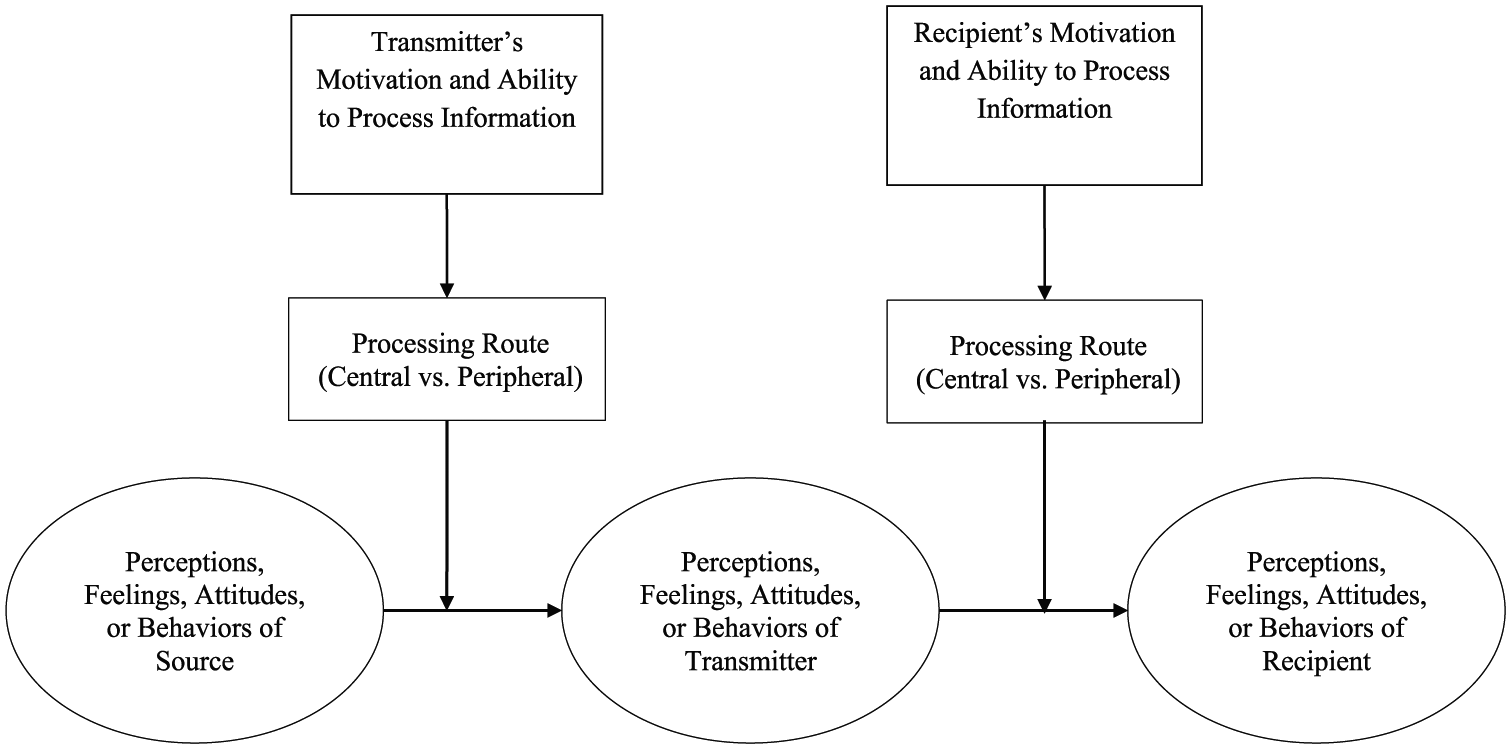
The Adapted Elaboration Likelihood Model
The AELM and Trickle Effects
In our review of the trickle-effects literature above, we organized the review by content area (e.g., leadership, justice). This reflects how researchers have examined trickle effects. That is, leadership researchers are interested in the trickle effects of leadership. Justice researchers are interested in the trickle effects of justice. As we noted previously, prior research has been interested in the fact that perceptions, feelings, attitudes, and behaviors are transmitted across boundaries; it has not focused on the process by which this indirect transmission occurs. However, focusing on the trickle-effects process itself—rather than the construct that is trickling—allows us to see commonalities and differences within and between constructs that are not apparent when the literature is viewed by content areas. The AELM framework allows us to do that by organizing trickle effects as its own literature, with its own theoretical underpinnings. As such, the AELM can both drive theory development and guide future research.
The AELM and the organization of the trickle-effects literature
The AELM provides a framework for organizing the trickle-effects literature. First, the AELM can provide structure by organizing the literature according to the principal theoretical explanations provided in the literature for the emergence of indirect social influence effects. More specifically, the three dominant theoretical perspectives that emerged from our review—social learning theory, social exchange theory, and displaced aggression—differ in the amount of elaboration that the processes they propose require.
Social exchange theory adopts a cognitive approach. It suggests that trickle effects are triggered when employees are motivated to follow the norm of reciprocity, which requires considering the relationship and the obligations owed and a complicated mix of interdependent observations and responses. This process requires thinking (i.e., elaboration) about the relationship, benefits received, and appropriate means of reciprocation. It therefore reflects central route processing. In contrast, displaced aggression suggests employees develop negative emotions such as frustration or anger after receiving negative treatment from others, which increase their need to vent these emotions toward third parties. Displaced aggression is cathartic and reactive. It requires little thinking and therefore reflects peripheral route processing.
Interestingly, whereas the third dominant theoretical perspective from our review—social learning—might appear to elicit elaboration as well (learning appears to require thought), Bandura (1977) suggests individuals may imitate the behavior of role models without extensive thought or deliberation. Social learning theory can be considered a bridge between behaviorist and cognitive learning theories because it acknowledges the role of attention, memory, and motivation but also relies on principles of (vicarious) reinforcement. It recognizes that cognition plays a role in learning (to a greater extent than classical or operant conditioning), but it does not require extensive elaboration. Social learning requires that individuals attend to the behavior of the model, remember the behavior, are able to reproduce it, and are motivated to reproduce it, but none of these components requires extensive elaboration. Therefore, social learning represents a middle ground between central route processing (extensive elaboration) and peripheral route processing (little or no elaboration).
Thus, the three main theoretical perspectives associated with trickle effects fall across the elaboration continuum. Social exchange theory suggests the greatest amount of elaboration, social learning a modest amount of elaboration, and displaced aggression the least elaboration.
The second way in which the AELM provides a framework for organizing the trickle-effects literature is that it allows us to categorize the constructs that have been examined in trickle-effects research. Research on the ELM indicates personal relevance is the most important factor affecting individuals’ motivation to process information in a more deeply elaborative way (Petty & Wegener, 1998). Personal relevance reflects individuals’ beliefs that the issue/event will have significant consequences for their own lives. According to Petty and Cacioppo (1986: 145), it can be judged based on a variety of factors, including number of personal consequences, magnitude of consequences, and duration of consequences. Although all workplace interactions are to some extent personally relevant, the level of relevance varies and may be useful in categorizing trickle effects. Indeed, categorizing constructs by their personal relevance highlights differences between constructs that on the surface appear to be similar, as well as similarities between constructs that on the surface appear to be different. Table 1 categorizes trickle constructs by personal relevance into high, moderate, and low categories. (Although these categorizations are subjective, we strove to differentiate the constructs on how personally relevant the perception, attitude, feeling, or behavior was likely to be to the receiver.)
Categorization of Constructs by Personal Relevance
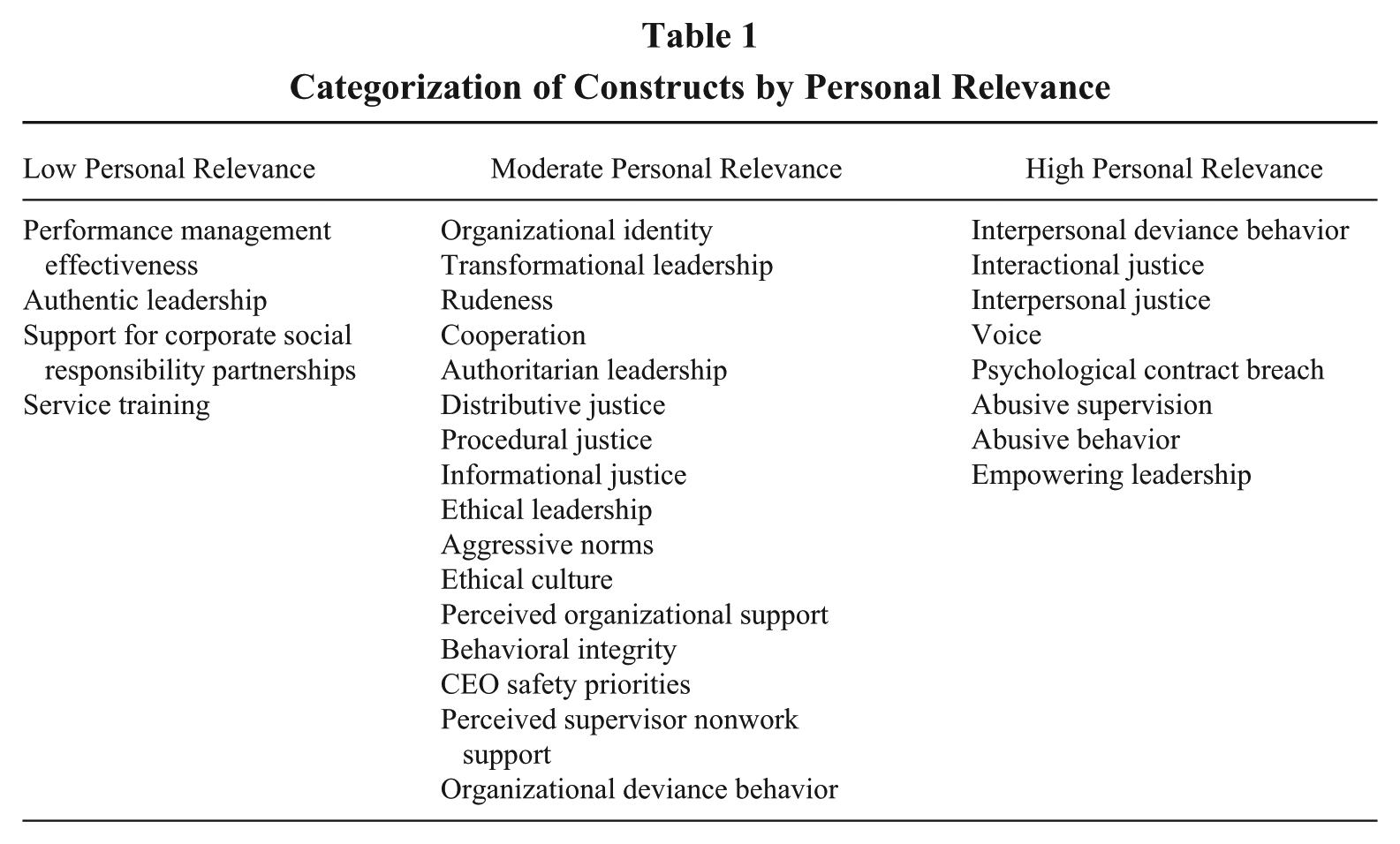
Some interesting observations arise from categorizing trickle-effect constructs based on personal relevance. For example, the categorization suggests not all types of justice or all types of leadership should necessarily trickle the same way. Rather, different facets of justice and different types of leadership may differ in their personal relevance. Therefore, constructs from the same domains may trickle in very different ways. In the leadership area, for example, empowering leadership is targeted directly at the follower, placing it in our categorization of high personal relevance as it is designed to shape directly the followers’ environment, expectations, and behavior. In contrast, authentic and ethical leadership are focused primarily on the characteristics and behavior of the leader. Although it is expected these leadership types will exert some impact on the work unit and beyond, they are categorized as less personally relevant than empowering leadership. Similarly, different facets of justice display different degrees of personal relevance. Procedural and distributive justice are less personal, and more organizational, than interpersonal justice. Given these differences in personal relevance, the AELM suggests individuals would be motivated to engage in greater elaboration for empowering leadership and interactional justice than for authentic leadership and procedural justice. This highlights the observation that constructs that appear to be similar, based on their core construct foundations (e.g., empowering and authentic leadership; distributive and interpersonal justice), may actually behave very differently in trickle situations. Likewise, constructs that appear to be different, due to their core construct foundations (e.g., empowering leadership and interactional justice; authentic leadership and procedural justice), may behave similarly in trickle situations.
Recognizing the importance of personal relevance can change how scholars interpret existing trickle-effects research. However, it can also change how they approach examining and theorizing about the trickle effects of constructs for which trickle effects have yet to be examined. Consider incivility, which has not yet been examined in the trickle-effects literature. One might expect the trickle-down effect of incivility to mirror those of a related construct, abusive supervision. Both are forms of interpersonal mistreatment and are often considered to vary primarily on the magnitude of the mistreatment (Reich & Hershcovis, 2015). However, the AELM suggests the two constructs differ in a way that may influence how they trickle down. Abusive supervision is subordinates’ perceptions of the extent to which their supervisors engage in the sustained display of hostile verbal and nonverbal behaviors (Tepper, 2000). That is, abusive supervision is sustained and it is targeted directly at the recipient. It is perpetrated by an individual (the supervisor) who is central in the recipient’s work life. In contrast, incivility is low-intensity deviant behavior with ambiguous intent to harm the target; it reflects a general lack of regard for others (M. Andersson & Pearson, 1999). Viewed through an AELM lens, therefore, abusive supervision, with its centrality of the perpetrator to the recipient, its ongoing nature, and its perceived targeted hostility, makes it more personally relevant than incivility. Therefore, rather than assuming the two constructs would trickle down via the same process because of their similar affective tone, the AELM suggests abusive supervision would elicit greater elaboration (central route processing) and incivility would elicit less elaboration (more peripheral route processing); thus, each may emerge via different trickle mechanisms.
The AELM also allows us to see commonalities across constructs that might not otherwise be linked. For example, the literature does not connect trickle-in effects of customer interpersonal deviance (a negative behavior) with trickle-down effects of empowering leadership (a positive behavior). But the AELM perspective would suggest both are high on personal relevance and would therefore best be categorized together.
New research directions
The AELM also suggests new avenues of research not currently explored in the trickle-effects literature. For example, on the basis of the AELM, the processing route (central or peripheral) utilized by the transmitter and the recipient should have implications for the strength and stability of the trickle-effect relationship. When utilizing the central route, individuals not only consider the information provided by the source or event but also generate and reflect on other potentially relevant information as well. They utilize information from memory. They seek information from other sources. They consider how new information fits with other experiences. They integrate these multiple pieces of information to form a perception, derive a judgment, form an attitude, or make a behavioral choice. That is, when individuals (in this case, transmitters and recipients) engage in greater elaboration, they consider the information from the source, but they supplement this with information from other experiences and other sources (Petty & Cacciopo, 1986), thereby diluting the impact of information received from the source. Thus, the relationship between the source’s original perception, attitude, feelings, or behavior and the recipient’s perception, attitude, feelings, or behavior should be weaker than if peripheral processing is used because with central processing, the source’s information is only part of the information considered. In peripheral processing, on the other hand, little other information is considered. Therefore, the influence that stems directly from the source should experience less distortion or dilution as it passes through the transmitter to the recipient. Thus, the relationship between the source’s perception, attitude, feelings, or behavior and the recipient’s perception, attitude, feelings, or behavior should be stronger when peripheral processing is employed.
As an illustrative example, let us consider how abusive supervision might trickle down through the central route versus the peripheral route. When supervisors work for an abusive manager and engage in central route processing, they may also consider their experiences with other managers in previous jobs, they may examine the fit of the abusive style with the organizational culture, and they may reflect on their own beliefs about the appropriateness and effectiveness of abusive behavior for individuals in a leadership position. All of this information then informs their decision as to whether to engage in abusive behavior toward their subordinates. To the extent that the additional sources of information do not support abusive behavior, these transmitters are less likely to engage in abusive supervision behavior themselves, and abusive supervision is less likely to trickle down. In contrast, if abusive supervision flows through the peripheral route, little additional information beyond the manager’s abuse is considered by the supervisor. Rather, they may enact a “monkey see, monkey do” response to the behavior—simply mimicking their manager—or they might mindlessly vent their frustration on their subordinates. In either case, there would be a stronger relationship between the manager’s behavior and the trickle-down behavior of the supervisor.
To examine whether the processing route employed (central vs. peripheral) influences the strength of trickle effects as suggested by the AELM, we looked to the categorizations of personal relevance of the trickle constructs provided in Table 1. As noted above, personal relevance elicits elaboration (Petty & Brinol, 2012), so we therefore expected that higher elaboration constructs would display weaker trickle effects than lower elaboration constructs.
To investigate this question, we explored the strength of the overall trickle effect by examining the correlation between the source’s perceptions, feelings, attitudes, or behaviors and the recipient’s perceptions, feelings, attitudes, or behaviors. As predicted by the AELM, the average correlation is strongest for the low personal relevance constructs (peripheral processing; r = .38) and weakest for the high personal relevance constructs (central processing; r = .19). The moderate personal relevance constructs’ average correlation falls between the two (r = .27).
Beyond its impact on the strength of the trickle effect, the amount of elaboration should also have an impact on the stability of the trickle effect. Because of the greater thought given to information when the central route is utilized, the perceptions, attitudes, judgments, and behaviors that result from this elaboration are more stable and enduring than attitudes, judgments, and behaviors that flow from peripheral processing (Petty & Brinol, 2012).
Taken together, the strength and stability propositions present an interesting picture. Although elaboration may weaken the trickle effect, when the effect does trickle, it is more stable. In contrast, constructs may flow more easily through the peripheral route, but there may be less long-term impact of the trickle effect, as peripheral trickle effects are more easily changed. These propositions highlight the importance of additional longitudinal work in this area. The current cross-sectional approaches employed in most studies do not provide a strong foundation on which to evaluate the permanence of trickle effects. Additionally, these propositions highlight the complexity of this work, as even constructs that trickle via the peripheral route will endure until other information or events supplant them. Perceptions, feelings, attitudes, and behaviors that emerge from peripheral processing will be more easily changed, but they still require a “nudge” to make that happen.
The AELM also suggests a new set of moderators that may influence trickle effects. More than half of the studies in our review were silent with respect to moderators of the trickle-effect process. The AELM suggests that variables that affect individuals’ motivation and ability to process information should influence the flow of trickle effects. Factors such as need for cognition, the quality of information, accountability, and consistency with prior beliefs influence individuals’ motivation to engage in elaboration. Factors such as repetition, distractions, and cognitive load influence individuals’ ability to engage in elaboration. Considering these factors highlights moderators that should be examined in trickle research.
For example, individuals (transmitters and recipients) higher in need for cognition are more likely to engage in elaboration and, thus, utilize central route processing. Factors that influence cognitive load and distraction, such as work overload and time pressure, should encourage more peripheral processing. In addition, the originating perceptions, feelings, attitudes, or behaviors of the source may play a role. When these are consistent with previous perceptions, feelings, attitudes, and behaviors of the target (the transmitter and then the recipient), they are more likely processed by a peripheral route. Yet when the source’s perceptions, feelings, attitudes, and behaviors are unusual, they are more likely to stimulate the transmitter’s interest in understanding them, leading to processing by the central route.
The quality of information also matters; higher quality information leads to greater inclination to elaborate. Consequently, if the source is widely viewed as highly competent, credible, or expert in an area, there is more likely to be greater elaboration on the part of the transmitter because the information coming from the source would be viewed as high quality and worthy of attention and reflection (Petty & Brinol, 2012).
The factors that influence motivation and ability can be extrapolated to support other moderators as well. For example, accountability increases the motivation for elaboration. It may be that if the source (i.e., manager) is an empowering leader, the transmitter (i.e., the supervisor) experiences greater accountability and, therefore, is more likely to engage in elaboration. Similarly, PSS might influence elaboration likelihood. If individuals (transmitter or recipient) believe their supervisors care about their welfare on the job, they may also be experiencing fewer distractions and be less likely to be operating under a burdensome cognitive load, both of which would facilitate elaborative processing.
In all, the AELM provides a road map for thinking about moderators that directly influence motivation and ability to engage in elaborative thinking, as well as those that indirectly influence motivation and ability. As we note above, in general, the trickle relationship should be weaker when there is greater elaboration. This suggests factors that encourage greater elaboration might be useful in buffering the flow of negative trickle effects but might also weaken the flow of positive trickle effects.
The AELM also allows us to adopt a more nuanced approach to the role of affect in trickle-down processes. Whereas affect generally elicits peripheral processing, research on the ELM demonstrates that affect-laden constructs are not necessarily processed via the peripheral route. Rather, factors that influence the motivation and ability of individuals to process information influence how affect is processed. For example, when an affect-laden construct is high in personal relevance (e.g., abusive supervision), the ELM (and AELM) suggests a more elaborative process will be employed. In this case, the affect is part of the information the individual considers. Consistent with the affect infusion model (Forgas, 1995) and the emotions as social information model (Van Kleef, De Dreu, & Manstead, 2010), when individuals engage in central route processing, affect is information. Thus, while many affect-laden constructs are likely to elicit peripheral processing, this more nuanced approach allows scholars to consider when—and why—affect-laden constructs will be the subject of elaboration.
The AELM sparks some thought about methodological issues as well. One of these concerns the role of time in studying and understanding trickle effects. Beyond the well-established observation that judgments resulting from high elaboration processing are more durable than those resulting from low elaboration peripheral processing in that they persist longer, are more resistant to change, and exert greater influence on other attitudes and behaviors (Krosnick & Petty, 1995), the literature is largely silent with respect to the role of time.
However, ELM research has revealed several fronts on which researchers do need to be cognizant about issues related to timing when executing studies based on ELM thinking. For example, research has shown that time pressures may inhibit the ability of individuals to engage in central processing (Kruglanski & Freund, 1983). Therefore, studies must be designed carefully so as to avoid creating situations in which participants might be motivated to engage in elaboration but are prevented from doing so as a result of protocol-induced procedures. Similarly, the measures themselves that are employed in a study can place unintended restrictions on the type of processing employed by participants. Implicit measures of attitudes, for example, tap evaluations that come to mind quickly, while more deliberative measures allow participants to reflect more fully on the target being assessed (Petty, Fazio, & Brinol, 2009). Thus, measures must be selected carefully to allow researchers to detect the processes they believe to be at work. Likewise, research has highlighted the importance of designing studies capable of addressing the potential gap between the salience of attitudes or judgments at the point in time at which they are measured versus the salience of those same attitudes or judgments at the point in time at which a behavioral decision is measured (Petty & Wegener, 1998). With most dependent variables in trickle studies reflecting behavioral outcomes, reducing that timing gap is critical for establishing the true relationship between trickle-based judgments and outcomes. In all, the role of time represents the especially challenging issue for researchers employing an AELM perspective on trickle effects.
Other methodological issues are worth noting as well. As we noted above, previous research has not focused on the process by which trickle effects occur. However, once the process of transmission becomes of interest, it almost demands examination via an experimental approach paired with research in organizational settings. The laboratory provides an opportunity to test the theory by manipulating moderating variables (e.g., time pressure, personal relevance) and examining the strength and stability of trickle effects. For example, one might compare the trickle effect of abusive behavior aimed specifically at the target (high personal relevance) versus abusive behavior targeted at a group (lower personal relevance). One might examine the trickle effect of interpersonal injustice under conditions of low cognitive load (central route processing) versus high cognitive load (peripheral route processing). The AELM provides a framework for exploring the trickle-effects process and studying these processes in experimental settings.
Finally, organizing extant research using the AELM holds promise for pointing researchers in more productive directions in understanding the theoretical foundations of trickle effects. Using AELM, scholars will be able to craft a theory-driven perspective based on whether the focal construct is of lower personal relevance, moderate personal relevance, or higher personal relevance. The AELM provides a new perspective that helps scholars integrate trickle research from different research domains, thereby promoting an interdisciplinary approach to understanding them. The AELM also can guide researchers in identifying relevant boundary conditions for trickle effects from both transmitters’ and recipients’ perspective. We believe such advancements are useful for trickle research, and such advancements will help the trickle-effects literature to grow, develop, and mature.
Conclusion
The trickle-effect literature is interesting, important, and vibrant and has grown by leaps and bounds in recent years. It is in need of a comprehensive, well-structured review. But the need may be even greater for a conceptual framework by which current and future work might be organized, integrated, and understood. We offer that here in the form of an indirect social influence framework: the AELM. This framework offers the potential for multiplying the impact of research efforts in the area by providing a model for understanding the phenomenon more generally rather than on a piecemeal basis.
Finally, we also hope this review and theoretical framework might contribute to organizational research well beyond that involved directly in trickle-effects scholarship. Interest in trickle effects has “trickled in” to many of the most prominent research domains in organizational research. It is bound to arrive in many more. We hope this review and our approach to theory development affect not only trickle-effects scholars but also those in a wide variety of domains seeking to understand better how their constructs of interest emerge and influence the experiences of organizational members.
Supplemental Material
JOM812951_DS – Supplemental material for Trickle-Down, Trickle-Out, Trickle-Up, Trickle-In, and Trickle-Around Effects: An Integrative Perspective on Indirect Social Influence Phenomena
Supplemental material, JOM812951_DS for Trickle-Down, Trickle-Out, Trickle-Up, Trickle-In, and Trickle-Around Effects: An Integrative Perspective on Indirect Social Influence Phenomena by David X. H. Wo, Marshall Schminke and Maureen L. Ambrose in Journal of Management
Footnotes
Acknowledgements
We thank the action editor, Christopher O. L. H. Porter, and two anonymous reviewers for their thoughtful and constructive comments concerning this manuscript. We also thank the Gordon J. Barnett Foundation and the UCF BB&T Program in Business Ethics for their support for this project.
Supplemental material for this article is available with the manuscript on the JOM website.
References
Supplementary Material
Please find the following supplemental material available below.
For Open Access articles published under a Creative Commons License, all supplemental material carries the same license as the article it is associated with.
For non-Open Access articles published, all supplemental material carries a non-exclusive license, and permission requests for re-use of supplemental material or any part of supplemental material shall be sent directly to the copyright owner as specified in the copyright notice associated with the article.
