




Abstract
Political polarization has increased significantly in society over the past decade, and whether intended or not, employees at all levels bring their political ideologies into organizations. We posit that political ideology is unique and warrants the attention of organizational scholars. We begin by integrating literature from political science and political psychology to review the various conceptualizations of political ideology as representing values, identity, and political affiliation. Next, we review the literature of political ideology in organizational sciences which has examined political ideology through a values-based lens,understanding it to be a source of motivated reasoning that influences strategic decisions. We then review a smaller subset of literature that has examined political ideology through an identity-based lens, exploring its influence on social dynamics including stereotyping, diversity in teams, and person-organization fit. Finally, we chart a course for future research on political ideology, focusing on (1) conceptual expansions, (2) contextual determinants, (3) diversity, (4) cross-level alignment, and (5) the acknowledgment of possible researcher bias.
“No politics at work” is a standard policy in many workplaces (Society for Human Resource Management [SHRM], 2016), yet a simple glance at the news illustrates that politics are certainly present at work. Organizational decisions such as those to promote a Black Lives Matter spokesman (Nike; Draper & Belson, 2018), to avoid filming in a state that has upheld anti-abortion laws (Disney; Victor, 2019), or to support family policies only for heterosexual families (Chick-fil-A; Bellafante, 2015) are interpreted as representing particular political views. Political ideology also seems to influence employee outcomes: At Facebook, Google, and Apple, employees acted in ways that were perceived to be incongruent with the dominant political ideologies of their organizations, costing them their jobs (Grind & Hagey, 2018; Steinbuch, 2018; Wakabayashi, 2017). In short, political ideology, “a set of beliefs about the proper order of society and how it can be achieved” (Erikson & Tedin, 2003: 64; Jost, Federico, & Napier, 2009), guides decisions and behavior by organizational members, whether intentionally or not.
A review of and framework for political ideology in organizations is necessary and timely due to several trends that have made it harder than ever to keep politics out of the workplace. First and foremost, politics is more salient in our daily lives than in the past, with the 24/7 news cycle accessible anywhere—including the workplace—on mobile devices. This salience is even stronger during national elections (every 4 years in the United States) and during major political transitions (Brexit in the United Kingdom), when it is hard to avoid political discussions in social contexts (Peterson, Goel, & Iyengar, 2017). Second, political ideology is more polarizing and divisive than ever before. In addition to experiencing a news cycle hallmarked by divisive tones (Iyengar, Sood, & Lelkes, 2012), individuals tend to live near others whose politics are similar to their own (Motyl, Iyer, Oishi, Trawalter, & Nosek, 2014) and to marry others with similar views (Iyengar & Konitzer, 2017), reducing exposure to opposing views in social contexts. The combination of lack of exposure to other views and increased polarization of politics has led individuals to despise those who vote for the “wrong” candidate (Iyengar & Westwood, 2015). Finally, a person’s political ideology may be more likely to differ from others’ ideologies in the work context (compared to the personal context) and more likely to be openly discussed, given the trend of employees bringing their “authentic selves” to work (Inam, 2018; Kahn, 1990; Opie & Freeman, 2017). For example, Twitter’s website states that employees should “[f]eel comfortable being yourself every day you’re here,” yet Jack Dorsey, the CEO of Twitter, acknowledged that conservative employees may be penalized for sharing their views (Wagner, 2018). Thus, we are at a time when political ideology is particularly influential in organizations.
As these media cases suggest, political ideology is highly prevalent in and relevant to organizations; accordingly, the time is right to comprehensively review what we know about political ideology in organizational science. Our aim is to provide a review and integrated framework of scholarly attention to this topic in organizations such that future scholars can continue to build on and extend this body of knowledge. Since political ideology in organizations is a relatively new topic, we first reviewed how scholars in political psychology, sociology, and political science have conceptualized the topic. Following this, we searched for key terms (“politics,” “political ideology,” “political identity,” and “political affiliation”) in applied psychology and organizational behavior journals and conference proceedings. Given the surprisingly limited number of articles found within the organizational science journals, we also searched for these key terms plus “workplace,” “organization,” and “work” in political science journals (e.g., Political Psychology, Political Behavior, Public Opinion Quarterly). We then reviewed our literature and excluded articles if they either focused on electoral or government decisions (e.g., political science rather than organizational science) or referred to the concept of organizational politics (e.g., forming coalitions to gain power; e.g., Ferris & Kacmar, 1992).
Based on our review of this literature, we structured this review as follows. First, we offer an integrative conceptualization of the topic as studied in political science, political psychology, and organizational science. Next, we organize the evidence of political ideology in organizations around two dominant paradigms: (1) political values and strategic decisions and (2) political identity and social dynamics. We conclude with several future directions which we hope stimulate theoretical, methodological and practical contributions.
Political Ideology: Conceptualization and Differentiation
Political ideologies are widely shared and deeply held beliefs regarding how a society ought to be structured (Jost et al., 2009). While scholars have debated the underlying components (Converse, 1964; Parsons, 1951), most agree that political ideology represents a schema of interconnected attitudes, beliefs, and values that people use to organize and process social and political information (Erikson & Tedin, 2003; Jacoby, 1991). We present three lenses of political ideology conceptualization in the literature: political ideology as values, as identity, and as party affiliation. We then differentiate political ideology from other individual differences to explain why political ideology deserves focused attention in organizations.
Conceptualization: Three Lenses of Political Ideology
Political ideology is complex and has been conceptualized differently in the fields of political science, organizational science, and political psychology. Based on our review of the literature, we conclude that there are three dominant conceptualizations, or lenses, which we synthesize in Figure 1. The hierarchical positioning indicates that each lens builds on the one below it and that the higher lenses are more known, meaning the individual is more likely to be aware of them and they are more behavioral, thus more visible to others in the environment. Specifically, the first lens at the bottom of the figure focuses on values or beliefs (Jost, 2006), which are not directly observable. The second lens views political ideology as a form of social identity (Levitin & Miller, 1979), as part of one’s self-concept that can be inferred by others via behavioral cues. Finally, the third lens, at the top, focuses on party affiliation as tied to behaviors (Goren, Federico, & Kittilson, 2009), such as campaigning for or donating to a certain political party. This final lens is the most visible to the self and others. In the following section, we explain these conceptualizations and discuss measurement techniques associated with each. 1
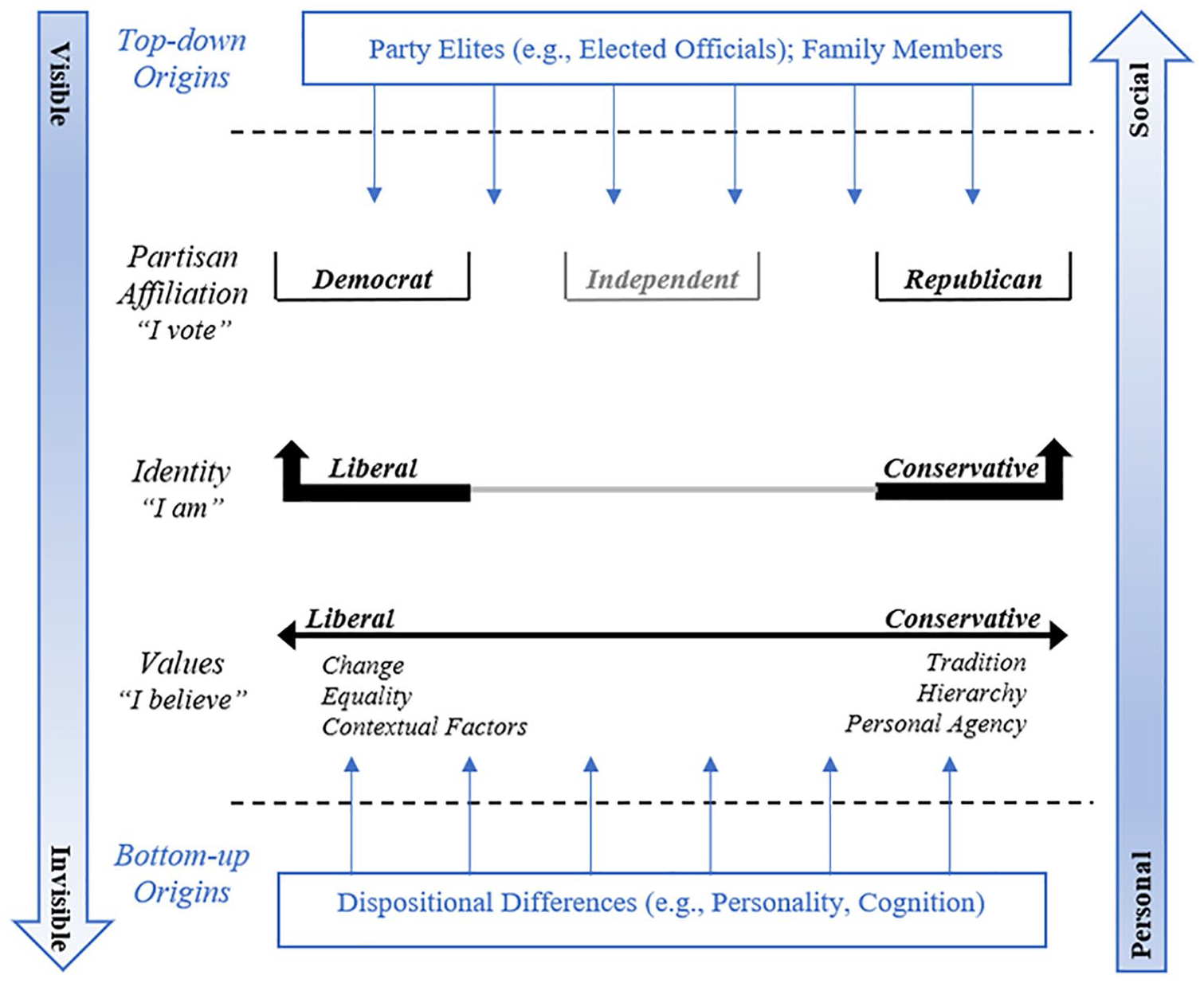
Conceptualizing Political Ideology Across Disciplines
Cognitive lens: Political ideology as values
A values-based perspective conceptualizes political ideology as a stable individual difference, or a “predisposition” (Hibbing, Smith, & Alford, 2014), such that the beliefs are deeply held and likely to remain consistent throughout the life course. From this lens, political ideology represents a schema of related values (Jost, 2006; Tedin, 1987) or beliefs that some behaviors are preferable to others (Rokeach, 1973: 160). These values or philosophies exist across a spectrum of left (liberal values; e.g., liberalism) to right (conservative values; e.g., conservatism)—at present, this terminology is widely utilized and accepted to generalize across countries and nationalities (Ware, 1996).
The defining values of liberalism and conservatism differ in many ways. For example, liberals tend to be concerned with social justice, economic equality, market controls, and planned changes to society (Jost, 2006). Conservatives, on the other hand, tend to value free markets, individualism, respect for authority, and differential economic rewards (McClosky & Zaller, 1984). While values are invisible to the naked eye (unseen by others), they are relatively known to an individual and represent what the individual believes (e.g., “I believe in social justice” or “I believe in free markets”).
Despite a vast array of value differences, research suggests that there are broad underlying distinctions at the heart of these different beliefs that are interrelated and threefold: the extent to which an individual (1) advocates for social change versus tradition, (2) advocates for equality versus hierarchy, and (3) emphasizes contextual factors versus personal agency in explaining outcomes and circumstances (Erikson & Tedin, 2003; Jost et al., 2009; Skitka & Tetlock, 1993). Put differently, those high in liberalism value social change and tend to focus on the situational and contextual factors that impede equality of outcomes, while those high in conservatism value traditionalism and accept status hierarchy, believing in the agency of individuals to change their position (Graham, Haidt, & Nosek, 2009). These values are not mutually exclusive, however conservatives may highly value meritocracy—for example—but that does not mean they are anti-egalitarian (or vice versa for liberals); rather, they more strongly believe in meritocracy as the right way to structure society.
In terms of measurement, most scholars using a value-based lens see this construct as unidimensional, with liberalism at one end of a continuum (left) and conservatism at the other (right). As such, political ideology is operationalized using a self-reported single-item continuum ranging from “very liberal” to “very conservative” (e.g., Inbar & Lammers, 2015; Rock & Janoff-Bulman, 2010; Tetlock, Vieider, Patil, & Grant, 2013). While some scholars have advocated for a multidimensional approach where differentiation can be made regarding social and economic values (e.g., one may be fiscally conservative but socially liberal; Feldman & Johnston, 2014), a unidimensional approach is still widely utilized in both the political and organizational sciences. As an alternative to the self-report continuum, organizational scholars have used archival political donation data to infer political values (Chin, Hambrick, & Treviño, 2013), thus using a behavioral approach as a proxy for a values-based conceptualization. 2
Social lens: Political ideology as identity
Scholars in the field of political science have focused on political ideology as identification with a social group (Greene, 1999; Huddy, 2001; Huddy, Mason, & Aarøe, 2015; Mason, 2018). The identity-based approach was first introduced in political science by Levitin and Miller (1979), with more recent scholars referring to “ideological social identity” (Devine, 2015), “ideological identity” (Malka & Lelkes, 2010), and “symbolic ideology” (Ellis & Stimson, 2012). These scholars all focus on how the ideological labels of “liberal” and “conservative” confer a personal connection to a group, even if these identities are not always precisely connected to the associated underlying values and beliefs (Ellis & Stimson, 2012; Malka & Lelkes, 2010). In other words, while the labels of “liberal” and “conservative” often represent underlying value beliefs (regarding hierarchy and inequality, for example), for some individuals these labels may only hold symbolic meanings (e.g., represent tribal memberships) and are not representative of deeper value beliefs (Ellis & Stimson, 2012). These symbolic memberships can still be quite powerful in motivating behaviors as they help individuals make sense of their social world.
Through a social identity lens, political ideology is best understood as self-defining and self-referential (e.g., “I am”). For example, one might say “I am a conservative” or “I am a liberal” not only to affiliate themselves with the group whose members they perceive as similar to them but also to differentiate themselves from members of another group. When an individual views membership in a political group as part of their self-definition, the individual has strong emotional reactions to events that affect the group (Tajfel & Turner, 1986), such as when their political party or a rival party wins an election (Lench, Levine, Perez, Carpenter, Carlson, & Tibbett, 2019; Lench, Tibbett, & Bench, 2016). Thus, this lens can explain attitudes and hostility toward political out-groups (Iyengar et al., 2012; Malka & Lelkes, 2010).
Measurement of political ideology by scholars using an identity lens includes asking individuals to endorse a category (e.g., liberal, conservative, or moderate) or rating on a continuum (e.g., very liberal to very conservative; Talaifar & Swann, 2019), similar to the values approach. More specific to the identity-based conceptualization are self-reported assessments of political group as a part of one’s self-concept (Huddy et al., 2015). For example, the item “When talking about [liberals/conservatives], how often do you use ‘we’ instead of ‘they’?” predicts distance from the out-group regardless of actual similarity or difference on issues and values (Mason, 2018).
Behavioral lens: Political ideology as party affiliation
The third approach to conceptualizing political ideology, found at the top of Figure 1, is political affiliation, which represents the specific political parties that one is likely to donate to, campaign for, and vote for. Though the value- and identity-based views of political ideology (as a left-right continuum) can be generalized across countries and populations, political affiliation is specific to the political parties and governmental institutions of a nation (i.e., Tories in the United Kingdom, Social Democrats in Germany). For example, in the United States, most people affiliate with one of two political parties (Pew Research Center, 2016): Democrat (left) or Republican (right). Some self-categorize as independent but tend to lean liberal or conservative (Carmines & D’Amico, 2015), and a smaller number endorse Libertarian (further right) and Green (further left) parties. Some nations have multiple dominant political parties (e.g., France, United Kingdom), and others have one (e.g., China), though every party leans toward either liberal or conservative values.
According to this party affiliation lens, behaviors toward a political party (e.g., campaigning, donating, and voting) are proxies for underlying values and identity (Goren et al., 2009), as seen at the top of Figure 1. These behaviors are also quite visible—campaign bumper stickers, hats, and pins that are disseminated during election years (but exist long after) serve as explicit cues of affiliation to all, political donations are publicly available information to any who seek it, and voting reveals to the actor (and others if disclosed) their affiliation of choice. In recent years, political affiliation (e.g., Democrat or Republican) has become one of the most salient characteristics that unites or divides people (Iyengar & Krupenkin, 2018).
When measuring political affiliation, scholars use self-reported categories (e.g., political party; Talaifar & Swann, 2019), a self-rating scale on a continuum from strong Democrat to strong Republican (Rock & Janoff-Bulman, 2010), or publicly available archival records of political behavior (e.g., donations to a political party; Chin et al., 2013; Gupta, Briscoe, & Hambrick, 2017). Archival indicators of donations comprise the dominant approach within the organizational sciences because they provide behavioral and accessible data for hard-to-survey populations (e.g., executives; Chin et al., 2013). Notably, party affiliation may be used as a proxy for underlying values and identity, but people may not always act in ways consistent with their internal beliefs and values (e.g., donating in strategic, rather than belief-driven, ways).
Differentiating Political Ideology from Related Constructs
In order to justify focused attention on political ideology in organizations, it is important to demonstrate how it differs from other more established individual and group differences.
Religious ideology
Religiosity and religious identities of workers are of rising interest in organizational scholarship (Gebert, Boerner, Kearney, King, Zhang, & Song, 2014; King, Stewart, & McKay, 2017; Jones & King, 2014). Conceptually, political ideology and religious ideology both reflect the strength of beliefs and values that guide behavior, with both religiosity and conservativism having values-based foundations related to tradition and moral purity (Graham et al., 2009). Both of these ideologies are often formed early in life and can influence each other; however, they can also diverge over time (Greene, 1999; Margolis, 2017). In fact, researchers found that in a representative sample of Americans, political conservatism was positively but weakly correlated with religiosity (r = .17; Malka, Lelkes, Srivastava, Cohen, & Miller, 2012). The two were similarly correlated among a representative sample of Italians (r = .20; Dallago, Cima, Roccato, Ricolfi, & Mirisola, 2008). This evidence suggests the two constructs are weakly associated such that they are independent constructs, each meriting particular attention.
We argue that there are two distinct reasons for focusing on the effects of political ideology in organizational scholarship rather than simply inferring that it has effects similar to those of religious ideology. The study of religious ideology in the workplace is typically the study of minority groups that tend to be stigmatized in society (King, McKay, & Stewart, 2014). Political identity is distinct from these religious identities, in that being liberal or conservative is only a source of stigma depending on the social context. For example, a Muslim employee is part of a numerical minority group whose members tend to be stigmatized in the United States workforce (King & Ahmad, 2010), but a strongly conservative or liberal employee would likely be stigmatized only if working in a place where the employee’s colleagues skew in the opposite ideological direction. A social conservative is a minority if they work as a professor in a liberal arts college but not if they move to work as a consultant in the natural gas drilling industry (Bonica, 2014). This fluidity means that the stigmatization on the basis of political ideology is dependent on the social context in which one is embedded, making it distinct from most religious groups that are numerical minorities across time and context. Such variability leads to unique questions about how employees’ political ideologies fit—or do not fit—with their organizations’ political ideology.
People feel more intensely hostile toward those affiliated with a rival political party than they do toward other minority groups, including Muslims and gay and lesbian individuals (Iyengar & Krupenkin, 2018). While there are federal legal protections for religious beliefs, there are no national laws protecting people from discrimination based on political beliefs. 3 Though legal protections do not stop all discrimination toward protected classes (King & Ahmad, 2010; Martinez, Hebl, Smith, & Sabat, 2017), a lack of legal protection for political differences means that negative political feelings may result in biased treatment that goes unpenalized. The combination of stronger negative emotions and a lack of legal protection suggests discrimination due to political views may be more likely than discrimination due to other factors.
Dispositional differences
Political ideology is associated with personal dispositional tendencies and preferences. Though a full review of these relationships is beyond the scope of this paper, we investigate those often used in organizational scholarship: namely, the Big Five personality traits and cognitive tendencies.
Political ideology is correlated with two Big Five traits: openness to experience (higher if more liberal) and conscientiousness (higher if more conservative; Gerber, Huber, Doherty, & Dowling, 2011). Given that openness is related to creativity and conscientiousness is predictive of job performance (Barrick & Mount, 1991), one might draw the conclusion that liberals are more creative and conservatives perform better. However, scholars have suggested that the openness scale may measure experiences that tend to be valued more by liberals than conservatives, leading to an artificial difference in their openness to experience score (e.g., secular arts, moral relativism; Duarte, Crawford, Stern, Haidt, Jussim, & Tetlock, 2015). In general, these findings are consistent with value preferences for change/risk versus tradition/stability.
Political ideology is also linked to cognitive styles and preferences, such as the desire for cognitive complexity and closure. Studies have shown that liberals are more comfortable with cognitively complex and ambiguous activities than conservatives (Jost, 2017; Jost, Glaser, Kruglanski, & Sulloway, 2003; Jost, Nosek, & Gosling, 2008). Again, these findings may be due to methods used, given that the political ideology difference seems to depend on type of task (Conway et al., 2016) or due to minor adjustments that are made to commonly used scales (Conway, Houck, Gornick, & Repke, 2018; Ditto et al., 2019; Winegard, Clark, Hasty, & Baumeister, 2019). While there is substantial research and debate within the field of political psychology regarding the underlying dispositions and motivational tendencies of liberals and conservatives, to date, we cannot assume that knowing one’s personality or cognitive preferences is the same as knowing one’s political ideology.
How Political Ideology Affects Organizational Outcomes
In this section, we organize our review of political ideology in organizations according to the two main approaches in the literature: (1) the dominant approach is political ideology as values that affect strategic decisions via motivated reasoning and biased information processing, and (2) the emerging focus is on political ideology as identity that can influence social dynamics at work.
Political Ideology as Values: Strategic Decision-Making in Organizations
Scholars across psychology, political science, and management have long been interested in how individuals make decisions with limited time and incomplete information (Hambrick & Mason, 1984; Simon, 1997). Within the field of management, theories such as bounded rationality (Simon, 1997) and upper echelons (Hambrick & Mason, 1984) suggest that managers and leaders frequently use intuition, beliefs, and values to make decisions more quickly and effortlessly rather than deploying a more deliberate approach that produces more accurate decisions (Chaiken & Trope, 1999; Kahneman, 2003). In particular, political ideology scholars rely on the idea of motivated reasoning, a type of information processing in which accuracy is less important than the desire to meet a cognitive goal or personal need (Kunda, 1990).
Motivated reasoning explains how political ideology can bias attention and information processing (Jost, 2006; Jost et al., 2009; Kahan, 2013). Political ideology represents values and beliefs that together serve as a cognitive filter when gathering and evaluating information, which can lead to biased conclusions (Kahan, Peters, Dawson, & Slovic, 2013; Kunda, 1990). Put differently, political ideology affects decision-making because individuals arrive at the conclusions they want to be true rather than those that are objectively more accurate, so long as they can (consciously or not) justify their decisions (Kahan et al., 2013; Kunda, 1990).
Individuals and groups can be charged with gathering information and making decisions. While political ideology originates in the cognitions and behaviors of individuals, through shared interactions it can manifest as a higher order, collective phenomenon (Kozlowski & Klein, 2000: 55). In other words, individual-level political ideology can be aggregated to the team or organizational level and used to represent the political leaning (highly liberal or conservative) of decision-makers to understand information-processing biases of the collective (Christensen, Dhaliwal, Boivie, & Graffin, 2015; Gupta & Wowak, 2017).
In the following subsections, we review organizational literature that has examined the role of political ideology as a source of cognitive bias in decision making. We organize our review around how the values (at the individual or group level) that differentiate conservatives and liberals have been shown to influence organizational information processing and decisions about (1) resource allocation, (2) organizational strategy and governance, and (3) financial investment.
Resource allocation decisions: Values of egalitarianism versus hierarchy
The allocation of limited resources such as pay and promotions can be influenced by political ideology. As previously noted, egalitarianism is a key component of political ideology: Liberals tend to place greater value on achieving social and economic equality, whereas conservatives have a greater tolerance for unequal outcomes (e.g., hierarchy), believing that meritocracy should determine the distribution of resources (Jost et al., 2008; Skitka & Tetlock, 1993). According to this logic, liberals have a preference for processes and outcomes that distribute resources more evenly, while conservatives are more comfortable with disparities. These preferences are seen in the greater likelihood of liberal CEOs compared to conservative CEOs to provide the same financial resources (capital allocation) across units within their firms (Gupta, Briscoe, & Hambrick, 2018) and to ensure pay equity within the top management teams of their organizations (Chin & Semadeni, 2017).
Political ideology may also influence organizational decisions and policies that address gender disparity (Lyness & Grotto, 2018). Given the liberal focus on the value of egalitarianism, employees with liberal ideologies may be more likely than their conservative peers to recognize societal inequities; they may also be more motivated to protect those lower in the status hierarchy (Graham et al., 2009). In contrast, those with more conservative ideologies are more likely to focus on individual merit and consider internal attributes as explanations of success (Tetlock et al., 2013). This value differentiation explains why liberal decision-makers are more likely to hire and promote female team and board members than are conservative decision-makers (Carnahan & Greenwood, 2018; McSweeney, McSweeney, Oliver, Park, & Withers, 2018). Similarly, employees who work under more liberal supervisors experience less gender disparity in performance-based pay than those who work under conservative supervisors (Briscoe & Joshi, 2017). Note that these authors do not conclude that conservative managers are more “sexist” than liberal managers but rather that liberal and conservative managers utilize different filters and place emphasis on different pieces of information due to their values. Similarly, liberal managers take into account the systemic and situational factors that influence an individual’s output (i.e., process accountability), and more conservative managers focus on the quantity and quality of the output itself (i.e., outcome accountability; Tetlock et al., 2013), consistent with a focus on internal attributes and merit.
Corporate strategy and governance decisions: Broad versus narrow view of stakeholders
Leadership decisions about corporate strategy and governance are determined by leaders’ perceptions of who constitutes key stakeholders and thus to whom the leaders are accountable. Political ideology affects leaders’ estimation of those to whom the organization is responsible, whether the direct stakeholders alone (narrow) or the stakeholders as well as the community in which the leaders’ organization are embedded (broad). Top management is obligated to consider stakeholders during strategic decisions (Andrews, 1971), but more liberal managers may also feel accountable to the broader society, community, and world, given their value of egalitarianism and their tendency towards social change and concern (Tetlock, 2000). As such, those with more liberal political ideologies place emphasis on organizational initiatives, strategies, and governance models that both take responsibility for and share accountability with individuals inside (employees) and outside (e.g., the community, customers) the organization (Tetlock, 2000). Alternatively, conservative managers, who place emphasis on hierarchy and merit, give preference to local organizational shareholders (the most direct stakeholders in the company) and prefer models of governance that place accountability in the hands of few (Gupta, Wowak, & Boeker, 2017; Tetlock, 2000).
These distinctions emerge clearly when focusing on corporate social responsibility (CSR) initiatives, which are “actions that appear to further some social good, beyond the interests of the firm and that which is required by law” (McWilliams & Siegel, 2001: 117). CSR includes an organization’s investments of time and money to support diversity and community relations, environmental protection, and human rights (Garriga & Melé, 2004), all of which move beyond internal shareholders to focus on organizational stakeholders. As expected, based on the values represented by their political ideologies, liberal CEOs in the United States are more likely than conservative CEOs to put forth CSR initiatives (Chin et al., 2013; Gupta, Nadkarni, & Mariam, 2018). Furthermore, the more liberal its members are on average (e.g., liberal organization ideology), the more likely a company is to adopt and promote CSR policies (Gupta, Briscoe et al., 2017). For instance, Chinese leaders with stronger left-wing political ideologies were more likely to adopt CSR strategies—specifically for environmental protection—than those who were less ideologically left (Jiang, Zalan, Tse, & Shen, 2018; Ou, Li, Jiang, & Deng, 2017). This emerging body of work on the ideology-CSR relationship has primarily used archival data (e.g., donations or party memberships) to predict CSR decisions; however, Jiang and colleagues (2018) used an experimental design and found consistent results.
Another organizational decision is how to respond to outsider advocacy, which refers to the work of activists to encourage organizations to change policies. For example, pressure from labor activists and campus-organizers in the 1990s compelled Nike to change their policies regarding the working conditions of their overseas factories (Anderson, 2015). Leaders holding more liberal political ideologies are more likely to see their organizations as embedded in the broader community and thus recognize activists’ claims and their firms’ activities as interconnected. Furthermore, top management teams whose members are, on average, more liberal have been found to be more receptive to activist groups than more conservative teams (Neville & Gamache, 2018). Similarly, more conservative organizations are less receptive to activists, using impression management tactics to avoid taking a stand on the controversial topics (Gupta & Briscoe, 2019).
Finally, decisions that are made about how to best structure and govern an organizations are influenced by political ideology. Decision-makers with more conservative political values are more likely to restructure an organization by downsizing than are those with more liberal values (Gupta, Nadkarni et al., 2018). This is consistent with conservatives’ valuing of shareholders (by maximizing profits) over the community (by retaining workers; Gupta, Nadkarni et al., 2018; Kavadis & Sidhu, 2017; Tetlock, 2000). Taken together, this research suggests that the more liberal or conservative ideologies of individual leaders, top management teams, and organizational members in the aggregate lead them toward strategic choices and governance practices that focus on shareholders or broaden their view to include community stakeholders.
Financial investment decisions: Values of change versus stability
Finally, leaders are tasked with making decisions about how to manage organizational assets and resources. Using political ideology as a proxy for risk-propensity, scholars found that liberal CEOs were more likely to engage in the risky strategy of corporate tax avoidance than conservative CEOs, which is consistent with the different values that the two groups place on change and stability (Christensen et al., 2015). The value of stability may also explain why ideologically conservative leaders hired and promoted male rather than female lawyers (Briscoe & Joshi, 2017; Carnahan & Greenwood, 2018), as males are perceived to be less risky in that profession (Nair, Gupta, & Wowak, 2018). However, the link between political ideology and other indicators of valuing change and risk, such as entrepreneurship and innovation, is unknown.
Political Ideology as Identity: Social Dynamics
The secondary theme in the literature is how political ideology influences the way employees interact with each other. This literature largely draws on psychological theories of social identity and self-categorization of in-groups and out-groups (Hogg & Terry, 2000; Huddy, 2001). Such categorization processes inherently create conflict as individuals attribute positive qualities to their group, the in-group, and negative qualities to the out-group (Tajfel & Turner, 1986). Indeed, research has demonstrated that members of opposing political parties have more negative affect toward out-group members than they do towards members of other salient groups such as those based on ethnicity, religion, or gender (Iyengar et al., 2012). Thus, while political ideology as values influences cognition and decision-making, political ideology as identity influences social dynamics among members.
We organize the research into three categories: (1) stereotyping, or how political ideology is a heuristic or social cue that biases judgments of and behavior towards others; (2) diversity and conflict, or how political ideology differences affect group interactions; and (3) perceived fit, or how similarity in political ideology (e.g., person with organization) affects outcomes.
Stereotypes and bias based on others’ political ideologies
As with other forms of social identity and group membership, political ideology can activate stereotypes. Stereotypes refer to overgeneralized beliefs about a group that may be applied to an individual based on their group membership (McCauley, Stitt, & Segal, 1980). Stereotypes act as heuristics or mental shortcuts, allowing individuals to quickly form judgments without having to process a lot of information (Kunda & Spencer, 2003). In learning that someone holds a liberal political ideology, one may assume the person also supports LGBT rights, affecting future interactions. Similarly, knowledge that an employee supports LGBT rights (e.g., seeing a rainbow sticker on their door) may be used to infer the person holds a liberal political view (Mason & Wronski, 2018). Importantly, individuals may infer one’s political ideology not only from overt cues (e.g., bumper stickers or hats) and issue-relevant conversations but also from subtle indicators of cultural preferences, such as the TV shows one watches, the car one drives, and the food one eats (Deichert, 2019).
As with all stereotypes, those derived from people’s political ideologies can be biased. Individuals form stereotypes about others’ underlying values and tendencies based on their political affiliation, but these stereotypes are likely to be more positive when both an individual and their interlocutor share a political identity. For example, liberals perceive other liberals to be “caring” and “open-minded,” whereas they perceive conservatives to be “prejudiced” and “close-minded.” Similarly, conservatives see other conservatives as “honest” and “individualistic,” whereas they see liberals as “lazy” and “unrealistic” (i.e., “bleeding heart”; Rothschild, Howat, Shafranek, & Busby, 2018). Such stereotyping can lead to prejudicial actions (Mackie & Smith, 1998), such as the expression of disgust or hatred towards members of the other group (Iyengar et al., 2012). Stereotypes based on political ideology have implications for how organizational members judge, make decisions about, and interact with each other.
Theoretical models suggesting that political ideology is a determinant of interpersonal bias during the selection process have recently emerged (Johnson & Roberto, 2018; Roth, Goldberg, & Thatcher, 2017). Leveraging principles of similarity-attraction and the attraction-selection-attrition model (Byrne, 1969; Schneider, 1987), the models propose that managers are less likely to interview or hire applicants who hold political ideologies different from their own (Johnson & Roberto, 2018; Roth et al., 2017). Gift and Gift (2015) found that résumés indicating a job candidate supports conservative causes received significantly fewer callbacks in counties that leaned heavily liberal, whereas the opposite was true in counties that leaned conservative. Across two experimental résumé studies, similarity in political identity (i.e., shared party affiliation between the evaluator and applicant) was found to predict greater hireability of potential job candidates; this favorable bias was stronger than a negative bias against dissimilar others (Griffith, Baur, & Buckley, 2018; Roth, Thatcher, Bobko, Matthews, Ellingson, & Goldberg, 2020). At the same time, academics explicitly stated that they would not hire and/or would discriminate against ideologically dissimilar others when reviewing their work (Inbar & Lammers, 2015). Such bias may result in hiring a less qualified applicant, though it is likely—but not directly studied—that job candidates conceal their political ideology in their applications.
Diversity and teamwork
In order for individuals in groups or teams to work together effectively, they must communicate, exchange information, and coordinate with one another (Marks, Mathieu, & Zaccaro, 2001). Having some forms of diversity—especially diversity in skills and knowledge—can benefit team performance (Bell, Villado, Lukasik, Belau, & Briggs, 2011). Yet diversity can also evoke conflict and harm performance (Horwitz & Horwitz, 2007). Political ideology diversity is functional if it leads to differences in processing information but dysfunctional if it produces hostility and conflict (Iyengar & Westwood, 2015).
There is limited evidence for how political ideology diversity affects a team. One study in Nature examined how the political ideology of Wikipedia editors affects their website pages, finding that writing teams with greater political diversity (e.g., balanced numbers of liberal and conservative editors) produced higher quality articles than homogeneous (skewed one way or the other) teams (Shi, Teplitskiy, Duede, & Evans, 2019). Notably, the editors worked with one another virtually and adhered to strict rules for group deliberation and decisions (i.e., wiki-page moderators) that could have reduced conflict. Another study demonstrated that political ideology affected beliefs about team members, with individuals seeing colleagues holding the same political ideology as offering greater expertise and counsel than those colleagues of a different political ideology. This occurred even when the individuals were explicitly told that a colleague with a different political ideology had more expertise (Marks, Copland, Loh, Sunstein, & Sharot, 2019). This similarity bias may lead ideologically diverse teams to avoid sharing information and working with others because of political dissimilarity. To date, however, there are no known studies assessing the role of political ideology diversity in ongoing or face-to-face workplace teams.
Though there is little direct evidence for how political ideology diversity affects team processes, there is reason to believe value-based diversity may evoke conflict and harm performance. Though not the same as political ideology, diversity in religious ideology increases relational conflict under certain conditions, such as when identity salience is high or there are extreme views (Gebert et al., 2014). In fact, individuals tend to have strong negative emotions (i.e., disgust, hatred) toward political outgroups and may lash out or undermine those who voted for the rival candidate (Iyengar & Westwood, 2015).
Perceived fit of political ideology in organizations
The extent of similarity in values between applicants and organizations is linked to attraction and selection into organizations (Cable & Judge, 1997; Schneider, 1987). Individuals consider how their values and tendencies match those of the organization (person-organization [P-O] fit), group or team (person-group [P-G] fit), and supervisor (person-supervisor [P-S] fit), with greater perceived fit related to higher job satisfaction, job performance, and well-being (Kristof-Brown, Zimmerman, & Johnson, 2005). Recent work has shown that political ideology contributes to fit perceptions in organizations (Johnson & Roberto, 2018; Roth et al., 2017; van Vianen, 2018). Individuals who perceived political ideology fit with their supervisors (i.e., P-S fit) experienced less job-related stress and higher job satisfaction than those with lower perceptions of fit (Foley, Offerman, & Lanzo, 2018). Similarly, the greater perceived political ideology dissimilarity among coworkers (i.e., P-G fit), the more distress, with implications for job satisfaction, burnout, and turnover intentions (He, Costa, Walker, Miner, & Wooderson, 2019).
In general, fit has implications for the retention of employees (Schneider, 1987), though few studies have assessed if and when political ideology incongruence results in quitting. In one study, political ideology misfit of members with their organization predicted turnover, specifically for conservative employees more than their liberal peers (Bermiss & McDonald, 2018). Employees who perceive misfit may not be able to leave, suggesting that there may be conservative employees working in liberally skewed teams/organizations and vice versa. Such employees may feel stigmatized or fear saying the wrong thing, with termination possible if the employees’ comments do not align with the organizational ideology, as seen at Google and Apple (Wakabayashi, 2017). In fact, holding a political ideology different than that of the majority may be so risky that individuals put on a “facade of conformity” to fit in (Hewlin, 2003), which is draining and costly for health and performance (Hewlin, Dumas, & Burnett, 2017). More research is needed on how political misfits manage their dissimilarity in organizations and if strategies look different from other types of misfits (e.g., demographic).
Finally, the fit between a leader’s and organizational members’ political ideology can enable or constrain the extent to which the leader’s ideology influences organizational practices and decisions. Liberal CEOs with predominantly liberal organizational members allocated resources more evenly across multibusiness unit firms than their conservative peers (Gupta, Briscoe et al., 2018), strongly left-leaning CEOs in China allocated more money towards CSR when employees also tended to be strongly socialist (Ou et al., 2017), and liberal CEOs were more likely to provide equal pay when compensation committees were more liberal than conservative (Chin & Semadeni, 2017). Further, organizational members may consider political ideology fit with top decision-makers before implementing new practices and policies at work: for example, the formation of LGBT-supportive groups was more likely to occur when the CEO was perceived to be liberal rather than conservative (Briscoe, Chin, & Hambrick, 2014). The importance of fit is represented in a recent theoretical model on how leader-organization political ideological fit enables CEOs’ socio-political activism (their personal and public expression of a stance on a political issue) and whether employees feel engaged at work (Hambrick & Wowak, 2019).
Future Directions for Political Ideology in Organizations
Based on our review, the majority of research on political ideology in organizations treats political ideology as indicating certain values and beliefs, which determine leaders’ strategic decisions, with less attention to political ideology as an identity, which affects members’ social dynamics. We see an identity lens—and its integration with the value lens—as a critical area of future development, given the political polarization and “us versus them” aspect of politics today (Iyengar et al., 2012; Pew Research Center, 2017). Below we specifically call for research that (1) conceptualizes political ideology as a personal identity, recognizing this may vary in strength and consistency with underlying values; (2) identifies contextual factors that determine for whom, when, and where political identity and values are most salient and influential at work; (3) incorporates political ideology with workplace diversity, drawing on diversity theorizing and contributing to that body of evidence; (4) considers cross-level fit in political ideology; and (5) acknowledges and accounts for the potential of researchers’ own political biases (see Table 1 for a summary).
Future Research Opportunities
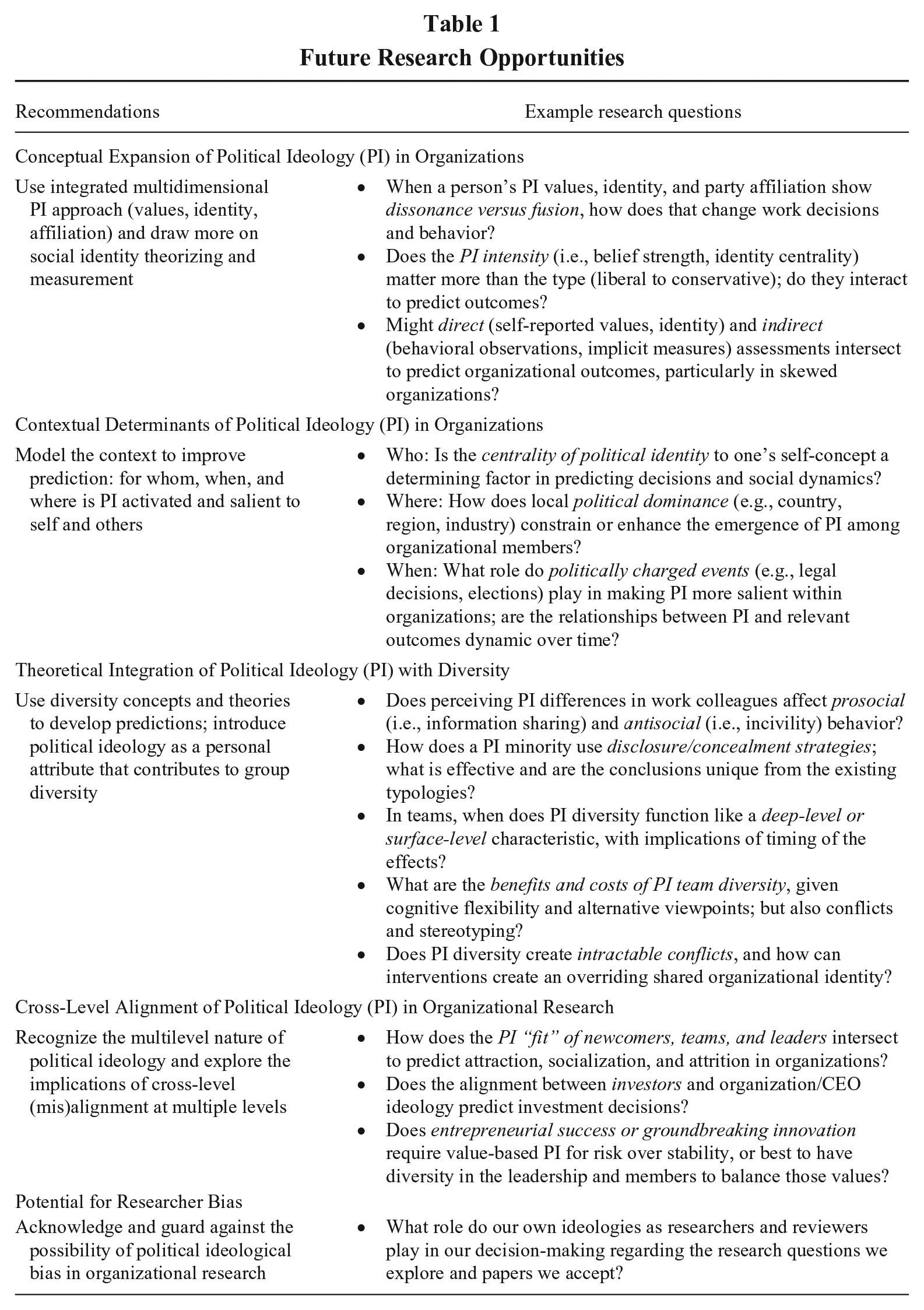
Conceptual Expansion of Political Ideology in Organizations
Our review revealed that the vast majority of organizational research focuses on how political ideology contributed to strategic decisions by representing values (Hambrick & Mason, 1984; Kunda, 1990) but much less on the “who am I” approaches of identity and affiliation. Identity research that does exist is limited to a unidimensional (e.g., liberal-conservative) conceptualization, which is under debate in the political sciences (Feldman & Johnston, 2014; Morgan & Wisneski, 2017). Notably, multidimensional approaches to measurement and theory are beginning to emerge (e.g., one can be conservative and liberal on social vs. fiscal dimensions; Chin, Zhang, Jahanshahi, & Nadkarni, 2018; Feldman & Johnston, 2014; Roumpi, 2015). We strongly suggest that organizational scholars take a multidimensional approach in their conceptualization of political ideology and particularly incorporate more theorizing and measurement drawing on social identity.
One multidimensional approach to political ideology is to assess political values, identity, and affiliation in the same study and determine their alignment as a predictor of outcomes. As noted earlier, the label of “liberal” and “conservative” may only hold symbolic meaning as a tribal identity or affiliation and may not always be representative of the values and beliefs one holds (Ellis & Stimson, 2012). Further, when this value-identity dissonance is made salient during decision-making or conversations, the employee is likely to feel negatively and strive to bring values and expressed social identities in line (Harmon-Jones, Harmon-Jones, & Levy, 2015). In short, the independence of political values and identities, and potential dissonance between them, suggests better prediction of decisions and social behavior when examined jointly than either one alone.
We also propose modeling the joint effects of political values/identity (i.e., liberal or conservative) with the extent to which those beliefs and identity are central to one’s self concept (i.e., identity centrality; e.g., Swann & Bosson, 2010). Employees hold many identities as part of the self, such as their gender and race, as well as occupational and organizational membership, but those that are more important or central to one’s self are more likely to predict how one processes information and enacts social behavior (Ashforth & Mael, 1989). As such, political ideology as an affiliation should more clearly predict organizational decisions and behavior when political identity is a strongly held aspect of the self (Chen & Urminsky, 2019), suggesting an interaction effect that has yet been fully tested.
At an extreme level, political identity fusion, where one feels a visceral sense of oneness with their political group or party that is both social and personal, means that when the political party is denigrated either by others or via the loss of an election, one feels personally threatened and motivated to take extreme actions to defend the group (Swann & Buhrmester, 2015). The integration of an identity fusion lens would be fruitful to explain ingroup favoritism in decision-making and prosocial/antisocial behavior (Swann, Jetten, Gómez, Whitehouse, & Bastian, 2012).
Currently, organizational scholars use donations to political parties as a way to infer the political ideological values and identities of individuals, however such indirect metrics fail to capture identity centrality. Political science scholars have created measures that ask directly about an individual’s identification with their partisan view (e.g., Bankert, Huddy, & Rosema, 2017; Huddy et al., 2015). We suggest drawing on social identity measures of identity centrality (e.g., choosing a visual representation of how much the self overlaps with political identity; items about how important one’s political affiliation is) when direct assessment is possible (e.g., survey or experimental research). Further, scholars might consider using the implicit association test (IAT), as individuals may associate with a political party at a visceral, automatic level (Deichert, 2019; Theodoridis, 2017). Such a measure could be particularly useful with experimental designs when explicit self-ratings might reveal the study’s purpose (Deichert, 2019; Jost, 2019) or when employees work in a highly skewed organization and may not accurately indicate a minority view (i.e., social desirability bias). Overall, we should use the social identity psychology literature to conceptualize and measure political ideology to better understand its influence on decisions about and behavior toward others in organizations.
Contextual Determinants of Political Ideology in Organizations
Political ideology is expected to be suppressed at work (SHRM, 2016), but as stated in one article, “in the media, workplace, and daily social interactions, political cues abound. Thus, the salience of one’s political identity can be increased when one least expects it” (Kim, Han, Duhacheck, & Tormala, 2018: 178). Future scholarship must develop conceptual models and test the contextual conditions that make one’s political views salient to organizational members (Johns, 2006). Context “includes ambient background stimuli, more salient situational features, and changes in these variables over time” (Johns, 2018: 22). Future scholars need to consider for whom, when, and where political ideology tends to be activated—or dormant—to understand when it is likely to influence organizational decisions and social dynamics.
As indicated above, people differ in how central their political identity is to their sense of self. Moreover, political events or conditions make salient one’s political ideology such that it is even more likely to influence one’s decisions and behavior (Stryker & Serpe, 1994). In one study, when participants’ political affiliations were made salient by asking them to describe words or phrases associated with their own political party, their endorsement of politically consistent values for equality versus hierarchy was strengthened compared to a control condition (Kim et al., 2018). Thus, we need to consider what situations makes the political values and identity salient to best predict decisions and behavior.
In line with event systems theory, politically relevant events, such as elections or key legal rulings, can make salient organizational members’ political ideology at work (Morgeson, Mitchell, & Liu, 2015). During an election year, political debates and animosity are constantly in the news (Iyengar et al., 2012), making political ideology more salient and members more aware of their differences. In fact, a recent study found that during the weeks prior to the U.S. Presidential election of 2016, there was an increase in identity fusion—where the self and political group identity merge as one (Misch, Fergusson, & Dunham, 2018), which then predicted prosocial ingroup behavior (e.g., donations to the party). This might also suggest more negative outgroup behavior would occur: Elections increase perceived political differences and incivility (He et al., 2019) and make it likely that teams have ideological ambivalence (e.g., some feel very positive about an election outcome, while others feel very negative; Ashforth, Rogers, Pratt, & Pradies, 2014; Pradies & Pratt, 2010), which can be destabilizing for group affect and outcomes (Pratt & Pradies, 2011).
Beyond political elections and events, organizational and industry events are likely to affect political ideology and outcomes. Hambrick and Wowak’s (2019) stakeholder alignment model suggests that CEO’s socio-political activism can create ripple effects on the engagement of employees and the ideological composition of the organization, as non-aligned individuals may exit. A recent Business Roundtable—a group of more than 180 prominent CEOs from various industries—endorsed a statement that organizations should serve the interest of all stakeholders (Harrison, Phillips, & Freeman, 2019), distinct from the politically conservative view that shareholders should be paramount (Tetlock, 2000). This industry event could create a shift in the endorsement of politically linked values and in the political ideology of leaders seen as a good fit to these broad stakeholder values.
Context also includes time, and scholars should study political ideology in more temporally dynamic ways. Political ideology is thought to be stable over time (Hibbing et al., 2014); however, the members of a team may change over time, organizational members are not constant, and the aggregated ideology of an organization may vary due to headquarter relocations, mergers, or acquisitions. Event systems theory might be a useful framework, which proposes when, why, and how events might have top-down and bottom-up effects on organizations (Morgeson et al., 2015). Event disruption—defined as when the external situation has changed—can occur when an election results in moving from a more liberal to a more conservative national leader with implications for business laws or can occur as an organization’s headquarters moves from a primarily conservative to a primarily liberal location. Such event disruption might be expected to influence the salience of the organizational ideology of the organization and success at interacting with the new public and clients. Scholars have theorized that founders might have an outsized influence in establishing the ideology of an organization (Gupta, Briscoe et al., 2017), and the departure of a founder might be an internal event that could also lead to long-term changes to the firm’s political ideology. To answer these questions, scholars will need to leverage longitudinal research methods and specifically examine or control for impactful discrete events.
Theoretical Integration of Political Ideology with Diversity
We strongly encourage scholars to integrate political ideology with work diversity concepts and theorizing. Strategy scholars have aggregated political ideology to the team level to represent political skew (highly liberal or conservative) and predict team processes and decision-making (Christensen et al., 2015; Gupta & Wowak, 2017), but future research should consider the diversity or extent of separation (or variability) from this average level (Harrison & Klein, 2007). Conceptualizing political ideology diversity as deep (values) versus surface (i.e., identity/social category) suggests predictions about how it might differentially affect group processes and outcomes, providing an intriguing direction for future research.
Work groups vary in their heterogeneity or similarity on different attributes, and there have been calls to move away from the focus on demographic or surface-level diversity (i.e., gender, race) to more deep-level characteristics (i.e., values, personal identities) that cannot be immediately discerned (Harrison, Price, & Bell, 1998; Horwitz & Horwitz, 2007; Joshi & Roh, 2009; Nkomo, Bell, Roberts, Joshi, & Thatcher, 2019). Similar to political ideology as values and as identity in our review above, these two forms of diversity may enhance decision making via information processing but may also hinder social processes due to social categorization and conflict (Bell et al., 2011; Shin, Kim, Lee, & Bian, 2012; Van Knippenberg & Schippers, 2007). Political ideology conceptualized as differing values (e.g., for egalitarianism vs. hierarchy) seems like deep-level diversity, which might provide cognitive diversity that helps quality of outcomes (Shi et al., 2019) but be harmful as those differences emerge over time (Harrison, Price, Gavin, & Florey, 2002). In one study, value-based team diversity did not affect team performance but did elicit more conflict and less cohesion than teams who had more similar values (Woehr, Arciniega, & Poling, 2013); we propose that diversity in political values—when salient—could be even more divisive due to their moralized nature (Graham et al., 2009).
Political identity or party affiliation can also act as a surface-level characteristic if it is known or simply perceived through social information (Deichert, 2019), quickly triggering social categorization and activating stereotypes and negative emotions that affect team processes immediately (He et al., 2019; Iyengar et al., 2012). Scholars should test whether employees use identity management in similar or unique ways to other types of identities, where they disclose, conceal, or subtly signal their political ideology at work (Jones & King, 2014). A single member who decides to share their authentic (political) self can have a vicarious learning effect, sharing information about their political values and beliefs with their coworkers and attempting to learn from them (Follmer, Talbot, Kristof-Brown, Astrove, & Billsberry, 2018). However, if the organization permits hostile work behaviors towards certain ideologies (i.e., conservative views), those members may put on a facade of conformity to appear to fit in, linked to more exhaustion and withdrawal cognitions (Bermiss & McDonald, 2018; Hewlin, 2003, 2009; Miner-Rubino & Cortina, 2007). These ideas lead to interesting research comparing how managing political ideological differences compare to other types of diversity and contribute to employee performance, burnout, and withdrawal behaviors.
In politically diverse teams, conflict is likely given the group polarization and identity fusion that may occur around political identities/affiliations (Iyengar & Westwood, 2015; Swann et al., 2012). With long-standing teams, one question is whether political identity differences spiral into “intractable conflicts,” where members’ differing identities are salient and feel more threatened over time (Rothman, 1997), highly likely given that elections result in winners and losers. The intractable identity conflict resolution model proposes organizational strategies to help people shift their identities and avoid conflict escalation (Fiol, Pratt, & O’Connor, 2009), particularly during election seasons when political ideology becomes salient. This model suggests ways that organizations strive to promote higher order goals and commonalities while still respecting group differences and others’ perspectives (see also Pratt & Corley, 2007). Perspective-taking exercises, in which an individual attempts to adopt another person’s values and beliefs, have been effective in diversity trainings regarding LGBT populations (Lindsey, King, Hebl, & Levine, 2015), and general practices of mindfulness help to enable individuals to overcome reductive negative stereotypes by seeing multiple perspectives (Fiol & O’Connor, 2003). Overall, such approaches may help the employee have an identity more strongly fused with that of the organization than one’s political ideology (Swann et al., 2012).
While organizational scholars are primarily concerned with how diversity impacts work-related outcomes, exposure to diverse political views at work may have effects beyond the organizational boundaries. In other words, might the interaction of a very liberal individual and a very conservative individual at work help reduce negative stereotyping and bias towards members of the outgroup outside of work (e.g., a family member)? Such notions would fit with the general principles of the contact hypothesis, as workplaces (more so than other venues of political discussion) are typically seen as places where individuals have relatively equal status and pursue common goals (Allport, 1954). Evidence for the contact hypothesis is equivocal (Paluck, Green, & Green, 2018), but whether workplaces could foster understanding across political party lines by having employees work toward a common goal merits consideration in this polarized time.
Cross-Level Alignment of Political Ideology in Organizational Research
The majority of research has focused on the political ideology held by the upper echelons of the organization and affecting strategic decisions. We call for more research at all levels of the organization and particularly consideration of alignment in political ideology that occurs at multiple levels and changes dynamically and alignment of our own political views as researchers (and reviewers) with the research.
Political ideology held at the upper echelons of organizations is proposed to constrain or enable the influence of political ideology at lower levels, and vice versa (Hambrick & Wowak, 2019). Scholars might find it useful to apply P-O fit perspectives to political ideology, particularly assessments of value fit (Li, Kristof-Brown, & Nielsen, 2019; Seong, Kristof-Brown, Park, Hong, & Shin, 2015). While we know that cross-level alignment enhances implementation of leaders’ policies, such as more liberal organizational members supporting CSR (e.g., environmental and diversity-related initiatives) (Gupta, Briscoe et al., 2017), empirical research is still needed on how that political ideology alignment enhances the employees’ engagement and well-being (Hambrick & Wowak, 2019). We need to extend beyond the decision-maker’s perspective (e.g., Gift & Gift, 2015; Johnson & Roberto, 2018) and determine how applicants use political ideology fit. Do they manage their political ideology differently depending on organizational-level political ideology, and does such fit affect attraction to an organization above and beyond the many other predictors of attraction (Cable & Judge, 1996)? We propose that most newcomers to the job market (e.g., the often-studied college students) are unlikely to use political ideology to determine attraction and selection of companies until they have experienced P-G political ideology misfit, suggesting predictions that change with job experience.
Another expansion to the existing work on upper echelons is to focus on how the ideological (mis-)fit of outside actors (e.g., activists and consumers) with organizational or CEO ideology influences an organization’s governance policies and decision making. While some preliminary work has examined the influence of outsider advocacy on organizational practices (cf., Gupta & Briscoe, 2019), there remain multiple avenues for future research that examine different constituents such as investors. One example in particular is that of activist investing, whereby hedge fund, private equity, or wealthy individual investors buy large shares in a target organization and then exert influence to change the strategic, operational, and financial management practices of the organization (Goranova, Abouk, Nystrom, & Soofi, 2017). A misfit between investor and organizational ideological values may motivate investors to target certain firms. Given the radical disruption and changes that can result from such practices (Goranova et al., 2017), it is fruitful to explore if and how ideology plays a role in such decision making. Future research examining these questions will further theory on organizational governance, agency theory, and political ideology.
Another new approach around cross-level alignment is to determine if certain types of industries are a better fit for some political values and political ideology diversity than others. For example, entrepreneur and innovator success requires risk-taking and willingness to face uncertainty and ambiguity (Stewart & Roth, 2001). To the extent that liberals prefer change and are more comfortable with uncertainty and conservatives value tradition and stability, one might expect that new businesses and innovative outcomes tend to be driven by liberal-leaning leaders. In fact, most of the innovative technology companies cited at the beginning of this review (Twitter, Facebook, Google, and Apple) have an overt liberal-leaning ideology, and political ideology seems to be linked to certain industries (Bonica, 2017). At the same time, it is possible that diversity in political values is better for balancing risk and stability in new businesses and for innovative products (Shi et al., 2019). New research should give attention to entrepreneurs, startups, and research and development (R&D) teams to identify how political ideology is linked to success in entrepreneurship and innovation.
Potential for Researcher Bias
Finally, we strongly urge scholars to consider how their own political ideology is, perhaps unintentionally, aligned with the research questions they ask and measures they use. Our review shows compelling evidence that political ideology can bias decisions via motivated reasoning; as such, it would be naive to believe that the decisions of scholars—including the phenomena we study, the theories that we leverage, and the conclusions that we draw—are not also biased by our own political views. Indeed, the majority of academics hold liberal-leaning political ideologies; this decreases ideological diversity in the classroom and research (Duarte et al., 2015) and contributes to the public’s distrust due to the scientists’ perceived bias (Rynes, Colbert, & O’Boyle, 2018). We must also reflect upon the role that our own ideologies play in our research and reviews of others work and take steps to mitigate bias.
We offer four suggestions to help scholars with drawing fair inferences in this line of research: (1) generate competing inferences, pitting against each other charitable explanations of conservative and liberal behaviors instead of ensuring a positive explanation no matter the outcome for liberals and a negative explanation for conservatives (Washburn & Skitka, 2018); (2) create more transparent methods and clearer explanations that offer less possibility for misinterpretation by science journalists (Rynes et al., 2018); (3) scrutinize the measures you utilize for potential bias (for example, personality may seem to be associated with political ideology because the personality items in use may be measuring activities that are more valued by those holding a particular political perspective; e.g., openness to experience scales; Charney, 2015); and (4) make academic posts more desirable for those with conservative ideologies by highlighting how viewpoint diversity is also a value for of diversity to the departments doing the hiring (Duarte et al., 2015).
Concluding Thoughts
In the past decade, political polarization has increased dramatically (Pew Research Center, 2017). Employees bring their conservative and liberal political ideologies to work, and these values and identities impact decision-making and social interactions, whether intentionally or not. Much remains unknown about how and when political ideology influences organizational life. As political ideology continues to cause divisions in societies across the globe, organizational scholars should seek to understand the implications of working with people holding different political ideologies for both work outcomes and for society.
