



Abstract
Conservation of resources (COR) theory proposes that mistreatment by customers (termed “customer mistreatment”) can deplete employees’ resources, lessen their ability to regulate their behaviors, and result in them engaging in customer-directed deviant behavior. However, COR has been criticized for its lack of precision regarding how this process unfolds. Integrating the person-situation interactionist perspective with COR theory, the present paper aims to provide a deeper understanding of COR theory by explicating how individual characteristics and work context—namely, psychological detachment and supervisory unfairness—can combine to attenuate/exacerbate the relationship between customer mistreatment and employees’ customer-directed deviant behavior. Using a multilevel field study with 1,092 daily-based surveys among 157 Korean call-center representatives, our results show that frontline employees’ emotional exhaustion mediates the relationship between customer mistreatment and customer-directed deviant behavior that occurs on the next working day. When faced with customer mistreatment, employees with lower (vs. higher) psychological detachment were more likely to be emotionally exhausted and engage in customer-directed deviant behavior on the next working day. Moreover, their emotional exhaustion predicted customer-directed deviant behavior more so when their supervisors treated them unfairly (vs. fairly). Taken together, the results show that the mediating effect of emotional exhaustion was strongest among employees with low (vs. high) psychological detachment and who reported more (vs. less) supervisory unfairness. Theoretical, methodological, and practical implications as well as directions for future research are discussed.
Keywords
Mistreatment by customers (hereafter termed “customer mistreatment”) refers to employees’ experience of low-quality interpersonal treatment from customers during their work-related interactions (Wang, Liao, Zhan, & Shi, 2011; Wang et al., 2013). Employees who are mistreated by customers are likely to react negatively by engaging in customer-directed deviant behavior such as incivility and mild forms of sabotage (Shao & Skarlicki, 2014; Skarlicki, van Jaarsveld, Shao, Song, & Wang, 2016; Walker, van Jaarsveld, & Skarlicki, 2017; Skarlicki, van Jaarsveld, & Walker, 2008; Wang et al., 2011). Such reactions can not only lower customer service quality but can also distract employees’ attention and motivation toward workplace duties and erode their performance (Shao & Skarlicki, 2014; Skarlicki et al., 2008).
One of the theoretical perspectives that help explain service employees’ negative reactions toward mistreating customers is conservation of resources (COR) theory. COR theory focuses on the resources that employees need in order to effectively deal with their day-to-day challenges and fulfill their work duties. COR theory proposes that individuals tend to protect their resources to minimize potential resource loss as well as devote effort to acquiring new resources (Hobfoll, 1989, 2001). When faced with customer mistreatment, service employees can experience resource loss, which in turn can negatively affect their ability to regulate their deviant behaviors. van Jaarsveld, Walker, and Skarlicki (2010), for example, found that employees who are mistreated by customers are more likely to be emotionally exhausted, making it difficult for them to control their deviant reactions, which ultimately results in them acting with incivility toward customers. Although COR theory has been shown to be a useful theoretical lens for explaining frontline employees’ insidious workplace behavior (e.g., Shao & Skarlicki, 2014; van Jaarsveld et al., 2010; Wang et al., 2011), previous research has not explicitly described the process by which service employees might potentially obtain or lose resources when faced with customer mistreatment. This theoretical gap is important because it limits understanding of employees’ psychological and cognitive experiences of and reactions to customer mistreatment.
In the present paper, we both test and extend COR theory. In terms of testing COR theory, we examine whether employees’ daily experience of customer mistreatment predicts their deviant behaviors toward customers on the next working day, which is expected to be mediated by their emotional exhaustion. While prior research demonstrates the role of emotional exhaustion in the relationship between employees’ general experiences of customer mistreatment and their behavioral reactions toward the customers, our research is unique in that we invoke the major tenets of COR theory to explore how the effects of customer mistreatment can go beyond a specific service episode on a given working day and influence employees’ psychological states and behaviors at a later point in time. We focus on service employees’ deviant behavior, defined as employees’ negative behaviors toward specific individuals (e.g., customers) who fall outside the organization’s service rule or regulations (Robinson & Bennett, 1995).
In terms of extending COR theory, our research takes the person-situation interactionist perspective from Schneider (1983a, 1983b) to study how service employees’ individual characteristics (i.e., psychological detachment) and their perceived work context (i.e., supervisory unfairness) combine to qualify the effects of daily experienced customer mistreatment and emotional exhaustion on deviant behavior. Integrating the interactionist view with a resource-based perspective contributes to the increased precision of COR theory by providing empirical evidence of how both individual and contextual factors can simultaneously impact resource loss and gain process experienced by service employees when they interact with difficult customers. Specifically, we investigate the role of psychological detachment in the relationship between employees’ daily customer mistreatment and their emotional exhaustion on the next working day. We expect that individuals with higher levels of psychological detachment are more likely to reduce potential resource loss resulting from daily workplace stressors (i.e., customer mistreatment) by creating distance from an often seemingly uncontrollable stressor. We further argue that psychological detachment helps employees regain valuable resources by allowing individuals to refresh themselves (e.g., not think about work-related matters) during off-duty hours, thereby lessening their emotional exhaustion on the subsequent working day.
We further extend COR theory by examining how unfair supervisory treatment can exacerbate employees’ customer-directed deviant behavior in the workplace. In the present study, we consider supervisory treatment as a moderator in the relationship between employees’ daily experiences of emotional exhaustion and deviant behavior. We treat supervisor (in)justice as a contextual variable based on Cropanzano, Byrne, Bobocel, and Rupp’s (2001) discussion of the distinction between an unfairness event and entity. Whereas events reflect employees’ experience of specific workplace episodes, supervisor injustice can often reflect one’s general impression of their supervisor (fair vs. unfair). Based on COR theory, employees’ daily experiences of emotional exhaustion will be more likely to result in daily deviant behavior among employees who perceive that their supervisor is unfair (vs. fair). This is because perceptions of supervisory unfairness can be considered an additional stressor that further drains one’s resources, making it even harder for emotionally exhausted employees to regulate their behaviors in accordance with customer service rules on a given working day. Figure 1 presents our theoretical model.
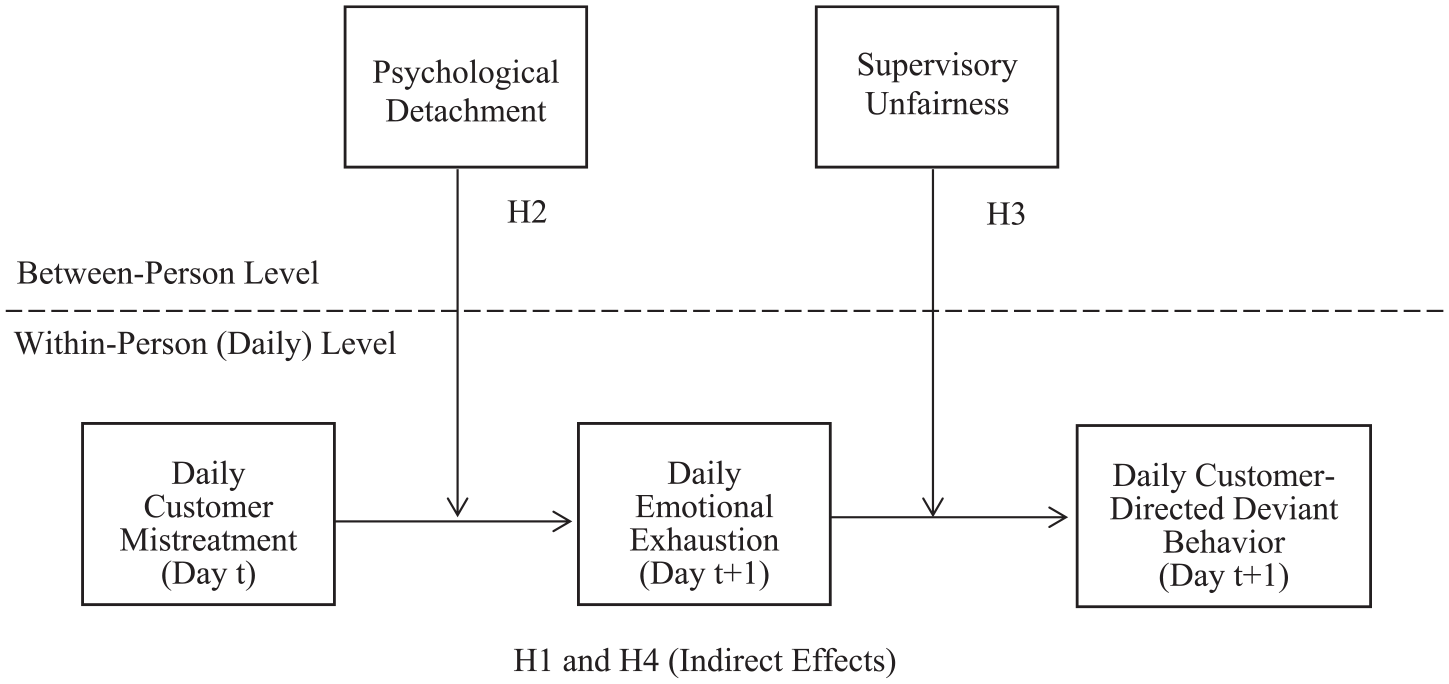
Hypothesized Model
In summary, our study aims to add precision to COR theory by specifying the roles of psychological detachment and supervisory unfairness in the indirect effect of daily customer mistreatment on employees’ daily deviant behaviors via their emotional exhaustion on the next working day. In doing so, we highlight the interplay between home and work factors that have implications for employees’ workplace behaviors (Allen, Cho, & Meier, 2014). In addition to explaining how employees will react to daily experiences of customer mistreatment (e.g., deviance) and why they react in this way (e.g., emotional exhaustion), our research provides an additional explanation of when the negative consequences of daily customer mistreatment can be mitigated or exacerbated and elucidate why these daily within-person effects of customer mistreatment can differ across individuals and work contexts.
From a methodological perspective, we used a time-lagged daily diary design to explore the within-person mediation effect of daily emotional exhaustion on the relationship between daily customer mistreatment and customer-directed deviant behavior on the next working day. Specifically, we studied whether Day t’s customer mistreatment predicts Day t + 1’s employee deviant behavior via Day t + 1’s emotional exhaustion. This research strategy allowed us to predict how employees’ detachment propensity can affect their emotional exhaustion arising from the previous day’s customer mistreatment. This design captures a sequential process of employees’ daily reactions to customer mistreatment that cannot be observed by a cross-sectional research design (Ohly, Sonnentag, Niessen, & Zapf, 2010). We chose a call center as our research site because employees interact with multiple customers on a daily basis (Wang et al., 2011) and can be exposed to customer mistreatment on a frequent basis (Grandey, Dickter, & Sin, 2004). From a managerial perspective, our research offers insights for managers in service industries to lessen the potentially detrimental effects of customer mistreatment on customer service quality.
Theory and Hypothesis Development
As a motivational stress theory, COR theory outlines how certain stressors can affect individuals’ cognitive and emotional attitudes and behaviors and explains how people strive to gain and protect valuable resources (Westman, Hobfoll, Chen, Davidson, & Laski, 2005). In particular, COR theory focuses on the role of resources employees need to respond to workplace stressors (Hobfoll, 1988, 1989). COR theory proposes that people are motivated to acquire and protect their personal, emotional, and social resources (Hobfoll, 1988; Hobfoll, Freedy, Lane, & Geller, 1990). Failing to conserve or acquire valuable resources can add to stress for individuals, especially after investing considerable energy and resources in an activity (Halbesleben, 2006; Hobfoll, 2001; Hobfoll & Freedy, 1993; Wright & Hobfoll, 2004).
COR theory broadly defines resources as objects, states, personal characteristics, conditions, or energies that are valuable to individuals that can vary by condition or situation (Hobfoll, 2001). Studies have explored numerous different types of resources, including objects (e.g., one’s home), conditions (e.g., job security), physical states (e.g., personal health), financial situations (e.g., savings or adequate income), social situations (e.g., support from family, friends, or community), and personal traits (e.g., individual’s cognitive, emotional, or motivational status) (Hobfoll, 2001; Hobfoll et al., 1990; Hobfoll & Lilly, 1993; Wang, 2007).
A growing number of studies have invoked COR theory to explain the relationship between customer mistreatment and customer-directed deviant behavior (Shao & Skarlicki, 2014; van Jaarsveld et al., 2010; Walker et al., 2017; Wang et al., 2011). Consistent with this perspective, we conceptualize emotional exhaustion as an indicator of employees’ resource depletion. Emotional exhaustion is defined as “feelings of being overextended and depleted of one’s emotional and physical resources” (Maslach, Schaufeli, & Leiter, 2001: 399). Based on COR theory, we proposed that customer mistreatment can contribute to employees’ experience of emotional exhaustion on the next working day for the following reasons. First, research has shown that customers’ unjust treatment (e.g., yelling or using condescending language during business interactions) is a major stressor (Shao & Skarlicki, 2014), and dealing with such stressful events may have a psychic cost in terms of the loss of usable resources (Baumeister, Bratslavsky, Muraven, & Tice, 1998; Wang et al., 2011). Furthermore, the accumulation of stressful experiences tends to chronically drain employees’ resources for a considerable period of time (Krannitz, Grandey, Liu, & Almeida, 2015). As a result, service employees who frequently experience customer mistreatment are likely to experience increasing emotional exhaustion as these episodes accumulate. Second, the threat of future resource loss can further exacerbate employees’ emotional exhaustion on the next working day. For example, Hobfoll and Lilly (1993) proposed that current resource losses yield more resource losses in the future (i.e., COR’s Corollary 2). As noted above, call-center customer service representatives report a high frequency of customer mistreatment during working hours (Grandey et al., 2004), which is why call-center work is considered as one of the more emotionally demanding occupations (Zapf, Isic, Bechtoldt, & Blau, 2003). Call-center representatives generally handle 50-75 calls per day (Grandey et al., 2004); they often are pressured to move on to the next call, and such pressure continues throughout their working hours. Being in such a chronically demanding work environment with excessive workloads can accelerate employees’ future emotional depletion. Furthermore, employees often recall their memories about negative customer mistreatment events (Baranik, Wang, Gong, & Shi, 2017; Song et al., 2018; Wang et al., 2013), and we expect that such a tendency will contribute to potential resource depletion in the future. Research on spillover similarly proposes that stressful events are often transferred to other types of relationship (e.g., work-family) and/or a later time (Ilies, Schwind, Wagner, Johnson, DeRue, & Ilgen, 2007; Thompson, Kirk, & Brown, 2005). Thus, due to this spillover effect, we expect that a current day’s customer mistreatment can affect employees’ next day’s experience of emotional exhaustion.
Previous research shows that emotional exhaustion incurs costs in terms of frontline employees’ emotions, behaviors, and attitudes, including deviant behavior, depersonalization, higher turnover intention, and lower job performance (Cordes & Dougherty, 1993; Cropanzano, Rupp, & Byrne, 2003; Howard & Cordes, 2010; Lee & Ashforth, 1996; van Jaarsveld et al., 2010; Wright & Cropanzano, 1998). Among the potential negative consequences of emotional exhaustion, in the present research we focused on employees’ customer-directed deviant behavior.
We expected that emotionally exhausted employees are more likely to engage in customer-directed deviant behavior for several reasons. First, resource depletion can leave employees with limited amounts of energy and resources to regulate their responses to stress (Macey & Schneider, 2008), in particular making them less able to regulate their behaviors according to customer service standards. Second, reflecting a “rich-get-richer and the poor-get-poorer phenomenon,” COR theory proposes that an initial resource gain is likely to yield future resource acquisition, creating a positive resource-gaining cycle. When faced with resource loss, however, individuals can become highly vulnerable to future resource loss and thus are likely to engage in minimizing future resource depletion rather than acquiring new resources (i.e., COR’s Corollary 4) (Halbesleben, Neveu, Paustian-Underdahl, & Westman, 2014; Hobfoll, 1988, 2001; Hobfoll & Lilly, 1993). This relatively passive approach to minimizing further resource loss can result in an undersupply of resources available to employees to refrain from engaging in deviant behavior. In support of our argument, numerous empirical studies have shown that emotional exhaustion is an important antecedent of service employees’ insidious workplace behavior (Bolton, Harvey, Grawitch, & Barber, 2012; Mulki, Jaramillo, & Locander, 2006; van Jaarsveld et al., 2010).
This argument is consistent with the self-control literature, which states that individuals utilize regulatory resources when engaging in self-control of their ideas, feelings, and actions (Baumeister et al., 1998). Such self-control activities diminish individuals’ regulatory resources, making it harder to regulate their subsequent reactions (Muraven & Baumeister, 2000). It follows that when faced with customer mistreatment, employees are likely to deploy their regulatory resources to engage in self-control or self-regulation (e.g., not to react negatively to customers) so that they can still perform their job well. Such self-control and self-regulation, however, can further deplete service employees’ regulatory resources, accelerating their resource depletion and ultimately leading to emotional exhaustion and the failure to control deviant behavior.
Given their exposure to customers on a daily basis, we further expect that service employees’ resource depletion is likely to occur in response to the level of customer mistreatment employees experience during their working day. It also follows that, all else being equal, on those days when employees experience more customer mistreatment, they are more likely to experience emotional exhaustion on the next working day, which in turn results in customer-directed deviant behavior. As noted above, call-center representatives often experience verbal aggression from customers throughout their working day (Grandey et al., 2004; Grandey, Kern, & Frone, 2007). Such chronic stresses from customers not only deplete their resources but also threaten the employees’ future resource loss, which further contributes to emotional exhaustion on the next working day. As a result, emotionally exhausted employees are likely to engage in more customer-directed deviant behavior due to the lack of enough resources needed to regulate their behavior. In summary, we propose that the relationship between employees’ perceived daily customer mistreatment (Day t) and their customer-directed deviant behaviors on the subsequent working day (Day t + 1) is mediated by their emotional exhaustion experienced on the subsequent working day (Day t + 1).
Hypothesis 1: Employees’ emotional exhaustion on the next working day mediates the positive relationship between customer mistreatment experienced on a given working day and their customer-directed deviant behavior on the following working day.
Psychological Detachment
Psychological detachment refers to an individual’s disposition to mentally disengage from job-related thoughts and activities during nonworking hours (Etzion, Eden, & Lapidot, 1998). In the present paper, we propose that psychological detachment as a between-person individual difference 1 can mitigate the effects of employees’ daily experiences of customer mistreatment on their emotional exhaustion on the next working day because individuals with higher detachment capacity tend to distance themselves from work-related issues during off-duty hours. This characteristic helps high-detachment individuals cope better with daily experiences of workplace stress (e.g., customer mistreatment) as compared to their low-detachment counterparts. Specifically, among individuals with higher psychological detachment, daily experiences of workplace stress (customer mistreatment) will be less resource-depleting because their detachment capacity can lessen their resource loss and help them acquire additional resources after they finish work on each working day. Moreover, individuals with higher psychological detachment are more capable of distancing themselves from the source of stress (Maslach et al., 2001). Such distancing capability has been shown to be an effective way to manage a seemingly uncontrollable stressor. Customer mistreatment is a typical uncontrollable stressor because customer concerns and their mistreatment can be out of employees’ control. Customers can also exert considerable power over service employees (Skarlicki et al., 2008; Spencer & Rupp, 2009), and employees can experience relatively little control over customers’ behaviors. Therefore, we propose that individuals’ higher levels of detachment capability from uncontrollable stressors (e.g., mistreatment from customers) provides an opportunity for them to decrease their resource loss (e.g., not ruminating about the customer mistreatment after each day’s work), helping them cope better with their daily experiences of customer mistreatment. Our argument is consistent with the coping literature, which proposes that avoidance can serve as one of the most effective emotion-focused defense mechanisms in situations of power imbalance (Lazarus & Folkman, 1984) that can occur when serving customers.
Furthermore, we argue that psychological detachment can aid by facilitating the acquisition of personal resources (Park, Fritz, & Jex, 2011) such as spending quality time with family or doing something enjoyable and fun after work. The tendency to detach can help employees cope better with their daily experienced customer mistreatment in terms of a reduced level of emotional exhaustion on the next working day. That is, when off-duty, individuals with higher levels of detachment are more able to mentally “switch off” and leave their stressful work-related issues behind (Sonnentag & Fritz, 2007), which offers them opportunities to refresh themselves and acquire valuable resources (Meijman & Mulder, 1998; Ten Brummelhuis & Bakker, 2012).
Employees who have lower levels of psychological detachment, in contrast, are more likely to be preoccupied with problems and issues that happened at work when off-duty, limiting their ability to mitigate resource loss and/or reobtain important personal resources (Thomson, 2006). Indeed, empirical evidence has found that individuals with higher levels of psychological detachment report higher levels of psychological well-being (Sonnentag & Fritz, 2007), whereas low detachment relates to fatigue and sleep problems associated with stress (Grebner, Semmer, & Elfering, 2005; van Hooff, Geurts, Kompier, & Taris, 2007).
Hypothesis 2: Employees’ psychological detachment moderates the positive relationship between employees’ experienced customer mistreatment on a given working day and their emotional exhaustion on the next working day, such that the relationship is stronger among employees with lower (versus higher) levels of psychological detachment.
Supervisory Unfairness
Numerous studies have found a significant relationship between workplace injustice and employees’ workplace deviance (Ferris, Spence, Brown, & Heller, 2012; Holtz & Harold, 2013; Jones & Skarlicki, 2005; Lawrence & Robinson, 2007; Skarlicki, Folger, & Tesluk, 1999). Among a variety of potential sources of workplace unfairness, we focus on supervisory unfairness because customers, supervisors, and customer-contact workers constitute the three major entities in the customer service context (Eddleston, Kidder, & Litzky, 2002). The social exchanges among these entities are essential to our knowledge of employees’ attitudes and behaviors in the service industry. As such, it makes theoretical sense to consider supervisors in the daily interactions between customers and employees.
Supervisory unfairness refers to individuals’ perceptions of unfair treatment received from authority figures (Bies & Moag, 1986). Prior research has investigated the moderating role of supervisory unfairness in the relationship between customer mistreatment and employee sabotage toward customers. Skarlicki et al. (2016), for example, examined the two-way interaction of supervisory unfairness and customer mistreatment on employees’ service sabotage, and they considered both supervisory and customer treatment at the entity level.
Extending this line of inquiry above, in the present research we were interested in understanding whether employees’ perceptions of supervisory unfairness moderate the relationship between their daily emotional exhaustion and deviant behavior. Previous research has documented that emotionally exhausted employees are more likely to conduct uncivil workplace behavior (van Jarssveld et al., 2010), and evidence has shown the moderating role of workplace unfairness in the effects of employees’ emotional exhaustion on their workplace behaviors (e.g., Hur, Park, & Moon, 2014; Janssen, Lam, & Huang, 2010).
We argue that perceptions of unfair treatment by a supervisor can exacerbate the effects of employees’ daily experienced emotional exhaustion on their deviant behavior. As stated earlier, emotionally exhausted employees generally can lack sufficient resources to control their workplace behavior. Unfair supervisory treatment is a major workplace stressor (Bruk-Lee & Spector, 2006). High levels of unfairness from supervisors can further deplete service employees’ available resources, making it even harder for emotionally exhausted employees to regulate their behaviors. Put differently, we consider supervisory unfairness as a second stage moderator such that employees experiencing emotional exhaustion on a given day are more likely to engage in deviance on that working day when they perceive higher (vs. lower) supervisory unfairness, due to the additional depletion of resources associated with supervisory unfairness. In short, emotionally exhausted employees are less capable of regulating their behaviors according to the service rules/standards from day to day when they perceive higher (vs. lower) supervisory unfairness. Taken together, we proposed:
Hypothesis 3: Supervisory unfairness moderates the positive relationship between employees’ daily emotional exhaustion and their daily customer-directed deviant behavior, such that the relationship is stronger among employees who perceive higher (versus lower) levels of supervisory unfairness.
Moderated Mediation Hypothesis
The interactionist perspective proposes that different characteristics and workplace environments combine to predict individuals’ attitudes and behaviors (Schneider, 1983a, 1983b). This person-by-situation perspective states that individuals’ behavior is not only influenced by trait-relevant individual differences (e.g., disposition, personality, or cognitive capability) but also concurrently influenced by contextual factors such as organizational setting or job-related situation (Schneider, 1983a; Trevino, 1986). Based on this perspective, we proposed that an individual’s dispositional differences in psychological detachment and contextual factors within the organization (i.e., supervisory unfairness) combine to affect employees’ daily reactions to their daily experiences of customer mistreatment.
Specifically, we proposed a moderated mediation model such that the mediating effects of daily emotional exhaustion focused on the relation between daily customer mistreatment and customer-directed deviant behaviors. This mediation effect will be moderated by psychological detachment in the first stage (i.e., daily customer mistreatment–following a day’s emotional exhaustion linkage) and supervisory unfairness in the second stage (i.e., the following day’s emotional exhaustion–customer-directed deviant behavior linkage) such that the mediation effect of daily emotional exhaustion will be strongest under conditions of low psychological detachment and high supervisory unfairness.
Hypothesis 4: Psychological detachment and supervisory unfairness moderate the indirect effect of employees’ experienced customer mistreatment of a given day on their customer-directed deviant behavior via their emotional exhaustion on the next working day, such that the indirect effect is strongest among employees who are lower (versus higher) on psychological detachment and who perceive higher (versus lower) levels of supervisory unfairness.
Method
Participants
Nine daily surveys were administered to 400 representatives at a telemarketing call center that represented 10 life insurance companies in three major cities in South Korea. Telemarketing sales is a common selling channel in South Korea, in which employees attempt to sell a variety of products by randomly calling prospective customers based on the company’s customer database. In this specific setting, call-center representatives sell accident and health insurance products that cover injury, disease, and third-party liability incidents. When representatives call potential customers, they briefly introduce themselves, including their company, name, and title, and then begin their conversation with small talk. Then, they proceed to explain the details of insurance products, including why it is important to be insured, potential coverage options, and the benefits/advantages of having this insurance product. If customers are not interested, representatives thank the customer and then hang up the phone. If customers are interested, representatives proceed to the contract with verbal consent. The call length varies depending on the degree of customers’ interest in the product, but in most cases, the discussion lasts from 3 to 15 minutes. On average, these call-center representatives made approximately 60-80 calls per day. Among the 400 representatives invited to participate in our research, 157 of them completed the initial survey and all the daily surveys. The participants received 20,000 Korean won (approximately US$17) for their participation. The participants had a mean age of 39 years (SD = 9.10), and 83% were female. Their average work experience was 4.80 (SD = 3.69) years, with an average income between US$17K and US$34K. The manager of the call center confirmed that these demographics were representative of their customer service workforce.
Procedures
We assembled English versions of the following measures and translated them into Korean following the translation and back-translation technique (Brislin, 1990). Paper-and-pencil–based surveys were used. Surveys were administered after working hours to call-center representatives over 9 consecutive working days, which included one weekend. Our research assistants visited the offices and distributed daily questionnaires directly to call-center representatives at 6 p.m. on each working day. While the research assistants administered the survey, managers were asked to leave the office to ensure confidentiality of employee responses. The research assistants stayed in the office, answered participants’ inquires, and collected questionnaires after completion. On Day 1, participants were asked to provide their demographic information and measures of their psychological detachment and supervisory unfairness. From Day 2 to Day 9, the participants completed daily measures of customer mistreatment, emotional exhaustion, and customer-directed deviant behavior.
Measures
Daily customer mistreatment
We used Skarlicki et al.’s (2008) customer mistreatment measure designed for a call-center setting. This measure has eight items (e.g., “During today’s working hours, customers refused to listen to you” and “During today’s working hours, customers interrupted you: Cut you off mid-sentence”). A 5-point Likert-type scale ranging from 1 (never) to 5 (frequently) was used to assess the frequency of the representatives’ daily experiences of customer mistreatment. The items were averaged to form the index of customer mistreatment such that higher numbers signified more experienced mistreatment. The mean alpha reliability value of the scale across 8 days was .84 (SD = .02).
Daily emotional exhaustion
Employees’ daily emotional exhaustion was assessed using Wharton’s (1993) six-item scale consisting of a 7-point Likert-type scale ranging from 1 (strongly disagree) to 7 (strongly agree). A sample item included “During today’s working hours, I feel emotionally drained from my work.” The items were averaged to form the index of emotional exhaustion. The mean of reliability for this variable across 8 days was .91 (SD = .08).
Daily customer-directed deviant behavior
We measured employee deviance using Skarlicki et al.’s (2008) five-item measure with a 5-point Likert-type scale, ranging from 1 (never) to 5 (frequently, more than seven times per day). A sample item included “During today’s working hours, I purposefully disconnected a call.” The mean of reliability (Cronbach’s alpha) for this variable across 8 days was .83 (SD = .02).
Psychological detachment
We used Sonnentag and Fritz’s (2007) four-item validated scale to measure employees’ psychological detachment. The measure was assessed based on a 7-point Likert-type scale ranging from 1 (strongly disagree) to 7 (strongly agree), and the sample items included “After working hours, I forget about work” and “After working hours, I don’t think about work at all” (α = .92).
Supervisory unfairness
We used Colquitt’s (2001) eight-item scale to assess employees’ perceived supervisory fairness. The sample items included “My immediate supervisor treats me with dignity and respect” and “My immediate supervisor is open and frank in (his/her) communications with me.” The response scale ranged from 1 (strongly disagree) to 7 (strongly agree). Items were reverse-coded and averaged such that higher numbers signified higher levels of supervisory unfairness (α = .98).
Control variables
We controlled for employees’ gender, work experience, income, and parental demand in our hypothesis testing. Following Bernerth and Aguinis’s (2016) guidelines for inclusion of controls, we selected control variables that are theoretically relevant to employees’ emotional exhaustion and deviant behavior. We controlled for gender because women often put more effort into regulating their emotions than men do (Grandey, 2000; Totterdell & Holman, 2003), which ultimately impacts their resource depletion and emotional exhaustion. We controlled for work experience because experience has been shown to provide a coping resource that can reduce deviant behavior (Karatepe & Karatepe, 2009). We controlled for income because higher financial resources are associated with deviance because individuals with more resources focus more on their own outcomes, interests, and self-sufficiency (Huiras, Uggen, & McMorris, 2000; Leana & Meuris, 2015; Vohs, Mead, & Goode, 2006). Finally, parental demand was measured as the number and age of the dependent(s) the employee had using Bedeian, Burke, and Moffett’s (1988) measure. Specifically, parental demand was coded as 0 (no child[ren]), 1 (one or more children older than 22 but none under the age of 22), 2 (one or more children between 19 and 22 but none under the age of 19), 3 (one or more children between 6 and 18 but none under the age of 6), and 4 (one or more children under the age of 6). We controlled for parental demand because it is a major nonwork stressor that has implications for an individual’s resource depletion, thereby affecting work-life conflict and emotional exhaustion (Demerouti, Peeters, & van der Heijden, 2012).
Analytic Strategies
Our data consisted of a multilevel nested structure where daily measures are nested within individuals. Hence, we used a multilevel modeling technique with random effects (e.g., Raudenbush & Bryk, 2002; Snijders & Bosker, 1999) to analyze the data. Our interest was in evaluating indirect effects at the within-person-level and cross-level moderation effects; thus, we followed the recommendations of Bauer, Preacher, and Gil (2006). The key feature of this approach is that all the parameters necessary to calculate and make inferences about the within-person-level indirect effect are given in a single model. In addition, this approach allows for the simultaneous evaluation of moderated mediation effects when the random indirect effect is predicted by between-person moderators.
We investigated the relationship between the within-person-level variables with a 1-day interval to make stronger causal inferences among the variables of interest. Specifically, we tested whether daily emotional exhaustion (measured in Day t + 1) mediates the relationship between daily customer mistreatment (measured in Day t) and deviant behavior (measured in Day t + 1) by matching up daily customer mistreatment from Days 2-8 with the daily emotional exhaustion and deviant behavior from Days 3-9. The within-person-level indirect effect was assessed using the resampling technique with a Monte Carlo simulation procedure (Preacher, Zyphur, & Zhang, 2010). The empirical sampling distributions of the indirect effects were constructed using parameter estimates and asymptotic variances and covariance structures, which considers the asymmetric nature of the sampling distribution of an indirect effect. Moreover, asymmetric confidence intervals (CIs) for the average indirect effect that are robust against the skewed sampling distributions of indirect effects were constructed to make inferences about the significance of effects.
To evaluate the cross-level moderation effects, we built a new mediation model in which psychological detachment predicts the random slope between Day t’s customer mistreatment and Day t + 1’s emotional exhaustion, and supervisory unfairness predicts the random slope between Day t + 1’s emotional exhaustion and Day t + 1’s deviant behavior, respectively. After identifying the significance of moderation effects, we tested moderated mediation effect whereby the mediating effects vary at the combination of different levels of our two between-person-level moderators. Although a bootstrapping approach (e.g., Edwards & Lambert, 2007), which generates a sampling distribution of the product of regression coefficients, is the typical approach to test mediating effect, the standard bootstrapping method could not be implemented in our setting due to the nature of the multilevel data structure (Preacher & Selig, 2012). Instead, we used a Monte Carlo simulation procedure following the recommendation of Bauer et al. (2006), which constructs a sampling distribution of the indirect effects.
Additionally, because customer mistreatment, emotional exhaustion, and deviant behavior were self-reported, we assessed the potential for common method bias following Podsakoff, MacKenzie, Lee, and Podsakoff (2003). We built a measurement model with our three within-person-level factors and an additional common method factor. The results revealed that the fitted model included negative residual variance on an item, which is an improper solution. This tends to occur when the model is not appropriate for the data (Hu & Bentler, 1999). We also conducted a Harman’s single factor test (Harman, 1976; Podsakoff & Organ, 1986) using confirmatory factor analysis (CFA). The results showed that a single common-factor model loaded on all the within-person items generated poor fit, χ2 = 10,533.06, df = 54, p < .01, comparative fit index (CFI) = .41, Tucker–Lewis index (TLI) = .27, root mean square error of approximation (RMSEA) = .28, standardized root mean residual (SRMR) = .21, relative to the measurement model with three within-person-level factors. The results of these tests suggest that common method bias is not a major concern in our data.
Results
Table 1 presents the means, standard deviations, correlations, and reliability estimates of the study variables at the two levels.
Means, Standard Deviations, Correlations, and Reliability Estimate for Study Variables
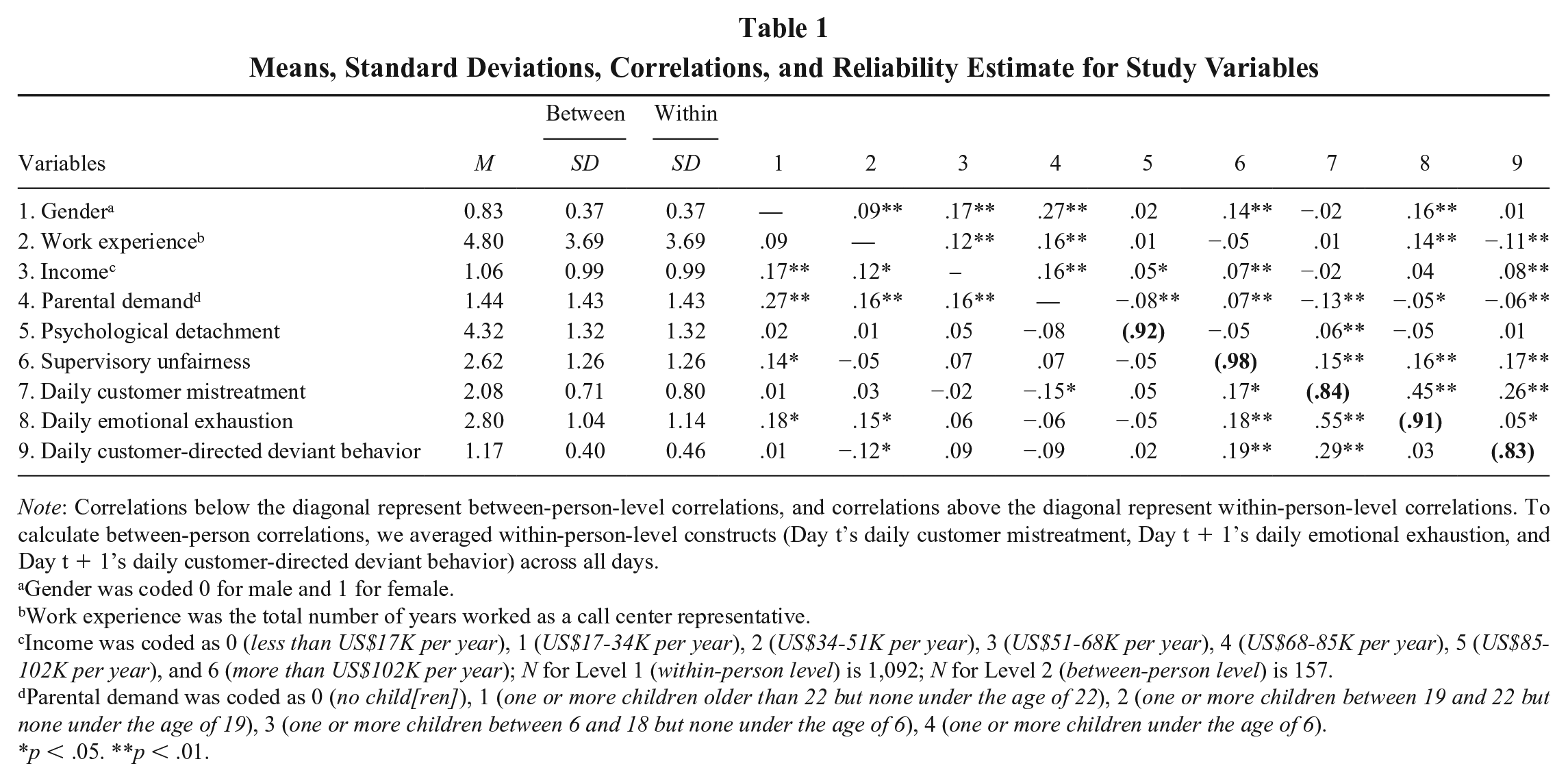
Note: Correlations below the diagonal represent between-person-level correlations, and correlations above the diagonal represent within-person-level correlations. To calculate between-person correlations, we averaged within-person-level constructs (Day t’s daily customer mistreatment, Day t + 1’s daily emotional exhaustion, and Day t + 1’s daily customer-directed deviant behavior) across all days.
Gender was coded 0 for male and 1 for female.
Work experience was the total number of years worked as a call center representative.
Income was coded as 0 (less than US$17K per year), 1 (US$17-34K per year), 2 (US$34-51K per year), 3 (US$51-68K per year), 4 (US$68-85K per year), 5 (US$85-102K per year), and 6 (more than US$102K per year); N for Level 1 (within-person level) is 1,092; N for Level 2 (between-person level) is 157.
Parental demand was coded as 0 (no child[ren]), 1 (one or more children older than 22 but none under the age of 22), 2 (one or more children between 19 and 22 but none under the age of 19), 3 (one or more children between 6 and 18 but none under the age of 6), 4 (one or more children under the age of 6).
p < .05. **p < .01.
Before testing our hypotheses, we conducted a multilevel CFA using Mplus 7.0 (Muthén & Muthén, 2012) to evaluate the construct validity of measures. A distinctive feature of multilevel CFA is that it can accommodate within-person and between-person-level factor structures in a single model (Heck & Thomas, 1999). We first built a measurement model that included all days’ within-person-level factor structure, consisting of daily customer mistreatment, daily emotional exhaustion, and daily customer-directed deviant behavior, as well as the between-person-level factor structure including psychological detachment and supervisory unfairness. The results showed that the hypothesized measurement model provided an acceptable fit to the data (χ2 = 835.95, df = 218, p < .01, CFI = .93, TLI = .92, RMSEA = .03, SRMR-Within [SRMR-W] = .06, SRMR-Between [SRMR-B] = .18), and the individual items significantly loaded onto their corresponding constructs at the within-person level. The standardized factor loadings ranged from .35 to .84, and the mean and standard deviation of those loadings were .56 and .21, respectively. These results provide evidence that the overall measurement model fits the data well at both the within- and the between-person levels.
We calculated intra-class correlation 2 (ICC2) for each within-person-level measure. The ICC2 was .86 for daily customer mistreatment, .89 for daily emotional exhaustion, and .82 for daily customer-directed deviant behavior, indicating that substantial amounts of variance were explained by between-person differences, thus justifying the use of a multilevel analysis.
Table 2 presents parameter estimates and their 95% CIs in the multilevel model, which evaluated within-person-level mediation effect. The results indicated that daily customer mistreatment was significantly related to daily customer-directed deviant behavior via daily emotional exhaustion, providing support for Hypothesis 1. The estimate of average indirect effect obtained using the Monte Carlo simulation procedure with 20,000 replications was .10, with a 95% bootstrap CI of [0.02, 0.19].
Parameter Estimates of Within-Person-Level Mediation Effects

Note: N for Level 1 (within-person level) is 1,092; N for Level 2 (between-person level) is 157.
p < .05. **p < .01.
Furthermore, the variance of the random slopes for daily customer mistreatment on daily emotional exhaustion and for daily emotional exhaustion on daily customer-directed deviant behavior were both significant (τ1 = .06, p < .05 and τ2 = .02, p < .05), suggesting that sufficient variance existed in random slopes that could accommodate further between-person predictors, thus justifying the use of moderated mediation analyses.
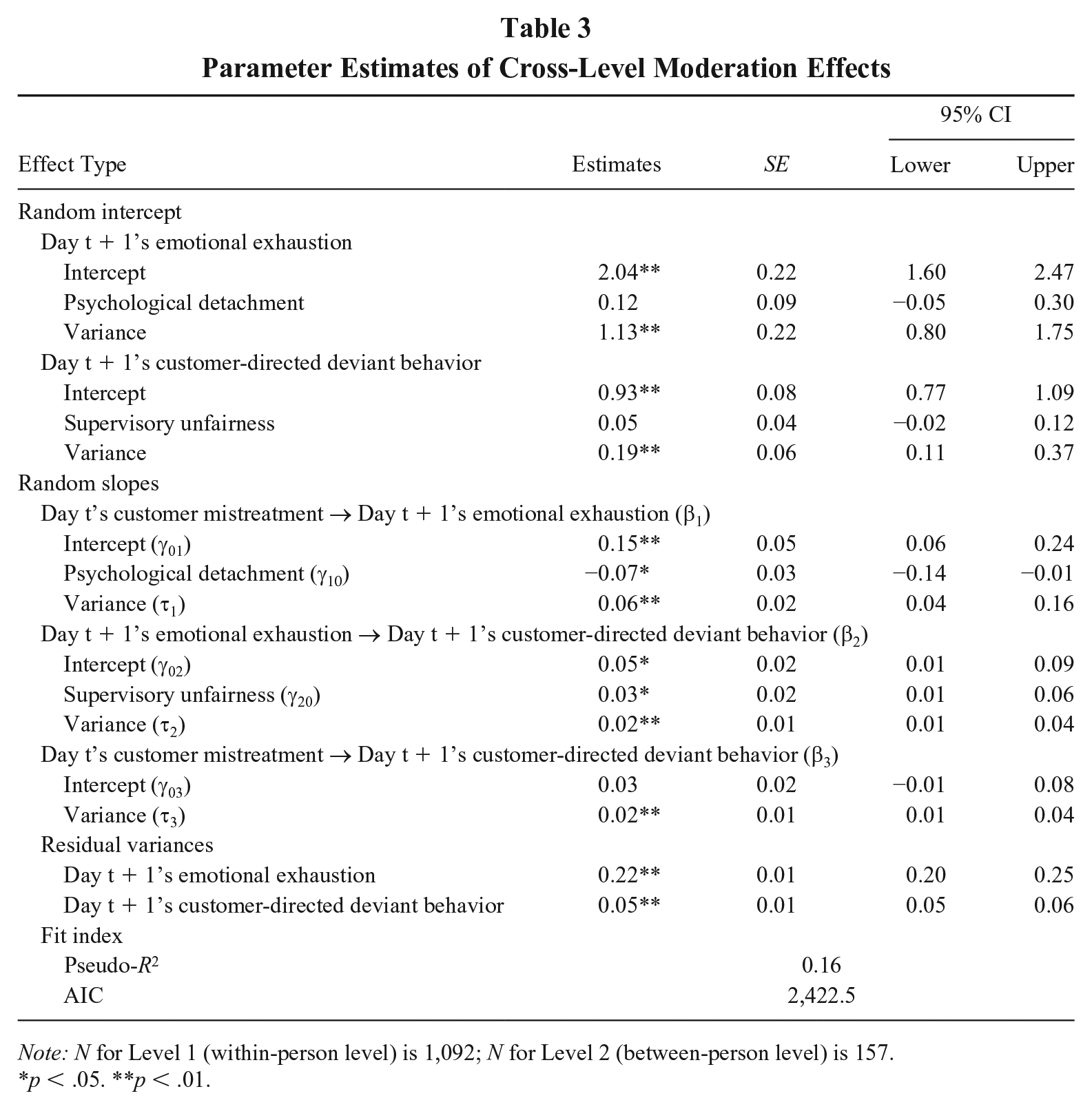
Hypothesis 2 proposed that psychological detachment moderates the relationship between daily customer mistreatment and daily emotional exhaustion on the next day. As shown in Table 3, psychological detachment was significantly and negatively related to the random slopes for customer mistreatment on emotional exhaustion (γ10 = −.07, p < .05), suggesting that the relationship between the two within-person-level variables was moderated by psychological detachment.
Parameter Estimates of Cross-Level Moderation Effects
Note: N for Level 1 (within-person level) is 1,092; N for Level 2 (between-person level) is 157.
p < .05. **p < .01.
As presented in Figure 2, the simple slope tests (Aiken & West, 1991; Dawson, 2014) showed that the relationship between daily customer mistreatment and emotional exhaustion on the next day was stronger among employees whose psychological detachment level was lower (B1 = .24, p < .001) versus higher (B2 = .05, ns), supporting Hypothesis 2.

The Cross-Level Moderation Effects of Psychological Detachment on Daily Emotional Exhaustion
Hypothesis 3 stated that supervisory unfairness moderates the within-person-level relationship between daily emotional exhaustion and customer-directed deviant behavior. Table 3 shows that the relationship between daily emotional exhaustion and customer-directed deviant behavior was moderated by supervisory unfairness (γ20 = .03, p < .05). The moderation pattern depicted in Figure 3 shows that when supervisor unfairness was higher, the slope coefficient for daily emotional exhaustion on customer-directed deviant behavior was positive and significant (B4 = .09, p < .01). However, when supervisory unfairness was lower, this coefficient was not significant (B3 = .01, ns), providing support for Hypothesis 3.

The Cross-Level Moderation Effects of Supervisory Unfairness on Daily Customer-Directed Deviant Behavior
Table 3 also shows that when comparing models with and without cross-level moderation effects, the addition of the moderation terms described in Hypotheses 2 and 3 not only explained an additional 1% of the variance in the model (Δpseudo-R2 = .01) but also decreased the AIC value (ΔAIC = 347.7) of the model. These findings provide additional support for the cross-level moderating effects of psychological detachment and supervisory unfairness in our model.
Hypothesis 4 stated that the indirect effect of daily customer mistreatment on daily customer-directed deviant behavior through daily emotional exhaustion is strongest when psychological detachment is low and supervisory unfairness is high. As shown in Table 4, the indirect effect was significant under this condition (γ = .02, CI [0.003, 0.045]) but was not significant under the other three conditions. Moreover, the indirect effect under the condition of low psychological detachment and high supervisory unfairness was the only condition that was significantly different from all other three conditions (diff = −.016, –.020, and .019, respectively; CI [−0.035, –0.002], [−0.041, –0.003], and [0.002, 0.039], respectively), while the indirect effects in other pairs were not significantly different from each other. This supports Hypothesis 4.
Parameter Estimates of Within-Person-Level Indirect Effects Under Different Levels of Psychological Detachment and Supervisory Unfairness

Note: N for Level 1 (within-person level) is 1,092; N for Level 2 (between-person level) is 157; “low” and “high” moderator refers to + and −1 SD value of the moderator, respectively.
p < .05.
As a further test of our moderated mediation model, we tested an alternative model in which we reversed the order of moderators, placing supervisory unfairness as the first moderator for the first mediation path and psychological detachment as the second moderator for the second mediation path. The result showed that both moderation effects were not significant (coefficient for supervisory unfairness on the first mediation path = .05, ns; coefficient for psychological detachment on the second mediation path = .02, ns).
Last, we conducted a post hoc analysis to test our hypotheses while excluding all the control variables. As is shown in Table 5, Hypotheses 1 and 3 were not supported when we excluded all the control variables. Hypotheses 2 and 4, however, were supported both with and without the control variables. The latter is an important finding because Hypothesis 4 presents our full model with the relationships among all our study variables.
Post Hoc Analysis (Results With and Without Control Variables)
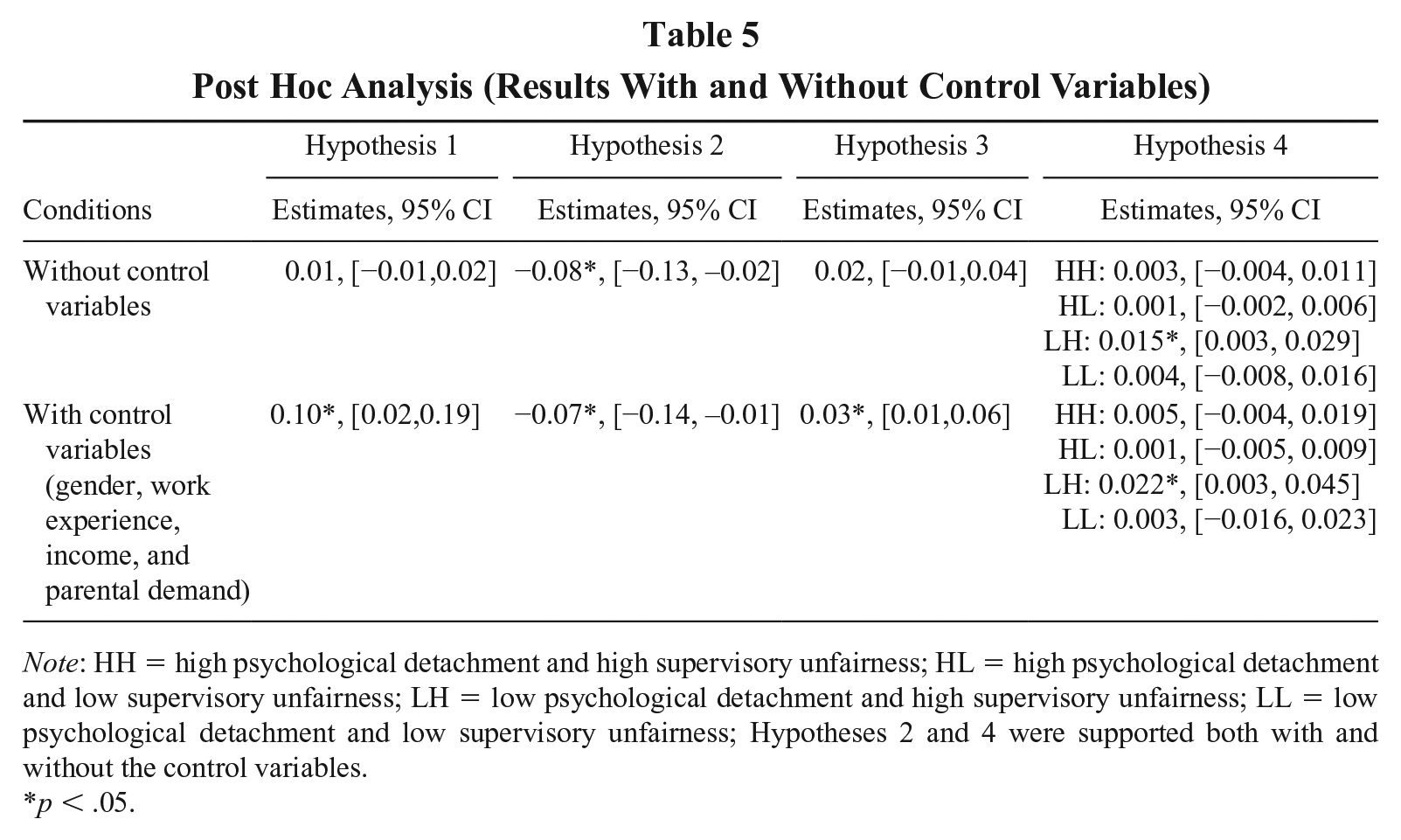
Note: HH = high psychological detachment and high supervisory unfairness; HL = high psychological detachment and low supervisory unfairness; LH = low psychological detachment and high supervisory unfairness; LL = low psychological detachment and low supervisory unfairness; Hypotheses 2 and 4 were supported both with and without the control variables.
p < .05.
Discussion
Workplace deviance research suggests that customer mistreatment can detract from the resources employees need to regulate their cognition and behavior, which can result in deviant behavior toward the customer (Shao & Skarlicki, 2014; Wang et al., 2011). Our paper contributes to research on customer mistreatment and customer-directed deviant behavior in notable ways. First, based on COR theory, our study tests the effects of customer mistreatment on frontline employees’ experience of emotional exhaustion and their consequent deviant behavior on the following day. Our findings show that the effects of customer mistreatment can go beyond the service episode on each working day and influence employees’ psychological states and behaviors at a later time. These findings shed light on how service employees’ resources are depleted and can potentially be replenished in the face of customer mistreatment.
Second, our research extends COR theory. By connecting the detachment and customer mistreatment literatures, our study shows that employees with higher levels of psychological detachment cope better with their daily experiences of customer mistreatment in terms of reduced levels of emotional exhaustion on the following working day. This suggests that individuals’ detachment capacity can help them decrease resource loss from day to day by distancing oneself from the stressor during off-duty periods. Doing so also helps replenish their resources, which helps employees deal with workplace stress more effectively the next day.
The lack of theoretical precision in explaining how resources can be lost and acquired, along with the ambiguous definitions of resources, has been criticized as a major weakness of COR theory (Halbesleben et al., 2014). To address this limitation, in the present research we conceptualize and operationalize service employees’ daily resources in terms of their higher versus lower levels of emotional exhaustion. Our results show that daily resource loss (emotional exhaustion as a result of customer mistreatment) experienced by service employees can be mitigated among those who usually detach themselves from work during off-duty hours. In short, our research addresses this theoretical gap and to some extent depicts the daily resource loss and gain process experienced by service employees when dealing with customer mistreatment from day to day. While prior research has supported the potential “dark side” of high levels of work engagement in individual employees’ work-life balance (e.g., work interference with family) (e.g., Halbesleben, Harvey, & Bolino, 2009), our research extends this line of inquiry and documents the possible negative implications of more “extreme” work engagement (i.e., the inability to detach from one’s work during off-duty hours) for employees’ well-being and behaviors at work. Building on COR theory, we offer new insights in understanding the complex roles played by detachment in employees’ daily reactions to workplace issues.
Third, our findings show that supervisory unfairness can exacerbate the relationship between employees’ daily emotional exhaustion and deviant behavior. While Hur et al. (2014) discussed the possibility of how supervisory unfairness might qualify the effect of emotional exhaustion on workplace outcomes, our study is among the first to empirically test this possibility. Building on COR theory, we treat supervisory unfairness as a workplace stressor, which can further deplete employees’ resources, thus amplifying the effects of their daily emotional exhaustion on their customer-directed deviant behavior.
Fourth, our study enhances understanding of how individual characteristics and work context jointly shape service employees’ daily emotional exhaustion and engagement in customer-directed deviant behavior. Our findings suggest that employees with lower psychological detachment and higher perceived supervisory unfairness will most likely experience emotional exhaustion and commit workplace deviance on the next working day when faced with customer mistreatment on the previous working day. Considering that previous research focused on demonstrating how the mediation process works (e.g., van Jaarsveld et al., 2010), our study provides additional value because we document the boundary conditions of the effects of daily customer mistreatment based on the person-by-situation perspective. That is, individual employees’ daily resource-gaining and depletion process is contingent on both dispositional and contextual factors.
Last, the present research captures within-person variations in employees’ experiences of customer mistreatment and their reactions based on a daily diary research design. Furthermore, our research design allows a one-day interval between daily customer mistreatment and daily emotional exhaustion to consider the fact that psychological detachment occurs after employees disengage from work-related duties. This research design and analytic approach helps to capture the dynamic nature of the relationship of interest, allowing for a more potent test of our moderator (psychological detachment).
Practical Implications
From a managerial perspective, our results show that customer service employees can consume considerable resources and energy when dealing with customers who mistreat them. If they are not able to regain resources from their work and/or during afterwork hours, they are more likely to engage in customer-directed deviant behavior due to insufficient resources to regulate their behaviors. Our findings suggest that one strategy to reduce service employees’ emotional exhaustion and deviance would be for managers and organizations to encourage employees to psychologically “switch off” from work during afterwork hours via a forced work-termination program in which managers refrain from, and employees are discouraged from, contacting colleagues about work after working hours. This is likely to be especially important today, as electronic media facilitates 24/7 ongoing contact with work. This implication is consistent with Etzion et al.’s (1998) recommendation that organizations mandatorily shut down facilities and encourage employees to use their vacation time. Second, organizations could implement specific training programs to help employees effectively detach themselves from work-related stressors. Such a training program could coach employees to psychologically distance themselves from work issues when off-duty and enhance employees’ psychological controllability, decreasing the intrusion of workplace stressors into people’s off-duty hours (Hahn, Binnewies, Sonnentag, & Mojza, 2011). In addition, companies might consider introducing a fairness training program (Skarlicki & Latham, 1996, 1997) to equip managers with the skills and knowledge needed to implement fair managerial activities.
Last, research on family interference with work suggests that employees’ experience of negative events during off-duty periods (e.g., family role conflict) can affect their customer-related performance at work (Carlson & Kacmar, 2000; Dai, Chen, Arnulf, & Dai, 2014; Zhao & Mattila, 2013). This implies that service employees experiencing family members’ mistreatment at night might engage in more customer-directed deviance on the following day. Although not the focus of the present research, this line of research suggests that managers should pay closer attention to what happens to their employees during off-duty hours. It has become common practice for many call centers to hold a mandatory daily morning meeting, and we recommend managers should make good use of such an opportunity to observe employees’ moods, emotions, and psychological states and provide support via the employee assistance program to help employees balance work-family demands (Milne, Blum, & Roman, 1994).
Limitations and Directions for Future Research
In terms of limitations, our analysis is based on self-reported data that can give rise to the potential for common method variance (CMV). Our analyses using Harman’s single factor analysis and within-person-level CFA, however, suggest that the CMV is not a major concern in these data. Furthermore, self-reported data are a reasonable source for the predictor and mediation variables because these constructs concern employee’s self-perceptions, which might not be accurately measured by others’ reports (Shao & Skarlicki, 2014). Nevertheless, future research might endeavor to measure the criterion variable from a third-party point of view (e.g., customer) in order to minimize such a concern. Moreover, while we recognize that these variables can give rise to CMV, which cannot create or inflate an interaction effect, on the contrary, finding a significant interaction effect in spite of common method bias concerns can be taken as stronger evidence that an interaction exists (Siemsen, Roth, & Oliveira, 2010).
Second, our study measured employees’ daily emotional exhaustion and deviant behavior at the same time, which limits our ability to draw causal inferences. Future studies should consider assessing these variables at different points in time. For example, a daily survey can be administered at three different points (e.g., customer mistreatment at noon, emotional exhaustion in the afternoon, and deviant behavior after working hours). In addition, the possibility of reverse causality exists in the relationship between daily customer mistreatment and emotional exhaustion. That is, an emotionally exhausted employee (at Day t) might perceive more customer mistreatment in the following day (at Day t + 1), which leads to more customer-directed deviance (at Day t + 1). To assess this possibility, we conducted post hoc analyses to explore whether employees’ daily emotional exhaustion predicts their daily customer mistreatment, which in turn leads to daily customer-directed deviant behavior. This mediation effect was not significant. While it is plausible that reverse causality could occur, it was not the case in our data.
A third potential limitation concerns the control variables in our analysis. We followed Bernerth and Agunis’s (2016) recommendations in selecting our control variables, and controlling for their effects allows us to partial out irrelevant variance in the criterion variable that are not accounted for by our predictors of interest, which contributes to a more accurate assessment of the relationships among our study constructs. In the post hoc analysis (see Table 5), however, we found that Hypotheses 1 and 3 were not supported if we excluded the control variables in our hypothesis testing. Hypotheses 2 and 4, in contrast, were supported both with and without the control variables. Given that Hypotheses 1 and 3 describe only part of our theoretical model and Hypothesis 4 presents our full model, we propose this finding provides support for the validity of our overall model. We also note that some of the effect sizes are small (e.g., some CI values approached zero). Hence, our results should be interpreted with these points in mind.
Last, our study did not consider the weekend effect when we explored the moderated mediation effect. That is, previous research found that having a sense of personal control during a weekend off-duty provides a feeling of autonomy, which helps to recover from work-related strain (Fritz, Sonnentag, Spector, & Mclnore, 2010). Thus, our study may provide a stronger test of our hypotheses because of the weekend included within our 2-week survey period. Additional studies should be conducted to determine the impact of the weekend on employees’ mental disengagement from work-related duties. 2
In terms of future research, we studied psychological detachment as an individual difference that is relatively stable over time (Sonnentag & Fritz, 2007). Another perspective is to consider psychological detachment as a daily-based construct fluctuating on a day-to-day basis (Dettmers, Vahle-Hinz, Bamberg, Friedrich, & Keller, 2016; Sonnentag & Bayer, 2005). This is worth considering because employees’ capability of mental disengagement could vary depending on different positive and negative events that they momentarily experience at work. Furthermore, psychological detachment could be an antecedent of daily customer mistreatment, as depending on employees’ different levels of detachment from a stressor their perception of customer mistreatment may vary accordingly.
In addition, future research might also consider different moderators, which can attenuate the daily customer mistreatment–customer-directed deviant behavior linkage. For example, Sonnentag and Fritz (2007) described that three coping strategies (i.e., relaxation, mastery experience, and control) can contribute to individuals’ stress control and well-being. These strategies can affect individuals’ subsequent emotions and behavior. Specifically, Trougakos, Beal, Green, and Weiss (2008) found that employees who can control their own break time are more pleasant after coming back and display more positive emotions. They show the importance of control and relaxation during the coping and recovery process. Future study is warranted to test how these coping strategies (other than psychological detachment) could attenuate the ill effects of daily customer mistreatment. In addition, future research could also explore whether our findings hold with leader-member exchange (LMX) or supervisory support as moderators. It is possible that both LMX and supervisory support can offer opportunities for resource gain, which helps employees cope with their daily emotional exhaustion and reduce customer-directed deviant behavior.
Furthermore, future studies should further explore alternative mediating mechanisms in the daily customer mistreatment and deviant behavior relationship. First, considerable research has explored the transgressor-victim relationship based on the self-regulation perspective (Baumeister et al., 1998; Muraven & Baumeister, 2000) because of its relevance in effectively accounting for the occurrence of deviant behavior at work (e.g., Long & Christian, 2015; Rosen, Koopman, Gabriel, & Johnson, 2016; Thau & Mitchell, 2010; Wheeler, Halbesleben, & Whitman, 2013). Therefore, future research might consider the mediating roles of self-regulatory mediators (e.g., ego-depletion or diminished self-control) in the linkage between daily customer mistreatment and deviant behavior.
In addition, many companies establish guidelines for employees’ emotional regulation called displayed rules, and such a strict policy can make employees suffer emotional dissonance when they have to deal with disgruntled customers, eventually leading employees to experience emotional labor (EL) (Rupp, McCance, Spencer, & Sonntag, 2008; Rupp & Spencer, 2006). Previous research has shown that such an EL process (i.e., surface acting) can be either an antecedent or an outcome of emotional exhaustion (Brotheridge & Grandey, 2002; Grandey, 2003; Lavelle, Rupp, Herda, Pandey, & Lauck, in press). Future studies should examine how they can influence each other. For example, it would be worthwhile to explore what construct comes first (surface acting or emotional exhaustion) when employees confront customer mistreatment, and such an in-depth investigation might help us better understand employees’ psychological responses to customer mistreatment.
Last, future research could also consider whether cultural differences moderate the effects observed in the present study. For instance, South Koreans are highly collectivistic and tend to emphasize group values over personal rights and interests (Cho & Yoon, 2001). In such a cultural context, employees can feel the normative pressure to stay late in order to complete assigned work duties and sacrifice personal and family time. In this context, being psychologically detached from work might be frowned upon and considered a bad thing. Therefore, employees are often encouraged to be psychologically engaged in their job responsibilities, whether on duty or not. In addition, South Korean employees are more likely to be higher in power distance compared to employees in Western cultures. We expect that employees with higher power distance can put more meaning and value on supervisory (un)fairness because of the saliency of organizational hierarchy in their mind. To further assess the generalizability of our findings, future research might replicate our findings in different cultural settings where employees are higher on individualism and lower on power distance.
Footnotes
Acknowledgements
The second and third authors have contributed equally to this article. The authors thank our editor, Christopher O. L. H. Porter, and three anonymous reviewers for their insightful comments and constructive feedback. We also thank Mo Wang, Kristopher J. Preacher, and Le (Betty) Zhou for their helpful comments and suggestions. This article is based on a presentation at the 75th Academy of Management Annual Conference, held in August 2015 in Vancouver, British Columbia, Canada. This research was supported by the Social Sciences and Humanities Research Council of Canada (Grant/Award Number: SSHRC #430-2016-00404).
