



Abstract
Although prior research recognizes the strategic importance of changes to the organization’s human resource base, there is little consensus regarding the influence of human resource flows on organizational performance. Employing a resource orchestration perspective, we emphasize the need by managers to “orchestrate” multiple, interrelated human resource flows; the role of the incumbent or newly appointed orchestrator in the decisions and outcomes associated with human resource flow strategies; and the importance of the performance of the current human resource base with which the flows interact. Utilizing fuzzy-set qualitative comparative analysis and longitudinal data from the Spanish premier soccer league, we identify five ways in which organizations are able to effectively configure human resource flows. We then elaborate theory on managerial decisions that allow human resource flows to work together depending upon the particular organizational conditions. Our study contributes to a better understanding of the performance outcomes of managerial resource flow decisions.
Keywords
Introduction
Because human resources are often an organization’s most valuable asset (Crook et al., 2011), changes to the human resource base may have major performance ramifications (Heavey et al., 2013). Yet, although the importance of human resource flows in, out, and through the organization has been recognized for some time (e.g. Beer et al., 1984; Guest, 1987), the influence of these flows on organizational outcomes remains unclear. Equivocal findings and numerous unanswered questions regarding the performance implications of human resource acquisition (Brymer et al., 2014; Campbell et al., 2012; Kor and Leblebici, 2005), disposal and turnover (Park and Shaw, 2013; Reilly et al., 2014), and internal development (Bhattacharya et al., 2005; Shaw et al., 2013; Youndt and Snell, 2004) unfortunately characterize the current state of the field’s understanding of change to the organization’s human resource base (Boselie et al., 2005; Guest, 2011; Hausknecht and Trevor, 2011).
In this study, we help bring increased clarity and detail to this discussion by employing a resource orchestration perspective, which emphasizes managers’ decisions regarding the structuring of the organization’s resource portfolio (e.g. Adner and Helfat, 2003; Sirmon et al., 2011). In particular, we conceptualize human resource flows (i.e. inflow, outflow, and internal development) as occurring concurrently (Boone and Van Witteloostuijn, 2007; Liu et al., 2007) and highlight managers’ role in effectively “orchestrating” the flow of quantities of human resources (e.g. Chadwick et al., 2015; Sirmon et al., 2011). Prior studies have focused on one type of human resource flow at a time (e.g. Kor and Leblebici, 2005; Moliterno and Wiersema, 2007); however, concurrent flows are interdependent and may be either complementary or substitutable with each other. In employing resource orchestration as a theoretical prism (Helfat and Martin, 2014; Sirmon and Hitt, 2009), we spotlight the decisions by which managers combine changes to the human resource base into effective human resource flow strategies.
With a resource orchestration perspective, we also add to the literature by considering human resource flows in the context in which they take place. We do so by showing that there is variation in the ways that incumbent and newly appointed managers handle human resource flows and that these differences are consequential to the effectiveness of human resource flows. Hence, we contribute to the literature by considering a key element pertaining to the role of the orchestrator in rendering human resource flows effective. Furthermore, differing human resource flow strategies of incumbent and newly appointed managers may prove effective when implemented within well-performing and poorly performing organizations, as resource orchestration encompasses the managerial task of recombining new and existing assets. Accordingly, we highlight the importance of the performance of the current human resource base with which human resource flows may be combined.
Taken together, our resource orchestration framework captures the systemic and contextual nature of human resource flows by including three types of flows (i.e. inflow, outflow and development) and two central contextual factors (i.e. type of orchestrator and prior performance). Based on this framework, we utilize fuzzy-set qualitative comparative analysis (fsQCA) (Fiss, 2007; Ragin, 2000) and a unique, longitudinal data set from the Spanish premier soccer league for the years 2002–2013 to uncover the ways in which managers effectively orchestrated human resource flows. A portrait of the ways in which incumbent and newly appointed managers orchestrate human resource flows emerges, allowing us to provide theoretical insights regarding effective human resource flow strategies that allow human resource flows to work together either as complements or substitutes.
Our study makes a number of contributions to the literature. First, although research is increasingly uncovering the organization-level consequences of collective changes to the firm’s human resource base (e.g. Chatterji and Patro, 2014; Hausknecht and Trevor, 2011), the performance implications of human resource flows remain an open question (Ployhart et al., 2009, 2011). By distinguishing flows from the resource stock and considering the role of the orchestrator and the organization’s prior performance in the effectiveness of human resource flow strategies, we advance understanding of the human resource flows–organizational performance relationship and thus contribute to theory on managing strategic human capital (Wright et al., 2014). 1
Second, because existing research largely focuses on singular human resource flows, we know little about the combined effects of such activities within organizations. By simultaneously examining three types of human resource flows, we provide a more complete picture of managerial orchestration decisions and take a step toward understanding the conflicting empirical results in previous research (Bapna et al., 2013; Hancock et al., 2013; Karim and Mitchell, 2004; Kor and Leblebici, 2005; Moliterno and Wiersema, 2007; Reilly et al., 2014).
Finally, by employing a unique data set and fuzzy-set analysis, our study makes an important empirical contribution to the literature. Sport settings provide a transparent and data-rich natural laboratory to study human resource flows, whereby organizations add, release, and develop players, as well as change club managers (Day et al., 2012; McNamara et al., 2013; Moliterno and Wiersema, 2007). Fuzzy-set analysis allows us to move toward reconciling conflicting results in prior studies and begin answering Huesch’s (2013) and Sirmon et al.’s (2011) recent calls to investigate the synergies involved in orchestration activities and the ways in which managers effectively combine “fluidity in all dimensions of portfolio structuring (accumulating, acquiring, and divesting)” (p. 1408).
Human resource flows: an overview
According to Dierickx and Cool (1989), stocks are the sets of resources that organizations hold at any given time (i.e. the resource base; Barney, 1991), and flows are the outcome of managerial decisions to maintain or change the stock by engaging with the factor market or investing in resource building. Ployhart et al. (2009) maintain that “although building a high-quality stock is important, it is even more important to control the flow of talent” (p. 1010). Consistent with Reilly et al. (2014), we define human resource flows as the system of changes to the organization’s human resource base, “including employee hiring, turnover, and transfers.” (p. 769).
We consider three types of human resource flows, according to their source and direction: external-to-internal, internal-to-internal, and internal-to-external. First, to enrich and enlarge their human resource base, managers can acquire new human resources from the external market that are then bundled with existing resources into new capabilities. For instance, Kor and Leblebici (2005) examine the inflow dynamics of new talent into law firms (also see Madsen et al., 2002). The acquisition of these external resources can serve as a source of value creation for organizations (Hatch and Dyer, 2004; Sirmon et al., 2007). We refer to this type as human resource inflow (Madsen et al., 2002).
Second, some managers may put a strong emphasis on the ability to internally generate talent through investments in training and skill development systems (Cappelli, 2009; Crook et al., 2011; Huselid, 1995; Lepak and Snell, 1999). Cappelli (2009), for instance, argues that one of the biggest mistakes contemporary organizations make in the realm of strategic human resource management is failing to develop in-house talent—a point recently emphasized by Mahoney and Kor (2015). We refer to this type as human resource development.
Third, human resource outflow involves the departure of human resources from an organization’s resource pool (i.e. employee turnover), and as such is always externally oriented. 2 Moliterno and Wiersema (2007), in their study of professional baseball franchises, found that organizations divest human resources to regain or enhance competitive advantage (Sirmon et al., 2011). Reilly et al. (2014), though, document a negative influence of human resource outflows. Hancock et al.’s (2013) recent meta-analysis of the collective turnover–firm performance relationship echoes these contradictions: turnover rates negatively relate to firm performance on average, but the range of effects is substantially wide, including potential null and positive curvilinear effects. As such, they conclude, “there may be underlying complexity in the relationship that warrants additional attention” (p. 574).
Similarly, evidence for the effectiveness of human resource inflow and development has been inconclusive to date (Bapna et al., 2013; Karim and Mitchell, 2004; Kor and Leblebici, 2005). For instance, Bidwell (2011) documents worse performance among external hires as compared to internally developed talent, even though external hires required more financial resources. March’s (1991) seminal piece, however, maintains that incoming talent “is less redundant with the [organizational] code and occasionally better, thus more likely to contribute to improving the code” (p. 79). In sum, there is little consensus regarding the influence of human resource flows on organizational performance.
A resource orchestration approach: the combination of human resource flows
Resource orchestration research integrates the resource management stream within resource-based theory and the asset orchestration concept from dynamic capabilities research (Helfat et al., 2009; Helfat and Peteraf, 2009; Sirmon et al., 2011). The primary focus within the resource orchestration perspective is not on the resources themselves but on managers’ resource-focused decisions, particularly the configuration and reconfiguration of resources into complementary combinations (Adner and Helfat, 2003; Sirmon et al., 2011). According to Teece (2012), resource “orchestration” aims to “minimize internal conflict and to maximize complementarities inside and outside the enterprise” (p. 1398). For example, Sirmon and Hitt (2009) demonstrate among a sample of US banks that deploying sophisticated resources in sophisticated markets, while deploying simpler resources in simple-service markets, allowed managers to increase the value extracted from investment in human resources, ultimately resulting in superior financial firm performance.
Sirmon et al. (2011) posit that a key aspect of managerial resource orchestration decisions pertains to the structuring of the organization’s resource portfolio, namely, the simultaneous search for and selection of resources as well as their development and disposal (Helfat et al., 2009; Helfat and Martin, 2014; Trahms et al., 2013). In the context of a firm’s human resource portfolio, managers must contend with organizational reality and, in pursuit of competitive advantage, make multiple, interrelated resource-based structuring decisions that shape the extent to which the organization will engage in bringing in new human resources, promoting talent from within, and/or releasing human resources. Hence, a resource orchestration lens provides three important insights to theory regarding human resource flows.
First, the effectiveness of human resource flows may be contingent upon their complementarity or substitutability with other flows (Mackey et al., 2014). Some flows may benefit from the presence of another flow working in conjunction with it, while others may be irrelevant or even detrimental to organizational performance in the presence of other flows. For instance, Call et al. (2015) show that the effect of collective turnover on performance is moderated by the quantity of new hires. Because the complex nature of organizational reality dictates that multiple, interrelated flows of human resources occur simultaneously, managers are inevitably charged with the task of “orchestrating” these flows into effective flow strategies.
Second, there is variation in the ways managers go about orchestrating the structuring of the human resource base (Chadwick et al., 2015; Chatterji and Patro, 2014; Sune and Gibb, 2015). Human resource flow decisions are complex and can be causally ambiguous (Barney et al., 2011), which implies that managers differ in their assessment of the ways in which multiple, interrelated human resource flows can create value (Ireland et al., 2003; MacLean et al., 2015). Consequently, these decision differences matter to firm performance (Kunc and Morecroft, 2010; Sirmon et al., 2011), making the orchestrator an important piece of the puzzle.
Specifically, prior research shows that there are usually differences in the ways that incumbent and newly appointed managers handle resource flows. For instance, change in the CEO position may affect organizational outcomes by altering the human resource stock itself and the way it is organized (Tushman and Rosenkopf, 1996). Traditional models of organizational change (e.g. Hannan and Freeman, 1984) suggest that newly appointed executives, who tend to have fewer vested interests in the status quo (Hambrick and Fukutomi, 1991), can help organizations revitalize organizational capabilities (Miller, 1993) and align their resources with changing environmental conditions. Applied to our context, this notion implies that human resource flow strategies initiated by existing orchestrators may lead to different outcomes than those initiated by newly appointed orchestrators due to internal reconfiguration activities. Hence, to better understand the effectiveness of various human resource flow strategies, we ought to consider whether they are undertaken by incumbent or newly appointed orchestrators.
Third, because resource orchestration highlights the importance of recombining new and existing assets into complementary resource bundles, the performance of the current resource base is critical and may shape the orchestrator’s human resource flow strategy. For instance, prior studies show that, in general, poorly performing organizations may decide to pursue dramatic changes to their resource base and well-performing organizations may opt for incremental changes (Moliterno and Wiersema, 2007). However, in many cases, poorly performing organizations fail to initiate substantial change and superior performers engage in more transformational changes (Simons, 1994). Furthermore, prior literature recognizes that effective resource-related decisions by managers of firms looking to acquire an advantage differ from those of firms looking to sustain an advantage (Berger et al., 2000; Trahms et al., 2013). Consequently, prior performance may act as both a catalyst for human resource flow decisions and a contingency for those flows’ influence on subsequent performance outcomes.
Taken together, a resource orchestration perspective emphasizes (1) the role of the orchestrator in the decisions and outcomes associated with human resource flows, (2) the importance of the performance of the current resource base with which human resource flows may be combined, and, ultimately, (3) the need to orchestrate multiple, interrelated human resource flows into effective flow strategies. Such an approach suggests an underlying configurational logic whereby flows and context “combine, rather than compete, to bring about an outcome and where individual causes may be neither necessary nor sufficient by themselves” (Delbridge and Fiss, 2013: 325). This approach allows us to assess both conjunctural causation and equifinality.
Conjunctural causation means that outcomes are generated by combinations of causal conditions, such that the effect of a single condition depends on the presence or absence of other causal conditions (Schneider and Wagemann, 2012). For instance, simultaneously invoking all human resource flow types in high magnitude may require substantial and often conflicting structural adjustments or be costly and cause coordination difficulties (March, 1991). This may render an otherwise effective human resource flow detrimental to performance due to its combined effect with the other human resource flows. Equifinality (Schneider and Wagemann, 2012), on the other hand, refers to the idea that different combinations of causal conditions can lead to high performance (Gresov and Drazin, 1997; Ragin, 2008). In our study, equifinality is important because there may be more than one way to effectively combine human resource flows rather than a universal prescription. This may help resolve the equivocal findings of prior studies that examine one type of human resource flow.
In sum, resource orchestration—with its inherent configurational logic—is a well-suited theoretical perspective for our study. As Ployhart et al. (2009) have argued, “[I]f the flow of … [human resources] manifests nonlinear relationships with unit outcomes, then it becomes important to understand why the relationship is nonlinear” (p. 1011). Our approach attempts to capture this systemic phenomenon of human resource flows by including five interrelated elements: three types of human resource flows (i.e. human resource inflow, outflow, and development) and two central contextual factors (i.e. prior performance and type of orchestrator). Based on this framework, we used data from the Spanish premier soccer league to identify the ways in which managers effectively orchestrate human resource flows. 3
Method
Research context
Spanish soccer clubs, similar to most professional sports organizations nowadays, are structured and organized like typical companies, a result of intense processes of industry professionalization and commercialization during the last three decades (Callejo and Forcadell, 2006; Gomez et al., 2007). In the premier division of the Spanish soccer league system, commonly known as La Liga or Liga BBVA, the club that finishes in the first place in a given season is crowned the national champion. Places 18 through 20, on the other hand, are relegated to the second division. Hence, “[t]he principal task of a football (soccer) team is to form a competitive team … that achieves the sporting success expected by its members and fans” (Gomez et al., 2007: 2). The players comprise each club’s core human resource stock, and each club has a “manager” (read: Head Coach) whose primary role is to maximize on-field results by structuring (i.e. adding, promoting, and releasing players) and utilizing the human resource stock (Dawson and Dobson, 2002). These managers typically have the authority over the coaching staff, scouts, and youth team.
La Liga is an excellent organizational context in which to study human resource flows for several reasons. First, it allows us to study an entire population of organizations competing in a particular task environment. Second, although soccer clubs are structured and organized like typical companies, their human resource base and performance outcomes are more well-defined (Moliterno and Wiersema, 2007). For example, for a typical firm, performance is composed of many accounting and market-based measures (Dalton et al., 2003), but for soccer clubs, clear performance indicators include league standing or points collected over a season (McNamara et al., 2013). Similarly, human resource inflow, outflow, and development are clearly separated. Club managers usually have much discretion in human-resource-related decisions, and human resource flows are largely determined by these decisions. In addition, because the overwhelming majority of human resource flows occur prior to the season’s start, the link between flows and performance outcomes is inherently lagged, making the data structure more conducive to inferring causality. Finally, La Liga clubs tend to have similar roster sizes—in our sample, approximately 30 players on average with a standard deviation of three players—making the magnitude of human resource flows comparable across clubs. These features make La Liga a particularly well-suited context to study the managerial orchestration of human resource flows. We provide additional information about the La Liga context in Online Appendix 1.
Sample and data
Data were gathered on La Liga soccer clubs for the seasons 2003–2004 through 2012–2013. The majority of the data were gathered from BDFutbol (2013), World Football (2013), and transfermarkt (2015), although we also obtained data from club websites and Liga Nacional de Fútbol Profesional (2013). The unit of analysis is the club-season, giving us a total of 200 observations over 10 seasons. Because each season three clubs are relegated to a lower division and three clubs from the lower division are promoted to La Liga, there are 32 soccer clubs in our unbalanced panel of data. The average number of club-seasons for the clubs in our data is six. Similar to Aversa et al. (2015),
the fact that the population of … firms changes over time allowed us to assess whether there are … [high-performance] configurations that remain stable over time despite changes in the population of firms, thus offering an opportunity to identify more robust configurations across the … seasons we analyzed. (p. 659)
Measures
Consistent with prior research (Moliterno and Wiersema, 2007), we measured performance using league standing at the end of the season. Past sports studies (Holcomb et al., 2009; Moliterno and Wiersema, 2007) measured organizational performance as the percentage of games won in a season. However, in La Liga, games may end in a draw and reward the club with one point. As such, using percentage of games won may inaccurately represent the performance of a club throughout the season. League standing at season end is an accurate and comparable measure of club performance vis-a-vis competitors, as it corresponds to each club’s win-draw-lose record in a given season. Similarly, to measure prior performance of the club’s human resource stock, we utilized the club’s standing in the previous season. This measure indicates the performance of the human resource base as a unit whereby value is created by not only the quality of each player but also the socially complex ways in which players coordinate and play together. To capture whether the orchestrator is an incumbent or not, we coded a binary variable, assigned the value 1 for clubs with a newly appointed manager in a given season and 0 otherwise.
Our approach to measuring human resource flows is similar to Reilly et al. (2014) and Madsen et al. (2002). To measure the magnitude and type of human resource flows, we obtained data on changes in team roster in the pre-season transfer window and during the season (Moliterno and Wiersema, 2007). However, as expected, the vast majority of transfers occurred in the pre-season transfer window. We considered changes in both periods to more fully capture the flows of human resources throughout a given period. Specifically, the number of incoming players was considered human resource inflow, the number of outgoing players was considered human resource outflow, and the number of players promoted from the youth department was considered human resource development. For human resource outflows, we included retiring players as well in order to capture the entire outflow of human resources from the organization. Retirements were not prevalent during the examined period in La Liga; in many cases, seasoned players are sold or released to play abroad for financial reasons or in lower leagues.
Because our data contain repeated measures for the same clubs, it is important that we determine the degree to which within-club variation exists before proceeding to the fsQCA analyses. We did not want to capitalize on a club “fixed-effect,” but instead to uncover effectively orchestrated flow strategies that covered a broad range of clubs across a broad range of seasons. In essence, we wanted to make sure that we are not simply replicating almost identical cases (i.e. club-seasons) for each club in our data. For the performance outcome, this is less of a concern, as we include prior performance as a causal condition in our model. To determine whether flows tend to exhibit serial correlation within clubs, we examined the extent to which flows at time t − 1 determined flows at time t. Although correlational analyses are not required in the context of set-theoretic relations, they can offer valuable information about patterns in the data and thus help in guiding more informed decisions regarding subsequent fsQCA (Fiss, 2011). These analyses revealed that 5%, 4.4%, and 14.5% of the variance in inflows, outflows, and development, respectively, are explained by the lagged flow variables. In addition, the majority of the variance in performance is not accounted for by prior performance, suggesting there is room to understand how managerial orchestration decisions within each season may shape club performance. These results indicate that although there is some temporal similarity, within-club change over time is substantial and additional fsQCA at the club-season level is appropriate.
Analytical technique
FsQCA, a technique grounded in set theory, provides enhanced methodological rigor to multi-case analysis by allowing the researcher to systematically analyze a far greater number of cases than can be subjectively assessed (see Fiss et al. (2013) for a detailed discussion and review of fsQCA). To do so, fsQCA utilizes a variant of Boolean algebra that considers each case’s membership in sets or conditions. That is, each case is treated as a bundle or configuration of causal conditions. A subsequent “comparison of cases [allows the] researcher to strip away attributes that are unrelated to the outcome in question” (Fiss, 2011: 402) and arrive at a solution of configurations of causal conditions that are related to an outcome condition. The solution in fsQCA may contain multiple configurations of causal conditions, which may be present or absent, along with statistics that quantify the configurations’ relationships with the outcome variable (Misangyi and Acharya, 2014).
According to Ragin (2006b),
[v]iewing cases as configurations in cross-case analysis (a) maintains a strong link to the study of specific empirical cases and (b) counteracts the veiling of cases that occurs when cross-case evidence is subjected to conventional forms of correlational analysis. Such analyses obscure cases in their emphasis on the net effects of independent variables and the competition to explain variation in the dependent variable. (p. 19)
Our analysis includes one outcome condition and five causal conditions. Hence, the number of possible configurations is 32 (25). Our 200 observations encompass 30 of these 32 theoretically possible configurations.
FsQCA requires that raw data be calibrated into membership scores in conditions between 0 and 1, inclusively. “A value of 1 denotes full membership in a condition, a value of 0 indicates full non-membership, and a value of 0.5 demarcates the crossover point at which it is not clear whether or not a case is a member of a particular condition. The crossover point is of particular qualitative importance, as it demarcates whether or not a case exhibits the presence or absence of a particular condition” (Frazier et al. 2016, p.1030). To calibrate current and prior club-season organizational performance, we designated the league standing mid-point (10.5) as the crossover point such that clubs that finish in the top half of the league are members of the high organizational performance condition, and clubs that finish in the bottom half are not. We considered first place as full membership in that condition and last place as full non-membership. Additionally, because competing in a lower division is much easier than competing in La Liga, we calibrated club-seasons that were promoted to La Liga as fully out of the high prior performance condition.
Since a dichotomous variable denotes whether the orchestrator is a newly appointed manager, it is already in the form of a crisp set (i.e. either fully in or out of the set) and hence did not require additional calibration. As for human resource flows, although theory-driven calibration based on substantive knowledge is preferable, oftentimes there is no clear and qualitative distinction between high and low levels of conditions, which was the case across the flow variables in this study. Accordingly, based on the 200 club-seasons in our data, we designate the 75th percentile for each flow variable as the full membership threshold, the mean as the crossover point, and the 25th percentile as the full non-membership point (e.g. Fiss, 2011).
To avoid potential “one-time” occurrences, we determined that a configuration must have at least two representative cases to be considered in the analysis. In line with Ragin’s (2008) recommendation to retain a minimum of 75% of the cases, a cutoff of 2 allowed us to retain 99% of the club-seasons in our data. Then, a consistency score - the extent to which membership in a configuration is a subset of membership in the outcome - is utilized to determine whether the retained configurations are consistent with the outcome or not. The formula for calculating set-theoretic consistency (of cause or causal combination X for the outcome Y) is as follows (Ragin, 2008: 134):

where Xi and Yi refer to calibrated values. According to Ragin (2008), a consistency score lower than 0.75 indicates that membership in the causal condition is substantially inconsistent with membership in the outcome condition. Following Bell et al. (2014), we employ 0.80 as the threshold for this study. In Table 1, we present a descriptive nested truth table that details each configuration’s frequency and consistency with the outcome.
Nested truth table.
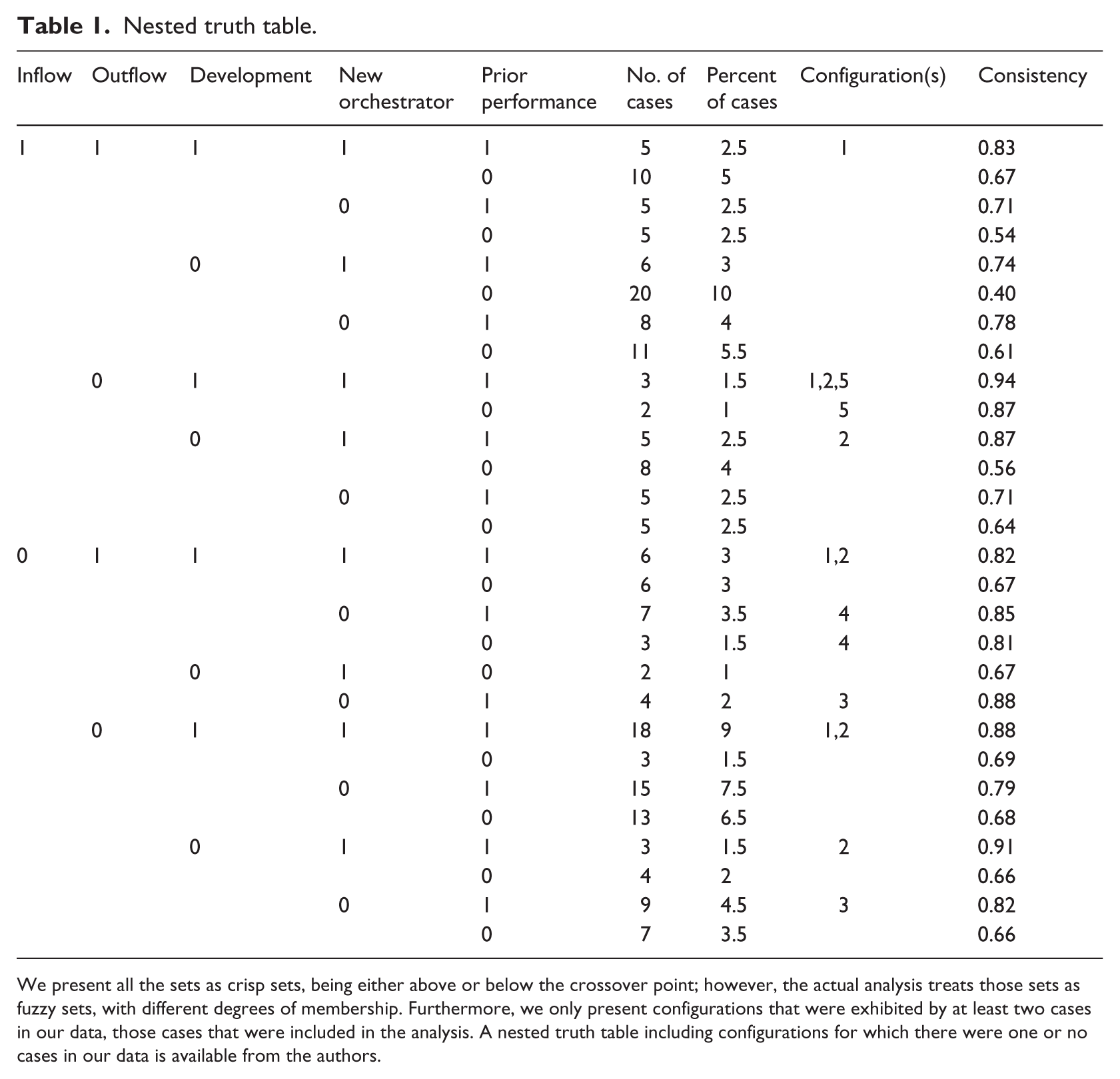
We present all the sets as crisp sets, being either above or below the crossover point; however, the actual analysis treats those sets as fuzzy sets, with different degrees of membership. Furthermore, we only present configurations that were exhibited by at least two cases in our data, those cases that were included in the analysis. A nested truth table including configurations for which there were one or no cases in our data is available from the authors.
Results
FsQCA results are displayed in Table 2. The five configurations presented in Table 2 are each sufficient for high performance. 4 Similar to prior studies (e.g., Crilly, 2010; Ragin, 2008), filled circles (“●”) indicate a condition is present, while crossed circles (“⊗”) indicate a condition is absent. We display the intermediate solution, which is appropriate when “easy” counterfactuals (configurations not exhibited by cases in the data, but that are consistent with theory) are considered (Fiss, 2011). “By specifying expected associations between conditions and the outcome a priori, the solution may be simplified by using the assumption that adding a redundant causal condition to a configuration already linked to high performance would still produce that outcome” (Fainshmidt et al., 2016), p.94. In our case, we used only one assumption, namely that high prior performance should lead to high performance because it indicates the presence of a higher performing initial base of human resources. FsQCA also provides tools for deriving a more parsimonious solution (Ragin, 2008) by incorporating imputed configurations for which there are no cases (Soda and Furnari, 2012). Doing so allowed us to distinguish between core and peripheral causal conditions; core conditions are those for which there is stronger evidence regarding their relation to the outcome (Fiss, 2011). In Table 2, core conditions are denoted with larger circles and peripheral conditions are smaller. Two of the three peripheral conditions, in Configurations 3 and 5, relate to orchestrator replacement, and the third, in Configuration 4, is human resource development.
Configurations sufficient for high performance.
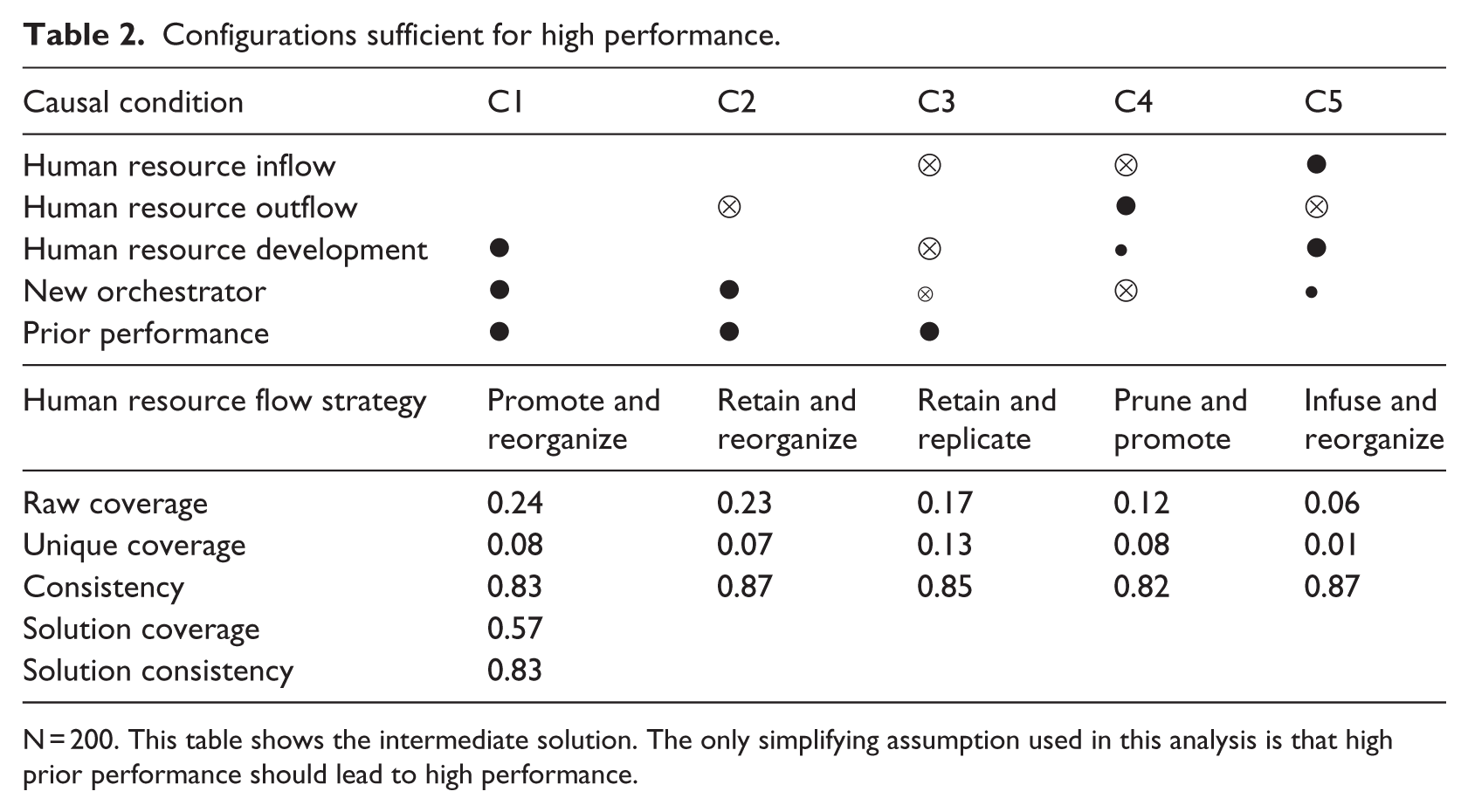
N = 200. This table shows the intermediate solution. The only simplifying assumption used in this analysis is that high prior performance should lead to high performance.
The five configurations associated with high performance had an overall 0.83 level of consistency and a 0.57 level of coverage. These fit statistics indicate that the solution brings about high organizational performance 83% of the time, accounting for 57% of fuzzy membership in the outcome. This indicates that the displayed configurations are indeed subsets of the high performance set and account for a substantial portion of it. The raw coverage shows how much of the outcome is covered by a given configuration, whereas the unique coverage indicates how much of the outcome is only covered by that specific configuration (Frazier et al., 2016; Schneider and Wagemann, 2012). The coverage values indicate that these configurations play an important role in explaining performance and are consistent with previous studies (e.g. Crilly, 2010; Fiss, 2011; Garcia-Castro et al., 2013). Furthermore, the lack of any configurations with only one condition, present or absent, indicates that none of the causal conditions are sufficient, by themselves, to produce the outcome. This finding highlights the merit of a configurational, set-theoretic approach.
Although examining the flow strategies sufficient for low performance is not our main interest, such analysis could offer additional insights. We explored the configurations associated with low performance and found five configurations sufficient for a relatively bad season (see Table 3). The analysis had a consistency of 0.82 and a coverage of 0.62. All five configurations had low prior performance, indicating that although clubs with high prior performance may slip into the bottom half of the table, there were no systematic ways to do so within the framework of our model. A new orchestrator achieved poor performance in one of the five configurations, while an incumbent achieved poor performance in two of them. In the other two configurations, this condition “doesn’t matter.”
Configurations sufficient for low performance.
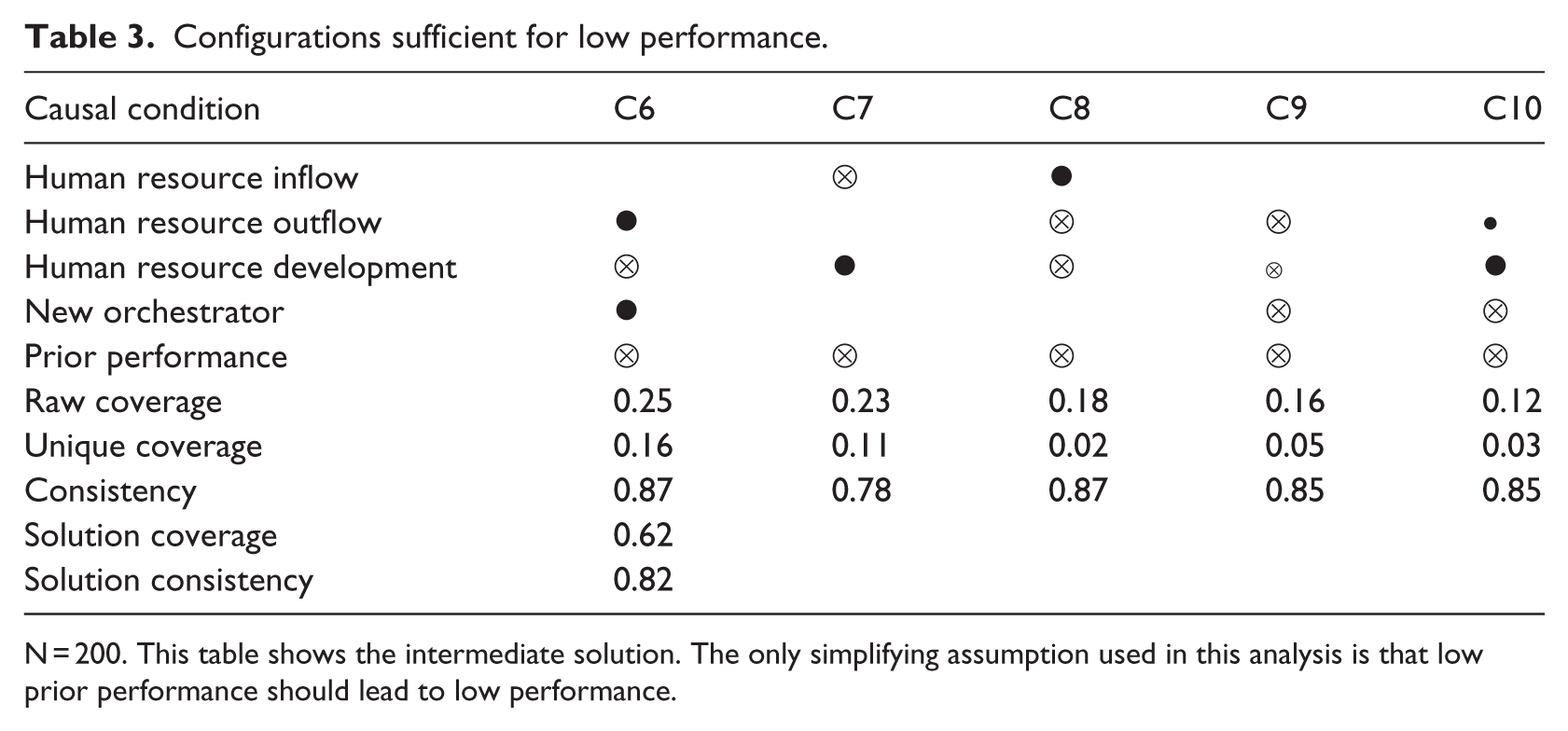
N = 200. This table shows the intermediate solution. The only simplifying assumption used in this analysis is that low prior performance should lead to low performance.
These results provide interesting insights particularly for flow strategies of clubs with poor prior performance. For instance, configuration C8 implies that newly appointed managers were not able to lead their club from the bottom half to the top half of the table by engaging in high inflow, low outflow, and low development. Configuration C5 in our main analysis suggests that such managers may have been more successful if high development was part of this flow strategy. In other words, more successful turnaround would have been enabled by not only infusing the human resource base with external talent but also doing so with internal talent, as we explain later in this article.
In order to establish the robustness of our results and provide a comparison to alternative specifications, we conducted a series of additional analyses. We present the results of these analyses in Online Appendix 2 (robustness of configurations over time) and Online Appendix 3 (other analyses), both of which indicate that the presented solution is robust and fits the data well.
Discussion and theory elaboration
Because our comparative case analysis involves managerial decisions and subsequent outcomes, the results provide theoretical insights regarding effectively orchestrated flow strategies. Consistent with Gresov and Drazin’s (1997) theorizing and the resource orchestration perspective, we observed a tradeoff equifinality task environment in which managers choose between strategic alternatives “based on their knowledge of tradeoffs and their personal preferences” (p. 416). Below, we extract theoretical insights based on the patterns we observed in our analysis.
Effectively orchestrated human resource flow strategies
Organizations with a successful prior season have five viable flow strategies available. They experience fewer constraints and can build on an already effective human resource stock. We begin by focusing on the more straightforward situation in which the manager is retained. Two strategies, C3 and C4, occurred under the guidance of an incumbent manager. In C3, which we label retain and replicate, the manager combines low inflows with low development, while outflow may be high or low. This is a strategy mostly characterized by stasis; the human resource stock has proven effective in the previous period, and the incumbent managers are retained to sustain that success. Oftentimes, “high performance provides validation of current strategies and leadership profiles” (Hambrick et al., 1993: 414), thus creating stronger commitment to the status quo. It should be noted, however, that the human resource base in the retain and replicate strategy is not completely frozen, as flows do occur but are small in magnitude.
Managers engage in larger outflows in both C3 and C4. However, C4, which we label prune and promote, represents a strategy where high outflows are always present in combination with a more substantial infusion of the human resource stock from internally developed talent. This strategy suggests that divestment may be useful for incumbent managers to sustain high performance; we suspect that these managers discard human resources in order to get rid of some inefficiencies (i.e. human resources that have not proven conducive to the current momentum) and use the freed up financial capital to finance their existing stock of well-performing human resources as well as bringing in smaller quantities of reinforcements. This strategy also provides a way for incumbents to turn their organization around from low performance. The prune and promote strategy suggests that high inflow may be too disruptive, so these managers (1) add fresh talent developed internally to invigorate the human resource base and (2) discard a substantial portion of human resources that likely were not performing well. As Sirmon et al. (2011) note, effective orchestration often requires that managers “identify and replace inefficient capabilities” (p. 1402). It seems that incumbent managers in C4 use flows to effectively prune the resource base so that the undergrowth may flourish.
For organizations with high prior performance and a newly appointed manager, there are three viable flow strategies. In C1, which we label promote and reorganize, the incoming manager focuses mainly on internally developed resources. These organizations have an effective human resource base and the manager promotes fresh talent that is familiar with existing organizational routines and culture but at the same time provides revitalization and new energy for another successful season. In C2, retain and reorganize, development may be present or absent, but outflows are absent. Some of these managers may engage in higher inflow and development, but they retain most of the previously successful human resource stock, which, in light of the uncertainty caused by a new leadership, may help to minimize potential disruptions to the organization’s harmony.
Managers in C5, infuse and reorganize, engage in high inflow combined with high development and low outflow. This is the only strategy in which high inflows are systematically present. Interestingly, this strategy works for organizations with both high and low prior performance; however, C1 and C2 indicate that organizations with prior high performance and a new manager have far more degrees of freedom with regard to flow strategies. Lower performing clubs may be better served employing the infuse and reorganize strategy. Overall, this strategy entails an enlargement of the human resource stock, mostly with outsiders. Yet, most of the previously successful human resources are retained, and it is the new managers who may provide the new way of configuring resources needed to effectively integrate new and existing resources. Had organizations utilizing infuse and reorganize retained an incumbent, high inflows may have infused too much unfamiliar change into the organization and potentially reduced the effectiveness of the new human resource base, at least in the short term.
For organizations with poor prior performance, the infuse and reorganize strategy results in a successful turnaround. Here, a new manager creates an influx of new hires and young talent, which not only changes the makeup of the human resource base but also provides a new way of deploying resources. As Penrose (1959) observed, “the experience of management will affect the productive services that all other resources are capable of rendering” (p. 5). Interestingly, these new managers engage in lower level of outflow. Possibly recognizing that some existing human resources may only seem less valuable due to the way previous management utilized them, these new managers retain much of the previous human resource base to see whether some may turn out to be useful to the new way of doing things. Alternatively, these managers may want to avoid a substantial shakeup in terms of divestment in the short term as a means of reducing potential damage to cohesiveness and social climate.
Overarching patterns and implications
We now turn our attention to discussing additional noteworthy findings and patterns that emerge from our empirical results. First, and most generally, our results provide evidence that managers’ abilities to properly handle the magnitude of human resource flows, expressed in terms of quantities of human resources, matters a great deal to organizational performance (Kor and Leblebici, 2005; Madsen et al., 2002; Reilly et al., 2014). This is affirmed by the relatively high solution consistency and coverage in the results. To better understand the performance consequences of managerial decisions regarding human resource flows, more research is needed to explore various dimensions of human resource flows that capture aspects of not only quality but also quantity (see Hausknecht and Holwerda (2013) for an excellent overview). It is not simply, however, that quantity matters and that there is an ideal magnitude for each resource flow. Instead, human resource flows matter in conjunction with the other flows and contextual conditions. Therefore, the ability of managers to understand whether the existing resource base and organizational context require small or wholesale changes and subsequently to manage each of those changes in concert with one another seems to have immediate performance implications.
Second, the importance of developing talent internally is also evident in our results. Although it is not necessary, it is present in three of the five configurations. Human capital theory (Becker, 1964) has long focused on the issue of whether human resources need to be developed internally or acquired from the external market. Although some studies highlight the high cost associated with building resources internally (e.g. Coen and Maritan, 2011), our results suggest that such an endeavor does pay off when done in the right context. This is consistent with studies suggesting that the answer to whether orchestrators need to internally develop or externally acquire human resources (Becker, 2009; Wright et al., 2001) is more than a dichotomous choice and that the context must be properly understood. Extending these studies, we show that contextual variables and the state of the other flows should not be ignored, which provides a first step toward reconciling the contradictions in prior studies whereby flow decisions are analyzed independently.
Third, whether the orchestrator is newly appointed or an incumbent is never a “doesn’t matter” condition, indicating that the strategies included within the five configurations depend on the tenure of the orchestrator of the organization’s resource base. It appears that newly appointed managers do well when they limit the magnitude of outflows and, in most cases, supplement the resource base with either internally developed talent or a combination of internally developed talent and human resource inflows. On the other hand, incumbent managers seem to do better with strategies that involve higher divestment and lower inflows. This may be because they have a better vantage point and more familiarity with the current resource base, which allows them to identify the human resources that must be divested.
When organizations intake higher volumes of human resources, it may take some time for the new human resource base to “gel” together (Boschma et al., 2009). Such large intakes entail costs (Hitt et al., 2001). A newly appointed orchestrator may help resolve this tension by potentially making the fault lines between the “old” and the “new” human resources less relevant. Furthermore, incumbent orchestrators may push newly acquired human resources to fit within existing assumptions and routines. New orchestrators, on the other hand, are in a better position to embrace and integrate the newly acquired human resources, thereby increasing the possibility that human resources will more easily “gel” with the human resource base. In sum, our results suggest that new managers are better at dealing with high human resource inflows, while incumbent managers seem to handle high human resource outflows better. More broadly, these results highlight the importance of the orchestrator to the decisions and outcomes associated with resource flows. Hence, examining additional orchestrator-related conditions may be a fruitful area for future research.
Finally, because productive resources such as human resources may diminish in value over time (Dong et al., 2009), completely restricting the flow of human resources in and out of the organization may be detrimental to the organization’s performance. Yet, for the most part, configurations with low to moderate levels of overall change to the human resource stock were associated with higher performance. After all, effectively orchestrating simultaneously high levels of all flow types can be quite challenging for managers, as commensurate high levels of inflow, outflow, and development invite intra-organizational conflict (Amit and Schoemaker, 1993), intensify job demands (Reilly et al., 2014), and diminish employee trust, socialization, and cohesion (Saks et al., 2007). Configuration C1, promote and reorganize, suggests that newly appointed managers may in some cases be able to successfully orchestrate high levels of all three flow types, although this was not systematic and rather uncommon and requires further investigation in future studies.
Limitations
Our study is not without limitations. First, although our sample is uniquely well-suited to capturing human resource flows, that uniqueness may limit generalizability. Although we believe that the thematic findings of this study are applicable to a wide array of organizations, specific findings should be generalized with caution. For instance, our characterizations of human resource inflows and development are somewhat domain-specific, and we acknowledge that organizations acquire and develop human resources in a variety of ways. Similarly, we did not directly measure internal reconfiguration activities and a direct incorporation of such decisions is warranted in future research. La Liga has a relatively stable task environment and rather rigid industry structure. Therefore, our results may be more applicable to mature industries that are still talent dependent but that are also less tumultuous and innovate mostly incrementally. Consequently, our results might be less relevant to organizations in high-tech industries where the acquisition of qualitatively new knowledge and skills is vital and radical innovation is prominent.
Second, because club roster sizes are somewhat stable, human resource flows are inherently interlinked. Although for most organizations growth and enlargement of the human resource stock are less limited than for La Liga clubs, all organizations are subject to constraints. Changes to the size of the workforce are somewhat limited for all organizations particularly in the short term, and there is an inherent tradeoff between the various flows. Furthermore, for soccer clubs, although roster size moves back to equilibrium in the long term, there is room for fluctuations in the short term, which makes it suitable to study the immediate impact of flows on performance.
Finally, some flows may prove effective only over longer periods of time, but our study examines performance outcomes in the short term. A fruitful avenue for future research is to study the cumulative impact of human resource flows over lengthier time periods. For instance, Sastry (1997) shows that by incorporating a temporal mechanism of a “trial period,” organizations may successfully implement substantial strategic changes. Here, other aspects of managerial resource orchestration, such as bundling and leveraging (Sirmon et al., 2011), may be useful for studying the outcomes of human resource flows. Such an agenda, however, is beyond the current scope and may be difficult to implement due to the number of intervening variables with regards to the human resource stock that can arise over a lengthier period of time.
Footnotes
Acknowledgements
For their valuable comments on earlier versions of this manuscript, the authors would like to thank Zur Shapira, William (Bill) Judge, Alan Ellstrand, Ajai Gaur, Brian Connelly, Keren Caspin-Wagner, Denis Khantimirov, Stephen Lanivich, Angela Heavey, and José Mauricio Geleilate. An earlier version of this manuscript was presented at the 2014 Academy of Management Annual Meeting in Philadelphia, PA. They thank the participants at the 2014 Academy of Management conference for their constructive feedback. They are also grateful to Strategic Organization Co-editor, Ann Langley, and three anonymous reviewers for masterfully orchestrating a highly constructive and valuable review process.
Declaration of Conflicting Interests
The author(s) declared no potential conflicts of interest with respect to the research, authorship, and/or publication of this article.
Funding
The author(s) received no financial support for the research, authorship, and/or publication of this article.
Supplementary Material
Supplementary material is available for this article online.
Notes
Author biographies
References
Supplementary Material
Please find the following supplemental material available below.
For Open Access articles published under a Creative Commons License, all supplemental material carries the same license as the article it is associated with.
For non-Open Access articles published, all supplemental material carries a non-exclusive license, and permission requests for re-use of supplemental material or any part of supplemental material shall be sent directly to the copyright owner as specified in the copyright notice associated with the article.
