



Abstract
There has been increasing attention to examining informal (i.e., horizontal), rather than formal (i.e., vertical), approaches to leadership over the last several decades, enhancing our understanding of the dynamics of emergent leadership. Although such research has led to a growing comprehension of the process of, and factors involved in, leader emergence, the literature still lacks theoretical coherence. Without a clear way to connect and synthesize extant research, the time is right for a much-needed comprehensive review. To address this issue, we examine emergent leadership research to date with the aim of developing a concise overview and comprehensive framework of the literature. In doing so, we (1) review past conceptualizations, establish a clear, common definition, and compare emergent leadership to other related constructs; (2) review previous operationalizations and provide recommendations for future measurement; (3) develop a comprehensive organizing framework of existing research; and (4) use our organizing framework, as well as three existing theories related to emergent leadership, to generate a series of detailed suggestions for future research for the next decade and beyond.
Organizational research emphasizes formal, hierarchical, top-down leadership, including control over tasks and stable roles (i.e., vertical leadership; Courtright, Fairhurst, & Rogers, 1989), and legitimate authority over team processes and outcomes (Carson, Tesluk, & Marrone, 2007). However, organizations continue to shift toward informality (e.g., “flattening” structures; Kent & Moss, 1994; McClean, Martin, Emich, & Woodruff, 2018; Wolff, Pescosolido, & Druskat, 2002; Zaccaro, Foti, & Kenny, 1991) by transitioning away from vertical leadership toward lateral perspectives (i.e., horizontal leadership; Kaplan, Dollar, Melian, van Durme, & Wong, 2016), such as emergent leadership. Over 30 years ago, Lord, De Vader, and Alliger (1986: 408) stated that emergent leadership was “a major component of the social fabric of many organizations.” In today’s competitive, fast-paced business environments, less formalized leader role designations are even more of a necessity. Indeed, research shows that teams that informally allow leaders to emerge and coordinate team processes can outperform those that do not (De Souza & Klein, 1995; Spisak, O’Brien, Nicholson, & van Vugt, 2015).
Emergent leadership research has grown exponentially (see Figure 1), but it lacks structure and coherence. Scholars have conceptualized emergent leadership differently, making study comparisons and replications difficult. Varying operationalizations also raise issues about whether scales across studies actually measure the same construct (McClean et al., 2018). This lack of conceptual and operational clarity has led to confounding emergent leadership with other informal (e.g., shared, participative leadership; Carson et al., 2007) and formal (e.g., supervisor roles; Barling & Weatherhead, 2016; Huang, Iun, Liu, & Gong, 2010) leadership.
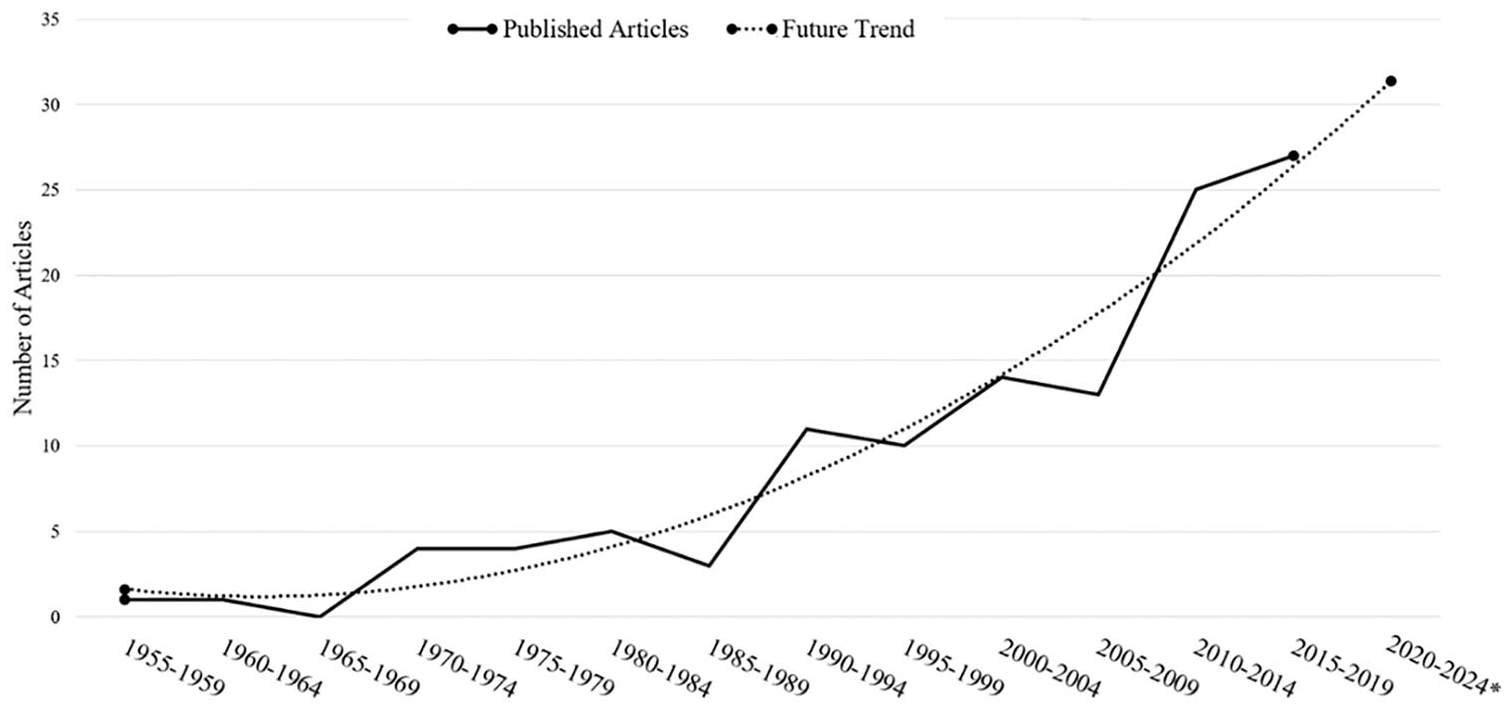
Publication Trends in Emergent Leadership Research (1955-2020)
Although reviews of emergent leadership exist, they narrowly focus on predictors, such as individual differences (Ensari, Riggio, Christian, & Carslaw, 2011), behavioral genetic estimates (Ilies, Gerhardt, & Le, 2004), and gender (Badura, Grijalva, Newman, Yan, & Jeon, 2018), overlooking other antecedents, mechanisms, boundaries, and outcomes. Reviews have not captured newer research, with 51 new studies (38% of the existing literature) published since Ensari et al.’s (2011) meta-analysis (see Online Supplement A). Badura et al.’s (2018) meta-analysis focused on developing an explanatory model of the gender gaps still found in recent emergent leadership research. More recently, Acton, Foti, Lord, and Gladfelter (2019) reviewed a narrow subset of the emergent leadership literature, relying exclusively on a process-oriented framework. They used a complexity perspective, focusing on completely different elements than our review. As a result, they offered only one future research direction, which was to use two types of computational modeling (i.e., agent-based and equation-based) to examine emergent leadership in simulated research environments. We provide a more comprehensive review and use multiple theoretical perspectives to highlight five directions for future research that their approach did not identify. We first briefly review existing conceptualizations and establish a clearer definition of emergent leadership, which we compare to other related constructs. We then briefly review its operationalizations and provide recommendations for future measurement. Finally, we answer calls (e.g., Kwok, Hanig, Brown, & Shen, 2018) to create a unified emergent leadership framework, and using this framework as well as theories related to emergent leadership, we generate a series of detailed suggestions for future research.
To be comprehensive, we searched for articles using a “snowballing” approach (Elsbach & Stigliani, 2018), continuously updating search conditions. We searched management and related fields (e.g., organizational science, applied psychology, sociology) using keywords such as “emerge,” “emergent leadership,” “leader emergence,” and “leadership emergence” in the JSTOR and Web of Science databases in all years up to January 2020. We continued to search associated references for articles in other fields (e.g., educational psychology, technology), resulting in a final count of 133 studies (see Online Supplement A for detailed descriptions).
Our review suggested an initial, high-level framework (see Figure 2) in which the more detailed review could be undertaken. Some emergent leadership research focused primarily on team-level perspectives, while other research examined individual-level constructs. At the team level, both team dynamics and emergent states have been studied as antecedents. Team context variables have often been examined as moderators and task-oriented factors as mediators. At the individual level, traits, demographics, states, and behaviors have been cast as antecedents; other individual traits, demographics, and states as moderators; and socially and task-oriented factors as mediators. Team- and individual-level constructs are all viewed as impacting leader emergence. Finally, team-level research focused on effectiveness-based and affect-based outcomes, while individual-level research focused primarily on effectiveness-based outcomes.
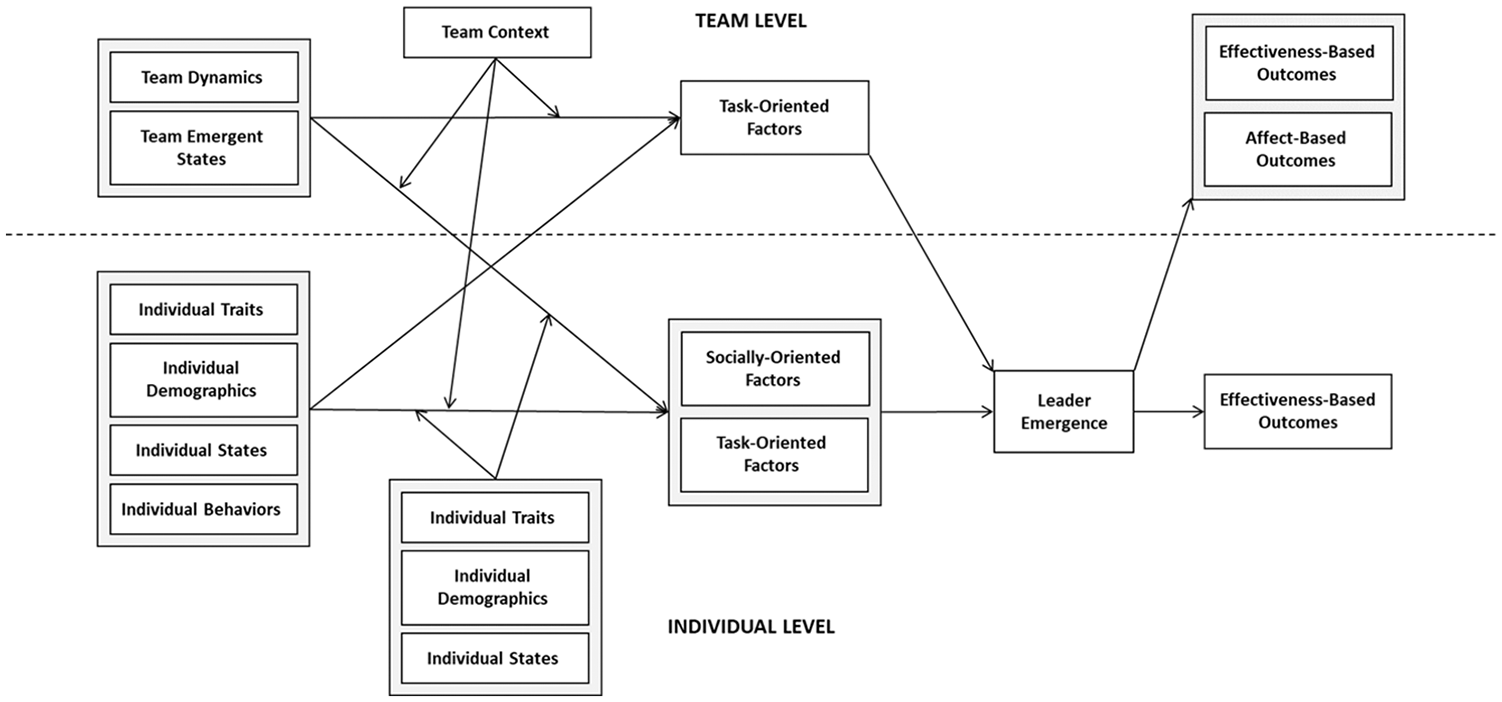
A High-Level Emergent Leadership Framework
We make four key contributions to the emergent leadership field. First, we resolve concerns about discrepancies in emergent leadership research by establishing a clear definition and comparing the construct to other related leadership types, which will allow for more consistency in future research. Second, we bring to light some of the major issues related to operationalizing emergent leadership and suggest improvements. Third, we offer a detailed organizing framework of emergent leadership research, providing a broad overview of current understanding. Finally, we overlay this framework of past research on emergent leadership with three existing leadership theories that explain different and complementary components of emergent leadership to propose a theoretically rich array of future research directions.
Conceptualizing Emergent Leadership
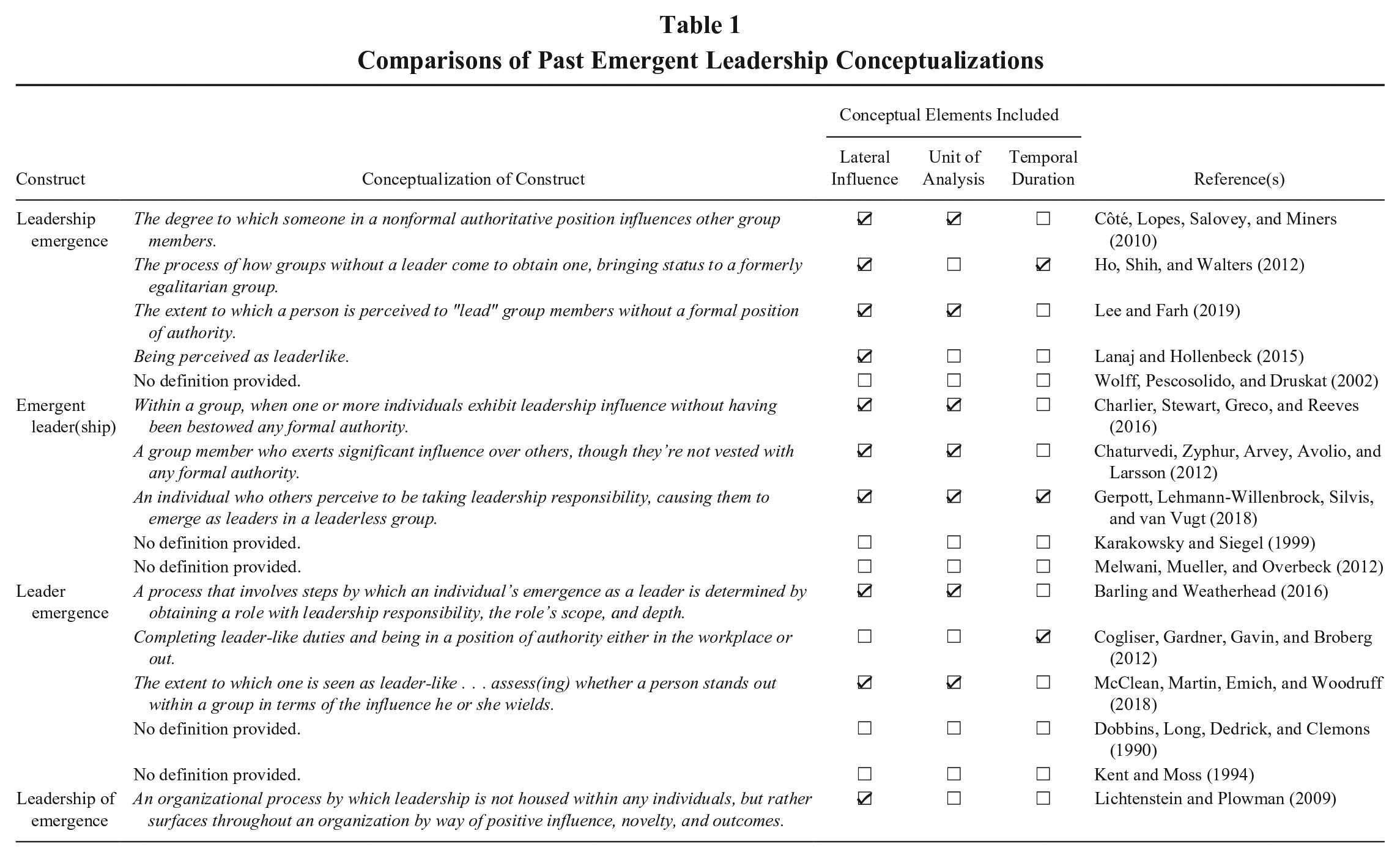
Numerous definitions of emergent leadership exist (see Table 1), often referring to it in simple or implicit ways, such as a leader “emerging” in a team (Côté, Lopes, Salovey, & Miners, 2010; Lanaj & Hollenbeck, 2015). Others include team opinions (Andrews, 1984), team status and influence (Baird & Weinberg, 1981), advancing team goals (Carter, 1953), lack of a formal leader (Sapp, Harrod, & Zhao, 1996; Taggar, Hackett, & Saha, 1999), formality of the leader role (Atwater, Dionne, Avolio, Camobreco, & Lau, 1999; Kolb, 1999), domain specificity of a role (Cogliser, Gardner, Gavin, & Broberg, 2012), and being perceived as leaderlike (Kent & Moss, 1990, 1994; Lanaj & Hollenbeck, 2015). The literature has not expanded on this one-dimensional definition nor clarified its conceptualization. Despite calls, many have continued to include “broader definitions and characteristics” (Kickul & Neuman, 2000: 28), leading scholars to conclude that we need to address a “lack of precision in definitions” (Schneier & Goktepe, 1983: 418) and “lay a foundational definition of the theoretical concept” (McClean et al., 2018: 1886).
Comparisons of Past Emergent Leadership Conceptualizations
Establishing a Unified Definition
Despite the lack of conceptual consistency, similarities exist. We argue that there are three key elements of emergent leadership: lateral influence, unit of analysis, and temporal duration.
Lateral influence
As noted, two main sources of leadership exist, vertical and horizontal. Since inception (Mann, 1959; Stogdill, 1948), lateral influence, or being perceived as leaderlike by others, has been one of the foundational characteristics of emergent leadership (Kent & Moss, 1990, 1994; Lanaj & Hollenbeck, 2015). For example, Gerpott, Lehmann-Willenbrock, Voelpel, and van Vugt (2019: 717) describe it as “the amount of . . . social influence that team members ascribe to one another.” Likewise, Kalish and Luria (2016: 1474) refer to emergent leaders as “individuals who are perceived by others as leaders despite not holding a formal leadership role” and as individuals “able to exert significant influence over the group.”
Other studies consider emergent leadership as the actual act of obtaining a formal leadership role (Barling & Weatherhead, 2016; Luria & Berson, 2012). However, the most common element of emergent leadership is the perception of leaderlike influence by team members despite not having such a formal role (McClean et al., 2018; Schneier & Goktepe, 1983). Unlike vertical leadership that focuses on specific leader behaviors (e.g., transformational, empowering), emergent leadership research largely refrains from prescribing specific behaviors or functions in conceptualizing perceived leaderlike influence, as there are numerous ways in which influence can be exhibited (e.g., pressure, interpersonal exchange, rational persuasion, inspirational appeal; see Kipnis, Schmidt, & Wilkinson, 1980). Taking this approach has allowed researchers to explore how a wider array of team member behaviors (e.g., initiating structure, consideration, ethics) or functions (e.g., coordinating tasks, motivating others, resolving conflict) influence perceptions of leader emergence (i.e., leaderlike influence on members or the team). For example, Walter, Cole, van der Vegt, Rubin, and Bommer (2012) explore how individuals’ coordination behaviors impact the extent to which they are perceived as an emergent leader. As such, here we do not strictly interpret how leaderlike influence manifests itself to allow the construct malleability necessitated by differing interpersonal influence tactics.
Unit of analysis
The second key feature of emergent leadership is that it occurs at the individual level of analysis. That is, lateral influence originates from an individual team member, not from a group of individuals (e.g., Kickul & Neuman, 2000; Kolb, 1999). For example, Walter et al. (2012: 977) refer to emergent leaders as “individual members with no formal authority” that “provide leadership on various tasks.” Further, Taggar et al. (1999: 901) define emergent leadership as “team members attribut[ing] leadership to . . . their peers.” Because emergent leadership is an individual-level phenomenon, in a team, more than one person can be perceived as an emergent leader, which is why teams can have “many different informal leaders” (Neubert, 1999: 636). Notably, although multiple members could be perceived as emergent leaders in a team, again, leaderlike influence originates from each team member individually (not as a collective), making emergent leadership an individual-level phenomenon.
Temporal duration
Temporal duration suggests that leaders can emerge temporarily for an unknown amount of time in a team. With emergent leadership rooted in others’ perceptions, different factors could influence who and for how long a member is perceived as an emergent leader in a team. Some view influencing others as a dynamic, changing process (Foti, Knee, & Backert, 2008), highlighting that others may not perceive the same individual the same way in all situations. Thus, a member’s emergent leadership “can end at any time” (Wolff et al., 2002: 506), making it potentially fleeting and fluid as team circumstances change. For instance, Taggar et al. (1999: 901) suggest that emergent leaders are those who become “important to the facilitation of [the] team task.” This implies that emergent leadership episodes can occur multiple times in the same team (and by the same person or other people), depending on the team’s varying tasks and outcomes. Thus, various members of a team can emerge as informal leaders at different instances and for varying lengths of time within a team experience.
The span of time between Schneier and Goktepe’s (1983: 418) early warning about the “lack of precision in definitions” and McClean et al.’s (2018: 1886) more recent call to create “a foundational definition of the theoretical concept” suggests that researchers have largely not heeded calls for conceptual clarity of emergent leadership in almost 40 years. We seek to achieve greater clarity by adopting a common conceptualization of emergent leadership based on the aforementioned key features. Specifically, we define emergent leadership as the degree to which an individual with no formal status or authority is perceived by one or more team members as exhibiting leaderlike influence. Our definition clearly highlights that emergent leadership is an informal, lateral form of leadership within a collective. We also recognize that it is an individual-level phenomenon that allows for more than a single individual to be perceived as an emergent leader. Overall, our conceptualization will help differentiate emergent leadership from other related constructs.
Emergent Leadership’s Relationship With Other Leadership Constructs
Because researchers sometimes treat emergent leadership interchangeably with other types of leadership (Carson et al., 2007; Huang et al., 2010), next, we briefly compare it to other related leadership constructs (see Online Supplement B for more detailed comparisons).
Shared leadership
Similar to emergent leadership, shared leadership entails lateral leadership with no formal leader providing vertical leadership (Carson et al., 2007). However, unlike emergent leadership, shared leadership emerges across an entire team. Indeed, shared leadership is “an emergent team property of mutual influence and shared responsibility among team members, whereby they lead each other toward goal achievement” (Wang, Waldman, & Zhang, 2014: 181). Thus, although both constructs focus on the lateral emergence of leadership perceptions in teams, emergent leadership focuses on an individual’s emergence as a leader, and shared leadership focuses on a collective’s leaderlike influence in leading a team.
Collective leadership
Collective leadership is a dynamic process in which team members interchangeably “utilize skills and expertise within a network, effectively distributing elements of the leadership role as the situation or problem at hand requires” (Friedrich, Vessey, Schuelke, Ruark, & Mumford, 2009: 933). Like emergent leadership, members use informal, lateral influence. However, similar to shared leadership, it is also conceptualized as a team-level construct, in which leadership influence is equally distributed in a team. Collective leadership is often viewed interchangeably with shared leadership (Zhu, Liao, Yam, & Johnson, 2018).
Self-leadership
Although self-leadership focuses on how people emerge as leaders, it also narrowly focuses on the autonomy an individual or team has. Specifically, self-leadership is “the process of influencing oneself” (Neck et al., 2010: 4), such that it is a “set of strategies that address what is to be done (e.g., standards and objectives) and why (e.g., strategic analysis) as well as how it is to be done” (Manz, 1991: 17). Self-leadership examines how an individual or team influences his/her (their) own behaviors, whereas emergent leadership consists of lateral influence. Like emergent leadership, self-leadership can occur at the individual level; however, it is also unique because it can manifest at the collective level (Stewart, Courtright, & Manz, 2011).
Leader development
Leader development is “the expansion of the capacity of individuals to be effective in leadership roles and processes” (Day & Dragoni, 2015: 135) and consists of approaches used to prepare leaders to manage mutual commitments, interpersonal relationships, and social processes (Day & Halpin, 2004). Leader development is supported by formal leaders or human resources and includes activities that expand leadership skills. Development can occur at an individual, team, or organization level (Day & Halpin, 2004). In contrast, emergent leadership occurs in teams with an individual (or individuals) laterally influencing others. Although emergent leadership could entail developing leadership skills, leadership development includes other programs and initiatives not part of emergent leadership.
Team leadership
Team leadership is the study of overall leadership occurring in a team. Thus, it is similar to emergent leadership in that it considers lateral influences among members (Day, Gronn, & Salas, 2006). However, it is unique because it also accounts for the vertical leadership influences of formally appointed leaders (Morgeson, DeRue, & Karam, 2010; Zhu et al., 2018).
Operationalizing Emergent Leadership
With no comprehensive emergent leadership review and limited consensus about its conceptualization, past studies have also operationalized it differently, calling into question whether studies capture a common construct. Indeed, McClean et al. (2018: 1886) noted, “the variation in how leader emergence is defined and measured raises questions as to whether all of these approaches are measuring the same dimensions of emergence.” Part of the challenge is that emergent leadership does not include a clear set of behaviors like more structural leadership forms do (Barrick, Thurgood, Smith, & Courtright, 2015; Courtright, Gardner, Smith, McCormick, & Colbert, 2016), as it is largely defined as perceptions of leaderlike influence. Thus, “leader emergence is inconsistently defined and measured” (McClean et al., 2018: 1886), making it challenging to replicate and compare prior research. Here, we review concerns about operationalization and offer guidance for future measurement. In the future research directions section, we provide additional methodological recommendations.
As emergent leadership rarely incorporates specific leadership behaviors, various Likert-type scales have been used to measure it. Some are very broad in that they allow others to subjectively decide what is leaderlike. For example, Lanaj and Hollenbeck (2015) asked team members to evaluate the extent to which other members “influenced the team” and “exhibited leadership in the team.” Other studies have focused on inconsistent subsets of behaviors that some may consider to be leaderlike (e.g., suggests or tries out inventive or new ideas, praises others in the team for what they have done, asks for and provides evaluations and analysis concerning goals; Cogliser et al., 2012; Cronshaw & Ellis, 1991). Finally, others focused on leaderlike characteristics (e.g., social popularity, benevolence, leadership, aggression, and honesty; Paunonen, Lönnqvist, Verkasalo, Leikas, & Nissinen, 2006). Little construct validation exists for each scale, and even less exists across scales. As a result, we provide two recommendations. First, researchers should develop and validate a standalone emergent leadership scale matched to a common definition so that scholars can converge on a unifying operationalization. Second, researchers should use multiple emergent leadership scales simultaneously, or across samples (see McClean et al., 2018), to demonstrate replication (Eden, 2002) and convergent validity.
Beyond the many different measures of emergent leadership, our review also revealed that some approaches have questionable construct validity (i.e., not accurately measuring the concept they are seeking to measure; Cook & Campbell, 1979), meaning that measurement error (e.g., method variance, random error) can arise, creating misleading implications (Campbell & Fiske, 1959). This is critical because hypotheses may be inaccurately supported or rejected due to measurement error, rather than adequacy of the theory (Bagozzi, Yi, & Phillips, 1991).
Some studies also used a forced selection approach constraining members to vote for a single emergent leader in a team (De Souza & Klein, 1995). Unfortunately, this does not allow for more than one person to emerge as leaderlike (Hawkins, 1995), which is a key part of emergent leadership, introducing range restriction, and potentially losing meaningful data. For instance, Goktepe and Schneier (1989) eliminated 25% of their sample due to lack of consensus among members about who emerged as the single leader (we discuss more on the role of consensus in our future research directions). A more valid approach entails asking every team member to evaluate the emergent leadership of every other member (see Hawkins, 1995). For construct validity, a measure should be operationally unique from other predictors and outcomes (Van Knippenberg & Sitkin, 2013). Unfortunately, scholars have noted that “items used to capture [emergent leadership] appear to conflate it with other constructs, such as effectiveness or contribution to the team” (McClean et al., 2018: 1886). Lord et al. (1986) asked about a member’s “contribution to team’s performance,” and Smith and Foti (1998) used “How much did this individual contribute to the task?” to capture emergent leadership. Others viewed emergent leadership as the person who is able to “help the team win an inter-team competition” (Carnabuci, Emery, & Brinberg, 2018: 123; see also Lee & Farh, 2019), suggesting that it is contingent upon team performance, rather than actual leaderlike perceptions.
An Extended Organizing Framework
An important outcome of our review is a more detailed elaboration and extension of the high-level organizing framework introduced earlier. With this elaboration (see Online Supplement C), our framework creates increased conceptual precision regarding extant theory and research related to emergent leadership. In effect, this serves as a nomological network for emergent leadership theory and its research domain (Zhu et al., 2018). Our extended framework also answers recent calls from emergent leadership scholars for a more organized and systematic view of leader emergence (e.g., Kwok, Hanig, Brown, & Shen, 2018; McClean et al., 2018). The inherent value of such a framework stems from two primary factors including (1) the ability to make better sense of the central themes spanning the construct’s extant literature and (2) clearer direction and guidance for the field to identify directions in which emergent leadership researchers should focus, broaden, and integrate research in the future (specified more explicitly in our first future research direction). Our organizing framework categorizes constructs most related to emergent leadership at both team and individual levels into four areas: antecedents (precursors), mediators (mechanisms), moderators (boundaries), and consequences (outcomes).
Antecedents
Scholars have explored a wide array of antecedent variables. Research on team variables has extended our understanding of antecedents to include more than just individual leader traits. Our extended framework organizes antecedents of emergent leadership into two overarching categories: team- and individual-level variables. Team-level antecedents can be further categorized into two groups: team emergent states and team dynamics. Examples of team emergent states include DeRue, Nahrgang, and Ashford’s (2015) finding that perceived group warmth positively impacts the likelihood of leader emergence. Other studies demonstrate the impact of team shared goals (Zhang, Waldman, & Wang, 2012) and team environment (Mumford, Antes, Caughron, & Fredrich, 2008). Team dynamics antecedents have included Druskat and Pescosolido (2006) finding positive effects for communication quantity and quality on leader emergence. Others include elements of virtuality (e.g., team centrality, dispersion, co-location; Charlier, Stewart, Greco, & Reeves, 2016), social cues (Cronshaw & Ellis, 1991), and gender representation (Hegstrom & Griffith, 1992). In the individual category, relevant antecedents can be broken down into four lower order classifications, including individual (1) traits, (2) demographics, (3) states, and (4) behaviors. The most salient individual traits impacting emergent leadership include work-related personality traits, as evidenced by Cogliser et al.’s (2012) findings of the positive impact of agreeableness and conscientiousness on leader emergence. Other traits include creativity (Guastello, 1995), social skills (Lanaj & Hollenbeck, 2015), narcissism (Paunonen et al., 2006), self-efficacy (Kwok et al., 2018), self-esteem (Andrews, 1984), and emotional stability (Li, Chun, Ashkanasy, & Ahlstrom, 2012). Major individual demographic variables include gender (see Badura et al.’s, 2018, meta-analysis), age (Chaturvedi, Zyphur, Arvey, Avolio, & Larsson, 2012), educational level (Garcia, 2015), economic status (Barling & Weatherhead, 2016), and race (Gundemir, Carton, & Homan, 2019). Key individual states are attitudes toward leadership (Cronshaw & Ellis, 1991), identification with a team (DeRue et al., 2015), self-concept (Emery, Daniloski, & Hamby, 2011), status (Karakowsky & Siegel, 1999), identification with the leadership role (Kwok et al., 2018), leader-member exchange (LMX; Zhang et al., 2012), leader (anti-)prototypicality (DeRue et al., 2015), and task ability (Hawkins, 1995). Finally, individual behaviors can predict leader emergence, such as Gerpott, Lehmann-Willenbrock, Silvis, and van Vugt (2018) linking the amount of attention given in a team to emergent leadership. Others include promotive voice (McClean et al., 2018), self-monitoring (Dobbins et al., 1990), self-promotion (Lim, 2019), teamwork actions (Luria & Berson, 2012), and traditional behaviors historically assumed to be a part of formal leadership, such as consideration and task-oriented behaviors (Cogliser et al., 2012).
Moderators and Mediators
Our extended organizing framework specifies two categories of moderating variables: team and individual factors. The team moderating factors include team dispersion, as shown in Charlier et al.’s (2016) study of its interactive effect with team member co-location on leader emergence. Other moderators include gender orientation of group task (Karakowsky & Siegel, 1999), team conflict (Li et al., 2012), team network centrality (Sutanto, Tan, Battistini, & Phang, 2011), and team virtuality (Sarker, Grewal, & Sarker, 2002). Individual moderators include Luria and Berson’s (2013) finding that cognitive ability has a positive interactive effect with individual motivation to lead. Others include desire to lead (Luria & Berson, 2013), dominance (Hegstrom & Griffith, 1992), and prosocial motivation (Cogliser et al., 2012) (all individual traits); gender (Barling & Weatherhead, 2016) (individual demographic); and major vs. minor position status (Karakowsky & Siegel, 1999) (individual state). Scholars have also explored several mediating mechanisms. Research shows that the majority of mediating mechanisms can be divided into two facets: socially oriented and task-oriented. At the team level, the primary socially oriented factor is shared team vision, which was shown to mediate the relationship between LMX and leader emergence (Zhang et al., 2012), and, primary task-oriented factors include communication quantity and quality (Charlier et al., 2016). At the individual level, socially oriented factors include identification with a team (DeRue et al., 2015), behavior role typicality (DeRue et al., 2015), network centrality (Sutanto et al., 2011), status (McClean et al., 2018), and peer relations (Kwok et al., 2018). The task-oriented factors are task competence (Ho, Shih, & Walters, 2012) and the presence of advice-seeking behaviors and activities (Druskat & Pescosolido, 2006).
Consequences (Outcomes)
Two categories of outcomes include performance-based and affect-based outcomes. The majority of performance-based factors have included effectiveness-based and affect-based outcomes. At the team level, effectiveness-based outcomes are team performance (Guastello, 1995) and effectiveness (Berson, Dan, & Yammarino, 2006). Team-level affect-based outcomes are perceived team trustworthiness (Cogliser et al., 2012) and team attention (Gerpott et al., 2019). At the individual level, the effectiveness-based outcome is contribution to team performance (Cogliser et al., 2012). A substantive point to be drawn here is the relatively small number of outcomes into which we have insight from extant research.
Making Connections Between Past Research and Recent Leadership Frameworks
Upon conducting a comprehensive review of the existing emergent leadership research, we found that much of the prior literature is intertwined with three unique leadership frameworks that have been developed in the past decade. We introduce each framework and highlight examples of how past research has explored their different aspects. First, functional leadership theory (McGrath, 1962) applied to teams (Morgeson et al., 2010) suggests that sources of leadership can be internal or external and formal or informal, with emergent leadership being internal and informal. Past research explored this framework by investigating how different sources of leadership require distinctive functions regarding when and how leadership occurs. For example, Luria and Berson (2012) found that teamwork behaviors were uniquely predictive of informal leadership emergence, suggesting that differing sources of team leadership require unique functional considerations. This model of leadership’s emphasis on leaders supporting the social climate in teams is validated by Wolff et al. (2002), finding that emergent leaders embody empathy to further team task coordination. Furthermore, Cogliser et al. (2012) highlighted the importance of managing social- and task-related elements of teams by linking emergent leader personality traits to team performance.
Second, DeRue and Ashford’s (2010) identity-based process model of leadership challenges traditional conceptualizations of leadership as top-down, hierarchical, and formal, suggesting that leadership is co-constructed through a process of individuals “claiming” and “granting” leader identities, which are critical for emergent leadership. Prior research on emergent leadership has examined this notion by highlighting how beliefs about traits or behaviors shared by team members influence the construction of informal leadership identities. Barling and Weatherhead (2016) support this by displaying the negative impact of economic status on perceptions of leadership antiprototypicality. Kwok et al. (2018) suggested that individuals who identify with being a leader will warrant greater support (i.e., leadership granting) from others. Charlier et al. (2016) highlight the importance of context in determining when claims are granted by examining the impact of different forms of communication unique to virtual teams on decisions to grant leadership.
Finally, Wellman’s (2017) relational models theory of group-level leadership emergence suggests that leaders emerge through either an authority ranking model (i.e., leadership influence is restricted to a small number of high-status individuals) or a communal sharing model (i.e., all members are collectively responsible for leadership), and feedback loops reinforce members enacting leadership consistent with one of these shared relational models. Wellman’s approach is useful for understanding how and why emergent leadership takes certain forms and the nature of the processes used. Past research has shown that shared consensus of group responsibilities in teams positively impacts emergent leadership (Zhang et al., 2012). DeRue et al. (2015) also showed that group-level leadership structure schemas meaningfully impact who emerges as a leader. Finally, elements of authority ranking have been explored by showing the positive impact of established status on resulting emergent leadership (McClean et al., 2018).
Future Directions in Emergent Leadership Research
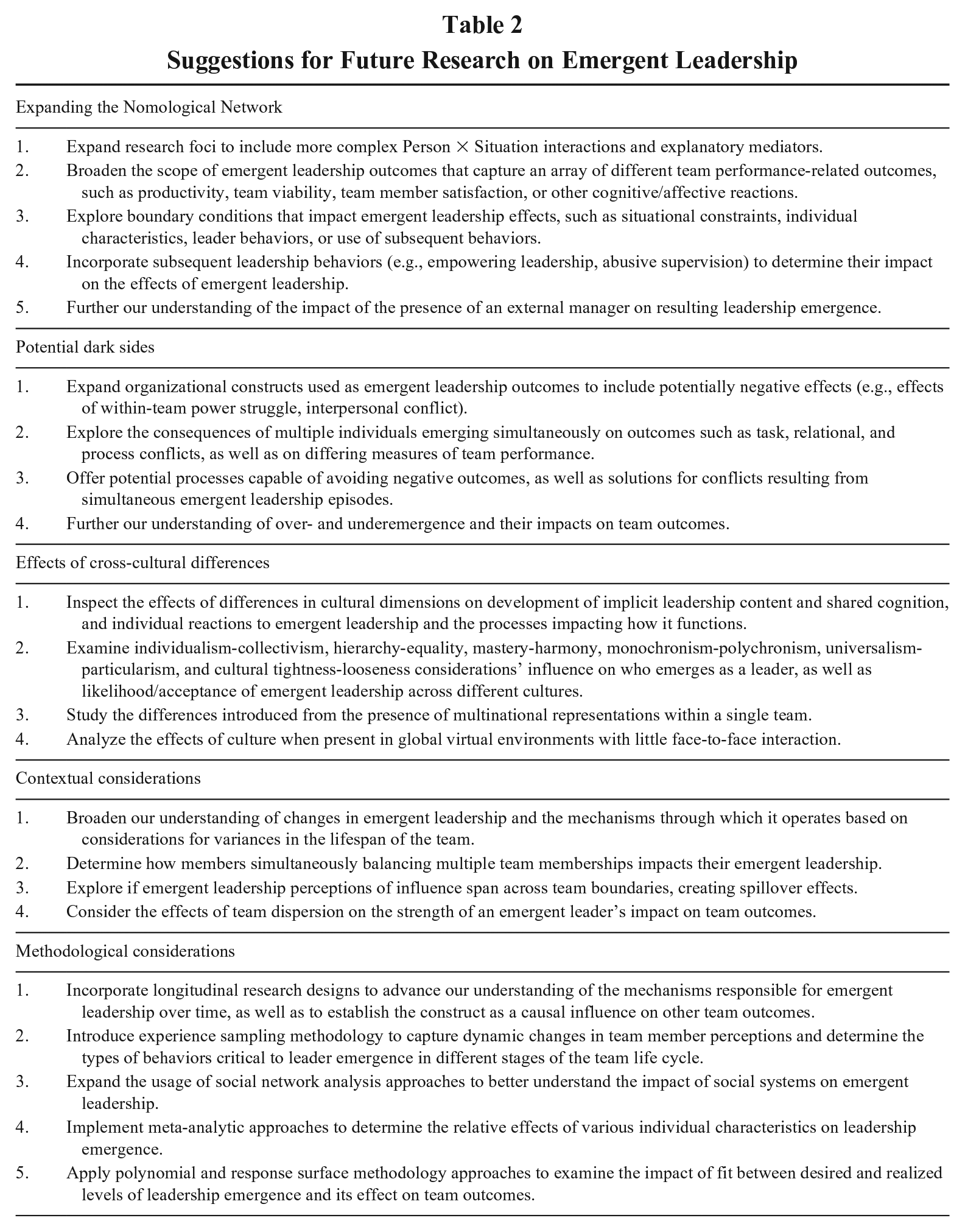
Although we have gained knowledge about emergent leadership over the last 50 years (and particularly in the last decade), there are many important theoretical and empirical questions remaining (see Table 2 for a summary). Recognizing what has been explored in our organizing framework, we use functional leadership theory, identity-based process model of leadership, and the relational models theory of group-level leadership emergence to identify and synthesize five promising avenues of future research. Each of these frameworks provides unique avenues for future research, including how can we expand the nomological network of emergent leadership, what are its potential dark sides, what are the cross-cultural values associated with leaders emerging differently across countries, what contextual factors would be important to include in future research, and what are the optimal research methods to use for future inquiry?
Suggestions for Future Research on Emergent Leadership
Expanding the Nomological Network of Emergent Leadership
Our framework clearly indicates where there has been an overabundance of research (e.g., individual differences as antecedents) and areas that have been understudied (e.g., Person × Situation interactions, outcomes, mediators). Concerning antecedents, researchers have overwhelmingly relied on trait-based approaches to predict the characteristics of those most likely to emerge. In fact, Ensari et al.’s (2011) meta-analysis exclusively examines individual differences as predictors of emergent leadership. Although this research has been helpful in identifying key individual differences related to emergent leadership, such approaches are limited in various ways. These include (a) creating an impression that the majority of research has made somewhat archaic assumptions about leadership being strictly attributed to individual traits, (b) omitting attention to situational or contextual factors that are likely to influence the effects of these individual differences, and (c) limiting attention to underlying theoretical mechanisms that explain how and why certain individual differences result in emergent leadership. To underscore this need, DeRue and Ashford (2010: 641) articulate a variety of ways that “identities develop in relation to specific situations;” and Wellman (2017: 611) urges scholars to “quantify the effects of contextual attributes on group-level leadership dynamics.” Thus, we encourage future research to expand past narrowly focusing on main effect relationships to explore more complex Person × Situation interactions and explanatory mediators.
Regarding consequences of emergent leadership, although a few studies demonstrated positive effects on individual and organizational outcomes (De Souza & Klein, 1995; Spisak et al., 2015), most research has again focused on antecedents without including organizationally relevant outcomes. This has led to an unwarranted assumption that emergent leadership is uniformly positive (we discuss potential dark side effects next). As Morgeson et al. (2010) recommend for all teams research, examining the consequences of emergent leadership needs to include different facets of team performance, such as productivity, team viability, member satisfaction, and other cognitive and affective reactions. Consequences need to be conceptualized at both team and individual levels of analysis. Both subjective and objective team performance should be included, as research has shown that leadership (and other team inputs) have differential effects on these sources (Mathieu, Gallagher, Domingo, & Klock, 2019).
Future research should also explore boundary conditions that enhance or diminish emergent leadership effects. Research shows that there are substitutes for leadership (Podsakoff, Niehoff, MacKenzie, & Williams, 1993), suggesting that there are likely situational constraints that reduce the effectiveness of emergent leaders. Also, individual characteristics (e.g., motivation to lead, intelligence, conscientiousness), or leader behaviors displayed after emerging, could impact whether an emergent leader influences individual or team outcomes. For example, an informal emergent leader in a team could engage in subsequent leadership behaviors (e.g., empowering leadership [Kirkman & Rosen, 1999], abusive supervision [Tepper, 2000]) that augment (or diminish) emergent leadership effects on different individual or team outcomes.
Finally, although emergent leadership requires that no team members possess a formal leadership role, it could still occur in teams that have an external leader. Indeed, Morgeson et al. (2010: 27) make no assumption that internal, informal team leadership cannot coexist with either internal or external formal leadership and suggest that considering “all of the sources of team leadership is essential for developing a complete understanding of team leadership processes and the leadership capacity within the team.” McClean et al. (2018) explored how emergent leadership occurred among members holding no formal leadership role, though the team still had a formal external manager. This unique scenario could affect emergent leadership processes because an external manager could influence who emerges as leaderlike due to differential relationships or resource allocation s/he has with different team members (Cropanzano & Mitchell, 2005). External managers could experience tensions with emergent leaders that rival their authority, given that their managerial power is bestowed upon them from an organization, and an emergent leader’s power is granted to him/her by a team (DeRue & Ashford, 2010). This is likely to be the case when an external and emergent leader espouse divergent perspectives.
Examining Potential Dark Sides of Emergent Leadership
In line with the management field’s interest in exploring the potential, and often unintended, dark sides of organizational constructs (for a review, see Griffin & O’Leary-Kelly, 2004), our emergent leadership organizing framework showed very little attention to this area. Responding to calls by Morgeson et al. (2010), DeRue and Ashford (2010), and Wellman (2017) to examine tensions inherent in leadership, we encourage future research on negative effects. For example, the conflict management literature has long examined the negative dynamics emerging when two or more people try to exercise power over one another simultaneously (Greer, 2014). Emergent leadership is often an organic phenomenon that occurs without formal agreement among individuals in a team. If one person emerges as a leader and that emergence is deemed acceptable to others, then interpersonal conflict is less likely to occur. However, if two or more people in a team emerge as leaderlike, there could be a power struggle resulting in high levels of task, relationship, and process conflict, which could harm team performance (De Dreu & Weingart, 2003). Specifically, Wellman (2017: 610) suggests that conflict between team members could alter a team’s “prevailing relational model and enacted leadership structure in dramatic ways,” and DeRue and Ashford (2010: 635) suggest that “confusion and conflict over leader and follower identities [will] emerge, thereby resulting in less clarity around the leadership identity.” These perspectives suggest that more is needed to understand the role of conflict in leadership emergence. Beyond examining negative effects of intrateam conflict, future research should also search for potential solutions to conflicts that arise during simultaneous emergent leader episodes. Research is also needed on emergent leadership processes that could help avoid these damaging effects. Indeed, as Morgeson et al. (2010: 28) state, “there is a need for research that explores multiple leadership sources simultaneously . . . we do not have a clear understanding of how different sources of team leadership . . . interact in a dynamic way.”
Another dark side area is leadership over- and underemergence. Leadership overemergence is defined as “instances when the level of one’s leadership emergence is higher than the level of one’s leadership effectiveness” (Lanaj & Hollenbeck, 2015: 1476), which challenges the widely held assumption that when individuals emerge as leaders, it is appropriate for them to do so (Zhang et al., 2012). To the contrary, those who could best be suited to take leader roles are not always the ones that emerge (or are selected) to do so (Lanaj & Hollenbeck, 2015). Wellman (2017: 605) suggests that leader-prototypicality could play an important role in leadership overemergence, as possessing prototypical attributes should generate “inferences about the extent to which . . . members would make effective individual leaders.” Leadership overemergence could also provide insights into the potential dangers of using concepts of performance and effectiveness interchangeably (e.g., Kickul & Neuman, 2000), as a number of antecedents of emergent leadership have been shown to have differing relationships with these (Judge, Bono, Ilies, & Gerhardt, 2002; Lanaj & Hollenbeck, 2015). Another important question is whether leadership overemergence negatively influences future opportunities to emerge as a leader. Indeed, as DeRue and Ashford (2010: 641) suggest, leadership identities that emerge do so “in relation to specific situations, but through repeated claiming-granting processes, those identities can shift from situated to generalized identities,” meaning that if leader identification does not generalize over time, that could likely limit subsequent leader emergence opportunities.
In contrast to leader overemergence, there may also be leadership underemergence. Not being perceived as having leader-prototypical attributes (Wellman, 2017), and thus not likely being recognized for your efforts by peers, could negatively affect an individual’s attitude toward a number of factors (e.g., leadership, level of effort, a team). Similar to the negative effects of leadership overemergence, leadership underemergence could have a long-term impact, such that repeated episodes decrease opportunities for emerging as a leader in a team (DeRue & Ashford, 2010). Lanaj and Hollenbeck (2015) found that those using supportive leadership behaviors were rated as underemerging as leaders, which is contrary to theories predicting the importance of consideration behavior for leadership effectiveness (Judge, Piccolo, & Ilies, 2004).
There are also likely to be situational contingencies influencing the relationship between predictors of both over- and underemergence and their actual occurrence. Key questions to be addressed include when is over- or underemergence more likely in units or teams; are there times when each of these might actually be beneficial, rather than harmful, for teams or the individuals themselves; and what is the role of national culture in determining the extent to which teams will have over- or underemergence in leadership (discussed next)?
Cross-Cultural Differences in the Way Leadership Emerges Across Countries
DeRue and Ashford (2010) argue that the more consistency people see between a person’s attributes and their own implicit leadership theories (ILTs, or beliefs about attributes, personality characteristics, skills, and behaviors that contribute to or impede leadership; Lord & Maher, 1991), the more likely they are to grant that person a leader identity, and Wellman (2017) identifies the importance of shared cognition in determining how individuals develop ILTs about attributes associated with effective leaders. Both perspectives suggest that national culture plays a role in shaping implicit leadership content and shared cognition about that content. Indeed, cross-cultural research has consistently demonstrated that people in different countries prefer various leadership behaviors and approaches (House, Hanges, Javidan, Dorfman, & Gupta, 2004; Javidan, Dorfman, De Luque, & House, 2006), which are rooted in ILTs. Extending ILT, Javidan et al. (2006) proposed the concept of culturally endorsed ILTs, suggesting that beliefs about the characteristics that facilitate or impair successful leadership are shared among people in common cultures. Such culturally endorsed ILTs could determine who and how individuals emerge as a leader differently across cultures. Two primary questions include the following: (a) Do people in certain cultures react more or less favorably to emergent leadership, and (b) how do the processes underlying emergent leadership function differently across cultures?
To inform these questions, we drew upon Nardon and Steers’s (2009) review of dominant cultural value frameworks, including those of Hofstede (1980), Trompenaars (2004), Schwartz (1994), GLOBE (House et al., 2004), Kluckhohn and Strodtbeck (1973), and Hall (1990). Across all of these frameworks, they identified five common dimensions: individualism-collectivism, hierarchy-equality, mastery-harmony, monochronism-polychronism, and universalism-particularism. We also include a more recent dimension, cultural tightness-looseness (Gelfand, Nishii, & Raver, 2006), that is independent of these dimensions (see Gelfand et al., 2011).
Nardon and Steers (2009) first highlight individualism-collectivism (i.e., the extent to which individual choice and accountability are emphasized in contrast to group needs, goals, and accountability; Stackhouse, Kirkman, Steel, & Taras, 2018) as the most commonly examined cultural value for leadership and management. On the one hand, emergent leadership could be more preferred in individualistic countries (e.g., United States, Great Britain, Sweden), in which people are expected to “stand out” or “rise above” others, and people in collectivistic countries could resist emergent leaders due to higher conformity norms (e.g., characterized by expressions such as “the nail that sticks out will be pounded down” in Japan or the “tall poppy syndrome” in Australia; Kirkman & Harris, 2017). On the other hand, individualists could react more competitively to emergent leaders, whereas collectivists could be more comfortable with ingroup members organically assuming leadership. In terms of the manner in which emergent leadership unfolds, whether the individual or the team to which one belongs is viewed as most important should influence the ways in which people take initiative and assume leadership responsibilities.
Hierarchy-equality is the extent to which power is structured and ordered versus equally distributed and egalitarian (i.e., power distance; Stackhouse, Kirkman, Taras, & Steel, 2018).In hierarchy-oriented societies (e.g., Arab, Central American countries), employees are expected to show deference to leaders, view them as higher status, and follow directives without question. Thus, the notion of a lower level employee attempting to emerge as a leader would likely be met with resistance by formal leaders, who would view such actions as threatening to a system built on strict adherence to hierarchy and status. In contrast, in equality-oriented countries (e.g., Norway, the Netherlands, New Zealand), there is less emphasis on status and hierarchy and more on knowledge and experience. We would thus expect preferences for emergent leadership to be greater in equality- vs. hierarchy-oriented countries. Wellman’s (2017) authority ranking versus communal sharing model could be tested by showing that the former is more likely to occur in hierarchy-oriented countries and the latter in more equality-oriented ones. Regarding emergent leadership processes, in hierarchy-oriented countries, we would expect that emergent leaders would need to be blessed by higher status leaders. Emergent leadership could rely more on task-based considerations (e.g., ability), compared to relationship-based ones (e.g., friendships), in equality-oriented countries.
Mastery-harmony is akin to Hofstede’s (1980) masculinity-femininity dimension, where people in countries high in mastery (e.g., Canada, Ireland, United States) have an internal locus of control, need for achievement, and an assertive, competitive orientation, and people in countries high in harmony (e.g., Belgium, Denmark, Sweden) value relationships over achievement, emphasize quality of life, and stress a passive orientation in social relationships. GLOBE breaks down mastery-harmony into two components, including gender egalitarianism (i.e., extent to which gender inequality is minimized) and assertiveness (i.e., extent of comfort in being aggressive). Countries higher in gender egalitarianism could have equal preferences for both genders, with countries lower preferring males. Assertiveness could also relate, as emergent leaders must often take the initiative in exercising leadership. Those in less assertive countries could be ostracized for taking on leadership without formal authority. Regarding processes, if a leader emerged in a less assertive country, the manner in which that person assumes leadership would likely be different than in a more assertive country. For example, indirect, subtle forms of emergent leadership could be more acceptable in a less assertive country, while direct, confrontational approaches could be tolerated more in a more assertive one.
Monochronism-polychronism relates to conceptualizations of time, with people in monochronistic countries viewing time as focused and precise with a high degree of normative behavior (e.g., ethicality, proper procedures) and people in polychronistic countries viewing time as unfocused and nonlinear with a high degree of pragmatic behavior (i.e., concern with results, market-orientation, and malleable rules) (Stackhouse et al., 2018). Those emerging as leaders in a monochronistic culture (e.g., Hong Kong, Japan) would likely be expected to exhibit greater ethical leadership (i.e., leading by respecting rights and dignity; Brown & Treviño, 2006) compared to those in a polychronistic culture (e.g., Jordan, West Africa). We also expect that subordinates in a normative culture would respond more favorably to an ethical leader. In contrast, for monochronistic cultures, emergent leaders would not have to exhibit such characteristics. Regarding process, leaders in a monochronistic culture would likely have to adhere to stricter rules and norms when asserting leadership, whereas those in polychronistic cultures could take a more results-driven, bottom-line approach.
Universalism-particularism is often referred to as uncertainty avoidance, with universalistic countries (e.g., Germany, Norway, Singapore) emphasizing rules and regulations to help deal with uncertainty and reinforce behavioral control and particularistic countries (e.g., African countries, Spain, Uzbekistan) emphasizing informal rules and agreements based on interpersonal trust and social networks (Stackhouse et al., 2018). If people in countries prefer to avoid uncertainty and ambiguity, they would likely feel uncomfortable with “messy” processes associated with individuals assuming informal leadership. If leadership responsibilities and lines of authority are clear, that could reduce uncertainty and ambiguity associated with whom to follow. Preferences for emergent leadership could be stronger in countries characterized by particularism rather than universalism. Regarding process, whereas emergent leadership could be allowed to occur in more organic ways in particularistic countries, more structure and formality would likely be required in universalistic ones. It could be questioned whether this structured process would even equate to the organic nature of emergent leadership.
Finally, Gelfand et al. (2006: 1226) define cultural tightness-looseness as “the strength of social norms and the degree of sanctioning within societies.” In tighter societies (e.g., India, Malaysia, Pakistan), societal institutions promote narrower socialization with higher levels of constraint and systems of monitoring and sanctioning behavior, whereas looser societies (e.g., Israel, Netherlands, Ukraine) promote broader socialization with lower levels of constraint and monitoring and sanctioning behavior. In culturally tighter societies, individuals will be allowed much less flexibility in expressing their individual attributes compared to culturally looser ones. As a result, there is likely to be a narrower band of what followers consider acceptable behaviors when leaders attempt to emerge. In contrast, what is considered leaderlike in culturally loose societies will be much more variable and unpredictable. Regarding process, more idiosyncratic and unpredictable mechanisms will likely be present in culturally loose, compared to tight, countries where more predetermined routes would be common.
To this point, we have not addressed situations in which there are multiple countries represented on a team, such as in a global virtual team. These entities are a very complex form of teaming, particularly when members are physically located in different countries (Gibson, Huang, Kirkman, & Shapiro, 2014). Although these teams often have formal leaders, research shows that members do take on leadership roles at different times to meet client demands or changing business needs (Gilson, Maynard, Jones-Young, Vartiainen, & Hakonen, 2015). Research is needed on how various cultural values of members influence emergent leadership. DeRue and Ashford (2010) argue that leader identities are granted based on normative cultural values, which suggests that identities are unlikely to be granted widely by those from multiple cultures with different values. Questions include: Do members that are more collectivistic or higher in power distance emerge as leaders in their teams? When members have various cultural values, will there be differing levels of resistance to emergent leadership? How do leaders emerge in virtual teams where there is little face-to-face interaction or relationship building?
Critical Contextual Factors Needed
All three theories and frameworks we used to generate and organize our future research directions point to the importance of context for emergent leadership. For example, Wellman (2017: 597) states, “leadership emergence research underestimates the importance of context,” and current approaches “overlook the potential for contextual features to directly influence the leadership emergence process . . . such that contextual features might qualify the previously identified associations between group members’ personal attributes and their emergence as leaders.” DeRue and Ashford (2010: 630) note, “what it takes to be a leader or follower, as well as who is a leader or follower in any given social context, is ambiguous, dynamic, and contextual.” Finally, Morgeson et al. (2010: 29) state that the effectiveness of various leadership functions “will also vary based on numerous team, organizational, or environmental factors.”
Despite these assertions, limited research exists about contextual or situational factors that make emergent leadership more or less likely to occur and how effective it will be. Examining either individual differences or contextual factors in isolation is less likely to lead to critical insights. Mischel’s (1969) seminal work on Person × Situation interactions points to the importance of examining interactions between individual attributes and situational features. After all, informal leaders are not likely to emerge in a vacuum. That is, there have to be followers for leadership to occur (Uhl-Bien, Riggio, Lowe, & Carsten, 2014), and those leaders and followers are embedded in social and organizational contexts. Leader emergence cannot solely depend on leader attributes, as the effect of individual differences will change depending on different contexts (Mumford et al., 2008).
One context that has grown in importance over the last 30 years is the increasing use of teams (Mathieu et al., 2019; Morgeson et al., 2010), and teams research from the 1990s and 2000s is likely to be much less applicable today. For example, Kirkman and Harris (2017) argue that, compared to older forms of teaming, today’s teams (a) are more dynamic, (b) have members and leaders on several teams simultaneously, (c) are more short-term and ad hoc, (d) have highly dynamic interdependence, (e) have unclear and fuzzy team boundaries, (f) are more likely to be virtual than face-to-face, and (g) are more global and multicultural. The complexity and dynamism of today’s teams have important implications for when and how leaders emerge (Morgeson et al., 2010). For example, if a team is together for 1 or 2 weeks (as opposed to months or years), leaders would need to emerge more quickly, using different mechanisms, and often without existing relationships. In the absence of tacit team knowledge, what cues do members use when they try to emerge? If individuals are both members and leaders of several teams, how do they balance their formal and emergent leadership roles? If membership is unstable, how do emergent leaders establish themselves as leaders in dynamic team membership contexts? Further, employees on multiple teams can have leadership in one team spill over to impact them in a separate team (Chen, Smith, Kirkman, Zhang, Lemoine, & Farh, 2019). Thus, it would be fruitful to explore if emergent leadership influences or perceptions similarly spill over across team boundaries.
Methodological Considerations for Future Emergent Leadership Research
As noted, the construct of emergent leadership implies that leaders emerge over a period of time. Indeed, DeRue and Ashford (2010: 641) strongly suggest that leader identity construction should be explored via longitudinal approaches to see how “the content and scope of leader and follower identities evolve over time.” Morgeson et al. (2010: 11) point to the fact that “teams perform in a series of episodic cycles of goal-directed behavior.” Wellman (2017) argues that events early in a team’s lifespan can “cause members to rapidly converge on [their] cognitive blueprints for leadership.” Despite these assertions, of the 108 empirical studies we reviewed, only a small number were longitudinal, with most being conducted in a snapshot, cross-sectional fashion. Without longitudinal studies, we have very little understanding of the underlying processes responsible for the unfolding of emergent leadership over time.
Although “the passage of time” has been identified as a “critical dimension” of leadership, time still plays a “vital yet poorly studied role in the process of leadership” (Castillo & Trinh, 2018: 165). Almost three decades ago, Ancona and Chong (1992: 169) noted that research not incorporating time reflects “the need for simplification of complex systems in order to understand them, the overt reliance on standardized statistical tests which often assume any variations as noise, and the cross-sectional methodologies usually employed.” There is likely no more pressing need than to incorporate temporal processes to better understand the complexity inherent in emergent leadership (DeRue & Ashford, 2010). Previous research that applied a temporal lens to leadership has provided new insights for both LMX (Liao, Liu, Li, & Song, 2019) and dynamic delegation (Klein, Ziegert, Knight, & Xiao, 2006). An experience sampling methodology could be used to continuously collect data over time, which could uncover whether certain behaviors are critical for emergent leadership at earlier versus later stages of a team. Repeated measure designs could capture changes in team members’ perceptions about who is emerging as a leader and why. Similarly, recording subjects in laboratory studies could allow researchers to assess in real-time how the timing or frequency of emergent leadership influences impact different individual and team outcomes.
The final issue regarding time is that there are different temporal dimensions that have yet to be distinguished. In some studies, team members report who emerged as a leader in a prior project (i.e., past-focused emergent leadership; Crockett, 1955; Hawkins, 1995). Other studies ask who team members would prefer to lead a future project (i.e., future-focused emergent leadership; Dobbins et al., 1990; McClean et al., 2018). Unfortunately, the person who others perceived as emergent in the past may not be the one they want to emerge in the future. For example, if an informal leader emerged, and the team performed poorly, team members are not likely to want that person to emerge in the future. We encourage future researchers not to view past- versus future-focused emergent leadership interchangeably.
Despite some research using social networking analysis to examine emergent leadership (Emery, Calvard, & Pierce, 2013; Kwok et al., 2018), more could be done. When describing the effects of relational model convergence on leadership emergence, Wellman (2017: 607) notes that “scholars have described the group-level structure of leadership activity using concepts from social network analysis . . . in particular—density and centralization—are commonly used to differentiate between enacted leadership structures” (e.g., amount of leadership behavior occurring in the group and number of members initiating leadership behavior). Social network research demonstrates the utility of understanding individuals most connected in an organizing structure. A great deal of this research has demonstrated that centrality in social networks has a profound effect on not only the social evaluation process (Gartrell, 1987) but also perceptions of social influence (Ibarra & Andrews, 1993). More research is needed on what social network attributes are associated with individuals being likely to emerge as a leader in a social system.
Beyond absolute levels of individual characteristics, there is evidence that “relative” levels of constructs matter for leadership. For example, relative LMX has been linked to unique outcomes compared to absolute LMX (Harris, Li, & Kirkman, 2014). Future researchers should explore whether relative individual characteristics in a team impact leader emergence more or less than absolute levels of different individual characteristics. Similarly, future scholars should use meta-analysis to examine what individual and team characteristics have the strongest relative effect on leader emergence (see Chiaburu, Smith, Wang, & Zimmerman, 2014). Doing so will differentiate between predictors that are more impactful when it comes to emergent leadership.
We also recommend moving beyond linear approaches to consider nonlinear effects, including curvilinear ones. For example, Pierce and Aguinis (2013) coined the “Too-Much-of-a-Good-Thing” effect to critique an overreliance on linear approaches and demonstrate that many effects turn detrimental when assessed at high levels. Emergent leadership, while essentially a positive attribute for many teams and tasks, could begin to have a negative effect at very high levels (e.g., leadership overemergence; Lanaj & Hollenbeck’s, 2015). We need to understand the factors that help explain when emergent leadership goes “from good to bad” in different contexts. For example, Sui, Wang, Kirkman, and Li (2016) found that team size and power distance influenced the rate at which LMX differentiation (i.e., extent to which a leader has different quality relationships with members) had negative effects on team performance. Similar research is critical to determine when the effects of emergent leadership can change direction.
As noted in the operationalization section, the large majority of research simply asks people to rate the extent to which a person emerged as a “leader.” One problem is that by referring generally to “leader” or “leadership,” researchers could run the risk of using measures that are too coarse to detect various forms of emergent leadership. After all, leadership has been referred to as “being in the eye of the beholder” (Javidan et al., 2006: 67). In most of these studies, researchers do not provide a specific definition of leadership to guide rater assessment. As a result, what one person views as emergent leadership could be quite different than another, again related to ILT research (Den Hartog, House, Hanges, & Ruiz-Quintanilla, 1999). Although for some research questions, this could be interesting data to collect (e.g., determining factors that account for differences in perceptions of emergent leadership), for other research questions, there may be inaccuracies in perceptions of who actually emerged as a leader because there is no information provided about what specific behaviors are emerging.
One remedy could be to include specific measures of leadership behaviors relevant to research questions. For example, if researchers want to examine the emergence of leaders who display servant-like or ethical-like influence tactics (Brown & Treviño, 2006; van Dierendonck, 2011), they could ask respondents about specific behaviors related to these types. As a result, rather than asking who emerged as a “leader,” respondents would be asked about the extent to which an individual displayed behaviors associated with servant or ethical leadership. The same method could be used for other types of leadership, such as transformational, authentic, and so on (Avolio, Walumbwa, & Weber, 2009). Doing so would allow for much more theoretical and empirical precision in what is considered leaderlike for specific types of emergent leadership.
There is also evidence that one individual could emerge above and beyond others to take on all (or a majority of) leadership responsibilities in a team. This is true when multiple individuals emerge by displaying different types of leadership behaviors simultaneously. For example, Cogliser et al. (2012) found that some individuals emerge by exhibiting initiating structure behaviors (e.g., keeping fellow team members on task, making sure they meet deadlines, and ensuring goals achievement). At the same time, others could emerge by exhibiting consideration behaviors (e.g., attending to members’ interpersonal needs, coaching members, and resolving unhealthy conflicts). Again, using a general leadership umbrella measure runs the risk of not capturing various forms of emergent leadership occurring simultaneously. We encourage future research to align their measures with their theoretical questions and models.
Analyzing whether an individual emerges as leaderlike to the extent that s/he desires to emerge is another area of future research requiring unique methods to test. For instance, scholars could use polynomial regression and response surface methodology (Edwards, 2002) to analyze whether someone emerged as a leader to the extent that s/he wanted to emerge. Fit theory suggests that individuals that emerge to the level they prefer are likely to have more favorable outcomes, while those that emerge less or more than they want are likely to experience unfavorable outcomes (van Vianen, 2018). For instance, someone that emerges but does not want to could feel exhaustion or role overload, whereas someone that emerges to a desired level may feel satisfied and motivated. Given that leader emergence is dynamic, fit tests could also be used to explore whether fluctuations or cycles of leader emergence impact the emergent leader and team differently than more stable leader emergence experiences (see Rosen et al., 2020).
As much emergent leadership occurs in teams, methodological approaches should also consider strength of consensus about who emerges. For example, there could be situations in which all team members rate another member’s emergent leadership very high; that is, the mean level of emergent leadership is very high and there is also strong agreement or consensus on their ratings. On the contrary, there may be other instances in which a majority of team members rate a person very high on emergent leadership but a few members rate that person very low; that is, although the mean rating on emergent leadership would still be higher, there is strong member disagreement. Using mean ratings in both scenarios (which would roughly be the same) to predict outcomes would lead to both cases being treated equally, despite the vastly different internal dynamics that would likely have distinct consequences. Thus, future researchers should incorporate both mean and dispersion ratings of team members on emergent leadership.
Another question that arises from assessing mean versus dispersion levels is whether a certain level of agreement among members is needed to conclude that a leader actually emerged. This is akin to social networking research that requires both parties to indicate friendship in order to conclude that an actual friendship exists. Levels of agreement are typically assessed using measures such as rwg (i.e., the degree to which raters are interchangeable or agree on a set of ratings on a common target; James, Demaree, & Wolf, 1993) or ICC(1) (i.e., the proportion of total variance accounted for by team membership; Bliese, 2000). One could argue that there must be a minimum threshold in team member agreement to establish that a leader emerged. However, this could result in an overly simplistic view of emergent leadership, as any type of interrater agreement assessment must be weighed against specific research questions. For example, a researcher could be interested in what causes a lack of agreement in emergent leadership perceptions to understand how different members perceive others as emergent. Agreement could be used as a moderator, such that emergent leadership effects may be conditioned by the level of agreement. If team members have vastly different cultural values, culturally endorsed ILTs could make it difficult for emergent leadership agreement to occur. Thus, we do not advocate for a minimum cutoff or threshold using statistics like rwg or ICC(1) when assessing emergent leadership. Rather, agreement on emergent leadership should be treated as a theoretically substantive source of variance in and of itself (Cole, Bedeian, Hirschfeld, & Vogel, 2011) and, at the very least, be used as a control variable to ascertain its impact on mean level effects.
As a final thought, we must emphasize that none of the methods we reviewed here are completely flawed. Each brings a set of strengths and weaknesses that must be balanced. However, future researchers need to be careful to align research questions with the most accurate measurement approaches to avoid theorizing about “apples” while measuring “oranges.”
Conclusion
Our emergent leadership review offers both a valuable synthesis and novel insights into this expanding phenomenon. We present a unified framework of emergent leadership research, which provides a collective overview of its relationships with a number of organizational constructs. We also add conceptual clarity to the construct’s disjointed conceptualizations, defining emergent leadership using the critical elements of lateral influence, unit of analysis, and temporal duration. In doing so, we compared emergent leadership with related leadership constructs as well as offered insights into future operationalizations. Collectively, our detailed review highlights the promise of future research on emergent leadership, from the construct’s potential to provide insight into topics such as cross-cultural differences and diversity, “dark side” factors, and person-situation interactions. As a result, we hope to spark continuing interest in future research on emergent leadership.
Supplemental Material
JOM965683_Supplemental_Material_CLN – Supplemental material for The Emergence of Emergent Leadership: A Comprehensive Framework and Directions for Future Research
Supplemental material, JOM965683_Supplemental_Material_CLN for The Emergence of Emergent Leadership: A Comprehensive Framework and Directions for Future Research by Andrew A. Hanna, Troy A. Smith, Bradley L. Kirkman and Ricky W. Griffin in Journal of Management
Footnotes
Acknowledgements
The authors would like to gratefully acknowledge the guidance and direction provided by the editor, Christopher Porter, and the anonymous reviewers, whose guidance aided in our constant improvement of this review.

Supplemental material for this article is available with the manuscript on the JOM website.
References
Supplementary Material
Please find the following supplemental material available below.
For Open Access articles published under a Creative Commons License, all supplemental material carries the same license as the article it is associated with.
For non-Open Access articles published, all supplemental material carries a non-exclusive license, and permission requests for re-use of supplemental material or any part of supplemental material shall be sent directly to the copyright owner as specified in the copyright notice associated with the article.
